
Pendo is a product analytics and digital adoption platform. It tracks how users behave inside software, guides them through it, and connects that behavioral data to feedback, roadmapping, and churn prediction.
If you searched "Pendo features," you already know what the platform is. What you need is a clear picture of what each feature does, how it works, which plan unlocks it, and where the feature set runs out. This breakdown covers all of it: product analytics, agent analytics, in-app guides, session replay, feedback and discovery, cross-channel orchestration, predictive churn scoring, and the data infrastructure underneath.
Pendo's feature set has you covered if:
You need to track feature adoption, user paths, and retention across web and mobile applications without requiring engineers to tag every event
You want to deploy in-app walkthroughs, tooltips, and onboarding flows without writing code or waiting on development sprints
You manage a portfolio of internal SaaS tools and need a single dashboard to monitor adoption, license utilization, and software spend across all of them
You want to collect user feedback, validate product ideas, and build roadmaps backed by behavioral data and revenue context in one platform
You are deploying AI agents and need to measure whether users accomplish their goals through conversational interfaces
You want to predict churn risk using product usage patterns and push those predictions into Salesforce and Slack for your CS team to act on
You'll reach the edges of its capabilities if:
You need to identify which companies are researching your product category across the web before they visit your site or use your product
You want verified B2B contact data (direct dials, business emails, org charts) to act on the usage signals Pendo surfaces
You need to orchestrate outbound sales motions, multi-channel advertising, or account-based marketing campaigns triggered by buyer intent
You want conversation intelligence that records, transcribes, and coaches from sales calls to understand why deals move or stall
You need to connect product usage signals to a broader go-to-market intelligence layer that reasons across CRM data, intent signals, and conversation transcripts
For those needs, the reference point is ZoomInfo: a GTM platform built on 500M contacts, 100M companies, and 135M+ verified phone numbers, a GTM Context Graph that fuses B2B data with CRM records, conversation intelligence, and behavioral signals into a single intelligence layer, and access through APIs, MCP, GTM Workspace, and GTM Studio.
After the feature breakdown, this article covers where Pendo stops and how ZoomInfo fills those gaps.
Pendo Platform Overview
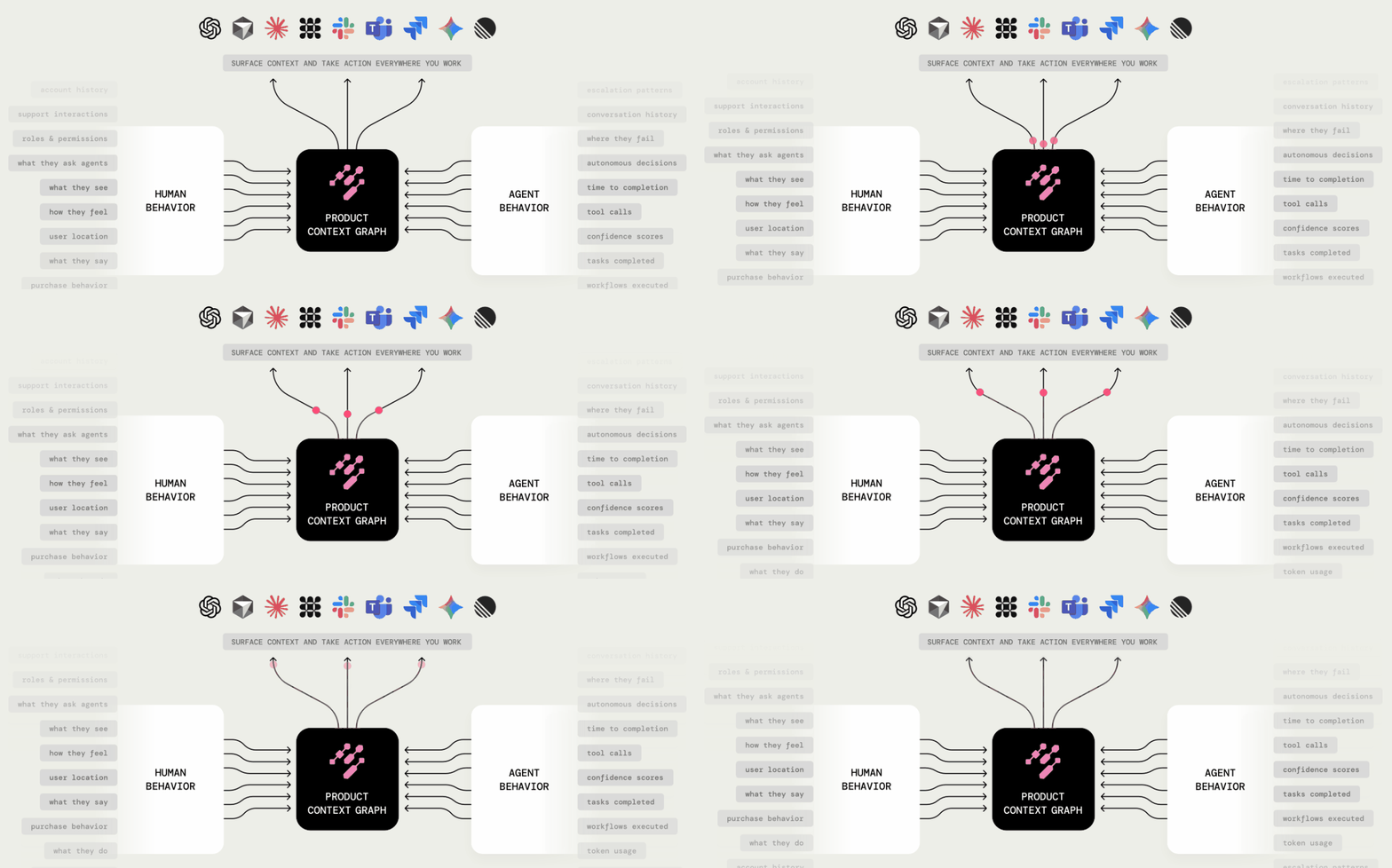
Pendo positions itself as the platform for "Software Experience Management" (SXM), a category it coined to group product analytics, digital adoption, voice-of-customer, and in-app guidance under one umbrella. The platform serves 14,000+ companies, including 75 of the Fortune 500 and customers like Salesforce, Verizon Connect, United Airlines, Labcorp, Okta, and Morgan Stanley. It processes 20B+ daily events across 1B+ monthly users.
Source: Pendo
The platform targets four personas (Product, IT, Sales, and Marketing) and covers two modes: Product Analytics for customer-facing SaaS products, and Process Analytics for enterprise IT teams monitoring employee adoption of internal tools.
Module | What It Does | Plan |
|---|---|---|
Behavioral tracking, feature adoption, paths, funnels, retention | All plans (including Free) | |
Measures AI agent adoption, prompt success, and user-side experience | AI add-on (custom pricing) | |
Walkthroughs, tooltips, banners, embedded guides, Resource Center | All plans; Guides Pro features on higher tiers | |
Video playback of user sessions across web, iOS, Android | Core and Ultimate | |
NPS, CSAT, and PMF surveys deployed in-app | NPS on all plans; full suite on Ultimate | |
Centralized feedback management with AI triage | Ultimate | |
In-app feature request collection and Ideas Portal | Part of Listen (Ultimate) | |
In-app idea testing with customer voting | Part of Listen (Ultimate) | |
Data-backed product roadmap planning | All plans (including Free) | |
Cross-channel journey automation (in-app + email) | Ultimate | |
AI churn prediction and customer health scoring | AI add-on (custom pricing) | |
Export behavioral data to warehouses and BI tools | Ultimate | |
Conversational analytics querying, guide creation, proactive Slack signals | Varies by capability | |
Surfaces product data to AI tools via Model Context Protocol | Available for paid plans |
Pendo uses MAU-based pricing across four tiers: Free (up to 500 MAUs), Base, Core, and Ultimate. Prices above the Free tier are not published; every paid plan requires a sales conversation. With that structure in place, here is the full tour.
Pendo Product Analytics
Product Analytics is the foundation everything else builds on. It tracks how users move through web and mobile applications, which features they adopt, where they drop off, and how often they return.
Source: Pendo
Installation works through a JavaScript snippet inserted into the host application (web) or a mobile SDK (iOS/Android). For third-party SaaS tools where teams cannot modify code, the Pendo Launcher browser extension deploys via IT. Once installed, Pendo captures every user interaction automatically. The critical distinction from tools that require engineers to define events before data appears: Pendo's snippet auto-captures interactions without manual event tagging, and behavioral data is retroactively available from the date of installation, not from the moment someone tagged a specific feature. A team that installs Pendo today and tags a feature next month can see that feature's usage data going back to the original install date.
The analytics surface organizes raw behavioral data into structured views. Data Explorer handles ad-hoc querying without specialized skills. Paths show how users navigate across pages and features, revealing the actual routes they take versus the intended flow. Funnels measure step-by-step conversion through defined workflows, with drop-off detection at each stage. Retention analysis shows cohort-based return rates over time, answering whether users who discovered a feature last month still use it this month.
Source: Pendo
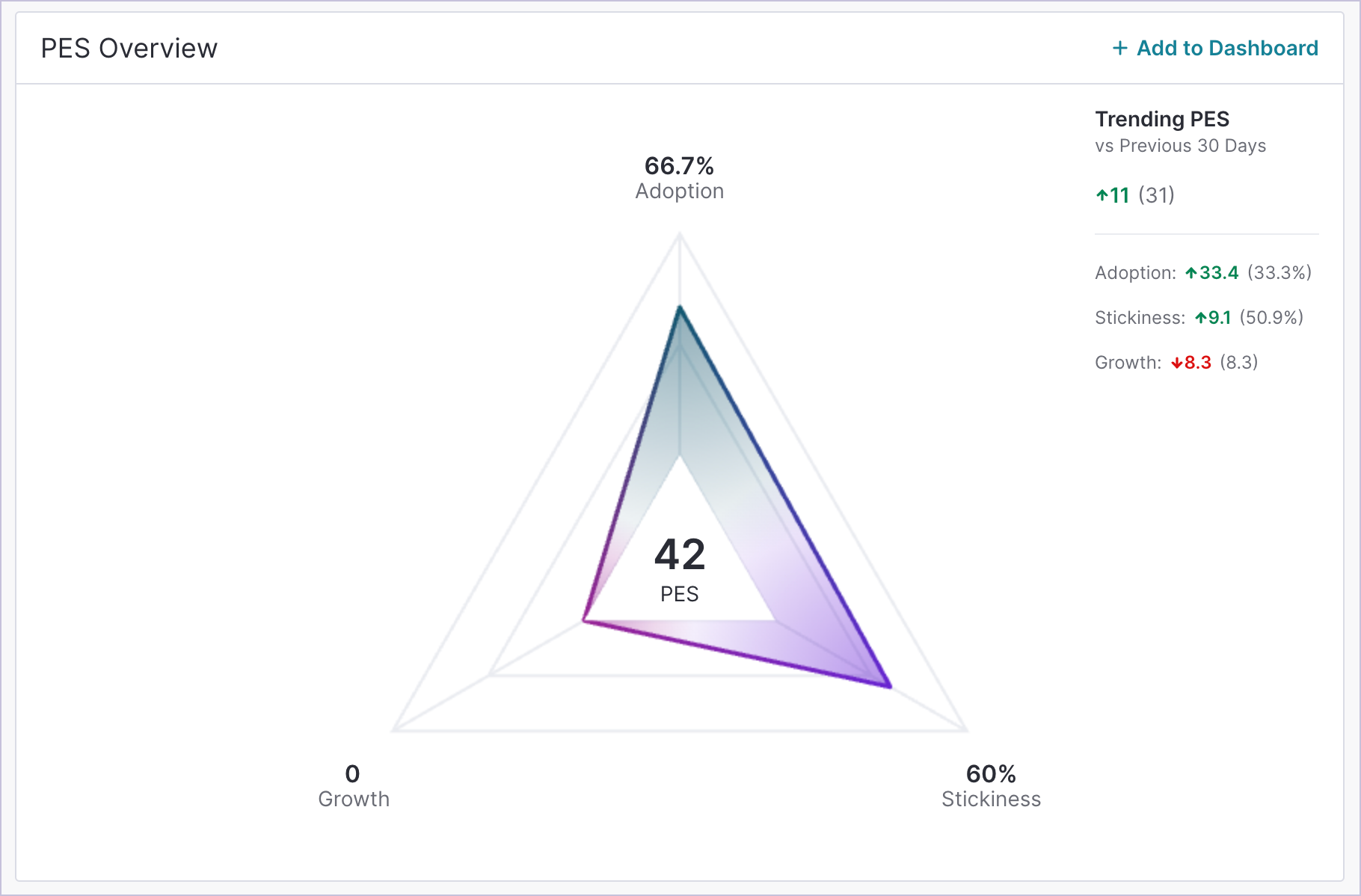
Segments slice all of this data by user groups, plans, geographies, or custom metadata passed at install time, so a product manager can compare how enterprise accounts behave differently from SMB accounts without exporting data. The Product Engagement Score (PES) rolls three dimensions into a single composite metric: Adoption (breadth of feature use), Stickiness (frequency of return), and Growth (new user acquisition versus churn). PES gives teams one KPI for product health, benchmarkable against 6,800+ applications across 2,500 customers using Pendo's anonymized peer data, segmented by region, company size, and industry.
For enterprise IT teams, Process Analytics extends the same behavioral tracking to employee-facing applications. A Portfolio View provides a single dashboard to baseline adoption across every app in the digital workplace, and License Utilization tracking measures actual software usage against purchased seats to identify waste.
AI-powered Insights surface automated trend and anomaly discovery with suggested next actions. Agent Mode (included on all plans) lets non-technical stakeholders query analytics in natural language rather than building reports manually.
One limitation: Pendo processes behavioral data in batches rather than real time. There is a documented delay of roughly one hour between a user action and that data appearing in dashboards or triggering a guide. For use cases requiring immediate behavioral triggers, this latency matters.
Pendo Agent Analytics
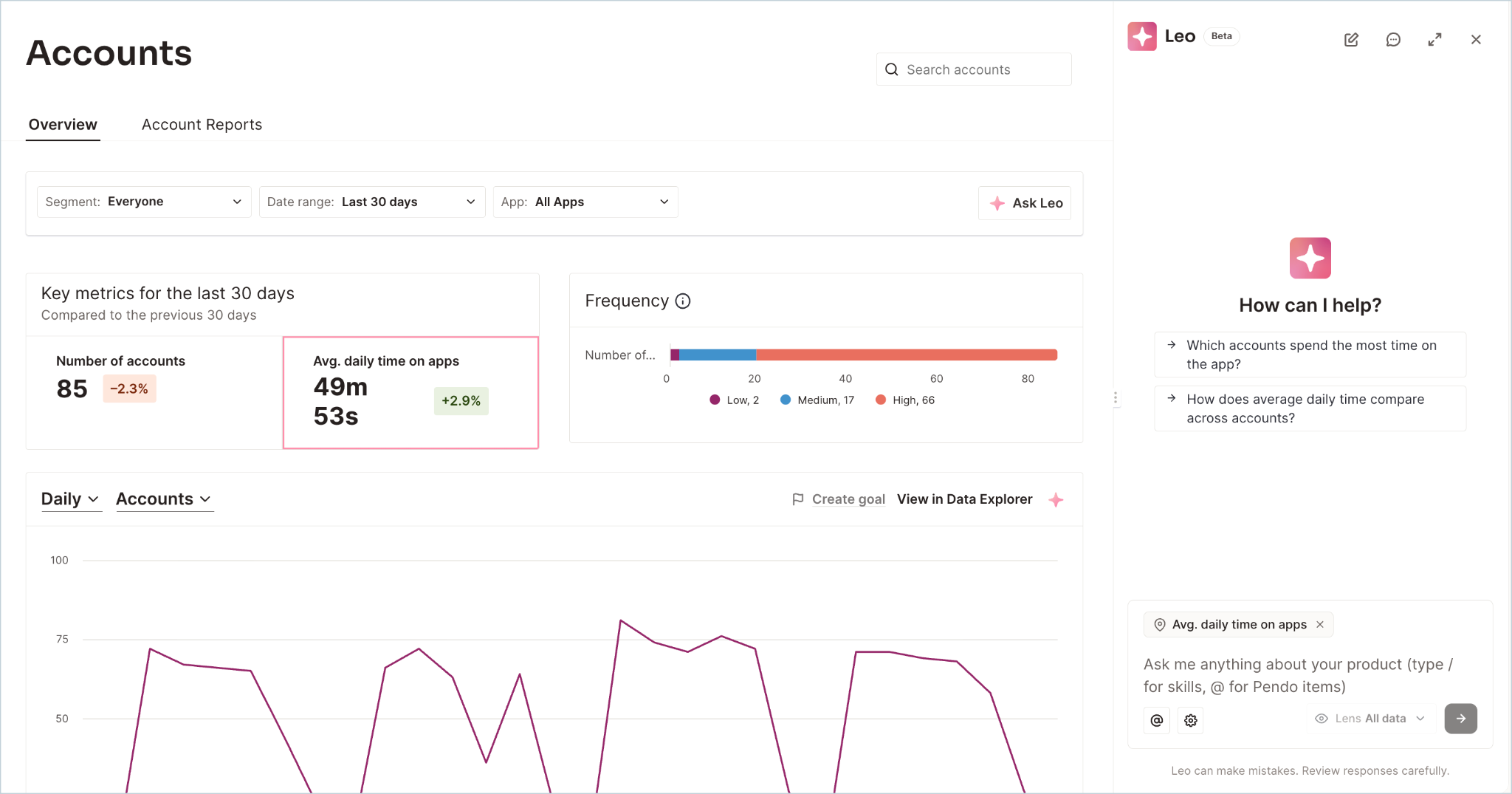
Agent Analytics extends product analytics to AI agents, a capability Pendo launched in 2025 that earned a Fast Company 2026 Most Innovative Companies placement. The product tracks 350+ AI agents and 2.5 million prompts per week across its install base.
Source: Pendo
The problem it addresses is specific: analytics tools built to measure traditional software (clicks, pageviews, funnels) cannot answer the questions that matter for conversational AI. Agent Analytics captures what users ask agents, whether they accomplished their intent, what they were doing before and after the interaction, and patterns of engagement and frustration. It categorizes conversations by use case and user type automatically, without manual tagging.
Rage prompting detection surfaces frustration signals within agent interactions, the conversational equivalent of rage clicking in traditional UI. Workflow speed comparison measures how long users take to complete the same tasks through agentic versus traditional UI workflows, answering quantitatively whether the agent is faster. Unsupported request detection identifies gaps between what users ask and what the agent can deliver, feeding directly into roadmap prioritization.
Agent Analytics also monitors third-party agents employees use (ChatGPT, Claude, GitHub Copilot), giving enterprise IT visibility into AI tool adoption across the organization. Daily Slack notifications report who is and is not using the agent, so teams can act on adoption gaps without checking dashboards.
The product is offered as an AI add-on with custom pricing, available alongside any Pendo plan.
Pendo In-App Guides
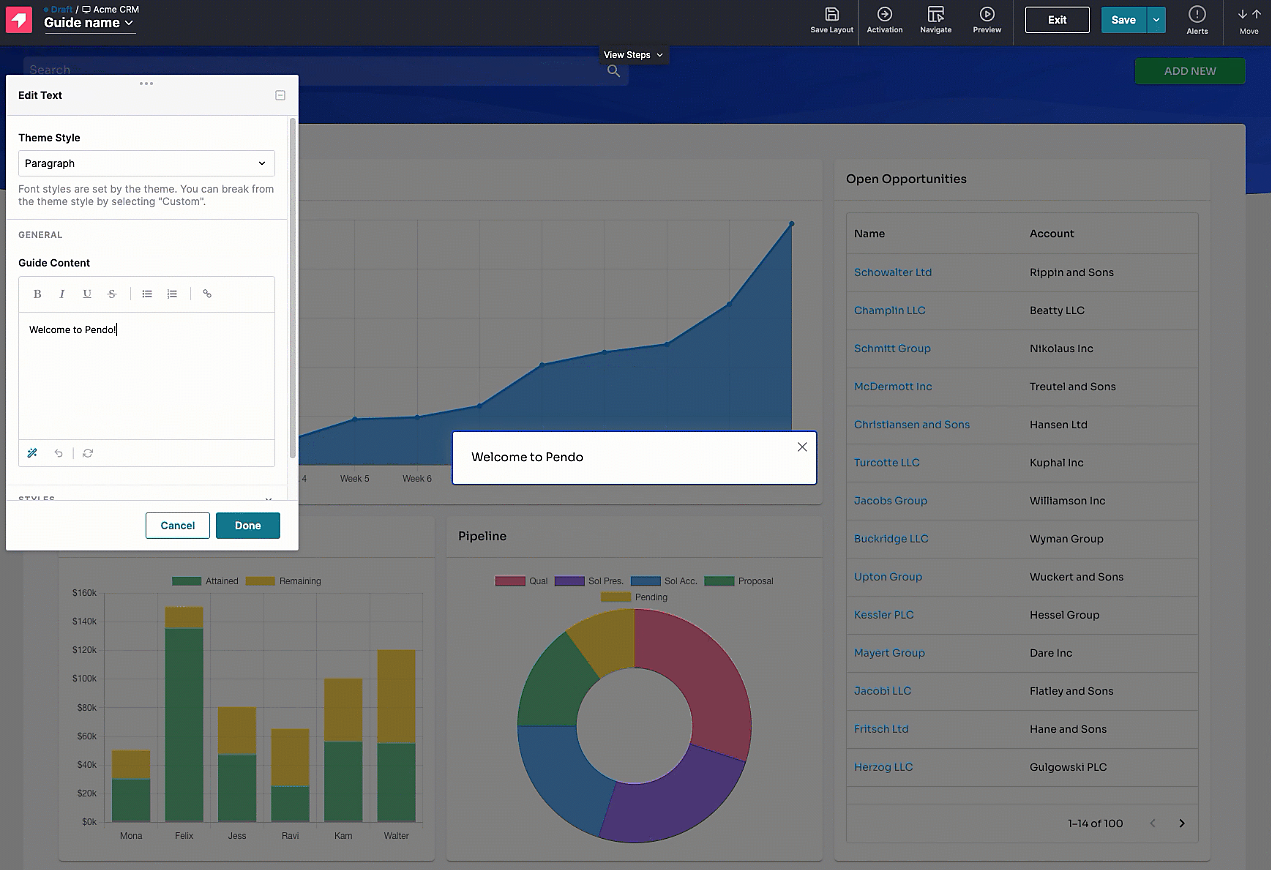
In-app Guides is the feature most teams deploy first after analytics. It places messaging inside the application (walkthroughs, tooltips, banners, and embedded content) without engineering involvement. Pendo reports that 82% of customers using Guides for onboarding saw at least a 10% reduction in onboarding time and effort.
Source: Pendo
Guide creation happens in the Visual Design Studio (VDS), which opens as an overlay on the live application so builders see guides in real context. The editor uses a building blocks system: text (with Markdown and multi-column support), buttons (up to four per row with custom styles), images, videos, polls, and custom code (Guides Pro). An AI writing assistant in the text editor adjusts tone across six options, controls length, and runs spellcheck.
Guides come in two categories. Overlay guides appear over the application:
Lightboxes: pop-up windows for onboarding flows, confirmations, and sign-up forms
Banners: full-width notifications at the top or bottom of the screen for time-sensitive messages
Tooltips: small pointers anchored to a specific UI element for feature explanations and contextual hints
Embedded guides (Guides Pro) sit inline inside the application, flowing with the page layout for persistent informational content, upsell prompts, or legal notices.
Activation options include automatic display on page load, badge interaction, element click, or confirmation modal. Guides can also be added to a Resource Center, a persistent in-app help hub users can open on demand.
Targeting uses Pendo's segmentation engine, which draws on behavioral data: a guide can target "users who have not used Feature X in the past 14 days" without additional integration. Guide throttling controls how many guides a user sees in a session or time window, preventing guide fatigue. Themes enforce brand-consistent global styling, and Layouts provide reusable building block templates.
On the Guides Pro tier, several capabilities unlock. Conditional branching routes users to different steps within a single guide based on page element or feature presence, reducing guide sprawl. A/B testing measures which guide version drives better engagement or goal completion. Cross-app guides operate across multiple applications for employee-facing deployments. Guide edit history tracks all changes over time.
Pendo recently introduced conversational AI guide creation (open beta): a two-panel interface where builders describe what they want in plain language on the left and see a live preview on the right, powered by Gemini Flash 2.5.
Guides is available at every pricing tier, including Free. Advanced capabilities (embedded guides, A/B testing, conditional branching, cross-app guides, AI creation, localization) require Guides Pro on higher tiers.
Pendo Session Replay
Session Replay records video playbacks of in-app user behavior (clicks, cursor movements, scrolling, and all interactions) across web, iOS, and Android. It closes the gap between quantitative analytics (knowing that users drop off at step 3) and understanding why (watching what confused them).
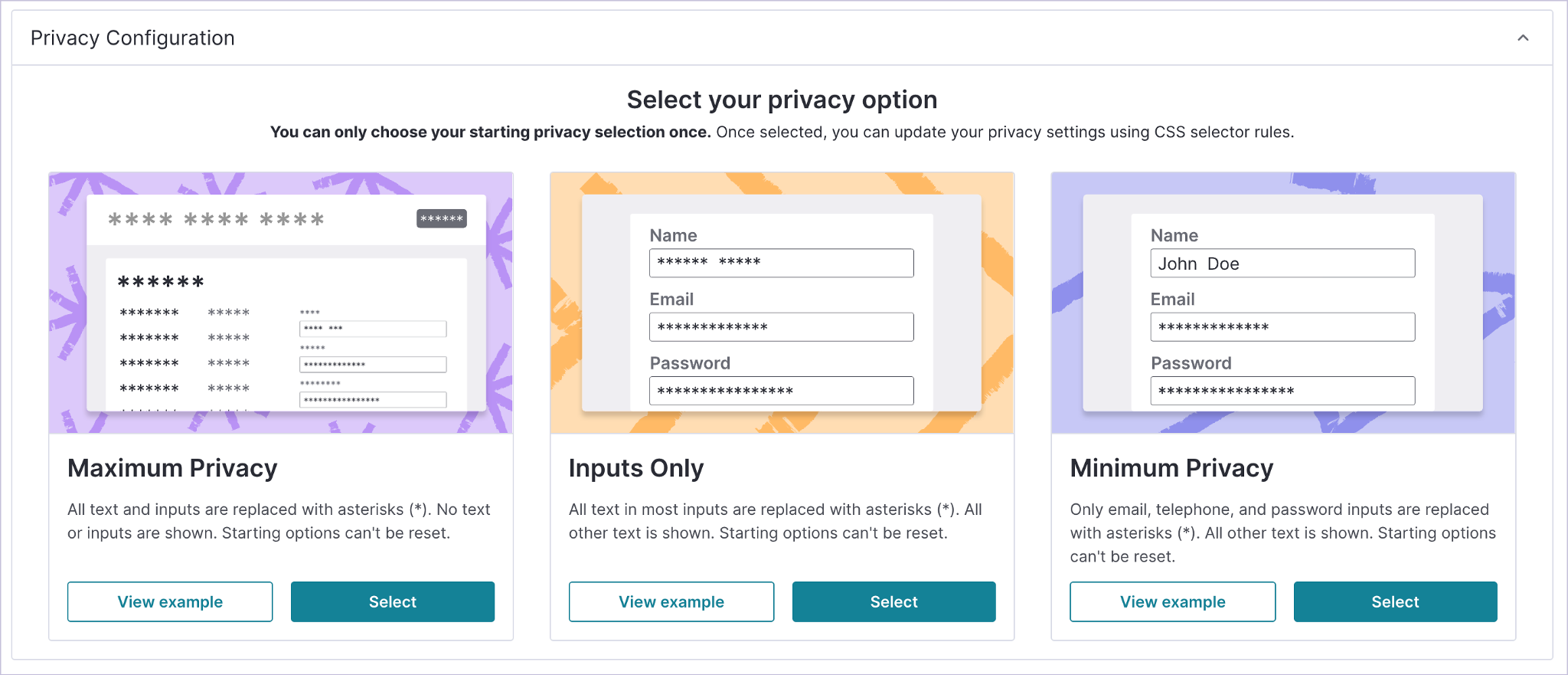
Pendo offers unlimited session replays with no per-session caps. Recordings are stored with a default retention of 30 days, extendable to 90 days with add-ons. Privacy filtering happens client-side: the selected configuration masks or blocks data before transmission to Pendo's servers. Three privacy configurations are available for web (Maximum Privacy, Inputs Only, Minimum Privacy), with CSS selector rules to mask, unmask, or block specific elements. A consent management layer gates recording behind user opt-in where required.
Source: Pendo
Platform integration is where Session Replay separates from standalone recording tools. A team reviewing an analytics funnel drop-off can click through to relevant session recordings without leaving the platform. Replays arrive tagged with full analytics history: who the user is, which segment they belong to, which features they have used, and which guides they have seen. Suggested Replays uses AI to identify behavior trends and recommend which sessions are worth reviewing, cutting the time spent browsing recordings.
Session Replay is included in the Core and Ultimate plans.
Pendo Listen, Feedback, and Validate: Product Discovery
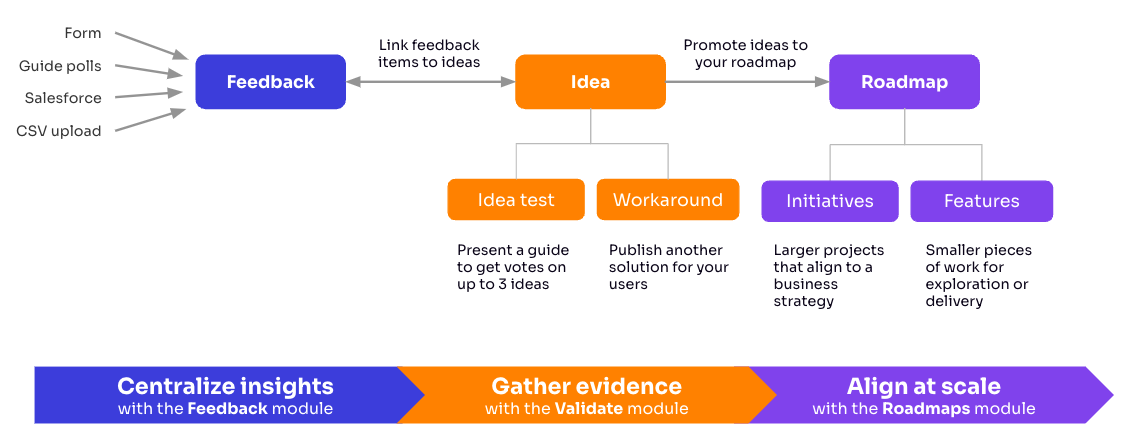
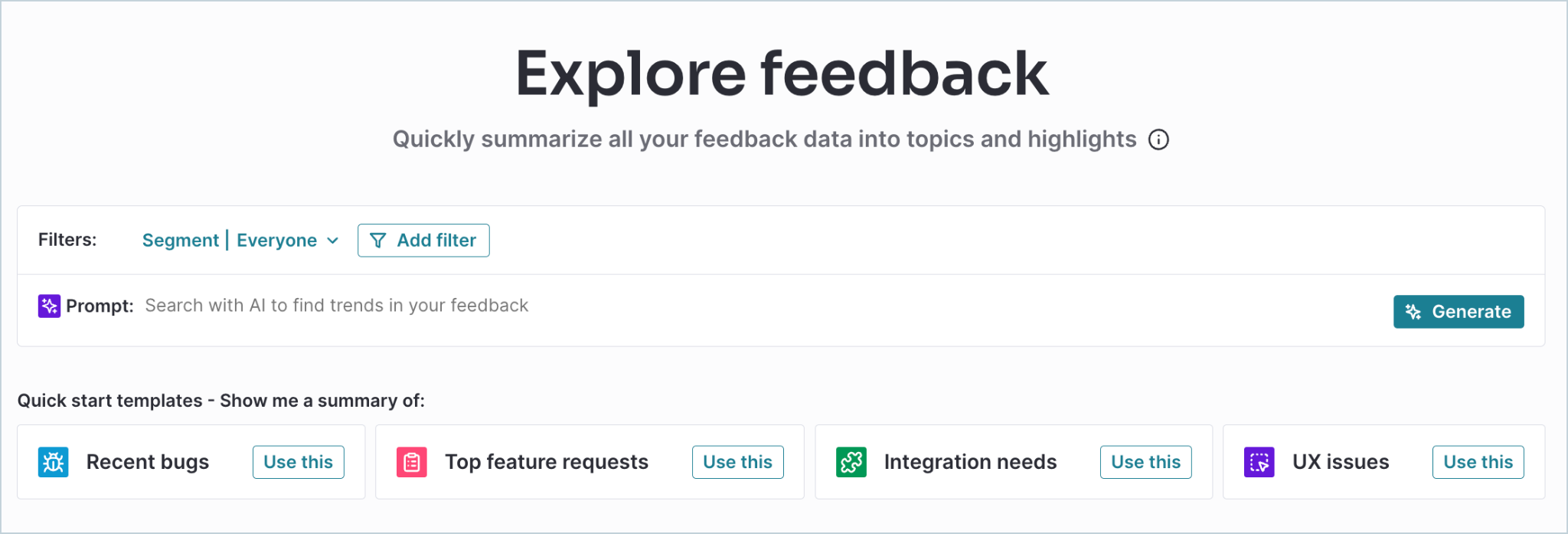
Listen is a centralized product discovery suite that consolidates user feedback from dozens of channels into a ranked view. It has three layers: ingestion, AI analysis, and prioritization.
Source: Pendo
Ingestion pulls feedback from Pendo's in-app polls and NPS surveys, plus external integrations with Gong call transcripts, Zendesk support tickets, Salesforce CRM records, and other tools. AI-assisted integrations identify and categorize product feedback from unstructured external sources automatically.
AI analysis triages incoming feedback: categorizing submissions as feature requests, bug reports, or complaints, identifying recurring themes, flagging duplicates, and filtering noise. The Feedback Agent lets team members query the full feedback corpus in natural language ("What feedback do we have about the dashboard?") and get AI-generated summaries backed by direct customer quotes linked to their original source.
Prioritization enriches each idea with business context (account ARR, churn risk score, and actual in-app usage behavior) so teams can assess the revenue impact of a given request rather than prioritizing by raw vote count.
Within Listen, Feedback handles the collection mechanics: an in-app widget for direct submission (no code required), CSV imports, and multi-source ingestion. It includes an Ideas Portal where customers submit requests and track their status, and loop-closing notifications alert users when their submitted ideas progress. When an issue is identified but a fix is not ready, teams can create and share temporary workarounds with affected user segments via in-app guides.
Source: Pendo
Validate structures feedback into controlled experiments. Product managers create Idea Tests: in-app prompts (delivered using Pendo's guide technology) that present up to three ideas at a time to a selected segment and ask users to vote on which they value most. Results are analyzed across vote count, number of accounts, ARR represented by voters, and impact/effort ratings. Teams can then create segments of customers who voted for a specific idea for targeted follow-up. The distinction from Feedback: Feedback captures ongoing open-ended input; Validate turns that input into structured, ARR-weighted experiments.
Listen integrates with Jira and Azure DevOps to generate development tickets from feedback with customer context pre-populated. A 2-way Jira integration (announced at Pendomonium 2026) automatically updates Listen when engineers move Jira tickets.
Listen is included in the Ultimate plan.
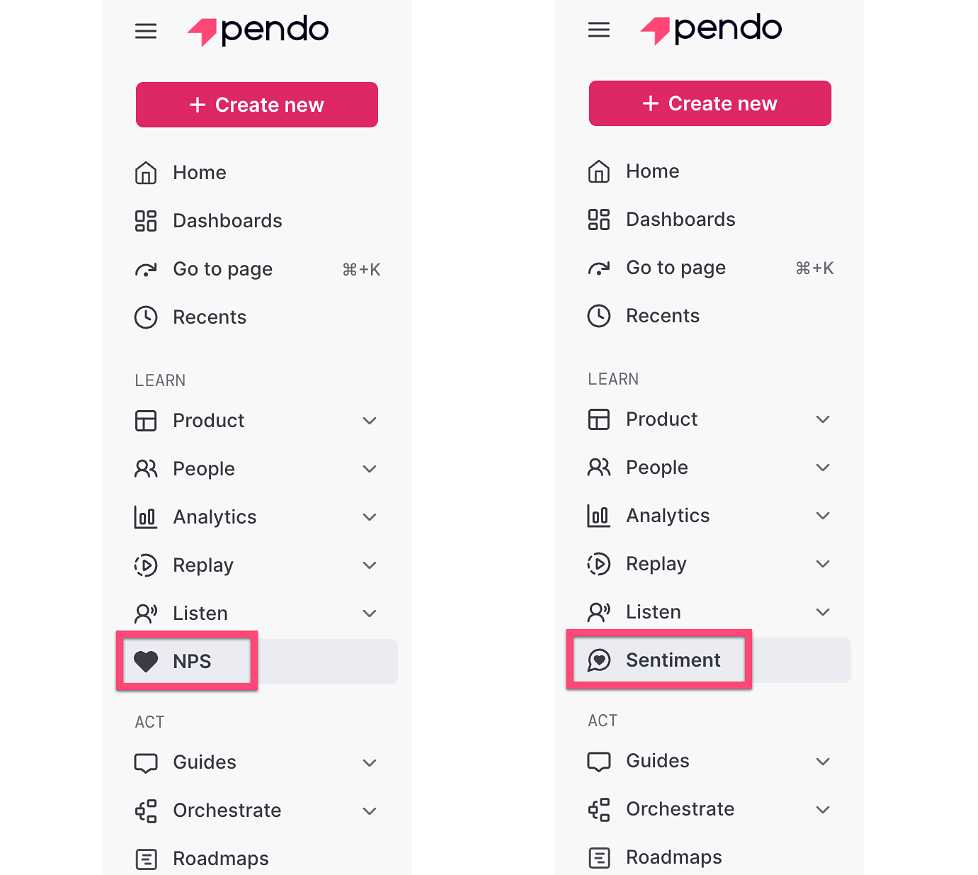
Pendo Sentiment: NPS, CSAT, and PMF Surveys
Sentiment is the survey hub supporting three types: Net Promoter Score (NPS), Customer Satisfaction (CSAT), and Product-Market Fit (PMF, using the Sean Ellis framework where 40%+ "Very disappointed" is the established benchmark).
Source: Pendo
The key mechanic is delivery: surveys deploy as in-app guides triggered during actual product usage, achieving response rates up to 1,300% higher than email-only approaches. Activation modes include automatic (served to eligible users during product use), scheduled (recurring on a defined cadence), and email delivery for segments not currently in-app.
Targeting uses the same segmentation engine as the rest of the platform, so surveys can filter by role, plan tier, account size, feature usage, guide completion, or any metadata. Every response arrives pre-enriched with the respondent's usage data: feature adoption, session frequency, and behavioral patterns. A detractor response can be investigated by jumping directly to a session replay recorded around the time of submission.
Pendo's AI classifies open-text responses by sentiment (positive, neutral, negative) and groups them into themes, reducing analysis time by 80%. After identifying detractors, teams can segment those users and deploy targeted in-app messaging to follow up without exporting to a separate tool.
NPS is available on all plans including Free (with Pendo branding). The full Sentiment suite with CSAT, PMF, and AI analysis requires the Ultimate plan.
Pendo Roadmaps
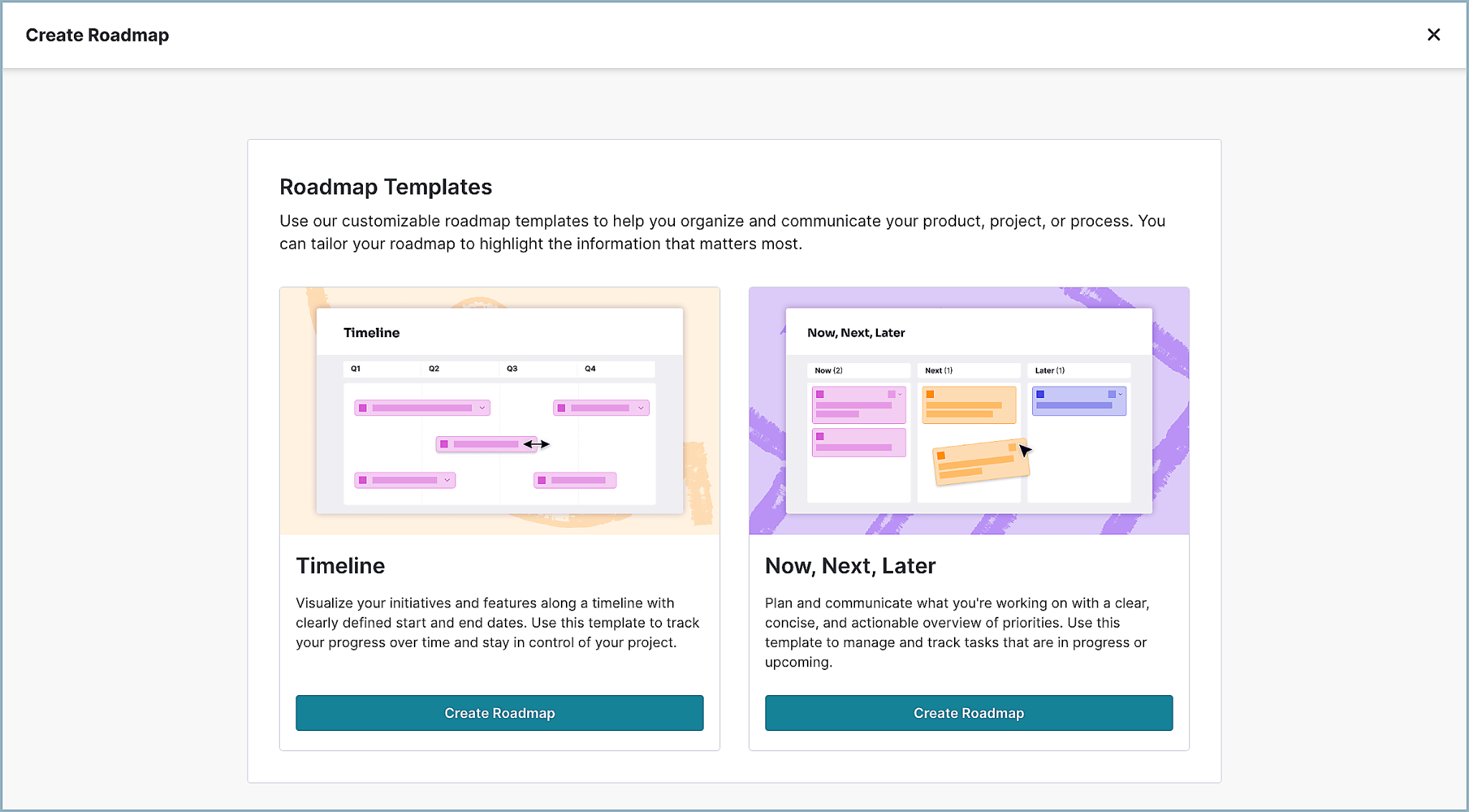
Roadmaps connects directly into the Feedback and Validate modules, so every roadmap item can link to real user requests and idea test results. Product managers create initiatives and feature items, then attach specific customer feedback and Validate results to each one. Each item surfaces the total number of customer votes and total ARR represented by requesting customers, giving executives a dollar-denominated view of priorities.
Source: Pendo
The module supports private roadmaps for internal use and team-level roadmaps for different audiences, with a drag-and-drop interface for real-time reprioritization. Jira integration pushes prioritized items into engineering workflows with supporting context. Loop-closing notifications alert users when roadmap items they contributed feedback on change status.
One current limitation: Roadmaps is internal only. External customer-facing sharing is planned but not yet available.
Roadmaps is included in all plans, including Free.
Pendo Orchestrate: Cross-Channel Journey Automation
Orchestrate combines in-app guides with email into sequenced, goal-driven journeys. It addresses the disconnect between in-app messaging and email campaigns: each channel traditionally runs in a separate tool, managed by a different team, with no connection to what users are doing in the product.
Source: Pendo
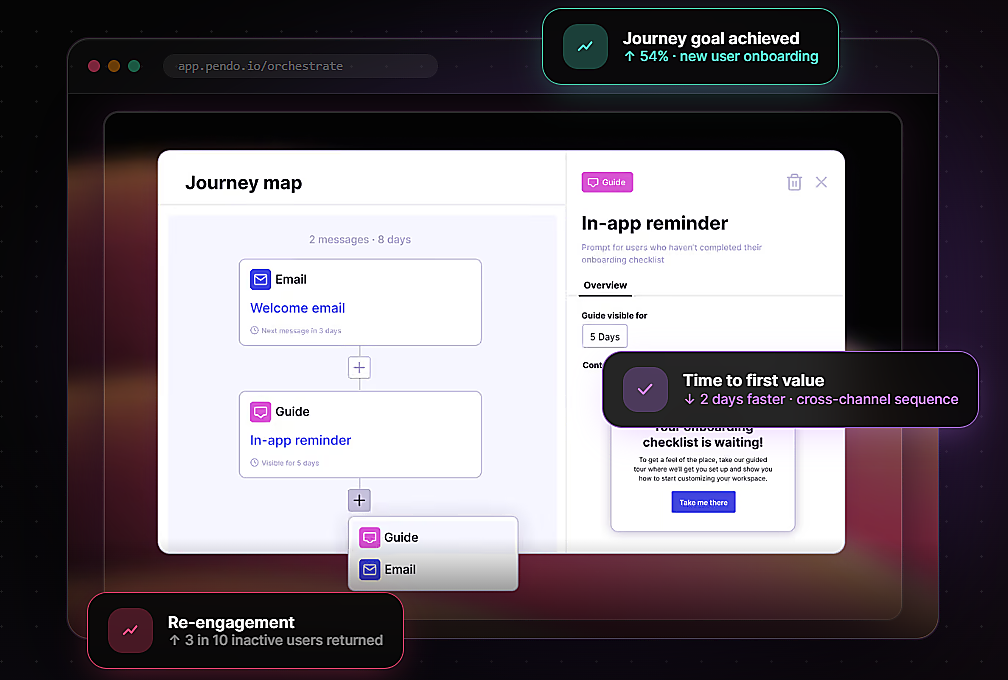
A journey is a visual sequence of up to 10 messages (a mix of in-app guides and emails) mapped to a defined goal. Journeys run continuously by default: as new visitors qualify for the target segment, they enter automatically. Visitor movement is governed by segment qualification, time periods between messages, and goal achievement. When a visitor achieves the goal, they exit. If a visitor does not log in during a guide's visibility window, they skip that guide and move to the next message, preventing the system from stalling.
Dynamic behavioral segmentation powers who enters a journey, using triggers based on what users do (or do not do) in the product, not static lists. Branching logic forks journeys based on in-app behavior. Orchestrate includes native HubSpot integration for email delivery (Marketo in beta) and pre-built email templates.
The measurement layer ties message interactions to downstream product behaviors, not just opens and clicks, so teams can prove whether a journey drove feature adoption or reduced churn. Pendo-reported benchmarks from Pendomonium 2026: 54% improvement in onboarding goal achievement, 3 in 10 inactive users returned in re-engagement campaigns, and time-to-first-value reduced by 2 days.
When combined with Predict, Orchestrate automatically triggers personalized journeys for users in predictive risk segments, closing the loop from churn prediction to automated intervention.
Orchestrate is available exclusively on the Ultimate plan.
Pendo Predict: AI Churn Prediction
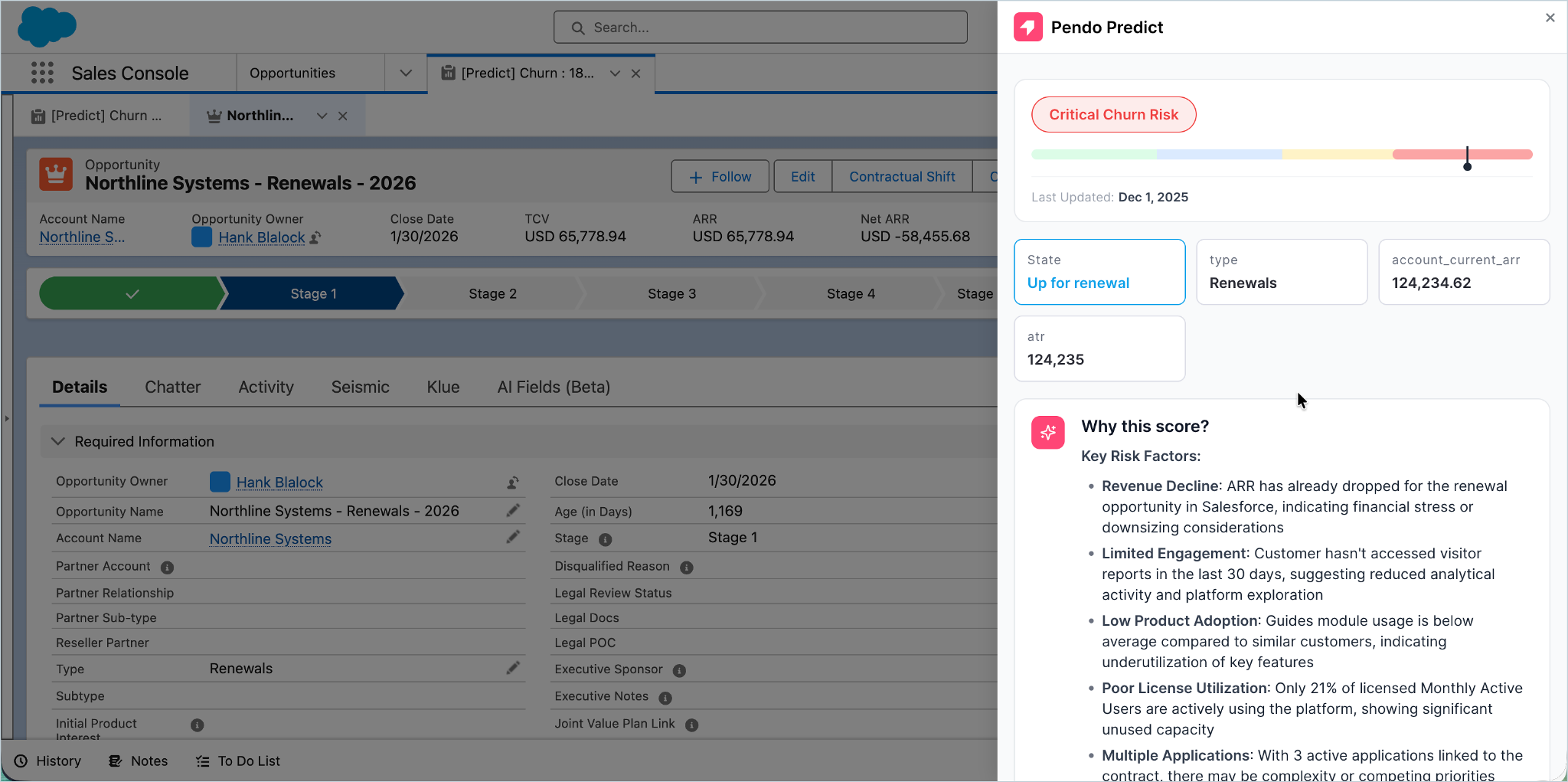
Predict is an AI churn prediction and customer health add-on built on technology from Pendo's July 2025 acquisition of Forwrd.ai. It serves RevOps, Sales, Marketing, and Customer Success teams and does not require Pendo to be the primary analytics tool: it accepts external data from non-Pendo analytics platforms including Snowflake, Amazon Redshift, Google BigQuery, and 20+ out-of-the-box integrations.
Source: Pendo
The operational flow has five steps. First, connect CRM data (Salesforce, HubSpot) and product usage data. Second, Predict's AI identifies behavioral patterns that historically preceded churn or renewal and builds a model, in days rather than months, with no data science team required. Third, each account receives a risk or opportunity score with data-backed explanations and recommended next steps. Fourth, scores push into Salesforce CRM opportunities and Slack, enriched with the reasoning behind each score. Fifth, Predict builds live, dynamic segments by risk level to trigger personalized in-app guides and communications via Orchestrate.
The model continuously retrains to keep signals fresh without manual upkeep. Predictions become live Pendo segments grouped by what users are likely to do next, and teams can upload retention playbooks so Predict recommends the best next step for each opportunity.
The key differentiator: Pendo's behavioral data from inside the product is the predictive signal. Competitors relying on CRM activity or support tickets alone miss in-app indicators like login frequency changes, feature abandonment, or usage pattern shifts that precede churn by weeks.
Predict is offered as an add-on to any Pendo plan with custom prediction volume pricing.
Pendo Data Sync and Integrations
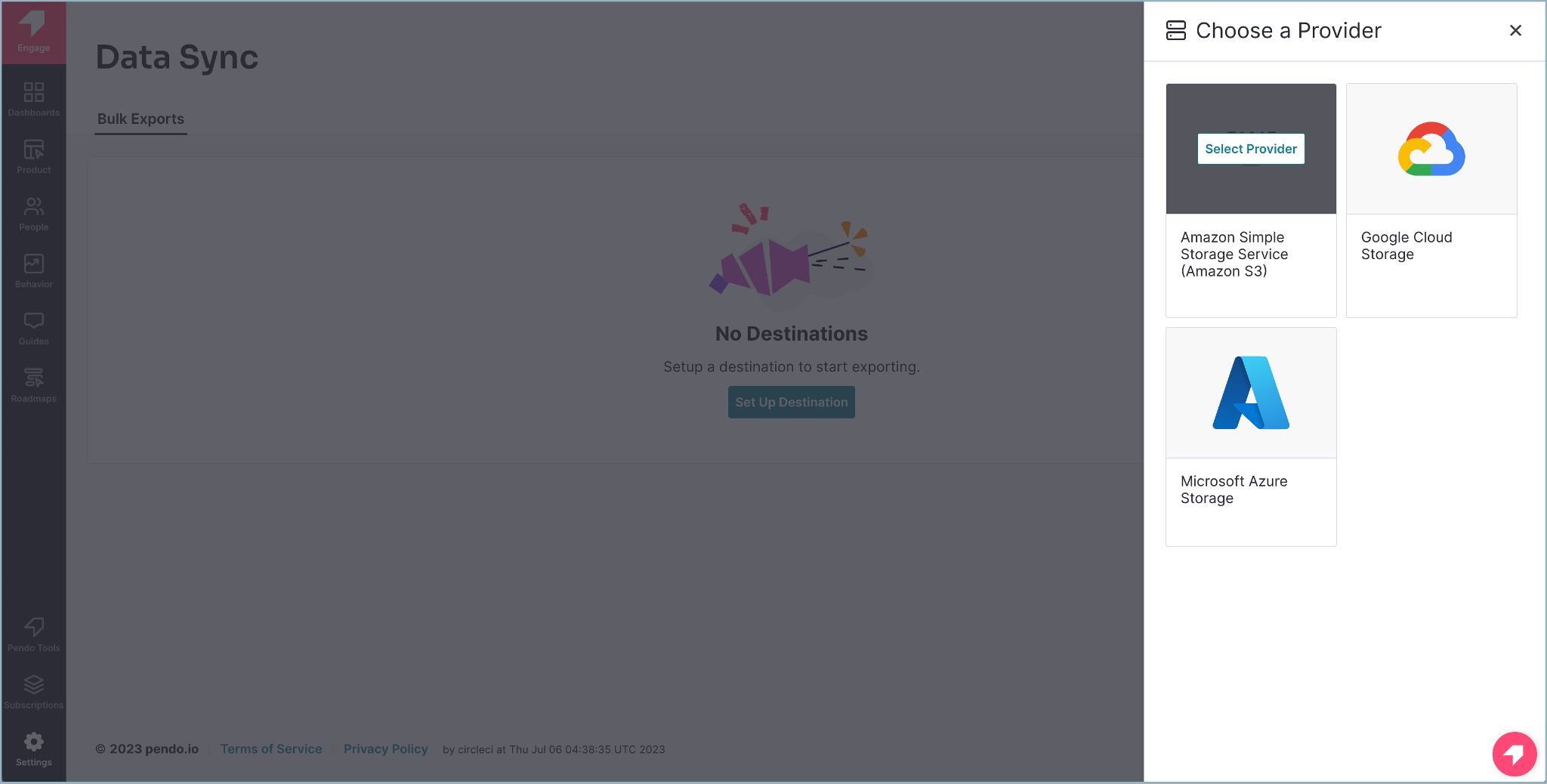
Data Sync moves enriched Pendo behavioral data into external data warehouses, cloud storage, and BI tools. The primary path is a direct Snowflake integration that requires no ETL pipeline or engineering setup: configure it once and it updates automatically. Additional export destinations include Amazon S3, Microsoft Azure, and Google Cloud Storage. Data Sync to Databricks entered early access at Pendomonium 2026.
Source: Pendo
Once data reaches the warehouse, teams can join Pendo behavioral data (page visits, feature clicks, user paths, NPS responses, session metadata) with data from Salesforce, HubSpot, Zendesk, and other systems already present. This powers executive dashboards in Looker, Tableau, or Power BI that tie product usage to revenue KPIs.
Data Sync is available on the Ultimate plan.
Beyond Data Sync, Pendo maintains 51 native integrations across CRM (Salesforce, HubSpot), customer success platforms (Zendesk, Gainsight, ChurnZero, Totango, Catalyst, Planhat), marketing automation (Marketo), BI tools (Tableau, Looker, Domo), data infrastructure (Segment, Snowflake, BigQuery, Fivetran), product tools (Jira, Confluence, Figma), collaboration (Slack, Okta), and iPaaS connectors (Zapier, Workato, Tray.io). The Pendo MCP server makes product data available to AI tools like Claude and Cursor via the Model Context Protocol, and an MCP Prompt Library provides pre-built queries for AI-assisted product workflows.
The Engage API provides programmatic access for aggregation queries, visitor and account metadata management, and guide operations. A separate Feedback API covers the feedback module. API access is plan-gated and not fully available on the Free tier.
Pendo AI: Leo, Novus, and the Conversational Layer
Pendo's AI capabilities are layered across the platform under several named products.
Source: Pendo
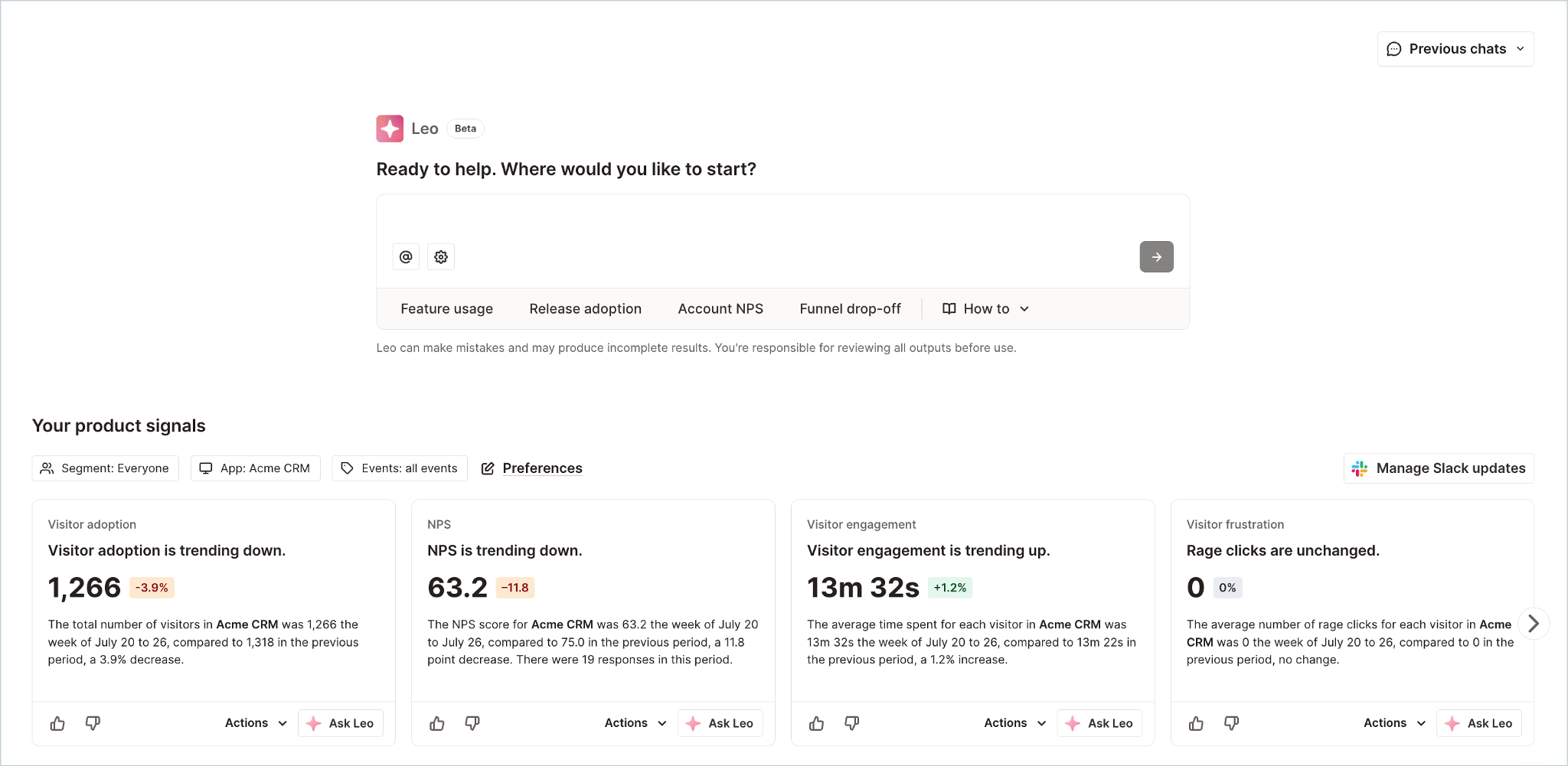
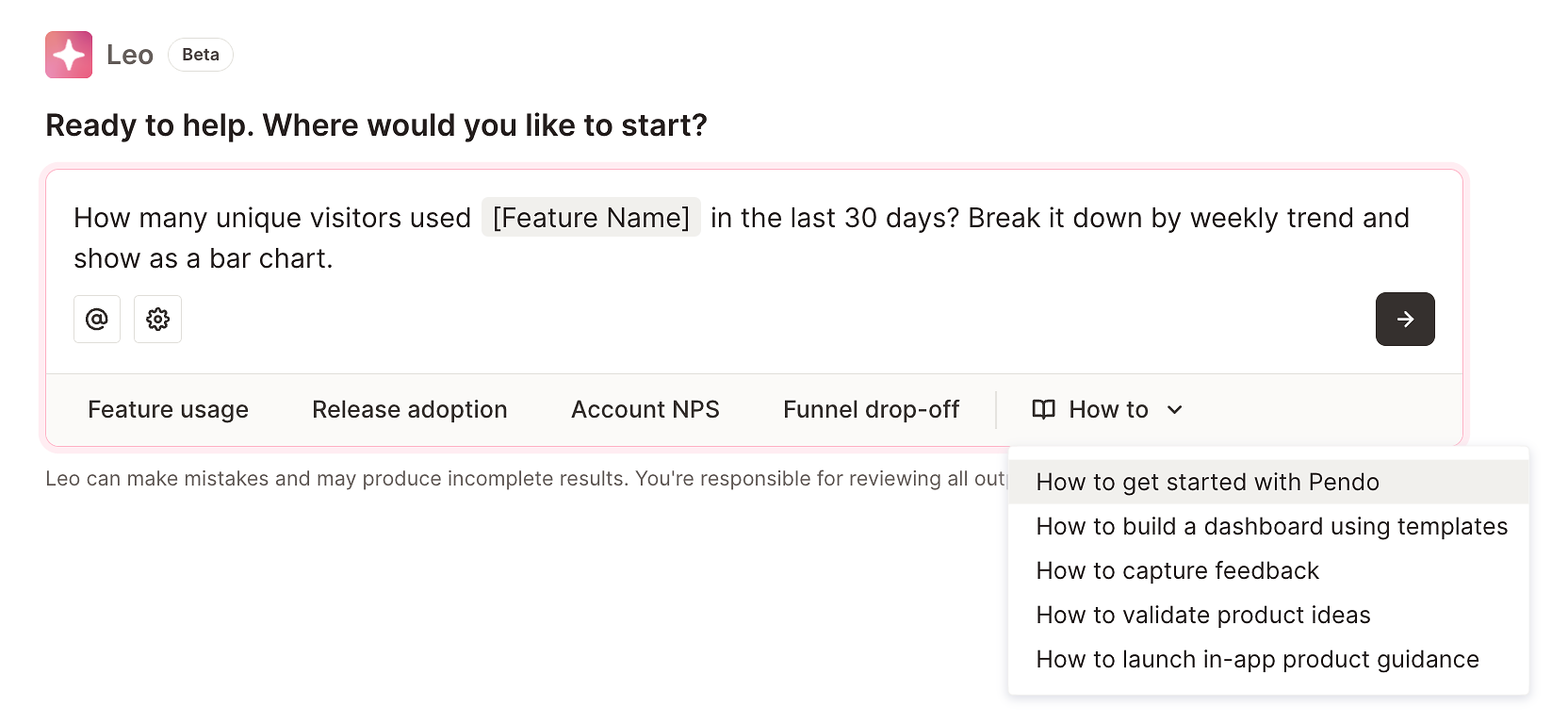
Leo is the conversational layer. It lets team members ask questions about analytics in plain language, create in-app guides through conversation, and receive proactive Signals pushed to Slack on meaningful adoption or retention shifts. Leo's query capability ships through Agent Mode, included on all plans.
Novus is described as "the product agent": it lives inside the codebase, surfaces issues, recommends improvements, and verifies impact without requiring teams to dig through analytics manually.
AI Resource Center Guides let users ask the Resource Center a question, after which Pendo guides them to the right page, highlights the exact button, and walks through each step.
The platform's AI capabilities draw on a dataset spanning 35 trillion events and over 1 billion users across 50,000+ agents and apps. AI features are evolving rapidly; some capabilities (particularly Leo, Novus, and Agent Analytics) are not fully available to EU-region customers due to data residency constraints.
Where Pendo Stops: The Gaps
Pendo is built to understand and guide behavior inside software. That focus shapes its strengths, but it also means the platform's insight boundary is the application boundary. Several capabilities a product-led revenue team needs sit outside that perimeter.
No buyer intent data or external signal detection. Pendo tracks what users do inside your product. It does not track which companies are researching your product category across the web before they visit your site, sign up for a trial, or log in. For teams trying to identify in-market accounts before any product interaction occurs, Pendo's behavioral data starts too late in the buyer journey.
No B2B contact database or verified contact data. Pendo captures anonymous and authenticated user behavior but does not provide a database of business contacts, direct-dial phone numbers, verified business emails, or organizational charts. When Predict flags an account as high-risk for churn or Pendo's analytics reveal an expansion-ready segment, the team needs contact data to act on that signal externally, and that data does not come from Pendo.
No outbound sales execution or multi-channel campaign orchestration. Orchestrate sequences in-app guides and emails within the product context. It does not orchestrate outbound sales cadences, display advertising, LinkedIn campaigns, direct mail, or the multi-channel go-to-market plays that revenue teams run to reach buyers outside the product.
No conversation intelligence. Pendo cannot record, transcribe, or analyze sales calls. It captures what users do in the product but not what they say on calls with your sales team. The context behind why a deal moved or stalled, what objections came up, or what the champion's concerns are sits outside Pendo's reach.
No cross-system intelligence layer that reasons about deal outcomes. Pendo can push behavioral data to warehouses and CRMs, but it does not fuse that data with CRM records, conversation transcripts, intent signals, and behavioral signals into a single layer that reasons about why deals close or churn. The product captures what happened in-app; it does not connect those patterns to what happened in the sales conversation, the competitive landscape, or the broader buying journey.
Opaque pricing with no published rates above the Free tier. Every paid plan requires a sales conversation. The MAU-based pricing model means fast-growing companies face unpredictable cost escalation, and the mandatory sales-led process is a mismatch for teams expecting self-serve purchasing. G2 reviewers consistently flag this: "Their pricing/licensing model is inflexible and old school."
How ZoomInfo Covers the Gaps
The gaps above share a common thread: Pendo's insight boundary is the application boundary. ZoomInfo operates on the other side, a GTM platform that supplies the buyer intelligence, contact data, intent signals, conversation intelligence, and multi-channel orchestration that product-led revenue teams need to act on the behavioral signals Pendo surfaces.
ZoomInfo Intent: Identifying in-market accounts before they ever use your product
Source: ZoomInfo
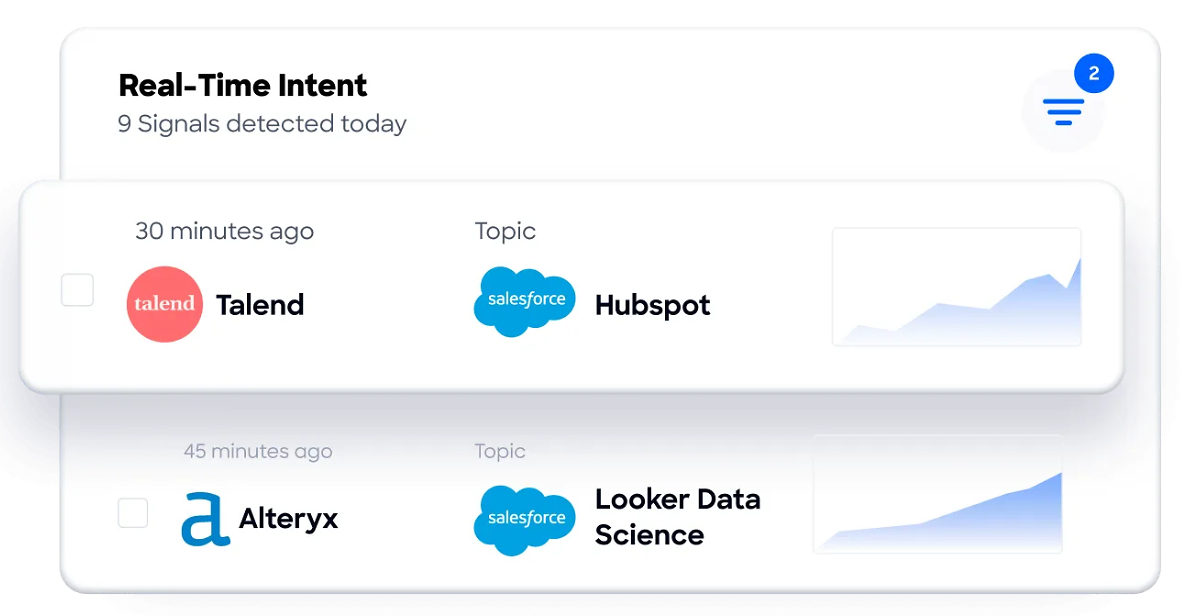
ZoomInfo Intent tracks signals from 210 million IP-to-Organization pairings and 6 trillion+ new keyword-to-device pairings sourced monthly, revealing which companies are researching topics related to your product category across the web. Where Pendo's analytics begin when a user logs in, ZoomInfo's intent data reveals buying interest weeks or months before any product interaction. Guided Intent, exclusive to ZoomInfo, identifies the topics historically correlated with deal success rather than requiring manual topic selection.
WebSights resolves anonymous website traffic to companies, with Automatic Traffic Filtering distinguishing real visitors from bots. ZoomInfo Marketing extends this to contact-level site visitor identification, identifying who specifically visited, not just which company.
ZoomInfo's B2B Data Platform: The contact data to act on product signals
ZoomInfo operates the largest B2B data platform in the industry: 500M contacts, 100M companies, 135M+ verified phone numbers, 120M direct-dial phone numbers, and 300M+ verified business email addresses. The data flows through a verification pipeline backed by 300+ human researchers and automated ML scanning of 28 million site domains daily, reaching up to 95% accuracy on first-party data.
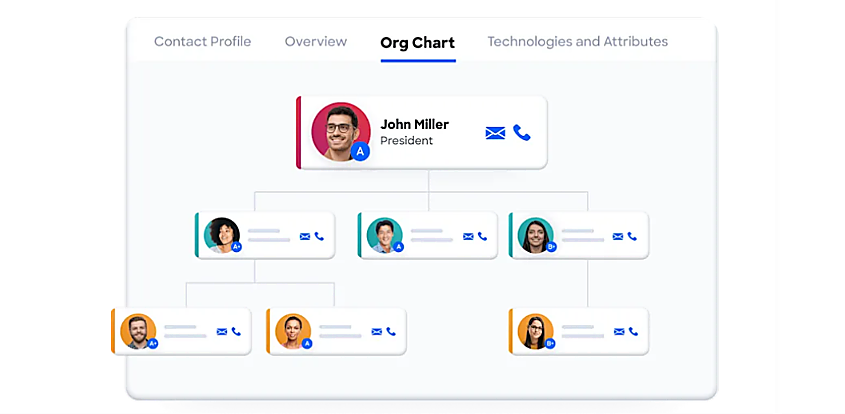
When Pendo's Predict module flags an account as at-risk, the CS team needs to reach the right stakeholders. ZoomInfo provides department org charts with decision-makers' direct dials and emails, 300+ company attributes for segmentation, and contact tracking with job-change alerts. In a Fortune 500 competitive RFP analyzing 25 million contacts across vendors, an independent consultant concluded that "no other competitor came even close."
ZoomInfo's GTM Context Graph and Chorus: Intelligence that captures why deals move, not just what users clicked
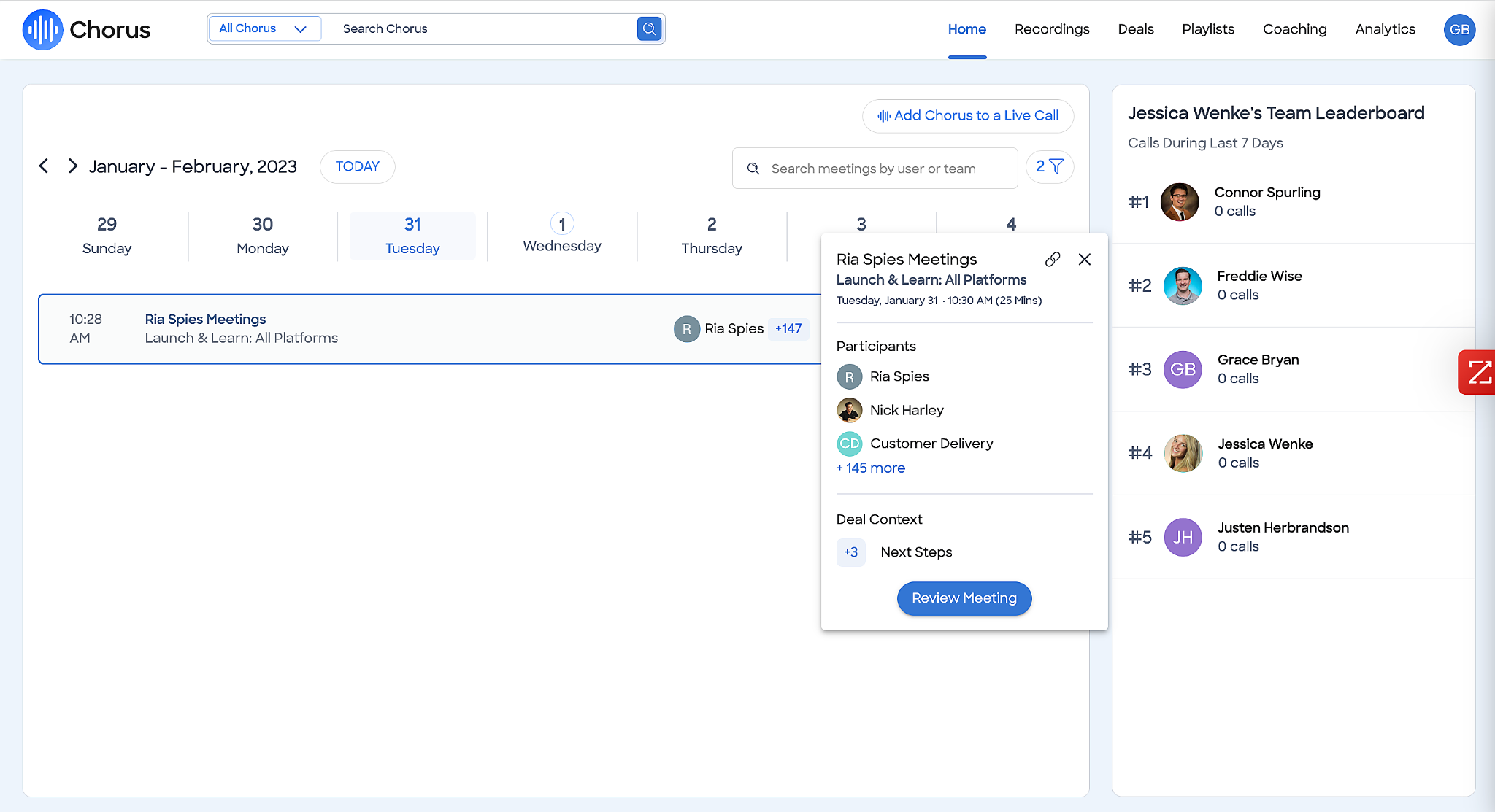
Pendo captures what users do inside the product. ZoomInfo's GTM Context Graph captures why deals move or stall by processing 1.5B+ data points daily, fusing B2B data with CRM records, conversation intelligence from Chorus, email interactions, and behavioral signals into a single intelligence layer.
Source: ZoomInfo
Chorus, ZoomInfo's conversation intelligence engine backed by 14 technology patents, records and transcribes sales calls, surfaces AI-generated insights (talk ratios, sentiment, objection detection), auto-syncs deal intelligence to the CRM, and provides coaching scorecards and clip sharing. It captures the dimension Pendo cannot: what happened on the call, what competitive threats were raised, and what the champion's real concerns are.
The GTM Context Graph reasons across all of this data. A CRM records that a deal moved stages. Pendo shows that the user adopted three features last week. The GTM Context Graph connects the CFO joining the last call with ROI-focused questions to the pattern behind closed-won deals in the same segment, then links that to intent signals showing the company is researching a competitor. That reasoning flows into every downstream action.
ZoomInfo GTM Studio: Multi-channel campaign orchestration beyond the product boundary
Source: ZoomInfo
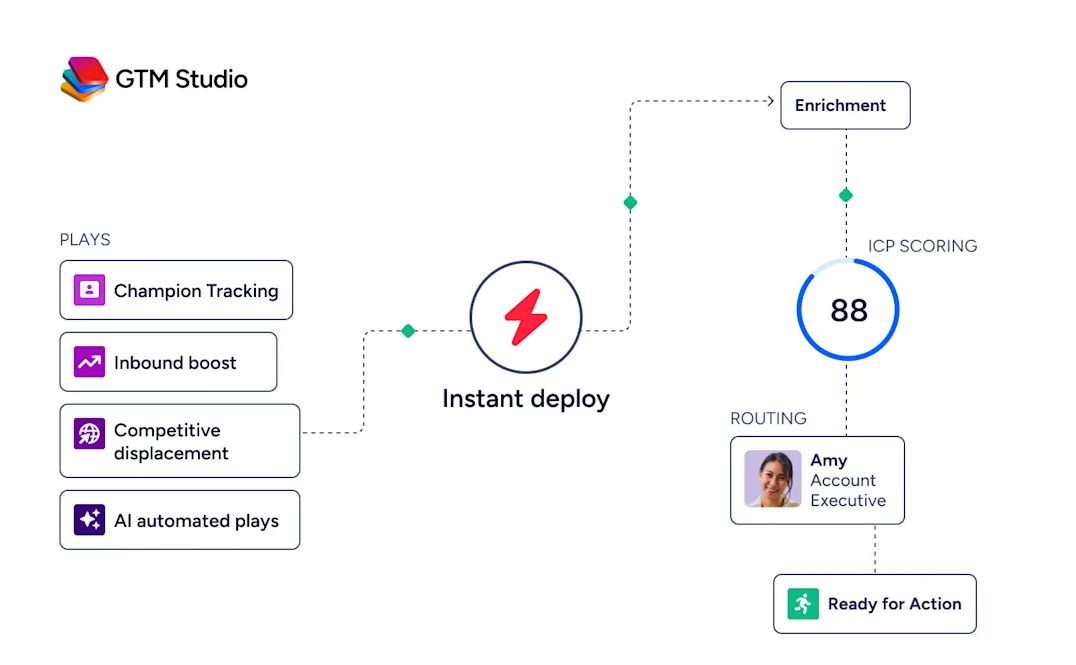
GTM Studio directly addresses the orchestration gap. Marketers, RevOps teams, and GTM engineers can build audiences using natural language, enrich with first- and third-party data, define triggers, and activate plays across channels (email, calls, display ads, direct mail, LinkedIn, Meta, Connected TV) without engineering support. Pre-built GTM plays cover inbound acceleration, champion tracking, competitive displacement, and ICP targeting. Expansion plays that used to take 3 weeks now launch in 30 minutes.
Where Pendo's Orchestrate sequences in-app guides and emails within the product context, GTM Studio orchestrates the full go-to-market motion across every channel, powered by the same GTM Context Graph.
ZoomInfo GTM Workspace: Seller execution powered by intelligence
Source: ZoomInfo
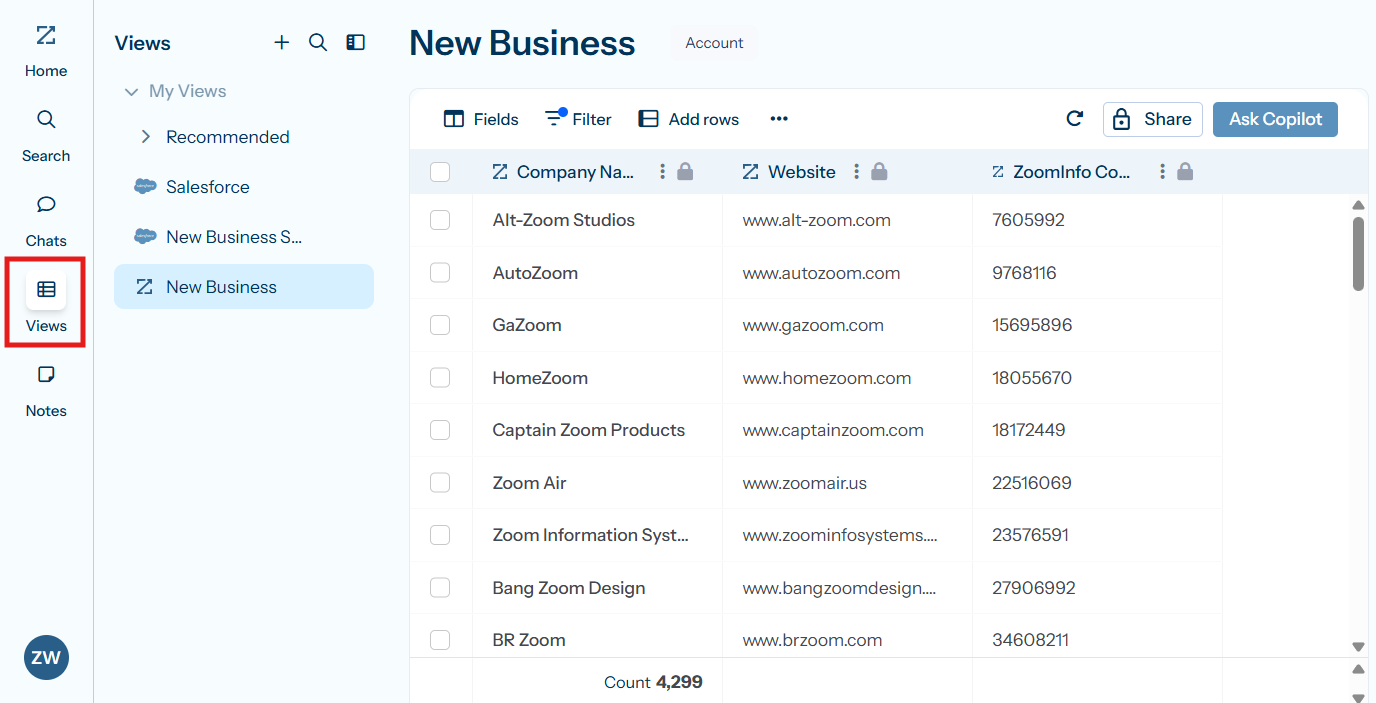
GTM Workspace gives sellers a complete Book of Business view across CRM, ZoomInfo data, conversation history, and market intelligence. AI agents automate account research, outreach drafting, CRM updates, and signal monitoring. An Action Feed streams in-market buyers matched to target criteria with pre-drafted actions on every signal.
ZoomInfo's Free Entry Points: A way to evaluate the platform without commitment
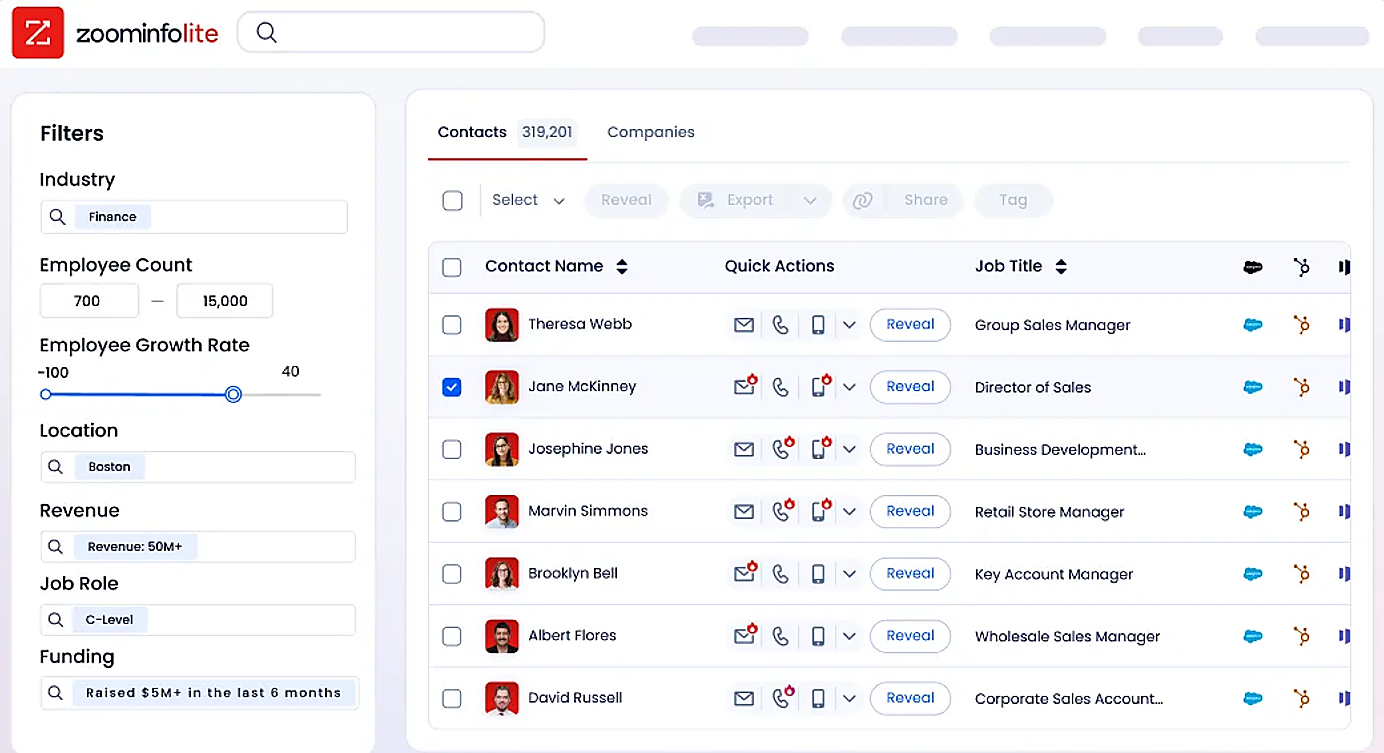
ZoomInfo offers ZoomInfo Lite, a permanent free tier with access to ZoomInfo's B2B database, 10 monthly export credits, individual and company searches, a Chrome extension, and WebSights Lite with up to 10 website visitor reveals per day. A separate 7-day free trial provides broader access with no credit card required.
Source: ZoomInfo
Seismic's sales team attributed 39% of active pipeline to opportunities identified or influenced by ZoomInfo signals, boosted productivity by 54%, and saved 11.5 hours per week per seller. (Seismic Case Study)
Final Summary
Pendo is a thorough toolkit for understanding and guiding behavior inside software: retroactive analytics without manual event tagging, no-code in-app guides with behavioral targeting, session replay across web and mobile, AI-powered feedback triage and churn prediction, cross-channel journey automation, and first-mover agent analytics for measuring AI adoption. It covers the full loop from behavioral data through feedback collection, roadmap prioritization, and automated in-app intervention, but thins out beyond the application boundary.
If your bottleneck sits outside the product (knowing which companies are in-market before they sign up, reaching the right stakeholders when Predict flags a risk, understanding what happened on the sales call, or orchestrating multi-channel campaigns beyond email and in-app guides), that is the ground ZoomInfo covers. Its 500M-contact, 100M-company database supplies the verified emails and direct dials needed to act on product signals externally. ZoomInfo Intent reveals in-market accounts from 6 trillion+ keyword-to-device pairings monthly, weeks before those accounts enter your product. Chorus captures and reasons about every sales conversation. And the GTM Context Graph fuses all of it into a single intelligence layer that captures why deals move, not just what users clicked.
See what that intelligence layer adds to your product signals: start with ZoomInfo Lite for free, or request a demo to watch intent data and verified contacts extend your product analytics into the full buyer journey.
FAQ
Does Pendo require engineering to tag features before tracking begins?
No. Pendo's JavaScript snippet auto-captures interactions from the moment of installation without requiring engineers to define events upfront. Product managers tag pages and features directly in the Pendo Designer visual interface, and behavioral data is retroactively available from the installation date, not from the moment of tagging. That said, initial setup (custom guide styling, behavioral segmentation logic, data architecture decisions) often benefits from dedicated admin resources.
Which Pendo plan includes Session Replay?
Session Replay is available on the Core and Ultimate plans. It is not included in the Free or Base tiers. Recordings have a default 30-day retention, extendable to 90 days with add-ons. There are no caps on recording volume.
Can Pendo track AI agent interactions?
Yes. Agent Analytics measures how users interact with AI agents, both agents the company built and third-party agents like ChatGPT, Claude, and GitHub Copilot. It tracks prompt success, rage prompting (user frustration), unsupported requests, workflow speed comparisons between agentic and traditional UI, and retention impact. Agent Analytics is offered as an AI add-on with custom pricing, separate from the standard plan tiers.
Does Pendo support mobile applications?
Pendo covers both web and mobile (iOS and Android) through its mobile SDK. Mobile guides include banners, sticky footers, and Help Center. However, mobile tracking is frequently noted as lagging behind web capability: element tagging on mobile is harder, push notifications are absent, and mobile guide options are more limited than their web counterparts.
How does Pendo's pricing work?
Pendo uses MAU-based (Monthly Active Users) pricing across four tiers: Free (up to 500 MAUs, no credit card), Base, Core, and Ultimate. Prices above Free are not published; every paid plan requires a sales conversation. There are no per-seat charges for internal users. AI add-ons (Predict, Agent Analytics) are priced separately with custom volume pricing. Professional Services onboarding packages and Premium Support are additional costs not included in the base subscription.
Can Pendo predict which customers will churn?
Yes. Predict, an AI add-on, builds churn prediction models from product usage data and CRM data, delivers scored predictions with explanations into Salesforce and Slack, and triggers automated interventions through Orchestrate. Models build in days without a data science team and continuously retrain. Predict also works with non-Pendo analytics tools: it accepts data from Snowflake, Redshift, BigQuery, and others.
Does Pendo offer buyer intent data or B2B contact information?
No. Pendo tracks behavioral data inside your application but does not provide buyer intent signals showing which companies are researching your category across the web, nor does it include a B2B contact database with direct dials, business emails, or org charts. Teams that need to act on Pendo's product signals through outbound outreach or multi-channel campaigns need an external source. ZoomInfo's intent data tracks signals from 210 million IP-to-Organization pairings and 6 trillion+ keyword-to-device pairings monthly, and its B2B database covers 500M contacts, 100M companies, and 135M+ verified phone numbers.
