
Choosing between Pipeliner CRM vs. Salesforce for your B2B sales operations comes down to these five questions:
Do you need a CRM your team will actually use without months of training, or do you need enterprise customization that justifies a longer ramp?
Is visual pipeline management your priority, or do you need a platform that spans sales, service, marketing, and commerce?
Can your business operate without a dedicated CRM administrator, or do you have the headcount for a full-time admin team?
Are you a mid-market company focused on sales execution, or an enterprise managing complex, multi-department operations?
How do you plan to keep the data inside your CRM accurate, and do you have a strategy for feeding it with verified contacts, buying signals, and account intelligence?
In short, here's what we recommend:
Pipeliner CRM (recently rebranded as Coevera) is built for B2B sales teams that want pipeline visibility without the complexity tax.
Its seven pipeline views, drag-and-drop deal management, and 30-minute user onboarding make it one of the fastest CRMs to deploy. With Voyager AI included free on every plan and no full-time admins required, Pipeliner appeals to mid-market companies that have been burned by implementation-heavy systems.
However, its integration ecosystem is narrower than enterprise alternatives, it lacks native marketing automation, and offline functionality remains a documented pain point.
Salesforce is the #1 CRM by IDC market share, and the platform enterprises default to when they need sales, service, marketing, commerce, and AI agents under one roof. Its ecosystem of 9,000+ partner apps, Agentforce AI, and 17 industry-specific clouds make it one of the most extensible CRMs on the market.
The trade-off is real: Salesforce typically requires dedicated administrators, partner-led implementations, and a pricing structure that compounds quickly across clouds, add-ons, and consumption tiers.
Both platforms are strong CRMs. But every CRM shares the same constraint: it's only as useful as the data inside it. Stale contacts, missing phone numbers, and invisible buying signals mean your sales team is working blind, regardless of how good the interface is. That's where the third piece of the stack comes in.
ZoomInfo is a B2B data and GTM intelligence platform that equips your sales reps to walk into every call knowing why the deal is moving, who's championing it, and what's likely to happen next.
Your marketers can describe audiences in plain language and launch plays against accounts matching your proven win patterns, no engineering ticket required. Your leaders can see deal risk before it shows up in CRM stage fields.
That depth comes from the GTM Context Graph, an intelligence layer built on 500M contacts, 100M companies, 135M+ verified phone numbers, and 200M+ verified business email addresses, unified with your CRM records, conversation transcripts, and behavioral signals. Your team accesses this intelligence through the GTM Workspace for sellers, GTM Studio for marketers and RevOps, or APIs and MCP in any front-end, including Salesforce itself.
If accurate B2B data and deal intelligence sound like the missing layer in your CRM strategy, see how ZoomInfo works with your stack.
Pipeliner CRM vs. Salesforce vs. ZoomInfo at a glance
Pipeliner CRM (Coevera) | Salesforce | ZoomInfo | |
|---|---|---|---|
Primary function | Visual sales CRM | Enterprise CRM platform | B2B data & GTM intelligence |
Implementation time | Weeks to 12 months | ||
Admin requirements | Typically requires dedicated admin(s) | Managed by RevOps or sales ops | |
AI capabilities | Voyager AI (free tier + credit-based agents) | Agentforce ($2/conversation or Flex Credits) | GTM Context Graph + AI agents |
Integration ecosystem | 120+ integrations + API/MCP | ||
Pipeline views | 7 views (Kanban, List, Map, Bubble, etc.) | Consolidated pipeline view | Action Feed with prioritized accounts |
B2B data included | No native data enrichment | No native contact database | |
Starting price | $65/user/month (annual) | $0 (free, 2 users); paid from $25/user/month | Consumption-based; free tier available |
Best for | Mid-market B2B sales teams | Enterprises needing multi-cloud CRM | Any B2B team needing accurate data & signals |
Adoption and time-to-value separate these CRMs
The biggest risk with any CRM isn't choosing the wrong features. It's choosing a platform your team won't use.
Pipeliner CRM was built around this insight.
The company claims a 30-minute user onboarding process and a 2–4 week implementation timeline. Initial configuration is a two-step process: connect data sources and customize pipeline stages, "ready in under 10 minutes."
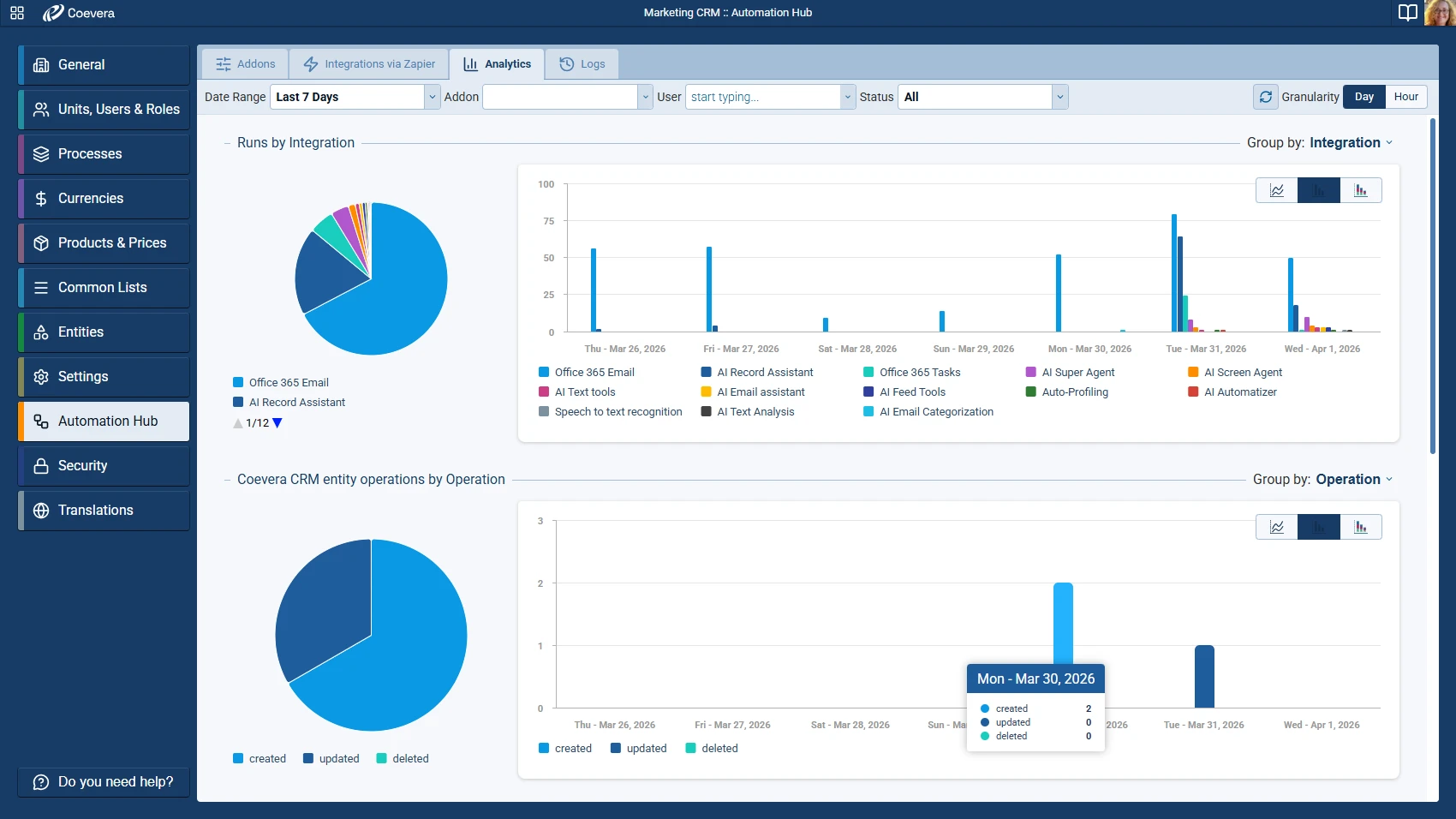
Source: Pipeliner CRM
The platform requires no full-time CRM administrators.
Salesforce occupies the opposite end of the spectrum.
Implementation timelines range from weeks for a simple Sales Cloud setup to 3–12 months for enterprise multi-cloud deployments. Over 70% of implementations are partner-led, adding cost and complexity.
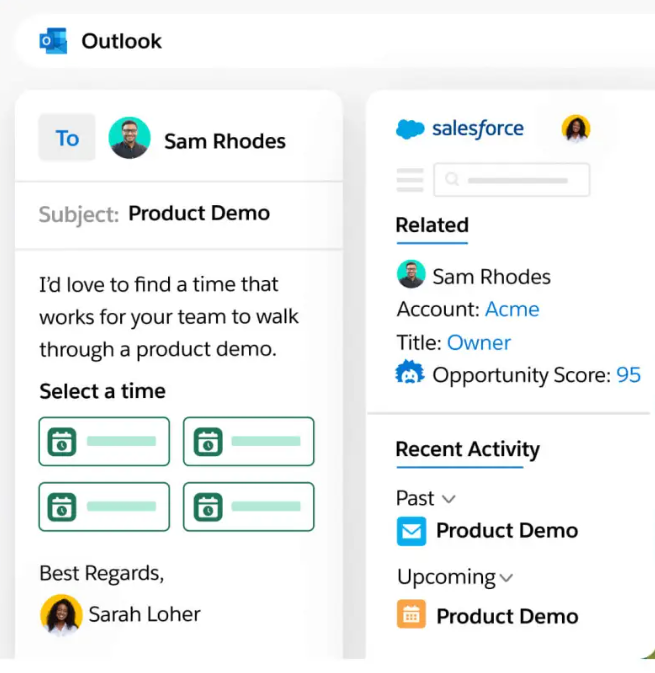
Source: Salesforce
The platform provides Trailhead with 1,500+ learning badges and 6+ million learners, but that volume of training content hints at the learning curve. Most organizations running Salesforce productively employ at least one full-time administrator, and larger deployments need entire teams.
This isn't a weakness in itself. Salesforce's complexity exists because it does more. But for a 50-person sales team that needs pipeline visibility next month (not next quarter), the implementation gap matters.
Visual pipeline management: Pipeliner's core advantage
Pipeliner CRM earned its name by treating the sales pipeline as a visual workspace rather than a data table.
The platform ships seven pipeline views: Kanban, Compact, List, Map, Bubble Chart, Calendar, and Task Board. All show the same live data and switch instantly without re-entering records.
Every opportunity card carries color-coded fitness indicators: green when upcoming activities are scheduled, yellow when nothing is planned, red when tasks are overdue.
Hovering over a stage header opens a Quick View Summary showing open value, lost value, lost rate, average velocity, and conversion rate to the next step, all without running a report. The Dynamic Target widget tracks quota progress in real time with every pipeline change.
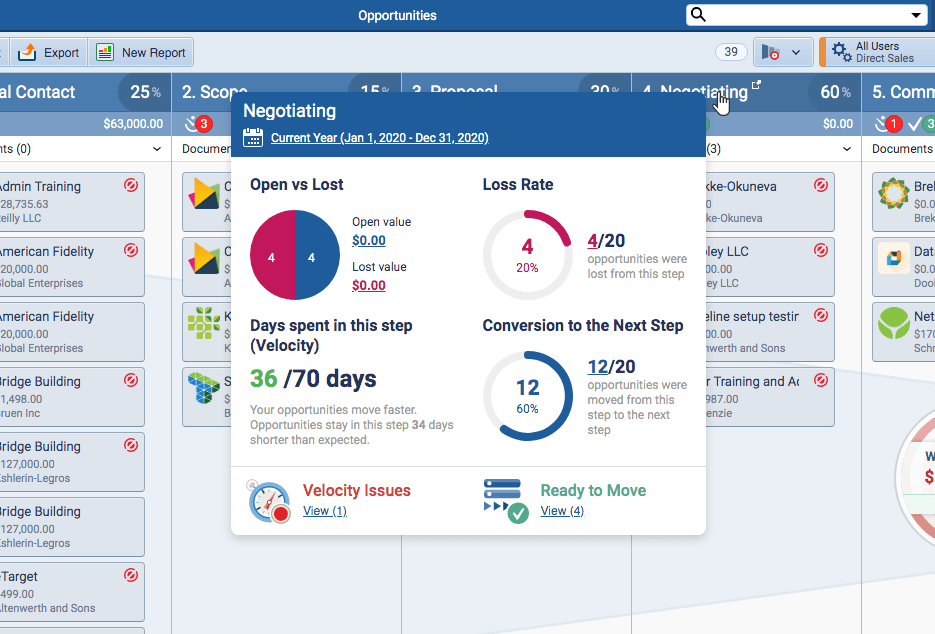
Source: Pipeliner CRM
Salesforce has its own pipeline management in Sales Cloud, including a consolidated pipeline view with AI deal insights and change signals.
The interface is capable and sits on a larger data model. But Salesforce's pipeline view is one feature among hundreds, not the organizing principle of the product. Sales reps who spend their day inside the pipeline will likely find Pipeliner's visual-first approach faster to work with.
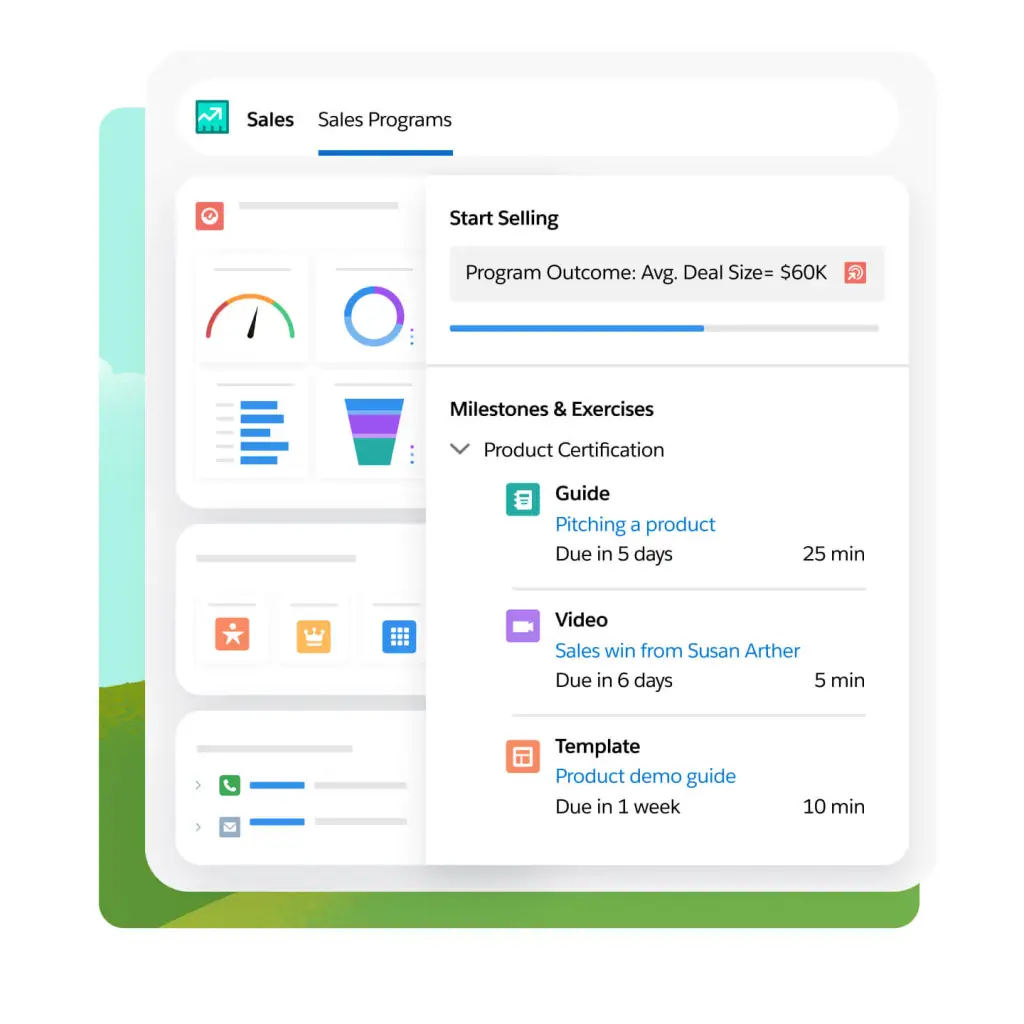
Where Salesforce pulls ahead is at the edges of deal management. Revenue Lifecycle Management covers CPQ, contract lifecycle, subscription management, and revenue analytics in one system. Sales Performance Management handles quotas, territory planning, and commissions. These capabilities don't exist in Pipeliner's product scope.
Source: Salesforce
AI approaches reflect different philosophies
Both platforms have invested heavily in AI, but their strategies differ.
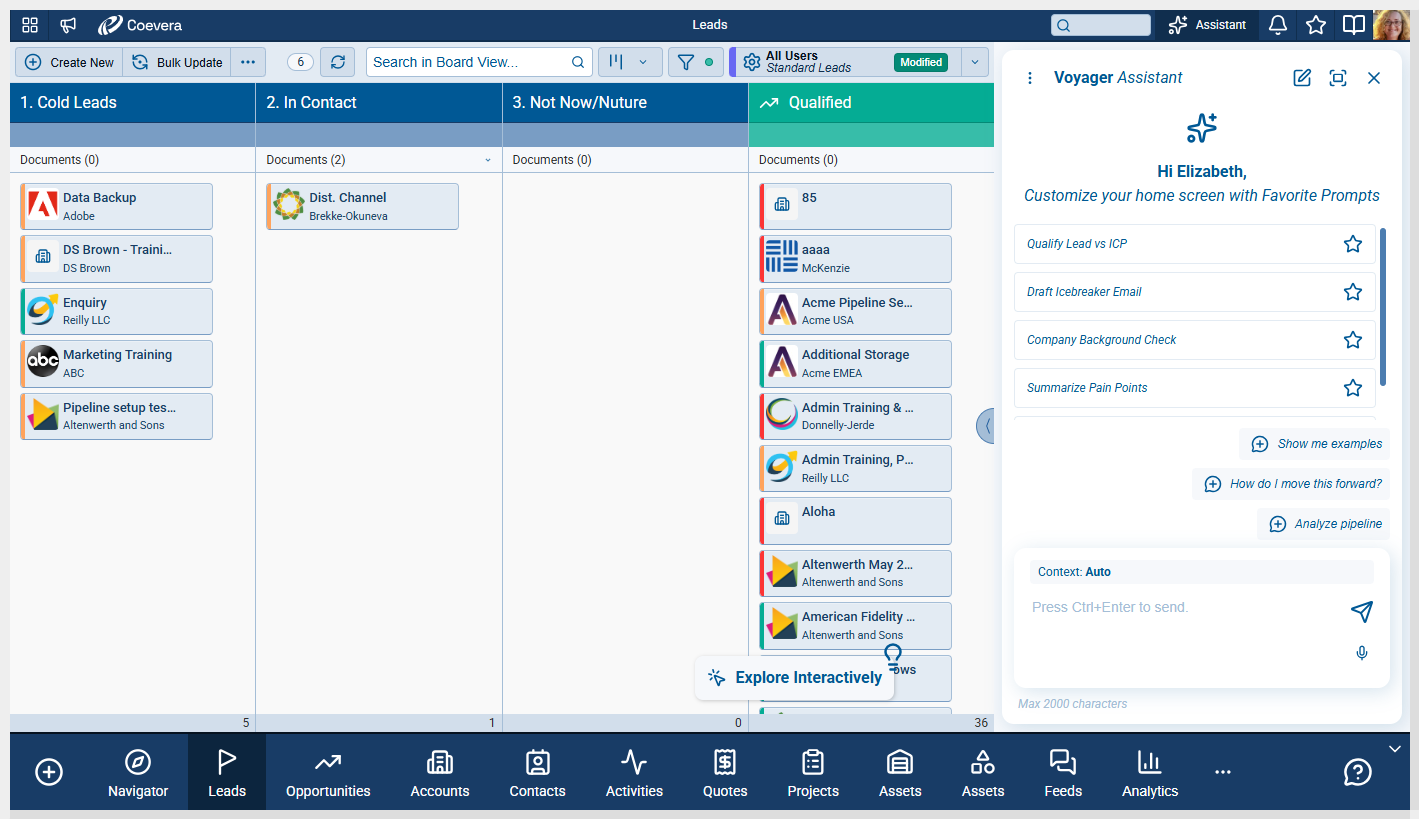
Pipeliner's Voyager AI uses a two-tier model.
Voyager I includes 11 AI features free on every plan: email assistance, speech-to-text, call transcription, document Q&A, and an AI Coach that draws on the Sales POP! library of 1,600+ expert episodes and 2,860+ articles. Voyager II adds credit-based agent capabilities: a Super Agent that handles record management, report generation, and automation building through natural language.
Source: Pipeliner CRM
The design principle is transparency: Voyager shows its reasoning, asks before it acts, and learns when you correct it. Customer data is never used to train AI models.
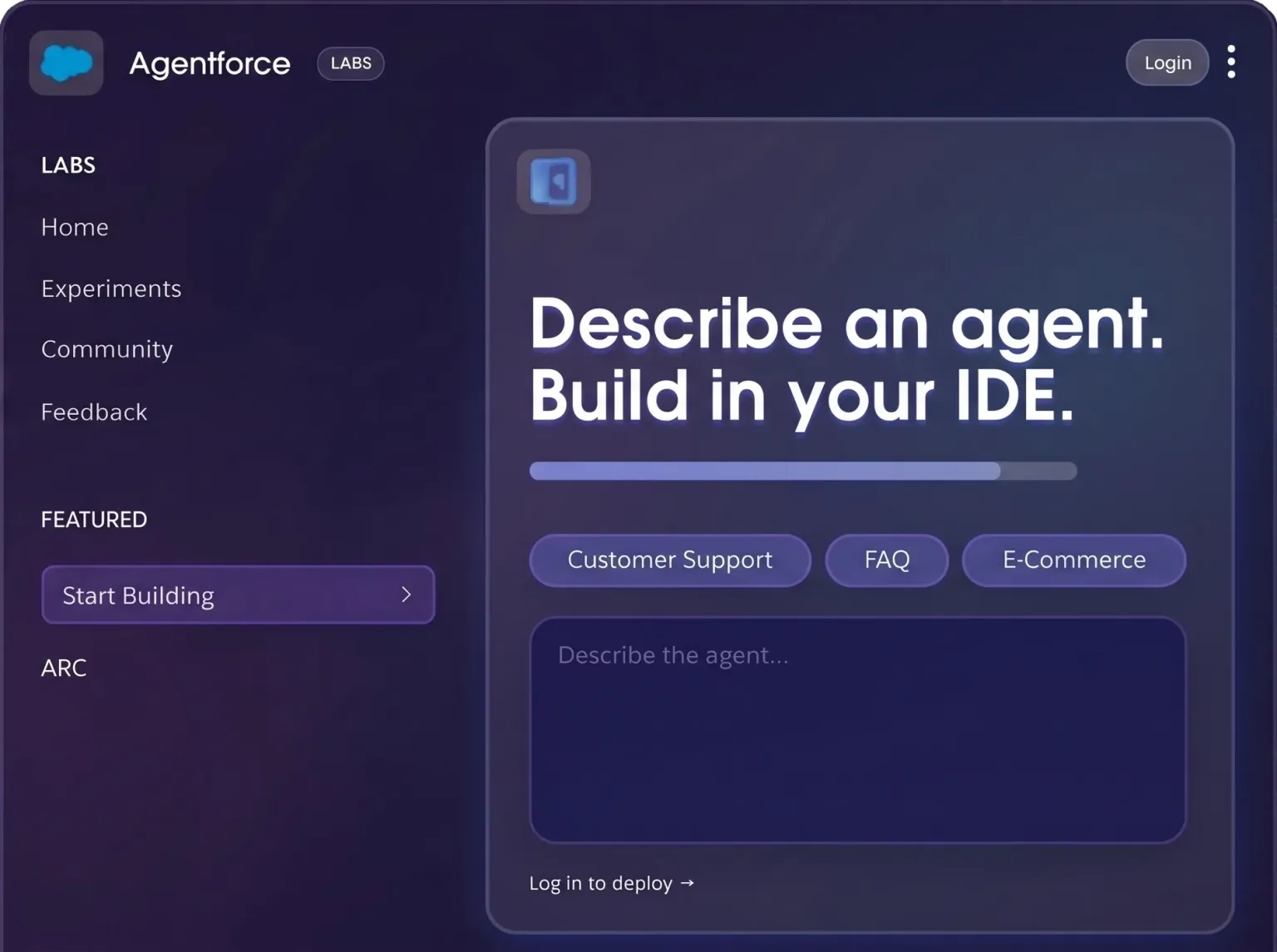
Salesforce's Agentforce operates at a different scale.
Source: Salesforce
Powered by the Atlas Reasoning Engine, Agentforce deploys autonomous AI agents that handle tasks end-to-end: prospecting, lead engagement, sales coaching, customer service, and quoting (75% faster).
Salesforce reports that its own Agentforce deployment resolves 85% of support requests without human escalation. The Einstein Trust Layer enforces zero data retention with LLM partners, PII masking, and audit trails.
The gap: Pipeliner gives every user functional AI at no extra cost. Salesforce's AI is more capable but priced separately, at $2 per conversation or through Flex Credits at $500 per 100,000, on top of existing license costs.
But both platforms face the same constraint. Their AI works with the data already in the CRM. If contact records are stale, phone numbers are wrong, and buying signals are invisible, even the best AI produces shallow results.
The data gap both CRMs share
This is where the CRM comparison shifts from product features to infrastructure.
A CRM records that a deal moved from Stage 3 to Stage 4. It captures that the close date shifted two weeks.
But as ZoomInfo's Chief Product Officer Dominik Facher writes: "The CRM recorded the state change. It has no record of why it happened." Perhaps the CFO joined the last call and asked about six-month ROI. Perhaps the VP went quiet for eight days during an internal budget battle. CRMs were never designed to capture these signals.
ZoomInfo's GTM Context Graph addresses this directly.
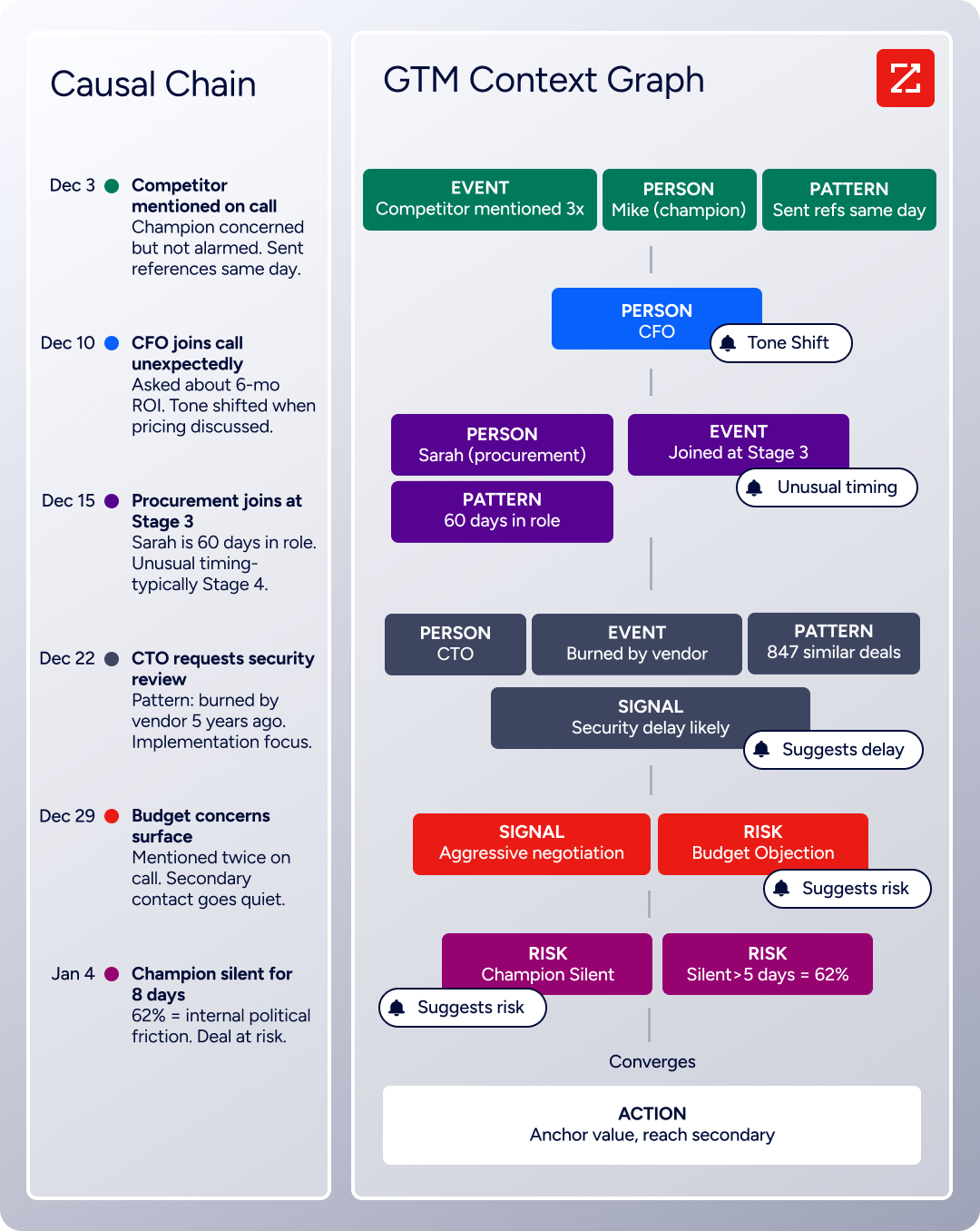
It processes 1.5B+ data points daily, fusing ZoomInfo's third-party B2B data with a customer's CRM records, conversation transcripts, email threads, and behavioral signals into one intelligence layer. The result is context that machines can read: who influences whom, what each action responded to, what thousands of similar deals suggest happens next, and why things slipped.
For sales reps, the difference shows at the point of action. A direct dial that actually rings. An email that actually lands. An intent signal showing the account is researching your competitor this week, not a generic "contact" record with a two-year-old phone number.
For RevOps, the difference is operational. Enrichment workflows don't require stitching together multiple vendors and a manual research layer to get a complete account picture. One platform already has the contact, the company attributes, the org chart, and the technographics. The data advantage isn't self-reported.
In a Fortune 500 competitive RFP analyzing 25 million contacts across vendors, the independent consultant concluded that "no other competitor came even close." ZoomInfo has been named a Gartner Magic Quadrant Leader for ABM Platforms two years running, a Forrester Wave Leader for Intent Data Providers, and holds 133 No. 1 rankings on G2.
"ZoomInfo gives us the information we need to execute. We don't have to go through and spend our time digging. It's already there, so we can be three steps ahead." (Vensure)
Integration ecosystems reveal different strategies
Salesforce's integration ecosystem has no peer.
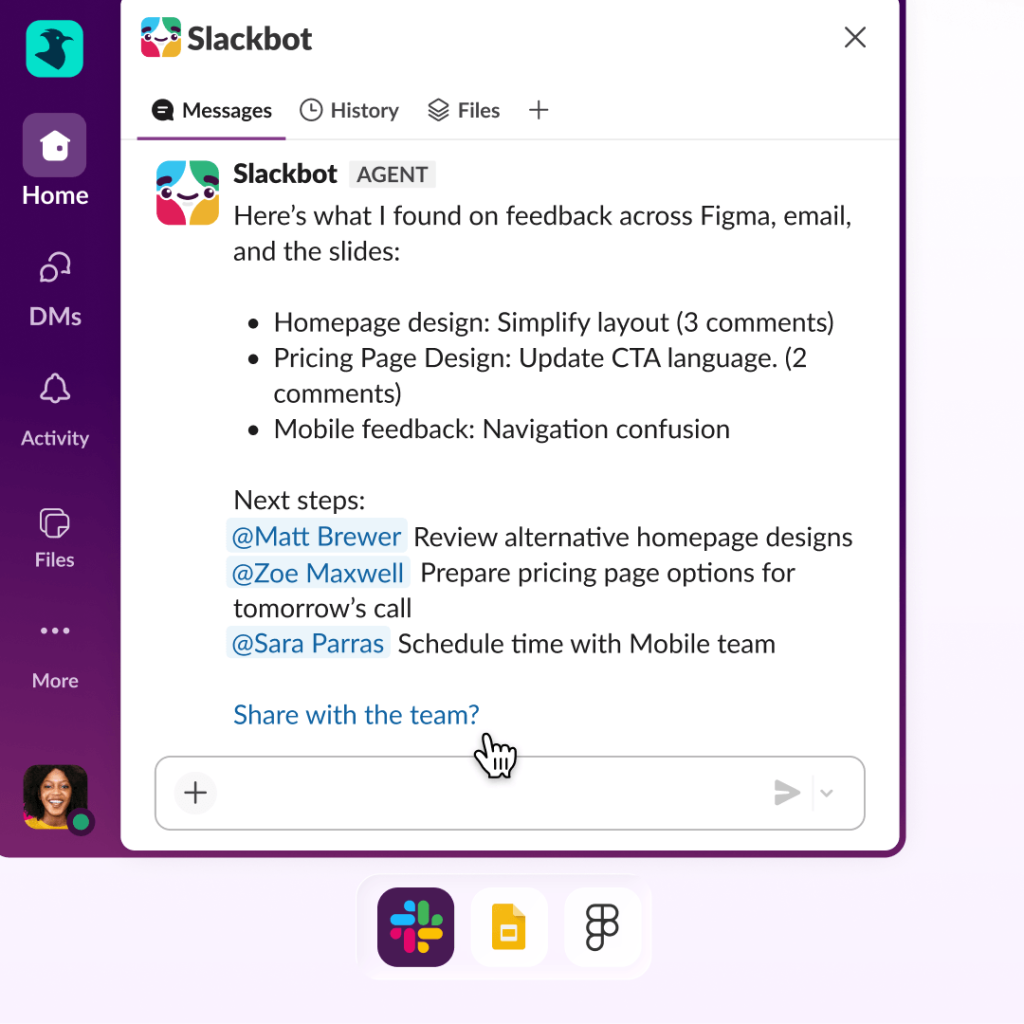
AppExchange lists 9,000+ partner apps with 14+ million installs, and 91% of customers use at least one AppExchange app. MuleSoft provides API management for complex integrations. Slack connects CRM data to team collaboration. If you need to connect Salesforce to an internal system, an industry tool, or a niche application, someone has probably already built the connector.
Source: Salesforce
Pipeliner CRM takes a leaner approach.
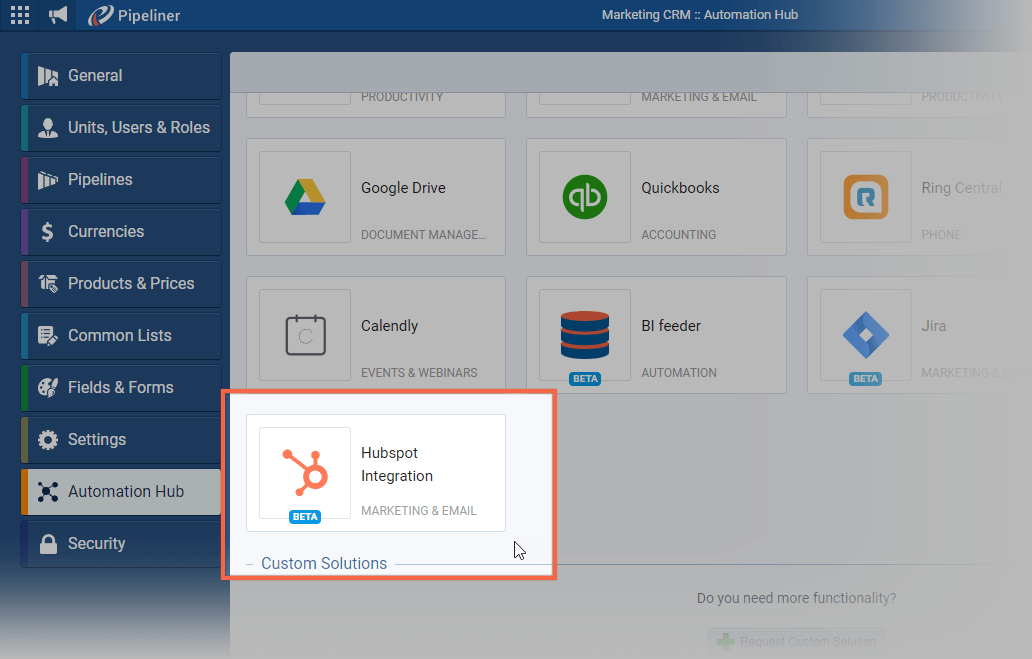
The platform offers 200+ integrations through its Automation Hub, covering the Microsoft stack (Outlook, Office 365, SharePoint, Azure AD), the Google stack (Gmail, Calendar, Drive), and named connectors for RingCentral, HubSpot, PandaDoc, and Jira. It also exposes both a REST API and GraphQL API.
Source: Pipeliner CRM
The ecosystem works but is narrower, and Capterra reviewers note limited third-party add-ons compared to top-tier CRMs.
ZoomInfo connects to both worlds.
Its App Marketplace lists 120 partner integrations including native connectors for Salesforce, HubSpot, and Microsoft Dynamics 365. The Enterprise API gives programmatic access to ZoomInfo's data and GTM Context Graph, with API access included in all relevant plans.
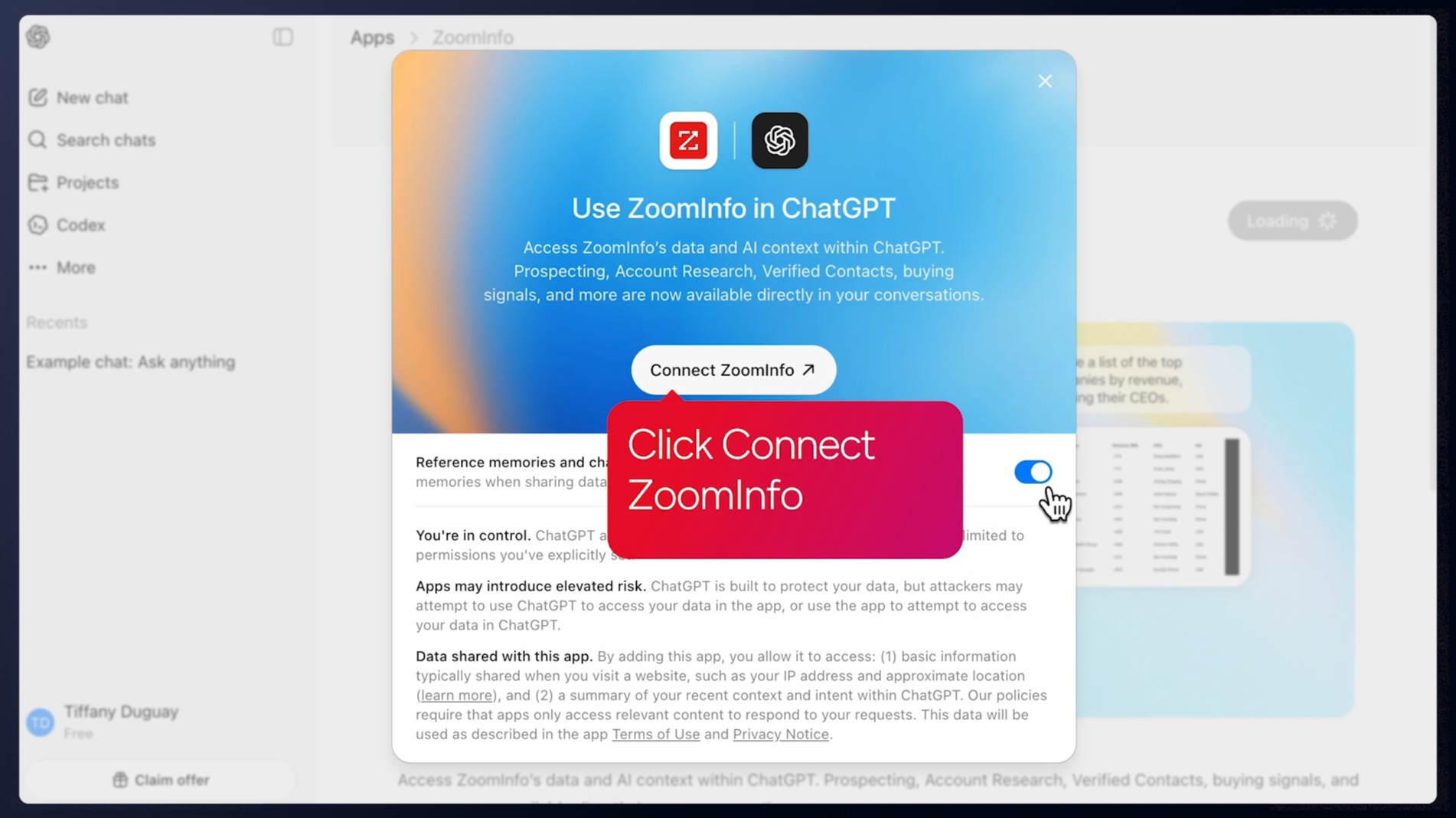
The ZoomInfo MCP server lets AI models access ZoomInfo data as a native tool, with support for Claude and ChatGPT and additional platforms coming.
Source: ZoomInfo
This means ZoomInfo's intelligence works regardless of which CRM you choose. A Salesforce shop gets enriched records and intent signals inside existing workflows. A Pipeliner team can pull verified contacts and account intelligence via API. A company building custom AI agents can connect to the same data through MCP.
"Without ZoomInfo, it would be extremely difficult, if not impossible, to achieve our business objectives. Without it, we wouldn't be able to understand the market, have the right contact data, and make meaningful connections." (Smartsheet)
For a closer look at how Salesforce and ZoomInfo compare as a combined B2B stack, see our Salesforce vs. ZoomInfo comparison.
Complex B2B selling: account management and buying centers
Both CRMs offer tools for managing multi-stakeholder B2B deals, but at different scales.
Pipeliner CRM provides a Visual Opportunity Buying Center that maps the decision-making structure for each deal: who's involved, their role, their level of support, and coverage gaps.
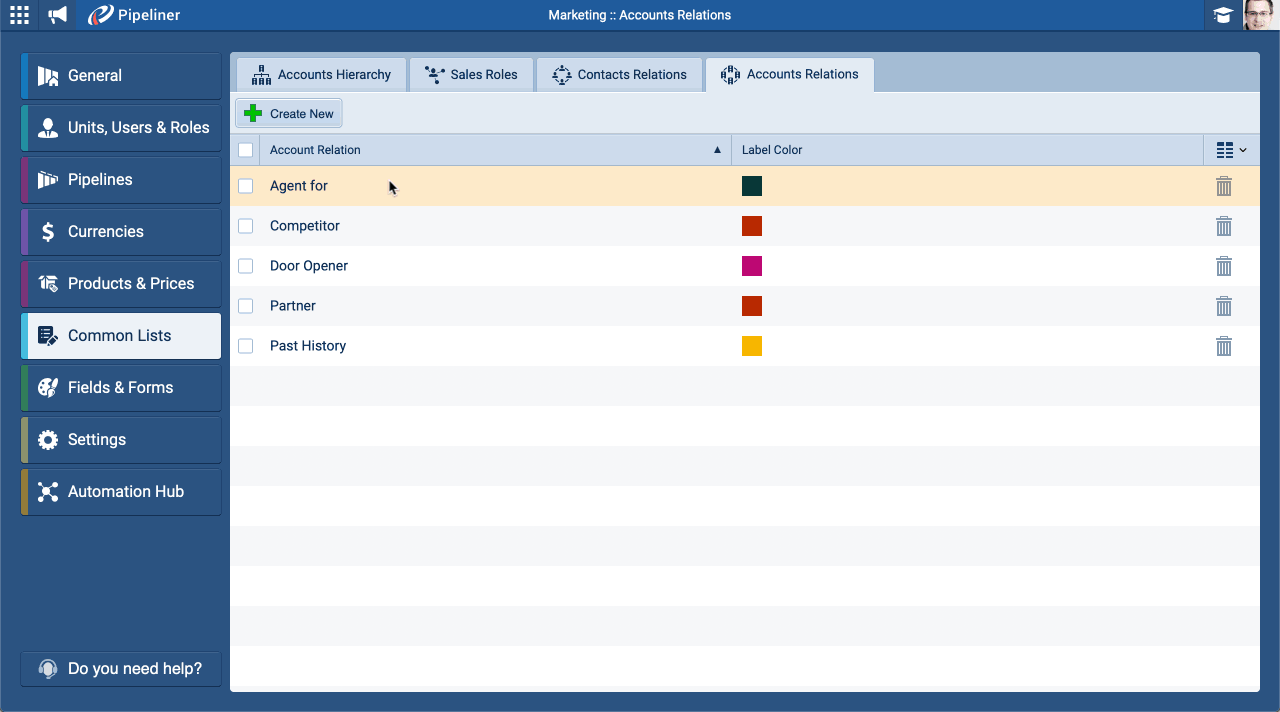
This is available on all pricing tiers. The Contact Org Chart renders internal reporting structures with influence indicators and relationship-strength ratings. An Account Relation Graph maps company-to-company dependencies (partners, suppliers, referral agents) with custom relationship types.
Source: Pipeliner CRM
These features are uncommon at Pipeliner's price point and represent a real differentiator for teams selling into complex B2B accounts.
Salesforce approaches complex selling through its Sales Cloud capabilities: AI-generated account plans with SWOT analysis, pipeline health signals, team selling, and contact roles.
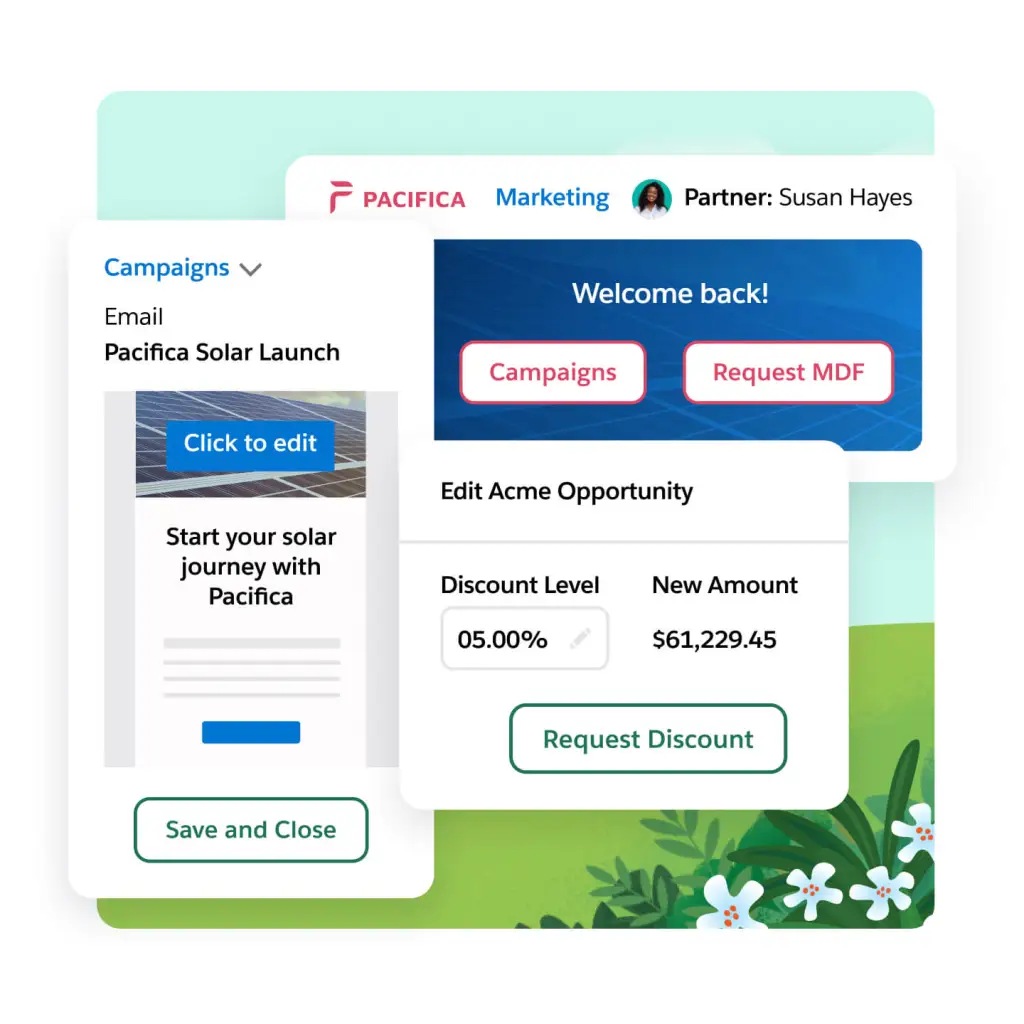
Partner Relationship Management adds branded partner portals. The depth is greater, and the platform's unified data model means service interactions, marketing engagement, and commerce data all inform the sales view. But accessing this depth requires higher-tier licenses and more configuration.
Source: Salesforce
ZoomInfo adds a different dimension to complex selling.
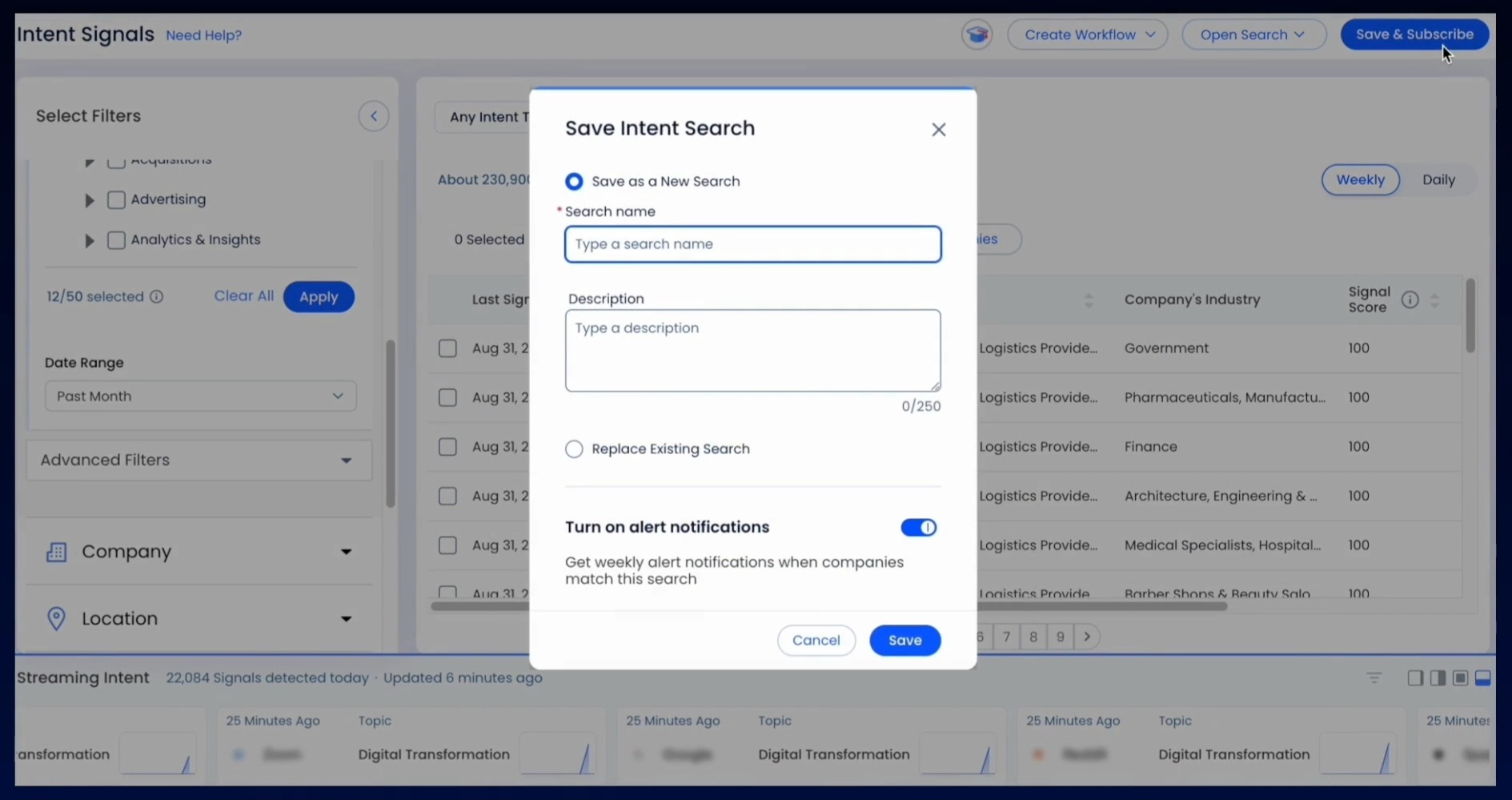
Its Buyer Intent data tracks signals from 210 million IP-to-Organization pairings and 6 trillion+ new keyword-to-device pairings monthly. Guided Intent identifies topics historically correlated with deal success rather than requiring manual topic selection.
Source: ZoomInfo
The GTM Workspace surfaces prioritized accounts with AI-drafted outreach that addresses the specific concern the reasoning engine identified as the deal-moving moment.
This means a sales rep using either CRM can layer ZoomInfo's intelligence on top: knowing not just who the buying committee members are, but that the CFO was recently hired, the company is researching your competitor's product category, and a similar deal at a similar company closed after executive sponsorship entered at Stage 3.
"That combination of our internal CRM data, external signals, and AI that's given all that context has helped us craft very specific account- and persona-based messages. And people have responded to them right away." (Seismic)
Automation capabilities comparison
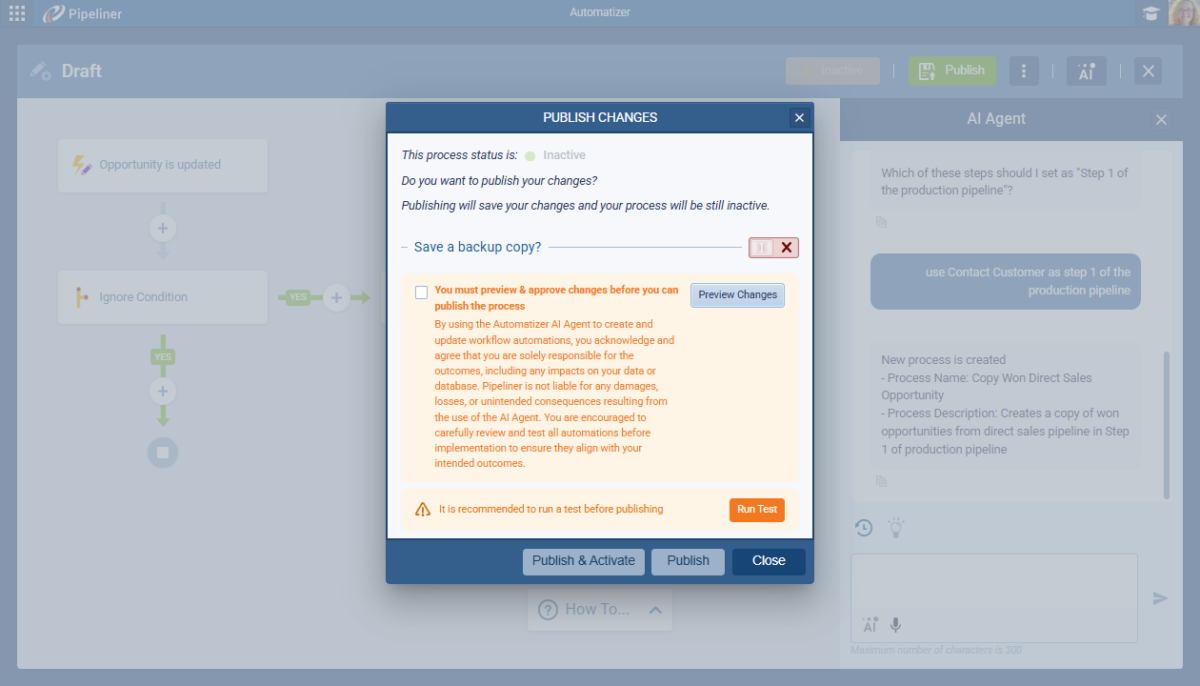
Pipeliner's Automatizer is a no-code workflow engine that lets teams build trigger-condition-action workflows directly inside the CRM.
Workflows can send emails, create tasks, update records, fire webhooks, and trigger other workflows in chained sequences. An AI Automatizer layer accepts natural-language instructions to build workflows. The practical value is that automation lives inside the CRM without requiring a separate tool.
Source: Pipeliner CRM
The limitation: Automatizer is only available on Enterprise ($115/user/month) and Unlimited ($150/user/month) plans. Starter and Business customers don't have access.
Salesforce's automation is broader and deeper.
Flow handles process automation from simple record-triggered updates to complex multi-step orchestrations. Agentforce adds autonomous AI agents that can execute entire workflows (prospecting sequences, case resolution, order management) without human intervention. MuleSoft extends automation beyond Salesforce to any enterprise system.
The trade-off is complexity: building sophisticated Salesforce automations typically requires admin expertise or developer support.
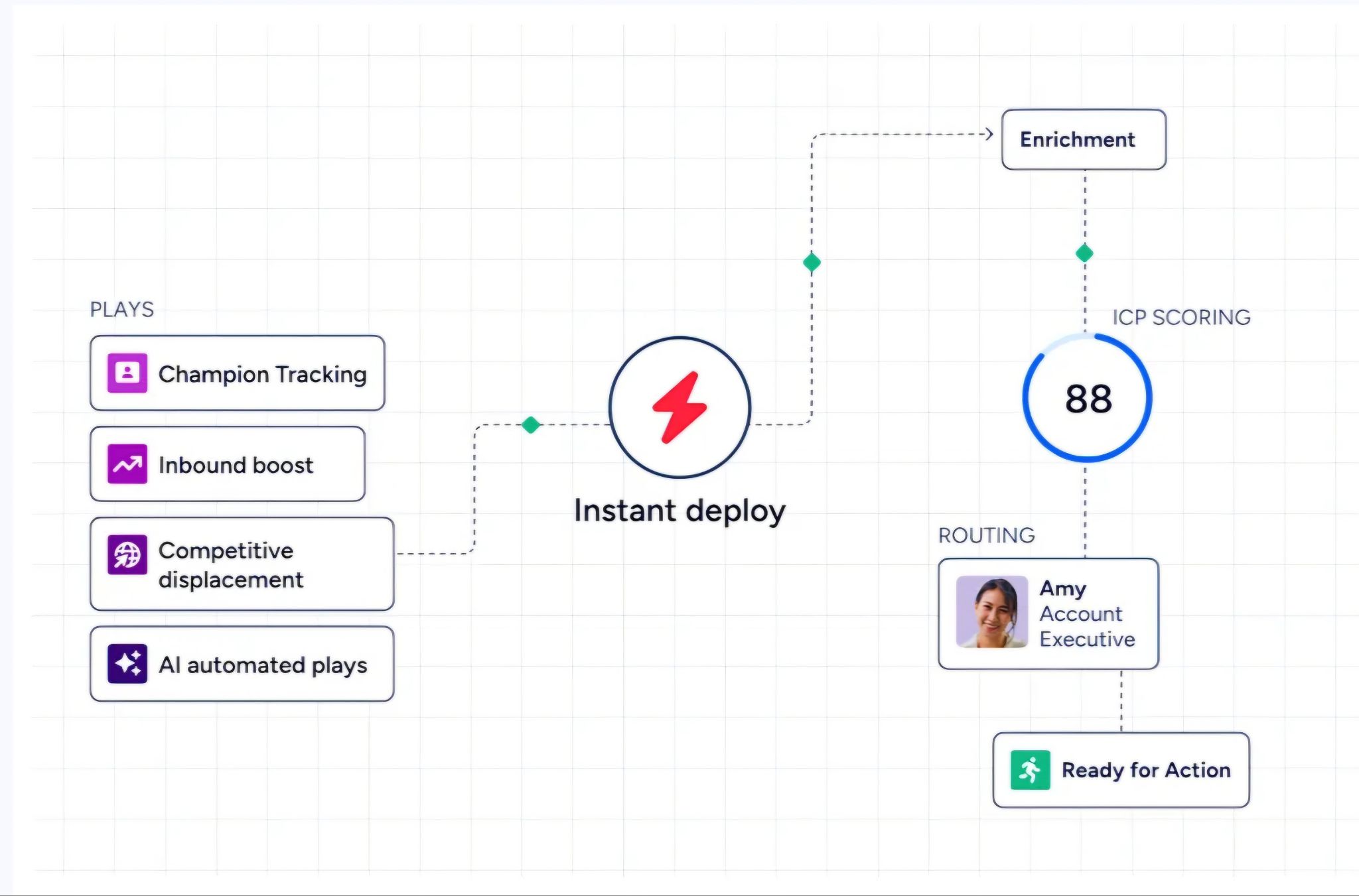
ZoomInfo's GTM Studio approaches automation from the go-to-market angle.
Source: ZoomInfo
RevOps teams and marketers can describe audiences in natural language, define triggers based on buying signals, and activate plays across channels (email, calls, ads, direct mail) without engineering support.
Pre-built GTM plays for inbound acceleration, champion tracking, and competitive displacement launch in one click. The company reports that expansion plays that used to take 3 weeks now launch in 30 minutes.
Pricing: sticker price vs. total cost of ownership
Pipeliner CRM uses straightforward per-seat pricing across four tiers:
Plan | Annual (per user/month) |
|---|---|
$65 | |
$85 | |
$115 | |
$150 |
The Starter plan requires a minimum of 3 users. A 14-day free trial is available with no credit card required. Subscriptions are 12-month terms with auto-renewal, and payments are non-refundable. Pipeliner argues its total cost of ownership is 70% lower than alternatives when you factor in implementation, admin, and consultant costs.
Salesforce's pricing is multi-layered. Sales Cloud alone ranges from free (2 users) to $550/user/month for the Agentforce 1 edition:
Edition | Price (per user/month) |
|---|---|
$0 (max 2 users) | |
$25 | |
$100 | |
$175 | |
$350 | |
$550 |
But Sales Cloud is often just the starting point. Agentforce consumption costs $2 per conversation or $500 per 100,000 Flex Credits. Premier Support adds 30% of net license fees. Marketing Cloud starts at $1,500/org/month. Data Cloud runs $500 per 100,000 credits. And implementation (which is partner-led for 70%+ of deployments) adds further cost.
ZoomInfo uses consumption-based pricing with no publicly listed prices.
Costs depend on usage patterns, number of users, monthly credit volume, and contract length. A permanent free tier, ZoomInfo Lite, provides access to 100M+ verified profiles with 10 monthly export credits at no cost.
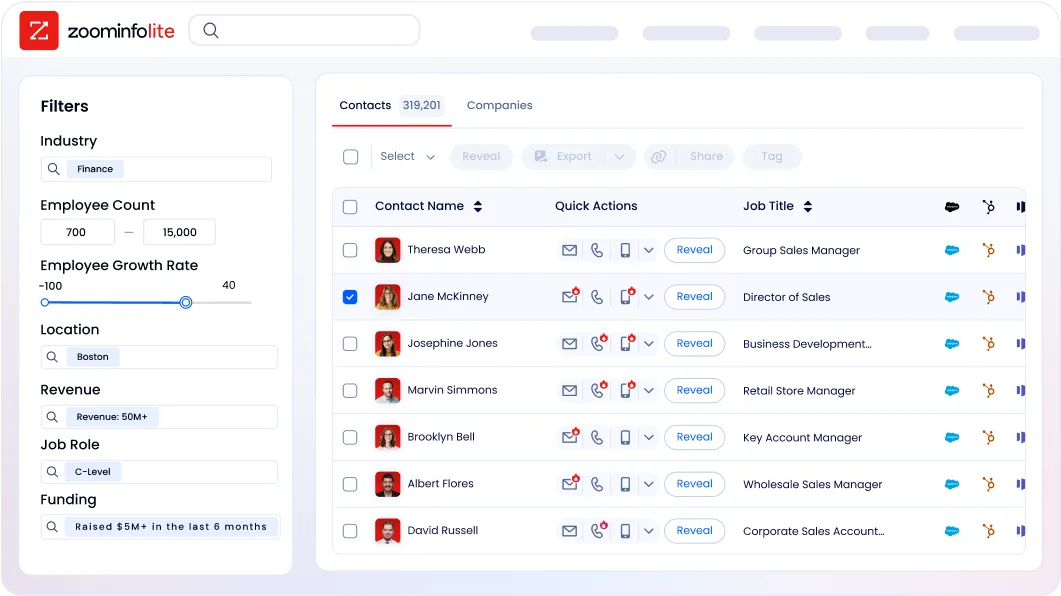
The honest comparison: Pipeliner is the most predictable spend. Salesforce is the most expensive when you account for the full stack. ZoomInfo sits alongside either CRM as a separate line item, but one that pays for itself through data that would otherwise require manual research or multiple point solutions to assemble.
Security and compliance
All three platforms meet enterprise security standards, though the specifics vary.
Pipeliner CRM holds ISO 27001:2022 and ISO 9001:2015 certifications, is GDPR and HIPAA compliant, and runs on AWS with data hosted across the US, Canada, Australia, and Europe.
Encryption covers AES-256 at rest and SSL/TLS 1.2+ in transit. Two-factor authentication is included on all tiers, with SAML 2.0 SSO on Enterprise and above.
Salesforce provides the deepest security and governance capabilities.
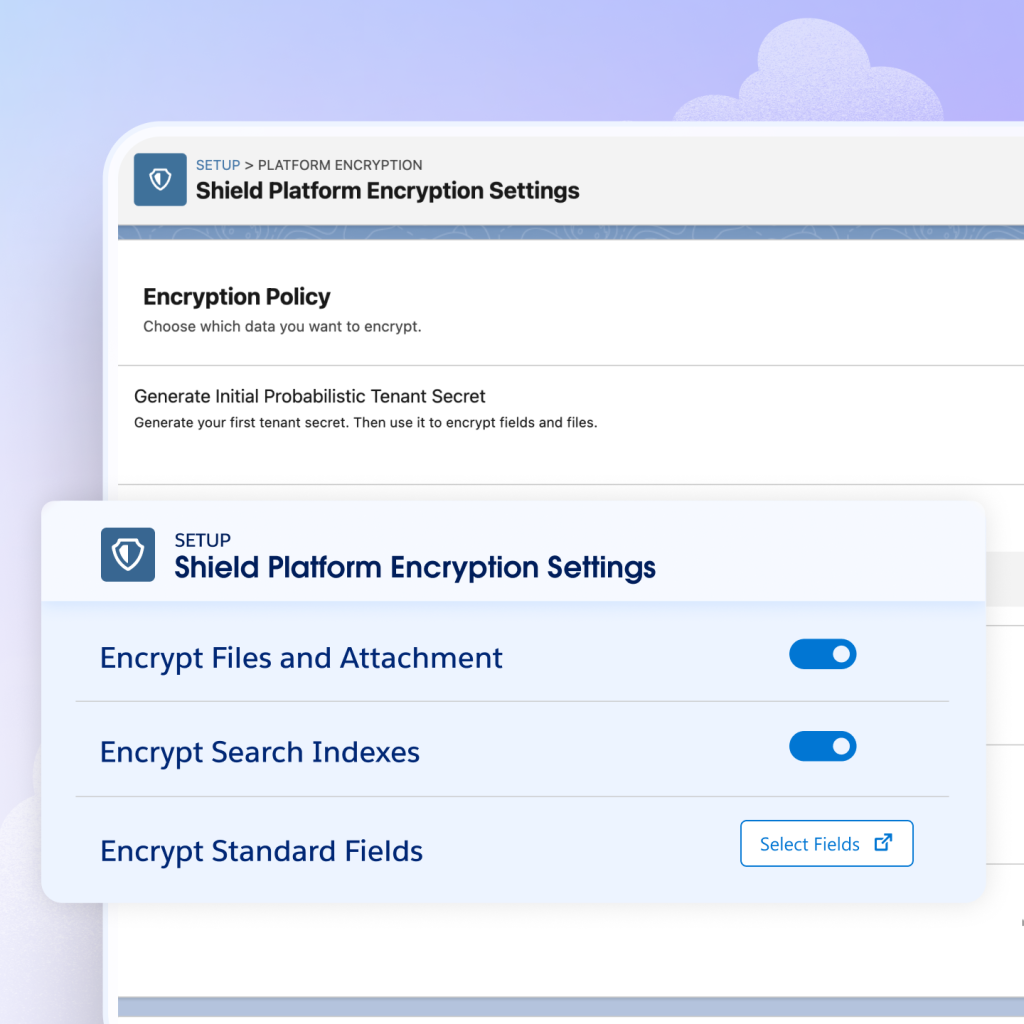
Certifications include ISO 27001/27017/27018, SOC 1/2/3, and FedRAMP for government use. Salesforce Shield (a premium add-on) adds event monitoring, platform encryption with BYOK, and indefinite field audit trails. The Einstein Trust Layer enforces zero data retention with LLM partners. Hyperforce enables regional data residency across multiple countries.
Source: Salesforce
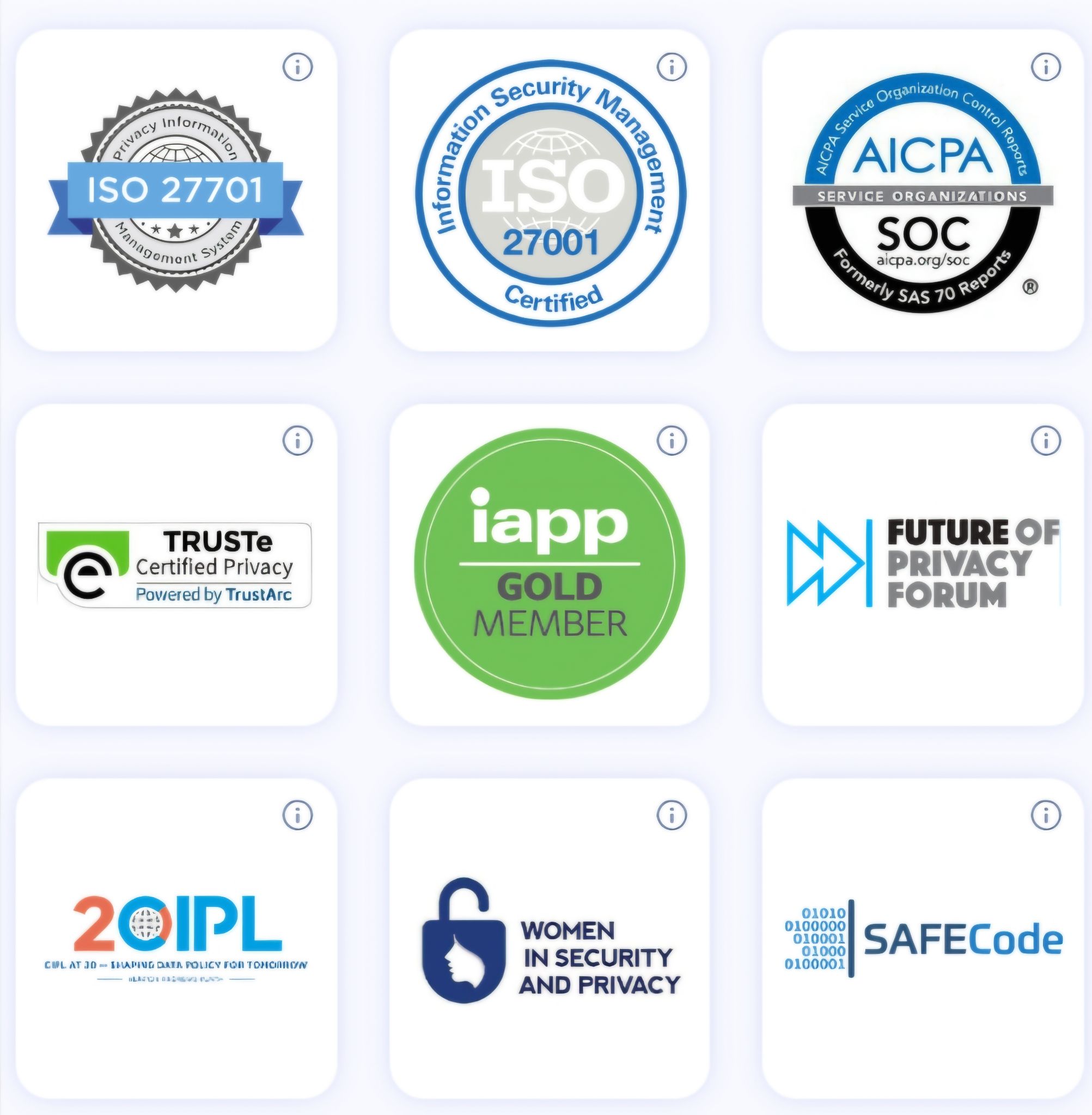
ZoomInfo maintains ISO 27001, ISO 27701, SOC 2 Type II, and TRUSTe GDPR and CCPA certifications, all renewed annually.
Source: ZoomInfo
The company is a registered data broker in California and Vermont. For organizations in regulated industries, ZoomInfo's compliance infrastructure is built into the data layer, not bolted on afterward.
Reporting and analytics
Pipeliner CRM bundles analytics into the same visual philosophy that drives the rest of the product.
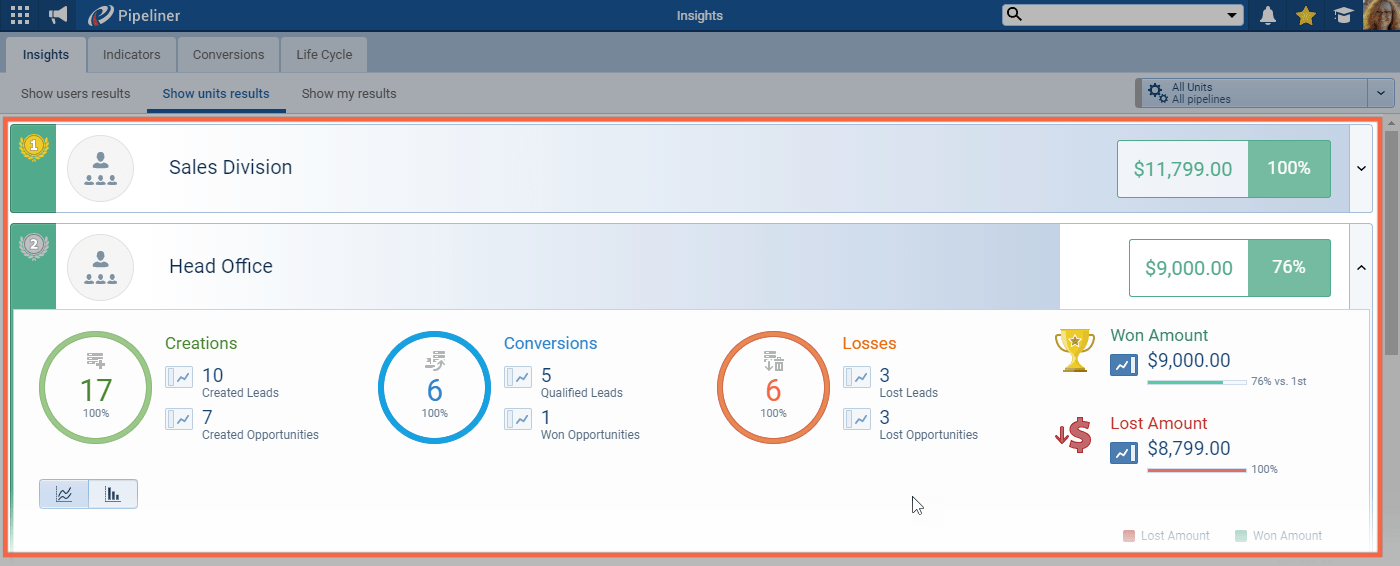
A four-tab Insights module covers KPI benchmarking, pipeline velocity, step-level conversion analysis, and lead-to-close flow visualization. The Forecasting module supports hierarchical forecasting up to five levels, with AI-powered Won Value Prediction using the ARIMA method.
Notably, Pipeliner builds its analytics on system-generated data that users cannot alter, making metrics immune to reps backdating fields or re-assigning records. The company positions its reporting as eliminating the need for separate BI tools: "No need for Tableau. No additional licenses. No data warehouse."
Source: Pipeliner CRM
Salesforce's analytics are broader.
CRM Analytics provides embedded dashboards directly within Salesforce records. Tableau is the enterprise analytics platform, with Tableau Next adding agentic analytics that let AI agents build and interpret dashboards.
Einstein Forecast overlays AI predictions on pipeline data. The breadth is wider, but accessing it often requires Tableau licenses, Data Cloud credits, and configuration time.
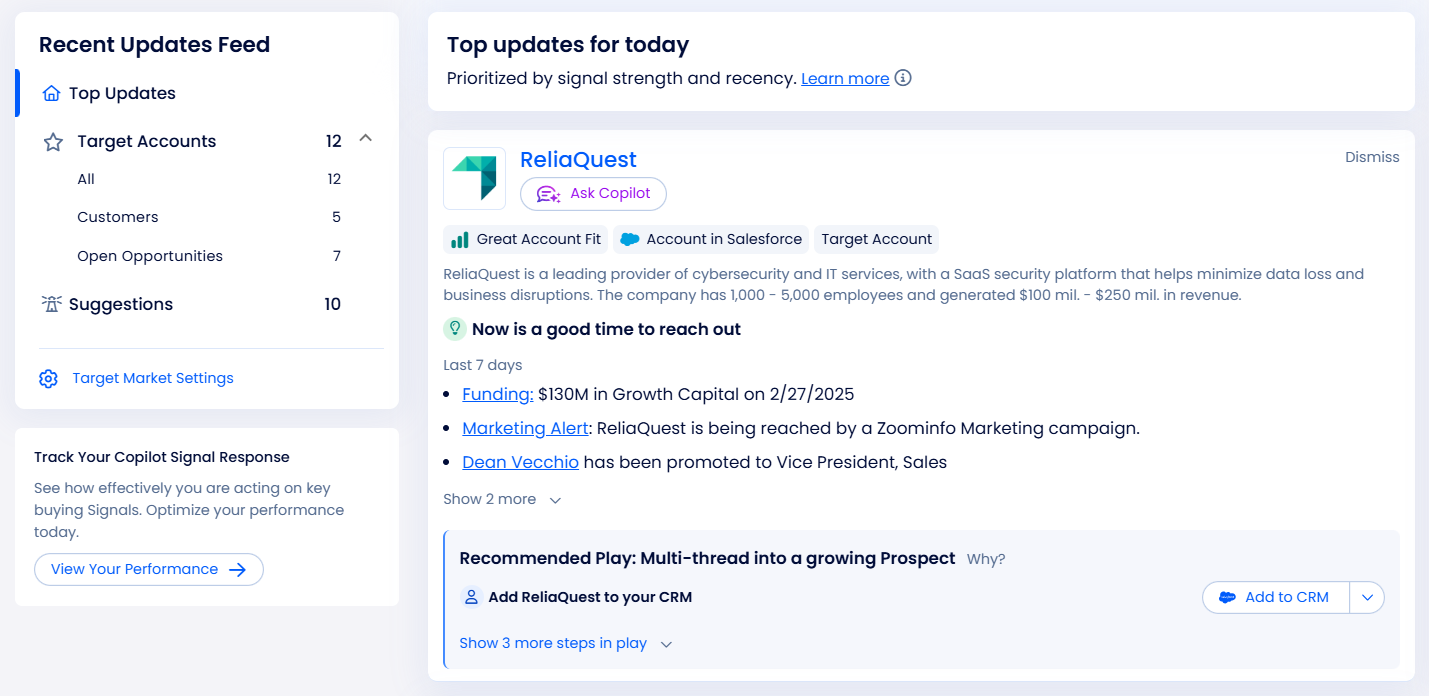
ZoomInfo contributes a different kind of intelligence to reporting.
Its Account Fit Score uses predictive AI to score accounts 0–100 based on patterns that predict conversion. GTM Studio analytics track engagement, funnel progression, and top-performing segments with AI-powered dashboards.
Source: ZoomInfo
This layer of external intelligence enriches whatever reporting your CRM provides with data it could never generate on its own: intent trends, competitive research activity, and market-level signal patterns.
Pipeliner CRM vs. Salesforce vs. ZoomInfo: Which should you choose?
The right choice depends on your team size, technical resources, and where you need the most help.
Choose Pipeliner CRM if:
You're a mid-market B2B sales team (10–500 users) that prioritizes adoption speed
Visual pipeline management is central to how your team works
You don't have (or want) a dedicated CRM administrator
Your needs are focused on sales execution, not marketing automation or customer service
You want built-in AI tools without per-usage fees
Choose Salesforce if:
You need a platform that spans sales, service, marketing, commerce, and custom apps
Your organization has the resources for dedicated administration and partner-led implementation
Enterprise-scale integrations and the AppExchange ecosystem are requirements
You want autonomous AI agents that can handle complex workflows end-to-end
Industry-specific compliance, data models, or vertical solutions are important
Add ZoomInfo to either CRM if:
You need verified B2B contact data and direct-dial phone numbers to fill your pipeline
Knowing which accounts are actively in-market would change how your team prioritizes
Your CRM data is stale, incomplete, or requires manual research to maintain
You want AI that understands deal context, not just CRM field values
You need the same intelligence accessible inside your CRM, through AI agents, or via API
See how ZoomInfo's data and intelligence layer integrates with your CRM.
The CRM you choose determines how your team manages deals. The data you feed it determines whether those deals are real. Pipeliner CRM gives mid-market teams a fast, visual system that reps actually use. Salesforce gives enterprises a platform they can build an entire business operation on.
ZoomInfo gives both the verified contacts, buying signals, and deal intelligence that turn CRM records from static data into actionable opportunities.
The strongest B2B sales organizations don't choose between a good CRM and good data. They use both.
Pipeliner CRM vs. Salesforce vs. ZoomInfo FAQ
What is the core difference between Pipeliner CRM, Salesforce, and ZoomInfo?
Pipeliner CRM is a visual sales CRM designed for fast adoption by mid-market B2B teams, with seven pipeline views, 30-minute onboarding, and no admin requirements.
Salesforce is the world's largest CRM platform, spanning sales, service, marketing, commerce, and AI agents across 17 industry verticals.
ZoomInfo is not a CRM but a B2B data and GTM intelligence platform that provides verified contact data, buyer intent signals, and deal context to power whichever CRM you use.
Which platform is cheapest to get started with?
Salesforce offers a free CRM for up to 2 users, and paid plans start at $25/user/month. Pipeliner CRM starts at $65/user/month with a 3-user minimum. ZoomInfo offers a permanent free tier (ZoomInfo Lite) with 10 monthly export credits.
However, total cost of ownership differs significantly: Pipeliner requires no admin headcount, while Salesforce typically needs dedicated administrators, partner-led implementation, and add-on purchases for AI, data, and support.
Does ZoomInfo replace a CRM?
No. ZoomInfo works alongside your CRM, not instead of it. It provides the verified B2B contact data, buying intent signals, and account intelligence that CRMs don't generate on their own.
ZoomInfo integrates natively with Salesforce, HubSpot, and Microsoft Dynamics, and can connect to any CRM via API or MCP. The GTM Workspace also serves as a seller front-end that consolidates CRM data with ZoomInfo intelligence in one view.
Which CRM is better for complex B2B deal cycles?
Both handle complex selling but in different ways. Pipeliner CRM provides visual buying center mapping, contact org charts, and account relationship graphs on all pricing tiers, which is uncommon at its price point.
Salesforce offers deeper enterprise capabilities including AI-generated account plans, revenue lifecycle management, and partner relationship portals, but these require higher-tier licenses and more configuration.
ZoomInfo adds external intelligence to either CRM, surfacing buyer intent signals, org chart changes, and funding events that help sales teams identify and engage the full buying committee.
How do the AI capabilities compare?
Pipeliner CRM includes Voyager I AI features free on every plan, covering email drafting, call transcription, and an AI sales coach. The credit-based Voyager II adds a Super Agent for natural-language record management and automation building.
Salesforce's Agentforce is the most capable, with autonomous agents for prospecting, coaching, service, and commerce, powered by the Atlas Reasoning Engine. Agentforce is priced separately at $2 per conversation or through Flex Credits.
ZoomInfo's GTM Context Graph processes 1.5 billion data points daily and powers AI agents inside GTM Workspace, but its AI focuses on data intelligence and deal context rather than CRM workflow automation.
Which platform has the best integration ecosystem?
Salesforce has no peer in integration breadth, with 9,000+ apps on AppExchange, 14+ million installs, and MuleSoft for API management.
Pipeliner CRM offers 200+ integrations through its Automation Hub, covering major email, calendar, and productivity tools.
ZoomInfo connects to 120+ partner integrations and provides API access on all relevant plans, plus an MCP server for AI-native tool access. ZoomInfo is designed to work within both CRM ecosystems rather than replace them.
What are the main limitations of each platform?
Pipeliner CRM's integration ecosystem is narrower than enterprise CRMs, it lacks native marketing automation, its mobile app lags behind the desktop experience, and users report limitations with offline functionality.
Salesforce's pricing complexity can lead to bill shock, implementations are long and typically partner-led, and the platform requires dedicated admin resources.
ZoomInfo does not publish pricing, which makes budget planning harder, and the platform's breadth requires a meaningful onboarding investment.
Can I use ZoomInfo with both Pipeliner CRM and Salesforce?
Yes. ZoomInfo integrates natively with Salesforce through the App Marketplace and works with any CRM through its Enterprise API and MCP server. A recently announced Coevera MCP Server will also allow AI assistants to access live Pipeliner CRM data.
ZoomInfo's architecture is designed so the same data foundation and GTM Context Graph are accessible in any front-end, whether that's ZoomInfo's own GTM Workspace, Salesforce, or a custom-built application.
See how Salesforce compares against other CRMs and platforms:
