

PitchBook has become the default intelligence platform for private capital markets professionals. Backed by Morningstar since 2016, it covers nearly 6 million companies, 2.7 million investments, 570,000 investors, 56,000 limited partners, 147,000 funds, and 4.4 million people, offering visibility into PE, VC, M&A, and credit markets that didn't exist a decade ago. For deal professionals, it replaces scattered spreadsheets and outdated databases with a single, continuously updated platform for company profiles, fund performance, and analyst reports.
We've analyzed PitchBook thoroughly. It's the right choice if:
You work in private equity, venture capital, investment banking, or credit markets
You need coverage of deal terms, fund performance, and investor activity
You want analyst-grade research alongside raw data
You value all-inclusive data access without per-dataset charges
You need a dedicated customer success manager and hands-on support
However, PitchBook might not be the best choice if:
You need verified B2B contact data for sales prospecting or outreach
Your team runs sales campaigns, intent-based selling, or account-based marketing
You want a self-serve product with transparent, published pricing
You need buyer intent signals showing which companies are researching solutions
Your primary goal is pipeline generation rather than deal intelligence
In this case, consider pairing PitchBook with ZoomInfo, a B2B intelligence and sales platform that adds verified contact data, buyer intent signals, and sales execution tools to PitchBook's capital markets coverage. Where PitchBook tells you which companies raised funding and who invested, ZoomInfo tells you who to call at those companies, gives you their direct dial and verified email, and shows you when they're in-market.
We cover ZoomInfo later in this review because it fills a gap in the deal-to-outreach workflow that PitchBook wasn't designed to address. If you want to see how B2B intelligence can strengthen your sales outreach, start with ZoomInfo's free trial here.
What is PitchBook?
PitchBook is a financial data and software company founded in 2007 by John Gabbert in Seattle, Washington. Gabbert spent nine years at VentureOne Corporation, where he saw firsthand that the PE and VC industry lacked integrated, reliable data.
After more than 200 investor rejections, he cold-called Morningstar founder Joe Mansueto, who invested $1.2 million as a Series A investor in 2009. Morningstar acquired PitchBook in December 2016 for approximately $225 million.
Its core strength is scope.
PitchBook tracks private capital across VC, PE, leveraged loans, private credit, real estate, real assets, infrastructure, funds of funds, secondaries, co-investment, CLOs, and more. 1,800+ researchers maintain this breadth, having logged over 10 million hours of research and talking directly to companies, advisors, investors, lawyers, accountants, and lenders to cross-validate data.
PitchBook's primary users include private equity firms, venture capital firms, investment banks, limited partners, corporate development teams, credit investors, lenders, law firms, and accounting firms.
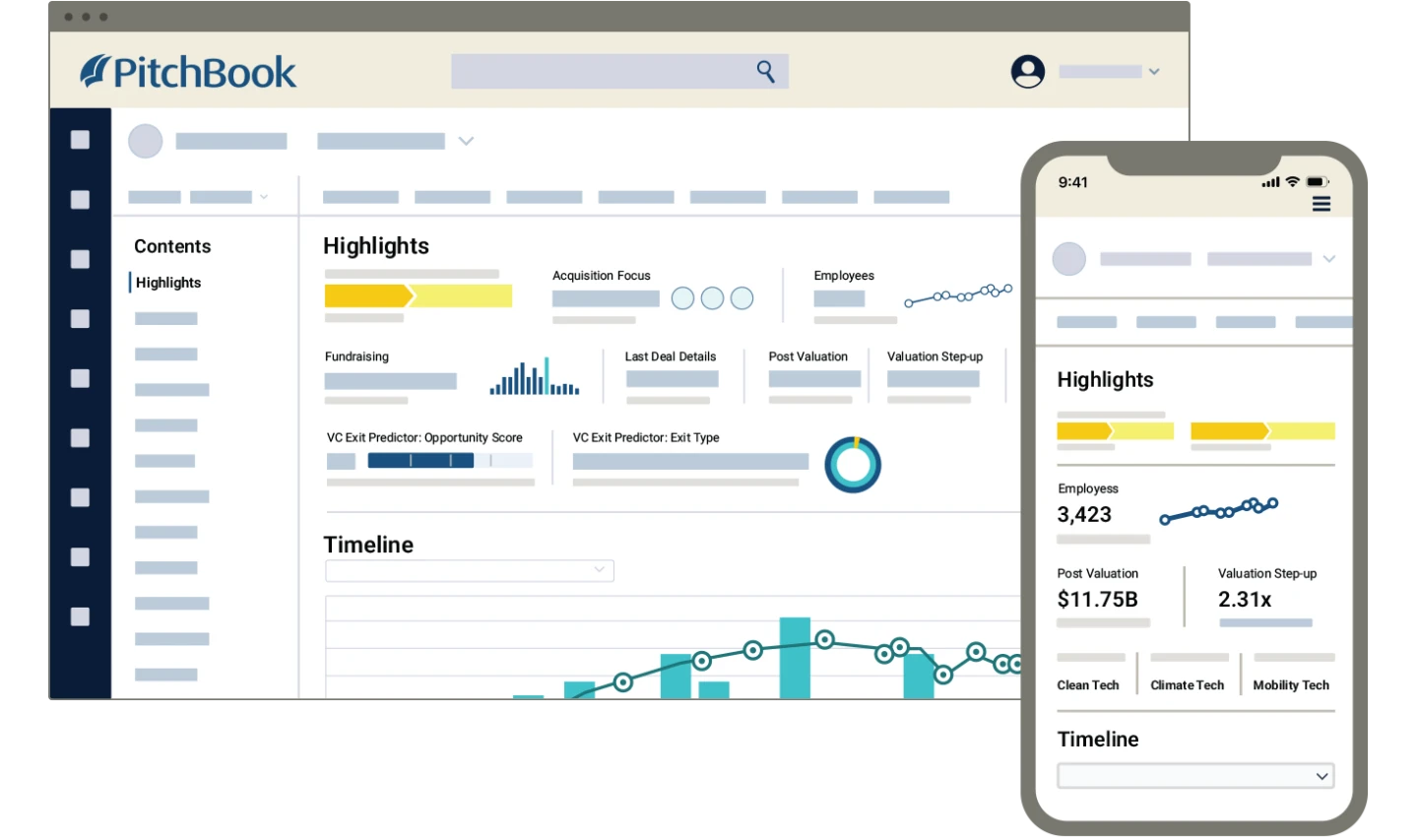
Source: PitchBook
PitchBook Pros & Cons
Pros | Cons |
|---|---|
- Broad private capital markets data coverage | - No publicly listed pricing; sales-gated quotes only |
- All-inclusive data access with no per-dataset charges | - No self-serve tier for smaller organizations |
- 60+ analyst team publishing institutional-grade research | - Steep learning curve for casual users |
- Primary research methodology with direct source verification | - No SOC 2 Type II or ISO 27001 certification |
- AI-powered Navigator for natural-language queries | - Corporate client segment showing persistent softness |
- Dedicated customer success manager for every account | - No B2B contact data for sales prospecting or outreach |
- Free Excel, PowerPoint, and Chrome extension plugins | - CRM integrations priced as premium add-ons |
PitchBook Review: How it Works & Key Features
PitchBook Desktop: A browser-based platform covering private and public markets in one view.
PitchBook Desktop is the flagship product. PitchBook calls it the most comprehensive, accurate, and timely source of private capital market data. For deal professionals, it largely delivers on that claim.
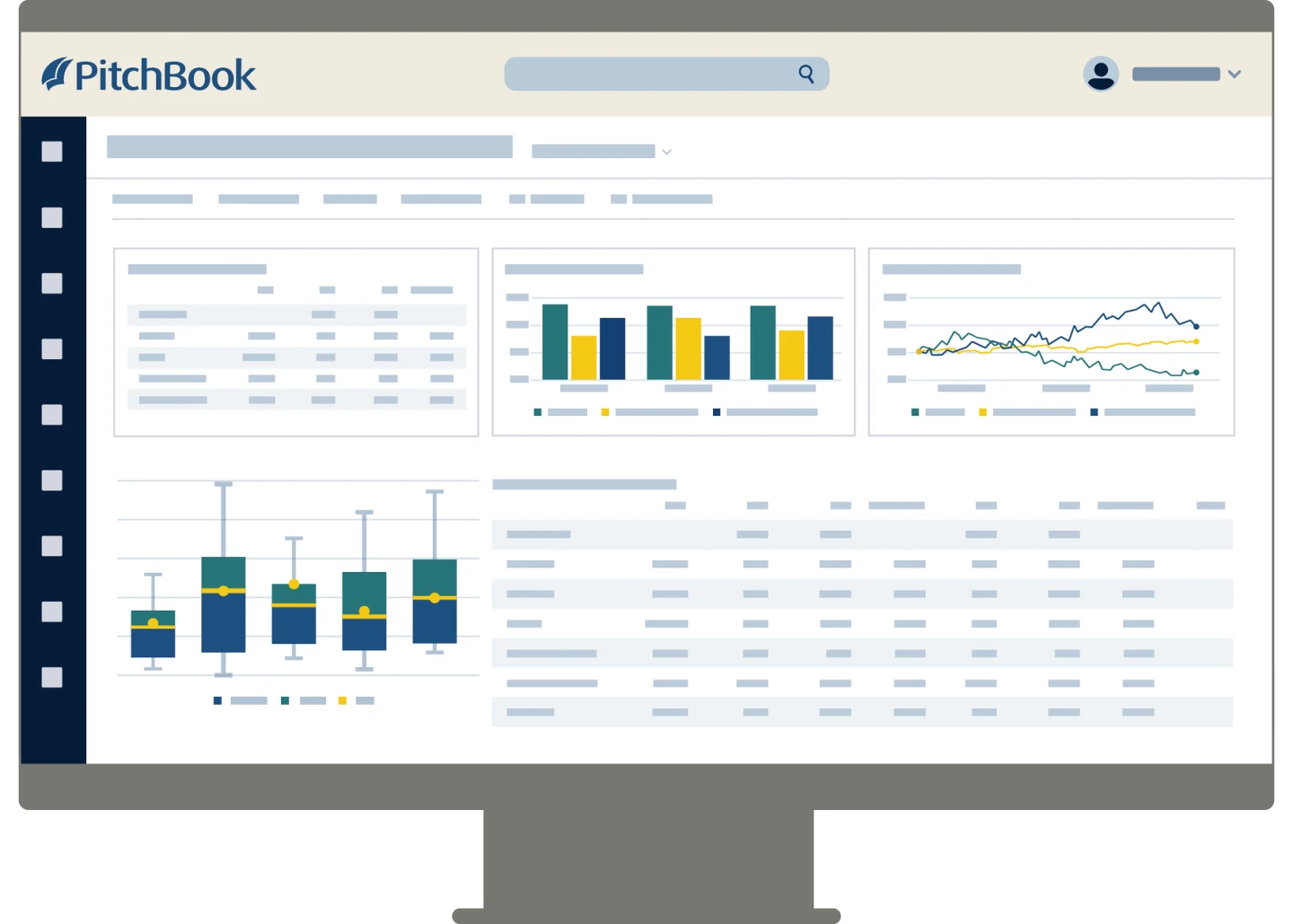
Source: PitchBook
A typical workflow moves through several stages: search and filter using Advanced Search across companies, investors, deals, funds, LPs, and professionals; explore entity profiles with financing history, cap tables, executives, and competitors; navigate to Discovery for analyst-built market maps; run comparables and benchmarks; set up monitoring via saved searches and alerts; then export data into deliverables via Excel, PowerPoint, and CRM integrations.
Advanced Search lets users zero in on companies, deals, investors, or individuals on criteria from broad to granular. Datasets update six times a day, and saved searches are dynamic, refreshing automatically as new matching entities enter the database.
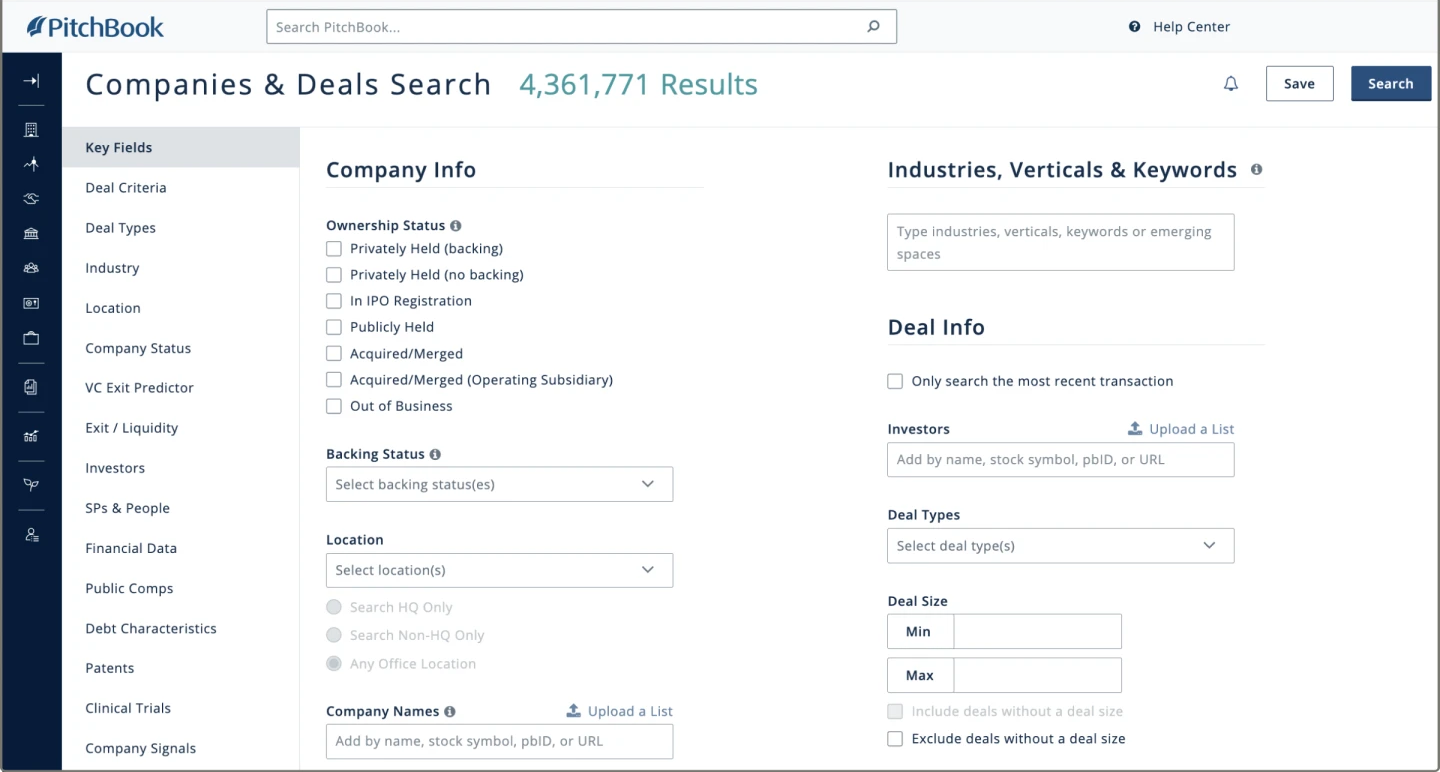
Source: PitchBook
Company Profiles surface pre- and post-money valuations, cap tables, balance sheets, financing history, executive teams, competitors, and AI-generated overviews. Non-financial signals like hiring pace, website traffic, and social media followers add context. Public company profiles incorporate consensus estimates from 800+ contributing analysts.
Deal and Fund Data covers over 2.8 million deals and 156,000+ funds with deal structure, pricing, terms, multiples, performance data, IRR, and cash flow multiples. Following the LCD integration, PitchBook also covers over 525,000 debt instruments.
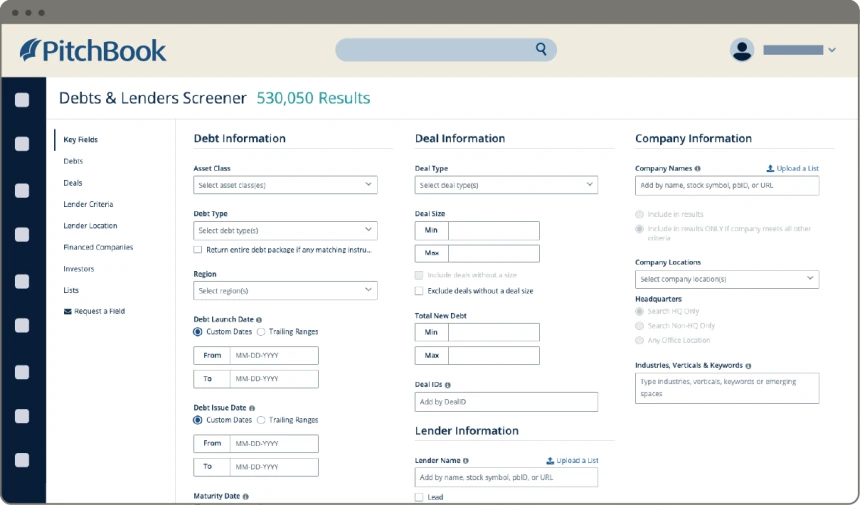
Source: PitchBook
PitchBook's all-inclusive pricing model sets it apart. Other data providers charge per dataset. PitchBook's all-inclusive pricing gives access to all data from day one. A PE analyst researching a target can move from company financials to fund benchmarks to credit data without hitting a paywall.
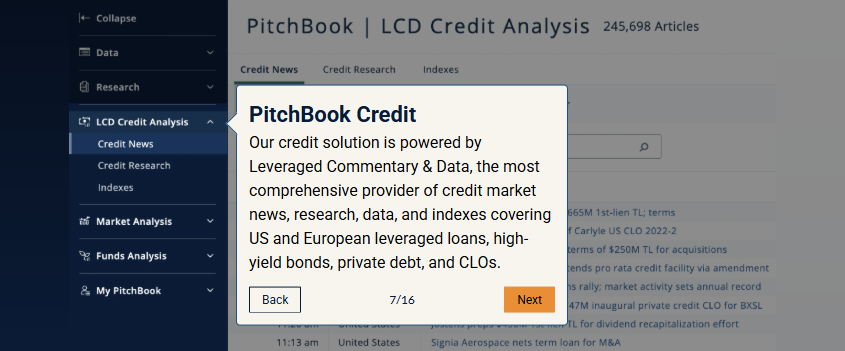
PitchBook Credit: The leveraged loan and credit database, integrated with private market intelligence.
PitchBook Credit, powered by LCD (Leveraged Commentary & Data), calls itself "the most comprehensive credit market database, credit news and research." LCD was acquired from S&P Global in June 2022 for up to $650 million, bringing its leveraged loan data under PitchBook's roof.
The credit platform consolidates several datasets into one dashboard. The Leveraged Loan Data set covers deal structure, pricing, yield, volume, secondary market performance, and PE-led LBO activity, maintained by 12 reporters with 25+ years of experience. The Private Credit Database contains 450,000+ private debt data points covering direct lending, mezzanine, distressed credit, and unitranche deals. Additional datasets include CLO Portfolio Holdings and BDC Holdings.
Source: PitchBook
The Morningstar LSTA Index Family, which tracks approximately $1.53 trillion in outstanding broadly syndicated loans, gives PitchBook a built-in advantage: credit funds benchmarked against it need PitchBook's data for performance attribution.
PitchBook Credit's strength is its connection to PitchBook's broader dataset. A credit analyst can move from a loan news story to sponsor and borrower profiles (PE fund history, VC backing, prior financing rounds) without leaving the platform.
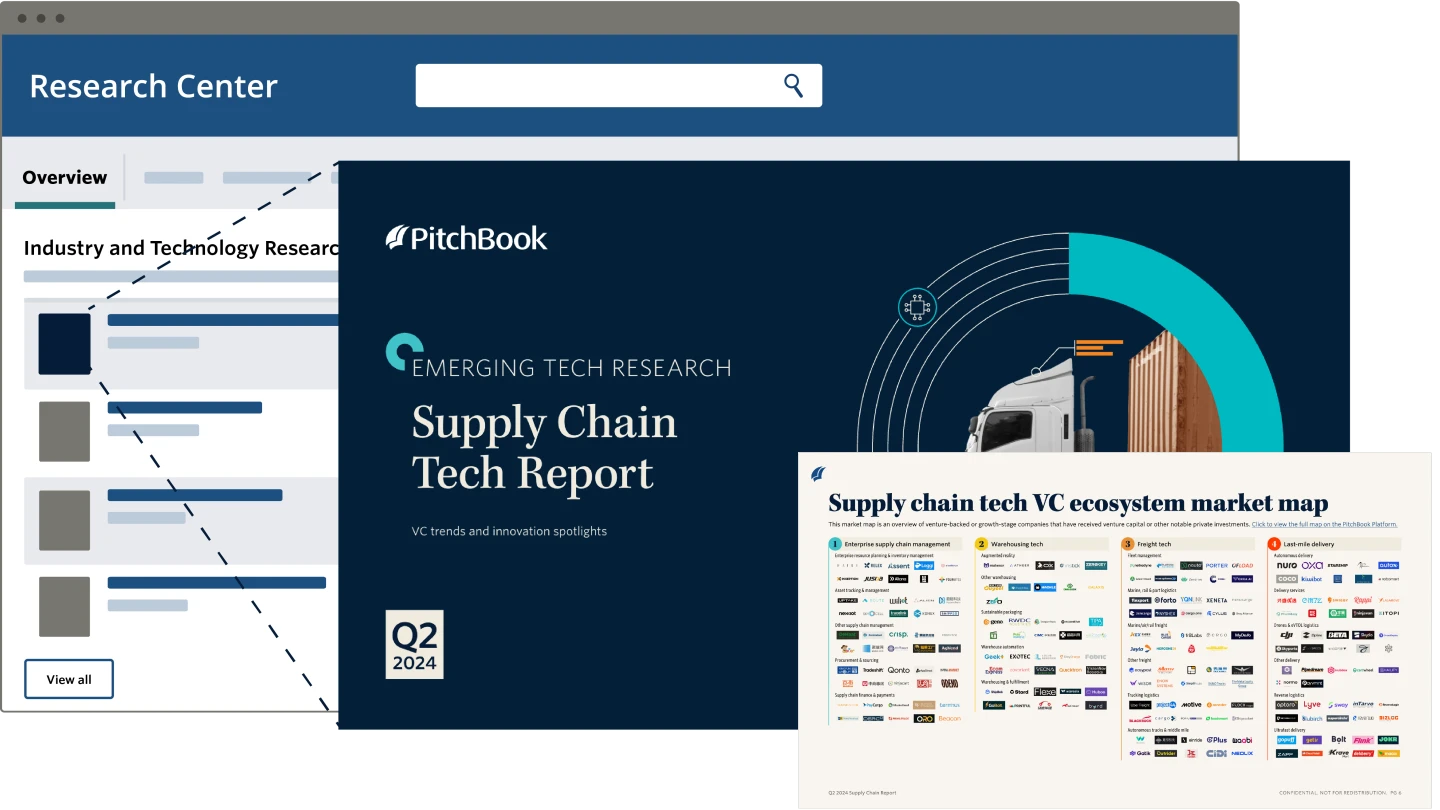
Research & Analytics: Institutional-grade research from 60+ analysts, plus quantitative tools.
PitchBook's Research & Analytics group combines its data with a dedicated analyst team. The Research Center lets users search through over 130,000 PitchBook and Morningstar reports from a single interface.
The PitchBook Institutional Research Group (PIRG) employs 60+ analysts with CFA, CAIA, and PhD credentials who publish dozens of new reports daily across PE, VC, M&A, real assets, leveraged loans, high-yield bonds, private credit, and 31 industry and technology verticals. Clients can reach analysts directly via phone and email.
Source: PitchBook
On the quantitative side, PitchBook offers several tools that go beyond static data:
VC Exit Predictor: An ML model that predicts exit probability. It is 75% accurate, and top-decile companies are 3.1x more likely to exit.
Manager Scores: Fund manager scoring on a 1-100 scale covering Fund Performance, Capital Call Speed, and Distribution Speed.
PitchBook Valuation Estimates: The first daily valuation model for private companies, covering 15,000+ VC-backed companies.
Custom Benchmarks: Custom peer benchmarks using performance data from 5,000+ funds.
Flagship report series include the PitchBook-NVCA Venture Monitor, widely cited as the authoritative US VC data source, and annual outlooks across asset classes.
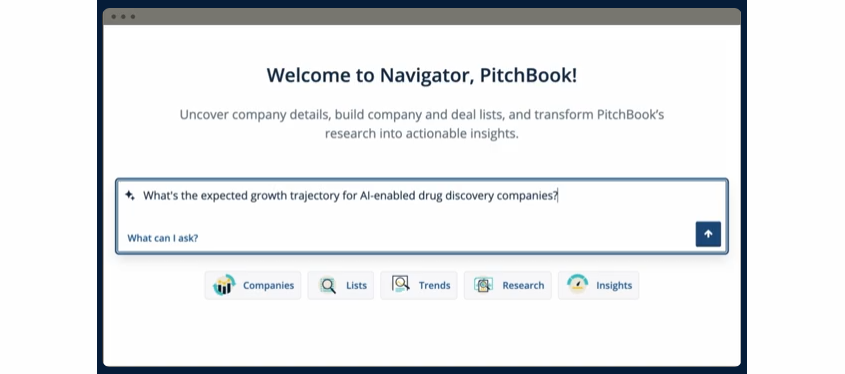
AI and Workflow Tools: PitchBook Navigator brings natural-language queries to private market data.
PitchBook launched Navigator, its generative AI feature, in November 2025. Users ask natural-language questions and get answers drawn from PitchBook data: deal screeners, market trend summaries, and research synthesis.
Navigator is built on what PitchBook calls its AI + HI (Artificial Intelligence + Human Insights) methodology. The "HI" component matters. Financial professionals worry about AI hallucination, and PitchBook grounds its AI outputs in human-verified data rather than generic training data.
Source: PitchBook
PitchBook has embedded AI elsewhere in the platform, too. AI-generated profile summaries give quick company overviews. ML-powered search suggestions help refine queries. Transcript summaries distill earnings calls.
PitchBook is also feeding its data into external AI tools through partnerships with Anthropic, Perplexity, Rogo, Hebbia, and OpenAI. PitchBook data now surfaces inside ChatGPT, Claude, and other LLM tools, reaching professionals who don't have a PitchBook login.
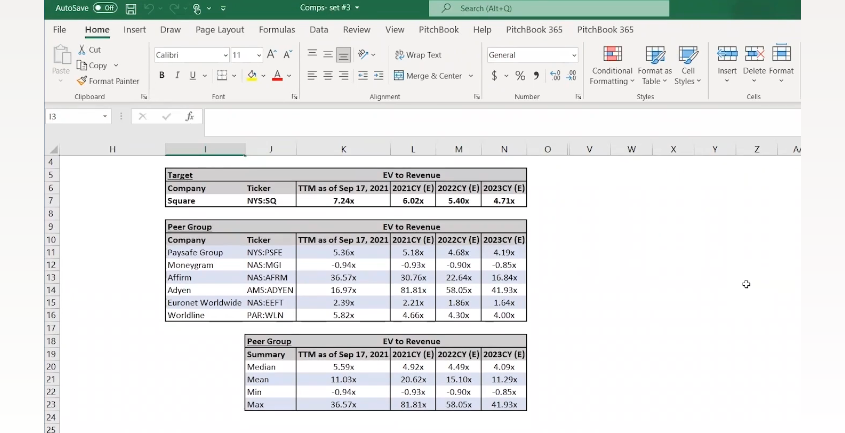
Direct Data and Integrations: Excel plugins, CRM connectors, and API access for embedding PitchBook data into existing workflows.
PitchBook's Direct Data products connect private capital market data with third-party tools. Several come free with every subscription:
Excel Plugin: 30+ pre-built templates for tearsheets, comps, and valuations, with a formula builder for pulling specific data points.
PowerPoint Plugin: Charts and tables that update automatically when underlying data refreshes.
Chrome Extension: Shows PitchBook data while browsing. Highlight and right-click any company name to see funding, investors, employees, and contacts (covering 900,000 companies and 1.5 million contacts).
Mobile App: Available on iOS and Android with news feeds, push notifications, list management, and Company Signals.
Source: PitchBook
Premium add-ons include a RESTful, JSON-based API covering all PitchBook entity types, customizable Data Feeds delivered to Azure, Snowflake, or AWS, and CRM integrations for Salesforce, HubSpot, and Microsoft Dynamics (supporting 83 mappable fields for Salesforce and Dynamics, and 80+ custom fields for HubSpot). CRM integrations sync automatically weekly.
Pricing: Enterprise-only, sales-gated, all-inclusive.
PitchBook does not publish pricing.
All buyers must request a quote from the sales team. Per Morningstar's FY2025 10-K, PitchBook generates most revenue through subscription services sold per-user or per-enterprise. License agreements typically range from one to three years.
Free access points include:
A free trial of PitchBook Desktop (gated request; excludes investor, people, LP, service provider, and debt data)
A free trial of LCD/Credit available separately
Limited profile previews visible publicly without login
PitchBook Pioneer training and certification, free to anyone regardless of license status
The pricing separates the core platform from premium additions. PitchBook Desktop is the base subscription with all-inclusive data access. PitchBook Credit (LCD), Direct Data (API and feeds), CRM integrations, and Premium Connectors for AI platforms are each priced separately.
Where PitchBook Falls Short
PitchBook excels at private capital markets intelligence. But its design has clear boundaries.
No B2B Contact Data for Sales Execution.
PitchBook tracks executive names, titles, and backgrounds, but it is not a prospecting tool. It does not provide verified direct-dial phone numbers or business email addresses.
If your workflow moves from "identify a target company" to "contact the VP of Engineering at that company," PitchBook cannot complete that step. You need a separate B2B data platform for outreach.
No Buyer Intent or In-Market Signals.
PitchBook tracks deal activity, funding events, and executive movements, all useful for understanding what has already happened. But it does not track buyer intent signals (the behavioral indicators showing when a company is researching a solution or preparing to buy).
For sales teams, knowing that a company raised a Series B is useful context. Knowing that the same company is currently evaluating CRM software is intelligence you can act on. PitchBook provides the former but not the latter.
No Self-Serve or SMB Access Path.
PitchBook has no published pricing, no self-serve purchasing, and no permanent free tier. Every prospect must engage sales for a quote. Academic licenses are available but carry download limits of 10 rows per day and 25 per month. This blocks smaller corporate development teams, individual analysts, and startups that need the data but cannot justify an enterprise contract.
Declining Renewal Rate Trend.
PitchBook's annual revenue renewal rate has fallen from 127% in 2021 to 103% in 2025. This reflects higher churn and lower expansion in the corporate segment, plus reduced expansion among core investor clients. A rate above 100% still means net revenue growth from existing clients, but the trend suggests some buyers find less value over time.
Missing Security Certifications.
Per PitchBook's Microsoft 365 Publisher Attestation filing, the platform does not hold SOC 2 Type II or ISO 27001 certifications. PitchBook inherits SOX compliance from Morningstar and runs annual penetration tests and quarterly vulnerability scans, but the absence of SOC 2 and ISO 27001 is notable for a data platform serving financial institutions.
These are not failures. They are the boundaries of a platform built for private capital market intelligence, not sales execution. But they create a gap for teams whose work extends beyond deal research into prospecting and outreach.
The Perfect Complement to PitchBook: ZoomInfo
ZoomInfo bridges the gap between finding an opportunity in PitchBook and acting on it. Where PitchBook answers "what deals are happening and who's investing?", ZoomInfo answers "who should I contact, what's their direct dial, and are they in-market right now?"
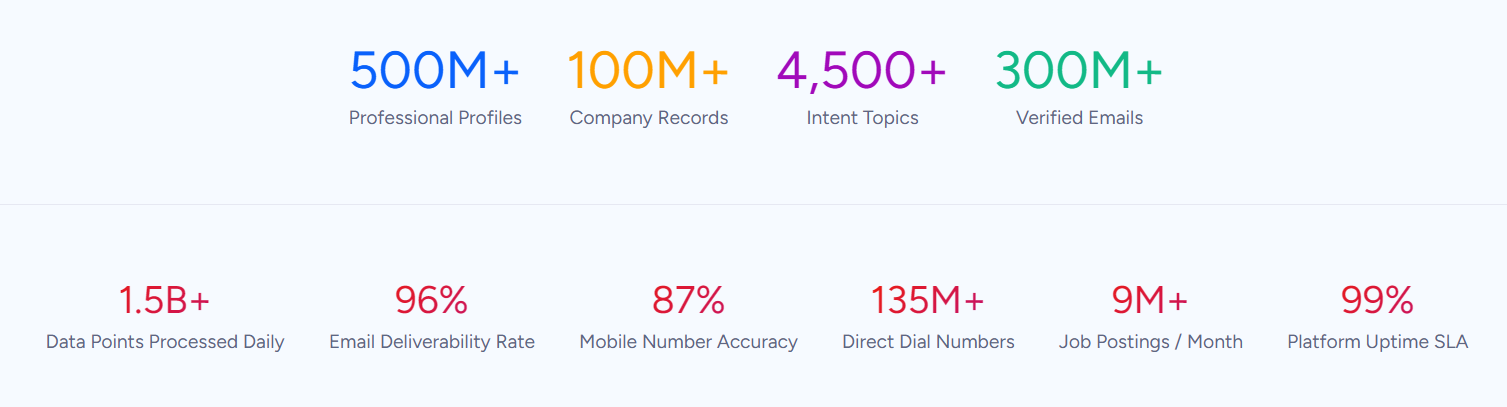
ZoomInfo is a B2B intelligence and sales platform built on a large data foundation: 500M contacts, 100M companies, 135M+ verified phone numbers, and 200M+ verified business email addresses. 300+ human researchers verify this data through multiple sources, reaching up to 95% accuracy on first-party data.
In a Fortune 500 competitive RFP analyzing 25 million contacts across vendors, the independent consultant concluded that "no other competitor came even close."
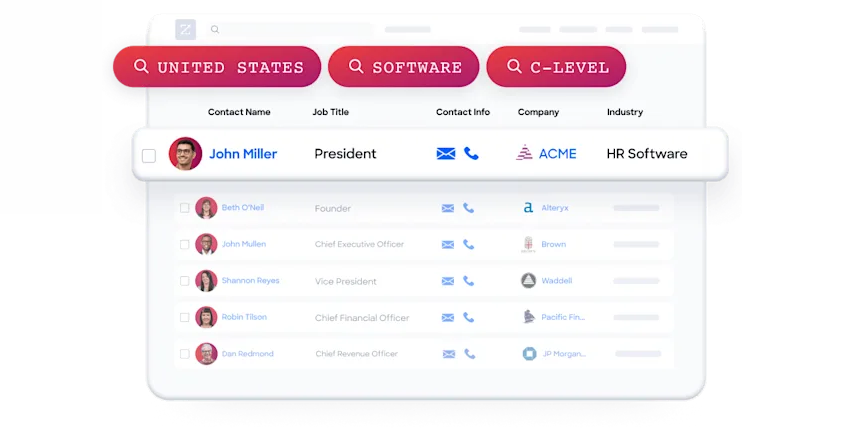
Verified B2B Contact Data: ZoomInfo provides the direct dials and verified emails that PitchBook doesn't.
PitchBook tracks executive names and titles. ZoomInfo provides the contact details needed to reach them: 120M direct-dial phone numbers and 200M+ verified business email addresses, searchable by 300+ company attributes including job function, seniority, department, geography, and tech profile.
Source: ZoomInfo
For deal teams and corporate development professionals, this means moving from "we've identified the target" to "we're on the phone with the decision-maker" without relying on LinkedIn outreach or manual research. Department org charts show reporting structures. Contact Tracker alerts you when executives change jobs. One-click CRM export eliminates manual data entry.
The data extends beyond contacts.
ZoomInfo tracks the tech stack of 30+ million companies across 30,000+ technologies, company attributes (industry, headcount, revenue, parent-child hierarchy relationships), and demographic data for selling to multiple stakeholders at once.
Source: ZoomInfo
Snowflake uses ZoomInfo for at least one-third of the most critical data features in their Account Propensity Scoring model, feeding over 70 company and technographic data fields. Accounts monitored using ZoomInfo-powered scores showed 90% higher opportunity open rates and 2x higher customer conversion rates. (Snowflake)
Buyer Intent and In-Market Signals: ZoomInfo reveals when companies are actively researching solutions, not just when they've completed a deal.
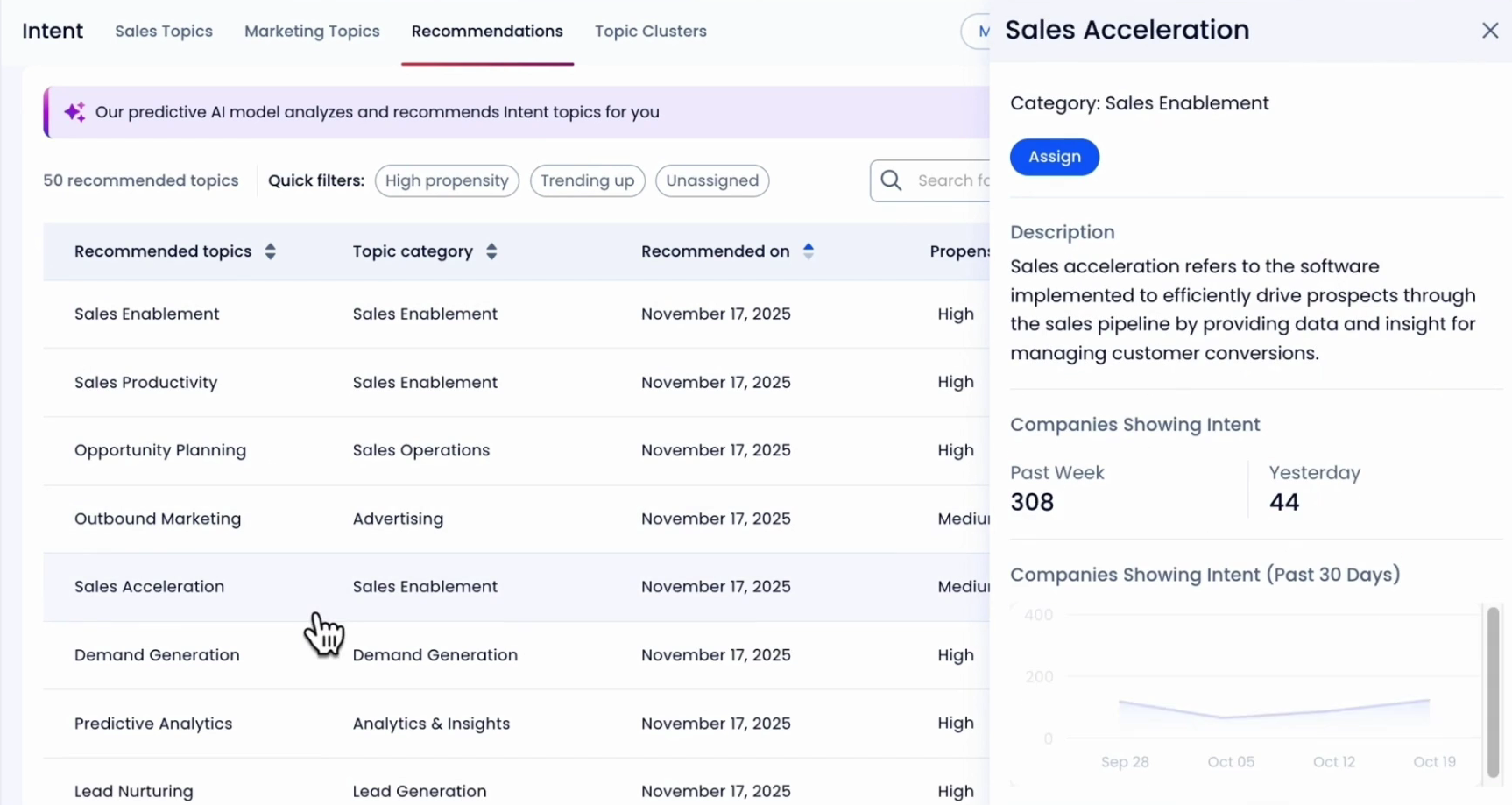
PitchBook tracks deal activity after it happens: funding rounds, acquisitions, exits. ZoomInfo's Buyer Intent Data tracks signals from 210 million IP-to-Organization pairings and 6 trillion+ new keyword-to-device pairings sourced monthly, revealing when a company is researching a product category before it reaches out to any vendor.
Guided Intent (exclusive to ZoomInfo) identifies topics historically correlated with closed deals rather than requiring manual topic selection. This is the difference between knowing a company closed a funding round (PitchBook) and knowing that same company is currently evaluating your type of solution (ZoomInfo).
Source: ZoomInfo
WebSights identifies which companies visit your website by resolving anonymous traffic to organizations, including buying team identification and contact details.
Seismic attributed 39% of active pipeline to opportunities identified or influenced by ZoomInfo signals and reported 54% productivity gains. "That combination of our internal CRM data, external signals, and AI that's given all that context has helped us craft very specific account- and persona-based messages." (Seismic)
AI-Powered Sales Execution: ZoomInfo's GTM Workspace gives sellers one place for account intelligence and outreach.
The GTM Context Graph (ZoomInfo's intelligence engine) processes 1.5B+ data points daily by combining ZoomInfo's B2B data with a customer's CRM records, conversation transcripts, and behavioral signals. It captures not just what happened in a deal, but why.
This powers GTM Workspace, the seller's front-end where prioritized accounts, AI-drafted outreach, and deal execution live in one place.
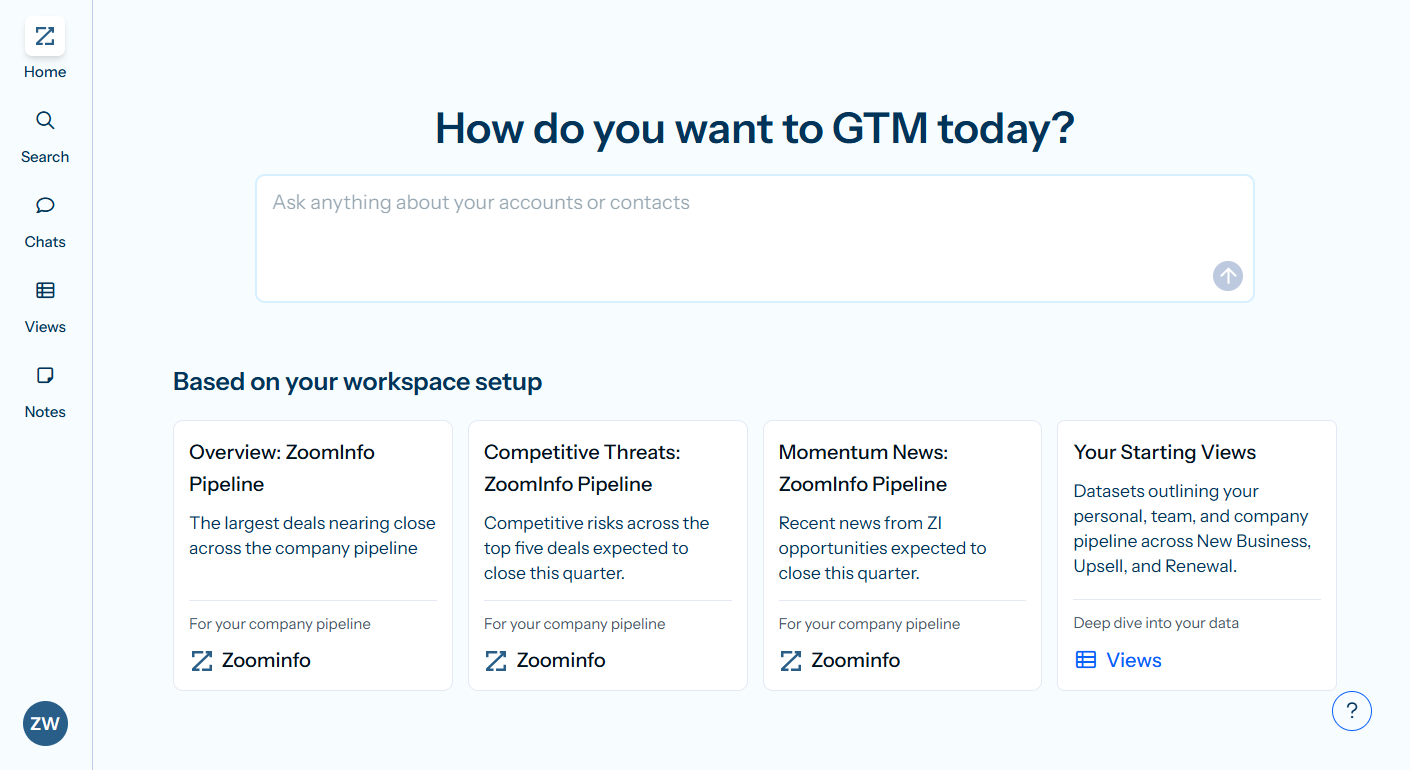
For marketers and RevOps teams, GTM Studio lets users define audiences, orchestrate campaigns, and measure pipeline using natural language. For teams building custom tools, APIs and MCP expose the same data to any application, workflow, or AI agent.
"ZoomInfo is our one source of truth for account data, and even more so for contact data. There's no other provider in the market that provides you with that level of detail." Thor Sanderson, Senior Manager of Sales Technology Enablement. (Smartsheet)
Accessible Pricing with a Free Tier: ZoomInfo offers multiple entry points before committing to a paid plan.
Unlike PitchBook's sales-gated model, ZoomInfo provides two free access paths.
ZoomInfo Lite is a permanent free tier (no credit card, no time limits) that includes access to 100M+ verified profiles, 10 monthly export credits, the ReachOut Chrome Extension, and WebSights Lite (up to 10 website visitor reveals per day). A separate 7-day free trial provides access to core platform features including intent signals and email outreach.
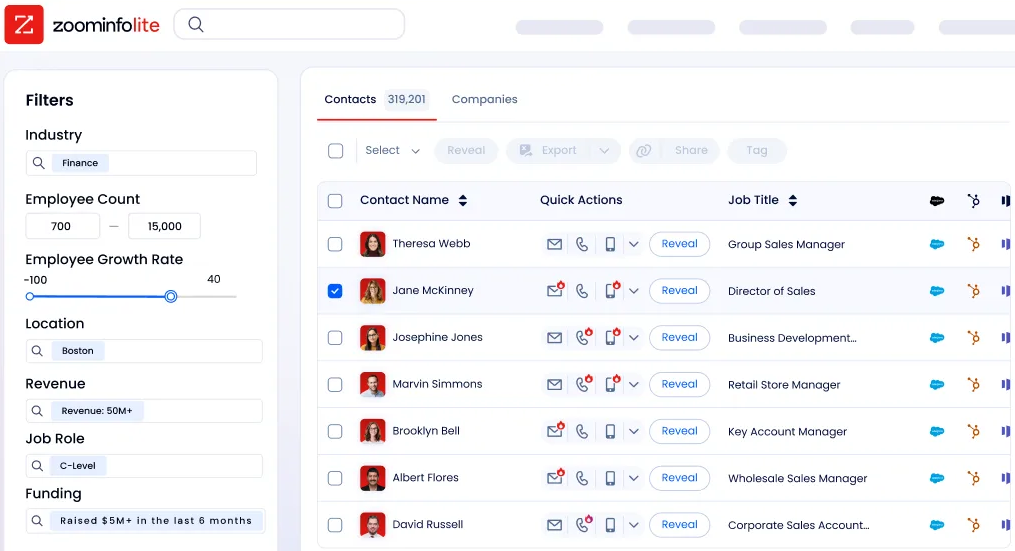
Source: ZoomInfo
Paid plans are organized into Sales, Marketing, and standalone products (Chorus for conversation intelligence, Chat for website engagement), with three tiers each: Professional, Advanced, and Enterprise. Pricing is consumption-based and custom-quoted, scaling with seats, credits, and feature access. API access is included in all relevant plans.
PitchBook and ZoomInfo: Comparison Summary
Aspect | PitchBook | ZoomInfo |
|---|---|---|
Primary Focus | Private capital market intelligence | B2B sales intelligence and execution |
Database Scope | ~6M companies, 2.7M investments, 570K investors, 4.4M people | 500M contacts, 100M companies, 135M+ verified phones, 200M+ verified emails |
Contact Data for Outreach | Executive names and titles only | Direct dials, verified emails, org charts |
Buyer Intent Signals | Not available | 210M IP-to-Org pairings, 6T+ keyword signals monthly |
Deal and Fund Data | 2.8M deals, 156K+ funds, 525K+ debt instruments | Not available |
Analyst Research | 60+ analysts, 130K+ reports, daily publishing | Not applicable |
AI Capabilities | Navigator (natural-language queries over private market data) | GTM Context Graph, AI agents, automated outreach |
Free Tier | Limited free trial (gated) | Permanent free tier (ZoomInfo Lite) + 7-day trial |
Pricing Transparency | No published pricing; sales-only | No published pricing; sales-only (but free tier available) |
Security Certifications | SOX (via Morningstar); no SOC 2 or ISO 27001 | ISO 27001, ISO 27701, SOC 2 Type II, GDPR/CCPA validated |
Best For | Deal sourcing, due diligence, fund benchmarking, credit analysis | Sales prospecting, ABM, pipeline generation, sales execution |
Final Verdict
PitchBook and ZoomInfo serve different functions, and the choice depends on what you need.
Use PitchBook if you work in private capital markets and need intelligence on deals, funds, investors, and companies.
It is the right tool for PE and VC professionals conducting due diligence, LPs evaluating fund managers, investment bankers building buyer lists, and credit analysts tracking leveraged loan markets. Its combination of primary-sourced data, institutional-grade research, and all-inclusive access makes it the standard for private market intelligence.
The lack of a self-serve tier means it's best suited for organizations with the deal volume and budget to justify an enterprise subscription.
Add ZoomInfo if your work extends beyond deal intelligence into sales execution, prospecting, or outreach.
ZoomInfo fills the gap that PitchBook was never designed to address: verified contact data for reaching decision-makers, buyer intent signals for identifying in-market companies, and AI-powered tools for turning intelligence into action.
For corporate development teams, investment banks with active origination, and any organization that needs to move from "we found the target" to "we're in conversation with the buyer," ZoomInfo connects research to revenue.
Get started with ZoomInfo here.
Together, PitchBook provides the deal context and market intelligence. ZoomInfo provides the contact data, intent signals, and execution tools to act on it.
PitchBook FAQ
What does PitchBook cost?
PitchBook does not publish pricing. All buyers must contact the sales team for a custom quote. Subscriptions are sold per-user or per-enterprise, with license agreements typically ranging from one to three years. PitchBook Credit (LCD), API access, and CRM integrations are priced separately from the core platform. There is no self-serve purchasing path or permanent free tier.
Who is PitchBook designed for?
PitchBook serves professionals whose work depends on private market intelligence: private equity firms, venture capital firms, investment banks, limited partners, corporate development teams, credit investors, lenders, law firms, and accounting firms.
It is not designed for individual retail investors, early-stage startups without institutional investor engagement, or sales teams focused on prospecting and outreach.
Does PitchBook have a free trial?
Yes. PitchBook offers a free trial of PitchBook Desktop through a gated request process. The trial excludes investor, people, LP, service provider, and debt data. A separate free trial is available for LCD/Credit. PitchBook Pioneer, the platform's training and certification program, is free to anyone regardless of license status.
How does PitchBook's data get verified?
PitchBook combines automated scanning with primary research. Web crawlers scan over one million news events per week, while 1,800+ researchers make direct calls and send emails to companies, investors, advisors, lawyers, and accountants to cross-validate data. Quality assurance runs through more than 100 proprietary processes. Public company data includes source-linked transparency connecting reported values to original SEC filings.
Does PitchBook offer CRM integrations?
Yes. PitchBook offers managed plugins for Salesforce, HubSpot, and Microsoft Dynamics, plus DealCloud and Affinity. Salesforce and Dynamics support 83 mappable fields, while HubSpot supports 80+ custom fields. All sync automatically on a weekly basis. CRM integrations are a premium add-on priced separately from the core subscription.
Can PitchBook be used for sales prospecting?
PitchBook tracks executive names, titles, and backgrounds, but it does not provide verified direct-dial phone numbers or business email addresses for outreach. It was designed for deal intelligence, not sales execution. Teams needing prospecting capabilities should consider a B2B data platform like ZoomInfo, which provides 120 million direct-dial phone numbers and 200 million+ verified business email addresses.
Does PitchBook hold SOC 2 or ISO 27001 certifications?
No. Per PitchBook's Microsoft 365 Publisher Attestation filing from March 2024, the platform does not hold SOC 2 Type II or ISO 27001 certifications.
It inherits SOX compliance from Morningstar and maintains operational security controls including annual penetration testing, quarterly vulnerability scanning, and a formal incident response process with 72-hour breach notification. SSO is supported via SAML 2.0 with Okta, Microsoft Entra, and OneLogin.
What is PitchBook Navigator?
PitchBook Navigator is the platform's generative AI feature, launched in November 2025. Users ask natural-language questions and receive answers grounded in PitchBook's verified data, including deal screeners, market trend summaries, and research synthesis.
Navigator uses an AI + HI (Artificial Intelligence + Human Insights) methodology, meaning AI outputs are grounded in human-verified data rather than generic training data. PitchBook has also partnered with Anthropic, OpenAI, and Perplexity to make its data accessible inside external AI tools.
