

Reply.io is an AI-powered sales engagement platform that bundles multichannel outreach, a B2B contact database, an autonomous AI SDR agent, and deliverability tools into a single subscription.
If you are evaluating what Reply.io can do across its product, this breakdown covers every feature area, how each works, who it serves, and which plan unlocks it.
Reply.io's feature set has you covered if:
You run multichannel outbound sequences combining email, LinkedIn, SMS, WhatsApp, and calls in a single workflow
You want an AI agent that finds prospects, personalizes outreach, handles replies, and books meetings around the clock
You need a B2B contact database with over a billion records and real-time verification so prospecting and outreach live in the same platform
You manage conditional sequences that adapt based on how each prospect engages
You want unlimited email warmup included with every purchased mailbox, backed by a peer-to-peer network of real inboxes
You run an agency managing multiple client campaigns and need workspace-level separation without per-seat pricing
You'll reach the edges of its capabilities if:
You need behavioral intent data showing which companies are researching your category across the web before you contact them
You want conversation intelligence that records, transcribes, and coaches from sales calls
You need account-based marketing orchestration, display advertising, or multi-channel campaign management beyond outbound sequences
You require an intelligence layer that fuses CRM records, conversation data, and third-party signals to explain why deals move or stall
You want analytics and forecasting tied to deal progression, not just email engagement metrics
For those needs, the reference point is ZoomInfo: a GTM platform built on 500M contacts, 100M companies, 135M+ verified phone numbers, and 200M+ verified business email addresses, a GTM Context Graph that fuses B2B data with CRM records, conversation intelligence, and behavioral signals, and access through APIs, MCP, GTM Workspace, and GTM Studio.
After the feature breakdown, this article covers where Reply.io stops and how ZoomInfo fills those gaps.
Reply.io Platform Overview
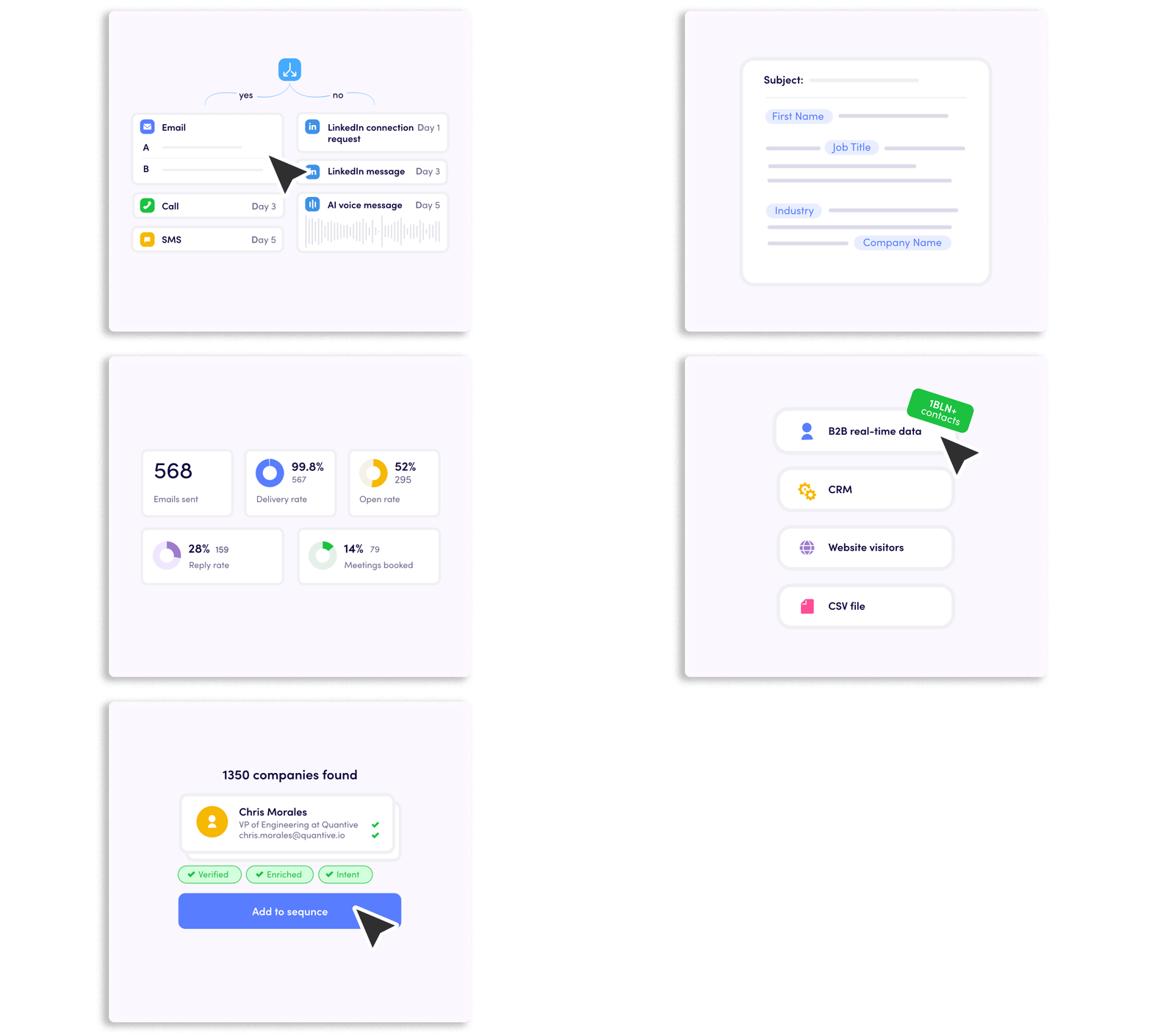
Source: Reply.io
Reply.io is an AI-powered sales engagement platform targeting SMBs, lean sales teams, agencies, and SDR teams who need to scale personalized outreach without expanding headcount. Over 3,000 companies use it, including Adobe, Strava, Youscan, and TNW, and G2 named it a Top 50 Sales Product of 2024.
The platform is organized around five capability areas plus an autonomous AI agent layer:
Module | What It Does | Plan Access |
|---|---|---|
Automated outreach combining email, LinkedIn, WhatsApp, SMS, and calls in unified workflows | Email Volume ($49/user/mo) for email only; Multichannel ($89/user/mo) for all channels | |
AI agent that finds prospects, builds sequences, personalizes messages, handles replies, and books meetings | AI SDR plans starting at $500/mo | |
1B+ contacts across 150+ countries with real-time verification and enrichment | Data credits included in paid plans; additional credits purchasable | |
Unlimited email warmup via peer-to-peer inbox network, inbox rotation, and sending optimization | Included with every purchased mailbox | |
Native CRM sync (Salesforce, HubSpot, Pipedrive), REST API (v3), MCP server, webhooks | API access on all paid plans |
Reply.io Multichannel Sequences: The Outreach Engine
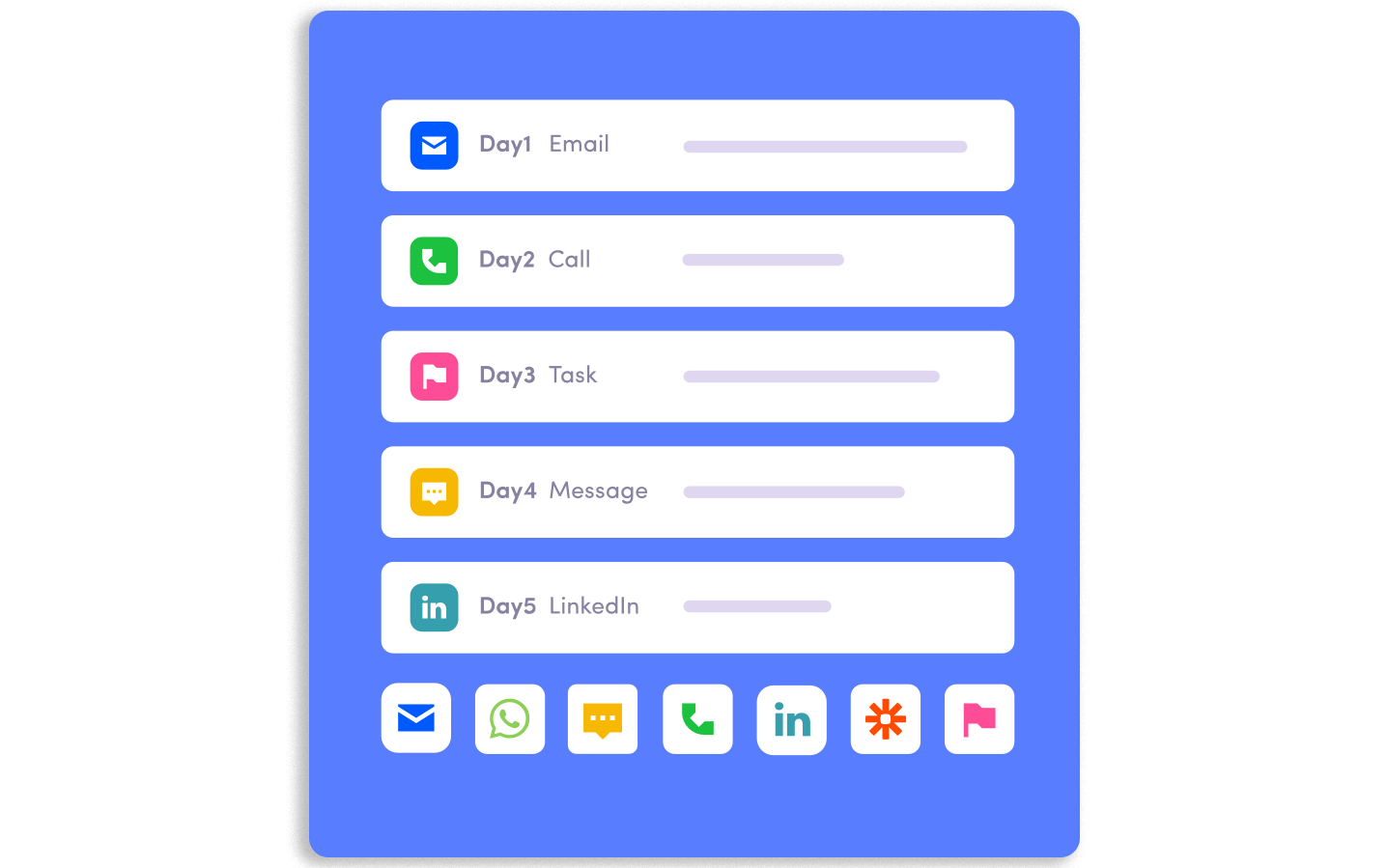
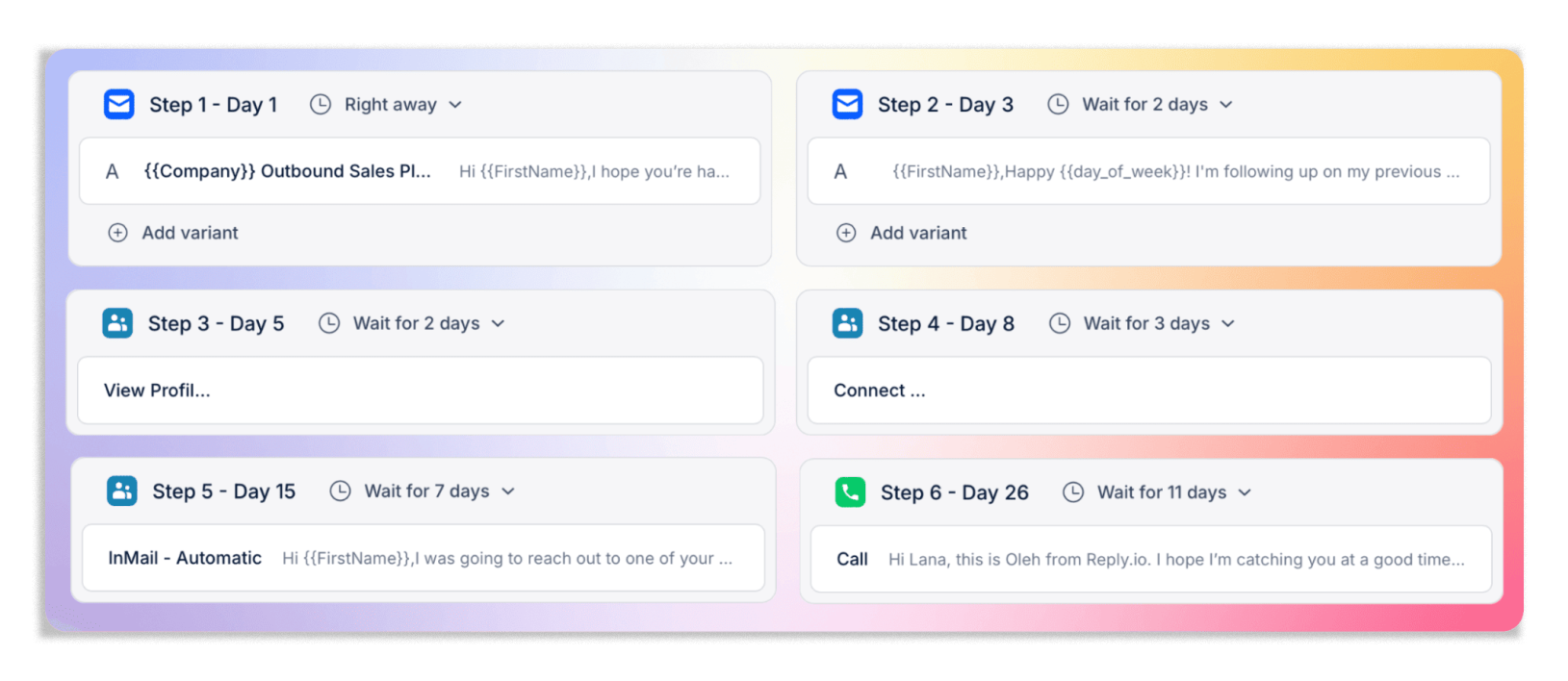
Multichannel Sequences are Reply.io's core automation capability, combining email, LinkedIn, WhatsApp, SMS, and calls into unified outreach campaigns. Each sequence is a series of touchpoints configured as automatic (sent by the system) or manual (generates a task for the user), with configurable timing delays between steps. Teams can set up a sequence in manual, mixed, or fully automated modes to match a specific product offering or target audience.
Source: Reply.io
Conditional Sequences add branching logic where different paths follow from prospects' actions and data. When a condition fires (such as "email opened" or "LinkedIn connection accepted"), the system checks every 10 minutes and moves prospects to the next step immediately. If the prospect has not acted when the monitoring period expires, they move to the "No" branch. The sequence splits into numbered "Yes" and "No" paths for tracking, and teams can wire in Zapier to connect any channel as a sequence step.
Personalization runs through three layers. Predefined variables (Email, First Name, Last Name, Job Title, Company Name, Phone, Website, Location, LinkedIn) populate at send time rather than using previously saved data. Conditional variables add context-aware branching within a template. AI variables generate personalized content based on prompts, so a single template produces distinct copy for each recipient without manual editing.
A/B testing launches with a single click, letting teams test different subject lines, email content, or calls-to-action across variants. The platform also includes inbox rotation to connect unlimited mailboxes and rotate them for higher volume, while automated warmup and deliverability monitoring keep emails out of spam.
The channel stack spans email steps for initial outreach and follow-ups, LinkedIn actions (profile visits, connection requests, DMs), calls via the integrated dialer, plus tasks for manual touchpoints. The Multichannel plan starts at $89/user/month, though LinkedIn automation adds $69/account and Calls/SMS adds $29/account as separate charges.
One constraint: LinkedIn automation violates LinkedIn's Terms of Service and can result in account blocks, with users reporting accounts being blocked, restricted, or not working as expected.
Reply.io's Jason AI: The Autonomous SDR Agent
Jason AI is Reply.io's autonomous sales development agent, a virtual SDR that works 24/7 finding buyers, researching them, launching multichannel sequences, personalizing messages and follow-ups, and handling replies. It operates on top of Reply.io's 1B+ contact database, combining prospect discovery, outreach creation, and conversation management in one AI layer.
Source: Reply.io
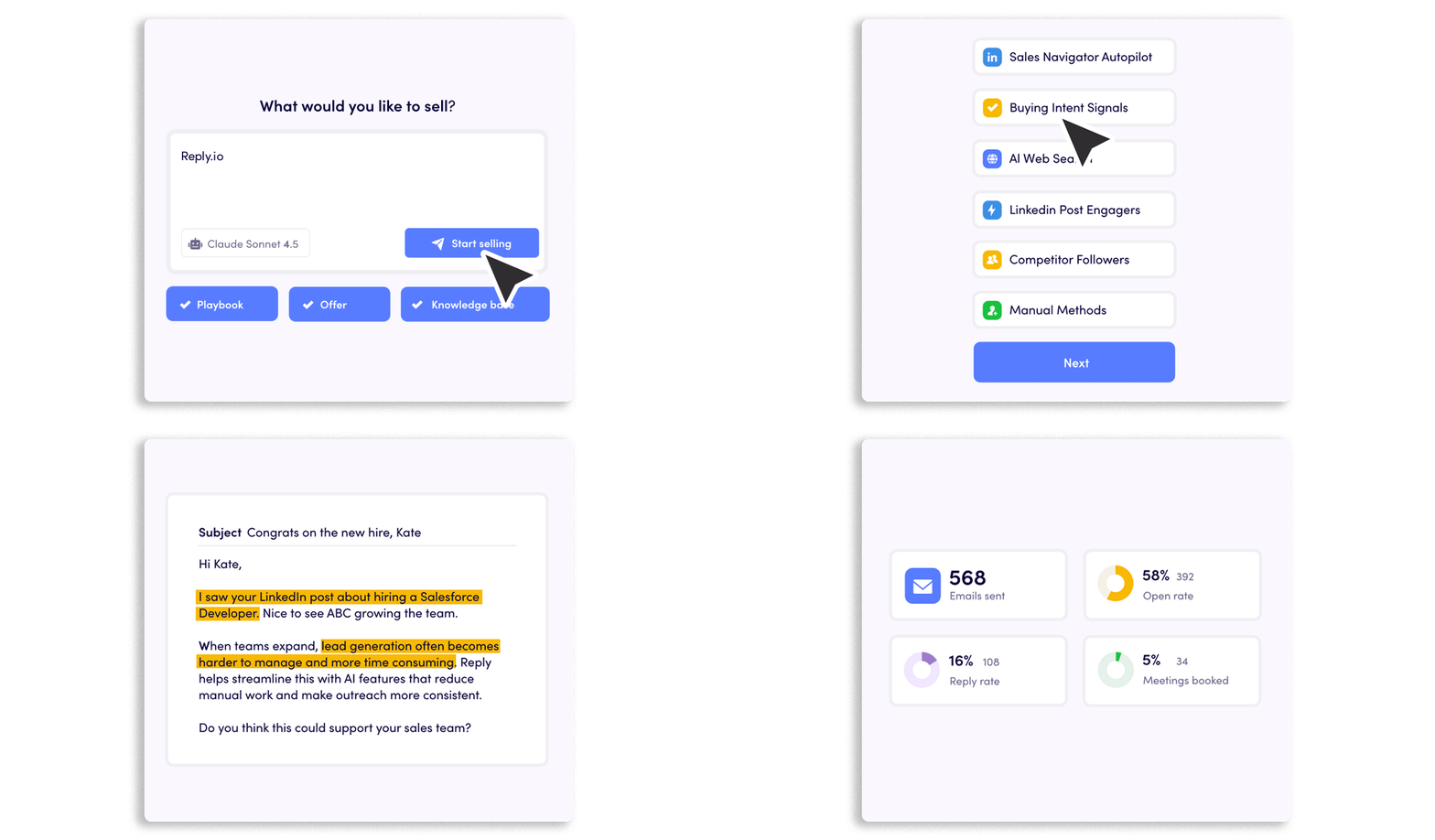
Setup follows the same onboarding you would give a human SDR. You provide your ideal customer profile, product details, and tone preferences, then upload PDFs, documents, sales scripts, or writing samples for Jason to learn your style and approach. From there, Jason analyzes your value proposition to define your ICP, finds qualified leads from its B2B database, and researches each prospect across LinkedIn, company websites, and other sources.
Jason then builds multichannel sequences combining email, LinkedIn, WhatsApp, and SMS with personalized messages for each prospect, adapting based on signals like "email opened," "link clicked," or "LinkedIn connection accepted." When prospects respond, Jason analyzes incoming messages and handles them directly by answering common questions, addressing objections, sharing resources, and proposing next steps. Meeting scheduling syncs with Google Calendar to book based on real-time availability, managing the back-and-forth if the recipient requests a different time.
Source: Reply.io
Every email passes through Jason's three-level validation system before sending: Level 1 checks brand voice using two AI models that compare messages against email examples from your playbooks; Level 2 enforces playbook rules and tone settings; Level 3 validates personalization by aligning prospect insights with your offer and showing exact sources to confirm factual accuracy. Users can choose their AI engine from Claude, Gemini, Mistral, or OpenAI.
Two operating modes give teams control over autonomy. Approval Mode routes every draft through human review before sending. Automatic Mode lets Jason handle routine replies independently, and teams can switch specific sequences or scenarios to automatic once comfortable with quality.
Jason's intent signal layer tracks signals such as hiring intent, technology usage, and behavioral insights to identify in-market prospects, and monitors LinkedIn activity on specific posts or creator profiles you choose, adding only qualified prospects who match your ICP to campaigns. The latest version, Jason AI SDR 2.7 (July 2025), added support for outreach in 50+ languages with native-level understanding, not just translation.
Jason AI pricing is separate from the core sequence plans. AI SDR Starter plans start at $500, $800, or $1,000/month (annual billing) for 1,000, 2,000, or 3,000 active contacts respectively. AI SDR Growth starts at $1,500 or $3,000/month for 5,000 or 10,000 active contacts. All AI SDR plans include unlimited users, multichannel automation, unlimited mailboxes and warmups, and all features unlocked.
Reply.io Data and Prospecting: The Built-In B2B Database
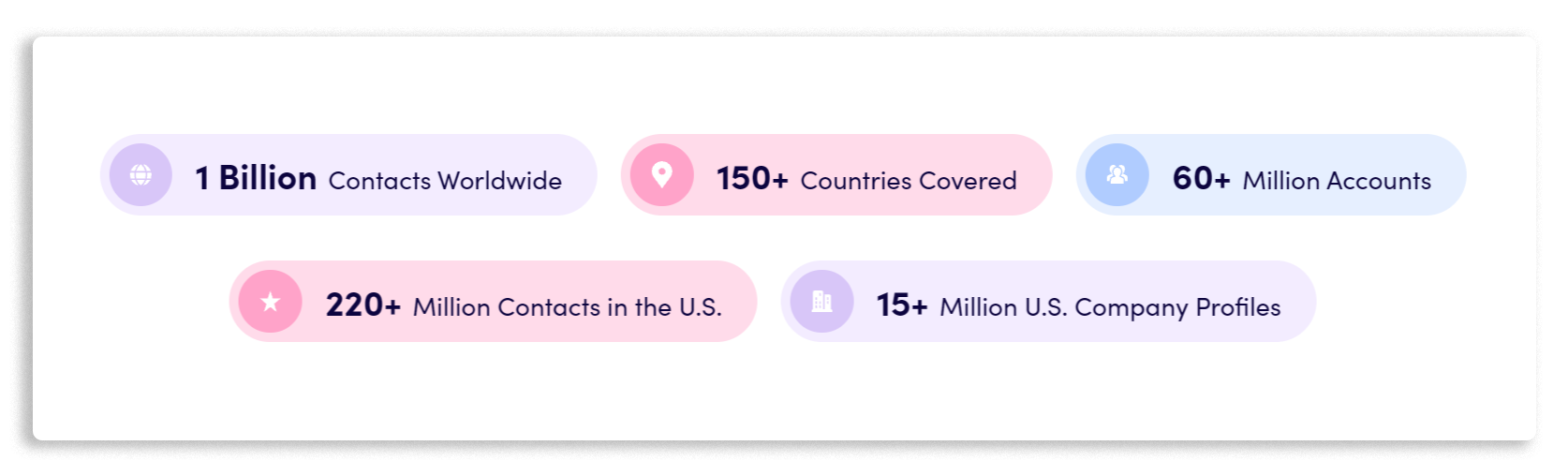
Reply Data is Reply.io's embedded B2B contact database, providing access to over 1 billion contacts and roughly 60 million accounts across 150+ countries, including more than 220 million U.S.-based contacts and 15 million U.S. company profiles. The database closes the gap between prospecting and outreach: search, enrich, verify, and push to a sequence from a single interface.
Source: Reply.io
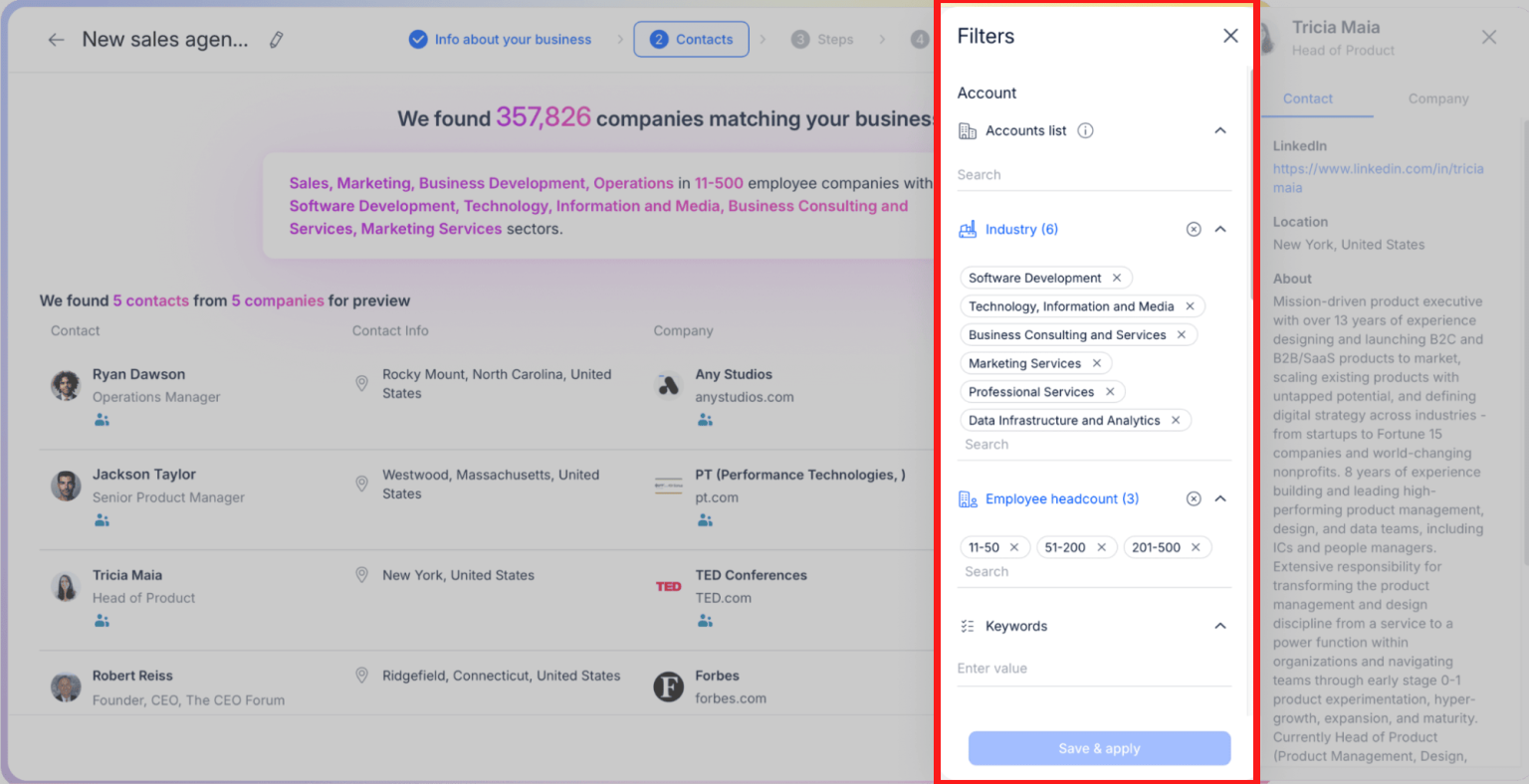
Users search through 16 filters including industry, location, employee headcount, technologies used, department, seniority, and intent signals. Exact job title search works in multiple languages, and users can upload account lists to search within specific companies. Hiring intent and technographic signals surface accounts showing buying intent through indicators like new job postings or shifts in tech stacks. The database searches the web in real time to keep contacts fresh rather than relying on static snapshots.
Source: Reply.io
The Findy Chrome extension enables prospecting directly from LinkedIn, gathering contact information and displaying real-time email and job title data while browsing profiles. Once contacts are identified, they can be transferred to a fresh list, existing list, or directly into a sequence for automated follow-up. All contacts include verified emails with bounce rates below 3%, verified to the mailbox level.
Credit costs scale by data depth: contacts without emails cost 1 credit, contacts with emails cost 2 credits, and intent data contacts cost 4 credits. 1,000 free data credits are included in Sales Engagement and Agency plans, with 200 free credits on trial and Free plans. The database integrates natively with Salesforce and HubSpot, syncing contacts, activities, and statuses automatically.
Reply.io's own features overview acknowledges that its data capabilities "may not provide the level of deep enrichment and prospecting features that platforms like Apollo or ZoomInfo offer," particularly for behavioral data or intent signals.
Reply.io Deliverability and Email Infrastructure
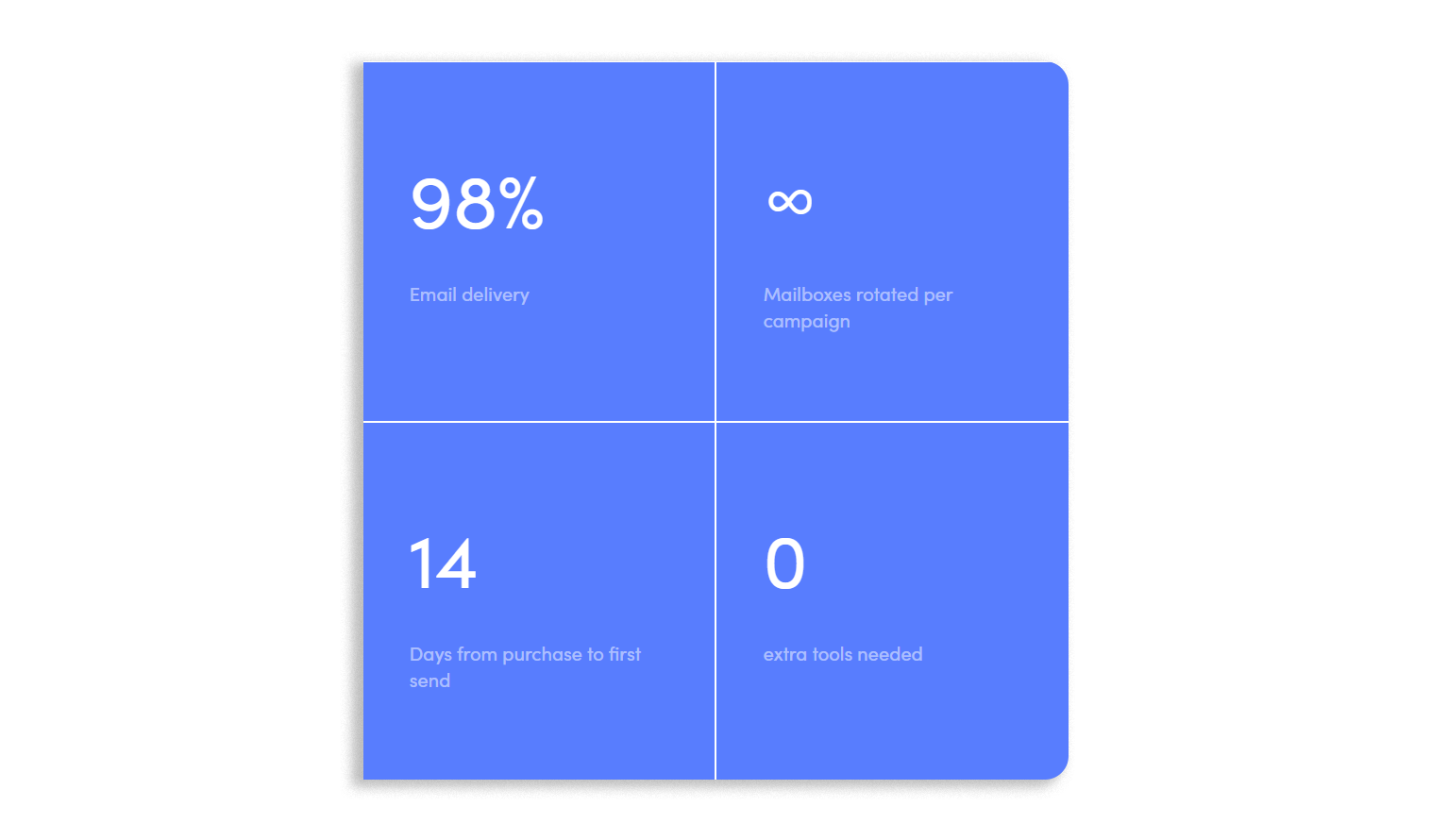
Reply.io includes unlimited email warmup with every purchased mailbox, using a peer-to-peer network of real inboxes to mimic human behavior and build sender reputation over two to three weeks. The warmup system exchanges emails with other accounts in the network, opening and replying with positive sentiment to warm both SMTP sending and IMAP receiving servers.
Source: Reply.io
Inbox rotation lets teams connect unlimited mailboxes and rotate them for higher volume within a single campaign, distributing sends across accounts to keep individual mailbox volumes sustainable. Plain text sending mode strips out HTML, images, and link tracking to bypass filters that flag marketing-formatted emails. Branded links align tracking URLs with your sending domain to build trust and reportedly boost open rates by 5-15%.
The platform also supports timezone-based delivery scheduling to reach prospects during their working hours, email throttling to control sending pace, and deliverability monitoring that surfaces inbox vs. spam placement data so teams can intervene before reputation degrades.
One limitation: setting up third-party mail servers requires technical knowledge, which can challenge non-technical users configuring custom SMTP/IMAP connections.
Reply.io Integrations, API, and Technical Infrastructure
Reply.io connects to the broader sales stack through native CRM integrations, a REST API, webhooks, and iPaaS platforms.
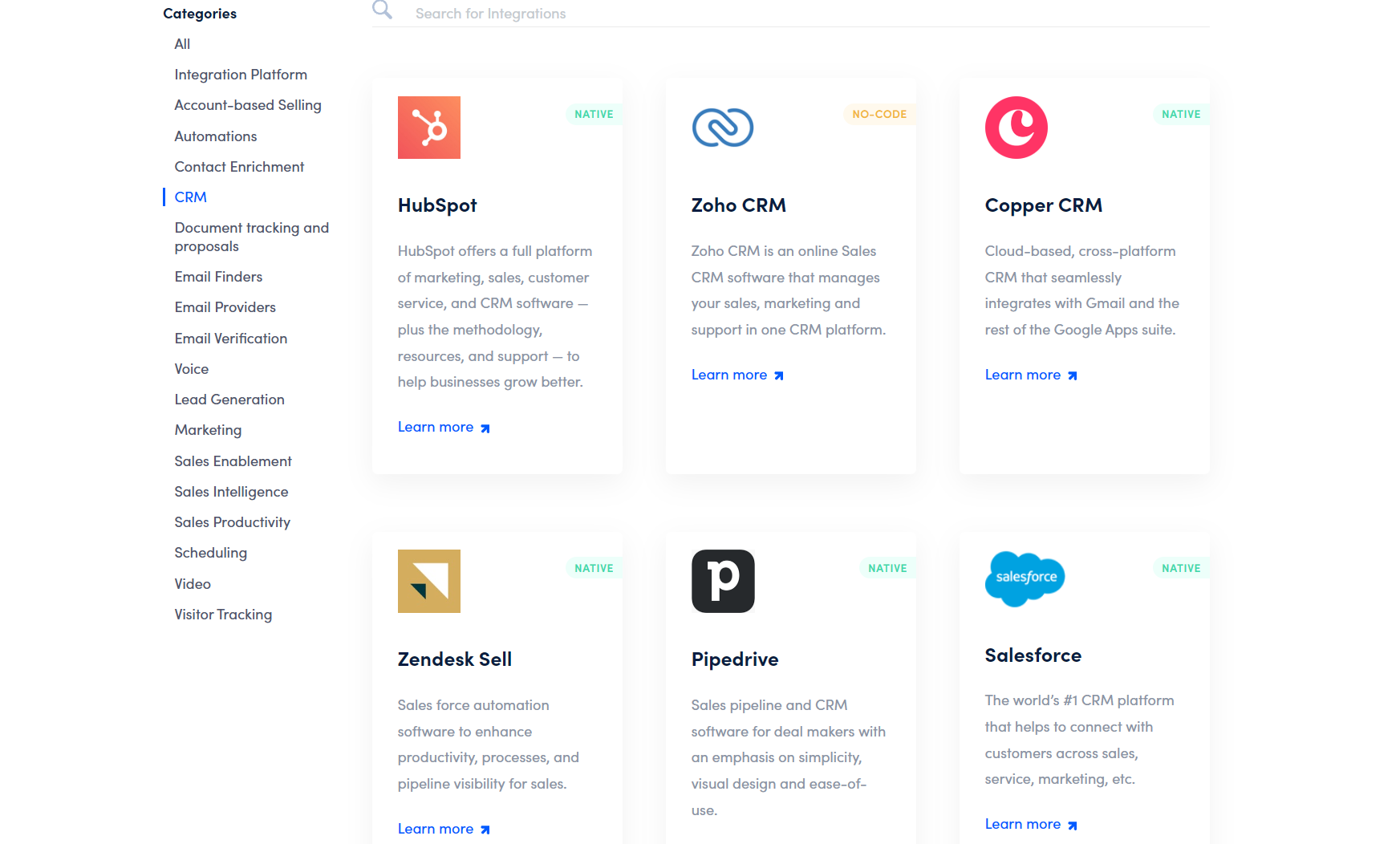
Native CRM integrations cover HubSpot (two-way integration with auto-sync every 2 hours, mapping default and custom profile fields, syncing contacts, statuses, emails, calls, and tasks), Salesforce (bidirectional sync with default and custom field mapping, plus sent emails, prospect statuses, tasks, and calls), Pipedrive (two-hour auto-sync with field mapping and event triggers that create or update Deals), Copper CRM, Zendesk Sell, and Close.
Source: Reply.io
The REST API (v3) at https://api.reply.io/v3 provides programmatic access to contacts, sequences, email and LinkedIn channel accounts, unified inbox, scheduling, tasks, reporting, and automation. Authentication uses Bearer token authorization with a granular scopes system in domain:verb format controlling endpoint access. Rate limits sit at 100 requests per minute and 3,000 requests per hour. Webhook support enables real-time notifications for email events (replies, opens, clicks, bounces) and LinkedIn events, with up to 50 active webhook subscriptions per account.
Reply.io also ships an MCP server that plugs Reply's API into Claude, Cursor, and any other MCP-aware AI client, and supports iPaaS platforms including Zapier, Make, n8n, and Integrately for broader workflow automation.
The platform maintains SOC 2 certification and GDPR compliance, along with Privacy Shield certifications for Europe and the U.S. A Data Processing Agreement (DPA) covers GDPR requirements with Standard Contractual Clauses (SCC) for international data transfers.
Reply.io Reporting, Analytics, and Team Management
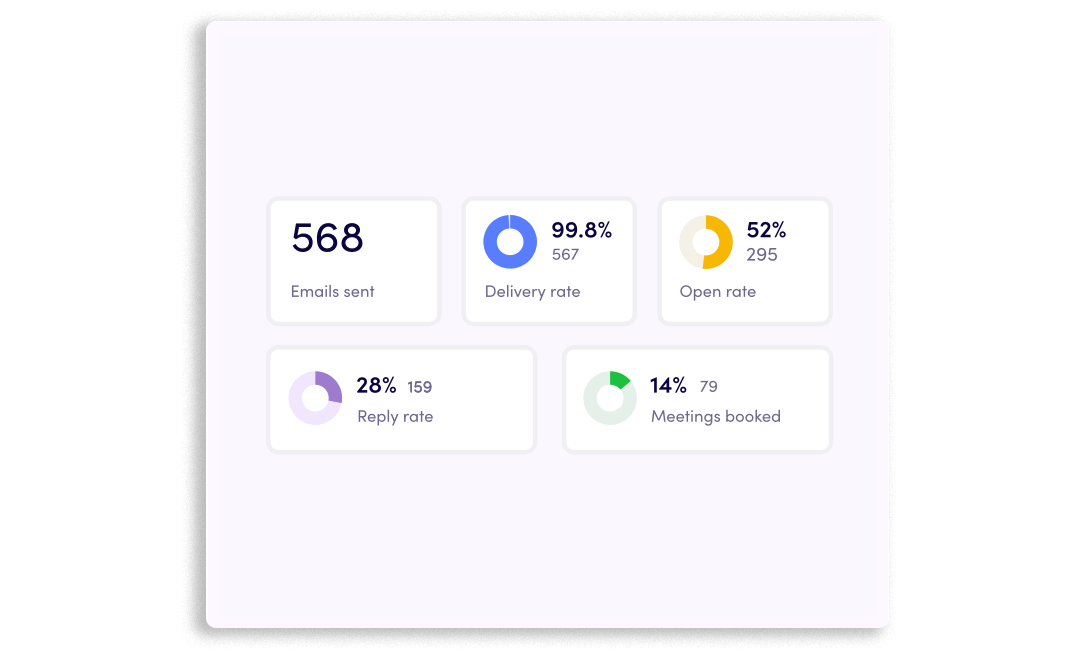
Reply.io includes built-in analytics covering sequence performance across channels. The platform tracks open rates, reply rates, click rates, bounce rates, and conversation-level metrics across email, LinkedIn, and other channels. Users can see per-step analytics within a sequence to identify which touchpoints drive engagement and where prospects drop off.
Source: Reply.io
The reporting capabilities are one of the platform's acknowledged weaknesses. The analytics dashboard is basic with limited flexibility, and analytics tools provide little actionable insight for improving campaigns beyond surface-level engagement metrics. There is no centralized dashboard for teams managing multiple sequences and users, which creates confusion when multiple team members coordinate outreach.
Team management supports roles and permissions for controlling access levels, and CRM integrations are team-wide rather than requiring per-seat configuration. For agencies, the platform offers dedicated Agency plans starting at $210/month with unlimited clients, unlimited users, multi-workspace management, and team dashboards.
Support is limited to chat only via Intercom, with a stated response target of under 15 minutes during operating hours (2 AM to 7 PM EST). Reply.io reports a 96% support satisfaction rate, though some users report slow response times for urgent issues. Documentation resources include a Knowledge Base, Help Center, Resource Library, and Reply Academy, with structured courses covering multichannel outreach, deliverability, and integration setup.
Source: Reply.io
Where Reply.io Stops: The Gaps
Reply.io centers on the multichannel outbound workflow: finding contacts, building sequences across email and LinkedIn, automating personalization with AI, and managing the replies that result. That focus shapes its strengths, but it also means the platform defers to external tools for several capabilities a revenue team eventually needs.
No behavioral intent data. Reply Data includes hiring intent and technographic signals that track indicators like new job postings or shifts in tech stacks. But the platform does not track which companies are researching specific topics across the broader web, the cross-site behavioral signal that reveals accounts in the early stages of a buying cycle before they respond to any outreach. Reply.io itself positions signal-driven prospecting through buyer intent data as the key to thriving in 2025, but the intent signals available within the platform are narrower than what dedicated intent providers offer.
No conversation intelligence. Reply.io records no calls, generates no transcripts, and provides no AI-driven analysis of what was said during sales conversations. The platform handles the outreach that gets a prospect on the phone, but once the call ends, there is no way to capture the context, extract deal-relevant information, or surface coaching insights. Teams moving from email to phone-based selling need a separate tool.
No intelligence layer connecting outreach to deal outcomes. Reply.io tracks email engagement (opens, clicks, replies, sentiment) and surfaces that data in its analytics. But no layer fuses CRM records, conversation data, intent signals, and behavioral patterns to explain why deals move or stall. The platform tells you a prospect replied; it does not connect that reply to the three other signals that explain why the deal is accelerating or at risk.
No marketing orchestration or ABM capabilities. Reply.io covers outbound sales execution. There is no display advertising, audience management, account-based marketing, or multi-channel campaign orchestration for demand generation teams. Marketing teams running programs alongside sales outreach need a separate platform.
Analytics limited to engagement metrics. The analytics dashboard is basic with limited flexibility, and reporting does not extend to deal forecasting, pipeline health, territory management, or the multi-dimensional performance analysis enterprise teams require. The platform shows who opened and replied; it does not show what those engagement patterns predict about revenue outcomes.
How ZoomInfo Covers the Gaps
The gaps above share a common thread: Reply.io optimizes for the outbound engagement layer but depends on external sources for the intelligence, signals, and cross-channel capabilities that surround it. ZoomInfo supplies those layers.
ZoomInfo Intent and WebSights: Behavioral signals that reveal in-market buyers before outreach
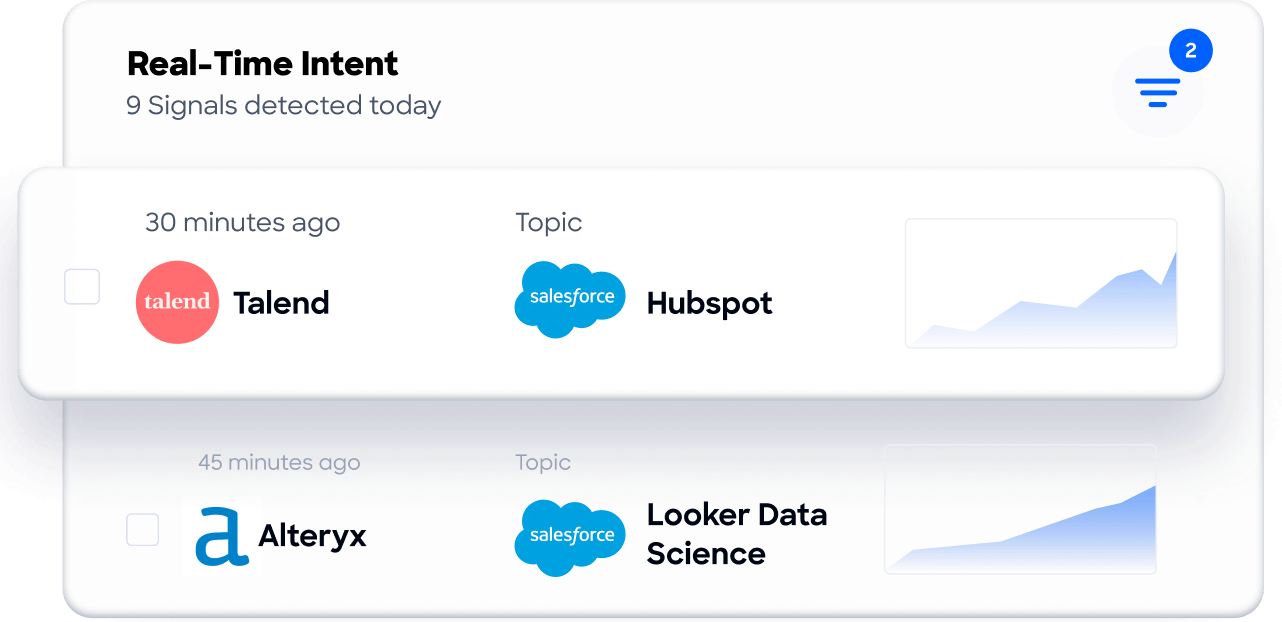
ZoomInfo Intent tracks signals from 210 million IP-to-Organization pairings and 6 trillion+ new keyword-to-device pairings sourced monthly. Where Reply.io surfaces hiring and technographic intent (new job postings, tech stack changes), ZoomInfo tracks which companies are researching topics related to your product across the web, before you have ever contacted them. Guided Intent, exclusive to ZoomInfo, identifies topics historically correlated with deal success rather than requiring manual topic selection.
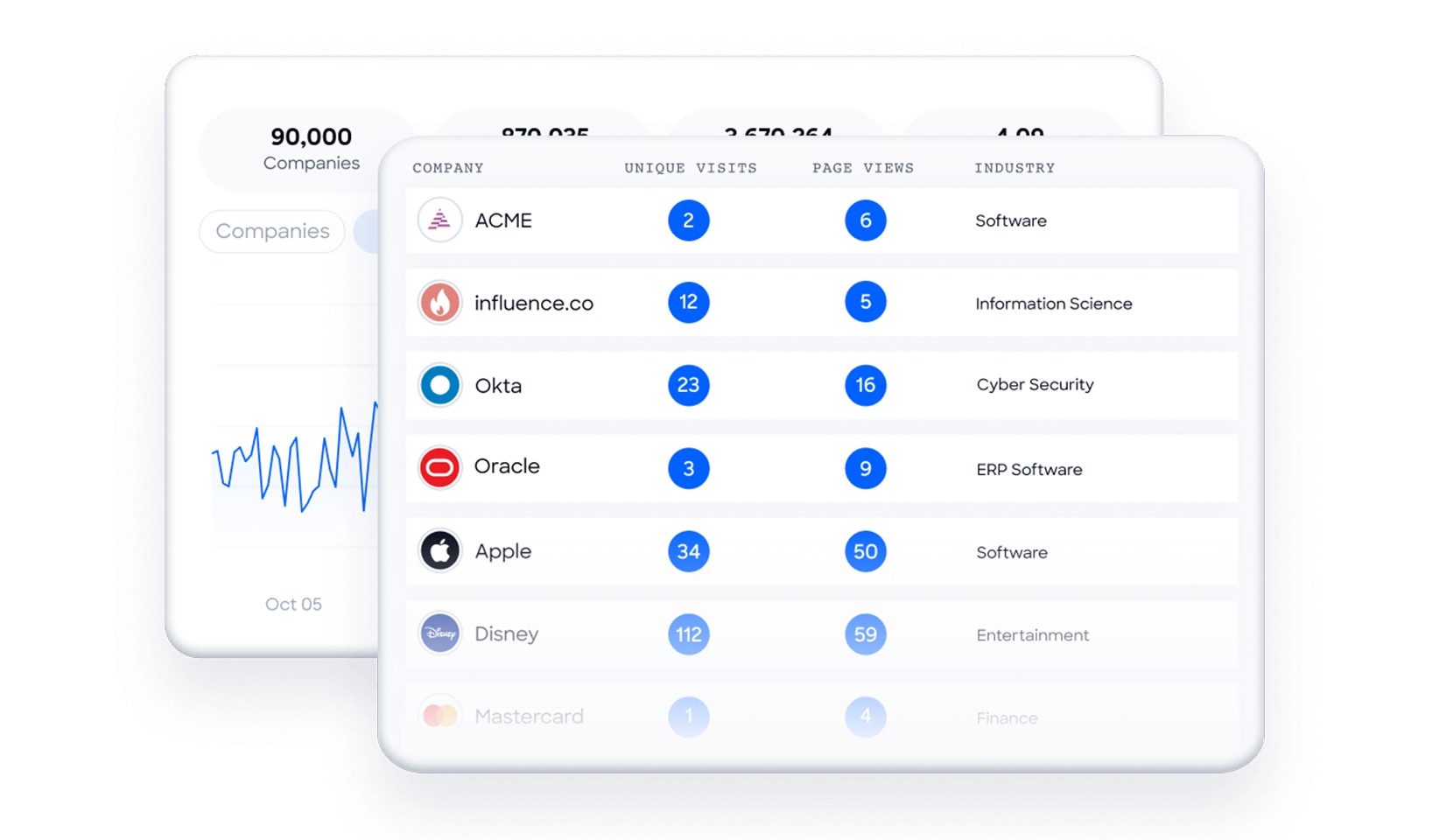
On the website side, WebSights resolves anonymous website traffic to companies with Automatic Traffic Filtering that distinguishes real visitors from bots. ZoomInfo Marketing extends this to contact-level site visitor identification, identifying who visited (not just which company) and triggering personalized outreach.
ZoomInfo's GTM Context Graph and Chorus: Intelligence from calls and deals, not just email engagement
Reply.io captures what happens in email and LinkedIn (opens, clicks, replies, sentiment). ZoomInfo's GTM Context Graph captures why deals move or stall by processing 1.5B+ data points daily, fusing B2B data with CRM records, conversation intelligence from Chorus, email interactions, and behavioral signals.
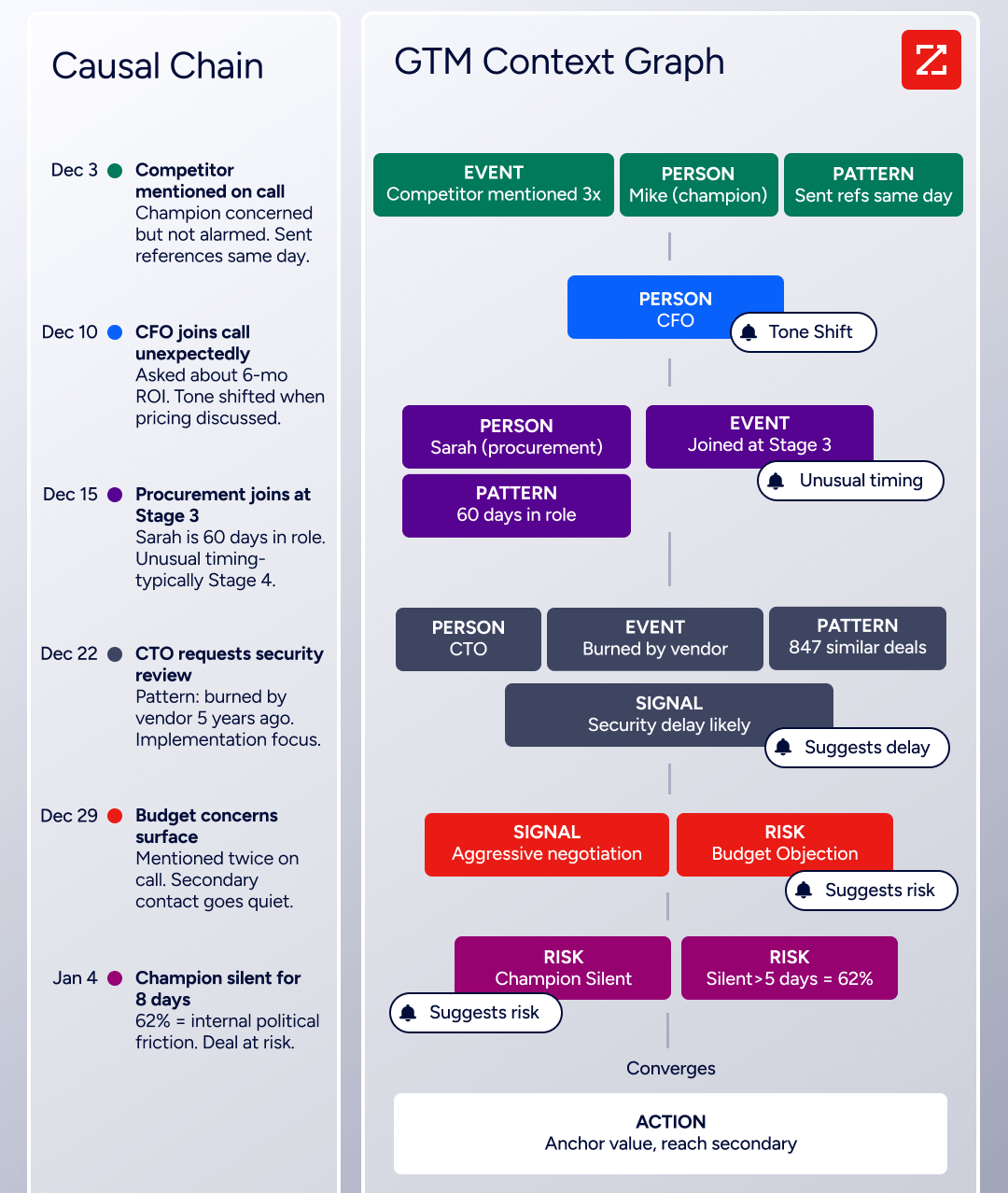
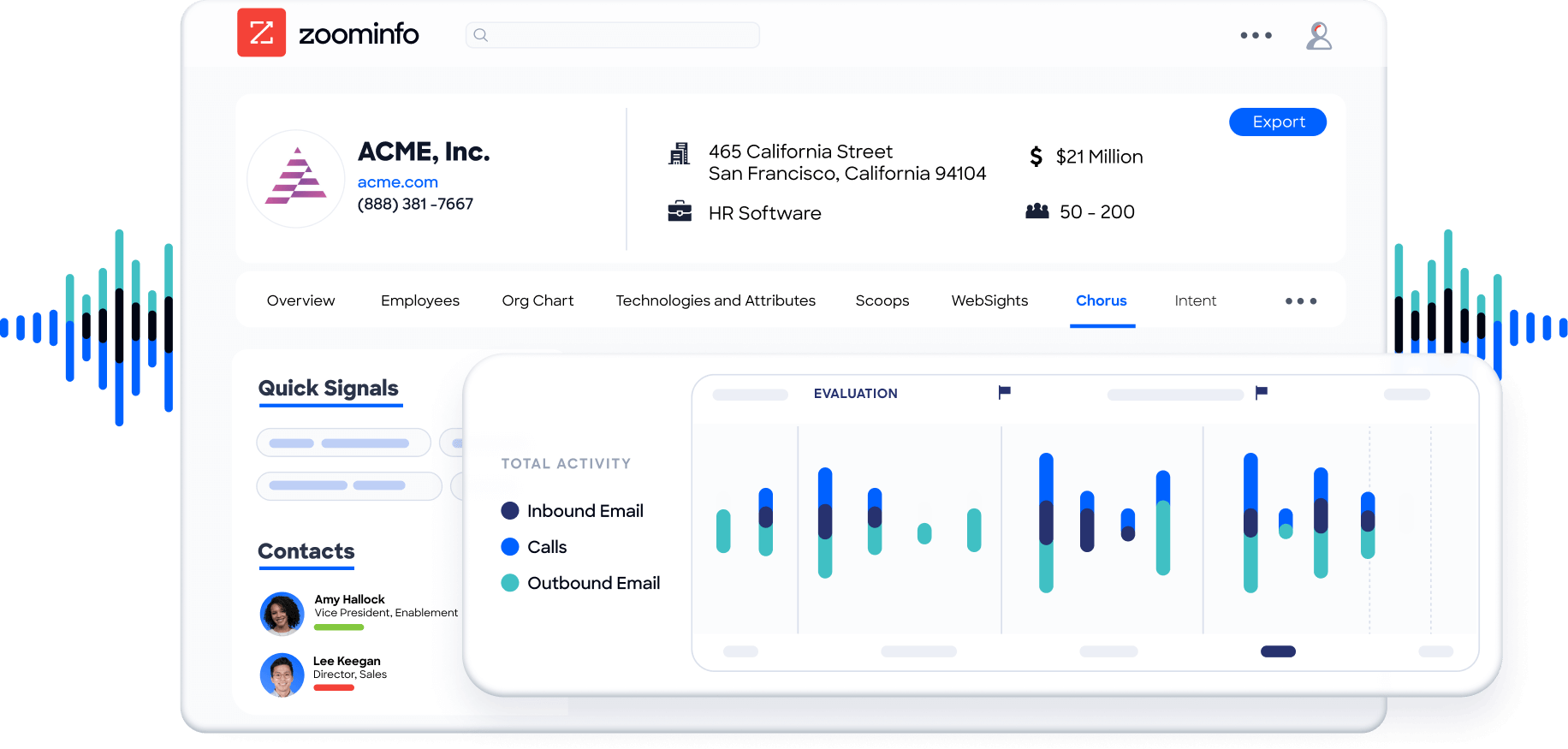
Chorus, ZoomInfo's conversation intelligence engine backed by 14 technology patents, records and transcribes sales calls, surfaces AI-generated insights (talk ratios, sentiment, objection detection), auto-syncs deal intelligence to the CRM, and provides coaching scorecards and clip sharing. It captures the context email analytics miss: why a champion went quiet, what a competitive mention means for deal risk, which objection patterns predict closed-lost outcomes.
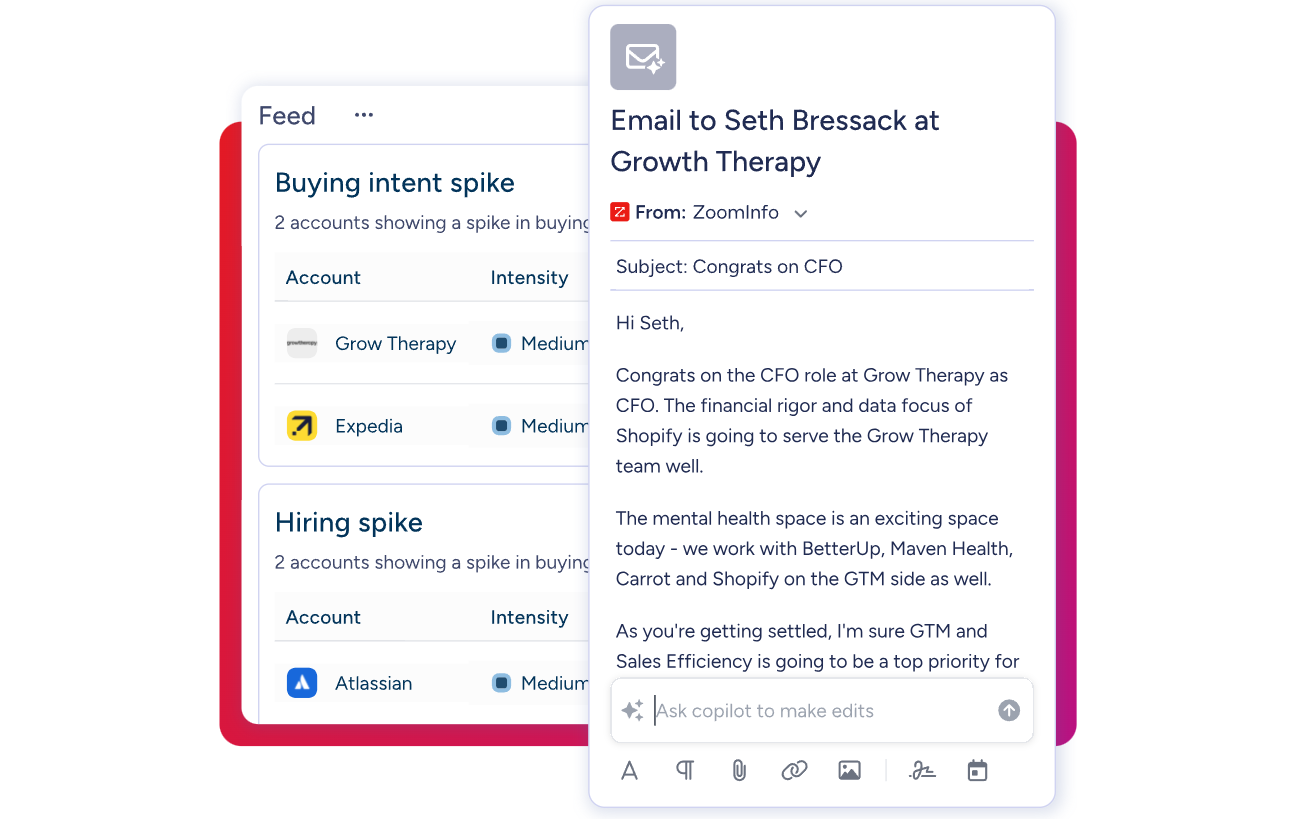
That reasoning flows into GTM Workspace, where sellers see a complete Book of Business view across CRM, ZoomInfo data, conversation history, and market intelligence, with AI agents automating account research, outreach, CRM updates, and signal monitoring. An Action Feed streams in-market buyers matched to target criteria with pre-drafted actions on every signal.
ZoomInfo GTM Studio: Marketing orchestration and ABM beyond outbound sequences
GTM Studio addresses the marketing orchestration gap directly. Marketers, RevOps teams, and GTM engineers can build audiences using natural language, enrich with first- and third-party data, define triggers, and activate plays across channels (email, calls, display ads, direct mail, LinkedIn, Meta, Connected TV) without engineering support. Pre-built GTM plays cover inbound acceleration, champion tracking, competitive displacement, and ICP targeting. Expansion plays that used to take 3 weeks now launch in 30 minutes.
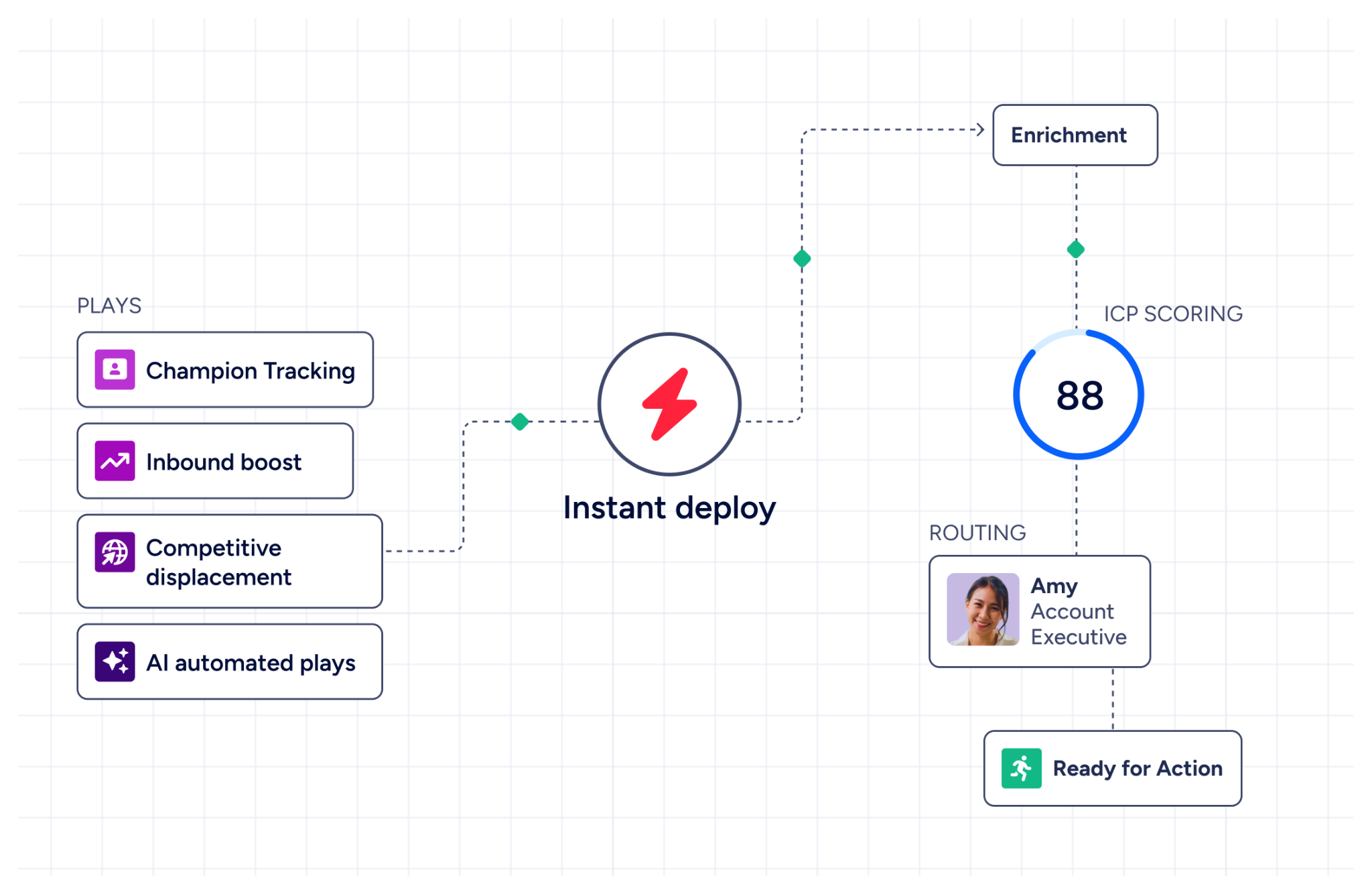
ZoomInfo Marketing includes a native Demand-Side Platform deploying display ads based on 300+ company attributes, FormComplete (reducing forms to a single field while auto-appending data), and Account Fit Scoring (predictive AI scoring 0-100 based on company attribute patterns).
ZoomInfo's B2B Data Platform: Deeper contact and company intelligence at scale
ZoomInfo operates the largest B2B data platform in the industry: 500M contacts, 100M companies, 135M+ verified phone numbers, 120M direct-dial phone numbers, and 200M+ verified business email addresses. Where Reply Data offers 1B+ contacts with real-time web search verification, ZoomInfo's data flows through a proprietary verification pipeline backed by 300+ human researchers and automated ML scanning 28 million site domains daily, reaching up to 95% accuracy on first-party data.
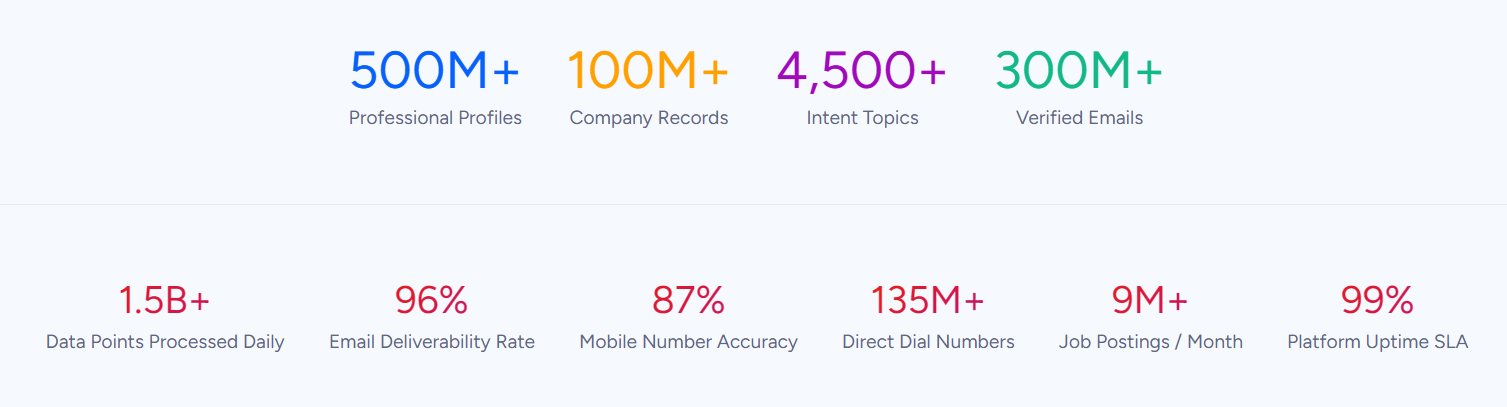
The depth extends beyond contact records. ZoomInfo provides 300+ company attributes for segmentation, department org charts with decision-makers' direct dials, contact tracking with job-change alerts, and technographic profiles covering 30,000+ technologies across 200+ categories for 30+ million companies. Global coverage extends to 34M+ company profiles outside North America, 200M+ professional profiles outside NA, and 45M+ mobile numbers outside NA.
In a Fortune 500 competitive RFP analyzing 25 million contacts across vendors, an independent consultant concluded that "no other competitor came even close."
ZoomInfo APIs and MCP: Universal data access for any tool or AI agent
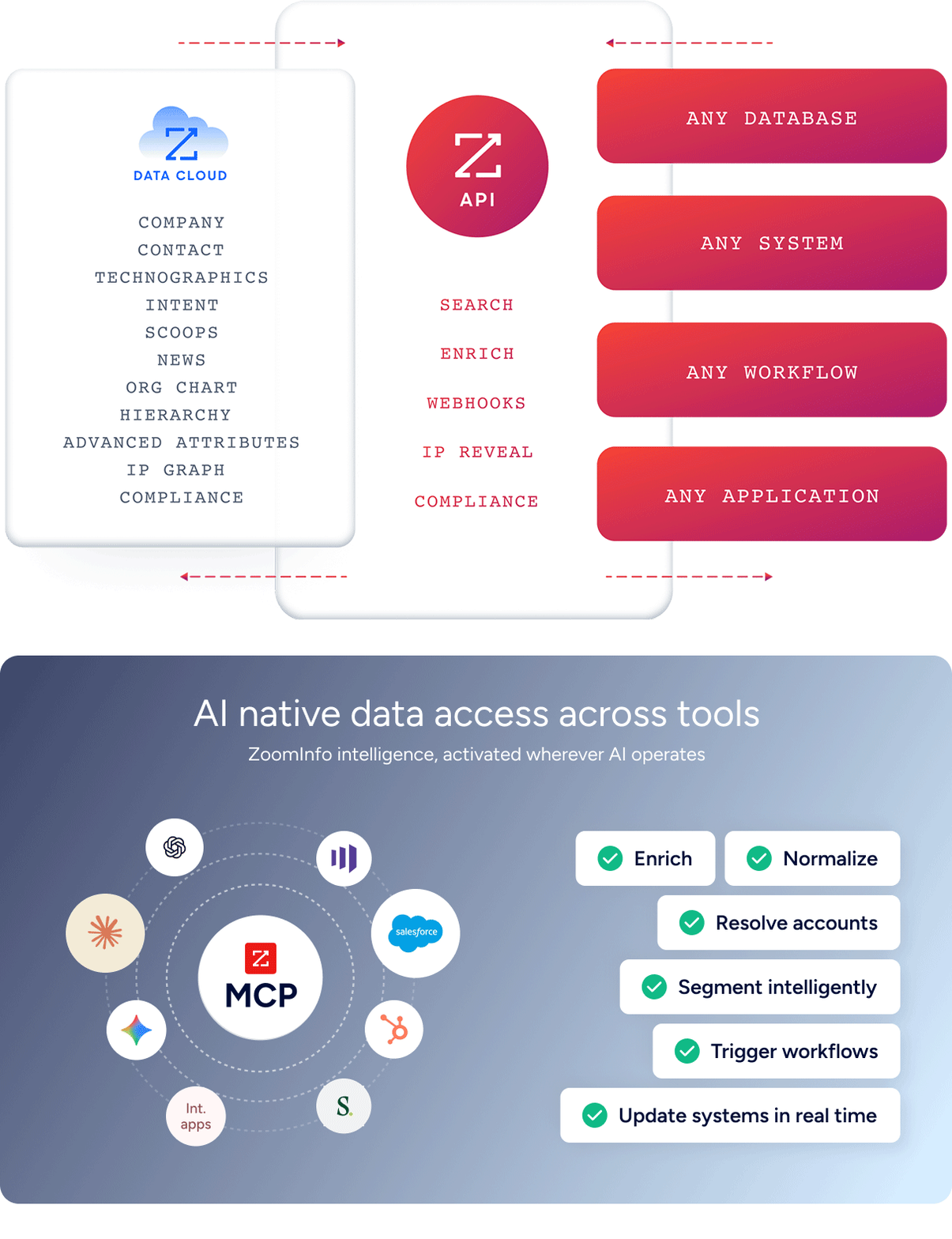
ZoomInfo delivers its intelligence through APIs and MCP, so the same data and GTM Context Graph powering ZoomInfo's own products is accessible inside any third-party tool or custom AI agent. The MCP server connects AI models directly to ZoomInfo's B2B data as a native tool, currently supporting Claude and ChatGPT. API access is included in all relevant plans, and the Enterprise API covers Search, Enrich, Copilot (AI intelligence), Marketing (audience management), and Engagements endpoints.
ZoomInfo's Free Entry Points: A way to evaluate the platform without commitment
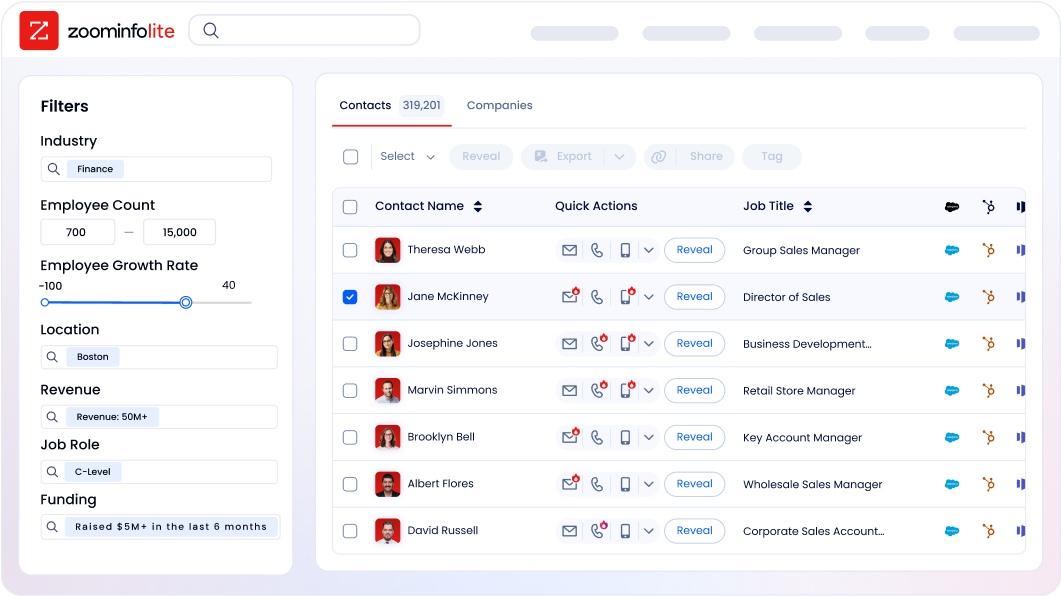
ZoomInfo Lite is a permanent free tier with access to ZoomInfo's B2B database, 10 monthly export credits, individual and company searches, a Chrome extension, and WebSights Lite with up to 10 website visitor reveals per day. A separate 7-day free trial provides broader access with no credit card required.
Seismic's sales team attributed 39% of active pipeline to opportunities identified or influenced by ZoomInfo signals, boosted productivity by 54%, and saved 11.5 hours per week per seller. (Seismic Case Study)
Final Summary
Reply.io is a capable toolkit for multichannel outbound execution: conditional sequences across email, LinkedIn, WhatsApp, SMS, and calls; an autonomous AI SDR that finds prospects, personalizes messages, and handles replies around the clock; a 1B+ contact database with real-time verification; and unlimited email warmup on every purchased mailbox. It fits SMBs, lean sales teams, and agencies who need to scale personalized outreach without enterprise pricing or complexity.
It is lighter on the layers around execution: no behavioral intent signals from across the web, no conversation intelligence, no layer connecting outreach data to deal outcomes, no marketing orchestration or ABM, and limited analytics beyond email engagement.
If your bottleneck is upstream of the sequence (knowing which companies are in-market before you reach out), downstream of the reply (understanding what happened on the call and why the deal is moving), or across the organization (marketing and sales working from the same intelligence), that is the ground ZoomInfo covers. Its 500M-contact, 100M-company database provides verified emails and direct dials at scale. ZoomInfo Intent surfaces accounts researching your category from 6 trillion+ keyword-to-device pairings monthly. Chorus captures and analyzes every sales conversation. GTM Studio gives marketing teams multi-channel orchestration and ABM capabilities. And the GTM Context Graph fuses all of it into an intelligence layer that captures why deals move, not just that they moved.
See what that intelligence layer adds to your outreach: start with ZoomInfo Lite for free, or request a demo to see intent signals and verified contacts flow into your pipeline.
FAQ
Does Reply.io include buyer intent data?
Reply Data includes hiring intent and technographic signals that track indicators like new job postings and shifts in tech stacks. These help identify companies that may be in-market based on observable business changes. The platform does not, however, track which companies are researching specific topics across the web, the behavioral layer that reveals accounts in the earliest stages of evaluation. ZoomInfo Intent tracks signals from 210 million IP-to-Organization pairings and 6 trillion+ keyword-to-device pairings sourced monthly, identifying in-market accounts before any outreach begins.
Can Reply.io automate LinkedIn outreach?
Yes, but with caveats. Reply.io supports LinkedIn actions (profile visits, connection requests, messages, InMail, and voice notes) as sequence steps, and Jason AI can automate LinkedIn connection requests and follow-ups. LinkedIn automation requires a separate add-on at $69 per account per month on top of the Multichannel plan. More importantly, LinkedIn automation violates LinkedIn's Terms of Service, and users report accounts being blocked, restricted, or not working as expected.
Which Reply.io plan includes multichannel sequences?
The Email Volume plan ($49/user/month, annual billing) is email-only. Multichannel sequences combining email, LinkedIn, WhatsApp, SMS, and calls require the Multichannel plan ($89/user/month, annual billing). Even on the Multichannel plan, LinkedIn automation costs an additional $69/account and Calls/SMS costs $29/account. AI SDR plans ($500+/month) include all channels with no per-channel add-ons.
Can Reply.io record and analyze sales calls?
No. Reply.io's integrated dialer supports making calls as sequence steps, but the platform does not record calls, generate transcripts, or provide AI-driven conversation analysis. Once a call ends, there is no capture of what was discussed, no objection detection, and no coaching scorecards. Teams that advance prospects from email to phone-based selling need a separate conversation intelligence tool. ZoomInfo's Chorus, backed by 14 technology patents, fills this gap with recording, transcription, AI insights, and coaching capabilities.
How does Reply.io's pricing actually break down?
Reply.io uses per-user, per-month subscription pricing with annual billing discounts of 17-40%. The base tiers are:
Free Plan: AI sequence generator, Chrome extension, 200 data credits, no automated sending
Email Volume: $49/user/month (annual), email-only automation, 1,000 active contacts
Multichannel: $89/user/month (annual), all channels (LinkedIn at $69/account extra, Calls/SMS at $29/account extra)
AI SDR (Jason AI): $500-$3,000/month (annual), autonomous prospecting and outreach, unlimited users
Agency: $210/month and up, unlimited clients and users
Additional costs include email validation at $5 per 1,000 validations, data credits beyond included amounts, and a mandatory 3-month minimum commitment that is not prominently disclosed during signup.
Does Reply.io integrate with Salesforce and HubSpot?
Yes. Reply.io offers native bidirectional integrations with both platforms. The HubSpot integration auto-syncs every 2 hours, mapping default and custom fields and syncing contacts, statuses, emails, calls, and tasks. The Salesforce integration syncs Contacts/Leads with default and custom field mapping. Pipedrive is also supported with the same two-hour auto-sync. Users report, however, that Salesforce integration can have issues with contact-to-account relationships and company-less prospects, and proper configuration often requires setup beyond the trial period.
What is Jason AI and how much does it cost?
Jason AI is Reply.io's autonomous AI SDR agent that finds prospects from the built-in database, researches them, builds multichannel sequences, personalizes messages, handles replies, and books meetings. It operates 24/7 in either Approval Mode (human review before sending) or Automatic Mode (autonomous operation). Users can choose their AI engine from Claude, Gemini, Mistral, or OpenAI. Pricing starts at $500/month for 1,000 active contacts (AI SDR Starter) and scales to $3,000/month for 10,000 contacts (AI SDR Growth), all billed annually.
Does Reply.io offer conversation intelligence or call coaching?
No. Reply.io does not include call recording, transcription, coaching tools, or conversation analysis. The platform handles the outreach that books the meeting, but capturing and learning from what happens during the meeting requires a separate tool. ZoomInfo's Chorus provides this natively, recording and transcribing calls, extracting deal intelligence, generating coaching scorecards, and feeding conversation context into the GTM Context Graph so the reasoning carries forward into every subsequent action on the account.
