
What is sales funnel mapping?
Sales funnel mapping is the process of documenting each stage leads move through on their way to becoming customers. It visualizes the buyer's journey from initial awareness to closed deal, showing where prospects enter, progress, and exit.
A sales funnel map connects prospect stages to the customer journey. Not every lead converts, some choose competitors, fail qualification, or abandon their search.
The five core stages are Awareness, Interest, Consideration, Intent, and Decision, each requiring distinct buyer actions, content, and conversion criteria. Some teams use a 4-stage AIDA model (Awareness, Interest, Desire, Action) as an alternative framing, which is more common in B2C contexts where purchase cycles are shorter and buying committees are smaller.
Every mapped funnel should include:
Channel strategy: Where you find and engage prospects at each stage
Content alignment: What messaging resonates as buyers move through stages
Stage-specific messaging: Personalized outreach tailored to prospect needs
Conversion triggers: Actions that move leads from one stage to the next
Sales funnel vs. sales pipeline
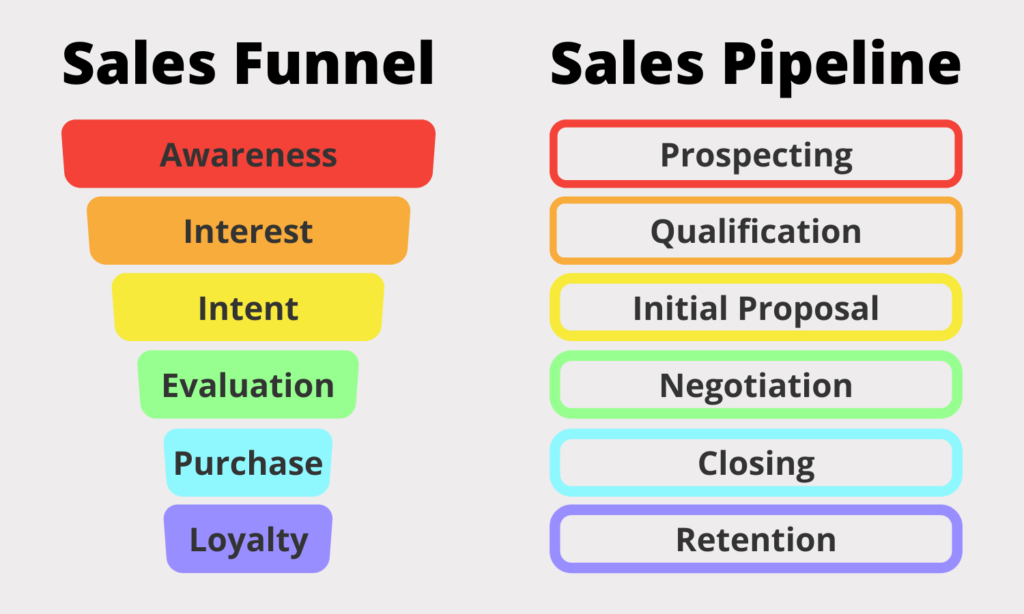
The sales funnel measures conversion rates at each stage. The sales pipeline tracks sales rep actions needed to move deals forward. Use both: the funnel shows where prospects are, the pipeline shows what reps do to advance them.
Why sales funnel mapping drives revenue
Revenue leaders need visibility into where deals stall and where they accelerate. Sales funnel mapping delivers that clarity.
Without a mapped funnel, you're flying blind. You can't pinpoint which stage bleeds leads, forecast based on real conversion rates, or align sales and marketing on prospect definitions.
A mapped funnel fixes this. Here's what it delivers:
Pipeline visibility: See exactly where prospects sit and how many you need at each stage to hit quota
Conversion rate clarity: Measure stage-to-stage conversion so you know where to focus improvement efforts
Forecasting accuracy: Predict revenue based on historical conversion patterns, not gut feel
Sales and marketing alignment: Agree on what qualifies as an MQL, SQL, and opportunity
Efficiency gains: Stop wasting time on leads that don't fit your ideal customer profile
When funnel stages are mapped to real buyer signals, the results are measurable. Seismic attributed 39% of active pipeline to ZoomInfo signals and saved sellers 11.5 hours per week, a direct outcome of connecting funnel stage definitions to verified buying behavior rather than guesswork.
Teams that skip funnel mapping discover their leaks only after budget has been spent. By the time a drop-off pattern is visible in CRM reports, weeks of outreach have already been wasted on the wrong stage.
How to map your B2B sales funnel step by step
Sales funnel mapping works best when the strategy comes first and the technology stack follows. Choosing a tool before you've defined your stages and buyer actions is a reliable way to end up with a funnel that fits the tool instead of your actual sales motion.
Sales funnel mapping requires three inputs: clear ICP criteria, defined buyer actions at each stage, and CRM tracking to measure conversion. Without these, your funnel map stays theoretical. Here's how to build one that drives results:
Step 1: Define your ideal customer profile
Funnel mapping starts with knowing who belongs in your funnel. Your ICP definition determines which leads are worth moving through stages.
ICP criteria to define:
Industry: Which verticals have the highest win rates and deal sizes
Company size: Employee count and revenue range that matches your solution
Tech stack: What tools they use that signal buying intent or compatibility
Buying signals: Actions that indicate active evaluation of solutions like yours
Without a clear ICP, your funnel fills with leads that will never close.
Step 2: Map buyer actions to funnel stages
Document which buyer actions correspond to which funnel stage transitions. This creates clarity for both sales and marketing on when a lead progresses. A simple spreadsheet or CRM stage picklist serves as your working sales funnel mapping template at this stage, the goal is to capture the logic before you automate it.
Here's what this looks like:
Buyer Action | From Stage | To Stage |
|---|---|---|
Downloads whitepaper | Anonymous | Awareness (TOFU) |
Attends webinar | Awareness | Consideration (MOFU) |
Requests demo | Consideration | Evaluation (MOFU) |
Responds to outreach | Evaluation | Opportunity (BOFU) |
Reviews pricing | Opportunity | Decision (BOFU) |
When you map actions to stages, automation becomes possible. Your CRM can move records automatically as buyer behavior changes.
Step 3: Connect your CRM to track progress
Funnel maps only work if tracked in your CRM. You need consistent field usage, stage picklists, and automation rules that move records as buyer actions occur.
CRM setup requirements:
Stage picklist: Standardized dropdown values that match your funnel map
Required fields: Data points needed to qualify and route leads properly
Automation triggers: Rules that update stage based on buyer actions
Reporting dashboards: Views that show funnel health and conversion rates
Use CRM reporting tools to automate stage-to-stage conversion tracking. Measure the same transitions the same way every time.
Step 4: Identify your drop-off points
Once your CRM is tracking stage transitions, calculate your stage-to-stage conversion rates. A drop-off rate above 50% at any single transition signals a specific, addressable problem: a content gap at TOFU to MOFU, friction in the demo or evaluation process at MOFU, or a qualification mismatch at BOFU.
Prioritize which leaks to fix first by multiplying drop-off volume by deal value impact. The highest-volume, highest-value leak is always the first to address. A 10% improvement in your MOFU-to-BOFU conversion rate is worth more than eliminating every TOFU drop-off if your average deal size is $50K.
Step 5: Standardize your funnel map as a living document
A funnel map is not a one-time planning artifact. Buyer behavior evolves, market conditions shift, and your ICP criteria sharpen over time. Treat your funnel map as an operational document that gets reviewed and updated on a regular cadence, at minimum quarterly.
Assign clear ownership: someone on RevOps or sales leadership should be accountable for triggering a revision when win rates shift, a new product is launched, or the handoff criteria between SDR and AE stop producing the right quality of opportunities.
How B2B sales funnel mapping differs from B2C
B2B sales funnels involve multiple stakeholders, longer evaluation cycles, and formal handoff criteria between marketing and sales. None of those dynamics appear in B2C funnel models, which means B2C frameworks need significant adaptation before they're useful for B2B sales teams.
Three requirements are specific to B2B funnel mapping:
Multi-stakeholder journey mapping: Map the buying committee, not just the primary contact. At each funnel stage, identify which roles are involved: economic buyer, champion, and procurement. A deal that looks like it's at BOFU from the champion's perspective may still be at MOFU for the economic buyer.
CRM-stage alignment: B2B funnels must map directly to CRM stage picklists (MQL, SAL, SQL, Opportunity, Closed-Won) with documented exit criteria for each. Without this alignment, funnel analysis and CRM reporting tell different stories.
SDR-to-AE handoff criteria: Define the exact actions and data points that trigger a handoff from SDR to AE, including response type, company size, and intent signal threshold. Vague handoff criteria are one of the most common sources of pipeline leakage in B2B sales motions.
These distinctions matter most at the MOFU-to-BOFU transition, where B2B deals stall most often.
Common challenges in B2B sales funnel mapping
Most teams struggle to build and maintain an accurate funnel map. The problem isn't complexity. It's consistency.
Three issues derail funnel mapping efforts more than anything else: teams call the same stage different names, data quality makes reporting unreliable, and sales and marketing can't agree on what qualifies as a real lead.
Inconsistent stage definitions
Marketing calls a lead "qualified." Sales calls the same lead "junk." This isn't a communication problem. It's a definition problem.
When teams use different names for the same stages, funnel analysis breaks down and conversion rates become meaningless.
Here's what this looks like:
What Marketing Calls It | What Sales Calls It |
|---|---|
Marketing Qualified Lead (MQL) | Unqualified Contact |
Hot Lead | Sales Qualified Lead (SQL) |
Engaged Prospect | Working Opportunity |
Nurture | Dead Lead |
The fix: Document universal stage definitions that both teams agree to. Write down the criteria for each stage. Make it specific. "Downloaded pricing guide and works at target account" is a stage definition. "Interested" is not.
Poor data quality across systems
Incomplete records, duplicates, and stale data make funnel reporting worthless. If your CRM shows a lead in "Qualified" but that person left the company months ago, your conversion metrics are fiction.
Common data quality issues that break funnel accuracy:
Duplicate records splitting a single buyer across multiple funnel stages
Missing fields that prevent proper segmentation and routing
Outdated contacts who no longer work at target accounts
Inconsistent formatting that breaks reporting and automation rules
Contact enrichment is often configured once at import and never revisited, meaning thousands of records decay silently as people change roles, leave companies, or update contact information. Data enrichment and hygiene aren't nice-to-haves. They're prerequisites for useful funnel mapping. If the data is bad, the map is useless.
Misalignment between sales and marketing
Sales and marketing often disagree on what qualifies as an MQL or SQL. Marketing passes leads that sales ignores. Sales complains about quality while marketing claims credit for deals sales closed independently.
This isn't a personality conflict. It's a process gap.
The fix requires three elements:
Shared definitions: Both teams agree on what moves a lead from marketing to sales
Documented SLAs: Set and measure follow-up timing expectations
Regular funnel reviews: Meet to spot disconnects and adjust criteria
How to structure your sales funnel
Simple beats sophisticated. Your funnel structure should be clear enough that any new sales rep can explain each stage in one sentence. If they can't, it's too complicated.
Here's how the sales funnel correlates with the customer journey:
Top of funnel (TOFU)
TOFU covers awareness and discovery. Leads arrive through content that addresses their pain points. This is where ICP targeting and buyer signals matter most for efficiency.
Middle of funnel (MOFU)
MOFU is where leads research and compare solutions. They evaluate features, pricing, and fit.
This is when to educate prospects on your solution, offer demos, and share proof points that differentiate you. Following software sales demo best practices at this stage can meaningfully improve the rate at which MOFU prospects move toward a decision.
Bottom of funnel (BOFU)
BOFU is where leads decide. They're evaluating final objections, negotiating terms, and getting internal buy-in.
Not every lead that reaches BOFU converts. Some deals stall for reasons outside your control. At BOFU, verified contact data and buying-committee intelligence become critical. Knowing who the economic buyer is and whether they are actively evaluating solutions determines whether a deal closes or stalls.
ZoomInfo's verified B2B data, 120M direct-dial phone numbers and 200M+ verified business emails, keeps your funnel current at every stage. At TOFU, buyer intent signals surface in-market accounts before competitors reach them. At MOFU and BOFU, GTM Workspace gives sellers the account context and AI-assisted outreach they need to move deals forward.
Best practices for effective sales funnel mapping
Building the funnel map is step one. Keeping it accurate and useful over time is where most teams fail.
Three principles separate functional funnel maps from ones that collect dust in a slide deck.
Ground stage definitions in data
Stage definitions should be based on measurable criteria, not subjective judgment. "Interested" is not a stage. "Downloaded pricing guide" is.
Vague definitions kill funnel accuracy. When stage transitions depend on gut feel, two reps call the same lead different stages.
Data-backed definitions fix this. Define each stage by specific actions or data points that are binary: either the criteria are met or they're not.
Track conversions at every transition
Each stage-to-stage transition should be measured. TOFU to MOFU. MOFU to BOFU. Every step.
This reveals where leads leak out and where to focus improvement. If 50% of leads drop between demo request and demo completion, you have a scheduling or follow-up problem.
When conversion tracking is operationalized at every funnel stage, the results compound. Thomson Reuters achieved 40% more closed-won deals and 115% average monthly quota attainment by doing exactly this.
Use CRM reporting or funnel analysis tools to automate this. Measure the same transitions the same way every time.
Keep your funnel structure simple
Overly complex funnels with too many stages create confusion and reduce adoption. If a stage cannot be clearly explained to a new sales rep in one sentence, it is too complicated.
More stages don't mean better tracking. They mean more places for leads to get stuck and more room for inconsistent data entry.
Start with three to five stages. Add more only if there's a clear business reason and you can maintain data quality across all of them.
These three principles only hold if the underlying data is accurate. Stale contact records, missing fields, and unsynced CRM data undermine every stage definition and conversion metric you build on top of them.
How ZoomInfo helps you build and track your sales funnel
ZoomInfo is an all-in-one AI GTM Platform that gives revenue teams the data, intelligence, and workflow tools to build and track a sales funnel that actually converts.
At the foundation is the most comprehensive B2B data platform available: 500M contacts, 120M direct-dial phone numbers, and 200M+ verified business emails, continuously refreshed so your funnel stages are never built on stale records. Seismic attributed 39% of active pipeline to ZoomInfo signals and saved sellers 11.5 hours per week, a result that only becomes possible when the data underneath the funnel is accurate enough to trust.
The GTM Context Graph processes 1.5B+ data points daily, fusing your CRM records, conversation intelligence, and behavioral signals into a unified reasoning layer that shows not just where prospects are in your funnel, but why they are moving or stalling. This is the intelligence layer that makes funnel mapping predictive rather than descriptive.
Sellers act on that intelligence directly in GTM Workspace. RevOps and marketing teams build and activate funnel plays in GTM Studio. And if you want to wire the same B2B intelligence into your own AI tools or agents, ZoomInfo MCP exposes the full data layer to any custom workflow, no separate data infrastructure required.
See ZoomInfo in action and explore how it supports your funnel strategy.
Frequently asked questions about sales funnel mapping
What is sales funnel mapping?
Sales funnel mapping is the process of documenting each stage leads move through on their way to becoming customers. It visualizes the buyer's journey from initial awareness to closed deal, showing where prospects enter, progress, and exit, and connecting each stage to specific buyer actions and conversion triggers. A mapped funnel gives revenue teams the visibility to identify where deals stall and what moves them forward.
What are the 5 stages of a sales funnel?
The five stages are Awareness, Interest, Consideration, Intent, and Decision. At Awareness, prospects discover a problem or solution. At Interest and Consideration, they research and evaluate options. At Intent, they signal active buying behavior. At Decision, they finalize vendor selection and negotiate terms. Some frameworks use a 4-stage AIDA model (Awareness, Interest, Desire, Action), both are valid, and the right model depends on your sales cycle length and team structure.
How do you map a B2B sales funnel?
Start by defining your ICP and the buyer actions that correspond to each funnel stage. Map those actions to CRM stage picklists with documented exit criteria, a simple spreadsheet or CRM stage picklist works as your starting sales funnel mapping template. Add SDR-to-AE handoff criteria at the MOFU-to-BOFU transition. Then connect your CRM to track stage-to-stage conversion rates automatically using CRM reporting tools. Revisit and update the map quarterly as buyer behavior and market conditions evolve, a funnel map is a living operational document, not a one-time planning artifact.
What is the difference between a sales funnel and a sales pipeline?
The sales funnel measures conversion rates at each stage, it shows where prospects are and how many drop off between stages. The sales pipeline tracks the actions sales reps take to move deals forward, it shows what reps need to do next. Use both together: the funnel tells you where the leaks are, and the pipeline tells you how to fix them.
What CRM fields do you need to track funnel conversion rates?
At minimum: a stage picklist with standardized values matching your funnel map, required fields for ICP qualification (company size, industry, title), automation triggers that update stage based on buyer actions, and a created-date or stage-entry-date field to calculate time-in-stage. Without consistent field usage, stage-to-stage conversion rates are unreliable and funnel analysis breaks down. GTM Workspace integrates with your CRM and automates stage updates based on buyer signals, reducing the manual overhead of keeping funnel data current.
How do you identify and fix funnel drop-off points?
Calculate stage-to-stage conversion rates in your CRM and identify where the largest percentage of leads exit. A drop-off rate above 50% at any single transition signals a specific problem: a content gap (TOFU to MOFU), friction in the demo or evaluation process (MOFU), or a qualification mismatch (BOFU). Prioritize fixes by multiplying drop-off volume by deal value impact, the highest-volume, highest-value leak is always the first to address. Thomson Reuters operationalized conversion tracking at every stage and achieved 40% more closed-won deals as a result.