

What is a sales funnel strategy?
A sales funnel strategy is the structured plan a sales organization uses to move prospects from initial awareness of a problem through to a closed deal, with defined stages, conversion criteria, and data-driven actions at each step. Without a deliberate strategy governing each stage, organizations often fail to define their funnels at all, leaving reps without a consistent framework for when to engage, how to qualify, and what moves a prospect forward. The result: pipeline that looks healthy on paper but stalls because nobody agreed on what "qualified" actually means.
The sales funnel itself is a visual metaphor for the process of gathering prospects and turning them into customers: start with a large group at the top, and winnow it into a smaller group as they reach the bottom and buy. Picture a funnel you might use to put oil in your engine, capturing a lot of material on top in order to direct it into a narrow opening at the bottom. This is a perfect analogy to what actually occurs in the sales process, where information starts out broad in the beginning and gets incredibly granular towards the end.
Implementing a sales funnel helps business development leaders understand their entire sales cycle. Through consistent processes, leaders derive quick insights on how their sales organization attacks the market, and small insights inherently uncover areas for incremental improvements. The revealed trends, both good and bad, equip leaders to identify effective tactics and expose inefficiencies.
For most organizations, the problems behind running a sales funnel are central to data management. Think about how much contact and account data your sales team needs just to prospect. Then, from a managerial perspective, think about whether the actual activity and outreach happening from the sales floor is captured to measure effectiveness. As valuable as the sales funnel is, it is only useful when paired with reliable data at each stage. ZoomInfo's all-in-one AI GTM Platform gives sales teams the verified data, intelligence, and workflow tools to act at every stage of the funnel, turning a static framework into a live operating system for revenue.
One structural shift every modern sales funnel strategy must account for is the digital-first buyer. B2B buyers now self-educate extensively before engaging a vendor, involve larger buying committees, and actively avoid early sales contact. A modern sales funnel strategy must be designed around buyer enablement, not seller-controlled progression, because by the time a prospect enters your funnel, they have already formed opinions you need to understand and meet.
Choosing the right sales analytics software is often the first step toward making data actionable across the funnel.
The four stages of a B2B sales funnel
A B2B sales funnel strategy typically moves through four stages: Awareness, Interest, Consideration, and Decision. Each stage represents a shift in the prospect's readiness to buy and requires a different set of actions from the selling team. The goal at each stage is to move the right prospects forward while filtering out those who are not a fit.
Some models use five or six stages. A common five-stage model adds a Purchase or Retention stage after Decision, recognizing that the relationship does not end at close. For most B2B organizations, the four-stage model is the operational standard, with post-close retention tracked separately.
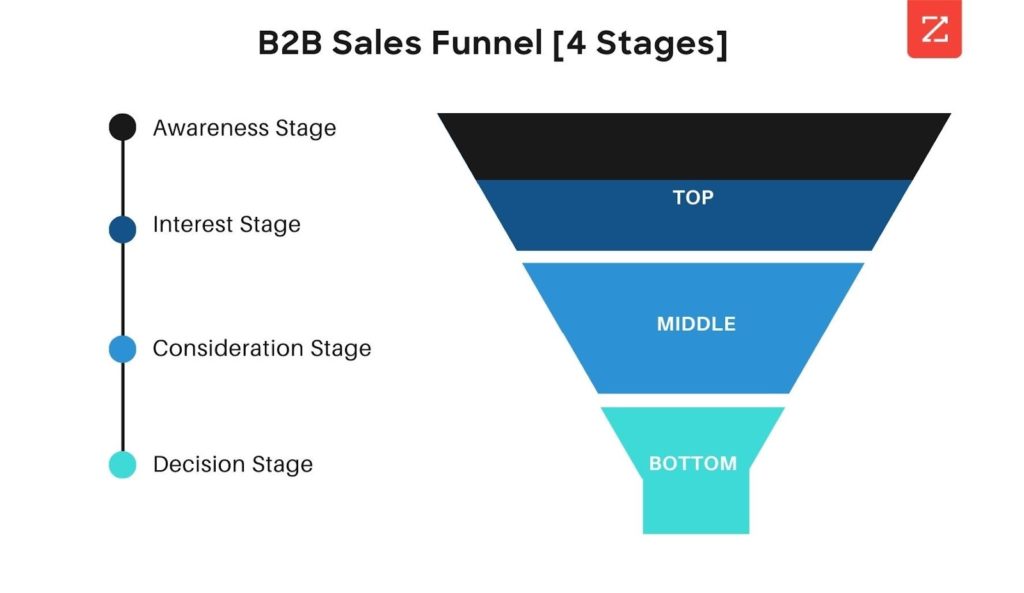
Stages of a B2B sales funnel: two perspectives
While typically depicted as a simple four-step visual, modern sales professionals should be simultaneously thinking about two different funnels in various snapshots that account for the different perspectives of the buyer and the seller, respectively.
1. Awareness stage
Buyer perspective
At this stage, potential customers have diagnosed pain points and are beginning to conduct preliminary research about available solutions in the marketplace.
As the widest section of the funnel, the main purpose of this stage is to improve the visibility of a brand and demonstrate expertise by accommodating prospects with value-centric, top-of-funnel resources. The focus is visibility and domain authority.
Seller perspective
For business development professionals, moving a prospect from the Awareness stage to the Interest stage requires verified B2B data and buying signals that go beyond standard firmographic data points like management level and job function, alongside firmographic classification like company size. Understanding the technology stack a target account relies on, for example, is the kind of signal that technographic data provides and that firmographics alone cannot reveal.
Deeper insights about a target account are required:
Does the organization outsource key components of its business?
What technologies does the organization use?
How many employees sit in the particular job function a solution supports?
Does the organization have multiple locations?
Common failure mode: The most common failure at this stage is treating all accounts equally. Without intent signals, reps default to working familiar accounts rather than in-market ones, leaving the highest-probability opportunities untouched.
2. Interest stage
Buyer perspective
At this stage, the prospect is actively looking for solutions to improve business outcomes. Understanding just how active a prospect is can be measured through third-party intent data such as surges in online search and consumption of content related to specific topics.
Conversely, first-party data reflects activity directly in response to internal sales and marketing efforts, such as a surge in anonymous traffic to web domains from specific companies, and the ability to capture and map behavior to conversions such as downloading an eBook or signing up for a webinar.
Seller perspective
At this point in the funnel, a buyer is already aware and actively looking for a solution. The interest stage is all about driving continued interest in a solution. Success at this stage requires go-to-market teams to decipher which channels and messaging turn prospects into customers. Understanding these conversion points is imperative because it determines how and when salespeople should intervene.
In order to optimize sales activities during the interest stage, reps should understand the data that qualified the lead in the first place. The lead is qualified and going through an education process, heavily rooted in how to buy. Get in their head with the following data-driven insights:
Intent data: When it comes to intent data, you can analyze either internal or external signals. Internal intent data refers to the campaigns a company is running and who is responding to them. External data refers to the relevant topics a company is researching online.
Social media data: Another kind of data that often gets neglected is social media behavior. Has your prospect followed you on social channels? What content are they engaging with, and how can you use that information to tailor content that matches their interests?
3. Consideration stage
Buyer perspective
In the consideration stage, leads are officially converted to sales-qualified opportunities and are viewed as prospective customers. They have a clear understanding of what their problem is, the solutions that could solve it, and what their budgets are.
Seller perspective
Data is imperative to progressing through the consideration stage because it is when sales is finally actively engaged with a prospect and has identified an open opportunity. The heavy lifting happens here. So the more data a business development professional can get their hands on, the better prepared they can be to guide qualified leads through this process.
Deeper company org charts and intelligence
You may have done top-of-funnel outreach to various buyer personas at the outset of the qualification process. More homework is often required at the consideration stage. It is not just understanding the challenges the various personas within a sales opportunity face, but rather conveying the tangible business value a solution can offer to alleviate those specific challenges and achieve desired results.
4. Decision stage
Buyer perspective
At this final stage of the funnel, qualified leads know everything there is to know about their pain point, the best solution for the problem, and are ready to select the provider to buy from. At the decision stage, questions are mostly vendor-driven, as prospects are trying to decide what will give them the best return.
Seller perspective
For business development professionals, the bottom of the funnel is when they must reaffirm trust and reinforce the fact that their solution can solve a prospect's problem better than competitors in the marketplace. Regardless of outcome, with sound data-driven practices, your funnel can improve exponentially through the following:
Product data: As prospects consider purchasing, an implementation plan will be discussed. Here is where prospects will start asking detailed questions, trying to find holes in the solution. Extensive product knowledge is a given for business development professionals, but this is also where you can identify blind spots hidden further up the funnel.
Final proof of concept content: While moving prospects from the top of the funnel requires content, the bottom of the funnel should take the same approach with even more hyper-targeted messaging. Forward-thinking business development teams marry fact-finding exercises with proof of concept content to underscore how their solution helps the prospect.
Feedback loops: The decision stage is when organizations must synthesize data amassed at the preceding stages of the funnel in order to recognize trends that can influence future performance. By connecting insights from closed-won and closed-lost sales, you can identify similar accounts to pursue and recognize what led to a closed-loss decision.
Common failure mode: The most common failure at the decision stage is discovering unknown stakeholders too late. Multi-threading the buying committee earlier, at the Consideration stage rather than the Decision stage, prevents last-minute surprises when a CFO or procurement lead appears at the legal review.
How the modern buyer changed your funnel
The buyer's journey is no exception to the rule that change accelerates trends. Buying habits change at a rate that have made tactics, once considered effective just five years ago, outdated. What was once a straight path down, the sales funnel is now more of a winding road.
Increasingly, B2B buyers arrive at conversations having already completed much of their own research, a shift that has fundamentally changed how sellers must engage. Gartner research has found that B2B buyers spend only 17% of their buying journey in direct contact with any single vendor's sales team. B2B procurement professionals and buying groups have an enormous portal through which to conduct a huge amount of research before making a purchase, and buyers prefer self-service.
This is where data earns its place in a modern sales funnel strategy. With buyers seemingly in control of the information-gathering process, forward-thinking organizations are creating data-driven go-to-market frameworks and maximizing sales through accelerated, hyper-targeted outreach to the right prospects at the right time. Signal-based outreach, grounded in verified contact data and behavioral intelligence, is what replaces the old gatekeeper model.
It is also worth understanding that real buyers rarely follow a perfect script through the funnel. They bounce between stages, skip stages entirely, or jump from consideration directly to a purchase decision after a single compelling interaction. The AIDA model (Awareness, Interest, Desire, Action) is the foundational framework underlying most funnel thinking, and it remains useful as a guide, but sellers must treat the funnel as a flexible operating model rather than a rigid sequence. The goal is not to push every prospect through every stage in order; it is to meet them where they are and accelerate their path to a decision.
Sales funnel benchmarks: conversion rates by stage
Without stage-level conversion benchmarks, sales leaders cannot diagnose where their funnel is leaking. Knowing you have a pipeline problem is not the same as knowing whether the leak is at the top, the middle, or the bottom, and each location requires a different fix.
The following directional ranges are drawn from third-party research, including Forrester and HubSpot State of Sales research. They vary by industry, deal size, and ICP, and should be used as a diagnostic starting point rather than absolute targets.
Stage | Typical B2B Conversion Rate Range | Top-Quartile Rate | Common Leakage Cause |
|---|---|---|---|
Awareness to Interest | 20-40% | 40%+ | Broad targeting, no intent signal prioritization |
Interest to Consideration | 10-20% | 25%+ | Weak qualification criteria, poor follow-up cadence |
Consideration to Decision | 15-30% | 35%+ | Buying committee blind spots, late multi-threading |
Decision to Close | 20-40% | 50%+ | Competitive displacement, stale stakeholder data |
The 10-3-1 rule: The 10-3-1 rule is a widely used prospecting benchmark: for every 10 prospects contacted, approximately 3 will engage meaningfully, and 1 will convert to a customer. Use it to set realistic top-of-funnel volume targets. If you need 10 new customers per month, you need to contact at least 100 qualified prospects. The ratio is a floor, not a ceiling, and improves significantly with better data and prioritization.
When your Awareness-to-Interest conversion sits below benchmark, stale contact data and low connect rates are the most common culprits. Reps burn outreach attempts on wrong numbers, bounced emails, and contacts who left the company months ago. The data problem masquerades as a messaging problem until someone audits the underlying records. Continuous contact enrichment and verified direct-dial coverage address the root cause rather than the symptom.
How to measure sales funnel performance
Knowing your funnel exists is not enough. You need to know where prospects stall and why. The metrics in this section give sales leaders the diagnostic tools to answer that question at every stage, connecting directly to the benchmark ranges above. A gap between your actual conversion rates and the top-quartile benchmarks points to specific stages where the intervention is needed.
Activity metrics that reveal funnel health
Regardless of tracking source, activity metrics quickly provide sales leaders an understanding of how much work it requires a business development team to generate revenue:
Total unique prospects worked vs. connections/replies made: How many prospects do you have to reach out to in order to make a connection?
Total connections vs. demos created: How many connections does it take for one of them to ask for a demo?
Demos scheduled vs. demos completed: How many demos that were scheduled actually happened? What was the quality of demos booked?
Demos completed vs. pipeline created: How many completed demos resulted in someone moving into the sales pipeline?
Pipeline created vs. closed won: How many prospects who entered the sales funnel resulted in a closed-won sale?
Sales and marketing alignment metrics
Alignment between sales and marketing is critical to the success of a sales funnel. Baseline metrics give an organization a clear picture:
Marketing Qualified Leads vs. Sales Accepted Leads: Marketing Qualified Leads (MQLs) are leads that marketing deems qualified and ready to be contacted by a sales rep, based on a response or multiple responses to campaigns. How many MQLs are successfully converted into sales accepted leads?
Sales Accepted Lead vs. Sales Qualified Lead: Sales Accepted Leads (SALs) are MQLs passed to sales reps who should contact them as high-priority leads. How many SALs turn into sales qualified leads (SQLs)?
Sales Qualified Opportunity vs. Closed Won/Lost: SQLs are prospects that have been contacted by a sales rep to explore their interest and actual capability to purchase. How many SQLs end up making a purchasing decision?
Outbound sales KPIs
Outbound sales refers to the process of initiating customer engagement without leads having expressed any prior interest.
Number of accounts contacted vs. total targeted universe: The number of accounts contacted refers to the total number of companies that outbound SDRs have prospected to. How many accounts contacted resulted in the right people getting informed about the product?
Number of accounts engaged vs. total number of accounts: The total number of companies that have responded to outreach. It is critical that the SDR and AE teams agree on what level of contact is required before an account is converted to a sales opportunity.
Number of accounts engaged vs. total pipeline created: Based on the number of accounts engaged, how many actually entered the sales pipeline?
Total pipeline created vs. closed: Of the accounts that entered the pipeline, how many were closed won or closed lost?
The accuracy of every metric in this section depends on the quality of the underlying contact and account data. Stale records inflate apparent pipeline while masking real conversion problems: a rep who contacts 50 accounts but reaches only 20 real people has a different funnel health story than the activity log suggests. Data quality is not a RevOps problem sitting downstream of sales; it is the foundation every funnel metric is built on.
How data-driven teams build a stronger sales funnel
ZoomInfo's all-in-one AI GTM Platform brings together three capabilities that data-driven sales teams need to run a high-performing B2B sales funnel strategy: comprehensive B2B data, the GTM Context Graph intelligence layer, and universal access through GTM Workspace, GTM Studio, and APIs.
The data foundation covers 500M contacts, 120M direct-dial phone numbers, and 200M+ verified business emails, verified through a multi-source pipeline with 300+ human researchers. For sales teams whose funnel leaks because of stale contact data, this is the fix at the source. Accurate records at the top of the funnel mean sequences that actually connect, not bounce, and it means the activity metrics in the previous section reflect reality rather than noise.
The GTM Context Graph processes 1.5B+ data points daily, fusing verified contact and company data with CRM records, conversation intelligence, and behavioral signals to surface not just what is happening in an account, but why. That distinction is what separates data-driven sales funnel optimization from simple data lookup: knowing that an account is surging on a competitor's pricing page is a different kind of intelligence than knowing the account exists. The Context Graph turns raw signals into reasoning that tells reps where to focus and when to move.
Sellers work inside GTM Workspace, marketers and RevOps teams use GTM Studio, and developers or AI agent builders access the same data through APIs. The same intelligence, no lock-in, no context-switching between tools. Every team member gets the data and signals they need in the environment where they already work.
The customer outcomes from this approach are concrete. Seismic saw a 54% productivity gain and saved 11.5 hours per week per rep, attributing 39% of pipeline to ZoomInfo signals after deploying GTM Workspace. Thomson Reuters hit 115% of monthly quota and closed 40% more deals after deploying ZoomInfo.
For teams serious about data-driven sales funnel optimization, the platform is the infrastructure that makes every other strategy in this article executable rather than theoretical.
See how ZoomInfo's AI GTM Platform accelerates every stage of your funnel. Request a demo.
Sales funnel optimization strategies that move deals forward
Understanding funnel stages is the foundation. Optimization is what separates teams that hit quota from those that miss it. The five strategies below address the specific friction points where B2B funnels most commonly stall.
1. Use intent signals to prioritize in-market accounts
Reps with 300 or more accounts in their territory cannot work them all equally, and working the familiar ones rather than the active ones is the single most common source of missed pipeline. Intent data surfaces which accounts are actively researching solutions like yours right now, letting reps redirect effort from cold outreach to warm, signal-driven engagement. The implementation note is simple: build a daily or weekly intent-based priority list and work it before the rest of the territory. Accounts showing buying signals deserve the first call of the day, not the last.
2. Eliminate stale data before it kills your sequences
A single bounce-heavy sequence can damage your sender domain reputation and reduce deliverability for the entire team, not just the rep who ran it. Continuous contact enrichment prevents this by keeping email addresses, phone numbers, and job titles current before outreach begins rather than discovering the decay mid-sequence. The implementation note: establish a recurring enrichment cadence for existing CRM contacts, not just net-new imports. Account enrichment running daily while contact enrichment was never configured is a common oversight that only surfaces when outreach fails at scale.
3. Multi-thread the buying committee early
Discovering a CFO or procurement lead at the legal stage is a late-stage surprise that kills deals that should have closed. The buying committee at most enterprise accounts includes finance, IT, legal, and end-user stakeholders, and each has different objections and timelines. Map the full buying committee at the Consideration stage, not the Decision stage, using org chart data to identify who holds budget, who holds veto power, and who is the internal champion. The implementation note: make buying committee mapping a required step before a deal advances from Consideration to Decision in your CRM.
4. Align stage gates between sales and marketing
Without explicit criteria for when a lead moves from marketing to sales ownership, leads stall in no-man's land between teams. Marketing considers them qualified; sales considers them unready; nobody follows up. Define agreed stage gate criteria for the MQL-to-SAL handoff, including minimum engagement signals, firmographic fit, and recency of activity. The implementation note: document the criteria in your CRM as required fields for stage advancement, so the gate is enforced by the system rather than by individual judgment.
5. Build feedback loops from closed-won and closed-lost data
The Decision stage generates the most valuable data in the funnel, and most teams let it evaporate. Closed-won and closed-lost patterns reveal which accounts to prioritize, which objections to address earlier, and which messaging resonated or failed. A sales funnel strategy without a feedback loop from the bottom of the funnel to the top is a strategy that repeats the same mistakes at scale. The implementation note: schedule a monthly closed-lost review with both sales and marketing present, focused on identifying the stage where deals most commonly stalled and what the leading indicators were.
Tools for building and running your sales funnel
In order to get people into the sales funnel in the first place, business development teams have to generate a healthy amount of leads. Below are the most important tool categories that salespeople and marketers use to generate leads and drive conversions.
1. GTM intelligence
Often conflated with prospect or lead lists, GTM intelligence combines advanced prospect data with real-time buying signals that empower business development teams to connect with the right buyer at the right time. ZoomInfo's B2B data platform covers 500M contacts, 120M direct-dial phone numbers, and 200M+ verified business emails, verified through a multi-source pipeline with 300+ human researchers and up to 95% accuracy on first-party data.
Individual information includes data essential to B2B prospecting:
Verified contact information
Job function
Management level
Professional certifications
Employment history
Insights about a target account universe include real-time updates related to:
Organizational reporting structure
Product launches
Funding rounds
Budgets
Year-to-year revenue growth
Company initiatives
Personnel moves
Installed or removed technologies
Surges in online consumption of relevant topics and keywords
2. Sales automation
In terms of productivity, sales automation is the sales team's most powerful lever for reclaiming selling time. All of those time-consuming tasks that sales development reps and managers have to take time out of their days to perform can be automated, leaving more time for prospecting and lead nurturing.
The core components commonly included in a sales automation solution include:
Dialer capabilities
Email service (personalized templates, automated A/B testing)
Activity management (automatic task creation, communication logging, and more)
Multi-touch, multi-channel sales sequence builder with the following capabilities:
Triggered based on custom needs
Create cadences across phone and email channels
Measure performance of sales activity
3. Customer Relationship Management (CRM)
CRMs help marketers and salespeople track sales from the very first touchpoint with a prospect all the way to the final sale. It is the foundation that houses much, if not all, of the data you can use to guide prospects through the sales funnel. Using that data, salespeople can easily segment prospects, making the entire sales process easier and more effective.
The most effective funnels connect CRM data to enrichment and intent signals automatically, so reps always work from current records, not stale snapshots. Without that connection, the CRM becomes a historical archive rather than a live prospecting tool.
4. Social media
Social platforms are great places to grow and nurture customer relationships, and you can track these interactions with CRM software. Social channels, along with search, are key lead drivers. Social media automation is imperative to the success of the overall funnel strategy, letting you align posts and marketing content so that prospects receive cohesive, consistent messaging.
How to build a B2B sales funnel from scratch
Creating your own B2B sales funnel strategy entails getting to know your audience and then creating informative and engaging content that demonstrates the value of your product or service. Below are the steps to start developing a funnel that works for your company.
Step 1: Research your audience
Broad-reach awareness campaigns have their place, but audience research is what separates top-of-funnel volume from bottom-of-funnel conversion. When you understand who your audience is, you learn about their pain points, interests, expectations, and social media behaviors, all things that determine how you position your product and how you address their concerns.
Step 2: Create buyer personas
Everyone buys for a different reason, so create several accurate personas based on:
Why they want to buy
How they can benefit from the product or service
How they can use the product or service
What will motivate them to buy based on their pain points
When you understand who your buyers are, you can create personalized and relevant content that caters to individuals' specific needs and concerns.
Step 3: Engage potential leads within your market
Getting audience attention and actually engaging them with content are two different feats. The ultimate goal of engagement is to inform prospects about how the product or service will benefit them and get them interested in your brand. You can engage your audience in a host of different ways:
Blog posts: Highlight your domain expertise by sharing internal and external content related to your messaging.
Case studies: Show, don't tell. Use relevant customer testimonials to provide proof of concept to prospects. Case studies and proof-of-concept content are especially effective at the Consideration stage, where prospects are actively comparing solutions and need evidence that your approach works for organizations like theirs.
Social media promotion: Stay in front of prospects by not only staying active but providing valuable exchanges via social media.
Step 4: Convert leads
The last stage of the funnel is all about converting leads into paying customers. To optimize this step, make the actual purchasing process easy and accessible. After leads convert to customers, continue nurturing those relationships to ensure long-term satisfaction.
Step 5: Set stage gate criteria
Define explicit qualification thresholds for moving a prospect from one stage to the next. What constitutes a Sales Accepted Lead versus a Sales Qualified Lead? What engagement signals, firmographic characteristics, and recency requirements must be met before a lead advances? Without agreed criteria, stage progression becomes subjective, pipeline reporting becomes unreliable, and the MQL-to-SQL handoff becomes a recurring source of tension between sales and marketing. Document these criteria in your CRM as required fields so the gate is enforced consistently.
Step 6: Establish a review cadence
Schedule monthly funnel reviews to identify where prospects are stalling and adjust your messaging, content, or outreach approach accordingly. A funnel without a review cadence is a funnel that optimizes by accident. Monthly reviews create a structured feedback loop from the bottom of the funnel back to the top, connecting closed-lost patterns to top-of-funnel targeting decisions and ensuring the buyer's journey insights you gather actually change how you work.
Sales funnel vs. marketing funnel: what's the difference?
The terms "marketing funnel" and "sales funnel" are often used interchangeably, and for good reason: they are, essentially, two halves of the same customer journey. A marketing funnel serves as a guide for potential customers, leading them through the journey from awareness to qualified lead, focused primarily on lead generation and lead nurturing. Once leads have expressed interest in the product or service, they enter the sales funnel. The biggest difference between the two is context: marketing content guides potential customers toward qualification; sales effort converts qualified leads into revenue.
The table below captures the key structural differences:
Dimension | Marketing funnel | Sales funnel |
|---|---|---|
Ownership | Marketing | Sales |
Primary metrics | Impressions, MQLs | Pipeline, revenue |
Stage coverage | Awareness to MQL | MQL to Closed-Won |
Primary tools | Marketing automation | CRM + sequencer |
Goal | Brand awareness and lead generation | Conversion and revenue |
In practice, the two overlap at the MQL-to-SAL handoff, which is why alignment between teams on stage gate criteria is the single most important structural decision in a B2B go-to-market motion.
Frequently asked questions about sales funnel strategy
How do I create a sales funnel?
A sales funnel strategy starts with defining your ICP and buyer personas, then mapping content and outreach to each stage of the journey. Set explicit stage gate criteria so leads move from marketing to sales ownership at the right moment, based on agreed qualification signals rather than individual judgment. See the full six-step build guide above for a detailed walkthrough.
What tools do sales teams use to manage their funnel?
The core stack for a data-driven funnel includes a GTM intelligence platform for verified contact data and buying signals, a CRM to track stage progression and deal history, and a sales automation tool for sequencing and outreach. The most effective teams connect these tools so data flows automatically rather than requiring manual exports between systems. When contact data, intent signals, and CRM records are synchronized, reps work from current intelligence rather than stale snapshots.
What is the difference between a marketing funnel and a sales funnel?
A marketing funnel covers the journey from awareness to MQL, owned by marketing and measured in leads and impressions. A sales funnel picks up at MQL and runs to closed-won, owned by sales and measured in pipeline and revenue. The two overlap at the MQL-to-SAL handoff, which is why alignment between teams on stage gate criteria is critical. See the marketing funnel guide for a deeper look at how the two connect.
What are the 5 stages of a sales funnel?
The five-stage model adds a Purchase or Retention stage after the Decision stage. The five stages are: Awareness, where the prospect identifies a problem and begins research; Interest, where the prospect actively evaluates solutions; Consideration, where the prospect compares vendors and builds a business case; Decision, where the prospect selects a provider; and Purchase or Retention, where the deal closes and the relationship is managed for renewal and expansion. Most B2B organizations use a four-stage model operationally but track post-close retention separately as part of their customer success motion.
What is the 10-3-1 rule in sales?
The 10-3-1 rule is a prospecting benchmark: for every 10 prospects contacted, approximately 3 will engage in a meaningful conversation, and 1 will convert to a customer. It is used to set realistic top-of-funnel volume targets. If you need 10 new customers per month, you need to contact at least 100 prospects. The ratio varies by industry, deal size, and data quality: teams working from verified direct-dial numbers and intent-qualified prospect lists typically see better ratios than teams working off stale lists.