

Sales pipeline management is the ongoing work of tracking deals from first contact to close, keeping the data behind them accurate, and pushing the right opportunities forward while clearing out the ones going nowhere.
Get it right and your sales forecast reflects reality: which deals land this quarter, which have stalled, and where reps are wasting effort. Get it wrong and your CRM turns into a list of optimistic guesses.
What follows is how to build a pipeline, the metrics that tell you whether you'll hit quota, and how to speed up deal velocity on the deals already in it.
What Is Sales Pipeline Management?
Sales pipeline management is how you keep every active deal moving toward close and your forecast tied to reality. It does three jobs:
Coverage: Shows whether you have enough live pipeline to hit quota early enough to correct a shortfall.
Early warning: Flags stalling deals while they can still be saved.
Focus: Directs sales reps toward the deals that will actually close.
The payoff is a forecast built on verified stages and current close dates rather than rep optimism, so the number you commit to holds up.
Core Stages of a Sales Pipeline
Every B2B sales pipeline follows a similar path, though exact stage names change by company. Understanding the stages helps you define where deals stand and what needs to happen next.
Prospecting: Finding buyers who match your ideal customer profile through sales prospecting and lead generation.
Qualification: Checking budget, authority, need, and timeline. Strong lead qualification here saves wasted cycles later.
Discovery: Learning the prospect's specific problems and goals on a structured discovery call.
Proposal: Showing your solution and how it solves their problem.
Negotiation: Working out pricing, terms, and implementation details.
Closed Won or Lost: The final outcome.
Each stage is a milestone in the buying process. Deals should advance when they meet specific criteria, not just because time has passed. If a rep cannot explain why a deal moved forward, your pipeline data is already broken. The stages themselves matter less than having clear rules for when deals advance. A deal in discovery should mean the discovery call happened and the business problem is documented. Without those rules, every rep uses different logic and your sales funnel becomes fiction.
How to Build a Sales Pipeline from Scratch
Building a pipeline takes more than dropping deals into your CRM. You need defined stages, clear advancement rules, and clean data that reflects reality.
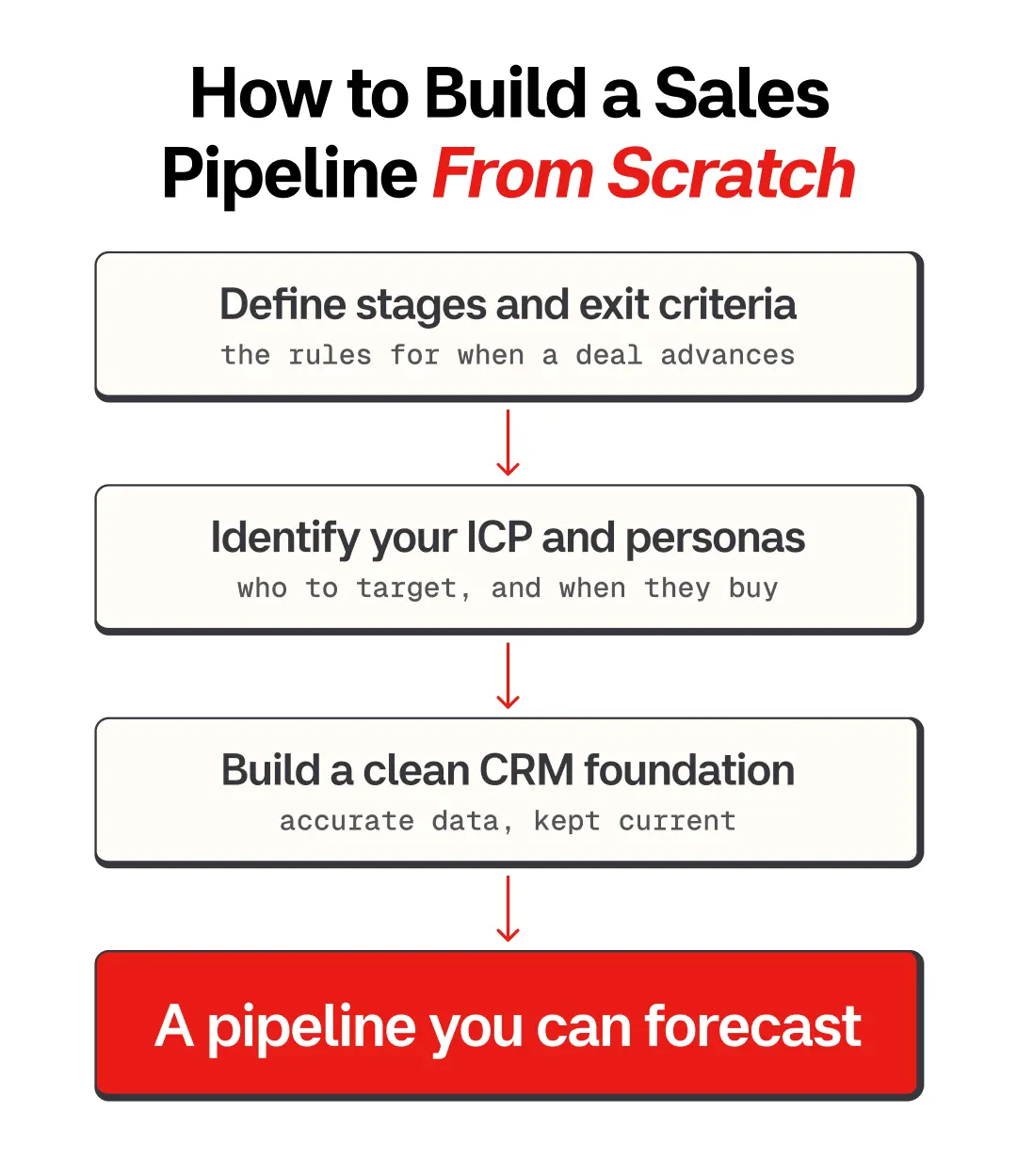
Define Your Pipeline Stages and Exit Criteria
Document what each stage means and what has to happen before a deal advances. This is your exit criteria. Without it, reps guess when to move deals and your sales analytics become unreliable.
Exit criteria might be a completed discovery call, a signed mutual action plan, or verbal agreement on pricing. The specifics matter less than consistency across the team. Write down what has to happen before a deal moves forward, and keep it simple enough that a new hire can follow it without asking. Criteria that need interpretation are a sign your stages are too vague. This is the backbone of sales process optimization.
Identify Your Ideal Customer Profile and Buyer Personas
A healthy pipeline starts with targeting the right accounts. Reps waste sales efforts on deals that were never going to close because they chased anyone who responded.
Your ideal customer profile defines the companies to target: firmographics like size, industry, revenue, and location. Buyer personas identify the decision makers within them. Layer in technographic data to see what a company already uses, and intent signals to find accounts actively researching solutions like yours.
Together, firmographic, technographic, and intent data tell you who to target and when they are ready to buy. Prospecting without a clear ICP builds a pipeline full of tire kickers, so fix your targeting before you worry about conversion rates.
Build a Clean CRM Foundation
Pipeline management depends on accurate data in your customer relationship management system. Reps have to update deal stages, next steps, and close dates for the pipeline to mean anything.
CRMs fail when reps do not update them, and more training rarely fixes that. Make data entry automatic wherever you can, and tie CRM hygiene to quota credit.
Start by enriching contact records with verified firmographic data so reps are not guessing at company size or titles, because bad data in means bad decisions out. Then set required fields for stage changes: moving a deal to proposal should require logging the proposal date and next step. Small friction points force better data without adding real work.
Key Sales Pipeline Metrics to Track
Pipeline metrics tell you whether you have enough deals to hit your sales targets and where your process breaks. Track these to catch problems before they kill the quarter.
Pipeline coverage: Compares total pipeline value to quota. B2B teams typically need several times their quota in pipeline to absorb deals that stall or die, and your exact target depends on historical win rates and cycle length.
Win rate: Measures deals won versus total deals, a direct read on how effective your sales process is. If it drops, either your targeting is off or execution needs work, and a disciplined win/loss analysis tells you which.
Average deal size: Shows revenue per closed deal and feeds your coverage math. If it shrinks, you need more deals for the same number.
Sales cycle length: Tracks days from first contact to close. Longer cycles mean you have to start deals earlier, which directly affects your sales forecasting.
Stage conversion rates: Reveal where deals stall. If half your qualified deals reach discovery but only a quarter advance to proposal, your discovery process needs work.
Pipeline velocity: Measures how fast deals move through the pipeline. Faster sales velocity means more predictable revenue and better cash flow, while slow velocity signals deals are stalling and you need to intervene.
Sales Pipeline Management Best Practices
Keeping a pipeline healthy takes discipline rather than heroics. These habits separate teams that forecast accurately from teams that scramble at quarter end.
Run weekly pipeline reviews: Meet with each rep to inspect deal health, validate stage accuracy, and flag stalled opportunities. Treat reviews as deal inspections where you challenge assumptions and validate next steps, rather than collect status updates.
Remove dead deals quickly: Dead deals inflate pipeline value and distort forecasts. Set aging rules and enforce them, because a 90-day-old opportunity with no logged sales activities is a distraction rather than a forecast line item.
Standardize the process: Make sure every rep follows the same stage definitions and updates the CRM on the same schedule. Without standardization you cannot trust your aggregate numbers or compare performance across the team.
Coach reps to move deals faster: Time kills deals. Push reps to advance opportunities or disqualify them, since a fast no beats a slow maybe. Sharpen the moment of closing the deal with repeatable closing techniques.
Balance prospecting with deal progression: Reps need to prospect continuously, not only when the pipeline runs thin. Set activity minimums for new outbound contacts even when things look healthy, because next quarter's revenue depends on this quarter's lead generation.
How to Optimize Your Sales Pipeline
Maintenance keeps your pipeline functional. Optimization makes it perform. The difference is using data to find what's broken and fixing it with process changes, not guesswork.
Fix Bottlenecks in Stage Conversion
Conversion rates between stages show where deals die. Run a funnel analysis to calculate stage-to-stage conversion.
If half your demos convert to proposals but only one in ten proposals convert to closed won, your pricing or value story is the problem, so fix the proposal stage instead of adding more demos. Then track how long deals sit in each stage.
A deal stuck in negotiation for 45 days has stalled, and the rep usually does not know how to move it forward. Coach to the specific bottleneck rather than generic skills, and watch your lead conversion rate climb.
Prioritize High-Intent Accounts
Not all pipeline is equal. Reps should focus on accounts showing active buying behavior, not leads that filled out a form six months ago. Intent data shows which accounts are researching your category right now. These accounts convert faster and at higher rates than cold outbound, so prioritize them over aged leads.
Build an account scoring model that combines firmographic fit with engagement and intent signals. Pairing that with lead scoring gives reps a clear framework for which deals deserve attention today and which can wait, and helps them tell warm leads from genuinely hot ones.
Automate Pipeline Updates to Improve Data Accuracy
Reps skip CRM updates because manual entry is tedious and does not help them sell.
Automation captures deal activity without manual logging, which improves data quality across the pipeline. Use activity capture to sync emails, calls, and meetings automatically, and use sales automation tools to advance deals based on completed actions like scheduling a demo or receiving a signed contract.
The less reps have to remember, the cleaner your data and the more you can trust your sales analytics. Better data means better forecasts.
How Deal Intelligence Improves Pipeline Management
Deal intelligence is real-time insight into buyer behavior, stakeholder engagement, and deal risk. Traditional pipeline management shows you deal stages. Deal intelligence shows you the health signals behind those stages, which turns reactive management into proactive coaching and is where modern revenue intelligence earns its keep.
Stakeholder mapping: Who is involved in the deal and how engaged they are.
Buying signals: Content downloads, email opens, website visits, and other predictive actions.
Deal risk indicators: Deals with no recent activity or single-threaded relationships.
Multi-threading matters because a deal with one contact dies when that person leaves or loses interest. A single relationship is a contact, not a committed deal. The numbers back this up: ZoomInfo enterprise users report 89% larger deals thanks to expanded buying committees and multi-threaded outreach. Deal intelligence surfaces those relationship gaps and protects the customer experience before they cost you the quarter, which is especially valuable when selling into the C-suite.
How ZoomInfo Powers Sales Pipeline Management
Pipeline problems usually trace back to disconnected tools: prospecting data in one system, engagement in another, deal signals in a third, none of them talking to the CRM. ZoomInfo is an all-in-one AI GTM Platform built as three layers that remove that fragmentation: a B2B data foundation, the GTM Context Graph intelligence layer on top of it, and universal access to both from whichever tool your team already works in.
The data foundation covers 500M+ contacts, 100M companies, and 200M+ verified business emails, kept current by multi-source verification and 300+ researchers. Clean inputs are what make CRM enrichment and data enrichment reliable, so your coverage math and forecast numbers hold up without manual data entry.
The GTM Context Graph processes 1.5B+ data points a day, fusing that data with your CRM, conversation intelligence from Chorus, and behavioral signals into one reasoning layer. It captures why deals move, not just what stage they sit in, which is how go-to-market intelligence becomes deal intelligence: at-risk deals surface before they stall, and reps see which accounts are showing buying behavior now. Three out of four customers said ZoomInfo surfaced opportunities they would have overlooked, driving a 32% increase in total pipeline and cutting sales cycles by 21%.
You use that same data and intelligence wherever you already work, with no lock-in:
Sellers work in GTM Workspace, where AI agents surface buying signals and draft outreach in context.
Marketers, RevOps, and GTM engineers use GTM Studio to score and prioritize accounts in plain language.
Developers wire the same intelligence into any custom tool or agent through GTM.AI, the headless API and MCP option.
One platform means your pipeline runs on a single set of numbers rather than five tools that disagree.

“The call recordings in Chorus would also allow our sales leaders to provide robust coaching to reps without the need to be present on every call.”
Turn Sales Pipeline Management Into Predictable Revenue
A pipeline you can forecast comes down to a few repeatable habits. Define your stages and exit criteria, target the right accounts, keep your CRM data clean, and review deal health every week. Track coverage, win rate, cycle length, conversion, and velocity so problems surface early.
Then layer in intent data and deal intelligence to prioritize the accounts most likely to close and coach the deals that are stalling. Handle those consistently and your sales pipeline stops being a list of wishful thinking and becomes a reliable engine for hitting quota.
Request a demo to see how ZoomInfo helps you build and manage a healthier pipeline.
Frequently Asked Questions
What is the difference between a sales pipeline and a sales funnel?
A sales pipeline tracks individual deals and what stage they're in. A sales funnel measures conversion rates from one stage to the next across all deals.
How often should sales teams review their pipeline?
Most teams run weekly pipeline reviews with reps and managers to check deal health and validate forecasts.
What pipeline coverage ratio should B2B sales teams target?
Pipeline coverage varies by win rate and sales cycle. Calculate your target by dividing quota by your historical win rate.
How do you remove dead deals from a sales pipeline?
Set aging rules that automatically flag deals with no activity in a defined timeframe, then require reps to update or remove them during pipeline reviews.
What is pipeline velocity in sales?
Pipeline velocity measures how fast deals move through your pipeline from first contact to close, which directly impacts revenue predictability.
