

Whether you are evaluating Salesforce for the first time or mapping what an existing license includes, the challenge is the same: the platform spans seven named clouds, an AI agent layer, a data unification engine, and a marketplace of 9,000+ apps, all on one codebase. This breakdown covers every major feature, how it works, who it serves, and which tier unlocks it.
Salesforce's feature set has you covered if:
You manage a sales pipeline from lead capture through close and need AI scoring, forecasting, and coaching in one system
You run customer service across email, chat, phone, SMS, and social channels and want AI agents resolving routine cases on their own
You orchestrate B2C or B2B marketing campaigns with journey builders, personalization, and a native customer data platform
You operate digital storefronts and need commerce, order management, and CRM sharing the same customer record
You want to build and deploy AI agents across sales, service, marketing, and IT without assembling separate tools
You need a low-code and pro-code development platform to build custom enterprise applications on top of your CRM data
You'll reach the edges of its capabilities if:
You need a B2B contact and company database to fuel prospecting before leads enter the CRM
You want buyer intent signals showing which companies are researching your category across the web before you ever contact them
You need to identify anonymous website visitors and convert that traffic into pipeline
You want an intelligence layer that reasons across CRM records, conversations, and market signals to capture why deals move, not just that they moved
You need automated data enrichment that keeps CRM records accurate without manual research
For those needs, the reference point is ZoomInfo: an AI GTM platform built on 500M contacts, 100M companies, 135M+ verified phone numbers, and 200M+ verified business email addresses, with a GTM Context Graph that fuses B2B data with CRM records, conversation intelligence, and behavioral signals into one intelligence layer.
ZoomInfo integrates directly with Salesforce, supplying the data and signals that make CRM execution work.
After the feature breakdown, this article covers exactly where Salesforce stops and how ZoomInfo fills those edges.
Salesforce Platform Overview
Salesforce is the world's #1 CRM by IDC 2024H1 revenue market share, serving over 150,000 companies worldwide across 17 industry verticals.
The platform is organized around four pillars: Agentforce (autonomous AI agents), Customer 360 (the CRM application suite), Data 360 (data unification and analytics), and Slack (enterprise collaboration). Salesforce now positions itself as "the operating system for the Agentic Enterprise", where AI agents and human employees work side by side.
Module | What It Does | Plan or SKU |
|---|---|---|
CRM, pipeline management, forecasting, sales engagement, revenue lifecycle | Free ($0, 2 users) through Agentforce 1 ($550/user/mo) | |
Case management, omnichannel support, field service, contact center | Same tier structure; add-ons from $75/user/mo | |
Cross-channel campaigns (B2C and B2B), personalization, CDP, loyalty | From $1,250/org/mo to $30,000/org/mo | |
B2C and B2B storefronts, order management, conversational shopping | Quote-based | |
Autonomous AI agents, Atlas Reasoning Engine, Trust Layer, Agent Builder | $2/conversation or $500/100K Flex Credits | |
Data unification, zero-copy connectors, identity resolution | $500/100K credits; $23/mo per TB | |
Analytics, dashboards, AI-powered insights | $15-$115/user/mo | |
API management, enterprise integration, Agent Fabric | Quote-based | |
Enterprise messaging, CRM integration, AI assistants | Free through Enterprise Grid (by quote) | |
9,000+ partner apps, AgentExchange for agent components | Per-app pricing |
Sales Cloud and Service Cloud follow a six-tier pricing model: Free Suite ($0, max 2 users), Starter Suite ($25/user/mo), Pro Suite ($100/user/mo), Enterprise ($175/user/mo), Unlimited ($350/user/mo), and Agentforce 1 ($550/user/mo).
Marketing Cloud is priced per org, not per user. Commerce Cloud and MuleSoft are quote-based. A June 2025 restructuring replaced Einstein add-ons with Agentforce editions and raised Enterprise and Unlimited list prices by an average of 6%. With that structure in place, here is the full tour.
Salesforce Sales Cloud: CRM, Pipeline, and Revenue Execution
Sales Cloud (now also branded Agentforce Sales) is the flagship product and the one most buyers encounter first. It centralizes lead management, deal tracking, forecasting, and sales engagement in one workspace, with AI layered across every step.
Lead Management starts with Einstein Lead Scoring, which ranks leads by conversion likelihood using historical patterns from your own data. Auto-assignment routes scored leads to reps by territory, product line, or capacity.
The result is a prioritized queue where high-potential leads surface first, not a flat list sorted by creation date. Lead management is available from Starter Suite and up; Einstein AI scoring requires Enterprise or above.
Account and Opportunity Management tracks every deal from first conversation through close. At the Enterprise tier, AI-generated account plans include SWOT analysis, pipeline health signals, and contact role mapping.
Team selling assigns multiple reps to an opportunity with defined roles (decision-maker, champion, influencer), so enterprise deals with complex buying committees track against the actual stakeholders, not a single contact name. Pipeline views consolidate all opportunities with AI deal insights and change signals that flag when a deal's close date, amount, or stage shifts.
Forecast Management rolls up individual forecasts into team, regional, and company views in real time. The Einstein Forecast overlay runs its own AI prediction alongside rep-submitted numbers, so managers can compare human judgment against the model.
Consumption forecasting handles usage-based revenue models where closed-won is not the end of the revenue cycle. Forecasting requires Pro Suite or above.
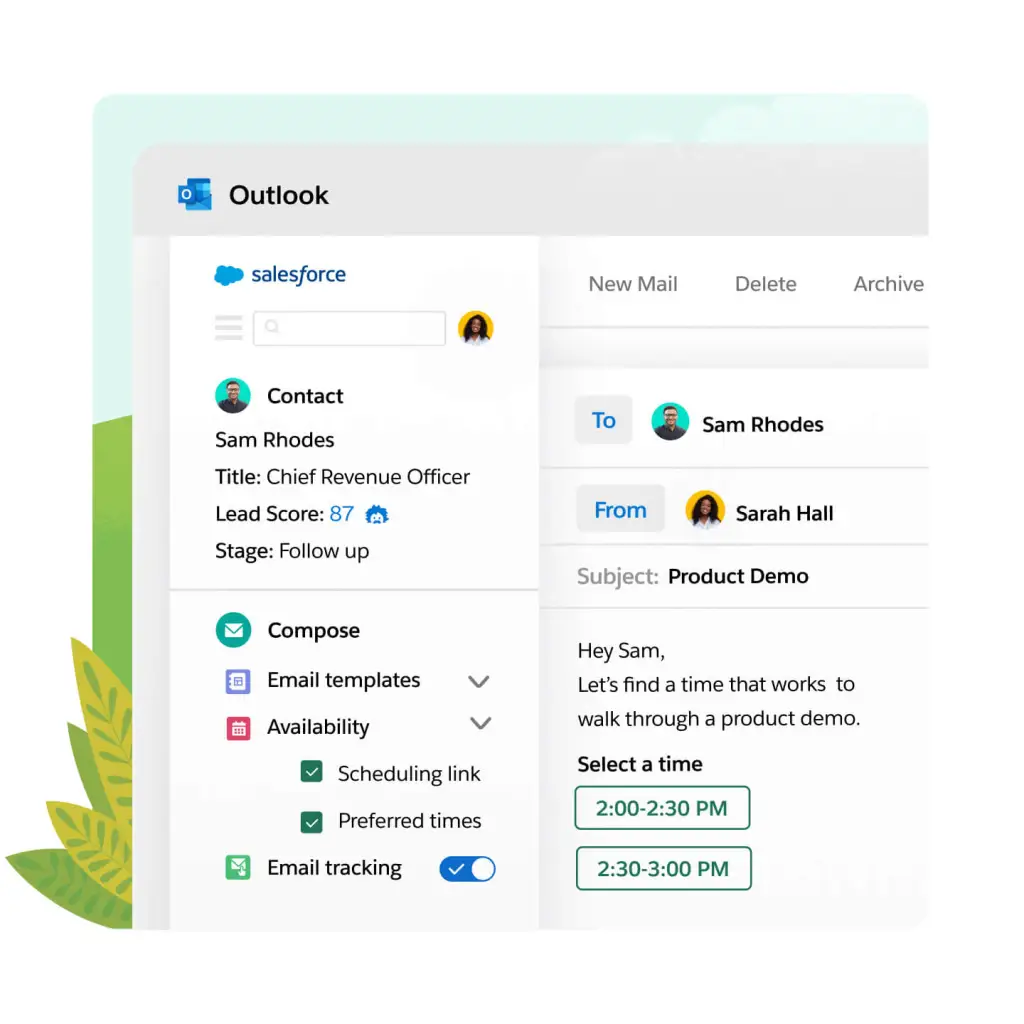
Sales Engagement brings sequencing into the CRM itself. Cadences let reps build multi-step outreach sequences (email, call, LinkedIn) with defined timing and automated task creation. The Prospecting Center consolidates a rep's queue into one prioritized workspace.
Source: Salesforce
CRM Everywhere, a Chrome extension, overlays Salesforce data on any webpage so a rep researching a prospect on LinkedIn or a company website can log activity, view contact history, and launch cadence steps without switching tabs.
Buyer Assistant handles inbound leads on your website with AI conversations that qualify, route, and book meetings. Sales Engagement features are available at Enterprise and above.
Sales AI spans the full workflow. Call Explorer transcribes recorded sales calls and lets managers search for specific topics (competitor mentions, pricing discussions, objections) across all calls instead of listening end to end.
Embedded summarization generates deal summaries, meeting prep briefs, and follow-up drafts from conversation data. Territory optimization uses AI to balance rep workloads and coverage. These AI features are available at Enterprise and above, with the full suite at Unlimited.
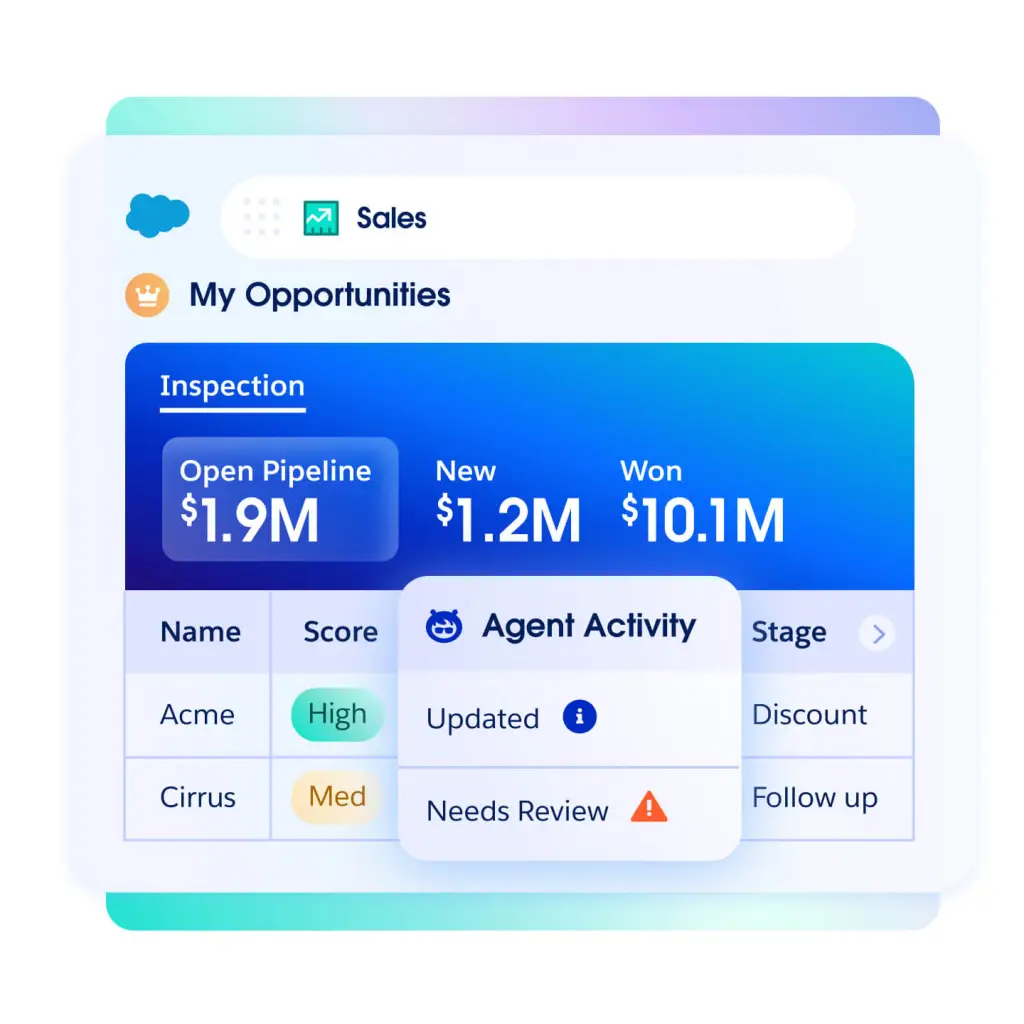
Agentforce Sales Agents bring autonomous execution to the sales cycle. The SDR Agent researches accounts, drafts personalized outreach, and engages inbound leads around the clock.
Source: Salesforce
The Sales Coach simulates buyer objections and scores rep responses. Automated quoting through the Revenue Lifecycle Management module handles quote generation 75% faster than manual creation. These agents require the Agentforce 1 tier or Flex Credits purchased separately.
The remaining Sales Cloud capabilities round out the revenue lifecycle. Revenue Lifecycle Management covers CPQ (configure-price-quote), contract lifecycle management, subscription billing, and order automation. Sales Performance Management handles quota setting, territory planning, and commission calculations through Salesforce Spiff.
Partner Relationship Management creates branded partner portals with shared pipeline visibility and Agentforce-powered partner support.
Salesforce Service Cloud: Customer Support Across Every Channel
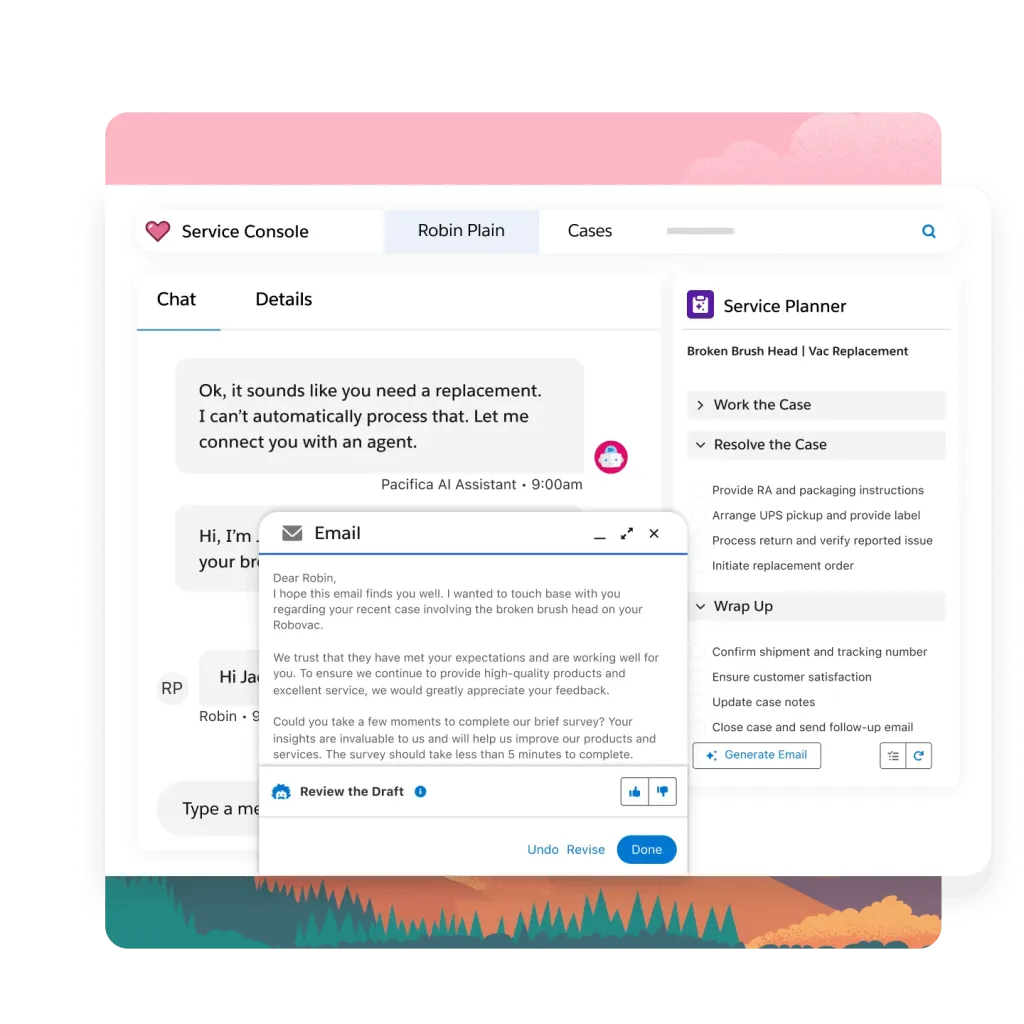
Service Cloud (now Agentforce Service) puts human agents and AI agents side by side across every support channel.
Source: Salesforce
Its advantage over standalone helpdesk tools is that service agents see the same customer record as sales and marketing, so a support interaction can reference the deal that closed last month, the campaign that drove the lead, and the product the customer purchased, without integration work.
Case Management handles assignment, escalation, and SLA tracking. Cases auto-route by product, region, or severity, with escalation rules and SLA milestones triggering alerts when response times approach breach. Incident management groups related cases under a single incident record so a widespread outage is tracked as one problem, not hundreds of duplicate tickets.
The Service Console gives agents a workspace with AI-generated action plans, conversation summaries, and swarming via Slack for complex issues that need cross-team collaboration.
Knowledge Management powers both agent-facing and customer-facing support. The knowledge base supports AI-powered search that returns direct answers rather than article lists, self-learning knowledge that surfaces content based on case resolution patterns, and AI-generated articles drafted from resolved case data. This is available from Pro Suite and above.
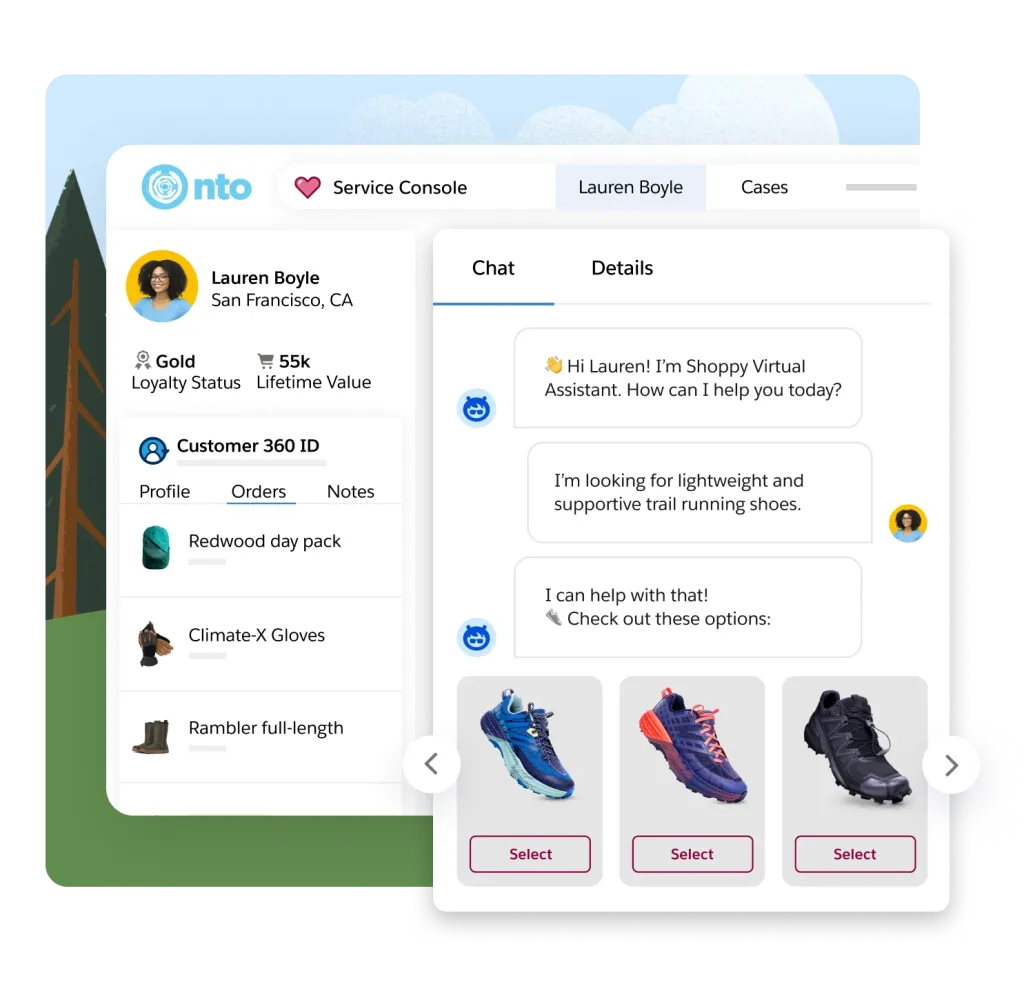
Digital Engagement ($75/user/month add-on) extends support across chat, SMS, WhatsApp, Facebook Messenger, Apple Messages for Business, LINE, and a bring-your-own-channel API.
Source: Salesforce
Conversations from all channels appear in one agent workspace with unified routing and queue management. Proactive messaging lets service teams push outbound notifications (appointment reminders, shipping updates) through the same channels.
Contact Center ($150/user/month add-on) adds voice integration with Amazon Connect or bring-your-own telephony, a Command Center dashboard for supervisors with real-time agent monitoring, feedback management for post-interaction surveys, and sentiment scoring during live interactions.
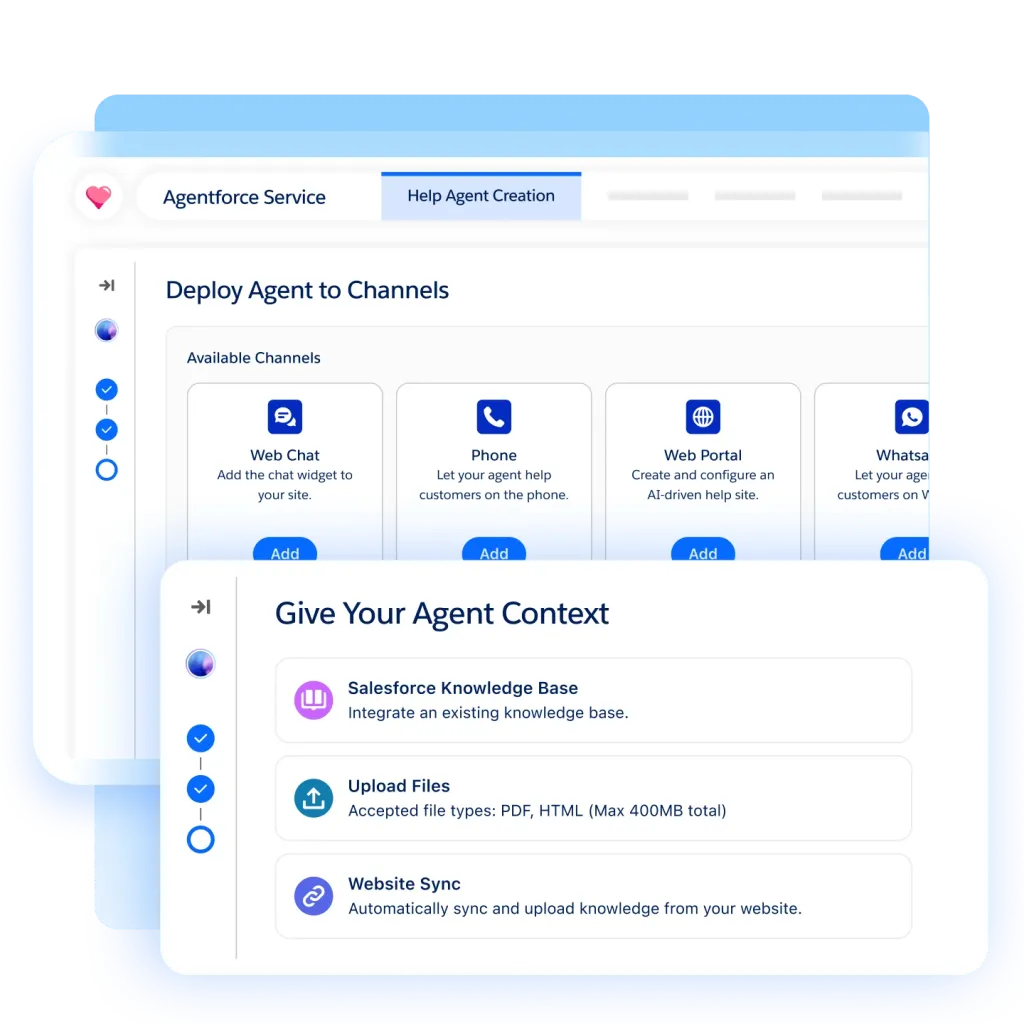
Agentforce for Service ($125/user/month add-on) deploys autonomous AI agents across any channel. Einstein case classification auto-tags incoming cases by type, urgency, and product area. Routing sends each case to the right agent (human or AI) based on those classifications.
Source: Salesforce
The AI agent handles routine inquiries (password resets, order status, FAQ answers) end to end, escalating to a human only when the issue exceeds its guardrails. Salesforce reports resolving 85% of its own support requests without human escalation using this technology.
Field Service (from $175/user/month) manages mobile workforces with AI-optimized scheduling, an offline mobile app for technicians in low-connectivity environments, pre-work briefs that summarize the job before a technician arrives, work order management, asset lifecycle tracking, and Visual Remote Assistant for remote diagnosis via video.
Salesforce Marketing Cloud: Campaigns, Personalization, and Customer Data
Marketing Cloud (now Agentforce Marketing) is organized around several sub-products, each sold separately, covering the full marketing lifecycle from data unification through campaign execution and measurement.
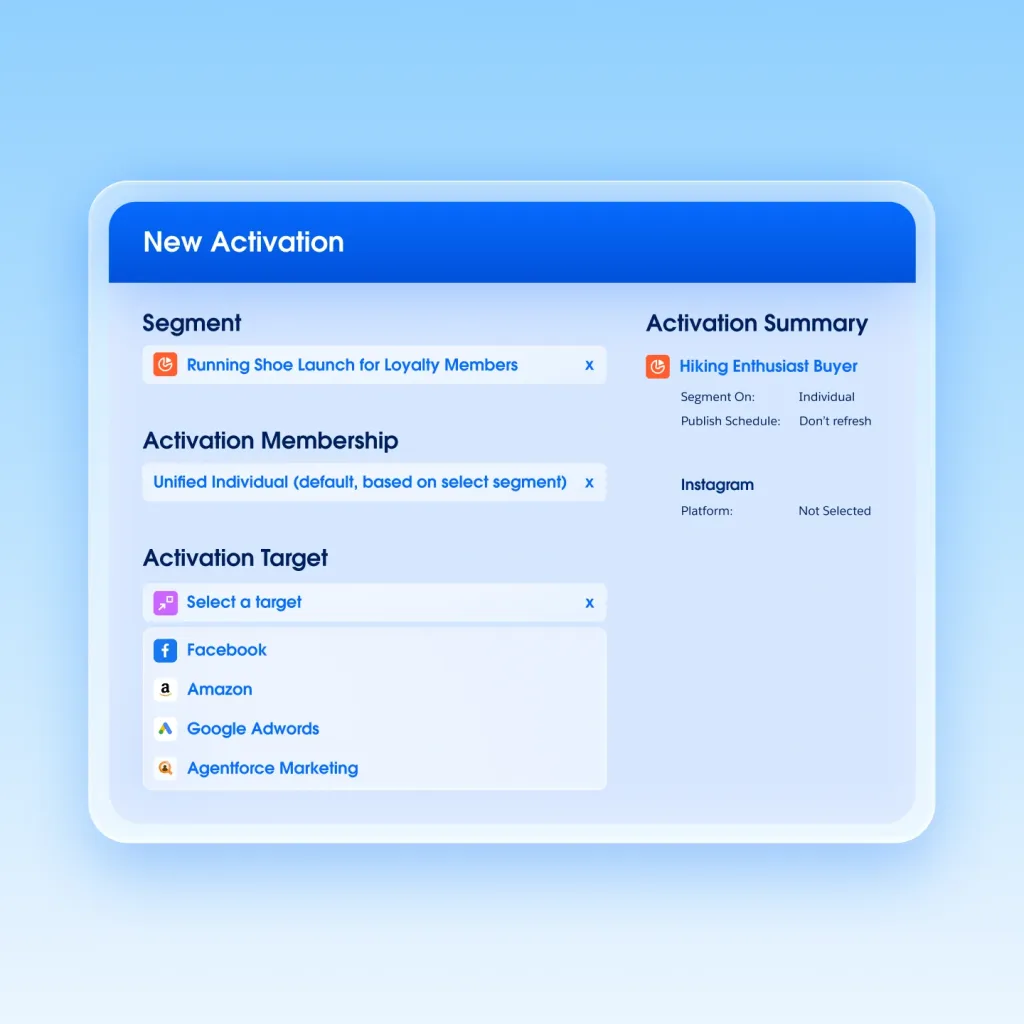
Data 360 CDP is the data foundation. It builds unified customer profiles by resolving identities across email addresses, phone numbers, device IDs, and loyalty accounts into a single record.
Source: Salesforce
The zero-copy architecture connects directly to live data in Snowflake, Databricks, Google BigQuery, and AWS without ETL or data duplication, so marketing teams can activate data warehouse segments without moving data into Salesforce first.
Agentforce segmentation builds audience segments from natural language prompts. First-party ad activation pushes segments directly to advertising platforms, and clean rooms let teams collaborate on data with partners without exposing raw records. Data 360 is the Gartner MQ Leader for Customer Data Platforms for the second consecutive year.
Journey Orchestration (Marketing Cloud Engagement) builds multi-step, event-driven campaigns across email, SMS, push notifications, and WhatsApp. Journey Builder sequences touchpoints based on customer actions: an abandoned cart triggers an email, a click triggers an SMS with a discount code, and no response triggers a display ad retargeting sequence.
Two-way conversations on SMS and WhatsApp let customers reply directly rather than being pushed to a form. Agentforce can create campaigns from natural language briefs, drafting copy, selecting audiences, and configuring journeys without manual setup. Engagement pricing starts at $2,000/org/month (2.5M emails, 15K contacts).
Account Engagement (formerly Pardot) handles B2B marketing automation: lead nurturing sequences, AI-powered lead scoring and grading, account-based engagement with Sales Cloud opportunity data, and multi-touch attribution that shows which campaigns influenced pipeline. Pricing starts at $1,250/org/month for 10,000 contacts.
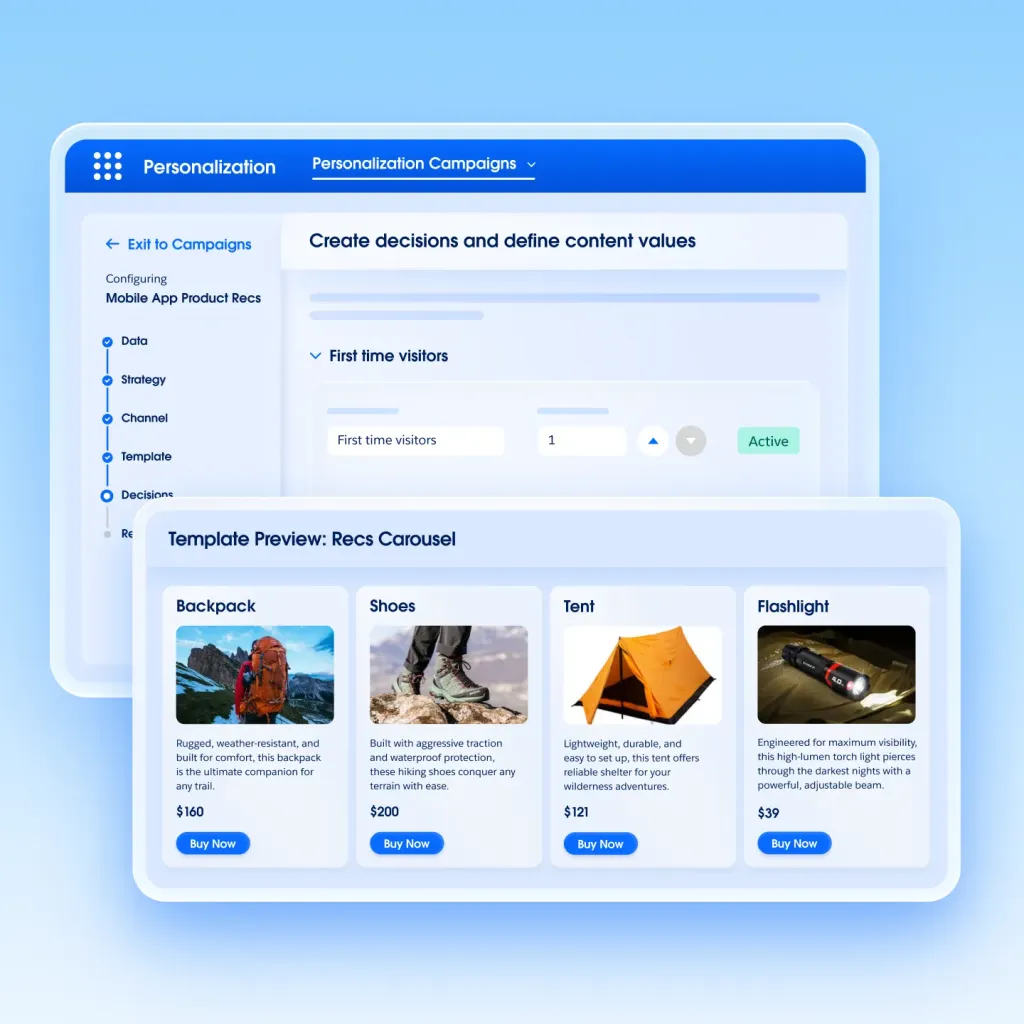
Personalization delivers real-time AI and rule-based recommendations across web, email, mobile, and agent interactions. It reads behavior in session (pages viewed, products browsed, time on site) and matches it against customer profile data to surface relevant offers, content, or product recommendations before the visitor navigates away. Pricing starts at $8,000/org/month.
Source: Salesforce
Marketing Intelligence (formerly Datorama) connects 170 prebuilt API connectors to ad platforms, web analytics, CRM, and social channels, consolidating performance data into one view. Agentforce-powered paid media optimization can auto-pause underperforming ads and reallocate budget based on predictive forecasting. Pricing starts at $10,000/org/month.
The suite also includes Loyalty Management ($20,000/org/month) for B2B and B2C loyalty programs with AI-powered referral programs and personalized promotions.
Salesforce Commerce Cloud: Storefronts, Orders, and Conversational Shopping
Commerce Cloud (now Agentforce Commerce) runs B2C and B2B digital commerce on the same platform as CRM, so a customer's purchase history, service interactions, and marketing engagement all live in one record.
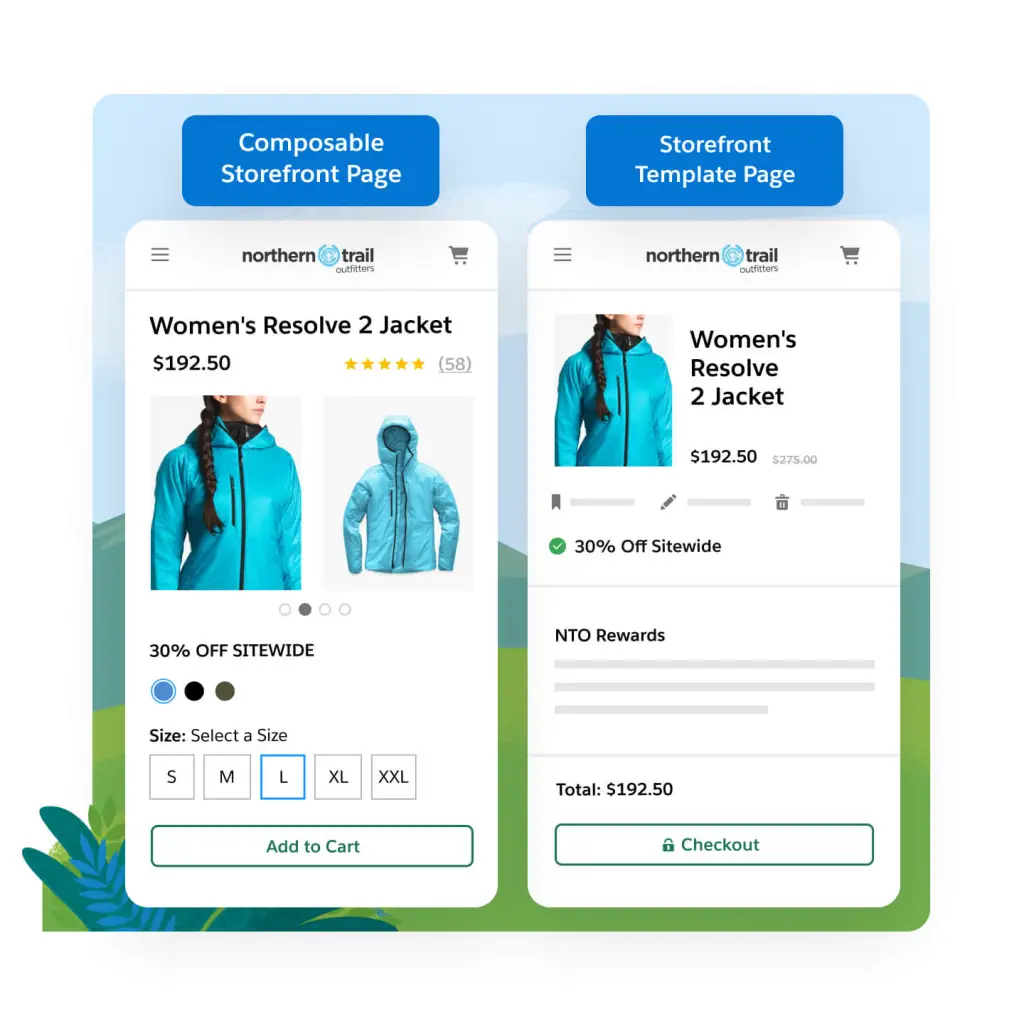
B2C Commerce provides storefront templates for rapid deployment and a Composable Storefront (a React-based PWA with Salesforce-managed hosting, CDN, WAF, and 60-second deploys). Page Builder lets merchandisers drag and drop components without developer involvement.
Source: Salesforce
The platform supports multi-region, multi-currency, and multi-language deployments and maintains 99.99% historical uptime. Gartner has named it a Leader in Digital Commerce for 10 consecutive years.
B2B Commerce adds the features enterprise buyers expect: account entitlements that restrict catalog visibility by customer, negotiated pricing with 200+ promotion types, multi-address shipping, and Agentforce for buyers that lets procurement teams reorder via natural language prompts or photos of existing products.
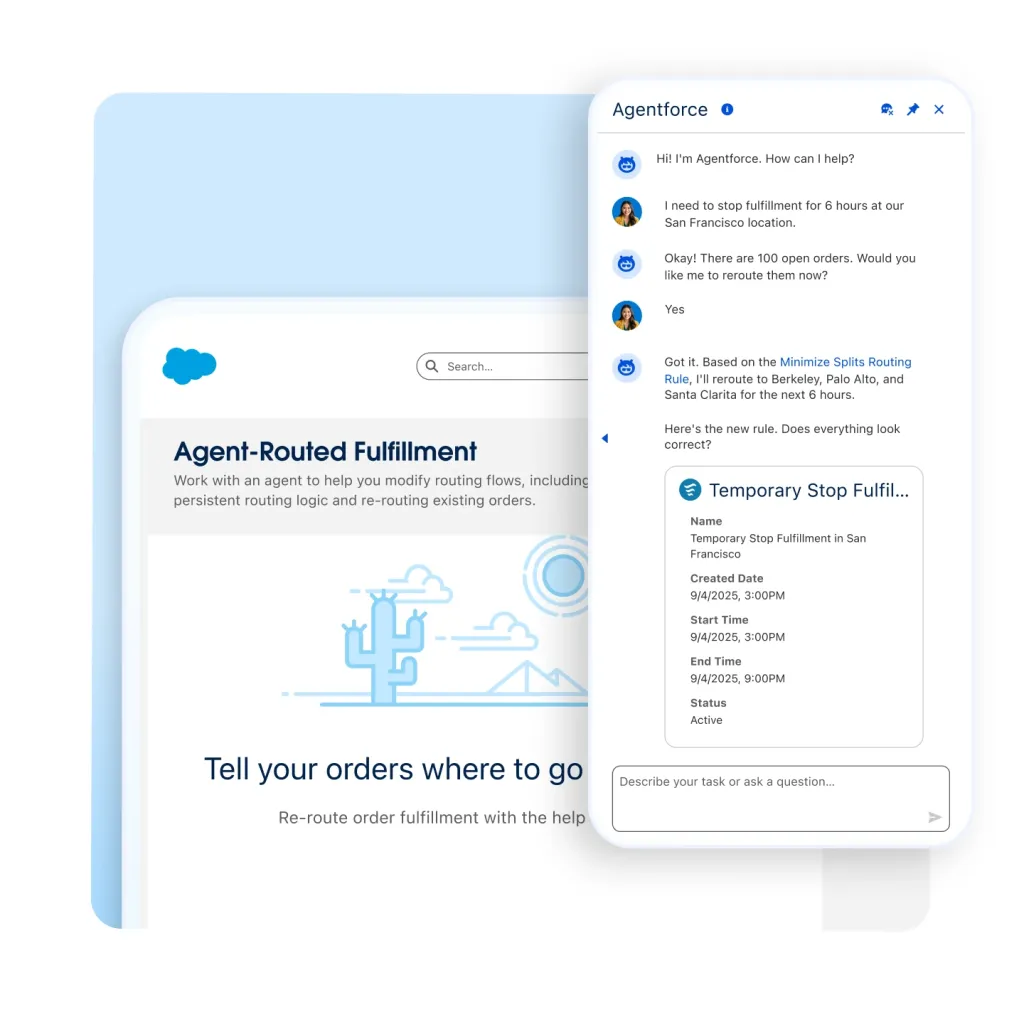
Order Management handles post-purchase logistics with agentic order routing (AI selects the best fulfillment location based on inventory, proximity, and cost), delivery estimation, omni-channel inventory visibility, BOPIS (buy online, pick up in store), and a Store Associate mobile app for in-store fulfillment.
Commerce AI includes Guided Shopping, a conversational AI that walks buyers through product selection with in-chat checkout (the buyer never leaves the conversation to complete the purchase), AI-generated product descriptions, promotions, and product recommendations. Commerce Cloud is entirely quote-based with no published pricing.
Source: Salesforce
Salesforce Agentforce: Autonomous AI Agents Across the Platform
Agentforce is Salesforce's autonomous AI agent platform, positioned as the shift from copilots (which require constant prompting) to agents that perceive, plan, and execute on their own. The platform has reached $800M ARR, growing 169% year over year, with 29,000 deals closed and 2.4 billion Agentic Work Units delivered.
The reasoning layer underneath is the Atlas Reasoning Engine, which uses Reasoning and Acting (ReAct) prompting: a loop of reason, act, observe, and adapt.
Unlike fixed chain-of-thought approaches that follow one predetermined path, ReAct agents reassess after each action based on what they observe, making them capable of handling multi-step tasks where the next step depends on the result of the previous one.
Pre-built agents ship for immediate deployment: Service Agent, SDR Agent, Sales Coach, Personal Shopper, Campaign Assistant, Employee Agent, and Setup Agent, plus industry-specific agents for Healthcare, Banking, Retail, Field Service, and IT Service.
Source: Salesforce
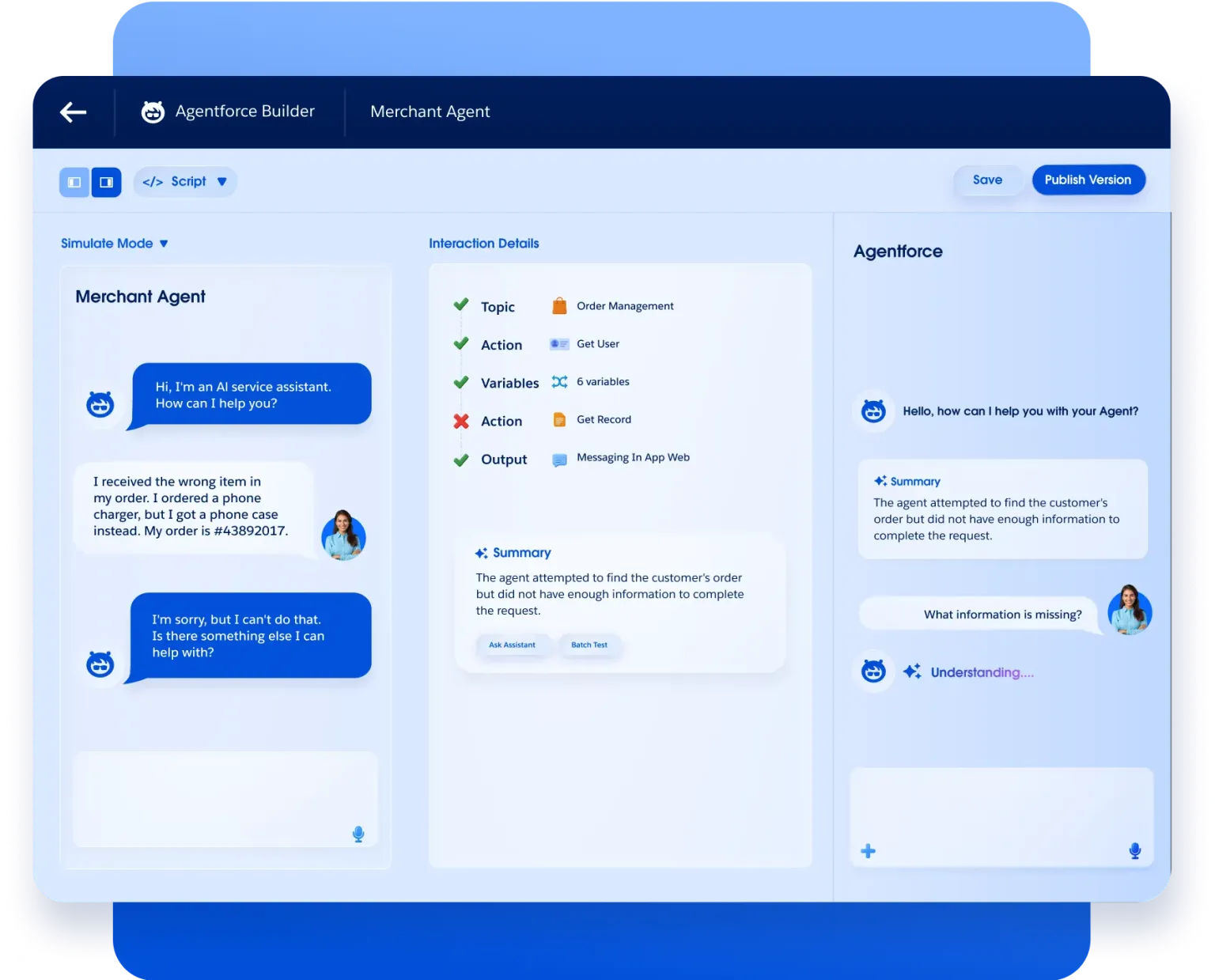
Each is configured via Topics (which scope what the agent can discuss), Actions (which connect it to data and workflows), and Guardrails (which set safety boundaries).
Agentforce Builder lets teams create custom agents. The starting point is natural language: describe what the agent should do, and Builder generates a draft configuration. A canvas view shows the agent's decision tree visually.
Source: Salesforce
For teams that need deterministic control over specific steps, Agentforce Script enables hybrid reasoning where certain steps follow hard-coded logic while others use LLM-based decision-making. Builder is included at no additional cost with Agentforce.
The Einstein Trust Layer is the security architecture underneath. It enforces zero data retention with LLM partners (your CRM data is not used to train third-party models), PII data masking that strips sensitive information before it reaches the LLM, dynamic grounding that ties agent responses to your actual CRM data rather than general knowledge, toxicity detection, and full audit trails.
For regulated industries, the Trust Layer gives a concrete advantage over generic AI tools that cannot guarantee data isolation.
Agentforce pricing follows three purchasing models:
Flex Credits: $500 per 100,000 credits. Each standard action costs 20 credits ($0.10/action); voice actions cost 30 credits ($0.15/action). Credits are fungible across all agent types.
Conversations: $2 per conversation (a 24-hour session). Customer-facing agents only. Cannot coexist with Flex Credits in the same org.
User licenses: Agentforce add-on at $125/user/month for unmetered employee usage.
Salesforce Foundations gives existing customers a free starting point with Agent Builder, Prompt Builder, 200K Flex Credits, and 250K Data Cloud credits. The Flex Agreement allows converting unused user licenses into Flex Credits or vice versa.
Salesforce Data Cloud and Tableau: Data Unification and Analytics
Data Cloud (branded Data 360) is the data engine underneath everything else. It transforms fragmented data into one complete view of the business. It ingested 112 trillion records in FY26, up 114% year over year.
The defining feature is zero-copy architecture. Instead of extracting data from Snowflake, Databricks, Google BigQuery, or AWS into Salesforce, Data Cloud connects to data where it already lives and queries it in place.
This eliminates the ETL pipelines, data duplication, and sync lag that plague CRM data projects. 200+ pre-built connectors ingest structured and unstructured data from Salesforce clouds, third-party apps, and databases.
Identity Resolution takes records from multiple systems (email from marketing, phone from sales, loyalty ID from commerce) and matches them into unified customer profiles. A customer who used one email for marketing subscriptions and another for support tickets appears as one person, not two separate records.
Vector Search provides vector and hybrid search indexes for RAG-based AI grounding, so Agentforce agents answer questions based on your actual data, not general training knowledge.
Governance includes policy-based data access controls, AI-powered tagging, customer-managed encryption keys, and Private Connect for network-level isolation.
Data Cloud pricing is consumption-based at $500 per 100,000 credits (fungible across all functions) with $23/month per TB of storage. Salesforce data ingestion from Salesforce clouds is free, consuming zero credits.
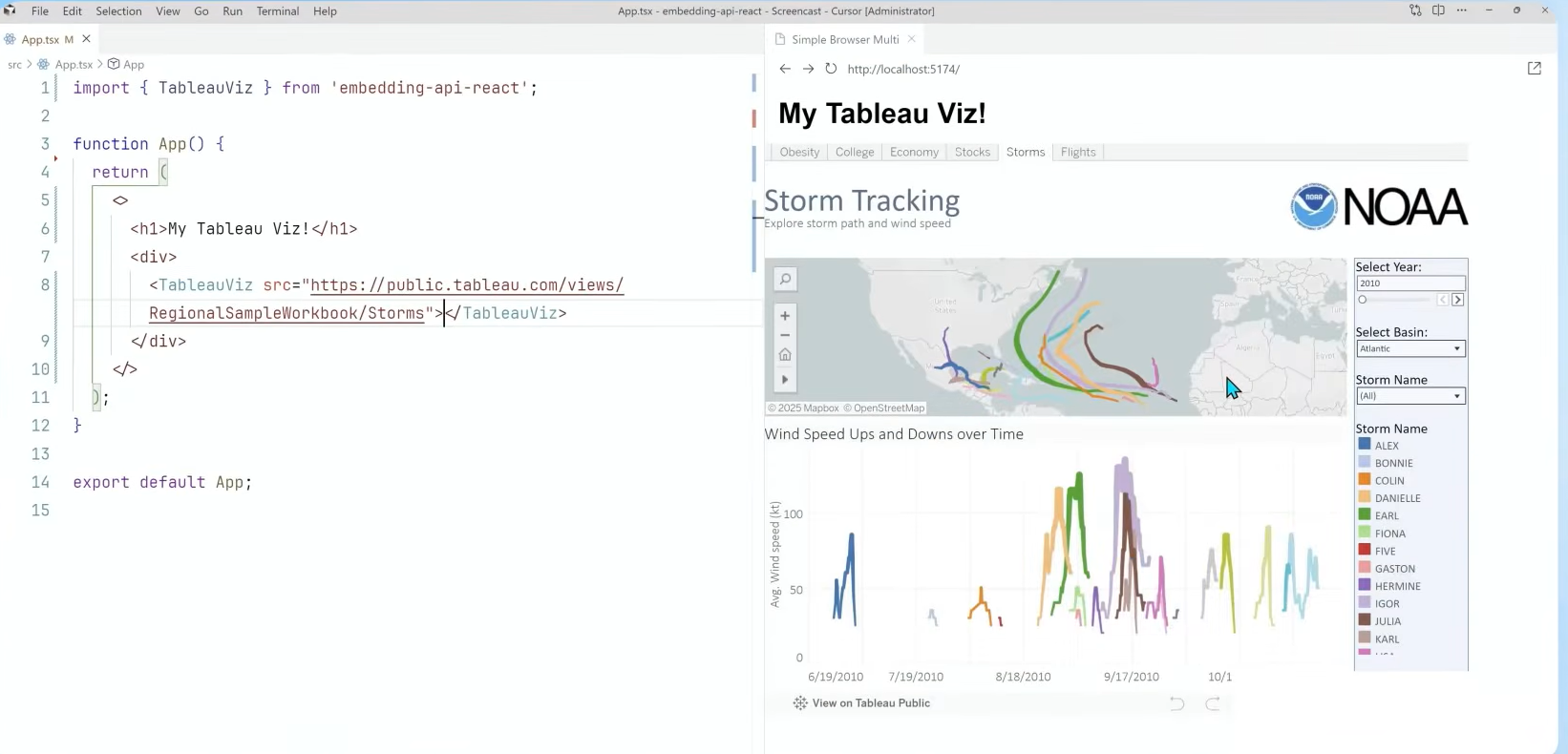
Tableau is Salesforce's analytics platform (acquired in 2019 for $15.7 billion). It spans three product lines. Tableau Desktop, Cloud, and Server handle traditional BI with interactive dashboards, drag-and-drop visualization, and published workbooks.
Source: Salesforce
Tableau Pulse delivers personalized AI-generated insight digests to each user's inbox, surfacing the metrics and anomalies relevant to their role without requiring them to build reports.
Tableau Next is the agentic analytics evolution, bringing Agentforce integration, a Tableau Semantics AI layer, and agent skills (Data Pro, Concierge, Inspector) that let users ask questions in natural language and get analytical answers grounded in governed data definitions.
CRM Analytics provides embedded analytics directly within Salesforce records; a sales manager viewing an account sees pipeline trends, win rate analysis, and forecast comparisons without opening a separate tool. Tableau Cloud pricing starts at $15/user/month for Viewers, $42 for Explorers, and $75 for Creators.
Salesforce Platform, MuleSoft, and Ecosystem
The Salesforce Platform (now Agentforce 360 Platform) is the development foundation for admins, developers, and citizen developers. Agent Builder creates AI agents with low-code tools. App Builder provides drag-and-drop application development.
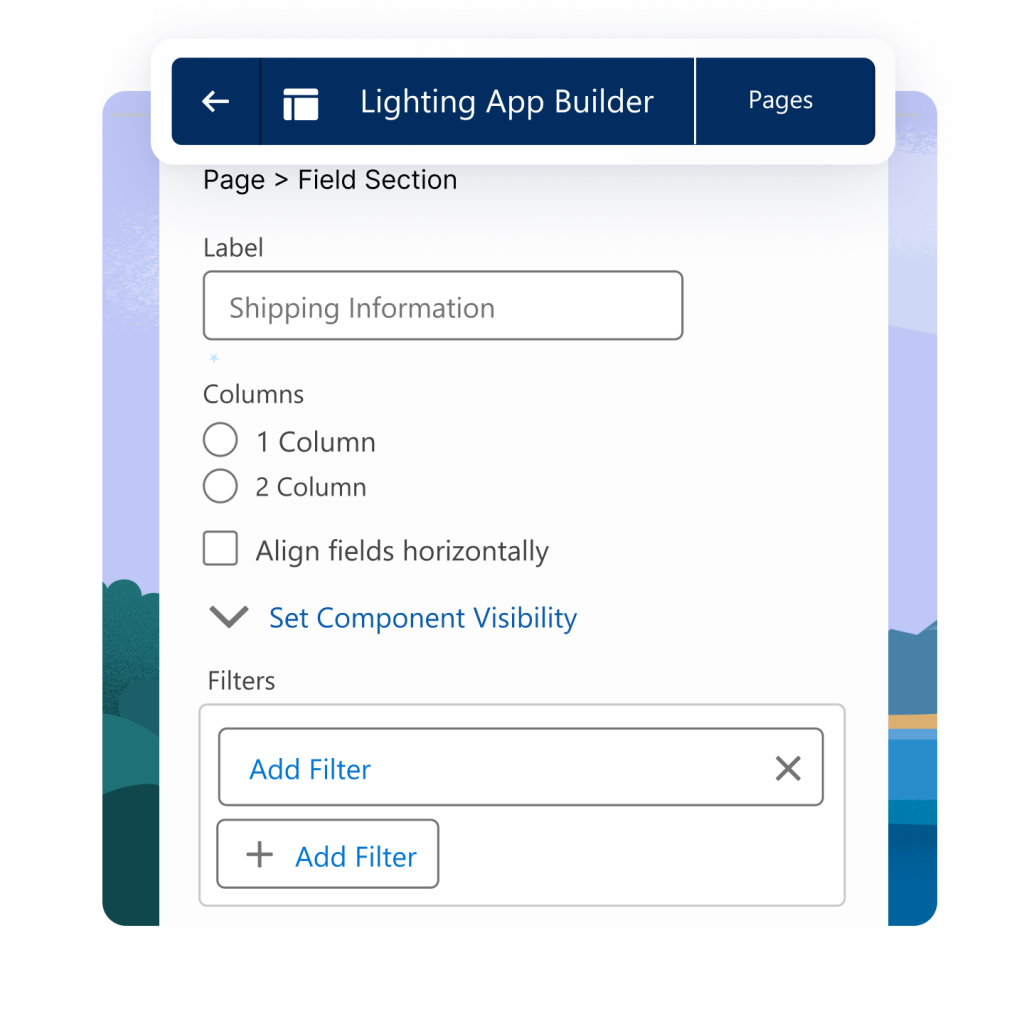
Source: Salesforce
Code Builder is a cloud-based IDE for pro-code development in Apex and Lightning Web Components. Flow automates business processes with a visual builder that handles approval chains, record updates, scheduled jobs, and API callouts.
Agentforce Vibes adds AI-assisted coding that generates Apex, Lightning components, and Flow configurations from natural language descriptions. Platform licenses start at $25/user/month.
MuleSoft is Salesforce's integration and API management platform, built around the Anypoint Platform. It provides hundreds of pre-built connectors for enterprise systems (SAP, Oracle, Workday, ServiceNow, databases, messaging systems), API design and governance tools, and gateway capabilities.
MuleSoft extends agent capabilities beyond Salesforce through Agent Fabric, which provides a multi-agent registry, scanners that discover and catalog AI agents across Salesforce, Amazon Bedrock, Google Cloud Vertex AI, and others, a broker that routes requests to the right agent, and governance controls.
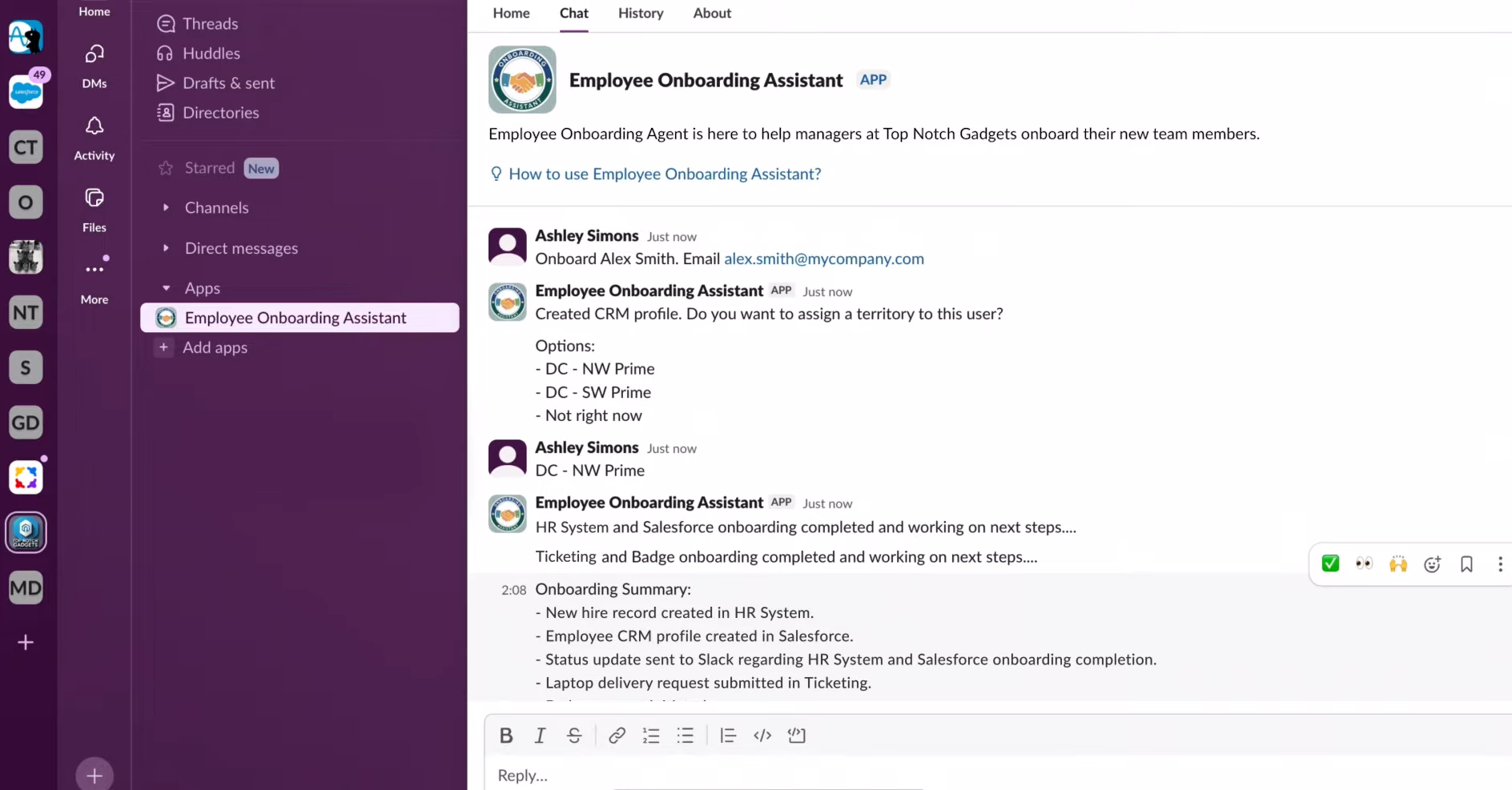
Source: MuleSoft
MuleSoft also supports MCP (Model Context Protocol), enabling external AI models to invoke Salesforce business logic directly. MuleSoft is sold separately from CRM licenses.
AppExchange is the world's largest enterprise cloud marketplace with 9,000+ partner apps, 14+ million installs, and 91% customer adoption. The ecosystem spans 160,000+ companies, 5,000 ISVs, and 7,000 system integrators.
AgentExchange, launched March 2025, is the dedicated marketplace for Agentforce components, with 200+ launch partners and 250+ pre-built agent actions, topics, and templates.
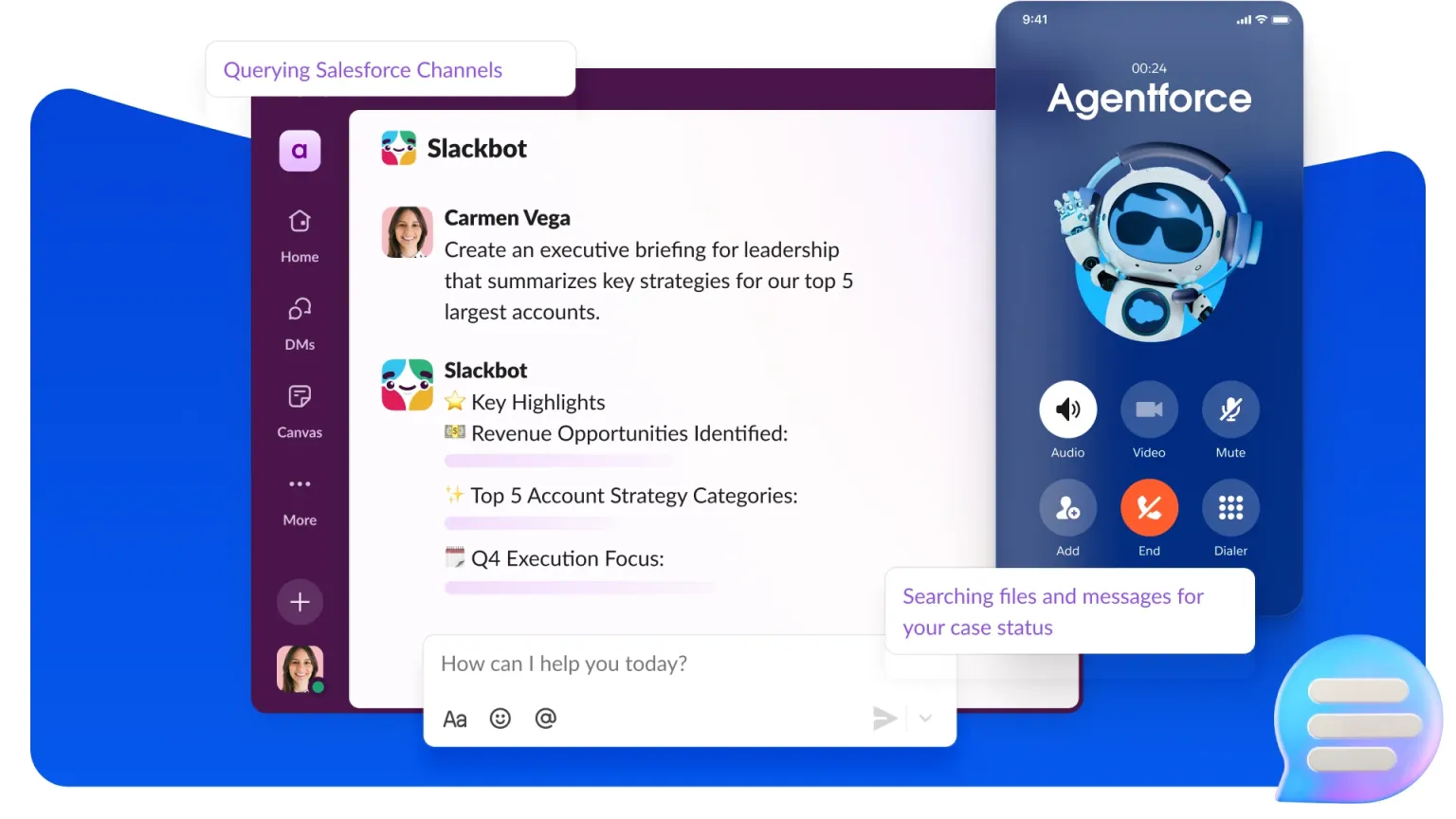
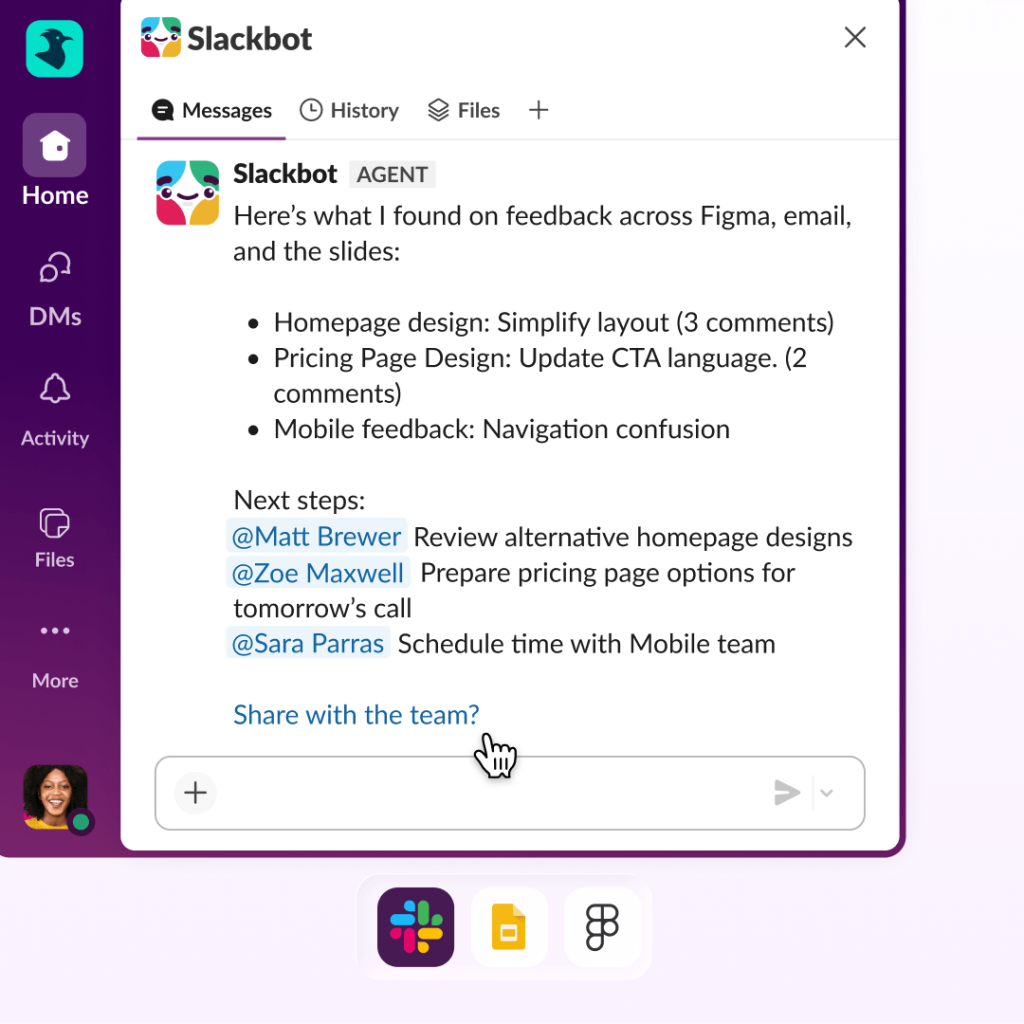
Slack (acquired in 2021 for $27.7 billion) processes 5.2 billion messages weekly and runs 148 million AI workflows monthly. Beyond standard messaging features (Channels, Huddles, Canvas, Slack Connect for cross-company collaboration), the Salesforce-specific integrations set it apart.
Source: Salesforce
Salesforce Channels bring CRM data into Slack conversations bidirectionally: a deal update in Salesforce triggers a Slack notification, and a Slack reply updates the CRM record. Slackbot acts as a personal AI agent that queries CRM, plans your day, drafts content, and orchestrates other agents. Agentforce in Slack brings AI agents into channels as full participants.
Slack pricing was updated in June 2025: Free ($0, 90-day message history), Pro (unchanged), Business+ ($15/user/month annually, includes full AI), Enterprise+ and Enterprise Grid (contact sales).
The API layer spans more than 30 distinct APIs: REST, SOAP, GraphQL, Bulk API 2.0, Pub/Sub API (gRPC for event streaming), and Metadata API. API access is available on all paid editions, with Enterprise Edition starting at 100,000 API requests per rolling 24-hour period. Security certifications cover ISO 27001/27017/27018, SOC 1/2/3, and FedRAMP for Government Cloud.
Salesforce Shield (premium add-on) adds Event Monitoring, Platform Encryption with bring-your-own-key, Field Audit Trail with indefinite retention, and Data Detect for PII pattern matching.
Hyperforce enables deployment on public cloud infrastructure with regional data residency at no additional cost. Trailhead, the free learning platform, has 6+ million learners, 1,500+ badges, and 60+ certifications.
Where Salesforce Stops: The Gaps
Salesforce's design centers on what happens after a lead enters the system: tracking deals, serving customers, running campaigns, managing storefronts, and deploying AI agents across all of it.
That scope runs deep, but it also means the platform depends on external sources for several capabilities a go-to-market team needs before and around CRM execution.
No native B2B contact or company database for prospecting.
Salesforce is a CRM, not a data provider. It stores, manages, and activates the contacts and companies you put into it, but it does not supply the raw B2B data itself: no proprietary database of verified emails, direct-dial phone numbers, org charts, or company attributes.
A team using Sales Cloud without a data provider has no contacts to enter into the pipeline. Agentforce's SDR Agent can draft outreach and research accounts, but it needs contact records to work with.
No native buyer intent signals.
Salesforce can track what happens inside your own properties (website visits, email opens, content engagement) and score leads based on those interactions. It does not include proprietary third-party intent data showing which companies are researching specific topics across the broader web.
Engagement signals tell you who is responding to your outreach; intent signals tell you who is in-market before you ever reach out.
No native website visitor identification for sales prospecting.
Salesforce does not include a tool that resolves anonymous website traffic into identifiable companies or contacts for outbound follow-up. Marketing Cloud Personalization can personalize experiences for known visitors, and Commerce Cloud tracks shopping behavior, but neither identifies anonymous B2B visitors and pushes them into a prospecting workflow.
Data quality is on the customer.
As CEO Marc Benioff acknowledged at Dreamforce 2025: "You have got to get your data right." Data Cloud unifies and resolves identity across systems, but it works with the data you feed it. If contact records are stale, phone numbers are wrong, or company attributes are missing, the CRM's AI predictions, forecasts, and agent actions inherit those blind spots.
Salesforce does not include automated B2B data enrichment from an external database to fill gaps in CRM records.
No cross-system intelligence layer that captures why deals move.
Salesforce records state changes (a deal moved from Stage 3 to Stage 4, a close date shifted two weeks). Sales AI and Agentforce can analyze patterns in those state changes and in recorded conversations.
But the platform does not fuse CRM data with external B2B intelligence (org chart changes, hiring patterns, funding events, competitor research activity) into a graph that captures why deals move or stall. The CRM sees what your team did; it does not see the market context that explains why the buyer responded.
How ZoomInfo Covers the Gaps
The gaps above share a common thread: Salesforce excels at executing sales, service, marketing, and commerce, but it depends on external data to fuel those motions with accurate contacts, timely signals, and market context.
ZoomInfo is an AI GTM platform that supplies that data layer, the intelligence on top of it, and the prospecting capabilities Salesforce does not include. The two platforms already integrate directly, with ZoomInfo data flowing into Salesforce for execution.
ZoomInfo's B2B Data Platform: The contact and company database Salesforce does not include
ZoomInfo operates the largest B2B data platform in the industry: 500M contacts, 100M companies, 135M+ verified phone numbers, 120M direct-dial phone numbers, and 200M+ verified business email addresses.
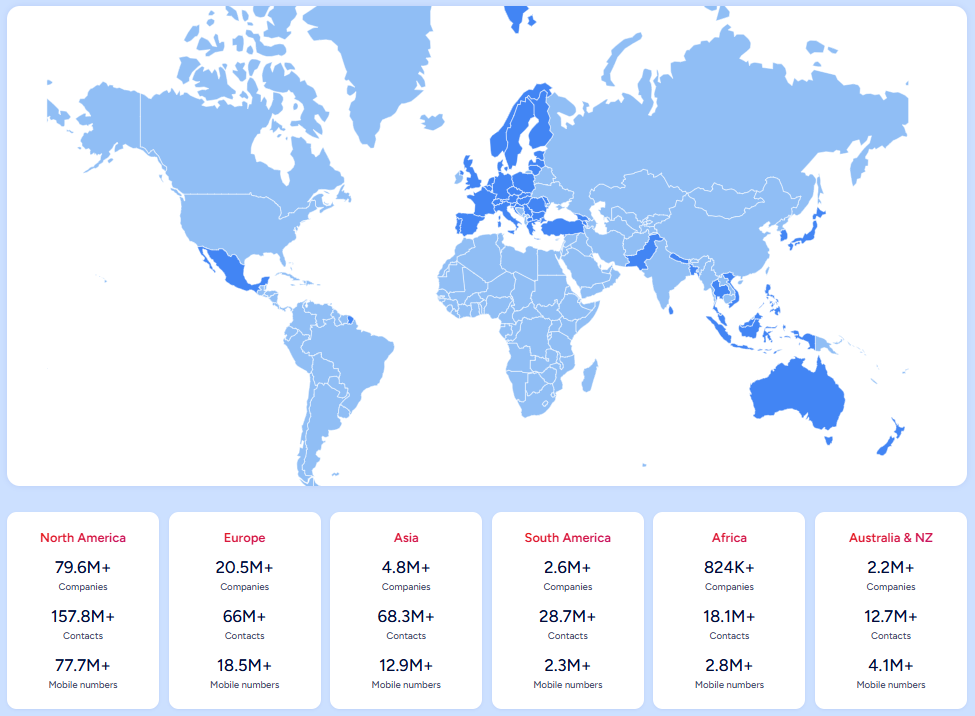
Source: ZoomInfo
The data flows through a proprietary verification pipeline backed by 300+ human researchers and automated ML scanning 28 million site domains daily, reaching up to 95% accuracy on first-party data.
For a team using Salesforce, this fills the fundamental prospecting gap. Sales Cloud's Agentforce SDR Agent can research accounts and draft personalized outreach, but it needs contacts to address.
ZoomInfo provides department org charts with decision-makers' direct dials and emails, 300+ company attributes for segmentation, technographic profiles covering 30,000+ technologies across 200+ categories for 30+ million companies, and contact tracking with job-change alerts.
The native Salesforce integration syncs this data bidirectionally: ZoomInfo contacts flow into Salesforce leads and accounts, and Salesforce CRM data enriches ZoomInfo's intelligence.
In a Fortune 500 competitive RFP analyzing 25 million contacts across vendors, an independent consultant concluded that "no other competitor came even close."
The data quality holds up to external validation: Forrester Wave Leader for Intent Data Providers, Q1 2025, Leader in the Gartner MQ for ABM Platforms for the second consecutive year, and the only vendor positioned in the Gartner Voice of the Customer Customers' Choice quadrant with a 4.7/5.0 rating.
ZoomInfo Intent and WebSights: Signals that surface in-market buyers before outreach begins
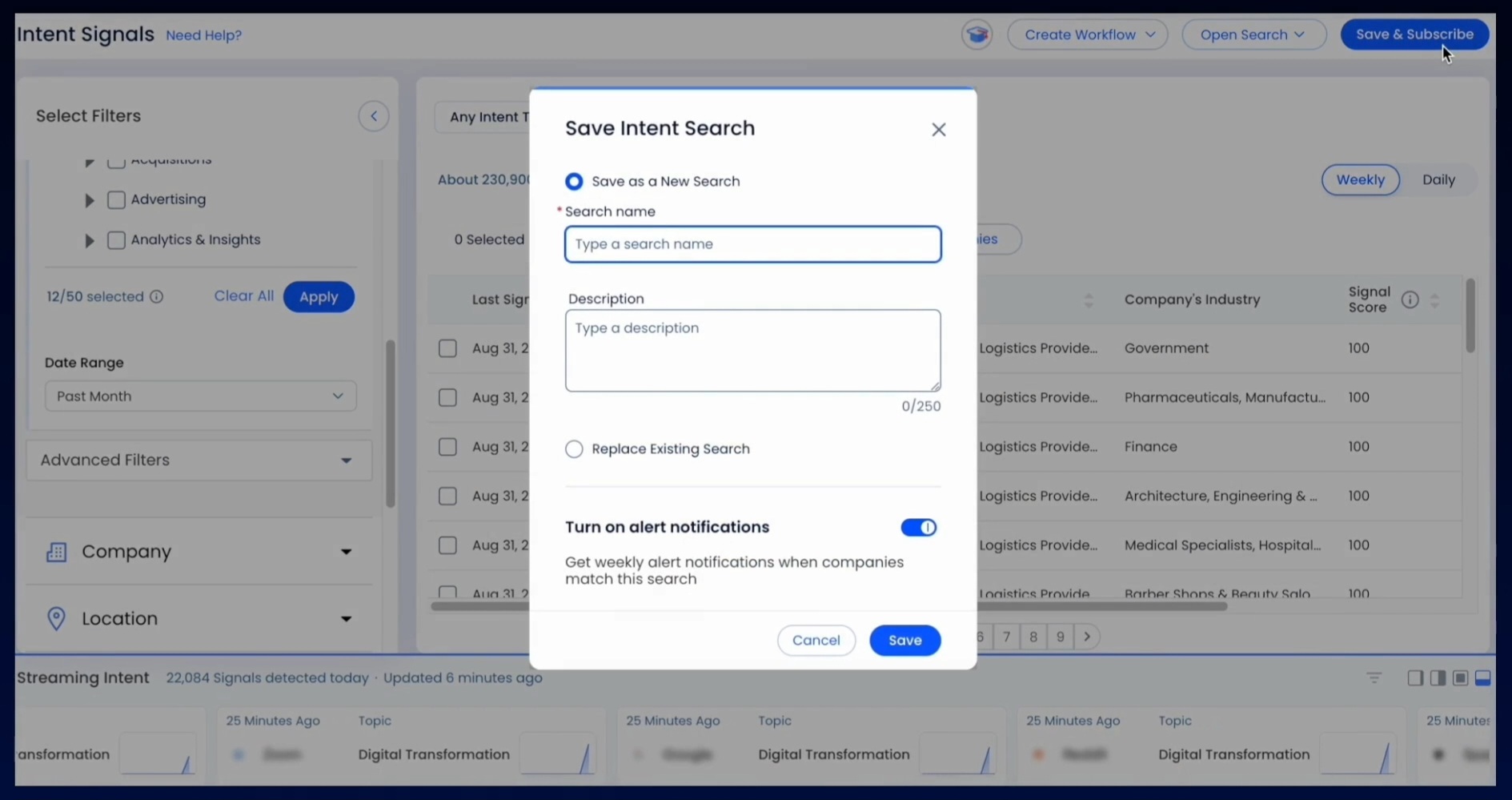
ZoomInfo Intent tracks signals from 210 million IP-to-Organization pairings and 6 trillion+ new keyword-to-device pairings sourced monthly.
Where Salesforce's lead scoring ranks leads based on their engagement with your own outreach and properties, ZoomInfo's intent data reveals which companies are researching topics related to your product across the broader web, before you have ever contacted them.
Guided Intent, exclusive to ZoomInfo, identifies the topics historically correlated with deal success rather than requiring manual topic selection.
Source: ZoomInfo
On the website side, WebSights resolves anonymous website traffic to companies with Automatic Traffic Filtering that distinguishes real visitors from bots. ZoomInfo Marketing goes further with contact-level site visitor identification, identifying the specific person visiting (not just the company) and triggering personalized outreach. These are prospecting capabilities Salesforce does not have natively.
ZoomInfo's GTM Context Graph: Intelligence that captures why deals move
Salesforce records that a deal moved from Stage 3 to Stage 4.
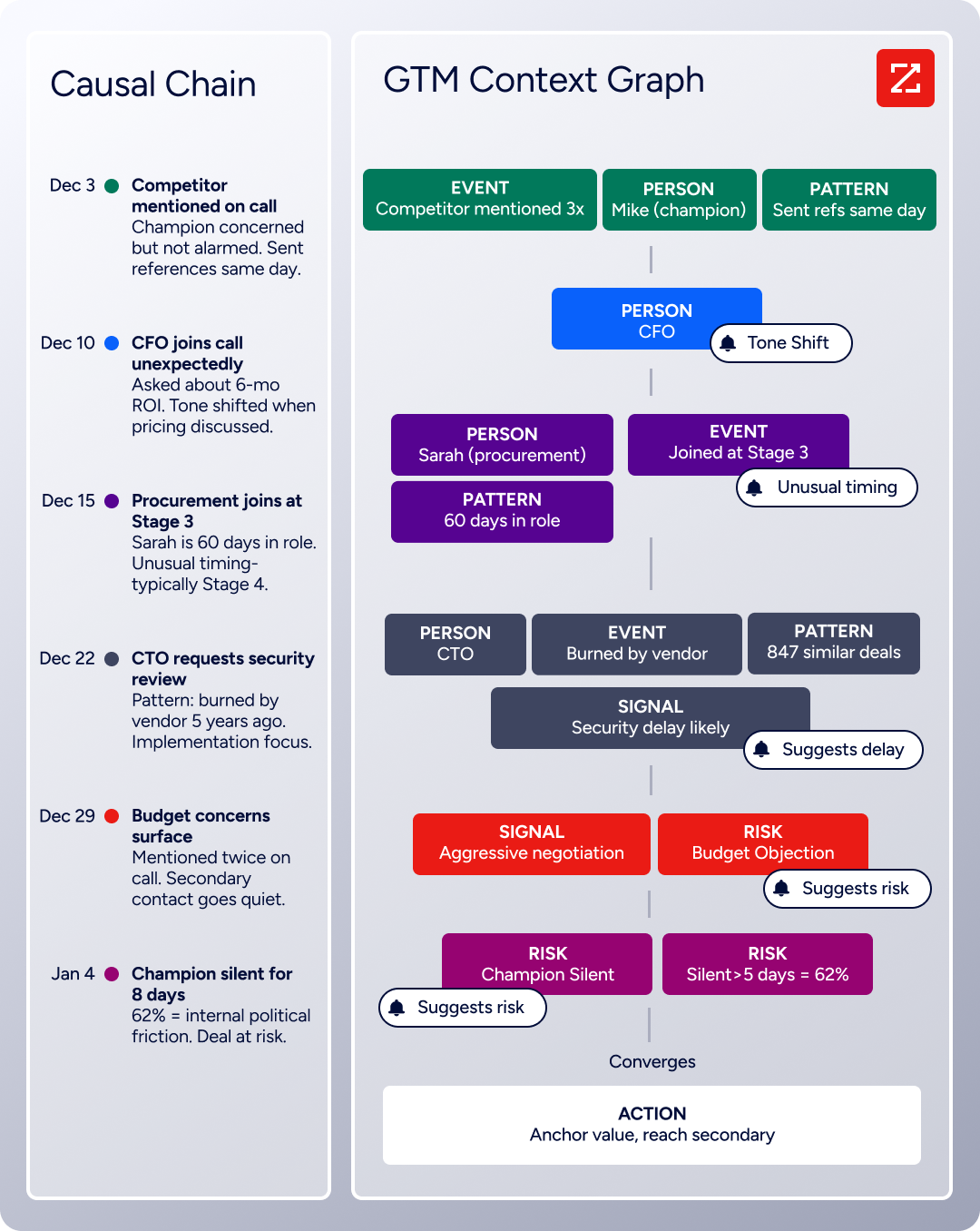
ZoomInfo's GTM Context Graph reasons about why. It processes 1.5B+ data points daily, fusing ZoomInfo's B2B data with a customer's CRM records, conversation intelligence from Chorus (backed by 14 technology patents), email interactions, and behavioral signals into one intelligence layer.
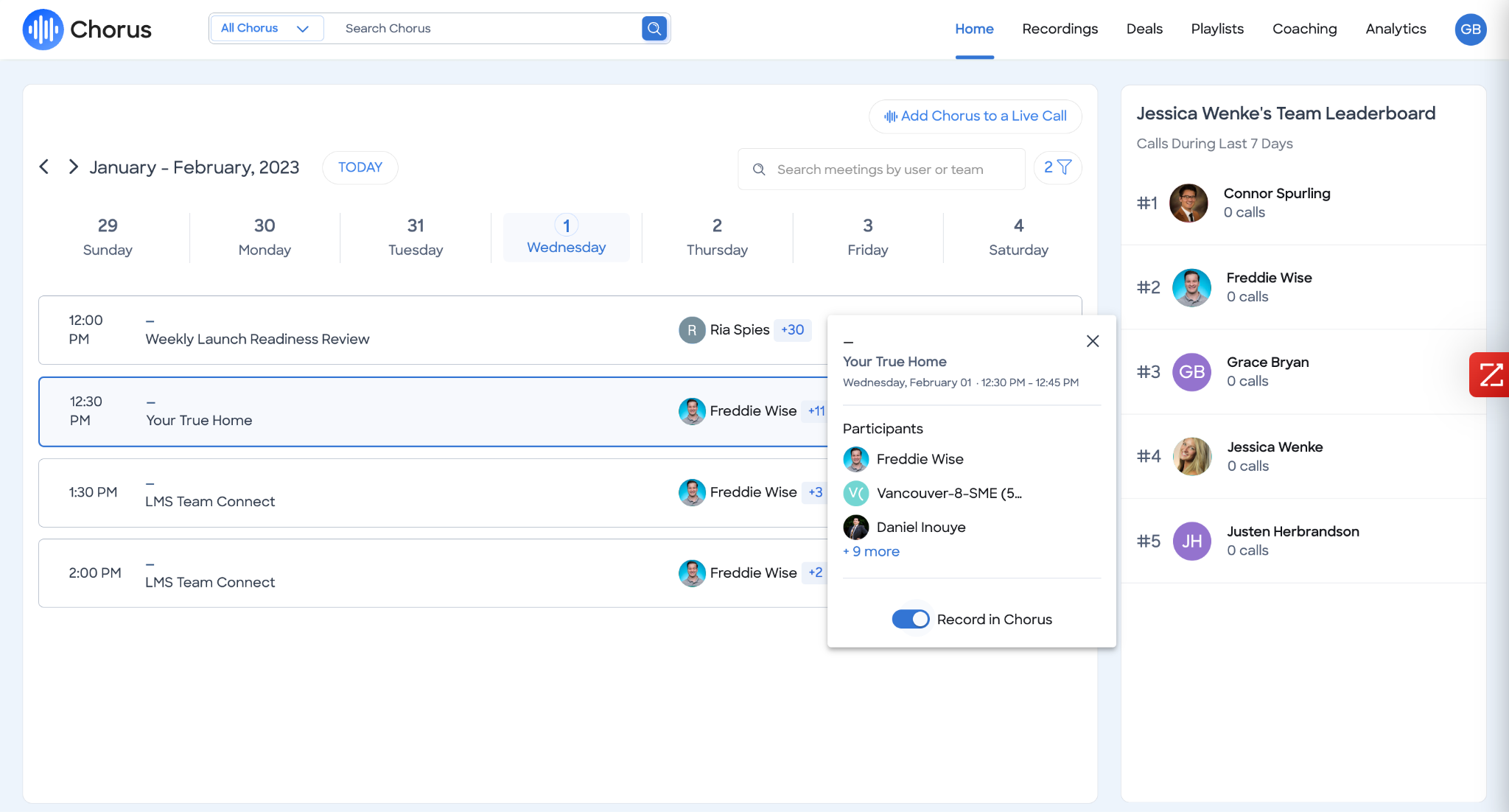
Chorus captures the context that CRM fields miss: it records and transcribes sales calls, surfaces AI-generated insights (talk ratios, sentiment, objection detection), auto-syncs deal intelligence to Salesforce, and provides coaching scorecards.
Source: ZoomInfo
The GTM Context Graph then connects the CFO joining the last call with ROI-focused questions to the pattern behind closed-won deals in that segment, and links that to third-party signals showing the company is hiring and researching a competitor. That reasoning flows into outreach, forecasting, and deal execution.
GTM Workspace and GTM Studio: Execution and orchestration on top of Salesforce
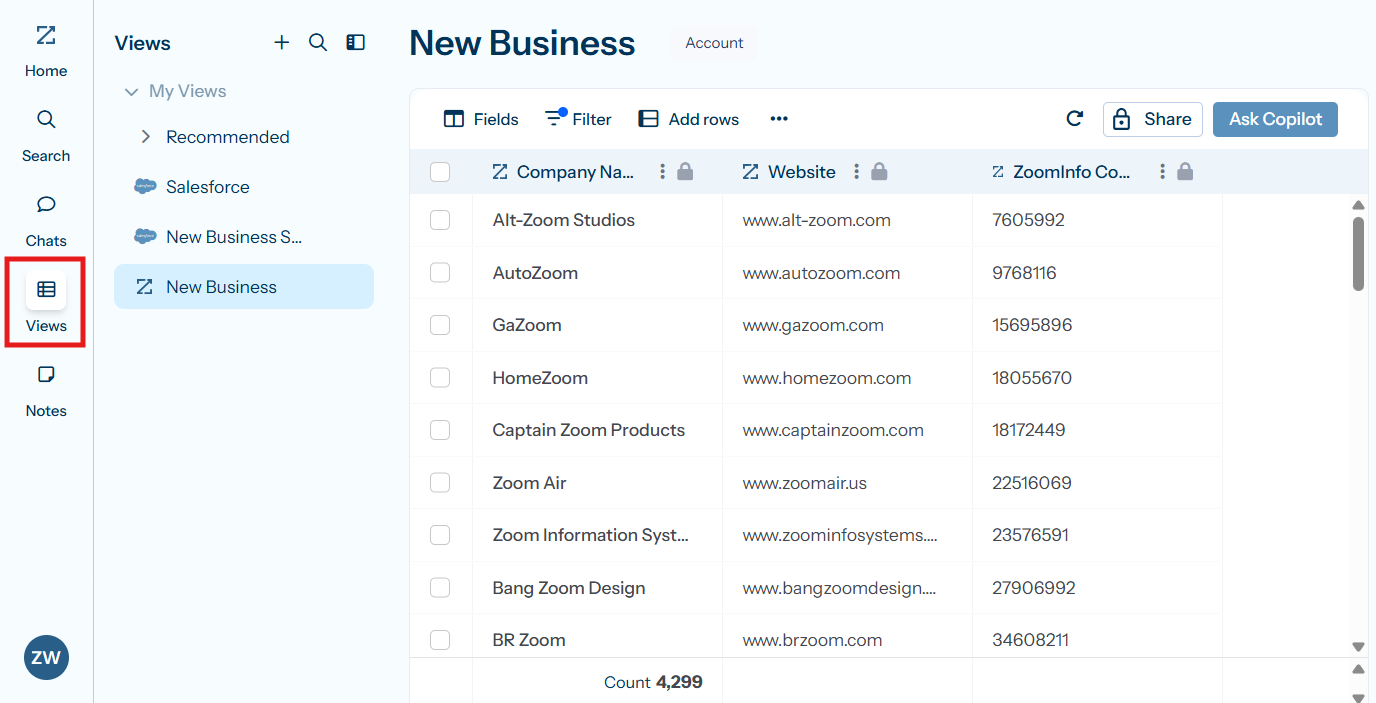
GTM Workspace is ZoomInfo's seller front-end.
Source: ZoomInfo
It provides a Book of Business view across CRM, ZoomInfo data, conversation history, and market intelligence. AI agents handle account research, outreach drafting, CRM updates, and signal monitoring.
An Action Feed streams in-market buyers matched to target criteria with pre-drafted actions on every signal. For Salesforce users, GTM Workspace surfaces the intelligence layer that Salesforce's CRM data alone cannot provide.
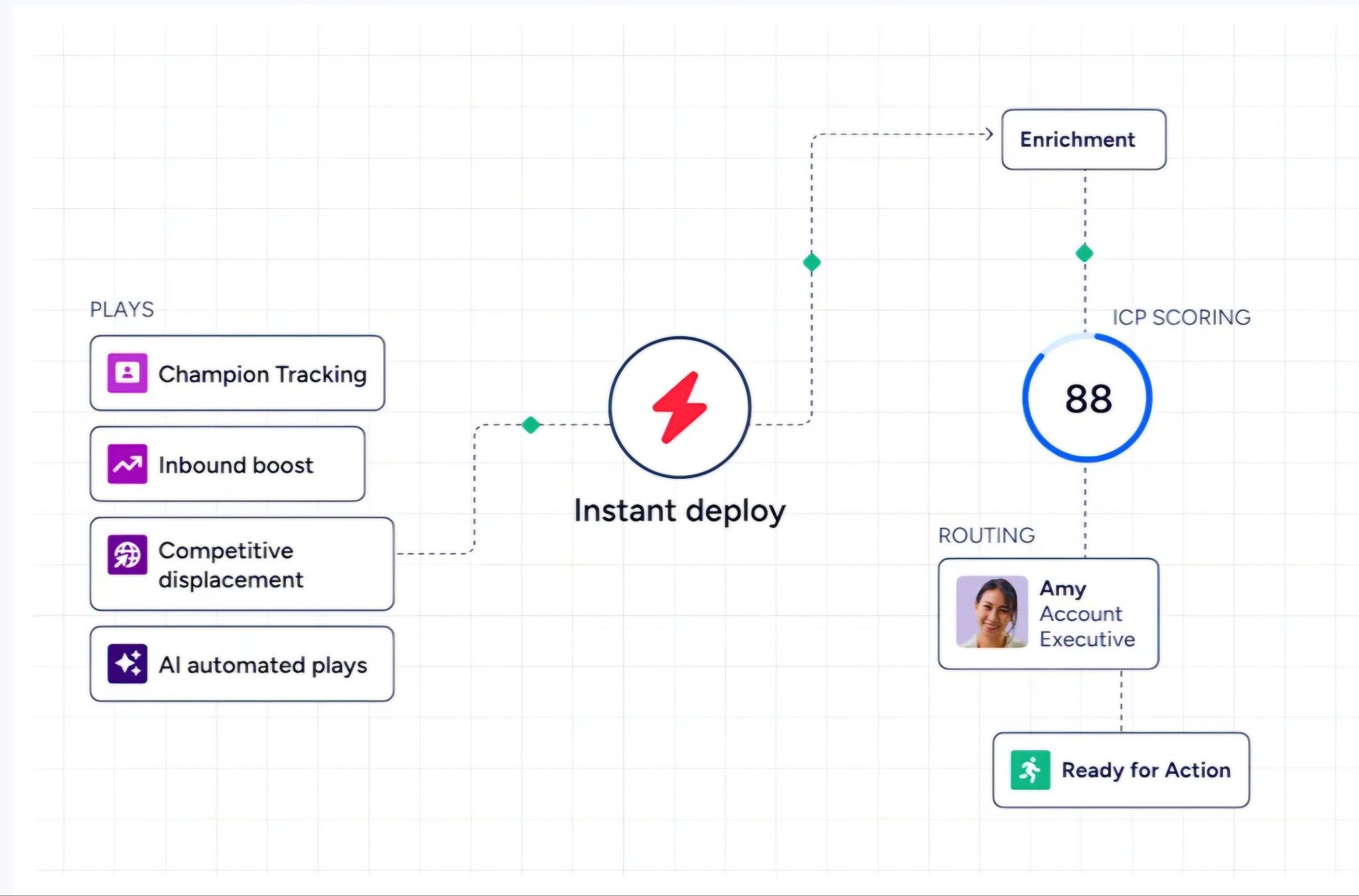
GTM Studio fills the marketing orchestration gap that sits outside Salesforce's CRM-centric scope. Marketers, RevOps teams, and GTM engineers can build audiences using natural language, enrich with first- and third-party data, define triggers, and activate plays across channels without engineering support.
Source: ZoomInfo
Pre-built GTM plays cover inbound acceleration, champion tracking, competitive displacement, and ICP targeting. Expansion plays that used to take 3 weeks now launch in 30 minutes.
ZoomInfo APIs and MCP: Access to intelligence inside any tool
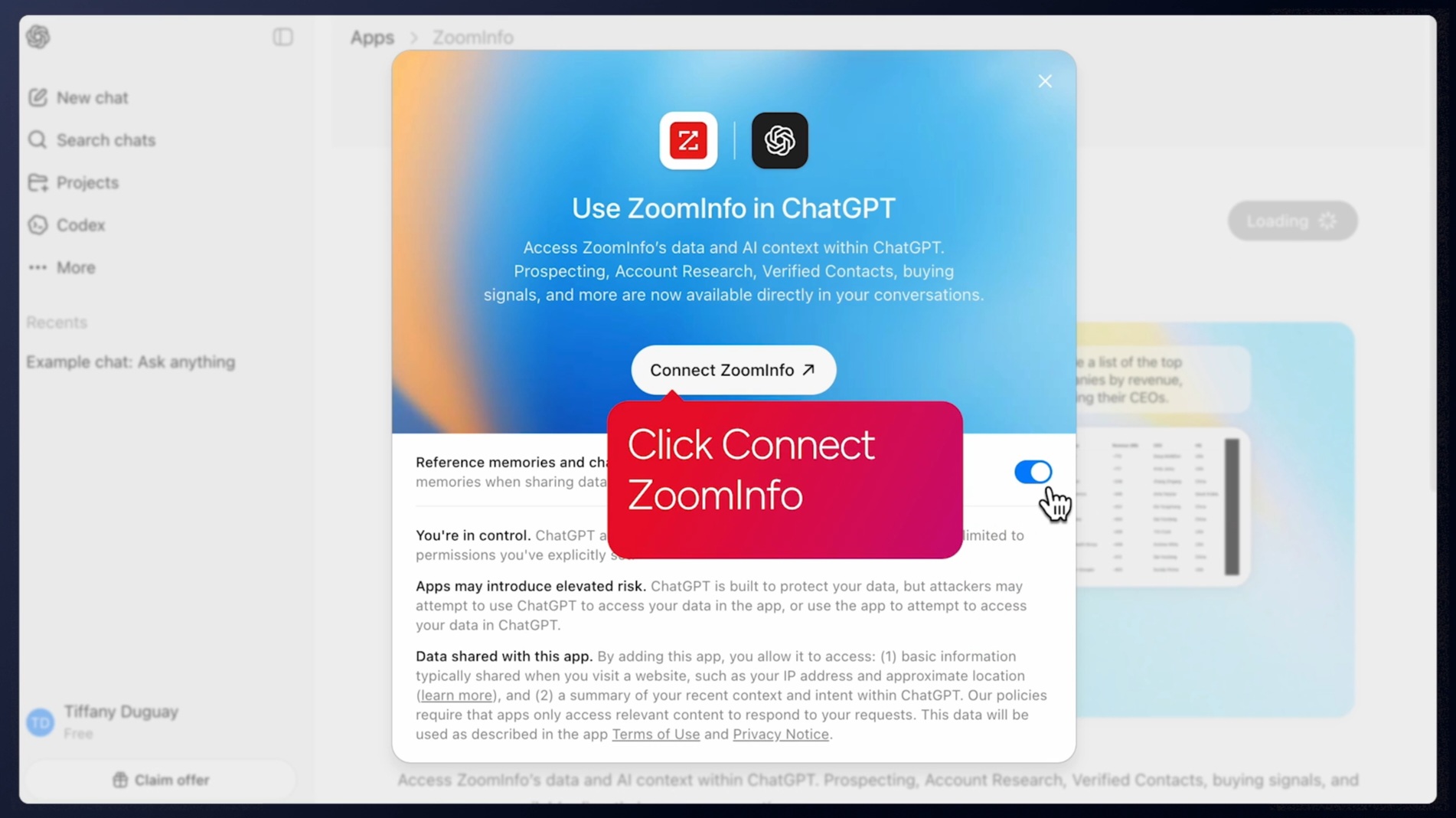
ZoomInfo delivers its intelligence through APIs and MCP (Model Context Protocol), so the same data and GTM Context Graph powering ZoomInfo's own products is accessible inside Salesforce, custom AI agents, or any third-party tool.
The MCP server connects AI models directly to ZoomInfo's B2B data as a native tool, currently supporting Claude and ChatGPT. API access is included in all relevant plans. For Salesforce customers, this means ZoomInfo's data and intelligence can power Agentforce agents, Flow automations, and custom Apex applications through programmatic access.
Source: ZoomInfo
ZoomInfo's Free Entry Points: A way to evaluate without commitment
ZoomInfo Lite is a permanent free tier with access to ZoomInfo's B2B database, 10 monthly export credits, individual and company searches, a Chrome extension, and WebSights Lite with up to 10 website visitor reveals per day.
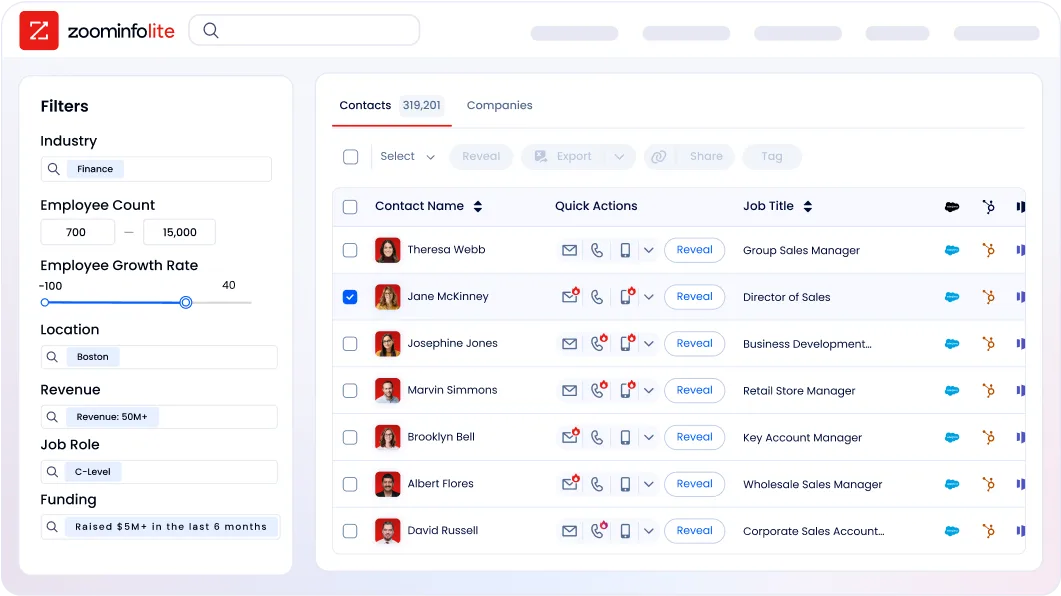
A separate 7-day free trial provides broader access with no credit card required.
Seismic's sales team attributed 39% of active pipeline to opportunities identified or influenced by ZoomInfo signals, boosted productivity by 54%, and saved 11.5 hours per week per seller. (Seismic Case Study)
Final Summary
Salesforce is a broad, capable CRM platform: Sales Cloud manages pipeline from lead through close with AI scoring and coaching, Service Cloud deploys autonomous agents across every support channel, Marketing Cloud orchestrates campaigns with a native CDP, Commerce Cloud runs storefronts on the same customer record, Agentforce brings autonomous AI across all of it, and Data Cloud unifies fragmented data with zero-copy architecture.
The AppExchange ecosystem of 9,000+ apps and the MuleSoft integration platform extend Salesforce to nearly any enterprise system.
It is lighter on the layer that fuels execution: no native B2B contact database, no proprietary buyer intent signals, no website visitor identification for prospecting, and no cross-system intelligence layer that reasons about why deals move.
If your bottleneck is upstream of CRM execution (knowing who to contact, which companies are in-market, and why deals are progressing), that is the ground ZoomInfo covers.
Its 500M-contact, 100M-company database supplies the verified emails and direct dials that Salesforce's leads, accounts, and cadences depend on. ZoomInfo Intent surfaces accounts researching your category from 6 trillion+ keyword-to-device pairings monthly. Chorus captures and reasons about every sales conversation.
The GTM Context Graph fuses all of it into one intelligence layer that captures why deals move, not just that they moved. And the native Salesforce integration means the two platforms run as one motion: ZoomInfo finds and qualifies the buyer, Salesforce executes the relationship.
See what that data layer adds to your Salesforce instance: start with ZoomInfo Lite for free, or request a demo to watch verified contacts, intent signals, and deal intelligence flow into your CRM.
FAQ
Does Salesforce include a B2B contact database for prospecting?
No. Salesforce is a CRM that stores and manages the contacts and companies you put into it. It does not supply a proprietary database of B2B contacts, verified emails, or direct-dial phone numbers. Agentforce's SDR Agent and Sales Engagement cadences execute outreach, but they need contact data to work with.
Teams pair Salesforce with a data platform like ZoomInfo, whose 500M contacts, 100M companies, and 120M direct dials supply the records that CRM workflows run on.
Which Salesforce plan includes AI features?
AI capabilities are tiered across editions. Einstein Lead Scoring, account plans with SWOT analysis, and Call Explorer require Enterprise ($175/user/month) or above. The full AI suite, including conversation intelligence and Premier Success, is included at Unlimited ($350/user/month).
Autonomous Agentforce agents require either the Agentforce 1 tier ($550/user/month, which includes unmetered Agentforce, Tableau Next, Slack Enterprise+, and 1M Flex Credits), Flex Credits purchased separately ($500/100K credits), or the $2/conversation pricing model. Salesforce Foundations offers 200K Flex Credits free to existing customers.
How does Salesforce pricing compare between Sales Cloud and Service Cloud?
They follow identical tier structures: Free Suite ($0, max 2 users), Starter Suite ($25/user/month), Pro Suite ($100/user/month), Enterprise ($175/user/month), Unlimited ($350/user/month), and Agentforce 1 ($550/user/month).
The difference is in add-ons: Service Cloud offers Digital Engagement ($75/user/month), Contact Center ($150/user/month), Agentforce for Service ($125/user/month), and Field Service (from $175/user/month) as separately priced modules. Both require annual contracts from Pro Suite and above.
Can Salesforce identify anonymous website visitors?
Salesforce does not include a native tool for identifying anonymous B2B website visitors and routing them into prospecting workflows. Marketing Cloud Personalization tracks known visitor behavior for personalization, and Commerce Cloud monitors shopping sessions, but neither resolves anonymous traffic to companies or contacts.
ZoomInfo's WebSights identifies companies visiting your site, and ZoomInfo Marketing provides contact-level visitor identification, both integrating directly with Salesforce.
What does Salesforce's Data Cloud actually do?
Data Cloud is a data unification engine, not a contact database. It connects to external data stores (Snowflake, Databricks, BigQuery, AWS) through zero-copy architecture, resolves customer identities across systems, and makes unified profiles available to every Salesforce cloud.
It answers the question "how do I connect all my data sources into one customer view" rather than "where do I get B2B data." Pricing is consumption-based at $500 per 100,000 credits, with $23/month per TB of storage. Ingesting data from Salesforce's own clouds is free.
Does Salesforce offer buyer intent data?
Salesforce can score leads based on engagement with your own properties (email opens, website visits, content downloads) through Einstein scoring and Marketing Cloud engagement tracking. It does not include third-party buyer intent data showing which companies are researching topics across the broader web before any engagement with your brand.
ZoomInfo Intent tracks signals from 210 million IP-to-Organization pairings and 6 trillion+ keyword-to-device pairings sourced monthly, identifying in-market accounts before outreach begins. ZoomInfo's intent data integrates with Salesforce to prioritize accounts inside the CRM.
What is Agentforce and how is it different from Einstein?
Einstein was Salesforce's AI branding for predictive features (lead scoring, forecasting, activity capture) built into each cloud. Agentforce is the evolution: autonomous AI agents that perceive, plan, and execute multi-step tasks without constant human prompting. Einstein features still exist within each cloud, but the
Agentforce layer adds autonomous capability (an SDR Agent that researches and drafts outreach independently, a Service Agent that resolves cases end to end). The underlying reasoning engine, Atlas, uses ReAct prompting that adapts after each action rather than following a fixed chain of thought.
Does Salesforce have a free plan?
Yes. The Free Suite provides basic lead, account, and opportunity management for up to 2 users with no contract and no time limit. The Starter Suite at $25/user/month adds unlimited users, AI email sync, and lead routing. Salesforce Foundations gives existing customers free access to Agent Builder, Prompt Builder, 200K Flex Credits, and 250K Data Cloud credits.
ZoomInfo also offers a permanent free tier, ZoomInfo Lite, with access to its B2B database, 10 monthly export credits, and WebSights Lite.
