
Salesken occupies a distinct position in the conversation intelligence market. Most competitors record and analyze conversations after the call ends. Salesken coaches sales reps during live calls, surfacing prompts and objection-handling cues while the conversation is still happening. For call-heavy sales teams, that distinction matters.
To write this Salesken review, we've analyzed the platform extensively. We believe it's the ideal choice if:
You run high-volume outbound or inside sales where calls are the primary channel
You need real-time coaching for reps during live conversations
You want 100% automated QA coverage instead of random call sampling
You operate in compliance-heavy verticals like financial services or healthcare
You need conversation-driven pipeline forecasting rather than CRM-dependent data
However, Salesken might not be sufficient if:
You need B2B prospecting data to identify and reach new buyers
You want a full go-to-market platform spanning data, intent signals, and marketing
Your team requires buyer intent data to prioritize accounts before the first call
You need conversation intelligence unified with company data, technographics, and org charts
You want to power custom AI agents or third-party tools with your GTM data
In this case, you should consider ZoomInfo: an AI GTM platform built on broad B2B data, a GTM Context Graph that combines conversation intelligence with CRM records, intent signals, and behavioral data, and access through GTM Workspace for sellers, GTM Studio for marketers and RevOps, or APIs and MCP for any tool.
We've included a detailed look at ZoomInfo later in this Salesken review for teams that need intelligence beyond conversation analysis. If you're ready to explore a full GTM platform, you can start with ZoomInfo's free trial here.
What is Salesken?
Source: Salesken
Salesken is an AI-powered revenue intelligence platform founded in 2018 in Bengaluru, India, by Surga Thilakan and Sreeraman Vaidyanathan.
Before founding Salesken, Thilakan ran a vocational skills-training organization that trained over 20,000 sales representatives from low-income backgrounds. That direct experience with coaching at scale led to Salesken's core idea: replace the human coach who can't be on every call with AI that can.
The company has raised approximately $41 million across seed, Series A (led by Sequoia India), and Series B (led by M12, Microsoft's venture fund). With approximately 84 employees and 200+ business customers, Salesken is a focused player in conversation intelligence, holding a 4.9/5 rating on G2 from 395+ reviews.
It ranks #1 in the G2 Conversation Intelligence Relationship Index and earned a "Leader" designation from Cloud Ratings for Sales Conversation Intelligence Software. Its primary market is India, with active expansion into the US through its Salesken AI Inc. entity.
The platform spans five products: Revenue Intelligence AI for pipeline forecasting, Quality Assurance AI for automated call scoring, AI Sales Assistant for live in-call coaching, Salesken Notetaker for transcription and summaries, and Field Sales Analytics for outside sales teams.
Salesken targets verticals with high-volume calling: EdTech, BFSI (banking, financial services, insurance), healthcare, and real estate.
Salesken Pros & Cons
Pros | Cons |
|---|---|
- Real-time in-call coaching with live AI prompts | - Occasional connectivity and call lag issues reported |
- 100% automated QA coverage (not random sampling) | - Limited report customization options |
- BANT and MEDDIC scoring from conversation data | - AI can misinterpret context during live coaching |
- Native CRM integration (Salesforce, HubSpot, Zoho) at no extra cost | - No B2B prospecting data or lead database |
- Multilingual support across 70+ languages | - Small company (~84 employees) with limited public case studies |
- Strong user ratings (4.9/5 on G2, 395+ reviews) | - No free trial or free plan available |
- Conversation-driven pipeline forecasting | - No published pricing; custom quote required |
Salesken Review: How it Works & Key Features
AI Sales Assistant: Salesken coaches reps during live calls, not after them.
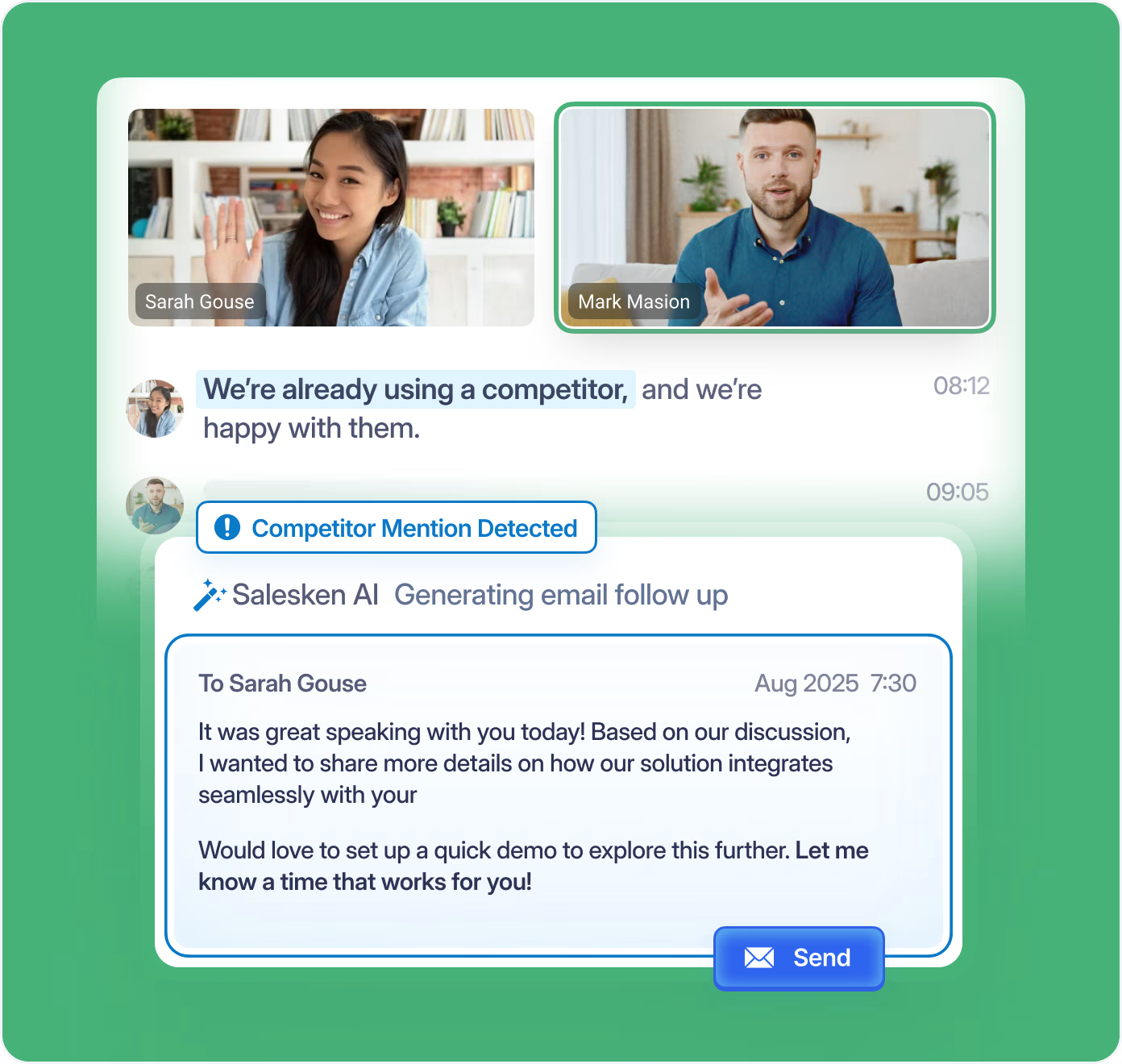
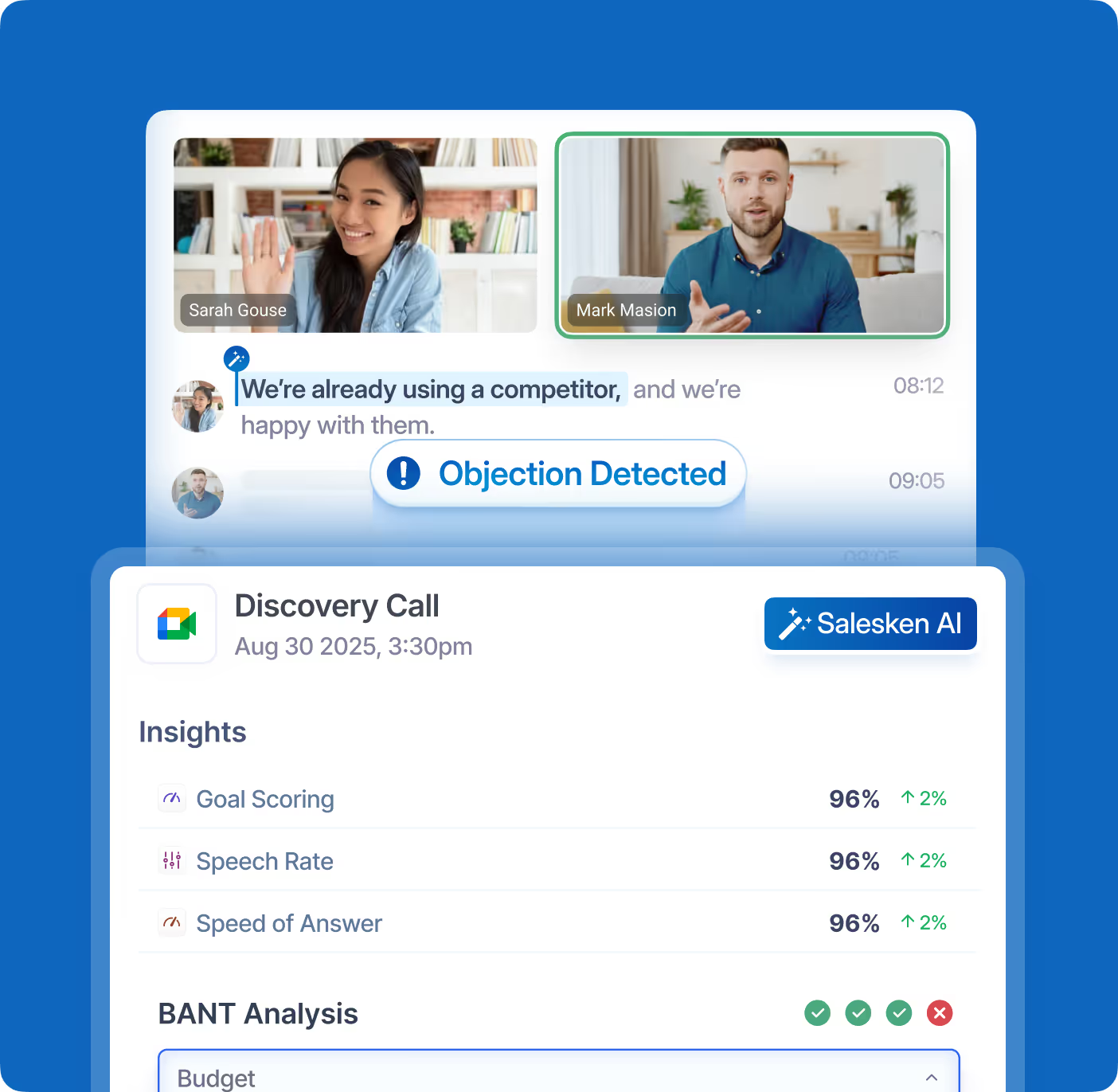
The AI Sales Assistant is Salesken's core differentiator. Most conversation intelligence tools record calls and deliver insights afterward. Salesken intervenes during the live conversation, surfacing prompts on-screen when the AI detects an objection, a competitor mention, or a pricing discussion.
Source: Salesken
The system works in three phases. During the call, it listens, transcribes, and detects key moments in real time, delivering cues so reps know how to respond without breaking the conversation's flow. It also analyzes buyer sentiment and detects tone shifts, helping reps adjust mid-conversation.
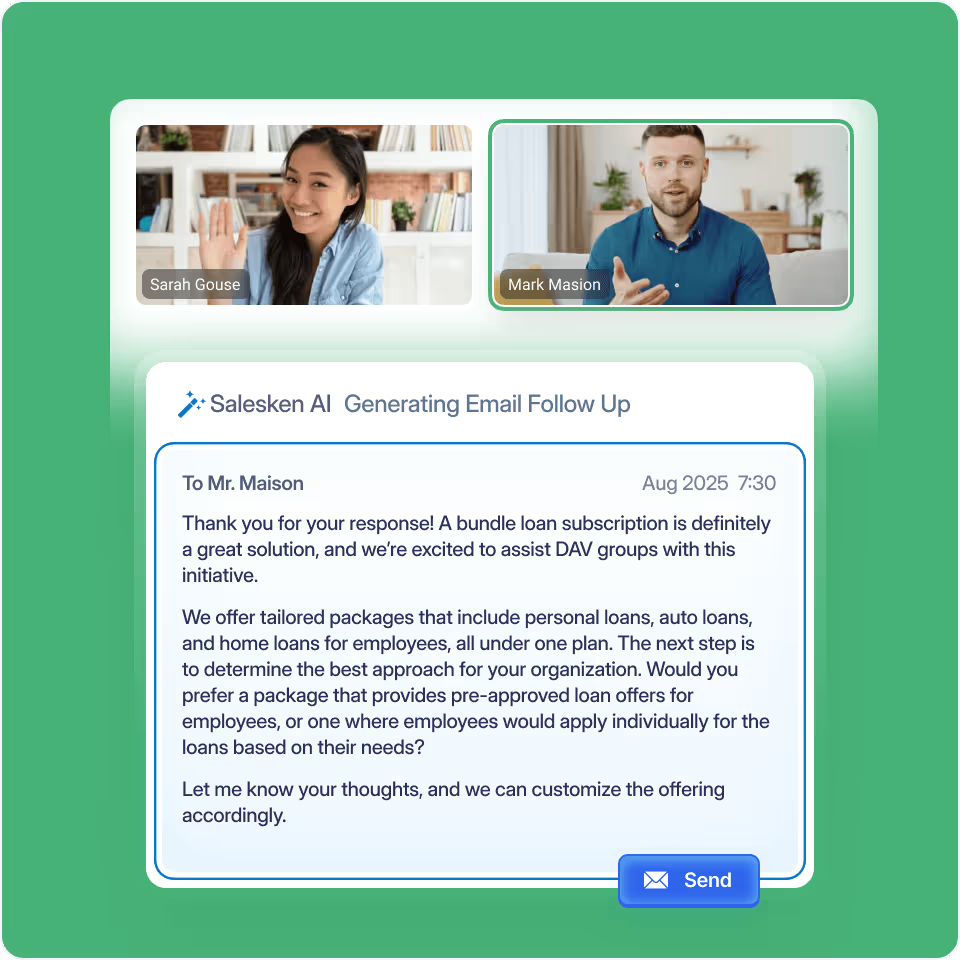
After the call, the assistant generates email drafts, to-dos, and CRM updates. The email drafts draw from the full conversation and deal history rather than generic templates, making follow-ups relevant. Call summaries, persona insights, and deal signals are automatically logged into the CRM.
Source: Salesken
The notetaker component joins calls on Zoom, Google Meet, and Microsoft Teams, producing speaker-labeled transcripts with timestamps and AI-generated meeting summaries. These outputs feed directly into Salesken's CRM integrations, eliminating manual note-taking.
That said, the real-time coaching has a known limitation. Some users report that the AI sometimes doesn't understand the context teams are pitching and may deliver irrelevant or misleading prompts mid-call. For a feature designed to change outcomes in the moment, context misinterpretation is a real risk.
Revenue Intelligence AI: Salesken forecasts pipeline from what buyers actually say, not what reps enter in the CRM.
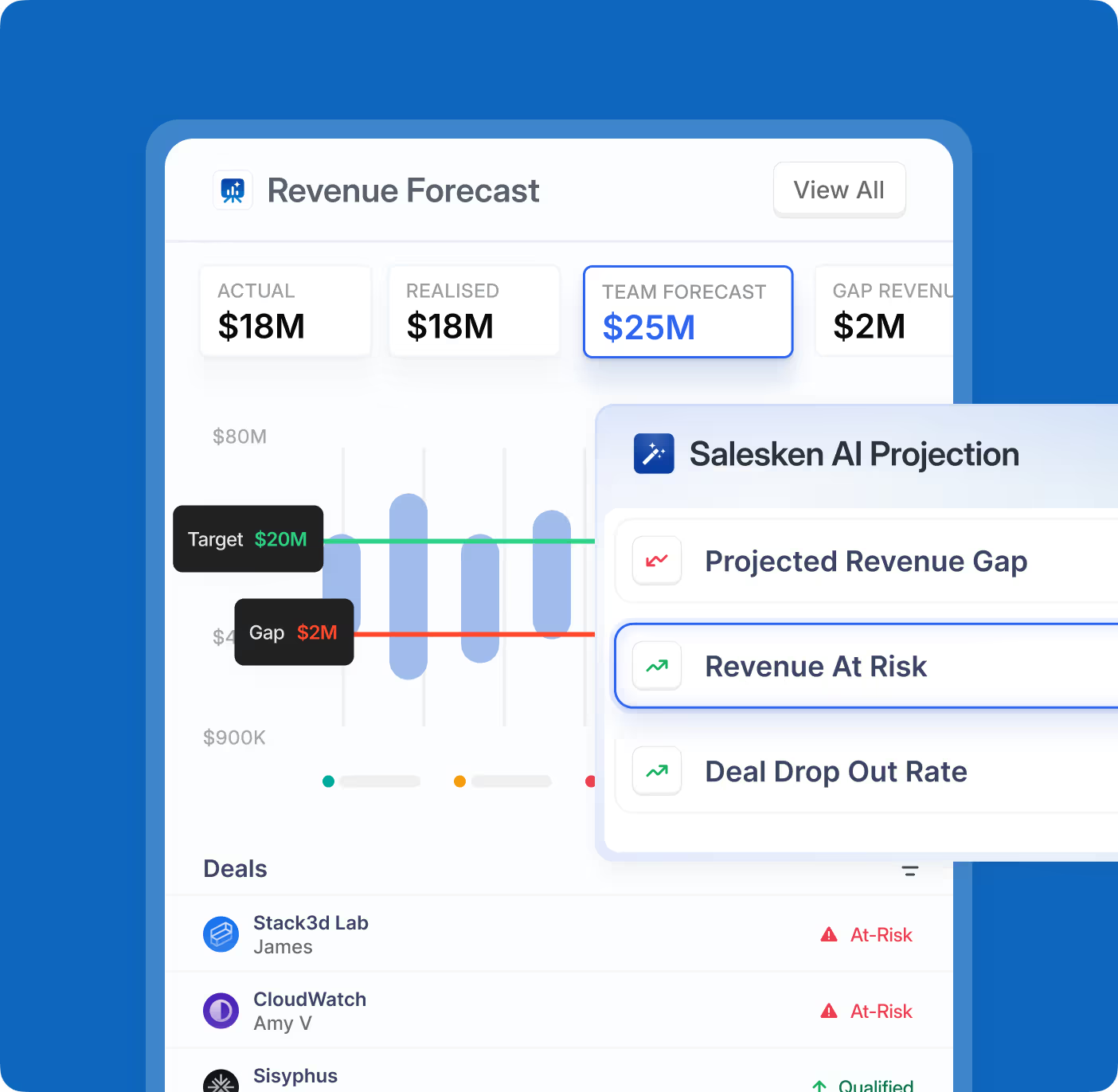
Revenue Intelligence AI addresses a persistent problem in sales forecasting: CRM data reflects what reps choose to report, not what actually happens in buyer conversations. Salesken extracts forecasting signals directly from call content.
Source: Salesken
The system captures and analyzes buyer-seller conversations, then ties that analysis to CRM data. It applies automatic BANT and MEDDIC qualification scoring based on what was actually discussed in calls, producing closure probability scores grounded in conversation evidence rather than self-reported CRM fields.
Key capabilities include stage-wise deal dropout analysis with AI-generated reasons for pipeline leakage, at-risk deal detection that spots hesitation, competitor mentions, and pricing concerns before they stall deals, and deal summaries with recommended next steps. The system also tracks competitor mentions, pricing pushbacks, and objection trends across all conversations.
All insights sync into the CRM automatically, and the analysis works across over 70 languages, which is useful for multilingual sales teams.
Quality Assurance AI: Salesken scores every call automatically, replacing random sampling with full coverage.
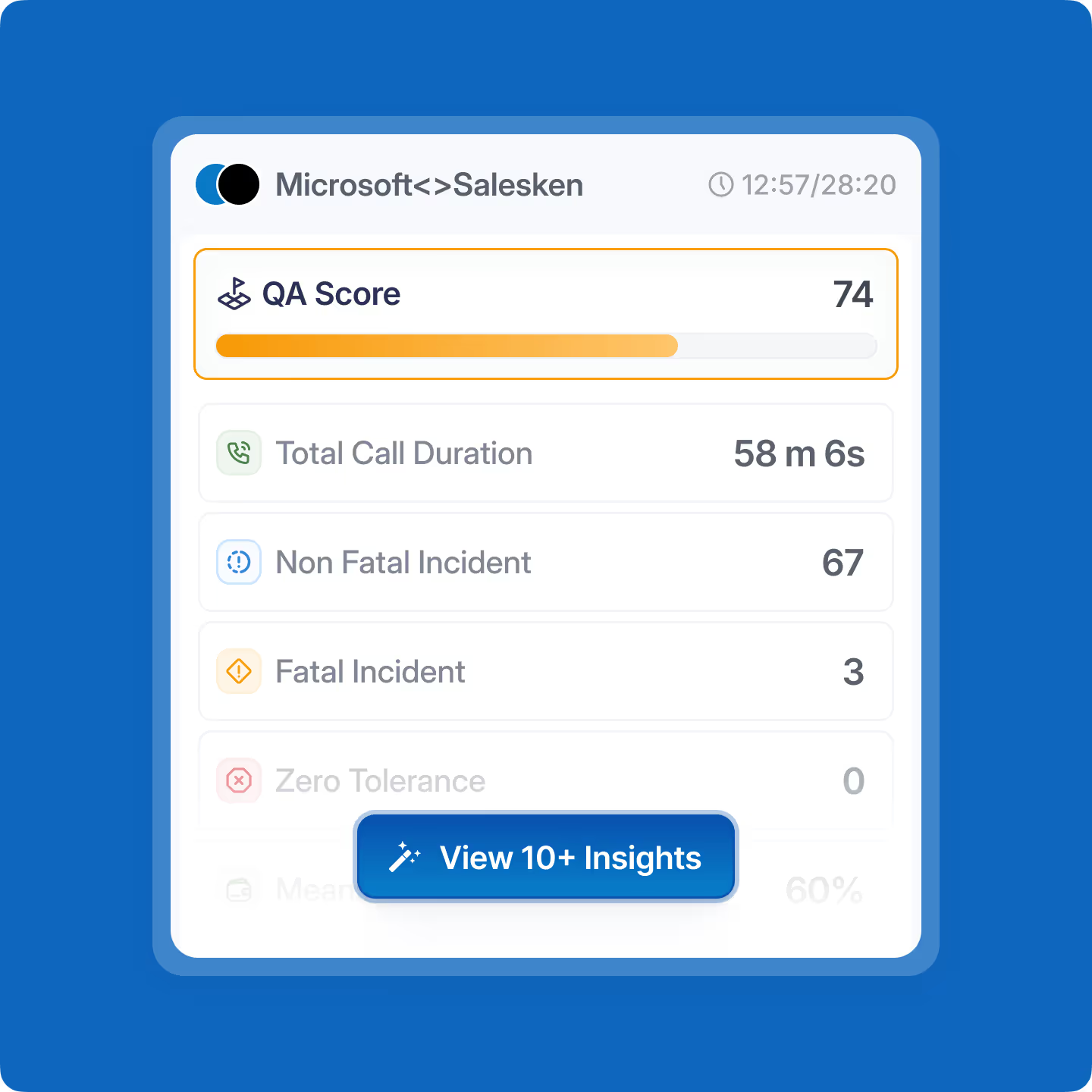
Traditional QA programs review 2-5% of calls through manual sampling. Salesken's Quality Assurance AI replaces that with 100% automated conversation scoring, covering every customer interaction.
Source: Salesken
The system scores each call against configurable parameters: compliance adherence, script following, objection handling, and customer satisfaction. It flags compliance violations, frustrated customers, and at-risk conversations as they occur. Over time, the AI tracks rep performance trends, highlighting recurring strengths and weaknesses rather than isolated call snapshots.
For compliance-heavy industries like BFSI and healthcare, real-time compliance flagging is a core feature, not an add-on. The platform also extends QA to field sales teams, providing visibility into on-site customer conversations through summaries, transcripts, and coaching insights. This is unusual since most conversation intelligence tools focus only on phone and video calls.
Managers can define performance benchmarks and track progress through AI-generated reports. The QA product offers 100% analysis or hourly analysis-based pricing, letting organizations choose the coverage model that fits their operations.
Pricing and Integrations: Custom quotes with CRM integration included.
Salesken uses a per-recorded-user license model with an additional platform fee based on user count. No dollar figures are published. All products require a pricing inquiry.
The platform sells five products individually or as a discounted bundle: Revenue Intelligence AI, Quality Assurance AI, AI Sales Assistant, Meeting Note Taker, and Field Sales QA. An Enterprise plan adds custom integrations and dedicated support. Integration with the existing tech stack is included at no extra cost.
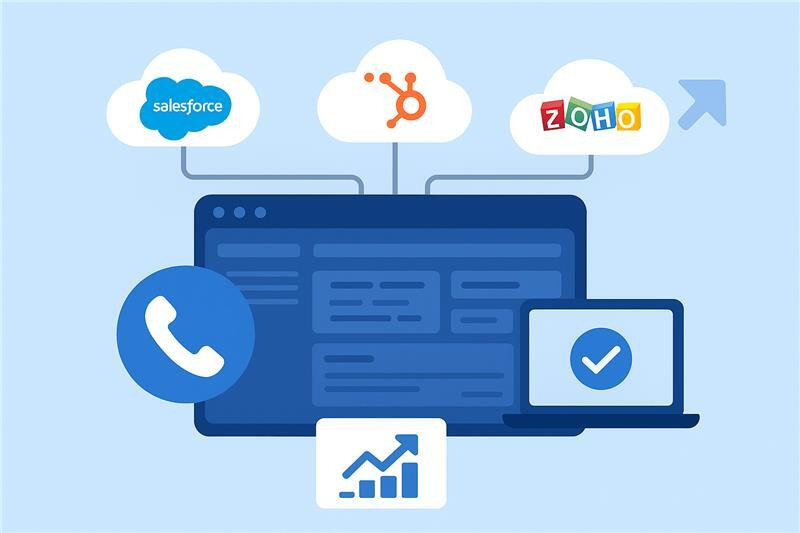
CRM integrations cover Salesforce (Classic and Lightning), HubSpot, and Zoho natively, with custom connectors for legacy CRMs. The platform automatically logs transcripts, summaries, action items, and deal signals into CRM records. Salesken also integrates with popular meeting tools and is listed on the Salesloft Marketplace.
Source: Salesken
There is no free trial, free plan, or self-serve signup. The only entry point is a 30-minute demo.
Where Salesken Falls Short
Salesken delivers strong conversation intelligence for call-based sales teams, but several limitations reveal a platform built for a specific use case rather than the full go-to-market workflow.
No Prospecting Data or Lead Intelligence. Salesken analyzes conversations that have already started, but provides no data to help you find the right people to call. There is no contact database, no company intelligence, no intent signals, and no technographic data. Teams using Salesken still need a separate tool to identify prospects, build target lists, and source verified contact information.
No Buyer Intent Signals. Salesken detects buying signals within active conversations, but it cannot tell you which companies are researching your category before they pick up the phone. Without intent data, sales teams reach out based on static lists rather than real-time buying behavior.
Conversation Intelligence Without Broader Context. Salesken's pipeline forecasting draws entirely from call data. It does not incorporate signals from outside the conversation (org chart changes, funding events, technology adoption, hiring patterns) that often predict deal outcomes. A forecast built only on what was said in calls misses the external context that shapes buyer decisions.
Small Vendor Scale. With approximately 84 employees and 200+ customers, Salesken is a small company competing against Gong, Clari, and ZoomInfo's Chorus.
Publicly documented customer names are scarce, and API documentation, support portals, and technical docs appear to be works in progress. For enterprise buyers running formal vendor evaluations, limited social proof and vendor stability questions may surface during procurement.
Reliability Concerns for the Core Feature. Multiple G2 reviews flag occasional lag during calls, intermittent connectivity drops, and calls sometimes failing to connect. Since real-time coaching is the primary value proposition, reliability issues during live calls directly undermine the core experience.
These limitations follow naturally from building a focused conversation intelligence product. But they create a gap for teams that need intelligence across the full go-to-market motion, from identifying who to target through understanding why deals move.
Top Salesken Alternative for Full GTM Intelligence: ZoomInfo
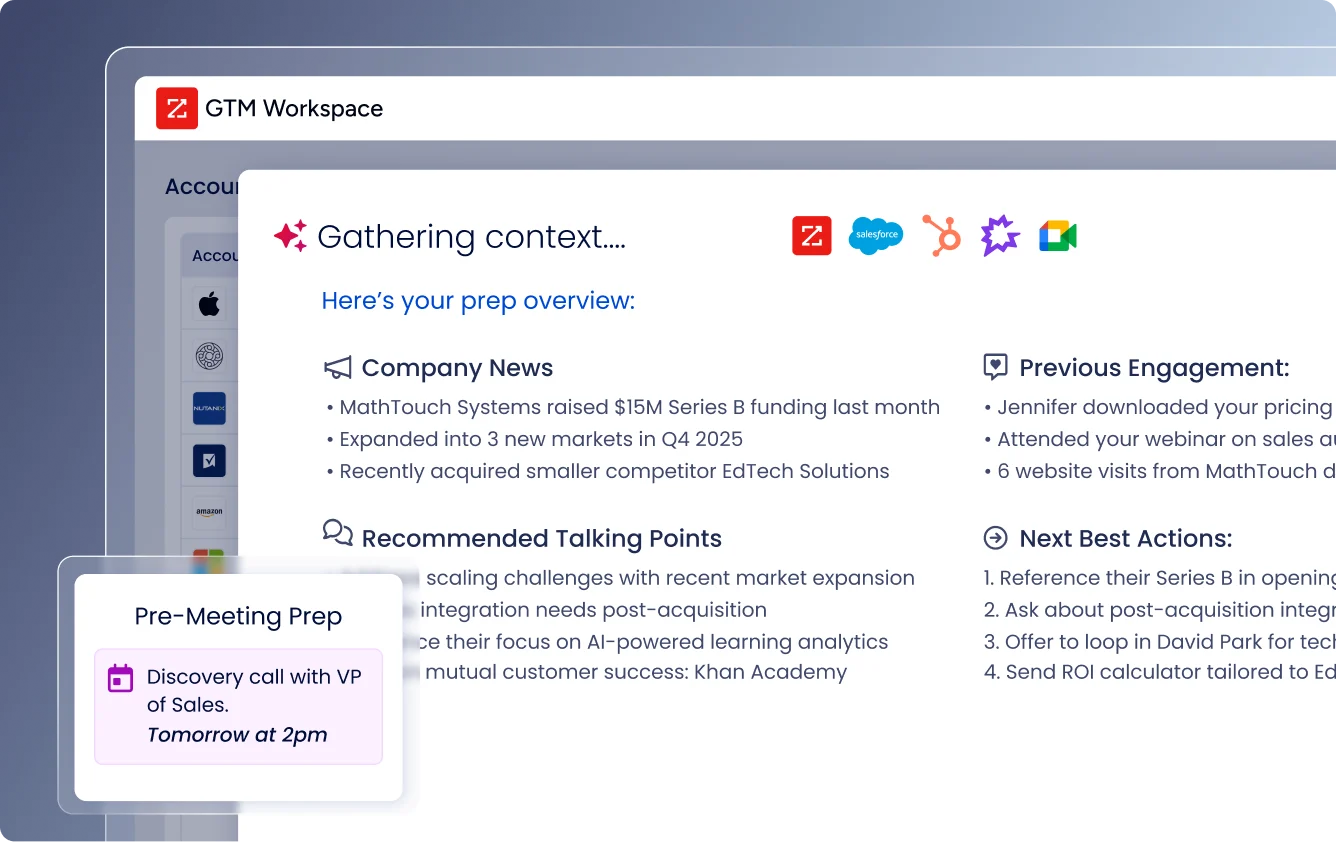
ZoomInfo is an AI GTM platform that addresses the scope limitations conversation-only tools like Salesken create.
Where Salesken focuses on what happens during and after a sales call, ZoomInfo covers the full go-to-market workflow: reps walk into every call knowing who they're talking to and why the account matters, marketers launch targeted plays without engineering tickets, and leaders see deal risk before it surfaces in CRM fields.
Comprehensive B2B Data: ZoomInfo provides the prospecting foundation that conversation intelligence alone cannot.
Salesken has no contact database.
ZoomInfo operates a large B2B data platform: 500M contacts, 100M companies, 135M+ verified phone numbers, 120M direct-dial phone numbers, and 200M+ verified business email addresses. A multi-source verification pipeline backed by 300+ human researchers maintains this data and achieves up to 95% accuracy on first-party records.
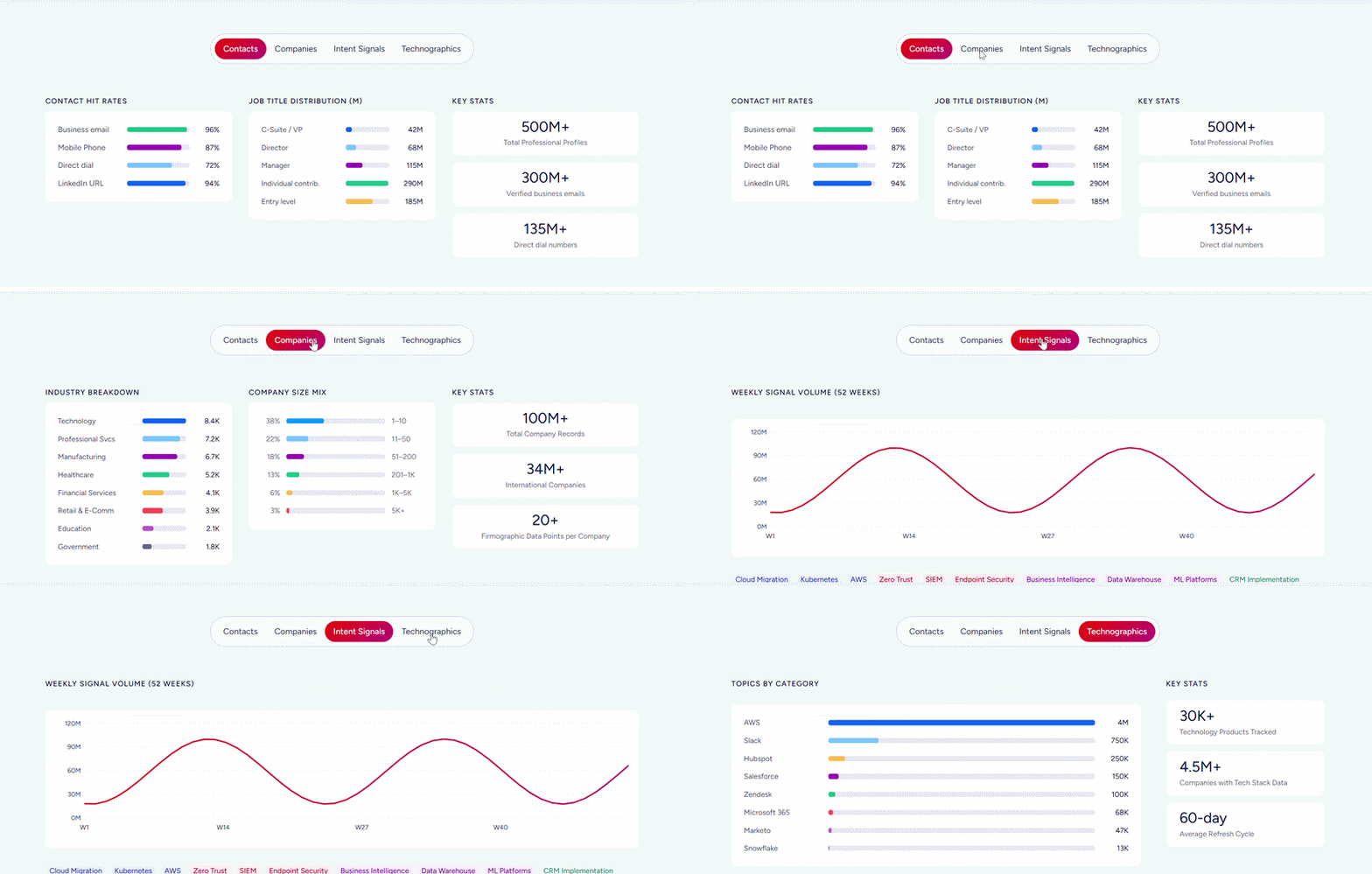
Beyond contact information, ZoomInfo tracks company attributes, org charts, and technographics for 30+ million companies. Buyer Intent data tracks signals from 210 million IP-to-Organization pairings and 6 trillion+ new keyword-to-device pairings sourced monthly, revealing which accounts are researching your category before the first call happens.
Guided Intent, exclusive to ZoomInfo, identifies topics historically correlated with closed-won deals rather than requiring manual topic selection.
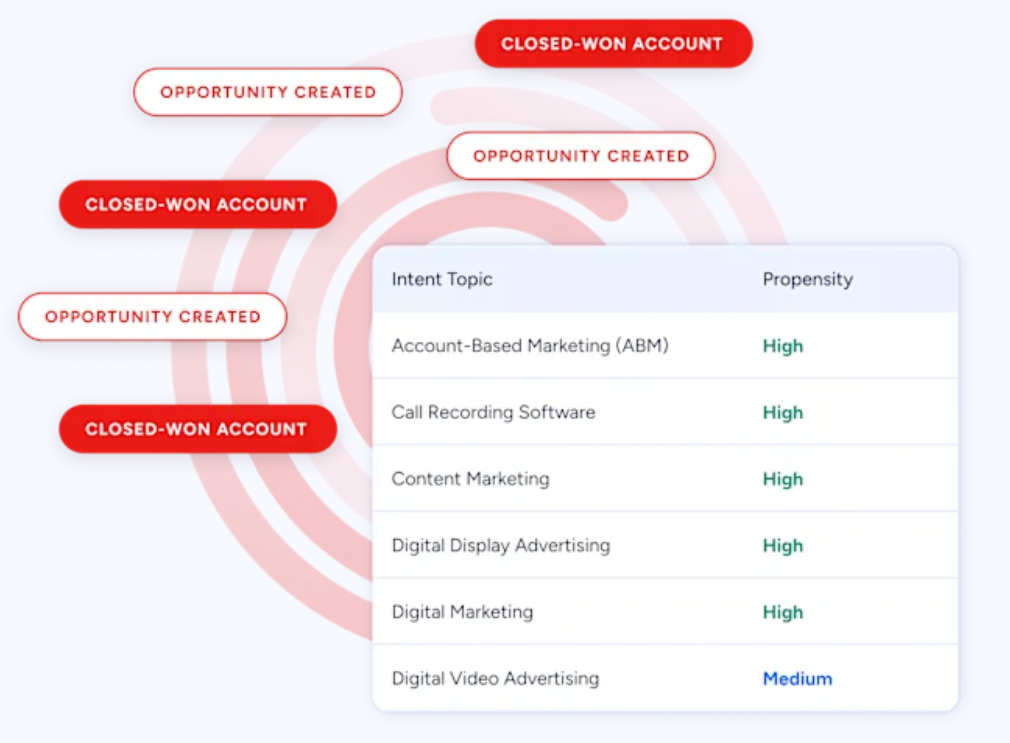
This data advantage has external validation. In a Fortune 500 competitive RFP analyzing 25 million contacts across vendors, the independent consultant concluded that "no other competitor came even close."
ZoomInfo holds 133 No. 1 rankings on G2 across Sales Intelligence, Buyer Intent, and Data Quality categories, and is a Leader in both the Gartner Magic Quadrant for ABM Platforms and the Forrester Wave for Intent Data Providers.
For teams currently using Salesken, adding ZoomInfo means reps walk into every call knowing who they're talking to, what technology the company runs, who else is on the buying committee, and whether the account shows active intent signals. That context makes every conversation more informed, whether or not you have real-time coaching on the line.
Vensure scaled prospecting with high-quality B2B data: "ZoomInfo gives us the information we need to execute. We don't have to spend our time digging. It's already there, so we can be three steps ahead." (Vensure Case Study)
The GTM Context Graph: ZoomInfo combines conversation data with CRM, intent, and behavioral signals in one intelligence layer.
Salesken forecasts pipeline from conversation data alone.
ZoomInfo's GTM Context Graph processes 1.5B+ data points daily, combining ZoomInfo's B2B data with a customer's CRM records, conversation transcripts (via Chorus, ZoomInfo's conversation intelligence product), email threads, and behavioral signals into a single layer that captures not just what happened, but why it happened.
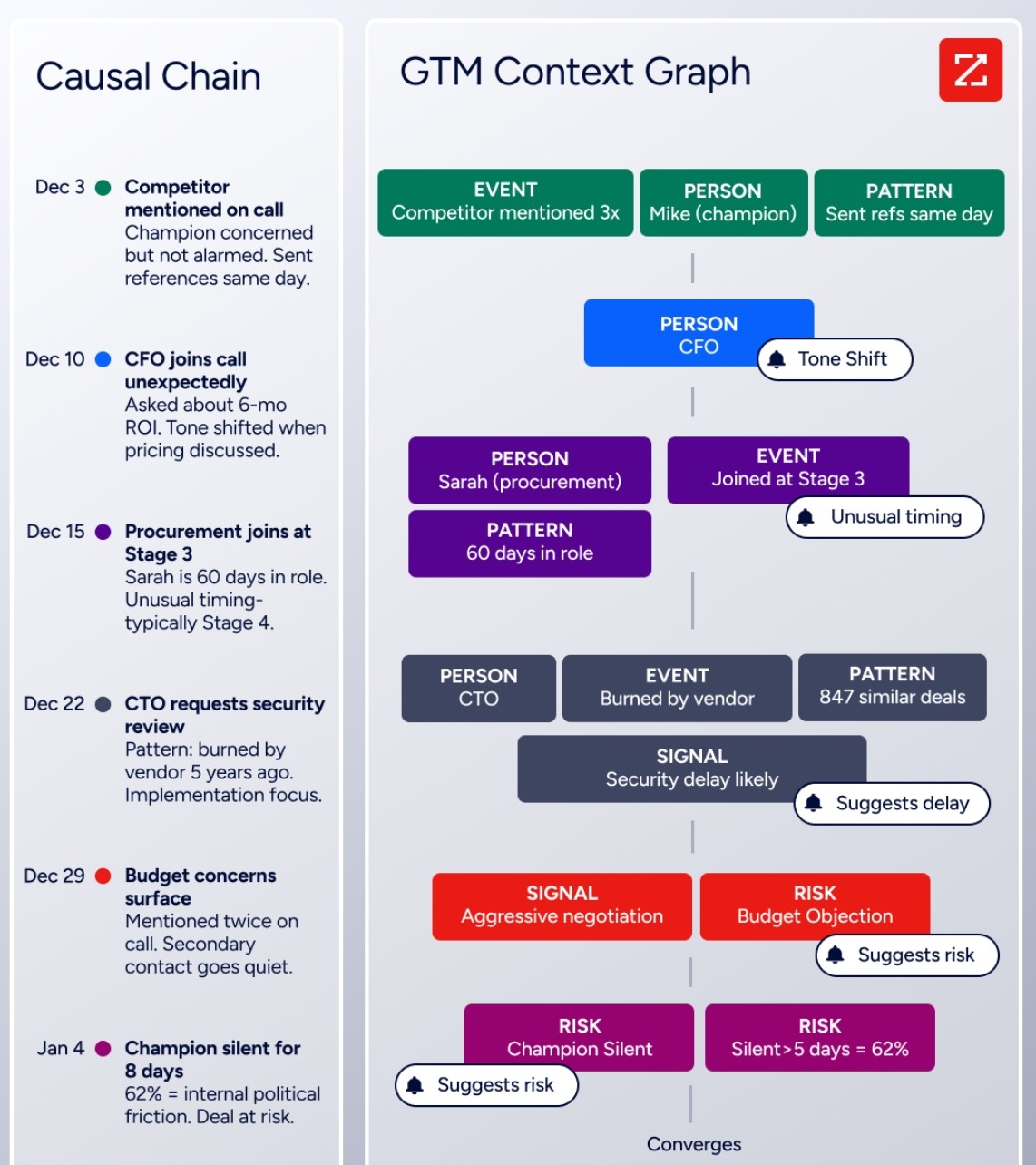
As ZoomInfo's CPO Dominik Facher explains: "The CRM recorded the state change. It has no record of why it happened." Perhaps the CFO joined the last call and asked about six-month ROI, which accelerated the deal. Perhaps the VP went quiet for eight days due to an internal budget battle, which almost killed it.
The GTM Context Graph makes this decision context machine-readable, connecting people and their relationships, actions and their outcomes, and patterns from thousands of similar deals into predictions about what happens next.
Chorus, ZoomInfo's conversation intelligence engine, captures every customer call, meeting, and email, then extracts the signals behind each interaction. Unlike standalone conversation tools, Chorus connects call insights to ZoomInfo's contact database.
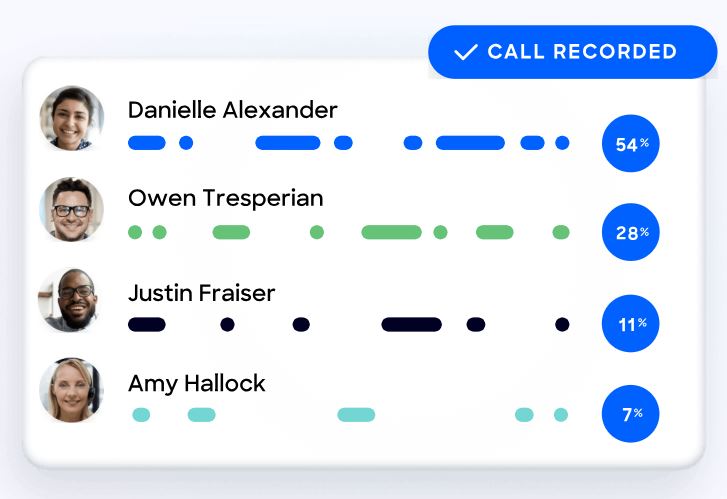
A manager reviewing a call sees the full profile and relationship history for every participant (contact details, company insights, and relevant signals) without switching to a separate system.
The practical difference: Salesken tells you what a buyer said on a call. ZoomInfo's GTM Context Graph tells you what the buyer said, connects it to the org change at their company, layers in intent signals showing their team is researching competitors, and matches that combination against thousands of historical deals to predict whether this deal closes.
Seismic attributed 39% of active pipeline to opportunities identified or influenced by ZoomInfo signals and reported 54% productivity gains. (Seismic Case Study)
Universal Access: ZoomInfo delivers intelligence through products for every GTM role and open APIs for any tool.
Salesken is a single product focused on call-based selling.
ZoomInfo delivers its intelligence through three channels, so every GTM role can use it the way that fits their workflow.
GTM Workspace is the seller's front-end. It consolidates CRM data, ZoomInfo intelligence, conversation history, and market signals into a single workspace where AI agents handle account research, outreach drafting, CRM updates, and signal monitoring.
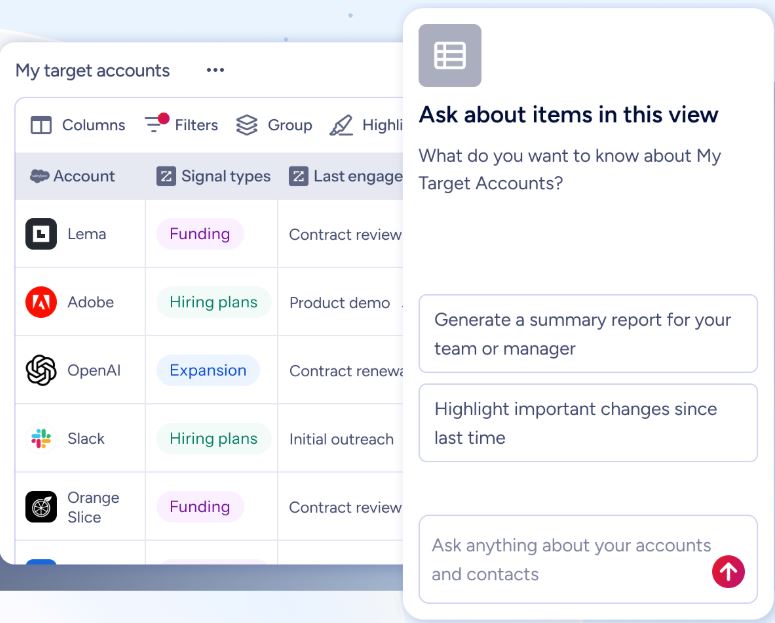
The Action Feed streams in-market buyers matched to target criteria, with pre-drafted actions on every signal. Customer results include Databricks reaching prospects 50% faster and Thomson Reuters increasing closed-won deals by 40%.
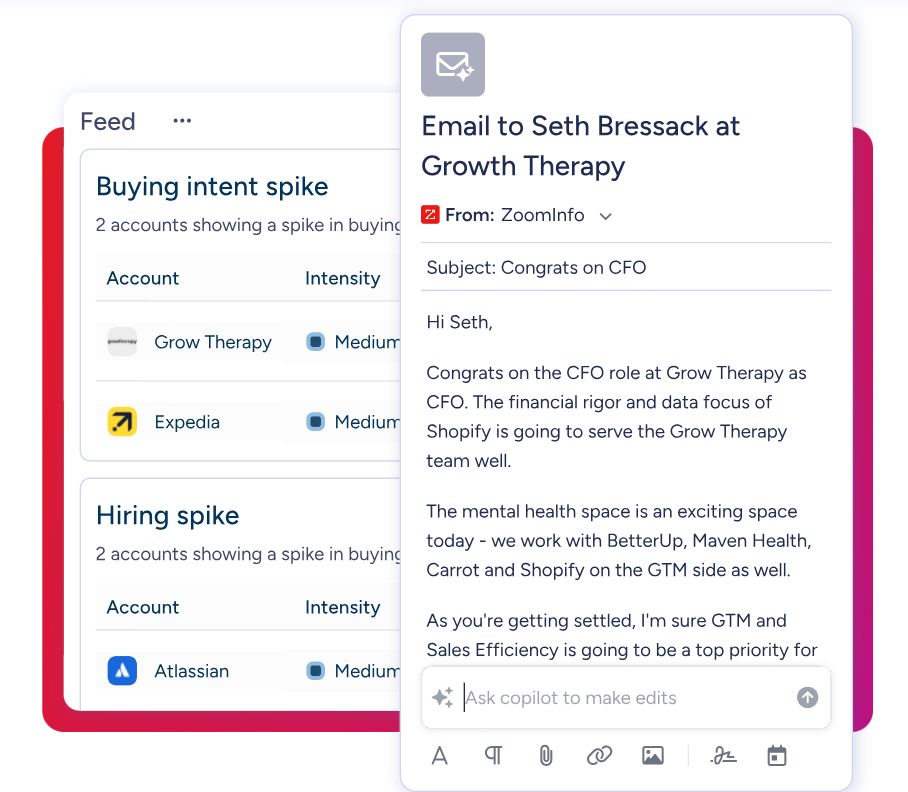
GTM Studio gives marketers, RevOps, and GTM engineers a canvas for designing, enriching, and activating go-to-market plays using natural language rather than engineering tickets. Expansion plays that used to take three weeks now launch in 30 minutes.
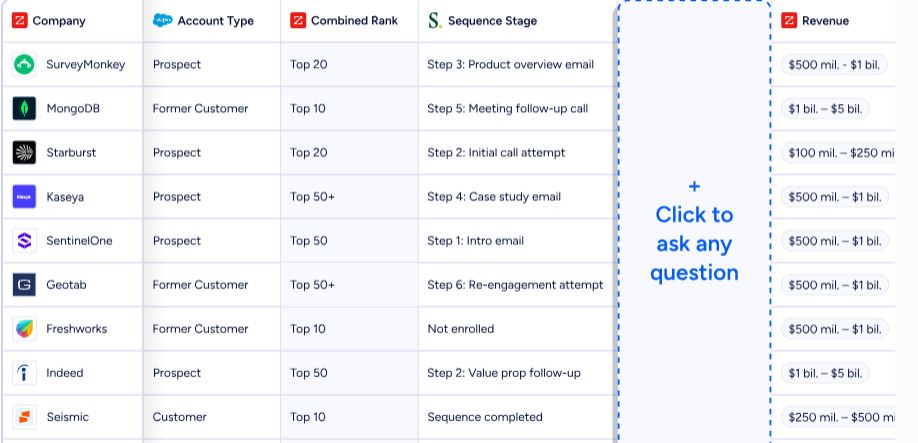
For teams that build beyond ZoomInfo's own products, APIs and MCP expose the same intelligence to any custom agent, internal tool, or partner platform. The MCP server connects AI models directly to ZoomInfo's B2B data with no custom coding, and is currently available through Anthropic Claude and ChatGPT. API access is included in all relevant plans.
"Anything that minimizes our team's need to switch contexts is beneficial. ZoomInfo offers a single view, eliminating the need to navigate between systems." (Spekit Case Study)
Pricing and Accessibility: ZoomInfo offers free entry points that Salesken does not.
ZoomInfo uses consumption-based pricing with custom quotes, similar to Salesken. Plans are organized into Sales, Marketing, and product-specific tiers (Chorus, Chat), each with Professional, Advanced, and Enterprise levels.
The key difference is accessibility. ZoomInfo Lite is a permanent free tier (no credit card, no time limit) with access to the B2B database, 10 monthly export credits, individual and company searches, the ReachOut Chrome Extension, WebSights Lite for website visitor identification, and HubSpot integration.
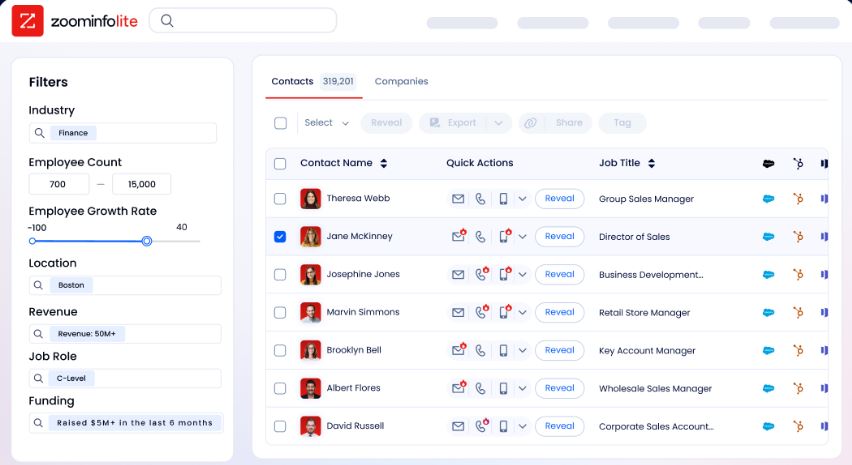
A separate 7-day free trial provides access to core platform features including intent signals and email outreach.
Salesken has no free trial, no free plan, and no self-serve signup. The only path to the product is a 30-minute demo conversation.
ZoomInfo is also publicly traded on NASDAQ (ticker: GTM) with $1.25 billion in annual revenue and 35,000+ customers worldwide, including Adobe, Snowflake, and PayPal. That scale provides the financial stability, development investment, and customer proof points that enterprise procurement teams evaluate alongside features.
Salesken or ZoomInfo: Comparison Summary
Aspect | Salesken | ZoomInfo |
|---|---|---|
Primary Focus | Conversation intelligence and real-time coaching | AI GTM platform |
B2B Contact Data | None | 500M contacts, 200M+ verified emails, 135M+ verified phones |
Real-Time In-Call Coaching | Core differentiator | Not available |
Conversation Intelligence | Revenue Intelligence AI, QA AI, AI Sales Assistant | Chorus (call analysis, deal intelligence, coaching scorecards) |
Pipeline Forecasting | From conversation data (BANT/MEDDIC scoring) | From GTM Context Graph (conversations + CRM + intent + behavioral signals) |
QA Automation | 100% call coverage with automated scoring | Chorus call analysis with scorecards |
Buyer Intent Data | Not available | 210M IP-to-Org pairings, 6T+ keyword pairings monthly |
Marketing / ABM | Not available | ABM platform with native DSP and multi-channel orchestration |
CRM Integration | Salesforce, HubSpot, Zoho | 120+ integrations including Salesforce, HubSpot, and Dynamics |
API / Programmatic Access | Referenced but not publicly documented | Documented APIs and MCP server, included in all relevant plans |
Free Entry Point | None (demo required) | ZoomInfo Lite (permanent free tier) and 7-day free trial |
Company Scale | 84 employees, private ($41M raised) | $1.25B revenue, public (NASDAQ: GTM) |
Best For | High-volume call-based sales teams needing real-time coaching | Teams needing full GTM intelligence from prospecting through deal close |
Final Verdict
The choice between Salesken and ZoomInfo depends on whether your primary challenge is coaching reps on calls or running a complete go-to-market operation.
Choose Salesken if your sales motion is call-driven and your biggest bottleneck is rep performance on the phone. Salesken is built for organizations where managers can't listen to every call, reps need live guidance during conversations, and QA programs need to cover 100% of interactions instead of random samples.
Its real-time coaching, conversation-based pipeline forecasting, and automated QA make it a strong tool for high-volume inside sales teams in verticals like EdTech, BFSI, and healthcare. If your team already knows who to call and needs to get better at closing, Salesken focuses on that problem.
Choose ZoomInfo if you need intelligence across the full go-to-market workflow, from identifying the right accounts and contacts to understanding deal dynamics to executing across channels. ZoomInfo provides the prospecting data, buyer intent signals, conversation intelligence (via Chorus), and AI-driven execution tools that Salesken doesn't cover.
For teams that need to answer not just "how are our calls going?" but "who should we be calling, why now, and what does the full picture of this deal look like?", ZoomInfo's GTM Context Graph delivers that breadth in one platform.
Get started with ZoomInfo here.
Salesken and ZoomInfo solve different-sized problems. Salesken makes individual calls better. ZoomInfo provides the data, intelligence, and execution tools to make the entire go-to-market motion smarter.
Salesken FAQ
Does Salesken offer a free trial or free plan?
No. Salesken does not offer a free trial, a free plan, or a self-serve signup. The only way to access the platform is by booking a 30-minute demo through the website. ZoomInfo, by contrast, offers a permanent free tier (ZoomInfo Lite) with access to its B2B database and 10 monthly export credits, plus a separate 7-day free trial for paid features.
How does Salesken's real-time coaching work?
Salesken's AI Sales Assistant listens to live calls, transcribes in real time, and detects key moments like objections, competitor mentions, and pricing discussions. When it identifies a critical moment, it surfaces a prompt on the rep's screen with the suggested response. The system also analyzes buyer sentiment and tone shifts during the conversation.
However, some users report that the AI occasionally misinterprets context and delivers irrelevant prompts.
What CRM integrations does Salesken support?
Salesken integrates natively with Salesforce (Classic and Lightning), HubSpot, and Zoho CRM. The platform automatically logs transcripts, summaries, action items, and deal signals into CRM records. For organizations using custom or legacy CRMs, Salesken builds custom connectors. All integrations are included at no extra cost.
ZoomInfo supports over 120 integrations through its App Marketplace, including Salesforce, HubSpot, Microsoft Dynamics, Snowflake, and many others.
What languages does Salesken support?
Salesken analyzes, coaches, and scores conversations across over 70 languages. This is particularly relevant for organizations running multilingual sales teams, common in India-based companies operating across regional languages.
Does Salesken include prospecting data or a lead database?
No. Salesken focuses entirely on analyzing conversations that are already happening. It does not provide B2B contact data, company intelligence, intent signals, or any tools for identifying and reaching new prospects. Teams using Salesken need a separate data provider for prospecting.
ZoomInfo provides 500 million contacts, 100 million companies, 135 million verified phone numbers, and 200 million verified business emails alongside buyer intent data.
How is Salesken priced?
Salesken uses a per-recorded-user license model with an additional platform fee based on user count. No dollar figures are published. The company sells five products (Revenue Intelligence AI, Quality Assurance AI, AI Sales Assistant, Meeting Note Taker, and Field Sales QA) individually or as a discounted bundle. All pricing requires a custom quote through the sales team.
What industries is Salesken best suited for?
Salesken targets verticals with high-volume call-based selling and compliance requirements. The company focuses on EdTech (enrollment counselors), BFSI (banking, financial services, insurance), healthcare (insurance and patient engagement), and real estate. Its 100% QA coverage and compliance flagging are particularly relevant for regulated industries where every call must be monitored.
Is Salesken suitable for enterprise organizations?
Salesken serves organizations from small teams to larger enterprises, with verified customers including Cuemath and Vedantu in the EdTech space.
However, with approximately 84 employees and limited publicly documented enterprise customers outside India, the company is smaller than competitors in conversation intelligence. Enterprise buyers conducting formal evaluations may find limited public case studies and references. The company does offer a customized Enterprise plan with custom integrations and dedicated support.
