
You are evaluating a revenue orchestration platform, and the question is no longer whether Salesloft can run sequences and log calls. The question is what each module does, how it works, and which package unlocks it.
Salesloft is an AI-powered revenue orchestration platform that spans sales engagement, conversation intelligence, deal management, forecasting, and website chat in a single system, built for mid-market to enterprise B2B revenue teams. After its December 2025 merger with Clari, Salesloft positions itself as the Predictive Revenue System, combining Clari's forecasting engine with Salesloft's execution layer. This breakdown covers every feature, how it works, who it serves, and which plan unlocks it.
Salesloft's feature set has you covered if:
You run structured, multi-channel outbound sequences across email, phone, SMS, and LinkedIn and need one platform to manage them
You want AI prioritization that ranks which prospects and deals deserve attention based on live buyer signals, not static lists
You need conversation intelligence that records, transcribes, and analyzes sales calls without a separate vendor
You manage complex enterprise deals with multi-stakeholder buying groups and need MEDDPICC or BANT qualification extracted automatically from call recordings
You want forecasting tied to actual deal activity and conversation data rather than rep-submitted estimates alone
You need website chat that identifies high-intent visitors and routes them into seller workflows in real time
You'll reach the edges of its capabilities if:
You need a B2B contact and company database to source prospects before they enter your CRM or sequencing tool
You want buyer intent signals showing which companies are researching your category across the web, not just engagement with your own outreach
You need a single intelligence layer that fuses third-party data, CRM records, and conversation intelligence to explain why deals move or stall
You want account-based marketing orchestration with native display advertising, audience management, and multi-channel campaign activation
You require programmatic access to B2B data through APIs and AI-native protocols like MCP for custom agents and workflows
For those needs, the reference point is ZoomInfo: an AI GTM platform built on 500M contacts, 100M companies, and 135M+ verified phone numbers, a GTM Context Graph that fuses B2B data with CRM records, conversation intelligence, and behavioral signals into one intelligence layer, and access through APIs, MCP, GTM Workspace, and GTM Studio.
After the feature breakdown, this article covers where Salesloft stops and how ZoomInfo fills those gaps.
Salesloft Platform Overview
Salesloft is a revenue orchestration platform built for enterprise B2B sales teams, spanning the full cycle from pipeline creation through deal close and customer renewal.
The platform is used by 5,000+ organizations including IBM, Stripe, Siemens, 3M, and SAP Concur, collectively processing more than 10 billion revenue interactions and 1 trillion data signals. Target industries include Professional Services, Manufacturing, Medical Software and Devices, and Logistics.
The platform is organized around nine modules:
Module | What It Does | Notes |
|---|---|---|
Multi-channel sequencing for outbound prospecting, nurture, and renewals | The foundational engagement engine | |
AI action prioritization based on buyer signals | Patent-pending Conductor AI engine | |
Call recording, transcription, and AI analysis | Built-in, not a separate product | |
Opportunity management with AI deal health scoring | MEDDPICC/BANT extraction from calls | |
AI-assisted revenue forecasting with rollup views | Integrates Clari forecasting post-merger | |
Website conversational AI for pipeline generation | Transitioning from Drift to 1mind | |
Reporting, dashboards, and Command Center | AI agents surface coaching opportunities | |
Role-specific agents across the revenue cycle | Account research, email generation, deal summaries | |
Data layer, CRM sync, security, and governance | SSO, GDPR tooling, multi-org management |
Salesloft offers two packages: Advanced and Elite, both quote-only with no public pricing. No self-serve free trial is publicly advertised, though Salesloft does make trial access available at its discretion, and a specific agent trial form exists for the AI Agents product. With that structure in place, here is the full tour.
Salesloft Cadence: Multi-Channel Sales Engagement
Cadence is the foundational module, and for many teams, it is the reason they bought Salesloft.
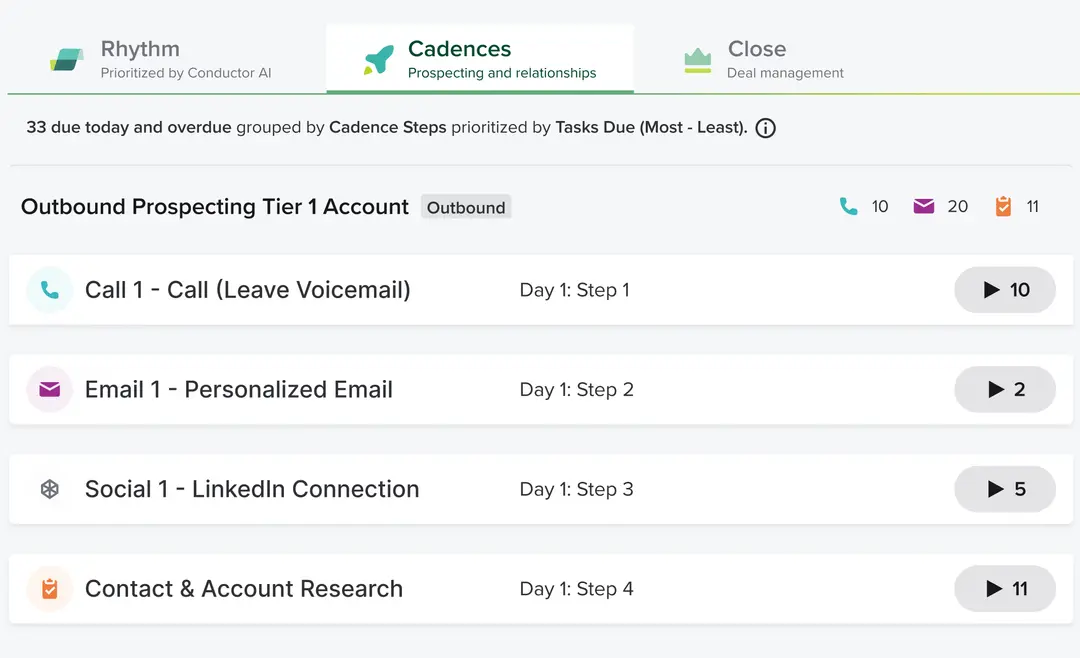
It structures outbound prospecting, lead nurture, and renewal workflows into repeatable, day-by-day sequences of touchpoints that reps execute at scale across email, phone, SMS, and social channels.
Source: Salesloft
Building a cadence starts with defining a series of steps spread across days. Each step belongs to one of four types: Email, Phone, Other (a general task), and Integration steps that trigger actions in connected tools like LinkedIn Sales Navigator. Steps are configured as either manual (the rep triggers them) or automated (Salesloft triggers them on schedule). Multi-touch cadences allow multiple touchpoints on the same day, and steps can be moved or edited after creation.
The channel breadth is where Cadence earns its depth.
Email, phone, SMS, and integration steps are all native, with LinkedIn Sales Navigator supporting four step sub-types: InMail, Research, Connection Request, and Introduction. Vidyard video steps and 200+ third-party integrations extend the channel range further. The built-in dialer supports calling from the Salesloft platform, cell phone, or hardline with automatic call logging, and SMS runs through Messenger.
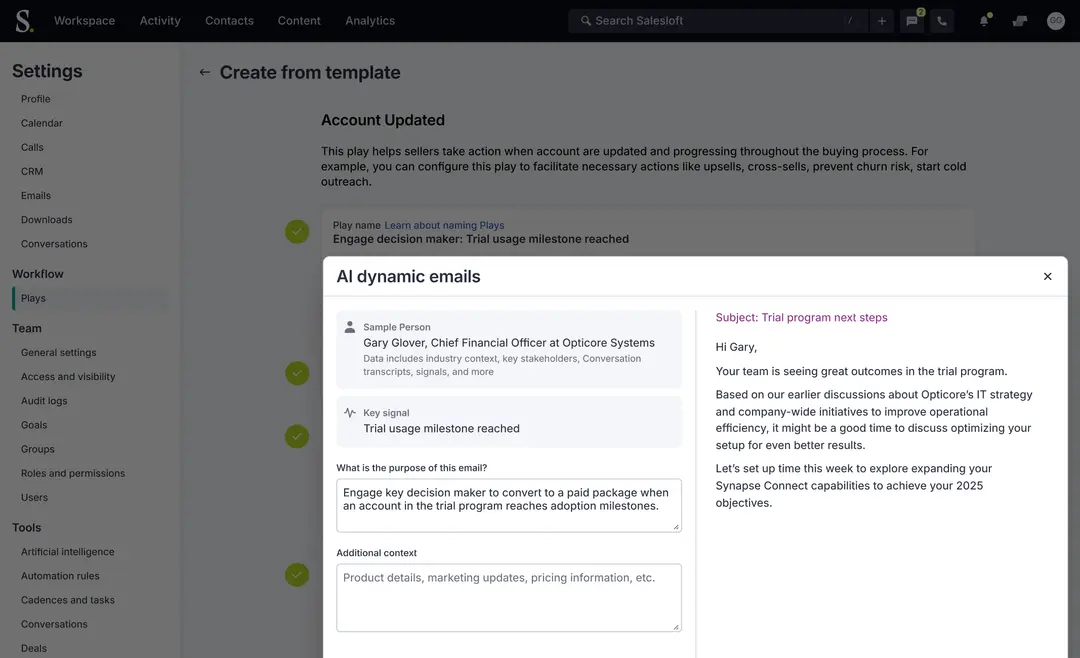
AI Email Agents are email generation agents that draft personalized emails at each cadence step based on account and person research.
Rather than pulling from a static template library, these agents reference live account data and buyer context to generate emails that reflect what the prospect's company does and what the rep's product solves for them.
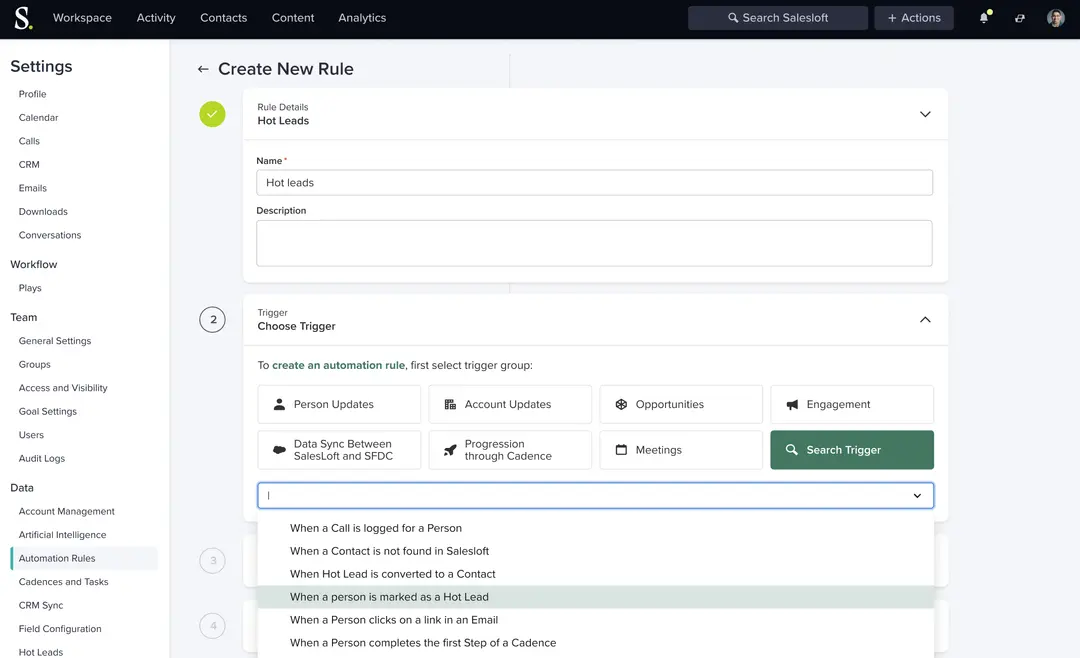
Automation rules add a reactive layer on top of the structured sequence.
Configurable rules trigger actions based on buyer behavior: a contact who clicks a link gets enrolled into a follow-up cadence, a prospect who is out of office has their steps rescheduled, a contact who replies is automatically removed. Every call, email, and meeting is automatically logged and synced to the CRM without manual entry.
Source: Salesloft
Cadence A/B testing randomly distributes contacts between message variants and reports performance, so teams can optimize messaging with data rather than intuition.
The framework supports both personal cadences (individual reps experimenting) and team cadences (standardized practices enforced across the org), letting leaders maintain process discipline while permitting individual customization.
Reps execute cadence steps from multiple surfaces. The Salesloft Connect Chrome extension surfaces cadence steps, contact data, dialing, and deal context inside Salesforce, Gmail, and LinkedIn, so reps can act without switching tools.
A full iOS and Android mobile app (localized in English, French, German, and Spanish with dark mode) mirrors the web experience for cadence execution on the go. Calendar integration embeds scheduling links directly into outbound emails.
The Buyer Identification Agent adds an upstream layer: it surfaces contacts matching the team's winning buyer patterns and, when integrated with ZoomInfo, can recommend contacts not yet in the CRM. Reps add identified contacts directly into a cadence from the agent's recommendations.
Salesloft Rhythm: AI-Powered Action Prioritization
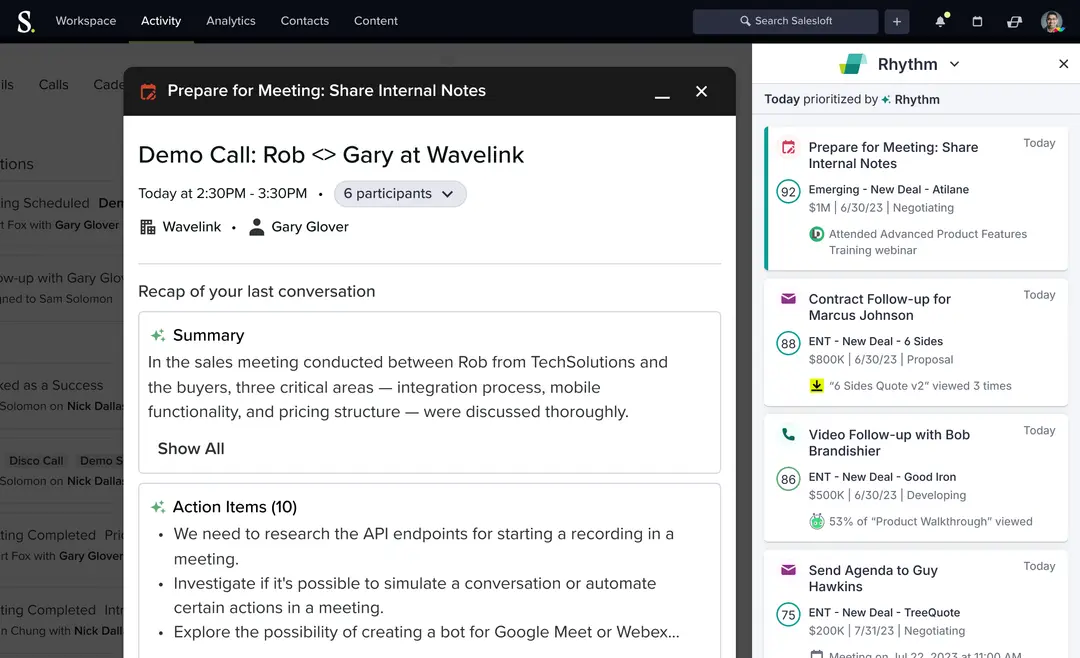
Rhythm sits on top of Cadence and every other module, acting as the AI layer that tells reps what to do next.
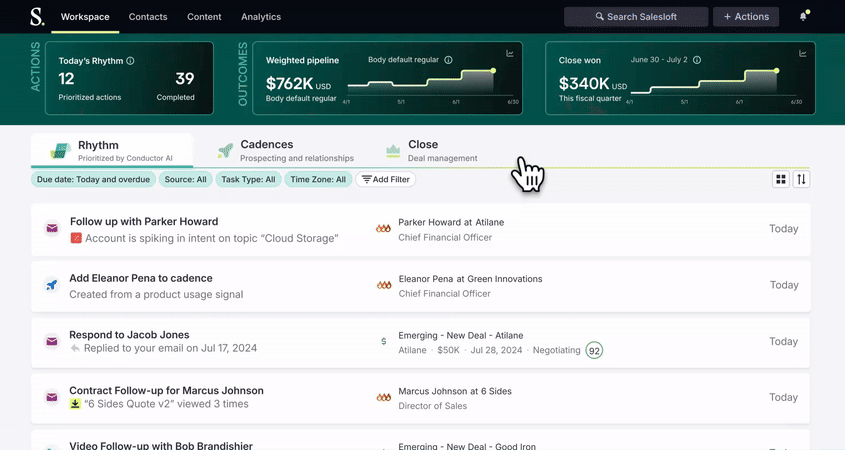
Its job is translating buyer signals from across the tech stack into a single, continuously re-ranked list of seller actions. Before Rhythm, Salesloft reported account executives spent at least 30 minutes per day just deciding what to work on.
Source: Salesloft
Rhythm operates as a three-layer signal-to-action pipeline.
First, it ingests buying signals from multiple sources: first-party Salesloft data (email opens, call outcomes, cadence engagement), Drift/Chat Agents website data (page views, chatbot conversations), third-party partner integrations, and custom data via an open Signals API.
Partners feeding signals into Rhythm include DocuSign, G2, Seismic, Vidyard, Highspot, LeanData, LeadIQ, Showpad, UserGems, Reachdesk, Equilar, Trumpet, Influ2, and B2Brain.
Second, a patent-pending AI engine called Conductor AI ranks the next best action based on likelihood to progress a deal. The Buyer Engagement model evaluates account-level and person-level engagement to score tasks and re-prioritizes as new signals arrive.
Third, prioritized actions surface in the seller's workflow through Plays, pre-configured automations that translate a signal event into a task. Each Play maps 1:1 to a signal type: when a prospect views a pricing page, Rhythm generates a follow-up task with the context of what they viewed.
As of the June 2024 product update, Rhythm can pre-populate AI-drafted emails based on each buyer's activities, role, and company.
Source: Salesloft
Focus Zones group the prioritized task queue by selling motion. The Cadence Focus Zone handles pipeline generation tasks; the Close Focus Zone surfaces deals most likely to close by end of quarter. Within each zone, the Rhythm Prioritizer re-ranks the seller's day based on live signals, with filters for action type, account tier, and custom scoring.
The Priority Accounts Agent ranks entire accounts (not just individual contacts) based on aggregate engagement signals and buying intent, enabling account-based selling where the unit of prioritization is the company, not the person. The Rhythm Sidebar, available from anywhere in Salesloft via the Rhythm icon, gives sellers access to their prioritized actions without navigating away from their current screen.
Salesloft Conversations: Call Recording and Intelligence
Conversations is the conversation intelligence module built into the platform.
Salesloft's positioning: "You don't need a separate Conversation Intelligence solution, it's part of our all-in-one platform." It records, transcribes, and analyzes sales calls and video meetings, then routes insights back into seller and manager workflows through Rhythm.
Source: Salesloft
Recording happens automatically through the Salesloft dialer and via native integrations with Google Meet and Zoom. Once a call is processed, a suite of AI agents runs against each transcript.
The Conversation Summary AI Agent generates a summary, action items, and can draft a follow-up email. Summaries appear in a Recap Tab and feed the seller's Rhythm workflow. The system includes a feedback mechanism to train AI on summary quality, so summaries improve based on actual usage.
The Conversation Key Moment AI Agent reviews transcripts to surface competitor mentions, objections, and decision-maker involvement that might affect deal health. These are not generic keyword flags: the agent identifies when a specific competitor was raised by the buyer, when a pricing objection surfaced, or when a new decision-maker entered the conversation. Custom keyword trackers can be configured for any topic the team wants to monitor.
Tracker Trends visualize patterns across multiple conversations, showing how frequently competitors, price sensitivity, or specific objections appear over time. This turns individual call data into a view of what the market is saying.
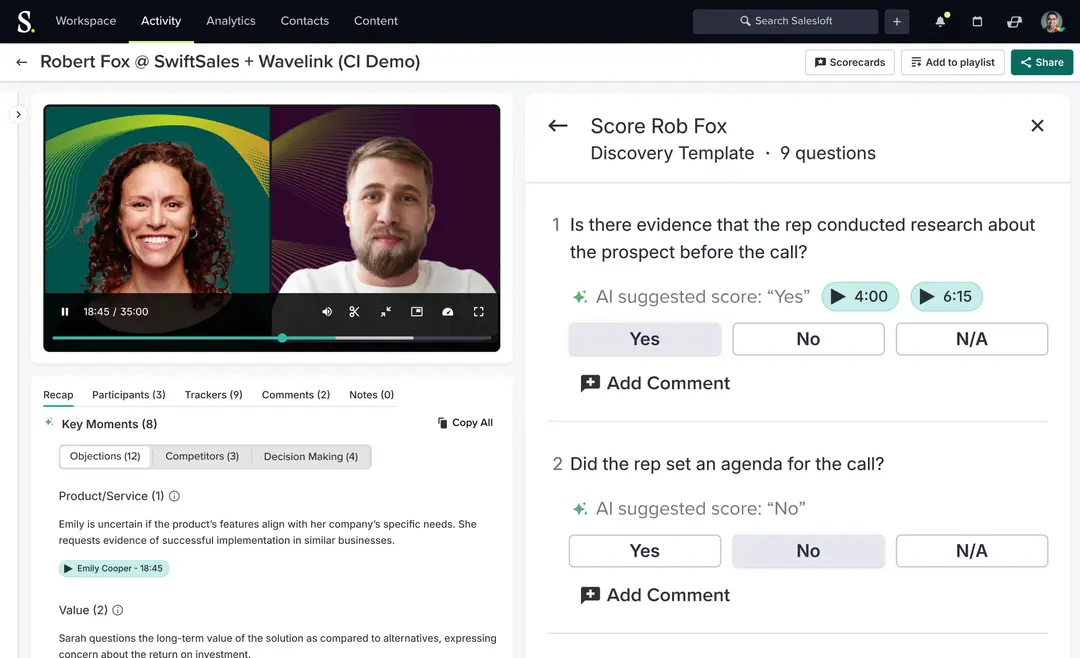
The coaching side of Conversations centers on the AI Scorecard Agent, which analyzes the transcript to pre-populate a manager's coaching scorecard based on rep performance against predefined criteria. Managers no longer need to listen to an entire call before coaching; the agent flags the specific moments that matter. Managers can build custom call playlists of best-practice examples, and reps can compare their behaviors against top performers.
Source: Salesloft
Before calls begin, AI consolidates past conversation data into a pre-call brief for the selling team, and Salesloft sends the buyer a meeting agenda ahead of the call.
Call-recording notifications and consent mechanisms are built in for U.S. state laws and international recording regulations. All conversation insights link directly to deal records, so deal risk signals (competitor mentions, unaddressed objections, absent decision-makers) are visible alongside pipeline data in Deals.
Salesloft Deals: Opportunity Management
Deals is where pipeline visibility and deal execution converge.
It provides a workspace for tracking, managing, and closing sales opportunities without toggling between CRM, spreadsheets, and disconnected pipeline tools.
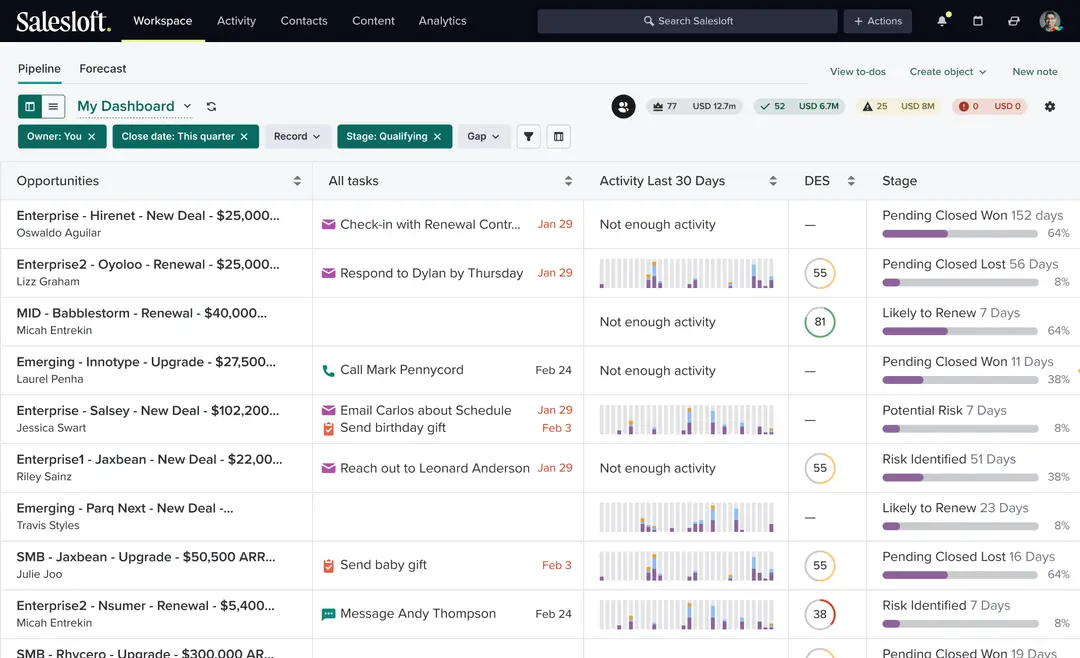
The Pipeline Dashboard is a customizable view of all open opportunities, sortable by region, territory, or product line.
AI deal intelligence surfaces buyer engagement scores and identifies deal gaps. In-line edits inside Deals flow back to the CRM in real time through bidirectional sync with Salesforce, HubSpot, and Microsoft Dynamics 365, eliminating manual CRM updates. The Deals Flow Chart visualizes pipeline performance, showing conversion rates between stages, idle deals, and committed-but-lost opportunities.
Source: Salesloft
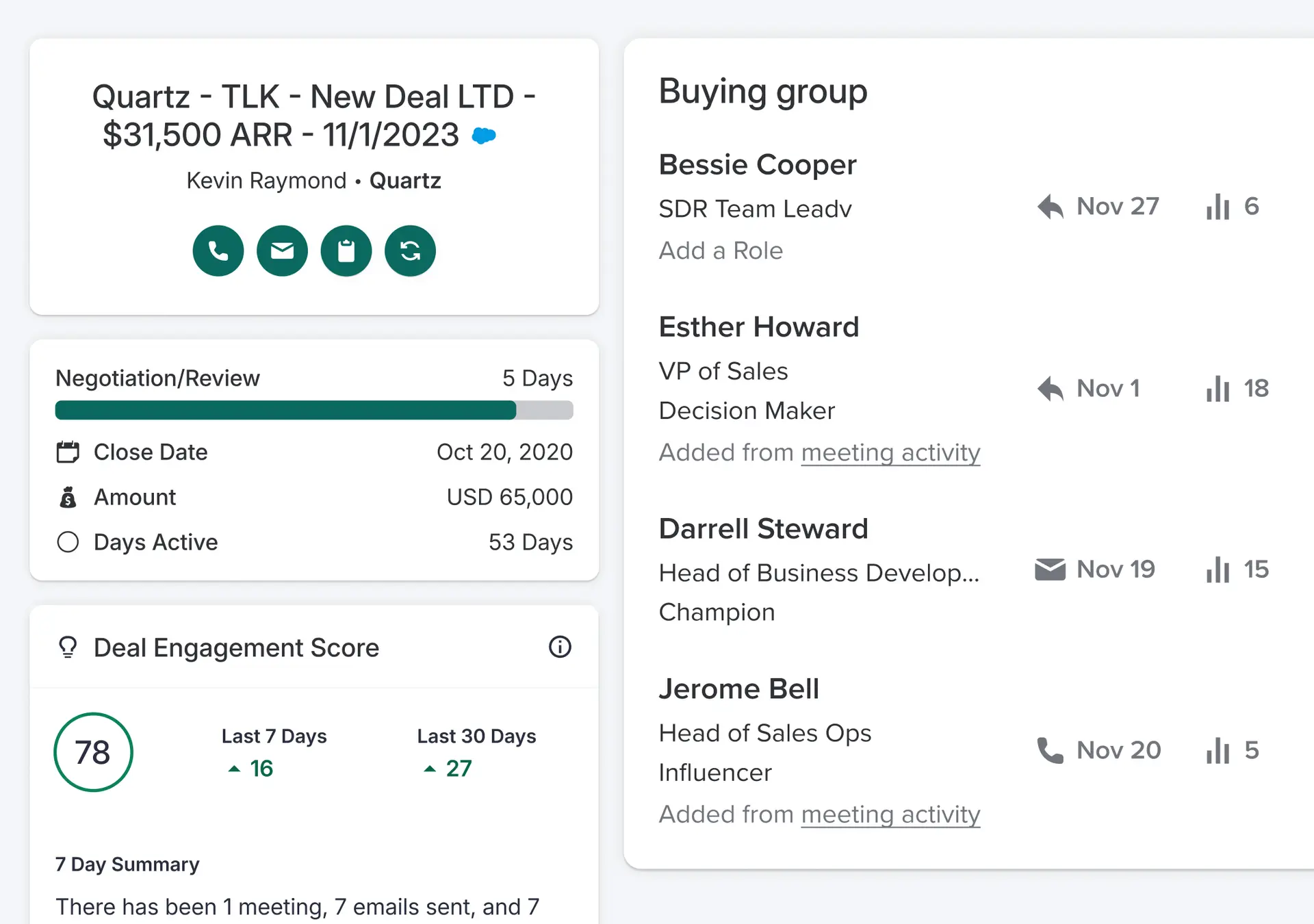
Deal Engagement Score (DES) is a 0 to 100 health score built on 30+ stakeholder engagement and deal progression factors.
Rather than relying on a rep's subjective assessment of deal health, DES aggregates actual engagement signals (email interactions, call frequency, stakeholder involvement, deal velocity) into a single number that flags risk before the rep notices it.
Qualification framework support is where Deals connects to Conversations. MEDDPICC, BANT, SPIN, and ICED frameworks are embedded into seller workflows. The Sales Methodology Extraction AI Agent, launched in Spring 2025, pulls MEDDPICC and other framework fields automatically from recorded buyer conversations.
Rather than requiring reps to fill in qualification data manually after each call, the agent listens to what was discussed and populates the deal record.
Auto Buying Group Capture automatically creates CRM records for every identified email or meeting recipient and associates them with the correct deal. In complex enterprise sales with multiple stakeholders, this ensures no participant goes untracked. When AI agents detect a stalled opportunity or deal risk, recommended actions surface in the seller's Rhythm workflow.
Source: Salesloft
The Close Focus Zone uses account planning agents to prioritize deals based on likelihood to close by the end of the quarter. Opportunity Agents (Spring 2025) organize a rep's book of business by account priority, with deal summaries, engagement signals, recommended next steps, and an "Ask Salesloft" conversational interface where reps can ask freeform questions about any account and receive data-backed answers.
Salesloft Forecast: Revenue Prediction
Forecast moves forecasting from a spreadsheet exercise into the live sales workflow. Its stated mission: "transform your sales forecast from a burdensome task into a strategic action plan to close more revenue."
The module operates on three layers.
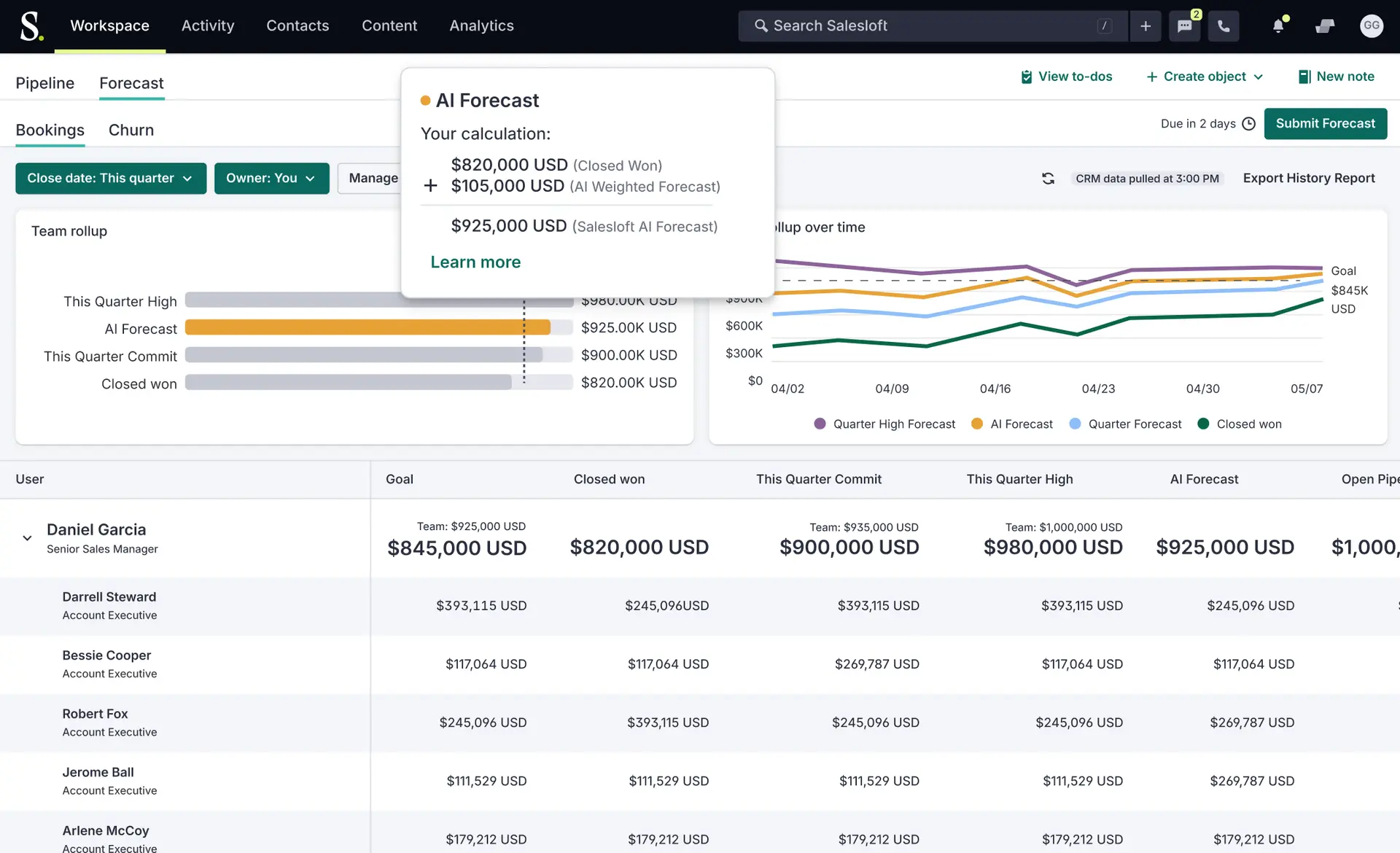
At the rep level, individual sellers submit their own forecast commitments, segmented by deal category, time period, or revenue type. In parallel, the AI Forecast Agent analyzes pipeline data, buyer interactions, and historical deal outcomes to produce an AI-generated prediction.
Source: Salesloft
The model trains on each customer's own historical data (not industry averages), accounting for deal size, stage, and velocity. Private AI models keep customer data protected. Managers then compare AI predictions against rep-submitted forecasts to make informed adjustments, creating a triangulation where the AI serves as a reality check rather than an override.
Rollups consolidate individual and team-level forecasts into a complete organizational view.
The Weekly Trend Chart shows week-over-week forecast changes across triangulations, making it visible when the forecast is drifting as close dates approach. Managers can share coaching notes and take action (schedule meetings, make calls, send emails) from the same view rather than switching tools.
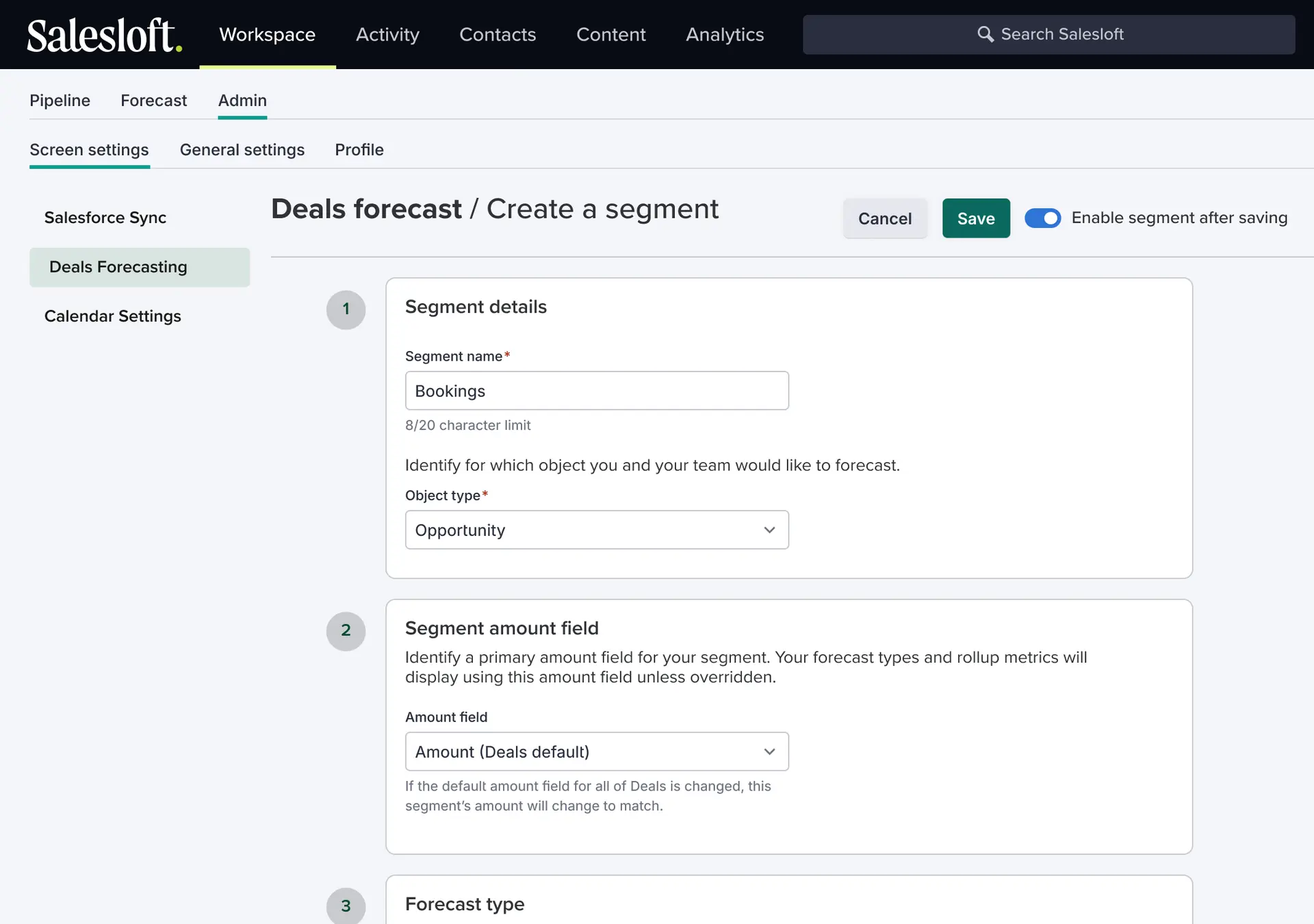
Forecast Segmentation lets organizations filter opportunities by new bookings vs. renewals, business segments, regions, account size, or time periods. Enterprise Forecasting extends this for multi-team complexity, enabling deals to be viewed and organized by account, revenue type, or segment with enterprise-grade security controls. Data is captured daily across reps, teams, and activities, so the forecast reflects the current pipeline rather than a weekly snapshot.
Source: Salesloft
After the December 2025 Clari merger, Forecast integrates with Clari's forecasting engine. As of the Spring 2026 product update, reps can trigger Salesloft tasks and AI-generated emails directly from Clari Inspect and Forecast screens, and call-to-follow-up is native within Clari Copilot.
Salesloft Chat Agents: Website Conversational AI
Chat Agents address the gap between when a buyer visits a website and when a seller responds.
Salesloft calls this the "intent-to-action gap," noting that every second between a buyer signal and a seller response is revenue at risk. The module was originally powered by Drift, which Salesloft acquired in February 2024. As of March 2026, Salesloft announced a partnership with 1mind as the successor technology, with Drift being gradually sunset.
When a prospect lands on the website, the system identifies who they are, surfaces relevant account data (company name, location, account history), and scores their engagement in real time before the conversation starts. The AI chat agent opens a personalized conversation using web activity, CRM data, and past conversations to tailor each interaction.
Fastlane bypasses standard form queues for qualified, high-intent buyers, connecting them immediately with a live representative or a meeting booking, using tech-stack data to identify and qualify high-value visitors in real time.
Source: Salesloft
The critical integration point is with Rhythm.
When visitors from high-intent accounts interact with chat, the agent routes qualified buyers into the seller's Rhythm workflow as a prioritized action with full conversation context. A website conversation generates the same kind of ranked, actionable task as an email reply or an intent signal from a third-party partner.
With the 1mind transition, the engagement layer expands beyond text. 1mind's "Superhumans" can engage buyers on websites, in product, in deal rooms, and on conference calls via Zoom, Microsoft Teams, and Google Meet, qualifying, demoing, and handling objections 24/7. Buyer intelligence captured by 1mind flows into Salesloft Cadences without switching tools or creating data silos.
Chat Agents includes ROI and engagement reporting to track engagement metrics, identify high-converting conversations, and attribute pipeline and revenue. Additional costs apply beyond the base platform: extra domains beyond one per instance, Bionic Chatbot, Site Concierge, and Drift Engage each carry volume-tier pricing.
Salesloft Analytics, AI Agents, and Command Center
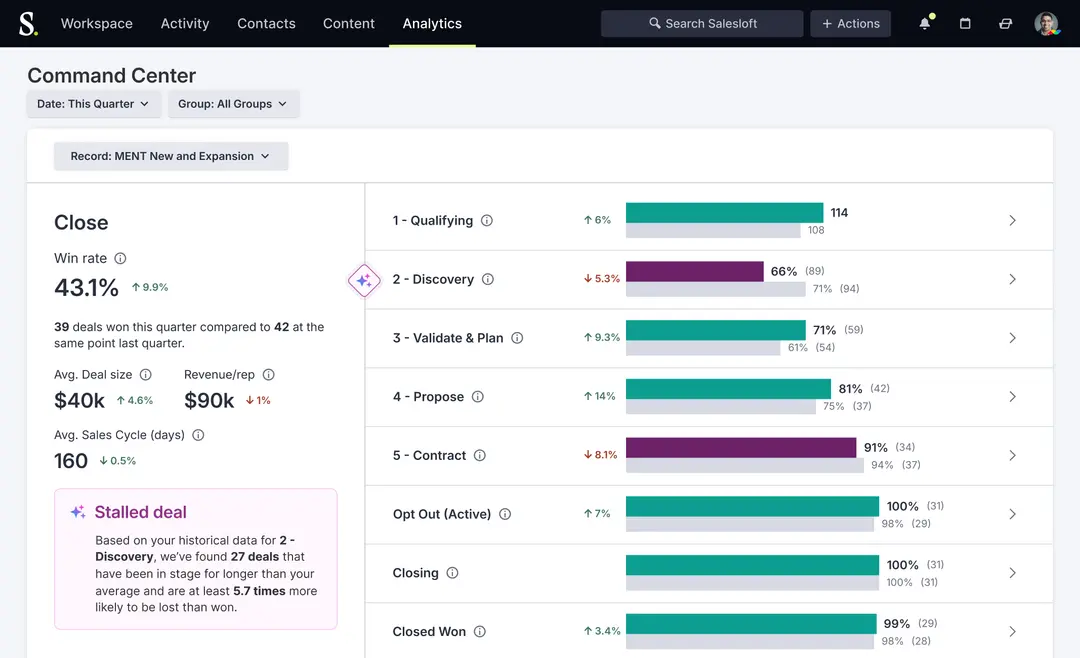
Analytics is the reporting layer, and its central hub is Command Center, introduced in the Fall 2024 product update.
Command Center gives RevOps and sales leaders a single place to view key metrics across all sales stages, consolidating buyer signals and revenue outcomes into executive-level dashboards. Revenue leaders can launch Plays directly from real-time signals they observe in Command Center, closing the loop between insight and action.
Source: Salesloft
Several AI agents operate within Analytics.
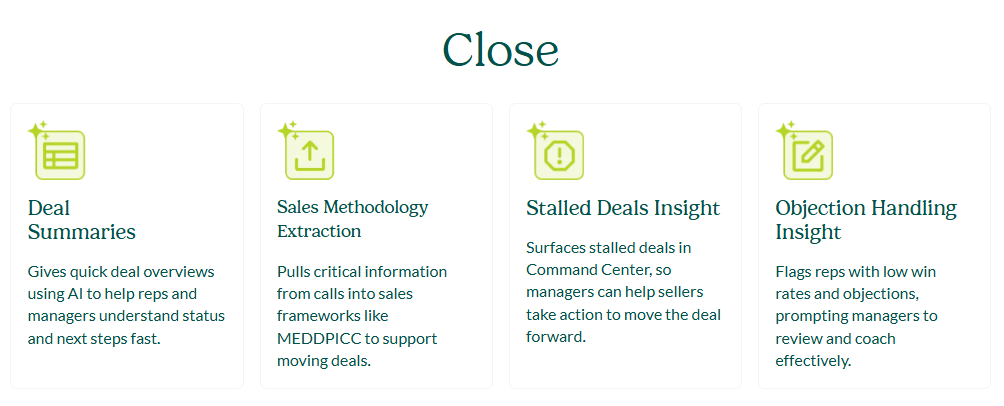
The Analytics Interpreter Agent summarizes notable changes, trends, and performance metrics with recommendations for next steps. The Stalled Deal Agent monitors deal progression, flags deals stuck in a stage too long, and triggers a Rhythm task to get them moving. The Objection Handling Agent identifies reps with low win rates combined with higher-than-average call objections, then creates specific next steps for managers to coach them. The AI Coaching Agent surfaces coaching opportunities at the individual seller level.
Beyond Analytics, Salesloft's full AI Agents suite spans four categories.
Create agents handle pipeline generation: the Account Research Agent researches accounts and posts summaries on account pages, the Person Research Agent injects contact-specific insights into generated content, and Ask Salesloft provides a conversational interface for freeform questions about any account.
Close agents accelerate deals: Deal Summaries generate deal overviews, and the Sales Methodology Extraction Agent pulls structured framework data from call recordings.
Grow agents support customer expansion with account-level Q&A and AI-drafted prep notes from past activity.
Scale agents replicate winning behaviors: the Sales Strategist delivers coaching recommendations by identifying performance trends across the team.
The Account Agent (AI Research Agent) includes an allowance of 100 Agent Runs per user per month, pooled across all users. Exceeding this requires purchasing additional volume or upgrading. Salesloft notes this pricing is promotional and may change.
Source: Salesloft
As of April 2026, the Salesloft MCP Server opens Salesloft's live revenue data to any MCP-compatible AI tool, including Claude, ChatGPT, Microsoft Copilot, Gemini, and Salesforce Agentforce. External AI applications can query live pipeline, deal, account, and call data, enabling custom agentic workflows built on real revenue context. RevOps teams manage governance of AI usage with full audit logging.
Salesloft Enterprise Data Platform, Integrations, and Security
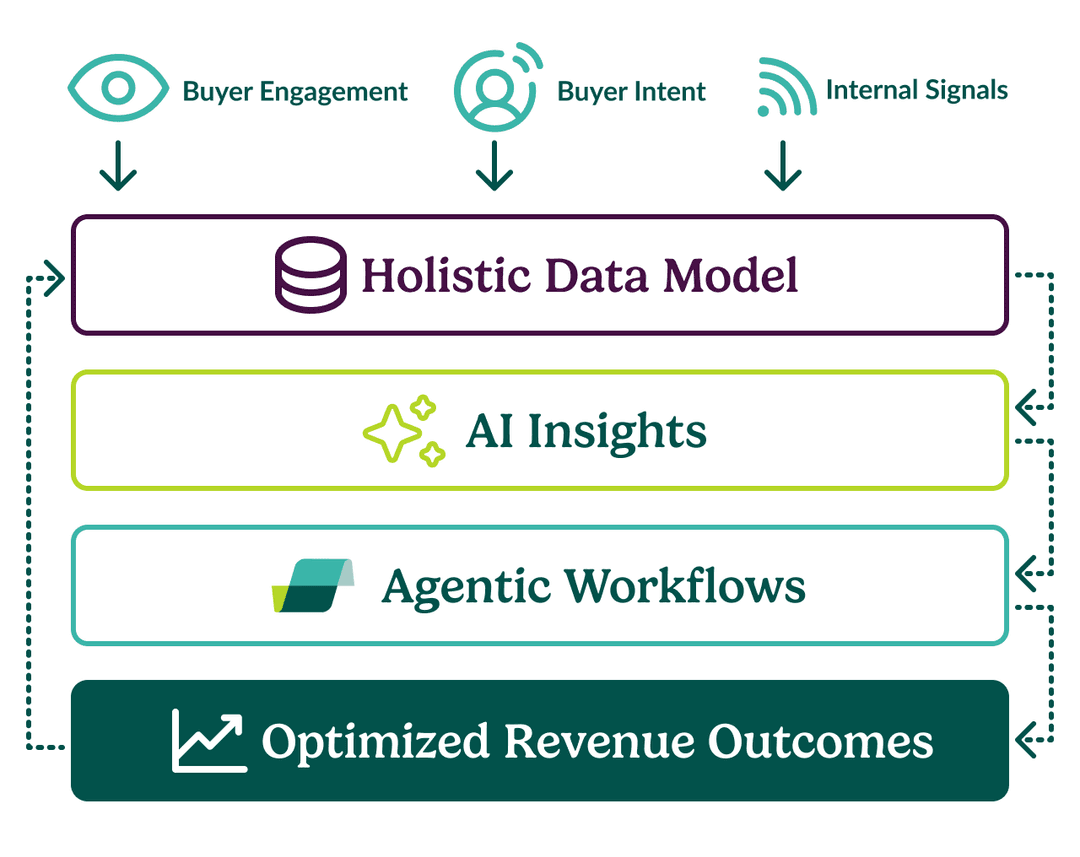
The Enterprise Data Platform is the infrastructure layer underneath everything described above.
It brings a company's entire revenue technology ecosystem (CRM, calendaring, dialer, email, conferencing, and third-party intent providers) into a single, secure data environment. Enterprise customers include IBM, Google, LinkedIn, and Shopify.
Source: Salesloft
CRM integration is bidirectional and automatic with Salesforce, HubSpot, and Microsoft Dynamics 365. Every interaction (calls, emails, meetings, deal activity) writes back to the CRM without manual logging. The Salesloft Connect Chrome extension surfaces inside Gmail, Outlook/Office 365 Online, the user's CRM, and most browser tabs via a Side Panel, supporting email tracking, templates, and Cadence steps directly from the inbox.
The Salesloft Marketplace hosts 180+ partner integrations across 16 technology categories including AI and Automation, Buyer Intent, CRM, Dialer, Marketing Automation, Sales Enablement, Sales Intelligence, and Video Engagement.
Notable integration partners include 6sense, Cognism, ZoomInfo, Gong.io, Zoom, Orum, Vidyard, Highspot, Seismic, and Mindtickle. The platform also supports Frontend Integrations for embedding custom UI panels inside the Salesloft interface and Third-Party Dialer integrations using Voice Links and Webhooks.
The REST API (v2.0) exposes over 90 resource groups covering People, Accounts, Cadences, Calls, Emails, Conversations, Tasks, Notes, Meetings, Opportunities, Signals, and Bulk Jobs.
Authentication uses OAuth 2.0 (required for partners) or API keys (customer self-use). Rate limiting operates at the team level: 600 cost points per minute, with higher costs for requests to high page numbers. Webhooks support 35+ event types across accounts, people, cadences, calls, conversations, emails, meetings, and tasks.
On the governance side, the platform provides SSO integration (SAML-based, supporting Duo, Okta, and OneLogin), GDPR-ready data protection tools, custom user roles and group permissions, regional security controls, and 24/7 protected data centers.
Multi-team management supports a single login to switch between multiple Salesloft instances with centralized user administration. Security certifications include SOC 2 Type II, ISO 27001, ISO 27701, GDPR, CCPA, CSA, EU-US Data Privacy Framework, and UK-US Data Privacy Framework. Infrastructure runs on AWS and GCP (US and EU regions) with HTTPS/TLS 1.2+ in transit and AES-256-GCM encryption at rest.

Source: Salesforce
Where Salesloft Stops: The Gaps
Salesloft orchestrates the revenue process once prospects are identified and engaged. That focus shapes its strengths, but it also means the platform depends on external sources for several capabilities a revenue team needs upstream and alongside deal execution.
No B2B contact or company database for prospecting.
Salesloft is a revenue execution platform, not a data provider. It manages contacts and accounts after they are imported and can enroll them into cadences, but it does not include a searchable database of companies, contacts, direct dials, or verified business emails for building outbound lists.
The Buyer Identification Agent recommends new contacts, but only when connected to an external data source like ZoomInfo. Without that connection, prospecting depends entirely on contacts already in the CRM.
No proprietary buyer intent signals.
Rhythm aggregates buyer signals from first-party engagement data (email opens, call outcomes, cadence activity) and third-party partners through its Signals API.
But Salesloft does not operate its own intent data layer showing which companies are researching specific topics across the web. The intent signals Rhythm processes come from partner integrations (G2, for example), not from Salesloft's own data collection. Teams that want intent-driven prospecting need a separate intent data provider.
No single intelligence layer connecting third-party data with conversation and deal context.
Salesloft captures rich first-party data: call transcripts, email engagement, deal progression, and buyer behavior on the website. But it does not fuse that data with third-party B2B intelligence (company attributes, org charts, technographics, hiring patterns, funding signals) into one layer.
Each data source operates in its own silo. Conversations knows what was said on a call; it does not connect that to the prospect company's tech stack changing or their CEO being replaced last month.
No marketing orchestration or account-based marketing.
Salesloft handles pipeline generation through Cadence and pipeline management through Deals, but it does not include display advertising, audience management, multi-channel campaign activation, or ABM capabilities. Marketing teams need a separate platform for demand generation, retargeting, and account-based advertising.
No data enrichment or CRM data quality management.
Salesloft syncs with the CRM bidirectionally, but it does not enrich contact or account records with missing data, deduplicate records, or validate data quality. The accuracy of Salesloft's AI agents, deal scores, and forecasts depends on the quality of data in the CRM, and Salesloft has no native mechanism to improve that quality.
Opaque pricing with no self-serve entry point.
Both the Advanced and Elite packages require a sales conversation to learn pricing. No public feature matrix distinguishes the two tiers, and no self-serve free trial is publicly advertised. Teams evaluating the platform face a real information gap before they can compare costs against alternatives.
How ZoomInfo Covers the Gaps
The gaps above share a thread: Salesloft orchestrates revenue actions but depends on external sources for the data, signals, and intelligence that determine which prospects to pursue and why deals move or stall.
ZoomInfo is an AI GTM platform that supplies those layers, and the two platforms have a formal partnership that connects ZoomInfo's buyer data and signals directly into Salesloft's execution engine.
B2B Data Platform: The contact and company database Salesloft does not include
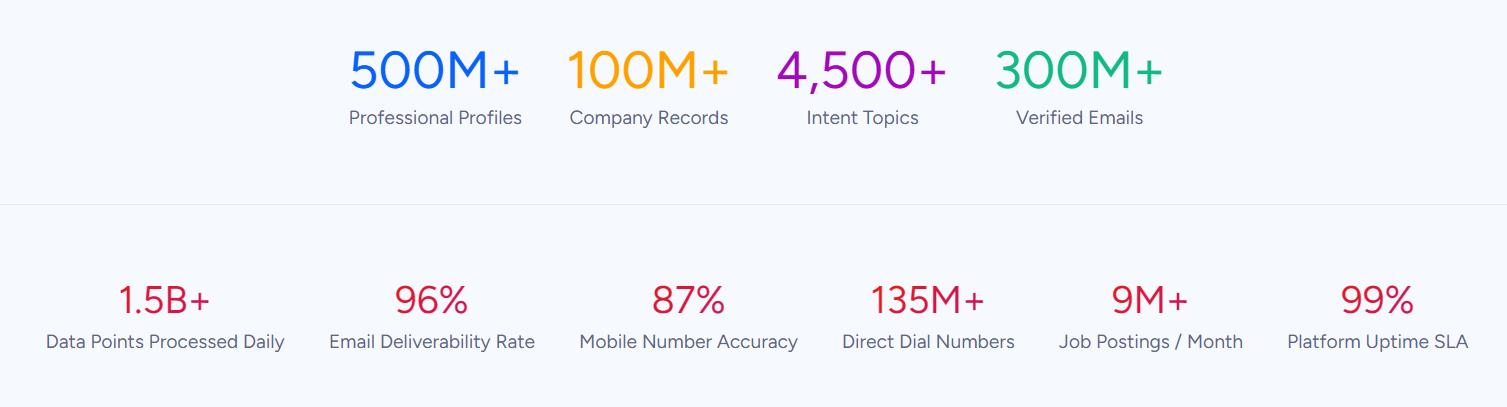
ZoomInfo operates the largest B2B data platform in the industry: 500M contacts, 100M companies, 135M+ verified phone numbers, 120M direct-dial phone numbers, and 200M+ verified business email addresses.
The data flows through a proprietary verification pipeline backed by 300+ human researchers and automated ML scanning 28 million site domains daily, reaching up to 95% accuracy on first-party data.
Source: ZoomInfo
For a Salesloft user, this fills the fundamental upstream gap.
Salesloft's Buyer Identification Agent already integrates with ZoomInfo to recommend contacts not yet in the CRM. With ZoomInfo providing the data layer, reps gain access to department org charts with decision-makers' direct dials and emails, 300+ company attributes for segmentation, contact tracking with job-change alerts, and technographic profiles covering 30,000+ technologies across 200+ categories for 30+ million companies. Contacts found in ZoomInfo flow directly into Salesloft Cadences through the native integration.
In a Fortune 500 competitive RFP analyzing 25 million contacts across vendors, an independent consultant concluded that "no other competitor came even close."
The data quality is externally validated: Leader in the Forrester Wave for Intent Data Providers, Q1 2025, Leader in the Gartner Magic Quadrant for ABM Platforms for the second consecutive year, and the only vendor positioned in the Gartner Customers' Choice quadrant with a 4.7/5.0 rating.
ZoomInfo Intent and WebSights: Signals that reveal in-market buyers before they enter the CRM
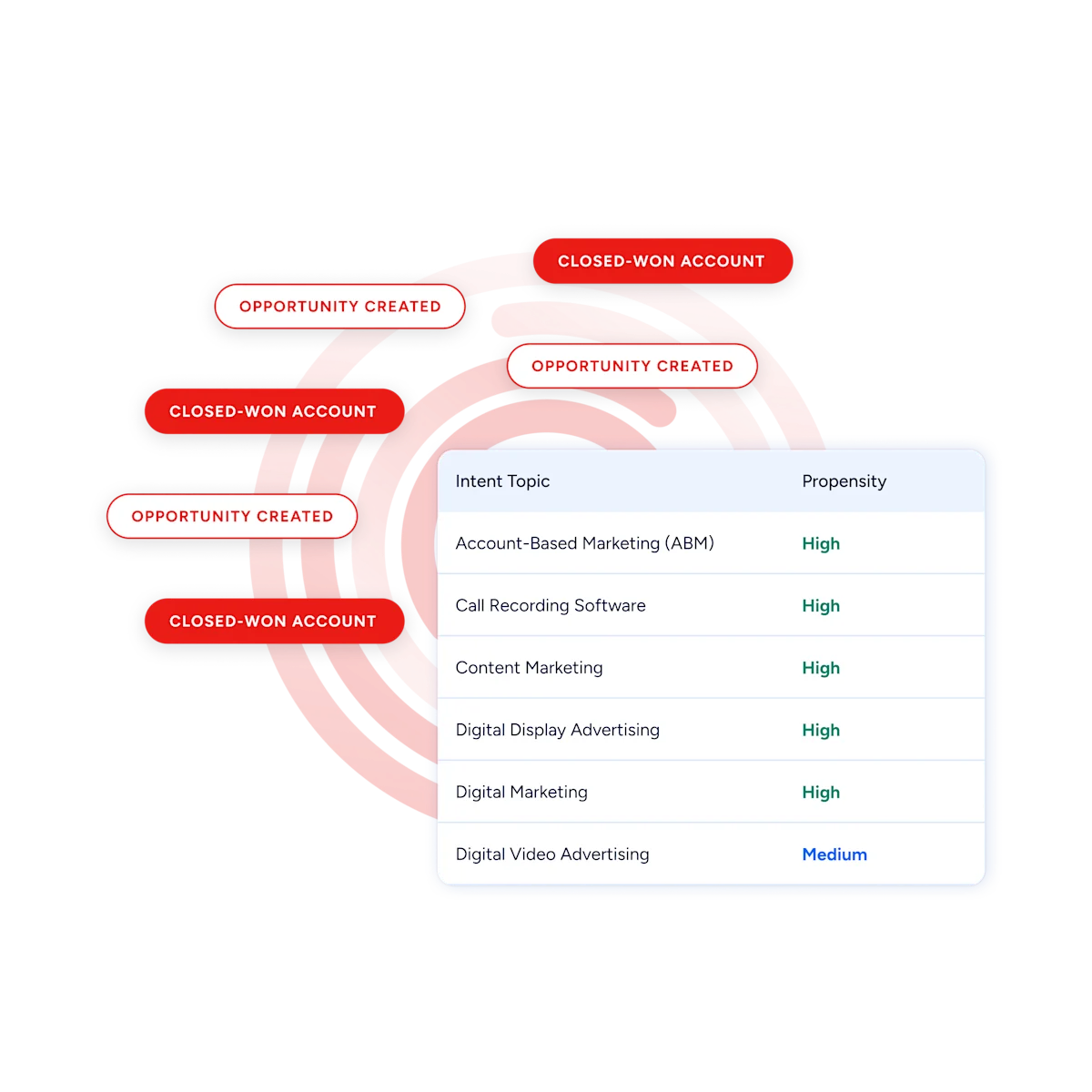
ZoomInfo Intent tracks signals from 210 million IP-to-Organization pairings and 6 trillion+ new keyword-to-device pairings sourced monthly.
Where Salesloft's Rhythm prioritizes actions based on engagement with your own outreach and partner-supplied signals, ZoomInfo Intent reveals which companies are researching topics related to your product across the web, before you have ever contacted them.
Guided Intent, exclusive to ZoomInfo, identifies topics historically correlated with deal success rather than requiring manual topic selection. Through the ZoomInfo-Salesloft partnership, these buying signals sync to Salesloft Rhythm for AI-prioritized engagement, creating a signal-to-sequence flow where intent data triggers personalized outreach the moment a prospect starts researching.
Source: ZoomInfo
WebSights resolves anonymous website traffic to companies with Automatic Traffic Filtering that distinguishes real visitors from bots. ZoomInfo Marketing goes further with contact-level site visitor identification, identifying who specifically visited (not just which company) and triggering personalized outreach.
GTM Context Graph and Chorus: Intelligence that captures why deals move, not just that they moved
Salesloft Conversations records and transcribes calls, then flags key moments and pre-populates coaching scorecards.
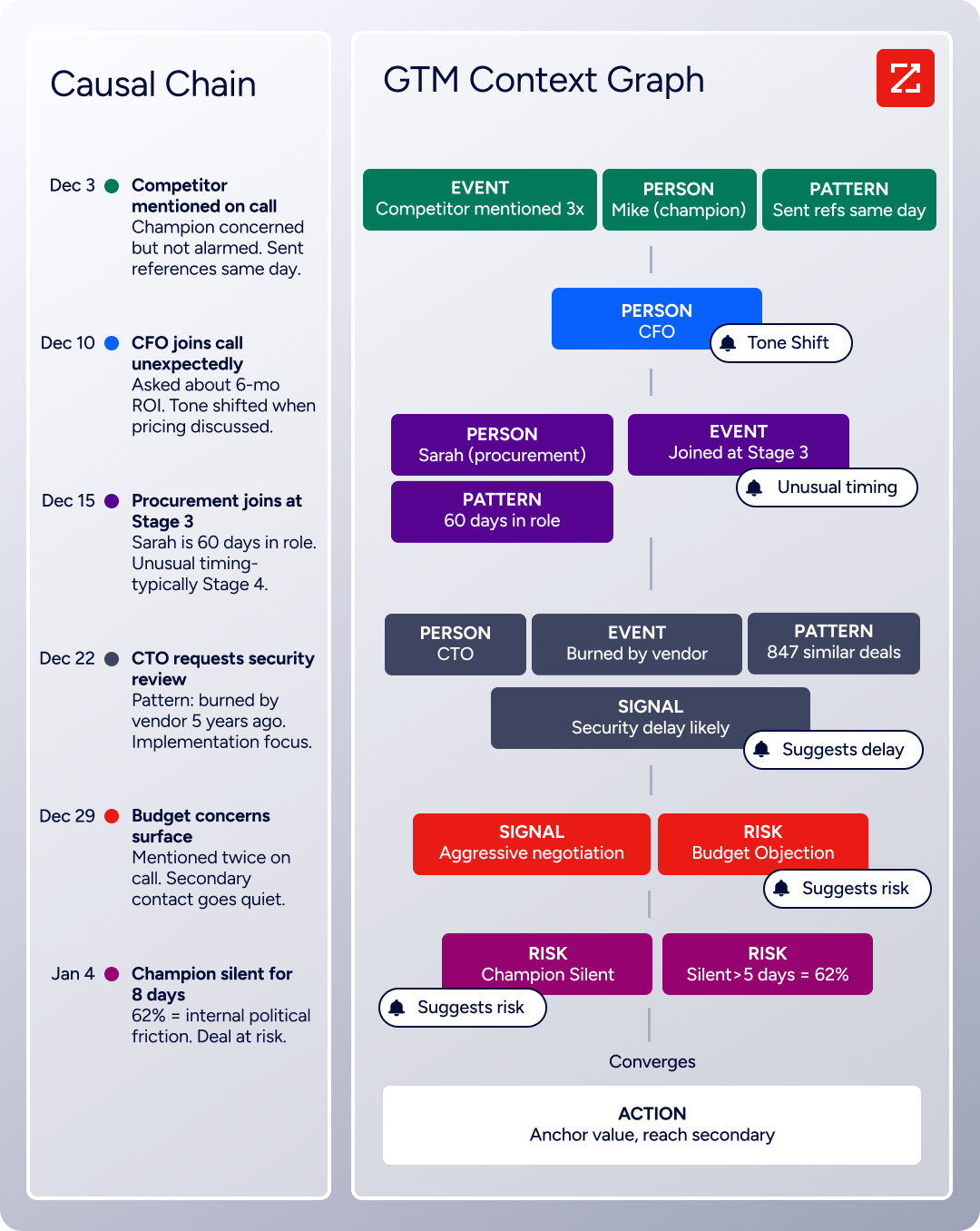
ZoomInfo's GTM Context Graph operates at a different depth, processing 1.5B+ data points daily and fusing ZoomInfo's B2B data with a customer's CRM records, conversation intelligence from Chorus (backed by 14 technology patents), email interactions, and behavioral signals into one intelligence layer.
A CRM records that a deal's stage changed. The GTM Context Graph reveals why: connecting the CFO joining the last call with ROI-focused questions to the pattern behind closed-won deals in the same segment, then linking that to third-party signals showing the company is hiring and researching a competitor.
This context is not available in any single tool operating alone. Chorus captures every customer call, meeting, and email, then surfaces AI-generated insights (talk ratios, sentiment, objection detection), auto-syncs deal intelligence to the CRM, and provides coaching scorecards and clip sharing.
Source: ZoomInfo
GTM Studio: Marketing orchestration and ABM that the engagement platform cannot provide
GTM Studio addresses the marketing orchestration gap directly.
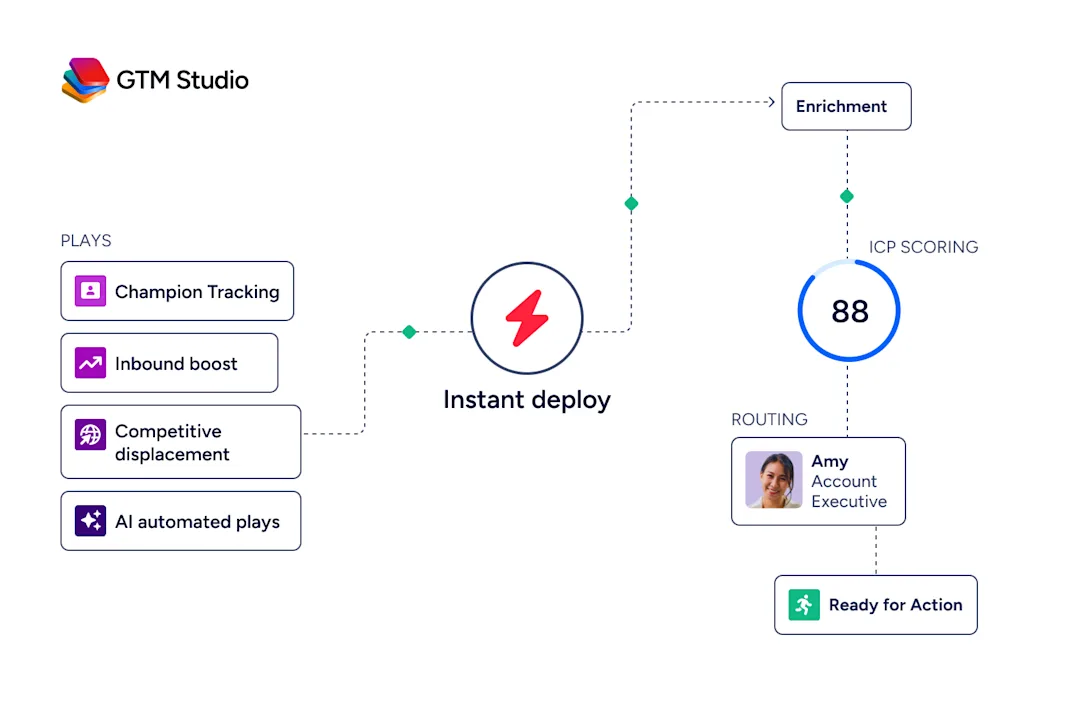
Marketers, RevOps teams, and GTM engineers can build audiences using natural language, enrich with first- and third-party data, define triggers, and activate plays across channels (email, calls, display ads, direct mail, LinkedIn, Meta, Connected TV) without engineering support.
Pre-built GTM plays cover inbound acceleration, champion tracking, competitive displacement, and ICP targeting. Expansion plays that used to take 3 weeks now launch in 30 minutes.
Source: ZoomInfo
ZoomInfo Marketing includes a native Demand-Side Platform deploying display ads based on 300+ company attributes, FormComplete (reducing forms to a single field while auto-appending data), and Account Fit Scoring (predictive AI scoring 0 to 100 based on company attribute patterns).
Hot accounts and recommended actions from GTM Studio plays flow directly into GTM Workspace for seller execution.
ZoomInfo APIs and MCP: Data access for any tool or AI agent
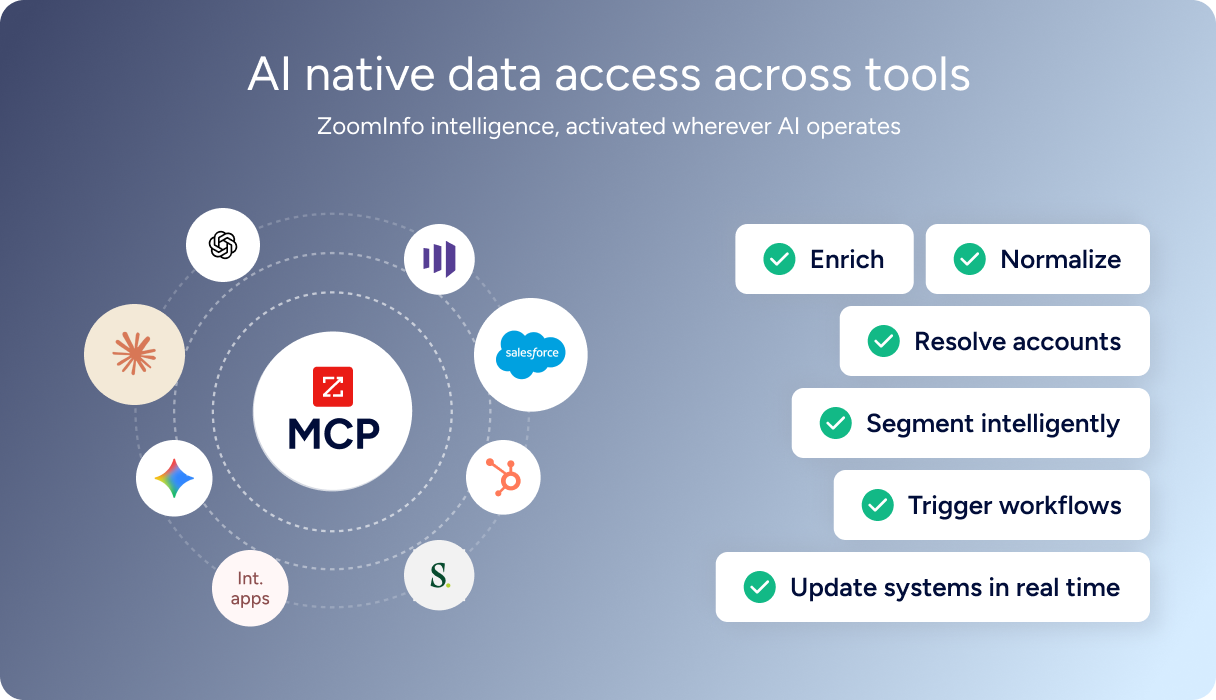
ZoomInfo delivers its intelligence through APIs and MCP, so the same data and GTM Context Graph powering ZoomInfo's own products is accessible inside any third-party tool or custom AI agent.
The MCP server connects AI models directly to ZoomInfo's B2B data as a native tool, currently supporting Claude and ChatGPT. API access is included in all relevant plans, and the Enterprise API covers Search, Enrich, Copilot (AI intelligence), Marketing (audience management), and Engagements endpoints.
ZoomInfo's Free Entry Points: A way to evaluate the platform without commitment
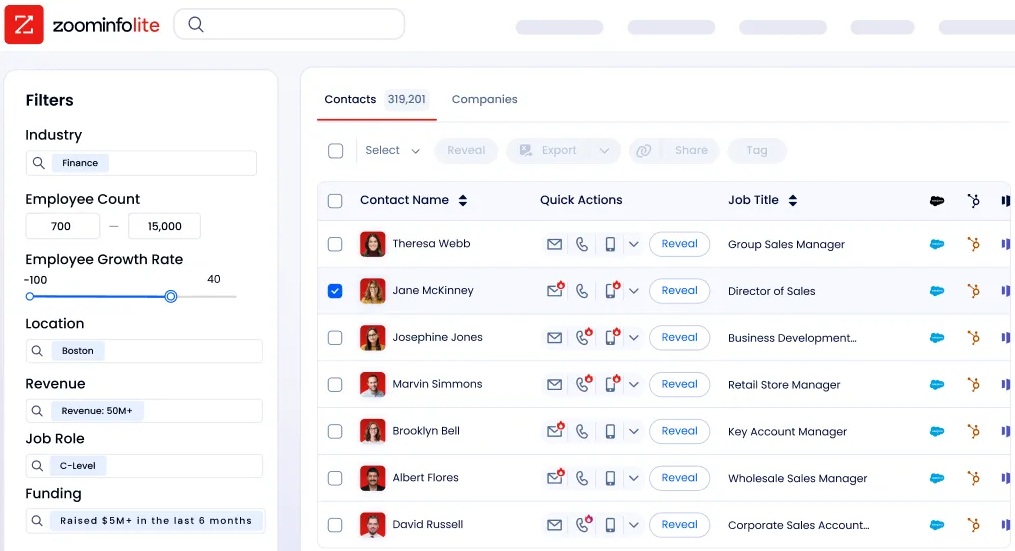
Where Salesloft requires a sales conversation to learn pricing, ZoomInfo Lite is a permanent free tier with access to ZoomInfo's B2B database, 10 monthly export credits, individual and company searches, a Chrome extension, and WebSights Lite with up to 10 website visitor reveals per day.
A separate 7-day free trial provides broader access with no credit card required.
Source: ZoomInfo
Seismic's sales team attributed 39% of active pipeline to opportunities identified or influenced by ZoomInfo signals, boosted productivity by 54%, and saved 11.5 hours per week per seller. (Seismic Case Study)
Final Summary
Salesloft is a revenue orchestration platform for enterprise B2B sales teams: Cadence structures multi-channel outreach across email, phone, SMS, and LinkedIn with AI-generated emails at each step, Rhythm's Conductor AI ranks seller actions based on live buyer signals, Conversations records and analyzes calls with automated coaching scorecards, and Deals manages opportunities with a 30+ factor engagement health score and AI-extracted qualification frameworks.
It fits mid-market to enterprise teams with 50+ reps and dedicated RevOps support who want pipeline creation, deal management, forecasting, and conversation intelligence in a single vendor.
It is lighter on the layers upstream and alongside execution: no B2B contact database for sourcing prospects, no proprietary buyer intent signals showing in-market companies, no single intelligence layer connecting third-party data with conversation and deal context, and no marketing orchestration or ABM capabilities.
If your bottleneck is upstream of the engagement platform (knowing which companies are in-market and sourcing verified contacts to fill cadences) or alongside it (understanding why deals move through a unified intelligence layer, orchestrating multi-channel marketing campaigns, or enriching CRM data quality), that is the ground ZoomInfo covers.
Its 500M-contact, 100M-company database supplies the verified emails and direct dials your Salesloft cadences run on, and the ZoomInfo-Salesloft partnership flows those contacts and signals directly into Rhythm for AI-prioritized engagement.
ZoomInfo Intent surfaces accounts researching your category from 6 trillion+ keyword-to-device pairings monthly. Chorus and the GTM Context Graph fuse B2B data with conversation intelligence and CRM records to capture why deals move, not just that they moved. And GTM Studio gives marketing teams multi-channel orchestration and ABM capabilities that feed directly into seller workflows.
Start with ZoomInfo Lite for free to see verified contacts and intent signals in action, or request a demo to see how the GTM Context Graph connects data, signals, and execution across your revenue team.
FAQ
Does Salesloft publish its pricing?
No. Salesloft offers two packages (Advanced and Elite), both quote-only with no publicly listed prices. No public feature matrix distinguishes the two tiers. Minimum seat requirements and typical contract structures are not disclosed without a demo conversation. Annual contracts are standard, and all fees are non-cancelable per the Master Subscription Agreement.
What CRMs does Salesloft integrate with?
Salesloft supports bidirectional sync with Salesforce, HubSpot, and Microsoft Dynamics 365.
The Salesforce integration is the most mature, with the Salesloft Connect Chrome extension surfacing cadence steps, contact data, and deal context inside Salesforce Classic and Lightning. HubSpot integration exists but is thinner in depth. Activity logging, contact status updates, and pipeline changes sync automatically across all three CRMs.
Can Salesloft record and analyze sales calls?
Yes. Conversations automatically records and transcribes calls made through the Salesloft dialer and video meetings via Google Meet and Zoom integrations.
AI agents generate summaries, flag competitor mentions and objections, and pre-populate coaching scorecards from transcripts. Managers can build coaching playlists and reps can compare their call behaviors against top performers. The module does not require a separate conversation intelligence vendor.
Does Salesloft include buyer intent data?
Not natively. Salesloft's Rhythm engine aggregates buyer signals from first-party engagement data and third-party partners through its open Signals API, but Salesloft does not operate its own intent data collection infrastructure. Intent signals come from partner integrations like G2.
ZoomInfo Intent, which tracks signals from 210 million IP-to-Organization pairings and 6 trillion+ keyword-to-device pairings monthly, is available through the ZoomInfo-Salesloft partnership and syncs directly to Rhythm for AI-prioritized engagement.
How does Salesloft's AI extract deal qualification data?
The Sales Methodology Extraction AI Agent, launched in Spring 2025, listens to recorded buyer conversations and pulls MEDDPICC and other qualification framework fields into deal records automatically.
Rather than requiring reps to fill in qualification data after each call, the agent identifies relevant discussion points (decision criteria mentioned, economic buyer identified, metrics discussed) and populates the corresponding fields. The agent currently supports MEDDPICC, with plans to expand to additional frameworks.
What is Salesloft's MCP Server?
Launched in Spring 2026, the Salesloft MCP Server opens live Salesloft pipeline data, deal activity, engagement signals, and call data to any MCP-compatible AI tool, including Claude, ChatGPT, Microsoft Copilot, Gemini, and Salesforce Agentforce.
External AI applications can query real revenue data and trigger actions without logging into Salesloft directly. RevOps teams manage which data is accessible and maintain full audit logging of AI usage.
Does Salesloft include a B2B contact database for prospecting?
No. Salesloft is a revenue execution platform that manages contacts after they are imported. It does not include a searchable database of companies, contacts, direct dials, or verified business emails. The Buyer Identification Agent can recommend new contacts, but only when connected to an external data provider like ZoomInfo.
ZoomInfo provides 500M contacts, 100M companies, 120M direct-dial phone numbers, and 200M+ verified business email addresses, with data flowing through a verification pipeline backed by 300+ human researchers and reaching up to 95% accuracy on first-party data.
