
Twilio Segment has become the default answer for companies asking a simple question: how do we collect customer data once and send it everywhere we need it? As a Customer Data Platform serving 25,000+ companies, Segment handles the plumbing between your digital properties and the hundreds of tools that need that data. But as B2B teams demand more from their data stack, the limits of first-party collection become clear.
To write this Twilio Segment review, we analyzed the platform thoroughly. It's the right choice if:
You need to collect behavioral data from websites, apps, and servers and route it to hundreds of downstream tools
You have engineering resources to instrument tracking and design an event schema
You want a standardized data pipeline with real-time identity resolution across devices
You're building a first-party data strategy as third-party cookies deprecate
You need to unify customer profiles across multiple touchpoints before activating audiences
Segment excels at collecting and routing the data your users generate on your own properties, but it only sees the fraction of your market that has already engaged with you.
For B2B teams that need to identify, reach, and engage prospects before they visit your website, ZoomInfo provides the third-party intelligence that picks up where first-party data leaves off.
With 500M contacts, 100M companies, 135M+ verified phone numbers, and 200M+ verified business email addresses, ZoomInfo's GTM platform covers the addressable market that first-party collection cannot reach.
We've included a detailed look at ZoomInfo later in this review, as it represents the natural complement for B2B teams that need more than first-party behavioral data. If you're ready to explore what third-party B2B intelligence adds to your data stack, start with ZoomInfo's free trial.
What is Twilio Segment?
Twilio Segment is a Customer Data Platform (CDP) founded in 2011 by five MIT students: Peter Reinhardt, Calvin French-Owen, Ilya Volodarsky, Jean Lafleur, and Ian Taylor. The original idea was a classroom lecture tool. It failed.
But while building it, the team created an internal JavaScript analytics library that developers kept requesting. That side project became Segment.
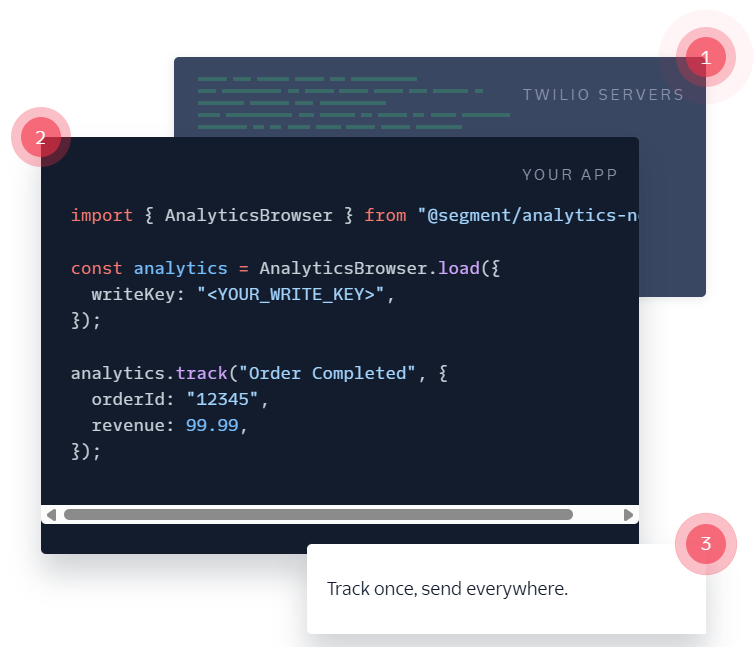
The founding insight was straightforward: every digital company writes the same data-collection code over and over for every analytics and marketing tool. Segment writes it once and connects it everywhere. One API call captures a customer event; Segment translates it and routes it to whatever downstream tools need it.
Twilio acquired Segment in 2020 for $3.2 billion, the largest deal in Twilio's history. Since then, Segment has grown from a data router into a full CDP with three product layers: Connections (the data pipeline), Unify (identity resolution and unified profiles), and Engage (audience building and journey orchestration).
As of 2025-2026, Segment's web presence is being consolidated onto Twilio.com, folding it into the broader Twilio platform.
Segment reported $297.7 million in revenue for 2024 and serves companies including IBM (which uses Segment to standardize data across 150 product lines), Instacart, Intuit, FOX, and Levi's. The platform targets three buyers: data engineers who need a scalable pipeline, marketers who need audiences they can act on, and product teams who need behavioral event data.
Twilio Segment Pros & Cons
Pros | Cons |
|---|---|
550+ destination integrations in a single catalog | MTU pricing creates unpredictable costs for high-traffic B2C sites |
Real-time data pipeline with first-party data control | Setup requires significant engineering effort and tracking plan design |
Identity resolution stitches anonymous and known users | Overkill and cost-prohibitive for small teams or simple analytics needs |
Developer-first design with extensive SDKs and documentation | Engage trails dedicated marketing automation platforms in depth |
Data governance via Protocols (schema enforcement, tracking plans) | CDP and Protocols pricing requires contacting sales |
Native connection to Twilio channels (SMS, email, WhatsApp) | Tracking plan UI described as "clunky" by some users |
Reverse ETL syncs warehouse data back to operational tools | No third-party B2B intelligence or prospecting capabilities |
Twilio Segment Review: How It Works & Key Features
Connections: Segment's core data pipeline collects events from any source and routes them to 550+ destinations.
Connections is the foundation. It solves a specific engineering problem: without a tool like Segment, engineering teams write custom integrations for every analytics, marketing, or CRM tool they adopt. Each vendor requires data in a slightly different format. Every new tool means more code to maintain.
Connections introduces an abstraction layer. Companies instrument their data collection once using Segment's standardized API and libraries. Segment translates and routes the data to every enabled destination. Adding a new tool requires no new instrumentation: enable the destination in the Segment app and data starts flowing.
The pipeline works in three steps. First, you instrument Sources using Segment's tracking libraries: Analytics.js for websites, native SDKs for iOS and Android, and server-side libraries for Node.js, Python, Go, Java, Ruby, PHP, and .NET.
Source: Twilio Segment
An HTTP Tracking API and a Pixel Tracking API cover environments where executing code is not possible. Cloud App Sources pull data from third-party SaaS tools (Salesforce, Stripe, Zendesk) using object-based syncs.
All data passes through the Segment Spec, a standardized schema with six core methods: identify (who the user is), track (what they did), page (what page they viewed), screen (mobile screen views), group (what account they belong to), and alias (linking anonymous and identified records).
This normalization means every downstream tool receives consistent data regardless of where it originated.
Once data reaches Segment's servers, Segment translates it into the format each enabled Destination requires and forwards it in real time. Two delivery modes exist: cloud-mode (Segment sends data server-to-server) and device-mode (the destination's code loads on the client).
Reverse ETL works in the opposite direction, extracting modeled data from warehouses (Snowflake, BigQuery, Redshift, Databricks) via SQL queries and syncing it back to marketing and operational tools.
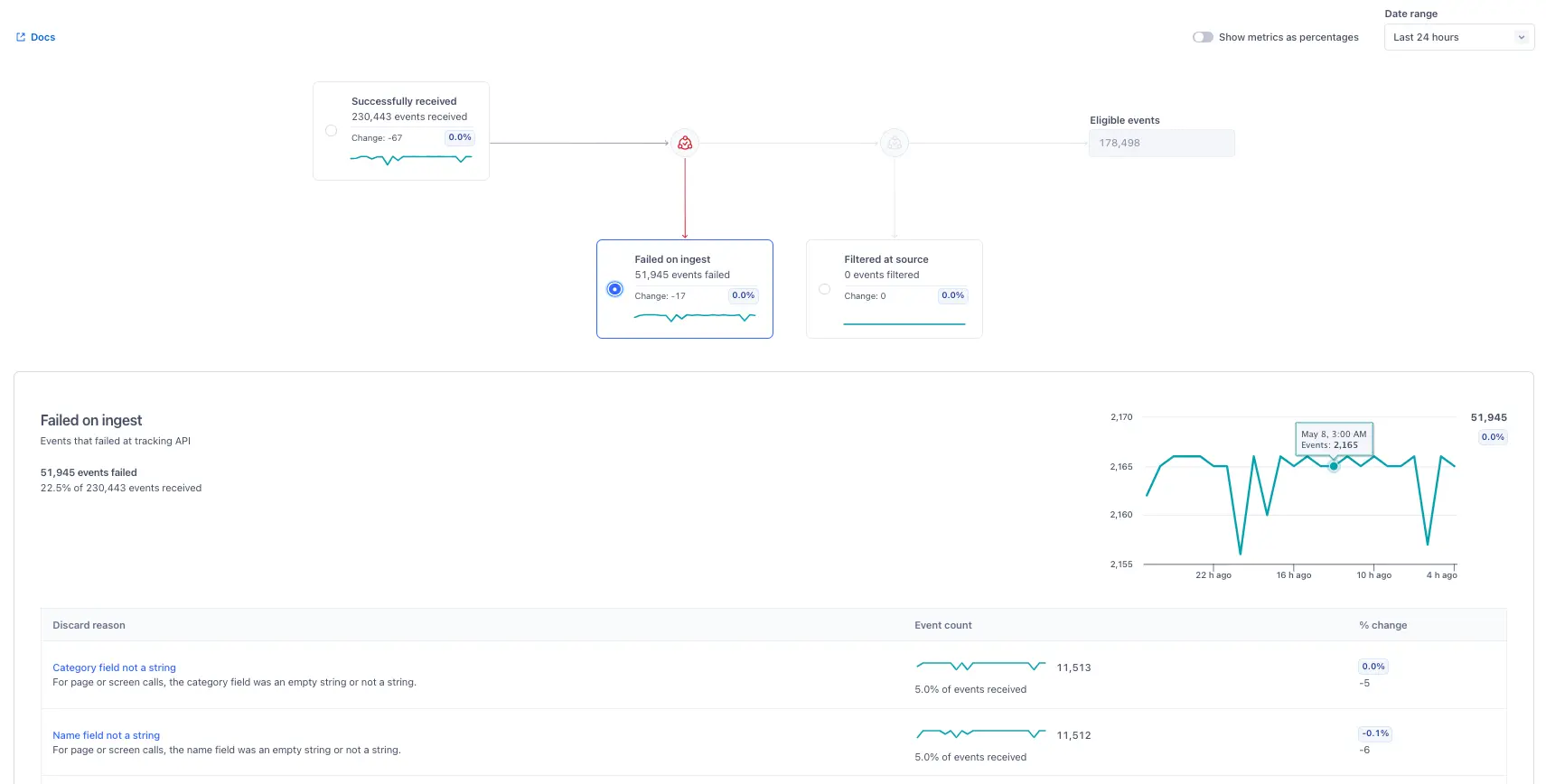
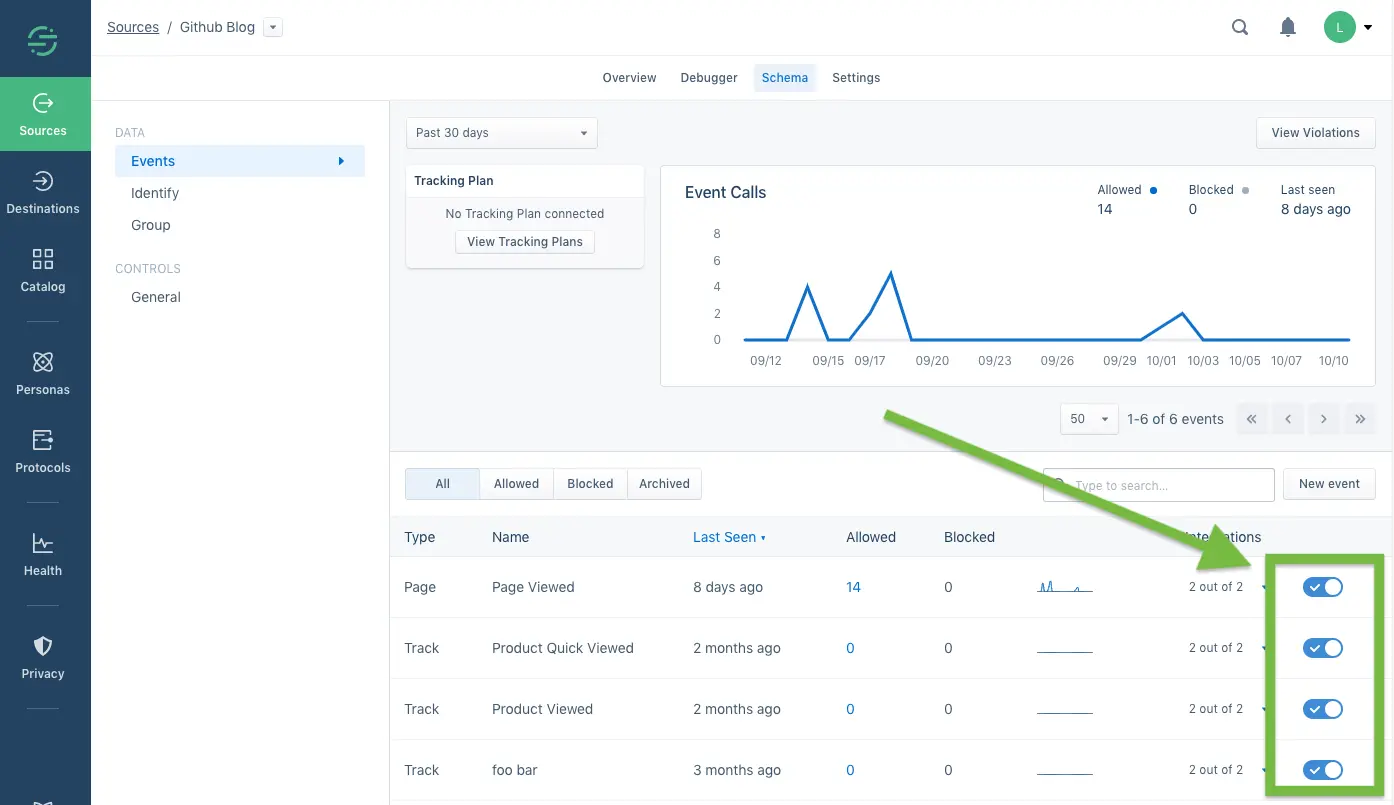
Filtering mechanisms let teams control which events reach which destinations, including destination filters, schema controls, and Destination Insert Functions (custom JavaScript that intercepts events before delivery).
Source: Twilio Segment
The practical benefit is clear. Teams that would otherwise spend months building and maintaining point-to-point integrations can route data to new tools with a few clicks. Instacart used this to evaluate five analytics providers simultaneously from a single data set.
Unify: Identity resolution stitches anonymous and known users into a single profile across devices and sessions.
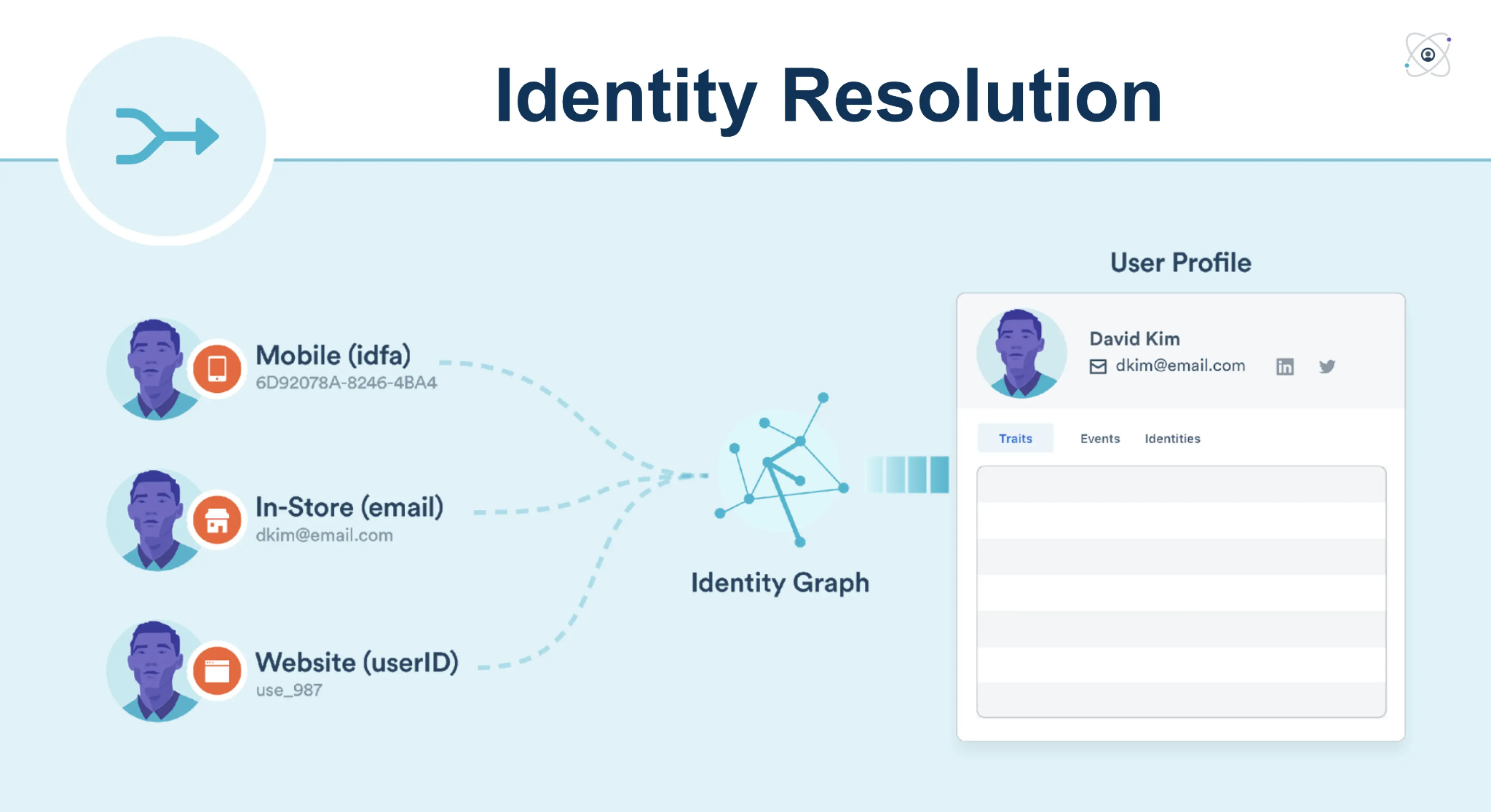
A visitor who browses on mobile, returns on desktop, and later logs in with their email looks like three separate people without identity resolution.
Unify solves this by merging every interaction into a single, real-time customer identity using an online and offline ID graph that supports cookie IDs, device IDs, emails, and custom external IDs.
At its core is the Identity Graph, which continuously merges customer history into unified profiles. Data engineers configure Identity Resolution rules to control which identifiers trigger profile associations and which require uniqueness enforcement.
Source: Twilio Segment
A built-in priority trust algorithm handles common edge cases automatically, detecting and resolving conflicts when multiple users share the same anonymous ID. When a user logs in after anonymous browsing, their profile updates and becomes available to downstream tools in real time, not during a nightly batch.
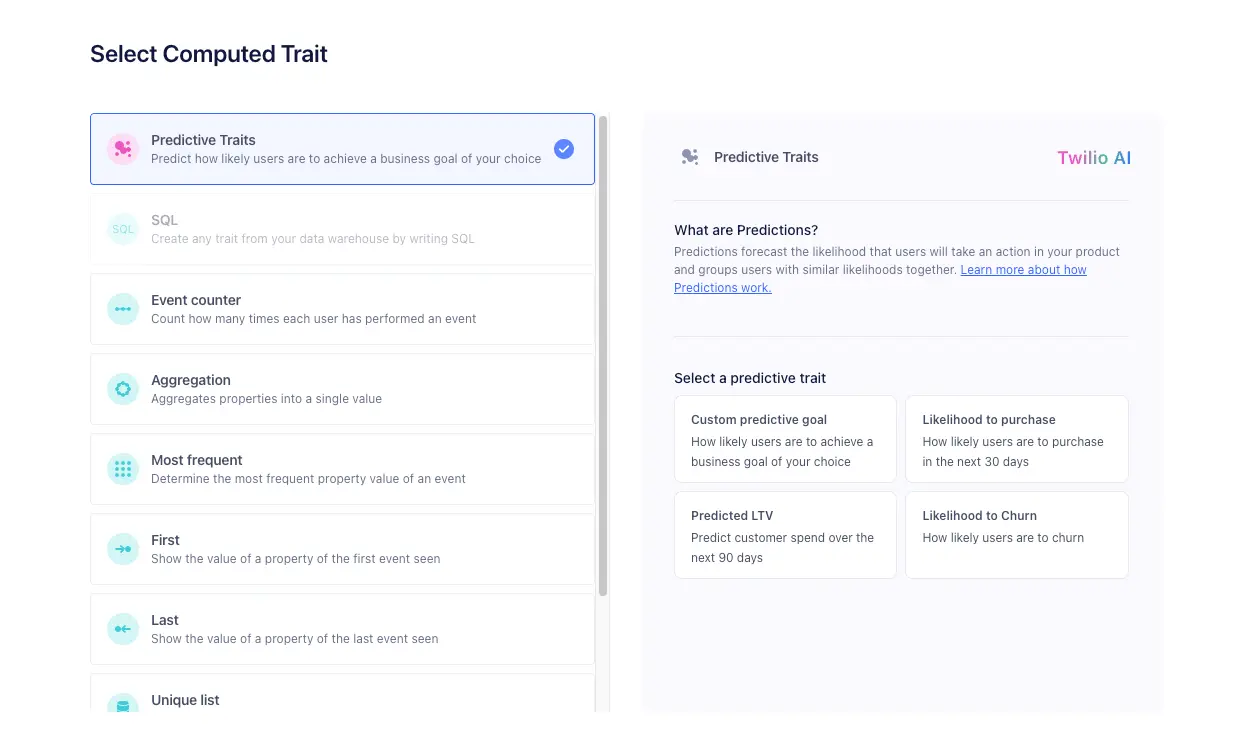
Beyond identity stitching, Unify includes Computed Traits (automatically maintained calculations like event counts, aggregations, and most-frequent values), SQL Traits (warehouse query results imported back into profiles), and Predictions (ML-powered scores for purchase likelihood, lifetime value, churn risk, and custom goals that refresh every seven days).
Source: Twilio Segment
The Data Graph connects profiles to entity datasets in the warehouse (accounts, subscriptions, households), and Linked Events enrich live event streams with that entity data before delivery to destinations.
The Profile API exposes unified profiles programmatically with response times under 200ms, enabling server-side real-time personalization. Profiles Sync continuously exports the full identity graph to a connected data warehouse for deeper analysis.
Unify is available only on Segment's Business tier and above. It is not included in Free or Team plans and is required for Twilio Engage.
Engage: Audience building and journey orchestration turn unified profiles into targeted actions.
Engage sits on top of the data pipeline and identity resolution to close the gap between data collection and personalized outreach.
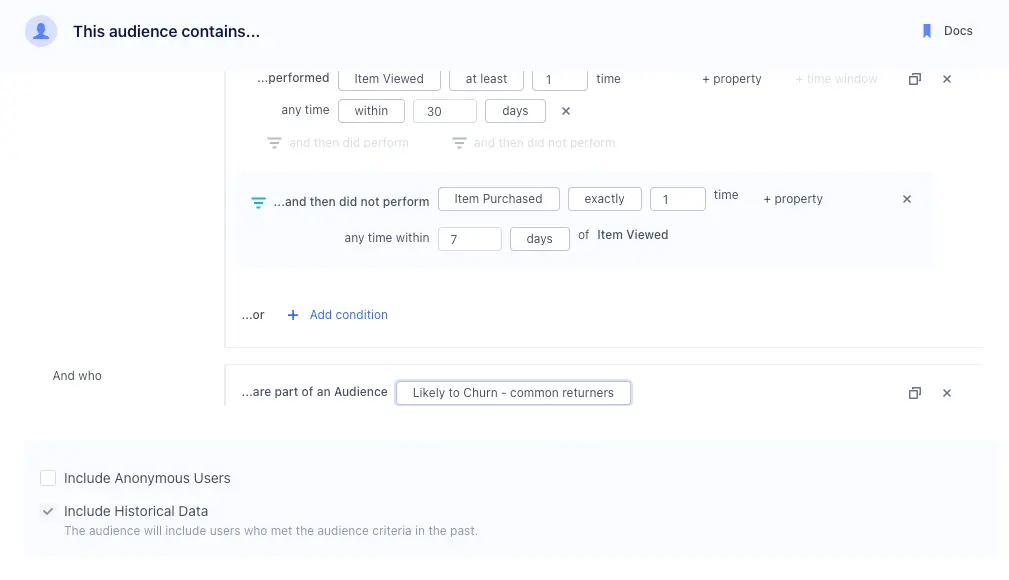
The audience builder lets marketers combine tracked events, user traits, computed traits, and SQL results into targeted segments without writing code. Over 20 operators cover equality checks, numeric ranges, date windows, substring matching, and existence conditions.
Source: Twilio Segment
Funnel audiences enforce strict event ordering with dynamic property references, and a Preview mode shows matching profiles before launch.
Two journey modes handle different activation patterns. Audience-based Journeys (V1) trigger multi-step sequences when users enter or exit an audience. Event-Triggered Journeys (V2) respond in real time to individual events like cart abandonment, with rules for re-entry or one-time entry.
Both support conditional branching, wait steps, and destination send steps, including Twilio's channels (SMS, email via SendGrid, WhatsApp).
Generative Audiences translate plain-language descriptions into structured audience conditions mapped to the workspace's actual event schema.
Linked Audiences combine Segment behavioral data with entity data from a connected warehouse via the Data Graph, letting marketers filter on relational objects without SQL.
Account-level Audiences support B2B use cases with conditions spanning both account traits and user behavior.
Trait Activation lets teams configure which profile traits travel with each audience sync payload, and ID Sync improves match rates across ad platforms.
Engage is available only on the CDP plan. Its marketing automation trails dedicated platforms like Braze, Klaviyo, or Iterable in template depth, A/B testing within journeys, and email deliverability tooling. Many companies use Segment as the data backbone and route audiences to a dedicated marketing platform for campaign execution.
Protocols: Schema enforcement and data governance prevent bad data from reaching downstream tools.
Protocols addresses a problem that compounds over time: as more teams and engineers instrument tracking across sources, data becomes inconsistent. An event tracked as completed_order in one codebase and Order Completed in another erodes trust in every downstream report.
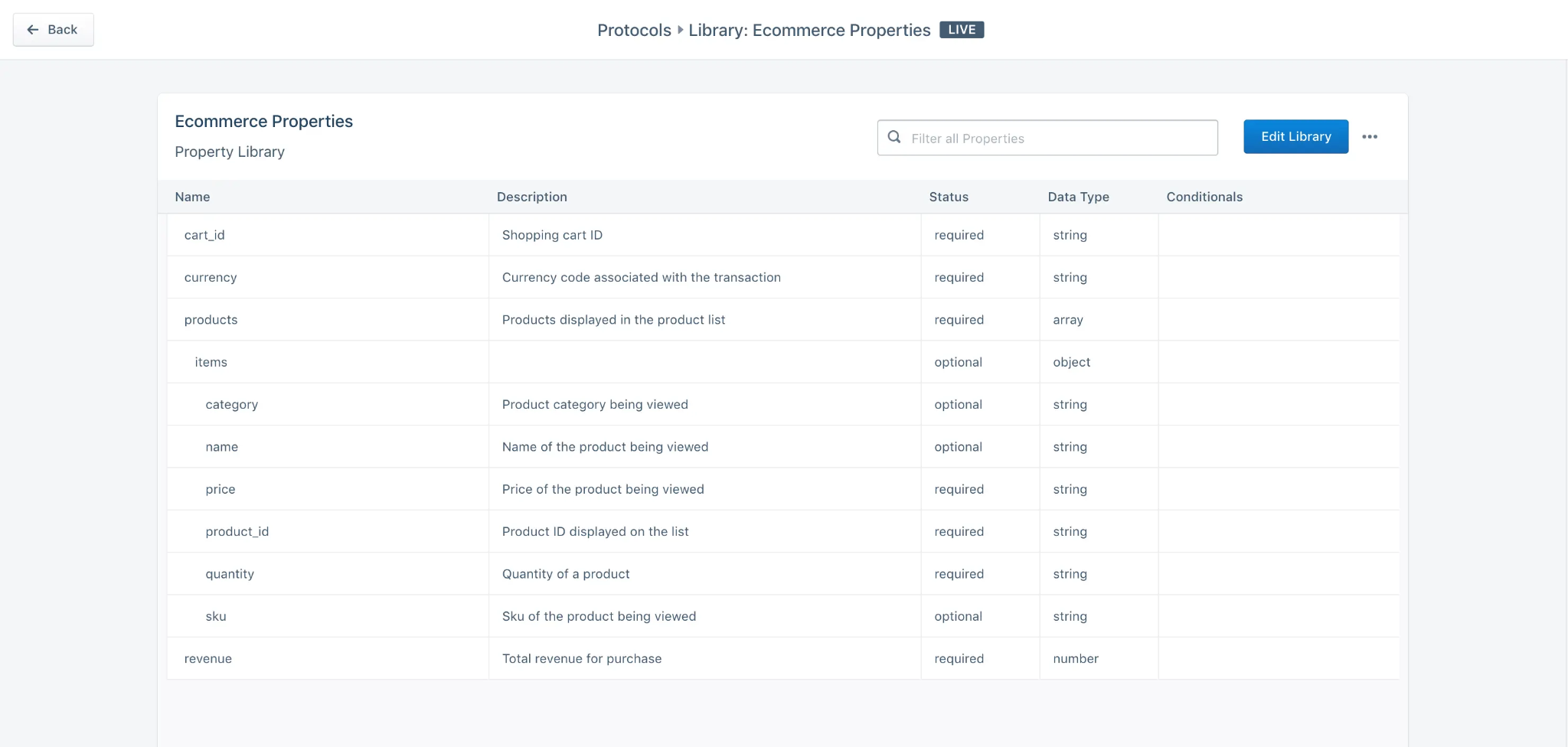
The solution is a Tracking Plan, a structured spec defining every expected event name, property, data type, and required/optional flag. Teams can bootstrap a plan by importing events from the past 24 hours, 7 days, or 30 days.
Plans support event versioning for schema evolution and can be shared across workspaces via Reusable Tracking Plan Libraries.
Source: Twilio Segment
Once connected to sources, Segment validates every inbound event against the plan. Violations surface in an aggregated view and can be forwarded to any destination for alerting.
Schema controls can allow unplanned events through, strip unplanned properties, or block non-conforming events entirely. Blocked events can go to a quarantined source for review rather than being dropped.
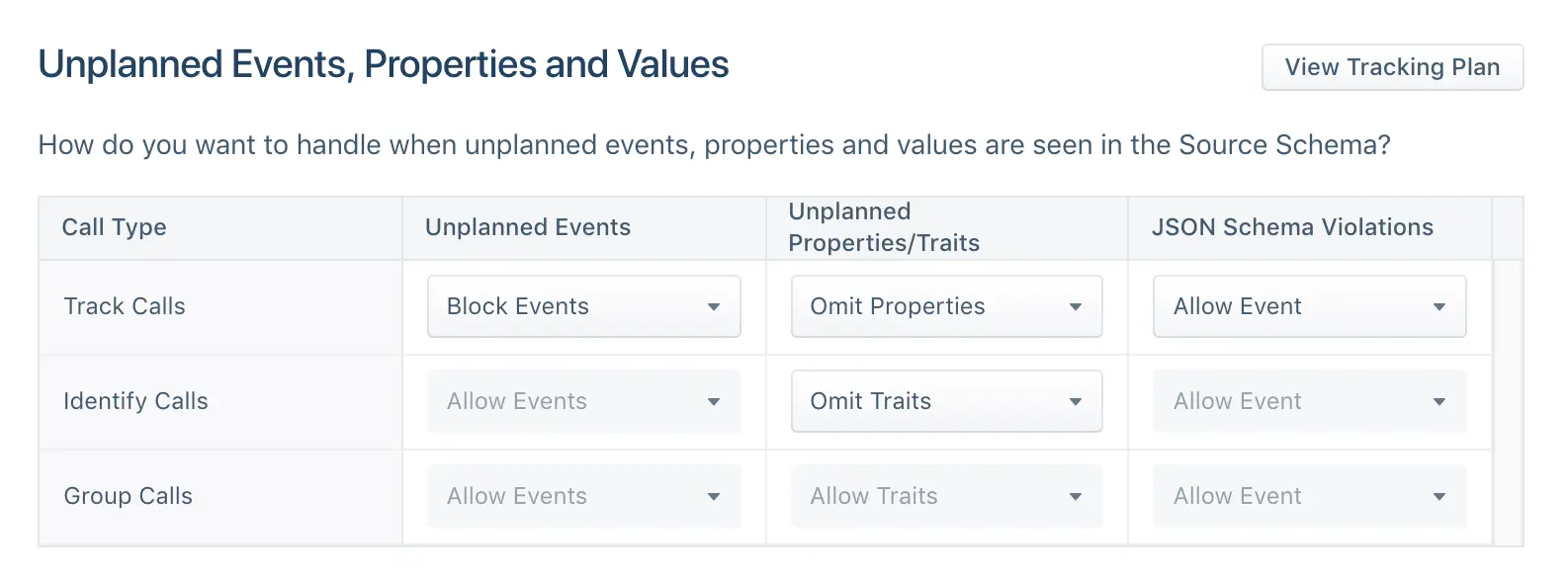
Source: Twilio Segment
Transformations rename events and restructure properties in-flight without touching application code, scoped to the entire source or a single destination.
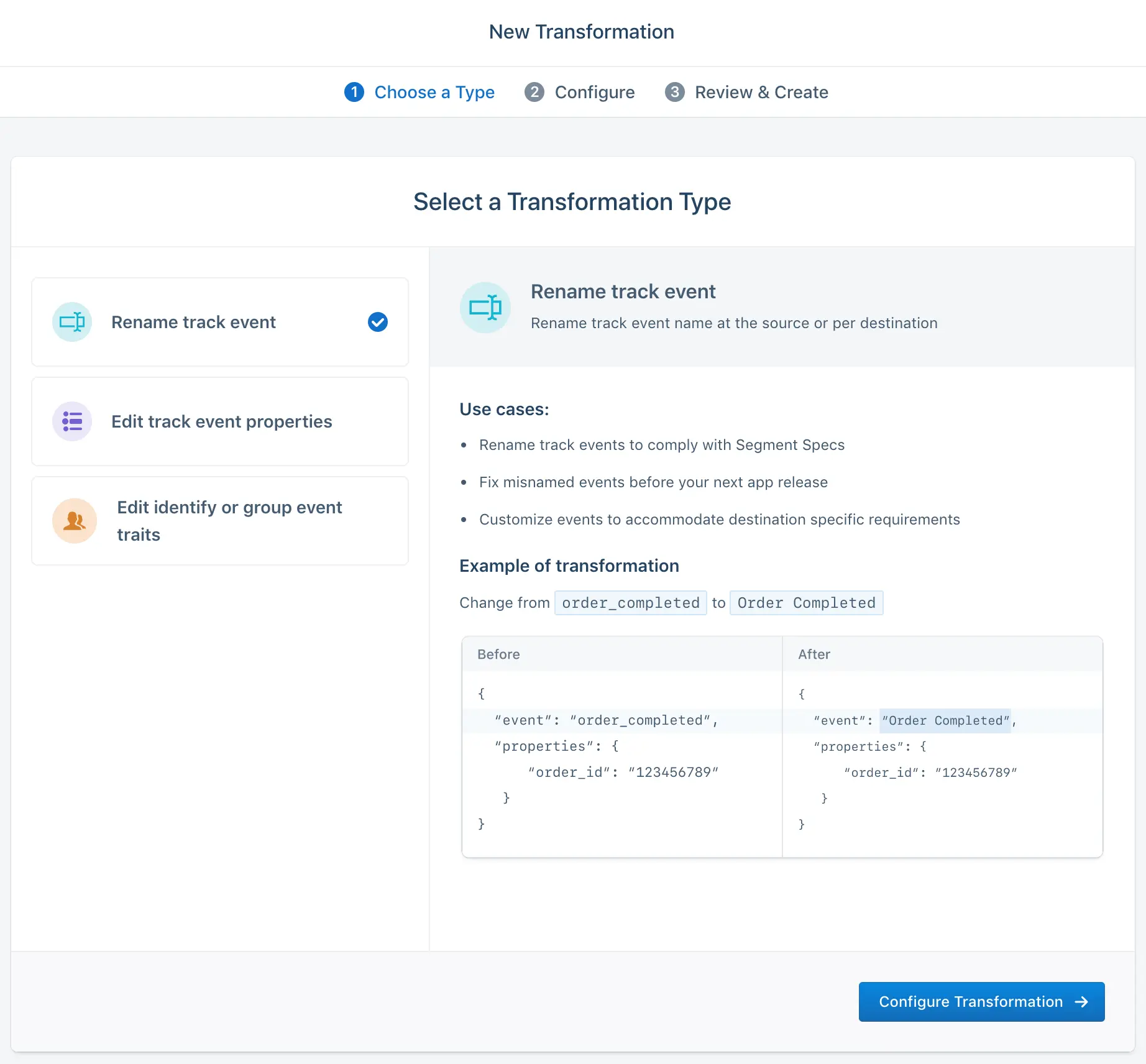
Source: Twilio Segment
Typewriter, an open-source CLI tool, generates strongly-typed analytics client libraries from the Tracking Plan in JavaScript/TypeScript, Swift, Kotlin, and React Native. Engineers call typed functions instead of free-form analytics.track() calls, so the compiler catches schema violations at build time.
Protocols is a paid add-on for Business tier customers. Pricing is not published.
Pricing Structure: Segment uses MTU-based pricing with a free tier and tiered paid plans.
Segment's primary billing metric is Monthly Tracked Users (MTUs): the count of unique user IDs plus unique anonymous IDs not tied to a user ID during a billing month. All paid plans include unlimited seats.
Free Plan ($0/month):
Up to 1,000 MTUs with no time limit
Connections only (sources, destinations, warehouses)
No Unify, Engage, or Protocols
No SSO or uptime SLA
Team / Connections Business (starting at approximately $120/month for 10,000 MTUs):
Unlimited seats and sources
Warehouse syncs (2/day on Team, custom on Business)
Protocols available as a paid add-on
SSO, MFA, HIPAA eligibility, regional data residency (EU or US)
Annual or monthly billing
14-day free trial of the Team plan (no credit card required for new workspaces)
CDP Plan (custom pricing, contact sales):
Everything in Connections Business
Unify (identity resolution, unified profiles)
Engage (audiences, journeys, messaging)
AI capabilities (Recommended Audiences, Prediction Traits)
Protocols available as a paid add-on
The MTU model is the most cited complaint in user reviews. Anonymous website visitors count as MTUs, so high-traffic B2C sites see costs scale with traffic regardless of conversion rates. The model works better for B2B companies with identifiable, logged-in users.
Additional costs to note: Segment does not provide a data warehouse (customers pay separately for Snowflake, BigQuery, or Redshift), does not bill for downstream destinations, and charges separately for Engage channel delivery through Twilio's communications pricing.
Support plans range from free (no response SLA) to Premium at the greater of 15% of license fee or $15,000/year, which includes 1-hour P1 response times around the clock. A non-profit discount of $120/month is available with proof of status.
Where Twilio Segment Falls Short
Segment's architecture is optimized for first-party data infrastructure. That design creates clear strengths but also defines the platform's boundaries.
First-party data only. Segment collects data from your own digital properties: your website, your mobile app, your servers. It tells you what known and anonymous users did on your site.
It knows nothing about the rest of your market. For B2B companies, Segment tracks the small percentage of your addressable market that visits your website while the other 95%+ remains invisible.
No third-party contact databases, no company firmographics, no org charts, no verified phone numbers.
No buying intent signals beyond your own properties. Segment can tell you someone viewed your pricing page. It cannot tell you a target account is researching your product category elsewhere on the web, reading competitor reviews, or hiring in a relevant department.
For B2B teams running outbound or account-based strategies, these external signals often separate timely outreach from blind prospecting.
No outbound execution layer. Even with Engage, Segment is reactive. It waits for users to interact with your properties, then routes that data or triggers journeys.
No prospecting, no outbound campaign automation, no way to identify and reach decision-makers at accounts outside your funnel. Teams that need to build pipeline from new accounts must use separate tools.
Implementation demands engineering investment. Setting up Segment requires instrumenting every data source, designing a tracking plan, and mapping all events to the Segment Spec.
Reviewers note that "initial implementation and event taxonomy design are hard to get right, and mistakes are expensive long-term." There is no retroactive tracking: what you miss at instrumentation time stays missed.
Analyst recognition has slipped. In the 2025 Gartner Magic Quadrant for Customer Data Platforms, Twilio Segment fell to Niche Player (down from Visionary in 2024).
In the Forrester Wave for Customer Data Platforms (B2C, Q3 2024), Segment was classified as a Contender. Both reports flagged pricing complexity.
Segment's standalone revenue grew only 1% year-over-year to $297.7M in 2024, suggesting CDP growth has plateaued even as Twilio's broader platform expands.
These limitations reflect Segment's identity as a first-party data infrastructure platform. They are design decisions, not failures. But for B2B go-to-market teams, they create a gap between knowing what happened on your own properties and understanding your full addressable market.
The Natural Complement to Segment: ZoomInfo
ZoomInfo fills the intelligence gap that first-party data platforms leave open. Where Segment tells you what your visitors did, ZoomInfo tells you who your buyers are, which accounts are in-market, and how to reach decision-makers, whether they've visited your site or not.
ZoomInfo is a GTM platform built on a B2B data foundation of 500M contacts, 100M companies, 135M+ verified phone numbers, and 200M+ verified business email addresses.
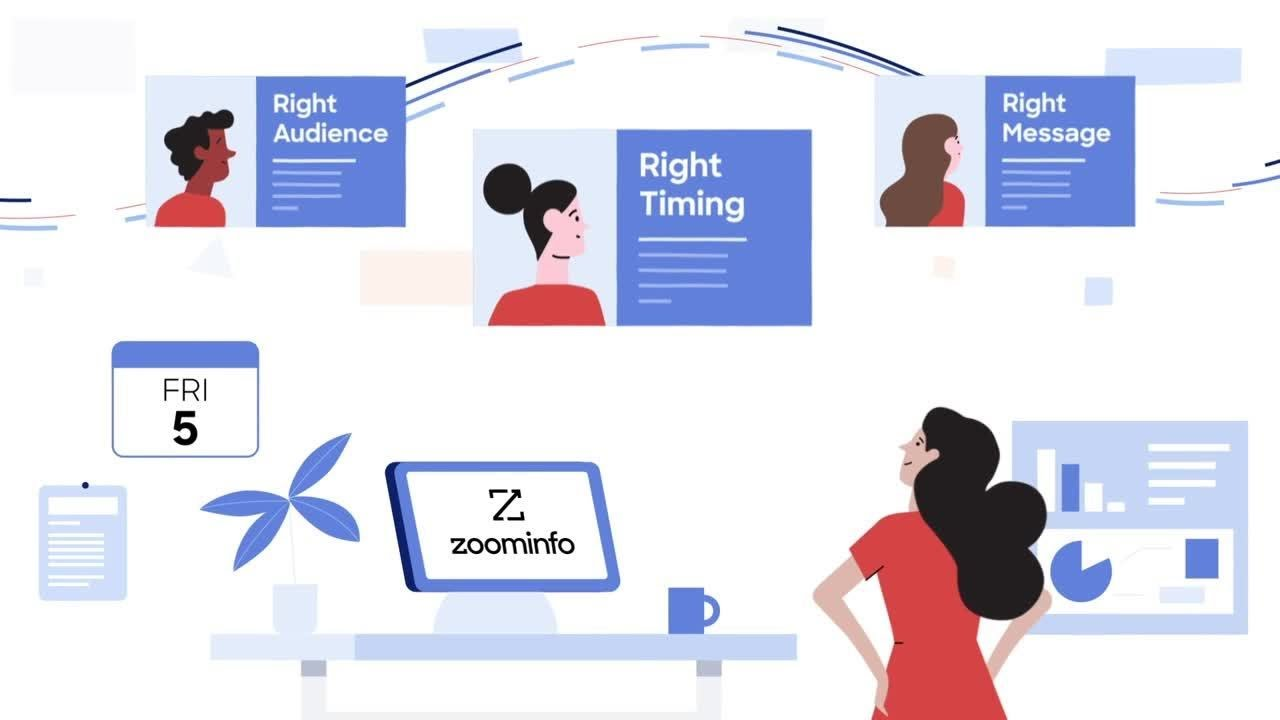
That data, combined with your CRM records, conversation transcripts, and behavioral signals, feeds ZoomInfo's GTM Context Graph, an intelligence layer that processes 1.5B+ data points daily and captures not just what happened in a deal, but why.
Teams access that intelligence through GTM Workspace for sellers, GTM Studio for marketers and RevOps, or APIs and MCP in any front-end.
Comprehensive B2B Data: ZoomInfo provides the third-party intelligence that first-party platforms cannot generate.
Segment collects events from your own digital properties. ZoomInfo covers the rest of the market.
The platform spans three data dimensions: identity data (verified contacts with 120M direct-dial phone numbers and 200M+ business emails), company context (firmographics, org charts, and technographics tracking 30,000+ technologies across 100M companies), and dynamic signals (buying intent, job changes, funding events, and technology adoption patterns).
The data comes from multiple verified sources: automated ML scanning of 28 million site domains daily, third-party partner data covering 95 million businesses, a community of 200,000+ ZoomInfo Lite users who share data back, and an in-house Data Training Lab of 300+ human researchers. ZoomInfo's data reaches up to 95% accuracy.
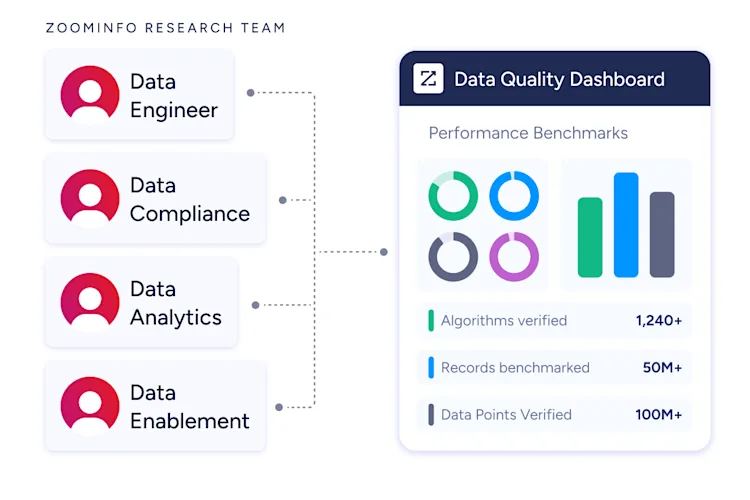
Source: ZoomInfo
That accuracy is externally validated. In a Fortune 500 competitive RFP analyzing 25 million contacts across vendors, the independent consultant concluded that "no other competitor came even close." ZoomInfo holds 133 No. 1 rankings on G2 across Sales Intelligence, Buyer Intent, Data Quality, and related categories.
For B2B teams already using Segment, this changes the equation. Segment can tell you an anonymous visitor looked at your pricing page. ZoomInfo can identify which company that visitor represents (via WebSights), surface the decision-makers with verified contact data, and report whether that company is researching your product category across the broader web.
"ZoomInfo gives us the information we need to execute. We don't have to spend time digging; it's already there, so we can be three steps ahead," noted William Kenimer, VP of Revenue Operations at Vensure. (Vensure)
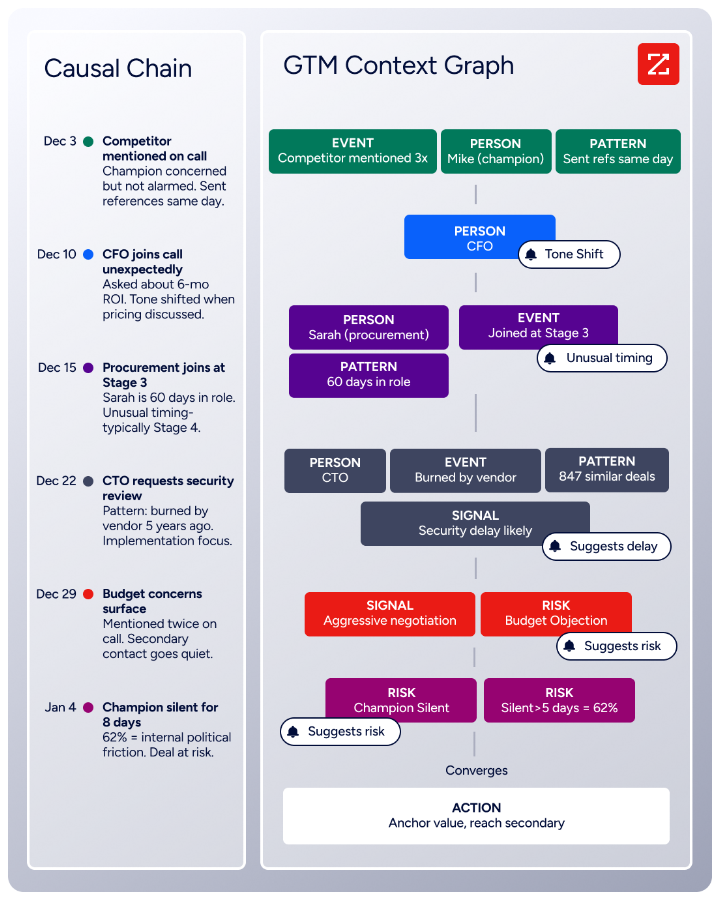
GTM Context Graph: ZoomInfo's intelligence layer captures why deals move, not just that they moved.
CRMs record that a deal's stage changed. Segment can tell you a user completed a key product event. Neither tells you why the deal advanced. As ZoomInfo's Chief Product Officer Dominik Facher writes: "The CRM recorded the state change. It has no record of why it happened."
The GTM Context Graph fuses ZoomInfo's third-party intelligence with a customer's own CRM records, conversation transcripts (captured through Chorus, ZoomInfo's conversation intelligence product), email threads, and engagement history. It then extracts the connections between signals and outcomes across all of it.
Individual data points are noise without context. An intent spike means nothing without knowing which contacts at that account are decision-makers. A champion going quiet might signal internal budget friction, not lost interest.
The GTM Context Graph connects these signals, drawing on patterns across thousands of deals to surface what actually drives outcomes.
Source: ZoomInfo
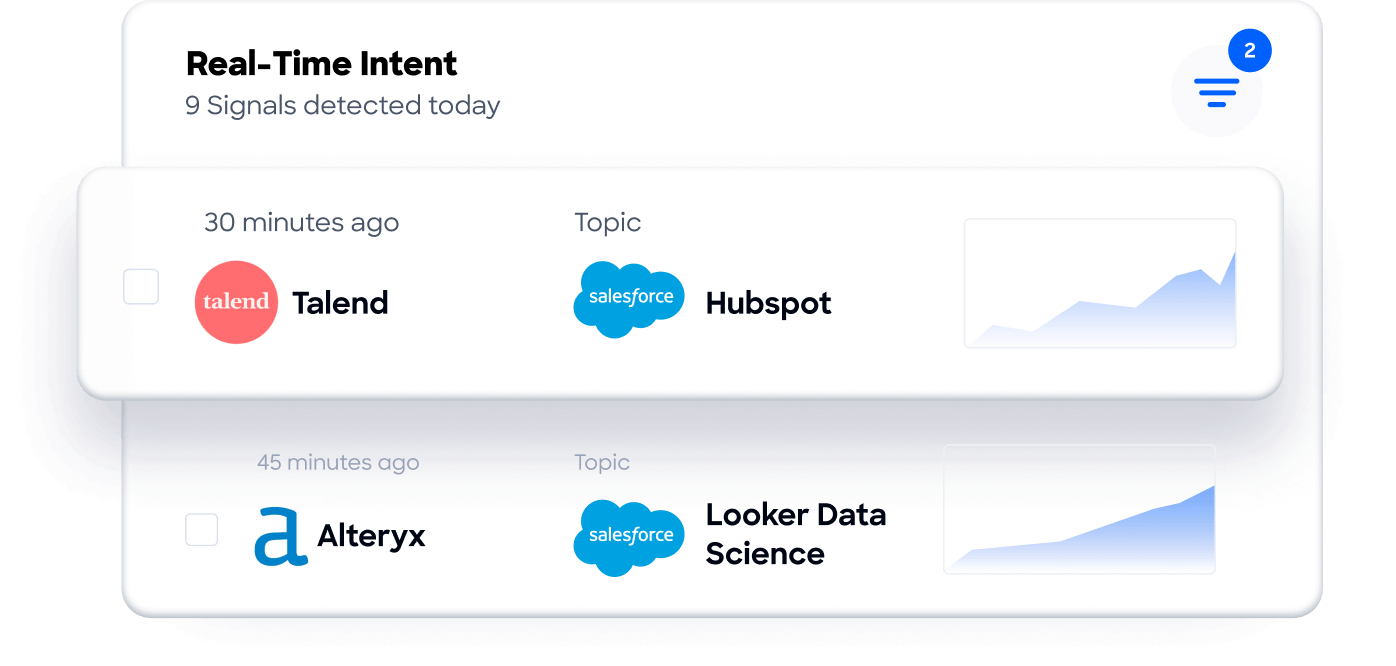
Buyer Intent tracks signals from 210 million IP-to-Organization pairings and 6 trillion+ keyword-to-device pairings sourced monthly.
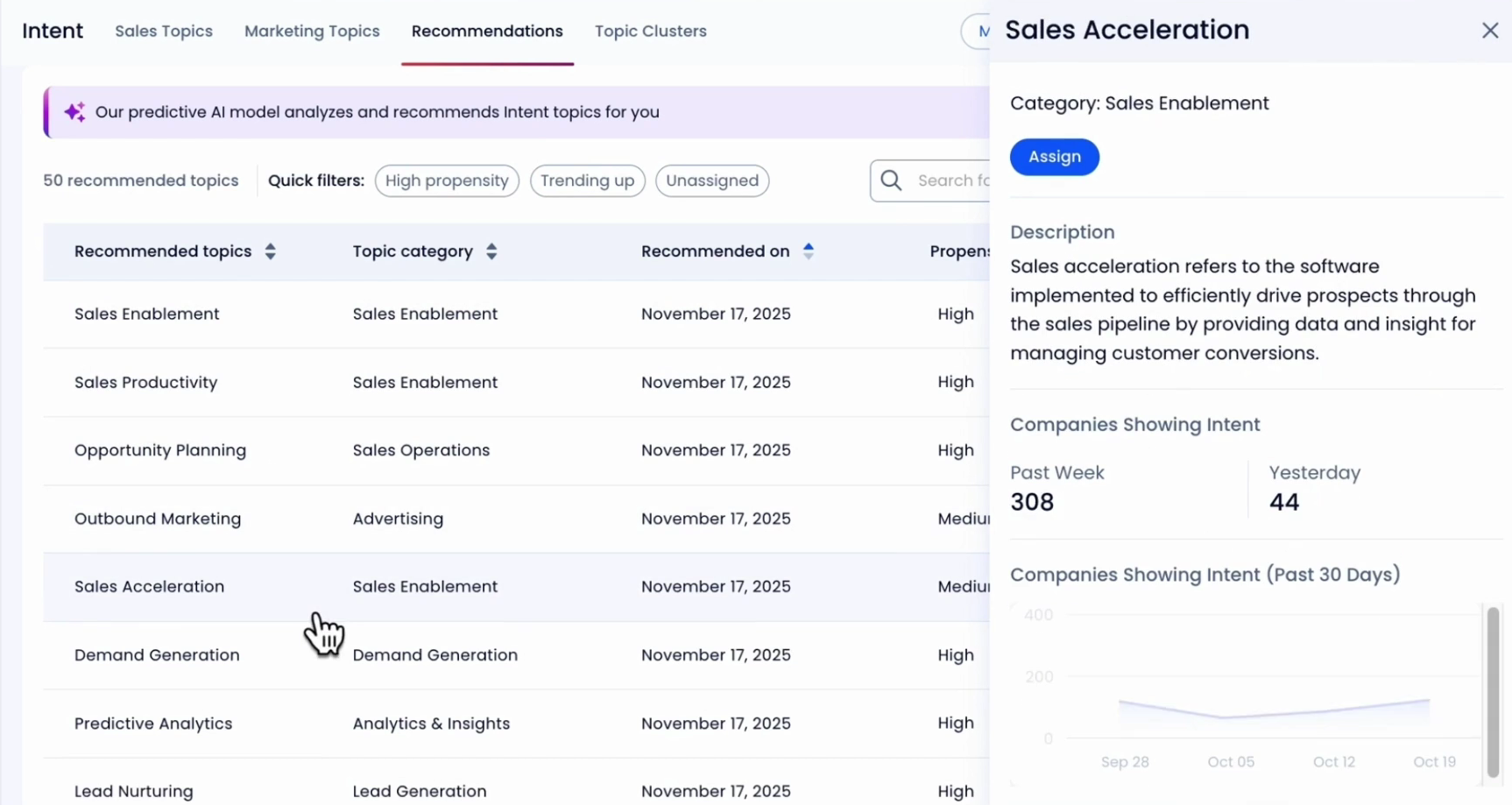
Guided Intent (exclusive to ZoomInfo) identifies topics historically correlated with deal success rather than requiring manual topic selection.
Source: ZoomInfo
Seismic attributed 39% of active pipeline to opportunities identified or influenced by ZoomInfo signals, with CBO Toby Carrington noting: "It's bringing data together faster than anyone could, both a time saving and a quality improvement." (Seismic)
Universal Access: ZoomInfo delivers intelligence through native products, APIs, and AI agent protocols.
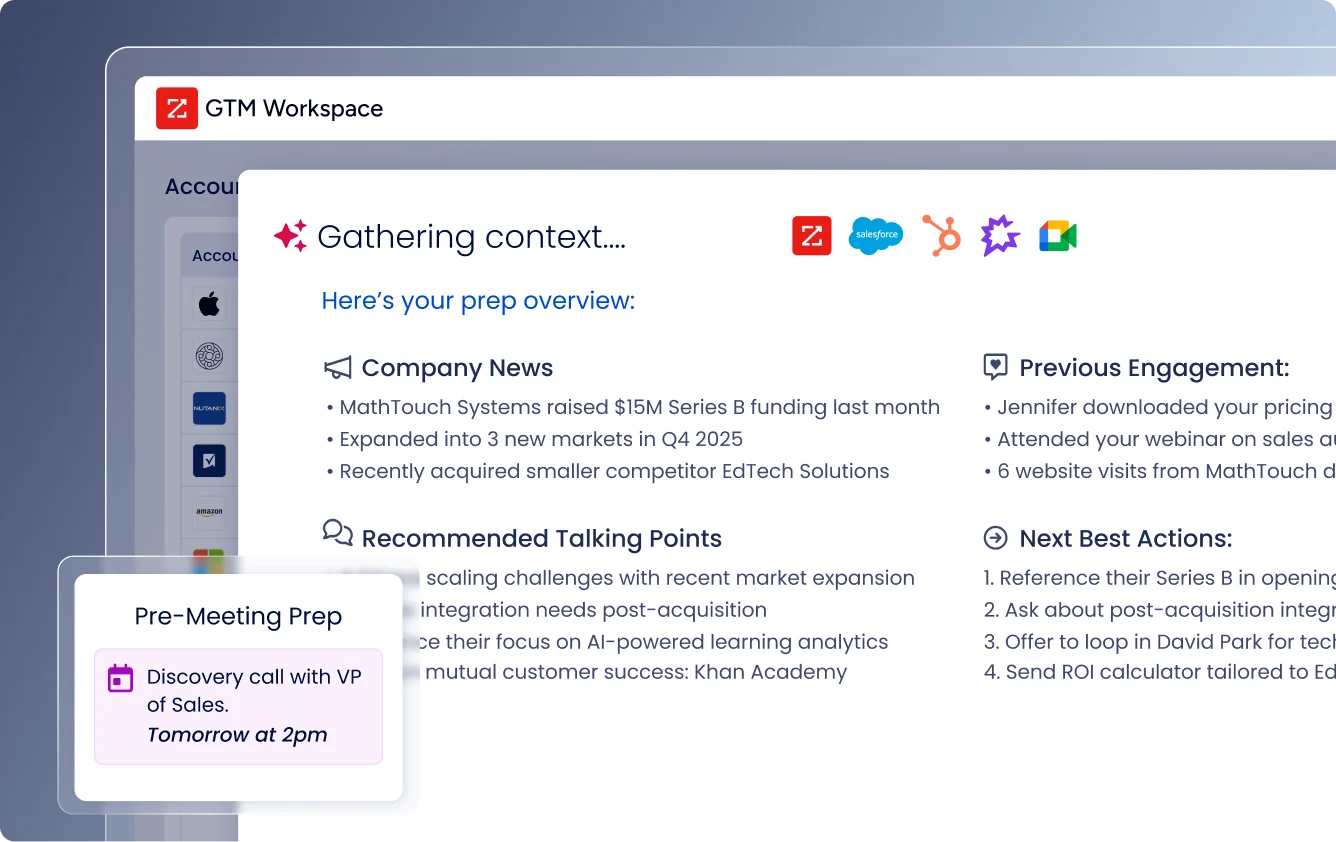
ZoomInfo's intelligence is accessible three ways, all drawing from the same GTM Context Graph. GTM Workspace gives sellers a workspace where prioritized accounts, drafted outreach, and deal context converge in one view.
Source: ZoomInfo
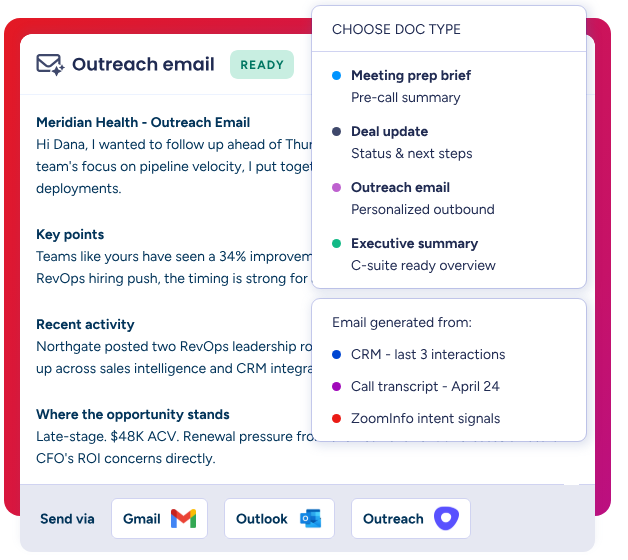
Its built-in AI agents handle account research, outreach generation, CRM updates, and signal monitoring.
Source: ZoomInfo
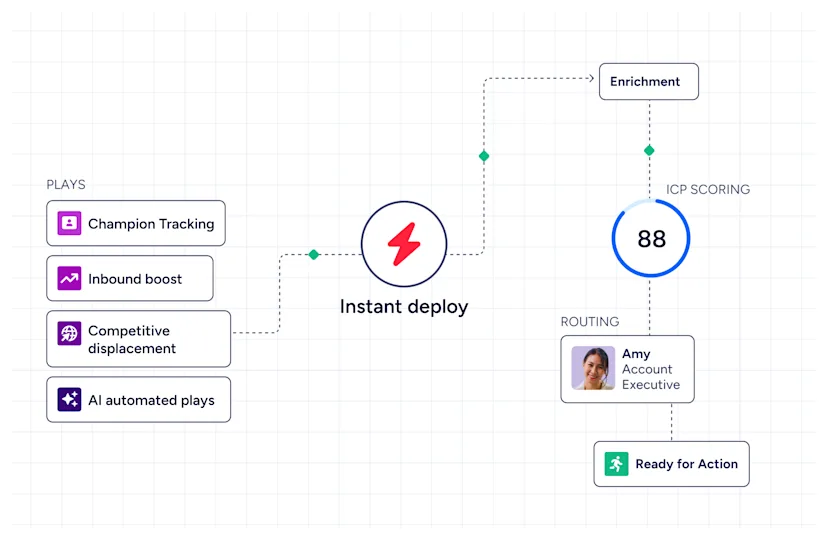
GTM Studio gives marketers, RevOps teams, and GTM engineers a canvas for building audiences in natural language, launching multi-channel plays, and measuring pipeline impact without engineering tickets. Expansion plays that used to take 3 weeks now launch in 30 minutes.
Source: ZoomInfo
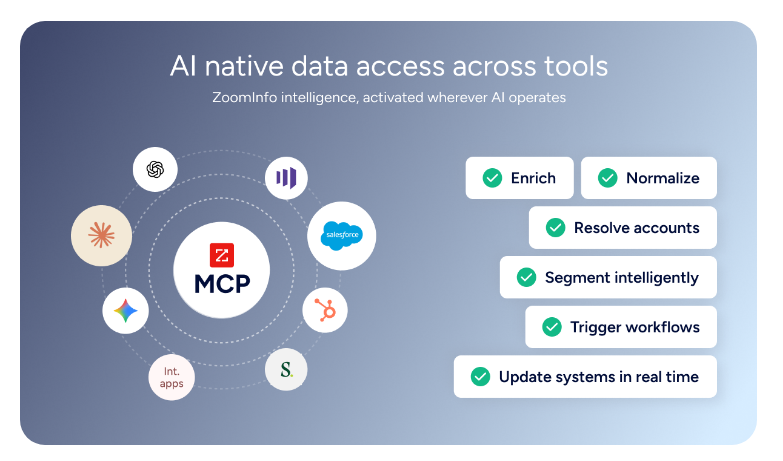
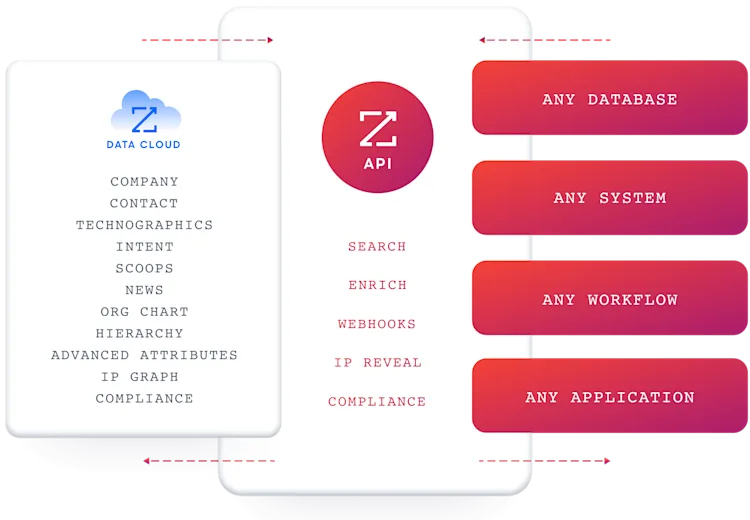
For teams building on their own stack, APIs and MCP expose the same data and intelligence to any custom tool, AI agent, or partner platform.
Source: ZoomInfo
The Enterprise API covers four areas: Data API (search and enrich), Copilot API (AI intelligence including account summaries and lookalikes), Marketing API (audience management), and Platform API (engagement data). API access is included in all relevant plans.
Source: ZoomInfo
For teams already using Segment, ZoomInfo's API and MCP access means third-party B2B intelligence can flow into the same systems Segment feeds, enriching the first-party behavioral picture without replacing the platform.
BDO Canada cut time spent on internal data dashboard updates by 87%. "The plug-and-play aspect of the API means I can integrate it into any process and get information at a moment's notice," noted Senior Marketing Intelligence Analyst Jerry Wilson. (BDO Canada)
Pricing: ZoomInfo offers a permanent free tier and custom-quoted plans.
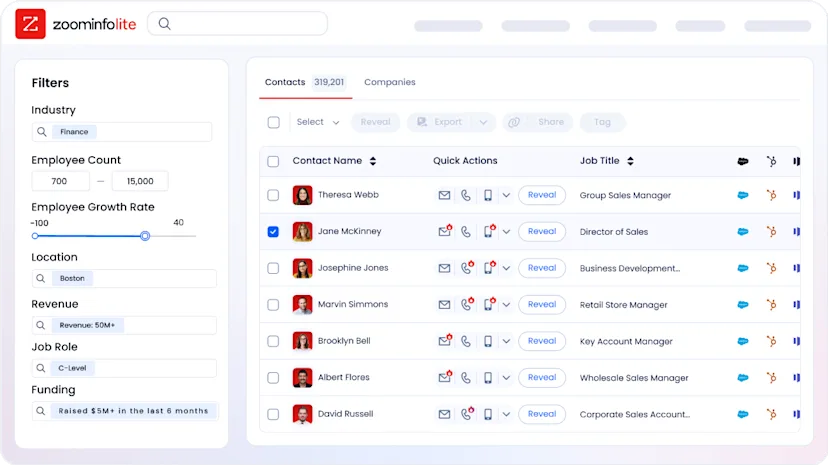
ZoomInfo Lite is a permanent free tier (not a trial) with access to ZoomInfo's B2B database, 10 monthly export credits, individual and company searches with advanced filters, the ReachOut Chrome Extension, WebSights Lite (up to 10 website visitor reveals per day), built-in email sending, HubSpot integration, and CRM data enrichment. No credit card or time limit.
Source: ZoomInfo
Paid plans are organized into Sales (Professional, Advanced, Enterprise) and Marketing (Marketing Demand, ABM Lite, ABM Enterprise) product lines, each with increasing data access, intent signal depth, AI capabilities, and integration options.
Pricing is consumption-based and custom-quoted. A 7-day free trial is available for paid features without a credit card. Annual contracts are standard, with multi-year commitments offering pricing advantages.
Twilio Segment and ZoomInfo: Comparison Summary
Aspect | Twilio Segment | ZoomInfo |
|---|---|---|
Primary Focus | First-party customer data collection and routing | Third-party B2B intelligence and go-to-market execution |
Data Source | Your websites, apps, and servers | 500M contacts, 100M companies across the market |
What It Tells You | What users did on your properties | Who your buyers are, where they work, and when they're in-market |
Identity Resolution | Stitches anonymous/known users across your touchpoints | Verified contact data, org charts, and company hierarchies |
Intent Signals | On-site behavioral events only | Web-wide intent from 210M IP-to-Organization pairings |
Audience Building | Behavioral audiences from first-party data | Audiences from firmographics, intent, technographics, and behavioral data |
Outbound Capabilities | None (routes data to downstream tools) | AI-drafted outreach, sales automation, multi-channel campaigns |
Execution Layer | Engage for journeys (CDP plan) | GTM Workspace (sellers), GTM Studio (marketers/RevOps), API/MCP (any tool) |
Free Plan | 1,000 MTUs, Connections only | ZoomInfo Lite: permanent, 10 credits/month, no time limit |
Paid Pricing | From ~$120/month; CDP plan: contact sales | Custom-quoted, consumption-based |
Analyst Recognition | Gartner CDP MQ 2025: Niche Player | |
Best For | Engineering-led first-party data infrastructure | B2B sales, marketing, and RevOps intelligence |
Final Verdict
Twilio Segment and ZoomInfo address different layers of the B2B data stack. They work best together.
Segment provides the infrastructure for collecting, standardizing, and routing first-party customer data. It is the right choice for companies that need a single source of truth for behavioral events across web, mobile, and server-side sources, with real-time routing to hundreds of downstream tools.
Its identity resolution, data governance, and audience activation make it a strong foundation for teams with engineering resources to instrument it properly.
If your priority is unifying your own customer data across a growing tool stack, Segment delivers.
ZoomInfo provides the third-party intelligence that first-party platforms cannot generate. It is the right choice for B2B teams that need verified contact data, company intelligence, and buying intent signals to identify and engage their addressable market, not just the visitors who have already found them.
With the GTM Context Graph connecting external signals to internal deal data, and access through native products, APIs, and MCP, ZoomInfo turns intelligence into pipeline.
Get started with ZoomInfo here.
Together, the two platforms create a complete picture: Segment captures what your customers and prospects do on your properties, while ZoomInfo reveals who they are, what they care about, and when they're ready to buy. First-party behavioral data plus third-party B2B intelligence is the combination that turns a data stack into a revenue engine.
Twilio Segment FAQ
What is Twilio Segment used for?
Twilio Segment is a Customer Data Platform that collects first-party behavioral data from websites, mobile apps, and servers, then routes it to 550+ downstream tools including analytics platforms, CRMs, marketing tools, ad networks, and data warehouses.
It standardizes event data through a single API, resolves user identities across devices, and lets teams build audiences for activation. It does not provide third-party B2B data like contact information, company firmographics, or buying intent signals from beyond your own properties.
How much does Twilio Segment cost?
The Free plan includes 1,000 Monthly Tracked Users at no cost with no time limit. The Team/Connections Business plan starts at approximately $120/month for 10,000 MTUs.
The full CDP plan (which adds identity resolution via Unify and audience activation via Engage) requires contacting sales for custom pricing. Protocols (data governance) is a separate paid add-on with no published price.
Additional costs include the data warehouse, downstream tool subscriptions, support plan upgrades, and Engage channel delivery fees billed through Twilio's communications pricing.
What is a Monthly Tracked User (MTU)?
An MTU is any unique user ID or anonymous ID that generates events in a billing month. Anonymous website visitors count as MTUs even if they never identify themselves.
This pricing model works well for B2B companies with mostly identified, logged-in users but can grow expensive for B2C sites with high anonymous traffic.
If a Free plan workspace exceeds 1,000 MTUs once in a six-month period, Segment locks the account. If exceeded twice, data stops flowing until the workspace upgrades.
Does Segment provide third-party B2B data?
No. Segment collects only first-party data from your own digital properties. It does not include a contact database, company firmographics, org charts, direct-dial phone numbers, or buying intent signals from across the web.
B2B teams that need this intelligence use platforms like ZoomInfo alongside Segment. ZoomInfo provides 500M contacts, 100M companies, 135M+ verified phone numbers, 200M+ verified business email addresses, and web-wide buyer intent signals from 210 million IP-to-Organization pairings.
Does Twilio Segment require engineering resources to set up?
Yes. Implementing Segment requires instrumenting every data source with Segment SDKs, designing a tracking plan that maps events to the Segment Spec, and configuring destinations. The documentation is extensive and well-organized.
However, getting the initial event taxonomy right is critical because retroactive tracking is not possible. Smaller teams without dedicated engineering may find the setup investment steep relative to the value received.
What analyst ratings does Twilio Segment hold?
In the 2025 Gartner Magic Quadrant for Customer Data Platforms, Twilio Segment fell to Niche Player (down from Visionary in 2024). Gartner cited strengths including 700+ prebuilt connectors, strong privacy controls, and AI transparency, but raised cautions about buyer alignment and growth direction.
In the Forrester Wave for Customer Data Platforms (B2C, Q3 2024), Segment was classified as a Contender. Twilio as a whole was named a Leader in the 2026 Gartner Magic Quadrant for CPaaS, positioned highest for Ability to Execute.
Can Segment and ZoomInfo work together?
Yes. The two platforms address different layers of the data stack and are stronger in combination. Segment collects first-party behavioral data from your digital properties and routes it to your analytics, marketing, and CRM tools.
ZoomInfo provides third-party B2B intelligence (contacts, companies, intent signals) and go-to-market execution. ZoomInfo's API and MCP access means its data can flow into the same downstream systems Segment feeds, enriching customer profiles with verified B2B intelligence that first-party collection alone cannot produce.
Is Twilio Segment a good fit for small teams?
Segment's Free plan (1,000 MTUs, Connections only) is viable for early-stage startups that want to instrument data collection correctly from day one.
But the platform is built for teams with engineering resources to implement and maintain tracking. Multiple reviewers note it "can get expensive and a little bit overkill for small projects." Companies with under 10,000 MTUs per month or simple analytics needs may find that a direct integration with their analytics tool is simpler and cheaper than adding a CDP layer.
