

If you're searching for a Slintel review, Slintel no longer exists as a standalone product. In October 2021, 6sense acquired Slintel and retired the brand. 6sense absorbed the technographic and buyer intelligence tool into its Revenue Marketing and Sales Intelligence platform.
That means a Slintel review is now a 6sense review. We've analyzed what the combined platform offers today. We believe 6sense is the right choice if:
You want to build your GTM strategy around account-based marketing
You need predictive buying-stage models to prioritize accounts before they self-identify
You have dedicated RevOps or marketing operations staff to manage the platform
Your sales and marketing teams are aligned on a shared account-based approach
You operate primarily in North America
However, 6sense might not be the best choice if:
You need a large, verified B2B contact database
Data quality and direct-dial phone coverage are your top priorities
You want a platform that works inside any tool, any AI agent, or any workflow
You need international data coverage across EMEA and APAC
You prefer transparent pricing you can evaluate before a sales call
Your team needs a platform that deploys quickly without months of implementation
In this case, you should consider ZoomInfo: a GTM platform built on comprehensive B2B data: 500M contacts, 100M companies, 135M+ verified phone numbers, and 200M+ verified business emails. Where 6sense starts with predictive models and asks you to trust its AI, ZoomInfo starts with verified data and lets your team act on what they can see and confirm. Its GTM Context Graph fuses that data with your CRM records, conversation transcripts, and behavioral signals to reveal not just what happened in a deal, but why. You can access that intelligence through GTM Workspace for sellers, GTM Studio for marketers and RevOps, or APIs and MCP in any third-party tool.
We've included a detailed look at ZoomInfo later in this Slintel review, as an alternative for teams that need data they can trust and access anywhere. If you're ready to explore ZoomInfo, you can start with a free trial here.
What is Slintel (Now 6sense)?
Slintel was founded in 2018 by Deepak Anchala, Rahul Bhattacharya, and Ranjana TN as a technographic-driven B2B buyer intelligence tool.
It specialized in tracking technology stack changes across companies to identify accounts likely to switch vendors or enter a buying cycle. By the time of its acquisition, Slintel tracked 250M B2B profiles, 100M decision-makers, 50M B2B emails, and 20M direct-dial numbers.
6sense acquired Slintel on October 5, 2021, while Slintel was growing at 500% year-over-year. 6sense retired the Slintel brand, and the combined entity now operates as 6sense.
6sense was founded in 2013 in San Francisco around a different idea: using AI to predict which B2B accounts are in-market before they raise their hand. The company has raised approximately $426M in total funding and reached a $5.2 billion valuation at its Series E in January 2022. As of September 2025, it reports $250M+ in ARR.
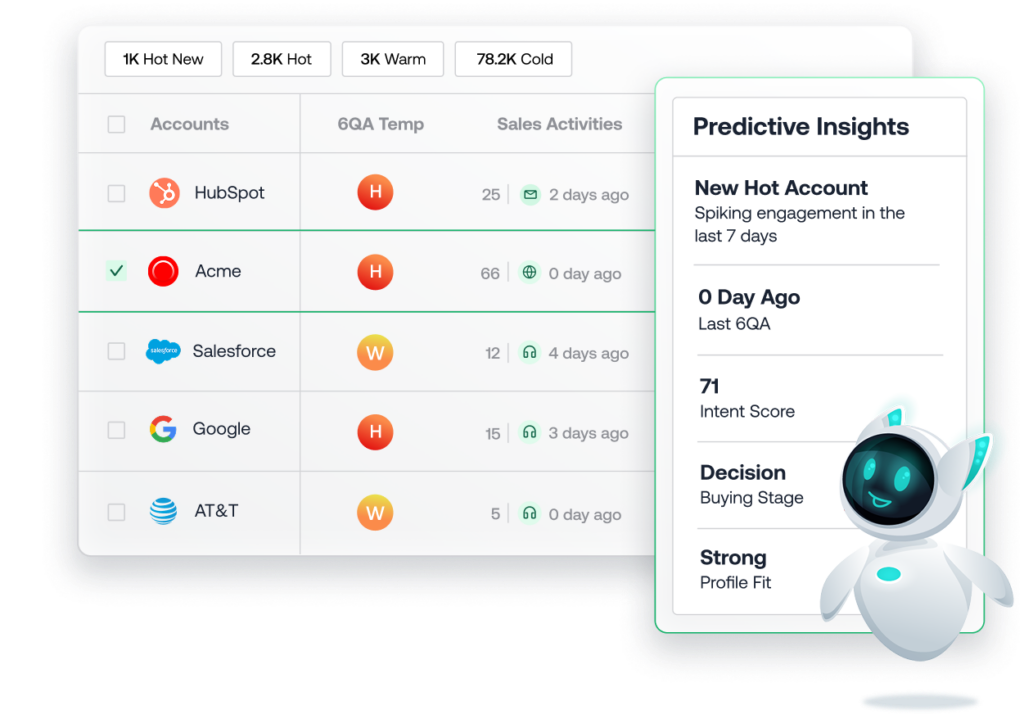
Today, 6sense positions itself as a B2B Revenue Marketing and Sales Intelligence platform.
Source: 6sense
Its core premise is that most B2B buying research happens anonymously before a prospect fills out a form. 6sense exists to surface those anonymous signals, predict which accounts are ready to buy, and orchestrate campaigns across advertising, email, and sales engagement. The platform targets revenue teams at mid-market and enterprise B2B companies, particularly BDRs, AEs, demand gen managers, and revenue operations leaders.
Slintel (Now 6sense) Pros & Cons
Pros | Cons |
|---|---|
- Predictive buying-stage models surface in-market accounts early | - Steep learning curve requiring dedicated RevOps staff |
- Deep intent data from the Signalverse network (500B+ signals monthly) | - Opaque pricing with no publicly listed rates |
- Unified platform for ABM, sales intelligence, and campaign orchestration | - Credit-based model with expiration and no rollover |
- AI Email agents automate SDR outreach at scale | - International data coverage weaker outside North America |
- Five consecutive years as Gartner Magic Quadrant Leader for ABM | - Contact data accuracy concerns flagged by users |
- Large B2B database (750M+ profiles, 111M+ verified emails) | - No contact-level website visitor identification |
- Chrome Extension for in-context prospecting | - Intent signals can feel opaque with false positives |
Slintel (Now 6sense) Review: How It Works & Key Features
Sales Intelligence: 6sense gives sellers AI-scored account lists and credit-gated contact data to focus outreach on in-market buyers.
6sense Sales Intelligence is the evolved form of the original Slintel product. It combines a database of 750M+ B2B buyer profiles and 111M+ verified emails with AI-driven intent analysis and predictive scoring, so sellers focus on accounts most likely to buy.
The platform operates on three layers.
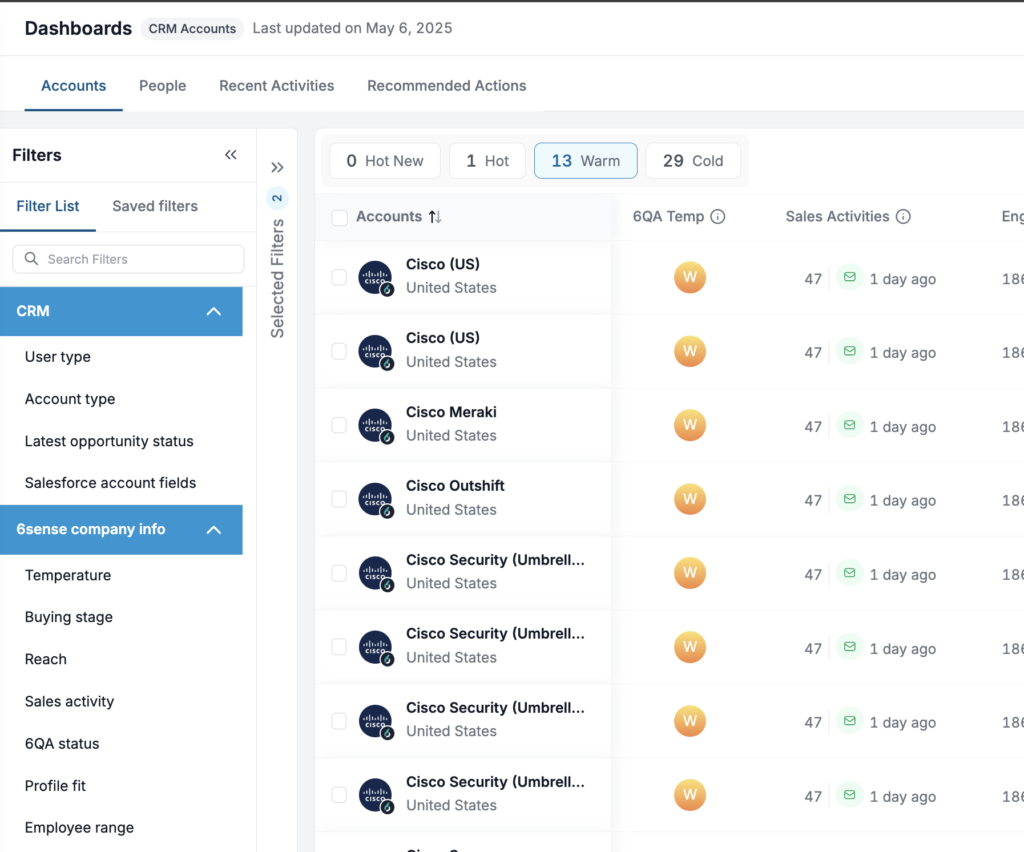
First, signal collection: 6sense's Signalverse processes over a trillion data points daily from buyer search activity, webpage visits, and content consumption across 75M+ company profiles spanning 200+ countries. Second, AI-powered scoring: accounts are classified by buying stage and surfaced as 6sense Qualified Accounts (6QAs), with Account Temperature ratings (Hot, Warm, Cold) visible across all dashboards. Third, seller workflow delivery through dashboards, a Discovery search interface with 50+ filters, daily Sales Alerts via email or Slack, and a Chrome Extension for in-context prospecting on LinkedIn.
Source: 6sense
Contact data is credit-gated: unlocking one contact's email and phone costs one credit. Once unlocked, records enter a 12-month maintenance window during which no additional credits are charged for re-enrichment.
Discovery filters span people attributes, firmographics, technographics, psychographics, intent signals, and CRM sync status, with results you can export to CSV (up to 25K records) or push to Salesforce, HubSpot, or Dynamics (up to 10K records).
Predictive Analytics: AI models classify every account in your addressable market by buying stage, updated daily.
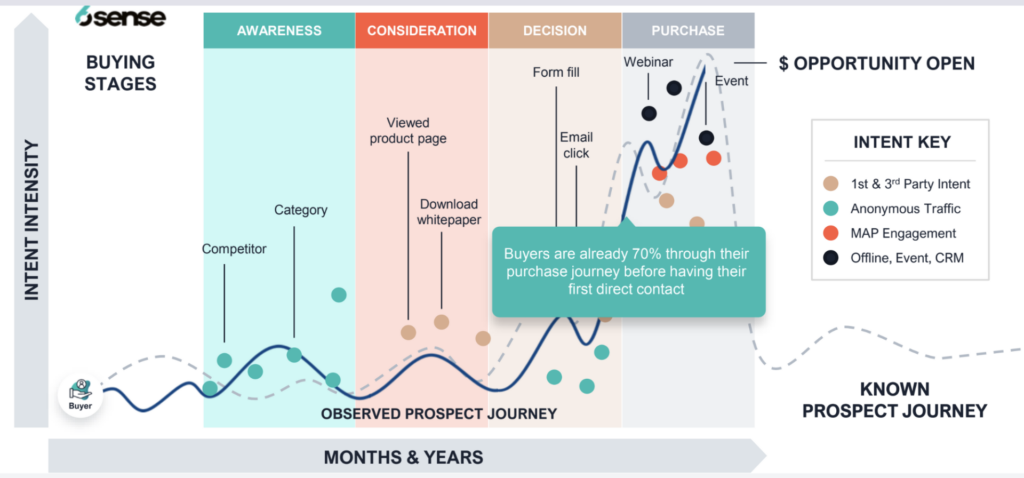
6sense Predictive Analytics is the AI layer that tells go-to-market teams who to prioritize. It addresses what 6sense calls the "dark funnel" (the portion of the buying journey that happens anonymously). A 2025 study found the average B2B buying journey lasts 11 months, with eight of those months unknown to sales.
The system runs six predictive models, each trained per customer.
The Account Profile Fit Model trains on a customer's historical closed/won opportunities and identifies which account characteristics matter most. The Intent Model predicts the likelihood an account is interested in buying based on CRM activity, web activity, and B2B network signals. Intent scores are then mapped to five predictive buying stages: Target (0-19), Awareness (20-49), Consideration (50-69), Decision (70-85), and Purchase (86-100).
Source: 6sense
What makes this useful is the customer-specific training. Rather than applying a generic scoring formula, 6sense derives its ICP model from each organization's actual win data. The Predictive Model Insights Report provides a 90-day backtested view of model performance, allowing customers to verify that predictions correlate with actual opportunity creation.
Revenue Marketing: 6sense surfaces anonymous website visitors, matches them to accounts, and runs targeted advertising campaigns against in-market buyers.
6sense Revenue Marketing tackles the invisibility problem in B2B. Only 3-4% of website visitors ever fill out a form, so marketing teams relying on form fills alone never see most buyers researching their solutions.
The module works through a layered pipeline.
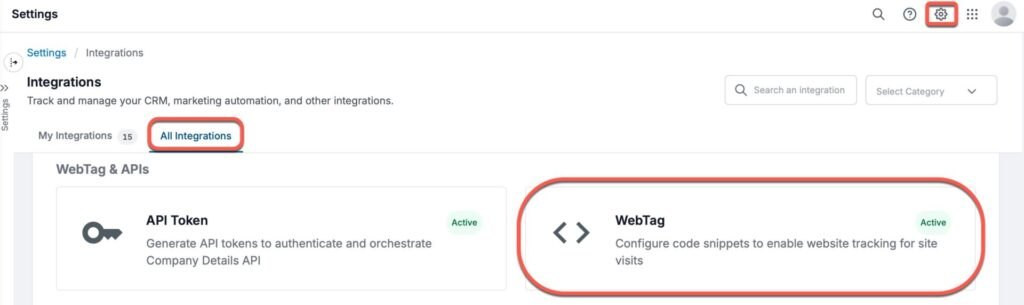
A JavaScript WebTag captures behavioral events on the customer's website. The Company Identification API matches anonymous visitors to named accounts using IP address matching against 6sense's database. 6sense enriches web activity with external intent signals from partnerships with G2, TrustRadius, Bombora, PeerSpot, and Gartner. Dynamic segments update in real time as accounts enter or exit qualifying criteria.
Source: 6sense
Campaign activation pushes these segments into 6sense Advertising, including display, video, and account-based retargeting. The system identifies at the account level, not the individual level, which aligns with enterprise compliance requirements but means you won't know which specific person visited your site.
AI Email: Autonomous email agents that write, send, follow up, and qualify leads without manual intervention.
6sense AI Email automates the outbound email lifecycle. An AI email agent, tied to a real inbox, sends personalized emails, reads replies, classifies responses (meeting request, positive interest, referral, out-of-office, do-not-contact), and either continues the conversation or escalates to a sales rep.
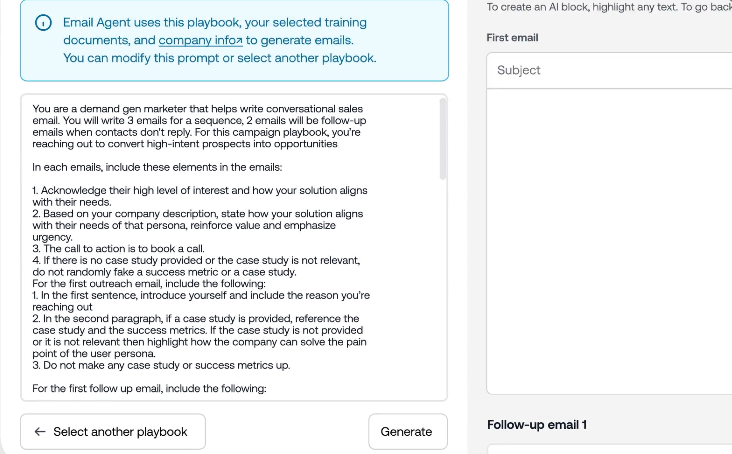
Source: 6sense
The system offers six default playbooks spanning conversion and progression scenarios. Dynamic "AI blocks" within each email rewrite themselves per contact using CRM fields and 6sense intent data. When the AI classifies a conversation as qualified (indicating a meeting request or positive interest), it automatically adds the rep to the email thread with full dialogue history.
Intelligent Workflows: A drag-and-drop canvas for building omnichannel GTM campaigns from a single interface.
Intelligent Workflows lets marketing and sales teams build automated campaigns that span advertising, email, CRM updates, and sales engagement sequences. The visual canvas uses drag-and-drop to chain segments, conditions, timing logic, and channel actions.
Audience Workflows build dynamic audiences that update daily based on actual buying behavior rather than static lists. Action nodes push accounts to ad platforms (6sense Display, LinkedIn, Meta, Google Ads) or contacts to CRM campaigns, MAP static lists, or sales engagement sequences (Outreach, Salesloft, Gong Engage). Timer nodes wait for specific buyer actions rather than calendar-based delays.
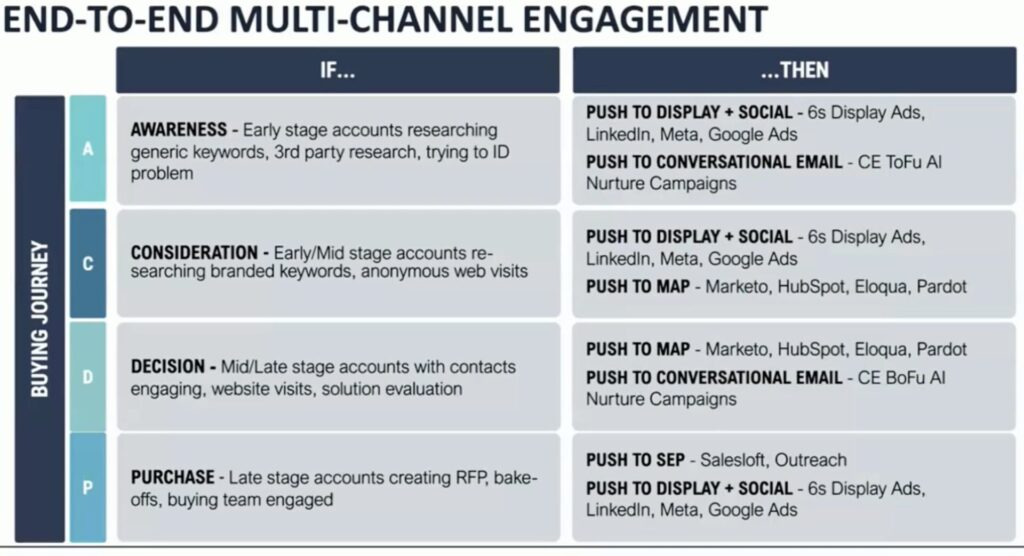
Source: 6sense
Data Workflows handle backend operations: CRM enrichment, contact purchasing, predictive score exports, and job change tracking.
Where Slintel (Now 6sense) Falls Short
While 6sense has built a platform around predictive AI and intent-driven orchestration, several limitations surface with regular use. These reflect a platform optimized for a specific methodology (account-based marketing with predictive AI at its center) rather than for data-first flexibility.
Steep learning curve and heavy implementation.
6sense requires significant time to implement, configure, and train on. The onboarding model is assisted, dividing responsibilities across three administrator roles, each with its own onboarding path. Without dedicated RevOps staff, smaller teams consistently underutilize what they're paying for.
G2 reviewers confirm the steep learning curve, citing initial setup and data interpretation as the biggest challenges. Capterra reviewers describe a UI that can feel slow and unintuitive, causing sales reps to disengage.
Opaque pricing and credit expiration risk.
6sense does not publicly disclose pricing for paid tiers. The credit-based model introduces financial risk: credits do not carry over from one contractual period to the next. When credits run out, the platform restricts credit-consuming actions entirely, including unlocking contact information and exporting data. 6sense maintains separate credit pools for orchestration and API usage, adding cost.
Capterra reviewers from SMBs note cost is difficult to justify without a mature ABM program already in place.
Intent signal opacity.
G2 reviewers note that intent signals can feel like a black box. It's not always clear why the platform flags an account as in-market. The AI buying-stage model generates false positives: accounts flagged as "Decision-stage hot" sometimes turn out to be researching competitors, browsing educational content, or cross-shopping vendors. Over time, this erodes sales team trust in the platform's recommendations.
International data gaps.
Despite EMEA and APAC expansion efforts, international data coverage remains limited. 6sense itself acknowledges that "limited relationships with relevant and trusted GDPR-compliant publishers outside North America leads to a shortfall in intent data coverage." Teams running global campaigns frequently cite this as an unmet need.
Contact data accuracy concerns.
G2 reviewers flag wrong emails and disconnected phone numbers. Capterra reviewers note limited cell phone numbers and a high rate of mismatched contacts. 6sense recently removed 17 million direct dials that failed its quality checks. When your outreach depends on reaching real people at valid addresses, inaccurate data wastes your team's time.
No contact-level website visitor identification.
The platform identifies which accounts visit your website but not which specific individuals. Newer tools surface contact-level visitor data, and buyers increasingly expect this from platforms at this price point.
These limitations aren't failures. They follow from building a platform centered on predictive AI and ABM orchestration. But they create gaps for teams that prioritize data accuracy, transparent pricing, and flexibility to use their intelligence in any tool.
Top Slintel (Now 6sense) Alternative: ZoomInfo
ZoomInfo addresses 6sense's limitations by starting from a different foundation: data. Where 6sense leads with predictive models and asks teams to trust the AI's account scoring, ZoomInfo starts with comprehensive B2B data and builds intelligence on top of verified facts.
The platform covers 500M contacts, 100M companies, 135M+ verified phone numbers, 120M direct-dial numbers, and 200M+ verified business emails. ZoomInfo verifies that data through a multi-source pipeline backed by 300+ human researchers, reaching up to 95% accuracy on first-party data.
In a Fortune 500 competitive RFP analyzing 25 million contacts across vendors, the independent consultant concluded that "no other competitor came even close."
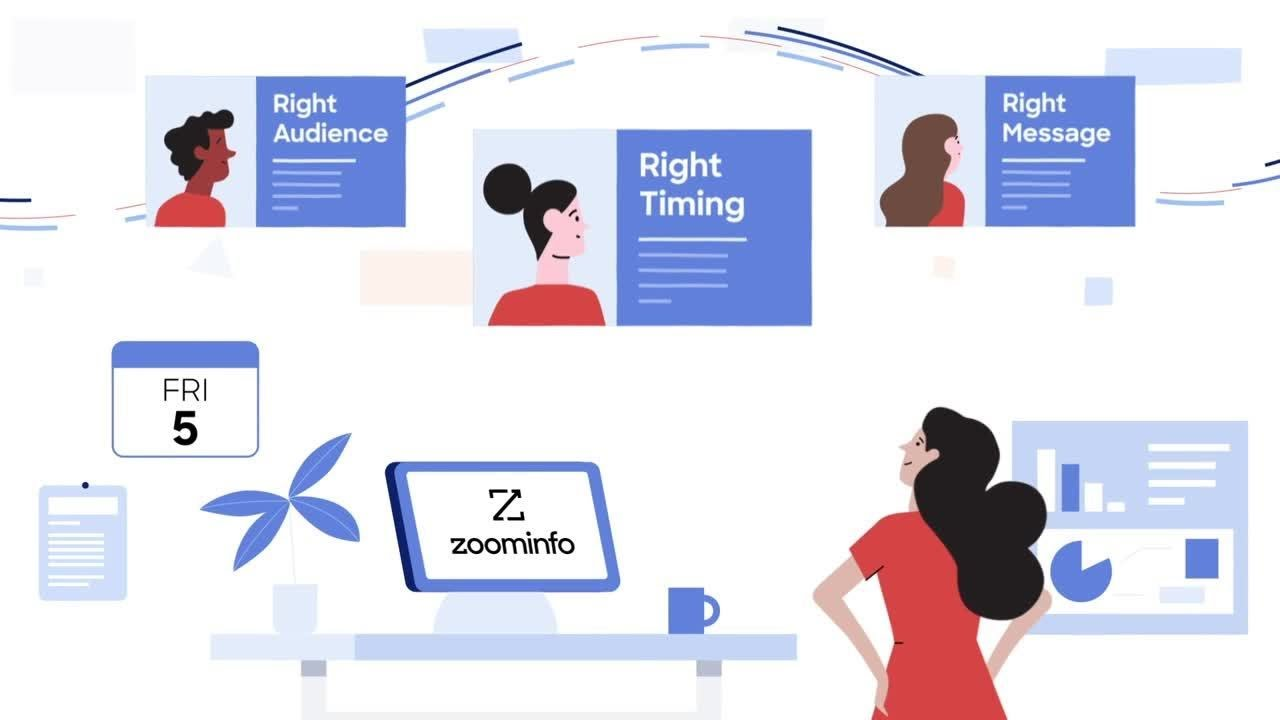
Comprehensive B2B Data: ZoomInfo operates a large verified B2B database spanning identity, company context, and dynamic signals.
ZoomInfo's data covers three dimensions.
Identity data tells you who buyers are and how to reach them: 120M direct-dial phone numbers, 200M+ verified business emails, and department org charts with decision-makers mapped. Company context includes firmographics, technographics across 30,000+ technologies at 30M+ companies, and parent-child hierarchy relationships.
Dynamic signals cover buyer intent from 210M IP-to-Organization pairings and 6T+ keyword-to-device pairings sourced monthly.
Global coverage extends to 34M+ company profiles outside North America, 200M+ professional profiles outside NA, and 45M+ mobile numbers outside NA. In 2025, ZoomInfo added 10.2 million contacts through enhanced title classification and expanded international mobile coverage by 1.8 million numbers across six European markets.
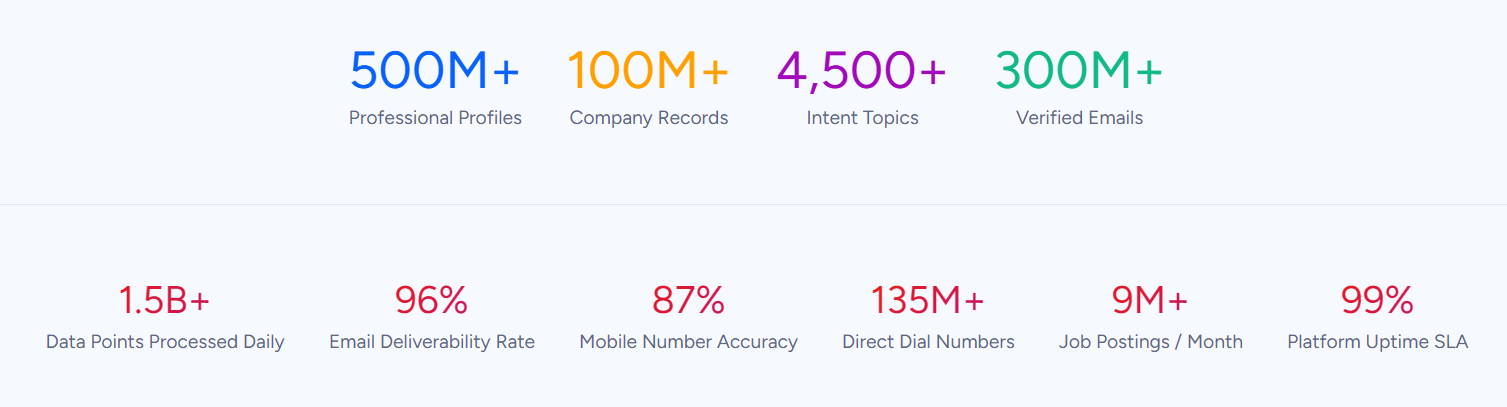
Source: ZoomInfo
Guided Intent, exclusive to ZoomInfo, identifies topics historically correlated with deal success rather than requiring manual topic selection. Unlike platforms that deliver intent signals without verified contacts, ZoomInfo combines both in one platform.
"ZoomInfo gives us the information we need to execute. We don't have to go through and spend our time digging. It's already there, so we can be three steps ahead." (Vensure)
GTM Context Graph: ZoomInfo fuses its B2B data with your CRM records, conversation intelligence, and behavioral signals into a single intelligence layer.
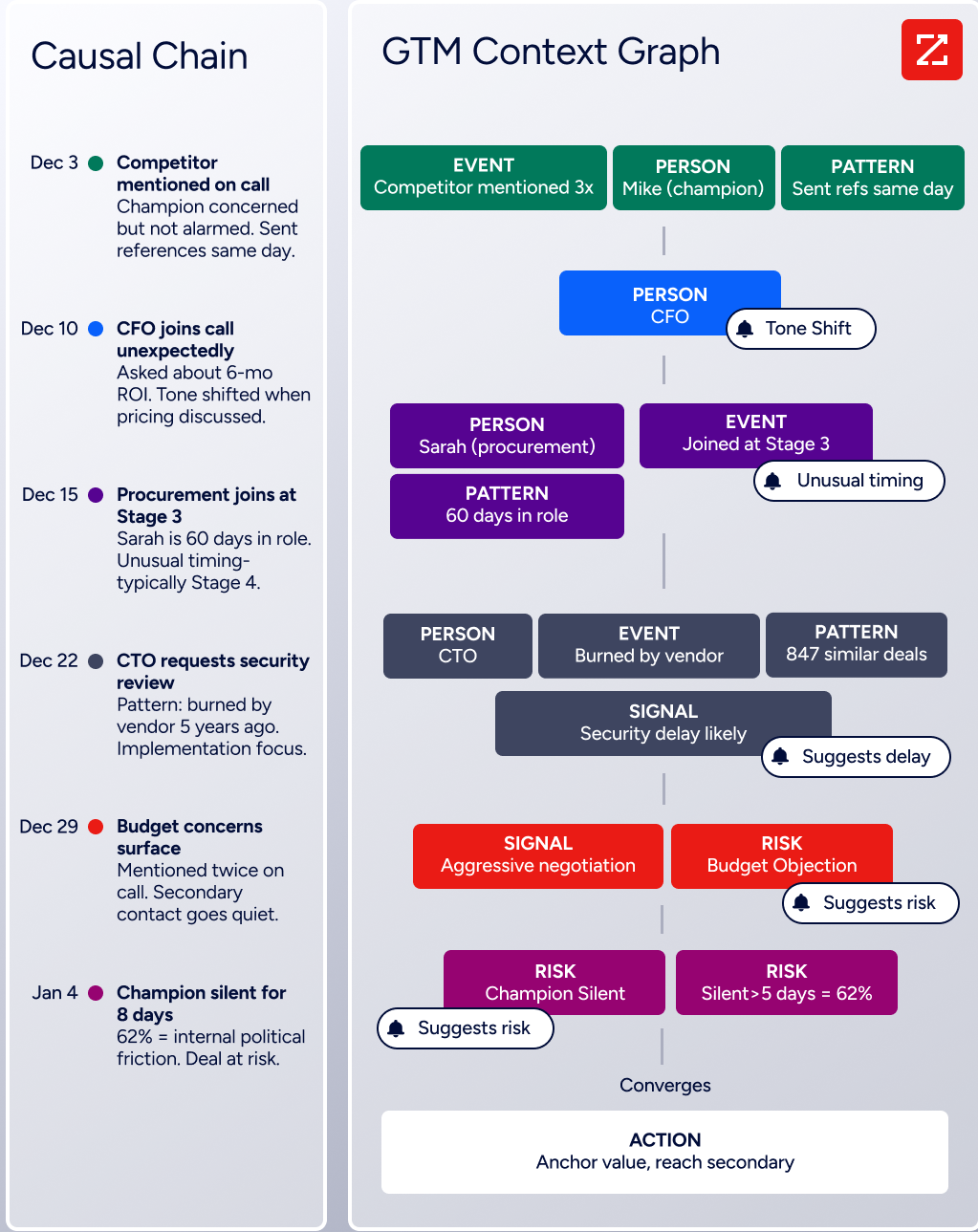
ZoomInfo’s GTM Context Graph processes 1.5B+ data points daily to capture not just what happened in a deal, but why it happened.
A CRM records that a deal moved to Stage 4. Conversation intelligence captures that the CFO joined the last call and asked about six-month ROI. Intent data shows the company is researching your competitor. The GTM Context Graph reasons across all three to explain the deal's momentum and predict what should happen next.
This intelligence layer draws on two decades of infrastructure investment. ZoomInfo's data unification platform (entity resolution, identity matching, hierarchy management) now processes customer first-party data: calls, emails, CRM records, and product usage. The acquisition of Chorus added the conversation engine that extracts context from every customer interaction, explaining why a deal accelerated or a champion went quiet.
Source: ZoomInfo
6sense's predictive scoring tells you which accounts scored highly. ZoomInfo's GTM Context Graph tells you why a specific deal is moving, who's championing it, and what the next conversation should address.
Seismic attributed 39% of active pipeline to ZoomInfo signals, with the sales team reporting 54% productivity gains. As CBO Toby Carrington put it: "That combination of our internal CRM data, external signals, and AI that's given all that context has helped us craft very specific account- and persona-based messages." (Seismic)
Universal Access: ZoomInfo delivers its intelligence through native products for sellers and marketers, plus APIs and MCP for any third-party tool.
Where 6sense requires sales teams to work inside its platform (and depends on CRM integrations limited to Salesforce, HubSpot, or Dynamics), ZoomInfo offers three access paths so intelligence reaches every team and tool.
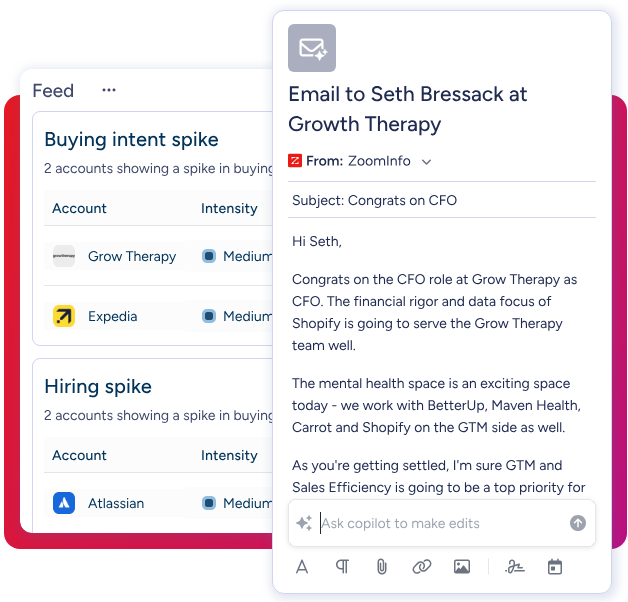
GTM Workspace gives sellers one place to manage prioritized accounts, AI-drafted outreach, and deal execution. It includes an Action Feed of in-market buyers with pre-drafted actions on every signal, an AI Assistant that generates one-click account briefs pulling CRM history, company news, and stakeholder context, and Views combining CRM data with real-time buying signals.
Source: ZoomInfo
GTM Studio gives marketers, RevOps, and GTM engineers a builder where they define audiences, orchestrate campaigns, and measure pipeline using natural language. Expansion plays that used to take three weeks now launch in 30 minutes, without engineering support.
For teams building beyond ZoomInfo's own products, APIs and MCP expose the same intelligence to any custom agent, internal tool, or partner platform. The MCP server is listed in the Claude directory and supports Claude and ChatGPT. API access is included in all relevant plans, so there's no lock-in.
"The plug-and-play aspect of the API means I can integrate it very easily into any process and get information at a moment's notice," resulting in an 87% reduction in time spent on data dashboard updates. (BDO Canada)
Pricing and Free Access: ZoomInfo offers a permanent free tier, a free trial, and tiered plans without credit expiration.
ZoomInfo provides two free entry points.
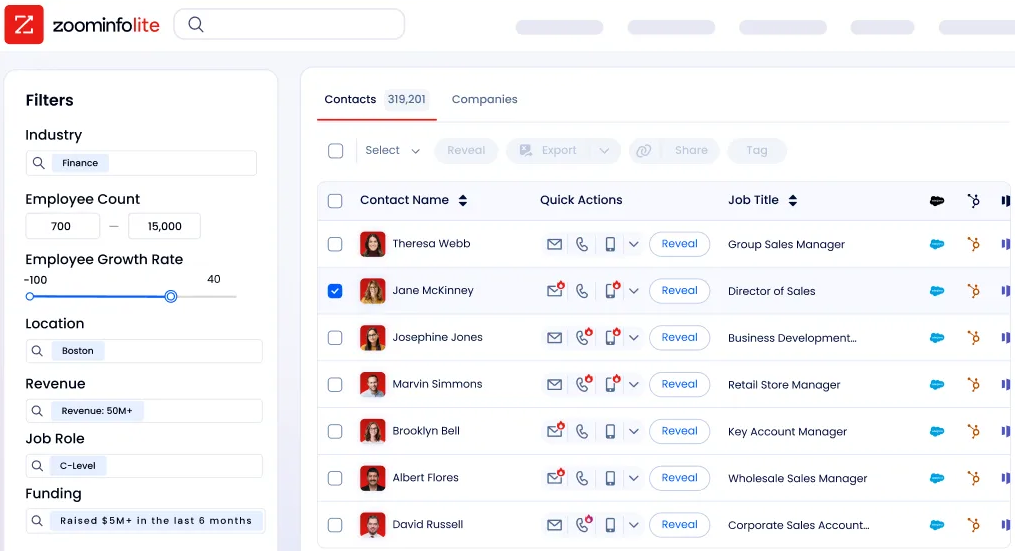
ZoomInfo Lite is a permanent free tier (not a trial) with access to the B2B database, 10 monthly export credits, individual and company searches, the ReachOut Chrome Extension, and WebSights Lite for up to 10 website visitor reveals per day. No credit card, no annual commitment, no time limit. A separate 7-day free trial provides access to core platform features including intent signals and email outreach.
Source: ZoomInfo
ZoomInfo organizes paid plans into Sales, Marketing, and standalone products (Chorus, Chat), each with tiered pricing. Like 6sense, specific dollar amounts are custom-quoted.
But ZoomInfo's credit mechanics are more straightforward: 1 credit equals 1 export, credits are consumed only when data leaves the platform, and searching and viewing data within ZoomInfo does not consume credits. The consumption-based model means teams pay for what they use, and the permanent free tier allows real evaluation before any commitment.
Slintel (Now 6sense) or ZoomInfo: Comparison Summary
6sense (Slintel) | ZoomInfo | |
|---|---|---|
Primary strength | Predictive AI and ABM orchestration | Comprehensive verified B2B data |
Contact database | 750M+ profiles, 111M+ verified emails | 500M contacts, 200M+ verified emails, 135M+ verified phones |
Direct-dial phone numbers | 98M+ direct dials (accuracy concerns noted) | 120M direct-dial phone numbers, up to 95% first-party accuracy |
Intent data | Signalverse: 500B+ signals monthly | 210M IP-to-Org pairings, 6T+ keyword-to-device pairings monthly |
Intent approach | Predictive buying stages (AI-classified) | Guided Intent (historically correlated with deal success) |
Website visitor identification | Account-level only | Account-level and contact-level |
AI capabilities | Predictive scoring, AI Email agents, RevvyAI | GTM Context Graph, AI agents in GTM Workspace, AI-powered GTM Studio |
Campaign orchestration | Intelligent Workflows with advertising, email, CRM, SEP | GTM Studio plays with display, email, calls, ads, direct mail |
CRM integrations | Salesforce, HubSpot, Microsoft Dynamics | Salesforce, HubSpot, Microsoft Dynamics, 120+ marketplace integrations |
API/MCP access | API available (requires specific CRM integrations) | API on all relevant plans, MCP server for any AI agent |
International coverage | Weaker outside North America (acknowledged by 6sense) | 34M+ companies, 200M+ profiles, 45M+ mobile numbers outside NA |
Free plan | 50 credits/month (permanent) | ZoomInfo Lite: permanent free tier + 7-day full trial |
Pricing transparency | Not publicly disclosed | Not publicly disclosed (custom-quoted) |
Learning curve | Steep; requires dedicated RevOps staff | Moderate; 90-day structured onboarding, deploys in weeks |
Analyst recognition | Gartner MQ Leader (ABM, 5 years), Forrester Leader (Intent Data, Revenue Marketing) | Gartner MQ Leader (ABM), Forrester Leader (Intent Data), G2: 133 No. 1 rankings |
Best for | Enterprise ABM-first GTM strategies with dedicated ops teams | Teams prioritizing data quality, broad access, and flexible execution |
Final Verdict
The choice between 6sense and ZoomInfo depends on what you believe should sit at the center of your go-to-market strategy.
Choose 6sense if your organization has committed to an account-based marketing strategy and has the RevOps resources to support a complex platform.
6sense excels at surfacing anonymous buying behavior through its Signalverse intent network, classifying accounts by predicted buying stage, and orchestrating multi-channel campaigns from a single canvas. For enterprise marketing teams with dedicated ABM managers and long sales cycles, the platform's predictive models can surface opportunities that teams would otherwise miss.
If you have the staff to manage the implementation and the budget to absorb the credit system, 6sense delivers a distinct approach to demand generation.
Choose ZoomInfo if you need a go-to-market platform built on verified, comprehensive data, accessible anywhere your team works.
ZoomInfo is the right fit when data accuracy is non-negotiable (direct dials that ring, emails that land), when your team needs intelligence inside their existing tools via APIs and MCP rather than locked inside a single platform, and when you want to deploy quickly without months of configuration.
The GTM Context Graph provides the contextual intelligence that makes AI-driven GTM work, and GTM Workspace for sellers and GTM Studio for marketers and RevOps give every team a workspace designed for their role. With a permanent free tier and a 7-day trial, you can validate the data before committing.
Get started with ZoomInfo here.
Both platforms are leaders in analyst evaluations. The fundamental difference is the starting point: 6sense starts with predictive AI and builds from intent signals. ZoomInfo starts with comprehensive verified B2B data and builds intelligence on top. For most B2B revenue teams, the quality of your data determines the ceiling of everything else you build on it.
Slintel (Now 6sense) FAQ
What happened to Slintel?
6sense acquired Slintel on October 5, 2021, and retired the Slintel brand. The combined product now operates entirely under the 6sense name. 6sense absorbed Slintel's technographic-driven buyer intelligence into its Revenue Marketing and Sales Intelligence platform, adding predictive AI, intent data, advertising, and campaign orchestration on top of the original capabilities.
Does 6sense have a free plan?
Yes, 6sense offers a permanent free plan that includes 50 data credits per month, Company and People Search, Sales Alerts, List Builder, and the Chrome Extension. The free plan does not include Buyer Discovery, Technographics, Psychographics, Web Visitor Identification, Intent data, CRM integration, or Predictive AI features.
ZoomInfo's free tier (ZoomInfo Lite) provides access to the B2B database with 10 monthly export credits, the ReachOut Chrome Extension, WebSights Lite, HubSpot integration, and built-in email sending, with no time limit.
How much does 6sense cost?
6sense does not publicly disclose pricing for its paid tiers. The platform uses a credit-based, tiered license model, and all pricing is custom-quoted through a sales process. 6sense assigns credits based on individual contracts, organizing them into time-bound pools that do not roll over. When credits run out, the platform restricts credit-consuming actions until you purchase more.
ZoomInfo also uses custom-quoted pricing, but offers both a permanent free tier and a 7-day free trial to evaluate the platform before committing.
Is 6sense accurate for contact data?
6sense maintains a database of 750M+ profiles and 111M+ verified business emails. However, multiple user reviews flag contact data accuracy concerns, including wrong emails, disconnected phone numbers, and mismatched contacts. 6sense recently removed 17 million direct dials that did not meet its quality bar.
ZoomInfo verifies its data through a multi-source pipeline backed by 300+ human researchers, reaching up to 95% accuracy on first-party data. In a Fortune 500 competitive evaluation analyzing 25 million contacts across vendors, the evaluator found no close competitor to ZoomInfo's data.
Does 6sense work outside North America?
6sense has been expanding EMEA and APAC coverage, with recent updates adding intent data in additional regions. However, 6sense itself has acknowledged limited relationships with GDPR-compliant publishers outside North America, leading to weaker intent data coverage internationally. Multi-region teams frequently cite this as an unmet need.
ZoomInfo covers 34M+ company profiles outside North America, 200M+ international professional profiles, and 45M+ mobile numbers outside NA, with recent additions including 1.8 million new mobile numbers across six European markets.
Can 6sense identify individual website visitors?
No, 6sense identifies which accounts visit your website but not which specific individuals. The Company Identification API matches anonymous visitors to named accounts using IP address matching. This account-level identification is privacy-compliant but means you won't know exactly who within a company visited your site.
ZoomInfo offers both account-level identification and contact-level site visitor identification, allowing teams to trigger personalized outreach to specific individuals.
What integrations does 6sense support?
6sense integrates with Salesforce, HubSpot, Microsoft Dynamics (CRM), Marketo, Eloqua, Salesforce Marketing Cloud (MAP), Outreach, Salesloft, Gong Engage (sales engagement), and advertising platforms including LinkedIn, Meta, and Google Ads. Intent data partnerships include Bombora, G2, TrustRadius, PeerSpot, and Gartner Digital Markets. However, the enrichment API requires Salesforce, HubSpot, or Salesloft, which limits flexibility for teams in other CRM environments.
ZoomInfo maintains 120+ marketplace integrations, offers API access on all relevant plans, and provides an MCP server compatible with Claude and ChatGPT for use in any AI agent or custom tool.
How does 6sense compare to ZoomInfo for sales prospecting?
6sense approaches prospecting through predictive AI, surfacing accounts based on anonymous buying signals and scoring them by predicted buying stage. ZoomInfo approaches prospecting through comprehensive verified data, giving sellers direct access to contacts, direct dials, org charts, and intent signals in a single search.
The key difference: 6sense tells you which accounts its AI predicts are in-market and lets you unlock contacts with credits. ZoomInfo gives you the verified data directly and layers AI-driven context (via the GTM Context Graph) on top. For teams that prioritize data accuracy and broad access, ZoomInfo's approach gives faster results.
