

Snitcher turns anonymous B2B website traffic into named companies and contacts. It watches who visits your site, scores their intent, and pushes that data into your CRM or outreach tools so sales can act while buyers are still browsing. For teams whose go-to-market strategy starts with their own website traffic, it offers a focused, affordable way to capture demand that would otherwise vanish.
To write this Snitcher review, we analyzed the platform in detail. We believe it's the right choice if:
You want website visitor identification with strong match rates
You need a tool that installs in minutes with no engineering
Your go-to-market strategy centers on first-party website intent signals
You want unlimited team members without per-seat fees
GDPR compliance matters to you (Amsterdam-based, EU data storage)
However, Snitcher might not be the best choice if:
You need B2B contact and company data beyond your website visitors
You want intent signals from sources other than your own site
You require conversation intelligence and deal-level analytics
You need a full GTM platform with sales automation, ABM, and marketing orchestration
You want AI-powered account research and outreach generation at scale
In this case, consider ZoomInfo: an AI GTM platform built on a large data foundation (500M contacts, 100M companies, 135M+ verified phone numbers, and 200M+ verified business email addresses). Its GTM Context Graph unifies this data with your first-party signals to drive execution across sales, marketing, and RevOps, taking GTM teams from identifying interest to closing deals.
We've included a detailed look at ZoomInfo later in this Snitcher review as the broader alternative for teams that need more than website visitor identification. If you're ready to explore the full platform, you can start with ZoomInfo Lite for free.
What is Snitcher?
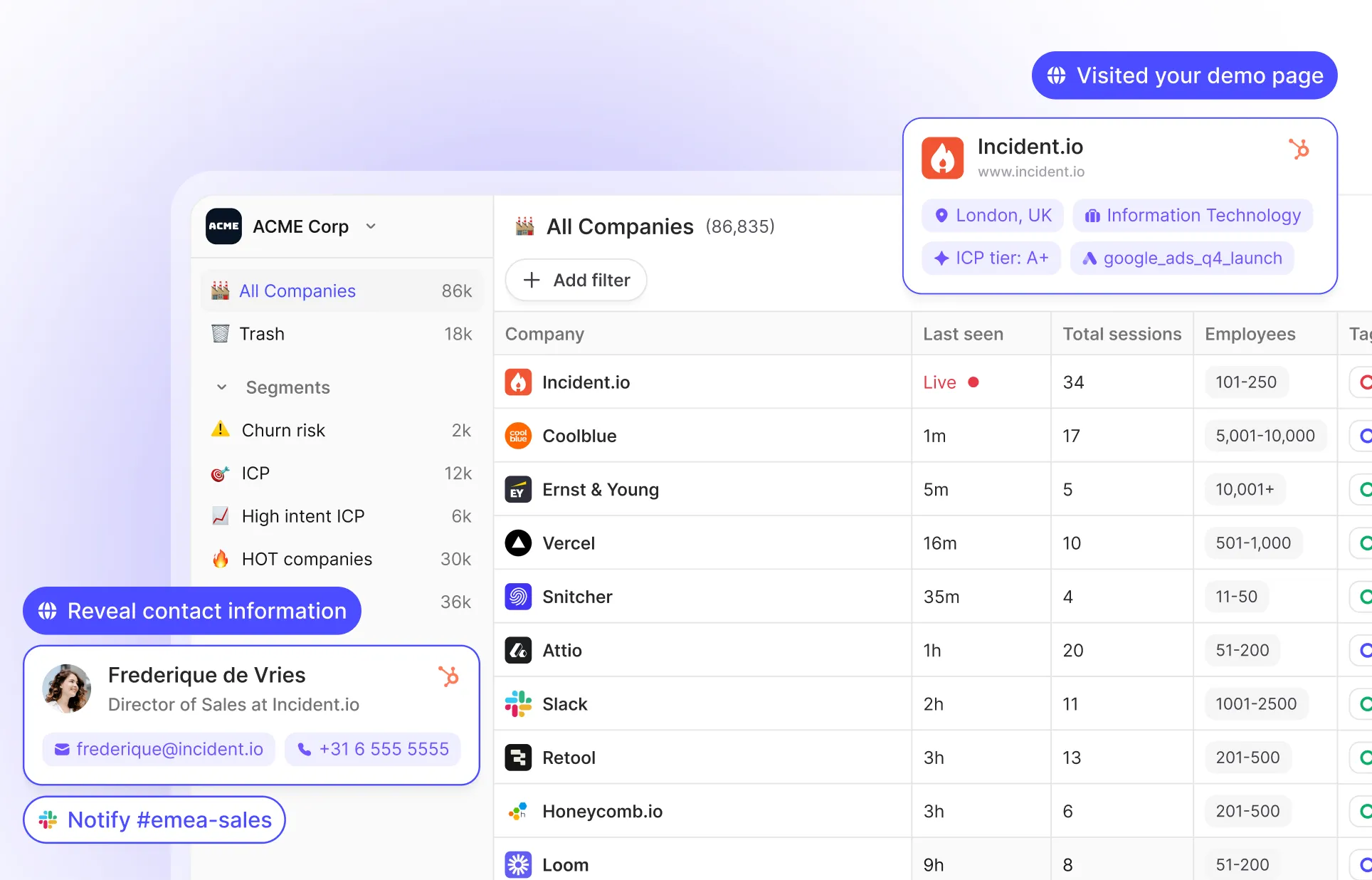
Snitcher is a B2B website visitor intelligence and GTM platform founded in 2015 by Jerre Baumeister as a side project in the Netherlands. What started as a late-night hack became a full-time business by mid-2019, when the team recognized its commercial potential.
Source: Snitcher
A defining moment came in 2019 when Google changed its tracking infrastructure and disabled Snitcher's existing tracking system. While competitors went offline for weeks, Snitcher rebuilt its own tracking overnight, had its best quarter as a result, and has run on independent infrastructure since.
The company is fully bootstrapped with no venture capital, headquartered outside Amsterdam, and reports ARR in the millions. The team is small (approximately 15 people) spanning engineering, commercial, marketing, design, customer success, and content.
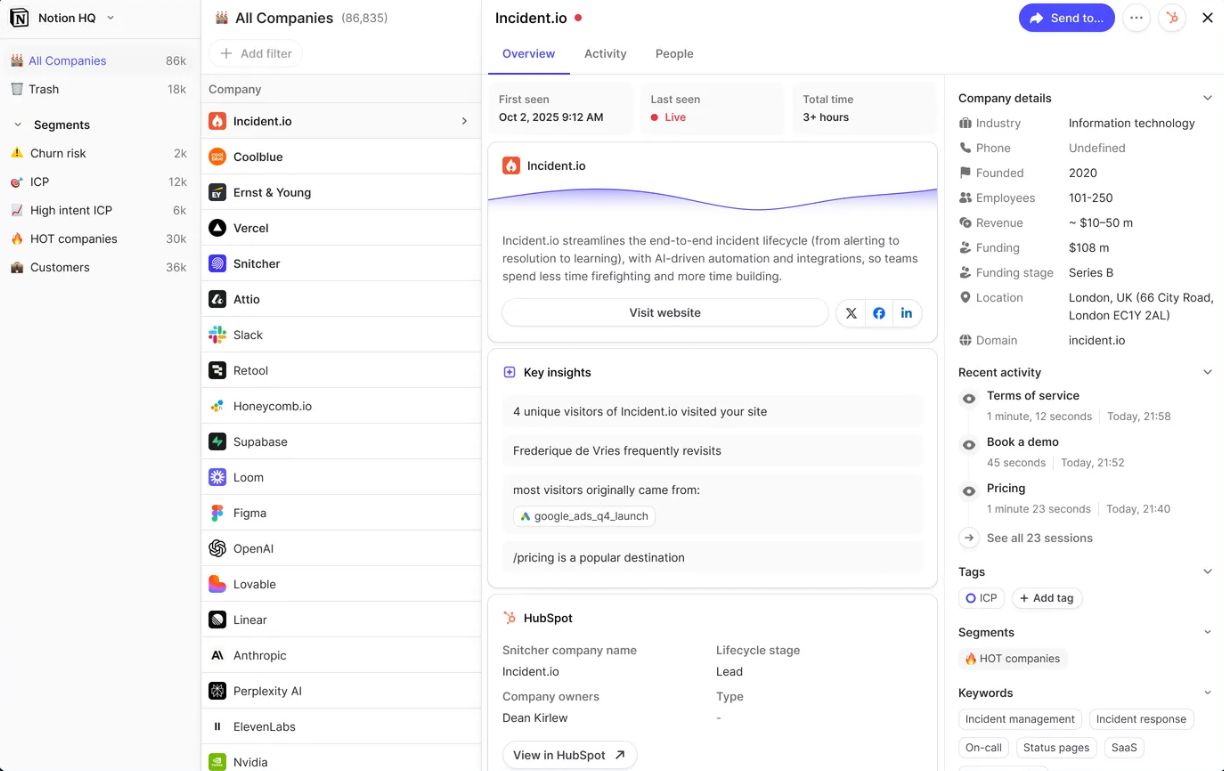
Today, Snitcher positions itself as a "GTM Platform" rather than a visitor identification tool. The product is built around five workflow modules: Identify, Signal, Automate, Engage, and Measure. Two additional offerings sit alongside the core platform: Radar (white-label visitor intelligence for SaaS platforms) and an IP to Company API for direct IP resolution.
Source: Snitcher
Snitcher targets B2B go-to-market teams at SMB to mid-market companies, specifically Sales, Marketing, RevOps, and Agencies. Named customers include Clay, Unify, lemlist, Entain, Moonpig, Perplexity AI, People.ai, RudderStack, Messari, Factors.ai, and Tacto.
Snitcher Pros & Cons
Pros | Cons |
|---|---|
- Strong identification match rates validated by customers | - Pricing scales steeply with traffic volume |
- Quick setup (minutes, no engineering required) | - Limited to first-party website intent only |
- Unlimited team members on all plans, no seat fees | - 16 native integrations (narrower than enterprise competitors) |
- Real-time alerts via Slack, Teams, or email | - Contact reveals are credit-gated (emails and phone numbers) |
- GDPR compliant with EU data storage (AWS Frankfurt) | - No conversation intelligence or call recording |
- 14-day free trial with no credit card | - No permanent free plan |
- Two-way CRM sync with HubSpot, Salesforce, Pipedrive | - No third-party intent data (only tracks your own website) |
- Usage-based pricing starting at $49/month | - Each website requires its own separate subscription |
Snitcher Review: How it Works & Key Features
Visitor Identification: Snitcher reveals which companies browse your site using a layered identification stack.
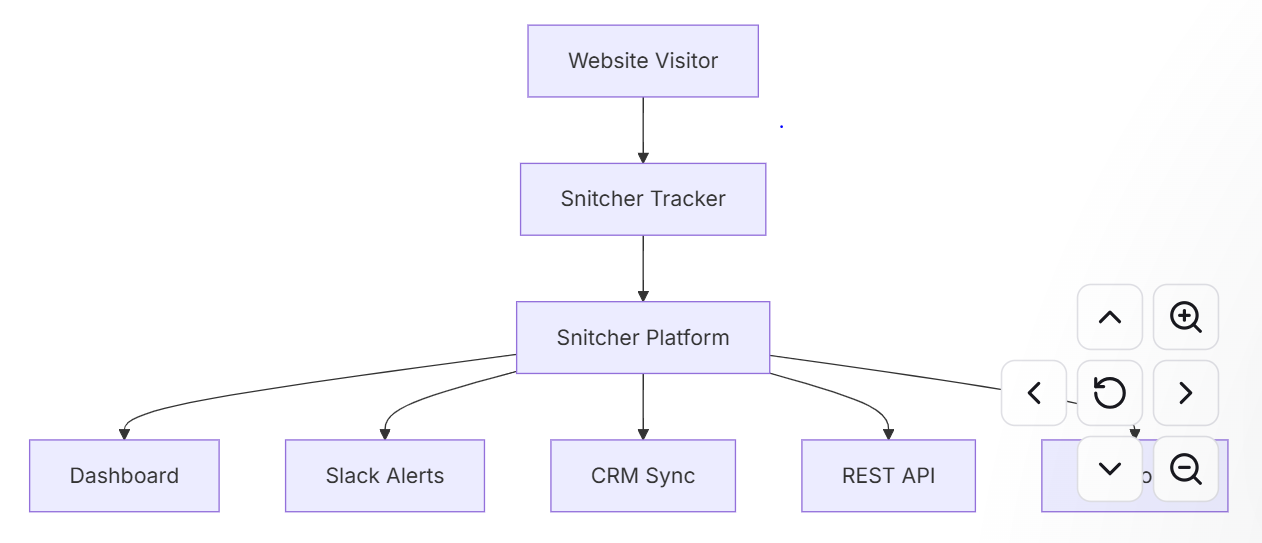
Snitcher's identification works through two layers, described in How Snitcher Works:
Source: Snitcher
The first layer is IP Intelligence. A lightweight JavaScript tracker (around 15KB gzipped, asynchronous) captures each visitor's IP address and matches it against a proprietary database of business IP ranges. A match returns the company name, domain, industry, employee count, headquarters location, and social profiles.
The second layer is the Identity Layer, which lifts company-level data to individual-level identification. It captures emails through four routes: automatic form tracking (no code changes needed), manual Snitcher.identify() calls, OAuth/SSO logins, and email link tracking via URL parameters compatible with tools like Outreach, Apollo, HubSpot, and Mailchimp.
What makes the identification valuable is retroactive identity resolution. When a visitor finally identifies themselves, Snitcher back-fills their entire anonymous session history to that profile, not just future sessions. A rep can see every page a prospect visited over the past weeks or months, even before the prospect filled out a form.
The platform layers IP intelligence, first-party cookies, form tracking, and email link tracking to work around VPNs, privacy browsers, and cookie blockers. It uses no third-party cookies or third-party data. All identification comes from first-party interactions on the customer's own website, making it resilient to browser-level cookie restrictions.
Intent Scoring and Prioritization: Snitcher's Signal module converts raw visitor data into a ranked account list.
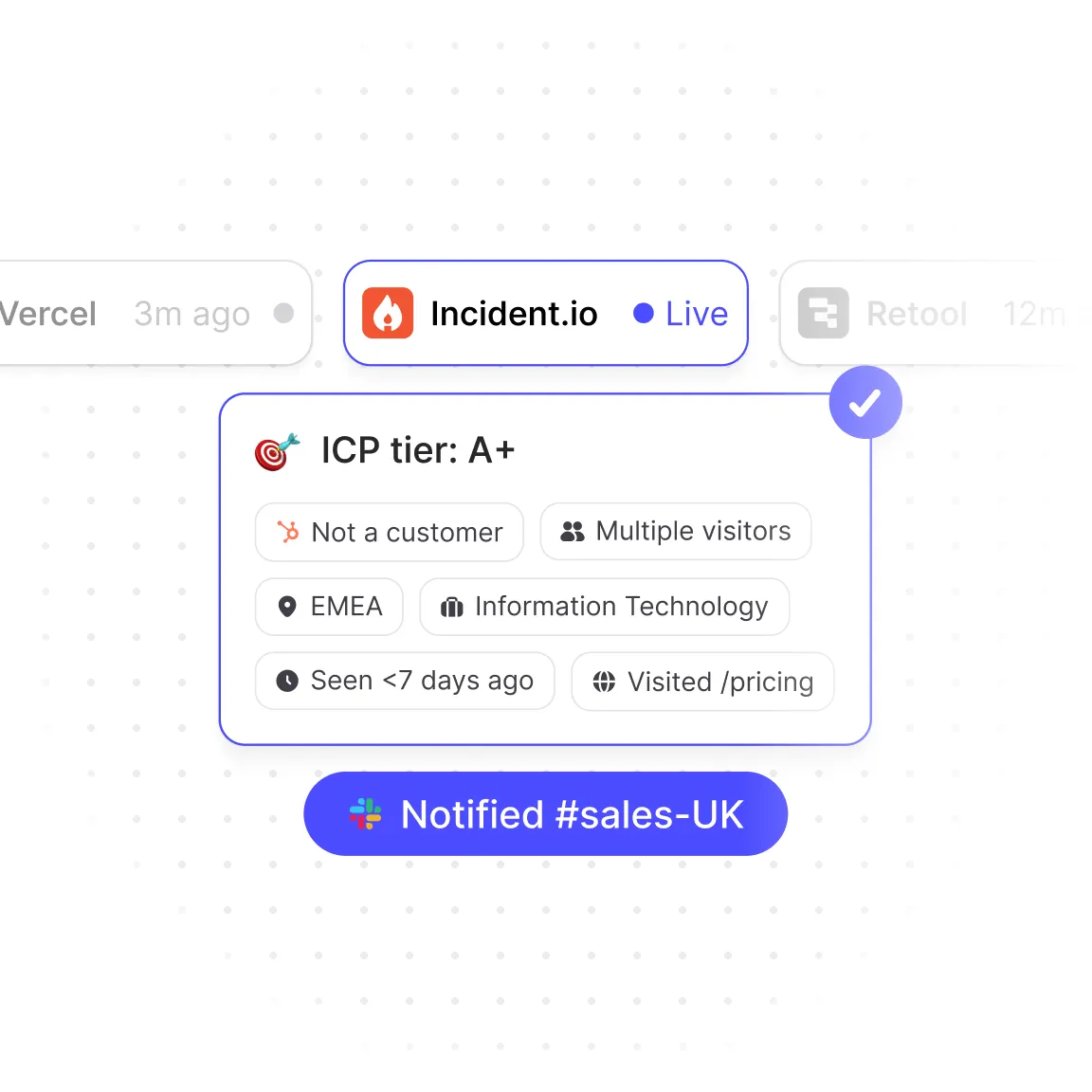
Once you know who visits, the next problem is noise. Hundreds of companies hit your site each week, and they all look like leads on the surface. Signal combines behavior, firmographics, CRM history, and intent data into a single composite score so teams open their day to one ranked list instead of cross-referencing tabs.
Source: Snitcher
Signal scores accounts by combining three data layers. Built-in signals cover visit frequency, page depth, time on page, and session count automatically.
Connected external data pulls in CRM activity, deal stage, previous engagement, and product usage signals. Custom rules let teams weight specific page visits (pricing page visits, repeat sessions, content depth), company size thresholds, industry filters, and tech stack attributes.
Scores update continuously as new behavioral data arrives. AI Insights generate plain-language summaries of what each top account is doing and why they show intent, replacing manual session-by-session review. Recommended Actions surface a clear next step for each scored account: reach out, nurture, or let marketing keep warming.
Signal also measures which campaigns brought companies that actually match the ICP, not just sessions or impressions. This gives marketing teams a way to connect ad spend to real company-level outcomes.
Automation and CRM Integration: Snitcher triggers workflows the moment visitor signals match your conditions.
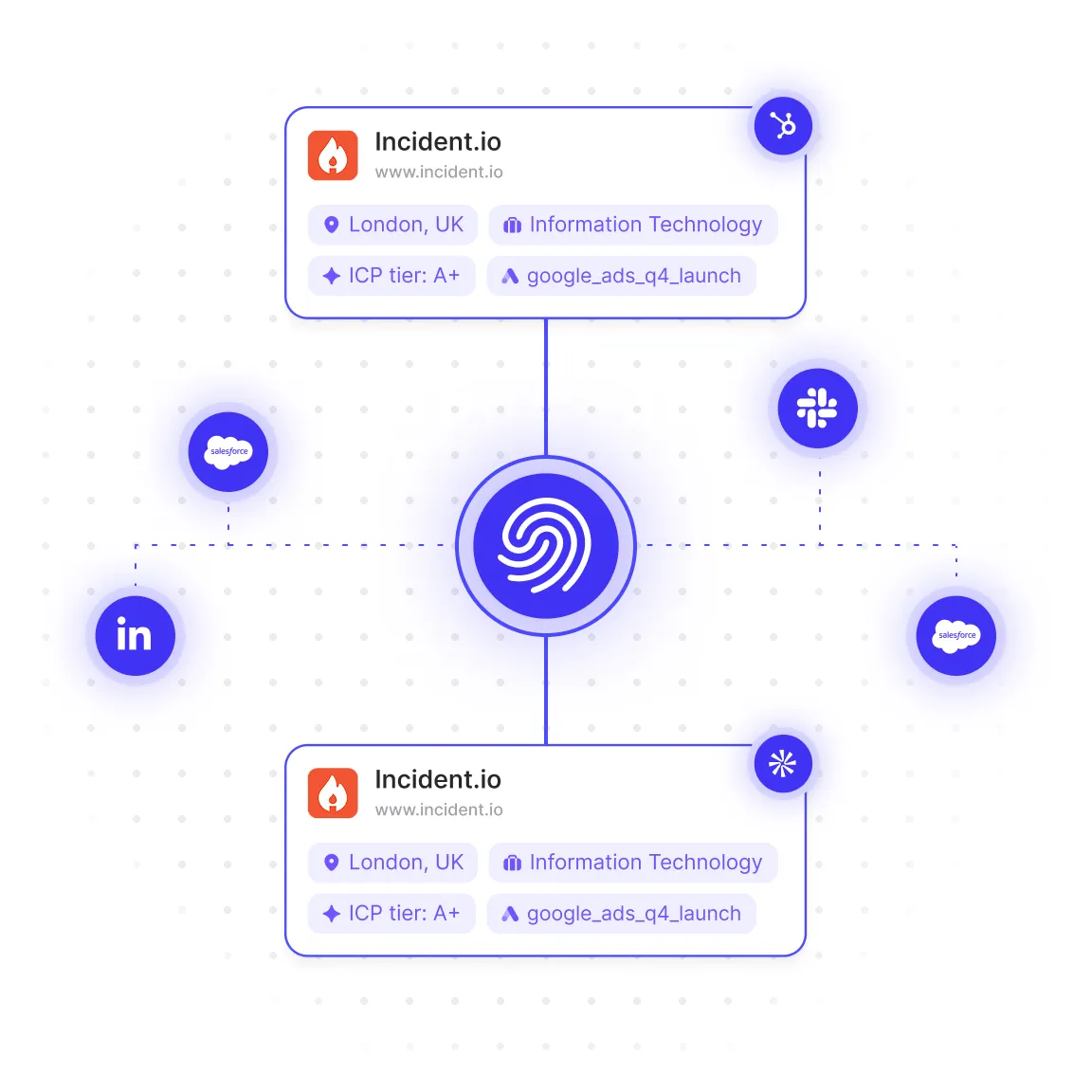
Snitcher's Automate layer is a rules-based engine that fires actions when conditions are met: pushing to CRM, alerting a rep, revealing contacts, or adding prospects to outreach sequences. The system works through triggers, routing, and two-way sync.
Source: Snitcher
Triggers are condition-based rules (new company identified, company enters segment, contact revealed) that execute instantly. Routing distributes leads to the right rep by territory, segment, or other criteria without manual assignment.
Two-way CRM sync with HubSpot, Salesforce, and Pipedrive maintains live, bidirectional data connections via real-time webhooks.
For Slack, automations route different segments to dedicated channels. ICP-matched visitors go to #sales-alerts, named accounts to #target-accounts, enterprise companies to #enterprise, each with messages including company name, industry, employee count, pages viewed, and a direct link to the Snitcher record.
Snitcher offers 16 native integrations including HubSpot, Salesforce, Pipedrive, Microsoft Dynamics, Zoho CRM, Attio, Apollo, Lemlist, Smartlead, Clay, Google Analytics, Google Ads, Slack, Teams, Zapier, and Webhooks (Beta). For tools outside this list, Zapier provides the bridge.
Contact Reveal and Outreach Delivery: Snitcher surfaces verified decision-makers at visiting companies and pushes them to your outreach tools.
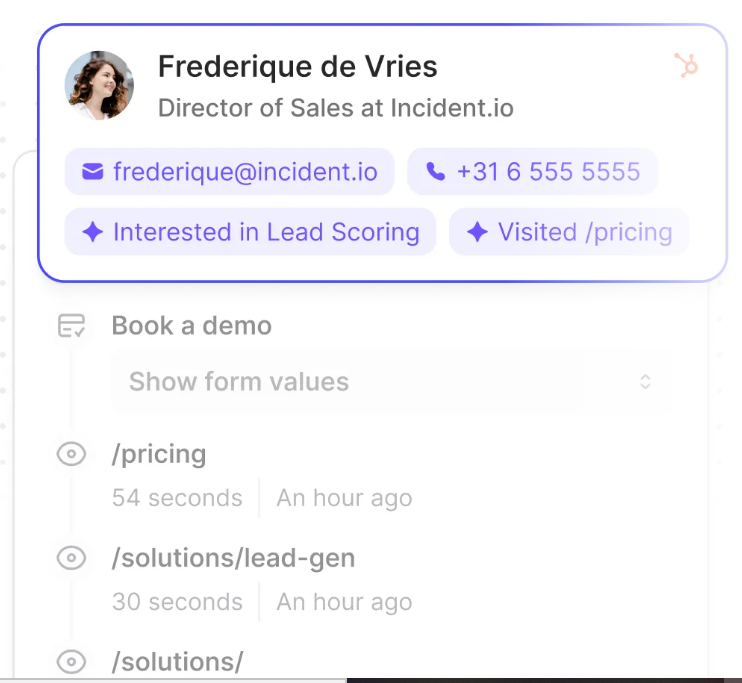
Snitcher's Engage layer bridges the gap between knowing which company visited and having someone to contact. It works across three stages: Reveal (surface verified email addresses and job titles), Match (filter contacts against your buyer persona so only relevant decision-makers appear), and Deliver (push contacts directly to Apollo, Lemlist, or CRM without manual export).
Source: Snitcher
Rather than delivering a full employee directory, Snitcher filters to the 2-3 people who match the buyer persona, cutting noise and eliminating manual org-chart research. Delivery can be triggered automatically via Automations or executed manually with a single click.
Contact reveals are credit-based. Phone numbers were added on February 16, 2026, at 5 credits per lookup from the same credit pool as email reveals. Lemlist integration passes structured data fields (company name, job title, industry) as template variables for personalized outreach.
Attribution and Measurement: Snitcher ties campaign touchpoints to identified accounts and pipeline revenue.
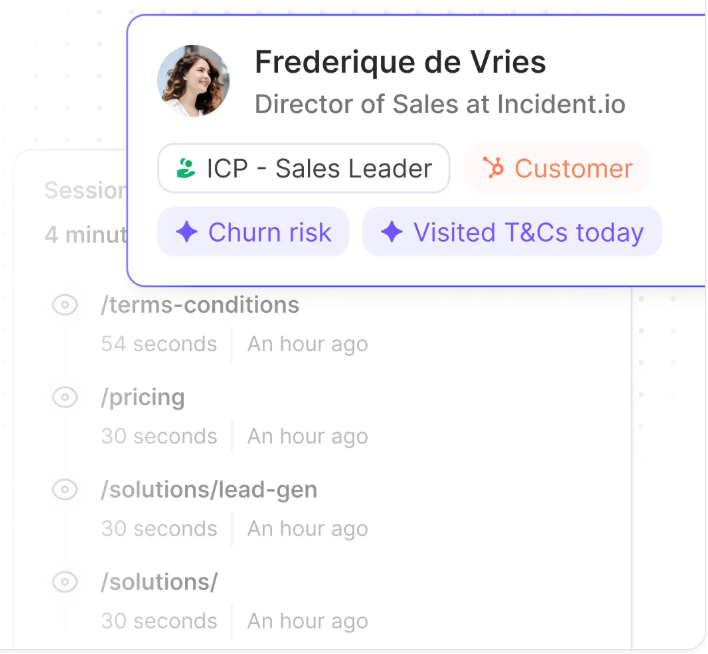
Snitcher's Measure module connects visitor identification data to CRM pipeline data using three mechanisms: historical stitching (retroactively connecting anonymous visits to known accounts), pipeline connection (linking marketing activity to CRM opportunities), and multi-touch attribution (crediting every touchpoint in the account journey).
Source: Snitcher
The HubSpot integration tracks four attribution categories: Sourced (Snitcher identified before CRM activity), Discovered (net new companies), Influenced (visited during sales cycle), and Engaged (repeat website engagement). Measure also offers churn risk detection by monitoring post-close visit patterns and unlimited data retention for long-term analysis.
Pricing: Snitcher uses usage-based pricing with no seat fees and no feature tiers.
Snitcher takes a single-plan approach where every customer gets the same full feature set. The monthly price scales by the number of unique companies identified per month:
Company IDs/month | Monthly Price |
|---|---|
0–50 | $49/mo |
51–100 | $69/mo |
101–250 | $99/mo |
251–500 | $139/mo |
501–750 | $189/mo |
751–1,000 | $229/mo |
1,001–2,000 | $279/mo |
2,001–3,000 | $349/mo |
3,001–4,000 | $439/mo |
4,001–5,000 | $529/mo |
5,000+ | Custom |
Annual billing saves about 30%. All plans include unlimited team members, CRM sync, REST API access, all features, and priority support. There is no permanent free plan, but Snitcher offers a 14-day free trial with no credit card required.
Each website requires its own separate subscription with no multi-site bundling at self-serve pricing. Annual plans require full upfront payment with no refunds under any circumstances, including mid-term cancellation.
Where Snitcher Falls Short
Snitcher does website visitor identification well. But several limitations surface when teams need more than first-party website signals to run their go-to-market motions. These gaps reflect Snitcher's focus on one slice of the GTM workflow rather than the full picture.
First-Party Website Intent Only: Snitcher tracks what happens on your own website and nothing else. It does not pull third-party buyer intent signals from sources like Bombora or G2, so it cannot identify in-market accounts that haven't visited your site.
For teams running outbound strategies, this creates a blind spot: accounts researching your category across the web but landing on competitor sites instead of yours.
No Contact and Company Database: Snitcher identifies companies that visit your site and can reveal contacts at those companies through credit-based lookups. But it offers no searchable database for proactive prospecting.
If no one from your target account visits your site, Snitcher has nothing to show you. Sales teams that need to build outbound lists, research buying committees, or find direct-dial phone numbers for cold outreach need a separate data provider.
No Conversation Intelligence: Snitcher tracks page views and session behavior, but it has no visibility into what happens after the first meeting is booked. No call recording, no transcription, no analysis of what buyers say in conversations. The platform can tell you a company visited your pricing page three times, but it can't tell you why a deal stalled or what objection the CFO raised on the last call.
Costs Escalate with Traffic Volume: The per-company-ID pricing model works well for sites with moderate traffic, but G2 reviewers note that costs rise with higher traffic volume. At $529/month for 4,001-5,000 company IDs, high-traffic sites face real costs for a single-channel intelligence tool.
Companies running content marketing or paid campaigns that drive large traffic volumes may find the model expensive for what it delivers.
Narrow Integration Footprint: With 16 native integrations and Webhooks still in Beta, Snitcher's connectivity is narrower than enterprise platforms. No native LinkedIn Ads integration exists. Teams with complex tech stacks beyond the supported tools rely on Zapier, which adds latency and maintenance overhead to workflows Snitcher otherwise tries to automate.
No Sales Automation or Marketing Orchestration: Snitcher can alert reps and push contacts to outreach tools, but it doesn't provide email sequencing, multi-channel campaign orchestration, or advertising natively. It remains an intelligence and routing layer that depends on other tools to execute.
Teams looking to consolidate their GTM stack rather than add another point solution will find Snitcher requires complementary platforms to complete the workflow.
These limitations are the natural consequence of building a focused product. But for teams that need broad B2B data, multi-source intent signals, conversation intelligence, and AI-powered execution in one platform, the gaps point toward a broader solution.
Top Snitcher Alternative for Full GTM Coverage: ZoomInfo
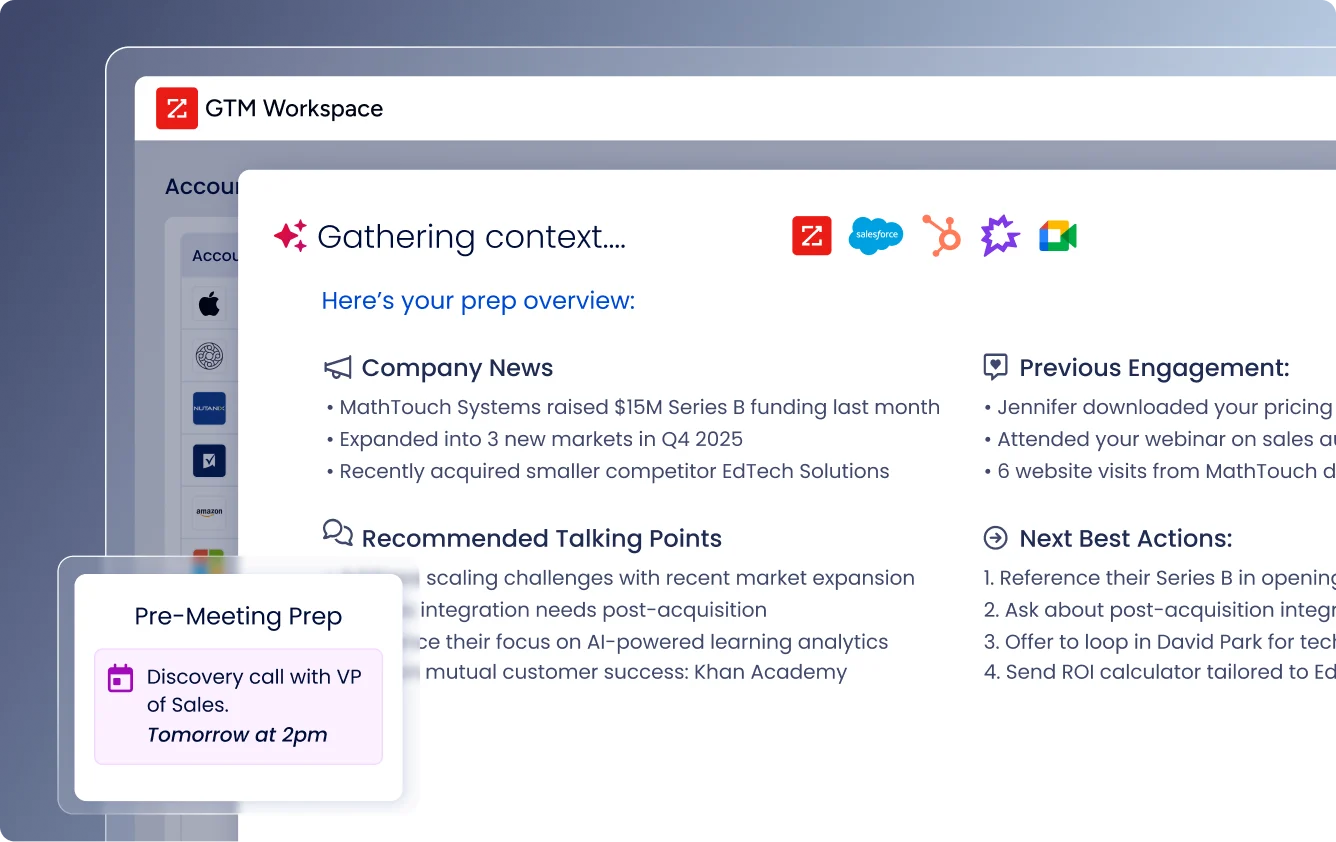
ZoomInfo is an AI GTM platform built on a large data foundation: 500M contacts, 100M companies, 135M+ verified phone numbers, and 200M+ verified business email addresses.
Its GTM Context Graph processes 1.5B+ data points daily, combining this data with your CRM records, conversation transcripts, and behavioral signals to reveal full account context (not just what happened, but why). Your team accesses that intelligence through GTM Workspace for sellers, GTM Studio for marketers and RevOps, or APIs and MCP in any other front-end.
Where Snitcher focuses on website visitor identification, ZoomInfo covers the full go-to-market motion from prospecting through closed deal.
Comprehensive B2B Data: ZoomInfo's data foundation covers contacts, companies, and signals at a scale no visitor identification tool can match.
ZoomInfo runs the largest B2B data platform: 500M contacts, 100M companies, 135M+ verified phone numbers, 120M direct-dial phone numbers, and 200M+ verified business email addresses. This data passes through a multi-source verification pipeline backed by 300+ human researchers, reaching up to 95% accuracy on first-party data.
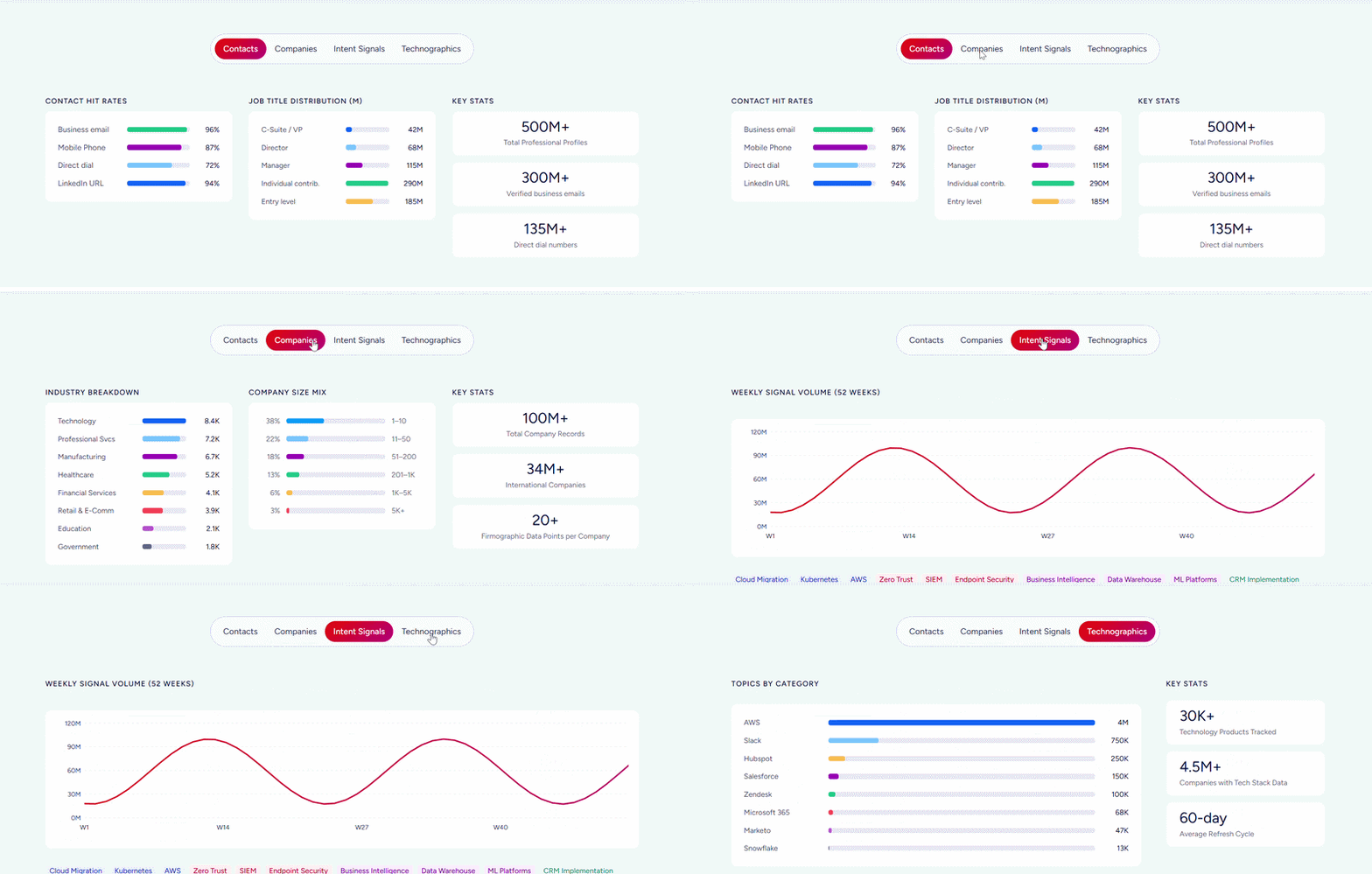
Where Snitcher reveals contacts at companies that visit your site, ZoomInfo provides a searchable database for prospecting across your entire addressable market, whether or not prospects have visited your site.
The platform includes department org charts with decision-makers' direct dials and emails, 300+ company attributes for market segmentation, technographic data covering 30,000+ technologies across 30M+ companies, and contact tracking with job-change alerts.
This data advantage holds up to outside scrutiny. In a Fortune 500 competitive RFP analyzing 25 million contacts across vendors, the independent consultant concluded that "no other competitor came even close."
ZoomInfo has been named a Leader in the Forrester Wave for Intent Data Providers B2B (Q1 2025), a Leader in the Gartner MQ for ABM Platforms (2024 & 2025), and earned 133 No. 1 rankings on G2.
"ZoomInfo gives us the information we need to execute. We don't have to spend time digging. It's already there, so we can be three steps ahead." (Vensure)
Multi-Source Intent Signals: ZoomInfo tracks buying behavior across the web, not just your own website.
Snitcher's intent data comes only from your website.
ZoomInfo's Buyer Intent tracks signals from 210 million IP-to-Organization pairings and 6 trillion+ new keyword-to-device pairings sourced monthly, spanning research activity across the broader web. ZoomInfo surfaces in-market accounts researching your category even if they never visit your site.
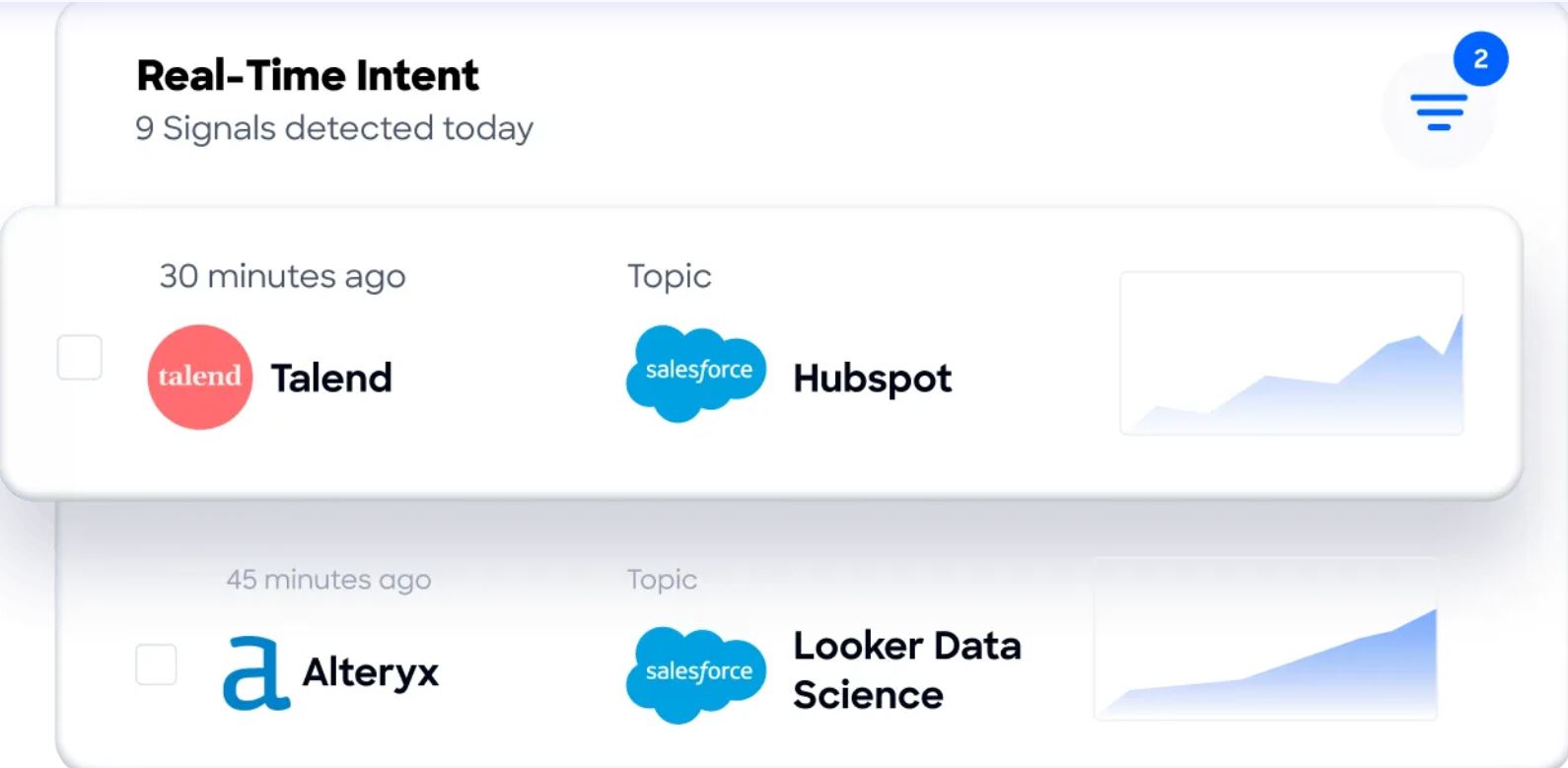
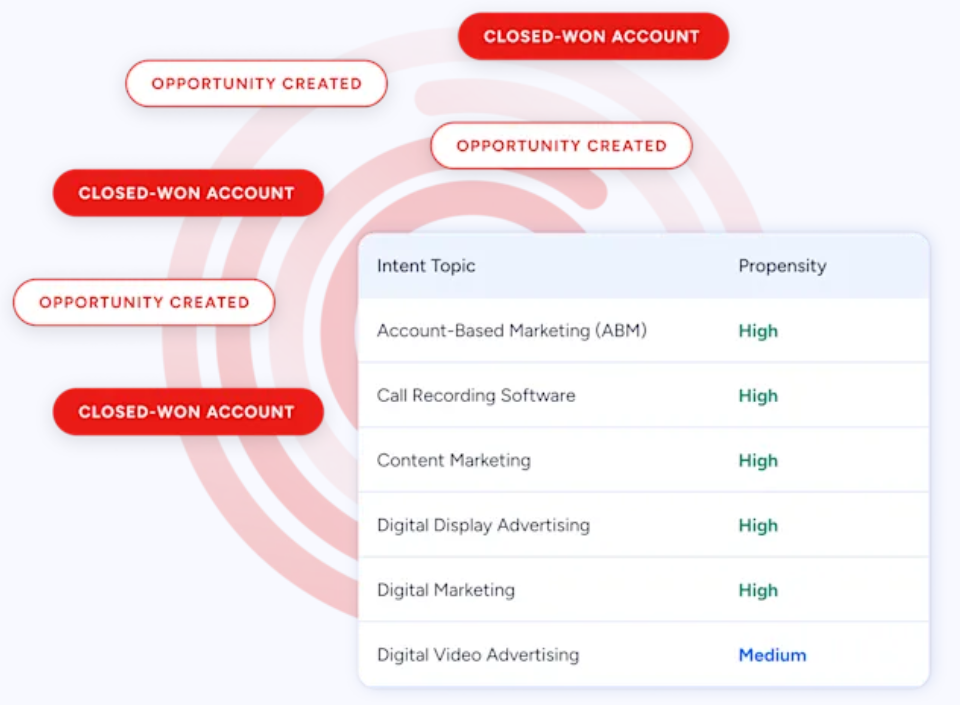
Guided Intent, exclusive to ZoomInfo, identifies topics historically correlated with deal success rather than requiring manual topic selection. Instead of guessing which keywords indicate buying behavior, the system learns from your actual win patterns.
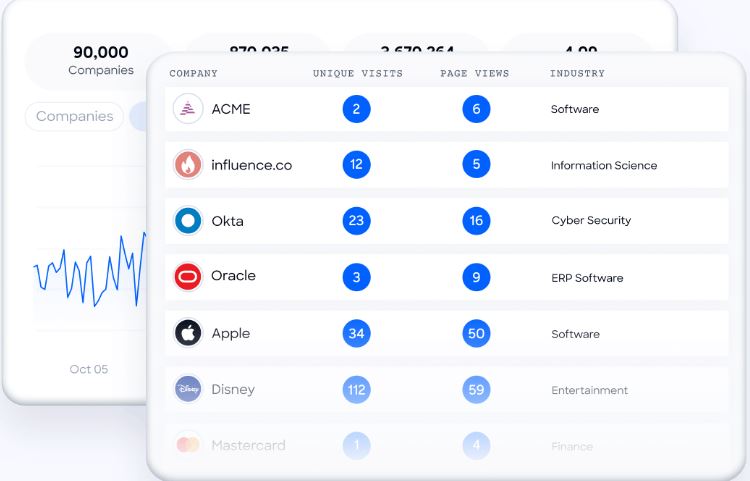
ZoomInfo also includes WebSights, which resolves anonymous website traffic to companies (similar to Snitcher's core capability) and adds Automatic Traffic Filtering to separate real company visits from bot traffic. Website visitor identification is one signal source among many, not the entire intelligence layer.
"That combination of our internal CRM data, external signals, and AI that's given all that context has helped us craft very specific account- and persona-based messages. And people have responded to them right away." (Seismic)
GTM Context Graph and AI-Powered Execution: ZoomInfo's intelligence layer captures not just what happened, but why.
The GTM Context Graph separates ZoomInfo from data providers and point solutions. It fuses ZoomInfo's B2B data with a customer's CRM records, conversation transcripts (captured by Chorus, ZoomInfo's conversation intelligence product), email interactions, and behavioral signals into a single intelligence layer that processes 1.5B+ data points daily.
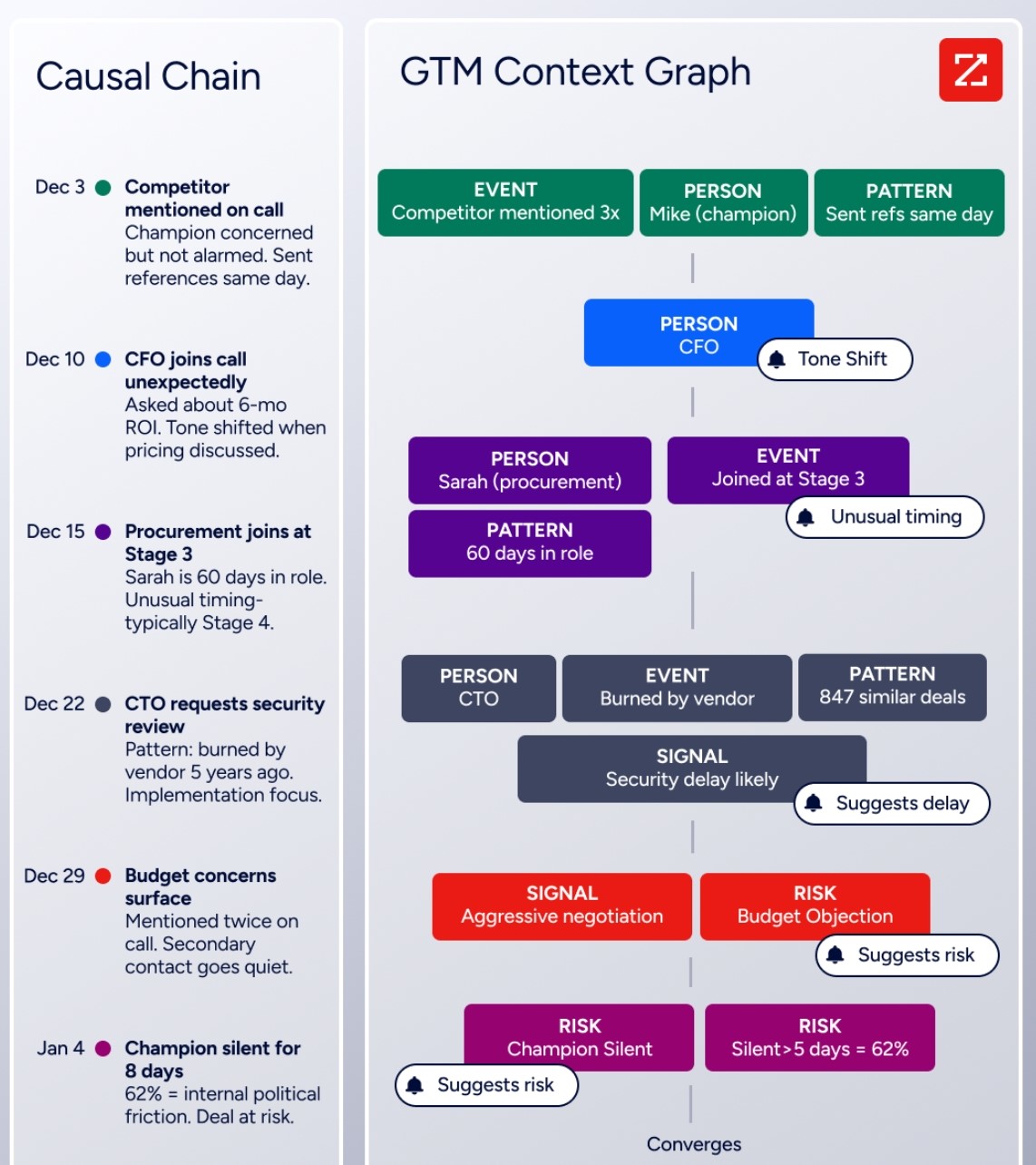
This matters because Snitcher can tell you a company visited your pricing page. ZoomInfo's GTM Context Graph can tell you that the CFO joined the last sales call, asked about ROI timelines, and that this pattern of executive engagement matches your historical win patterns for deals at this stage.
It captures the connections between signals and outcomes, giving AI the context to recommend specific next actions rather than generic alerts.
That intelligence reaches teams through three access points. GTM Workspace gives sellers a single surface where prioritized accounts, AI-drafted outreach, and deal execution converge.
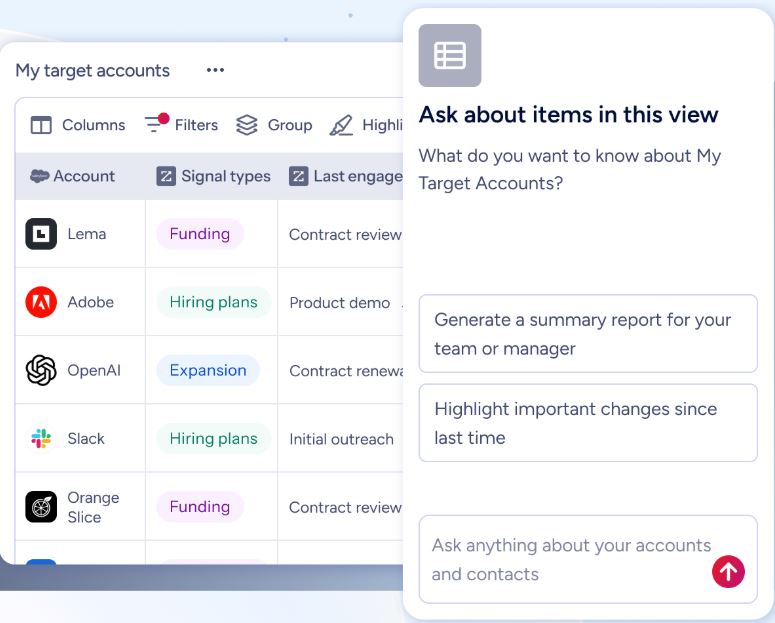
GTM Studio gives marketers, RevOps, and GTM engineers a builder environment where audience definition, campaign orchestration, and pipeline measurement happen in natural language.
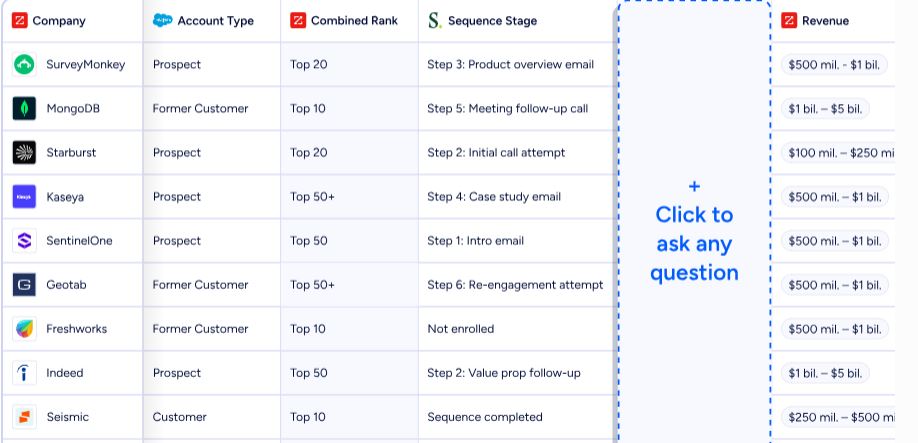
And APIs and MCP expose the same intelligence to any custom agent, internal tool, or partner platform.
"ZoomInfo's not just a contact data company anymore. They've built a full system of execution. GTM Intelligence works the list, writes the outreach, triggers the play, and helps drive predictable growth." (Levanta)
Pricing and Access: ZoomInfo offers a permanent free tier and consumption-based plans for teams of any size.
ZoomInfo uses a consumption-based pricing model with no publicly listed prices for paid tiers. Pricing scales around data access, API consumption, AI activity, and credit volume, and is custom-quoted based on usage patterns.
However, ZoomInfo provides two free entry points that Snitcher does not:
ZoomInfo Lite is a permanent free tier (not a trial) that includes access to ZoomInfo's B2B database with 100M+ verified profiles, 10 monthly export credits, individual and company searches with advanced filters, the ReachOut Chrome Extension and mobile app, WebSights Lite (up to 10 website visitor reveals per day), built-in email sending, HubSpot integration, and CRM data enrichment.
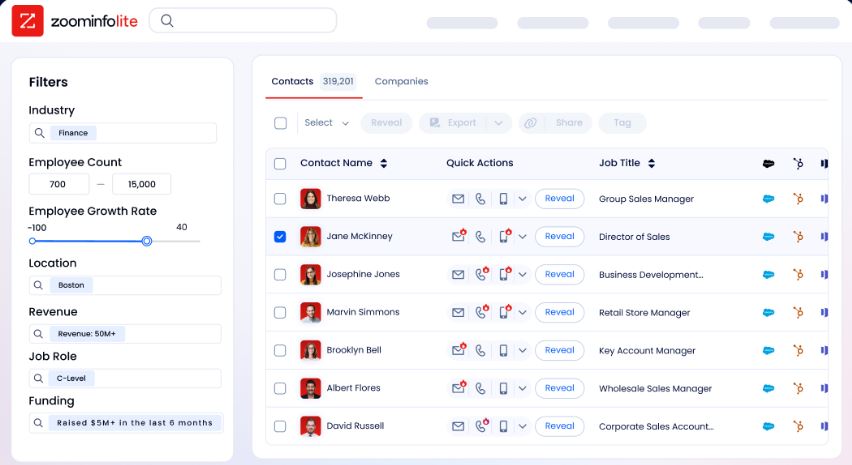
A 7-day free trial (no credit card required) is also available for evaluating paid features including full intent signals and advanced capabilities.
Paid plans are organized across Sales, Marketing, and standalone products (Chorus, Chat), each with tiered feature access. API access is included in all relevant plans.
Snitcher or ZoomInfo: Comparison Summary
Snitcher | ZoomInfo | |
|---|---|---|
Primary focus | Website visitor identification | AI GTM platform |
Target audience | SMB to mid-market B2B GTM teams | Mid-market to enterprise B2B organizations |
Contact database | Credit-based reveals at visiting companies only | 500M contacts, 120M direct dials, 200M+ verified business emails |
Website visitor identification | Core product, strong match rates | WebSights (included as one capability) |
Intent data sources | First-party website intent only | First-party website + third-party web-wide intent (6T+ signals/month) |
Conversation intelligence | Not available | Chorus (call recording, transcription, AI analysis) |
Sales automation | Push contacts to Apollo, Lemlist, Smartlead | Native sequencing via Salesloft partnership + AI-drafted outreach |
Marketing / ABM | Campaign attribution only | Native DSP, FormComplete, multi-channel orchestration |
AI capabilities | AI-generated account summaries | GTM Context Graph, AI agents, AI-drafted outreach and account research |
CRM integrations | HubSpot, Salesforce, Pipedrive, Zoho, Dynamics, Attio | Salesforce, HubSpot, Dynamics + 120 marketplace integrations |
API / MCP access | REST API on all plans (60 req/min) | Enterprise API + MCP on all relevant plans |
Free tier | 14-day trial only (no permanent free plan) | ZoomInfo Lite (permanent free) + 7-day trial |
Pricing model | Usage-based, starts at $49/mo | Consumption-based, custom-quoted |
Seat fees | None (unlimited team members) | Seat-based within tiers |
GDPR compliance | GDPR compliant, AWS Frankfurt | ISO 27001, ISO 27701, SOC 2 Type II, TRUSTe GDPR/CCPA |
Best for | Teams focused on converting website traffic to pipeline | Teams needing full GTM execution from data to closed deal |
Final Verdict
The choice between Snitcher and ZoomInfo depends on where you are in your GTM maturity and how much of the workflow you want one platform to handle.
Choose Snitcher if your primary need is turning anonymous website visitors into pipeline. It does this specific job well: strong identification match rates, fast setup, affordable entry pricing, and clean integrations with CRM and outreach tools.
For B2B teams with steady website traffic that want focused visitor intelligence without the complexity of a full GTM platform, Snitcher delivers clear value at a predictable cost. Its unlimited-seats, all-features-included pricing makes it practical for small teams that want the full toolset without negotiating enterprise contracts.
Choose ZoomInfo if you need more than website visitor data to drive your go-to-market strategy. Where Snitcher shows you who visited your pricing page, ZoomInfo shows you who visited, who else at that company you should talk to, what they're researching across the web, what happened on your last call with them, and what to say next.
For teams ready to consolidate their GTM stack around one platform rather than stitching together point solutions, ZoomInfo delivers the data, intelligence, and execution layer to make that possible.
Get started with ZoomInfo for free here.
Snitcher FAQ
What does Snitcher do?
Snitcher identifies the anonymous companies visiting your B2B website using IP-to-company resolution, then enriches those visits with firmographic data, intent scoring, and contact information. The platform turns website traffic into sales pipeline by alerting reps when target accounts browse and pushing verified contacts to CRM and outreach tools.
It captures what Snitcher describes as the 97% of B2B visitors who never fill out a form.
How accurate is Snitcher's visitor identification?
Snitcher competes on identification accuracy and has multiple customer validations supporting its match rates. Praveen Das, Co-founder of Factors.ai, stated that they tested multiple providers and none came close to Snitcher's identification rates. A Waylay case study reports identifying 2x more visitors after switching to Snitcher.
However, like all IP-based identification tools, accuracy depends on the visitor's network. Traffic from VPNs, shared ISP connections, or mobile networks will be harder to resolve.
How much does Snitcher cost?
Snitcher uses usage-based pricing starting at $49/month for up to 50 company identifications, scaling to $529/month for 4,001-5,000 identifications, with custom pricing above 5,000. Annual billing saves about 30%. All plans include the full feature set with unlimited team members and no seat fees.
There is no permanent free plan, but a 14-day free trial requires no credit card. Each website needs its own subscription.
Does Snitcher identify individual people or just companies?
Core identification is at the company level using IP-to-company resolution. Person-level identification requires the Identity Layer, which captures individual emails through form submissions, logins, or email link clicks. Snitcher does not identify anonymous individuals by default.
Contact reveals for people at identified companies are available through credit-based lookups that surface verified emails, job titles, and (as of February 2026) phone numbers.
What CRM integrations does Snitcher support?
Snitcher offers 16 native integrations including HubSpot, Salesforce, Pipedrive, Microsoft Dynamics, Zoho CRM, and Attio for CRM. Sales engagement integrations include Apollo, Lemlist, and Smartlead. Additional integrations cover Slack, Microsoft Teams, Google Analytics, Google Ads, Clay, and Zapier. Webhooks are available in Beta.
ZoomInfo, by comparison, offers 120+ marketplace integrations plus Enterprise API and MCP access for connecting to any tool.
Can Snitcher track intent signals beyond my website?
No. Snitcher tracks only first-party website intent. It records what companies do on your website (pages visited, time on site, return visits) but does not pull third-party buyer intent signals from the broader web. Snitcher cannot surface accounts researching your category on competitor sites, review platforms, or industry publications. ZoomInfo tracks intent across 210 million IP-to-Organization pairings and 6 trillion+ keyword-to-device pairings monthly from web-wide sources.
Is Snitcher GDPR compliant?
Yes. Snitcher operates under a legitimate interest legal basis under GDPR Article 6(f). All visitor data is collected and stored on AWS eu-central-1 (Frankfurt, Germany), encrypted in transit and at rest. The company maintains a trust center at trust.snitcher.com.
Core identification uses only company-level data; person-level identification occurs only when visitors voluntarily provide their email. Snitcher also supports consent management platforms like OneTrust and Cookiebot via a built-in waitForConsent configuration option.
Does Snitcher offer a white-label or API product?
Yes. Snitcher offers two infrastructure products beyond the core platform. Radar is a white-label visitor identification product that lets SaaS platforms embed visitor intelligence into their own products under their own brand.
The IP to Company API is a standalone REST endpoint that resolves any IP address to firmographic company data. Both are priced separately via sales and used by companies like Clay, Lemlist, RudderStack, and People.ai.
