
Spekit solved a problem that has frustrated revenue teams for years: reps know the knowledge exists somewhere, but they can't find it when they need it. Instead of building another content portal that reps ignore, Spekit embeds coaching, playbooks, and process guidance inside the tools where selling actually happens (Salesforce, Gmail, Gong, and others) through a browser extension that surfaces the right answer at the right moment.
To write this Spekit review, we analyzed the platform extensively. We believe it's the ideal choice if:
You need enablement content delivered inside the tools reps already use, not in a separate portal
You want to compress new rep ramp time through in-workflow learning
You need a governed, single source of truth for sales content that stays current automatically
Your CRM is Salesforce and you want embedded guidance attached to fields and processes
You prioritize ease of use and fast implementation over feature breadth
However, Spekit is not sufficient on its own if:
You need external buyer intelligence to know which accounts to target and when
You require verified contact data, direct-dial phone numbers, and business emails for prospecting
You want intent signals that reveal which companies are actively researching solutions like yours
You need a single view connecting your internal deal context with third-party market intelligence
Spekit excels at helping reps execute once they're in a deal. But knowing how to sell is only half the equation. The other half is knowing who to sell to, when to engage, and what signals indicate a deal is ready to move.
That external intelligence sits outside Spekit's scope entirely, and it's where ZoomInfo fits naturally into the stack.
ZoomInfo is an AI GTM platform built on a large B2B data foundation: 500M contacts, 100M companies, 135M+ verified phone numbers, and 200M+ verified business emails. Its GTM Context Graph combines this data with your CRM records, conversation transcripts, and behavioral signals to reveal the full context of your accounts, not just what happened in a deal, but why, and which actions to take next.
We've included a detailed look at ZoomInfo later in this Spekit review as the natural complement for teams that need external buyer intelligence alongside internal enablement. If you're ready to explore how ZoomInfo's data and AI can support your prospecting and deal execution, you can start with a free trial.
What is Spekit?
Spekit is an AI-powered revenue enablement platform founded in 2018 in Denver, Colorado, by Melanie Fellay (CEO) and Zari Zahra (CTO). The founding story is practical: Fellay had managed a Salesforce implementation at a previous employer and watched the company spend hundreds of thousands of dollars on training that failed because it was disconnected from employees' actual workflows. As Fellay described it: "We didn't launch the company because of some grand aspiration to become entrepreneurs. We were just two people who were tired of doing things the way they'd always been done."
The platform launched at Salesforce's Dreamforce conference and initially focused on Salesforce training, embedding contextual help inside the CRM. Spekit coined the philosophy "Just-in-Time Enablement" and has since expanded from a digital adoption tool into a revenue enablement platform organized around four pillars: a GTM Knowledge Engine, Agentic Coaching and Actions, Personalized Buyer Experiences, and Unified Deal Context.
The company has raised approximately $60 million in venture funding, including a $45 million Series B led by Craft Ventures in January 2022. In November 2025, Spekit was named a Visionary in the 2025 Gartner Magic Quadrant for Revenue Enablement Platforms. Named customers include Southwest Airlines, InMoment, Justworks, iHeartRadio, Q4, Ibotta, and Scholastic.
Spekit's target buyer sits at the intersection of sales leadership and revenue operations: CROs, enablement teams, and sales leaders at mid-market to enterprise B2B companies, particularly those running Salesforce and Gong.
Spekit Pros & Cons
Pros | Cons |
|---|---|
- In-workflow delivery via Chrome extension eliminates portal fatigue | - No public pricing; requires sales engagement |
- 4.8/5 on G2 with 9.2 Ease of Use rating | - Analytics and revenue attribution need manual assembly |
- AI Sidekick provides contextual coaching without tab switching | - Salesforce-centric; reduced value for HubSpot or Dynamics users |
- Content governance flags stale material automatically | - Content migration from legacy systems is manual |
- Fast implementation (G2's Fastest Time to ROI) | - Chrome extension can break during version updates |
- Deal Rooms with buyer engagement tracking | - Multi-language support rated 7.8/10 on G2 |
- Learning Paths embedded in daily tools | - No free plan or self-serve trial available |
- Strong customer support (G2 Quality of Support: 9.5) | - Cannot schedule Spotlights or save Speks as drafts |
Spekit Review: How it Works & Key Features
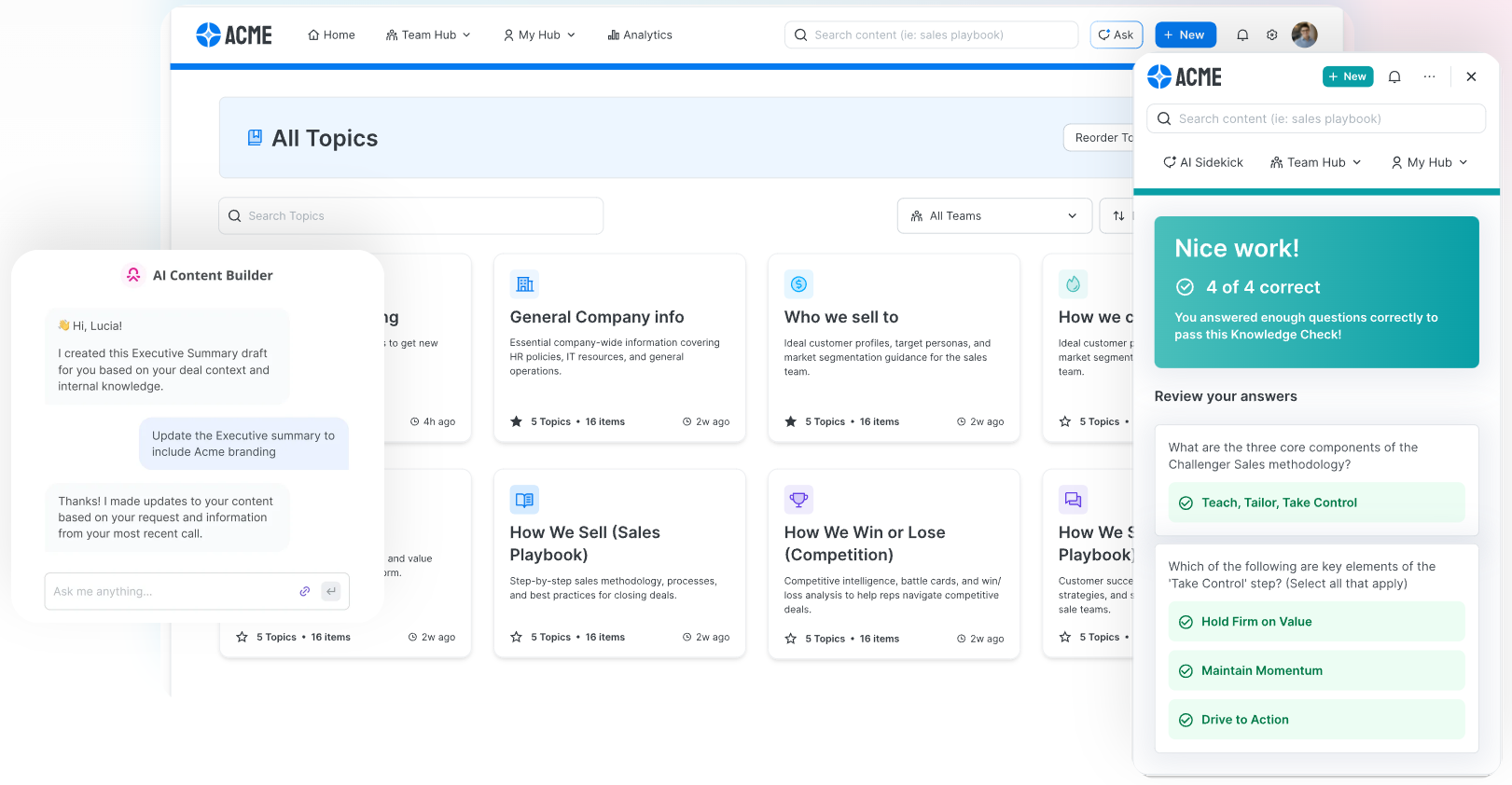
GTM Knowledge Engine: Spekit centralizes sales content in a governed system that keeps itself current.
The GTM Knowledge Engine is the foundation of Spekit's platform. It serves as the content management layer where enablement teams create, organize, and govern all sales knowledge, from battlecards and playbooks to process documentation and competitive intel.
Content is built around modular units called Speks, the building blocks that power every rep-facing surface on the platform. These can be created manually, generated with the AI Content Builder using templates and natural language prompts, or synced from existing repositories. Connectors sync with Google Drive, SharePoint, and Confluence so content stays current without manual imports.
Source: Spekit
What makes this more than a standard CMS is the governance layer. The Governance Dashboard monitors content freshness, flags outdated material, detects conflicts, and tracks ownership. When source material changes, Spekit updates every surface that references it automatically: Sidekick answers, Learning Paths, and Deal Room assets all reflect the update without manual edits. AI auto-tagging categorizes and indexes content so reps find what they need without admin overhead.
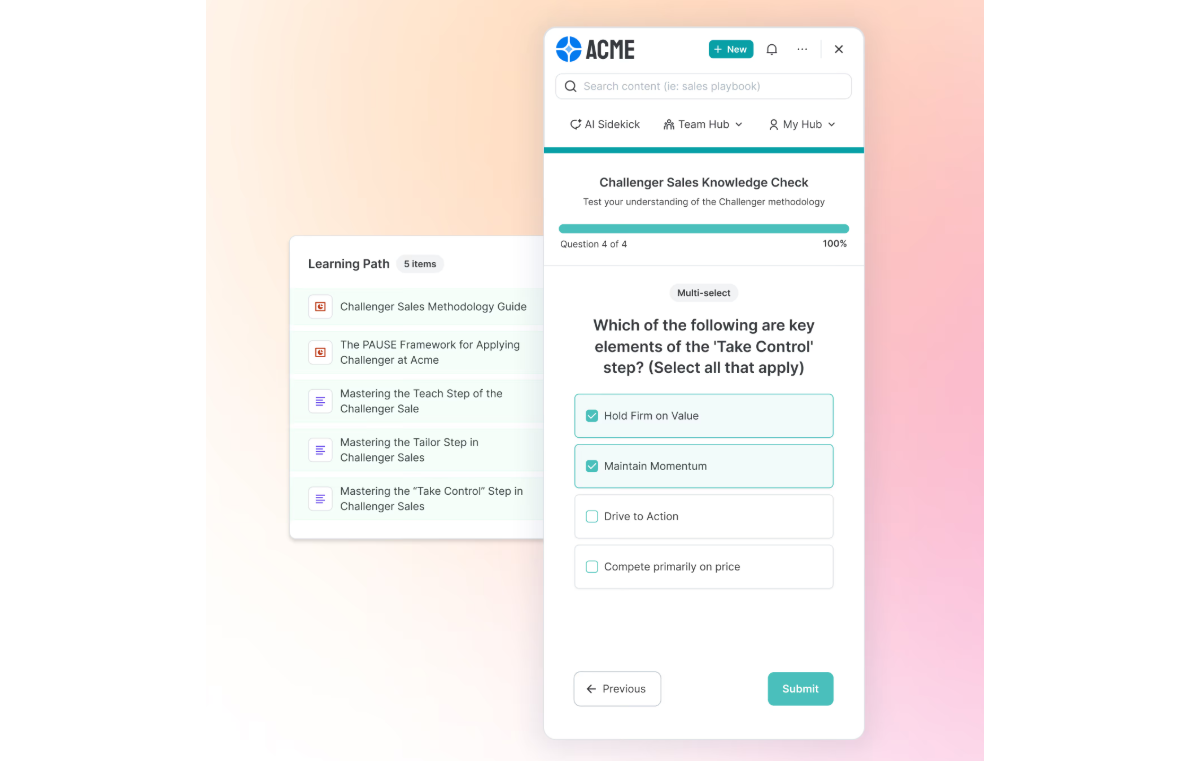
The Knowledge Engine also includes Learning Paths: structured, role-based learning programs built from the same Speks that power the knowledge base. These support onboarding for new reps and ongoing training for experienced ones, with optional Knowledge Checks (embedded quizzes that can be AI-generated). Learning Paths are delivered through the Chrome extension inside Salesforce, Gmail, and Gong, not in a separate LMS portal.
Source: Spekit
AI Sidekick: Spekit's browser-native assistant delivers coaching and content without requiring reps to leave their current tool.
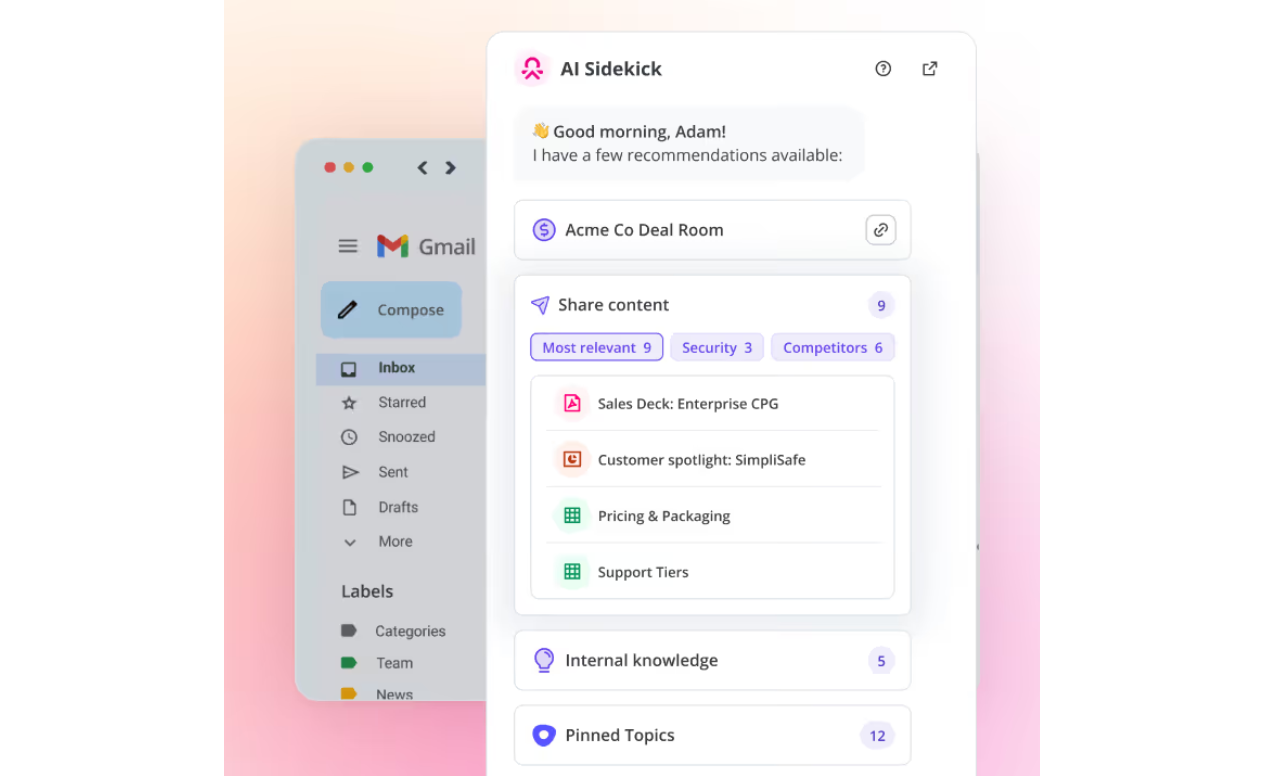
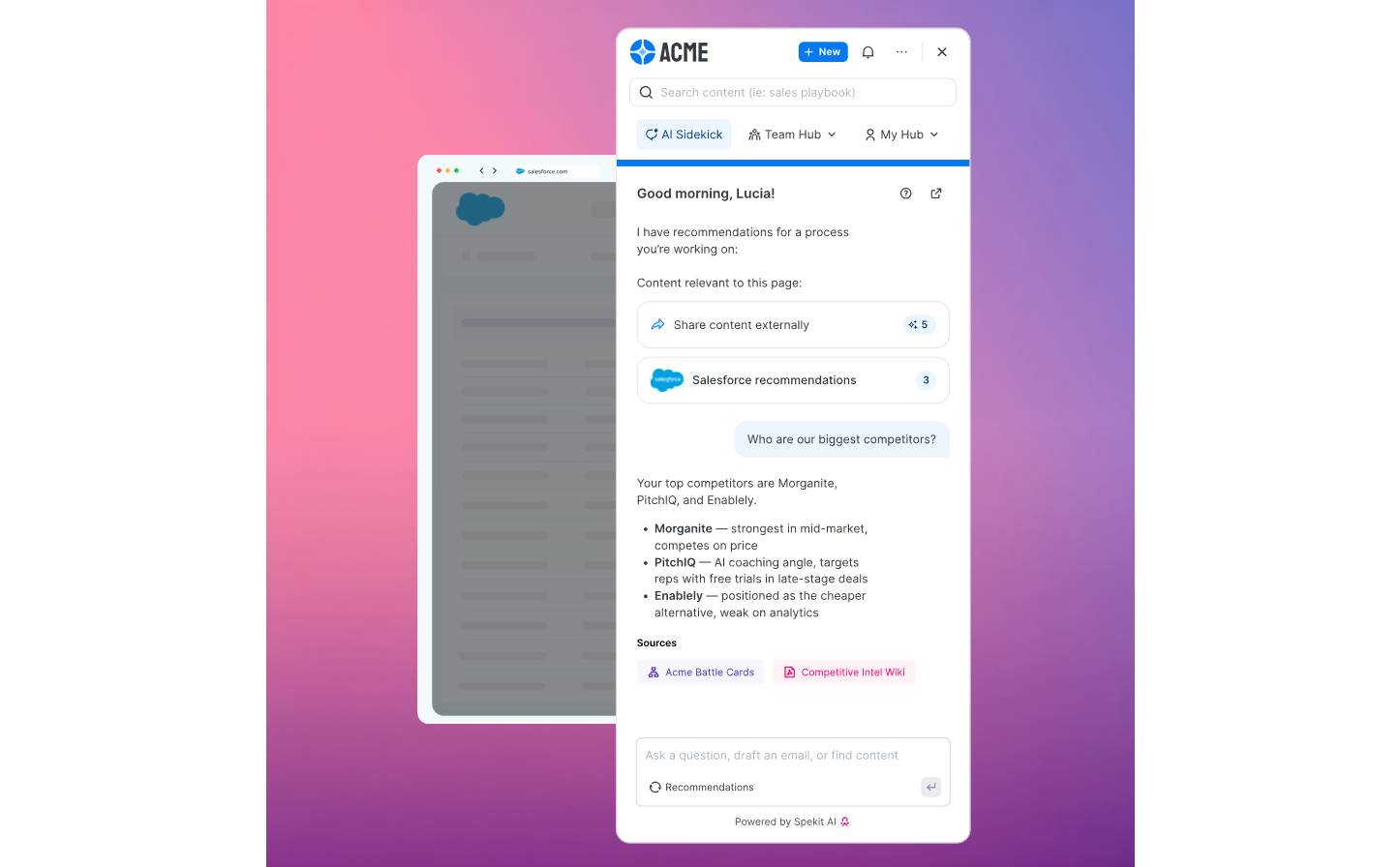
AI Sidekick is Spekit's most distinctive feature. It runs as a Chrome extension overlaying whatever tool a rep is using (Gmail, Gong, Salesforce, Outlook, LinkedIn) and provides coaching, content recommendations, and automated actions based on deal context.
Source: Spekit
Sidekick draws from two data sources: the company's approved GTM knowledge in the Knowledge Engine, and deal context pulled from Salesforce opportunity data and Gong call transcripts. This lets it surface guidance specific to the deal a rep is working on, not generic playbook content.
The system is designed to act before the rep asks. When a competitor comes up on a call, the relevant battlecard appears. When a deal advances to a new stage, exit criteria and play guidance surface in the rep's current view. After calls, Sidekick reviews Gong transcripts to identify key moments and action items, then recommends relevant knowledge based on what was discussed.
Source: Spekit
Beyond surfacing information, Sidekick executes tasks: drafting follow-up emails using live deal and call context, generating executive summaries from Gong call intelligence, and assembling Deal Rooms preloaded with stage-appropriate content. All outputs are grounded in the company's approved messaging, not generic AI training data.
Deal Rooms: Spekit creates personalized buyer-facing spaces with engagement tracking.
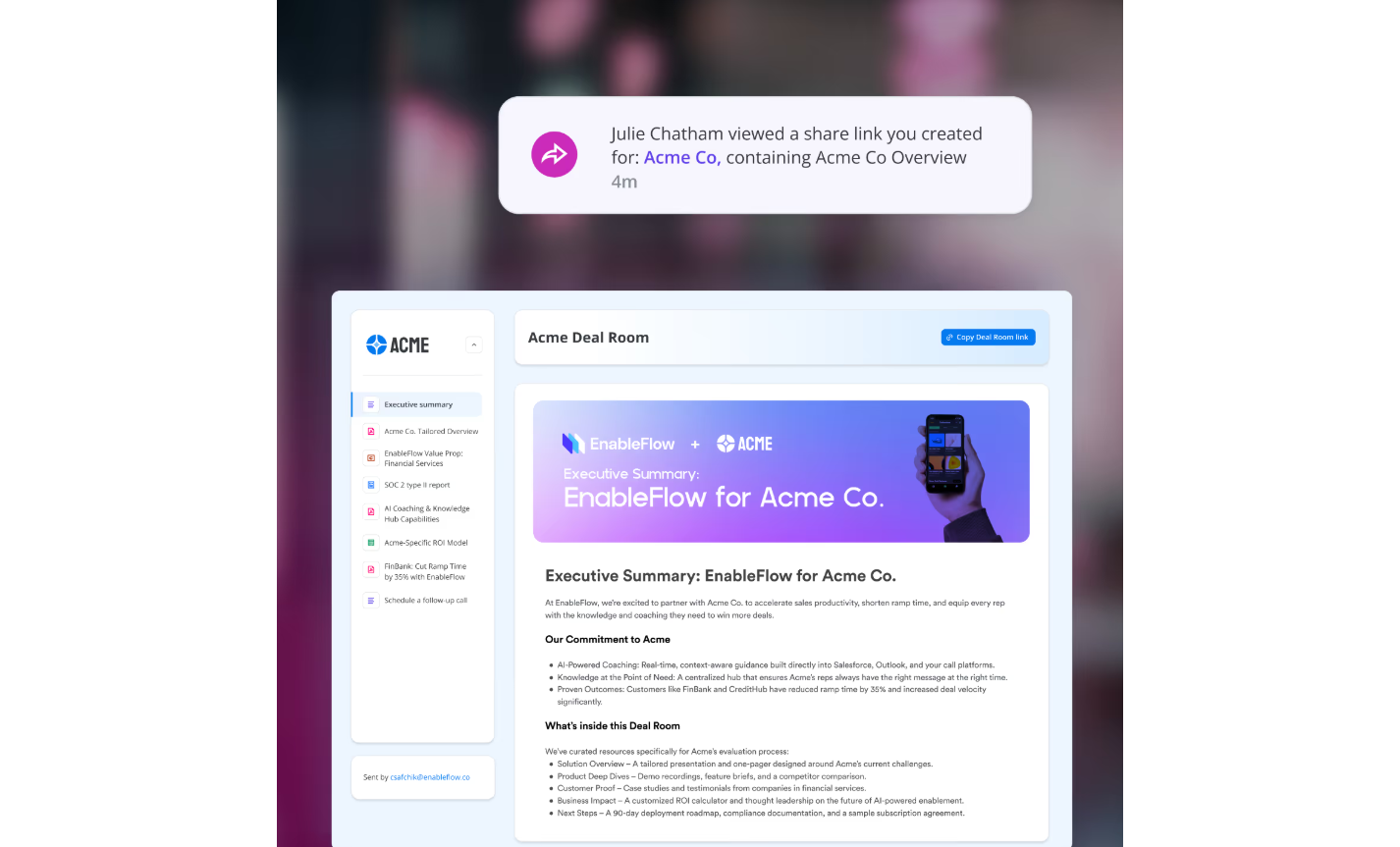
Deal Rooms are branded digital spaces created for each opportunity. Rather than sending static attachments that go stale as deals evolve, reps generate Deal Rooms where content stays current because it syncs from governed sources in the Knowledge Engine.
Source: Spekit
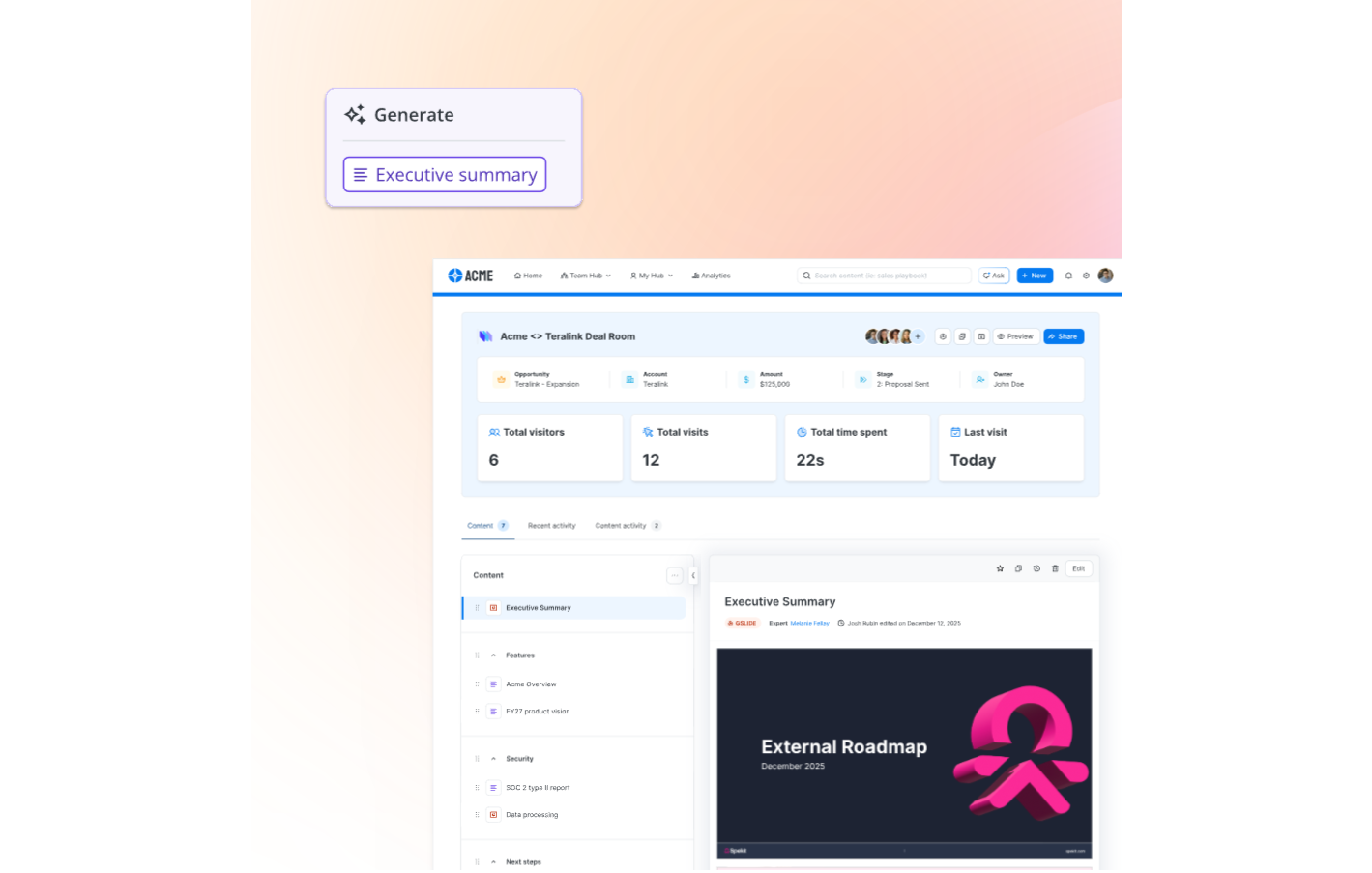
The AI Content Builder can generate Deal Room content (follow-up emails, executive summaries, and presentations) from a single prompt in under 30 seconds, pulling from Gong call transcripts and Salesforce opportunity data. Content within a Deal Room is organized by stakeholder so each person in the buying committee sees material relevant to their role.
The engagement layer tracks who visited, which assets they spent time on, and which stakeholders have not yet engaged. Reps and managers receive notifications when buyers engage, including alerts when previously active stakeholders go quiet. Spekit positions Deal Rooms for prospecting, opportunities, onboarding, and expansion/renewal conversations, extending beyond the initial sale.
Source: Spekit
Unified Deal Context: Spekit aggregates CRM, call intelligence, and email data into one view inside the rep's workflow.
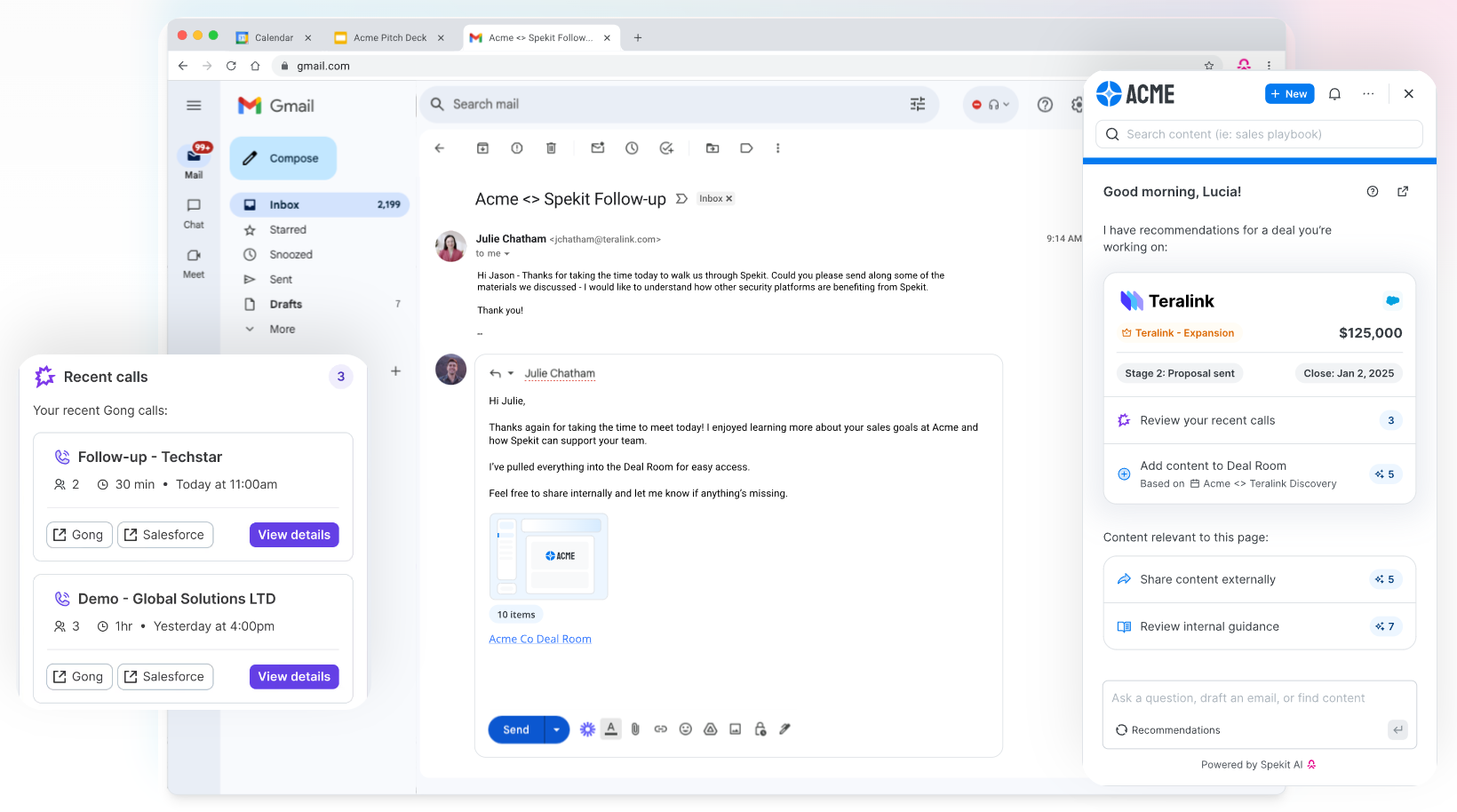
Unified Deal Context assembles data from Salesforce, Gong, and email into a connected view delivered through AI Sidekick. The system works through automatic deal detection: in email, Spekit detects the domain to match the active Salesforce opportunity, then surfaces relevant Gong call intelligence and content recommendations without any manual lookup.
In practice, a rep composing a follow-up email in Gmail sees the deal stage, last call summary, and recommended content in a sidebar panel. After meetings, Spekit pulls Gong transcripts and Salesforce opportunity data to generate follow-up emails and executive summaries grounded in what actually happened on the call.
Source: Spekit
The Salesforce integration is a no-code, one-click, two-way sync. Spekit describes itself as "the only enablement platform that automatically updates as Salesforce changes", tracking new fields and updates to the org automatically. Embedded Enablement attaches guidance directly to Salesforce fields and workflow steps, so process documentation appears in context when a rep updates a deal record.
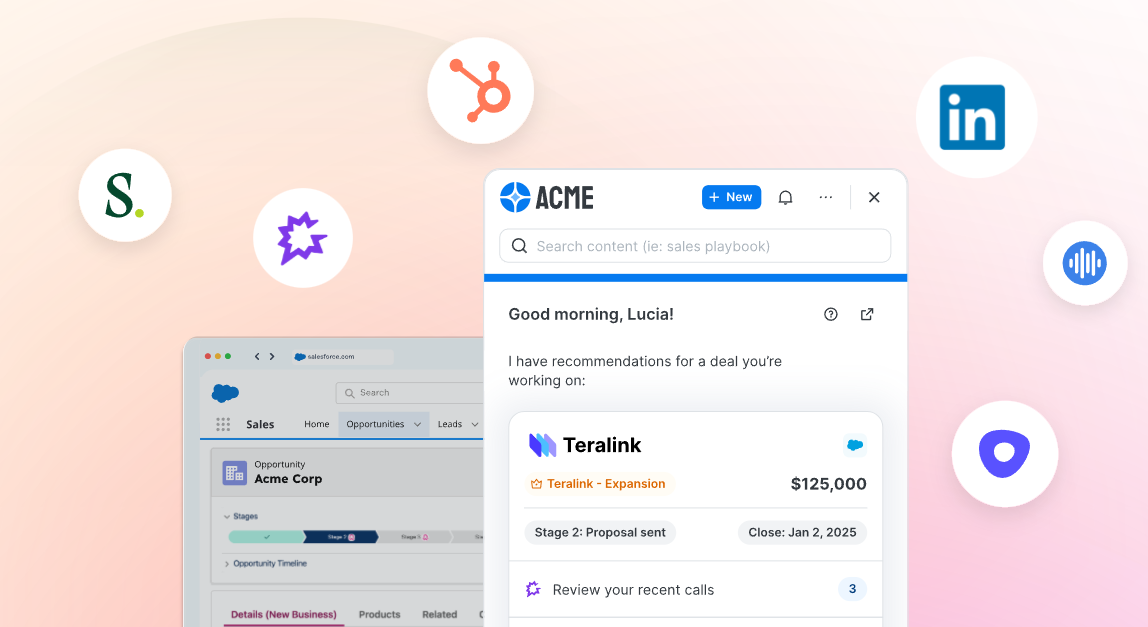
Integrations and Deployment: Spekit connects through a Chrome extension and native integrations with core selling tools.
Spekit's integration model centers on the Chrome Extension, which works across any browser-based tool. Native integrations include Salesforce (featured, with AppExchange listing), Gong (Spekit joined the Gong Collective in November 2025), Gmail and Outlook, Google Drive, SharePoint, and Confluence (content sync), Slack (knowledge base search), and integrations with Outreach, Salesloft, Chorus, Zendesk, and HubSpot.
Source: Spekit
SSO is supported through Okta, PingOne, and Azure Active Directory with SCIM and JIT provisioning. Security includes SOC 2 Type II certification, GDPR and CCPA compliance, and Salesforce security review certification. An Outlook add-in is available alongside the Chrome extension.
Where Spekit Falls Short
Spekit's design philosophy (embedding enablement inside existing tools rather than building a destination platform) is its greatest strength. But that same philosophy creates boundaries that show as teams scale or broaden their requirements.
No External Buyer Intelligence. Spekit governs what reps know and coaches how they sell. It does not provide data about who to sell to or when to engage. There are no contact databases, no company data, no intent signals revealing which accounts are actively researching solutions. Reps still need a separate source for prospecting data, verified phone numbers, and buyer signals. Spekit tells you how to run the play; it doesn't tell you which accounts are ready for it.
Analytics That Stop Short of Revenue Attribution. Spekit tracks content engagement, learning completion, and adoption metrics well. But connecting enablement activity to pipeline velocity and closed-won revenue requires manual assembly. For enablement leaders who need to demonstrate ROI to their CRO, this gap means exporting data and building the attribution story outside the platform.
Salesforce Dependency. Spekit's best features (deal context, stage-based coaching, embedded guidance, bi-directional sync) are built around Salesforce. Teams running HubSpot, Microsoft Dynamics, or other CRMs get a reduced experience. The deal intelligence features that connect Gong transcripts to opportunity data rely on Salesforce as the connecting layer. Adding a new Salesforce field also requires a manual resync that takes 5-10 minutes, a minor friction point that compounds for admins managing frequent org changes.
No Public Pricing or Free Trial. Spekit's pricing page shows only a demo request form. No tiers, per-seat rates, or feature comparison tables are published. There is no self-serve signup or free plan. For teams evaluating enablement platforms, this creates friction: you cannot test Spekit's workflow delivery model without engaging sales first. Contracts auto-renew for consecutive 12-month periods and early termination requires payment of all remaining fees through the end of the term.
Content Migration and Workflow Gaps. Teams migrating from Confluence, Highspot, or other legacy platforms report no automated importer tool, making initial migration manual and time-consuming. The platform also lacks the ability to schedule Spotlights in advance or save Speks as drafts, limiting enablement teams managing coordinated launch calendars. Multi-language support scores 7.8 on G2, a constraint for global revenue teams.
These limitations are design choices, not failures. Spekit optimized for in-workflow delivery and ease of use rather than trying to become an all-in-one revenue platform. But they highlight a clear gap: Spekit makes reps better at executing deals once engaged, but the external intelligence that identifies which deals to pursue, which buyers to contact, and which signals indicate readiness sits outside its scope.
The Natural Complement to Spekit: ZoomInfo
ZoomInfo fills the intelligence gap that Spekit's enablement layer doesn't address. Where Spekit governs how reps sell, ZoomInfo provides the who, when, and why behind every go-to-market motion.
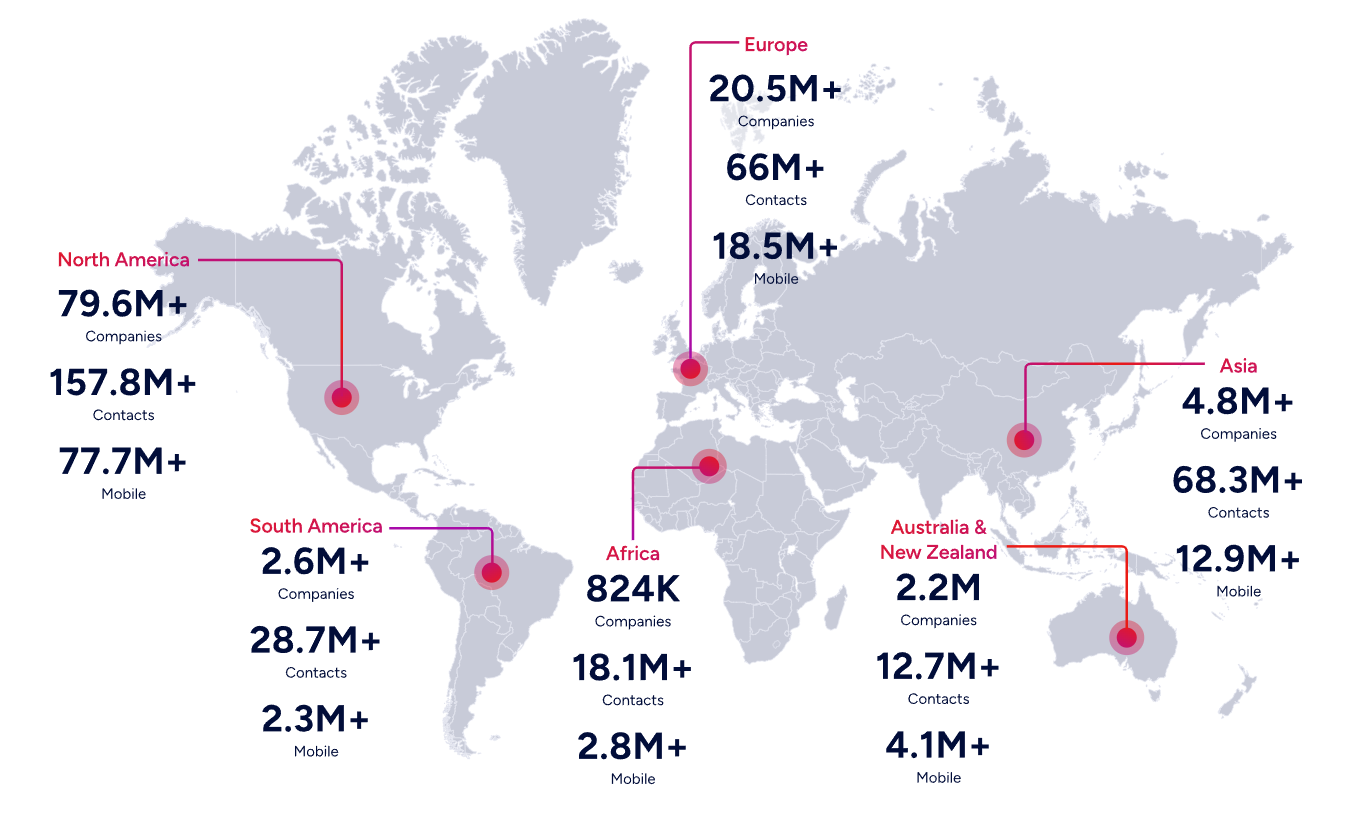
ZoomInfo is an AI GTM platform built on a large B2B data foundation: 500M contacts, 100M companies, 135M+ verified phone numbers, and 200M+ verified business emails. Its GTM Context Graph processes 1.5B+ data points daily and unifies this data with your CRM records, conversation transcripts, and behavioral signals to reveal the full context of your accounts. That context gives AI the fuel to show not just what happened, but why, and which actions to take next. Your team can drive sales motions from the GTM Workspace for sellers, run GTM plays from GTM Studio for marketers and RevOps, or power their own tools through the API and MCP in any front-end.
The connection between the two platforms isn't hypothetical. Spekit is a ZoomInfo customer, and the results show how the tools work together in practice.
Opportunities at higher-scoring accounts were 43% more likely to turn into qualified pipeline, moving 58% faster through qualification. (Spekit Case Study)
Comprehensive B2B Data: ZoomInfo provides the external intelligence that Spekit's internal enablement layer doesn't cover.
Spekit can surface a battlecard when a competitor comes up on a call. But it cannot tell you which companies are researching that competitor right now, who the decision-makers are, or how to reach them. That's the data layer ZoomInfo provides.
The platform covers three dimensions: identity data (500M contacts with 120M direct-dial phone numbers and 200M+ verified business emails), company context (100M companies with firmographics, org charts, and technographics covering 30,000+ technologies across 30M+ companies), and dynamic signals that reveal when accounts are actively in-market.
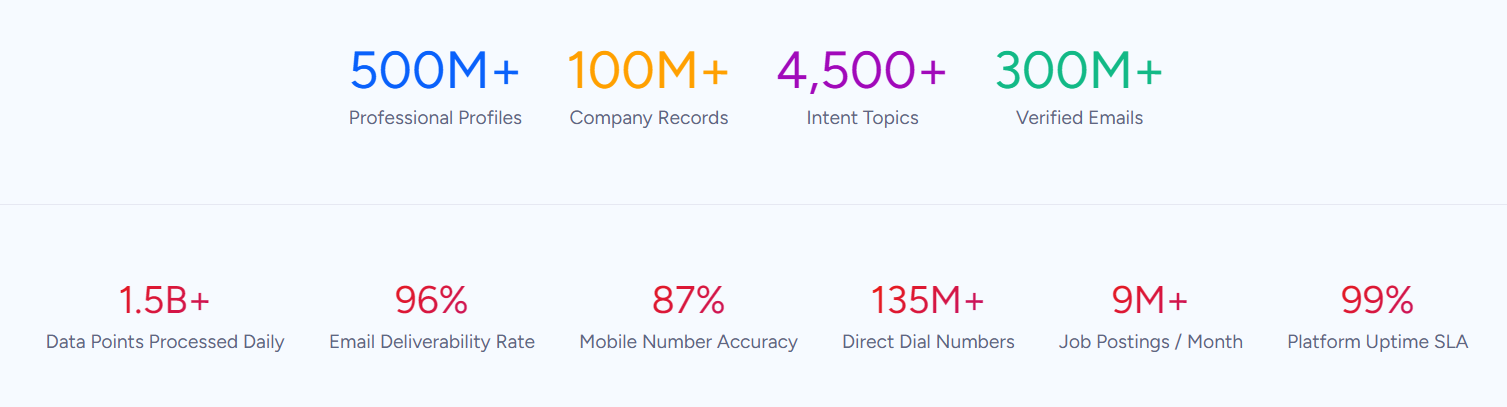
Data quality is verified through a multi-source pipeline backed by 300+ human researchers, reaching up to 95% accuracy on first-party data. In a Fortune 500 competitive RFP analyzing 25 million contacts across vendors, the independent consultant concluded that "no other competitor came even close."
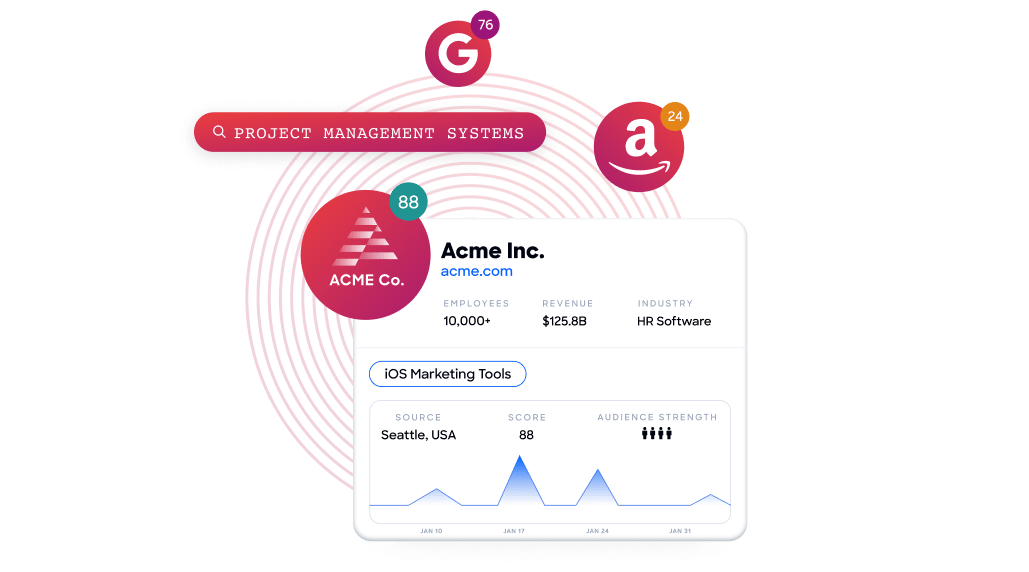
Buyer Intent tracks signals from 210 million IP-to-Organization pairings and 6 trillion+ new keyword-to-device pairings monthly. Guided Intent, exclusive to ZoomInfo, identifies topics historically correlated with deal success rather than requiring manual topic selection. This means reps using Spekit for coaching and content can also know, via ZoomInfo, which accounts show buying behavior right now.
"It's not just the data itself. It's more about the right data at the right time to help us reach out with the right message across that full buyer journey." - Chelsea Kenyon, Senior Director of Digital Strategy, Redwood Logistics (Case Study)
GTM Context Graph: ZoomInfo captures why deals move, not just that they moved.
Spekit's Unified Deal Context aggregates CRM and call data to give reps a connected view of each opportunity. ZoomInfo's GTM Context Graph goes further by unifying a customer's internal data (CRM records, conversation transcripts, email interactions) with ZoomInfo's external intelligence (intent signals, org chart changes, funding events, hiring patterns) into one intelligence layer.
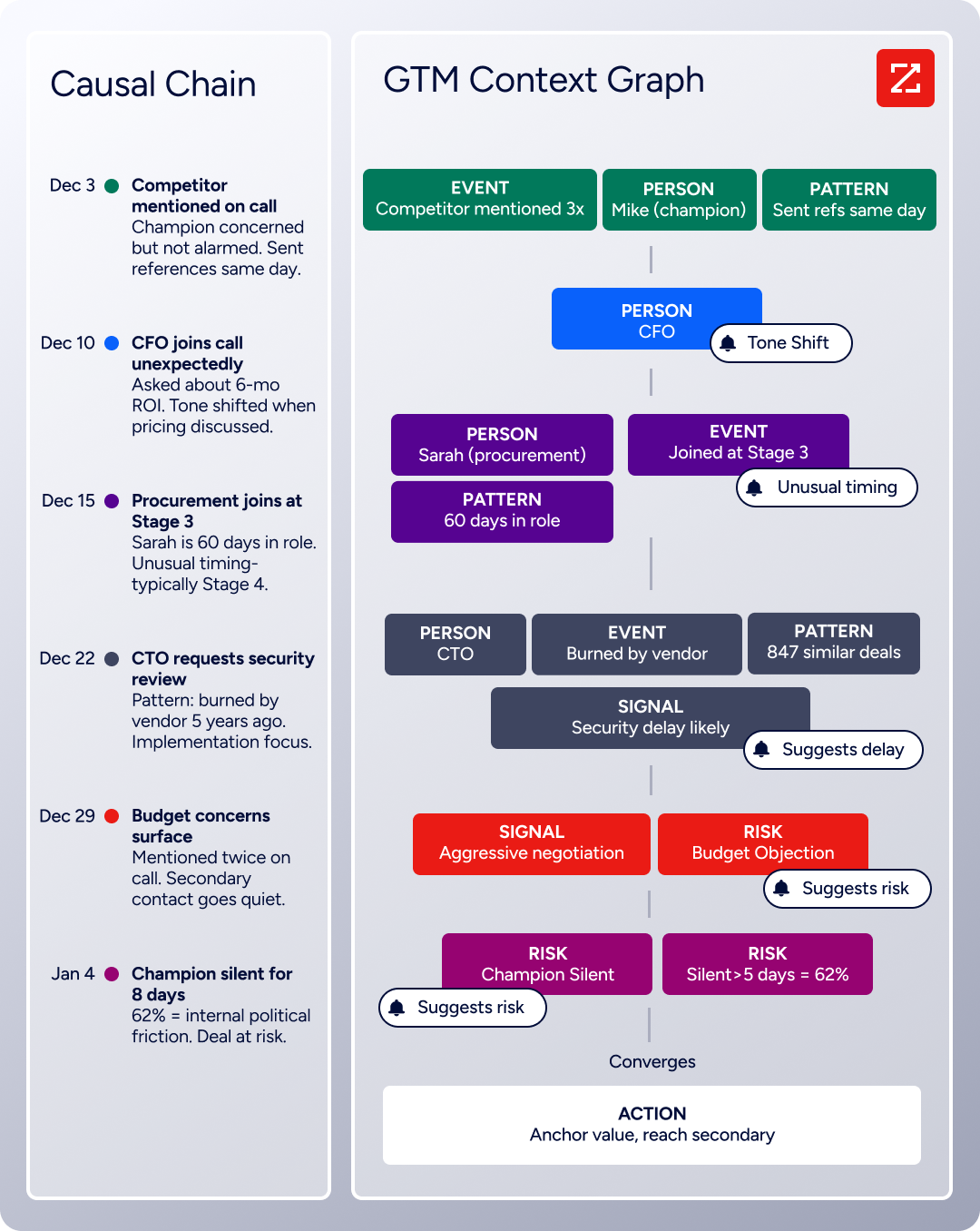
As ZoomInfo's CPO Dominik Facher writes: "The CRM recorded the state change. It has no record of why it happened." Perhaps the CFO joined the last call and asked about ROI, which is what actually accelerated the deal. Perhaps the VP went quiet due to an internal budget battle. The GTM Context Graph makes this decision context machine-readable, capturing people and their relationships, actions and their outcomes, patterns across thousands of deals, and exceptions that reveal real blockers.
This intelligence feeds directly into seller workflows. Seismic's sales team attributed 39% of active pipeline to opportunities identified or influenced by ZoomInfo signals and reported 54% productivity gains, saving 11.5 hours per week.
GTM Workspace: ZoomInfo gives sellers an AI-powered workspace for prospecting and deal management.
Where Spekit embeds guidance inside existing tools, ZoomInfo’s GTM Workspace provides sellers with a dedicated execution environment. It consolidates the complete book of business (CRM data, ZoomInfo intelligence, conversation history, market signals) into a single view with AI agents that handle account research, outreach drafting, CRM updates, and signal monitoring.
Key capabilities include an Action Feed that streams in-market buyers matched to target criteria with pre-drafted actions on every signal, AI-generated outreach personalized from full account context, and buying group intelligence that surfaces hidden stakeholders. GTM Workspace integrates natively with Salesforce, HubSpot, and Microsoft Dynamics.
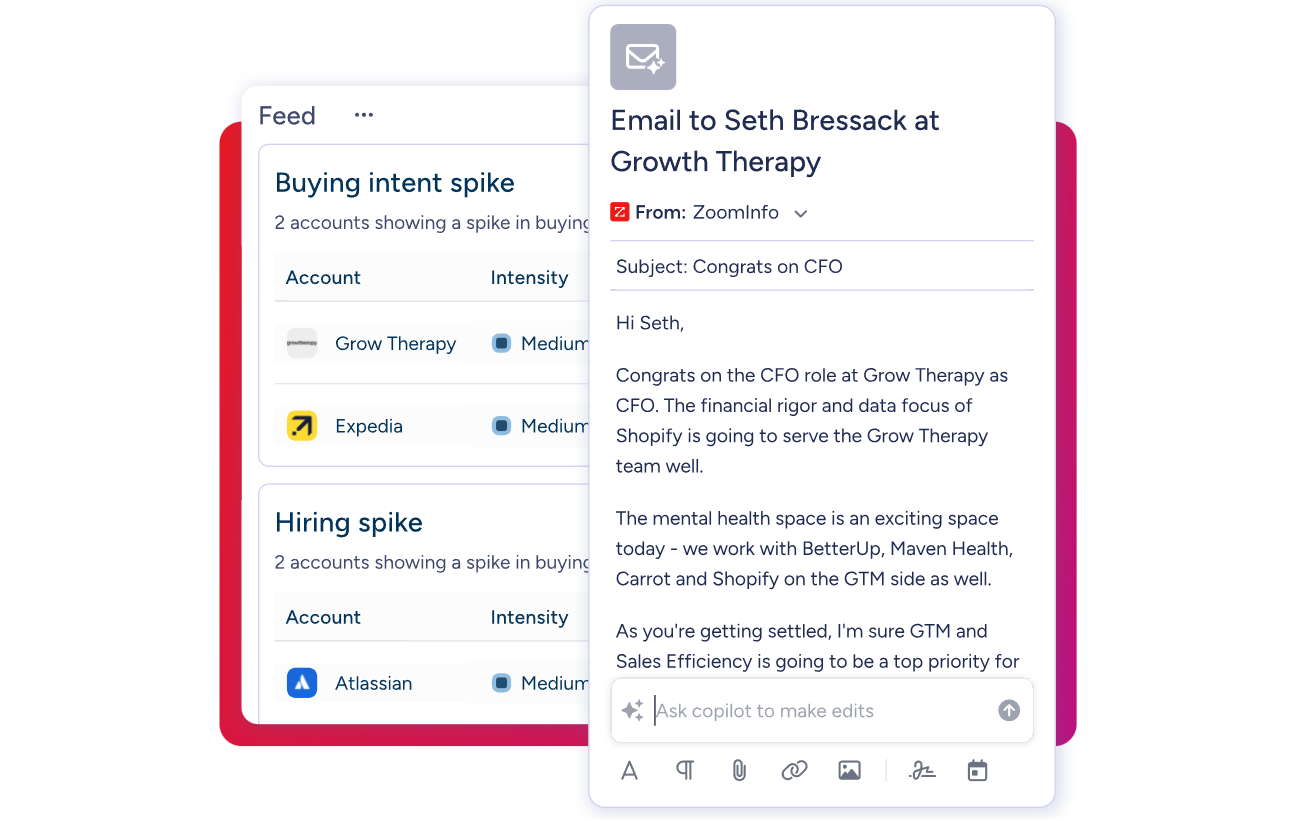
The practical difference in a combined Spekit + ZoomInfo stack: ZoomInfo identifies which accounts show buying signals and drafts the initial outreach. Spekit coaches the rep through the deal once engaged, surfacing the right battlecard, objection response, or follow-up template at each stage. ZoomInfo provides the who and when; Spekit provides the how.
Universal Access: ZoomInfo's intelligence works in any tool through APIs and MCP.
ZoomInfo's data and intelligence aren't locked inside its own products. APIs and MCP (Model Context Protocol) deliver the same intelligence into any custom agent, internal tool, or partner platform. The MCP server connects AI models directly to ZoomInfo's B2B data as a native tool, listed in the Claude directory and supporting Claude and ChatGPT.
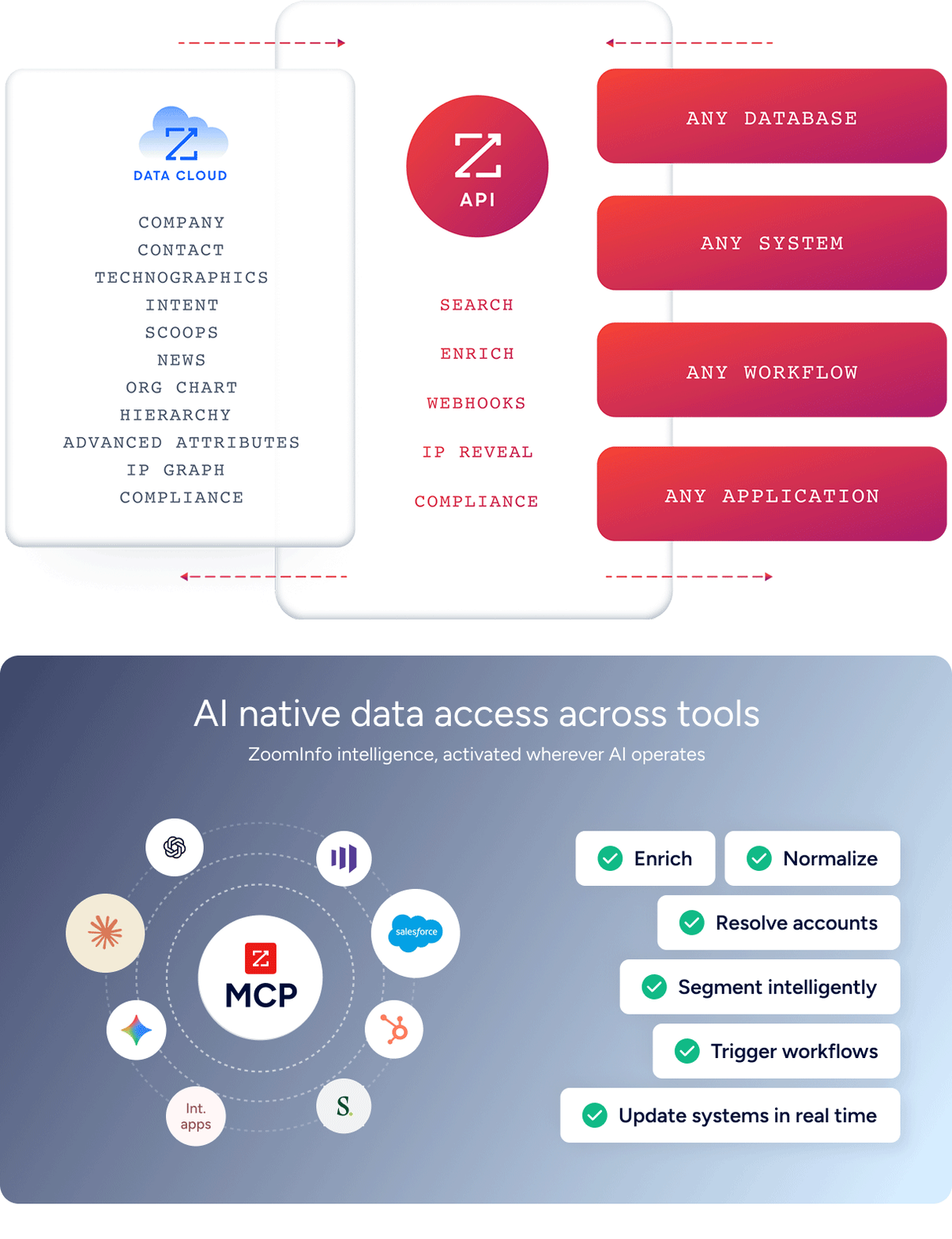
API access is included in all relevant plans. For teams building on top of their GTM stack, this means ZoomInfo's buyer intelligence can flow into the same Salesforce records where Spekit's embedded coaching lives, creating a workflow where external signals and internal enablement converge at the point of execution.
Transparent Entry Points: ZoomInfo offers a permanent free tier and a free trial.
Unlike Spekit's sales-engagement-only access, ZoomInfo provides multiple ways to evaluate the platform. ZoomInfo Lite is a permanent free tier (no credit card, no time limit) with access to the B2B database, 10 monthly export credits, individual and company searches, the Chrome extension, and WebSights Lite for up to 10 website visitor reveals per day. A separate 7-day free trial provides broader access to core features including intent signals and email outreach.
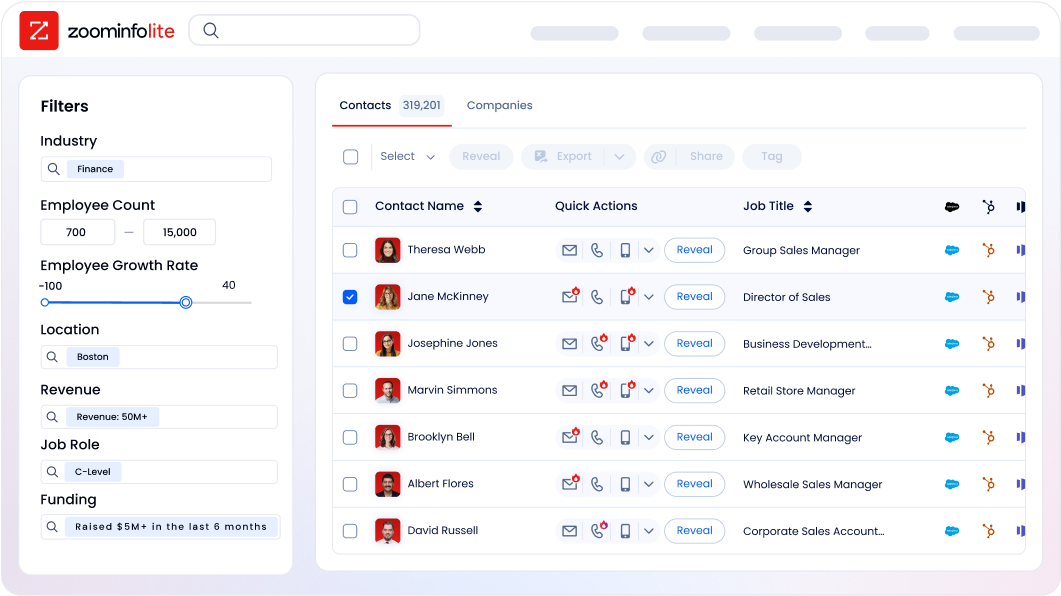
Paid plans are organized across Sales (Professional, Advanced, Enterprise) and Marketing (Marketing Demand, ABM Lite, ABM Enterprise) product lines, with custom-quoted pricing based on usage patterns, seat count, and feature requirements.
Spekit and ZoomInfo: Comparison Summary
Aspect | Spekit | ZoomInfo |
|---|---|---|
Primary Focus | Internal sales enablement and coaching | External buyer intelligence and GTM execution |
Core Problem Solved | Getting the right knowledge to reps in their workflow | Identifying the right accounts, contacts, and signals |
B2B Contact Data | Not available | 500M contacts, 120M direct dials, 200M+ verified emails |
Buyer Intent Signals | Not available | 210M IP-to-Org pairings, 6T+ keyword signals monthly |
In-Workflow Coaching | AI Sidekick with proactive coaching | GTM Workspace with AI agents |
Content Governance | Governance Dashboard with freshness tracking | Not a content governance tool |
Deal Rooms | AI-generated, buyer engagement tracked | Not a Deal Room platform |
CRM Integration | Deep Salesforce; limited others | Salesforce, HubSpot, Microsoft Dynamics |
Conversation Intelligence | Integrates with Gong | Chorus (owned, native) |
API/MCP Access | API available as add-on | APIs and MCP included in all relevant plans |
Free Plan | No free plan or self-serve trial | ZoomInfo Lite (permanent free tier) |
Pricing Transparency | Contact sales only | Contact sales; consumption-based pricing |
Analyst Recognition | Gartner MQ Visionary (Revenue Enablement, 2025) | Gartner MQ Leader (ABM, 2024 & 2025); Forrester Leader (Intent Data, 2025) |
Best For | Coaching reps through deals with governed content | Finding the right accounts, contacts, and signals to pursue |
Final Verdict
Spekit and ZoomInfo solve different halves of the same revenue problem, and the choice depends on which gap is more urgent in your current stack.
Choose Spekit if your team's primary challenge is enablement execution: reps can't find the right content, onboarding takes too long, messaging drifts across the field, and coaching happens in manager reviews instead of during live deals. Spekit's in-workflow delivery model, AI Sidekick, and content governance system address these problems with an ease of use that earned it a 4.8/5 on G2 and G2's Fastest Time to ROI badge. For Salesforce-centric teams that need their enablement platform to live inside the tools reps already use, Spekit delivers.
Add ZoomInfo if your team also needs external buyer intelligence to power the top of the funnel and the intelligence layer around every deal. ZoomInfo's B2B data, intent signals, and GTM Context Graph provide the who, when, and why that Spekit's enablement layer doesn't cover. Together, ZoomInfo identifies the right accounts and surfaces buying signals while Spekit coaches reps through execution with governed content. The combination means reps walk into every conversation knowing both who they're talking to (ZoomInfo) and what to say (Spekit).
Get started with ZoomInfo here.
The strongest sales teams don't choose between intelligence and enablement. They build a stack where external buyer data informs which deals to pursue, and internal coaching ensures those deals are executed well. Spekit and ZoomInfo, used together, cover both sides.
Spekit FAQ
What is Spekit used for?
Spekit is an AI-powered sales enablement platform that delivers coaching, content, and process guidance inside the tools sales reps already use (primarily Salesforce, Gmail, Gong, and Outlook). Its core use cases include compressing new rep ramp time, eliminating internal questions during deals, keeping sales messaging current across the field, and automating post-call follow-ups. The platform is organized around four pillars: a GTM Knowledge Engine for content governance, AI Sidekick for in-workflow coaching, Deal Rooms for buyer engagement, and Unified Deal Context for aggregating deal data.
How much does Spekit cost?
Spekit does not publish pricing on its website. All pricing is quote-based and requires a sales engagement. From the Master Services Agreement, pricing is set per Order Form with seat-based or seat-banded licensing. Contracts auto-renew for 12-month periods, and early termination requires payment of all remaining fees through the end of the subscription term. Professional services (implementation, migration) carry separate costs. ZoomInfo, by comparison, offers a permanent free tier (ZoomInfo Lite) and a 7-day free trial alongside its custom-quoted paid plans.
Does Spekit offer a free trial?
No. Spekit does not advertise a free trial or free plan. The getting-started page directs visitors to request a demo or take a guided product tour. There is no self-serve signup. ZoomInfo offers two free entry points: ZoomInfo Lite (a permanent free tier with 10 monthly export credits, search access, and a Chrome extension) and a 7-day free trial with broader feature access, neither requiring a credit card.
Which CRMs does Spekit integrate with?
Spekit's deepest integration is with Salesforce, including a two-way sync, AppExchange listing, and embedded guidance attached to fields, stages, and processes. The platform also lists HubSpot, Outreach, Salesloft, and Zendesk as integrations, but the deal intelligence features (connecting Gong transcripts to opportunity data, stage-based coaching, embedded field guidance) are built primarily around Salesforce. Teams on HubSpot or Microsoft Dynamics will see reduced value from these core capabilities.
What is Spekit's AI Sidekick?
AI Sidekick is Spekit's browser-native assistant that runs alongside any tool a rep uses via a Chrome extension. It proactively surfaces coaching, content recommendations, and automated actions based on the active deal context from Salesforce and Gong. Rather than waiting for a rep to ask a question, Sidekick monitors deal stage, conversation history, and buyer behavior to deliver guidance in the moment. It can also draft follow-up emails, generate executive summaries, and create Deal Rooms from live deal data.
Can Spekit replace an LMS?
For GTM training and sales onboarding, Spekit's Learning Paths can substitute for a separate LMS. Learning Paths are structured programs built from the same Speks that power the knowledge base and are delivered inside daily workflow tools. They support videos, images, embedded tools, and Knowledge Checks. However, Spekit is not designed for compliance training, certification management, or use cases outside go-to-market teams. Organizations needing full video-based LMS capabilities with compliance tracking should maintain a dedicated LMS alongside Spekit.
Does Spekit provide buyer intelligence or contact data?
No. Spekit focuses entirely on internal enablement: coaching, content delivery, and knowledge governance. It does not provide B2B contact data, company data, intent signals, or prospecting tools. For external buyer intelligence, teams typically pair Spekit with a platform like ZoomInfo, which provides 500M contacts, 135M+ verified phone numbers, buyer intent data, and AI-powered account prioritization. Spekit is a ZoomInfo customer, and the two platforms work together in practice to cover both internal enablement and external intelligence.
How does Spekit compare to Highspot and Seismic?
Spekit competes with Highspot and Seismic in the revenue enablement category but differentiates on delivery model and ease of use. Where Highspot and Seismic are primarily content management and digital sales room platforms that reps navigate to, Spekit embeds enablement inside the tools reps already use via its Chrome extension. Multiple Spekit customers, including InMoment (which replaced Highspot) and Uberall (which replaced Seismic), cite rep adoption as the reason for switching. Spekit holds G2's Fastest Time to ROI badge and a 4.8/5 overall rating. However, Spekit's analytics and reporting capabilities are less mature than those of its larger competitors.
More Spekit comparisons and alternatives:
