
Tegus built its reputation on a clear idea: expert calls are baseline knowledge that every institutional investor needs, and the transcripts from those calls should accumulate into a shared, searchable library rather than vanish after a single conversation. That model attracted 2,500+ customers and a $3 billion valuation before AlphaSense acquired Tegus in July 2024 for approximately $930 million, folding its transcript library, call services, and Canalyst financial models into a broader AI-powered research platform.
To write this Tegus review, we analyzed it extensively. We believe it's the right choice if:
You're an institutional investor (hedge fund, PE, or asset management) who needs qualitative expert insights to validate investment theses
You want access to a large library of prior expert conversations before commissioning new calls
Compliance-grade expert research with multi-layered MNPI protections is non-negotiable
You value transparent, subscription-based pricing over per-call markups
You need private company coverage that traditional broker research doesn't provide
However, Tegus might not be the best choice if:
You need verified contact data to reach decision-makers at target companies
You want real-time buying signals showing which accounts are in-market right now
You require tools that connect intelligence directly to outreach and campaigns
You're looking for quantitative B2B data (technographics, org charts, firmographics) rather than qualitative expert opinions
You need a self-serve option with transparent pricing and a free tier
In this case, you should consider ZoomInfo: an AI-powered GTM platform that takes a different approach to market intelligence. Where Tegus delivers qualitative depth through expert conversations, ZoomInfo provides quantitative breadth through 500M contacts, 100M companies, 135M+ verified phone numbers, and 200M+ verified business emails, combined with intent signals and execution tools that connect intelligence to action.
We've included a detailed look at ZoomInfo later in this Tegus review because it represents a different philosophy of market intelligence for professionals who need actionable data alongside qualitative research. If you're ready to explore a data-driven approach to company intelligence, you can start with ZoomInfo's free tier here.
What is Tegus?
Tegus was founded in October 2015 by identical twin brothers Thomas Elnick and Michael Elnick, both Brown University economics graduates. Their founding story traces to frustration with investment research: Tom worked as an analyst at a value-oriented hedge fund while Mike was one of the earliest employees at AlphaSights, an expert network startup.
They watched analysts waste most of their time finding and aggregating data rather than analyzing it, and saw incumbent expert networks extract large margins from what the brothers believed was commodity information.
They quit their jobs on September 11, 2015, spent 18 months talking to fundamental investors, and built what they called a "Costco model": subscription fees fund the platform, expert calls are available at cost, and every call adds to a shared transcript library that reduces the need for additional calls over time.
Today, Tegus is part of AlphaSense, serving as the expert research and financial data division of the combined entity. The platform contributes 260,000+ expert transcripts and 4,000+ Canalyst financial models into a content library of 500M+ documents.
The target buyer remains institutional: hedge funds, private equity firms, asset managers, investment banks, and venture capital firms. The compliance page highlights trust with "90% of the top asset management firms".
Tegus Pros & Cons
Pros | Cons |
|---|---|
- Industry's largest expert transcript library (260,000+) | - Enterprise-only pricing with no published rates |
- Transparent, no-markup pricing on expert calls | - No self-serve free plan or instant trial |
- Multi-layered compliance review (AI + human) | - Post-acquisition price increases reported |
- AI-Led Expert Calls available 24/7 | - Coverage may be thinner outside TMT and healthcare |
- 4,000+ pre-built Canalyst financial models | - No actionable contact data or intent signals |
- Private company coverage for PE/VC due diligence | - Annual contracts with no mid-term cancellation |
- Deep Research mode for automated analysis | - No self-directed expert marketplace browsing |
Tegus Review: How It Works & Key Features
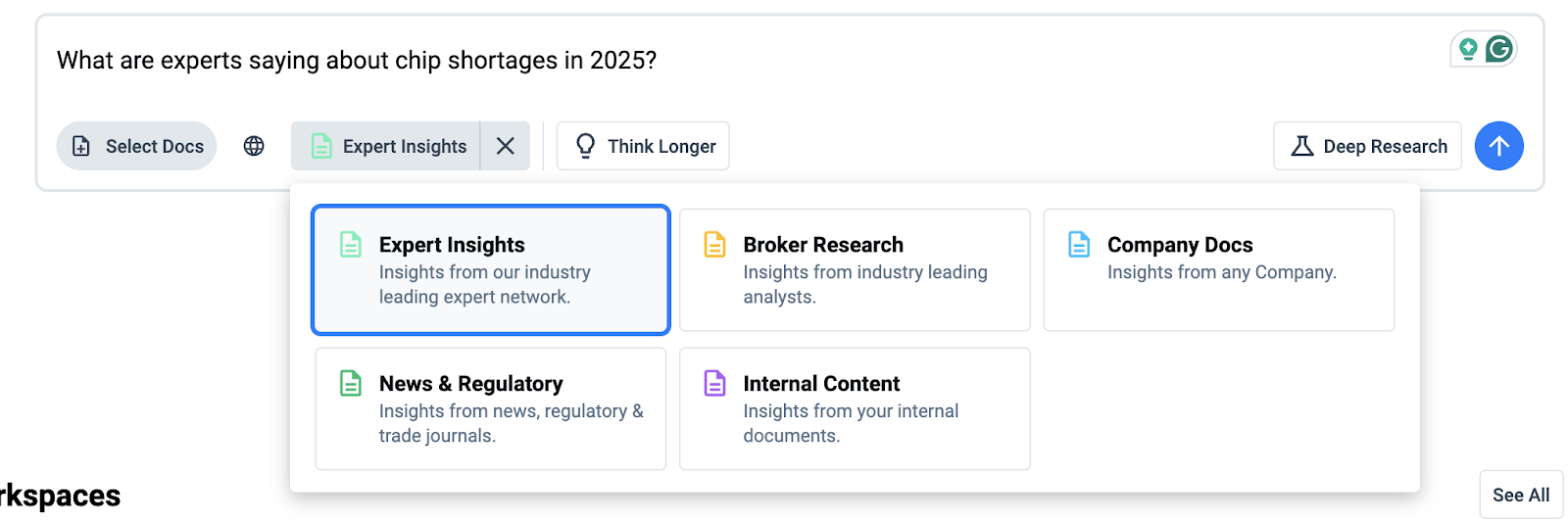
Expert Transcript Library: The largest collection of proprietary investor-led expert conversations, searchable by AI.
The Expert Transcript Library is Tegus's defining asset. It houses over 260,000 proprietary, investor-led expert call transcripts spanning more than 27,000 public and private companies across every major sector, with 7,000-8,000 new transcripts added monthly.
Source: AlphaSense
The library runs on a contribution flywheel: when a subscriber conducts an expert call through the platform, the call is recorded, transcribed, compliance-reviewed, and published to the shared library.
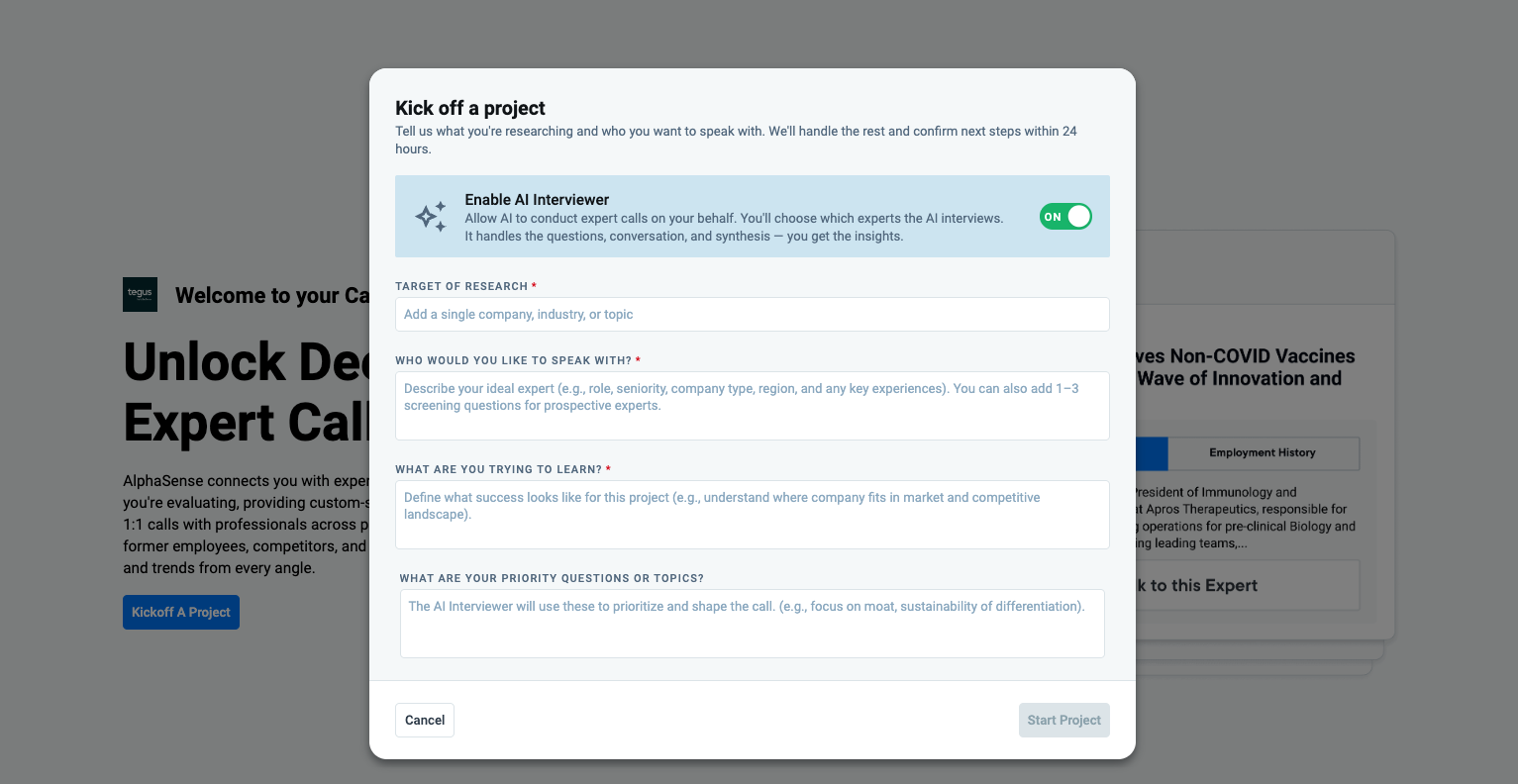
Beyond investor-led calls, the platform now includes AlphaSense-Led calls (conducted by in-house research analysts) and AI-Led calls (where an AI interviewer conducts conversations with vetted experts and delivers a compliance-reviewed transcript within approximately 24 hours).
Source: AlphaSense
Users can filter transcripts by Expert Type (former executives, customers, competitors, key opinion leaders), by Analyst Perspective (investor-led, AlphaSense-led, or AI-led), and by Transcript Focus (company deep-dive, industry overview, topic deep-dive, Voice of Customer, or Channel Check). Every transcript includes AI-generated summaries, top investor questions, and topic tags.
The scale matters: the library is more than double the combined size of competing transcript libraries. Unlike professionally-authored content, Tegus's transcripts capture questions and follow-up threads from actual buy-side and sell-side investors, reflecting real diligence priorities rather than generic research templates.
Expert Calls: On-demand primary research with human-led and AI-led interview options.
Tegus Expert Call Services connect institutional investors with vetted industry experts for one-on-one interviews. Experts include former executives, customers, channel partners, competitors, and specialists across every major sector.
Source: AlphaSense
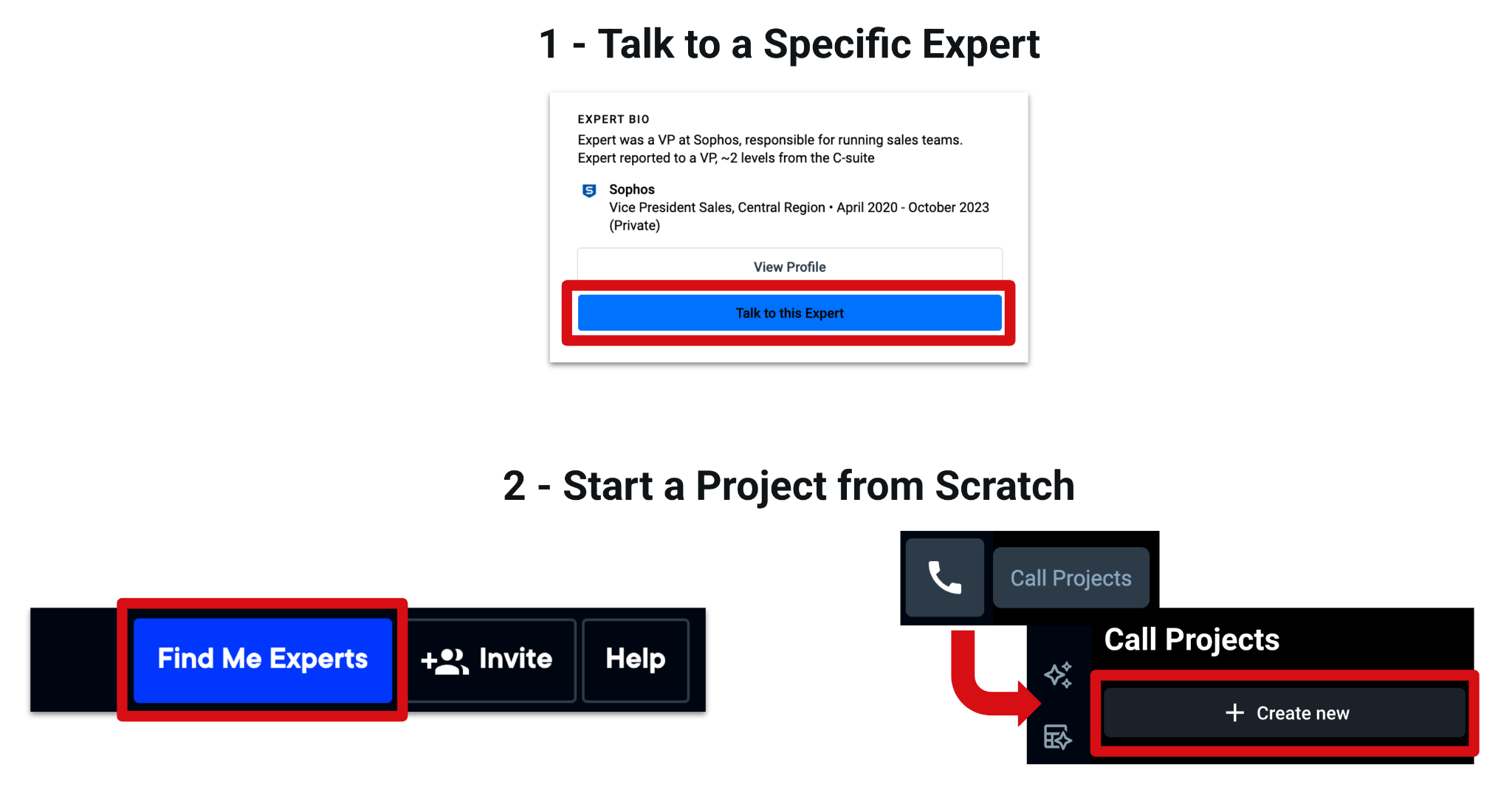
Clients initiate a project through the Call Services portal, specifying their research objective and expert type. Expert recommendations arrive within 24-48 hours.
Before any call, experts must complete a 10-15 minute introductory call, agree to terms, complete compliance training, and fill out a pre-call compliance questionnaire. Experts must be at least six months removed from any prior role at the target company.
Calls are 30-60 minute audio-only interviews, recorded and transcribed. The notable innovation is AI-Led Expert Calls: an AI interviewer dials the expert directly, reads compliance disclosures, and follows a structured prompt built from the client's research brief. These run 24/7 and deliver compliance-screened transcripts in approximately 24 hours.
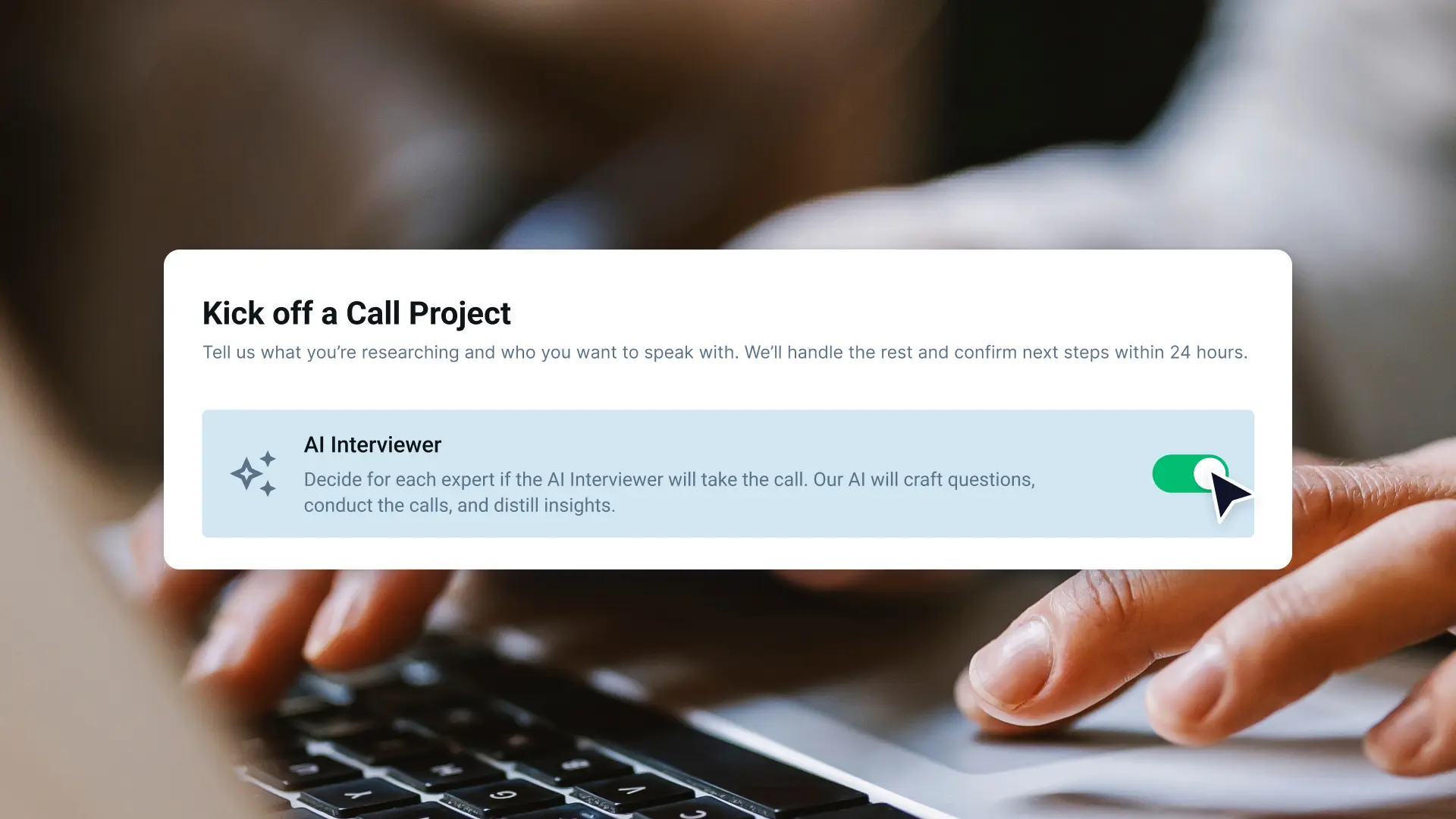
Source: AlphaSense
The pricing model sets Tegus apart from traditional expert networks. The platform offers transparent pricing with no credits and no markups, advertising approximately 70% cost savings compared to traditional expert networks. Customers pay only the expert rate plus a flat $75 transcription fee for live calls.
Channel Checks extend the AI-led model: consistent monthly interviews with ground-level channel sources (suppliers, distributors, customers) surface demand, pricing, and inventory signals weeks before they reach the broader market, with hundreds of new interviews added weekly and 350+ tickers covered.
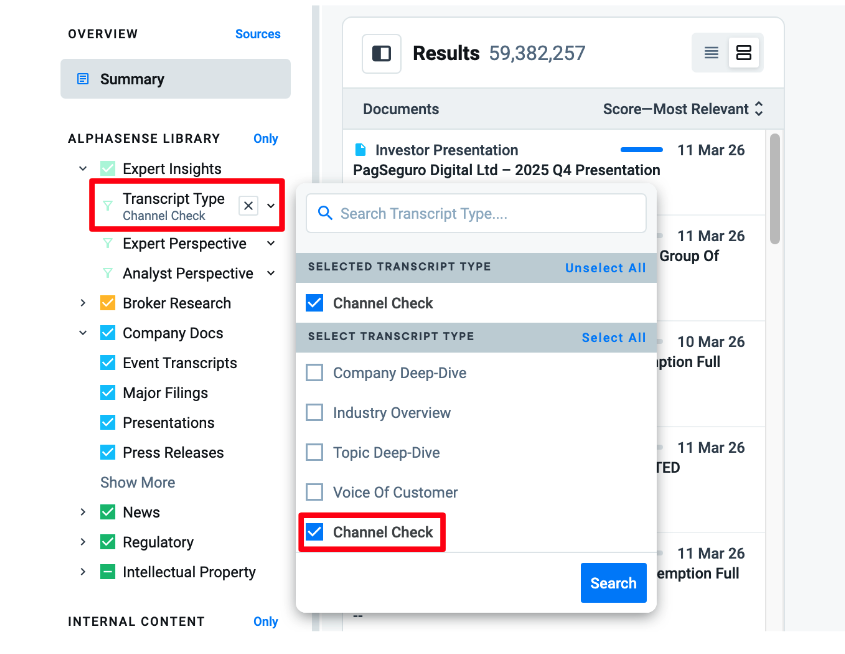
Source: AlphaSense
Financial Models (Canalyst): Pre-built, analyst-maintained Excel models for 4,000+ public companies.
Canalyst Financial Models (acquired by Tegus in 2022, now accessible through AlphaSense) provides a library of 4,000+ pre-built financial models covering public equities across all sectors and market caps.
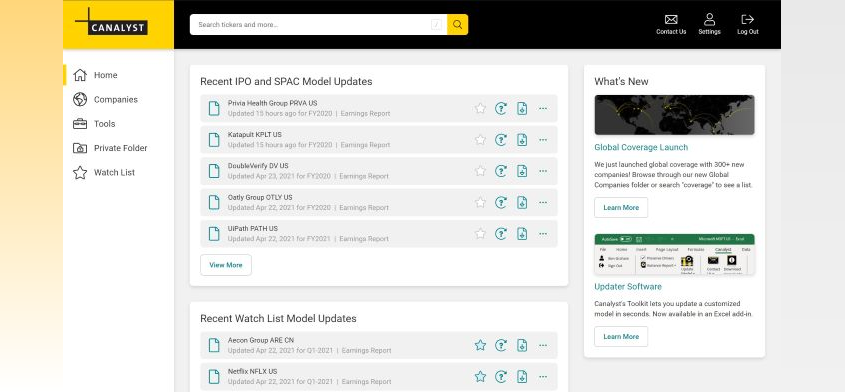
Source: Canalyst
Each model ships as an unlocked Excel workbook containing 10 years of historical data and 5 years of forward-looking forecasts. Models include income statements, cumulative and quarterly cash flow statements, balance sheets, consensus data, and real-time stock pricing.
Quality control involves two analysts independently entering data from public filings, proprietary software comparing the two versions, sector specialist sign-off, and a final battery of quantitative checks.
The practical value is time savings. Building a financial model from scratch for a public company takes hours of manual data entry, statement linking, and verification.
Automatic Earnings Updates handle the recurring maintenance: when a company reports, the Canalyst team updates the model and pushes it to subscribers. Analysts who have customized a model receive new period data automatically, along with a variance report showing prior forecasts versus reported results.
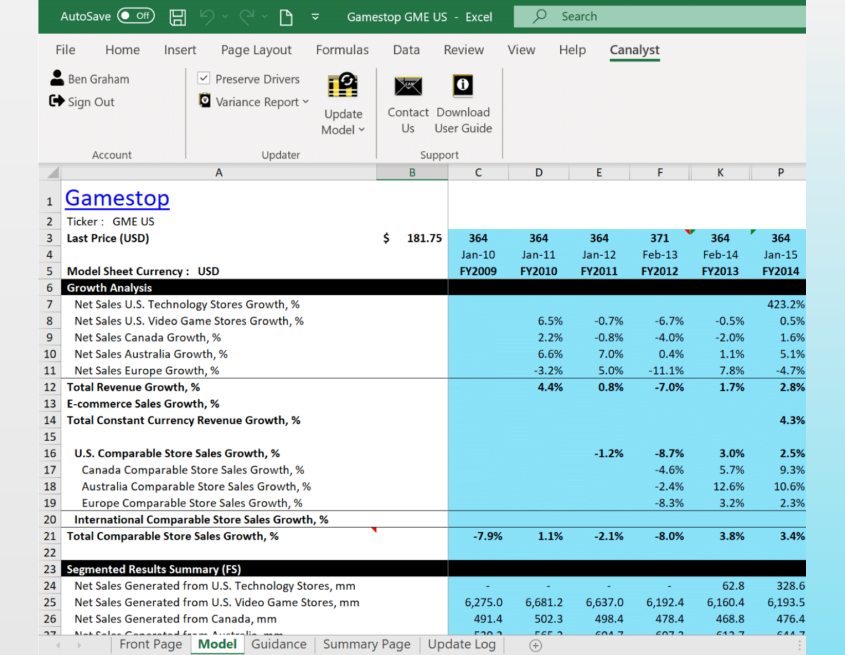
Source: Canalyst
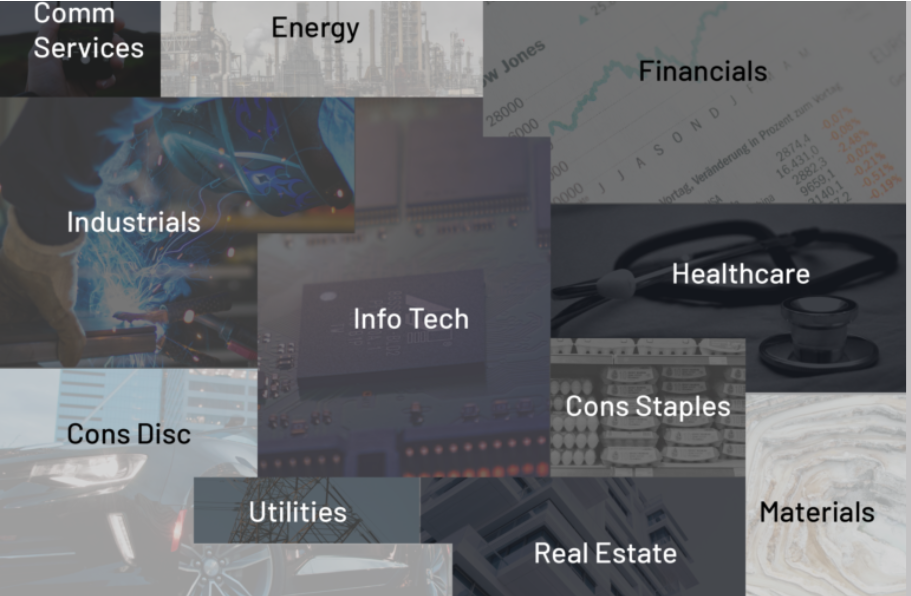
Coverage includes US companies above $100 million market cap and revenue, Canadian companies above $30 million market cap and revenue, and revenue-generating US domestic IPOs and SPACs post-S4 filing. 100+ equity research analysts (all North America-based) build and update every model directly from primary filings.
Source: Canalyst
AI and Search: Generative AI capabilities across the combined platform.
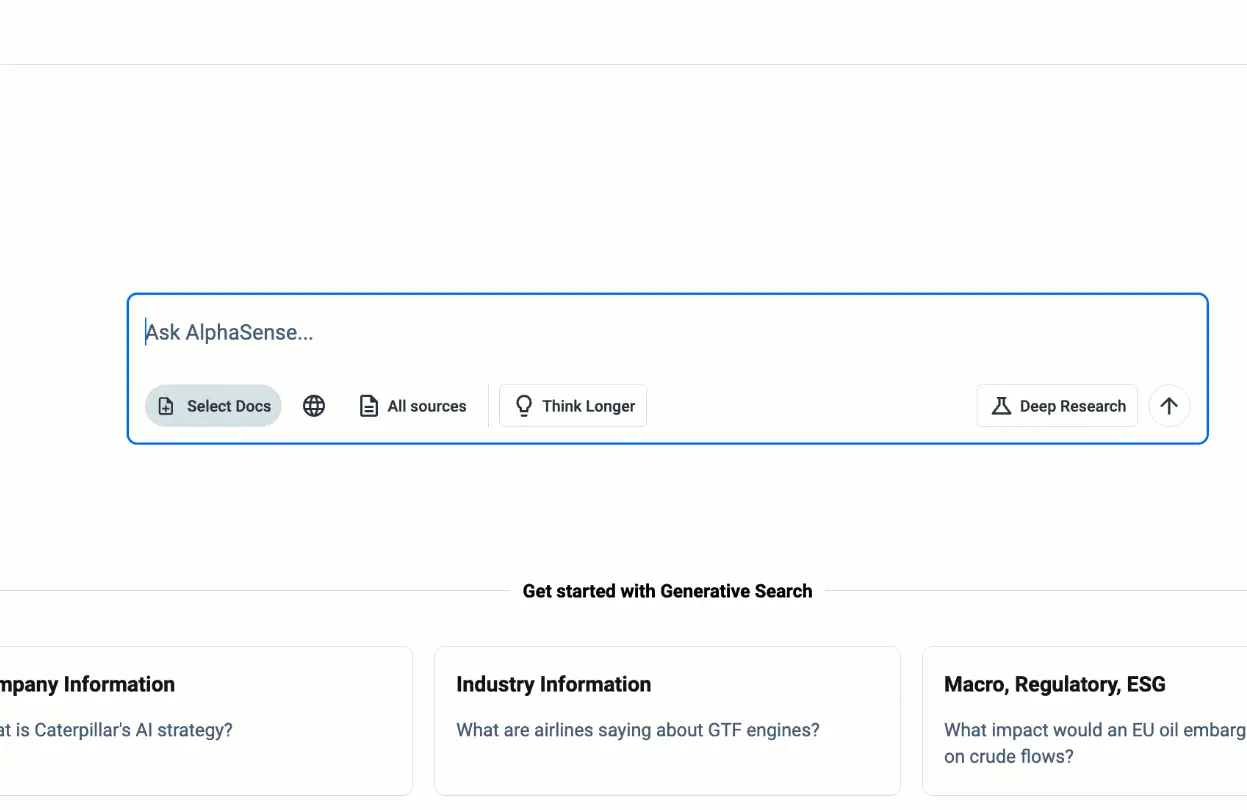
Following the AlphaSense acquisition, Tegus content now sits within a single AI-powered research environment. Deep Research automates analysis by conducting dozens of searches, parsing thousands of results, and producing company or industry analysis in minutes.
Source: AlphaSense
The platform processes expert transcripts, financial data, broker research, and market intelligence at the same time.
AlphaSense says its AI delivers "no hallucinations", with every fact cited to source. Generative Search lets users ask natural-language questions and receive sourced, synthesized answers drawn from the full library. The combined platform was named a Leader in the inaugural Gartner MQ for Competitive and Market Intelligence Platforms, ranked highest on Ability to Execute.
Where Tegus Falls Short
Tegus excels at qualitative expert research for institutional investors, but several limits show up for professionals who need market intelligence that goes beyond qualitative insights into actionable data and execution.
Enterprise-only pricing with no transparency. Tegus publishes no pricing on its website. All purchases require a signed Order Form through AlphaSense's sales team. Payment obligations are non-cancelable and fees are nonrefundable, with auto-renewal unless 30 days' written notice is given.
The "Free Trial" link on tegus.com routes to a sales-led trial request form, not a self-serve sign-up. You cannot experience the platform without engaging sales.
No actionable contact data. Tegus tells you what a former VP of Engineering thinks about a company's product roadmap. It does not give you that VP's current email address, direct phone number, or org chart position.
For professionals who need to reach decision-makers at target companies (for partnerships, deal sourcing, competitive intelligence, or outbound engagement), Tegus provides qualitative understanding but no path to action.
No real-time buying signals. The platform captures what experts said about a company weeks or months ago. It does not tell you which companies are researching solutions right now, which accounts just received funding, or which prospects are showing intent signals today. For teams that need to act on timing, not just knowledge, the platform's retrospective nature leaves a gap.
Post-acquisition pricing concerns. After the AlphaSense acquisition in July 2024, industry commentary indicates that Tegus raised prices. The combined platform is positioned as an enterprise subscription, which can be prohibitive for smaller funds or corporate teams that need episodic access rather than a full annual commitment.
Coverage depth varies by sector. For firms focused on industrials, commodities, or niche sub-sectors, the transcript library may offer thinner expert coverage compared to its strengths in TMT and healthcare. Geographic coverage also skews toward North American and English-language markets.
No execution layer. Tegus is a research platform. Once you've gathered insights, it offers no way to act on them: no outreach tools, no campaign orchestration, no CRM integration for pushing intelligence into sales workflows. The gap between "I understand this market" and "I'm reaching the right people at the right time" stays manual.
These limits are not failures. They reflect Tegus's deliberate focus on qualitative depth in the investment research workflow. But they create clear openings for platforms that approach market intelligence from the opposite direction: starting with verified data and building execution on top.
A Different Approach to Market Intelligence: ZoomInfo
ZoomInfo takes a different approach to company and market intelligence. Where Tegus provides qualitative depth through expert conversations (what practitioners think about a company or market), ZoomInfo provides quantitative breadth through verified B2B data (who the buyers are, how to reach them, and when they're ready to act) combined with execution tools that connect intelligence to action.
Comprehensive B2B Data: The industry's largest verified database of contacts, companies, and signals.
ZoomInfo operates the largest B2B data platform across three dimensions: identity data (500M contacts, 135M+ verified phone numbers, 120M direct-dial phone numbers, 200M+ verified business email addresses), company context (100M companies with firmographics, org charts, and technographics), and signals that reveal when accounts are in-market.
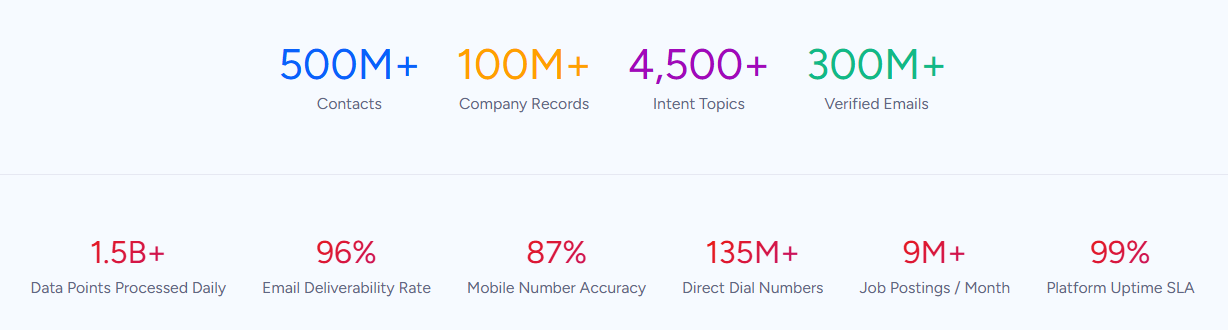
Data flows through a proprietary verification system: automated ML scanning 28 million site domains daily, third-party partner data covering 95 million businesses, a community of 200,000+ ZoomInfo Lite users who share data back, and an in-house Data Training Lab of 300+ human researchers. First-party data reaches up to 95% accuracy.
These aren't self-reported figures. In a Fortune 500 competitive RFP analyzing 25 million contacts across vendors, the independent consultant concluded that "no other competitor came even close." ZoomInfo has been named a Leader in the Forrester Wave for Intent Data Providers (Q1 2025), a Leader in the Gartner MQ for ABM Platforms (2024 & 2025), and earned 133 No. 1 rankings on G2 in Summer 2025.
"You'll get 10x the value if you think of ZoomInfo as a full platform and not just a tool for one team." SpringDB used ZoomInfo's enriched data to achieve 2x-3x increases in campaign conversions and a 300% increase in database usability. (SpringDB)
GTM Context Graph: Intelligence that captures not just what happened, but why.
The GTM Context Graph is ZoomInfo's intelligence layer, processing 1.5B+ data points daily. It merges ZoomInfo's B2B data with a customer's own first-party data (CRM records, conversation intelligence, email interactions, and behavioral signals) into a single graph that captures not just what happened in a deal, but why it happened.
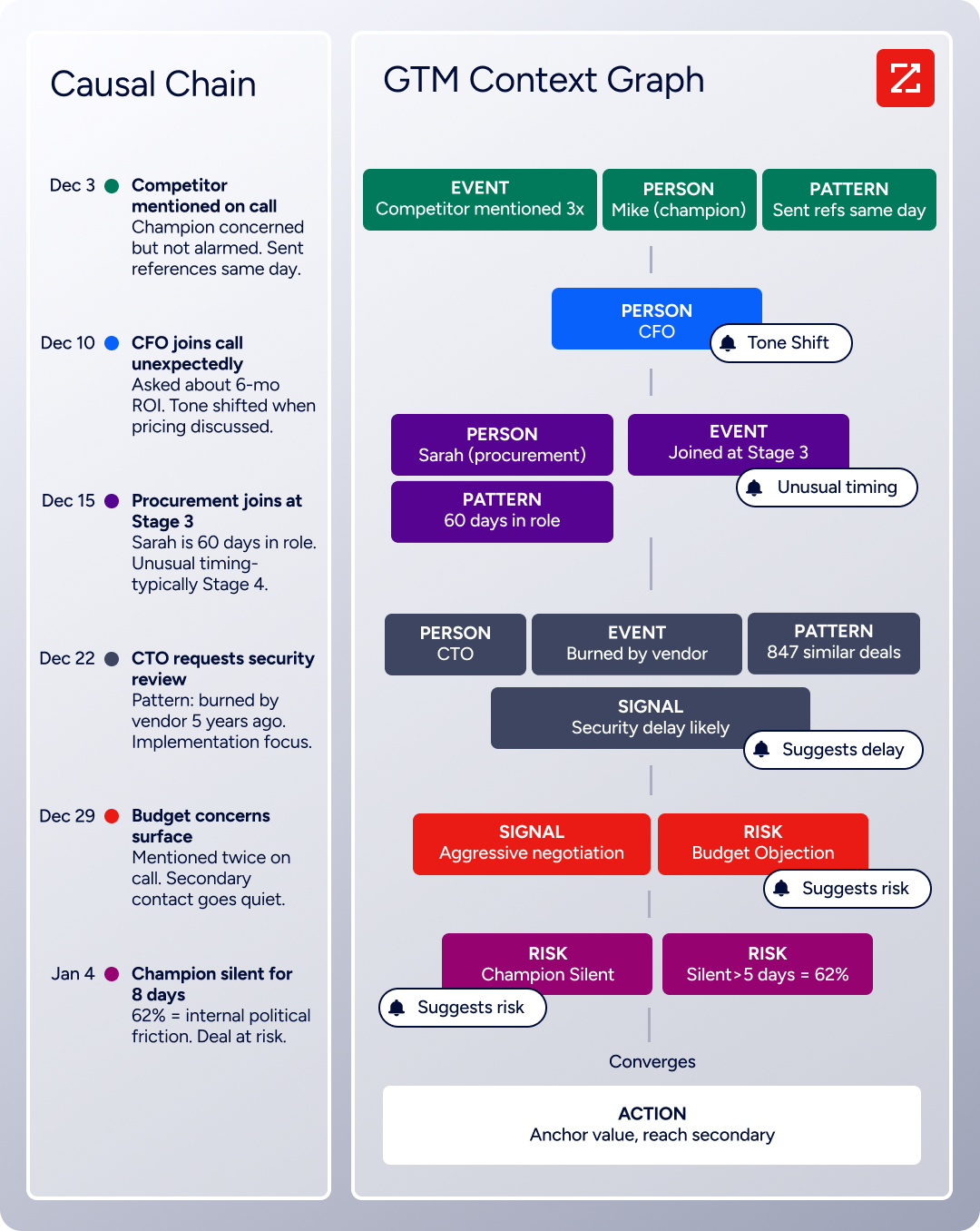
As ZoomInfo's Chief Product Officer Dominik Facher writes: "The CRM recorded the state change. It has no record of why it happened." The GTM Context Graph makes this decision context machine-readable, connecting people and their relationships, actions and their outcomes, patterns and predictions across thousands of deals.
This matters because AI experiments fail without context. They have the data but not the understanding: no patterns across deals, no connections between signals and outcomes.
ZoomInfo built this layer through 20 years of data unification infrastructure plus the Chorus conversation intelligence acquisition, which captures every customer call, meeting, and email, then extracts the signals underneath (why a deal accelerated, why a champion went quiet, what a competitive mention predicts about deal risk).
Seismic attributed 39% of active pipeline to opportunities identified or influenced by ZoomInfo signals, reported 54% productivity gains, and saved 11.5 hours per week per seller. "That combination of our internal CRM data, external signals, and AI that's given all that context has helped us craft very specific account- and persona-based messages. And people have responded to them right away." (Seismic)
Universal Access: Use the intelligence in any tool, any workflow, any AI agent.
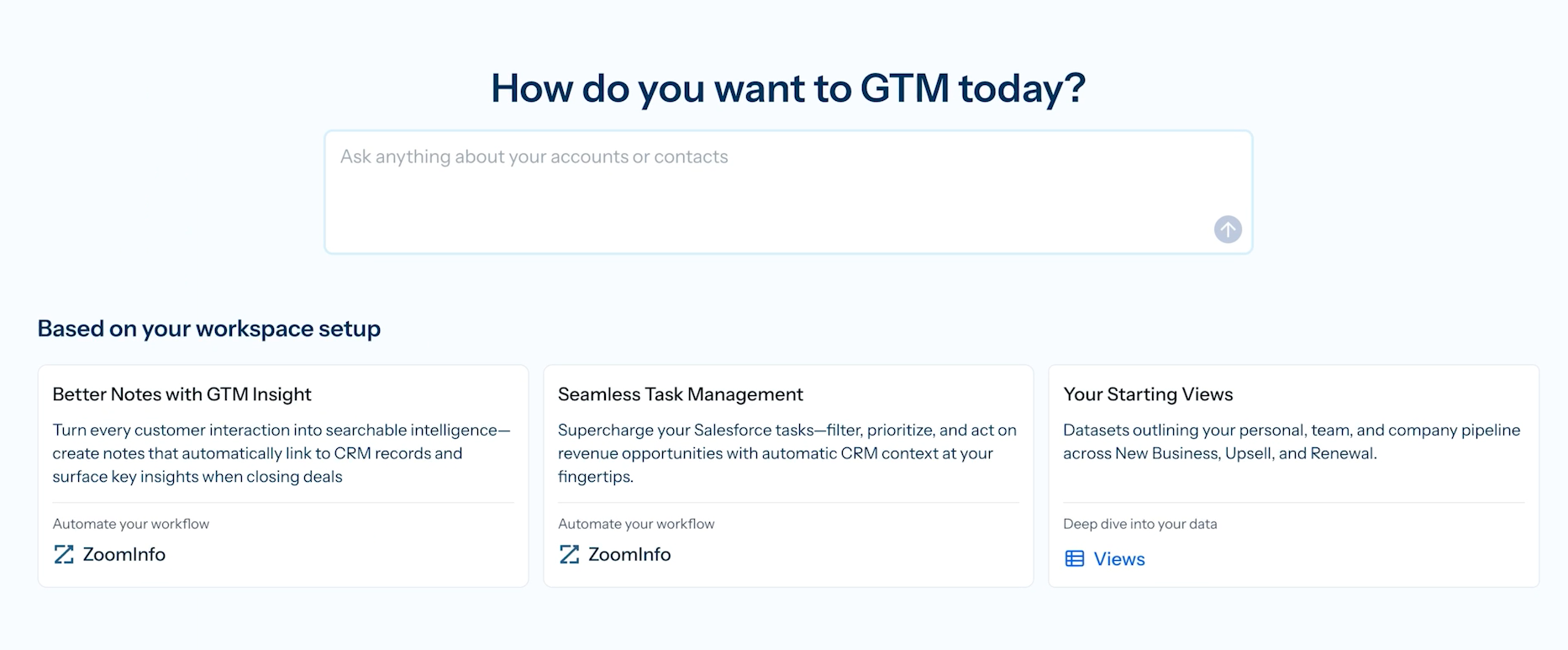
ZoomInfo delivers its intelligence through three channels. GTM Workspace gives sellers a single surface where prioritized accounts, AI-drafted outreach, and deal execution converge.
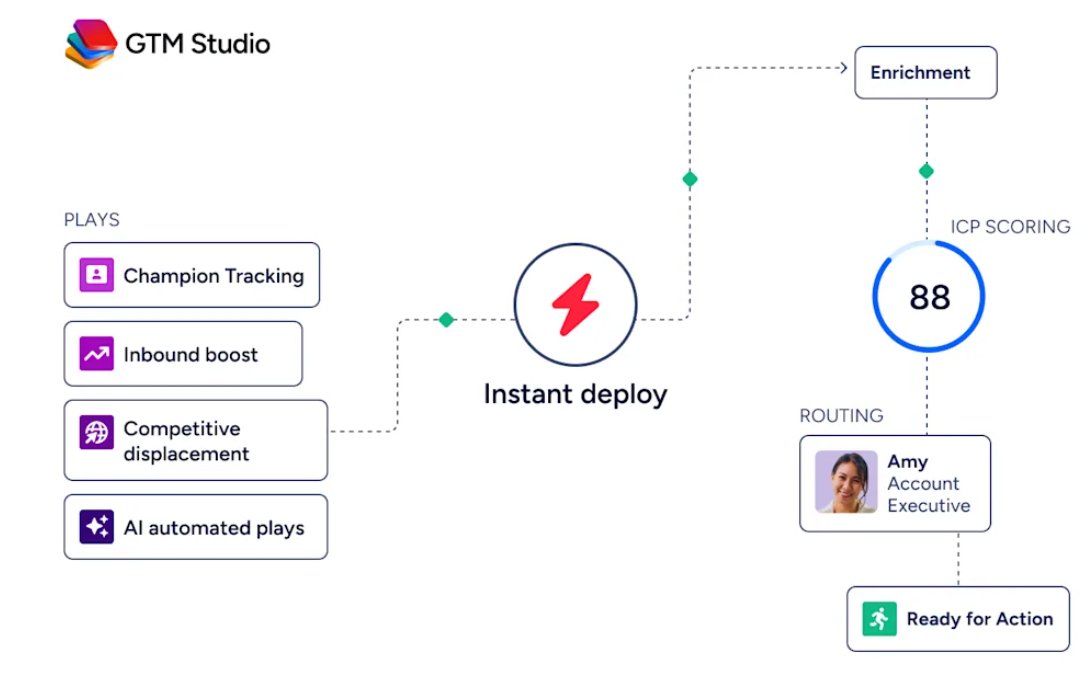
GTM Studio gives marketers, RevOps, and GTM engineers a builder environment where audience definition, campaign orchestration, and pipeline measurement happen in natural language.
And APIs and MCP expose the same intelligence to any custom agent, internal tool, or partner platform (from Anthropic Claude to Google to proprietary systems).
All three channels draw from one GTM Context Graph: the same data, the same intelligence, the same continuously learning model. Expansion plays that used to take 3 weeks now launch in 30 minutes without technical support. GTM Workspace "deploys in weeks, not months".
BDO Canada's Jerry Wilson, Senior Marketing Intelligence Analyst: "The plug-and-play aspect of the API means I can integrate it very easily into any process and get information at a moment's notice," achieving an 87% reduction in time spent on updates to their internal data dashboards. (BDO Canada)
Accessible Entry Points: Free tier and transparent trial access.
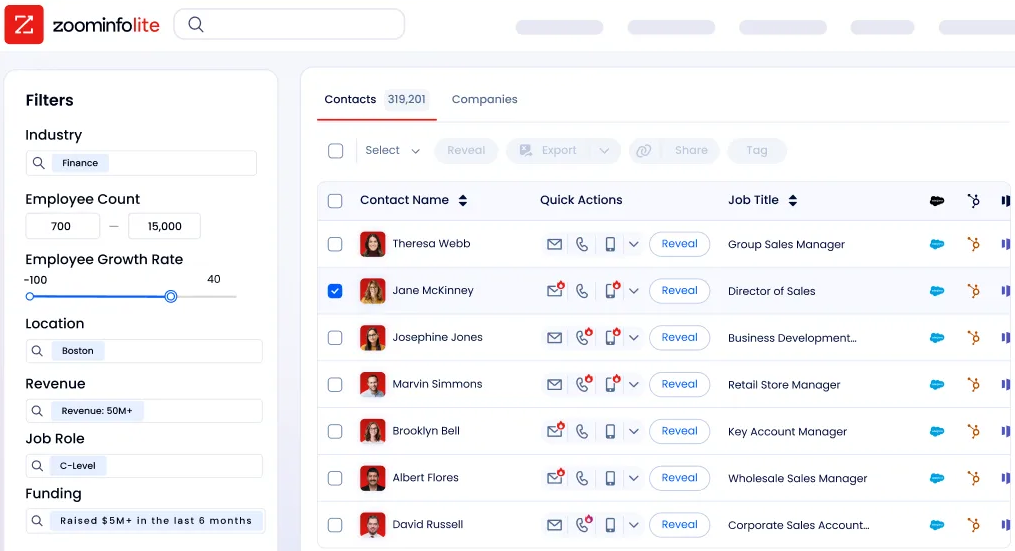
Unlike Tegus's sales-gated access, ZoomInfo provides multiple ways to evaluate before committing. ZoomInfo Lite is a permanent free tier (no credit card, no time limit) with access to the B2B database, 10 monthly export credits, individual and company searches, the ReachOut Chrome Extension, and WebSights Lite (up to 10 website visitor reveals per day). A separate 7-day free trial provides access to core platform features including intent signals and email outreach.
Tegus or ZoomInfo: Comparison Summary
Aspect | Tegus (by AlphaSense) | ZoomInfo |
|---|---|---|
Approach | Qualitative expert intelligence (transcripts, calls, financial models) | Quantitative B2B data + AI execution (contacts, signals, workflows) |
Primary audience | Institutional investors, PE firms, corporate strategy | Sales, marketing, RevOps, corporate development |
Contact data | Expert identities anonymized; no contact database | 500M contacts, 135M+ verified phone numbers, 200M+ verified business emails |
Company intelligence | Expert opinions on 27,000+ companies | Firmographics, technographics, org charts for 100M companies |
Real-time signals | Channel Checks (weekly cadence) | Intent signals, website visitors, buying behavior (continuous) |
Execution tools | None (research only) | GTM Workspace, GTM Studio, automated outreach, campaigns |
AI capabilities | Deep Research, Generative Search, AI-Led Calls | GTM Context Graph, AI agents, AI-drafted outreach |
Financial models | 4,000+ Canalyst models (unlocked Excel) | Not available |
Free tier | No (sales-led trial request only) | ZoomInfo Lite (permanent, no credit card) + 7-day trial |
Pricing transparency | No published pricing | Consumption-based pricing (custom-quoted), free tier available |
Compliance infrastructure | Multi-layered AI + human MNPI review; SOC 2, ISO 27001 | ISO 27001, ISO 27701, SOC 2 Type II, TRUSTe GDPR/CCPA |
Best for | Investment thesis validation, due diligence, qualitative research | Prospecting, pipeline generation, account intelligence, GTM execution |
Final Verdict
The choice between Tegus and ZoomInfo depends on what kind of intelligence you need and what you plan to do with it.
Choose Tegus if your work centers on understanding companies through the eyes of industry practitioners. It's the right tool for hedge fund analysts validating investment theses, PE firms conducting commercial due diligence, and corporate strategy teams who need qualitative depth that quantitative data alone cannot provide.
The transcript library (260,000+ conversations with former executives, customers, and competitors) compresses weeks of primary research into hours, and the Canalyst financial models eliminate the work of building models from scratch. For institutional investors who treat qualitative research as their edge, Tegus remains a category-defining platform.
Choose ZoomInfo if your need extends beyond understanding companies into identifying and reaching the right people at those companies at the right time. It's the right tool when you need verified contact data for outreach, real-time buying signals that show which accounts are in-market today, and execution tools that turn intelligence into meetings, pipeline, and revenue.
The GTM Context Graph captures why deals move or stall, and three delivery channels (GTM Workspace, GTM Studio, APIs/MCP) ensure intelligence reaches every team and every tool without lock-in. For professionals who need their market intelligence to be actionable, not just informative, ZoomInfo provides the data-to-execution path that research platforms do not.
Get started with ZoomInfo Lite for free here.
These platforms represent two legitimate philosophies of market intelligence. Tegus answers the question "What do practitioners think about this company?" ZoomInfo answers the question "Who should I contact, when, and what should I say?" For organizations that need both qualitative depth and quantitative execution, they serve different phases of the decision-making process.
Tegus FAQ
What is Tegus and who acquired it?
Tegus is an expert research platform founded in 2015 by Thomas and Michael Elnick, built to give institutional investors access to expert call transcripts, live expert calls, and financial models. AlphaSense acquired Tegus in July 2024 for approximately $930 million.
The Tegus brand continues to operate as a product division within AlphaSense, contributing 260,000+ expert transcripts and 4,000+ Canalyst financial models to a combined content library of 500M+ documents.
How much does Tegus cost?
Tegus does not publish pricing on its website. All purchases require engagement with the AlphaSense sales team and a signed Order Form.
The platform bills annually by default, with non-cancelable and non-refundable payment obligations. Expert calls are priced separately, with customers paying only the expert rate plus a flat $75 transcription fee. Tegus positions this as approximately 70% savings compared to traditional expert networks.
ZoomInfo uses consumption-based pricing (custom-quoted) but provides a permanent free tier (ZoomInfo Lite) and a 7-day free trial for evaluation before committing.
What is the Tegus Expert Transcript Library?
The Expert Transcript Library is the largest collection of proprietary, investor-led expert call transcripts in the industry, housing over 260,000 transcripts covering 27,000+ public and private companies. It grows by 7,000-8,000 transcripts monthly through three channels: investor-led calls, AlphaSense-led calls by in-house analysts, and AI-Led calls conducted by an autonomous AI interviewer.
Transcripts are searchable with AI-generated summaries and topic tags, and customers reportedly complete qualitative research 5-10x faster using the library.
Does Tegus offer a free trial?
Not in the traditional self-serve sense. The "Free Trial" button on tegus.com links to a sales-led trial request form on the AlphaSense website. No trial duration, scope, or content limits are publicly disclosed. There is no self-serve sign-up or permanent free tier.
What are AI-Led Expert Calls?
AI-Led Expert Calls use an autonomous AI interviewer to conduct conversations with vetted human experts 24/7. The AI reads required compliance disclosures, follows a structured prompt built from the client's research brief, asks context-rich questions, and adapts during the conversation. Compliance-reviewed transcripts with summaries are delivered in approximately 24 hours. This lets firms scale call volume without adding headcount and conduct research at any time of day.
What compliance protections does Tegus have?
Tegus runs a multi-layered compliance infrastructure with both AI and human review before any transcript is published. AlphaSense invests over $100 million annually in compliance with a dedicated team of 75+ professionals.
Experts must be at least six months removed from any prior role at the target company, expert identities are anonymized in published transcripts, and AI-led transcripts are labeled as AI-generated. The platform holds SOC 2 Type II and ISO 27001 certifications.
What sectors does Tegus cover best?
Tegus has its strongest coverage in technology, media, telecom (TMT), and healthcare, where the transcript library has the deepest archive of expert conversations. Coverage of industrials, energy, consumer, commodities, and emerging markets may be thinner. The platform covers both public and private companies, with more than 50% of Midas List VC investors using Tegus Expert Insights for private company research.
Can Tegus help me reach decision-makers at target companies?
No. Tegus is a research platform that provides qualitative insights about companies through expert conversations, not a contact database. Expert identities are anonymized in transcripts, and the platform does not provide verified email addresses, phone numbers, or org charts for company employees.
For professionals who need to identify and reach specific people at companies, a platform like ZoomInfo (which maintains 500M contacts with verified direct dials and business emails) addresses that need directly.
