

Visual Visitor has spent over 15 years in website visitor identification, offering something most tools in this space don't: the ability to identify individual people visiting your site, not just the companies they work for. For SMBs watching 98% of their website traffic leave without a trace, that matters. But as sales intelligence moves from identification toward full-funnel go-to-market execution, the question is whether visitor ID alone is enough.
To create this Visual Visitor review, we analyzed the platform in detail. We believe it's the right choice if:
You need person-level website visitor identification at an affordable price
Your website traffic is primarily US-based
You want a tool that identifies visitors within minutes of setup
You prefer month-to-month contracts without enterprise sales pressure
You value hands-on customer support from a small, responsive team
You're an agency looking for a white-label visitor identification product to resell
However, Visual Visitor might not be the best choice if:
You need global visitor identification beyond US traffic
You require enterprise security certifications (SOC 2, ISO 27001)
You want deal intelligence and conversation analysis
You're managing multi-channel GTM strategies across large sales teams
You need intent data with thousands of signals across third-party sources
You require bidirectional CRM integration with automated workflows
In this case, you should consider ZoomInfo: an AI-powered GTM platform with 500M contacts, 100M companies, 135M+ verified phone numbers, and 200M+ verified business email addresses.
Where Visual Visitor identifies who visited your website, ZoomInfo provides the broader intelligence layer: who's in-market, why deals move or stall, and what to do next, delivered through workspaces for sellers and marketers or via APIs and MCP into any tool you already use.
We've included a detailed look at ZoomInfo later in this Visual Visitor review for teams that need more than visitor identification. If you're ready to explore a go-to-market intelligence platform, you can start with ZoomInfo's free trial here.
What is Visual Visitor?
Visual Visitor is a consent-based website visitor identification and sales intelligence platform headquartered in Alpharetta, Georgia, with a second office in Jacksonville, Florida.
Brothers Rick Batchelor and Kevin Batchelor founded the company on October 5, 2009 as a company-level visitor tracking tool. It has since evolved into a person-level identification platform with AI outreach capabilities.
The flagship product, WebID +Person, identifies individual website visitors by name and email address, returning up to 40+ data points per contact without requiring a form fill. Visual Visitor claims identification rates of 35–40% of US-based website visitors, with some documentation suggesting up to 50–55% in certain contexts.
The platform now includes a B2B contact database (959+ million contacts as of May 2026), AI email outreach (AI Sales Rep), pre-call coaching (AI Sales Coach), and person-level advertising.
Visual Visitor is bootstrapped with no outside capital and reports 2,000+ paying customers. The company targets SMBs and marketing agencies, pricing itself below enterprise competitors with month-to-month contracts and no aggressive sales process.
Visual Visitor Pros & Cons
Pros | Cons |
|---|---|
- Person-level identification (name + email), not just company | - US-only coverage for person-level identification |
- Quick setup (approximately 20 minutes) | - Identification rate caps at roughly 35–55% of US visitors |
- Built-in double email validation at no extra cost | - Basic reporting and analytics dashboard |
- Month-to-month contracts available | - No formal security certifications (SOC 2, ISO 27001) |
- Responsive, hands-on customer support | - Specific pricing not published on website |
- White-label reseller program for agencies | - Limited native CRM integrations (HubSpot via Zapier only) |
- 14-day free trial with 500 identifications, no credit card | - Small company with limited public transparency |
- Automated credit refund for low-confidence contacts | - Demographic enrichment data can be inconsistent |
Visual Visitor Review: How it Works & Key Features
WebID +Person: Visual Visitor identifies individual website visitors by name and email without requiring a form fill.
WebID +Person is the core product. You install a lightweight JavaScript tracking snippet on your website. When a visitor lands and accepts cookies, the platform cross-references their browser session against an identity graph built from 13+ source types including data co-ops, social channels, publishers, and advertising networks.
A successful identification requires three fields: first name, last name, and email address. Beyond these, the platform can return up to 52 total data fields including mailing address, gender, search terms used to find the site, and geographic data when available. Identified contacts push in real time to connected platforms via 300+ integrations or Zapier.
Visual Visitor describes the identification as consent-based: the visitor previously consented to their data being included in the identity graph through some prior digital interaction. The platform includes cookie consent management and "Do Not Sell My Info" forms, along with suppression controls for regulated sectors like healthcare and finance.
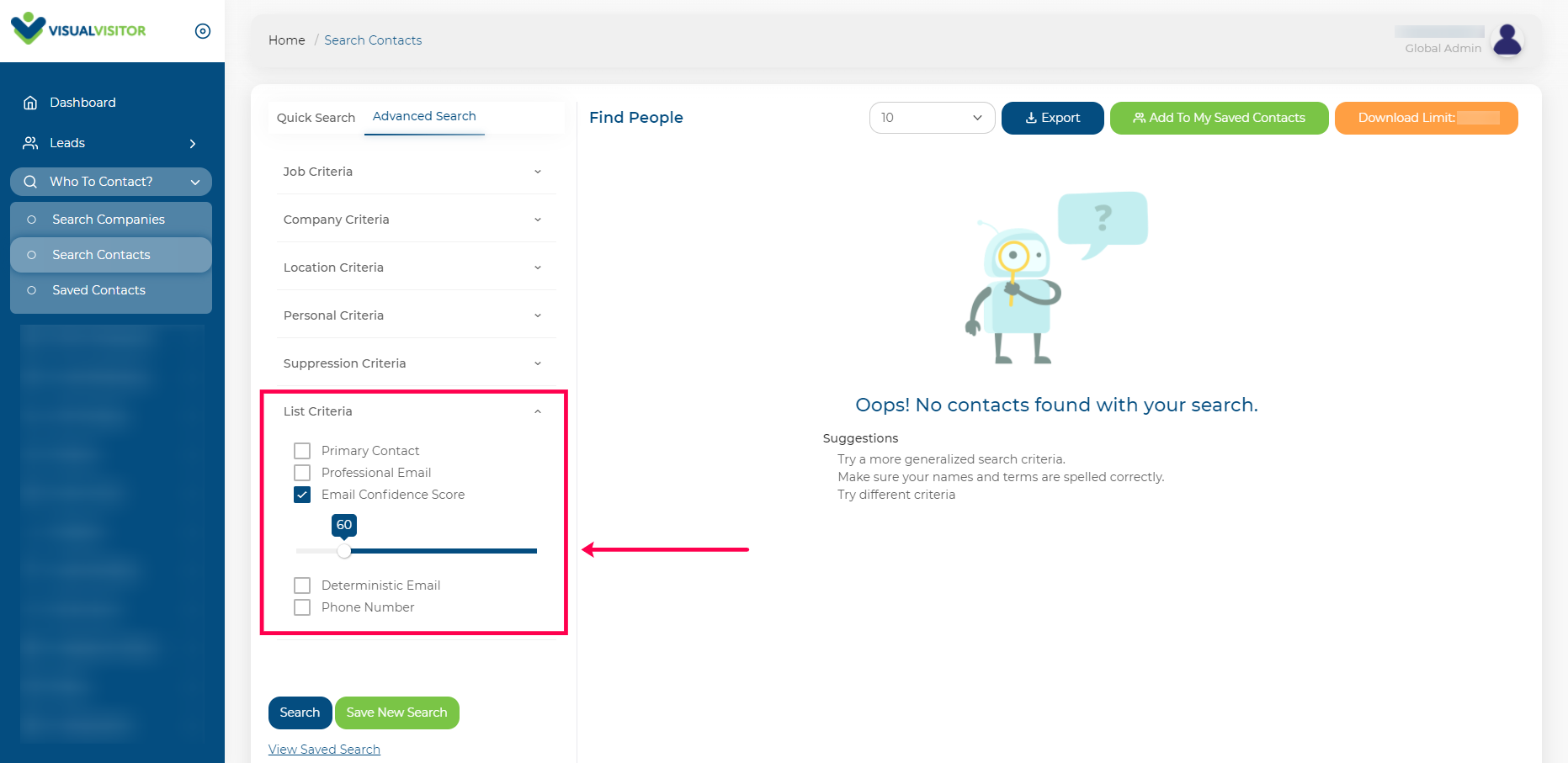
Every identified contact passes through a two-stage email validation system called the Contact Confidence Score, rated 0–100.
Source: Visual Visitor
The system computes a Historical Confidence Score when it first acquires the data, and a Real-Time Confidence Score when you export or act on the contact. If the real-time score drops to 40 or below, the platform automatically refunds the credit with no manual claim required. Visual Visitor includes email validation at no additional cost, while most competitors charge separately.
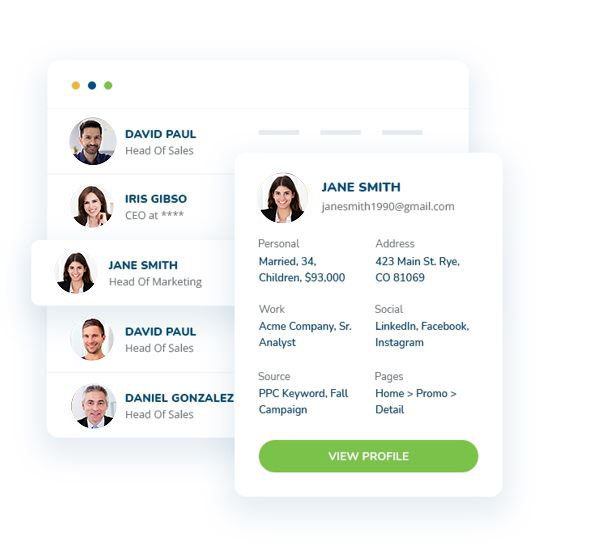
WebID +Employee: Visual Visitor identifies the specific employee visiting your site, including remote workers on residential networks.
WebID +Employee is the B2B-focused identification tier. Most visitor identification tools rely on IP-to-company lookups that break when employees work from home on residential ISPs.
Source: Visual Visitor
Visual Visitor's multi-source matching approach identifies remote workers even off corporate networks.
The product returns professional contact data (name, email, alternate email, phone number, job title, skill sets, education history) along with company firmographics (size, industry, address). It also includes per-user lead routing for territory-based sales teams, customizable lead filters by industry and company size, and real-time email alerts when matching visitors arrive.
WebID +Employee sits between WebID +Company (company-level only) and WebID +Person (consumer-level with 40+ fields) in Visual Visitor's product lineup, making it the right choice for B2B sales teams that need individual employee identification without the consumer demographic data.
AI Sales Rep and AI Sales Coach: Visual Visitor offers automated outreach and pre-call coaching powered by AI.
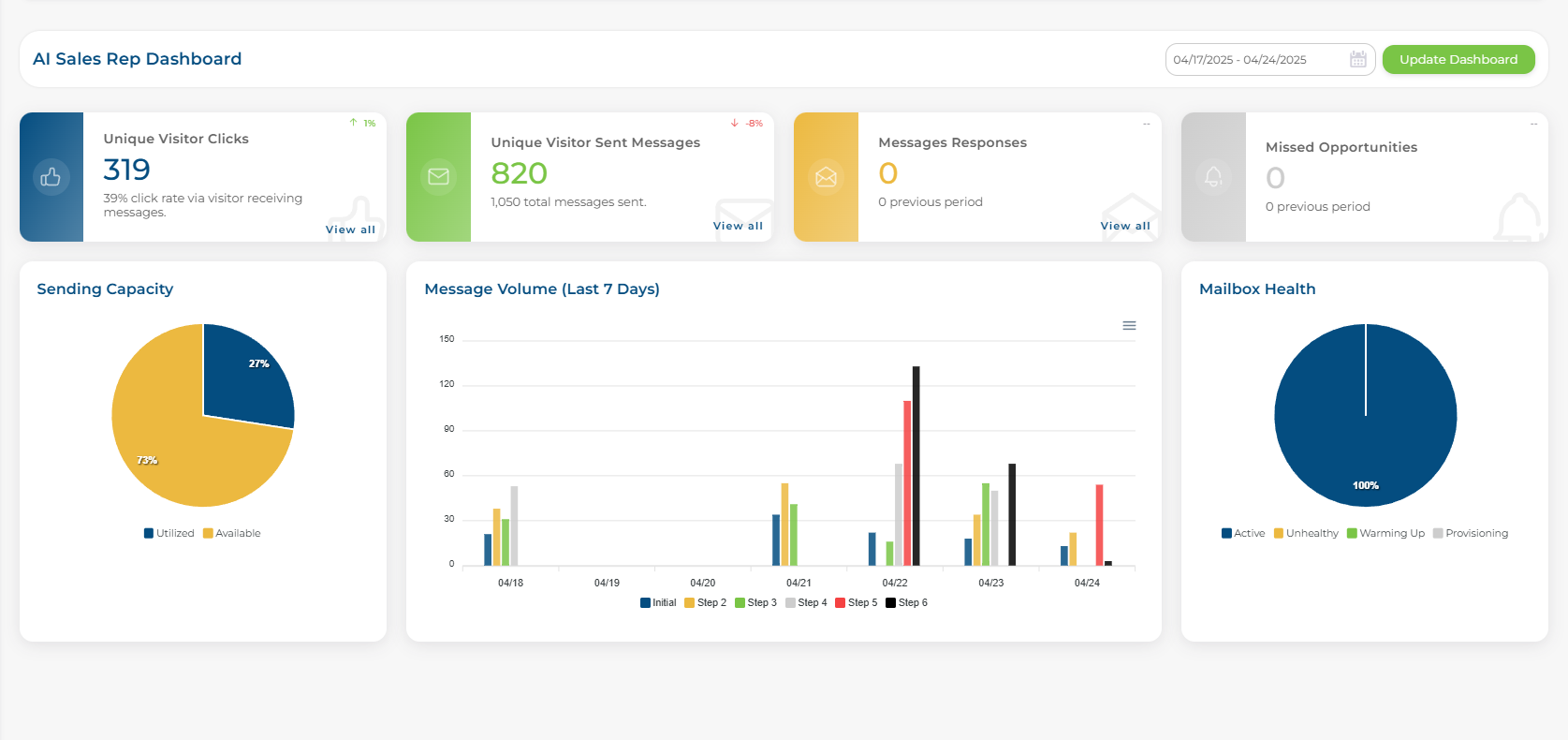
AI Sales Rep, launched in June 2024, automates outbound email to identified website visitors. The system focuses on visitors spending time on buying pages, generates personalized emails based on browsing behavior, and handles negative replies and out-of-office responses without human intervention.
Source: Visual Visitor
Visual Visitor claims open rates above 60% and delivery rates over 90% on its distributed email infrastructure, with built-in SPF, DKIM, and DMARC management.
AI Sales Coach, released in January 2025, takes a different approach: it analyzes a prospect's LinkedIn profile across 34+ data points and generates a personality profile with communication recommendations.
The output includes do's and don'ts for calls, scripts calibrated to the prospect's behavioral style, and closing approach guidance. A sample output PDF is publicly available for evaluation.
Together, these tools extend Visual Visitor from identification into outreach and sales coaching, though both are new additions compared to the core WebID products.
Who to Contact and Person Level Advertising: Visual Visitor includes a contact database and person-level ad targeting.
Who to Contact is a standalone B2B contact database that has grown to 959+ million contacts as of May 2026, covering 54 million companies. Records include professional and personal email addresses, cell phone numbers, direct dials, job titles, skill sets, and organizational data (manager and co-workers).
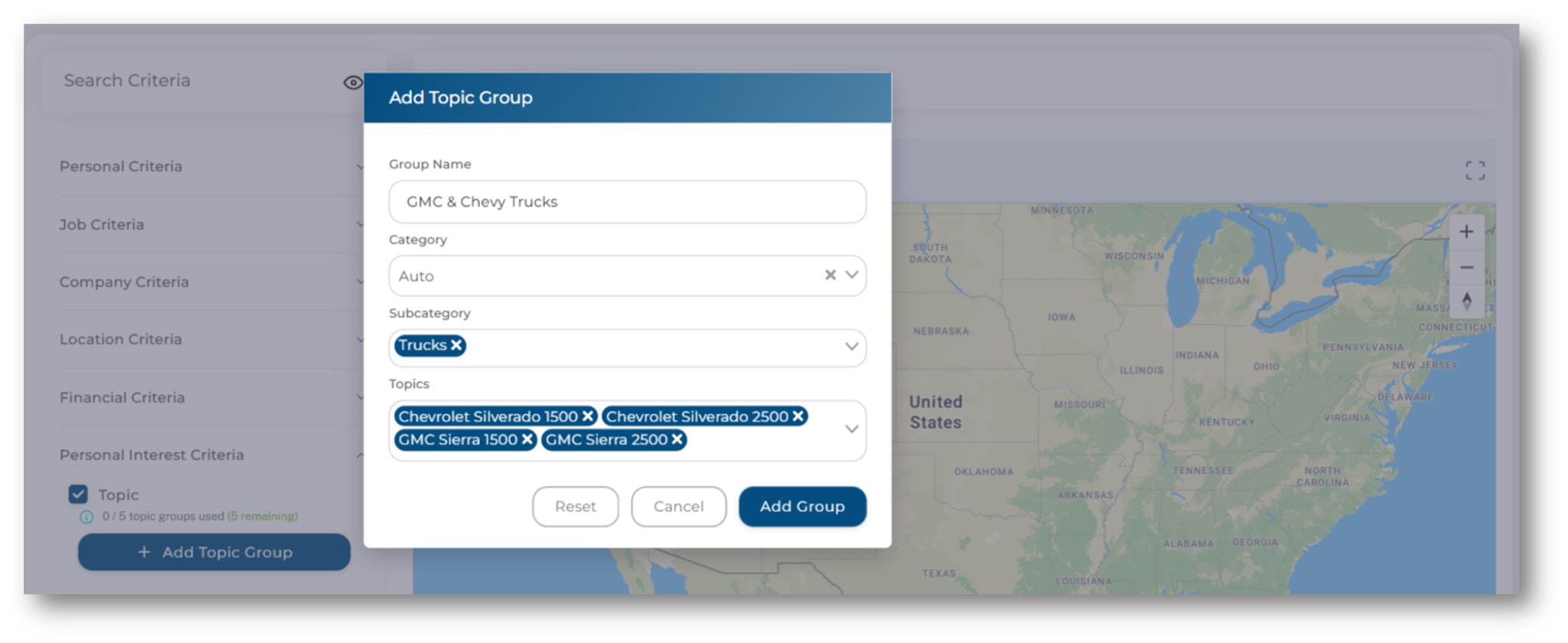
Person Level Advertising, launched in November 2025, targets identified individuals across 33,000+ B2B topics and 6,600+ B2C topics.
Source: Visual Visitor
The Facebook Connector and Google Connector automatically sync identified audiences into Meta Custom Audiences and Google Customer Match. A Lead Reactivation module monitors uploaded CRM lists daily and alerts sales teams when dormant contacts show renewed buying interest.
Pricing: Visual Visitor uses usage-based pricing with month-to-month flexibility, but doesn't publish specific rates.
Visual Visitor prices based on the number of successful identifications: you pay for contacts the system returns, not a flat platform fee.
The platform splits into two product lines: Marketing Product (WebID +Person) and Sales Product (WebID +Employee, AI Sales Rep, AI Sales Coach).
Specific tier names and dollar amounts don't appear on the website. A Premium Plan tier exists (it includes a 60-minute onboarding session), but the full tier structure requires contacting the sales team or starting a free trial.
Visual Visitor offers a 14-day free trial for WebID +Person with 500 free identifications (no credit card required) and a separate full-platform trial with 25 free credits. Both month-to-month and annual plans are available. The company distances itself from competitors that "push you into a multi-year agreement with aggressive sales people."
One note: while the marketing emphasizes month-to-month flexibility, the Terms of Service for customers who sign a formal Order Form default to a 12-month initial term with auto-renewal unless you provide written notice 30 days before term end. Buyers should clarify which contract structure applies to their plan.
Where Visual Visitor Falls Short
Visual Visitor does several things well for its target market.
But as businesses scale their go-to-market operations, certain limitations become apparent. These reflect the natural boundaries of a platform built for visitor identification at SMB pricing, not full-funnel sales intelligence.
US-Only Person-Level Identification. WebID +Person works only with US-based visitors. International traffic returns company-level or ISP-level data at best. For any company with meaningful traffic from Europe, Asia, or other regions, the core value proposition doesn't apply to a large portion of their audience. There is no publicly stated roadmap for international expansion.
No Formal Security Certifications. Visual Visitor holds no SOC 2, ISO 27001, or other recognized security certifications. For enterprise buyers running formal vendor security reviews (particularly in financial services, healthcare, or technology), this blocks procurement approval.
The company describes its data as ethically sourced and offers CCPA opt-out and cookie consent tools, but lacks the independently audited security posture larger organizations require.
Basic Reporting and Analytics. Multiple reviewers on SourceForge and Capterra describe the reporting dashboard as basic, with limited customization and visualization options. Teams that need to attribute identified visitor activity to downstream revenue or run funnel analysis may find the analytics too shallow.
Limited Native CRM Integrations. While Visual Visitor lists 300+ integrations, several major CRMs (HubSpot, Pipedrive, Zoho) connect only through Zapier rather than native, bidirectional integrations.
Salesforce has a direct integration via webhooks, but overall CRM integration depth is limited compared to platforms built for enterprise GTM workflows. There is no published public API documentation for custom builds.
Identification Ceiling. Even at the platform's highest claimed rates, roughly 45–65% of US visitors and nearly all international visitors remain anonymous. Companies expecting full visibility into their traffic will find a gap. The Contact Confidence Score and automated refund mechanism ensure quality of what gets identified, but they don't raise the ceiling itself.
Small Company Transparency. Visual Visitor does not publish revenue, employee headcount, or leadership information beyond the founding brothers. No named executives, department heads, or advisors appear on the company website.
The 15+ years of bootstrapped operation and Inc. 5000 recognition provide some stability signals, but enterprise buyers performing due diligence may find the lack of organizational transparency concerning.
These limitations are the natural result of building a lean, focused platform for SMBs. But they create gaps for teams that need broader data coverage, deeper intelligence, and enterprise infrastructure across their go-to-market operation.
Top Visual Visitor Alternative for Complete GTM Intelligence: ZoomInfo
ZoomInfo is an AI-powered GTM platform built on a large B2B data foundation.
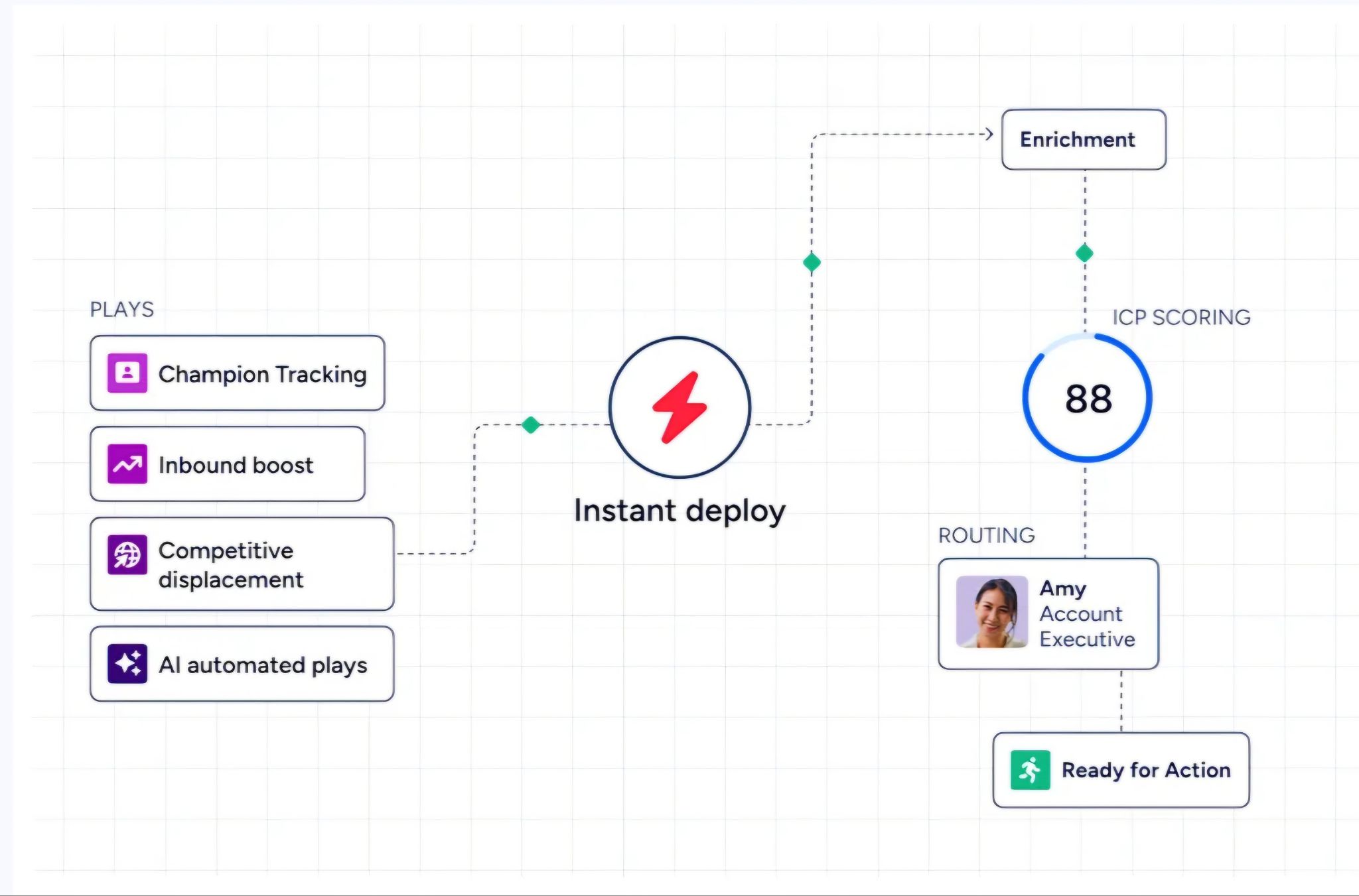
Its GTM Context Graph fuses ZoomInfo's data with your first-party data to capture not just what happened in a deal, but why, and what to do next. That intelligence reaches your team through GTM Workspace for sellers, GTM Studio for marketers and RevOps, or APIs and MCP in any front end.
Source: ZoomInfo
Founded in 2007 and now a public company (NASDAQ: GTM) with $1.25 billion in annual revenueAs the GTM data layer trusted by over half the Fortune 500, ZoomInfo counts among its customers35,000+ companies Adobe, Snowflake, PayPal, and Thomson Reuters.
Comprehensive B2B Data Foundation: ZoomInfo maintains a verified B2B data platform with 500M contacts and global coverage.
ZoomInfo's data covers three dimensions: identity (500M contacts, 135M+ verified phone numbers, 120M direct dials, and 200M+ verified business email addresses), company context (100M companies with attributes, org charts, and technographics covering 30,000+ technologies), and signals that indicate when accounts are actively in-market.
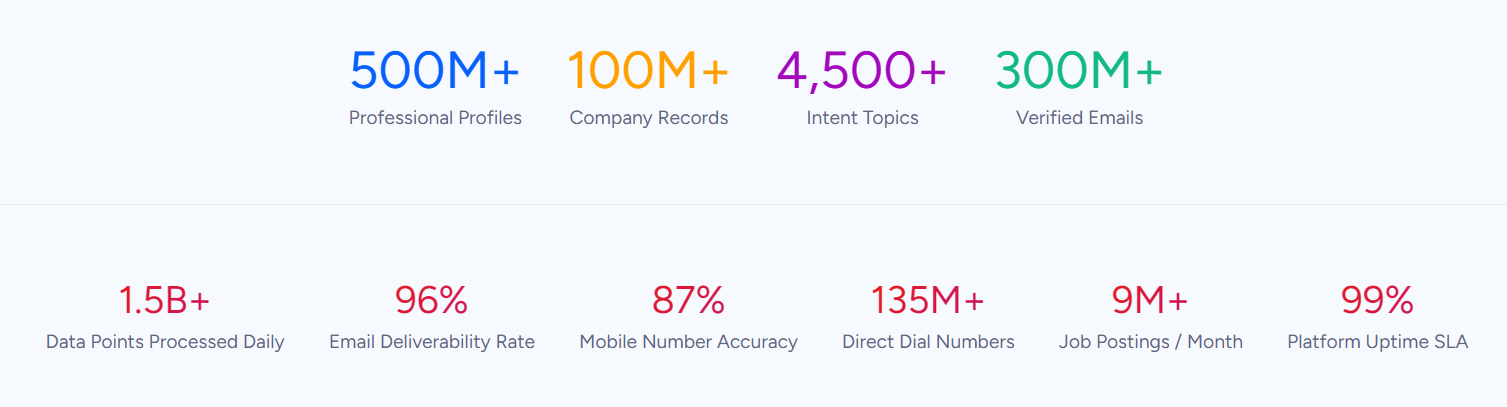
Three hundred human researchers verify the data through a multi-source pipeline, achieving 95% accuracy on first-party data. Global coverage extends beyond North America with 34M+ international company profiles, 200M+ international professional profiles, and 45M+ international mobile numbers.
In a Fortune 500 competitive RFP analyzing 25 million contacts across vendors, the independent consultant concluded that "no other competitor came even close."
Where Visual Visitor's contact database focuses on raw scale (959M+ records) at SMB pricing, ZoomInfo's advantage is verified depth: each contact comes with direct dials, verified business emails, org chart positioning, technographic data, and intent signals, processed through continuous multi-layer verification.
"ZoomInfo gives us the information we need to execute. We don't have to go through and spend our time digging. It's already there, so we can be three steps ahead." (Vensure)
GTM Context Graph: ZoomInfo's intelligence layer captures not just what happened in a deal, but why.
Visual Visitor identifies who visited your site and can trigger automated outreach.
ZoomInfo's GTM Context Graph goes further by fusing its B2B data with a customer's CRM records, conversation transcripts, email threads, and behavioral signals into a single intelligence layer that processes 1.5B+ data points daily.
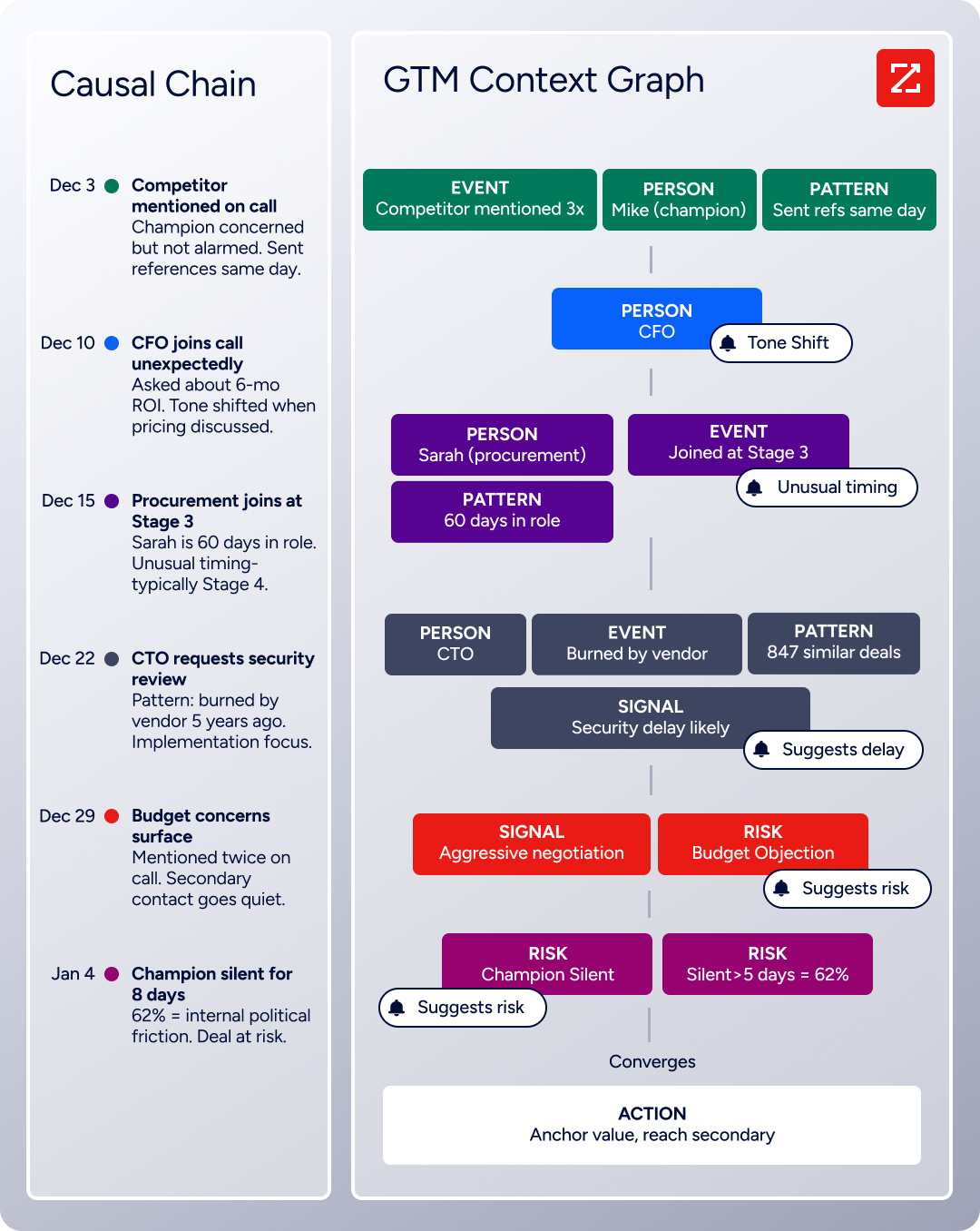
The practical difference: a CRM records that a deal moved to Stage 3. Conversation intelligence transcribes what the VP of Finance said on the last call. Intent data logs a spike in research activity.
The GTM Context Graph connects all three to surface why the deal moved, then translates that context into actions: the follow-up email addresses the specific concern the executive raised, the next play targets accounts whose signal patterns match actual wins, and the forecast reflects buying evidence rather than stage labels.
This layer exists because ZoomInfo spent twenty years building its data infrastructure and acquired Chorus for conversation analysis. Visual Visitor's AI Sales Coach analyzes a prospect's LinkedIn profile before a call; ZoomInfo's GTM Context Graph analyzes every call, email, and CRM interaction across thousands of deals to identify the patterns that predict outcomes.
"That combination of our internal CRM data, external signals, and AI that's given all that context has helped us craft very specific account- and persona-based messages. And people have responded to them right away." (Seismic)
GTM Workspace and GTM Studio: ZoomInfo delivers intelligence through dedicated AI workspaces.
ZoomInfo provides three ways to access its intelligence.
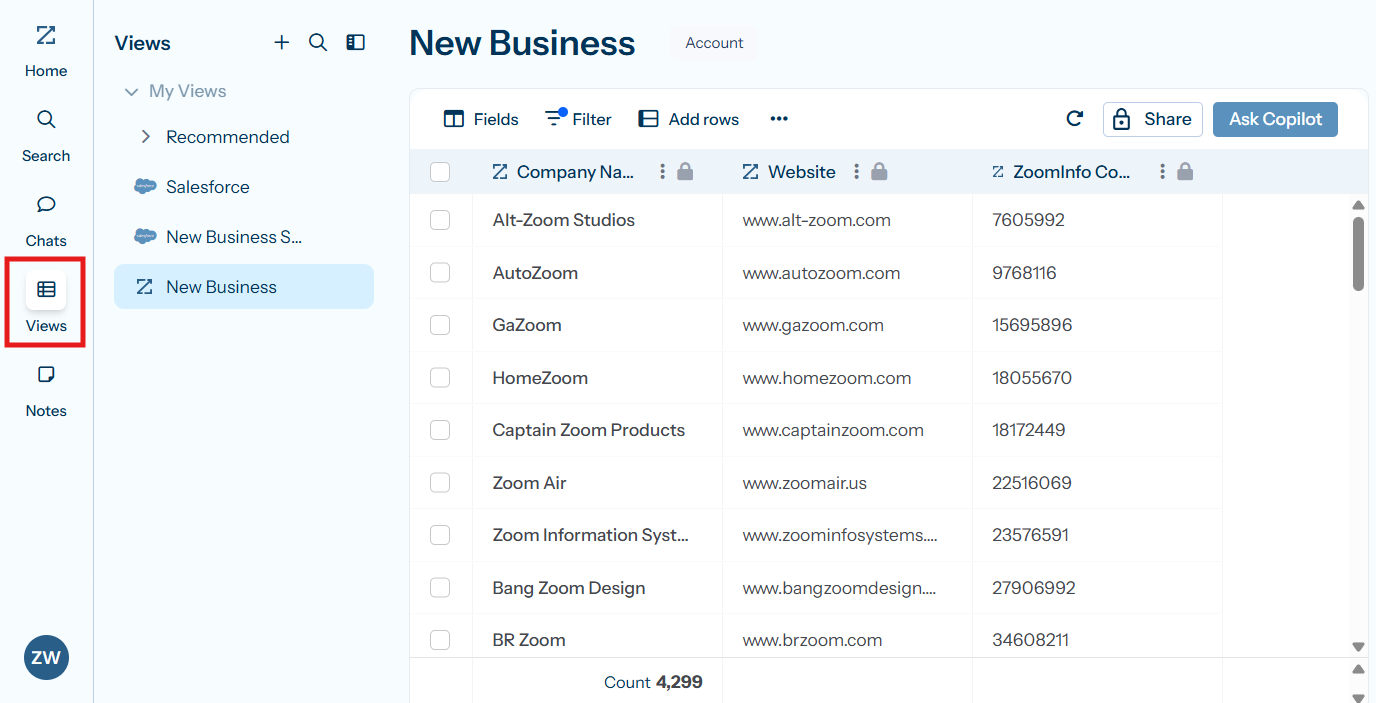
GTM Workspace is the seller's interface: an AI workspace where prioritized accounts, AI-drafted outreach, and deal execution converge without toggling between tools. AI agents handle account research, outreach generation, CRM updates, and signal monitoring, answering three questions for every rep: who to contact, when to engage, and what to say.
Source: ZoomInfo
GTM Studio serves marketers, RevOps, and GTM engineers with a builder where audience definition, campaign orchestration, and pipeline measurement happen in natural language. Expansion plays that used to take three weeks now launch in 30 minutes without engineering support.
For teams building beyond ZoomInfo's own products, APIs and MCP expose the same intelligence to any custom agent, internal tool, or partner platform. The MCP server connects AI models (including Anthropic Claude and ChatGPT) directly to ZoomInfo's data through natural language. All three draw from the same GTM Context Graph, so your choice of interface never limits the intelligence available.
Visual Visitor's integrations are primarily one-directional (push identified contacts out). ZoomInfo's architecture is bidirectional: it pulls intelligence from across the GTM stack and pushes actions back, creating a closed loop between data, intelligence, and execution.
"Anything that minimizes our team's need to switch contexts is beneficial. ZoomInfo offers a unified view, eliminating the need to navigate between systems." (Spekit)
Enterprise-Grade Security and Compliance: ZoomInfo holds the certifications that enterprise procurement requires.
ZoomInfo maintains a compliance stack renewed annually: ISO 27001 (information security management), SOC 2 Type II (security, confidentiality, and availability), ISO 27701 (privacy information management), and TRUSTe GDPR and CCPA practice validations.
The company is a registered data broker in California and Vermont and maintains a dedicated Trust Center.
ZoomInfo also offers ZoomInfo Lite, a permanent free tier (no credit card, no time limit) with access to the B2B database, 10 monthly export credits, advanced search filters, CRM enrichment, and WebSights Lite (up to 10 website visitor reveals per day).
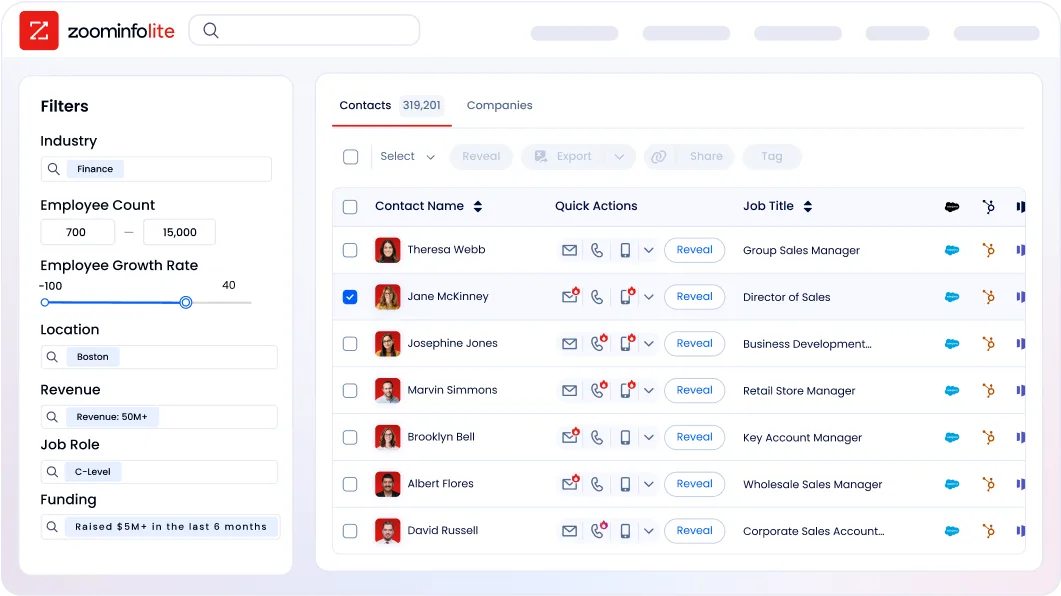
Paid plans use consumption-based pricing, custom-quoted based on usage patterns, organized into Sales, Marketing, and standalone product tiers. A 7-day free trial (no credit card required) is also available.
Visual Visitor or ZoomInfo: Comparison Summary
Visual Visitor | ZoomInfo | |
|---|---|---|
Primary focus | Website visitor identification | AI GTM platform |
Target audience | SMBs and agencies | Enterprise and upper mid-market |
Contact database | 959M+ contacts | 500M contacts (multi-source verified, 95% accuracy on first-party data) |
Direct-dial phone numbers | 23M cell numbers | 135M+ verified, 120M direct dials |
Verified business emails | 183M professional emails | 200M+ verified |
Website visitor identification | Person-level (US only, 35–55% rate) | Company-level with contact-level identification |
Intent data | B2B intent (limited disclosure on methodology) | 210M IP-to-Organization pairings, 6T+ keyword-to-device signals monthly |
AI capabilities | AI Sales Rep (email outreach), AI Sales Coach (LinkedIn profiling) | GTM Context Graph, AI agents for research/outreach/CRM updates, AI audience building |
Conversation intelligence | Not available | Chorus (call recording, transcription, deal intelligence) |
CRM integrations | Salesforce (webhook), HubSpot/Pipedrive/Zoho (Zapier) | Native Salesforce, HubSpot, Microsoft Dynamics; 120+ marketplace integrations |
API and developer access | Webhooks and Zapier; no public API docs | Enterprise API suite, MCP server, developer portal |
Security certifications | None published | ISO 27001, ISO 27701, SOC 2 Type II, TRUSTe GDPR/CCPA |
Global coverage | US only for person-level ID | 34M+ international companies, 200M+ international profiles |
Pricing transparency | Not published; usage-based | Not published; consumption-based |
Free tier | 14-day trial (500 IDs, no credit card) | ZoomInfo Lite (permanent, no credit card) + 7-day full trial |
Contract flexibility | Month-to-month and annual | Annual contracts standard |
Best for | SMBs needing affordable US visitor identification | Teams needing complete GTM intelligence, data, and execution |
Final Verdict
The choice between Visual Visitor and ZoomInfo depends on where your business stands and what you need from your sales intelligence tools.
Choose Visual Visitor if you're an SMB or agency with primarily US-based website traffic that needs an affordable way to identify who's visiting your site. The platform delivers on its core promise: turn anonymous visitors into named contacts with email addresses, fast.
The 20-minute setup, month-to-month pricing, hands-on support, and white-label reseller program make it suited for small sales teams and digital agencies that want person-level identification without enterprise complexity. If your primary job is converting website traffic into an outbound contact list, Visual Visitor handles it at a price point enterprise platforms don't match.
Choose ZoomInfo if your go-to-market operation has grown beyond visitor identification into territory where you need verified global data, intent signals, deal intelligence, and AI execution across sales, marketing, and RevOps. ZoomInfo is the platform for teams that need to know not just who visited, but who's in-market across the web, why deals are moving or stalling, and which accounts to prioritize next.
The GTM Context Graph, GTM Workspace, and GTM Studio turn scattered signals into coordinated action. For organizations that have outgrown point solutions and need their data, intelligence, and execution in one system, ZoomInfo provides the infrastructure that scales with them.
Get started with ZoomInfo here.
The difference is scope. Visual Visitor answers the question "Who visited my website?" ZoomInfo answers "Who should I be selling to, why, and how?" Both serve their audiences well. Your choice depends on which question your business needs answered.
Visual Visitor FAQ
Does Visual Visitor offer a free trial?
Yes. Visual Visitor provides a 14-day free trial for WebID +Person with 500 free identifications and no credit card required. A separate full-platform trial with 25 free credits is also available. Setup takes about 20 minutes, and the trial gives full access to the platform's features. There is no permanent free plan.
ZoomInfo offers both a permanent free tier (ZoomInfo Lite with 10 monthly export credits and WebSights Lite) and a 7-day full-platform free trial, also without requiring a credit card.
What identification rate can you expect from Visual Visitor?
Visual Visitor claims identification rates of 35–40% of US-based website visitors, with some documentation suggesting up to 50–55% in certain contexts. A successful identification requires resolving first name, last name, and email address.
The actual rate depends on your traffic composition; visitors using VPNs, incognito browsing, or those outside the US will not be identified. International traffic returns company-level data at best.
Does Visual Visitor work outside the United States?
Person-level identification (WebID +Person) works only with US-based visitors. International traffic may return company-level identification through IP lookup, but the platform's core capability of identifying individuals by name and email does not extend beyond the US.
ZoomInfo provides global coverage with 34 million international company profiles, 200 million international professional profiles, and 45 million international mobile numbers.
How much does Visual Visitor cost?
Visual Visitor does not publish specific pricing on its website. The company uses a usage-based model priced on the number of successful identifications. Both month-to-month and annual plans are available. The pricing page positions the platform as "priced substantially below most big competitors." To get exact pricing, you need to contact the sales team or start a free trial.
ZoomInfo also uses consumption-based pricing but offers a permanent free tier through ZoomInfo Lite.
What CRM integrations does Visual Visitor support?
Visual Visitor offers a native Salesforce integration via webhooks. HubSpot, Pipedrive, and Zoho CRM connect through Zapier.
The platform also integrates directly with email marketing tools like Mailchimp, ActiveCampaign, Klaviyo, and Constant Contact. A generic webhook endpoint and WordPress plugin are available. Total integrations are listed at 300+, though many rely on Zapier as the connector rather than native, bidirectional sync.
Is Visual Visitor compliant with GDPR and CCPA?
Visual Visitor's person-level identification is consent-based and designed for US traffic, so GDPR is not its primary compliance framework. The platform includes CCPA opt-out functionality and cookie consent management tools. The company positions its data collection as CAN-SPAM compliant and CCPA-aligned.
However, Visual Visitor holds no formal security certifications like SOC 2 or ISO 27001. For companies requiring independently audited compliance, ZoomInfo holds ISO 27001, ISO 27701, SOC 2 Type II, and TRUSTe GDPR and CCPA practice validations.
What is Visual Visitor's Contact Confidence Score?
The Contact Confidence Score is a two-stage email validation system scored 0–100. The system assigns a Historical Confidence Score when it first acquires the contact data, and recalculates a Real-Time Confidence Score when a user exports or acts on the contact. If the real-time score falls to 40 or below, the platform automatically refunds the credit with no manual claim.
Visual Visitor includes this validation at no extra charge, while most competitors charge separately for email verification.
How does Visual Visitor compare to enterprise platforms like ZoomInfo?
Visual Visitor focuses on website visitor identification at SMB-accessible pricing, while ZoomInfo is a full go-to-market intelligence platform with broader data, deal intelligence, conversation analysis, and multi-channel execution tools. Visual Visitor's advantages are affordability, quick setup, and person-level identification for US traffic.
ZoomInfo's advantages are global verified data at larger scale, intent signals, the GTM Context Graph for understanding deal dynamics, and enterprise security certifications. The right choice depends on whether you need a focused visitor identification tool or a complete GTM platform.
