
Choosing between WalkMe and ProductLed for your SaaS growth strategy comes down to five questions:
Do you want to add guidance layers on top of your existing product, or redesign how users experience it?
Are you trying to help employees adopt internal enterprise software, or convert free users into paying customers?
Do you have the budget for enterprise software and multi-year contracts, or do you want a focused engagement with a defined outcome?
Is your biggest challenge that users can't figure out your product, or that your product doesn't deliver value fast enough?
Once you've solved the adoption problem, do you have the go-to-market intelligence to fill the top of the funnel with the right prospects?
In short, here's what we recommend:
WalkMe is the enterprise standard for digital adoption, now owned by SAP. It places interactive guidance, tooltips, and automation on top of any web or desktop application, helping employees navigate complex software without leaving the workflow. WalkMe serves large organizations rolling out SAP, Salesforce, or Workday at scale. But it carries enterprise pricing: custom quotes, multi-year contracts, and a real learning curve for administrators who build the guidance content.
ProductLed is the consulting and education firm behind the product-led growth movement. ProductLed helps SaaS founders redesign their product experience so users reach value in 60 seconds or less. Their programs range from a $497 on-demand sprint to $10,000 consulting engagements, and they've worked with 434+ SaaS companies generating over $1B in collective self-serve revenue. But ProductLed is a methodology and consulting service, not a software platform, and it serves only SaaS companies past product-market fit.
Both approaches tackle a real problem: getting users to adopt and extract value from software. But neither addresses what happens before users reach your product. The best onboarding experience in the world can't compensate for reaching the wrong prospects, or missing the ones who are actively in-market. That's where go-to-market intelligence enters the picture.
ZoomInfo is an AI-powered GTM platform that helps SaaS companies identify and reach the buyers most likely to convert. Built on 500M contacts, 100M companies, 135M+ verified phone numbers, and 200M+ verified business emails, ZoomInfo's GTM Context Graph combines this data with your CRM records, conversation transcripts, and behavioral signals to reveal which accounts are in-market and why deals move. Whether your growth motion is product-led, sales-led, or hybrid, ZoomInfo provides the intelligence that ensures the right prospects enter your funnel, through the GTM Workspace for sellers, GTM Studio for marketers and RevOps, or APIs and MCP in any tool.
If a data-driven growth engine sounds like the missing piece of your GTM strategy, see how ZoomInfo works with a free trial.
WalkMe vs. ProductLed vs. ZoomInfo at a glance
WalkMe | ProductLed | ZoomInfo | |
|---|---|---|---|
What it is | Enterprise digital adoption platform (software) | PLG consulting and education firm | AI-powered go-to-market intelligence platform |
Core approach | Overlay guidance on top of existing applications | Redesign the product experience itself | Identify and reach the right buyers with verified data and signals |
Target buyer | CIOs, CHROs, IT leaders at large enterprises | SaaS founders and GTM leaders past PMF | Sales, marketing, and RevOps teams at B2B companies |
Primary problem solved | Employees can't use enterprise software effectively | SaaS products don't convert free users to paid | Go-to-market teams can't find, prioritize, or reach the right prospects |
Pricing | Custom enterprise quotes, multi-year contracts | $497 to $20,000+ (project-based) | Custom consumption-based pricing; free tier available |
Company size focus | 1,000+ employees (typically 5,000-100,000) | SaaS companies past product-market fit | Enterprise and upper mid-market B2B |
Key differentiator | DeepUI technology auto-adapts to UI changes | Methodology backed by $1B+ in client self-serve revenue | 500M contacts, GTM Context Graph, universal access via API/MCP |
Analyst recognition | Forrester Wave Leader (DAP, Q4 2024) | Not applicable (consulting firm) | Gartner MQ Leader (ABM, 2024 & 2025); Forrester Wave Leader (Intent Data, Q1 2025) |
These platforms solve fundamentally different problems
The most important thing to understand about WalkMe and ProductLed is that they look similar from a distance but work at different levels of the stack.
WalkMe operates at the interface layer.
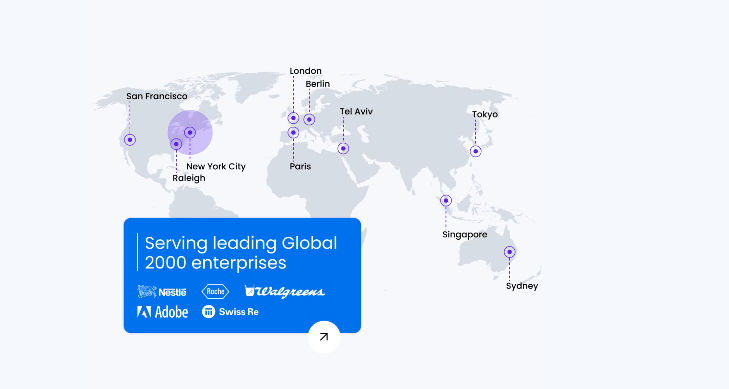
It sits on top of existing software and guides users through it. When an employee opens Salesforce and doesn't know how to log an opportunity, WalkMe walks them through each field with tooltips, validation rules, and step-by-step flows. When an enterprise rolls out SAP S/4HANA to 50,000 employees, WalkMe ensures those employees can use it. The underlying software doesn't change. WalkMe makes it navigable.
Source: WalkMe
ProductLed operates at the product layer.
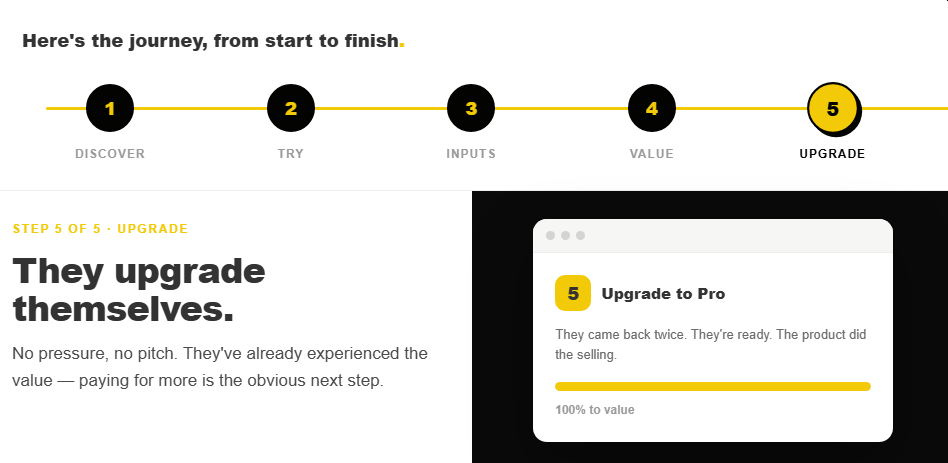
It doesn't add guidance on top of your product; it helps you rebuild how the product delivers value. When a SaaS founder discovers that new users take 40 steps to reach their first meaningful outcome, ProductLed's methodology compresses that to five.
Source: ProductLed
The distinction matters because these approaches address different root causes. If your product works well but users can't find the right buttons, WalkMe helps. If your product requires too many steps before users experience its value, ProductLed helps you redesign the path. Putting tooltips on a broken onboarding flow is like putting better signage on a maze. The signs help, but the maze is still the problem.
WalkMe excels at enterprise software adoption at scale
WalkMe's strength is organizational.
When a company with 10,000 employees migrates from one CRM to another, the technical migration is only half the battle. The other half is getting people to use the new system correctly.
The platform addresses this with three pillars.
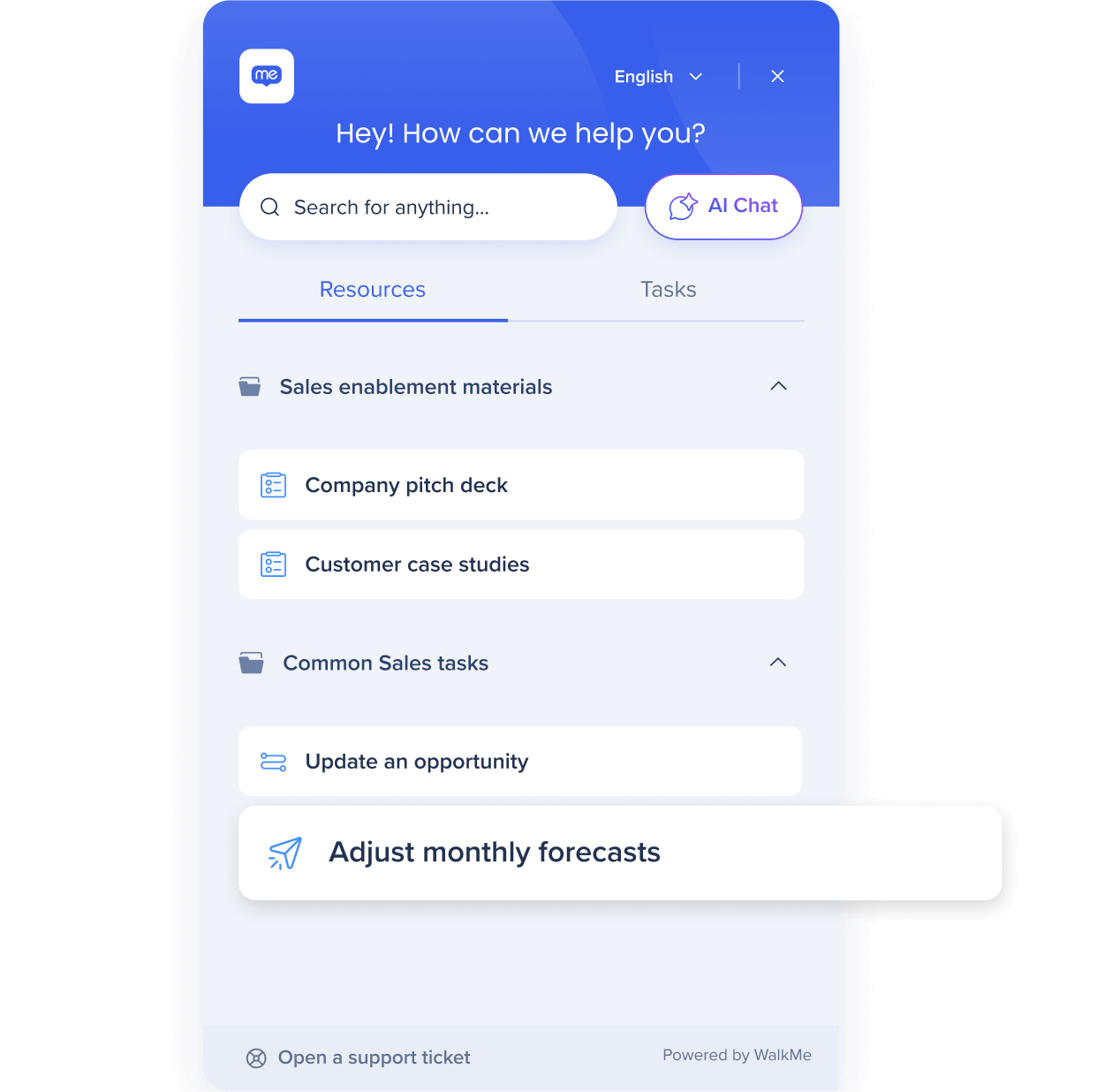
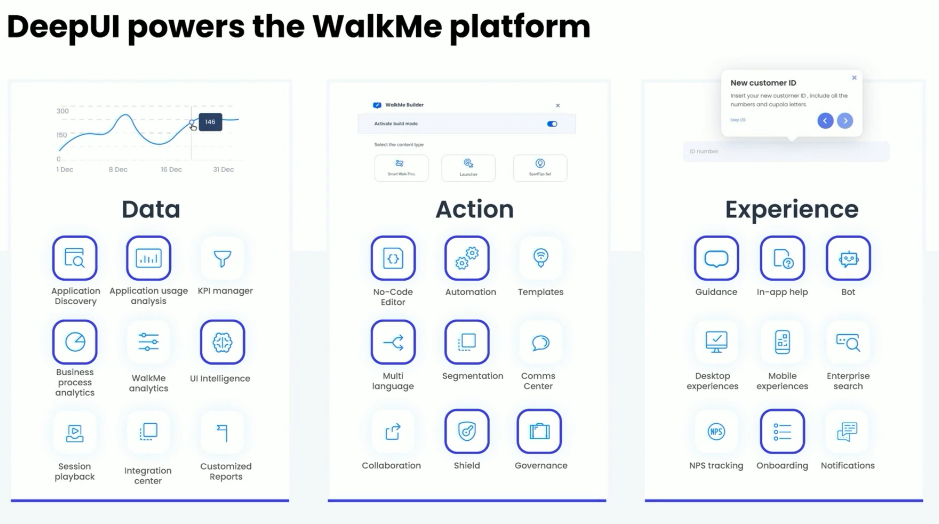
The Data pillar (App Discovery & Analytics, WalkMe Insights, Form Analytics) reveals how software is actually used: where employees get stuck, which forms have high abandonment rates, and which licenses sit idle. The Action pillar (WalkMe Editor, Workflow Automation) lets non-technical teams create interactive guidance and automate repetitive tasks inside applications. The Experience pillar delivers that guidance contextually through in-app overlays, a conversational interface, and the WalkMe Menu.
Source: WalkMe
What makes WalkMe technically distinctive is DeepUI, a proprietary technology that uses AI to understand application interfaces the way a human would (reading visual elements and layout structure rather than relying on brittle code references).
When Salesforce pushes an update that moves a button, DeepUI re-identifies the element by its meaning and context.
Source: WalkMe
Since the SAP acquisition in September 2024 (~$1.5B), WalkMe is embedded natively into SAP applications with a WalkMe Standard tier included in SAP subscriptions. This gives it distribution across SAP's 300,000+ enterprise customers, but it also means the product roadmap increasingly prioritizes the SAP ecosystem.
ProductLed redesigns the product experience from the ground up
ProductLed starts from a different premise: if your product needs a guidance layer to be usable, the product itself has a design problem.
The insight: products can sell themselves if the path to value is short enough and clear enough. He spent the next several years consulting with SaaS companies on this approach, then codified it in his 2019 book and the consulting firm that followed.
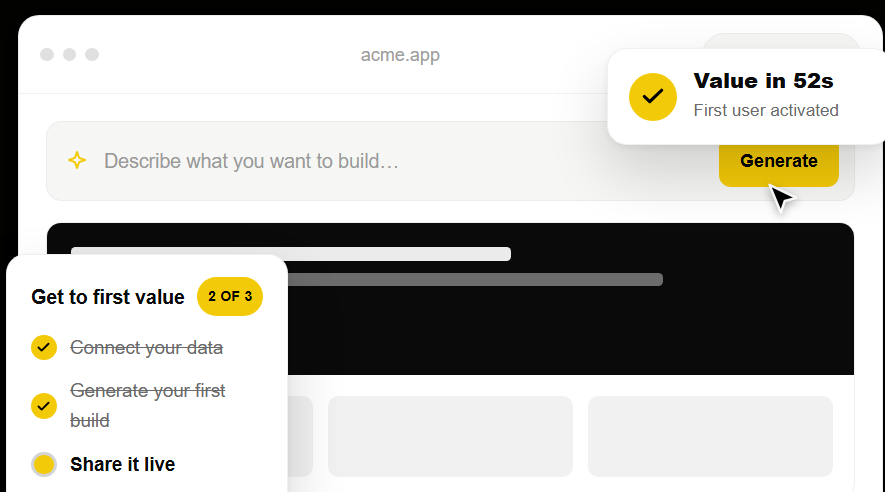
The flagship program is the WARP Week, a five-day on-demand sprint where SaaS founders map their current user journey (which typically turns out to be 40-50 steps between signup and first value), then redesign it using the WARP Framework to deliver a meaningful outcome in 60 seconds or less. Participants leave with a clickable prototype they can show to their engineering team, not a slide deck.
Source: ProductLed
For deeper engagements, Growth Sprints ($10,000 for 2-4 weeks) tackle specific bottlenecks in strategy, onboarding, or pricing. The Fractional Head of PLG service embeds a certified ProductLed Implementer inside a client's organization for 6-12 months.
ProductLed's limitation is structural: it's a consulting service, not a software tool. Once the engagement ends, execution depends on the client's team. And it's only for SaaS companies. If you're not selling software, or if you haven't yet reached product-market fit, ProductLed isn't for you.
ZoomInfo solves the problem upstream: finding the right buyers
A SaaS company can have strong in-app guidance (WalkMe) and an optimized product experience (ProductLed), and still struggle to grow. The reason is simple: adoption and conversion only matter for users who show up in the first place. Identifying, reaching, and engaging the right prospects is a different problem entirely.
This is where ZoomInfo operates.
As an AI-powered GTM platform, ZoomInfo provides the data and intelligence that power every stage of the go-to-market process, from building a target account list to understanding why deals move or stall.
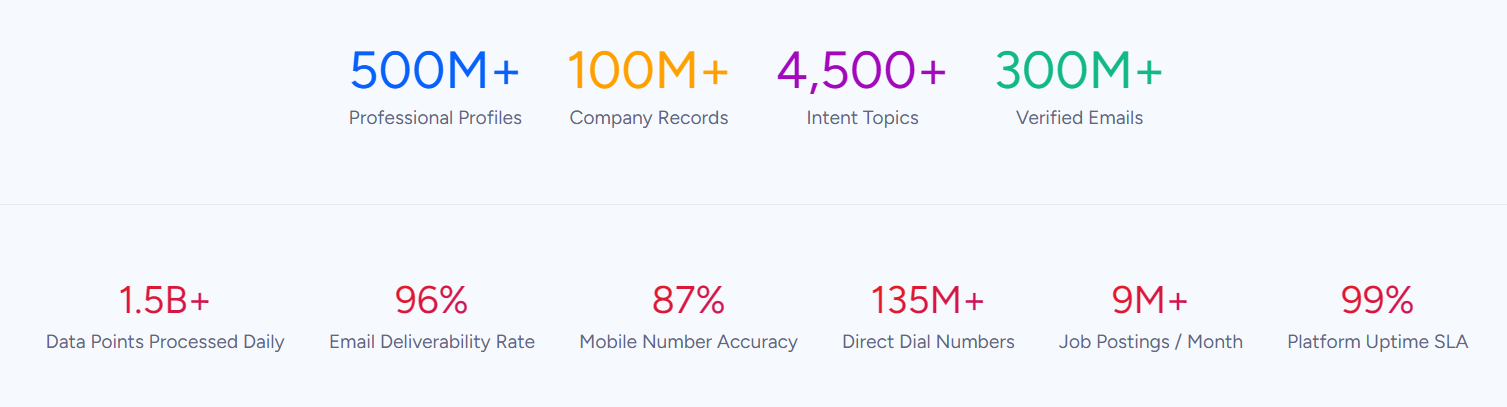
The foundation is data: 500M contacts, 100M companies, 135M+ verified phone numbers, 120M direct-dial phone numbers, and 200M+ verified business email addresses, verified through a pipeline backed by 300+ human researchers and achieving up to 95% accuracy on first-party data. In a Fortune 500 competitive RFP analyzing 25 million contacts across vendors, the independent consultant concluded that "no other competitor came even close."
Source: ZoomInfo
But data alone is a starting point.
ZoomInfo's GTM Context Graph combines this B2B data with a customer's own CRM records, conversation transcripts, intent signals, and behavioral data into a single intelligence layer that processes 1.5B+ data points daily. The result: AI that doesn't just know what happened in a deal, but why it happened, and what signals predict what happens next.
This intelligence is accessible through three paths.
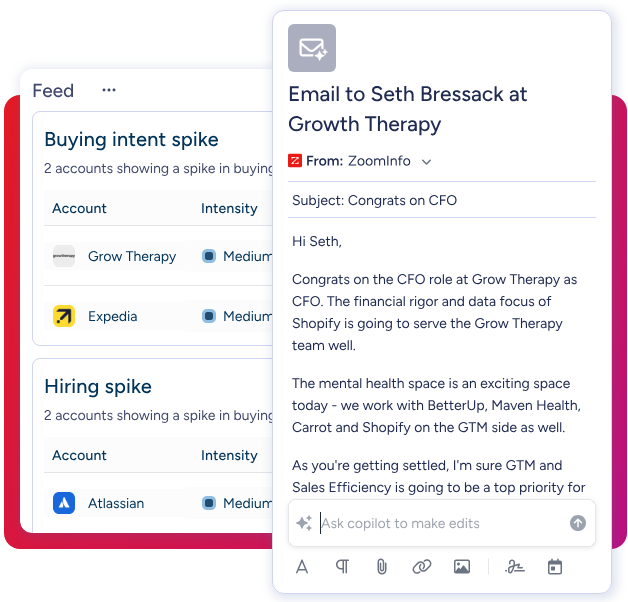
GTM Workspace gives sellers AI-powered account research, prioritized action feeds, and AI-drafted outreach in one view. GTM Studio lets marketers and RevOps teams describe audiences in natural language, launch multi-channel plays, and track pipeline impact in real time. And APIs and MCP expose the same intelligence to any custom agent, CRM, or third-party tool.
Source: ZoomInfo
"ZoomInfo's not just a contact data company anymore. They've built a full system of execution. GTM Intelligence actually works the list, writes the outreach, triggers the play, and helps drive predictable growth." (Ian Brodie, CEO & Co-Founder, Levanta)
Comparing their approaches to SaaS growth
Each platform addresses a different stage of the SaaS growth equation. Where your bottleneck lives determines which approach matters most.
If your problem is internal software adoption: WalkMe is designed for this. When you're rolling out enterprise software to thousands of employees, you need a platform that delivers contextual guidance at scale, tracks adoption metrics, and adapts when the underlying applications change. No consulting methodology or B2B data platform solves this.
If your problem is product-to-user fit: ProductLed addresses the design of the product experience itself. If users sign up for your SaaS product but never reach the moment of value, the issue isn't that they can't find the right button. It's that the path to value is too long, too complex, or too unclear. ProductLed's methodology shortens that path.
If your problem is finding and reaching buyers: ZoomInfo provides the intelligence infrastructure. You can have the fastest time-to-value in your category, but if your sales team works stale contact lists, your marketing targets the wrong accounts, or your outreach lands in spam because of bad email data, growth hits a ceiling that no product experience improvement can lift.
If your problem is all three: Most growing SaaS companies face some combination. A company implementing a hybrid PLG-plus-sales motion might use ProductLed's methodology to optimize self-serve conversion, then use ZoomInfo to layer enterprise sales on top, targeting product-qualified leads with verified contact data and deal intelligence. WalkMe enters the picture when the company's own employees need to adopt internal tools at scale.
Pricing structures reflect different business models
The pricing differences between these three don't just reflect cost; they reveal what kind of commitment each requires.
WalkMe operates on enterprise software pricing. No public rates. Custom quotes.
Multi-year contracts that auto-renew and are non-cancelable for the full commitment term. Fees are non-refundable and not conditioned on deployment or actual usage. Overages trigger additional fees. For SAP customers, a WalkMe Standard tier is included in SAP subscriptions, with WalkMe Premium available for customization.
This model works for large enterprises with dedicated IT budgets and procurement processes. For smaller organizations, the cost and contract rigidity can be prohibitive.
ProductLed uses project-based, fixed-fee pricing that's publicly listed:
Program | Price | Duration |
|---|---|---|
$497 | ~1 week, on-demand | |
$997 | ~1 week, on-demand (includes 45-min call with Wes Bush) | |
$997 | Self-paced, lifetime access | |
$10,000 | 2-4 weeks | |
$20,000 | 3 intensive days with Wes Bush | |
Custom | 6-12 months |
No recurring subscription. No multi-year lock-in. The WARP Week offers a full refund after Day 1, and the MBA has a 7-day money-back guarantee. The trade-off: ProductLed delivers methodology and consulting, not ongoing software. Once the engagement ends, execution is on you.
ZoomInfo uses consumption-based pricing that scales with usage. No public prices, but the structure is transparent: three product lines (Sales, Marketing, and standalone products like Chorus and Chat), each with tiered plans that gate features and credit allocations.
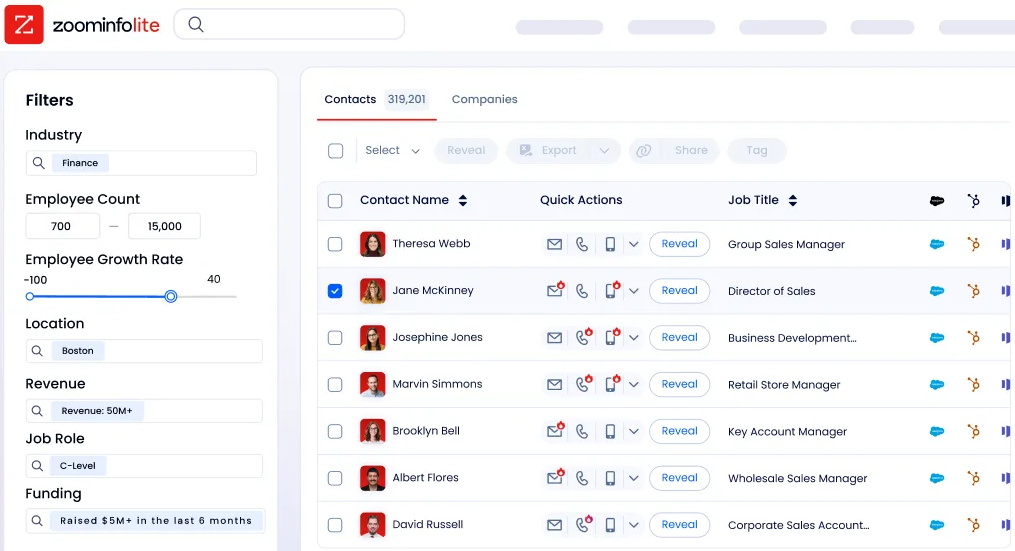
Unlike WalkMe, ZoomInfo offers a permanent free tier: ZoomInfo Lite with access to the B2B database, 10 monthly export credits, and WebSights Lite for website visitor identification. A 7-day free trial of paid features is also available with no credit card required.
Source: ZoomInfo
Who each platform is actually built for
The target buyers reveal how different these platforms are.
WalkMe's buyer is an IT leader, CHRO, or Change Management professional at a large enterprise (1,000+ employees, typically 5,000-100,000). They're managing digital transformation, ERP migration, or AI tool adoption across a complex organization. They need a platform with FedRAMP Ready status, SOC 2 Type II, and ISO certifications, deployed and maintained by a dedicated internal team.
WalkMe is not designed for SMBs, startups, or SaaS companies looking to onboard external customers with a light touch.
ProductLed's buyer is a SaaS founder or GTM leader at a company past product-market fit with existing customers.
ZoomInfo's buyer is a sales, marketing, or RevOps leader at a B2B company who needs to find, reach, and engage target accounts. ZoomInfo serves 35,000+ companies worldwide, with customers including Snowflake, Adobe, Databricks, and Thomson Reuters. The platform is designed for B2B go-to-market teams, not B2C companies or organizations without an outbound or data enrichment motion.
"That combination of our internal CRM data, external signals, and AI that's given all that context has helped us craft very specific account- and persona-based messages. And people have responded to them right away." (Toby Carrington, Chief Business Officer, Seismic)
The technology question: software vs. methodology vs. intelligence
These platforms represent three different categories, and understanding the category is more useful than comparing features point by point.
WalkMe is software you deploy and maintain.
It requires installation (browser extension and the WalkMe Editor desktop application), ongoing content creation by trained builders, and organizational investment in a Center of Excellence approach to scale.
The learning curve is real: G2 reviewers flag difficulty with advanced configurations, and WalkMe recommends dedicated internal champions. The payoff is a living system that guides users through software in real time, tracks adoption, and automates workflows. But it's an ongoing operational commitment, not a one-time project.
ProductLed is the methodology you implement.
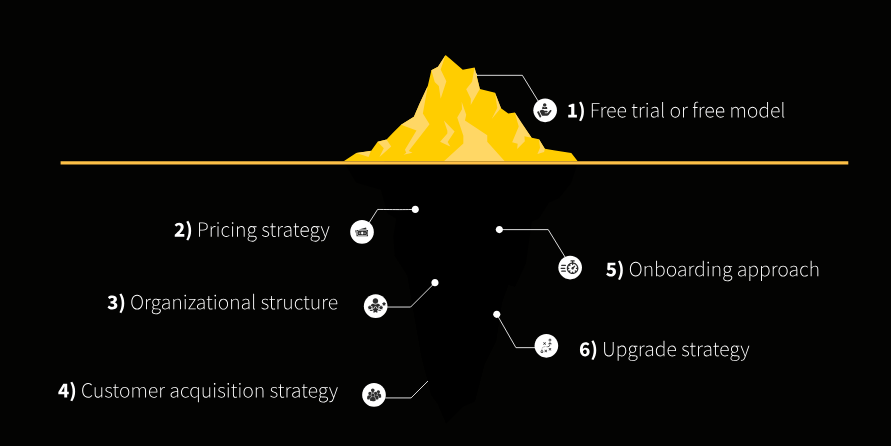
There's no software to deploy. You get frameworks (the WARP Framework, the ProductLed System), templates, prototypes, and expert guidance. The Val AI Audit Tool runs a free diagnostic of your product experience, and the ProductLed Assessment generates a personalized growth roadmap.
Source: ProductLed
But execution happens in your own product, with your own engineering team. The consulting engagement ends; the methodology stays.
ZoomInfo is intelligence infrastructure you connect to.
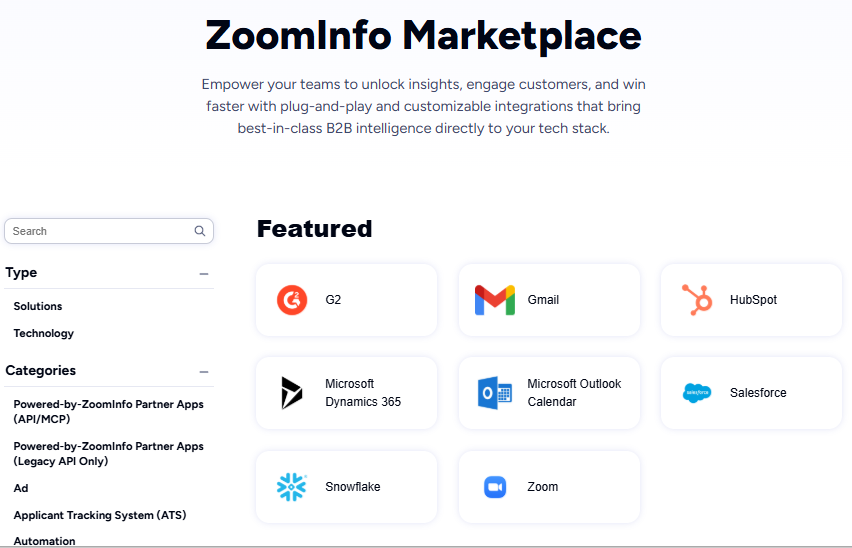
It integrates with your existing CRM, marketing automation, and sales engagement tools through 120+ partner integrations and direct connectors for Salesforce, HubSpot, Microsoft Dynamics 365, and cloud data platforms like Snowflake and Databricks.
The MCP server connects AI models directly to ZoomInfo's data as a native tool with no custom coding. You can interact with ZoomInfo entirely through its API, so the intelligence works whether you use ZoomInfo's own interface or not. Deployment is measured in weeks: GTM Workspace "deploys in weeks, not months".
Source: ZoomInfo
Where these platforms complement each other
The key insight about these three platforms is that they don't compete. They address different stages of the same growth challenge, and using one doesn't preclude using the others.
A SaaS company running a hybrid product-led and sales-led motion might use ProductLed to optimize the self-serve experience so free users convert faster, ZoomInfo to identify enterprise accounts showing buying intent and arm the sales team with verified contacts and AI-generated account briefs, and WalkMe to ensure its own internal teams adopt the CRM and marketing tools needed to execute that motion.
The combination matters because SaaS growth has multiple compounding bottlenecks.
ProductLed's data shows that 97% of modern buyers prefer to try before they buy. ZoomInfo's data shows that Gartner predicts a 25% decline in inbound search traffic by 2026, making outbound intelligence more critical. WalkMe's research shows that enterprises lose 51 workdays per employee annually to technology friction. Each statistic points to a different bottleneck, and each platform addresses a different one.
"It's not just the data itself. It's more about the right data at the right time to help us reach out with the right message across that full buyer journey." (Chelsea Kenyon, Senior Director of Digital Strategy, Redwood Logistics)
WalkMe vs. ProductLed vs. ZoomInfo: Which should you choose?
The right choice depends on which growth problem you're solving now.
Choose WalkMe if:
You're a large enterprise rolling out or migrating complex internal software
Employee adoption and data integrity across your tech stack are primary concerns
You need a platform that scales across thousands of users and dozens of applications
Compliance requirements demand FedRAMP, SOC 2, or ISO certifications
You have the budget and internal resources for an enterprise DAP deployment
Choose ProductLed if:
You run a SaaS company past product-market fit with a self-serve or freemium model
Your free-to-paid conversion rate is underperforming and you've already tried internal fixes
You need a structured methodology and expert guidance, not another software tool
You want to compress time-to-value from minutes to seconds for new users
Your budget suits a defined consulting engagement rather than an ongoing software subscription
Choose ZoomInfo if:
You need to find, reach, and engage B2B buyers with verified contact data and buying signals
Your sales team wastes time on stale data, wrong numbers, and untargeted outreach
You want AI that reveals which accounts are in-market and why deals move
You're building a hybrid PLG-plus-sales motion and need enterprise sales layered on top of self-serve
You want to access intelligence through your own tools via API, MCP, or native integrations
Start with ZoomInfo Lite for free or request a demo to see the full platform.
The choice between WalkMe, ProductLed, and ZoomInfo isn't a choice between alternatives. It's a question of where your growth is constrained.
If users can't navigate your internal software, that's an adoption problem and WalkMe addresses it. If users can't find value in your product fast enough, that's an experience problem and ProductLed addresses it. If your go-to-market team can't identify and reach the right buyers, that's an intelligence problem and ZoomInfo addresses it.
The companies growing fastest solve all three. The question is which one to solve first.
WalkMe vs. ProductLed vs. ZoomInfo FAQ
What is the key difference between WalkMe, ProductLed, and ZoomInfo?
WalkMe is a digital adoption platform that adds interactive guidance overlays on top of existing software to help users navigate complex applications.
ProductLed is a consulting and education firm that helps SaaS companies redesign their product experience to convert free users to paid customers faster.
ZoomInfo is a B2B go-to-market intelligence platform that provides verified contact data, buying signals, and AI-powered insights to help sales and marketing teams find and engage the right prospects. Each addresses a different stage of business growth.
Which platform is best for improving SaaS user onboarding?
It depends on the root cause.
If users need step-by-step guidance through an existing interface, WalkMe's in-app walkthroughs and tooltips handle that. If the product itself requires too many steps before delivering value, ProductLed's methodology helps redesign the experience from the ground up. ProductLed's clients have seen results like a 332% increase in signup-to-trial conversion (KUMO) and trial conversions jumping from 5% to 28% (Noterro).
Can WalkMe and ProductLed be used together?
Yes, and some SaaS companies benefit from both. ProductLed helps redesign the core product experience for self-serve users, while WalkMe can layer contextual guidance on top for more complex workflows or enterprise customers who need extra support.
They operate at different levels: ProductLed changes the underlying product path, while WalkMe adds a navigation layer on top of whatever path exists.
How does ZoomInfo complement WalkMe or ProductLed?
ZoomInfo addresses the upstream challenge of finding and reaching the right buyers.
A SaaS company might use ProductLed to optimize its free-to-paid conversion rate and ZoomInfo to identify enterprise accounts showing buying intent, then arm its sales team with verified contact data and AI-generated account research. Similarly, an enterprise using WalkMe internally might use ZoomInfo to power its own sales and marketing outreach to grow the customer base.
What does WalkMe cost compared to ProductLed?
WalkMe uses custom enterprise pricing with no published rates, multi-year contracts, and non-cancelable terms. ProductLed uses transparent, project-based pricing: WARP Week starts at $497, the ProductLed MBA costs $997, and Growth Sprints cost $10,000 for a 2-4 week engagement. WalkMe requires ongoing operational investment (administrators, content maintenance), while ProductLed engagements have a defined start and end date.
Is ProductLed a software product or a consulting service?
ProductLed is a consulting and education firm, not a software platform. It offers on-demand training programs, structured consulting sprints, and fractional executive services.
It provides free tools like the Val AI Audit Tool and downloadable templates, but the core value is methodology, frameworks, and expert guidance from certified PLG Implementers. Execution happens within the client's own product using the client's own engineering team.
Which platform is best for enterprise-scale organizations?
WalkMe is the strongest fit for large enterprises focused on internal software adoption, with FedRAMP Ready status, SOC 2 Type II certification, and the infrastructure to support deployments across tens of thousands of employees.
ZoomInfo serves enterprise go-to-market teams with B2B data at scale and is used by companies including Adobe, Snowflake, and JPMorgan. ProductLed has worked with companies up to the scale of Boomi ($4B valuation) but focuses on SaaS companies and does not provide enterprise software.
Does ZoomInfo offer a free plan?
Yes. ZoomInfo Lite is a permanent free tier (not a trial) that includes access to ZoomInfo's B2B database, 10 monthly export credits, WebSights Lite for website visitor identification, a Chrome extension, and HubSpot integration. A separate 7-day free trial of paid features is also available with no credit card required.
Neither WalkMe nor ProductLed offers a permanent free tier, though ProductLed provides free resources including a Slack community, newsletter, AI audit tool, and assessment.
See how WalkMe compares to other platforms:
