

Few domains have as much appetite for AI transformation as go-to-market. And AI context graphs are having a moment, with some calling them AI’s latest trillion-dollar opportunity.
But reality is paved with failed "GPT on my CRM" experiments. Most GTM AI is still expensive autocomplete. Even the most sophisticated GTM teams can't operationalize a context graph until a clean GTM data foundation is in place.
It's because of the way GTM stacks evolved over the last decade. We added a tool for every problem and tried to connect it back to the CRM. Adding another tool won't fix the AI problem. It created it.
Point Solutions Bottleneck AI
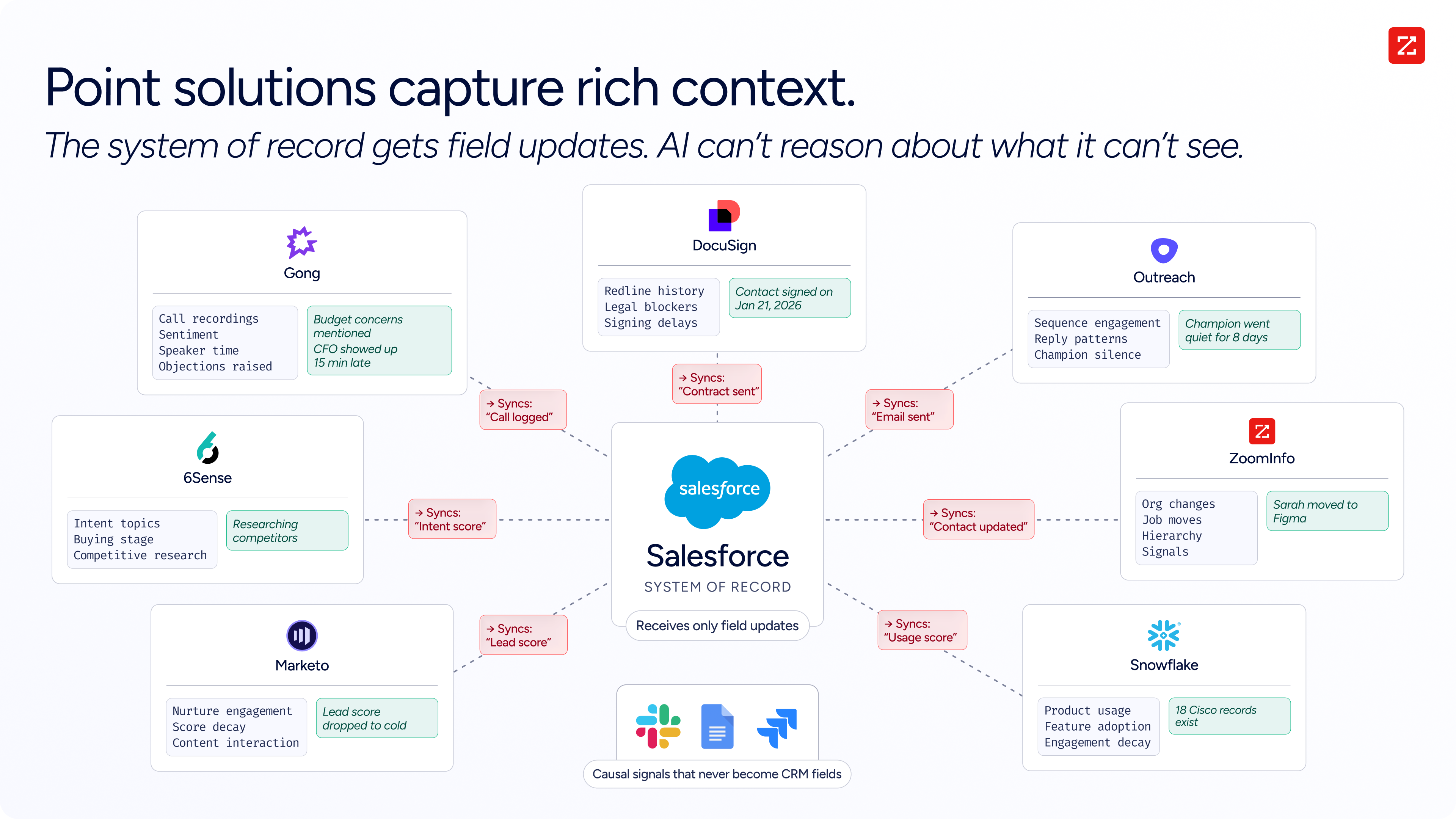
Most GTM stacks look like this: Salesforce as the system of record. Point solutions around it. A hub-and-spoke model.
The theory: integrate all the point solutions into the system of record and you get a unified view. It doesn't work that way.
The average enterprise runs 42+ GTM tools. Each one captures a slice of context. Each one stores it in its own database. Each one "integrates" with Salesforce by syncing fields.
That's the problem. When your data lives in siloed systems, the system of record loses context.
Think about the frontline seller and all the context they need to prepare for a meeting: account and opportunity history, engagement history, last QBR deck, support tickets, product usage, latest trends. They're not getting all of that in one place. They context-switch an average of 1,000 times per day between browser tabs across point solutions.
So you try to connect the systems. You hire a GTM Engineer and a Head of GTM Systems. They pull from Salesforce, Gong, Outreach, 6sense, your data warehouse.
But what they find is:
18 Ciscos. Your CRM has 18 different Cisco records. "Cisco Systems Inc." "Cisco" "CSCO" "Cisco (different division)." Some have opportunities attached. Some have contacts. Which one is right? Which one should your AI use?
Contact mismatches. Sarah Chen appears as "Sarah Chen" in Salesforce, "S. Chen" in Gong, "sarah.chen@cisco.com" in Outreach. Same person? She changed titles three months ago, but only one system has the update.
Hierarchy confusion. Is "Cisco WebEx" a separate account or a subsidiary? Your CRM has them as separate. Your data warehouse has them as one. Call recordings are mapped to the wrong ones.
Missing normalization. Outreach says "VP of Sales." Salesforce says "Sales Leader." ZoomInfo says "Head of Sales." Are these the same role?
Every scaled GTM organization has this. Integration doesn't solve it. Integration just moves the mess around faster.
No CFO would tolerate messy ERP data because the business would break. The same is now true for GTM. If your AI can't resolve which "Cisco" it's looking at, no amount of context capture will save you.
CRM was never designed to be a context foundation.
What It Takes to Fix the Foundation
Few companies have the necessary data foundation in place. Some of the best GTM organizations in the world have put everything on ice for 18 months to tackle this problem.
To make GTM data AI-ready, you need infrastructure that does the hard work:
1. Entity resolution at scale. Resolving billions of entities across every variation, misspelling, abbreviation, and format. Knowing that "Cisco Systems Inc." and "CSCO" and "Cisco (WebEx division)" are all part of the same entity graph. This is years of specialized infrastructure. Not a feature you bolt on.
2. Semantic normalization. "VP Sales" = "Vice President of Sales" = "Head of Sales" = same role, same buying committee position. You need a schema that makes GTM machine-readable so AI can reason across systems that were never designed to talk to each other.
3. Hierarchy and relationship management. Which Cisco record owns the relationship? How do the subsidiaries relate to the parent? This requires a graph, not a database. Relationships, not rows.
4. First-party and third-party unification. Your internal data tells you what's happening inside the account. External data tells you what's happening outside: org changes, funding, intent signals. Neither is complete alone.
This is what ZoomInfo does. We've spent 20 years building the largest B2B data unification platform in the world. We resolve hundreds of millions of companies and contacts across every variation. When there are 18 Cisco records in your CRM, we know they're the same entity. We know Meraki is a subsidiary. We know Sarah moved from Cisco to Figma three months ago.
The same entity resolution and signal extraction we built for third-party data, now applied to a customer's calls, emails, CRM, product usage.
If you rebuilt the GTM stack for AI, you'd end up with ZoomInfo for first-party data.
GTM Context: The Causal Chain
We've talked about bringing context together. But think about all the context that isn't captured. The email thread the rep never logged, the objection buried in call recordings no one has time to review, the relationship history with the champion that lives in a Slack DM or a seller's head.
Open any deal in your pipeline. Look at the record: Stage changed from 3 to 4. Close date pushed two weeks. Amount revised down 15%.
That's CRM.
In reality: The CFO joined the last call and asked about ROI within six months. That's why the deal accelerated. The VP of Sales went quiet for eight days because she was fighting an internal battle with IT over budget ownership. That's why it almost died. The 15% discount happened because of competitive pressure.
The CRM recorded the state change. It has no record of why it happened.
CRMs capture outcomes. AI needs the full trace: what was tried, what worked, what failed, and why. Your GTM is missing the “why.”
GTM Context is the causal chain behind those outcomes. Take the following example:
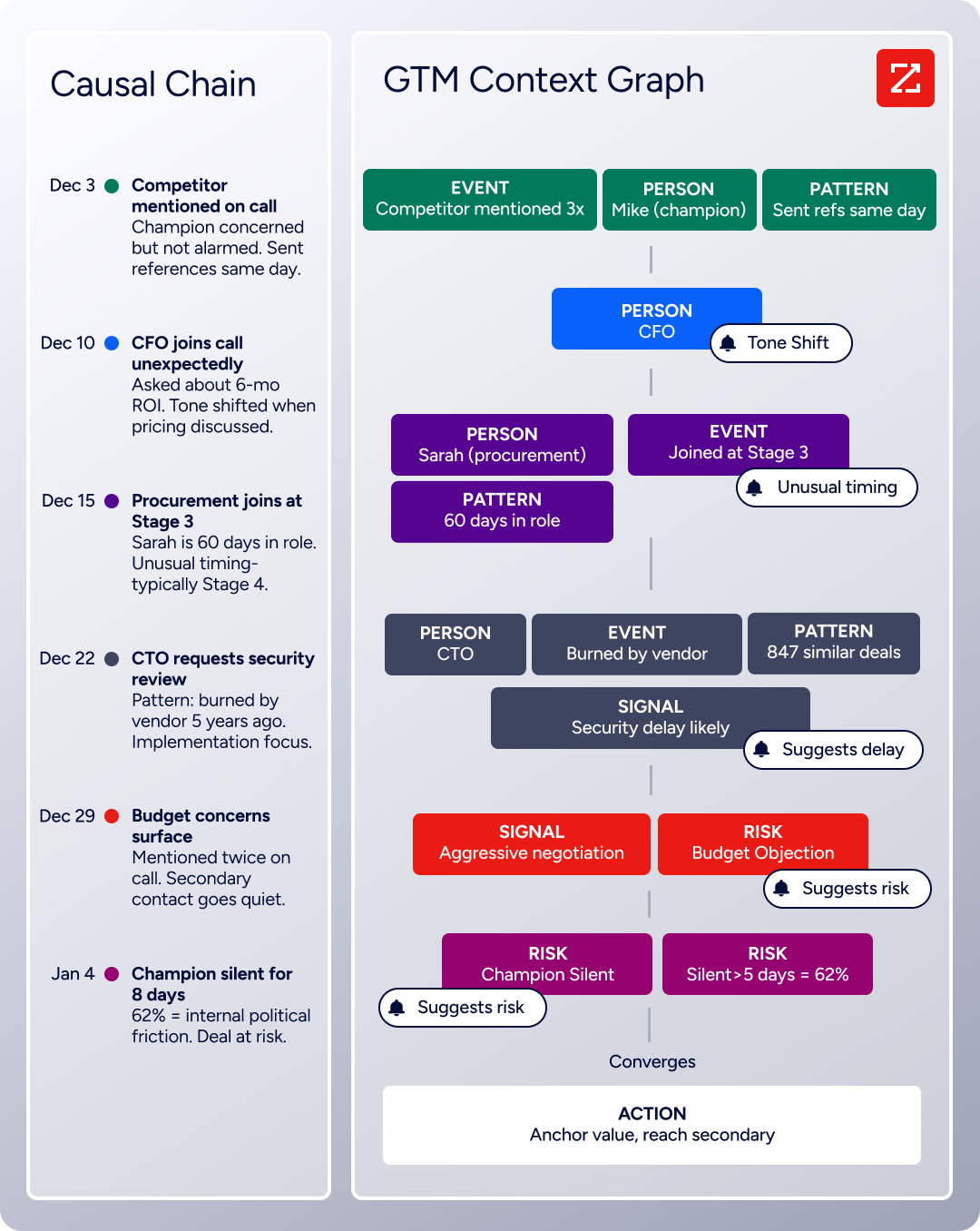
Dec. 3: Mike (champion) mentions competitor evaluation on call. Sentiment: concerned but not alarmed. Action taken: sent references who switched from competitor the same day. Result: competitor deprioritized in follow-up call Dec 5.
Dec. 15: Sarah (procurement) joins email thread. Unusual timing. Procurement typically enters at Stage 4, not Stage 3 for this segment. Context: she's 60 days into role. Likely aiming for early wins with aggressive negotiation incoming.
Dec. 29: Technical call focused on implementation questions. Pattern match: this mirrors 847 deals where buyers had prior bad vendor experience. Probability of "security review" delay: high.
Jan. 4: Champion went quiet for eight days. Historical pattern: 62% of the time when champions go quiet for more than five days at this stage, it's because of internal political friction.
Events linked to context linked to patterns. Data structured so AI can reason about what to do next.
Point Solutions Can't Solve This
No GTM system captures this today.
Gong has the calls. It can tell you Sarah mentioned procurement concerns at 23:47 in the Dec. 14 recording. It can't tell you Sarah entering at Stage 3 is unusual or that her pattern correlates with 34% longer negotiation cycles.
Outreach has the sequences. It knows you sent seven emails over three weeks. It can't tell you the champion went quiet because of internal politics, or that similar patterns resolve 62% of the time if you reach out to a secondary contact.
6sense has intent data. It knows Cisco is researching "revenue intelligence platforms." It can't tell you which of your 18 Cisco records this maps to, who the actual decision-makers are, or that the real objection is implementation risk from a burned CTO.
Each tool captures a slice of raw data. None capture the causal chain.
Syncing Gong transcripts to Salesforce just puts raw data in another place. You still don't have causality. You still don't have patterns. And enterprise GTM scale breaks any context window.
The GTM Context Graph
Today's GTM data is structured as a database around the Salesforce model. Company Name, Industry, Deal Size. Static fields.
ZoomInfo's GTM AI is a context graph that stores relationships and patterns over time:
Sarah (Procurement) → entered deal at Stage 3 → unusual timing → pattern: new-to-role behavior → implication: expect aggressive negotiation → recommended action: anchor on value, engage champion to advocate internally.
In practice, this means capturing:
People and their relationships: who influences whom, who's blocking, who's championing, how dynamics shift over time
Actions and their outcomes: what each action responded to, what it aimed for, whether it worked
Patterns and predictions: what 10,000 similar deals suggest happens next
Exceptions and explanations: why things slipped and what that reveals about real blockers
This GTM Context Graph makes decision-context machine-readable. When a buyer says "we need to loop in our security team" in a call, we extract: new stakeholder entering, stage Security Review, risk increased.
We spent over $500 million acquiring Chorus and Workbounce. Not for their products, but for their context capture and reasoning engines.
CRM is not going to be the platform to run GTM AI on.
HubSpot co-founder Dharmesh Shah recently wrote about why context graphs aren't ready for most businesses. He's right. But they are ready for GTM.
The data unification problem is solved. We've spent 20 years building entity resolution at scale – matching billions of records across every variation and format.
The context signal is already being captured. Every call, every email, every CRM update contains decision traces. The signals exist. They're just trapped in point solutions that can't connect them.
Sellers are already making context-driven decisions. Every day, on every account. It's based on intuition, and the best practices are locked in the heads of top performers. But it's happening. Now it's time to operationalize it with AI.
Every board is asking how to use AI for growth. We can make that a reality in GTM today. The ZoomInfo GTM AI context layer powers our GTM Studio and GTM Workspace products and is available via APIs and MCP for enterprise environments, and through partners like Anthropic Claude and Google.