
Winmo occupies a niche in the sales intelligence market: it serves professionals who sell to national advertisers and their agencies. Instead of competing as a general B2B data provider, Winmo focuses on the advertising ecosystem, combining a human-verified contact database with predictive intelligence designed to tell sellers not just who to call, but when.
The platform tracks decision-makers who control more than $100 billion in annual ad spending across brands, agencies, adtech companies, and sponsorship sellers.
To write this Winmo review, we analyzed the platform in detail. It's the right choice if:
You sell exclusively to national advertisers, agencies, or sponsorship buyers
You need brand-to-agency relationship mapping that shows which agency handles which account
You want predictive alerts on agency reviews and campaign launches months before they go public
You value human-curated contacts in the advertising vertical over broad B2B coverage
Your prospecting is focused on the US and UK advertising markets
However, Winmo might not be the best choice if:
You sell to buyers outside the advertising and media ecosystem
You need a global contact database spanning all B2B industries
You want execution tools that go beyond contact discovery and alerts
You require transparent, self-serve pricing before committing
Your team needs conversation intelligence, multi-channel orchestration, or GTM automation
In this case, consider ZoomInfo: a GTM platform built on a B2B data foundation of 500M contacts, 100M companies, 135M+ verified phone numbers, and 200M+ verified business emails.
Its GTM Context Graph processes 1.5B+ data points daily, combining this data with your CRM records, conversation transcripts, and behavioral signals to show not just what happened in a deal, but why. Your team can act on that intelligence through GTM Workspace for sellers, GTM Studio for marketers and RevOps, or APIs and MCP in any tool.
We've included a detailed look at ZoomInfo later in this review as the broader alternative for teams whose selling extends beyond advertising. If you're ready to explore it, start with a free trial.
What is Winmo?
Winmo is a sales intelligence platform for professionals who sell to national advertisers and their agencies.
It is a brand of List Partners LLC, an Atlanta-based private information services company. CEO Dave Currie has led the company since 2005, guiding it from a directory publisher called The List Online into a SaaS platform that launched as Winmo in 2015.
The platform's core thesis, as stated on its homepage, is "Contacts Tell You Who, Context Tells You When". Winmo provides verified contact data for brand and agency decision-makers, then adds predictive intelligence to help sellers time their outreach. Its in-house research team verifies contacts on a 60-day refresh cycle, a process the company positions against algorithmically scraped databases.
In 2018, Winmo made three acquisitions: Access Confidential, Redbooks, and AAR Partners. The platform now operates under "Winmo Powered By MediaRadar" co-branding, with MediaRadar's ad spend data feeding its media buying insights.
Source: Winmo
Winmo serves four primary audiences: ad agencies seeking new clients, ad sales teams at media companies, adtech companies prospecting brands and agencies, and sponsorship sellers at sports properties and events. Enterprise customers include TikTok, Accenture, Screenvision, Lamar, Criteo, and Activision Blizzard.
Winmo Pros & Cons
Pros | Cons |
|---|---|
Human-verified contacts on a 60-day refresh cycle | Coverage skewed toward large national advertisers |
Predictive agency review alerts (WinmoEdge) 3-18 months ahead | Limited to US and UK markets |
Brand-to-agency relationship mapping at the decision-maker level | Custom-quoted pricing with no public price points |
Embedded ad spend data from iSpot.tv, Adbeat, and Media Analytics | UX described as cluttered with dense information layouts |
DiSC personality insights integrated into search and outreach | CRM connector and API access are paid add-ons |
Dedicated Customer Success Advisor included | No self-serve trial; sales-team-provisioned demos only |
AI outreach drafting via Winmo Compose | Annual contracts with auto-renewal and limited cancellation flexibility |
Winmo Review: How it Works & Key Features
Targeted Contact Database: Winmo provides a human-verified directory of advertising and media decision-makers.
Winmo's Targeted Contact Database is the foundation of the platform.
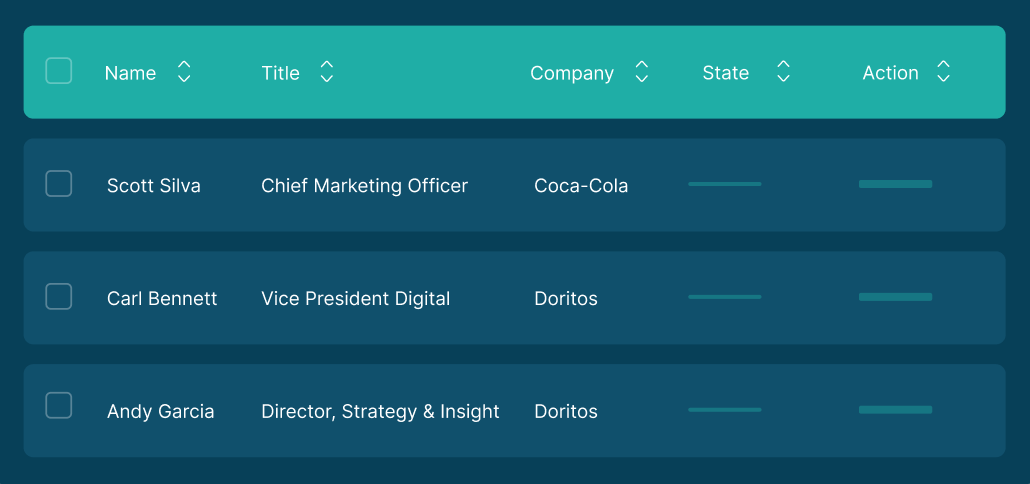
The US database covers 32,000+ brands, 8,000+ agencies, and 176,000+ decision-makers with direct dials, work email addresses, and LinkedIn profiles. An in-house research team verifies every contact on a 60-day cycle, and fills on-demand requests for missing contacts within 48 hours.
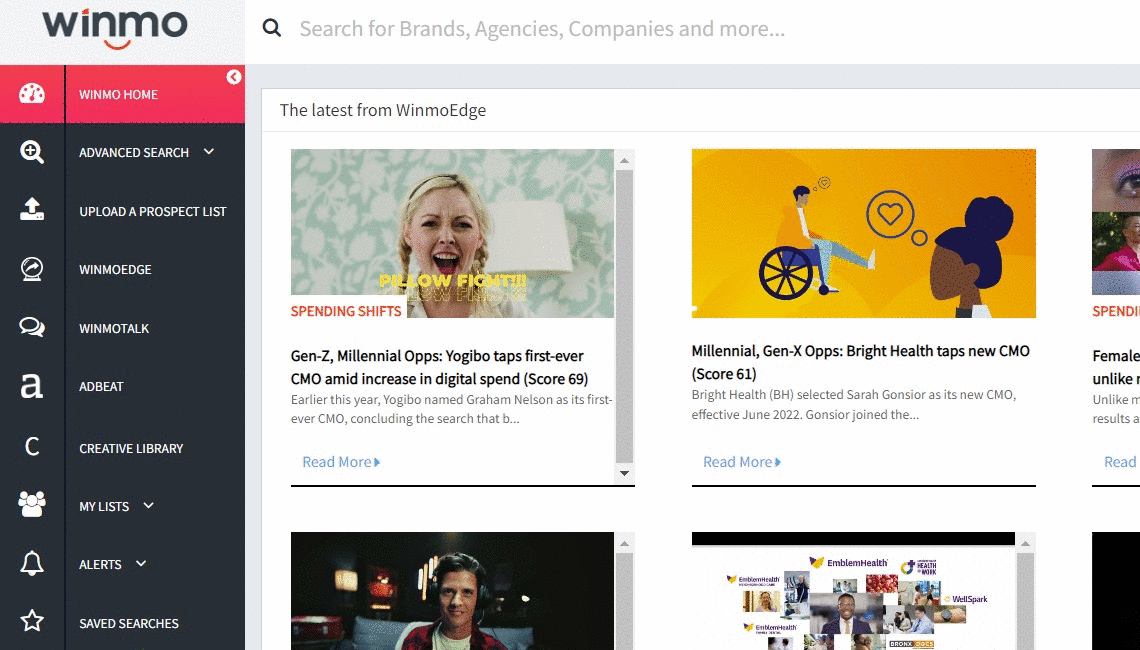
The database supports two search modes. Quick Search uses predictive text to find brands, companies, agencies, and individuals by name, handling parent-child company hierarchies automatically.
Advanced Search lets users prospect with filters across Brands, Agencies, Companies, and Contacts tabs, narrowing by industry, category, media spend, planning period, revenue, territory, and DiSC personality type.
Source: Winmo
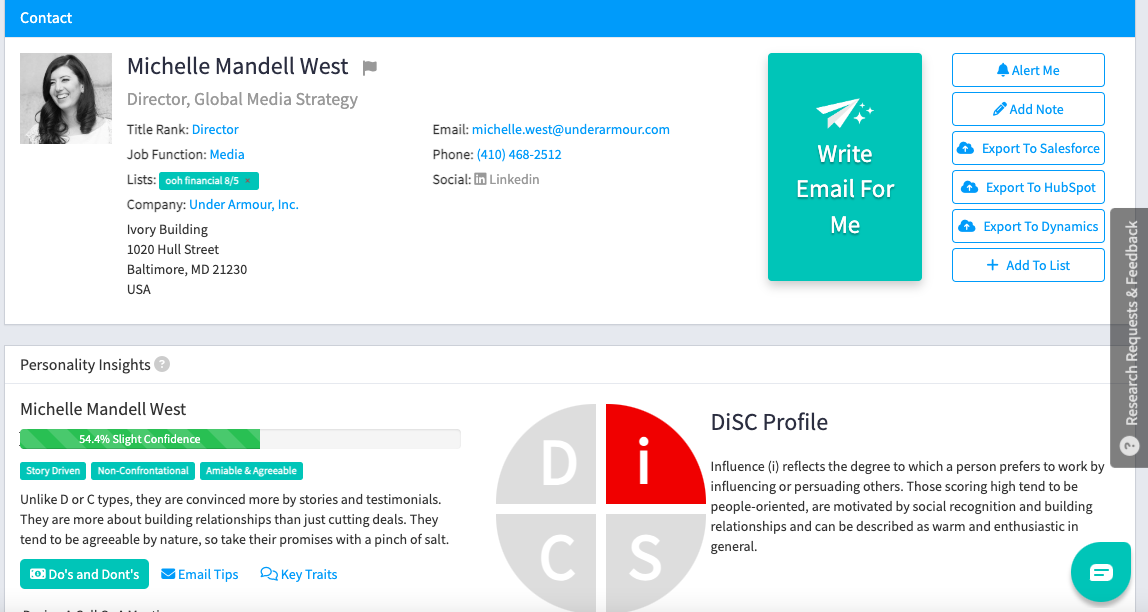
The personality type filter is unusual: users can build prospect lists segmented by communication style (Dominance, Influence, Steadiness, Conscientiousness), then use Winmo Compose to generate outreach matched to the recipient's preferences.
Contact records link to brand and agency profiles, so a user can navigate from a brand to its agency roster, or from an agency to its client accounts, without leaving the platform. Saved contacts can be organized into Contact Lists with team sharing, lead assignment, and duplicate detection, then exported to Salesforce, HubSpot, or Microsoft Dynamics with two clicks.
WinmoEdge: Predictive alerts surface agency reviews, campaign launches, and leadership changes months before public announcements.
WinmoEdge is Winmo's predictive intelligence feature.
The platform positions it as the industry's first sales prediction tool, launched in April 2014 and refined over a decade of tracking agency review patterns.
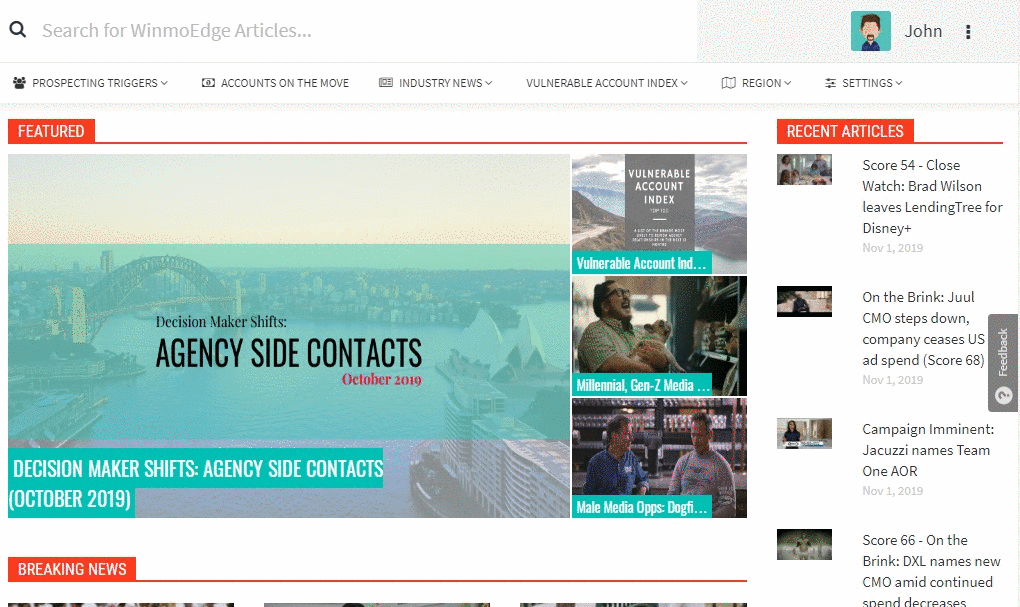
The system monitors 17 variables that precede agency changes, producing a Vulnerable Account Index (VAI): a 1-100 score indicating how likely a brand is to enter an agency review. Among these triggers, a first-ever CMO hire is the strongest signal. Winmo claims 81% accuracy for sales opportunity predictions and 73% accuracy for agency review forecasting.
Beyond the scoring, an in-house research team writes articles that connect signals: a new CMO hire plus increased digital spending plus a shift in creative direction might signal an approaching agency review. These arrive as daily alerts, configurable by type, industry, territory, and frequency, with no limit on alerts per user.
Source: Winmo
WinmoEdge covers several signal categories: predicted agency reviews, marketers changing roles, imminent campaigns and product launches, new funding, shifts in ad spending, new markets and audiences, and struggling companies.
In 2025, Winmo added WinmoAnswers, an AI tool built on the Miso model that lets users ask natural-language questions across the WinmoEdge content library, drawing answers from Winmo's proprietary research only.
Brand & Agency Relationship Mapping: Winmo tracks which agencies manage which brand accounts and who controls each budget.
Brand & Agency Relationships is the feature Winmo users cite most often in reviews.
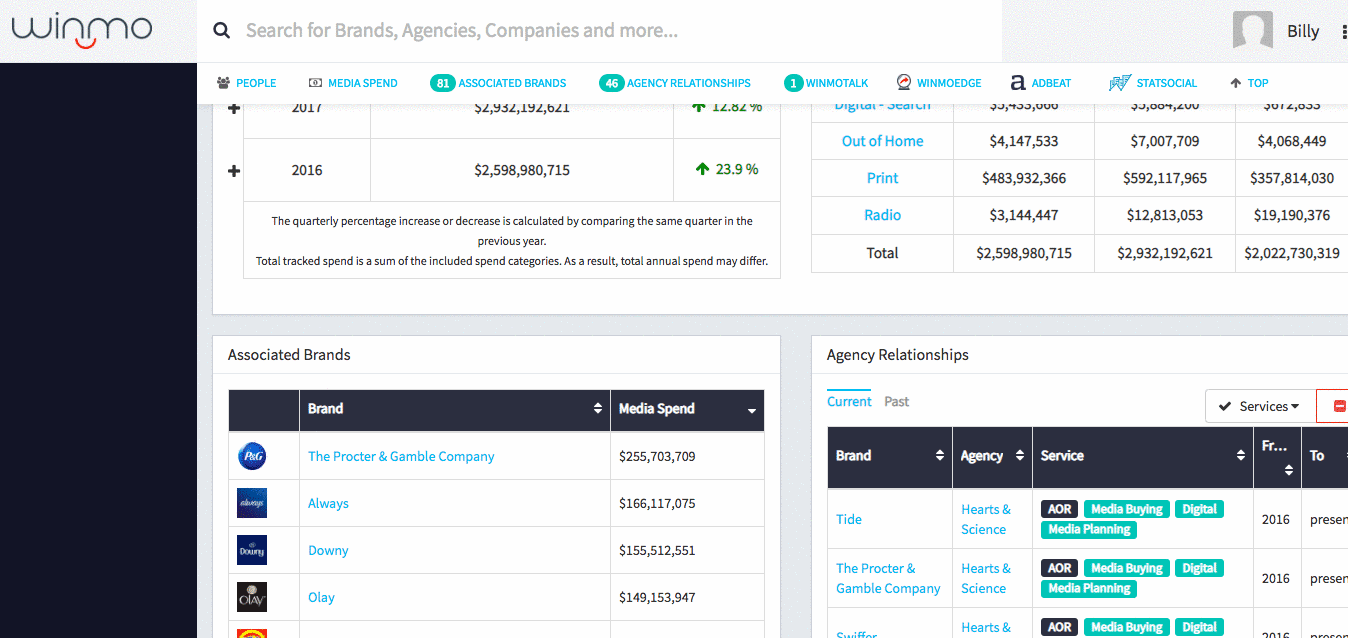
The platform maps the advertising ecosystem at the decision-maker level: which agencies hold creative, media, digital, and experiential relationships with which brands, and who at each organization owns the account.
Source: Winmo
Winmo claims to be the only platform that monitors the brand, client, agency, and holding company landscape at the decision-maker level.
The tracking covers agencies affiliated with all major holding companies (Omnicom, WPP, Publicis Groupe, Interpublic Group, Havas, Dentsu, Stagwell) and independents, filterable by agency discipline: media planning and buying, creative, digital, influencer, experiential, shopper marketing, and market research.
Users can enter from either direction: a brand profile shows every agency on its roster with named contacts, and an agency profile shows its full client list.
This two-way visibility is useful for adtech sellers and media companies, who often need to reach both the brand marketer and the agency planner before closing a deal.
Ad Spend & Media Buying Insights: Winmo surfaces where brands allocate their advertising dollars across channels.
Ad Spend & Media Buying Insights shows sellers how a prospect spends its media budget before they make contact. The US database tracks over $100 billion in media spend with a trailing 12-month estimate across channels including Cable TV, Network TV, Spot TV, Digital Display, Online Video, Social, AVOD, OOH, Cinema, Radio, and more.
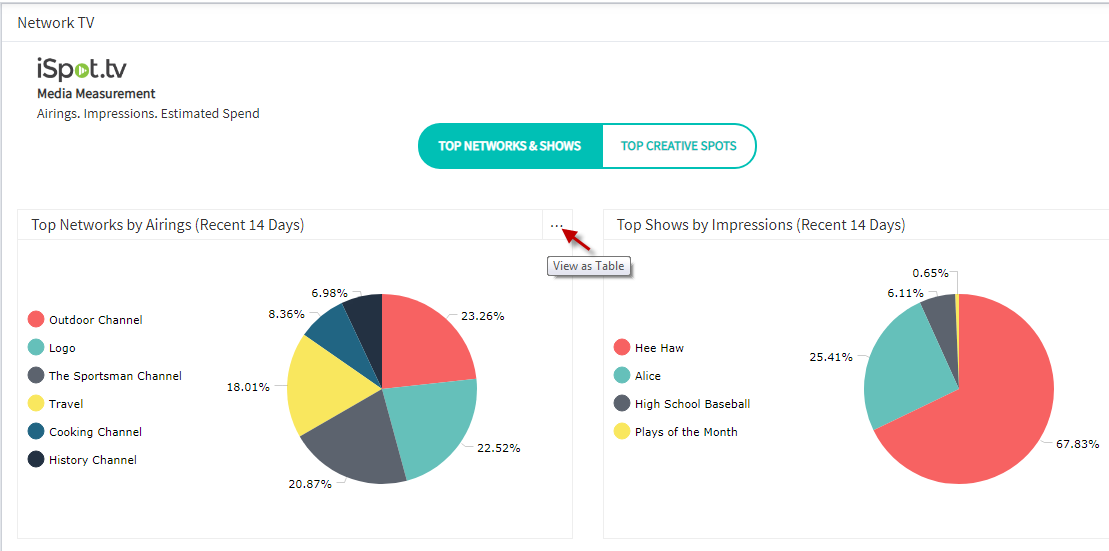
Rather than building its own measurement for every channel, Winmo embeds third-party data partners into brand profiles.
iSpot.tv provides TV spend intelligence with network breakdowns and ad creative placements. Adbeat Enterprise covers digital ad spend, publisher-level allocation, and creative libraries, available through Winmo "at a fraction of the cost" of a standalone subscription. Media Analytics adds DRTV campaign data with predictive launch scoring over 30/60/90-day windows.
Source: Winmo
In late 2024 and 2025, Winmo added sponsorship tracking across 15 North American sports leagues, event sponsorship data covering music and film festivals, influencer-to-brand relationship data, demographic targeting based on actual customer base data, and CTV spending and impressions data.
Intent Signals & Outreach: Winmo identifies in-market accounts and provides AI-assisted email drafting.
Winmo's Intent Signals feature combines two products. Intent Insights, powered in part by Bombora, surfaces account-level buying signals across 20+ categories including Adtech, Analytics, CRM, Demand Generation, eCommerce, and Event Management.
Winmo Reveal is a JavaScript pixel that identifies up to 30% of website visitors by name, work email, LinkedIn profile, and Winmo profile link (person-level identification, not just company-level matching).
On the outreach side, Winmo Compose is an AI email drafting tool that uses DiSC personality data to tailor messages to each recipient's communication style. CRM integration works through direct connectors to Salesforce, HubSpot, and Microsoft Dynamics with no plugin installation required, supporting both individual and bulk exports from Contact Lists.
Source: Winmo
Where Winmo Falls Short
Winmo works well within its advertising niche, but several limitations surface depending on your team's needs and selling scope. These are the trade-offs of a platform built for a single vertical, not broad B2B coverage.
Coverage Concentrated on Large Advertisers. Winmo's database centers on major-spend brands and their agencies.
Reviewers have noted this gap: one G2 user wrote that "Winmo seems to be catered towards huge brands with massive spend; for agencies dealing in small to medium-sized businesses, there seems to rarely be data available" (G2). Capterra reviewers echoed that data is "heavily focused on the most massive companies" (Capterra). Teams selling to mid-market or regional advertisers will find gaps.
Geographic Limitations. Winmo operates in US and UK markets only. Teams selling into Canada, Australia, Germany, France, or any other market outside these two will find no coverage. For companies that sell internationally, this is a hard constraint.
No Coverage Outside the Ad Ecosystem. Winmo tracks marketing and advertising decision-makers, but it has no data on buyers in IT, finance, operations, procurement, HR, or any function outside the marketing department. A team that sells to both CMOs and CIOs would need a second data platform for the non-advertising half of their pipeline.
Opaque and Inflexible Pricing. Winmo publishes no US price points; all pricing is custom-quoted through sales. The UK market is the only geography with a disclosed starting price: $9,495/year for Winmo Core.
Reviewers cite cost as a top concern, with Capterra users noting it is "very pricey" and adding that "now that they've bought up their rivals, there is no real competition" (Capterra). Annual contracts auto-renew unless cancelled with 30 days' written notice, and there is no mid-term cancellation right.
UX Complexity. The density of data creates navigation challenges. Capterra reviewers describe it as "a little clunky, with a lot of information clumped together" with "too many search options and information spread across multiple places" (Capterra). For smaller teams without dedicated research staff, the learning curve is steep.
Limited Execution Tools. Winmo provides contact data, alerts, and basic CRM export, but it lacks conversation intelligence, campaign orchestration, workflow automation, or AI-driven deal execution. The CRM connector and API access are paid add-ons on top of the base subscription, and the API is scoped to brand-level spend data only.
These are not failures. They follow from building a specialist tool for a single vertical. But for teams that sell beyond advertising, or need a platform that moves from data discovery to execution, they leave a clear gap.
Top Winmo Alternative: ZoomInfo
ZoomInfo addresses Winmo's coverage and execution gaps by operating as a different kind of platform.
Where Winmo goes deep in the advertising vertical with 176,000+ contacts, ZoomInfo provides 500M contacts across 100M companies spanning every B2B industry. Where Winmo stops at contact discovery and alerts, ZoomInfo extends into deal execution, conversation intelligence, marketing orchestration, and programmatic data access.
Comprehensive B2B Data: ZoomInfo covers every industry, function, and geography at a scale Winmo's vertical focus does not reach.
ZoomInfo's data covers three dimensions: identity data (500M contacts, 135M+ verified phone numbers, 120M direct-dial phone numbers, and 200M+ verified business emails), company context (100M companies with org charts and technographics tracking 30,000+ technologies across 200+ categories), and dynamic signals that reveal when accounts are in-market.
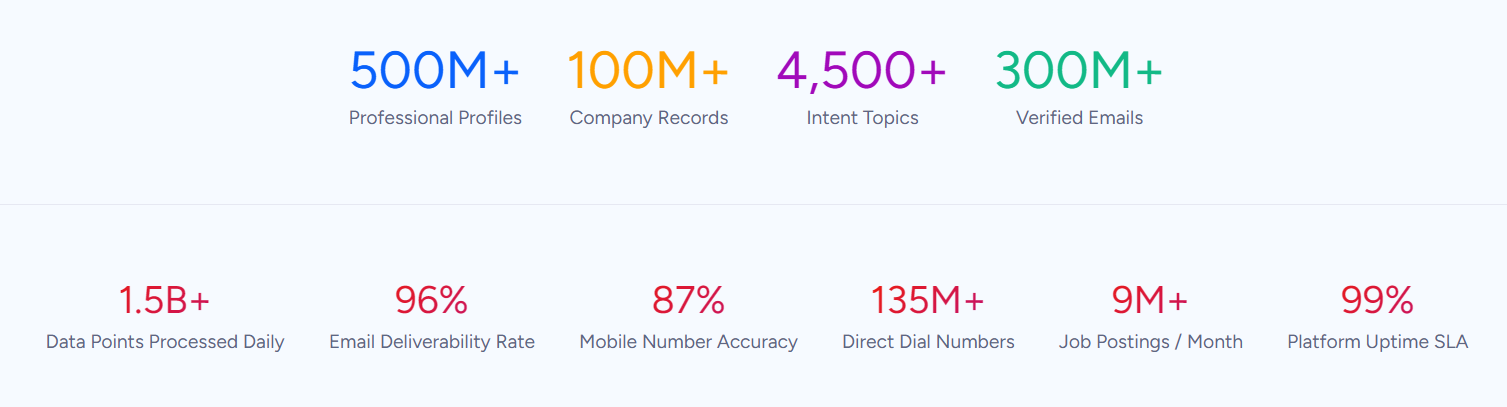
The data is not limited to marketing buyers. ZoomInfo covers decision-makers across IT, finance, operations, HR, engineering, and every other function, making it a single source for teams that sell into multiple departments. Global coverage extends to 34M+ company profiles and 200M+ professional profiles outside North America, with 45M+ international mobile numbers.
Verification runs through multiple sources: automated ML scanning of 28 million domains daily, third-party partner data covering 95 million businesses, a community of 200,000+ ZoomInfo Lite users who share data back, and an in-house lab of 300+ human researchers. First-party data reaches up to 95% accuracy.
The quality is externally validated. In a Fortune 500 competitive RFP analyzing 25 million contacts across vendors, the independent consultant concluded that "no other competitor came even close." ZoomInfo holds Leader positions in both the Gartner Magic Quadrant for ABM Platforms and the Forrester Wave for Intent Data Providers, and earned 133 No. 1 rankings on G2 in Summer 2025.
SpringDB used ZoomInfo's data for precise client targeting, achieving 2x-3x increases in campaign conversions, 300% improvement in database usability, and 30-50% larger average deal sizes. (SpringDB)
GTM Context Graph: ZoomInfo's intelligence layer captures not just what happened in a deal, but why.
Winmo's intelligence is one-directional: alerts flow from Winmo to the seller, who then acts on them independently.
ZoomInfo's GTM Context Graph works differently. It combines ZoomInfo's third-party B2B data with a customer's CRM records, conversation transcripts, email interactions, and behavioral signals into a single intelligence layer that processes 1.5B+ data points daily.
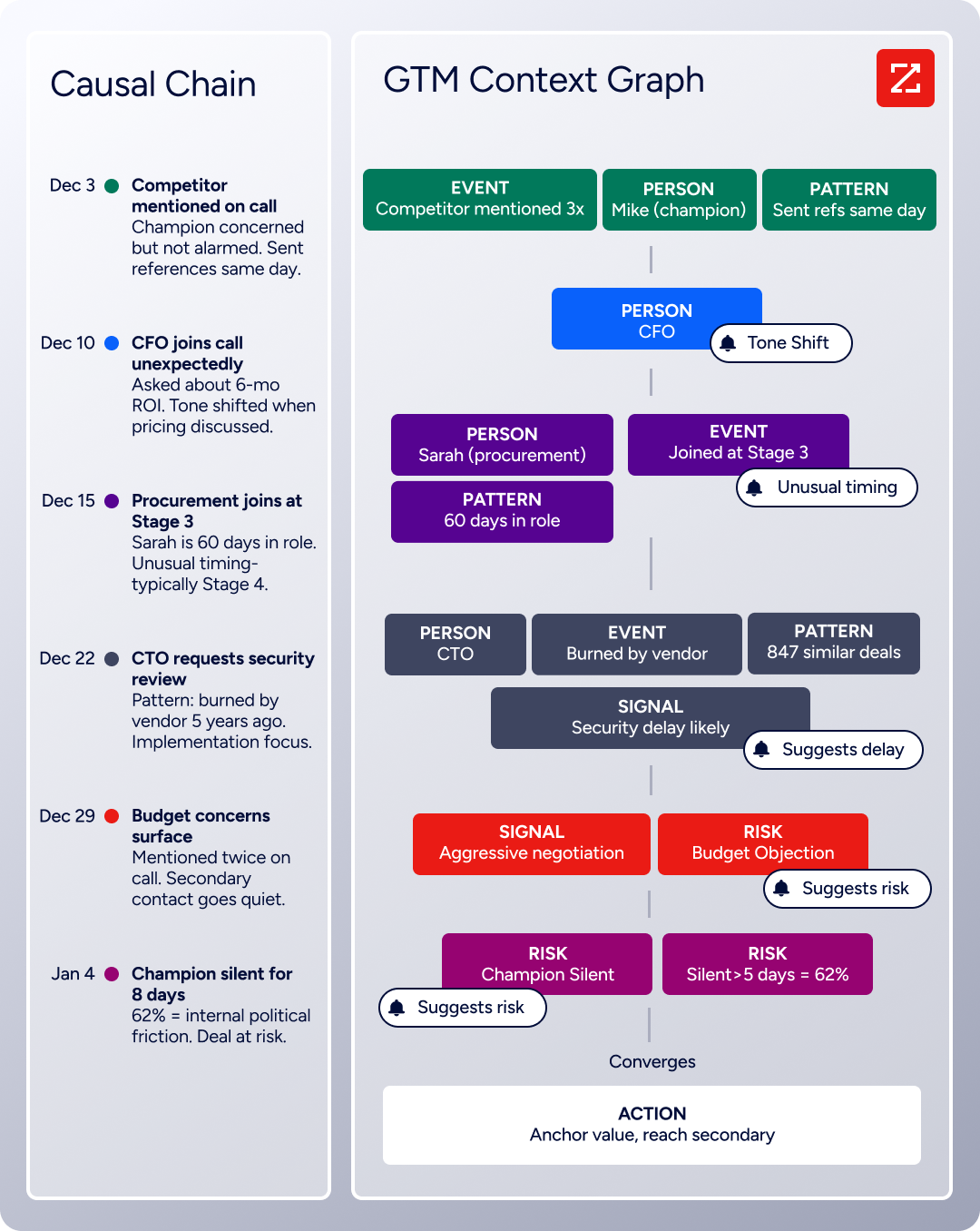
The result is contextual reasoning, not data retrieval. A CRM records that a deal moved to Stage 3. Conversation intelligence captures that the CFO joined the last call and asked about ROI. Intent signals show the company is researching competitors. The Context Graph connects these signals to reveal why the deal is moving and what pattern across thousands of similar deals suggests happens next.
This layer powers everything downstream: AI-drafted outreach that addresses concerns raised on calls, GTM plays that target accounts matching win patterns, and forecasts weighted by buying evidence rather than stage labels.
Seismic's sales team attributed 39% of active pipeline to opportunities identified or influenced by ZoomInfo signals, reported 54% productivity gains, and saved 11.5 hours per week per seller. (Seismic)
AI-Powered Execution: ZoomInfo moves beyond data discovery into deal execution, marketing orchestration, and conversation intelligence.
Where Winmo's workflow ends at CRM export and email composition, ZoomInfo provides execution infrastructure through three channels.
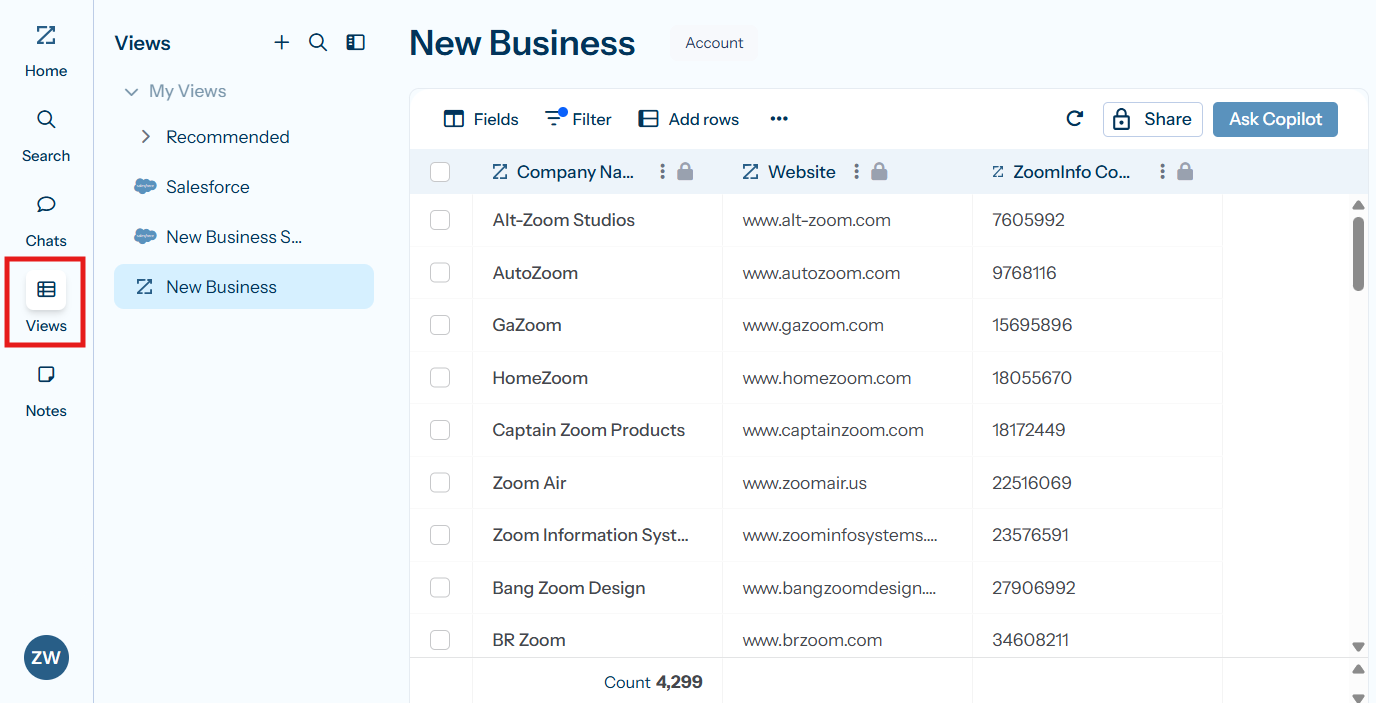
GTM Workspace gives sellers a workspace where prioritized accounts, AI-drafted outreach, and deal execution converge. Built on Anthropic's Claude, its AI agents handle account research, outreach generation, CRM updates, and signal monitoring. Databricks reached prospects 50% faster using it. Thomson Reuters increased closed-won deals by 40%.
Source: ZoomInfo
GTM Studio gives marketers and RevOps teams a canvas where they define audiences, orchestrate campaigns, and measure pipeline using natural language. Expansion plays that used to take 3 weeks now launch in 30 minutes, without engineering support.
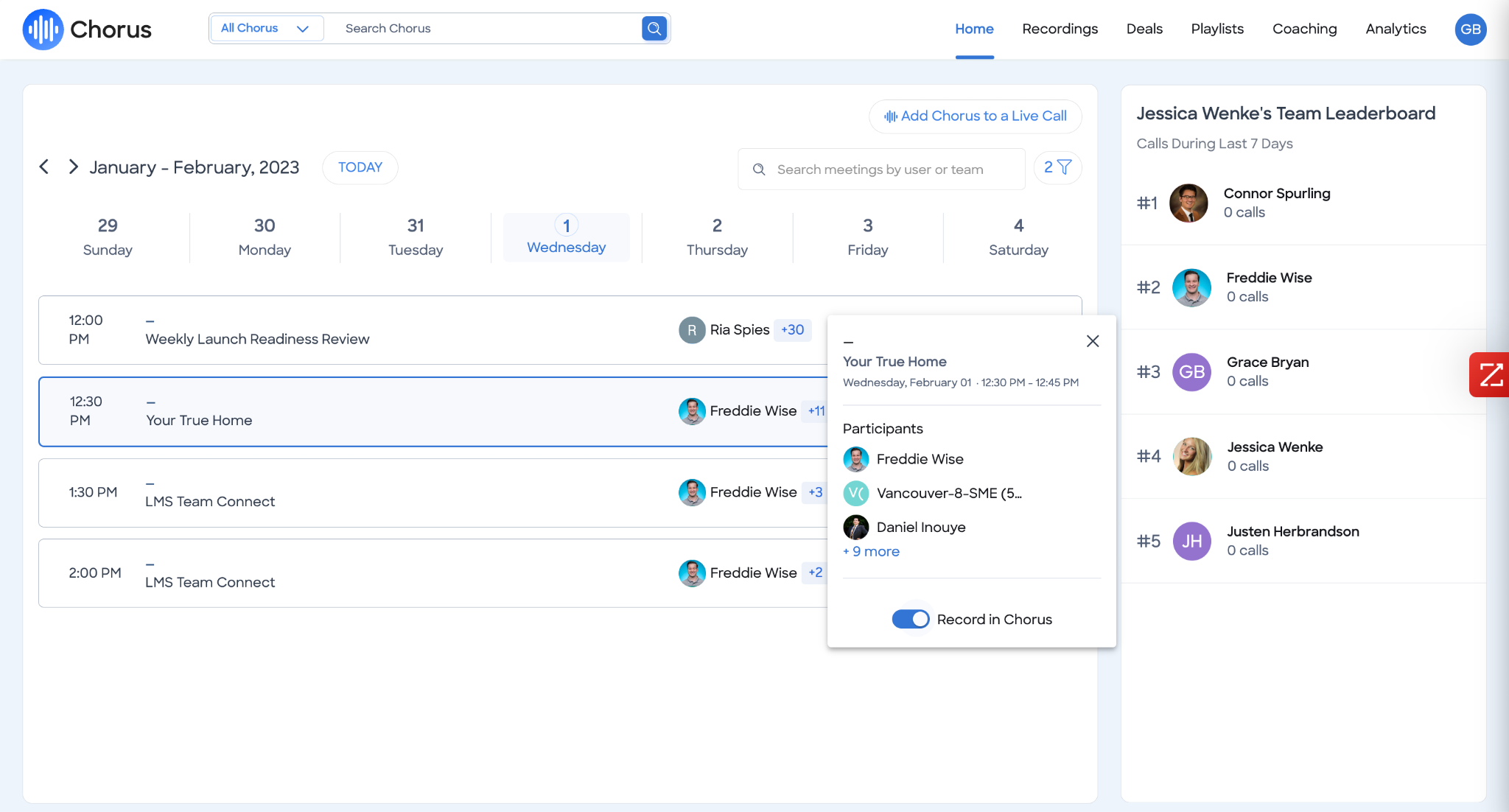
Chorus, ZoomInfo's conversation intelligence product, captures and analyzes customer calls, meetings, and emails. It extracts not just what was said, but the signals behind it: why a deal accelerated, why a champion went quiet, what a competitive mention predicts about deal risk. This feeds into the GTM Context Graph.
Source: ZoomInfo
For teams building custom workflows, APIs and MCP expose the same intelligence to any tool, AI agent, or internal application, with API access included in all relevant plans.
"ZoomInfo's not just a contact data company anymore. They've built a full system of execution that works the list, writes the outreach, triggers the play, and helps drive predictable growth." - Ian Brodie, CEO & Co-Founder (Levanta)
Accessible Pricing with Free Entry Points: ZoomInfo offers a permanent free tier and a self-serve trial.
ZoomInfo uses custom-quoted pricing for paid plans, similar to Winmo.
But it provides two entry points Winmo does not: ZoomInfo Lite, a permanent free tier (not a trial) with access to 100M+ verified profiles, 10 monthly export credits, the ReachOut Chrome Extension, WebSights Lite for website visitor identification, and HubSpot integration; and a 7-day free trial of paid features with no credit card required.
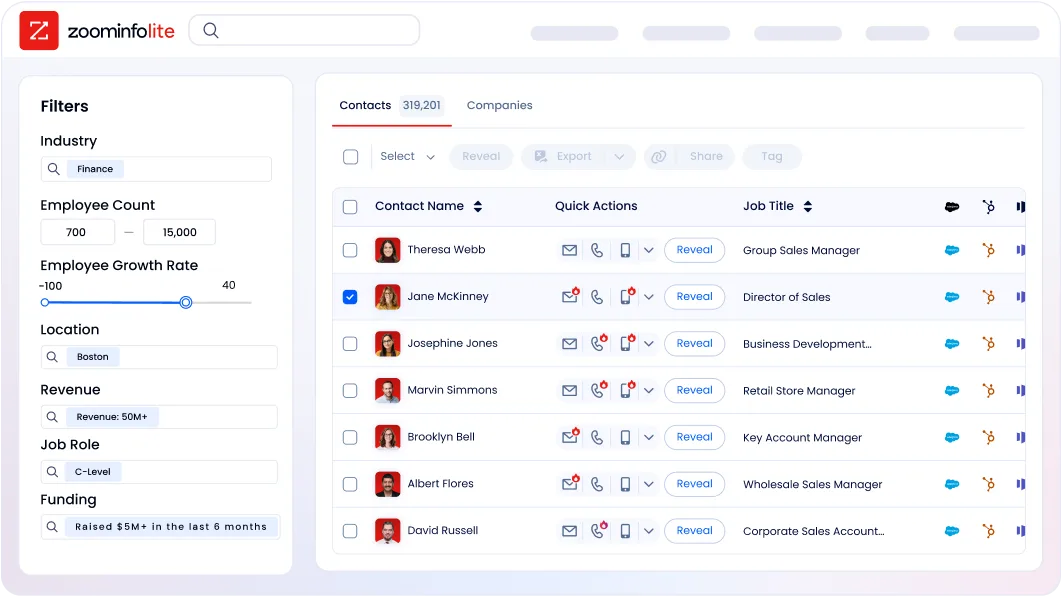
Paid plans are organized into Sales, Marketing, and standalone product tiers (Chorus, Chat), with pricing based on seats, credit volume, features, and contract length. The credit system works on a 1-credit-per-export model: searching and viewing data within ZoomInfo does not consume credits.
Note: ZoomInfo is transitioning toward a consumption-based pricing model.
Winmo or ZoomInfo: Comparison Summary
Aspect | Winmo | ZoomInfo |
|---|---|---|
Market focus | Advertising and media vertical only | All B2B industries and functions |
Contact database | 176,000+ ad decision-makers (US), 230,000+ total | 500M contacts, 100M companies |
Phone numbers | Direct dials for ad decision-makers | 135M+ verified phone numbers, 120M direct dials |
Geographic coverage | US and UK only | Global (34M+ company profiles outside North America) |
Data verification | Human team, 60-day refresh cycle | 300+ human researchers, ML scanning 28M domains daily, up to 95% accuracy |
Predictive intelligence | WinmoEdge: agency reviews, campaign launches, VAI scoring | GTM Context Graph: 1.5B+ data points daily, combining CRM, conversation, intent, and behavioral signals |
Brand-agency mapping | Full relationship mapping at decision-maker level | Org charts, department structures, corporate hierarchies |
Ad spend data | $100B+ tracked via iSpot.tv, Adbeat, Media Analytics | Technographics (30,000+ technologies), intent signals, company attributes |
AI execution tools | Winmo Compose (email drafting) | GTM Workspace (AI agents for sellers), GTM Studio (AI orchestration for marketers/RevOps) |
Conversation intelligence | Not available | Chorus (call recording, transcription, AI analysis) |
Website visitor ID | Winmo Reveal (person-level, 30% match) | WebSights (company and buying team identification) |
CRM integration | Salesforce, HubSpot, Dynamics (paid add-on) | Salesforce, HubSpot, Dynamics + 120 marketplace integrations |
API/MCP access | Paid add-on, brand-level spend only | Included in all relevant plans; MCP for AI agents |
Free tier | No free plan; sales-provisioned demos only | ZoomInfo Lite (permanent free) + 7-day trial |
Analyst recognition | No public analyst coverage | Gartner Leader (ABM), Forrester Leader (Intent Data), G2: 133 No. 1 rankings |
Compliance certifications | GDPR compliance | ISO 27001, ISO 27701, SOC 2 Type II, TRUSTe GDPR/CCPA |
Best for | Teams selling exclusively to advertisers and agencies | Teams selling across industries with GTM execution tools |
Final Verdict
The choice between Winmo and ZoomInfo depends on what you sell, to whom, and how much tooling your team needs.
Choose Winmo if your revenue comes exclusively from selling to national advertisers, agencies, or sponsorship buyers, and your priority is timing. Winmo's brand-to-agency mapping, WinmoEdge alerts, and embedded ad spend data give advertising sellers industry-specific context that horizontal platforms don't replicate.
For ad sales teams at media companies, sponsorship sellers at sports properties, and agency new business directors who work within the advertising ecosystem, Winmo provides a toolset that matches how their prospects buy.
Choose ZoomInfo if your team sells beyond advertising, needs execution tools rather than just data and alerts, or requires global coverage.
With 500M contacts across 100M companies, the GTM Context Graph, and execution tools (GTM Workspace, GTM Studio, Chorus, APIs, and MCP), ZoomInfo provides the infrastructure for teams that need to find, engage, and close buyers across any industry, function, and geography. The free tier (ZoomInfo Lite) lets you evaluate the data before committing.
Get started with ZoomInfo here.
Winmo solves a specific problem well: it tells advertising sellers who controls the budget and when that budget is about to move. ZoomInfo solves a broader problem: it gives go-to-market teams the data, intelligence, and execution tools to find, win, and grow customers.
Winmo FAQ
What is Winmo used for?
Winmo is a sales intelligence platform for professionals who sell to national advertisers, agencies, and sponsorship buyers. It provides a human-verified contact database of advertising decision-makers, predictive alerts on agency reviews and campaign launches via WinmoEdge, brand-to-agency relationship mapping, and ad spend data across TV, digital, and other channels.
Its primary users are ad sales teams, agency new business directors, adtech sellers, and sponsorship sellers.
How much does Winmo cost?
Winmo does not publish US pricing. All plans are custom-quoted through sales, with no self-serve signup. The only publicly disclosed price is for the UK market, where Winmo Core starts at $9,495 per year.
The US platform uses a modular structure with a required base package (Commercial Essentials) and paid add-ons for CRM integration, API access, and single sign-on. Annual contracts auto-renew unless cancelled with 30 days' written notice, and renewal price increases are capped at 10%.
Does Winmo offer a free trial?
Winmo does not offer a self-serve free trial. The company provides a self-guided product tour (a simulated walkthrough, not access to live data) and sales-team-provisioned demos.
ZoomInfo offers both a permanent free tier (ZoomInfo Lite with 10 monthly export credits and access to 100M+ profiles) and a 7-day free trial of paid features with no credit card required.
How accurate is WinmoEdge's predictive intelligence?
Winmo claims 81% accuracy for WinmoEdge sales opportunity predictions and 73% accuracy for agency review forecasting, based on a model tracking agency changes since April 2014. The system monitors 17 variables that precede agency reviews and generates a Vulnerable Account Index (VAI) score of 1-100 for each tracked brand. Predictions arrive 3-18 months before contracts change hands.
Does Winmo cover international markets?
Winmo operates in the US and UK markets only. Teams selling into Canada, Australia, Germany, France, or other international markets will find no Winmo coverage.
ZoomInfo provides global coverage with 34 million company profiles and 200 million professional profiles outside North America, plus 45 million international mobile numbers.
What CRM integrations does Winmo support?
Winmo integrates with Salesforce, HubSpot, and Microsoft Dynamics through a direct connector that requires no plugin installation. The CRM connector is a paid add-on, not included in the base subscription.
ZoomInfo includes CRM integrations in its plans, with an app marketplace of 120 partner integrations spanning CRM, marketing automation, sales engagement, data warehouses, and more.
Does Winmo cover small and mid-sized advertisers?
Winmo's database is strongest for large national advertisers and major agency networks. User reviews on G2 and Capterra note that coverage for small and mid-sized businesses is limited. Teams targeting regional or mid-market advertisers may find gaps in both contact data and ad spend intelligence.
How does Winmo compare to ZoomInfo for advertising sales teams?
Winmo offers deeper advertising-specific features that ZoomInfo does not replicate: brand-to-agency relationship mapping at the decision-maker level, predictive agency review alerts via WinmoEdge, and embedded ad spend data from iSpot.tv, Adbeat, and Media Analytics.
ZoomInfo offers broader coverage (500M contacts vs. 176,000+), execution tools (GTM Workspace, GTM Studio, Chorus), global reach, and compliance certifications (ISO 27001, SOC 2 Type II). Teams that sell only to advertisers may prefer Winmo's vertical depth; teams that sell across industries or need GTM execution tools will benefit from ZoomInfo's broader platform.
Researching Winmo? These comparisons and alternatives help you decide:
