

Choosing between Wiza and ZoomInfo for B2B prospecting comes down to five questions:
Are you prospecting through LinkedIn, or do you need data across multiple channels and sources?
Do you need a focused contact-finding tool, or a full go-to-market platform with intent data, orchestration, and AI?
Is your team small enough to benefit from self-serve simplicity, or large enough to need enterprise infrastructure?
Do you want transparent, credit-based pricing you can start today, or custom-quoted plans that scale with your organization?
Is real-time LinkedIn verification enough, or do you need verified direct dials, technographics, org charts, and buying signals in one place?
In short, here's what we recommend:
Wiza is a prospecting tool built for sales teams that live on LinkedIn. Its Chrome extension turns LinkedIn Sales Navigator searches into verified contact lists with 99%+ email accuracy and less than 1% bounce rates. With access to 850M+ prospects and pricing starting at $49/month, Wiza delivers speed and simplicity. Teams can be operational within an hour. But its strength is also its boundary: Wiza is a contact-finding tool, and its accuracy is highest for North American contacts, with gaps in EMEA and APAC markets.
ZoomInfo is an AI go-to-market platform built on a large B2B data foundation: 500M contacts, 100M companies, 135M+ verified phone numbers, 120M direct-dial phone numbers, and 200M+ verified business email addresses. Its GTM Context Graph, which processes 1.5B+ data points daily, unifies this data with your CRM records, conversation transcripts, and behavioral signals to reveal not just who to contact, but why and when. Teams can access this intelligence through the GTM Workspace for sellers, GTM Studio for marketers and RevOps, or APIs and MCP in any third-party tool.
Both platforms deliver verified B2B contact data, but they serve different scales of ambition. Wiza is a prospecting tool. ZoomInfo is the intelligence infrastructure behind an entire go-to-market operation.
Wiza vs. ZoomInfo at a glance
Wiza | ZoomInfo | |
|---|---|---|
Core Focus | LinkedIn-first prospecting | AI go-to-market platform |
Database Size | ||
Verified Phone Numbers | Included (credit-based) | |
Email Accuracy | ||
Intent Data | Not available | |
Technographics | Not available | |
AI Capabilities | Smart Search, AI Columns | GTM Context Graph, GTM Workspace AI agents |
LinkedIn Integration | Core feature (Chrome extension) | Chrome extension (ReachOut) |
CRM Integrations | 120+ integrations including Salesforce, HubSpot, Dynamics 365 | |
Starting Price | $49/month (monthly) | Custom-quoted (enterprise) |
Free Tier | ||
Best For | LinkedIn-heavy SDR teams | Enterprise GTM organizations |
The core difference: Prospecting tool vs. GTM platform
The gap between Wiza and ZoomInfo is not just features. It is a difference in what each product was designed to be.
Wiza was founded in 2019 by Stephen Hakami, who ran a cold email agency and needed a faster way to convert LinkedIn searches into verified contact lists.
The company grew from that single need into a bootstrapped, profitable business serving nearly 500,000 individuals and over 50,000 companies. Its architecture reflects its origin: a Chrome extension that sits on top of LinkedIn, finds verified emails and phone numbers in real time, and exports them to your CRM. Everything Wiza does orbits LinkedIn prospecting.
ZoomInfo was founded in 2007 by Henry Schuck, who saw that incomplete, stale data undermines every go-to-market motion.
Over nearly two decades, ZoomInfo built a large B2B data platform through organic development and strategic acquisitions (including Chorus for conversation intelligence, Clickagy for intent signals, and RingLead for data orchestration). Today, ZoomInfo is a $1.25 billion revenue public company serving 35,000+ companies, including Adobe, Snowflake, and Thomson Reuters.
Its architecture reflects that scale: a data and intelligence layer that powers prospecting, intent detection, conversation analysis, marketing orchestration, and AI-driven execution across every revenue function.
The contrast is structural. Wiza helps you find contact data faster. ZoomInfo helps you find the right contacts, understand why they matter now, and act on that intelligence across your entire go-to-market motion.
Wiza excels at LinkedIn-based prospecting speed
Wiza built its reputation on making LinkedIn prospecting fast and accurate.
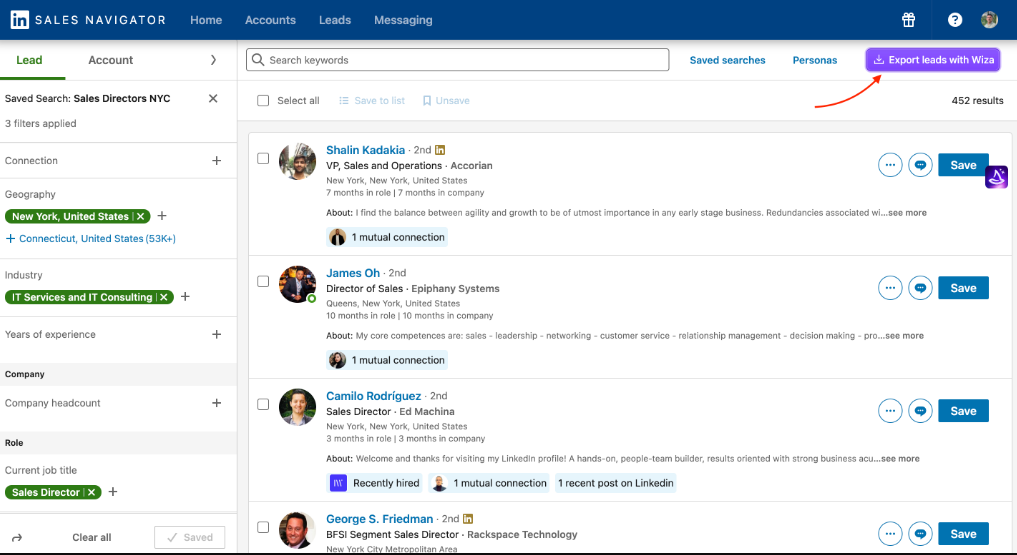
The Chrome extension adds "Reveal work email" and "Reveal phone number" buttons directly to LinkedIn profiles, so reps can get verified contact data without leaving their browser. For bulk prospecting, users can export up to 2,500 contacts at once from LinkedIn Sales Navigator searches, including 30+ data points per contact (name, title, company attributes, funding data, and multiple phone numbers).
Source: Wiza
Implementation is fast. Magnifi2's team was live within one hour. No lengthy onboarding, no SDK integration, no multi-week project. Install the extension, connect your CRM, and start prospecting.
Wiza's Prospect platform extends beyond the Chrome extension, offering a standalone B2B database with 40+ data points and Smart Search that lets users describe prospects in plain English (for example, "VP of Sales at healthcare companies with 500+ employees") rather than navigating filter menus. The AI Columns feature lets users add custom research questions about contacts, with AI-generated answers and transparent reasoning.
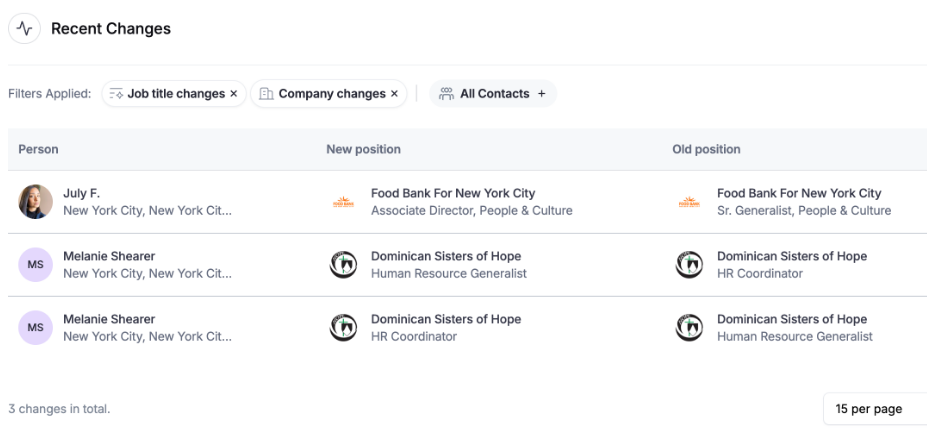
For teams that need to track job changes, Wiza Monitor alerts sales teams when contacts change roles or companies, with notifications via Slack and email and automatic CRM updates.
Source: Wiza
The 2-way CRM sync is useful for reps who prospect on LinkedIn daily. A badge on LinkedIn profiles shows whether contacts already exist in Salesforce or HubSpot, preventing duplicate outreach and letting reps view and update CRM records without leaving LinkedIn.
Where Wiza shows limitations is beyond LinkedIn.
The platform claims 95% LinkedIn data coverage, but its accuracy drops outside North America. It offers no intent data, no technographics, no conversation intelligence, and no orchestration capabilities. For teams whose prospecting starts and ends on LinkedIn, these gaps may not matter. For teams running multi-channel go-to-market motions, they will.
ZoomInfo provides full GTM intelligence and execution
ZoomInfo starts where Wiza stops. Contact data is the foundation, but the platform layers intelligence, context, and execution on top of it.
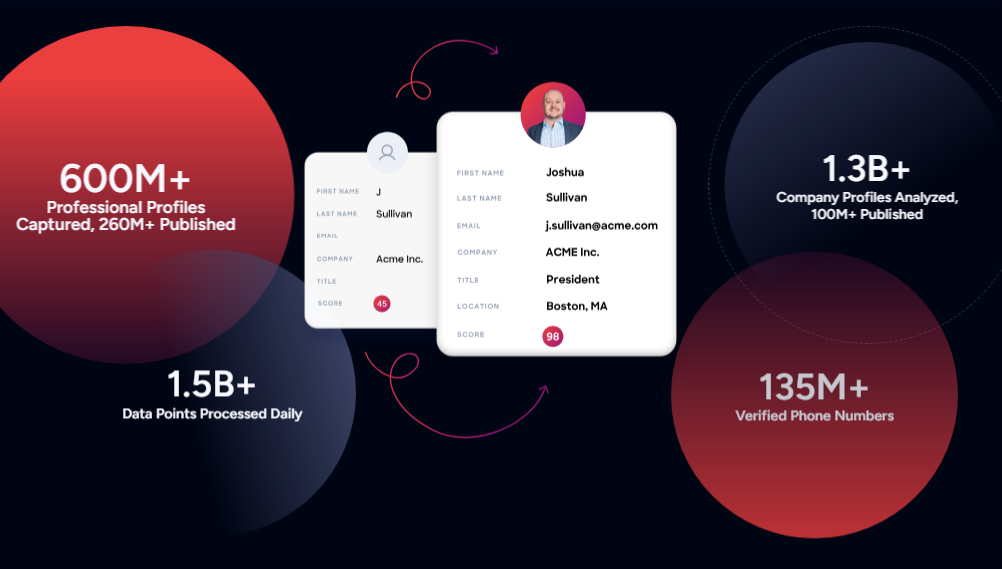
ZoomInfo's database includes 500M+ contacts, 100M+ companies, 135M+ verified phone numbers, 120M+ direct-dial phone numbers, and 200M+ verified business email addresses. This data is maintained through a multi-source verification pipeline that includes automated ML scanning of 28 million site domains daily, a community of 200,000+ ZoomInfo Lite users who share data back, and 300+ human researchers.
In a Fortune 500 competitive RFP analyzing 25 million contacts across vendors, the independent consultant concluded that "no other competitor came even close."
Source: ZoomInfo
But ZoomInfo's differentiation is what it does beyond contact data.
Buyer Intent Data. ZoomInfo Intent tracks signals from 210 million IP-to-Organization pairings and 6 trillion+ new keyword-to-device pairings sourced monthly. Guided Intent, exclusive to ZoomInfo, identifies topics historically correlated with deal success rather than requiring manual topic selection. Wiza has no intent data capability.
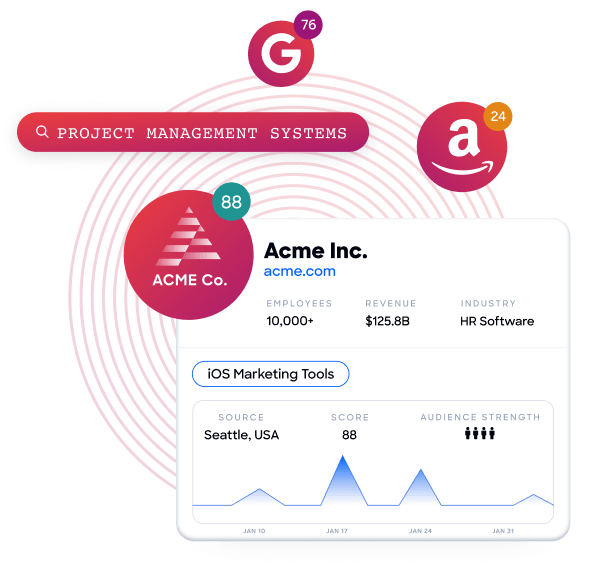
Technographics. ZoomInfo profiles the tech stack of 30+ million companies, tracking 30,000+ technologies across 200+ categories. Nearly 90% of active pairings are updated within three months. Wiza does not track technology usage.
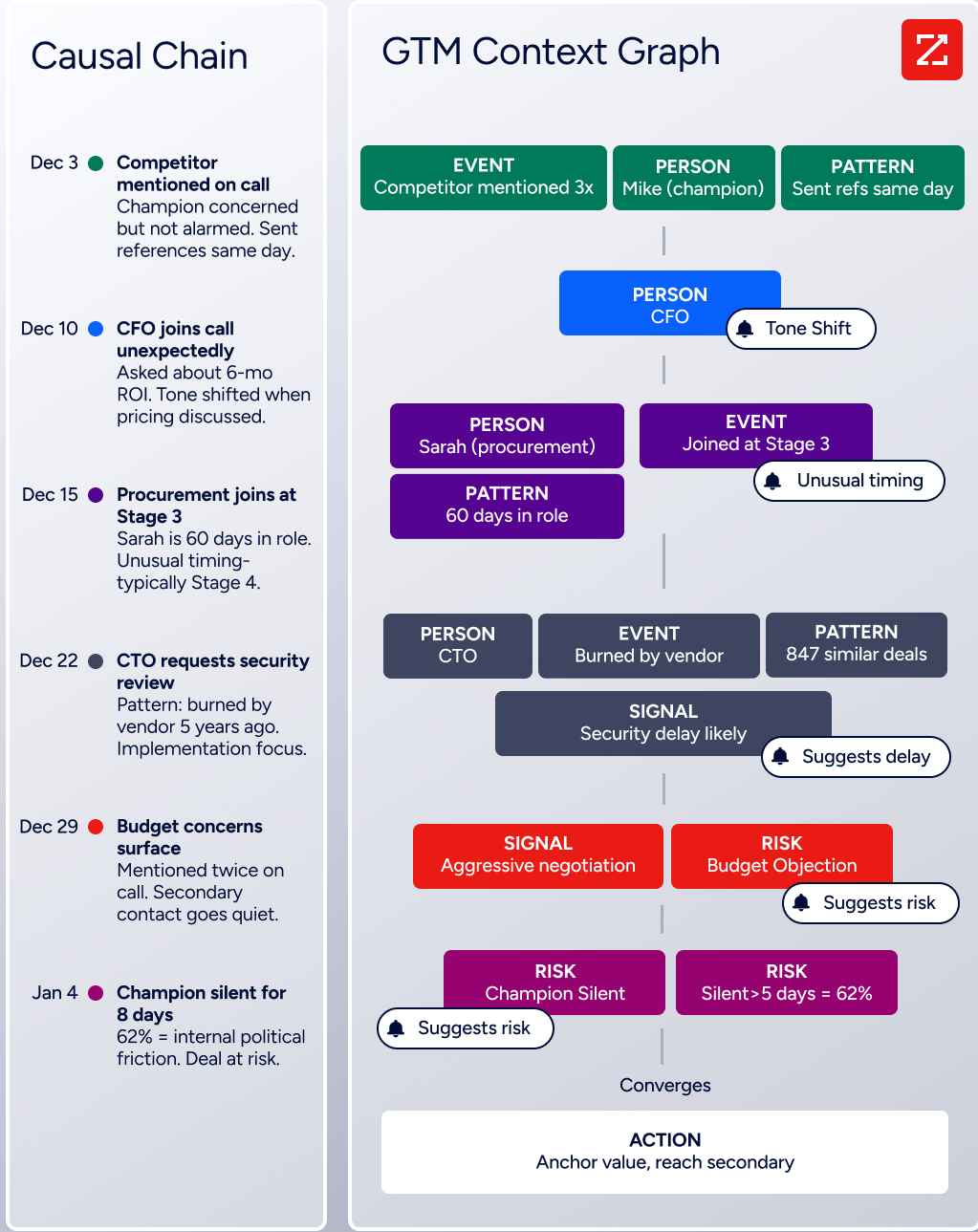
The GTM Context Graph. This is ZoomInfo's intelligence layer, processing 1.5B+ data points daily. It combines ZoomInfo's B2B data with a customer's CRM records, conversation transcripts, email interactions, and behavioral signals to capture not just what happened in a deal, but why it happened. A CRM records that a deal moved to Stage 4. The GTM Context Graph identifies that executive sponsorship entering at this stage, combined with ROI-focused questions from the CFO, matches the pattern behind closed-won deals in your segment. Wiza has no equivalent.
Source: ZoomInfo
Conversation Intelligence. Chorus captures and analyzes customer calls, meetings, and emails, extracting competitive mentions, objection patterns, and deal-moving moments. This feeds the GTM Context Graph, giving AI agents the context to draft follow-ups that address what actually happened in the conversation.
Multi-channel orchestration. GTM Studio lets marketers and RevOps design, enrich, and run go-to-market plays across email, calls, ads, and direct mail, triggered by buyer behavior. GTM Workspace gives sellers a single place where prioritized accounts, AI-drafted outreach, and deal execution converge. APIs and MCP expose the same intelligence to any custom agent or third-party platform.
The trade-off is complexity and cost. ZoomInfo's breadth requires more onboarding (the company redesigned its onboarding program to span 90 days), and its custom-quoted pricing starts higher than Wiza's self-serve plans.
Data quality and coverage comparison
Both platforms claim high accuracy, but they measure and deliver it differently.
Wiza emphasizes real-time verification. Rather than maintaining a static database, Wiza checks live data sources as you request contact information.
The company claims 99%+ email accuracy and less than 1% bounce rates, with 97% job title accuracy. Users consistently praise mobile number accuracy. The phone number flagging system provides free replacement numbers when users report inaccuracies, creating a feedback loop for data quality.
However, Wiza's accuracy varies by geography. Hit rates are higher for US contacts than EMEA or APAC regions. Teams prospecting internationally may encounter inconsistent results.
Source: Wiza
ZoomInfo takes a different approach: breadth and multi-source verification at scale.
The platform aggregates from automated ML scanning of 28 million site domains daily, third-party partner data covering 95 million businesses, a community of 200,000+ users who contribute data, and 300+ human researchers. First-party data reaches up to 95% accuracy.
ZoomInfo's global coverage is broader. The platform includes 34M+ company profiles outside North America, 200M+ professional profiles outside NA, and 45M+ mobile numbers outside NA. In 2025, ZoomInfo expanded international mobile coverage by 1.8 million numbers across six European markets and verified location data for 160 million contacts.
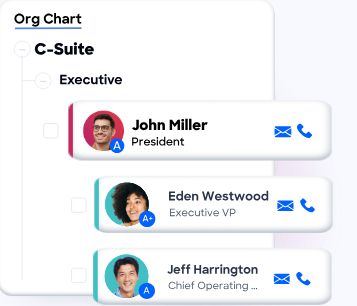
The data quality comparison extends beyond accuracy. ZoomInfo provides data dimensions that Wiza does not: org charts with decision-maker hierarchies, 300+ company attributes for market segmentation, technographic profiles, and parent-child company relationships. For teams that need to understand the structure of a buying committee (not just find email addresses), ZoomInfo's data architecture is more complete.
Source: ZoomInfo
AI capabilities
Wiza has introduced targeted AI features. Smart Search lets users find prospects using natural language queries, translating descriptions into structured filters. AI Columns let users ask custom research questions about prospects at scale, with answers and reasoning. AI Research combines live web data with Wiza's database for prospecting insights.
These features make prospecting faster and more intuitive. They do not capture deal context, predict buying behavior, or orchestrate multi-channel actions based on signal patterns.
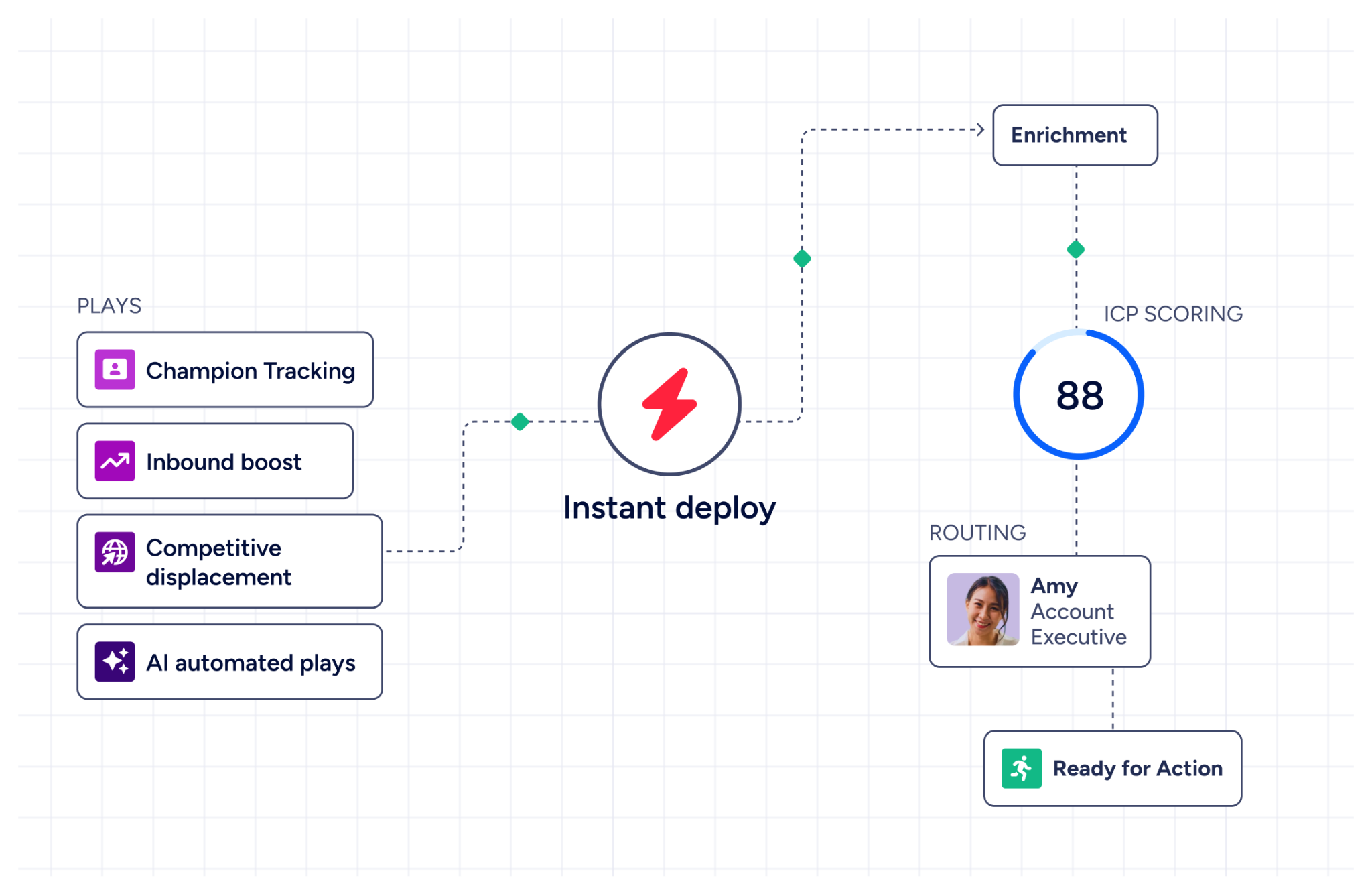
ZoomInfo has built AI into its platform architecture. The GTM Context Graph processes 1.5B+ data points daily, combining first-party CRM data with third-party intelligence to capture deal context. Built on Anthropic's Claude, the AI agents inside GTM Workspace handle account research, outreach generation, CRM updates, and signal monitoring automatically.
GTM Studio uses AI to let marketers describe audiences in natural language, launch multi-channel plays, and measure pipeline impact, with targeting that improves as prospects respond. The Copilot API (part of GTM Workspace) exposes AI capabilities programmatically, including account summaries, company insights, lookalike expansion, and AI-ranked buying committee suggestions.
Source: ZoomInfo
The AI gap between the platforms mirrors the data gap. Wiza's AI makes searching easier. ZoomInfo's AI makes the entire go-to-market motion more intelligent.
Pricing and cost structure
The pricing models reflect each platform's target market.
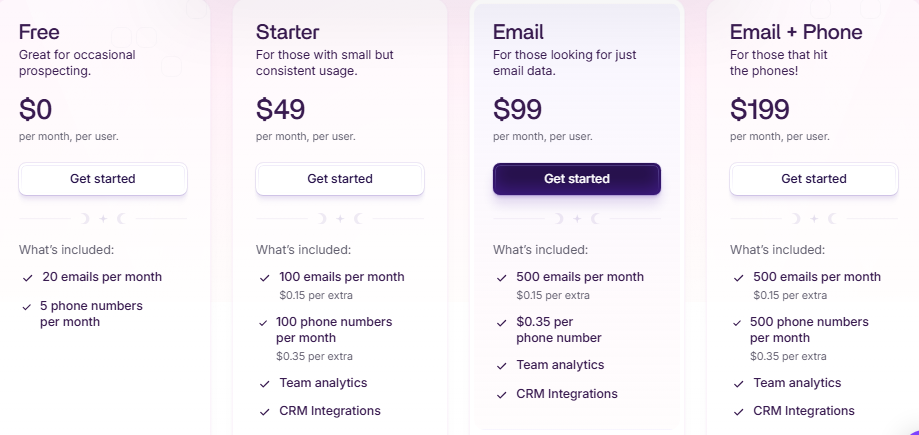
Wiza publishes transparent pricing with multiple entry points:
Free Plan: $0/month, 20 emails and 5 phone numbers per month
Starter Plan: $49/month, 100 emails and 100 phone numbers per month
Email Plan: $99/month (or $83/month billed annually), 500 emails per month, unlimited on annual plans
Email + Phone Plan: $199/month (or $166/month billed annually), 500 emails and 500 phones per month, unlimited on annual plans
Team Plan: Starting at $449/month billed annually for 3+ users, with unlimited emails and phones, API access, and a dedicated success manager
When credits run out, Wiza charges $0.15 per valid email and $0.35 per phone number. Annual unlimited plans have a monthly cap of 2,500 prospects exported. Credits do not roll over between billing cycles.
Wiza Monitor (job change tracking) is priced separately at $99/month for 1,000 contacts, with $30/month for each additional 1,000.
Source: Wiza
ZoomInfo uses custom-quoted, seat-and-credit-based subscriptions with no publicly listed prices.
Pricing depends on number of users, monthly credit volume, features, company size, and contract length. Annual contracts are standard. The platform organizes into three product lines (Sales, Marketing, Operations/Studio), each with tiered plans (Professional, Advanced, Enterprise for Sales; Marketing Demand, ABM Lite, ABM Enterprise for Marketing).
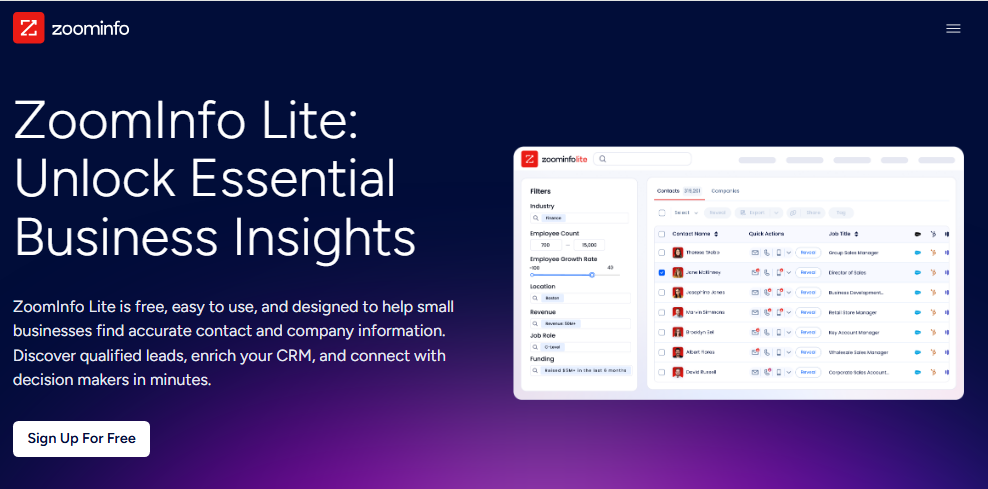
ZoomInfo does offer free entry points. ZoomInfo Lite is a permanent free tier with 10 monthly export credits, contact and company searches, the ReachOut Chrome Extension, and HubSpot integration. A 7-day free trial provides broader access to core features.
Source: ZoomInfo
The cost comparison depends on what you are buying. For contact data alone, Wiza is cheaper. A single sales rep on Wiza's Email + Phone plan pays $166/month for unlimited contacts (annual billing). ZoomInfo's paid plans start higher but include capabilities Wiza does not offer at any price: intent data, technographics, conversation intelligence, multi-channel orchestration, and the GTM Context Graph.
For teams evaluating cost per contact, Wiza's model is more predictable. For teams evaluating cost per outcome (pipeline generated, deals closed, accounts won), ZoomInfo's customers report results like Seismic's 54% productivity gain and 11.5 hours saved per week per seller, Snowflake's 200% higher conversion rates on top-scoring accounts, and Thomson Reuters' 40% increase in closed-won deals.
Integration ecosystems
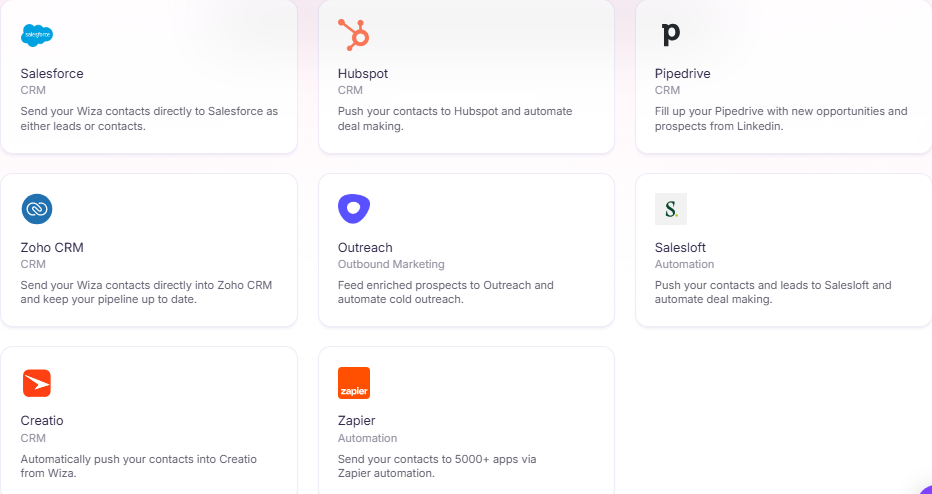
Wiza offers native integrations with HubSpot, Salesforce, Pipedrive, Zoho CRM, and Creatio (all marked as "Alpha" status), plus Outreach and Salesloft for sales engagement. Automation platforms include Zapier, Clay, and n8n. API access is available on Team plans and higher. Okta SSO is available for enterprise authentication.
The integrations focus on the prospecting workflow: find contacts, sync to CRM, push to sequences. The direct-to-cadence functionality syncs to CRM first, then adds contacts to sequences, reflecting how sales teams actually work.
Source: Wiza
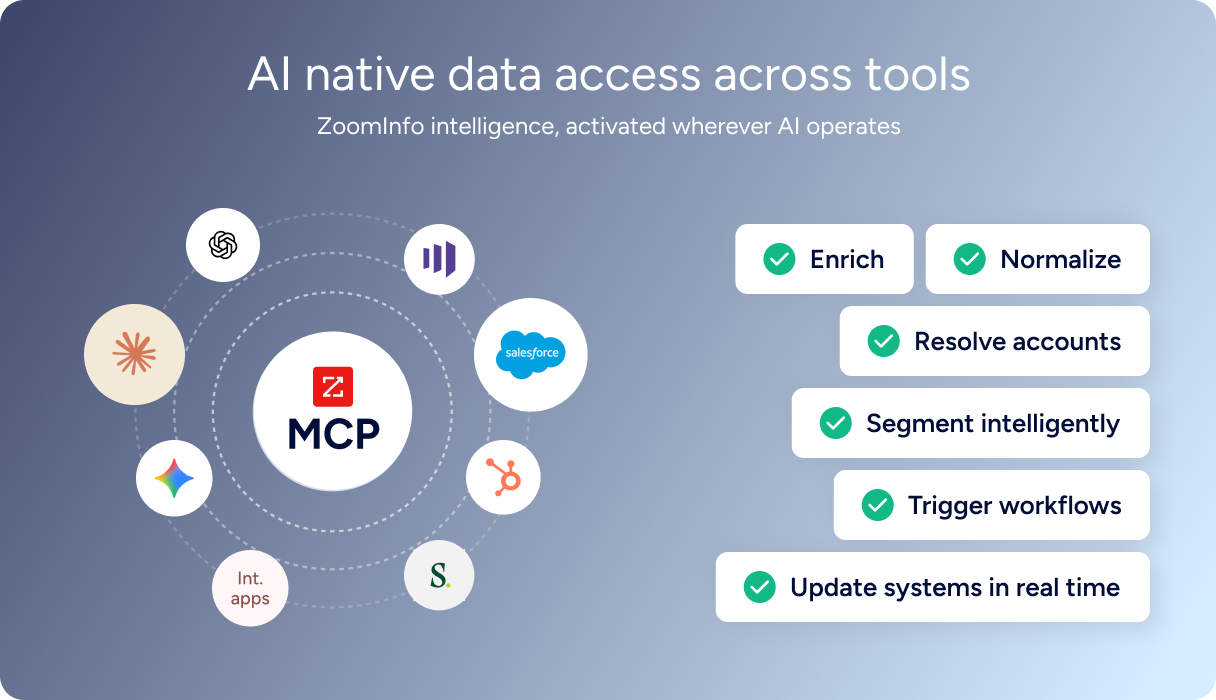
ZoomInfo's App Marketplace lists 120+ partner integrations spanning CRM (Salesforce, HubSpot, Microsoft Dynamics 365), sales engagement (Salesloft, Outreach), marketing automation (Marketo, Eloqua), data warehouses (Snowflake, Databricks), communications (Zoom, Gmail), and ATS platforms (Bullhorn). Cloud Partners enables direct data ingestion into AWS, Google Cloud, Snowflake, and Databricks.
The Enterprise API provides programmatic access across four areas: Data API (search and enrich), Copilot API (AI intelligence, part of GTM Workspace), Marketing API (audience management), and Platform API (engagement data). The MCP server connects AI models directly to ZoomInfo's data as a native tool, currently supporting Claude and ChatGPT.
Source: ZoomInfo
The integration difference reflects the platform difference. Wiza connects to your sales workflow. ZoomInfo connects to your entire GTM infrastructure.
Security and compliance
Wiza complies with GDPR, CCPA, and regional privacy laws including Australia's Privacy Act and New Zealand's Privacy Act. Payment data is handled by Stripe. The company maintains a vulnerability disclosure program. No specific security certifications (SOC 2, ISO) were found in available documentation.
ZoomInfo maintains a certification stack, all renewed annually: ISO 27001 (information security), SOC 2 Type II (security, confidentiality, availability), ISO 27701 (privacy management), and TRUSTe GDPR and CCPA validations. ZoomInfo is a registered data broker in California and Vermont and maintains a dedicated Trust Center.
For regulated industries (financial services, healthcare, government contractors), ZoomInfo's compliance infrastructure is more established. Wiza's compliance posture may be sufficient for smaller teams without strict procurement requirements.
Implementation and learning curve
Wiza wins on speed to value. Install the Chrome extension, connect a CRM, and start prospecting.
Customer testimonials report being fully operational within one hour. Users describe the interface as "easy to use" with a short learning curve. The help center includes getting-started videos and organized documentation, and Team plan subscribers receive a dedicated success manager.
ZoomInfo requires more onboarding. The company redesigned its onboarding program from 30 to 90 days, structured across planning, technical implementation, education, and adoption phases.
This redesign produced a 25% improvement in customer satisfaction scores. ZoomInfo University provides role-specific learning paths, certifications, and live webinars. Enterprise tiers include dedicated onboarding and customer service managers.
The implementation gap reflects what each platform demands. Wiza asks you to learn a prospecting tool. ZoomInfo asks you to learn a platform that, once adopted, becomes infrastructure for your entire revenue operation.
Wiza vs. ZoomInfo: Which should you choose?
The choice depends on your team's size, budget, prospecting workflow, and go-to-market ambitions.
Choose Wiza if:
Your prospecting workflow centers on LinkedIn and Sales Navigator
You need a fast, affordable way to find verified emails and phone numbers
Your team is small and values self-serve simplicity over platform depth
Budget is a primary constraint and transparent pricing matters
You want to be operational within hours, not weeks
Your focus is primarily on North American contacts
You need a focused tool, not a platform, and plan to assemble your GTM stack from specialized vendors
Credit-based, pay-as-you-go economics match your volume
Choose ZoomInfo if:
You need a large B2B data foundation across contacts, companies, intent signals, and technographics
Your GTM strategy requires multi-channel orchestration, not just contact finding
You want AI that captures deal context, identifies buying committee patterns, and generates outreach from conversation intelligence
Your team spans sales, marketing, RevOps, and customer success, and needs a single intelligence layer
Enterprise compliance (ISO 27001, SOC 2 Type II, ISO 27701) is a procurement requirement
You need global data coverage beyond North America
You want to power custom agents and third-party tools through APIs and MCP
You are willing to invest in onboarding for a platform that grows more useful as your organization adds teams and use cases
Get a ZoomInfo free trial here!
Wiza and ZoomInfo solve the same starting problem (finding B2B contact data) but diverge in everything after that.
Wiza is a prospecting tool that does one thing well: it gets you verified contacts from LinkedIn, fast and affordably. ZoomInfo is the data and intelligence infrastructure behind a complete go-to-market operation, with the GTM Context Graph as the intelligence layer powering AI-driven execution across sales, marketing, and operations.
For individual reps and small teams that prospect through LinkedIn, Wiza delivers immediate value at a fraction of the cost. For organizations building a coordinated go-to-market engine, ZoomInfo provides the data foundation, contextual intelligence, and access points that a prospecting tool alone cannot deliver.
The right choice matches not just your current prospecting needs, but the complexity and scale of the go-to-market motion you are building.
