

Yellow.ai is an enterprise AI platform that automates customer and employee interactions across voice, chat, and email from a single system.
It deploys autonomous AI agents that resolve support queries, replace legacy IVR trees with conversational voice, manage knowledge retrieval through agentic RAG, assist live agents with real-time suggestions, and operate across 35+ channels in 135+ languages.
The platform runs on a multi-LLM architecture drawing on 15+ models and claims a less than 1% hallucination rate on its in-house model. 1,300+ enterprise brands use it.
This breakdown covers every feature, how it works, who it serves, and which plan unlocks it.
Yellow.ai fits if:
You handle high volumes of repetitive customer queries (FAQs, order status, billing, account lookups) and want 70-90% automation within 30 days
You need to replace or augment legacy IVR systems with conversational voice AI that understands accents, dialects, and interruptions
You run customer support across WhatsApp, web chat, email, voice, and social channels and want one platform managing all of them with shared context
You want HR self-service and IT helpdesk automation on the same platform as customer support
You operate in regulated industries (BFSI, healthcare, utilities) and require HIPAA, SOC 2 Type II, PCI-DSS v4.0.1, and ISO 27001 compliance built into the platform
You need AI agents deployed in 135+ languages, including regional dialects and mixed-language patterns
You'll hit its limits if:
You need a B2B contact and company database for outbound sales prospecting
You want buyer intent signals showing which companies are researching your category across the web
You need conversation intelligence that records, transcribes, and coaches from sales calls
You run account-based marketing, display advertising, or multi-channel campaign orchestration
You want to see a price before talking to sales
For those needs, the reference point is ZoomInfo: an AI GTM platform built on 500M contacts, 100M companies, 135M+ verified phone numbers, and 200M+ verified business emails, with a GTM Context Graph that combines B2B data with CRM records, conversation intelligence, and behavioral signals into a single intelligence layer, accessible through APIs, MCP, GTM Workspace, and GTM Studio.
After the feature breakdown, this article covers where Yellow.ai stops and how ZoomInfo fills those gaps.
Yellow.ai Platform Overview
Yellow.ai targets enterprise CX and IT leaders who want to automate high-volume customer and employee interactions without stitching together separate tools for chat, voice, email, knowledge management, and agent assist.
Source: Yellow.ai
The platform serves industries with heavy support traffic: BFSI, healthcare, utilities, retail, travel, and government.
The platform organizes around six core areas:
Module | What It Does | Plan Availability |
|---|---|---|
No-code/pro-code environment for creating and deploying AI agents across voice, chat, and email | Free (1 agent); Enterprise (unlimited) | |
Agentic RAG-powered knowledge retrieval with multi-step reasoning and autonomous workflow triggering | Enterprise | |
Unified voice AI with 10-second voice cloning, sub-400ms latency, 500+ languages | Enterprise (unlimited) | |
AI-powered helpdesk for live agents with response suggestions, in-inbox automation, and CRM integration | Free (2 human agents); Enterprise (unlimited) | |
35+ channel deployment (WhatsApp, SMS, email, social, voice) with cross-channel context persistence | Free (chat only); Enterprise (all channels) | |
Self-learning analytics with topic clustering, sentiment tracking, and auto-generated KB articles | Enterprise (full suite) |
Yellow.ai uses a two-tier model: a permanent Free plan with 500 chat sessions per month (one AI agent, two human agents, limited channels), and a custom-quoted Enterprise plan through sales. The platform is also available on the AWS Marketplace starting at $10,000/year. Here is the full tour.
Yellow.ai AI Agent Builder: Creating and Deploying AI Agents
AI Agent Builder 2.0 is the development environment where teams create, test, and deploy agents. The defining design choice is accessibility: agents are defined through natural language descriptions rather than code or scripted logic trees, making the builder usable by business analysts and CX teams alongside developers.
Source: Yellow.ai
Three assist features sit on top of the build environment. Ask AI converts plain-language descriptions of what an agent should do into structured, optimized prompts, removing the manual prompt engineering step.
Agent Analyzer acts as a built-in quality layer, detecting weaknesses in an agent's configuration and recommending fixes before deployment.
MagicCues provides contextual suggestions during the build process, automatically adding missing validations and refining workflows as the agent takes shape. Together, these three tools close the gap between "describe what I want" and "production-ready agent."
The architecture uses a Super Agent orchestration model: a top-level agent routes conversations to specialized domain agents while keeping conversation context across handoffs.
A single customer interaction can move from a billing inquiry to a technical support question without losing what was already discussed. Teams configure multi-step business processes (creating support tickets, initiating orders, routing approvals) through Workflows 2.0, a visual flow designer, with no code required.
Agents process text, image, and voice inputs and deploy to voice, chat, and email from a single build. Versioning enables A/B testing and rollback, so teams can iterate on agent behavior without risking production stability.
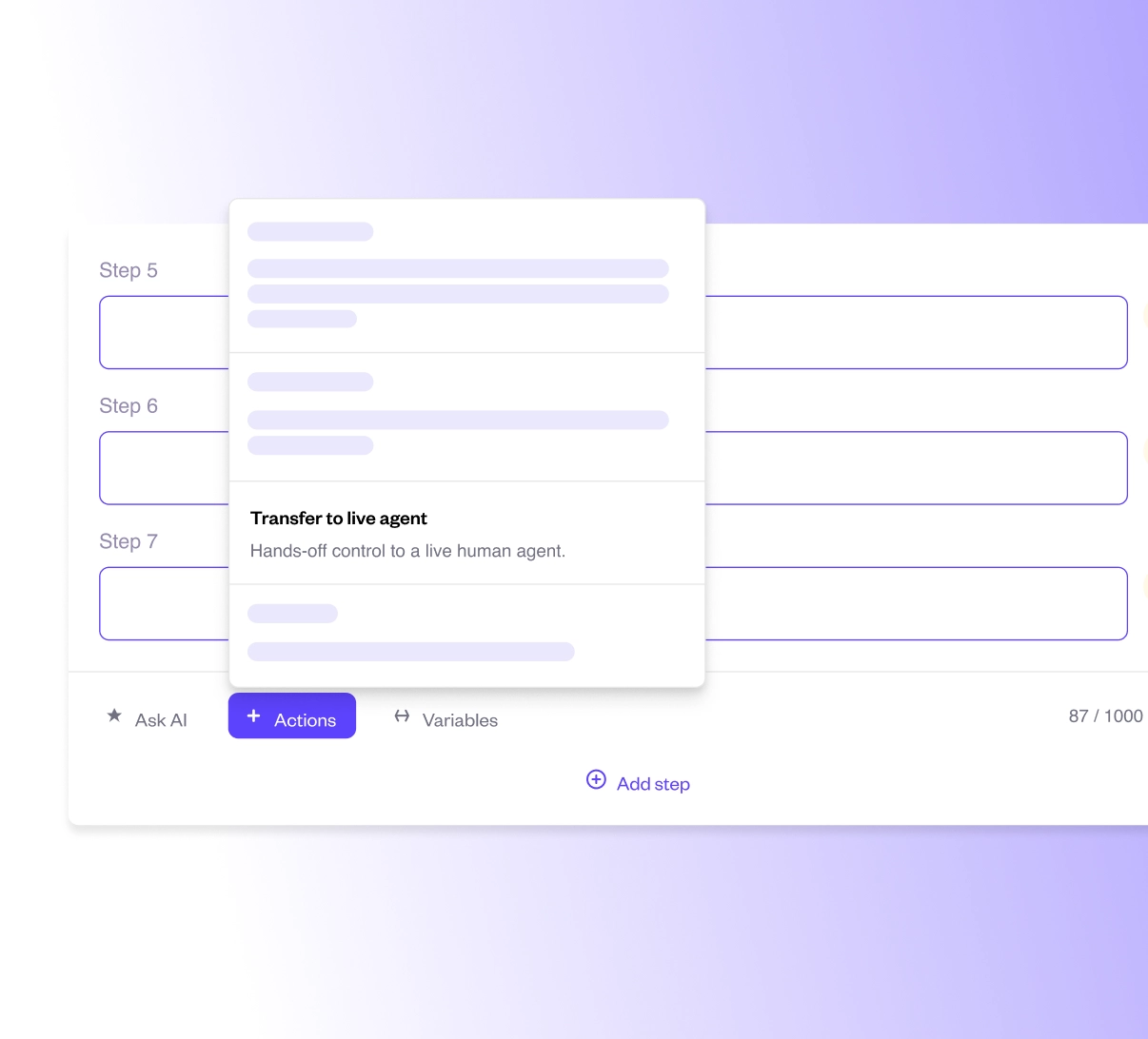
When an agent cannot resolve a query, human-agent handoff transfers the conversation with full context preserved.
Source: Yellow.ai
Before any agent reaches production, Automated Testing auto-generates test cases from documents (SOPs, product docs, websites) and runs hundreds of conversational tests in parallel. These tests integrate into CI/CD pipelines.
The AI Copilot adds a debugging layer: real-time visibility into how AI agents make decisions, letting teams replay conversations, inspect LLM reasoning pathways, and catch hallucination or configuration errors before deployment.
The platform connects to enterprise systems through 150+ prebuilt integrations (Salesforce, ServiceNow, SAP, Oracle, Zendesk, Freshdesk, HubSpot, Genesys), and Yellow.ai reports 3x faster deployments compared to traditional bot-building.
Yellow.ai Nexus Vox: Enterprise Voice AI
Nexus Vox is the voice channel layer and Yellow.ai's biggest architectural bet. Traditional enterprise voice AI assembles four separate vendor components: speech-to-text, reasoning, text-to-speech, and telephony.
Every handoff between components adds latency and creates integration fragility, resulting in what Yellow.ai describes as "800ms+ pauses, robotic delivery, fragile integrations".
Nexus Vox eliminates those boundaries by running all four functions in the same runtime, where "listening, thinking, speaking, and calling all happen in the same software, sharing the same understanding of the conversation in real time".
The result is sub-400ms end-to-end response latency, within the range of natural conversation. Because the voice layer has direct access to conversation state, the system adjusts its tone when the caller is frustrated, in real time.
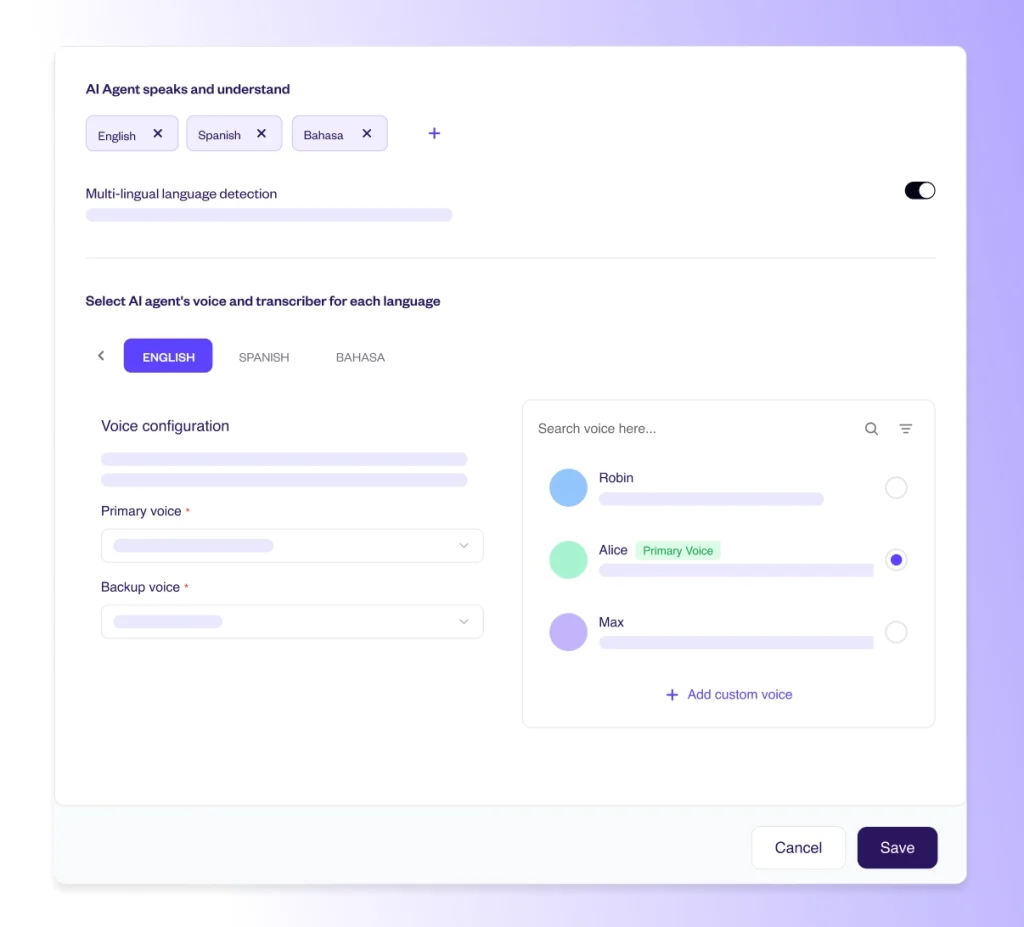
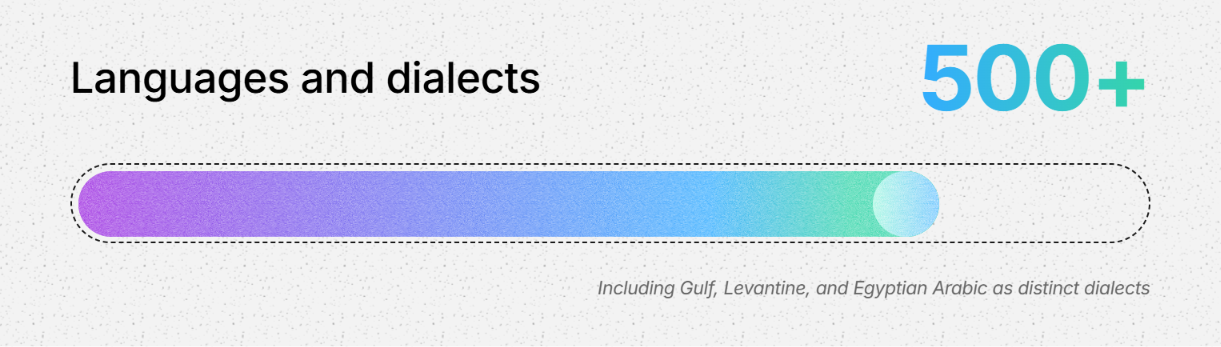
Voice cloning works from a 10-second audio sample. The system captures the timbre, cadence, and emotional range of the source voice and synthesizes responses in any of 500+ supported languages and dialects while preserving voice characteristics.
Source: Yellow.ai
This covers regional combinations most voice AI cannot handle: Gulf Arabic, Tamil-English, Bahasa-Javanese, and mixed-language patterns including accents, mumbling, interruptions, and code-switching mid-sentence.
Vox connects to backend business systems. When a caller requests a refund, flight rebooking, or password reset, the agent executes the action by making API calls or CRM operations rather than drafting responses for a human to review.
Everest Group Practice Director Anubhav Das noted that the platform "addresses limitations like high latency, poor audio quality, and limited conversational depth" common to the broader voice AI market. The module includes single-click integrations for contact centers, help desks, and CRM systems including Zendesk, Freshdesk, HubSpot, and Genesys.
Yellow.ai Conversational Knowledge Base: Agentic RAG
Yellow.ai's Conversational Knowledge Base replaces static search with active intelligence. Where conventional knowledge base search returns scattered keyword matches and forces users to sift through results, this system understands what the user needs, asks clarifying questions when queries are vague, retains full conversation context, and can execute follow-on workflows within a single conversation.

Source: Yellow.ai
The system runs on Agentic RAG, which adds a reasoning and action layer on top of standard retrieval-augmented generation. A conventional RAG system retrieves a chunk, passes it to an LLM, and returns a response.
Yellow.ai's system decides what to do next: it can collect user data, trigger workflows, or escalate, making resolution actionable rather than informational.
Document ingestion supports PDFs, Word docs, Excel files, sitemaps, Amazon S3 buckets, Google Drive, SharePoint, ServiceNow, and Salesforce, with sync schedules configurable as hourly, daily, or weekly.
During processing, the system applies context-aware chunking: rather than splitting documents by arbitrary character counts, it categorizes content by meaning, keeping related content together. It applies automated metadata tagging during ingestion.
Retrieval combines semantic search (understanding intent and meaning) and entity-based search (extracting specific named objects, values, or attributes). Yellow.ai cites up to 90% search accuracy from this dual approach. After retrieval, the agent synthesizes content and can respond via text, images, videos, and rich media.
One distinguishing feature is the feedback loop. The Analyze module's Self Learning Loopback auto-generates new KB articles from successfully resolved conversations and feeds them back into the knowledge base, so the system learns from its own resolutions without manual article authoring.
Yellow.ai Omnichannel Automation: 35+ Channels, 135+ Languages
Yellow.ai's Omnichannel Automation deploys a single AI agent across 35+ communication channels simultaneously. The supported channels span:
Messaging: WhatsApp, SMS, Facebook Messenger, Instagram, Telegram, Viber, Line, Zalo, Apple Business Chat, Google Business Messages
Workplace: Microsoft Teams, Slack, Webex, Google Chat
E-commerce: Lazada, Shopee, Tokopedia
Other: Web chat widget, email, push notifications, Sunshine Conversations
A bot built in Agent Builder 2.0 connects to each channel through channel-specific configurations, but the same AI logic runs regardless of surface.
The platform maintains a unified conversation state, so if a customer starts on WhatsApp and continues via email or web chat, the AI agent retains prior interaction history and does not restart the conversation. AI agents operate natively across 135+ languages.
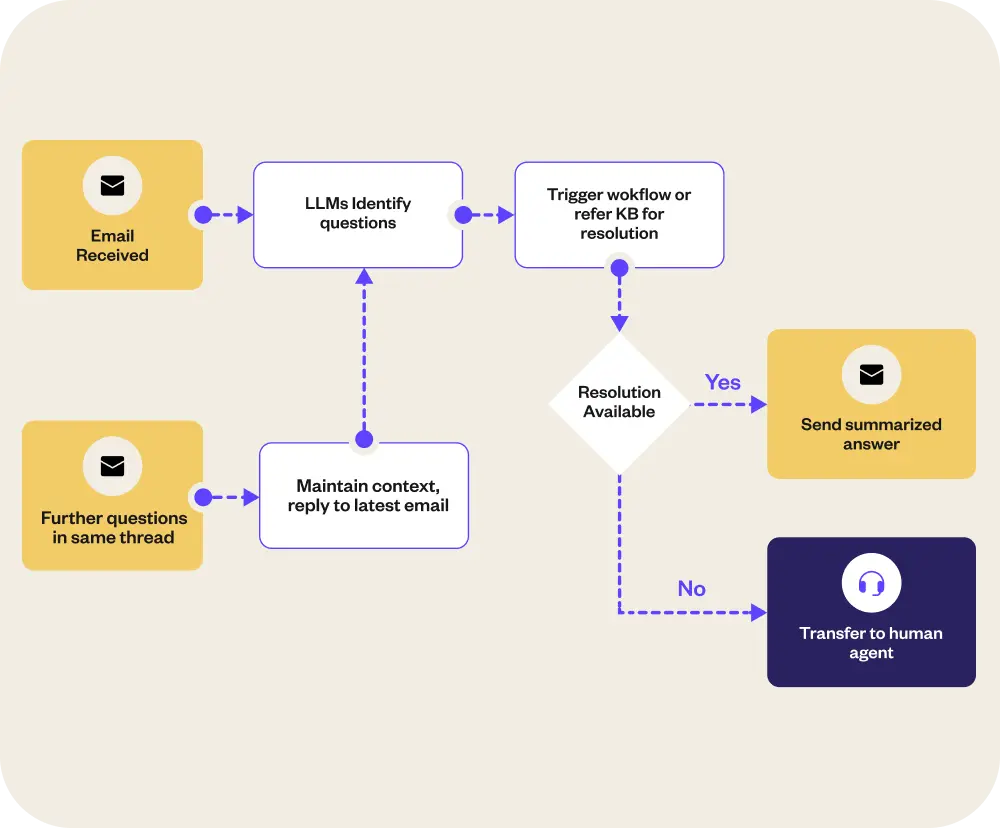
Email AI handles a specific problem: multi-intent parsing. Most email automation tools treat each email as a single-intent ticket.
Yellow.ai's LLM-based email layer identifies multiple distinct intents within a single incoming email, assigns urgency levels using sentiment detection, cross-references the knowledge base and CRM data, and either resolves automatically or routes to a human agent with full context.
Source: Yellow.ai
Outbound campaign automation through the Engage module sends personalized proactive messages (order shipped, appointment reminder, payment due) via WhatsApp and messaging channels.
Sentiment-triggered escalation monitors conversations in real time and transfers to human agents when negative sentiment is detected.
The omnichannel layer connects into existing CRM and ticketing stacks (Zendesk, Freshdesk, Salesforce, Genesys, NICE, HubSpot) via integrations, recording all conversations back into the CRM and pulling historical interaction data for context. No rip-and-replace required.
Yellow.ai Agent Assist: The Live-Agent Helpdesk
Agent Assist governs what happens after an AI agent decides a conversation needs a human. It operates as a unified inbox (called Inbox) that receives escalated conversations and presents them to available agents with AI support layered on top.

Source: Yellow.ai
The core problem it targets is context-switching. Support agents routinely toggle between the customer chat, a CRM, a ticketing system, an order management tool, and a knowledge base within a single session.
Yellow.ai's documentation puts it directly: "This constant tool-switching disrupts the agents' workflow, reduces their productivity, and can lead to frustration."
Once a conversation lands in Inbox, three AI layers activate. AI response suggestions analyze the customer's message and surface suggested replies, coaching insights, and a conversation summary so agents can act quickly without re-reading the full thread.
The Agent Assist Bot is a dedicated internal bot that runs inside the inbox, separate from the customer-facing AI agent. Agents invoke it with Cmd+K or via a panel icon.
It executes custom automation flows built in Yellow.ai's Automation module: clicking "Cancel order" can auto-capture the order ID from the current chat and execute the cancellation without the agent opening a separate system. The bot communicates only with the agent, not the customer.
CRM and CDP integration pulls real-time user data from Yellow.ai's Customer Data Platform (User360), so the agent sees a full customer profile alongside the conversation.
The inbox covers 15+ channels (chat, email, voice, WhatsApp), includes video call and voice call support, and connects to 100+ API integrations including Zendesk, Freshdesk, HubSpot, and Genesys.
Queue and assignment management routes incoming chats through auto-assignment with configurable concurrency limits per agent. Supervisors monitor active chats in real time and can reassign high-priority conversations manually.
Yellow.ai AI Analytics: Self-Learning Performance Intelligence
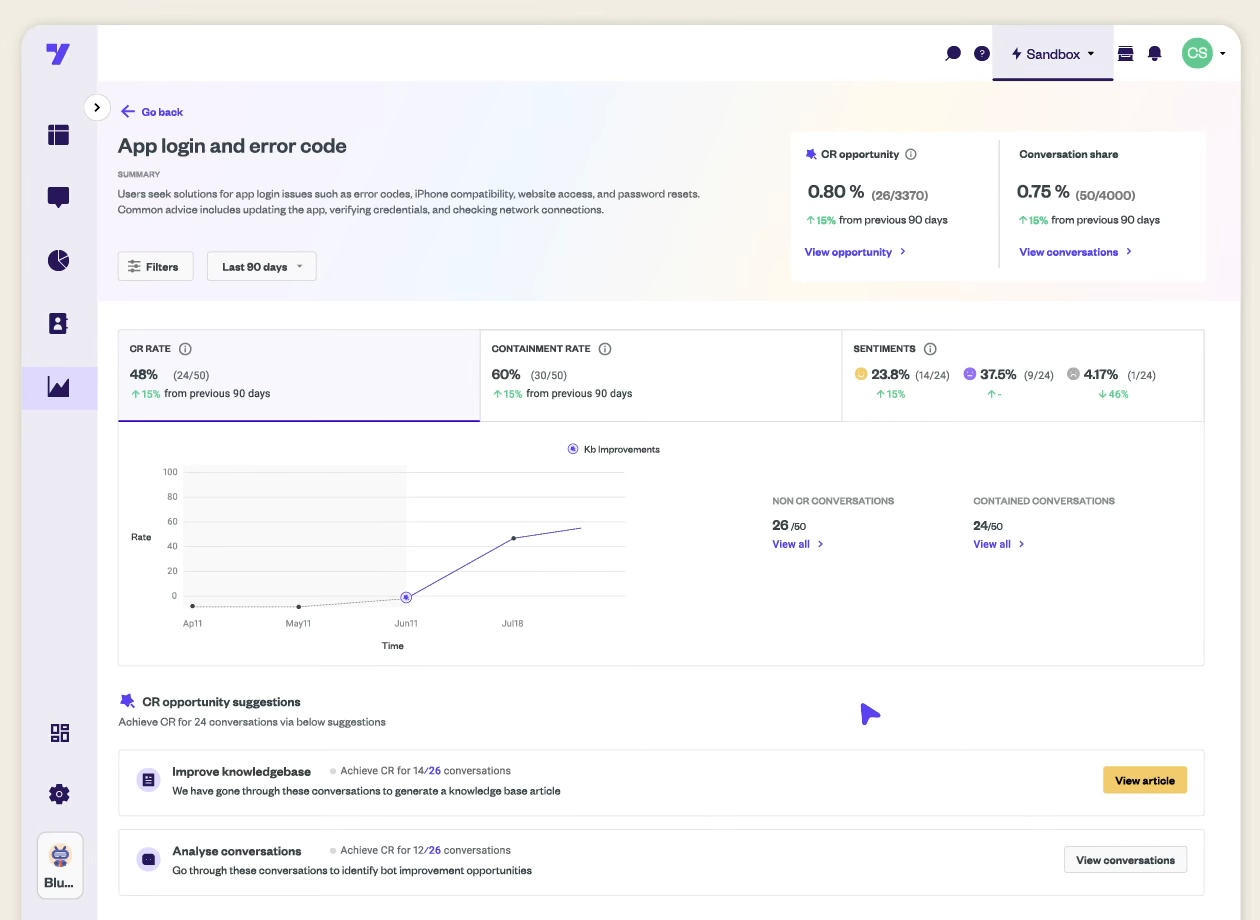
Analyze is not a passive reporting layer. It processes every conversation passing through Yellow.ai's AI agents and feeds findings back into the system to improve agent performance.
The process works in three steps. First, LLM models evaluate every agent conversation (text and voice), applying multi-layer filtering to segment conversations by resolution rate, containment type, user sentiment, and escalation outcome.
Second, AI-generated topic clustering groups conversations into recurring themes, revealing which topics the agent handles well and where it fails. Each cluster carries metrics including conversation share, containment rate, resolution rate, and sentiment distribution.
Third, the Self Learning Loopback takes conversations that resolved successfully and auto-generates new KB articles, pushing them into the Conversational Knowledge Base so agents improve without manual intervention.
Smart Conversation Logs provide LLM-generated summaries and debugging insights explaining what occurred, why, and recommended fixes. This lowers the expertise required to diagnose agent failures compared to traditional filter-and-sort log tools.
Source: Yellow.ai
Sentiment Analysis operates at both the topic and conversation level with a timeline view for trend visualization.
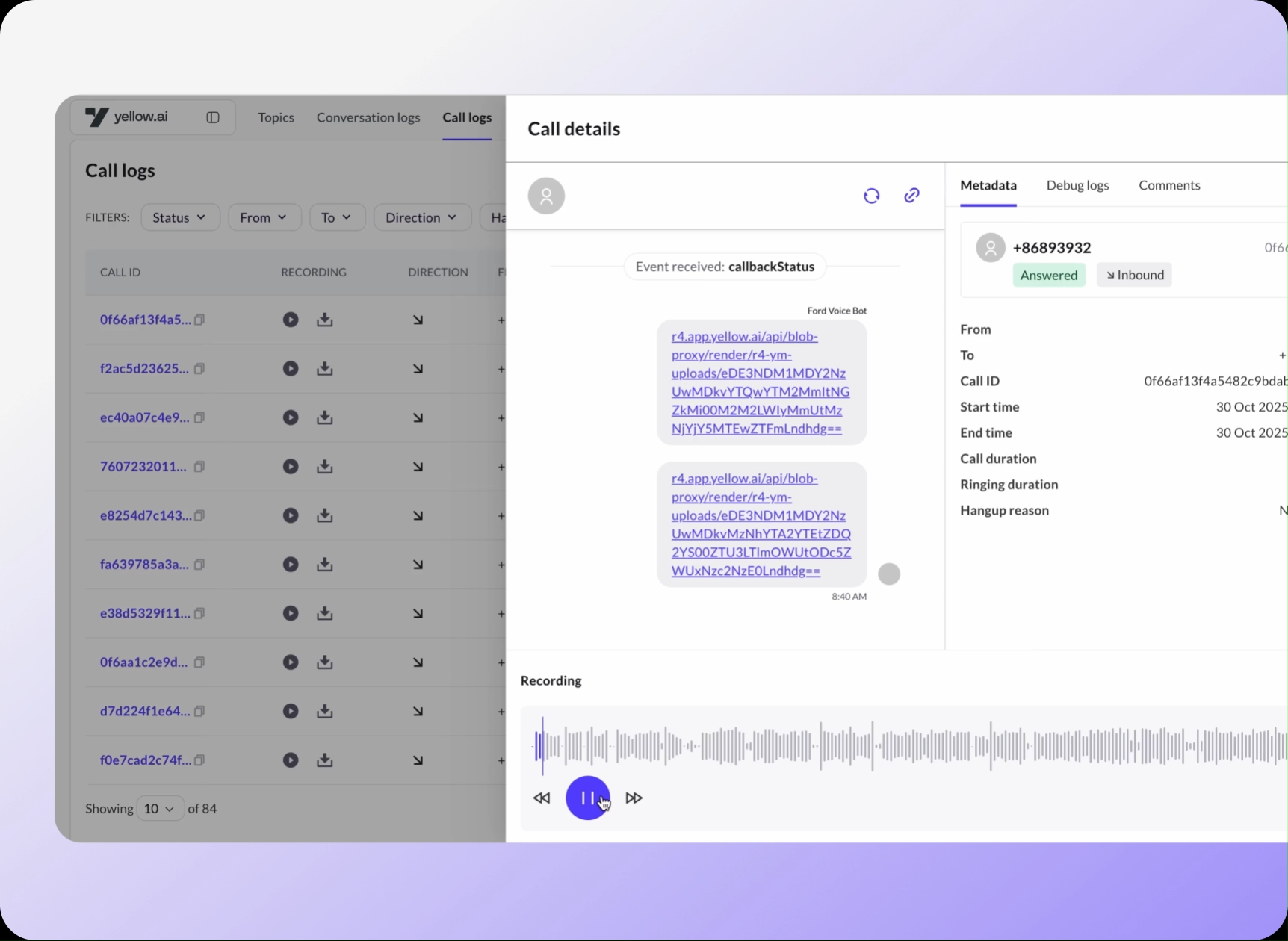
For voice, Analyze ingests call recordings, runs transcript analysis, and applies filters for call direction, status, duration, and hang-up reason. A unified performance dashboard shows resolution rate, containment rate, sentiment, and adoption rate side by side, with AI versus human agent performance comparison.
Yellow.ai reports 30% reduction in support tickets, 10% higher containment rates, and 93% containment rate from the Analyze module. The Enterprise plan unlocks the full analytics suite including LLM Analytics, Sentiment and Topic Tracking, Custom Dashboards, and Data Explorer. The Free plan does not include these capabilities.
Yellow.ai Employee Experience: HR and IT Self-Service
Yellow.ai serves both Customer Experience and Employee Experience on the same platform, a distinction from most CX-only conversational AI vendors. The EX module handles internal automation that typically bogs down HR and IT teams.
HR self-service automation covers leave requests, payslip retrieval, policy FAQs, onboarding checklists, and benefits inquiries without HR staff involvement. IT helpdesk ticket deflection automates password resets, software access requests, hardware procurement, and status updates.

Source: Yellow.ai
Employee onboarding orchestration guides new hires through document submission, system access, training scheduling, and first-week tasks via conversational interface.
These capabilities run on the same Agent Builder, Knowledge Base, and Omnichannel infrastructure as the CX side, meaning a single contract and single platform covers both customer-facing and employee-facing automation. Agents can be deployed internally via Microsoft Teams, Slack, or a dedicated portal.
Yellow.ai Security, Compliance, and Enterprise Infrastructure
Yellow.ai carries a compliance stack that clears procurement in BFSI, healthcare, utilities, and government:
SOC 2 Type II (security, availability, confidentiality; active attestation period Dec 2024 to Nov 2025)
ISO/IEC 27001:2022 (information security management system)
ISO/IEC 27701:2019 (privacy information management)
HIPAA (healthcare data protection)
PCI DSS v4.0.1 (payment card industry, Service Provider level)
CCPA (California Consumer Privacy Act)
Data hosting is available in six regions: US, EU, Singapore, India, Indonesia, and UAE with N+1 availability zone redundancy.
Platform-level security controls include SSO support for Google, Microsoft, ADFS, and Azure AD; role-based access controls with granular permission levels; SSL/TLS 256-bit encryption in transit with encryption keys stored in vaults and rotated quarterly; PII/sensitive data redaction and masking; WAF, DDoS protection, IPS/IDS, and VPC with network ACLs; and continuous third-party vulnerability scanning plus annual penetration testing. A Trust Center at trust.yellow.ai provides auditable documentation.
The platform exposes a RESTful API for programmatic integration, scoped per bot instance. Endpoints cover User360 (contact record management), Messages (conversation history retrieval), Integrations/Events (posting messages or events to bots), Engage (audience management), and Email Ticket workflows. API authentication uses OAuth bearer tokens or API keys with IP whitelisting for enterprise scenarios.
Native integrations connect to CRMs (Zendesk, Freshdesk, ServiceNow, Salesforce, HubSpot, Zoho), contact centers (Genesys, Avaya, NICE), retail platforms (Shopify, WooCommerce, Magento), and payments (Razorpay, PayU, Paytm). The integrations marketplace lists 150+ pre-built connectors. Custom integrations for systems without built-in connectors are available on request.
Where Yellow.ai Stops: The Gaps
Yellow.ai automates service interactions: deflecting support tickets, replacing IVR trees, managing knowledge retrieval, and assisting live agents. That focus shapes its strengths, but it also means the platform does not cover several capabilities a revenue team needs.
No B2B contact or company database. Yellow.ai does not include a database of contacts, companies, direct dials, or verified business emails. It automates conversations with people who reach out; it does not help you find the people to reach in the first place.
No buyer intent signals. The platform does not track which companies are researching specific topics across the web. It handles inbound interactions; it does not surface the accounts that are in-market before any conversation begins.
No conversation intelligence for sales. Yellow.ai's Analyze module covers support conversation analytics (resolution rates, containment, sentiment), but the platform does not record, transcribe, or coach from sales calls. It does not detect objections, track talk ratios, or extract deal qualification frameworks from sales conversations.
No marketing orchestration or ABM. Yellow.ai can send outbound engagement campaigns via messaging channels, but it does not include display advertising, audience management, account-based marketing, or multi-channel campaign orchestration for demand generation.
No published pricing for the core enterprise product. The gap between the Free plan (500 sessions, chat only, one agent) and the opaque Enterprise plan creates a pricing cliff. Usage-based billing tied to conversation volume and Monthly Reached Users makes costs hard to predict without historical baseline data and a detailed quote.
API surface is narrower than expected for a platform of this scope. The published API does not include a documented outbound webhook catalog. No official SDKs exist in any language. Rate limits beyond the Add User endpoint (2,000 requests per minute) are not publicly documented. Developers needing programmatic integration face a thinner surface than enterprise platforms typically provide.
How ZoomInfo Covers the Gaps
These gaps share a common thread: Yellow.ai automates the service layer of customer interaction but depends on external sources for the intelligence, data, and orchestration that fuel the revenue cycle. ZoomInfo is an AI GTM platform that supplies those layers.
ZoomInfo's B2B Data Platform: The contact and company intelligence Yellow.ai does not include
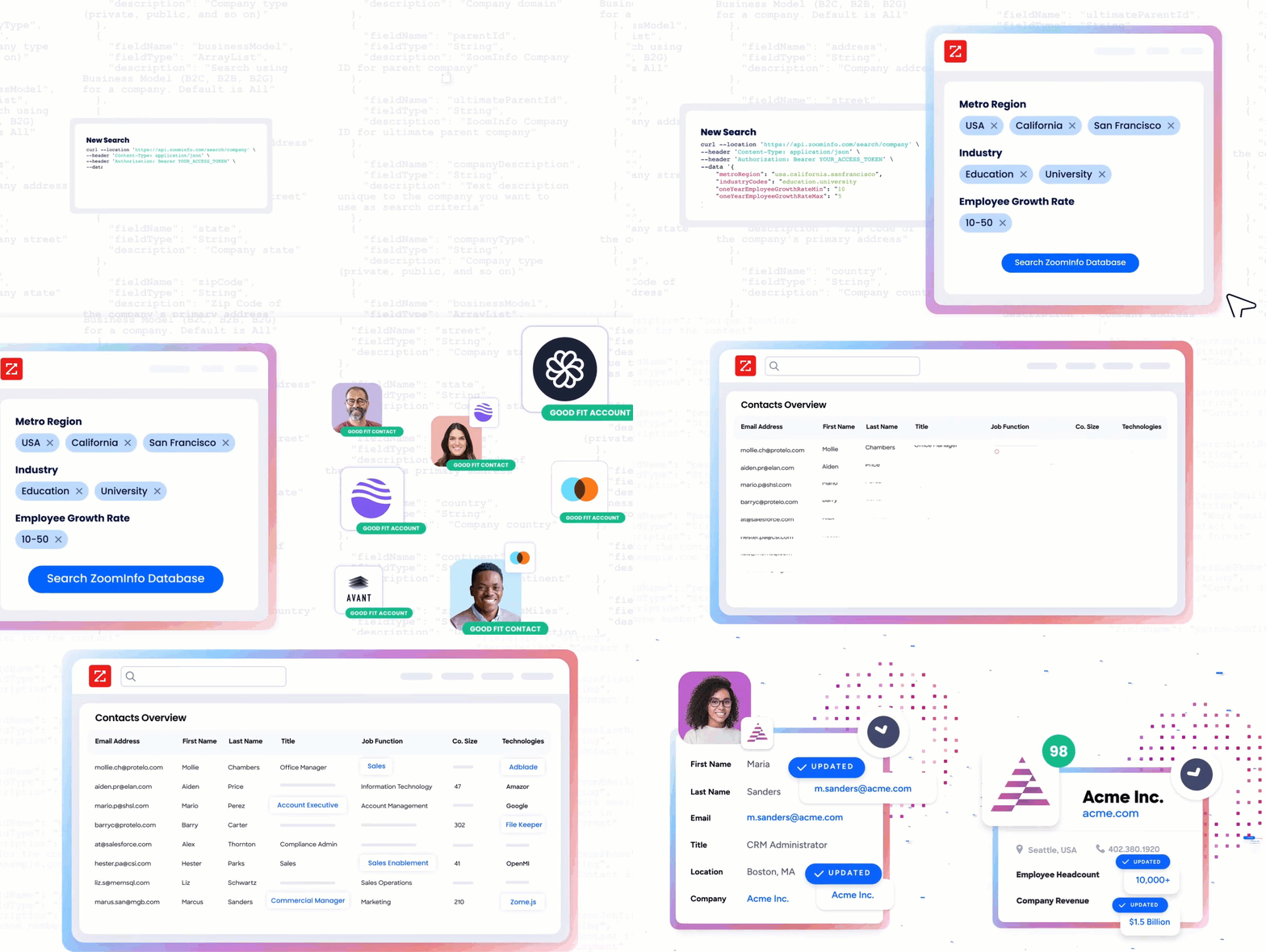
ZoomInfo operates the largest B2B data platform: 500M contacts, 100M companies, 135M+ verified phone numbers, 120M direct-dial phone numbers, and 200M+ verified business email addresses.
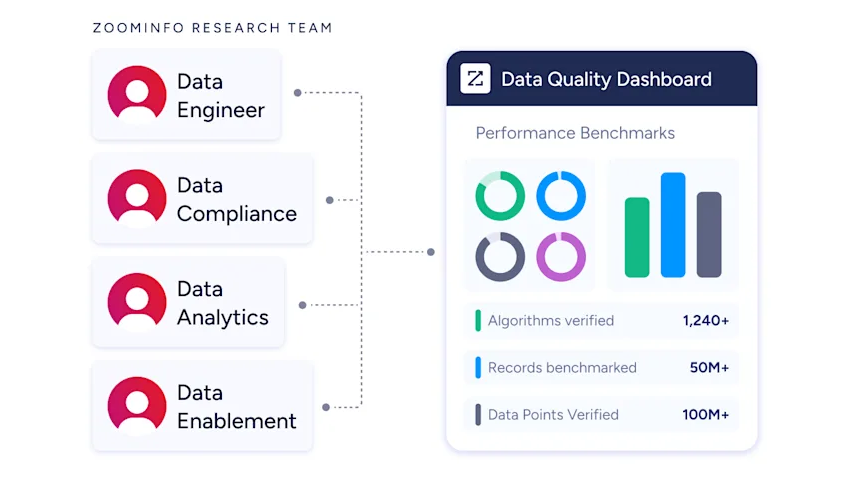
The data flows through a proprietary verification pipeline backed by 300+ human researchers and automated ML scanning 28 million site domains daily, reaching up to 95% accuracy on first-party data.
Source: ZoomInfo
Where Yellow.ai waits for customers to reach out, ZoomInfo provides the intelligence to find them: department org charts with decision-makers' direct dials and emails, 300+ company attributes for segmentation, contact tracking with job-change alerts, and technographic profiles covering 30,000+ technologies across 200+ categories for 30+ million companies.
In a Fortune 500 competitive RFP analyzing 25 million contacts across vendors, an independent consultant concluded that "no other competitor came even close."
ZoomInfo Intent and WebSights: Signals that reveal in-market accounts before they ever contact you
ZoomInfo Intent tracks signals from 210 million IP-to-Organization pairings and 6 trillion+ keyword-to-device pairings sourced monthly. This reveals which companies are researching topics related to your product across the web, before any inbound interaction occurs.
Guided Intent, exclusive to ZoomInfo, identifies the topics historically correlated with deal success rather than requiring manual topic selection.
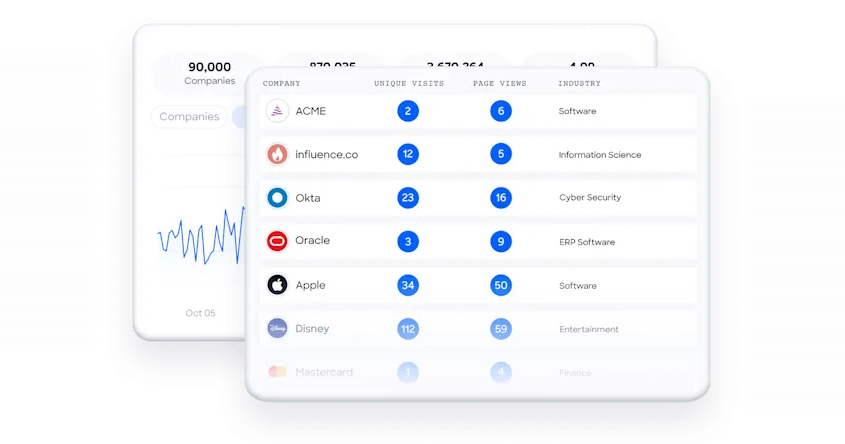
On the website side, WebSights resolves anonymous website traffic to companies with Automatic Traffic Filtering that distinguishes real visitors from bots. ZoomInfo Marketing goes further with contact-level site visitor identification, identifying who visited (not just which company) and triggering personalized outreach.
Source: ZoomInfo
Yellow.ai handles conversations with visitors who engage your chat widget; ZoomInfo identifies the visitors who don't, and routes them into outreach.
ZoomInfo's GTM Context Graph and Chorus: Sales conversation intelligence and deal reasoning
Yellow.ai's analytics capture why a support interaction succeeded or failed. ZoomInfo's GTM Context Graph captures why deals move or stall by processing 1.5B+ data points daily, combining B2B data with CRM records, conversation intelligence from Chorus, email interactions, and behavioral signals into a single intelligence layer.
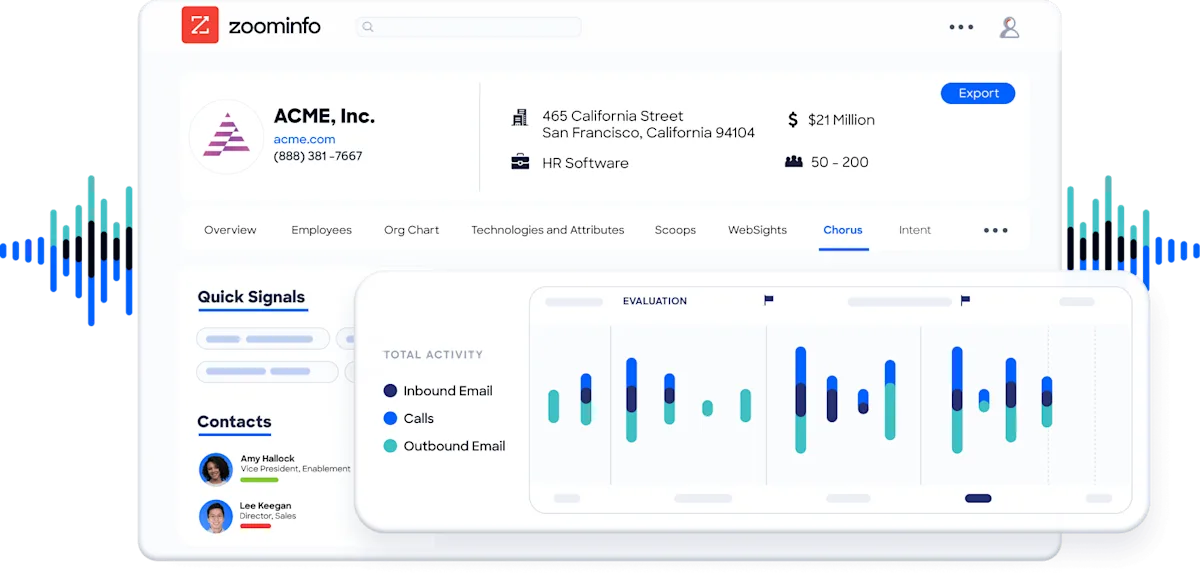
Chorus, backed by 14 technology patents, records and transcribes sales calls, surfaces AI-generated insights (talk ratios, sentiment, objection detection), auto-syncs deal intelligence to the CRM, and provides coaching scorecards and clip sharing.
Source: ZoomInfo
It captures the context that support analytics miss: why a champion went quiet, what a competitive mention means for deal risk, which objection patterns predict closed-lost outcomes.
That reasoning flows into GTM Workspace, where sellers see a complete Book of Business view across CRM, ZoomInfo data, conversation history, and market intelligence, with AI agents automating account research, outreach, CRM updates, and signal monitoring.
Seismic's sales team attributed 39% of active pipeline to opportunities identified or influenced by ZoomInfo signals, boosted productivity by 54%, and saved 11.5 hours per week per seller. (Seismic Case Study)
ZoomInfo GTM Studio: Marketing orchestration and ABM that the service automation layer cannot provide
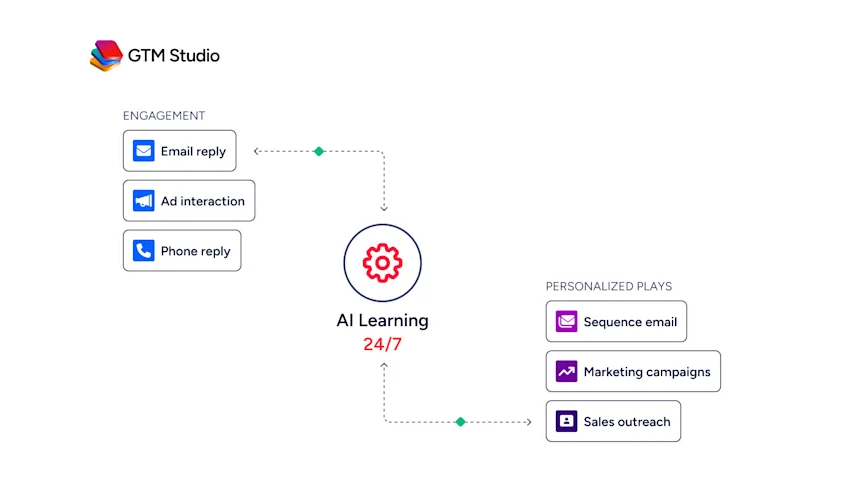
ZoomInfo’s GTM Studio addresses the marketing orchestration gap directly. Marketers, RevOps teams, and GTM engineers can build audiences using natural language, enrich with first- and third-party data, define triggers, and activate plays across channels (email, calls, display ads, direct mail, LinkedIn, Meta, Connected TV) without engineering support.
Source: ZoomInfo
Pre-built GTM plays cover inbound acceleration, champion tracking, competitive displacement, and ICP targeting. Expansion plays that used to take 3 weeks now launch in 30 minutes.
ZoomInfo Marketing includes a native Demand-Side Platform deploying display ads based on 300+ company attributes, FormComplete (reducing forms to a single field while auto-appending data), and Account Fit Scoring (predictive AI scoring 0-100 based on company attribute patterns).
ZoomInfo APIs and MCP: Universal data access for any tool or AI agent
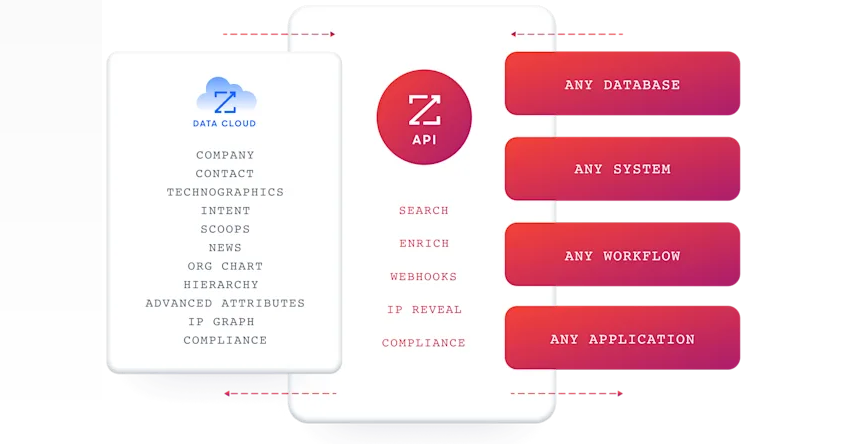
ZoomInfo delivers its intelligence through APIs and MCP, so the same data and GTM Context Graph powering ZoomInfo's own products is accessible inside any third-party tool or custom AI agent.
The MCP server connects AI models directly to ZoomInfo's B2B data as a native tool, currently supporting Claude and ChatGPT. API access is included in all relevant plans, and the Enterprise API covers Search, Enrich, Copilot (AI intelligence), Marketing (audience management), and Engagements endpoints.
Source: ZoomInfo
ZoomInfo's Free Entry Points: A way to evaluate the platform without commitment
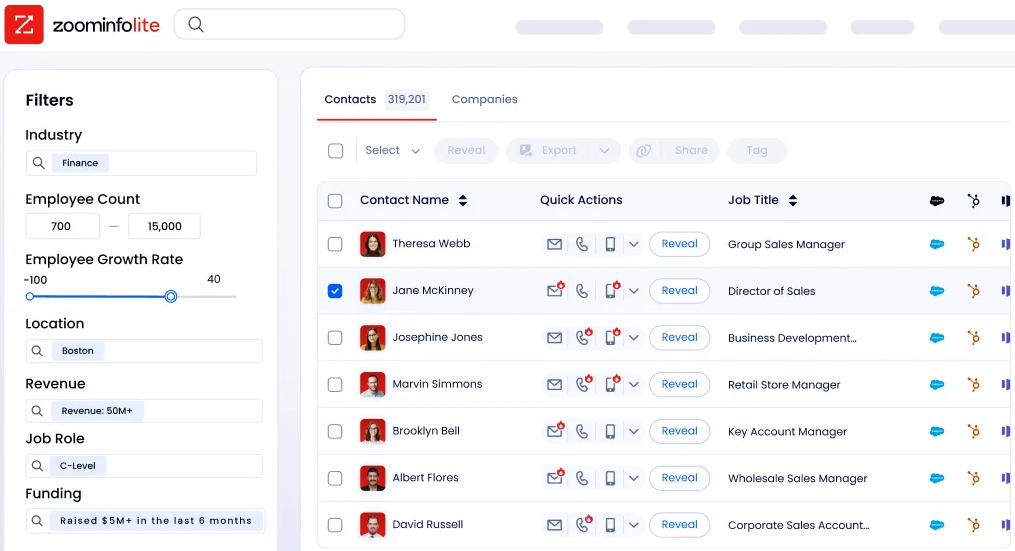
ZoomInfo Lite is a permanent free tier with access to ZoomInfo's B2B database, 10 monthly export credits, individual and company searches, a Chrome extension, and WebSights Lite with up to 10 website visitor reveals per day.
Source: ZoomInfo
A separate 7-day free trial provides broader access with no credit card required.
Final Summary
Yellow.ai is a toolkit for enterprise service automation: AI agents that resolve customer queries across 35+ channels in 135+ languages, unified voice AI with sub-400ms latency and 500+ language support, agentic RAG-powered knowledge retrieval, AI-assisted live agent support, and self-learning analytics that auto-generate KB improvements.
It fits enterprises with high-volume repetitive interactions, regulated industries needing HIPAA/SOC 2/PCI-DSS compliance, and global operations requiring multilingual voice and text automation.
It does not cover the revenue-cycle layer: no B2B database, no buyer intent signals, no sales conversation intelligence, and no marketing orchestration or ABM.
If your bottleneck is upstream of the service interaction (knowing which companies are in-market, finding verified contacts, understanding why deals move), that is the ground ZoomInfo covers. Its 500M-contact, 100M-company database supplies verified emails and direct dials for outreach.
ZoomInfo Intent surfaces accounts researching your category from 6 trillion+ keyword-to-device pairings monthly. Chorus captures and analyzes every sales conversation.
GTM Studio gives marketing teams multi-channel orchestration and ABM. And the GTM Context Graph combines all of it into a single intelligence layer that captures why deals move, not just that they moved.
Yellow.ai and ZoomInfo serve different layers of the same revenue engine: Yellow.ai automates how you serve customers, ZoomInfo provides the intelligence to find and win them.
Start with ZoomInfo Lite for free, or request a demo to see verified contacts and live intent signals flow into your pipeline.
FAQ
Does Yellow.ai support voice automation?
Yes. Nexus Vox is Yellow.ai's enterprise voice AI, built as a unified system where speech-to-text, reasoning, text-to-speech, and telephony share a single runtime. It delivers sub-400ms response latency, supports 500+ languages and dialects, and can clone any voice from a 10-second audio sample.
Which Yellow.ai plan includes the full analytics suite?
The Enterprise plan unlocks LLM Analytics, Sentiment and Topic Tracking, Custom Dashboards, and Data Explorer. The Free plan provides basic reporting but does not include AI-generated topic clustering, Self Learning Loopback, or custom dashboards.
Can Yellow.ai handle multiple intents in a single email?
Yes. Yellow.ai's email AI layer identifies multiple distinct intents within a single incoming email, assigns urgency levels using LLM-based sentiment detection, and routes each intent appropriately. Most email automation tools treat each email as a single-intent ticket; this is a distinguishing capability.
What channels does Yellow.ai support?
Yellow.ai deploys across 35+ channels including WhatsApp, SMS, Facebook Messenger, Instagram, Telegram, Viber, Line, Zalo, Apple Business Chat, Google Business Messages, Microsoft Teams, Slack, Webex, Google Chat, web chat, email, and voice.
It also connects to e-commerce platforms including Lazada, Shopee, and Tokopedia. A single bot build deploys to all channels with cross-channel context persistence.
How does Yellow.ai pricing work?
Yellow.ai uses a two-tier model. The Free plan includes 500 chat sessions per month, one AI agent, two human agents, and limited channels, with $0.99 per resolution after the cap.
The Enterprise plan removes all caps and unlocks the full platform (35+ channels, unlimited agents, full analytics, SOC 2/ISO/HIPAA compliance) but requires a sales consultation for custom pricing. Yellow.ai is also available on the AWS Marketplace at $10,000/year (Basic) and $25,000/year (Standard).
Does Yellow.ai include a B2B contact database or sales prospecting tools?
No. Yellow.ai is built for service automation, not revenue-cycle automation. It does not include a contact database, verified business emails, direct-dial phone numbers, buyer intent signals, or sales prospecting tools. Teams needing to identify and reach prospects pair Yellow.ai with a data intelligence platform.
ZoomInfo provides 500M contacts, 100M companies, 135M+ verified phone numbers, 200M+ verified business email addresses, and buyer intent data from 210 million IP-to-Organization pairings.
Can Yellow.ai integrate with existing CRM and contact center systems?
Yellow.ai connects to 150+ enterprise systems through prebuilt integrations, including Salesforce, ServiceNow, Zendesk, Freshdesk, HubSpot, Zoho CRM, Genesys, Avaya, NICE, Shopify, and WooCommerce.
Custom integrations for systems without prebuilt connectors are available on request. The platform records all conversations back into the CRM and pulls historical interaction data for context.
Does Yellow.ai offer buyer intent data or website visitor identification for sales?
No. Yellow.ai identifies website visitors who engage with the chat widget, but it does not track which companies are researching your category across the web or identify anonymous site visitors for sales outreach.
ZoomInfo Intent tracks signals from 6 trillion+ keyword-to-device pairings monthly, and WebSights resolves anonymous website traffic to companies with contact-level identification, providing the buyer intelligence layer Yellow.ai does not cover.
