
Defining Account-Based Marketing
Account-based marketing (ABM) is a B2B strategy that targets specific high-value companies as individual markets, aligning sales and marketing teams to deliver personalized campaigns that drive faster deal cycles and higher win rates. Rather than casting a wide net, you focus resources on accounts that match your ideal customer profile with tailored messaging built for their buying committee. ZoomInfo, an all-in-one AI GTM Platform, provides the data foundation, orchestration layer, and intelligence that make this kind of precision possible at scale. Teams that prefer to wire that same B2B intelligence into their ownbuying AI tools and agents can do so through GTM AI, ZoomInfo's agent-native context layer, which connects ZoomInfo's verified data to any agent via MCP or one API.
The term "account-based marketing" was coined by Bev Burgess at ITSMA in 2003, formalizing a practice that enterprise sales teams had been running informally for years. Two decades later, ABM has evolved from a manual, high-touch discipline into an AI-driven operating model where signals, orchestration, and measurement happen in near real-time. What started as a strategy for landing net-new logos now applies equally to existing customer expansion: upsell, cross-sell, and renewal motions all benefit from the same account-level precision.
ABM flips the traditional marketing funnel upside down. Rather than starting wide with leads and narrowing down to customers, you start by identifying your best-fit accounts first and then engage them with tailored marketing and sales plays.
This approach only works if four things happen:
Target account selection: You identify specific companies that match your ideal customer profile (ICP), a company that would get significant value from your product and provide value to you in return.
Buying committee mapping: B2B decisions involve multiple people. You need to identify everyone from the end-user and champion to the economic buyer and legal reviewer.
Personalized engagement: You create account-specific messaging, content, and offers that address the unique pain points and goals of each account.
Sales and marketing alignment: Both teams must agree on target accounts, messaging, and engagement plans to create a consistent buyer experience.
The biggest problem with traditional lead generation is waste. You spend time and money on prospects who will never buy from you. ABM fixes this by focusing your efforts on accounts that actually matter to your business.
How Does ABM Work?
Account based marketing operates through four coordinated steps:
Define your ICP: Build criteria for companies that match your ideal customer profile
Map buying committees: Identify decision-makers and influencers within each account
Execute campaigns: Deploy personalized messaging across channels to each stakeholder
Measure account progress: Track success at the account level, not individual lead metrics
This inverts traditional demand generation. You pre-qualify accounts first, then generate interest within them. This stands in contrast to traditional B2B marketing funnels, where broad awareness campaigns feed leads into a funnel and qualification happens later.
ABM vs. Demand Generation
ABM and demand generation operate on different principles, but they are not competitors. ABM is a targeted "push" strategy while demand generation is a broad "pull" strategy.
Demand generation creates content to attract potential buyers, qualifies MQLs from that audience, and passes them to sales. ABM flips this by identifying target accounts first, then pushing personalized campaigns to them. You qualify entire accounts, measured as Marketing Qualified Accounts (MQAs), rather than individual leads.
Aspect | Account-Based Marketing | Demand Generation |
|---|---|---|
Targeting | Specific, named accounts | Broad audience segments |
Content Strategy | Personalized to account needs | SEO-optimized for discovery |
Funnel Model | Flipped funnel (start narrow) | Traditional funnel (start wide) |
Metrics | Account engagement, pipeline velocity | Website traffic, leads, MQLs |
Best For | High-value enterprise deals | Volume-based lead generation |
Most high-performing B2B companies use both strategies together. Demand generation builds brand awareness and generates a consistent flow of leads. ABM cracks high-value, strategic accounts that require a more targeted approach.
The distinction also extends to lifecycle ownership. Demand generation typically hands off at the MQL stage, while ABM, when done well, maintains alignment across sales, marketing, and customer success well past the initial close.
A Marketing Qualified Account (MQA) is qualified at the account level rather than the individual lead level. An account typically reaches MQA status when multiple stakeholders show engagement signals simultaneously: three people from the same company attending a webinar, visiting the pricing page, and downloading a competitive comparison within the same week. This shift from individual MQLs to account-level qualification is one of the most important conceptual changes for practitioners transitioning to ABM measurement.
Programmatic ABM has also made account-based strategies accessible to companies of all sizes. You no longer need a dedicated ABM team of ten to run effective programs; the right data and orchestration tools let a mid-market marketing team of two or three execute targeted plays that were once reserved for enterprise organizations.
Benefits of Account-Based Marketing
When you focus on accounts that are actually likely to buy, you stop wasting budget and start closing bigger deals faster. Industry research consistently shows that B2B companies with mature ABM programs report higher win rates and larger average deal sizes compared to organizations relying solely on broad demand generation. Buyers now expect personalized interactions, and ABM is how B2B teams deliver that expectation at scale.
The results are measurable. Impartner, a leading partner relationship management platform, used ZoomInfo to overhaul its ABM process and saw a 12% increase in pipeline generation quarter over quarter, a 45% increase in website engagement, and $130,000 in influenced pipeline from just three target accounts the team had been working to land.
"ZoomInfo has literally changed the way we go to market. It's a game-changer that has made our job so much easier and more efficient." , Jeremy Melius, Senior Director of Marketing Operations, Impartner
According to ZoomInfo data, customers using the platform for ABM programs report approximately 25% more pipeline, stronger engagement rates, and meaningful weekly time savings across their go-to-market teams. Results vary based on program maturity, data quality, and sales-marketing alignment, but the directional evidence is consistent: focused effort on the right accounts outperforms broad-based lead generation.
Sales and Marketing Alignment
Sales cycles get shorter when sales and marketing align on the same accounts. This coordinated effort helps move accounts through the pipeline faster because there is no confusion about messaging or next steps.
Both teams operate from three shared foundations:
Unified account lists: Sales knows which accounts marketing is warming up
Consistent messaging: No mixed messages across touchpoints
Joint engagement plans: No handoff delays between teams
This alignment also requires shared data definitions. When sales and marketing use the same firmographic, technographic, and intent data to evaluate accounts, targeting becomes sharper, messaging becomes more relevant, and handoffs become cleaner.
Shorter Sales Cycles
ABM compresses deal timelines through coordinated multi-touch engagement. When sales and marketing hit accounts simultaneously with consistent messaging, buying committees move faster. Pre-educated buyers spend less time in discovery. Fewer handoff delays between teams means accounts progress without stalling.
Higher ROI and Larger Deal Sizes
ABM delivers stronger ROI by eliminating wasted spend on low-fit prospects. You direct investment toward accounts with genuine revenue potential, improving cost efficiency across the funnel.
Deal sizes increase when you engage the entire buying committee and demonstrate deep understanding of account needs. Instead of selling a point solution, you become a strategic partner. Smartsheet used ZoomInfo's ABM capabilities to achieve an 84% increase in MQLs and 26% higher opportunity rates by targeting the full buying committee with coordinated, account-specific outreach.
Revenue attribution also becomes clearer because ABM focuses on a defined account list, making it easier to measure marketing's direct impact on pipeline and closed revenue.
Better Resource Efficiency
Marketing efficiency improves when you stop spending budget on leads that will never convert. Safety Services shifted to a focused ABM approach and generated 200% more MQLs by concentrating resources on accounts that matched their ICP rather than casting a wide net.
The personalized approach also builds stronger customer relationships by demonstrating deep understanding of each account's business, creating partnerships that drive retention and expansion over time.
As ZoomInfo data shows, ABM workflows powered by GTM Studio's orchestration are giving top marketing teams back significant hours each week, with some teams reclaiming more than 13 hours per week by automating data management, lead scoring, and campaign orchestration.
Types of Account-Based Marketing
ABM is not one-size-fits-all. The level of personalization and resources you apply depends on the value of the target account. Most companies use a tiered approach that combines three types of ABM.
Strategic ABM (One-to-One)
Strategic ABM, also called one-to-one or 1:1 ABM, is the most intensive form. You treat each account as its own market with deeply customized campaigns, bespoke content, and dedicated resources. This works best for pursuing large enterprise deals with long sales cycles and high contract values. Think custom research reports, executive briefings, and dedicated account teams.
ABM Lite (One-to-Few)
ABM Lite, also called one-to-few or 1:Few ABM, applies light personalization to small clusters of accounts that share similar characteristics. You might create a campaign for 5 to 15 accounts in the same industry or facing similar business challenges. The content is tailored to the group's shared attributes rather than being fully bespoke for each company.
Programmatic ABM (One-to-Many)
Programmatic ABM, also called one-to-many or 1:Many ABM, uses technology to apply personalization at scale to hundreds or thousands of target accounts. You use account-level data to tailor digital advertising, website content, and email nurturing. This provides more relevance than traditional demand generation without the heavy resource requirements of one-to-one ABM.
Most successful ABM programs use all three types simultaneously. You run one-to-one programs for your most strategic accounts, one-to-few for important prospects, and one-to-many for the broader target account list.
Bev Burgess's 2025 framework expands the original three ABM types to five, adding Scenario ABM (time-boxed interventions around specific events like mergers or regulatory changes) and Pursuit Marketing (competitive deal situations where you are actively displacing an incumbent). The competitive renewal play documented later in this article is essentially Pursuit Marketing. High-performing companies blend multiple types based on account value and available resources, treating the tiers as a simultaneous portfolio decision rather than a sequential choice.
How to Select Target Accounts
Your ABM program will fail if you target the wrong accounts. To pick the right accounts, you need to look at three types of data.
Defining Your Ideal Customer Profile (ICP)
Your ICP describes companies that get the most value from your product and deliver the most value back to you. Build it from three data layers:
Firmographic attributes: Industry, company size, revenue range, geographic location, and corporate hierarchy position
Technographic signals: Current technology stack, competitive solutions in use, and integration requirements
Behavioral patterns: Common characteristics across your best existing customers, including buying patterns and usage behaviors
Using Firmographic and Technographic Data
Fit criteria determine whether an account matches your ideal customer profile. Firmographic data reveals company fundamentals:
Industry classification: Vertical markets and sub-sectors that match your solution
Company scale: Employee headcount, revenue range, and growth trajectory
Geographic footprint: Headquarters location, regional presence, and market coverage
Corporate structure: Parent-child relationships and organizational hierarchy
Technographic data shows technology readiness:
Current tools: Existing solutions in their tech stack
Competitive presence: Whether they use competing products
Integration needs: Systems your solution must connect with
Intent Signals and Buying Triggers
Intent signals reveal which accounts are actively researching solutions like yours. These behavioral signals include topic-based research on third-party websites, visits to your pricing page, or engagement with your content. Intent answers a critical question: "Is this account in-market right now?"
Key intent signals to track:
Topic-based research: Accounts consuming content about problems your product solves
Website visitor activity: Repeated visits to your site, especially pricing and product pages
Trigger events: Funding announcements, executive hires, leadership changes, and job-change alerts that signal buying windows
Intent signals are most powerful when combined with firmographic fit. An account spiking on relevant research topics is a strong signal, but only if they also match your ICP. Prioritizing accounts based on intent alone, without fit validation, leads to wasted outreach.
Engagement History and Account Scoring
Engagement history captures your existing relationship with an account: past sales opportunities, current marketing engagement scores, and previous touchpoints.
Combine fit, intent, and engagement data into an account scoring model. This ensures your team focuses intensive efforts on accounts with the best combination of all three factors.
The biggest mistake companies make is targeting accounts based on size alone. A Fortune 500 company might look attractive, but if they do not fit your ICP or show buying intent, you are wasting resources.
Mapping the Buying Committee
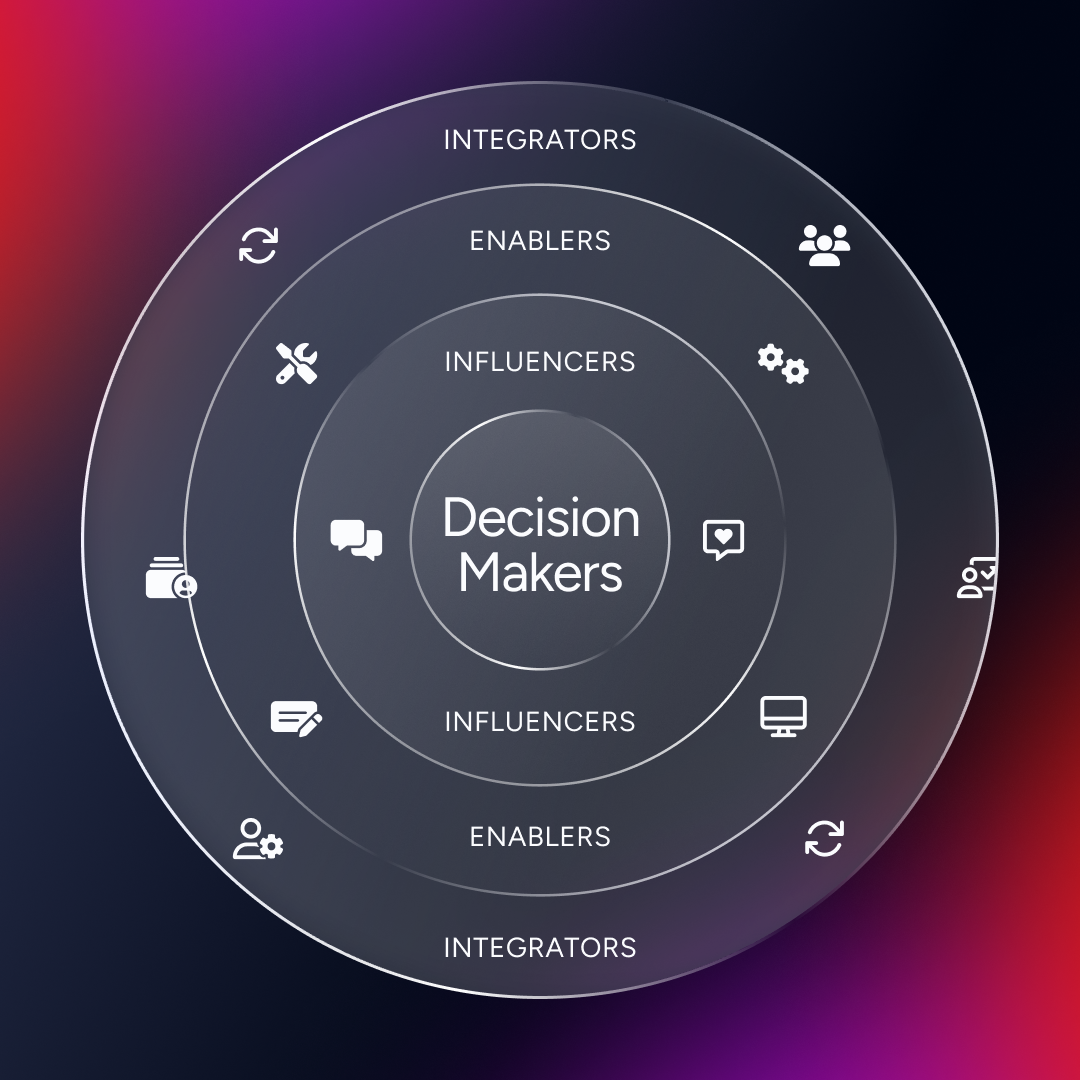
B2B decisions involve multiple people. You cannot close deals by talking to just one person. You need to identify and engage everyone who influences the buying decision.
Identifying Key Stakeholders
Every B2B buying committee includes distinct roles with different priorities:
Champion: Your internal advocate who sells your solution to other stakeholders. They care about solving their team's problems and building internal credibility.
Economic buyer: The budget holder who signs the contract. They care about ROI, total cost of ownership, and strategic alignment.
End-user: The daily operator who will actually use your product. They care about ease of use, implementation complexity, and day-to-day functionality.
Technical influencer: The IT or technical lead who evaluates architecture, security, and integration requirements.
Legal and procurement: The gatekeepers who review contracts, compliance, and vendor requirements.
You need to identify all of them. Missing one stakeholder can stall or kill your deal. When working with enterprise accounts, it is common to encounter buying committees of six to 10 people, each with distinct concerns that require tailored messaging.
As Joseph Santos, ZoomInfo's Director of Data Advisory, explains in this post about buying committees, many companies actually rely upon buying networks, not committees. These are complex power structures that involve multiple stakeholders, each with their own degree of influence over larger purchasing decisions.
Multi-Threading Your Outreach
Multi-threading means engaging multiple stakeholders simultaneously rather than relying on a single contact. Deals with multiple active relationships close faster because you are building consensus directly with each stakeholder, addressing their specific concerns in parallel. This approach is critical for successfully engaging stakeholders across complex buyer networks.
Even in smaller, committee-based buying structures, single-threading makes you vulnerable. If that one contact leaves, gets reassigned, or loses internal influence, your deal stalls or dies. Multi-threading spreads risk and keeps deals moving even when contacts change.
How to Build an ABM Strategy
Launching an ABM program requires structure and close collaboration between teams. This framework breaks down the process into actionable steps that reflect account based marketing best practices.
1. Define Goals and Align Teams
Start with clarity on what you are trying to achieve. Are you targeting net-new logos? Expanding into existing accounts? Displacing a competitor?
Get sales and marketing aligned before you build your first target account list:
Shared account lists: Both teams agree on which accounts to target
Joint planning: Coordinate on messaging, timing, and tactics
Agreed metrics: Define what success looks like and how you will measure it
Without this alignment, your ABM strategy will struggle before it starts. The most effective ABM teams also define SLAs and stage gates with clear handoff criteria that keep both teams accountable as accounts progress through the pipeline.
2. Build and Tier Your Target Account List
Start by building your target account list (TAL). Define your ideal customer profile based on the fit, intent, and engagement criteria of your best customers. Use this ICP to score your addressable market and identify companies that are a strong match.
Allocate accounts across ABM tiers based on value and fit:
Tier 1 (Strategic ABM): Top 10 to 25 accounts for one-to-one treatment
Tier 2 (ABM Lite): Next 50 to 100 accounts for one-to-few campaigns
Tier 3 (Programmatic ABM): Remaining accounts for one-to-many personalization
Validate this list with your sales team. Their frontline knowledge is critical for success, and you need their buy-in to make ABM work.
3. Research Accounts and Map Contacts
Go deep on each account once you have your TAL. Identify the key stakeholders who form the buying committee or buying network, including potential champions, budget holders, end-users, and technical influencers.
Use ZoomInfo's data enrichment capabilities to find verified contact information, pulling from 500M+ contacts with multi-source verification. Research their roles, priorities, and pain points on platforms like LinkedIn. The more you know about each stakeholder, the better you can personalize your approach. Clean, unified data shared across teams is the foundation of this step. When sellers and marketers work from the same data definitions, targeting becomes sharper and handoffs become cleaner.
4. Develop Personalized Content and Messaging
Create personalized messaging and content with a clear understanding of your target accounts and their buying committees. Develop account-specific value propositions that address their unique business challenges.
Build a library of content assets including case studies, webinars, and reports that speak to different stakeholder perspectives. The CFO cares about ROI and cost of ownership. The IT director worries about implementation complexity and security. The end-user wants to know the product will not slow them down. Effective ABM content addresses all three simultaneously, through different assets delivered to the right person at the right moment.
ABM programs evolve through stages: pilot (months 1 to 6, focused on coverage and engagement), scale (shifting to pipeline velocity and deal size), and optimize (targeting win-rate lift and customer lifetime value). The metrics and tactics that matter differ at each stage, so build your content and measurement plan with this progression in mind.
ABM Tactics and Execution Channels
A successful ABM strategy uses multiple account based marketing tactics across different channels to surround the buying committee with a consistent message. The right mix depends on your target accounts, budget, and program scale. These account based marketing best practices apply whether you are running a strategic one-to-one program or a programmatic one-to-many motion.
Personalized Email Outreach
Email remains the primary ABM channel for direct engagement. Effective email ABM requires account-specific content, stakeholder-relevant messaging, and sequence coordination with other channels.
Build email sequences that reference account-specific context: recent company news, industry challenges, or stakeholder priorities. When a target account's VP of Marketing publishes a post about pipeline challenges, reference it in the opening line. Coordinate email timing with advertising exposure and other touchpoints to create consistent message reinforcement.
Targeted Advertising
Digital advertising builds awareness within target accounts efficiently. Use LinkedIn's targeting capabilities to run campaigns aimed at specific companies and job titles. Deploy programmatic display advertising and IP-based targeting to ensure your message is visible across the web. For example, run a LinkedIn Sponsored Content campaign showing an industry-matched case study to all director+ employees at the target account.
The key is frequency and consistency. You want the buying committee to see your message multiple times across different channels to build familiarity and trust. CreditXpert used ZoomInfo's intent-driven targeting to achieve a ~50% CTR lift over programmatic targeting by focusing ad spend on accounts showing active research signals rather than broad audience segments. In competitive situations especially, display ads running as "air cover" while sales engages the account directly reinforce your message and keep your brand prominent throughout the deal cycle.
Events and Direct Mail
Getting senior leaders' attention requires high-value offers. Host exclusive, small-group virtual roundtables for executives from your top-tier accounts to discuss industry trends. Create custom webinars that address specific challenges of a single strategic account.
These tactics work because they provide genuine value while demonstrating deep understanding of the account's business. Executives will attend if the content is relevant and the peer group is valuable.
Direct mail campaigns cut through digital noise. A high-impact package for a strategic account might include a personalized industry benchmark report, a handwritten note from the account executive referencing a specific business challenge, and a branded item tied to the account's industry. Sent to three or four members of the buying committee simultaneously, this kind of coordinated physical touchpoint creates memorable moments that stand out in crowded inboxes.
Other effective ABM tactics include:
Content syndication: Place your best assets on third-party sites where your buyers spend time
Sales enablement tools: Ensure sales teams deliver consistent, on-brand messaging
Custom research: Commission industry reports that feature insights relevant to your target accounts
Data Infrastructure for ABM Success
Effective ABM runs on data and technology. Without accurate information and the right tools to act on it, personalization at scale is impossible.
ABM technology generally maps to four functional layers: intelligence (the data and signals that inform targeting), engagement (the channels and tools that deliver messages), orchestration (the workflows that coordinate actions across teams and systems), and measurement (the analytics that prove impact). Understanding where each tool fits in this stack helps you evaluate account based marketing platforms and avoid buying overlapping point solutions.
Data is the foundation of everything. Your strategy is only as good as the information it is built on. You need accurate contact data to reach the buying committee, firmographic and technographic intelligence for account selection, and intent signals to know which accounts are in-market. You also need engagement data from your own systems to track how accounts interact with your brand, including which messages resonate and which tactics drive progression.
Data Quality and Verification
Data quality is especially critical for ABM because you are targeting specific people at specific accounts. Bad data means:
Missed connections: You cannot reach actual decision-makers
Bounced emails: Your sender reputation degrades
Wasted spend: Advertising impressions go to the wrong people
Bad data leads to poor targeting, irrelevant messaging, and wasted resources. Investing in a purpose-built, continuously refreshed B2B data platform is not optional for ABM; it is a prerequisite. Redwood Logistics proved this when they switched to verified data and cut their 99% CPC reduction, eliminating wasted ad spend that had been going to outdated or incorrect contacts.
Workflow Orchestration and CRM Integration
ABM data needs to flow into execution systems. Your CRM, email platform, advertising tools, and sales engagement systems must work together.
For most companies, the first step is getting all their data in one place. ZoomInfo Marketing and ZoomInfo GTM Workspace provide the comprehensive contact, company, and intent data needed to power an ABM strategy.
GTM Studio helps orchestrate custom workflows, while AI agents in GTM Workspace surface critical account insights by reasoning across CRM, intent, and conversation signals. ZoomInfo's GTM Context Graph fuses CRM data, behavioral signals, and intent into a unified reasoning layer, surfacing not just what happened in an account but why it matters for your next play. Together, these capabilities reduce what used to require three weeks of cross-functional coordination to something that can be executed in approximately 30 minutes.
Integration requirements include:
CRM synchronization: Account and contact data flowing bidirectionally
Email platform connections: Triggering personalized sequences based on account behavior
Advertising platform integrations: Pushing target account lists to LinkedIn, display networks, and other channels
Governance and Compliance
Enterprise ABM programs require data governance and compliance infrastructure. When you are using third-party data to target accounts, you need to meet regulatory requirements.
Key compliance frameworks for ABM data:
GDPR: Governs data privacy for European contacts
CCPA: California consumer privacy requirements
SOC 2: Security and availability controls for service providers
ISO certifications: International standards for information security management
Measuring ABM Performance
Measuring ABM requires a shift away from traditional lead-based metrics like cost-per-lead. The focus is on account-level progress and revenue impact. The right account based marketing metrics help you understand whether your strategy is successfully engaging target accounts and moving them through the buying journey.
Your measurement framework should include metrics across three categories.
Coverage Metrics
Coverage metrics measure whether you have access to the full buying committee. Track your coverage percentage: the portion of identified stakeholders you can actually reach with verified contact information.
Monitor how many buying committee members you have identified versus how many you can contact. Low coverage means you are missing key influencers, and missing influencers means deals stall at stages you cannot see.
Engagement Metrics
Engagement metrics track account-level activity across all channels. Aggregate individual interactions into account-level scores:
Content interactions: Downloads, webinar attendance, and asset consumption by account
Email engagement: Opens and clicks rolled up to the account level
Ad impressions: Frequency of message exposure across the buying committee
Event participation: Attendance at roundtables, webinars, or field events
Pipeline and Revenue Metrics
Pipeline metrics track how ABM efforts translate into sales opportunities. Key indicators include pipeline generated from your target account list, pipeline velocity for ABM accounts compared to non-ABM accounts, and average deal size differences.
Revenue metrics prove the ROI of your program. This includes win rates for ABM accounts versus non-ABM accounts, impact on customer lifetime value, and total revenue influenced by ABM programs. For context, Impartner's ABM team used ZoomInfo to generate $130,000 in influenced pipeline from three target accounts, a result directly attributable to improved targeting, consistent messaging, and better audience alignment.
Pipeline velocity is among the most operationally useful metrics for ABM programs. ABM should accelerate how quickly target accounts move through your sales process. If it is not doing that, something in your targeting, messaging, or coverage needs to change. ABM programs should also measurably reduce "time to opportunity," the elapsed time from first account engagement to a qualified sales opportunity. This metric captures whether your orchestration is actually compressing the early funnel or just moving activity around.
The most important metric will vary by business model and sales motion. Programs evolve through distinct maturity stages:
Pilot phase (months 1 to 6): Focus on coverage and engagement. Are you reaching the right stakeholders? Are target accounts interacting with your content?
Scale phase: Shift measurement to pipeline velocity and deal size. Are ABM accounts converting faster and closing larger than non-ABM accounts?
Optimize phase: Target win-rate lift and customer lifetime value. Are you winning a higher percentage of ABM deals, and are those customers expanding over time?
Metrics and tactics differ at each stage. Holding a pilot program to optimize-phase benchmarks sets unrealistic expectations; measuring a mature program on engagement alone understates its impact.
ABM in Action: A Documented Orchestration Example
ABM works when you trigger the right action at the right moment, and the most effective programs do this through orchestrated, signal-based plays rather than one-off campaigns. Here is how a competitive renewal play works using ZoomInfo's orchestration capabilities. This is an example of what Bev Burgess's framework calls "Pursuit Marketing," a competitive deal situation where you are actively displacing an incumbent.
Competitive Renewal Displacement Play
Trigger: A competitor's contract renewal window opens within 90 days. The account has recently mentioned cost-cutting in a sales call, a new VP of Sales has just started, and the finance department is now engaged in the evaluation.
Orchestrated actions:
The buying committee is assembled automatically, pulling in the new executive and finance stakeholders alongside existing contacts.
Relevant talk tracks and case studies matched to this competitive scenario are surfaced for the sales team.
The outbound team launches persona-specific outreach: hitting the new VP of Sales and C-suite at the executive level, while re-engaging existing champions and end-users at the operational level.
Marketing layers in display advertising as air cover, ensuring the account sees consistent brand messaging across the web while the deal cycle is active.
SLAs and stage gates keep both teams accountable, with clear handoff criteria at each step.
Outcome: What used to require three weeks of cross-functional coordination now executes in approximately 30 minutes using GTM Studio's orchestrated workflow. The buying committee is covered, the messaging is persona-specific, and sales and marketing are moving in lockstep.
Additional Signal-Based Plays
Website visitor identification prioritizes warm accounts: When someone from a target account visits your website, especially pricing or product pages, they move to the top of your outreach queue. Sales sees who visited and what they viewed. Marketing retargets the entire account with relevant content.
Job-change alert activates champion-tracking play: When a champion who knows your product moves to a new company, trigger a re-engagement sequence. If the new company fits your ICP, you have a warm entry point. Sales reaches out to reconnect, while Marketing supports with case studies and proof points.
Expansion momentum play: When product usage at an existing customer crosses a defined threshold, trigger a coordinated cross-sell motion. Account managers and customer success align on value-realized narratives tied to the usage uptick, then multi-thread back into the account to engage additional buyers and decision-makers.
These account based marketing examples show how signal-based orchestration replaces manual coordination. See how teams like Impartner generated $130,000 in influenced pipeline from three target accounts. Talk to our team to see these plays in action.
Beyond ABM: The Evolution to Account-Based Go-to-Market
Traditional account based marketing focuses primarily on top-of-funnel activation, identifying and engaging target accounts before the sale. But modern revenue teams are evolving this motion into something more comprehensive: account-based go-to-market (AB-GTM).
Account-based go-to-market is a coordinated, cross-functional approach to identifying, engaging, closing, and expanding your highest-value accounts. It takes the precision of ABM and stretches it across the full customer journey, encompassing awareness, evaluation, purchase, adoption, retention, and expansion. It is not just marketing-owned. Sales, marketing, RevOps, and often customer success all collaborate around the same accounts, the same signals, and the same outcomes.
The gap in most ABM programs is what happens after the deal closes. Marketing focuses on engagement. Sales focuses on progression. Customer success focuses on onboarding. None of it feels connected. When teams evolve ABM into a full go-to-market motion, targeting, messaging, signals, and customer insights carry across the entire journey.
Dimension | Traditional ABM | Account-Based Go-to-Market |
|---|---|---|
Scope | Top-of-funnel activation | Full customer lifecycle |
Ownership | Marketing-led | Sales, Marketing, RevOps, CS |
Data sharing | Often siloed by team | Unified, shared definitions |
Handoffs | Handoff at MQL or opportunity | Continuous alignment post-close |
Expansion focus | Limited | Built into the motion |
ZoomInfo's platform is designed for this full-lifecycle motion: GTM Workspace as the shared operating layer where every team works from the same data, GTM Studio for orchestration across the lifecycle from first touch through expansion, and universal access to signals so no team is working from a stale or siloed view of the account.
The teams that win will be the ones who treat ABM not just as a marketing channel, but as a go-to-market operating model. Buying groups will continue to grow. Personalization expectations will keep rising. And the pressure on revenue teams to stay aligned will only increase.
Frequently Asked Questions
How many accounts should be in an ABM target list?
Most companies start with 50 to 200 accounts for programmatic ABM and 5 to 25 accounts for strategic programs.
What's the difference between ABM and key account management?
ABM focuses on acquiring new customers from target accounts, while key account management focuses on growing and retaining existing customers.
What is the difference between ABX and ABM?
ABX (account-based experience) extends ABM beyond top-of-funnel activation to cover the full customer lifecycle, including post-sale retention and expansion. Where ABM focuses on acquisition, ABX vs ABM spans the entire customer journey from awareness through expansion.
How do you get sales team buy-in for ABM programs?
Include sales leadership in target account selection and share early engagement metrics showing marketing's impact on their pipeline.
What budget should companies allocate to ABM programs?
Start by reallocating existing demand gen budget to test ABM, with allocation based on average deal size and sales cycle length.
What is an example of account-based marketing?
A competitive renewal displacement play is one of the clearest account based marketing examples. A competitor's contract renewal window opens, and the ABM platform automatically assembles the buying committee, surfaces relevant talk tracks and case studies, launches persona-specific outreach to executives and end-users simultaneously, and layers display advertising as air cover. What used to take three weeks of cross-functional coordination executes in approximately 30 minutes through orchestrated workflows. Smartsheet used this kind of focused ABM approach to achieve an 84% increase in MQLs and 26% higher opportunity rates.
Can ABM work for companies with short sales cycles?
Yes, but focus on one-to-many tactics that engage accounts quickly rather than intensive campaigns designed for complex enterprise sales.
