

Bad email data kills pipeline. Invalid addresses tank deliverability, damage sender reputation, and waste budget on contacts who never see your message. When bounce rates creep above the 2% threshold that major ESPs use to flag senders, the damage compounds: ISPs throttle your domain, legitimate emails land in spam, and every campaign you launch underperforms. Keeping that rate in check is one of the foundational principles covered in any serious guide to B2B email marketing best practices.
Email verification software validates addresses before you send by running syntax checks, confirming domain and MX records, executing SMTP handshakes, and flagging spam traps, disposable addresses, and invalid contacts. The best email verification software goes further, preventing bad data from entering your CRM in the first place rather than cleaning it after the damage is done.
Here are nine email verification tools built for B2B sales and marketing teams, compared by features, strengths, limitations, and pricing.
Best Email Verification Software at a Glance
Here's how the top B2B email verification tools compare:
Tool | Key Strength | Best For | Starting Price |
|---|---|---|---|
ZoomInfo | All-in-one AI GTM Platform with pre-verified data and automated CRM maintenance | B2B GTM teams that need verified contacts, buying signals, and list hygiene in one platform | Free to start |
ZeroBounce | Deliverability toolkit with Activity Data scoring and inbox placement testing | Email marketers optimizing deliverability and subscriber engagement | ~$0.008/credit |
Instantly | Cold email outreach automation with built-in verification and inbox warm-up | Outbound SDR teams running high-volume cold email sequences | Contact for pricing |
NeverBounce | Native CRM and MAP integrations with scheduled list cleaning | Marketing ops teams embedding verification into existing automation workflows | Pay-per-verification |
Bouncer | Deep catch-all verification for Google Workspace and M365 domains | Teams verifying 500K+ addresses per batch with EU data residency needs | Pay-as-you-go (credits never expire) |
Hunter | Combined email finding and verification in one prospecting workflow | Reps who need to find and verify emails in one prospecting workflow | Free (50 credits/mo); $34/mo paid |
Emailable | 30K+ verifications per minute with credit-friendly policies | Speed-critical bulk verification workflows with large, duplicate-heavy lists | Pay-as-you-go |
Clearout | Real-time API with AI Verdict deliverability scoring | Teams needing point-of-capture form validation with confidence scoring | Free trial; paid plans by volume |
Kickbox | Developer-friendly API with comprehensive documentation and SDKs | Developers embedding verification into custom-built workflows and signup forms | Pay-as-you-go |
9 Best Email Verification Tools for B2B Sales and Marketing
1. ZoomInfo
ZoomInfo is an all-in-one AI GTM Platform that delivers pre-verified B2B contact data built on 500M+ contact profiles and 100M+ company profiles. Rather than cleaning lists after the fact, ZoomInfo's verified data pillar means contact data accuracy is built into the platform at source. ZoomInfo Operations is the product surface for automated data hygiene and CRM Enrichment, continuously updating contact records as people change jobs, companies, or email addresses. The platform processes 1.5B+ data points daily and integrates with 80+ systems including Salesforce, HubSpot, Mailchimp, and Marketo. Impartner improved results by leveraging ZoomInfo's pre-verified data to fuel partner marketing campaigns with accurate contact information, demonstrating the direct impact of data quality on campaign performance.
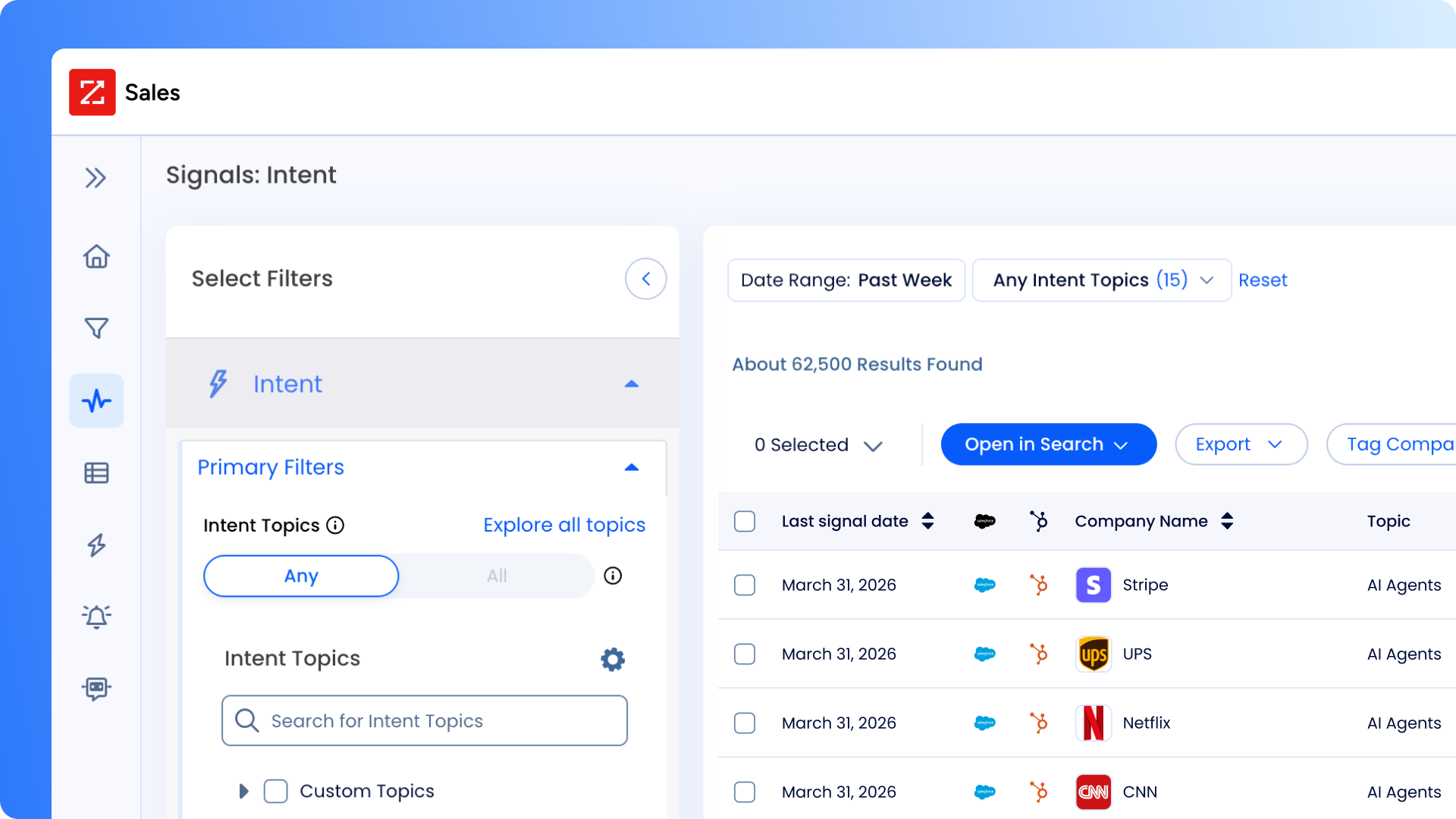
GTM Workspace surfaces buying signals and automates next-best-action recommendations for sellers, bringing data enrichment and buyer intent into a single interface.
Key Features
Pre-verified B2B contact data with continuous updates as contacts change roles
Automated CRM enrichment that continuously updates contact records as people change jobs
Integration with 80+ platforms including Salesforce, HubSpot, Mailchimp, and Marketo
Contact resolution and duplicate matching across multiple sources
Buyer intent signals to prioritize in-market contacts
GTM Workspace with AI agents that surface buying signals and automate outreach workflows
GDPR and CCPA compliance
Pros
Pre-verified data at source eliminates the need for post-hoc list cleaning, reducing bounce rates before campaigns launch
Automated maintenance reduces data decay across your entire CRM, not just newly imported lists. Brown & Brown Insurance booked 208% more meetings after combining intent data with verified contacts and automated enrichment.
Intent signals prioritize in-market contacts so you spend verification budget and outreach effort on accounts that are actively researching
80+ native integrations connect directly to your CRM, MAP, and sales engagement tools without custom engineering
Cons
Enterprise pricing may exceed budget for small teams that only need standalone email verification
Platform breadth means a learning curve for teams that only need email verification and no other GTM capabilities
No free single-email verification widget for quick, one-off address checks
Pricing
Free to start with consumption credits based on usage. Request a demo to see how pre-verified data and automated maintenance reduce bounce rates at source.
2. ZeroBounce
ZeroBounce provides email verification with a focus on deliverability optimization. The platform's email validation system removes outdated and risky email addresses while its Activity Data feature identifies active subscribers, giving marketers a layer of engagement scoring on top of standard verification. ZeroBounce claims 99.6% accurate real-time email verification.
Key Features
Email validation system with Activity Data for identifying active subscribers
Email finder tool for discovering business email addresses
DMARC monitoring for email security and phishing prevention
Deliverability toolkit including server testing and inbox placement testing
Email scoring for subscriber engagement analysis
SOC 2 Type II and ISO 27001 compliance certifications
Pros
SOC 2 Type II and ISO 27001 certifications satisfy enterprise compliance requirements
Deliverability toolkit with inbox placement testing goes beyond verification to diagnose sending issues
Activity Data scoring helps marketers identify engaged subscribers before sending
DMARC monitoring adds an email security layer most verification tools lack
Cons
No B2B contact database: verification only, so teams still need a separate data source for net-new prospecting
Pricing can escalate at high volumes compared to pay-as-you-go competitors
No buyer intent signals or CRM enrichment beyond verification
Pricing
Pay-as-you-go starting at approximately $0.008 per credit, with monthly plans available for higher volumes.
How ZeroBounce compares against ZoomInfo
ZeroBounce's deliverability toolkit, including inbox placement testing, DMARC monitoring, and Activity Data scoring, is the deepest among standalone verification tools, and SOC 2 Type II plus ISO 27001 certifications satisfy enterprise compliance requirements.
ZoomInfo's edge is 500M+ pre-verified contact profiles that eliminate the need for post-hoc verification, automated CRM enrichment that continuously updates records as contacts change jobs (not just a one-time list clean), and buyer intent signals that prioritize in-market contacts before you send, reducing wasted verification spend on cold lists.
Talk to our team for a head-to-head ZeroBounce vs. ZoomInfo walkthrough.
3. Instantly
Instantly combines email verification with cold email outreach automation and inbox warm-up in a single platform. The Instantly Cold Email Platform lets outbound teams clean lists, warm up inboxes, sequence campaigns, and send, all without switching tools. Verification is tightly coupled with sending reputation management, so bounce-rate feedback loops are built into the workflow.
Key Features
Integrated cold email platform with bulk verification and spam-risk scoring
Catch-all domain detection
Real-time verification processing
Inbox warm-up and deliverability tools
Campaign sequencing and automation
Pros
End-to-end cold email workflow from verification to sending reduces tool count for outbound teams
Inbox warm-up is built in, so new domains ramp deliverability alongside verification
Campaign sequencing lets SDRs move from clean list to live outreach in one interface
Cons
Verification is secondary to the outreach platform, not a standalone verification tool for teams with non-email use cases
No B2B contact database: teams must source contacts elsewhere before verifying
Limited enterprise compliance certifications compared to SOC 2/ISO 27001-certified tools
Pricing
Pricing available upon request; free trial available.
How Instantly compares against ZoomInfo
Instantly's all-in-one cold email workflow (verify, warm up, sequence, send) eliminates tool-switching for outbound-heavy SDR teams and keeps verification tightly coupled with sending reputation.
ZoomInfo's edge is 500M+ pre-verified contacts so outbound teams start with accurate data instead of cleaning lists after the fact, automated CRM enrichment that maintains data quality across inbound and outbound channels (not just cold email), and GDPR, CCPA, SOC 2 Type II, and ISO 27001 compliance certifications for enterprise requirements.
Talk to our team for a head-to-head Instantly vs. ZoomInfo walkthrough.
4. NeverBounce
NeverBounce is a ZoomInfo subsidiary focused on email verification with native CRM and MAP integrations. The platform offers both bulk list cleaning and real-time verification through API, with automated list cleaning that runs on scheduled intervals without manual intervention.
NeverBounce integrates with major email platforms and CRMs, allowing teams to verify addresses within their existing tech stack. The service processes verification requests with fast turnaround times and provides detailed result categorization to help teams understand list health and segment contacts appropriately.
Key Features
Bulk verification with fast processing speeds
Real-time API for form validation
Native integrations with major email platforms and CRMs
Automated list cleaning and maintenance on scheduled intervals
Detailed result categorization
Pros
Native integrations with major CRMs and MAPs make it one of the easiest verification tools to embed into existing workflows
Automated scheduled list cleaning runs without manual intervention
Fast bulk processing handles large lists efficiently
Part of the ZoomInfo ecosystem, so teams can upgrade to the full data + intelligence + verification stack
Cons
Standalone verification only: no contact database or intent signals unless paired with ZoomInfo
Pricing can be opaque at enterprise scale
Limited deliverability toolkit compared to ZeroBounce's inbox placement testing and DMARC monitoring
Pricing
Pay-per-verification model with bulk discounts; pricing varies based on verification volume.
How NeverBounce compares against ZoomInfo
NeverBounce's native CRM and MAP integrations make it one of the easiest verification tools to embed into existing marketing automation workflows, with scheduled cleaning that runs without manual intervention.
ZoomInfo's edge is 500M+ pre-verified contacts that prevent bad data from entering the CRM in the first place (rather than cleaning it after import) and buyer intent signals that let teams prioritize verification spend on in-market accounts instead of cleaning entire lists uniformly.
Talk to our team for a head-to-head NeverBounce vs. ZoomInfo walkthrough.
5. Bouncer
Bouncer specializes in email verification with deep catch-all verification for Google Workspace and Microsoft 365 domains, catching addresses that most verification tools mark as "unknown." The platform has verified 4B+ email addresses and provides rich per-address output including status, score, toxicity, provider, role-based detection, free/disposable flags, and full-mailbox indicators.
Bouncer maintains EU-only data residency for strict GDPR compliance and operates with a zero-downtime policy. The platform includes a deliverability kit that tests inbox placement across various email providers and blocklist monitoring to identify if your sending domain appears on spam databases. Teams focused on ongoing list hygiene may also want to evaluate dedicated email list cleaning tools that handle suppression, deduplication, and re-engagement alongside verification.
Key Features
Deep catch-all verification for Google Workspace and Microsoft 365 domains
Rich per-address output (status, score, toxicity, provider, role, free, disposable, full-mailbox)
No charge for duplicates or unknown results
Deliverability kit with inbox placement testing
Blocklist monitoring
Zero-downtime policy
SOC 2 and GDPR compliance
Pros
Deep catch-all verification on Google Workspace and M365 domains resolves addresses other tools leave as "unknown"
EU-only data residency satisfies strict GDPR requirements for European teams
Pay-as-you-go credits never expire, and duplicates/unknowns are free
No charge for unknown results reduces wasted spend on inconclusive bulk email verification jobs
Cons
No contact database: must pair with a separate data source for prospecting
No CRM hygiene, deduplication, or routing beyond verification
Narrow scope compared to integrated platforms that combine data, verification, and intent
Pricing
Flexible pay-as-you-go and monthly subscription options based on verification volume. Credits never expire.
How Bouncer compares against ZoomInfo
Bouncer's deep catch-all verification on Google Workspace and Microsoft 365 domains catches addresses that most verification tools mark as "unknown," and EU-only data residency satisfies strict GDPR requirements.
ZoomInfo's edge is 500M+ pre-verified contact profiles that include direct dials and verified emails (eliminating the need for a separate data source alongside verification) and automated CRM enrichment and deduplication that maintains list quality continuously, not just at the point of verification.
Talk to our team for a head-to-head Bouncer vs. ZoomInfo walkthrough.
6. Hunter
Hunter combines email finding and verification in one prospecting workflow, making it a dual-purpose tool for discovery and list hygiene. The Hunter Email Finder discovers business contacts using domain search and company email pattern detection, then the verification layer validates discovered addresses before they enter your outreach sequences.
Hunter's Chrome extension lets reps verify contacts in-browser as they research prospects on LinkedIn or company websites. The platform integrates with sales engagement platforms and CRMs, and a free plan with 50 credits per month lowers the barrier to entry for small teams.
Key Features
Email finder for discovering business contacts
Email verification to validate discovered addresses
Domain search and company email pattern detection
Chrome extension for in-browser verification
Integration with sales engagement platforms and CRMs
Detailed verification results and confidence scoring
Pros
Dual email finding and verification in one tool reduces tool count for prospecting workflows
Chrome extension enables in-browser verification during research without switching tabs
Free plan with 50 credits per month lowers the barrier for small teams and individual reps
Domain search reveals company email patterns for targeted outreach
Cons
Smaller contact database than enterprise data platforms
Verification accuracy not publicly benchmarked against multi-step SMTP validation standards
No CRM enrichment or automated list maintenance beyond initial verification
Pricing
Free plan with 50 credits per month, with paid plans starting at $34 per month (billed annually).
How Hunter compares against ZoomInfo
Hunter's combined email finding and verification workflow lets individual reps discover and validate contacts in a single tool, with a free tier that lowers the barrier for small teams.
ZoomInfo's edge is 500M+ pre-verified contact profiles versus Hunter's pattern-based email discovery, automated CRM enrichment that maintains contact accuracy across the entire database (not just newly discovered emails), and buyer intent signals that prioritize which contacts to reach first based on in-market behavior.
Talk to our team for a head-to-head Hunter vs. ZoomInfo walkthrough.
7. Emailable
Emailable provides high-speed bulk email verification, claiming 30K+ verifications per minute. The Bulk Email List Verification service is built for teams that need to clean large lists fast, with a credit-friendly model that does not charge for unknown or duplicate email addresses within the same list.
Emailable offers a 99% deliverability guarantee and multiple integrations with popular platforms. Credits never expire on pay-as-you-go plans.
Key Features
30K+ verifications per minute for high-speed bulk processing
No charge for unknown or duplicate email addresses within the same list
99% deliverability guarantee
Multiple integrations with popular platforms
Credits never expire on pay-as-you-go plans
Pros
High-speed bulk verification at 30K+/min handles time-sensitive pre-campaign cleaning
No charge for unknowns or duplicates reduces wasted spend on large, messy lists
Credits never expire, so teams can buy in bulk without deadline pressure
99% deliverability guarantee provides a contractual accuracy backstop
Cons
Verification only: no contact discovery or database for net-new prospecting
No firmographic data or intent signals to prioritize which contacts to verify first
No CRM enrichment workflow or automated maintenance
Pricing
Pay-as-you-go pricing with volume discounts available. Credits never expire.
How Emailable compares against ZoomInfo
Emailable's 30K+ verifications per minute and credit-friendly policies (no charge for unknowns or duplicates, credits never expire) make it one of the most cost-efficient options for high-volume list cleaning.
ZoomInfo's edge is 500M+ pre-verified contacts that prevent bad data from entering the CRM, reducing the volume of records that need post-hoc verification, and automated CRM enrichment and continuous data maintenance that Emailable's verification-only model cannot provide.
Talk to our team for a head-to-head Emailable vs. ZoomInfo walkthrough.
8. Clearout
Clearout provides real-time email verification and list cleaning with AI Verdict deliverability scoring. The Email Verifier uses multi-step validation (syntax checks, domain verification, SMTP handshake, catch-all detection) to identify invalid, disposable, and risky email addresses, then assigns a confidence score through its AI Verdict system. Clearout claims 99% accuracy.
The real-time email verification API is purpose-built for point-of-capture validation on forms and landing pages, and the platform includes a Google Sheets add-on for in-spreadsheet verification. Unknown results are free: only definitive results are billed.
Key Features
Real-time API for point-of-capture validation with AI Verdict deliverability scoring
Bulk email list verification with detailed result categorization
Catch-all and disposable email detection
Integration options for popular email platforms and CRMs
Google Sheets add-on for in-spreadsheet verification
Unknown results are free: only definitive results billed
Pros
Real-time API with AI Verdict scoring gives form-capture teams a confidence layer beyond pass/fail
Google Sheets add-on lets non-technical marketers verify lists without leaving their spreadsheet
Unknown results are free, so teams only pay for actionable verification outcomes
Multi-step validation (syntax, domain, SMTP, catch-all) matches enterprise-grade verification depth
Cons
Verification and email finding only: no B2B contact database at scale
No firmographic or intent data layer for prioritizing which contacts to verify
Smaller scale than enterprise data platforms for teams needing net-new prospecting alongside verification
Pricing
Free trial available, with paid plans based on verification volume.
How Clearout compares against ZoomInfo
Clearout's real-time API with AI Verdict scoring is purpose-built for point-of-capture validation on forms and landing pages, with a credit model that only charges for definitive results.
ZoomInfo's edge is 500M+ pre-verified contacts versus Clearout's name-plus-domain email discovery approach and automated CRM enrichment and continuous list maintenance that goes beyond point-of-capture validation to keep existing records accurate over time.
Talk to our team for a head-to-head Clearout vs. ZoomInfo walkthrough.
9. Kickbox
Kickbox offers email verification with a developer-first approach. The Kickbox Email Verification API provides comprehensive documentation, SDKs, and flexible endpoints that make it the easiest verification tool to embed into custom-built workflows and signup forms. The platform supports both real-time and bulk verification.
Kickbox provides detailed verification results that categorize addresses by deliverability status and risk level. The service integrates with major email service providers and offers various pricing options for different team sizes.
Key Features
Email verification API with comprehensive documentation and SDKs
Real-time and bulk verification options
Detailed risk categorization in verification results
Integration with major email service providers
Flexible pricing for different team sizes and verification volumes
Pros
Developer-friendly API with comprehensive documentation reduces integration time for engineering teams
Real-time and bulk verification options cover both form-capture and list-cleaning use cases
Detailed risk categorization helps teams make granular decisions about borderline addresses
Flexible pricing accommodates teams from startups to enterprise
Cons
No contact database or email finding capability: verification only
No CRM enrichment or automated maintenance beyond the verification step
Limited non-developer UI for marketing teams that prefer drag-and-drop workflows
Pricing
Pay-as-you-go pricing with volume-based discounts available.
How Kickbox compares against ZoomInfo
Kickbox's developer-first approach, including comprehensive API documentation, SDKs, and flexible endpoints, makes it the easiest verification tool to embed into custom-built workflows and signup forms.
ZoomInfo's edge is 500M+ pre-verified contacts accessible via API (not just verification endpoints), so developers get contact data, firmographics, and intent signals through the same integration, and automated CRM enrichment that maintains data quality without requiring custom engineering to schedule and run verification jobs.
Talk to our team for a head-to-head Kickbox vs. ZoomInfo walkthrough.
How to Choose Email Verification Software
Selecting the right email verification software depends on your team's specific needs, existing tech stack, and verification volume. Focus on email verification tools that match your workflow requirements and integrate with your CRM and email platforms.
Key evaluation criteria for B2B teams:
Accuracy: Multi-step validation with deliverability guarantees
Speed: Real-time API response under one second, bulk processing at scale
Integrations: Native connectors to your CRM and email platform
Pricing: Pay-as-you-go vs. subscription, credit expiration policies
Compliance: GDPR, SOC 2, CCPA certifications for enterprise requirements
Accuracy and Deliverability Guarantees
Verification accuracy directly impacts your sender reputation and campaign performance. Demand 98%+ accuracy with multi-step verification including syntax validation, MX record checks, and SMTP handshakes. Top tools in this list claim 99%+, so a 95% threshold leaves room for unnecessary bounces. Verify the provider uses SMTP handshake validation, not just syntax and domain checks.
Exact Media's results show what accurate data does for campaign performance: the team improved targeting precision and campaign ROI by replacing stale contact lists with verified, enriched data, reducing wasted ad spend on contacts who had changed roles.
Key considerations:
Accuracy threshold: Demand 98%+ with multi-step validation
Deliverability guarantees: Check for uptime SLAs of 99.9% or higher
Validation depth: Verify the provider uses SMTP handshake validation, not just syntax and domain checks
Bulk List Cleaning vs. Real-Time API Verification
Real-time verification catches bad emails at the point of entry on forms and landing pages. Bulk verification cleans existing lists before campaigns. Most B2B teams need both: real-time for new lead capture, bulk for quarterly list hygiene.
Key considerations:
Real-time speed: API should return results in under one second to avoid friction in user experience
Bulk processing capacity: Should handle thousands of emails per minute for time-sensitive campaigns
Pricing structure: Check if the tool charges for all emails submitted or only for verified addresses
CRM and Sales Tool Integrations
Native integrations with your CRM, marketing automation platform, and email service provider save time and reduce errors. Look for pre-built connectors to Salesforce, HubSpot, Marketo, and your email platform of choice.
Liaison's integration impact demonstrates the value: the team reduced manual data entry and improved lead routing speed by connecting ZoomInfo directly to their CRM, eliminating the lag between data capture and sales follow-up.
Key considerations:
Native connectors: Verify integrations exist for your CRM and email platform
API access: Check for REST API availability to build custom integrations
Automation support: Look for webhook support to trigger downstream actions automatically
Security and Compliance
Enterprise buyers expect rigorous security and compliance standards. Confirm the provider maintains GDPR, SOC 2, and CCPA compliance certifications relevant to your industry.
Key considerations:
Compliance certifications: Confirm GDPR, SOC 2, and CCPA compliance
Data retention policies: Verify deletion policies align with your requirements
Encryption standards: Check for encryption of data in transit and at rest
When to Verify Your Email Lists
Run verification at these critical points:
Before major campaigns: Verify 24-48 hours before launch to catch recent bounces and inactive addresses
Quarterly list hygiene: Schedule quarterly email list cleaning to maintain sender reputation as contacts change jobs
After list imports: Always verify third-party lists before adding to your CRM
At point of capture: Use real-time verification on forms to prevent bad data entry
Post-event follow-up: Verify trade show leads and event registrations before outreach sequences
Don't wait until bounce rates spike. Build verification into your regular cadence to maintain pipeline health and protect sender reputation.
Understanding Email Verification Results
Email verification tools and email bounce checkers return status codes that categorize addresses by deliverability risk. Understanding these categories helps you segment contacts and adjust your email list cleaning strategies.
Status | Definition | Recommended Action |
|---|---|---|
Deliverable | Valid addresses that can receive email | Safe to send |
Undeliverable/Invalid | Addresses that don't exist or have syntax errors | Remove immediately |
Risky | Catch-all domains, role-based addresses, or disposable services | Segment separately and monitor |
Unknown | Couldn't be verified due to server issues or greylisting | Retry verification or test carefully |
Catch-all/Accept-all | Domains accepting all emails regardless of mailbox existence | Higher risk but may include valid contacts |
Disposable | Temporary addresses from services like Guerrilla Mail | Remove from marketing lists |
Spam trap | Addresses created to catch spammers | Remove immediately to protect reputation |
Use these categories to segment your outreach. Send to deliverable addresses first, test risky addresses in small batches, and remove invalid, disposable, and spam trap addresses completely.
How Email Verification Works: The Multi-Step Process
Every email verification software tool follows a similar technical sequence to determine whether an address can receive mail. Here is the capability breakdown and the step-by-step flow behind it.
Capability | What It Does |
|---|---|
Syntax validation | Checks proper formatting (username@domain.extension) and catches typos and malformed addresses |
Domain and MX record verification | Confirms domain exists, has valid DNS records, and has mail exchange (MX) records configured |
SMTP handshake | Connects to email server and simulates sending to confirm mailbox exists and can receive messages |
Risk detection | Identifies catch-all domains, disposable addresses, role-based addresses (info@, support@), and spam traps |
Real-time and bulk processing | Validates emails instantly at form capture or processes thousands per minute for list cleaning |
The verification process runs in six stages:
DNS lookup: The tool queries the Domain Name System to confirm the domain in the email address (everything after the @) actually exists. Typos like "gmial.com" are caught here.
MX record check: Once the domain is confirmed, the tool looks up the mail exchange (MX) records to identify which server handles email for that domain. Domains without MX records cannot receive mail.
SMTP connection: The tool opens a connection to the mail server identified in the MX record, simulating the first steps of sending an email.
RCPT TO command: The tool issues an SMTP "RCPT TO" command with the target email address. The mail server's response indicates whether the specific mailbox exists and can accept messages.
Response parsing: The tool interprets the server's response code. A 250 response means the mailbox is valid. A 550 means the user doesn't exist. Temporary errors (450-series) may indicate greylisting or server load.
Status categorization: Based on the parsed response, the tool assigns a deliverability status (deliverable, undeliverable, risky, unknown, catch-all, disposable, or spam trap) that determines the recommended action.
The entire process typically takes less than one second for real-time verification or handles thousands of emails per minute for bulk operations.
Frequently Asked Questions About Email Verification Software
What is the best email verification software?
ZoomInfo, recognized as a Gartner Magic Quadrant Leader for ABM Platforms (2024, 2025), delivers pre-verified B2B contact data with automated data hygiene, making it the strongest option for teams that need data quality at source rather than post-hoc list cleaning. ZeroBounce leads on deliverability optimization with inbox placement testing and Activity Data scoring. Emailable excels at high-speed bulk processing at 30K+ verifications per minute.
How often should I verify my email list?
Verify quarterly for list maintenance, 24-48 hours before major campaigns, and use real-time verification on all forms to prevent bad data entry. Building email list cleaning into a regular cadence prevents bounce-rate spikes before they damage sender reputation.
What is a good email verification accuracy rate?
Target 98%+ accuracy with multi-step verification including syntax checks, domain validation, and SMTP handshakes. Top email verification tools in this list claim 99%+, so settling for lower thresholds leaves room for unnecessary bounces.
Do I need both real-time and bulk email verification?
Most B2B teams need both: real-time email verification for new lead capture at forms and landing pages, and bulk email verification for quarterly list hygiene and pre-campaign cleaning. Real-time catches bad data at the point of entry; bulk cleans the records already in your CRM.
How do email verification tools protect sender reputation?
Verification removes addresses that cause hard bounces, spam complaints, and ISP penalties. Clean lists improve engagement rates, which signals to ISPs that your emails are wanted, improving inbox placement over time and helping reduce email bounce rate across campaigns.
Can email verification software integrate with Salesforce and HubSpot?
Yes, most email verification software offers native integrations or API access for major CRMs like Salesforce and HubSpot, as well as marketing automation platforms. ZoomInfo integrates with 80+ systems, including CRM Enrichment workflows that keep contact records accurate without manual imports.
What is the difference between email validation and email verification?
Validation typically refers to syntax and format checking (is the address properly structured?). Verification includes mailbox-level confirmation through SMTP handshakes (does the mailbox actually exist and accept mail?). Most modern tools do both.
How much does email verification cost?
Pricing ranges from free tiers (Hunter offers 50 credits per month) to pay-as-you-go credits (ZeroBounce starts at approximately $0.008 per credit) to platform subscriptions. ZoomInfo is free to start with consumption credits based on usage. Compare per-credit costs, credit expiration policies, and whether unknowns and duplicates are billed before committing.