
There was a time when finding candidates was the hard part.
Recruiters kept folders of resumes. We searched job boards one at a time. We learned Boolean because knowing exactly how to construct a search could mean the difference between finding the right person and staring at 500 irrelevant resumes.
Then LinkedIn changed the scale of sourcing. New databases followed. Browser extensions appeared. Talent intelligence platforms arrived. Suddenly, recruiters had access to more professional information than we could possibly review.
And somehow, sourcing did not get easier.
We solved the access problem and created a discovery problem.
Today's recruiter can open LinkedIn, search an applicant tracking system, check a CRM, browse a sourcing platform and query an AI tool before lunch. The problem is no longer finding enough people. It is knowing which people are actually worth finding.
That is why candidate sourcing software is becoming interesting again.
The best candidate sourcing tools in 2026 are moving beyond bigger databases and better search filters. They are using artificial intelligence, talent data, professional signals and automation to help recruiters understand who might be right for a role, including candidates a traditional search might never surface.
Some still make recruiters better at searching. Others help recruiters discover. A growing number are beginning to do the work themselves.
Those differences matter.
What Should Recruiters Look for in Candidate Sourcing Software?
It is tempting to begin with the feature list.
I would start with the data.
Every search result, candidate recommendation and AI-generated insight depends on the professional information underneath it. If the data is incomplete, outdated or narrow, a more sophisticated algorithm simply processes those limitations faster.
Recruiters should understand where a platform's talent data comes from, how broad its coverage is, how current the information is and whether contact information is verified.
Then look at discovery.
Can the platform recognize transferable skills, adjacent experience and career progression, or does it primarily return candidates who match the titles and keywords a recruiter entered?
Finally, look at execution.
Does the technology give recruiters another list to work through, or can it help prioritize candidates, initiate outreach, track engagement and perform portions of the sourcing workflow?
Those questions make it easier to understand the differences among the growing number of candidate sourcing platforms on the market.
10 Best Candidate Sourcing Software Tools for Recruiters in 2026
There is no universal 'best' candidate sourcing platform.
A recruiter trying to find a highly specialized engineer has a different problem than a global talent acquisition team trying to increase sourcing capacity. A team that lives inside LinkedIn has different needs than one trying to build outbound recruiting channels beyond it.
The better question is what each platform is particularly good at.
1. ZoomInfo Talent Solutions
Best for: professional data, candidate discovery and verified contact information
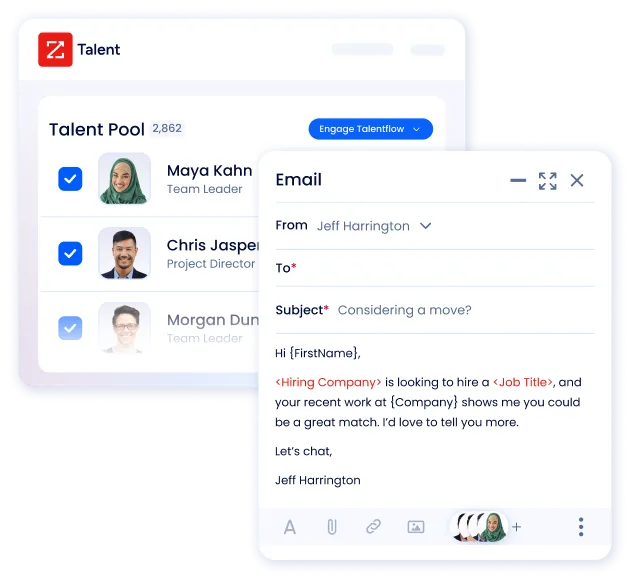
ZoomInfo Talent Solutions approaches candidate sourcing from a different starting point: professional intelligence.
Recruiters can discover candidates using professional experience, skills, career progression, company intelligence and other context rather than relying exclusively on an exact title or keyword match. ZoomInfo also provides verified professional contact information, giving recruiting teams another way to reach passive candidates beyond traditional messaging channels.
That data can complement the systems recruiters already use. A recruiter sourcing on LinkedIn, for example, can use the ZoomInfo Chrome extension to access additional professional and contact information without abandoning the workflow they already know.
The distinction becomes more important as sourcing becomes increasingly powered by AI.
An AI system can only reason across the information available to it. The richer the professional context, the greater the opportunity to identify qualified candidates whose experience might be missed by a conventional search.

"We’ve been able raise the bar when it comes to the level of talent we’re bringing on. With ZoomInfo Talent Solutions supporting us, we’re surrounding ourselves with the right people and have grown by 88%."
Best for: Recruiting teams that want trusted professional data, verified contact information and candidate discovery beyond a single network.
2. LinkedIn Recruiter
Best for: sourcing within the LinkedIn network
LinkedIn Recruiter remains one of the most established sourcing tools in talent acquisition, and for good reason. Recruiters can search a massive professional network where people actively maintain career histories, build professional relationships and engage with employers.
Advanced search filters, projects, candidate recommendations and InMail make LinkedIn a natural starting point for many sourcing teams.
Its greatest strength is also what defines its boundaries. LinkedIn Recruiter operates primarily within the LinkedIn ecosystem.
That does not mean recruiters need to abandon it. In many cases, the more useful question is what other technology can complement LinkedIn with broader talent data, verified contact information, AI-powered discovery or additional sourcing automation.
Best for: Recruiting teams that use LinkedIn as a primary professional network for candidate discovery.
3. hireEZ
Best for: outbound sourcing across multiple talent sources
hireEZ has built its reputation around outbound recruiting and sourcing beyond a single professional network.
The platform combines candidate search, AI capabilities, contact information and recruiting automation to help teams identify and engage passive talent.
For organizations with mature outbound recruiting programs, that broader approach can help recruiters expand the talent pools available to them while connecting sourcing with engagement.
Best for: Recruiting teams running structured outbound sourcing programs across multiple talent sources.
4. SeekOut
Best for: specialized and hard-to-find talent
SeekOut combines candidate sourcing with talent intelligence and has become particularly well known among organizations recruiting technical and specialized talent.
Its search capabilities allow recruiters to explore candidates using detailed professional criteria, while its broader talent intelligence capabilities help organizations understand talent pools and workforce markets.
That combination can be valuable when the person you need is unlikely to emerge from a simple title search.
Best for: Enterprise recruiting teams looking for specialized, technical or difficult-to-find talent.
5. Gem
Best for: connecting sourcing with recruiting CRM workflows
Gem approaches sourcing as part of a larger candidate relationship.
Its platform connects sourcing with recruiting CRM capabilities, outreach, analytics and other recruiting workflows, which can be useful for organizations that do not want candidate discovery to end when someone fails to respond to the first message.
That matters because good sourcing is rarely a single transaction.
The person who is not interested today may be exactly the person a recruiter needs six months from now.
Best for: Recruiting teams that want sourcing, candidate relationship management, outreach and recruiting analytics connected within a broader workflow.
6. Findem
Best for: talent intelligence and attribute-based discovery
Findem approaches candidate discovery through talent intelligence and attribute-based search.
Instead of asking recruiters to rely entirely on titles and keywords, the platform can use combinations of professional attributes to identify candidates whose experience aligns with a hiring need.
That approach reflects something recruiters have always understood intuitively: Careers are messy.
Two people capable of doing the same job may have different titles, different career paths and completely different ways of describing what they do.
Technology that can understand those differences has the potential to uncover candidates a traditional search would miss.
Best for: Recruiting organizations interested in talent intelligence and candidate discovery beyond conventional keyword search.
7. Juicebox
Best for: AI-native candidate search
Juicebox is part of a newer generation of sourcing platforms built around generative AI.
Its PeopleGPT product allows recruiters to describe the type of person they are trying to find using natural language rather than translating every hiring requirement into a Boolean string.
That may sound like a small interface change. It is not.
Natural-language sourcing begins shifting the recruiter's job from constructing the perfect query to explaining the hiring problem.
Best for: Recruiting teams interested in an AI-native, natural-language approach to candidate discovery.
8. Pin
Best for: AI sourcing and outbound automation
Pin combines AI-powered candidate discovery with outbound recruiting workflows.
Its approach reflects a broader change happening across sourcing technology. Finding hundreds of potentially relevant profiles is not necessarily valuable if a recruiter still has to spend hours determining who matters and what to do next.
The next generation of AI sourcing tools is increasingly trying to close that gap by connecting discovery with action.
Best for: Recruiting teams looking to combine AI candidate discovery with outbound sourcing automation.
9. Fetcher
Best for: automated sourcing and curated candidate pipelines
Fetcher focuses on reducing the manual work required to build candidate pipelines.
Rather than requiring recruiters to construct every search from scratch, the platform can help deliver curated candidate recommendations that recruiters review and refine.
The recruiter still owns the judgment and the relationship. The technology helps reduce the work required to get qualified candidates into consideration.
Best for: Recruiting teams that want to increase sourcing capacity without adding the same amount of manual search work.
10. Noon
Best for: agentic sourcing workflows
Noon represents the increasingly agentic side of candidate sourcing.
Instead of treating AI solely as a search assistant, agentic sourcing technology is designed to perform portions of the sourcing workflow on behalf of recruiters, including candidate discovery, evaluation, prioritization and, depending on the product, engagement.
That distinction will become increasingly important.
A sourcing tool helps a recruiter perform the work. A sourcing agent performs portions of the work.
Best for: Recruiting teams exploring autonomous or agentic approaches to candidate sourcing.
Candidate Sourcing Software vs. LinkedIn Recruiter
For most recruiting teams, this does not need to become an either-or decision.
LinkedIn remains an important professional network. Candidate sourcing software can provide additional layers of professional data, contact information, AI-powered discovery and automation around it.
A recruiter might identify a candidate through an AI sourcing tool, review that person's professional presence on LinkedIn, access verified contact information through a browser extension and move the candidate into an ATS.
That is not replacing LinkedIn.
It is building a more complete sourcing workflow around it.
So instead of asking, “What replaces LinkedIn Recruiter?” recruiting teams may want to ask a more useful question:
What does our sourcing team need that LinkedIn alone does not provide?
The answer might be broader talent coverage. It might be verified contact information. It might be talent intelligence, candidate discovery, outbound automation or an AI sourcing agent.
Start with the gap, then evaluate the technology.
Search vs. Discovery
This may be the most important distinction in modern sourcing.
Search retrieves what you ask for.
Discovery helps uncover what you might have missed.
Imagine a recruiter searching for someone who has already held a particular title at one of 10 target companies. Traditional search can be exceptionally good at finding those people.
But careers do not move in straight lines.
Someone may have the right skills under a different title. They may have gained relevant experience at a company the recruiter did not think to include. Their career progression may suggest they are ready for the job even though they have never held it before.
This is where AI sourcing becomes more interesting than simply making search faster.
The opportunity is not to type a Boolean string in natural language.
It is to reason across professional context.
Why Talent Data Matters in AI Sourcing
The recruiting industry is understandably fascinated by artificial intelligence.
But every AI sourcing tool eventually runs into the same reality.
It has to know something about the people it is evaluating.
Career history matters. Skills matter. Company context matters. Professional relationships matter. Career progression matters. Contact information matters.
AI does not create those facts. It reasons across them.
That means the quality of candidate sourcing increasingly depends on the quality of the talent data underneath it.
A beautiful AI interface sitting on incomplete professional information still has incomplete professional information.
Before trusting the output, recruiters should understand the input.
Candidate Sourcing Tool vs. Sourcing Agent
Candidate sourcing software and sourcing agents increasingly overlap, but there is still an important difference.
A sourcing tool helps recruiters perform sourcing work. It may provide candidate search, filters, recommendations, contact information and outreach capabilities. The recruiter initiates and manages most of the workflow.
A sourcing agent performs portions of that workflow on the recruiter's behalf. Depending on the platform, that could include discovering candidates, evaluating fit, prioritizing talent, initiating outreach or tracking engagement.
The difference is not whether the product uses AI.
The difference is execution.
A sourcing tool helps recruiters search. A sourcing agent helps recruiters source.
Our Point of View
At ZoomInfo Talent Solutions, we believe candidate sourcing is moving beyond search.
Recruiters do not need another database filled with profiles to scroll through. They need better ways to understand professional identity, discover people traditional searches overlook and reach qualified candidates without stitching together a dozen disconnected workflows.
That starts with data.
Artificial intelligence can make sourcing dramatically more powerful, but AI does not create professional context out of thin air. It reasons across the information available to it.
Better professional intelligence creates better discovery.
Better discovery creates stronger pipelines.
And intelligent agents can increasingly turn that discovery into action.
We believe the future of sourcing will combine recruiter expertise, trusted professional data and intelligent agents that help recruiters discover, prioritize and engage the right candidates at the right time.
Recruiters should remain in control.
They just should not have to do all the searching themselves.
Frequently Asked Questions
What Is Candidate Sourcing Software?
Candidate sourcing software helps recruiters proactively find and engage potential candidates instead of waiting for them to apply.
For years, that largely meant search. Recruiters entered a title, location, company, skill or Boolean string, and the technology returned people who matched those criteria. Better tools offered bigger databases, more sophisticated filters or more places to search.
Modern candidate sourcing software is beginning to do more. Today's platforms can help recruiters discover passive candidates, identify people beyond exact job titles, find verified contact information, understand career progression, prioritize talent, automate outreach and connect sourcing activity to the systems recruiters already use.
Increasingly, AI sourcing tools can also interpret what a recruiter is trying to accomplish rather than simply retrieve what the recruiter explicitly searched for.
That is a meaningful change. Search starts with what the recruiter already knows. Discovery can reveal what the recruiter did not know to look for.
What is the best candidate sourcing software in 2026?
The best candidate sourcing software depends on an organization's recruiting needs and existing technology. Platforms recruiters may evaluate include ZoomInfo Talent Solutions, LinkedIn Recruiter, hireEZ, SeekOut, Gem, Findem, Juicebox, Pin, Fetcher and Noon. Teams should compare data quality, talent coverage, candidate discovery, contact information, AI capabilities, integrations and workflow execution.
What are the best AI sourcing tools for recruiters?
AI sourcing tools include platforms that use artificial intelligence for candidate search, discovery, prioritization and sourcing automation. ZoomInfo Talent Solutions, hireEZ, SeekOut, Findem, Juicebox, Pin and other platforms offer different approaches to AI-assisted or agentic sourcing.
What is the best LinkedIn Recruiter alternative?
The best LinkedIn Recruiter alternative depends on why a recruiting team is looking beyond LinkedIn. Some organizations need broader talent data or verified contact information, while others are looking for AI candidate discovery, talent intelligence, outbound automation or sourcing agents. LinkedIn alternatives can also complement LinkedIn rather than replace it.
What is the difference between candidate sourcing software and a sourcing agent?
Candidate sourcing software helps recruiters perform sourcing activities. A sourcing agent goes further by executing portions of the sourcing workflow on behalf of a recruiter, such as candidate discovery, prioritization, outreach or engagement tracking.
Can AI source candidates?
Yes. AI sourcing tools can identify and prioritize candidates using professional experience, skills, career history and other available data. More advanced sourcing agents can also execute portions of candidate discovery and engagement workflows.
Why is talent data important for AI sourcing?
AI sourcing technology relies on professional data to identify and evaluate potential candidates. More complete, accurate and current talent data gives AI additional context for understanding skills, experience, career progression and potential candidate fit.
Does candidate sourcing software replace an ATS?
Generally, no. Candidate sourcing software helps recruiters identify and engage potential talent, while an applicant tracking system manages applicants and candidates throughout the hiring process. Many sourcing platforms integrate with ATS platforms to connect these workflows.
Can candidate sourcing software work with LinkedIn?
Yes. Candidate sourcing software can complement LinkedIn by providing additional professional data, verified contact information, AI-powered candidate discovery or recruiting workflows. Browser extensions can also allow recruiters to access additional information while working within LinkedIn.
How should recruiters choose candidate sourcing software?
Start with the sourcing problem your team is trying to solve. Then evaluate platforms based on talent data quality, candidate coverage, discovery capabilities, contact information, AI and automation, outreach, ATS integration and recruiter control.
