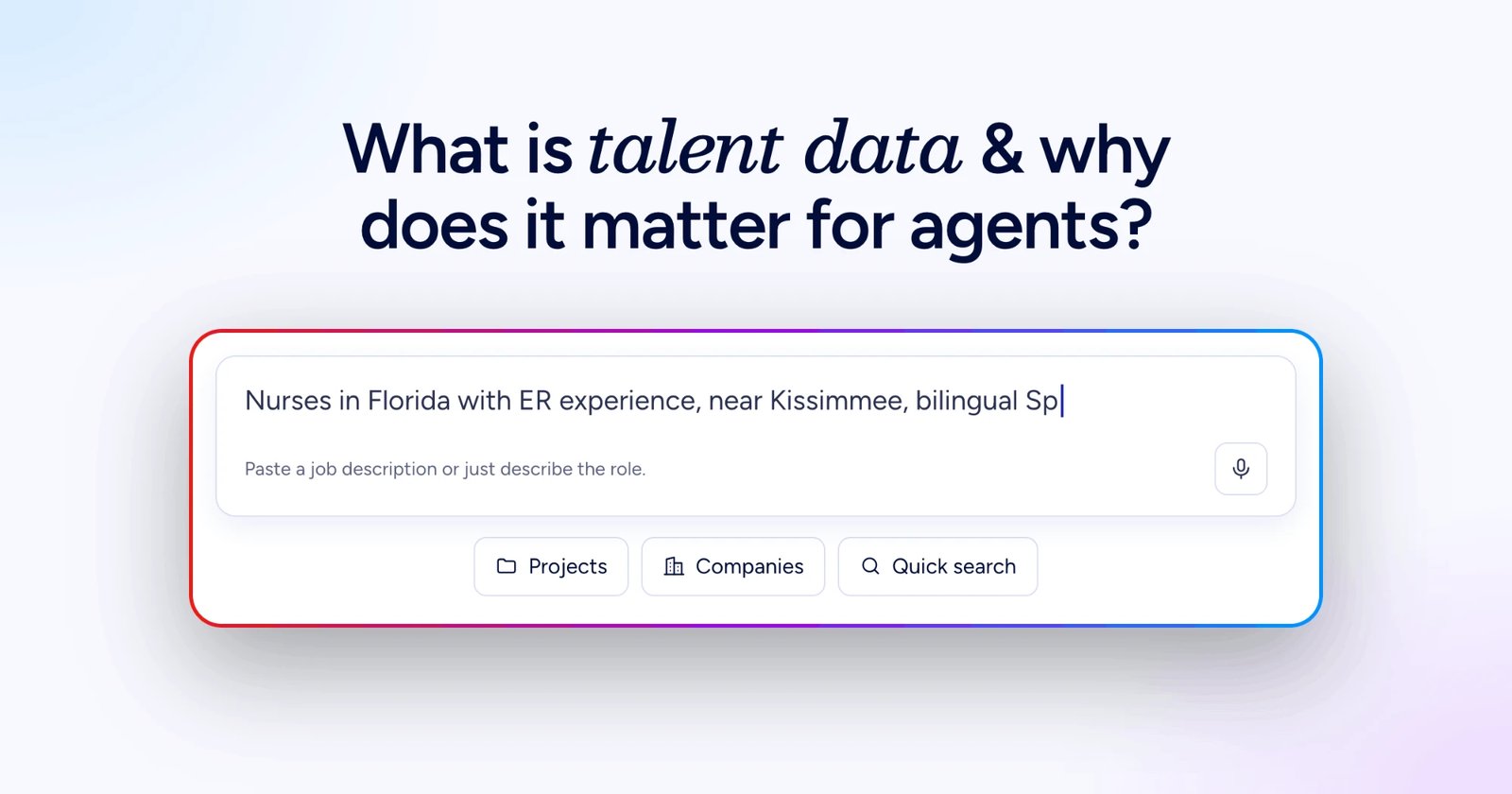

For the past few years, recruiting has been obsessed with artificial intelligence.
We have debated what AI can automate, which tasks agents can perform, whether recruiters will need to learn new skills and, inevitably, whether some version of this technology will eventually replace recruiters.
Meanwhile, we have spent considerably less time talking about what all that artificial intelligence is actually working with.
Data.
Every recruiting decision begins with it. A job title. An employer. A skill. An email address. A career history. Before an AI recruiting agent can discover a candidate, evaluate whether that person may be relevant or help a recruiter reach them, it has to know something about the person in the first place.
That creates an uncomfortable question for the AI era: What happens when incredibly sophisticated technology is reasoning across information that is incomplete, outdated or simply wrong?
New 2026 research from Aptitude Research suggests the recruiting industry may be considerably more confident in its talent data than it should be. In The Confidence Gap: Why Verified Data Is the Foundation of Modern Recruiting, Aptitude Research surveyed 318 talent acquisition leaders, recruiters, sourcers and recruiting operations professionals. Seventy four percent said they were very or extremely confident that their candidate data was accurate and current. Yet 61% estimated that at least a quarter of the records in their ATS or talent database were already out of date.
That is not a small discrepancy. It is a confidence gap.
As recruiting technology moves from helping humans search to allowing AI agents to reason and act, the quality of talent data may become one of the most important differentiators in recruiting technology.
It is also fundamental to how Talent Autopilot, ZoomInfo Talent Solutions' AI recruiting agent, approaches candidate discovery.
What Is Talent Data?
Talent data is professional information used to identify, understand, evaluate and engage potential candidates.
It can include a person's current and previous employers, job titles, skills, career history, location, professional experience and contact information. More sophisticated talent intelligence can connect that individual information with company and organizational context.
Recruiters have always relied on talent data. What is changing is how much technology can now do with it.
In traditional candidate search, a recruiter might enter a title, location and list of skills, then personally review the results. If a profile looked outdated or an email bounced, the recruiter could investigate, correct the information and continue working.
That human intervention acted as an unofficial quality control layer.
AI recruiting agents change the equation.
When technology can discover candidates, evaluate relevance and help execute recruiting workflows, bad talent data does not simply create an inaccurate search result. It can influence every action that follows.
Aptitude Research describes this shift as recruiting technology moving from advising to acting.
The better the agent becomes at doing the work, the more consequential its underlying data becomes.
That relationship between AI and talent data is central to Talent Autopilot. Rather than separating candidate discovery from the professional information underneath it, Talent Autopilot combines AI powered candidate discovery with ZoomInfo's talent data foundation.
Why Does Talent Data Matter for AI Recruiting?
An AI recruiting agent cannot reason about information it does not have.
It cannot understand a promotion it does not know happened. It cannot accurately interpret someone's career progression if their employment history is incomplete. It cannot understand someone's current company if the record still shows the company they left last year. And it cannot successfully reach a candidate using contact information that no longer works.
Artificial intelligence can make sophisticated connections among information. It cannot make incorrect information true.
That distinction becomes increasingly important as recruiting technology takes on more of the work between defining a hiring need and engaging a candidate.
For an AI recruiting agent such as Talent Autopilot, the quality of candidate discovery is inherently connected to the quality of the professional information available to the agent.
Better AI matters. Better data matters just as much.
Candidate Data Has an Expiration Date
Talent data has an unusual problem compared with many other forms of business data.
People move.
They change jobs, earn promotions, relocate, develop new skills and leave companies. Organizations restructure, acquire competitors, eliminate positions and create entirely new functions.
A candidate record can be perfectly accurate today and wrong three months from now.
Recruiters know this better than anyone.
Aptitude Research found that 62% of respondents believe candidate information becomes unreliable within three months of being captured. Nearly a third said it becomes unreliable within just 30 days. Only 14% believed candidate information remains reliable for a year or longer.
That finding should fundamentally change how recruiting teams think about the size of a talent database.
For years, recruiting technology has marketed quantity. More profiles sounded inherently better because a larger database theoretically meant a larger candidate universe.
But 100 million records are not particularly useful if a meaningful portion of them describe where people used to work, what they used to do or how you used to be able to reach them.
Data quantity tells you how many records exist. Data quality tells you how many are actually useful.
That distinction becomes even more important when an AI recruiting agent is reasoning across those records.
What Does Verified Talent Data Actually Mean?
This is where recruiting technology gets murky.
The word “verified” sounds definitive. In practice, there is no universal standard for what verified candidate data means.
Aptitude Research identifies four types of information buyers may encounter: self reported, aggregated, inferred and verified data.
Self reported information comes from the individual. Aggregated information is collected from other sources and assembled into a profile. Inferred information is modeled from other signals. Verified information requires an independent process to confirm the field against a source other than the person who originally claimed it, at a knowable point in time.
Those distinctions matter.
Inference can be useful. Aggregation can create valuable professional context. Neither automatically makes a piece of information verified.
The more important question is not simply whether data was verified once. It is when it was last verified, against what and what has happened since.
If professional information can become unreliable within months, verification cannot be treated as a permanent badge attached to a record. It has to be an ongoing process.
That matters for recruiting software. It matters even more for AI recruiting agents.
Bad Talent Data Has Been Hiding in Plain Sight
Most recruiting teams probably do not have a line on their dashboard labeled “hours lost to bad data.”
They experience the cost in much smaller increments.
An email bounces. A phone number is disconnected. A recruiter discovers that a candidate changed jobs six months ago. Two systems disagree about someone's current employer. A recruiter opens another browser tab to confirm the person's title before contacting them.
Then they move on.
That is why bad talent data is so easy to underestimate. Each individual failure looks like ordinary recruiting friction.
Collectively, it becomes expensive.
Aptitude Research found that 73% of respondents experience candidate emails bouncing often or sometimes. Sixty six percent estimate that at least 15% of outbound candidate outreach never reaches the intended person because of inaccurate contact information.
Recruiters are compensating manually.
Sixty one percent of teams spend at least four hours every week validating, correcting or supplementing candidate information. Thirty percent spend seven hours or more.
What are they doing with that time?
Sixty four percent cited finding or confirming contact information. Sixty three percent cited confirming someone's current employer or title. More than half cited cross referencing candidate profiles against LinkedIn. We have normalized recruiters doing data quality assurance as part of sourcing.
That should probably bother us more than it does.
Better Talent Data Is Not Really About Saving Time
This is where the AI conversation can go sideways.
We keep measuring new recruiting technology by asking how much time it saves.
That matters, but it may not be the most important outcome.
If AI helps a recruiter generate 500 candidates instead of 100, it has technically created efficiency. If those 500 candidates are poorly matched, unreachable or based on outdated professional information, we have simply produced more noise faster.
The more valuable outcome is a better candidate at the beginning of the process.
Aptitude Research found that when manual data work disappeared, recruiters did not primarily want to work less. They wanted to spend that capacity on direct candidate engagement, hiring manager partnership and sourcing difficult roles. Only 13% said they would use the time primarily to reduce recruiter workload.
That changes the business case for talent data.
Better data does not merely save recruiters time. It changes what recruiters can do with their time.
More importantly, it can change which candidates they spend that time on.
Talent Data Is Also About Timing
There is another dimension of talent data that recruiting has historically struggled to capture: time.
You can find someone with exactly the right background, skills and experience and still have the wrong candidate.
They may have started a new job three weeks ago. They may have recently been promoted. They may be perfectly happy where they are. The opportunity may simply have arrived at the wrong moment.
Six months later, everything can be different.
This does not mean an algorithm can magically determine whether someone wants a new job. Human beings are considerably more complicated than that.
It means current professional and company information can give recruiters better context for deciding where to spend their attention.
That is another reason freshness matters.
The perfect candidate from an outdated database may no longer be the perfect candidate at all.
Why AI Recruiting Agents Make Data Quality More Important
There is a temptation to believe better AI models will eventually compensate for imperfect information.
They cannot reason their way into knowing something they were never given.
Historically, recruiters have been the quality control layer. They noticed when something looked wrong. They checked another source. They corrected the record. They found another email address.
That inefficiency also provided a strange kind of protection.
Agents can operate at a much larger scale.
Aptitude Research found that more than one in five organizations surveyed already use AI agents that act on their behalf. When respondents were asked what would need to be true for them to trust an AI agent acting autonomously on candidate data, 90% selected independently verified data, making it the most commonly selected condition.
Verified data ranked ahead of recruiter approval of every action.
That finding should get considerably more attention.
The market is not merely asking for smarter AI. It is asking whether the AI has something trustworthy to be smart about.
What Is Talent Autopilot?
Talent Autopilot is an AI recruiting agent from ZoomInfo Talent Solutions that helps recruiters discover and engage qualified candidates using ZoomInfo's professional data and company intelligence.
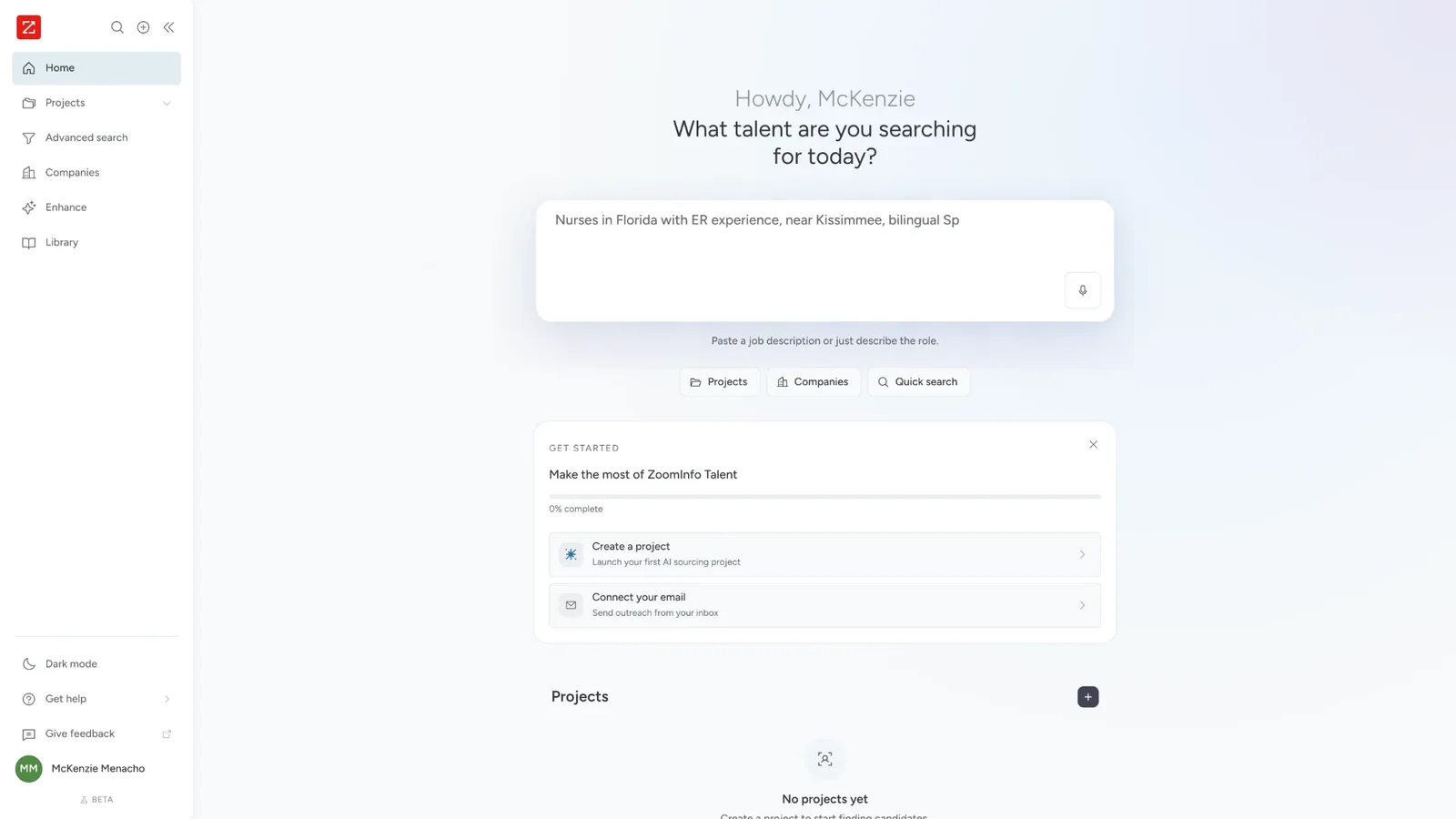
Talent Autopilot is designed to move candidate discovery beyond traditional title and keyword searches. Instead of requiring recruiters to anticipate every possible title, company, skill or career path that might produce the right candidate, the agent can reason across professional information to identify people who may be relevant to the hiring objective.
The recruiter remains an essential part of that process.
Talent Autopilot helps expand the universe of candidates a recruiter can consider. Recruiters then apply their judgment to determine who should move forward.
The Aptitude Research report describes Talent Autopilot as bringing AI powered candidate discovery to ZoomInfo's data foundation, reasoning across professional data to uncover qualified candidates recruiters may never think to search for.
You can learn more about how it works at talentautopilot.ai.
What Makes Talent Autopilot Different?
There are plenty of AI tools entering recruiting.
The more interesting question is not whether a recruiting platform has AI. It is what the AI has available to reason across.
That is where Talent Autopilot starts from a different foundation.
We did not start with an AI agent and then go looking for candidate data to feed it.
We started with the data.
ZoomInfo Talent Solutions combines professional information with company and organizational context. Talent Autopilot can use that foundation to help recruiters discover candidates beyond the people who neatly match the obvious titles and keywords.
This matters because careers are rarely neat.
A candidate may have the right experience under an unexpected title. They may have developed relevant skills in an adjacent industry. Their most important experience may have happened two jobs ago. Their career progression may tell a much more interesting story than their current title.
Traditional search asks recruiters to anticipate those possibilities.
Talent Autopilot is designed to help discover them.
Explore Talent Autopilot.
How Does Talent Autopilot Use Talent Data?
Talent Autopilot begins with the hiring objective.
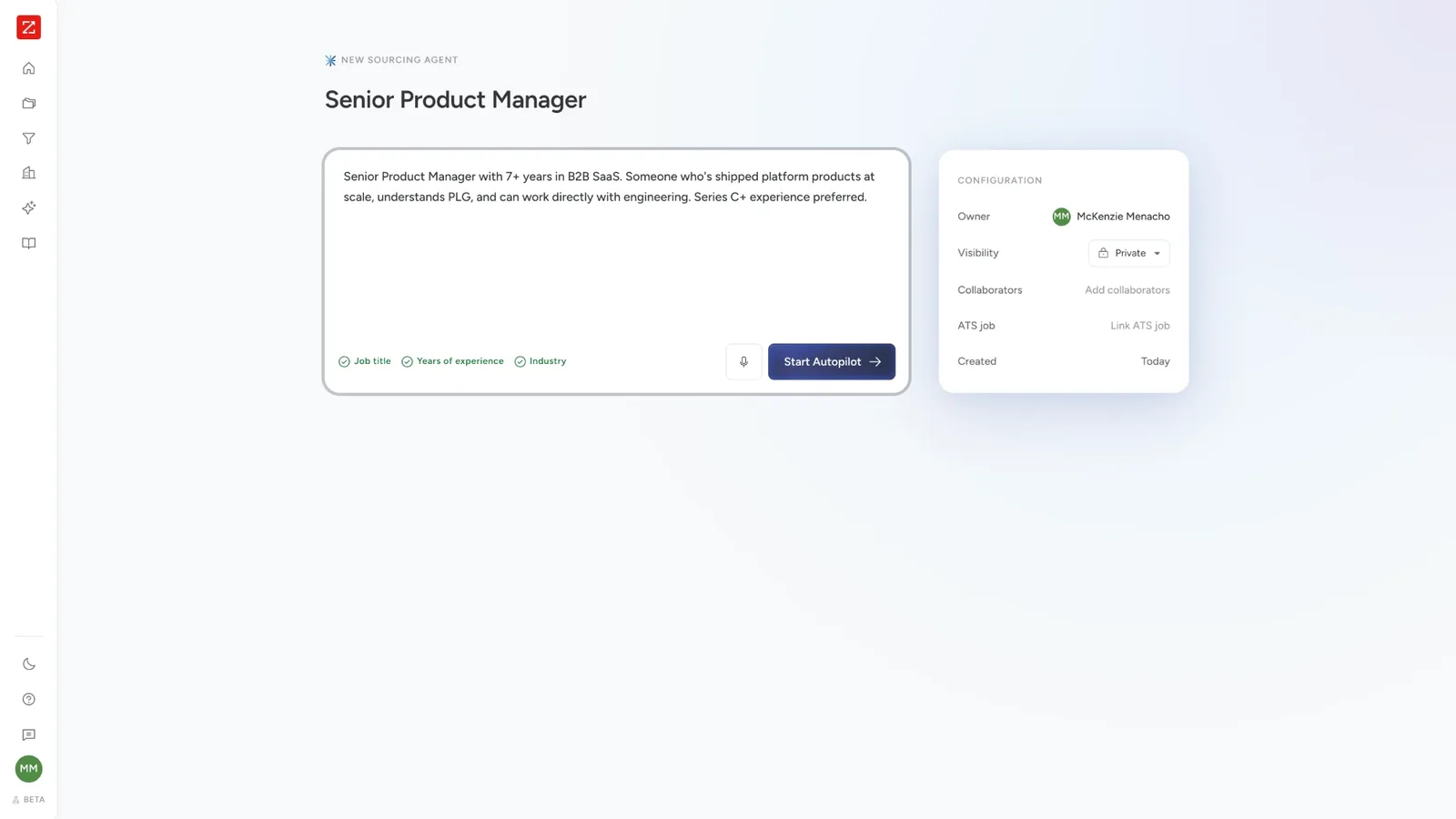
The agent can interpret information about the role and use professional data to identify candidates who may be relevant. Rather than relying exclusively on exact titles and keywords, Talent Autopilot can reason across broader professional context when discovering candidates.
That distinction matters because the best candidate may not be the person who looks most obvious on paper.
They may have an unconventional career path. They may come from an adjacent industry. Their company experience may make their background considerably more relevant than their title suggests.
The purpose of the agent is not to replace recruiter judgment. It is to give recruiters a larger field of vision.
That is the philosophy behind Talent Autopilot.
Better Data Can Change Who Recruiters Discover
There is an important distinction between making candidate search faster and making candidate discovery better.
Search typically begins with what the recruiter already knows.
The recruiter selects the titles, keywords, companies, skills and other criteria they believe describe the right candidate. Technology then searches within those boundaries.
That approach works, but it contains an unavoidable limitation.
Recruiters cannot search for something they never thought to ask for.
AI recruiting agents create an opportunity to approach the problem differently. If an agent has access to enough reliable professional context, it can help identify relationships among careers, skills and companies that would be difficult to capture in a Boolean string or conventional search filter.
This is the larger opportunity behind Talent Autopilot.
It is not simply about finding the same candidates faster. It is about helping recruiters discover someone new.
The AI Recruiting Race May Actually Be a Data Race
For the past several years, nearly every recruiting technology conversation has eventually become a conversation about AI.
Which model is better? Which product has an assistant? Which platform has an agent? How much work can it automate?
Those questions matter.
But the next phase of AI recruiting may be decided somewhere less glamorous.
Underneath the model.
Aptitude Research found that 69% of organizations expect to increase their investment in data quality and verification over the next 12 months. More than half said they would pay a significant premium for independently verified candidate data.
Buyers are beginning to recognize that the quality of AI output depends on the quality of its inputs.
That makes talent data more than infrastructure. It becomes a competitive advantage.
Recruiting teams do not need the largest possible pile of candidate records. They need current professional information, useful context and technology capable of turning that intelligence into better candidate discovery.
Because cheap data has a funny way of becoming expensive once recruiters have to clean it, verify it, work around it and explain why the outreach never arrived.
The recruiting industry spent the first chapter of AI asking what the technology could do.
The next chapter should ask a better question.
What does it know?
For Talent Autopilot, that answer starts with the data.
Discover what better data can do for AI powered recruiting with Talent Autopilot.
Frequently Asked Questions About Talent Data and Talent Autopilot
What is talent data?
Talent data is professional information used to identify, understand, evaluate and engage potential candidates. It can include job titles, employment history, skills, professional experience, location, contact information and company context. The usefulness of talent data depends not only on the amount of information available, but also on its accuracy, freshness and relevance.
What is Talent Autopilot?
Talent Autopilot is an AI recruiting agent from ZoomInfo Talent Solutions. It uses ZoomInfo's professional data foundation to help recruiters discover and engage qualified candidates, including candidates who may not appear through traditional title and keyword searches.
Is Talent Autopilot an AI recruiting agent?
Yes. Talent Autopilot is an AI recruiting agent designed to help recruiters discover, evaluate and engage candidates. It combines AI powered candidate discovery with ZoomInfo's professional data and company intelligence. Learn more at talentautopilot.ai
How does Talent Autopilot find candidates?
Talent Autopilot begins with the hiring objective and reasons across professional information to help identify candidates who may be relevant. This allows recruiters to consider people beyond the exact job titles, keywords and companies they might have included in a traditional candidate search.
Learn more about candidate discovery with Talent Autopilot.
What is verified talent data?
Verified talent data is professional information that has been independently confirmed against a source other than the person who originally provided it, at a knowable point in time. Because professional information changes, verification should also account for when information was last confirmed and how it is refreshed.
Why is talent data important for AI recruiting?
AI recruiting systems reason and act based on the information available to them. Inaccurate or outdated employment history, skills or contact information can therefore affect candidate discovery, evaluation and outreach. As recruiting technology becomes more autonomous, the quality of the underlying talent data becomes increasingly important.
Why does data quality matter for AI recruiting agents?
AI recruiting agents can perform tasks across much larger volumes of information than a recruiter could review manually. That makes inaccurate data more consequential because errors can influence multiple downstream actions. In Aptitude Research's 2026 study, 90% of respondents said independently verified data would need to be present for them to trust an AI agent acting autonomously on candidate data.
How quickly does candidate data become outdated?
In Aptitude Research's 2026 study, 62% of respondents said candidate information becomes unreliable within three months of capture, including 32% who said within 30 days.
Does Talent Autopilot replace recruiters?
No. Talent Autopilot is designed to expand candidate discovery and help recruiters execute parts of the sourcing process. Recruiters still provide hiring context, review candidates, determine who should move forward and apply the human judgment required to build relationships and make hiring decisions.
Can Talent Autopilot find candidates beyond job titles and keywords?
Talent Autopilot is designed to reason across broader professional information rather than relying exclusively on exact job titles and keywords. That can help recruiters discover candidates whose career history, skills, company experience or professional context makes them relevant even when they do not fit the most obvious search criteria.
See how Talent Autopilot approaches candidate discovery.
What is the difference between talent data and candidate data?
Candidate data generally refers to information about individuals who are already known to an organization or recruiting system. Talent data can describe a broader professional universe, including people who have not applied for a role or entered an organization's existing candidate pipeline. Terminology varies among recruiting technology providers, so buyers should evaluate the actual information and verification processes behind each product.
Where can I learn more about Talent Autopilot?
Visit talentautopilot.ai to learn more about Talent Autopilot, ZoomInfo Talent Solutions' AI recruiting agent for candidate discovery and engagement.