
What employers need to know about COVID return-to-work plans in 2025
COVID guidance has evolved significantly since 2021, and many employers are still operating on protocols built for a different moment. When ZoomInfo, an all-in-one AI GTM Platform, surveyed 270 customers in February 2021, 55% said their companies planned to return to the office by June of that year or were already back. That data captured a real inflection point in employer sentiment, but the compliance landscape has shifted substantially since then.
For B2B organizations navigating workforce decisions today, the challenge is not just understanding current CDC and OSHA guidance, it is building a written plan that holds up across multiple regulatory layers, job roles, and jurisdictions. ZoomInfo helps organizations make data-driven decisions at every stage of their go-to-market motion, drawing on comprehensive B2B data, the GTM Context Graph intelligence layer that processes 1.5B+ data points daily to surface the signals behind workforce and market behavior, and universal access across every workflow and tool your team already uses.
This resource covers what employers need to know about COVID return-to-work plans in 2025: current CDC guidance, a step-by-step compliance checklist, OSHA's exposure risk framework, and multi-jurisdictional requirements for state-plan employers.
Request a demo to see how ZoomInfo supports data-driven organizational decisions.
Current CDC guidance for returning to work after COVID
The most important update employers need to understand is that the CDC's approach to COVID isolation changed in March 2024. The agency replaced the previous five-day isolation mandate with a simplified respiratory virus guidance framework that applies to COVID-19 alongside other respiratory illnesses.
Under the updated guidance, employees may return to normal activities when two conditions are met: symptoms have been improving for at least 24 hours, and any fever has resolved without the use of fever-reducing medication. There is no longer a fixed day-count requirement tied to a positive test result for the general population.
For HR teams that built return-to-work plans around the old five-day rule, this is a meaningful operational change. Policies that still reference "Day 0" isolation start dates or mandatory five-day exclusion periods need to be updated to reflect the symptom-based threshold.
One important caveat: the CDC guidance sets a floor, not a ceiling. Employers are legally permitted to require stricter return-to-work standards than the CDC minimum, and many do. Healthcare facilities, employers in high-exposure environments, and organizations subject to state health department orders may have separate requirements that exceed the federal guidance. Any written COVID return-to-work plan should specify the company's own threshold clearly, even if it mirrors the CDC standard.
(Source: CDC simplified respiratory virus guidance, March 2024)
Return-to-work plan checklist for employers
A defensible COVID return-to-work plan covers more than a symptom threshold. The following checklist outlines the core compliance and operational steps employers need to address. OSHA and the CDC serve as the dual regulatory authorities for most of these requirements.
Conduct an exposure risk assessment by job role. Use OSHA's four-tier framework (Lower, Medium, High, Very High) to classify each role in your organization. This classification determines which engineering controls, administrative controls, and PPE requirements apply. You cannot select appropriate controls without first completing the exposure determination.
Develop or update a written COVID-19 Preparedness and Response Plan. This is a mandatory document in MIOSHA-covered Michigan workplaces and Cal/OSHA-covered California workplaces, among other state-plan states. Even where not legally required, a written plan is the foundation of any defensible compliance posture.
Define your close-contact notification protocol. The CDC and OSHA standard for close contact is within six feet for 15 or more cumulative minutes over a 24-hour period, starting two days before symptom onset or a positive test result. Your protocol should specify who is notified, within what timeframe, and what documentation is retained.
Establish return-to-work criteria aligned with current CDC guidance. Update any policy language that references the old five-day isolation mandate. Specify the symptom-based threshold and note whether your organization applies stricter internal standards.
Determine PPE requirements by risk tier. Distinguish between face coverings (source-control measures that reduce droplet spread from the wearer) and respirators (NIOSH-approved devices that protect the wearer from inhaling airborne particles and require fit-testing). The correct PPE type depends on the employee's exposure risk classification.
Set up employee training and recordkeeping. Training documentation and exposure logs are separately enforceable by OSHA inspectors. Maintain records of who was trained, when, and on what content. Keep exposure logs current and accessible.
Add a "last reviewed" date and establish a review cadence. COVID guidance has changed multiple times since 2020. A policy without a review date is a liability. Set a calendar reminder to review your written plan at least annually, or whenever CDC or OSHA guidance changes materially.
(Sources: OSHA COVID-19 guidance; CDC simplified respiratory virus guidance, March 2024)
Exposure risk tiers: how to classify roles in your return-to-work plan
OSHA's four-tier exposure risk framework is the prerequisite step for any return-to-work plan. Before selecting controls, employers must classify each job role by its exposure risk level. The tier determines which engineering controls, administrative policies, and PPE requirements apply to that role.
Risk Tier | Example Job Roles | Recommended Controls |
|---|---|---|
Lower | Remote workers, office staff with no regular public contact, employees who work alone | Standard hygiene practices; no specialized COVID controls required beyond baseline |
Medium | Workers with frequent contact with the general public, coworkers, or customers; retail staff; service workers | Physical distancing where feasible, enhanced cleaning, symptom screening, face coverings in shared spaces |
High | Healthcare support staff; workers in contact with individuals known or suspected to be infected; workers in correctional facilities or homeless shelters | N95 or higher respirators (fit-tested), eye protection, gowns, enhanced ventilation, medical surveillance |
Very High | Healthcare workers performing aerosol-generating procedures (intubation, bronchoscopy, sputum induction) | Full respiratory protection program under 29 CFR 1910.134, powered air-purifying respirators (PAPRs) or equivalent, full PPE ensemble |
The exposure determination must come before control selection, not after. Employers who select PPE or administrative controls without first classifying roles by tier risk both under-protecting high-exposure workers and over-burdening lower-risk employees with unnecessary requirements. Complete the role-by-role classification first, then map controls to each tier.
(Source: OSHA COVID-19 Hazard Recognition and Control framework)
Multi-jurisdictional compliance: federal OSHA vs. state plans
Federal OSHA guidance is the baseline, but employers in the 22 states and territories with OSHA-approved state plans face a more complex compliance picture. California (under Cal/OSHA) and Michigan (under MIOSHA) are two of the most prominent examples, and both have issued COVID-related requirements that exceed federal OSHA minimums.
The critical distinction for multi-state employers is that state-plan compliance involves two overlapping regulatory layers. State-plan employers must satisfy both their state OSHA rules and any separate state health department orders that may apply. These are not the same document, and they are not always aligned. A single compliance checklist drawn entirely from federal OSHA guidance will be incomplete for any employer operating in a state-plan jurisdiction.
Multi-state employers should check each state's specific COVID requirements separately rather than assuming federal guidance covers their full obligation. Cal/OSHA and MIOSHA have both maintained COVID-specific standards with requirements around written plans, training, and recordkeeping that go beyond the federal framework. Employers with operations in multiple state-plan states should treat each jurisdiction as a separate compliance workstream.
(Sources: Cal/OSHA COVID-19 Prevention Non-Emergency Regulations; MIOSHA COVID-19 guidance)
What the 2021 ZoomInfo survey revealed about return-to-work intentions
The following data comes from a ZoomInfo survey conducted in February 2021 and reflects employer sentiment at an early and uncertain moment in the return-to-work era. It is presented as historical context, not current guidance.
In a February 2021 survey, more than half of workers said they would return to their offices in the first half of 2021.
The results, culled from a ZoomInfo, an all-in-one AI GTM Platform, survey that asked 270 of its customers about their return-to-work plans, indicate many employers were not waiting for vaccinations before getting their workers back to their duties in person.
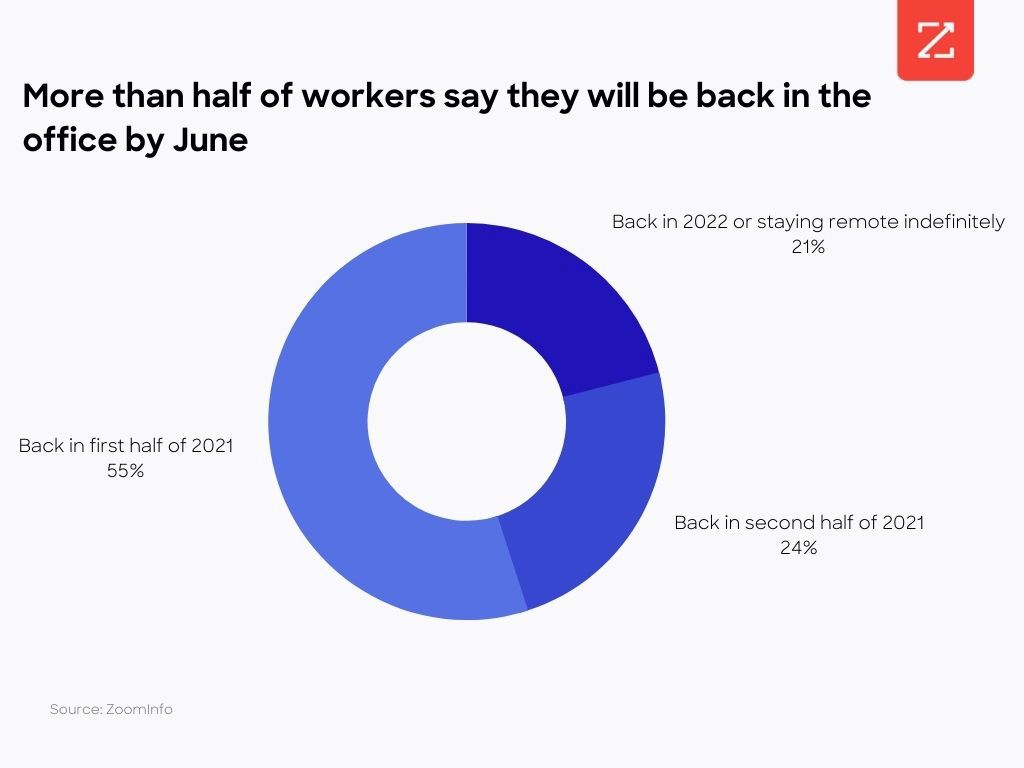
Nearly 55% of respondents, which included representation from executives, IT workers, and marketers, said their companies planned to be back in the office by June or were already back.
By comparison, 24% of people said they would go back at some point in the second half of 2021, and 21% indicated they wouldn't go back until 2022 or would stay remote indefinitely. The latter represents a sizable one out of five workers.
The findings follow prior research from ZoomInfo that showed employers searched online more often about COVID-19 screening topics than about testing topics, suggesting that less costly screenings may prove more popular for employers (Medium, 2021).
IT workers most likely to return by June
In breaking down ZoomInfo's survey results by job function, either marketing, IT, or executives, there are interesting differences.
Perhaps not surprisingly because of the nature of their jobs, more IT workers as a percentage had already returned to the office or planned to do so by June. Executives were close behind.
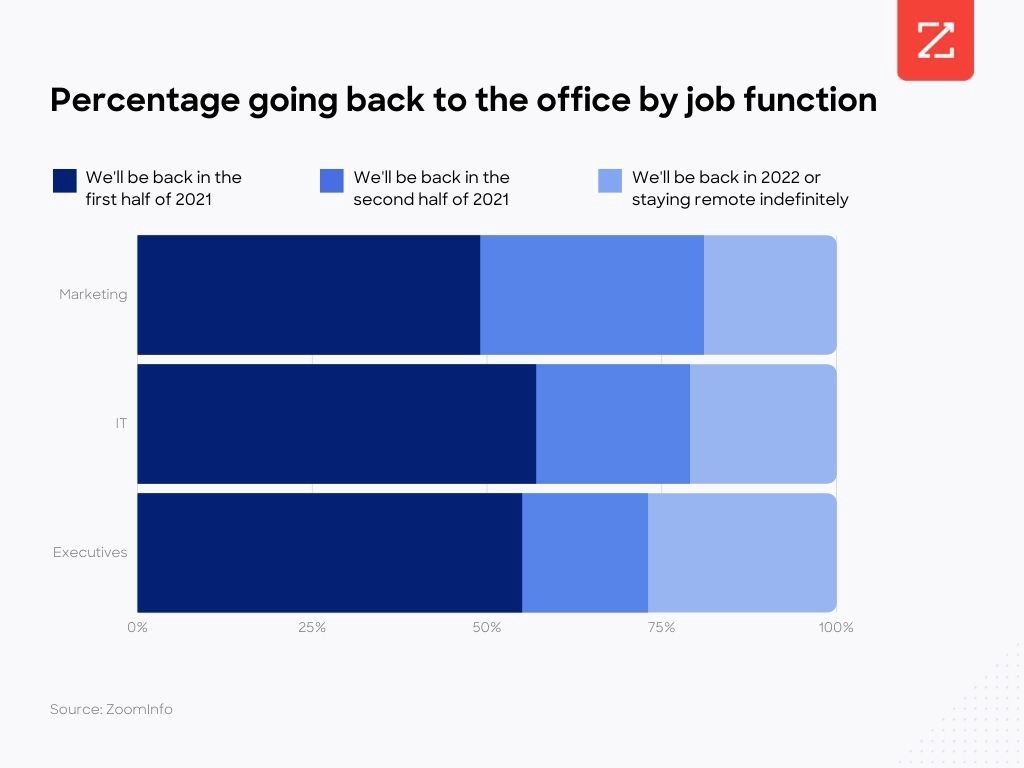
As for those coming back in the second half of the year, marketers by percentage outranked the other two categories.
Finally, executives placed higher than marketing or IT teams in saying they would stay remote until 2022 or even indefinitely. In many cases, it is the C-suite that is pushing for offices to reopen, so this 2022 outlier was unexpected.
Frequently asked questions about COVID return-to-work plans
What are the current CDC guidelines for returning to work after COVID?
Per the March 2024 CDC simplified respiratory virus guidance, employees may return to normal activities when symptoms have been improving for at least 24 hours and any fever has resolved without fever-reducing medication. This replaced the previous five-day isolation mandate that many employers built their COVID return-to-work plans around. Employers may set stricter internal standards than the CDC minimum, and some state jurisdictions have their own enforceable requirements that exceed the federal guidance.
How long should an employee stay home after testing positive for COVID?
Under current CDC guidance (2024), there is no fixed day-count requirement for the general population. The threshold is symptom-based: stay home until symptoms have improved for 24 or more hours and fever is gone without medication. Some employers, healthcare facilities, and state jurisdictions may require longer exclusion periods, so employees should check their employer's written return-to-work plan for the specific standard that applies to them.
What should a COVID return-to-work plan include?
A complete employer return-to-work plan should cover an exposure risk assessment by job role using OSHA's four-tier framework, a written COVID-19 Preparedness and Response Plan (required in some state-plan jurisdictions), close-contact notification protocols, return-to-work criteria aligned with current CDC guidance, PPE requirements by risk tier, and employee training and recordkeeping. See the checklist section above for a full step-by-step breakdown. If your organization needs data-driven support for workforce and go-to-market planning decisions, talk to our team.
Do employers have to follow CDC COVID guidelines?
CDC guidelines are recommendations, not federal mandates for most employers. However, OSHA can cite employers for failing to provide a safe workplace under the General Duty Clause, and state-plan states such as California under Cal/OSHA and Michigan under MIOSHA have issued their own enforceable rules that may exceed CDC minimums. Employers should treat CDC guidance as the floor, not the ceiling, and verify their specific state's requirements before finalizing any written policy.
What is the difference between a face covering and a respirator for COVID workplace compliance?
Face coverings (cloth masks, surgical masks) are source-control measures that reduce the spread of respiratory droplets from the wearer. Respirators (N95, KN95) are NIOSH-approved devices that protect the wearer from inhaling airborne particles and require fit-testing before use. OSHA's respiratory protection standard (29 CFR 1910.134) applies to employers in the High and Very High exposure risk categories. Employers should match PPE type to the employee's exposure risk tier rather than applying a single standard across all roles.