
Choosing between Affinity and Salesforce for deal management often comes down to these questions:
Are you managing relationship-driven deals in private capital, or transactional sales pipelines across a larger organization?
Do you want a CRM that captures your relationship data from email and calendar automatically, or one that scales across your entire business?
Is your team 10 investment professionals or 500 sales reps spread across multiple departments?
How much CRM administration are you willing to take on?
Do you have the B2B intelligence to know who to pursue and when they're ready to buy?
In short, here's what we recommend:
Affinity is built for private capital firms that live or die by their relationships. It automatically captures data from email and calendar to build relationship maps across your firm's network, assigning AI-powered relationship scores that show who has the strongest connection to a target.
For venture capital, private equity, and investment banking teams, Affinity eliminates the manual data entry that drags down traditional CRMs and surfaces warm introduction paths that help close deals 25% faster. However, its $2,000/user/year starting price targets mid-market firms, its analytics lag behind competitors, and its narrow focus on private capital means it isn't designed for general B2B sales teams.
Salesforce is the #1 CRM by market share, serving over 150,000 companies across every industry and company size. Its Sales Cloud, Service Cloud, Marketing Cloud, and Commerce Cloud form a single platform for managing the customer lifecycle. With Agentforce deploying autonomous AI agents and an ecosystem of 9,000+ partner apps, Salesforce can handle nearly any business process.
The trade-off: configuration requires dedicated administrators, 72% of sales reps' time still goes to non-selling activities, and pricing can spiral from $25/user/month to well over $500/user/month once you add the features you actually need.
Both platforms manage your deals and relationships. But neither solves the problem that comes before every CRM workflow: knowing who to target, when they're ready to buy, and what to say when you reach them. That's a data intelligence problem, and it determines whether your CRM is full of real opportunities or guesswork.
ZoomInfo is a B2B intelligence and GTM platform built on 500M contacts, 100M companies, 135M+ verified phone numbers, and 200M+ verified business email addresses. Its GTM Context Graph combines this data with your CRM records, conversation transcripts, and behavioral signals to reveal not just what's happening in your pipeline, but why deals move or stall.
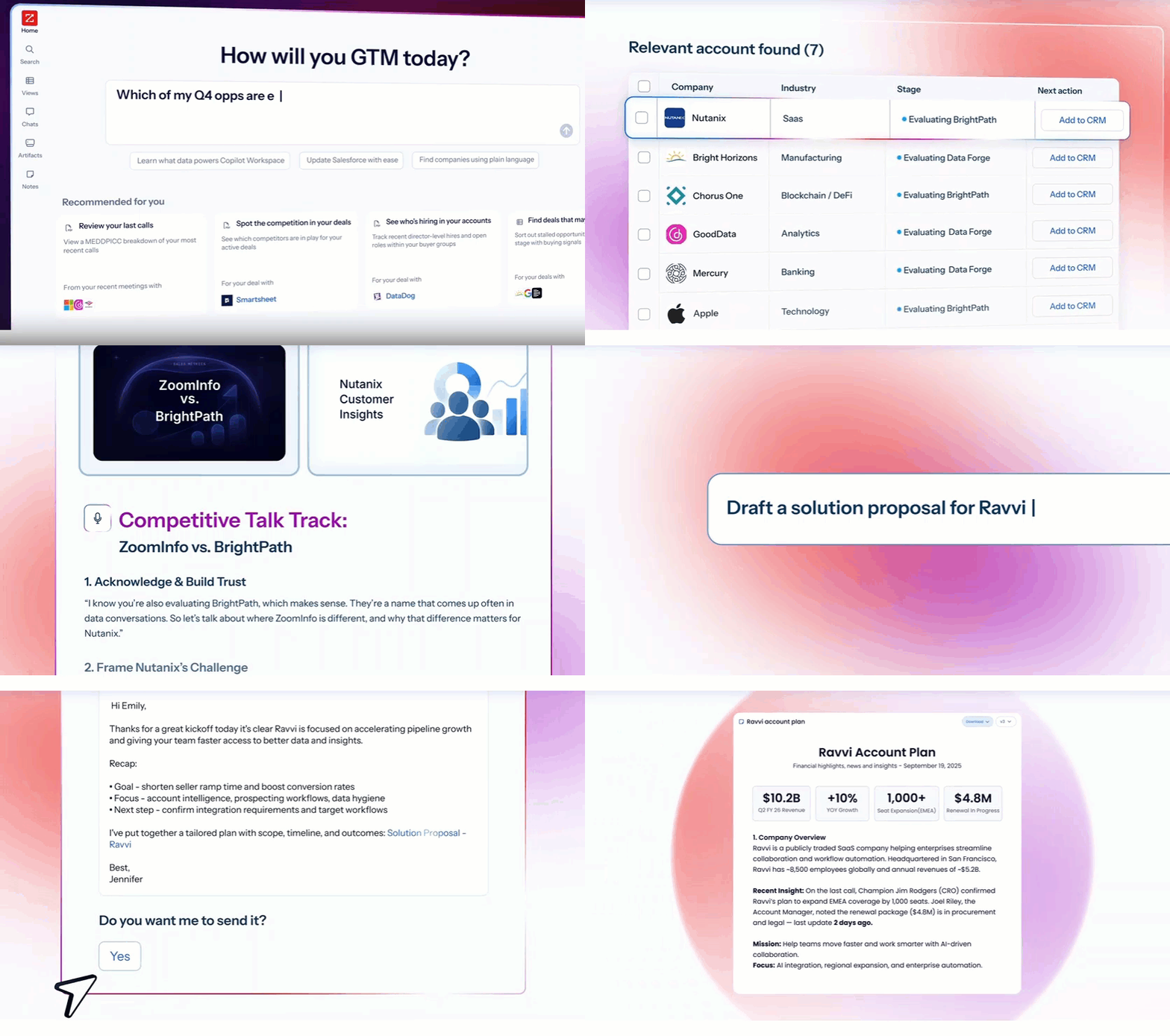
ZoomInfo works alongside either CRM through its Salesforce integration and API/MCP access, or serves as a workspace through GTM Workspace, where AI-drafted outreach, account intelligence, and deal signals live in one place.
If B2B intelligence sounds like the missing layer in your GTM stack, start with a free trial or explore ZoomInfo Lite at no cost.
Affinity vs. Salesforce vs. ZoomInfo at a glance
Affinity | Salesforce | ZoomInfo | |
|---|---|---|---|
Primary function | Relationship intelligence CRM for private capital | Enterprise CRM and business platform | B2B data intelligence and GTM execution |
Ideal user | VC, PE, investment banking firms | Sales, service, marketing teams across industries | B2B sales, marketing, and RevOps teams |
Data approach | Auto-captures from email and calendar | Manual entry + Einstein Activity Capture | 500M contacts, 100M companies with continuous verification |
AI capabilities | Relationship scoring, meeting transcription, deal assist | Agentforce autonomous agents, Einstein AI | GTM Context Graph, AI-drafted outreach, intent signals |
Starting price | $2,000/user/year | $25/user/month (Starter Suite) | Custom pricing; free Lite tier available |
Learning curve | Low; 30-day implementation | Steep; weeks to 12 months | Moderate; 90-day structured onboarding |
Ecosystem | Limited integrations | 9,000+ apps on AppExchange | 120+ partner integrations, API/MCP access |
Best for | Relationship-driven dealmakers in private capital | Organizations needing a full business platform | Teams needing B2B intelligence to power GTM execution |
Two different CRM philosophies
Affinity and Salesforce start from opposite assumptions about what a CRM should do.
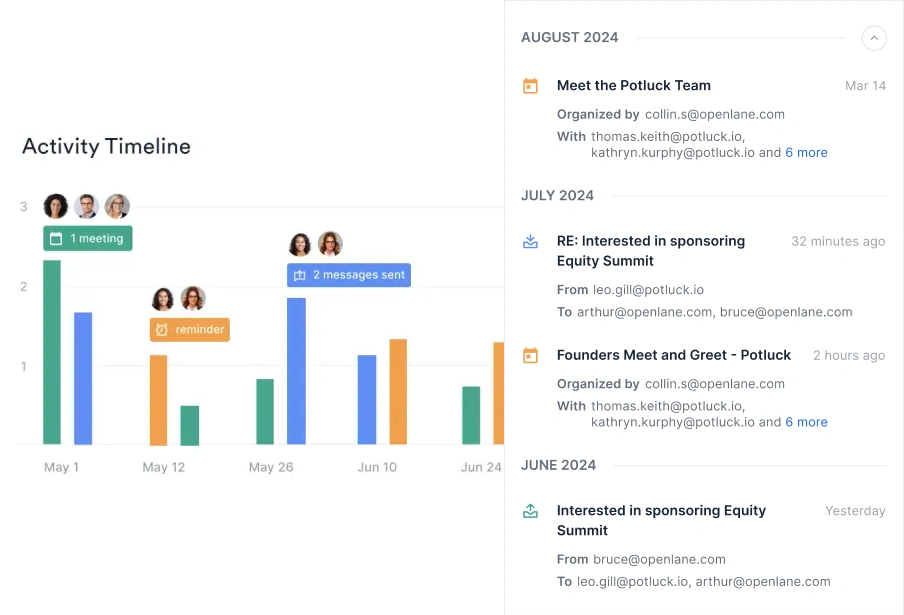
Affinity assumes your most valuable data already exists in your email and calendar. The platform automatically captures every communication and meeting, creating contact records and company profiles without manual input.
Source: Affinity
By 2021, it had processed over 18 trillion emails and calendar events. For investment professionals who evaluate hundreds of deals per year, this automation saves over 200 hours per employee annually.
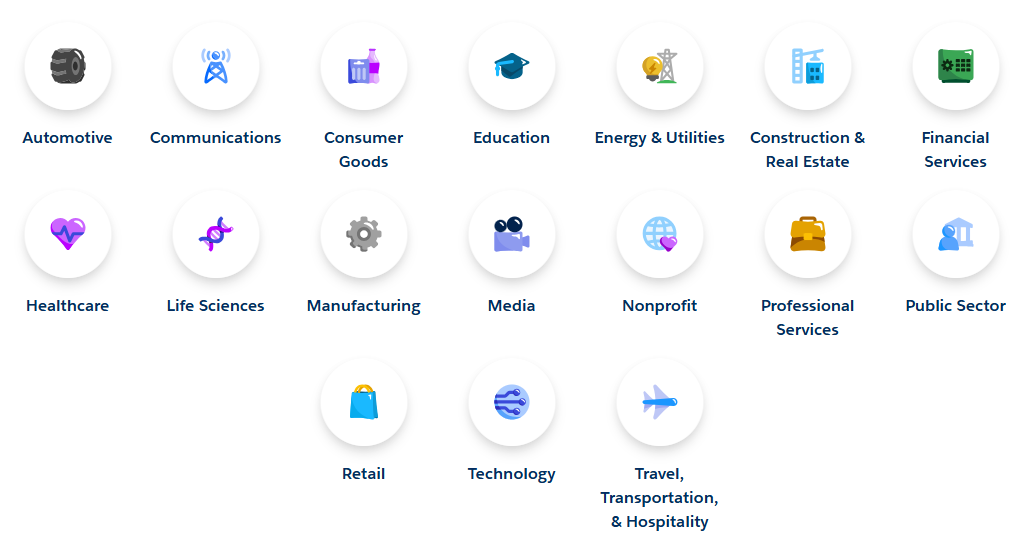
Salesforce assumes you need a platform that manages every aspect of your business. Beyond CRM, it covers service, marketing, commerce, analytics, and collaboration through dedicated clouds. Its Lightning Platform lets you build custom apps. Its 17 industry clouds provide vertical-specific data models and workflows.
Source: Salesforce
If your organization needs one system for sales pipeline, customer service ticketing, marketing automation, and e-commerce, Salesforce can do it all.
Relationship intelligence is where Affinity leads
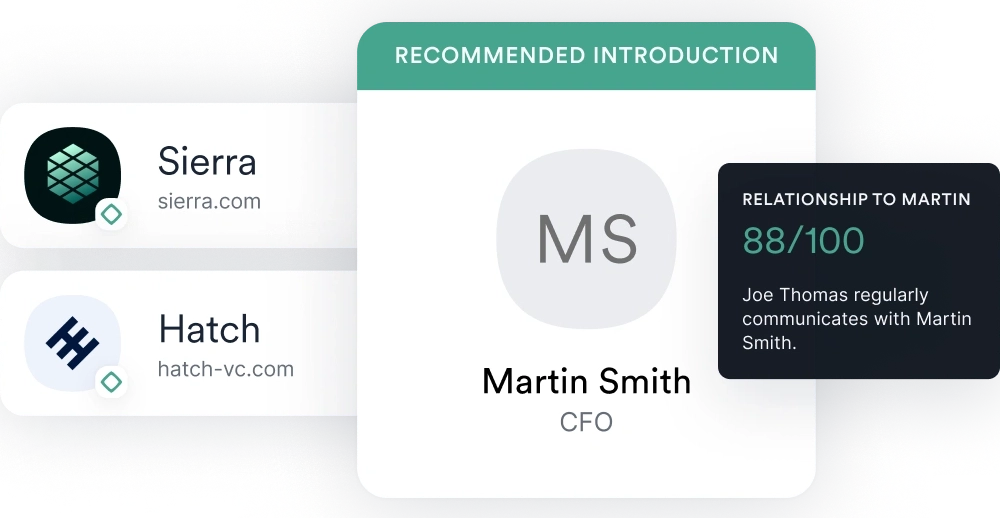
Affinity's core differentiator is its Relationship Intelligence technology. The platform analyzes communication patterns across your firm's network and assigns each relationship a strength score based on recency and frequency of interactions. When you need to reach a decision-maker at a target company, Affinity shows which team member has the strongest connection and suggests the best introduction path.
Source: Affinity
This matters in private capital because deals move through networks, not funnels. A venture capital firm evaluating a startup doesn't run it through a lead-scoring algorithm.
They ask: who on our team knows the founders, who can make a warm introduction, and how strong is that connection? Affinity surfaces these answers automatically, including inferred connections based on shared work history that extend beyond direct email contact.
Salesforce approaches relationship data differently. Einstein Activity Capture syncs emails and calendar events from Gmail and Outlook, but the platform was designed around structured data entry (accounts, contacts, opportunities, stages) rather than relationship mapping. Salesforce excels at tracking where a deal stands in your pipeline. Affinity excels at revealing who can move it forward.
Salesforce has responded with AI features through Agentforce, including AI-generated account plans with SWOT analysis and pipeline health signals. These help manage existing pipeline. But they don't replicate Affinity's ability to map your firm's collective network and score relationship strength across every connection.
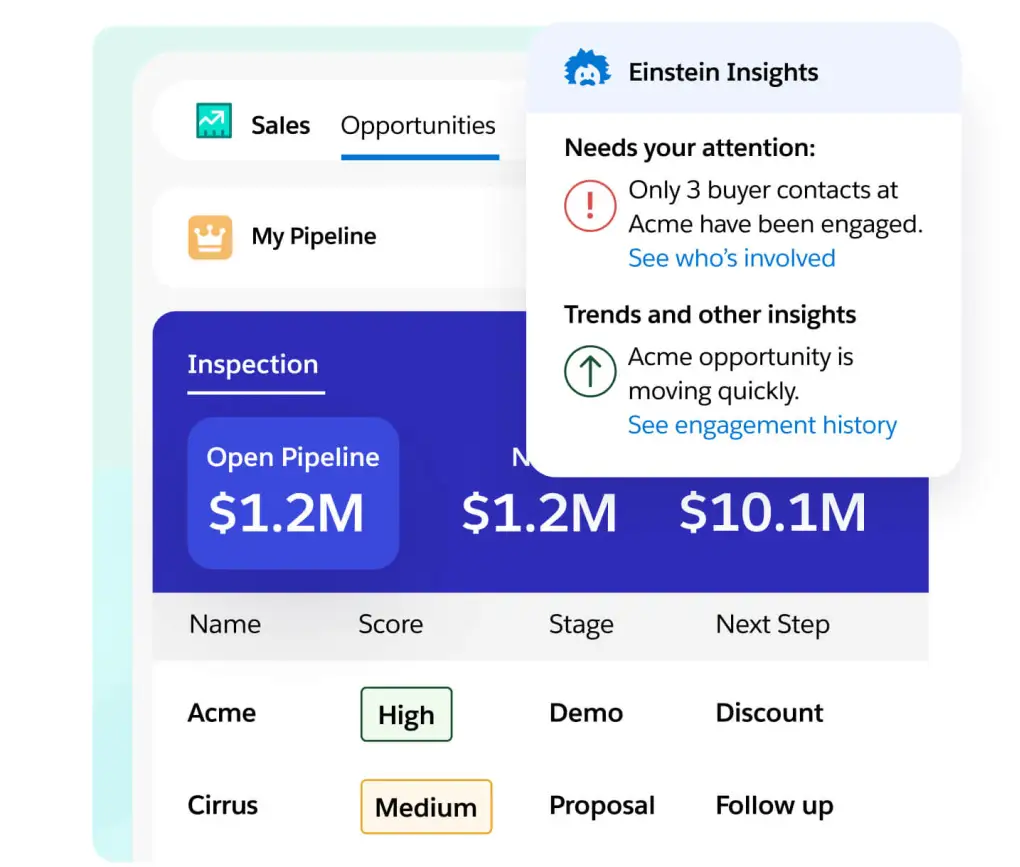
Source: Salesforce
The data gap neither CRM closes
Both Affinity and Salesforce are only as useful as the data inside them.
Affinity solves part of this problem by automating data capture from internal communications. But it can only surface relationships your team has already built. It doesn't tell you about the 500 companies in your target market that no one on your team has contacted, or that three of them are researching solutions in your space this week, or that the CFO at your top prospect just changed jobs.
Salesforce provides data enrichment through Data Cloud, which can ingest records from external sources. But the CRM itself doesn't include a B2B contact database. Sales reps still spend time researching prospects, finding direct phone numbers, and verifying email addresses before they can begin selling.
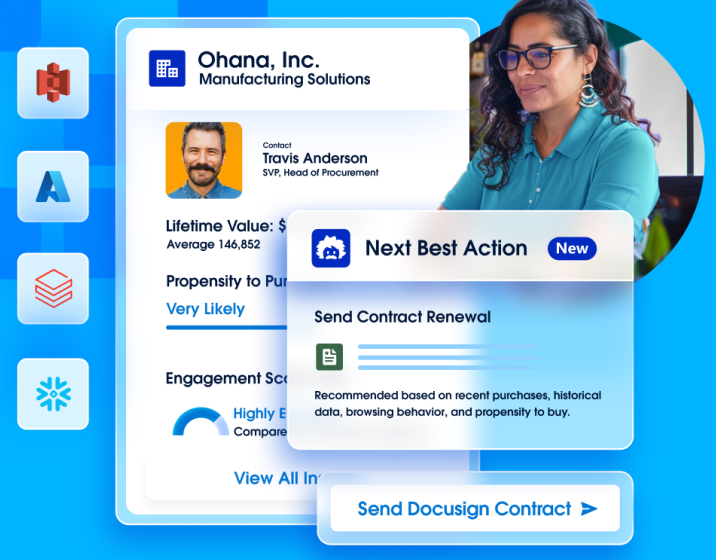
Source: Salesforce
This is the upstream problem ZoomInfo solves. The platform maintains the largest B2B dataset in the industry, verified through a multi-source pipeline that includes automated ML scanning of 28 million site domains daily, a contributor community of 200,000+ users who share data back, and an in-house team of 300+ human researchers.
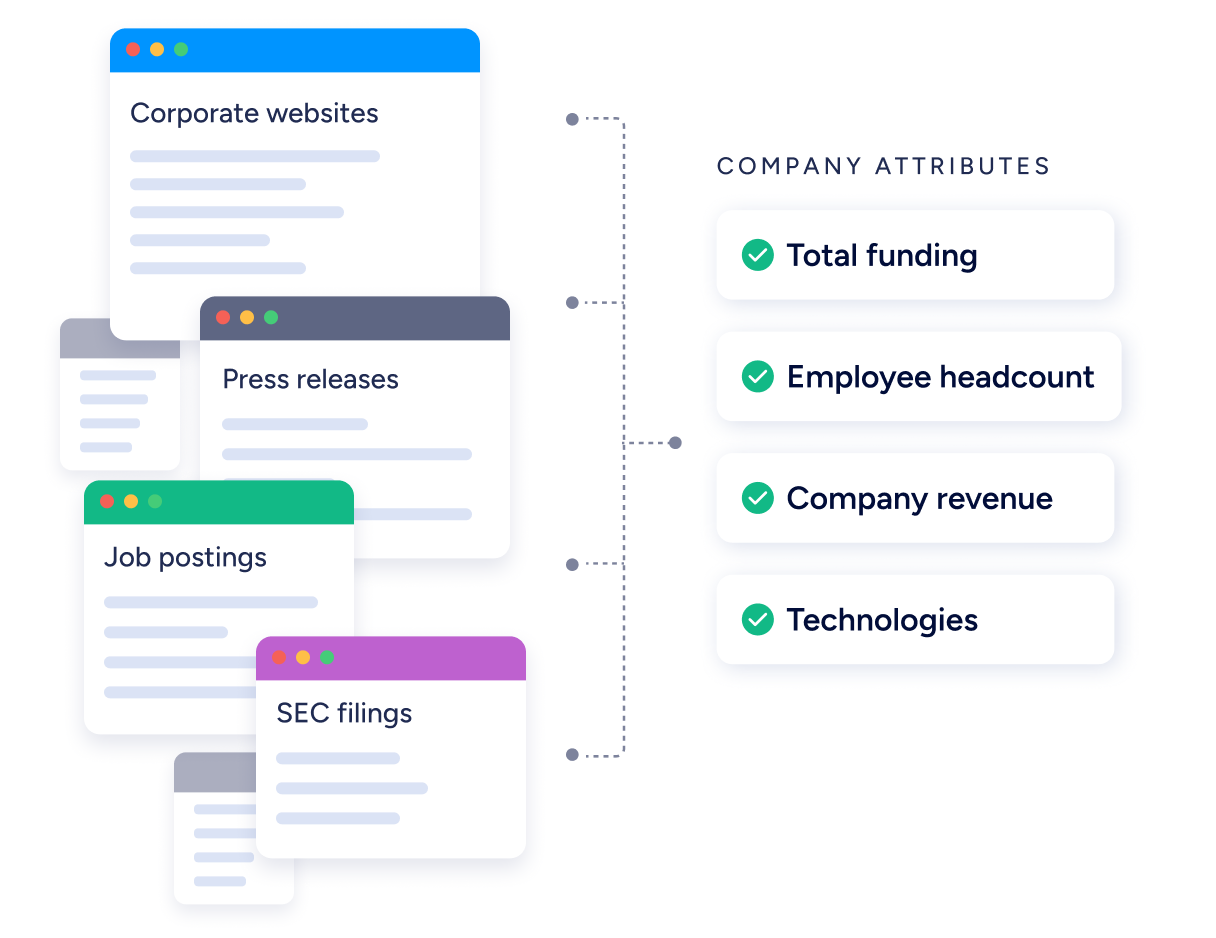
Source: ZoomInfo
First-party data reaches up to 95% accuracy. In a Fortune 500 competitive RFP analyzing 25 million contacts across vendors, an independent consultant concluded that "no other competitor came even close."
Beyond contact data, ZoomInfo tracks buyer intent signals from 210 million IP-to-Organization pairings and technographic data across 30+ million companies. These signals tell you not just who to contact, but when they're in-market.

Source: ZoomInfo
Snowflake uses ZoomInfo data for at least one-third of the most critical features in their Account Propensity Scoring model, feeding over 70 firmographic and technographic data fields. Accounts monitored using ZoomInfo-powered scores showed 90% higher opportunity open rates and 2x higher customer conversion rates. (Snowflake Case Study)
AI capabilities serve different purposes
Each platform's AI reflects its core mission.
Affinity uses AI to strengthen relationship understanding. Its Notetaker joins Zoom, Google Meet, and Microsoft Teams calls automatically, transcribing and summarizing conversations with vocabulary tuned for private capital terminology.
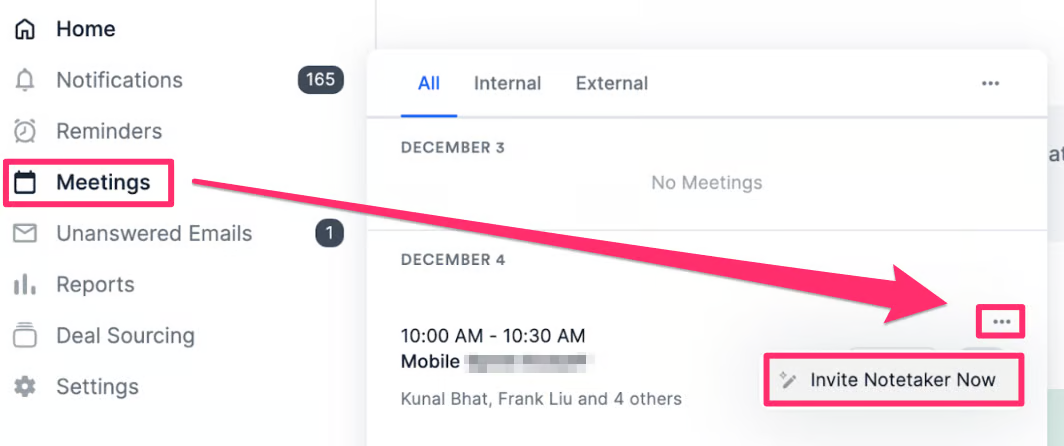
Source: Affinity
Deal Assist lets users ask natural-language questions about deals, analyzing PDFs, notes, and meeting transcripts to support investment decisions. Industry Insights generates competitor lists and tracks company changes. These features keep investment professionals informed without manual research.
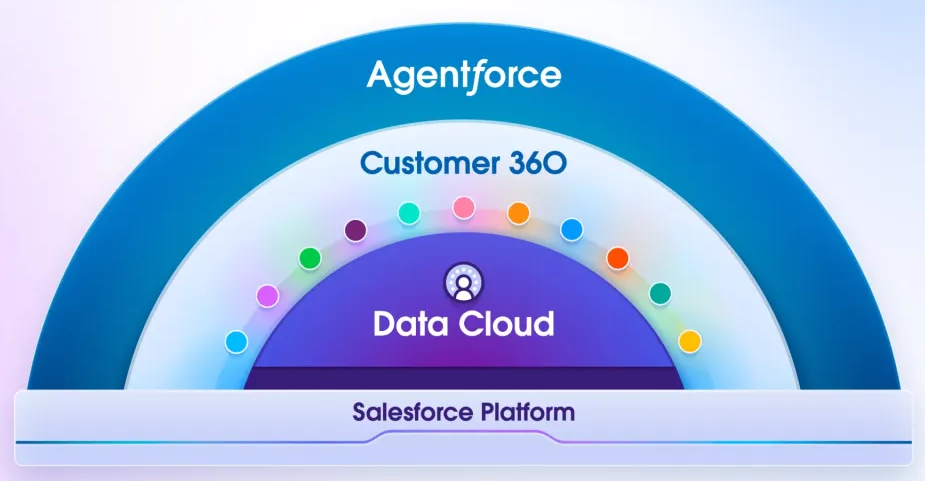
Salesforce uses AI to automate business processes at scale. Agentforce deploys autonomous AI agents that can resolve 85% of support requests without human escalation (demonstrated on Salesforce's own help site), handle sales prospecting, coach reps, and assist shoppers.
Source: Salesforce
The Atlas Reasoning Engine uses a reason-act-observe loop to handle multi-step tasks. With $800M in Agentforce ARR and 29,000 deals closed, Salesforce is betting heavily on AI agents as the next wave of enterprise automation.
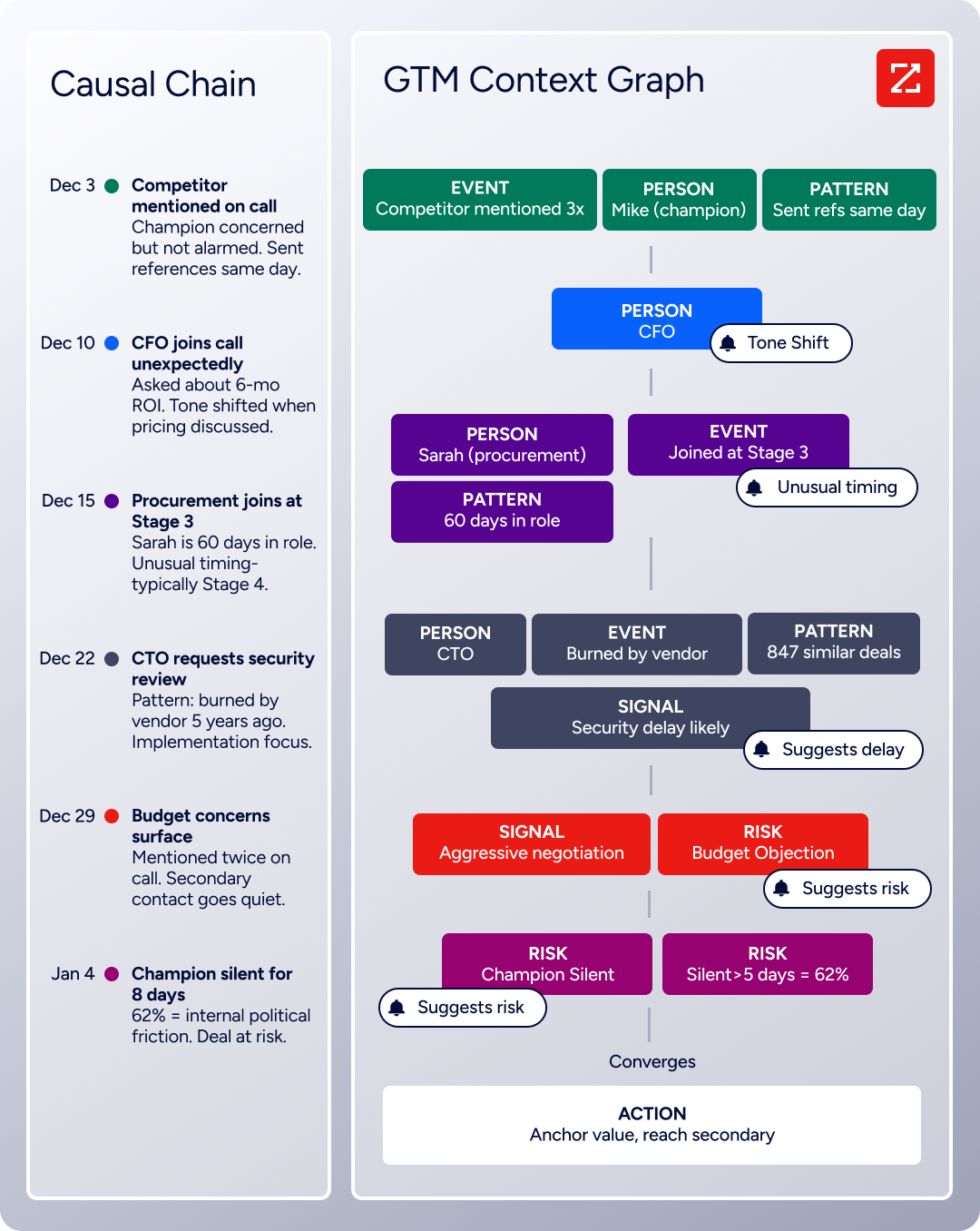
ZoomInfo uses AI to connect intelligence with action. The GTM Context Graph goes beyond recording deal stages or transcribing calls. It reasons across CRM data, conversation intelligence, intent signals, and behavioral data to capture why deals move or stall.
Source: ZoomInfo
As ZoomInfo's CPO Dominik Facher writes: "The CRM recorded the state change. It has no record of why it happened." The GTM Context Graph fills that gap, powering AI-drafted outreach in GTM Workspace and AI-built audience segments in GTM Studio.
Source: ZoomInfo
Seismic attributed 39% of active pipeline to opportunities identified or influenced by ZoomInfo signals, with the sales team reporting 54% productivity gains and saving 11.5 hours per week per seller. (Seismic Case Study)
Pricing reflects different markets
Affinity's pricing is straightforward: four annual tiers, all per-user.
Essential: $2,000/user/year (activity capture, relationship scoring, pipeline management)
Scale: $2,300/user/year (adds browser extensions, analytics, mobile access, inferred connections)
Advanced: $2,700/user/year (adds AI meeting intelligence, bulk email, premium data enrichment)
Enterprise: contact sales (adds SSO, granular permissions, unlimited API access)
Third-party research suggests implementation costs range from $5,000 to $25,000, and multi-year contracts can reduce annual pricing by 10-20%.
Salesforce's pricing requires more navigation. Sales Cloud alone spans five tiers:
Free Suite: $0/user/month (max 2 users, basic functionality)
But these are starting points. Agentforce AI capabilities require additional per-user licensing ($125/user/month) or consumption credits ($2 per conversation). Premier Support adds 30% of net license fees. Data Cloud, Marketing Cloud, and other products carry separate pricing.
Over 70% of implementations are partner-led, adding further cost. A mid-market company running Sales Cloud Enterprise with AI and proper support can easily spend $300-400 per user per month all in.
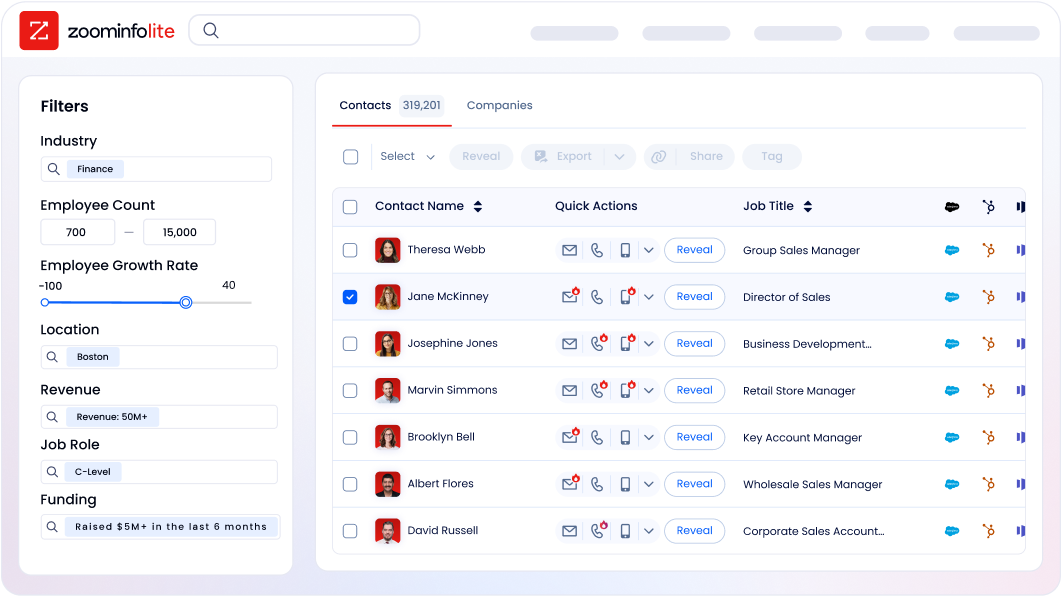
ZoomInfo uses custom, consumption-based pricing with no published rates for paid tiers. It does offer a permanent free tier (ZoomInfo Lite) with access to the B2B database, 10 monthly export credits, and basic prospecting tools, plus a 7-day free trial of the full platform. Paid plans scale based on seats, credit volume, and feature access across Sales, Marketing, and Enterprise tiers.
Source: ZoomInfo
Implementation tells you how quickly you'll see value
Affinity was designed for fast adoption. Implementation typically takes 30 days or less. The platform runs in the background once connected to your email and calendar, capturing data without changing how your team works.
Salesforce implementation timelines vary widely. A simple Sales Cloud setup for a small team can take weeks. An enterprise multi-cloud deployment with custom objects, integrations, and data migration can take 3-12 months.
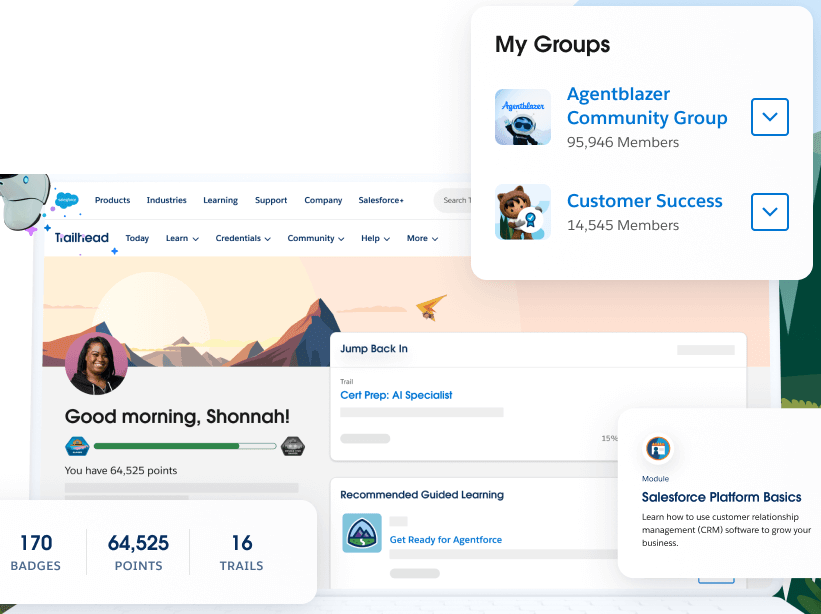
The platform requires dedicated administrators (the Salesforce admin role is a career path in itself), and Trailhead offers 1,500+ badges and 60+ certifications for upskilling. This investment pays off in platform power, but it means Salesforce is not a tool you turn on and use at full capacity immediately.
Source: Salesforce
ZoomInfo falls between the two. The platform redesigned its onboarding to a structured 90-day process covering planning, technical implementation, education, and adoption. That investment produced a 25% improvement in customer satisfaction scores.
CEO Henry Schuck has noted that GTM Workspace "deploys in weeks, not months", and role-specific learning paths through ZoomInfo University cover Sales, Marketing, Administrator, and Customer Success tracks.

Source: ZoomInfo
Integration ecosystems show different strategies
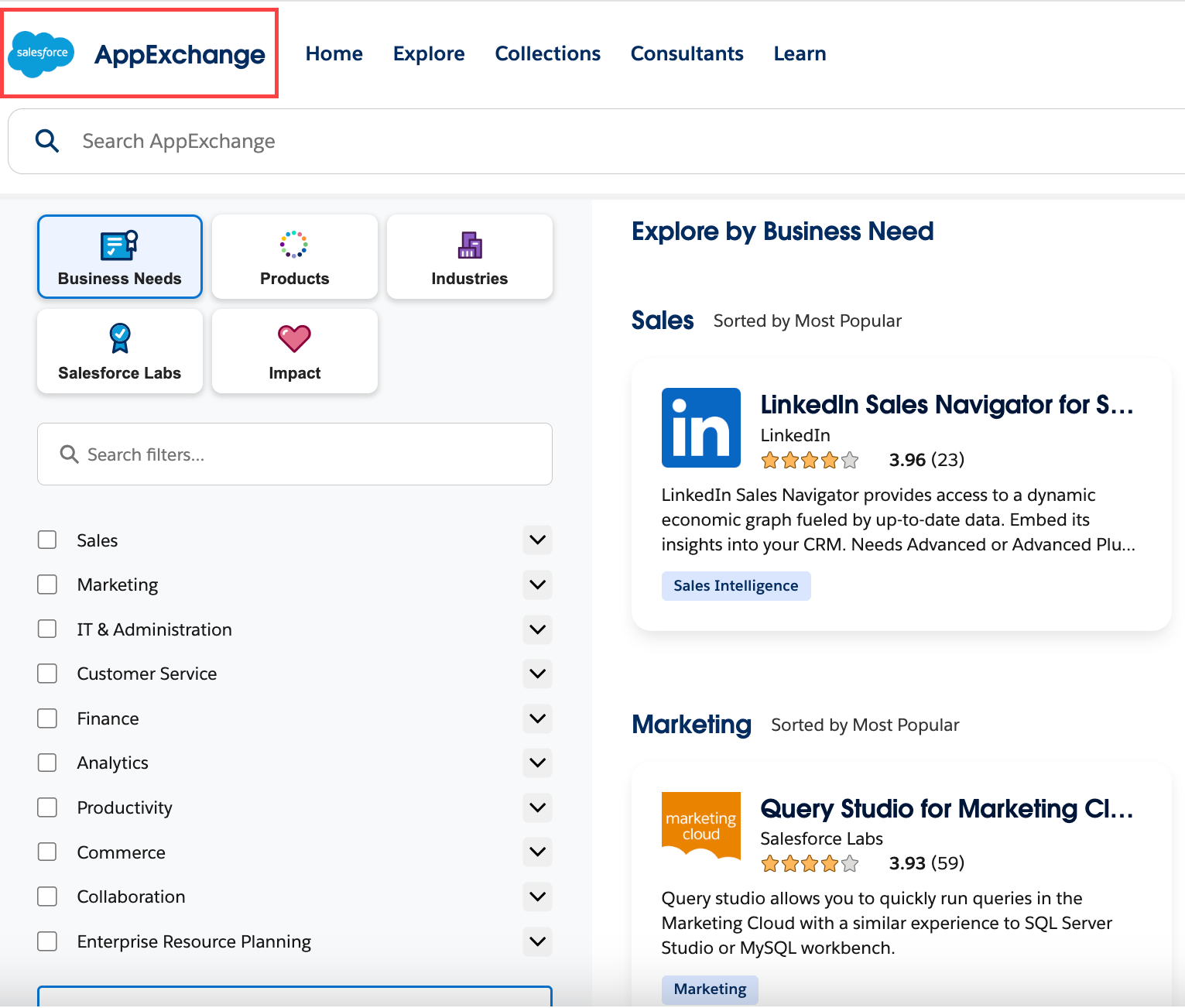
Salesforce's integration ecosystem is in a class by itself. AppExchange lists 9,000+ partner apps with 14+ million installs, and 91% of customers use at least one AppExchange app. MuleSoft provides enterprise-grade API management with hundreds of pre-built connectors. For organizations building a technology stack, Salesforce is the hub everything connects to.
Source: Salesforce
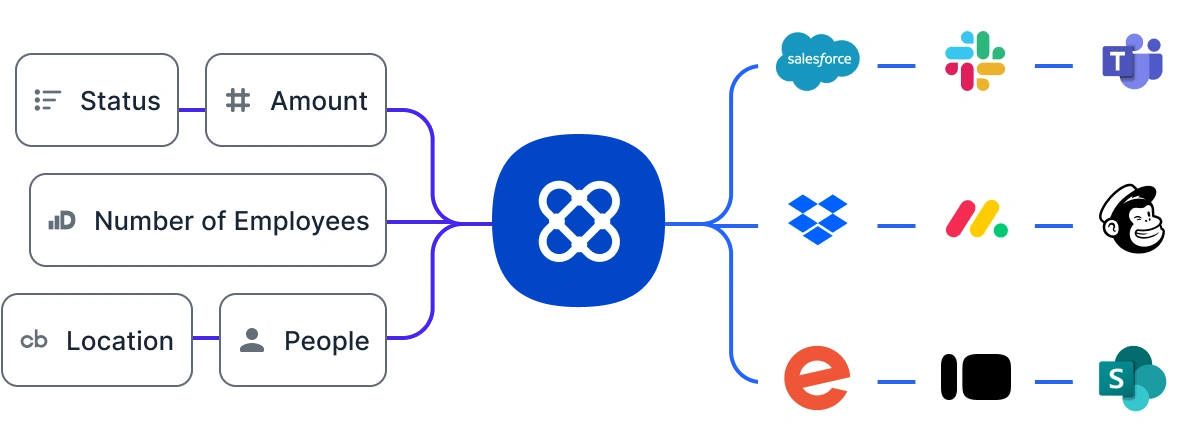
Affinity's integration ecosystem is narrower but targeted. Native integrations cover Gmail, Outlook, Slack, Microsoft Teams, Salesforce, Box, DocuSign, Dropbox, and Airtable, with data enrichment partners like Crunchbase, Dealroom, and PitchBook. The API v2 provides programmatic access, with Advanced tiers offering 100,000 monthly calls and Enterprise providing unlimited access.
Source: Affinity
Notably, Affinity offers Affinity for Salesforce, a product that layers relationship intelligence into existing Salesforce deployments, acknowledging that some firms need both platforms.
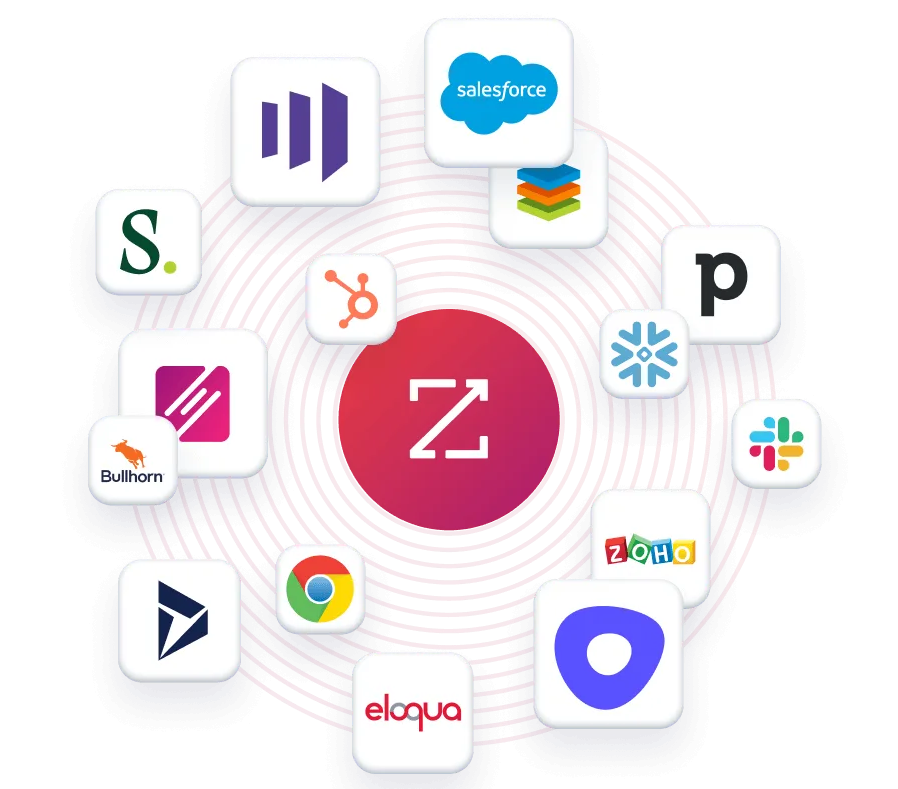
ZoomInfo makes its data available wherever you work. The ZoomInfo App Marketplace lists 120+ partner integrations across CRM, marketing automation, sales engagement, and data warehouse categories.
Source: ZoomInfo
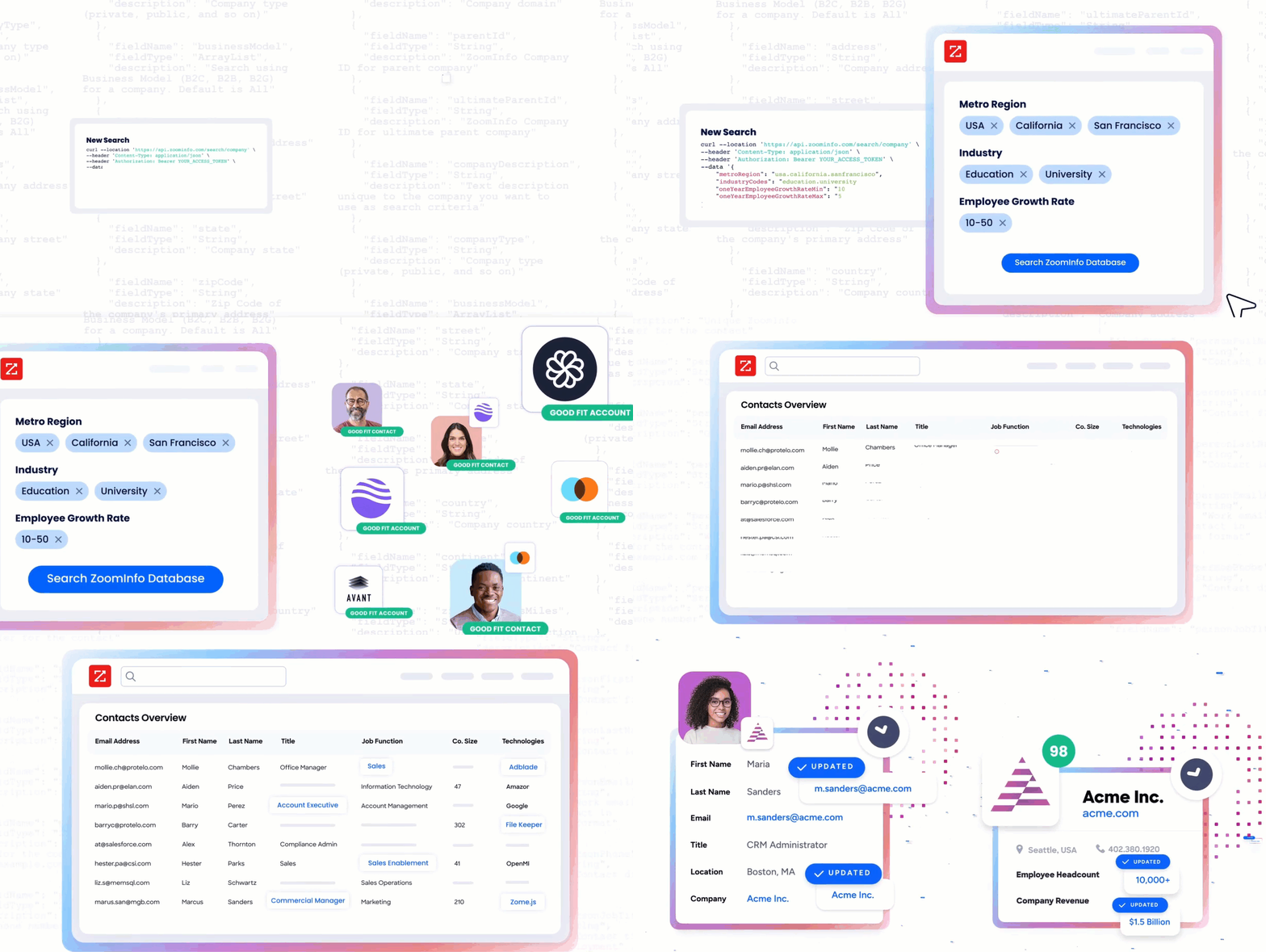
The Enterprise API and MCP server make ZoomInfo's data available inside any tool or AI agent, from Anthropic Claude to Google to proprietary systems. API access is included in all relevant plans, not locked behind enterprise tiers.
Source: ZoomInfo
BDO Canada achieved an 87% reduction in time spent on updates to their internal data dashboards by using ZoomInfo's API. "The plug-and-play aspect of the API means I can integrate it very easily into any process and get information at a moment's notice," noted Jerry Wilson, Senior Marketing Intelligence Analyst. (BDO Canada Case Study)
Where ZoomInfo fits with either CRM
ZoomInfo is not a CRM replacement. It's the intelligence layer that makes your CRM more effective, regardless of which one you choose.
For Salesforce users, ZoomInfo enriches CRM records with verified contact data, company attributes, and technographics. Intent signals and buyer behavior data flow into Salesforce to prioritize accounts. GTM Workspace gives sellers AI-drafted outreach and account intelligence in one place, reducing the time spent on non-selling activities inside Salesforce.
For a deeper look at how these two platforms compare as standalone solutions, see our Salesforce vs. ZoomInfo breakdown.
For Affinity users, ZoomInfo fills the gap between relationship intelligence and market intelligence. Affinity tells you who in your network knows a target company's leadership. ZoomInfo tells you which companies are in-market, what technologies they use, how fast they're growing, and who the key decision-makers are, with verified contact details to reach them directly.
For teams using both Affinity and Salesforce (through Affinity for Salesforce), ZoomInfo adds the third data dimension: verified B2B intelligence that neither platform generates on its own.
Redwood Logistics achieved a 99% reduction in CPC and a 310% increase in CTR by combining ZoomInfo's data-driven targeting with their internal systems. "It's not just the data itself. It's more about the right data at the right time to help us reach out with the right message across that full buyer journey," noted Chelsea Kenyon, Senior Director of Digital Strategy. (Redwood Logistics Case Study)
Affinity vs. Salesforce vs. ZoomInfo: Which should you choose?
Choose Affinity if:
You're a venture capital, private equity, or investment banking firm
Relationship mapping and warm introductions drive your deal flow
You want a CRM that captures data automatically from email and calendar
Your team manages relationship-driven deals in private capital
Quick implementation (30 days or less) matters more than platform breadth
Choose Salesforce if:
You need a platform that scales across sales, service, marketing, and commerce
Your organization has the resources for dedicated CRM administration
Integration with thousands of third-party apps is a requirement
You're building AI-powered automation with Agentforce across departments
You need industry-specific solutions for regulated verticals
Add ZoomInfo if:
You need verified B2B contact and company data
Knowing which accounts are in-market would change how you prospect
Your CRM suffers from incomplete or stale records
You want AI-powered GTM execution through GTM Workspace or GTM Studio
You need B2B intelligence accessible via API or MCP in any tool your team uses
Start free with ZoomInfo Lite or request a full platform demo.
The choice between Affinity and Salesforce depends on your team's size, industry, and workflow. Affinity is the pick for private capital firms where relationship intelligence drives every decision. Salesforce is the platform for organizations that need to manage customer operations across multiple departments and use cases.
But regardless of which CRM you choose, the quality of your go-to-market depends on the quality of your data. ZoomInfo provides that intelligence foundation, whether your team accesses it through Salesforce, through Affinity, through GTM Workspace, or through any other tool via API and MCP.
Affinity vs. Salesforce vs. ZoomInfo FAQ
Is Affinity a competitor to Salesforce?
Not directly. Affinity is a specialist CRM built for private capital firms (venture capital, private equity, investment banking), focused on relationship intelligence and automated data capture from email and calendar.
Salesforce is a general-purpose CRM platform serving over 150,000 companies across all industries. Affinity even offers a product called Affinity for Salesforce that layers relationship intelligence into existing Salesforce deployments, recognizing that some firms use both.
Can ZoomInfo replace my CRM?
ZoomInfo is not a CRM. It's a B2B data intelligence and GTM execution platform. While GTM Workspace provides a place for account research, AI-drafted outreach, and deal signals, it works alongside your CRM rather than replacing it. ZoomInfo integrates with Salesforce, HubSpot, and Microsoft Dynamics to enrich records and deliver intelligence where your team already works.
Which platform is best for a small venture capital firm?
Affinity is the strongest fit. It was built for relationship-driven dealmakers in private capital, with automated data capture that eliminates manual CRM entry, relationship scoring that surfaces warm introduction paths, and deal management tailored to investment workflows. More than half of the top VC firms use Affinity, including Kleiner Perkins, Bessemer, and Lightspeed.
How much does each platform actually cost?
Affinity starts at $2,000/user/year for its Essential tier and goes up to $2,700/user/year for Advanced, with Enterprise pricing available on request. Salesforce Sales Cloud starts at $25/user/month for Starter Suite, but most teams need Enterprise ($175/user/month) or higher, plus add-ons for AI capabilities, premium support, and additional clouds.
ZoomInfo uses custom consumption-based pricing with no published rates, though ZoomInfo Lite is available permanently at no cost with limited export credits and features.
What is ZoomInfo's GTM Context Graph?
The GTM Context Graph is ZoomInfo's intelligence layer that processes over 1.5 billion data points daily. It combines ZoomInfo's third-party B2B data with a customer's CRM records, conversation transcripts, and behavioral signals to capture not just what happened in a deal, but why.
This context powers AI-drafted outreach, account prioritization, and deal insights across GTM Workspace, GTM Studio, and any tool connected via API or MCP.
Does Affinity work with Salesforce?
Yes. Affinity offers a dedicated product called Affinity for Salesforce that integrates relationship intelligence into existing Salesforce implementations. This includes automated activity capture logged in Salesforce, relationship strength scores visible within Salesforce records, and firm-wide interaction history across all team members.
Which platform has the strongest AI capabilities?
Each platform's AI serves a different purpose. Affinity's AI focuses on relationship intelligence: meeting transcription tuned for private capital terminology, conversational deal research via Deal Assist, and AI-generated competitor analysis through Industry Insights. Salesforce's Agentforce deploys autonomous AI agents across sales, service, and marketing workflows, powered by the Atlas Reasoning Engine.
ZoomInfo's GTM Context Graph reasons across CRM data, conversation intelligence, and market signals to explain deal dynamics and power contextual AI-drafted outreach through GTM Workspace.
Can I use all three platforms together?
Yes. A common enterprise configuration uses Salesforce as the CRM, Affinity for Salesforce for relationship intelligence, and ZoomInfo for B2B data enrichment, intent signals, and GTM execution.
ZoomInfo integrates natively with Salesforce, and its API and MCP server make its intelligence available in any connected tool. Each platform addresses a distinct layer of the go-to-market stack: Salesforce manages customer operations, Affinity maps relationships, and ZoomInfo provides the underlying data intelligence.
