

In 2026, the strongest AI GTM tools go past scheduled automation to run agentic workflows that complete multi-step tasks on their own. The result is a shorter sales cycle, from first signal to booked action.
This guide covers 12 and draws the line the category blurs: a point tool automates a single job, while an AI GTM platform grounds every agent in verified data. Settle that distinction first, because it decides what belongs on your shortlist.
What Are AI GTM Tools?
AI GTM tools are software platforms that use artificial intelligence to run the sales, marketing, and customer success work teams once handled by hand. Instead of building lists, researching accounts one at a time, and writing every email from scratch, they surface which accounts are ready to buy and act on that signal while the buyer is still in the research phase.
The category splits three ways by how much the AI actually does:
Rules-based automation fires a fixed action when a condition is met.
Predictive AI reads behavioral signals and ranks accounts by likelihood to buy.
Agentic AI runs multi-step research and outreach on its own, closer to an AI SDR than a scheduled task, checking in with a human at the decisions that matter.
A second split decides what you shortlist. Most of the tools in this guide are point tools that automate one job, such as conversation intelligence, sequencing, enrichment, or ABM advertising. A smaller set are AI GTM platforms, a reasoning layer that connects verified data, real-time buying signals, conversation history, and CRM records so agents act on the full picture of an account. The strongest platforms share four capabilities:
Unified data layer that pulls CRM, marketing, and product-usage data into one source of truth about each buyer.
Predictive signal processing that reads website visits, content downloads, and search activity to flag high-intent companies before they raise a hand.
Agentic workflow execution that runs outreach across email, phone, and social, updates CRM records, and handles lead routing without manual work at each step.
Personalization at scale that tailors messages to company, role, recent activity, and buying stage, well past merge-field substitution.
The distinction matters because most teams are not seeing the returns they expected. Use of AI products has grown 893% since 2022 across nearly every industry, according to ZoomInfo technographic data. Yet the payoff stays thin: 71% of teams using AI in marketing and sales report revenue gains, though the most common increase is still under 5%, according to Stanford's 2025 AI Index.
The gap traces back to data. Teams that want to wire verified B2B intelligence directly into their own agents can do that through GTM AI, ZoomInfo's context layer, which connects 100M+ companies and 600M+ contacts to any agent via MCP or one API, so the AI reasons from real data rather than filling gaps with guesses.
AI GTM Tools and Platforms at a Glance
Platform | Primary Focus | AI Capability | Pricing Model | Best For |
ZoomInfo | All-in-one AI GTM platform | GTM Context Graph reasoning, agent execution, predictive scoring | Free to start, consumption credits | Mid-market to enterprise teams needing data, signals, and automation in one platform |
Apollo | Prospecting and engagement | AI agents, drafted emails, call summaries | Public tiered ($0 to $119/seat/mo + Enterprise) | Startups to enterprises wanting integrated prospecting |
Cognism | GDPR-compliant EU data | Diamond Verified data, intent integration | Quote-based (Standard / Pro) | European teams requiring compliance |
6sense | ABM and predictive intelligence | Predictive scoring, RevvyAI agent, MCP server | Free tier + quote-based bundles | Enterprise ABM programs |
Gong | Conversation intelligence | Call analysis, coaching, Engage and Forecast | Quote-based | Teams focused on call quality and deal review |
Clay | Data orchestration | Claygent agent, waterfall enrichment, MCP | Public tiered (Free / Launch $167 / Growth $446) | Teams building custom GTM workflows |
HubSpot | Unified CRM and marketing | Breeze Assistant, Agent Hub, lead scoring | Public tiered (Free CRM; $20 to $150/seat/mo) | Teams wanting sales and marketing on one platform |
Outreach | Sales engagement | Autonomous agents, Omni, MCP server | Quote-based (Amplify tiers) | Enterprise sales development |
Salesloft | Revenue orchestration | AI agents, in-platform CI, Clari forecasting | Quote-based (Advanced / Elite) | Mid-market to enterprise revenue teams |
Demandbase | Account-based marketing (ABX) | Account intent, identification, advertising | Quote-based | Enterprise ABM and demand gen |
Clearbit | Data enrichment (Breeze Intelligence) | Firmographic and technographic enrichment | HubSpot Credits (Pro / Enterprise) | HubSpot-centric teams |
Seamless.AI | Contact search | Real-time verification, prospecting agents | Free + quote-based tiers | Individual sellers and small teams |
The 12 Best AI GTM Tools & Platforms of 2026
We evaluated each platform on data verification, AI capability type (rules-based, predictive, or agentic), signal velocity, workflow activation depth, integration breadth, compliance, and pricing transparency. The ranking reflects how well each one holds up against the jobs a seller, RevOps lead, or marketing buyer actually needs done.
1. ZoomInfo
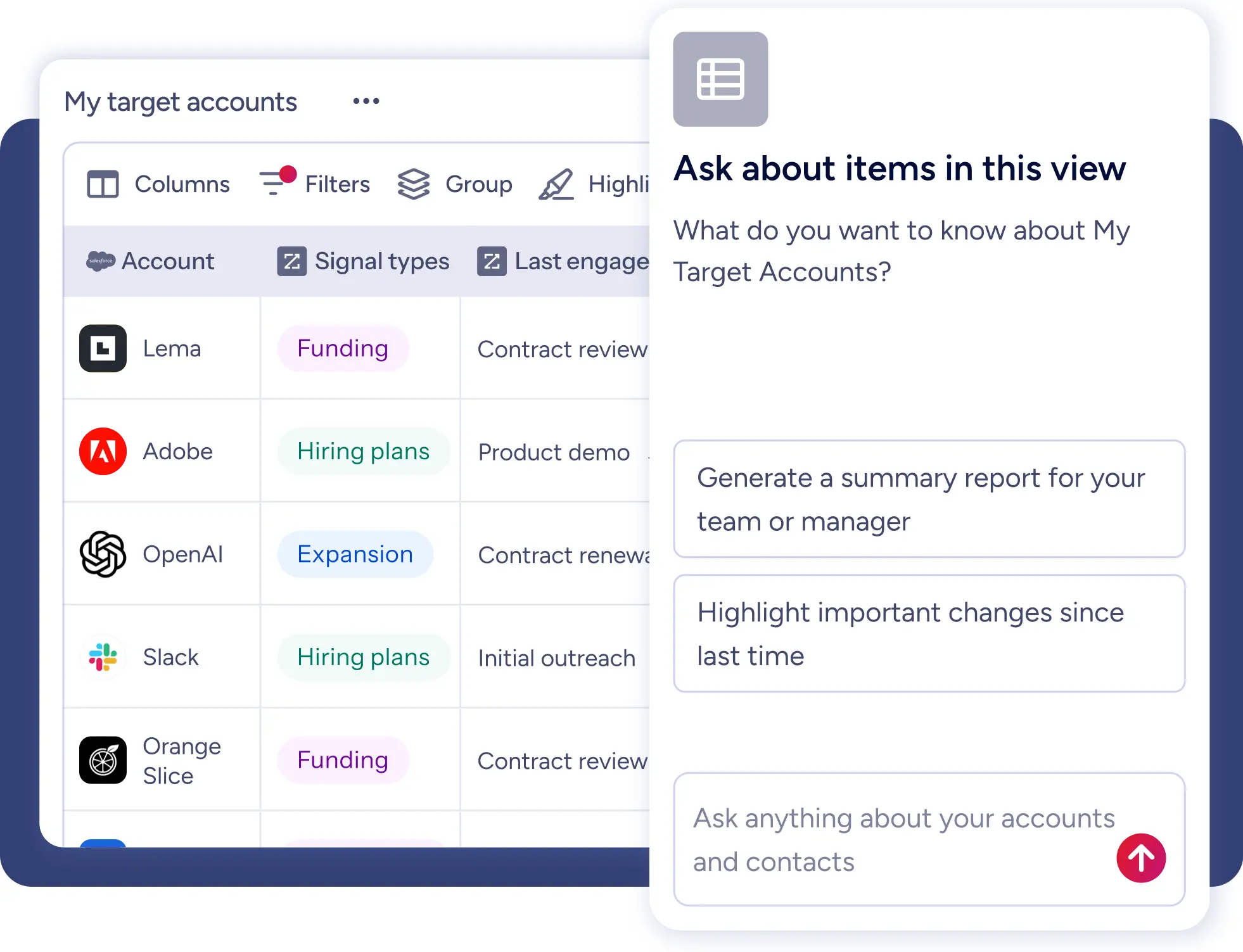
ZoomInfo is an all-in-one AI GTM platform, and the one option on this list built as a reasoning layer rather than a single tool. A verified B2B data foundation feeds the GTM Context Graph, which processes 1.5B+ data points daily and connects contact and company records, real-time buying signals, conversation history, and CRM activity into one picture of each account. Because agents reason over that whole account, they execute plays and update records instead of scoring in isolation.
The platform reaches each team through its own products, delivered by GTM AI, the context foundation for AI-powered go-to-market. GTM Workspace is the seller surface, GTM Studio gives RevOps and marketers a codeless builder for audiences and plays, and the API, MCP server, and CLI open the same data and reasoning layer to developers and any AI agent. Because that access runs through MCP, teams can pull verified data into the tools they already use, including Claude and ChatGPT, so an assistant reasons from real B2B data with accuracy scores rather than working like a ChatGPT wrapper guessing from the public web.
Key features
GTM Context Graph reasoning across CRM, intent, conversation, and behavioral signals, processing 1.5B+ data points daily
Verified data on 600M+ contacts and 100M+ companies with 4,500+ intent topics, continuously refreshed with per-record accuracy scores
ZoomInfo Intent for real-time buying signals, plus WebSights to de-anonymize visiting companies and surface the dark funnel through identity resolution
Technographic intelligence on the tech stack of 30M+ companies
GTM AI skills that run named jobs from a single prompt, including account research, buying-group mapping, list-building, and enrichment
Verified data inside Claude and ChatGPT through the ZoomInfo MCP server, with accuracy scores on every field
Enterprise compliance, including ISO 27001, ISO 27701, SOC 2 Type II, and TRUSTe GDPR/CCPA
Pros
One platform covers the full GTM motion, pulling verified data, intent, conversation intelligence, and agent execution into a single system that replaces a stack of point tools
AI agents reason over the whole account rather than one data silo, because every team and every assistant works from the same GTM Context Graph
Because the data underneath is continuously verified, AI acts on facts rather than guesses, which is where most GTM AI investment stalls
Cons
Enterprise-tier commercial model that fits mid-market and up better than very small teams
Full-platform breadth means a real ramp when teams adopt multiple products together
Best for: Mid-market to enterprise revenue teams that want verified data, buying signals, conversation intelligence, and agent execution running off the same context.
Pricing: Free to start, with consumption credits based on usage.
ZoomInfo customer outcomes
ZoomInfo customers grew their total addressable markets by 40% on average, with 32% pipeline growth and 31% larger deals through multithreaded outreach, and three in four say they surfaced opportunities they would have missed. A few examples:
Snowflake built an Account Propensity Score on 70+ data points and saw a 90% lift in opportunity open rates with 2x new-customer conversion.
Seismic grew pipeline 40% and gave sellers back more than 40 hours a month.
Levanta, a six-person team, closed more than $4M in TCV and drove 10x+ ROI.
Smartsheet aligned sales and marketing on ZoomInfo data to run a unified GTM motion across both teams.
2. Apollo
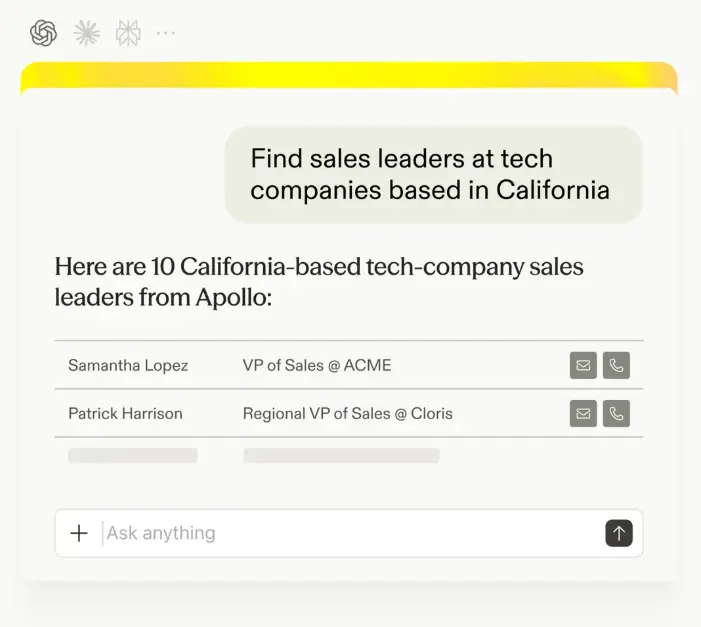
The Apollo AI Sales Platform wraps agentic capabilities around its contact database and sequencing engine. It combines a database of 270M+ contacts, with a claimed 97% email accuracy from a multi-step verification process, alongside email sequencing, direct dials, and a Chrome extension that captures prospect details from LinkedIn during research. Apollo pitches itself as a stack-consolidator that folds prospecting, enrichment, and cold email into one login.
Key features
AI agents for prospecting and outreach inside the Apollo workspace
AI email agents that draft personalized messages from contact and engagement data
Conversation summaries from synced calls feeding deal-stage context
Email sequence automation with scheduling and A/B testing
Lead scoring informed by reply-rate cohorts
CRM integration with Salesforce and HubSpot
Pros
Public tiered pricing with a free entry point makes it easy to trial without procurement
Tight loop between contact data, sequencing, and AI drafting in one workspace
Credit-based data consumption lets buyers model spend per record
Cons
Agents reason over Apollo's own data alone, without cross-signal context across CRM, intent, and conversation
Data depth thins out beyond North America
Per-seat pricing scales with headcount rather than usage, which surprises data-heavy teams
Best for: Startups and growth-stage teams that want prospecting, sequencing, and light AI in one place.
Pricing: Free ($0), Basic $49, Professional $79, Organization $119/seat/mo (annual, 3-seat minimum), Enterprise custom.
Compare directly: Apollo vs. ZoomInfo.
3. Cognism
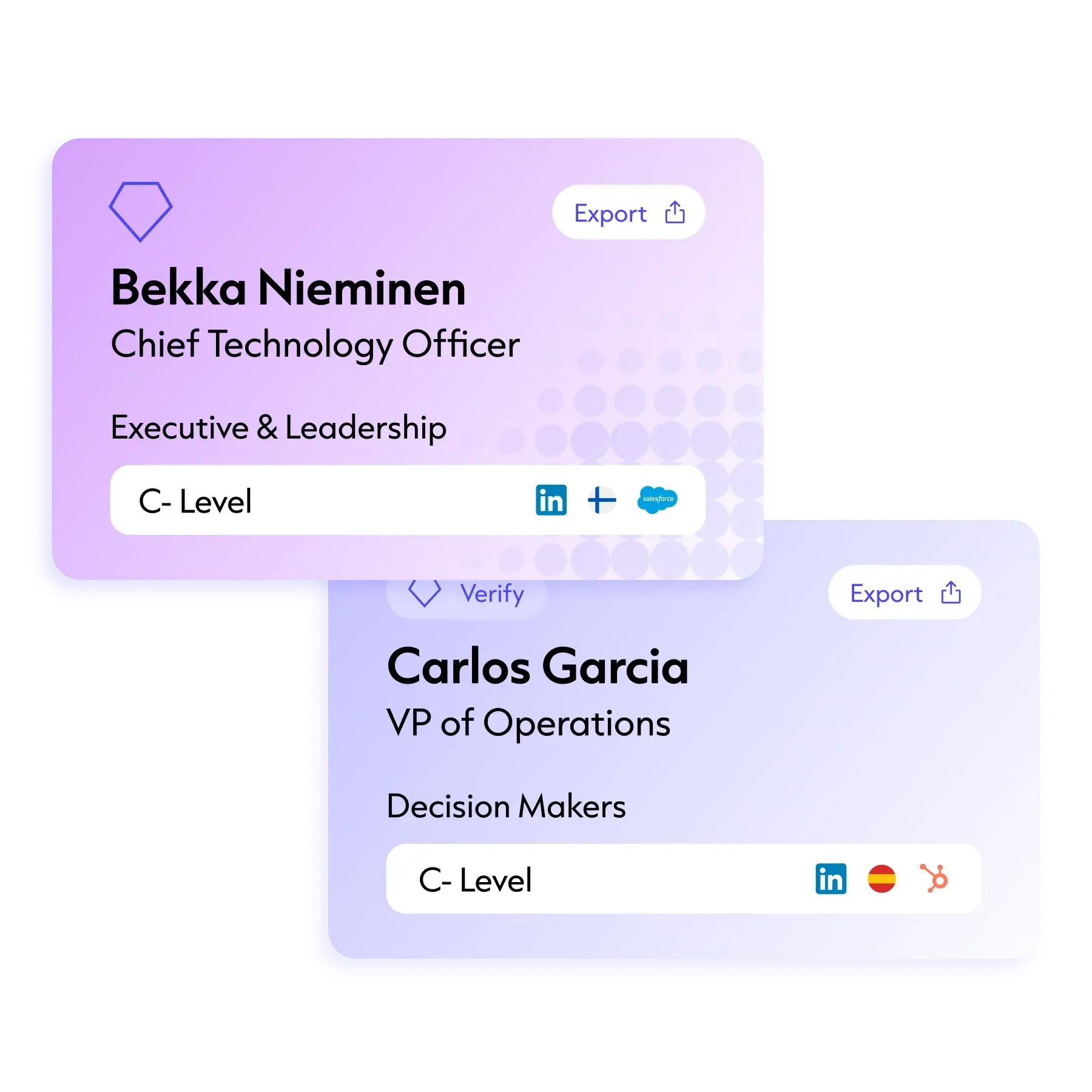
Cognism provides B2B contact data with a focus on European markets and GDPR compliance. Its flagship Diamond Verified Data set is built on a manual phone-verification process that backs an 87%+ accuracy claim on verified records, with intent data integrated through Bombora to show which accounts are researching solutions. Cognism leans on transparent packaging and an included data allowance as its pitch against credit-based models.
Key features
Phone-verified mobile numbers with an EU focus
Diamond Verified data with an 87%+ accuracy claim on verified records
A human validation process applied at the point of use
Intent data integration through Bombora
GDPR and CCPA compliance signaling for European buyers
Technographic intelligence on company technology stacks
Pros
EU mobile verification rigor that few competitors match in regulated markets
Compliance-first sourcing lowers procurement risk for European deployments
The Diamond process gives high confidence on mobile-heavy outbound
Cons
Narrow EU mobile focus next to the global scale of a broader platform
Pricing is quote-based with no public figures, which slows evaluation
Teams that need both EU compliance and global reach often add a second vendor
Best for: European-facing teams where regional mobile coverage and GDPR posture are hard requirements.
Pricing: Quote-based across Standard and Pro tiers, with Diamond Verified Data as a Pro feature.
Compare directly: Cognism vs. ZoomInfo.
4. 6sense
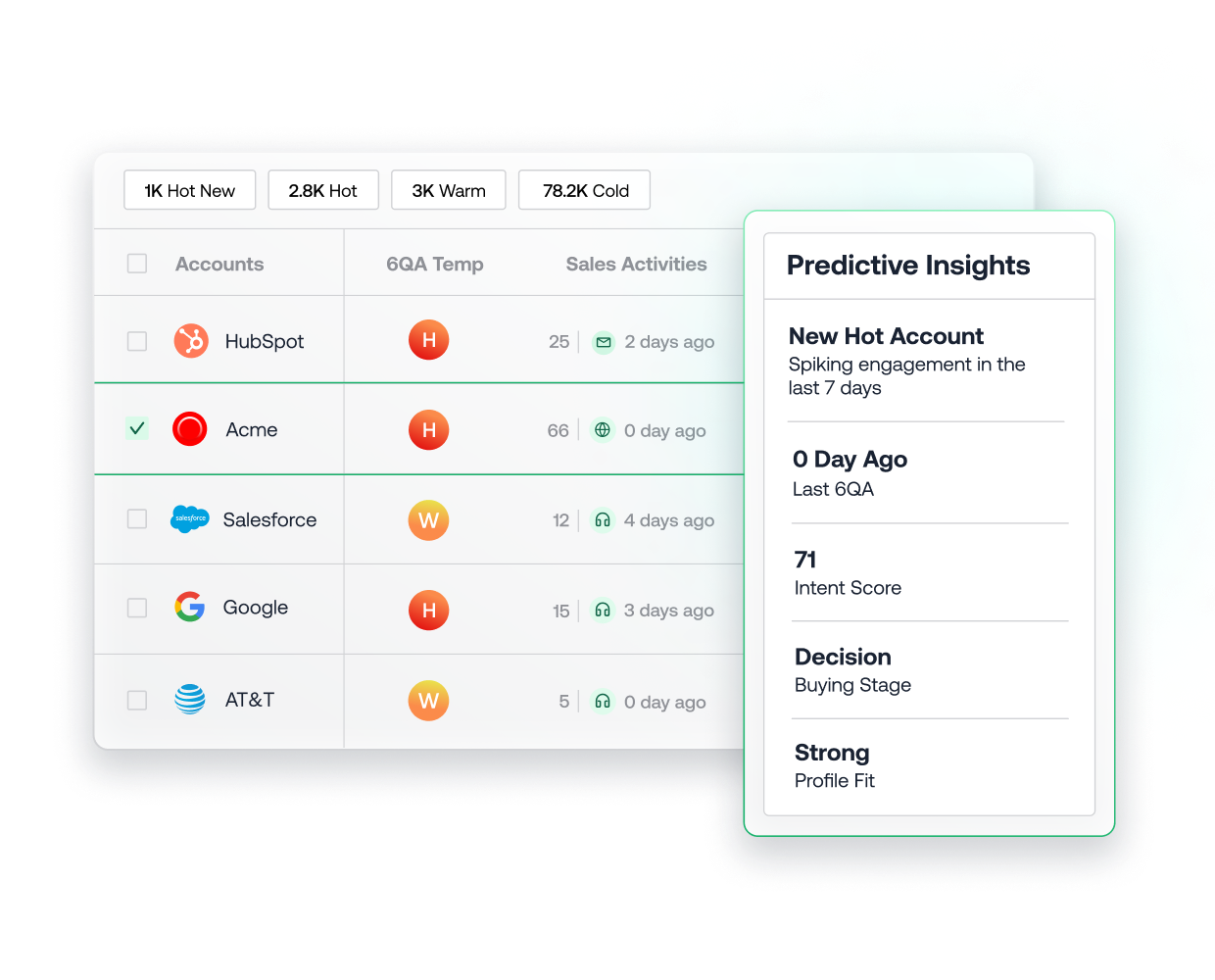
6sense identifies in-market accounts through predictive AI and pairs it with multi-channel orchestration across display, LinkedIn, and email. It resolves anonymous website visitors to companies and reveals which organizations are researching before they fill out a form, surfacing dark-funnel demand. In 2026 the company repositioned around agentic capabilities, adding the RevvyAI agent and its own MCP server to open its intelligence to other AI tools.
Key features
In-market account identification via predictive AI
Multi-channel campaign orchestration across display, LinkedIn, and email
Anonymous buyer-journey identification from website behavior
RevvyAI agent and an MCP server that expose its intelligence to other agents
Account-based advertising across display, social, and search
Pipeline analytics and account-level attribution
Pros
Named a Leader in The Forrester Wave: Revenue Marketing Platforms for B2B, Q1 2026
Strong ABM advertising orchestration for enterprise marketing programs
Mature predictive scoring and anonymous account identification
Cons
No conversation intelligence equivalent to Chorus for deal-stage call context
ABM platform pricing is quote-based, which slows lightweight evaluation
Advertising-centric focus means sellers still need a separate prospecting data source
Best for: Enterprise marketing teams running structured ABM programs where prioritization and ad coordination are central.
Pricing: Free Sales Intelligence tier, plus quote-based bundles. The ABM platform is priced separately.
Compare directly: 6sense vs. ZoomInfo.
5. Gong
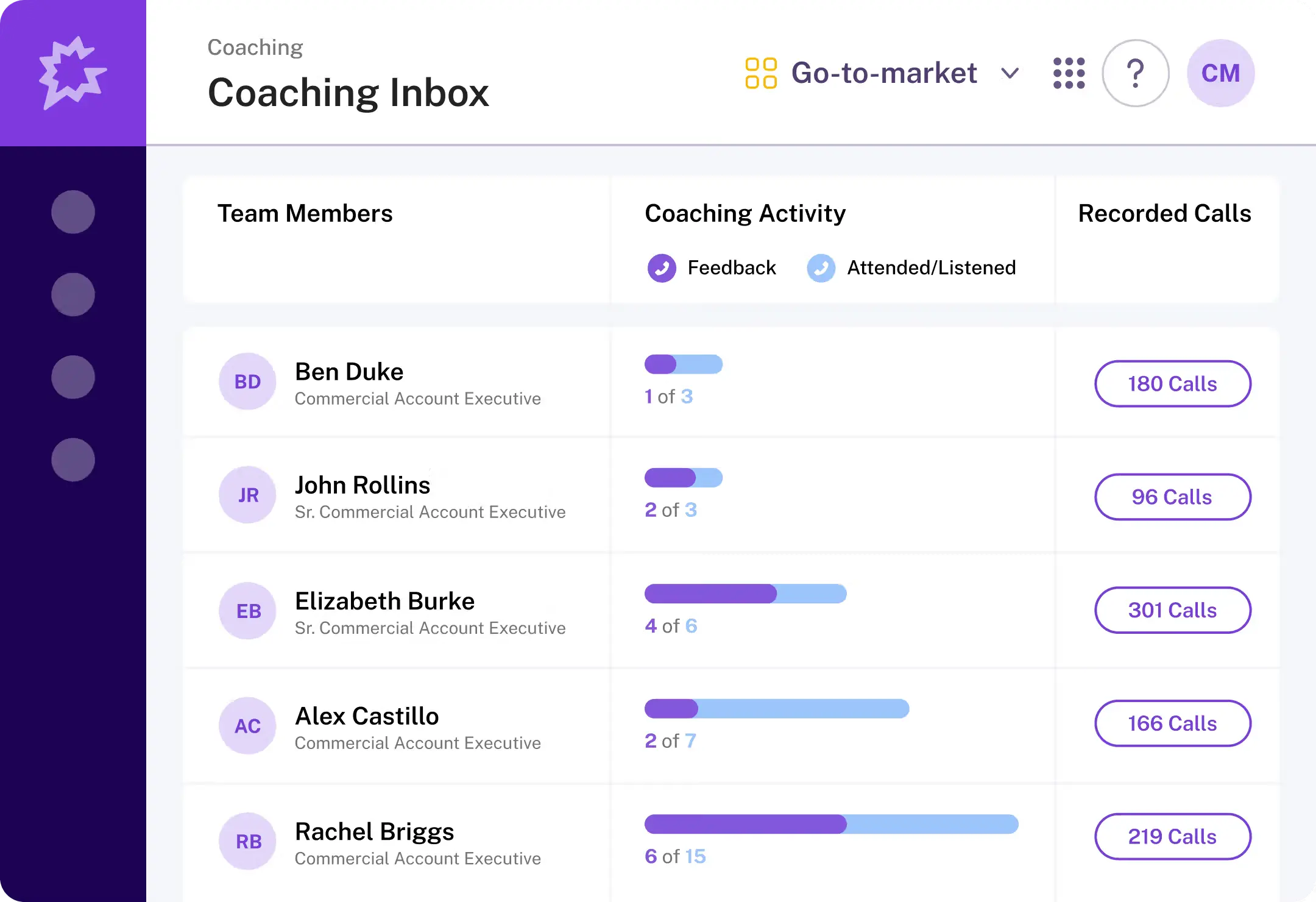
Gong records and analyzes sales calls, video meetings, and email, then extends that conversation intelligence into Gong Engage for sales engagement and Gong Forecast for pipeline prediction. It handles call summarization automatically and identifies moments like competitor mentions, pricing discussions, and objection handling, with deal tracking that flags risk based on conversation patterns and engagement.
Key features
Call recording across video and dialer
AI-powered conversation analytics and call summarization on transcripts
Topic detection and trends across the rep population
Deal-level conversation context surfacing risk and momentum
Coaching workflows that benchmark reps against the team
Engage for sequencing and Forecast for revenue prediction
Pros
Category-leading conversation intelligence depth and coaching workflows
Strong fit for sales managers focused on call quality and deal review
Expansion into Engage and Forecast reduces reliance on separate point tools
Cons
No verified B2B data foundation, intent platform, or ABM motion for prospecting
Runs as a standalone layer rather than feeding a unified reasoning graph
Premium pricing lands hardest on smaller teams
Best for: Revenue organizations that want a dedicated conversation intelligence layer with deep coaching.
Pricing: Quote-based.
Compare directly: Gong vs. ZoomInfo.
6. Clay
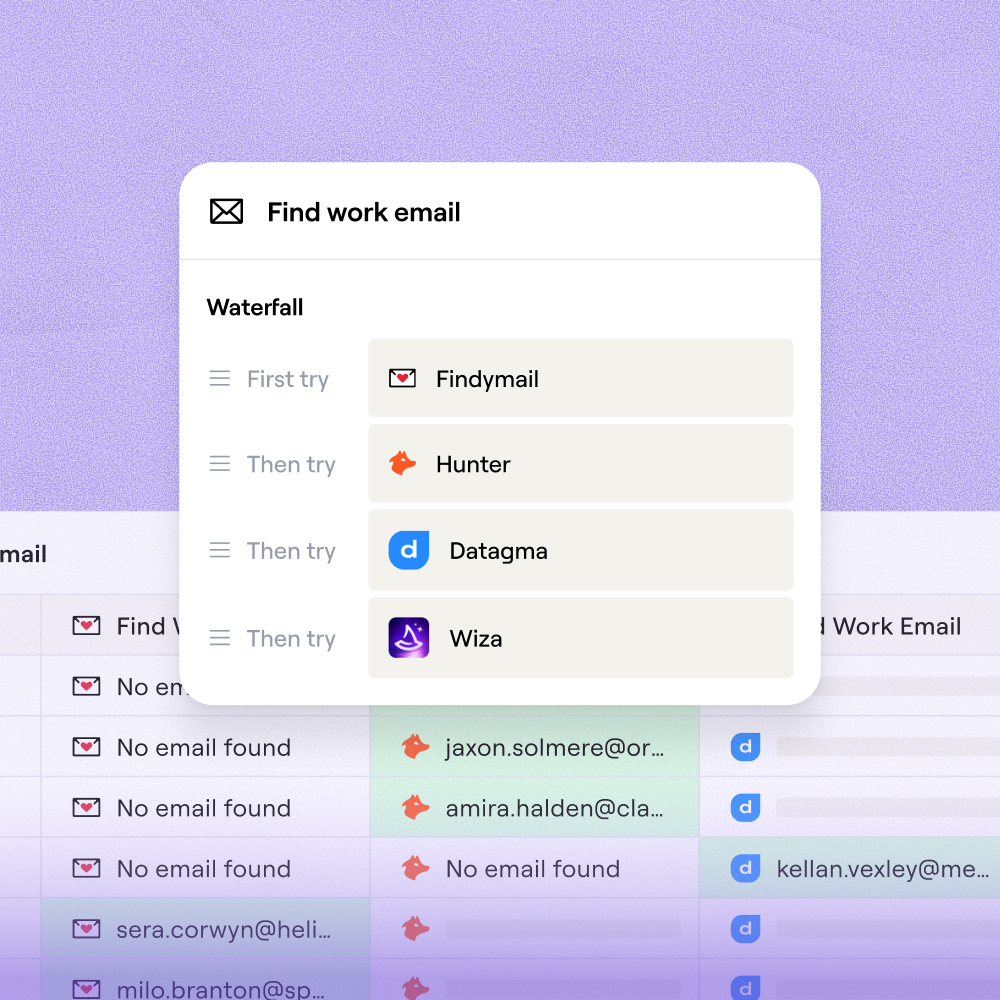
The Clay Platform aggregates data from more than 150 sources through a spreadsheet-style workflow canvas, with two consumption units, Data Credits for unlocking data and Actions for workflow operations. Claygent, Clay's AI research agent, gathers company information, finds contact details, and personalizes outreach through no-code waterfall enrichment, and Clay MCP now pushes that prospecting data into reps' AI tools.
Key features
Spreadsheet-style workflow canvas for prospect data
Waterfall enrichment across 150+ sources
Claygent AI agent with web research access
Clay MCP that brings prospecting data into reps' AI tools
AI-powered message personalization based on prospect research
Integration with CRM, warehouse, and engagement platforms
Pros
Multi-provider orchestration suits GTM-engineering teams
Public tiered pricing with a calculator for usage-based modeling
Unlimited seats on every tier, including Free, easing per-seat economics
Cons
No primary contact database, so the layer needs data vendors plugged in for coverage
No native ABM, conversation intelligence, or forecasting motion in-platform
Spreadsheet UX has a steeper ramp than natural-language agents
Best for: Technically proficient teams that want to build highly customized workflows and can maintain them.
Pricing: Free ($0), Launch from $167/mo, Growth from $446/mo (billed annually), Enterprise custom.
Compare directly: Clay vs. ZoomInfo.
7. HubSpot
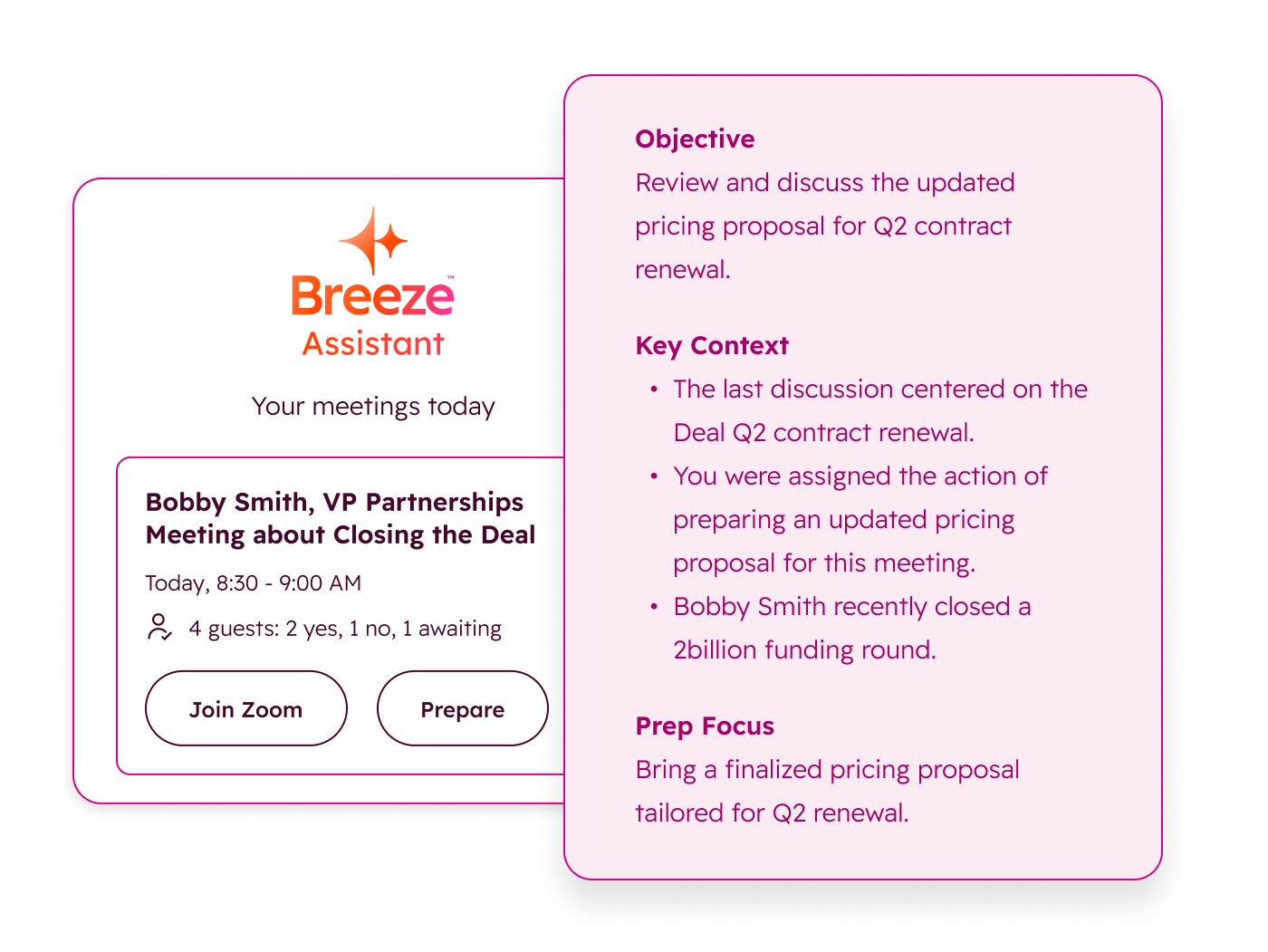
HubSpot provides CRM, marketing automation, and sales tools in one platform, with Breeze Assistant and the Agent Hub bringing AI across every Hub. AI-drafted emails and content run throughout, predictive lead scoring identifies which contacts are most likely to convert based on engagement and firmographics, and Breeze Intelligence (formerly Clearbit) handles enrichment inside the CRM.
Key features
Breeze Assistant AI, included with paid HubSpot subscriptions
Agent Hub with AI agents, including an AI Prospecting Agent
Breeze Intelligence for firmographic and technographic enrichment
Predictive lead scoring on engagement plus firmographics
AI content writer for emails and campaigns
Workflow automation across email, tasks, and data updates
Pros
Unified CRM, marketing, and service experience for SMB and mid-market teams
Free CRM tier and public Hub pricing make trial and expansion frictionless
Breeze Assistant ships with the subscription, so native AI adds no separate contract
Cons
Agents reason within HubSpot CRM context and do not extend across external signals
Smaller verified data foundation than a dedicated data platform behind scoring
Mandatory onboarding fees and per-seat pricing raise the true cost at Professional and up
Best for: SMB and mid-market teams that want sales and marketing operating from one platform.
Pricing: Free CRM, plus Sales Hub at $20 (Starter), $90 (Professional), and $150 (Enterprise) per seat/mo billed annually, with one-time onboarding fees of $1,500 and $3,500 on Professional and Enterprise. Breeze Assistant is included with paid subscriptions at no extra cost.
Compare directly: HubSpot vs. ZoomInfo.
8. Outreach
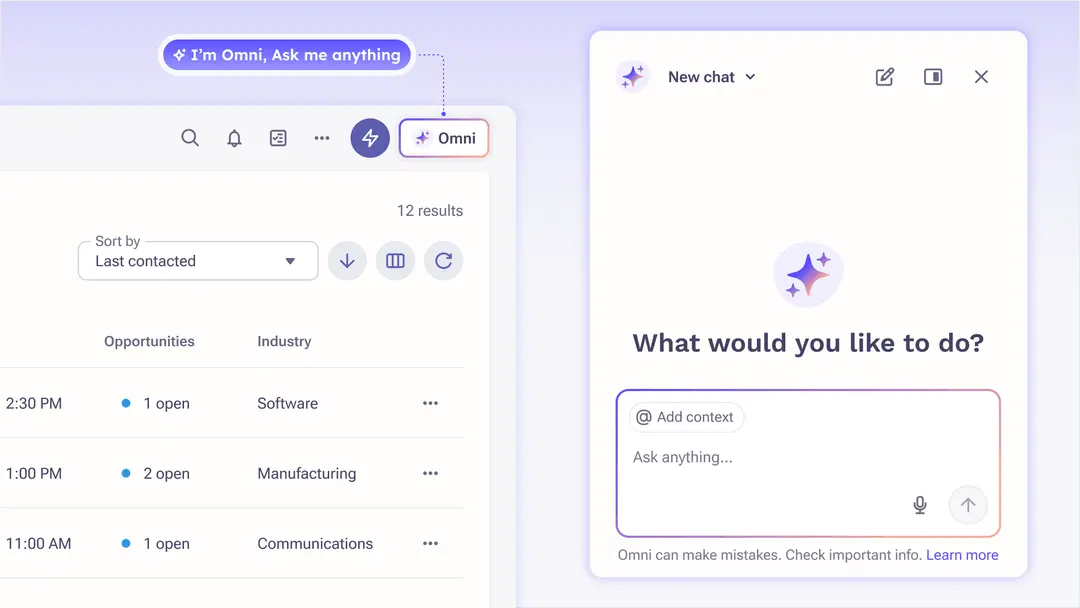
Outreach rebranded to Outreach.ai as an agentic AI platform for revenue teams, putting Outreach AI Agents at the center of its sales engagement platform. Its Spring 2026 release added Outreach Omni and Agent Studio, and the platform now ships an MCP server that brings Outreach context into ChatGPT and Codex. Underneath, it automates outreach workflows across email, phone, and social, with subject-line optimization drawn from reply-rate cohorts.
Key features
Autonomous prospecting agents that draft outreach and follow up
Outreach Omni and Agent Studio for building agentic workflows
MCP server available in ChatGPT and Codex
AI email agents that draft outreach informed by past conversations
Deep Salesforce integration for activity sync
Revenue intelligence and pipeline analytics
Pros
Mature, enterprise-grade sequencing engine with strong governance for large SDR orgs
Agentic and MCP capabilities now built into the platform
Deep Salesforce activity logging and reporting
Cons
No verified B2B data foundation underneath, so agent quality depends on the customer's data vendor
Reasoning stays within sequencing and engagement data rather than a cross-signal layer
Quote-based pricing with seat and consumption components complicates budgeting
Best for: Enterprise sales development organizations that need structured, measurable outreach at scale.
Pricing: Quote-based across Amplify Essentials, Core, Plus, and Pro, combining seat-based access with consumption-based AI credits that scale from 10,000 to 100,000 by tier.
9. Salesloft
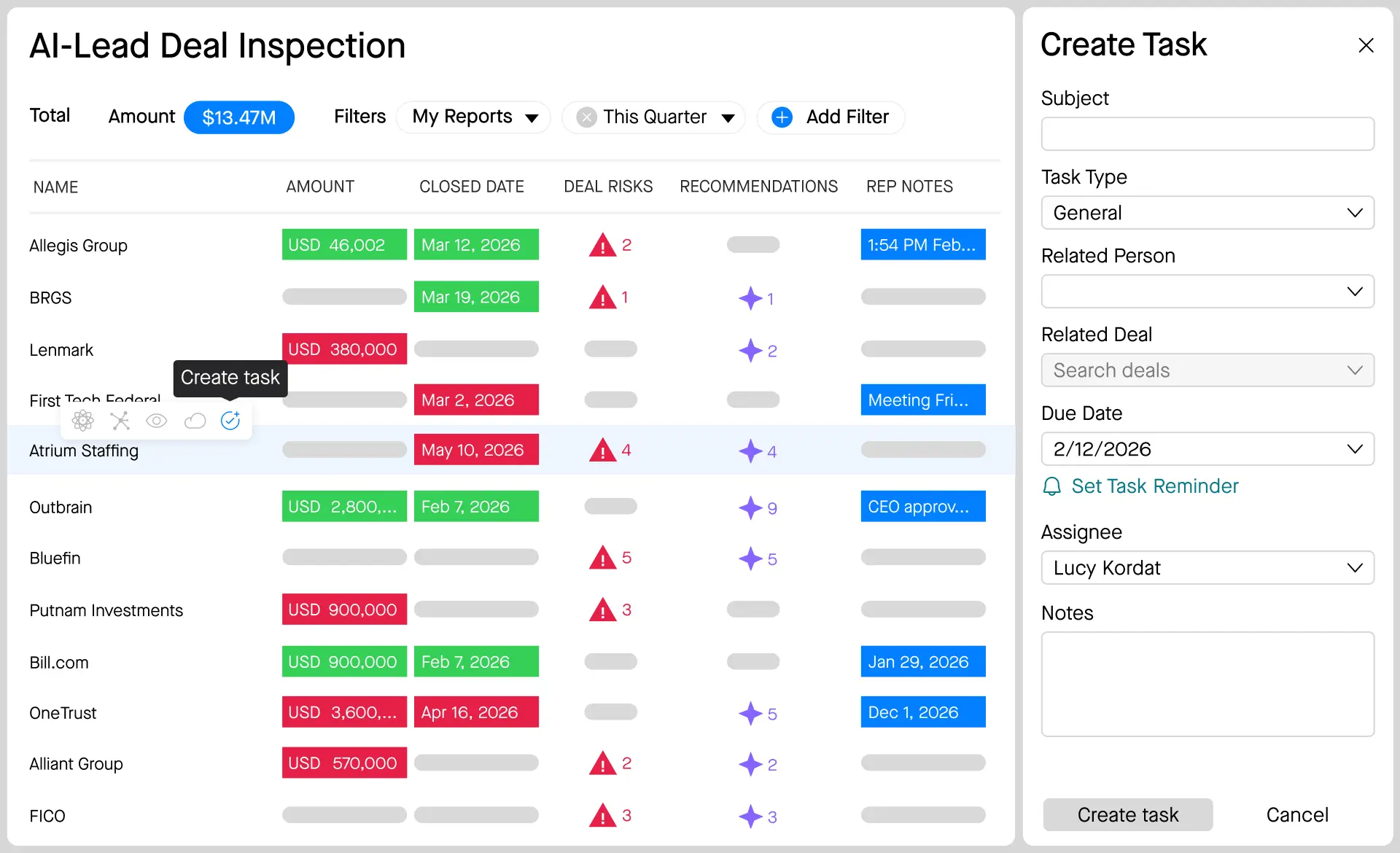
Salesloft brings autonomous prospecting agents onto its cadence and conversation-intelligence stack. Following its merger with Clari, which closed in December 2025, it now pairs sales engagement with Clari's revenue forecasting under one platform, spanning cadence automation, conversation intelligence, and deal management. Deal-stage AI assistance built on engagement signals flags risks and opportunities from activity patterns.
Key features
Autonomous AI agents for prospecting and outreach
Cadence automation for multi-step sequences
In-platform conversation intelligence
Deal management with risk identification from engagement signals
Clari revenue forecasting across the combined platform
Coaching insights and best-practice surfacing
Pros
Mature cadence and engagement workflows with deep enterprise adoption
Forecasting depth strengthened by the Clari merger
In-platform conversation intelligence reduces toggling between cadence and CI tools
Cons
No verified B2B data foundation for prospecting, so teams still pair a data platform
The Clari integration is still maturing across the combined product
No free tier, so a higher entry point than self-serve sequencing tools
Best for: Mid-market and enterprise revenue teams running multi-touch cadences where forecast accuracy is top of mind.
Pricing: Quote-based across Advanced and Elite, plus an Account Agents add-on.
10. Demandbase
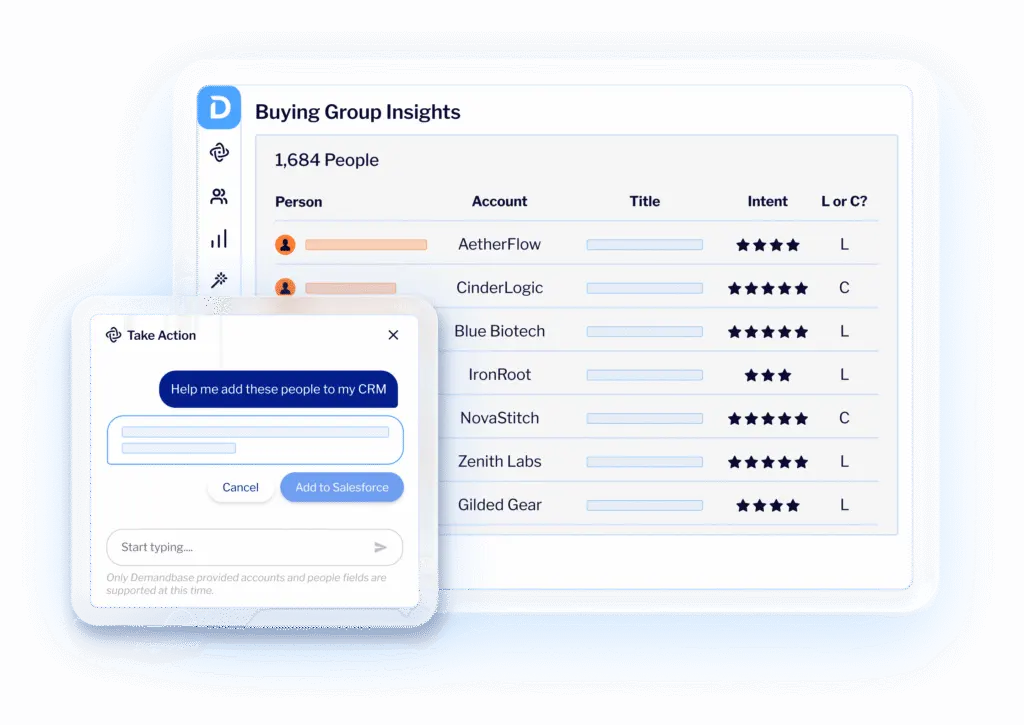
Demandbase One is a unified account-based experience (ABX) platform spanning ABM advertising, account intelligence, sales intelligence, and data. It handles account identification for target companies showing buying intent, provides insight into their research activity, and supports B2B advertising that reaches decision-makers across display, social, and search. It sits among the most directly competitive ABM platforms in the enterprise cohort.
Key features
Unified ABX platform across ABM ads, account intelligence, sales intelligence, and data
Account-level orchestration across marketing and sales surfaces
Predictive scoring and intent signals at the account level
Native ad targeting and retargeting
Website personalization based on the visiting company
Account-based analytics and reporting
Pros
ABM and sales intelligence consolidated in one platform for enterprise programs
Strong account-level measurement and pipeline attribution
Native advertising reach across display, social, and search
Cons
Fully quote-based, with no public figures for budget modeling
No conversation intelligence for deal-stage call context
Advertising-led focus means sellers still need a separate prospecting data source
Best for: Enterprise marketing teams where advertising reach and account-level measurement are central to the strategy.
Pricing: Quote-based, with modules purchasable separately or as the unified Demandbase One bundle.
Compare directly: Demandbase vs. ZoomInfo.
11. Clearbit
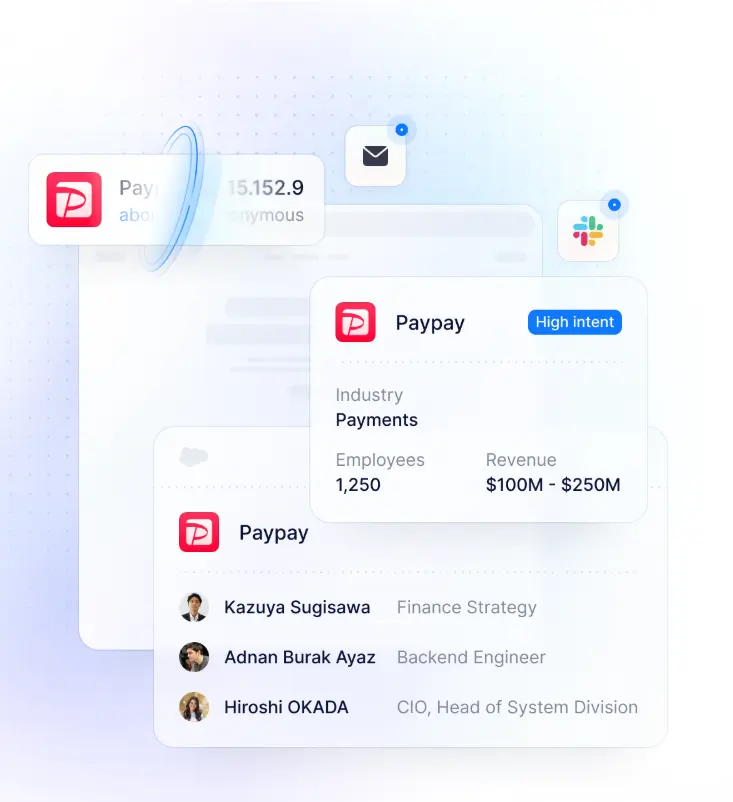
Clearbit was acquired by HubSpot and now ships as Breeze Intelligence, enriching CRM and marketing records with real-time firmographic and technographic data. It identifies visiting companies, matches them to company records, and supports form shortening that pre-fills known information. The standalone product is retired, with the free tools sunset on April 30, 2025 and the Logo API on December 1, 2025.
Key features
Company and contact enrichment via HubSpot Credits
Reveal-style website visitor identification
Form shortening with progressive profiling
Native HubSpot CRM integration
API access for custom integrations within HubSpot
Lead scoring data based on company attributes
Pros
Tight Breeze Intelligence integration for HubSpot-centric teams
Solid baseline firmographic and technographic enrichment for North American records
Basic enrichment is now free with paid HubSpot seats
Cons
Available only inside HubSpot, with no standalone path for other CRMs
Narrower coverage outside North America than a dedicated data platform
A credit model with monthly resets complicates predictable budgeting
Best for: HubSpot-centric teams that want firmographic and technographic enrichment inside the platform they already run.
Pricing: Consumes HubSpot Credits on Professional and Enterprise editions. There is no standalone subscription path.
Compare directly: Clearbit vs. ZoomInfo.
12. Seamless.AI
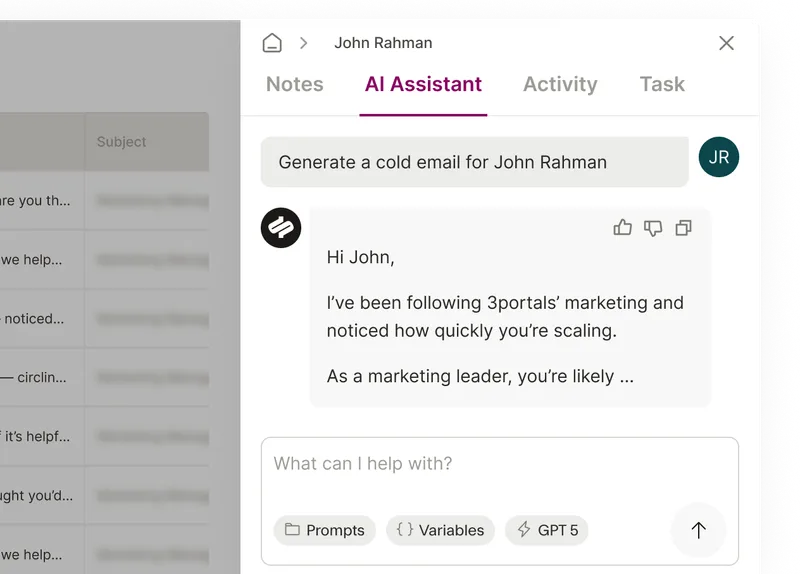
Seamless.AI is a real-time search engine for B2B contacts, with engagement, AI agents, and automation layered on top. It organizes around a Data Engine, Engagement, AI Agents, and Automation, finding email addresses and phone numbers and verifying deliverability before outreach, with a Chrome extension that supports prospecting on LinkedIn and company websites.
Key features
Autonomous AI agents for prospecting
Real-time contact search and verification
Email deliverability checking
Chrome extension for LinkedIn prospecting
AI-drafted outreach bundled with the platform
CRM integration for contact sync
Pros
Lightweight entry point for individual sellers and small teams
Credit-based model charges only for the contacts you export
Real-time verification helps deliverability on cold outbound
Cons
No verified B2B data foundation behind agent recommendations
Smaller scale and proof-point density than enterprise agent vendors
Data accuracy varies more than premium providers
Best for: Individual sellers and small teams with straightforward prospecting needs.
Pricing: Free ($0), plus quote-based Pro and Enterprise tiers.
Compare directly: Seamless.AI vs. ZoomInfo.
How to Choose an AI GTM Tool
Match the tool to your GTM motion, team size, and existing stack. Start with where your biggest drag comes from, then weigh each option against the criteria below.
Your biggest GTM drag. If reps lose hours to manual research, prioritize data and signal automation. If pipeline stalls because no one can see which deals are at risk, prioritize conversation intelligence and forecasting. If sales and marketing run off different data, prioritize a platform built for orchestration over another point solution that adds to the sprawl.
Data quality and coverage. Accuracy beats database size. Ask how often a vendor verifies data, what its deliverability rate is, where it sources records, and whether coverage matches your target market. Verified, continuously refreshed data is what makes predictive modeling and every layer above it work.
AI capability and depth. Separate rules-based automation from predictive scoring, and both from agentic systems that execute multi-step tasks. This is where the tool-versus-platform line matters most, because a point tool automates one job while a platform grounds its agents in a reasoning layer across data, signals, and CRM context. IBM research shows only 19% of companies believe their data is AI-ready, so evaluate the AI and the data together.
Integration with your stack. Native integrations beat API-only connections. Check whether the platform syncs bidirectionally with your CRM, sales engagement, and marketing automation, since one-way pushes create reconciliation work that degrades data quality over time.
Pricing and total cost of ownership. Model the full cost, including software fees, credit or export limits, onboarding, and contract terms, then weigh it against time-to-value and the impact on pipeline, customer acquisition cost, and customer lifetime value. A cheaper tool that takes months to implement can cost more than a platform you deploy in weeks.
Why ZoomInfo Is the AI GTM Platform
Every tool here earns its place on a specific job, and the strongest point tools own their category outright. The deciding question is less about feature-list length and more about whether the AI underneath reasons over the whole account or only one slice of it.
A platform wins when your motion depends on data, signals, conversation, and workflow working from the same source, which is exactly the gap GTM AI is built to close.
If that is where your team is headed, start with the data layer and build out from there. Start building with GTM AI.
Frequently Asked Questions
How Does an AI GTM Tool Differ From an AI GTM Platform?
A tool automates one job, like sequencing, enrichment, or conversation intelligence. A platform provides a reasoning layer that connects verified data, buying signals, conversation history, and CRM records so agents act on the full account. Most options in this guide are tools. ZoomInfo is a platform, and GTM AI delivers that reasoning layer to any external agent through APIs and MCP.
How Do AI GTM Tools Differ From Traditional Sales Software?
Traditional tools rely on manual work and rules-based workflows. AI GTM tools use predictive analytics and signal-driven agents to prioritize accounts by buying signal and personalize outreach at scale, with the most advanced running agentic workflows that execute multi-step tasks on their own.
How Do These Platforms Use Intent Data to Identify Buyers?
They read behavioral signals like website visits, content downloads, search activity, and third-party research to surface accounts actively evaluating solutions. Signal velocity, the recency and frequency of behaviors correlated with closed-won deals, matters more than raw database size.
Can AI GTM Tools Replace Your Sales Team?
No. They remove the low-value work like research, data entry, and admin so sellers focus on conversations. Seismic's reps saved 40+ hours a month and redirected them into pipeline.
What Integrations Do AI GTM Tools Need?
CRM, sales engagement, marketing automation, and communication tools like email and calendar, with bidirectional sync so data flows without manual updates. Native integrations with Salesforce, HubSpot, and Microsoft Dynamics beat API-only connections.
How Long Does Implementation Take?
A few days for lightweight tools, several weeks for enterprise platforms with complex integrations. Aligning the team on which signals to prioritize usually takes longer than the technical setup.
Which AI GTM Tool Is Best for Data Enrichment?
The best enrichment tools refresh records and reason across them once they land in your CRM. ZoomInfo's verified data feeds the GTM Context Graph, connecting firmographic, technographic, intent, and conversation signals into one reasoning layer. Cognism fits when EU mobile verification is the hard requirement, and Clearbit (now Breeze Intelligence) fits HubSpot-centric teams.
