
AI SDR tools now do far more than send cold email. The best ones find and research prospects, qualify inbound leads and book meetings on their own. Some sell a single autonomous rep that works at volume, while ZoomInfo Agent Teams runs complete plays on verified data, from the first signal to a routed lead or a finished account brief, writing every step back to the CRM.
Below, we compare 10 AI SDR tools on data, channels, pricing and G2 ratings, explain how AI SDRs differ from AI BDRs and share what to look for when choosing one. Since most of these tools lean outbound, it also helps to know how AI SDRs fit into outbound sales before you build a shortlist.
AI SDR Tools at a Glance
Tool | Best for | Inbound or outbound | Starting price | G2 rating |
ZoomInfo | AI agents that run full inbound and outbound plays on verified data | Both | Free to start with consumption credits based on usage | 4.5/5 |
Artisan | An autonomous outbound AI BDR | Outbound | Custom, scoped by lead volume | 4.2/5 |
11x | An outbound AI SDR plus an AI phone agent for inbound | Both | Custom | 4.4/5 |
AiSDR | Email and LinkedIn outbound with inbound follow-up | Both | $250/month (Solo) | 4.6/5 |
Apollo | Data, sequencing and AI agents on a budget | Outbound | Free plan, then $49/seat/month (billed annually) | 4.7/5 |
Reply | Multichannel sequences with an AI SDR add-on | Outbound | Jason AI SDR from $500/month | 4.6/5 |
Salesforce Agentforce | SDR agents that work inside Salesforce | Both | Flex Credits or add-ons from $125/user/month | 4.3/5 |
Clay | Custom research and enrichment workflows | Outbound | Free plan, then $167/month (billed annually) | 4.6/5 |
Instantly | High-volume cold email | Outbound | From $47/month | 4.8/5 |
Outreach | Enterprise sales engagement with AI agents | Both | Custom | 4.3/5 |
What Is an AI SDR Tool?
An AI SDR tool is a type of AI sales agent that does the work of a sales development rep with little or no manual effort. It finds prospects that match your ideal customer profile, researches each account, writes and sends personalized outreach, qualifies replies and books meetings for account executives.
Basic workflow automation follows a fixed sequence. AI SDRs make decisions as they go. They read how prospects respond, adjust timing and messaging and decide when a lead is ready for a human. Most combine a B2B contact database with large language models, so the quality of their work depends heavily on the data underneath.
Core capabilities include:
Prospecting: Builds target lists from firmographics, technographics and buying signals such as funding rounds, hiring or job changes, the same job AI prospecting tools focus on.
Research: Pulls company news, tech stack and role context so each message has a real reason to reach out, the same job our roundup of prospect research tools covers.
Personalized outreach: Writes unique emails and LinkedIn messages, then manages multi-touch sales email sequences.
Qualification: Reads replies, handles common objections and scores interest, a job covered in our guide to lead qualification.
Meeting booking and handoff: Schedules meetings and passes context to the rep who takes the call.
AI SDR vs. AI BDR: What’s the Difference?
The terms AI SDR and AI BDR are often used interchangeably, and most tools on this list do both jobs. The difference comes from how human sales development teams split the work.
An AI BDR (AI business development rep) focuses on outbound prospecting, which means finding net-new accounts, mapping the buying group and starting conversations with people who haven’t raised their hand yet. An AI SDR (AI sales development rep) traditionally leans toward inbound lead generation, which means following up on form fills and demo requests fast, qualifying the buyer and routing them to the right rep.
AI SDR | AI BDR | |
Main focus | Inbound leads and follow-up | Outbound prospecting into new accounts |
What starts the work | A form fill, demo request or website visit | An ICP list, intent spike or trigger event |
Core job | Respond fast, qualify and route | Research, find the buying group and open the conversation |
What success looks like | Speed to lead and qualified meetings | New pipeline from accounts not yet in play |
ZoomInfo Agent Teams template | Inbound Lead Activation | Outbound Prospecting |
In practice, vendors blur the line. Artisan calls its agent Ava an AI BDR, while 11x pairs an outbound agent with an inbound phone agent. The useful question is which jobs you need covered and whether one platform can run both without separate tools. AI SDRs also differ from AI sales assistants, which suggest next steps while a rep does the work. For a dedicated comparison of outbound-first tools, see our roundup of AI BDR software.
How We Evaluated These AI SDR Tools
We assessed each tool against the five criteria that most affect results in real deployments, using G2 reviews and vendor documentation:
Data quality. Is outreach built on verified contacts, or on data the tool scrapes or rents? Bad data means bounced emails and wrong-person outreach at machine speed.
Inbound and outbound coverage. Can the tool qualify inbound leads, prospect outbound or both?
Personalization. Does it use real account context, such as news, intent signals and CRM history, or fill in templates?
CRM and stack integration. Does it sync natively with Salesforce or HubSpot and work with the sales engagement tools you already run?
Governance. Can you monitor what the AI does, control who uses it and see what it will cost?
1. ZoomInfo
G2 rating: 4.5/5
ZoomInfo is an all-in-one AI GTM Platform built on three layers. Its own data sits at the foundation, the GTM Context Graph adds the intelligence and Universal Access puts both into every tool your team uses. It’s the foundation 37 of the top 40 AI companies use to run GTM. ZoomInfo maintains 500M contacts and 100M companies, including 135M+ verified phone numbers, 120M+ direct dials and 200M+ verified business emails, kept current by 300+ human researchers, with up to 95% accuracy on first-party data.
The GTM Context Graph sits on top of that data. It processes 1.5B+ data points daily and fuses ZoomInfo’s data with your CRM records, conversation intelligence and behavioral signals, so every agent knows why an account matters now along with who to contact. Sellers use it in GTM Workspace, RevOps and marketing teams use GTM Studio, and developers connect their own agents through GTM.AI’s API and MCP.
For AI SDR work, the key piece is Agent Teams, which runs inside GTM Studio. It coordinates specialist agents to run whole GTM motions end to end, grounded in ZoomInfo’s context layer for AI agents. You give it an outcome, such as converting a qualified inbound lead or preparing outbound into a target account, and it runs every step to get there. Ready-made templates cover both AI SDR and AI BDR work, and we break down how it differs from single-agent tools after the list below.
Key features:
Agent Teams templates for Inbound Lead Activation and Outbound Prospecting, plus 50+ ready-made agents
Verified data on 500M contacts and 100M companies, with intent, technographics and job-change signals
GTM Context Graph reasoning across CRM, conversation and behavioral data
Specialist agents with shared context and a supervisor agent checking each step
Native Salesforce, HubSpot, Slack, Gmail, Salesloft and Outreach integrations, with CRM write-back
Monitoring, admin dashboards, role-based access and a credit estimate before each play
Pros:
Covers both AI SDR and AI BDR work in one platform
Agents work from verified data, so outreach reaches the right person
Acts inside the CRM and sales tools reps already use
No new SKU for GTM Studio customers
Cons:
Agent Teams is newer than ZoomInfo’s core platform, so it has a shorter track record
Consumption credits need scoping against your real volume
Built for mid-market and enterprise teams more than solo founders
Best for: RevOps, sales and marketing leaders at mid-market and enterprise companies on Salesforce or HubSpot who want AI agents to run inbound and outbound plays end to end.
Pricing: Free to start with consumption credits based on usage.

"We've built out account briefs that tell our sellers exactly what they need to know. For our AEs, who are in meetings all day, this makes it so they'll actually pick up the phone and make the call."
2. Artisan
G2 rating: 4.2/5
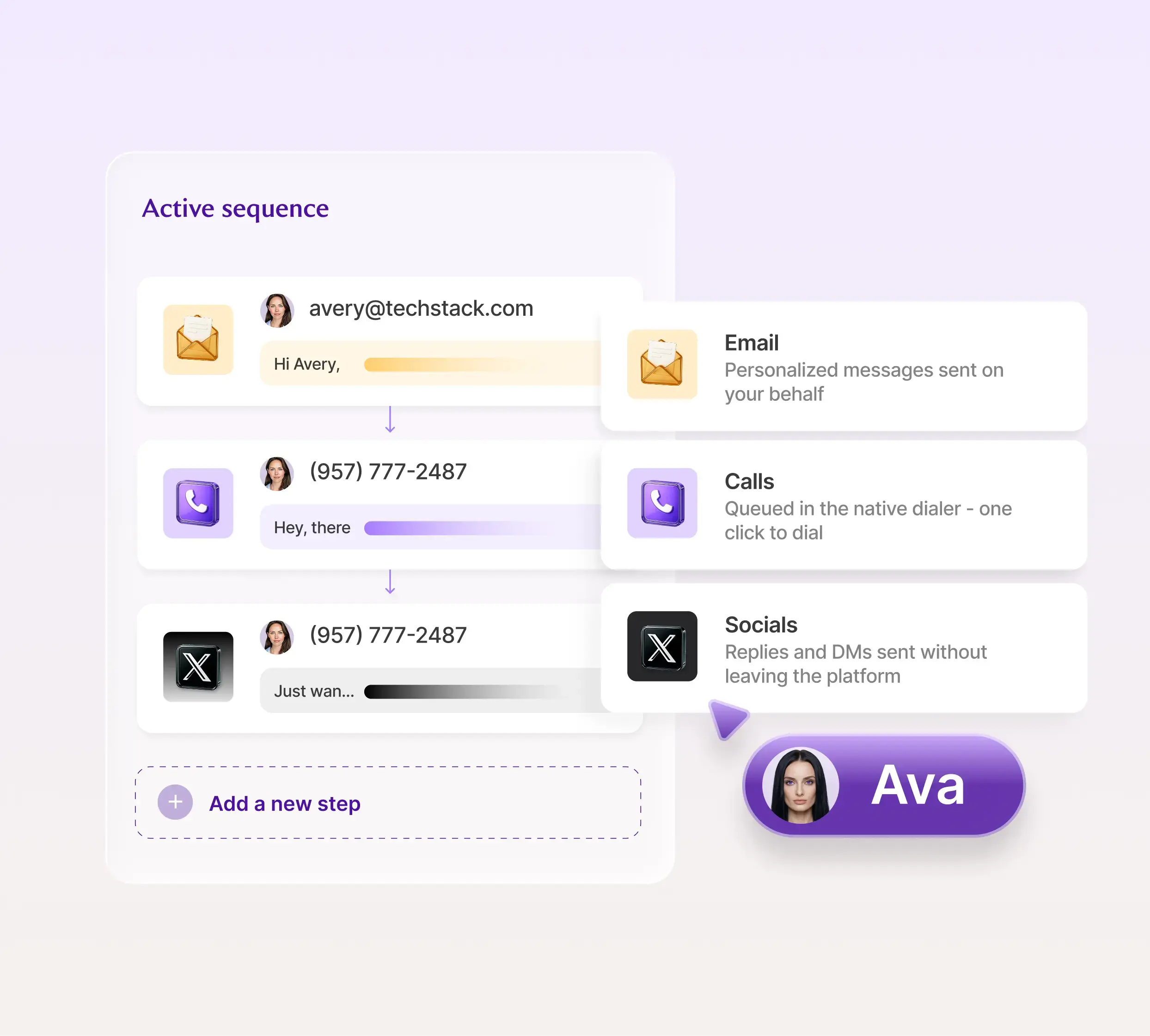
Artisan sells Ava, “the AI BDR,” which it says “books meetings for your reps autonomously.” Ava runs multichannel outreach across email and social. It finds leads from a database of 250M+ verified B2B contacts, enriches them, sends personalized emails from your reps’ names and domains, handles replies and books meetings. Call steps are queued for reps in a native dialer, with a pre-call brief and post-call follow-up.
Ava prioritizes leads using intent signals such as funding rounds and leadership hires, and website visits can trigger outreach. Teams can approve messages before they send, lock tone and calls to action and set banned phrases.
Key features:
Ava, an autonomous AI BDR for outbound
250M+ verified B2B contacts, enriched from 22+ sources
Approval mode, tone controls and exclusion lists
AI dialer as a per-seat add-on
Escalation rules for when a human takes over
Salesforce and HubSpot two-way sync
Pros:
Fully autonomous outbound from list to meeting
Strong message controls for brand safety
CSM support and onboarding on every plan
SOC 2 Type II certified, with SSO and SAML
Cons:
No public pricing
Focused on outbound more than inbound qualification
Calls stay with human reps
Best for: Teams that want an autonomous AI BDR to run outbound alongside their reps.
Pricing: Custom. Plans are scoped to lead volume, mailboxes and dialer seats, with Team covering about 2,500 leads contacted a month, Scale about 6,000 and Enterprise set to custom volume.
Weighing Artisan against other AI BDRs? Compare your options in our guide to Artisan alternatives.
3. 11x
G2 rating: 4.4/5
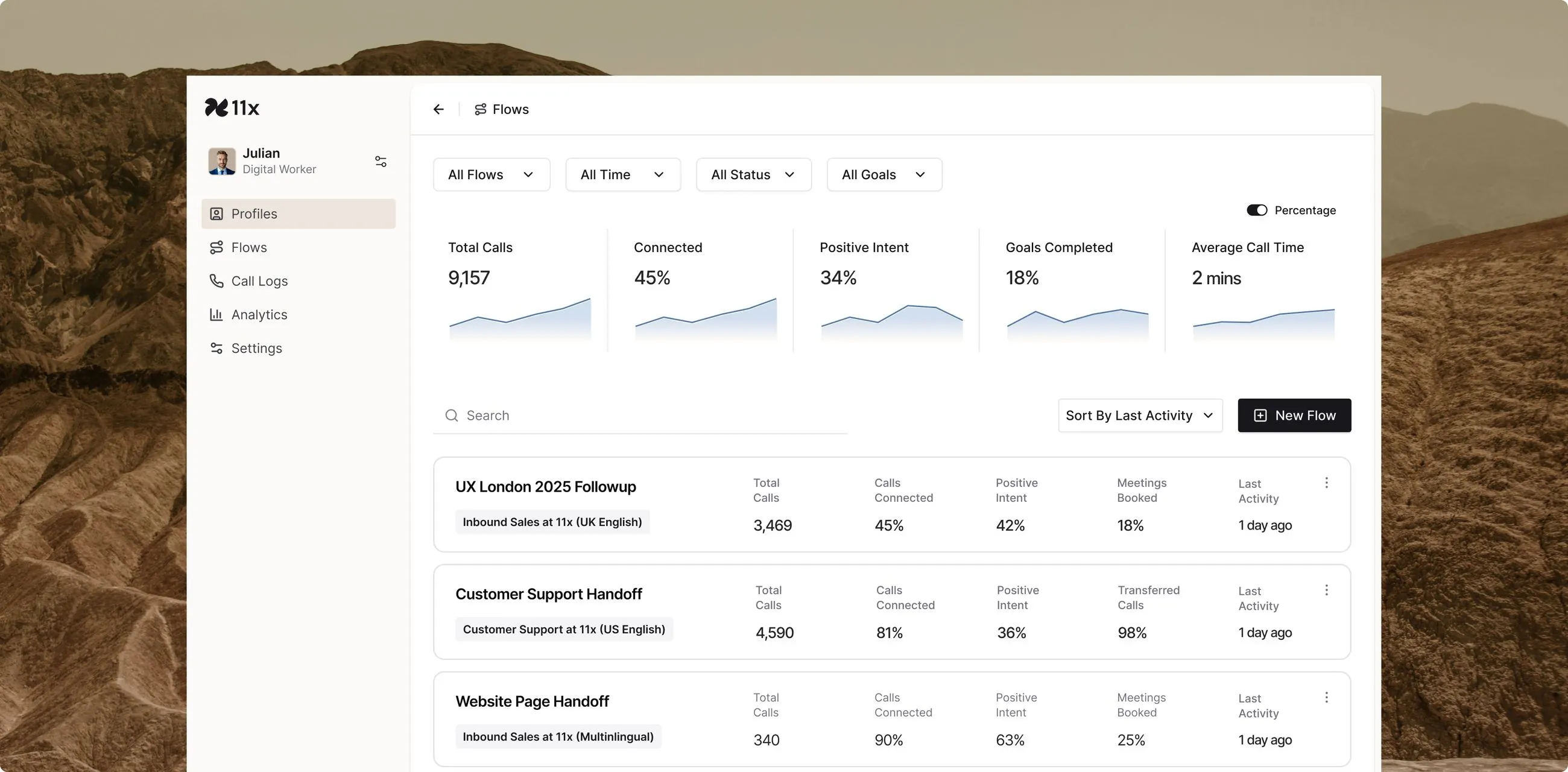
11x sells two AI agents. Alice is an AI SDR for outbound that engages prospects across email, LinkedIn, phone and messaging channels, handles replies and books qualified meetings. Julian is an AI phone agent for inbound that answers calls, qualifies leads and schedules meetings.
11x says Alice filters signals from 50+ data sources to find ICP-matching buyers and writes each message for a specific prospect. The platform also includes website visitor tracking, playbooks, a knowledge base and lead routing, and campaign dashboards track meetings booked, pipeline generated and closed-won deals. Beyond net-new outbound, 11x pitches Alice for lead nurture, closed-lost recovery and website visitor retargeting.
Key features:
Alice for multichannel outbound
Julian for inbound phone qualification and speed to lead
Signals from 50+ data sources and deep account research
Smart replies, lead routing and deliverability tools
Campaign dashboards for meetings, pipeline and closed-won deals
CRM, Slack and API integrations
Pros:
Covers outbound and inbound phone in one vendor
Wide channel coverage, including SMS and WhatsApp
Built-in deliverability and mailbox health tools
Cons:
No public pricing
Two separate agents to configure
Best for: Teams that want an outbound AI SDR plus an AI agent answering inbound calls.
Pricing: Custom, through a demo.
4. AiSDR
G2 rating: 4.6/5
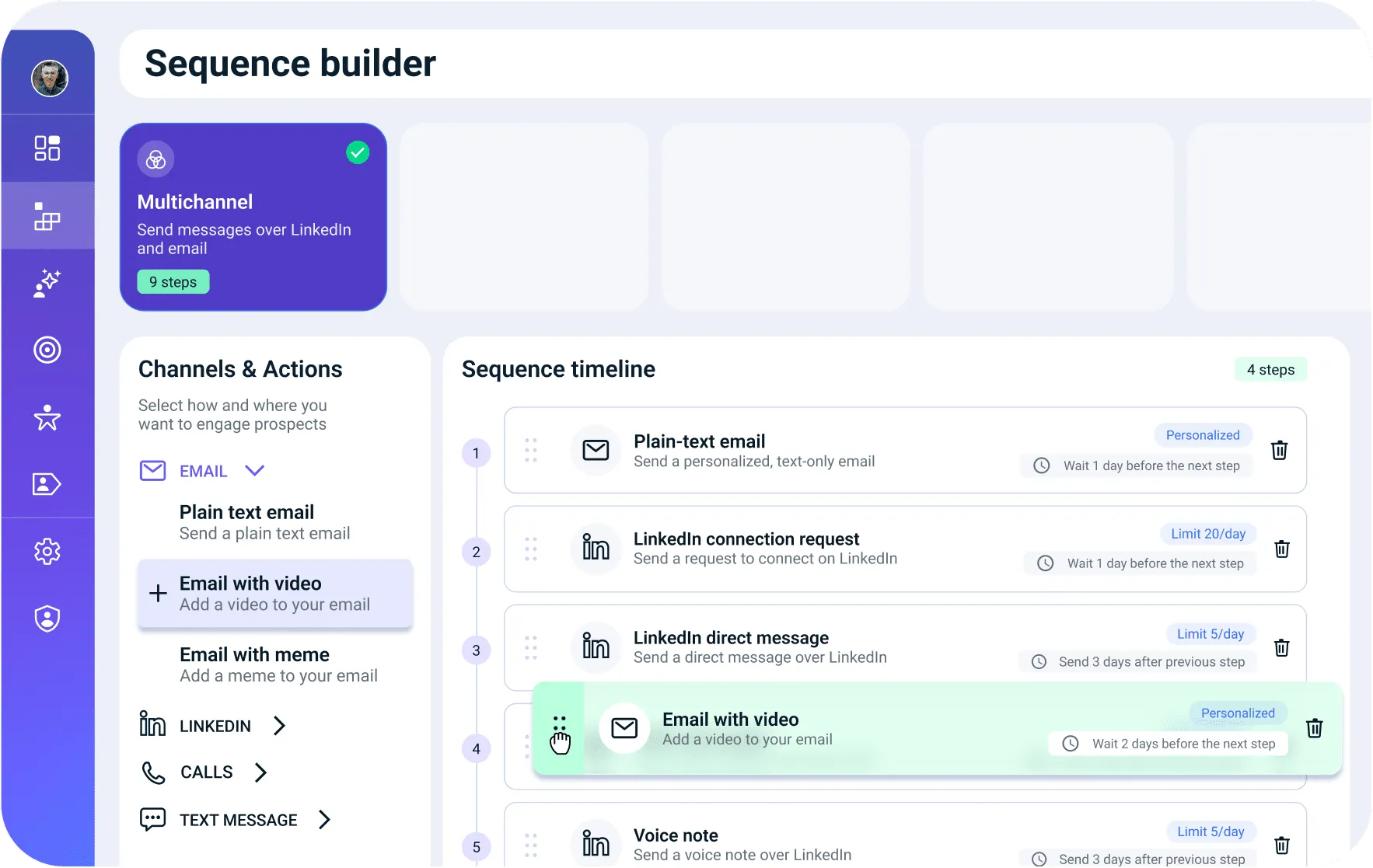
AiSDR positions itself as “an AI agent that focuses on lead quality over volume.” Its agent, Ami, runs outbound across email, LinkedIn and phone, and also follows up on inbound leads, answers questions and handles objections before escalating complex conversations to a person.
Sequences can mix channels in any order and include videos and voice notes, and HubSpot and Salesforce integrations score leads and log activity. Every plan includes AI-researched emails and LinkedIn actions, email setup and warmup and a native two-way HubSpot sync. Salesforce sync, AI video and voice messages and website visitor tracking come on the top plan.
Key features:
Ami agent for outbound and inbound follow-up
Email, LinkedIn and phone outreach
Email setup and warmup included
Two-way HubSpot sync on every plan, Salesforce on Scale
LinkedIn signal tracking on Explore and above
Aircall integration for call steps
Pros:
Published pricing
Handles inbound and outbound conversations
Strong G2 rating for a newer tool
Cons:
Salesforce sync only on the top plan
Contact limits on each plan
Explore and Scale use quarterly contracts
Best for: SMB and mid-market teams that want an AI SDR for email and LinkedIn with transparent pricing.
Pricing: Solo at $250 a month (200 AI-researched contacts), Explore at $900 a month (800 contacts) and Scale at $2,500 a month (2,500 contacts), all billed monthly. Solo runs month to month, Explore and Scale have quarterly contracts, and annual plans save 20%, as our AiSDR pricing breakdown explains.
Shopping around? See how it stacks up in our roundup of AiSDR alternatives.
5. Apollo
G2 rating: 4.7/5
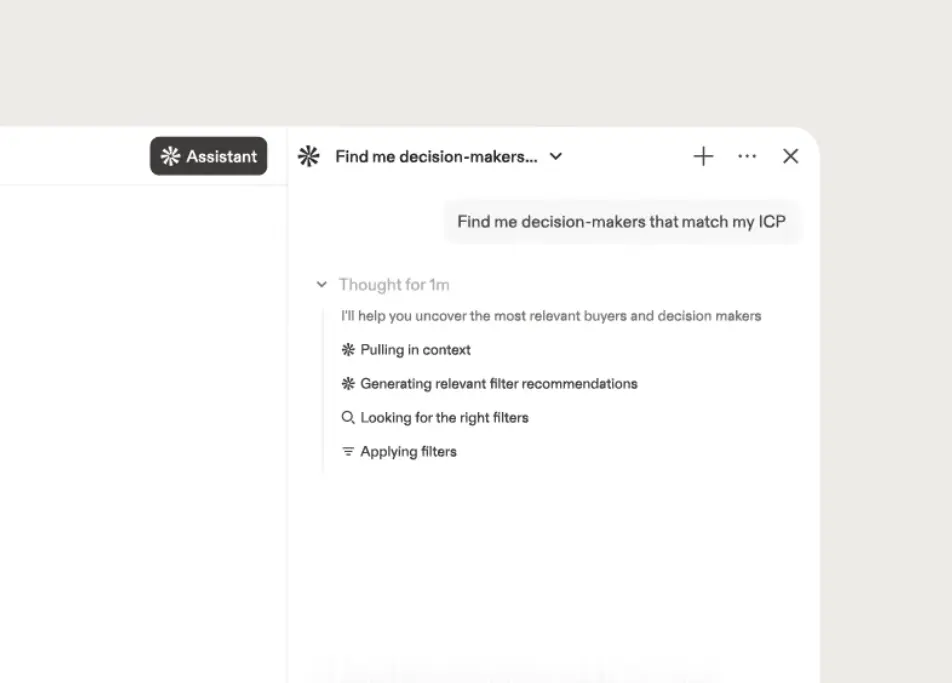
Apollo combines a database of 240M+ contacts and 30M+ companies with sequencing, dialing and AI agents that research accounts, prioritize leads and write outreach in the background.
For AI SDR work, Apollo’s strength is bundling. Its feature set can replace a separate prospecting database, sequencing tool and dialer, the free plan makes it easy to test, and an MCP server lets AI assistants work with its data.
Key features:
240M+ contacts and 30M+ companies
Email, phone and LinkedIn sequencing
Parallel and power dialing through the Advanced Dialer add-on
AI agents and an AI assistant for research and writing
Chrome extension for prospecting on LinkedIn and in Gmail
Salesforce, HubSpot and other CRM integrations
Pros:
Data, sequencing and dialing in one license
Permanent free plan
Accessible per-seat pricing
Cons:
Per-seat costs add up as teams grow
The Advanced Dialer and Inbound features are paid add-ons
Data and AI features draw on per-seat credits
Best for: SMB and mid-market outbound teams that want data and sequencing with AI assistance in one tool.
Pricing: Free plan with 900 credits a year, then Basic at $49, Professional at $79 and Organization at $119 (minimum three seats), per seat per month billed annually. Annual billing saves 24% over monthly, and our Apollo pricing breakdown covers credits and add-ons.
Considering Apollo? See how the two platforms compare in Apollo vs. ZoomInfo.
6. Reply
G2 rating: 4.6/5
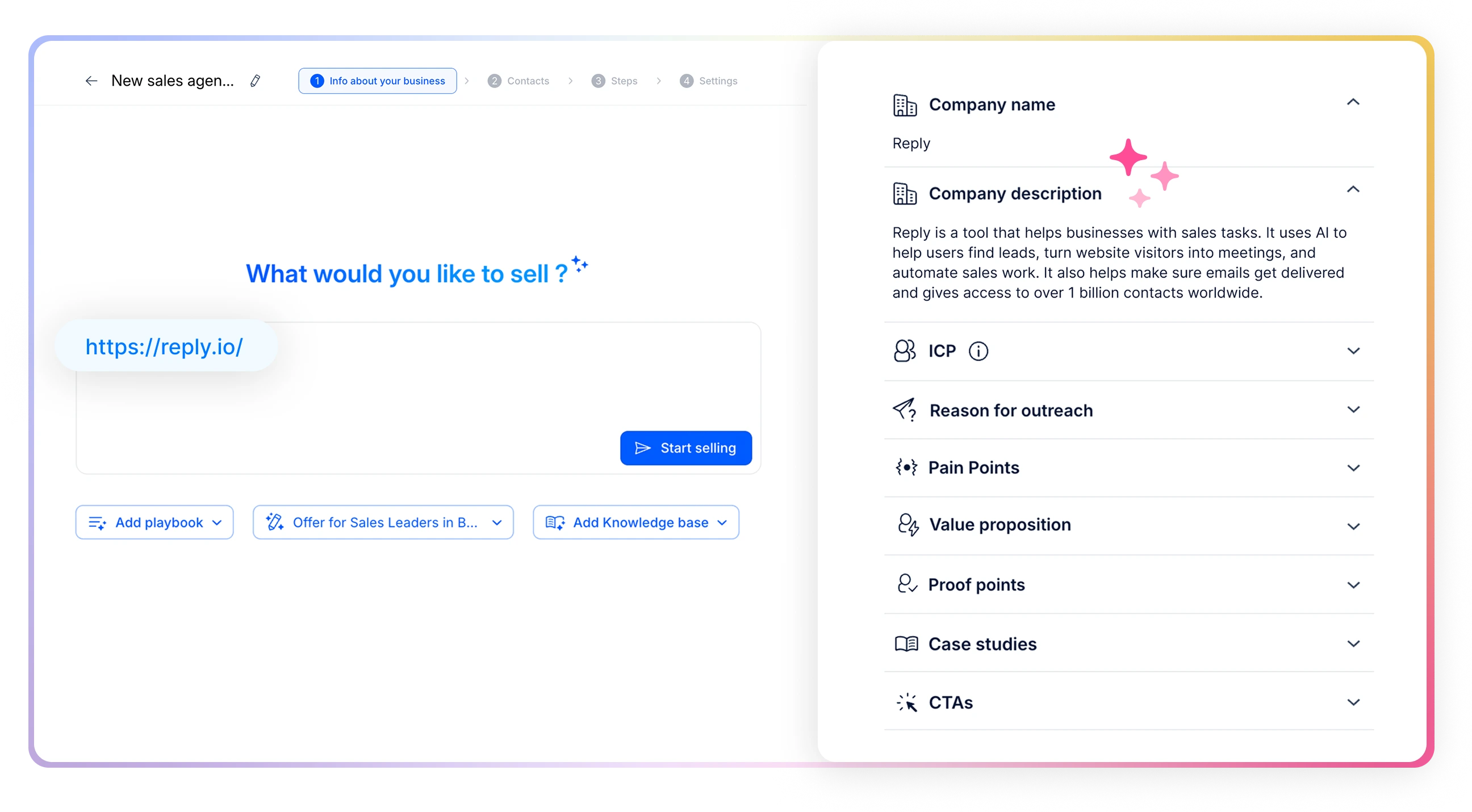
Reply is a sales engagement platform with an AI SDR called Jason AI. Jason runs multichannel outreach with AI personalization and intent signals, in either autopilot or copilot mode, and Reply’s core features cover mailboxes, warmup and deliverability.
Jason handles replies, answers common questions and books meetings, and Reply’s LinkedIn automation covers connection requests, messages, InMails and voice messages. Like other sales cadence tools, Reply offers two core plans. Email Volume covers high-volume email with LinkedIn and calls as paid add-ons, while Multichannel bundles email, LinkedIn, calls, SMS and WhatsApp. Both draw on a B2B database Reply says covers over 1 billion contacts.
Key features:
Jason AI SDR with autopilot and copilot modes
Email, LinkedIn, calls, SMS and WhatsApp
Unlimited mailboxes and email warmup on Email Volume
Live data credits from Reply’s B2B database
Intent signals and AI-generated responses on Jason AI
LinkedIn automation for connection requests, messages and InMails
Meeting scheduler and A/B testing for email copy
Pros:
Choice between autonomous and assisted modes
Wide multichannel coverage
Published pricing
Cons:
LinkedIn and calling cost extra on Email Volume
Jason AI SDR is priced separately from the core plans
Email Volume caps active contacts, starting at 1,000 a month
Best for: Teams that want multichannel sequences with an AI SDR they can switch between autopilot and copilot.
Pricing: Jason AI SDR starts at $500 a month. Email Volume starts at $49 per user per month and Multichannel at $89 per user per month, both billed annually.
7. Salesforce Agentforce
G2 rating: 4.3/5
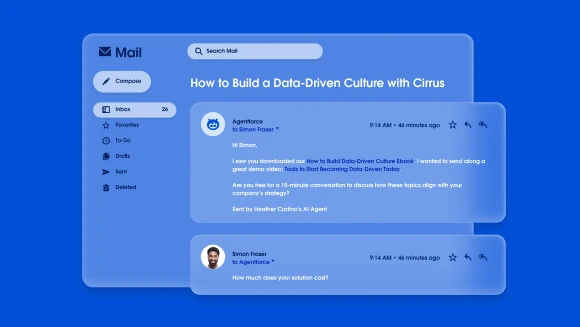
Salesforce Agentforce brings AI agents into Salesforce. Agentforce for Sales Development nurtures inbound leads around the clock, handling personalized outreach, answering their questions and scheduling introduction meetings for reps, grounded in your company’s sales, product and customer data.
ZoomInfo works alongside Agentforce. ZoomInfo data now powers the Salesforce Agentforce Prospecting Agent, giving mutual customers verified contact, company, intent and Scoops data inside Agentforce by default. The integration runs through GTM.AI, ZoomInfo's GTM context layer, over API and MCP, so every agent recommendation traces back to a cited, verified signal.
Key features:
Agentforce for Sales Development for lead outreach and meeting booking
Native to Salesforce data and workflows
Agentforce Sales Coach for rep coaching
ZoomInfo data available in the Agentforce Prospecting Agent
Pros:
Works natively inside Salesforce
No separate tool for Salesforce-centric teams
Strong ecosystem of partners and data providers
Cons:
Designed for teams that run on Salesforce
Flex Credit usage needs forecasting against agent volume
Works best on clean, verified CRM data, which is where ZoomInfo data helps
Best for: Sales teams standardized on Salesforce that want SDR agents inside their CRM.
Pricing: Sold through Salesforce, either on Flex Credits at $500 per 100,000 credits (a standard agent action uses 20 credits) or as Agentforce add-ons for Sales from $125 per user per month.
8. Clay
G2 rating: 4.6/5
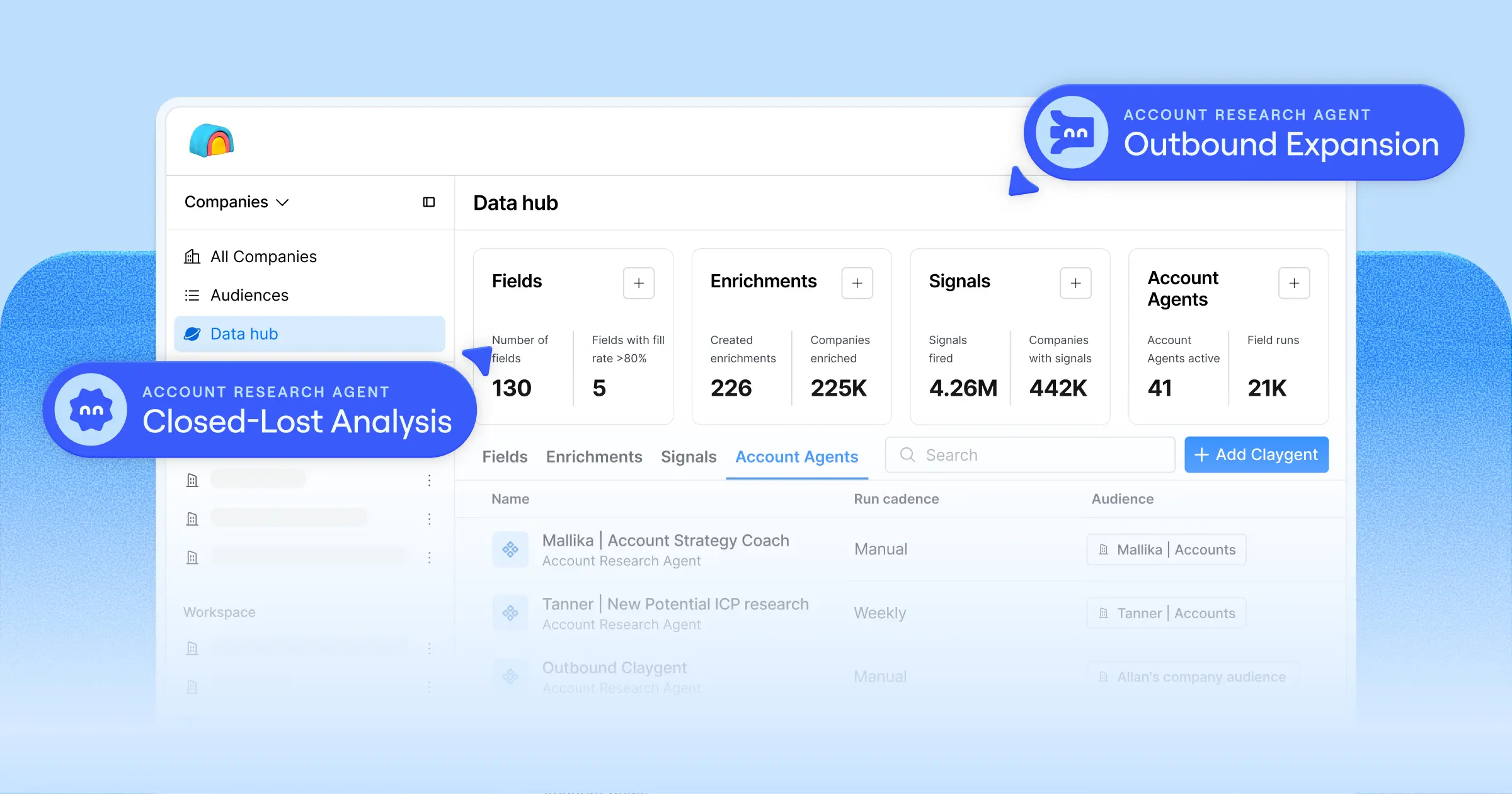
Clay is a GTM data and workflow platform built around spreadsheet-style tables. As our guide to what Clay is explains, it offers waterfall enrichment across a marketplace of 200+ data providers, Claygent for custom web research and its own email sequencer. Clay has also introduced a global agent, still in alpha, that plans and builds workflows from a goal you describe.
Clay is less an AI SDR than the toolkit GTM engineers use to build one. Teams that have a GTM engineer can design highly custom research and outreach, while teams without one often find it hard to maintain, a theme that comes up often in Clay reviews.
Key features:
Waterfall enrichment across 200+ providers
Claygent for custom web research
Workflows, signals and a native sequencer
A global agent in alpha that plans and builds plays
CRM and outreach integrations
Pros:
Maximum flexibility for custom research
Combines many data sources in one place
Public pricing with a free plan
Cons:
Needs a GTM engineer to build and maintain
Actions and data credits are hard to predict at scale
Data quality depends on which providers a waterfall reaches
Best for: RevOps and GTM engineering teams that want to build their own AI SDR workflows.
Pricing: Free plan, then Launch from $167 a month and Growth from $446 a month, both billed annually, with custom Enterprise pricing.
See how Clay compares head to head in Clay vs. ZoomInfo, or browse more Clay alternatives.
9. Instantly
G2 rating: 4.8/5
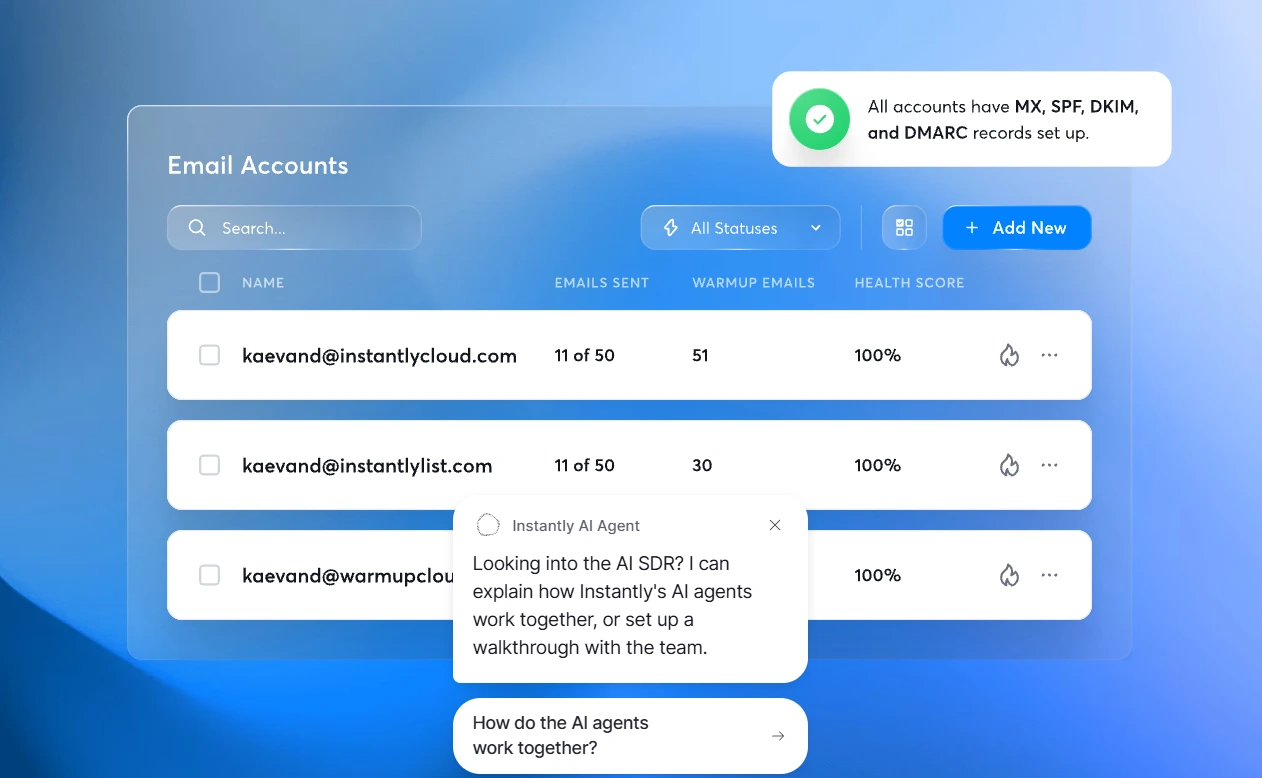
Instantly is a cold email platform built for volume and deliverability. It combines unlimited email accounts and warmup with a lead database of 450M+ B2B contacts, a CRM and AI agents, including an AI Sales Agent, an AI Reply Agent that handles inbox responses and an AI BDR, which puts it in closer competition with autonomous email agents like B2B Rocket.
For AI SDR use, Instantly suits teams whose main channel is email at scale. It gives less depth on account research and CRM integration than platforms built around verified data, though teams can connect it to their own systems through the Instantly API. Analytics go past opens and replies to opportunities, pipeline and revenue, and campaigns can pause or scale automatically based on performance.
Key features:
Unlimited email accounts and warmup on all Outreach plans
450M+ B2B lead database with waterfall email enrichment
AI Sales Agent, AI Reply Agent and AI BDR
Unified inbox and revenue-level campaign analytics
Deliverability tools and inbox placement tests
Pros:
Low entry price
Strong deliverability tooling
Highest G2 rating on this list
Cons:
Email-first, with limited multichannel depth
Lighter CRM integration than enterprise tools
Pricing is split across several products
Best for: Teams and agencies running high-volume cold email.
Pricing: Instantly’s Outreach plans start at $47 a month (Growth), with Hypergrowth at $97 and Light Speed at $358 on monthly billing and custom Enterprise pricing. The lead database and CRM are priced separately.
10. Outreach
G2 rating: 4.3/5
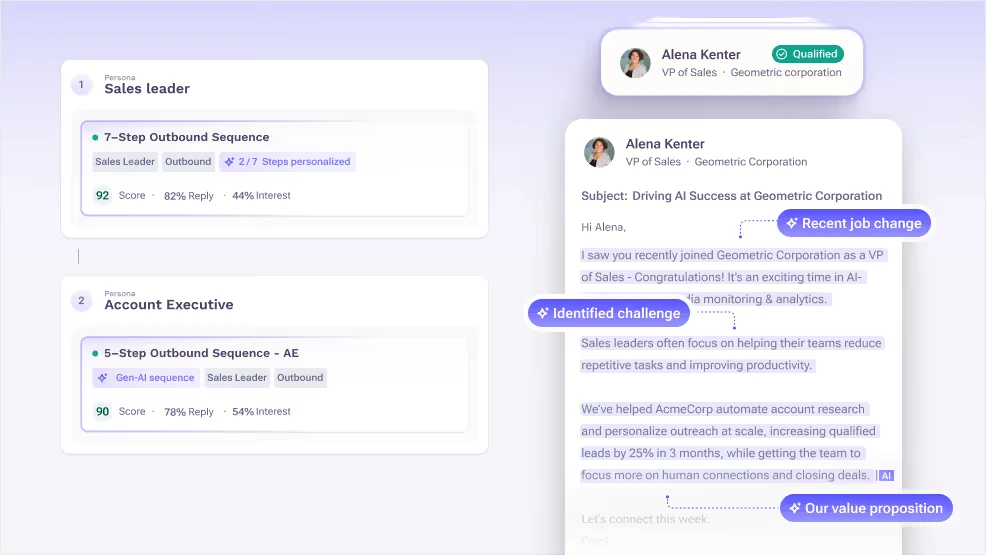
Outreach now describes itself as an agentic AI platform for revenue teams. Its AI agents work across prospecting, deal management, forecasting and coaching, with Agent Studio for ready-to-run workflows, a Meeting Prep Agent and Outreach Omni, a conversational assistant for sellers.
Outreach is also one of the sales engagement platforms Agent Teams connects to natively, so teams can keep their Outreach sequences and let Agent Teams enroll qualified buyers into them. Smaller teams often weigh it against lighter engagement tools, as in our Outplay vs. Outreach comparison.
Key features:
Sales engagement and multichannel sequences
Agent Studio and a Meeting Prep Agent
Outreach Omni conversational assistant
Conversation intelligence and forecasting
Governance controls for agent permissions with audit trails
Pros:
Deep enterprise sales engagement platform
AI agents across the full sales cycle
Strong security, SSO and role-based access
Cons:
No public pricing
More platform than most SDR teams need on day one
Agent features sit inside a broad platform, so rollout takes planning
Best for: Enterprise sales organizations that want AI agents inside an established sales engagement platform.
Pricing: Custom.
How ZoomInfo Agent Teams Compares to Other AI SDR Tools
Most tools on this list give you one agent that handles one part of the job, such as writing outbound email or answering replies. Agent Teams works differently. It works as an orchestration layer, the same idea behind revenue action orchestration tools, coordinating a team of specialist agents that hand each other the full story, from research to deal history, with a supervisor agent checking every step against your rules.
Typical single-agent AI SDR | ZoomInfo Agent Teams | |
Scope | One job, such as outbound email or reply handling | A whole play, from the first signal to a routed lead or account brief |
What starts the work | A list or campaign you load | Signals such as a form fill, intent spike, CRM event or job change |
Context | The vendor’s database plus web research | Verified ZoomInfo data plus your CRM, calls, emails and notes |
When a deal goes quiet | The sequence ends or restarts | The play resumes from the account’s current state |
Where actions happen | Mostly inside the vendor’s app, synced to the CRM | Natively in Salesforce, HubSpot, Slack, Gmail, Salesloft and Outreach |
Oversight | Varies by vendor | Monitoring, admin dashboards, role-based access and a credit estimate before each play |
Two plays for SDR and BDR work
Inbound Lead Activation (the AI SDR job). A form fill from a qualified buyer starts the play. The Agent Team researches the lead, creates the CRM record, routes it to the right rep and sends a Slack update, so every qualified buyer reaches the right rep with the full picture. In a fuller version of the play, a new lead in Salesforce or HubSpot triggers enrichment, scoring and qualification, then enrollment in the right sequence in Salesloft or Outreach. That goes further than routing a lead, because the goal is converting the buyer.
Outbound Prospecting (the AI BDR job). The Agent Team researches a target account, builds a structured list of the key buying group contacts and writes a complete account brief, so outbound starts from real context.
Teams can deploy either template as-is, customize it in plain language or code, or describe a new play in plain English and let Agent Teams generate the workflow. With 50+ ready-made agents to draw on, teams can be live in a day.
Why adaptive plays beat fixed sequences
A form fill, intent spike, CRM event or job change opens or resumes a play, and plays can also run on a schedule, from webhooks or after completed meetings. Because each play works from the account’s current state, a two-week pause in a deal never resets the plan. A fixed sales automation sequence can’t do that, and it’s what lets the same platform run plays well beyond SDR work, from champion tracking and MEDDIC capture after calls to closed-won handoffs, closed-won lookalikes and closed-lost win-backs.
Along the way, agents research accounts, update CRM records, enroll prospects in sequences and send emails and Slack messages. Every step is written back to the CRM, which keeps CRM data enrichment current without manual entry.
Agent Teams is built on technology from DoubleO.ai, now part of ZoomInfo. It’s part of GTM Studio with no new SKU or contract, runs on consumption-based AI Credits and shows a credit estimate before each play is activated. Teams that want to work outside the interface can run plays headless through GTM.AI’s API, GTM CLI and MCP, including from AI assistants such as Claude through ZoomInfo’s MCP.
How to Choose AI SDR Software
Your choice depends on your data, your stack and whether you need inbound, outbound or both. These five questions cover the decisions that matter most.
How good is the data underneath? AI SDRs amplify whatever data they run on. Ask how often contacts are re-verified and how the tool handles B2B data decay, then test a sample against your own pipeline. Platforms with verified data avoid the bounced emails and wrong-person outreach that damage domains, and our guide to data enrichment tools covers what to test.
Do you need inbound, outbound or both? If speed to lead matters most, look for an AI SDR that responds to inbound leads in minutes and routes them correctly. If you need new pipeline, prioritize research and buying-group mapping for outbound lead generation.
Is the personalization real? Check whether the AI references company news, intent data and CRM history, or fills in templates, the gap that separates the best generative AI sales tools from the rest. Ask for sample messages written for your own target accounts.
Does it fit your stack? Native integrations for Salesforce data enrichment or HubSpot keep records current, and support for sales engagement platforms such as Salesloft and Outreach means you don’t have to rebuild sequences. Check whether the tool writes its actions back to the CRM.
Can you govern it? You’ll want to see what every agent did, control who can build and run plays and know the cost before anything runs.
AI SDR vs. Human SDR
The most effective teams combine both. AI handles volume and speed, while people handle judgment and relationships.
AI SDRs are strongest at:
Volume: Researching and reaching thousands of prospects without fatigue
Speed: Responding to inbound leads in minutes, at any hour
Consistency: Following up on every lead on schedule
Signal processing: Spotting intent, job changes and other triggers across many sources
Human SDRs are still essential for:
Complex conversations: Nuanced objections and multi-stakeholder deals
Relationships: Building trust with senior and strategic buyers
Judgment calls: Situations no playbook covers
Whether your team is in-house or works with outsourced SDR companies, AI SDRs free reps to spend more time on the conversations that close.
Choose an AI SDR That Runs the Whole Play
The right AI SDR depends on what you need covered. Autonomous reps like Artisan and 11x suit teams that want outbound volume, sequencing platforms like Apollo, Reply and Instantly add AI to existing outreach, and Clay suits teams with a builder. For a broader view, our roundup of AI sales agent platforms covers agents beyond sales development. Teams that want inbound and outbound plays to run end to end on verified data, inside the tools reps already use, should look at ZoomInfo Agent Teams.
Meet with a GTM expert to see Agent Teams run an inbound or outbound play on your own accounts.
AI SDR Software FAQ
What is an AI SDR tool?
An AI SDR tool is software that does the work of a sales development rep. It finds and researches prospects, writes and sends personalized outreach, qualifies replies and books meetings, adjusting its approach based on how prospects respond. Some tools sell a single AI rep, while platforms like ZoomInfo Agent Teams coordinate several specialist agents to run a complete play.
What are the best AI SDR tools?
ZoomInfo is the best choice for teams that want AI agents to run complete inbound and outbound plays on verified data inside Salesforce or HubSpot. Artisan and 11x suit teams that want an autonomous AI rep for outbound, AiSDR suits smaller teams that want published pricing, and Apollo, Reply and Instantly add AI agents to sequencing platforms. Salesforce Agentforce fits teams standardized on Salesforce, and Clay fits teams with a GTM engineer to build custom workflows.
Do AI SDRs actually work?
Yes, for the right jobs. AI SDRs work well for research, first touches, follow-up and fast responses to inbound leads, where speed and consistency matter most. Results depend heavily on the data underneath and the context the AI has. Outreach built on stale contacts or generic templates produces bounced emails and low reply rates at scale. They work best at the top of the funnel, while complex enterprise deals still need people for relationships and negotiation.
Is AI replacing SDRs?
Not fully. AI SDRs take on research, first touches, follow-up and qualification at a volume no team can match, but people are still needed for complex objections, strategic accounts and relationship building. Most teams use AI to give each rep more qualified conversations and to cover work that used to go undone.
How much do AI SDR tools cost?
Prices range widely. Apollo and Clay offer free plans, Instantly starts at $47 a month, AiSDR starts at $250 a month and Reply’s Jason AI SDR starts at $500 a month. Salesforce prices Agentforce through Flex Credits or per-user add-ons, while Artisan, 11x and Outreach use custom pricing. ZoomInfo is free to start with consumption credits based on usage, and Agent Teams shows a credit estimate before each play runs.
Which AI SDR tool is best for pricing?
For the lowest entry cost, Apollo has a permanent free plan and Instantly starts at $47 a month for cold email. AiSDR publishes its plans from $250 a month. ZoomInfo is free to start with consumption credits based on usage, and Agent Teams shows the credit cost of each play before it runs, so teams can see what a play will cost before committing to it.
How quickly do AI SDR tools show results?
It depends on the tool and the channel. Email-first tools need new sending domains to warm up before they reach full volume, and AiSDR, for example, says warmup alone takes around 30 days. Platforms that work on existing data and systems move faster: ZoomInfo says teams can have Agent Teams up and running in a day, with a forward-deployed team helping get the first plays live.
What is the difference between an AI SDR and an AI BDR?
An AI BDR focuses on outbound prospecting into new accounts, while an AI SDR traditionally focuses on following up and qualifying inbound leads. Most tools do both. ZoomInfo Agent Teams covers the two jobs with separate templates: Inbound Lead Activation for SDR work and Outbound Prospecting for BDR work.
Can AI SDRs handle inbound leads?
Yes. Several tools on this list handle inbound. ZoomInfo’s Inbound Lead Activation play researches a new lead, creates the CRM record, routes it to the right rep and sends a Slack update, while 11x’s Julian answers inbound calls and AiSDR follows up on inbound leads by email.
Which CRM integrations matter most for an AI SDR?
Prioritize native, two-way integration with your primary CRM, usually Salesforce or HubSpot, so prospect data stays current and every action the AI takes is logged without manual entry. If your reps already work in a sales engagement platform such as Salesloft or Outreach, check that the AI SDR can enroll prospects into the sequences you’ve already built.
What is the best AI SDR tool for qualifying leads and booking meetings?
Look for a tool that responds within minutes, researches the lead, routes it to the right rep and books the meeting. ZoomInfo's Inbound Lead Activation play researches each new lead, creates the CRM record, routes it to the right rep and sends a Slack update, and a fuller version enrolls qualified buyers in the right Salesloft or Outreach sequence. 11x's Julian answers and qualifies inbound calls, and AiSDR follows up on inbound leads by email and LinkedIn.
What is ZoomInfo Agent Teams?
Agent Teams is agentic orchestration for GTM, built into ZoomInfo GTM Studio. It coordinates teams of AI agents across your systems, signals and ZoomInfo data to run complete plays, from signal detection and qualification through enrichment, routing, outreach and CRM updates. It’s part of GTM Studio with no new SKU and runs on consumption-based AI Credits.
