

You are evaluating Apollo.io, or you already use it and want to know what you are paying for. Either way, you need the same thing: a clear accounting of every feature, how it works, who it serves, and which plan unlocks it.
Apollo.io is an AI sales platform that combines a B2B contact database, multichannel outreach sequencing, a built-in dialer, conversation intelligence, deal management, and workflow automation into a single subscription. This breakdown covers the full feature set.
Apollo's feature set has you covered if:
You need a B2B database of 240M+ contacts and 30M companies built into the same platform you prospect and sequence from
You run multichannel outbound sequences across email, phone, and LinkedIn with SDR or BDR teams
You want AI writing personalized emails, summarizing calls, and updating your CRM automatically
You need call recording, transcription, and coaching scorecards inside the same tool as your sequences
You manage deals with Kanban boards, stall alerts, and engagement history tied to the contacts you prospected
You want a free-forever plan that gives individual contributors access before any procurement conversation
You'll reach the edges of its capabilities if:
You need intent data powered by hundreds of millions of IP-to-organization pairings and trillions of keyword signals, not a third-party layer with limited topic depth
You want an intelligence layer that reasons across CRM records, conversation transcripts, and behavioral signals to explain why deals move, not just that they moved
You need contact-level website visitor identification (not just company-level) that works globally
You require marketing orchestration, display advertising, or account-based marketing alongside sales execution
You want programmatic access at enterprise scale with documented rate-limit tiers and production-grade API delivery
For those needs, the reference point is ZoomInfo: an AI GTM platform built on 500M contacts, 100M companies, and 135M+ verified phone numbers, a GTM Context Graph that fuses B2B data with CRM records, conversation intelligence, and behavioral signals into one intelligence layer, and access through APIs, MCP, GTM Workspace, and GTM Studio.
After the feature breakdown, this article covers exactly where Apollo stops and how ZoomInfo fills those edges.
Apollo Platform Overview
Apollo.io positions itself as "The AI sales platform for smarter, faster revenue growth", claiming to replace your data provider, outreach platform, dialer, enrichment, and CRM. Founded in 2015 by Tim Zheng and Ray Li in San Francisco, the company has grown to 1M+ users across 550,000+ companies, reaching $150M ARR by May 2025.
The platform is organized around four solution areas:
Solution | What It Does | Plan Availability |
|---|---|---|
AI-powered multichannel sequences, built-in dialer, email deliverability | All plans (feature depth varies) | |
Website visitor identification, form enrichment, lead routing, scheduling | Paid plans; add-on for visitor ID | |
240M+ contacts, 30M companies, CRM/CSV/API enrichment, waterfall enrichment | All plans (credits vary) | |
Conversation intelligence, deal management, coaching, analytics | Included in platform pricing |
Apollo uses a hybrid per-seat plus credit-consumption model. Four tiers span from a free-forever Starter plan through Organization at $119/seat/month (annual). Credits fund data reveals, AI research, and enrichment; seats unlock feature depth. With that structure in place, here is the full tour.
Apollo's B2B Database and Data Enrichment
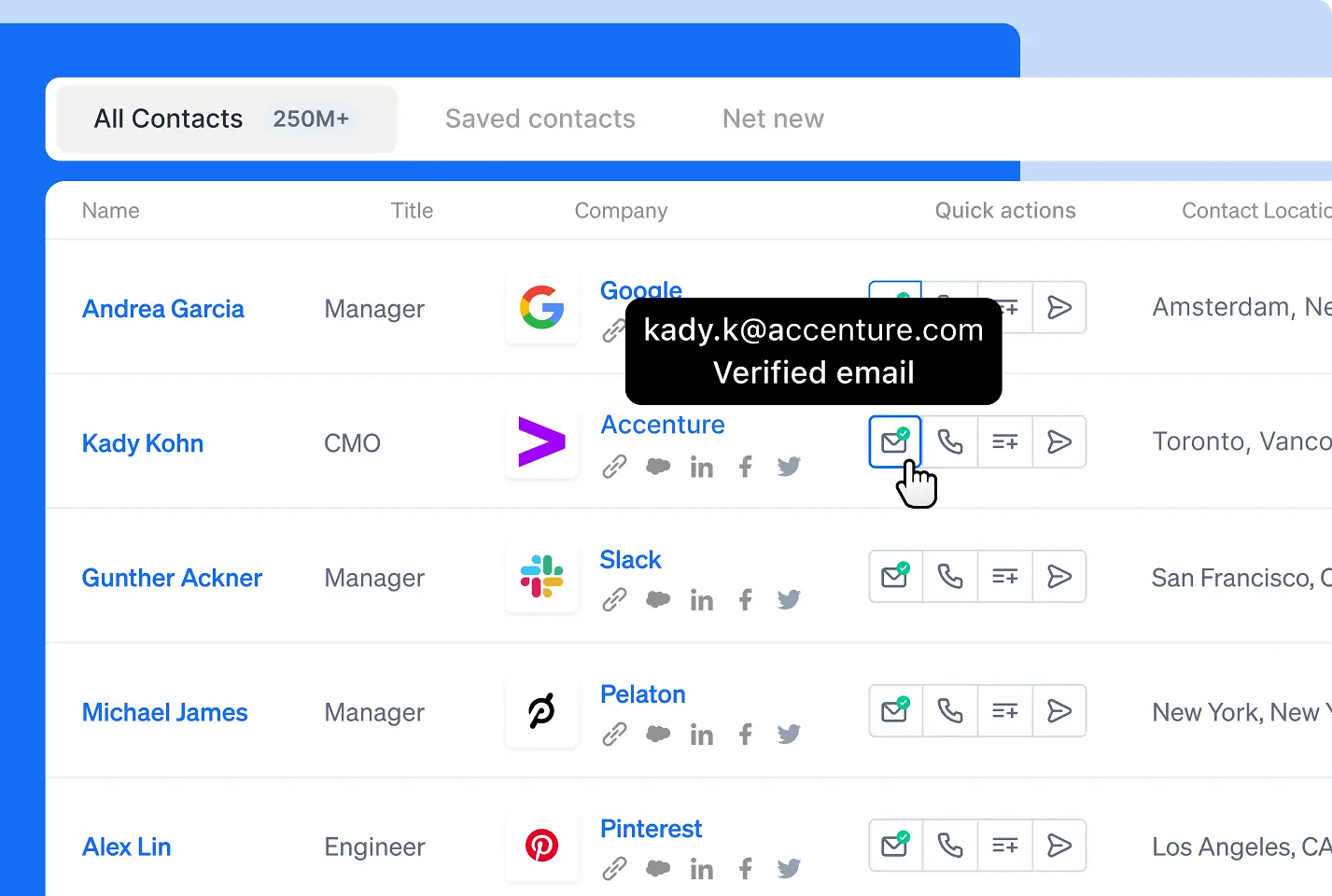
The database is the foundation everything else in Apollo runs on. At 240M+ contacts and 30M companies, it lets Apollo bundle prospecting and outreach in one platform rather than requiring a separate data vendor.
Data sourcing draws from four channels: a contributor network of over 2 million data sources (connected inboxes, CRMs, and CSV uploads that feed crowdsourced verification), Apollo's own engagement suite (email replies and bounces validate addresses in real time), public data crawling via proprietary algorithms that build a web-wide index, and third-party providers processing over 230 million records monthly.
Source: Apollo
The result: 5.3M new contacts added monthly, 72M emails verified monthly, and 150M contacts refreshed monthly. Apollo claims a 98% email accuracy rate through a 7-step verification process and less than 1% invalid direct phone numbers via real-time validation.
Search works through 65+ data attribute filters covering job title, management level, department, location, industry, employee count, revenue, technographics, and more. The Chrome Extension, available on all plans including free, surfaces Apollo data on company websites, LinkedIn, Salesforce, HubSpot, and Gmail, so prospecting happens wherever a rep already works.
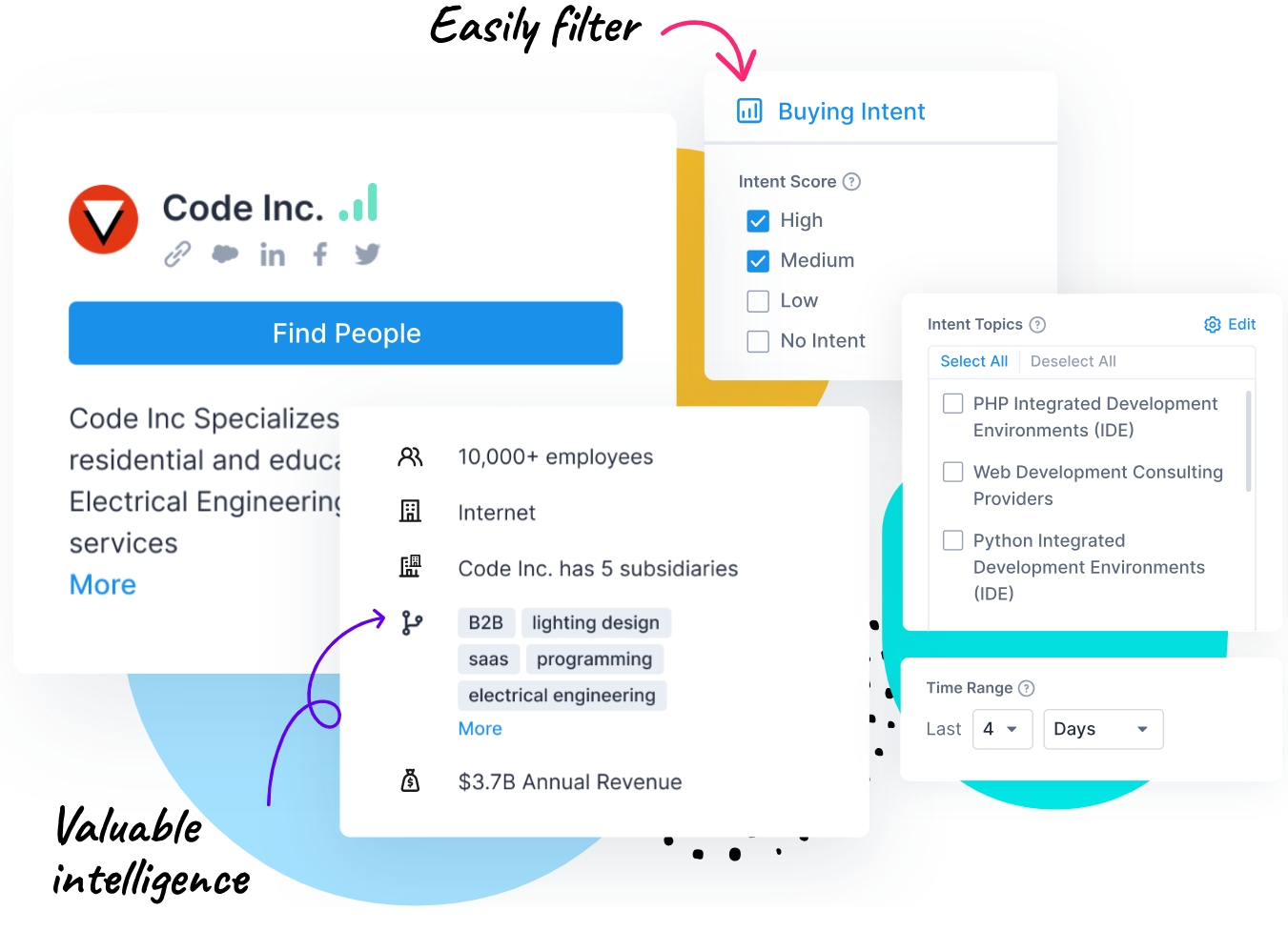
Buying Intent is where Apollo bundles what many competitors charge separately for. Intent data is available on all plans including free, covering over 1,600 topics via a partnership with LeadSift (a Foundry company), with a claimed 98% accuracy rate and weekly refresh. This gives even free-tier users a signal layer showing which accounts are researching relevant categories.
Source: Apollo
Enrichment comes in four forms. CRM Enrichment connects Salesforce or HubSpot for scheduled enrichment jobs (daily, weekly, monthly), monitored through a Data Health Center dashboard. CSV Enrichment uploads a file, matches records, fills gaps, and returns an enrichment report. API Enrichment pushes data to and from any system via Apollo's API.
Waterfall Enrichment is the newest addition: when Apollo's own database cannot match, it queries dozens of third-party providers in sequence until a verified result surfaces. Apollo reports 5% more email coverage, 7% more phone numbers, and 45% lower bounce rates from waterfall compared to its own database alone.
Data enrichment access is tier-gated. CRM enrichment, CSV enrichment, and job change enrichment require the Professional plan ($79/seat/month annual) or above. The free plan provides 75 credits/month for data reveals; the Organization plan provides 72,000 credits/year granted upfront. Each email reveal costs 1 credit; each phone number costs 8 credits.
Apollo holds ISO 27001 and SOC 2 Type 2 certifications, is GDPR compliant as both Data Processor and Controller, and maintains a Trust Center at trust.apollo.io.
Apollo's Outbound Sales Engine
Outbound is the feature set most buyers encounter first. It orchestrates the full cycle from prospect list to booked meeting, combining sequences, a dialer, email deliverability tools, and workflow automation in one interface.
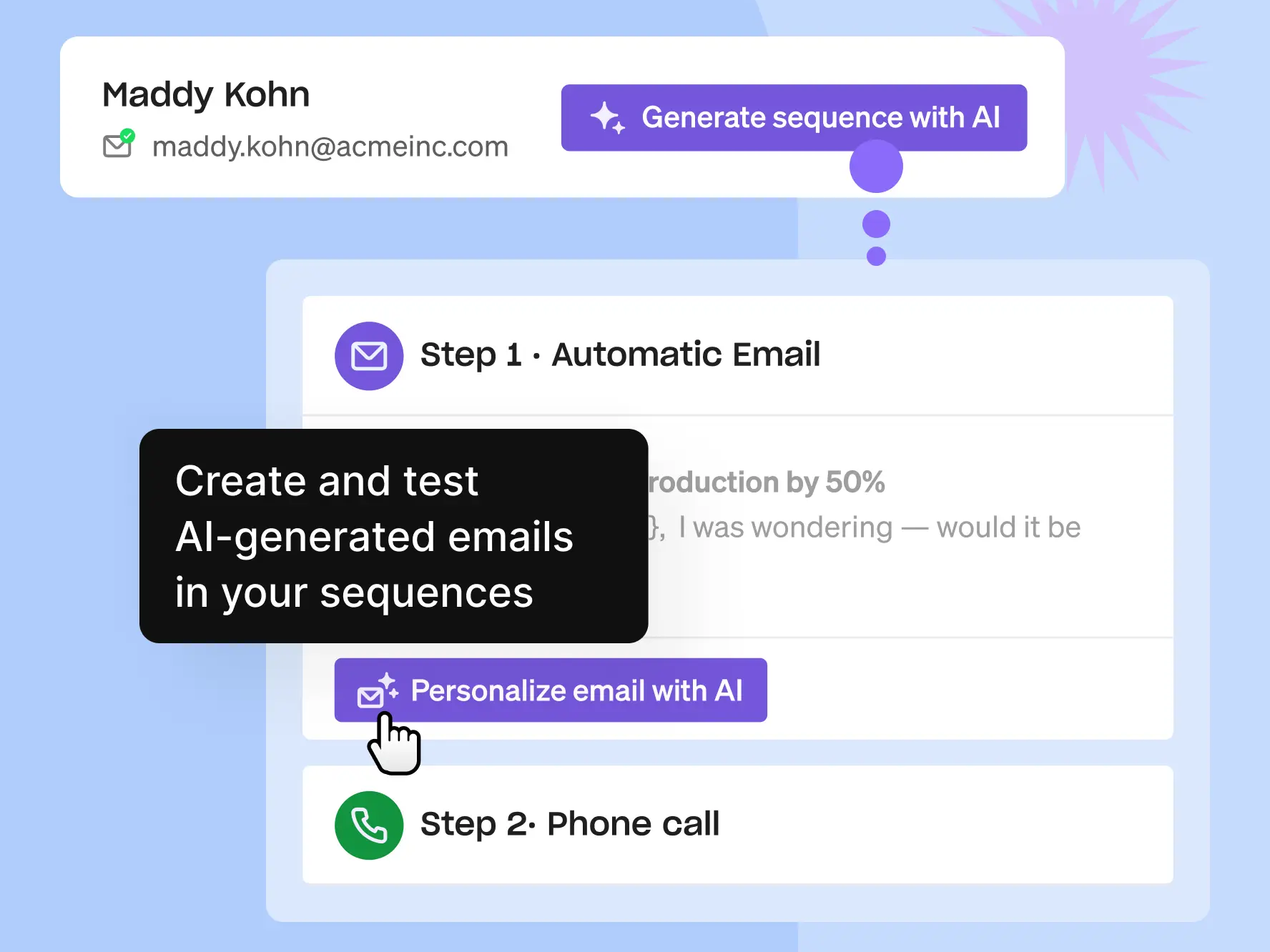
Sequences are multichannel campaigns supporting automatic and manual emails, phone calls, LinkedIn steps (connection requests, messages, post engagement), and custom tasks. Each sequence step can use pre-built templates, and AI-assisted sequence building generates entire outreach flows from a description of the target persona and value proposition.
Source: Apollo
A/B testing on email steps allows variant comparison. The free plan limits users to 2 active sequences; Professional and above unlock unlimited.
Apollo AI accelerates every outbound step. It generates email copy personalized with company news, role context, and the rep's own tone, builds lead lists from natural language descriptions of an ICP, and creates automated call summaries and CRM updates after meetings. The AI runs on Google Gemini, grounded in Apollo's own database of 240M+ contacts and millions of sales engagement data points.
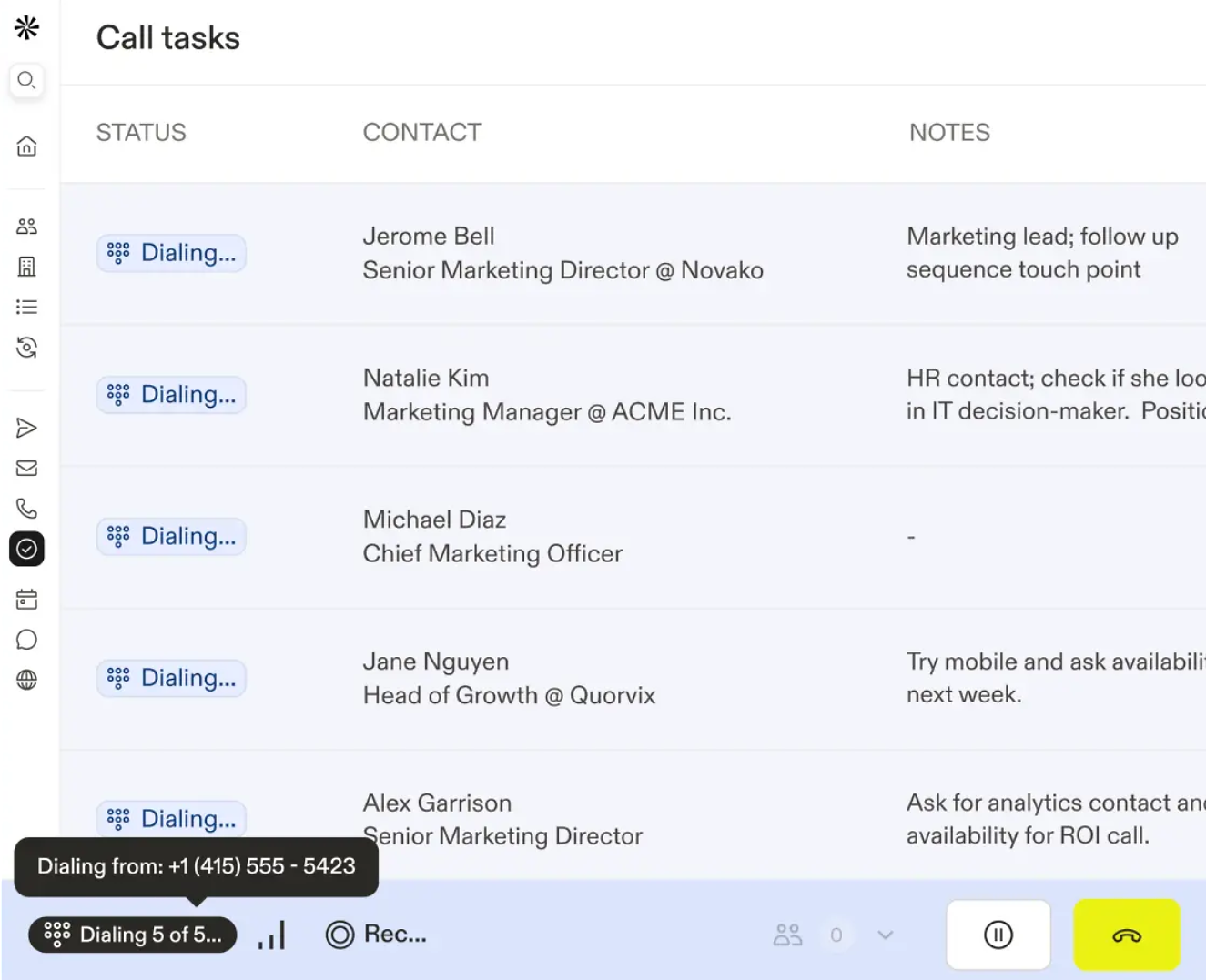
The Apollo Dialer covers the phone channel. A basic click-to-call dialer ships with the platform, but the advanced capabilities require an add-on at $149/month or $119/month billed annually.
Source: Apollo
That add-on unlocks the Power Dialer (automated sequential dialing), the Parallel Dialer (dialing multiple numbers simultaneously and connecting to the first pickup, with Apollo claiming reps can reach 100+ prospects per hour), Local Presence (displaying local area codes for higher pickup rates), International Dialing, AI-personalized call scripts, and voicemail drops. All calls are recorded, transcribed, and auto-logged.
Email Deliverability is handled natively. Apollo includes built-in automatic warm-up that gradually ramps new mailboxes to mimic natural sending behavior, along with real-time deliverability scoring, domain authentication support (SPF, DKIM, DMARC), and the ability to purchase and authenticate sending domains within the platform.
Warmup is free for one mailbox; additional mailboxes consume credits. One constraint on the free plan: only Gmail accounts can connect for email campaigns. Microsoft Office and other providers require a paid subscription.
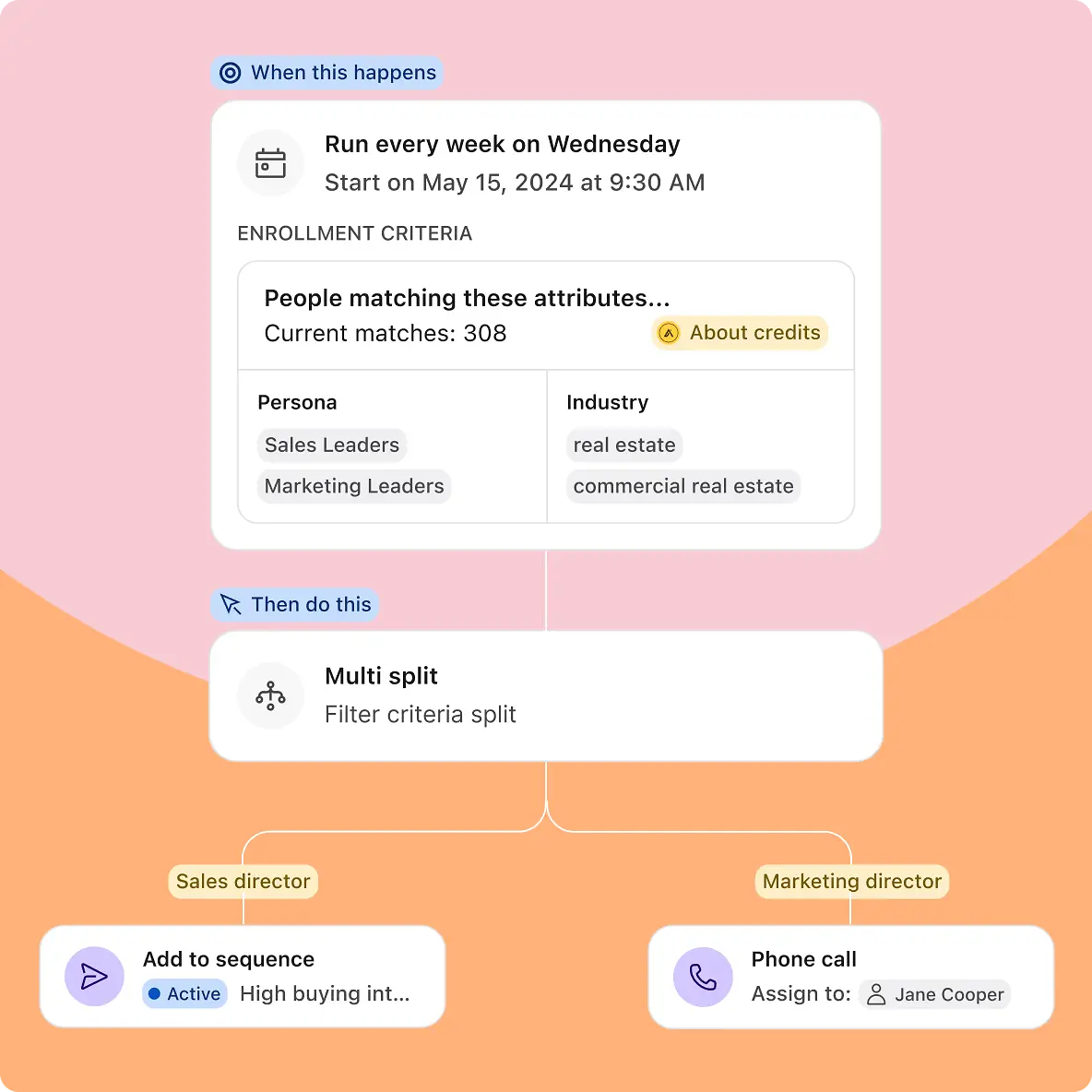
The Workflow Engine ties the outbound pieces together with automation. It provides a visual drag-and-drop builder with multi-branch conditional logic, trigger-based automation (a prospect visits a pricing page, a contact changes jobs, an intent signal fires), manual review gates for human checkpoints, and out-of-the-box templates.
Source: Apollo
Apollo reports that users who adopt Workflows book 2.5x more meetings. Reps work from a prioritized task queue that surfaces the highest-priority actions across all active sequences and workflows.
Apollo's Inbound Lead Capture and Routing
Inbound complements outbound, designed so teams never let a hot lead go cold. Apollo cites that most organizations capture less than 3% of website visitors in their sales funnel.
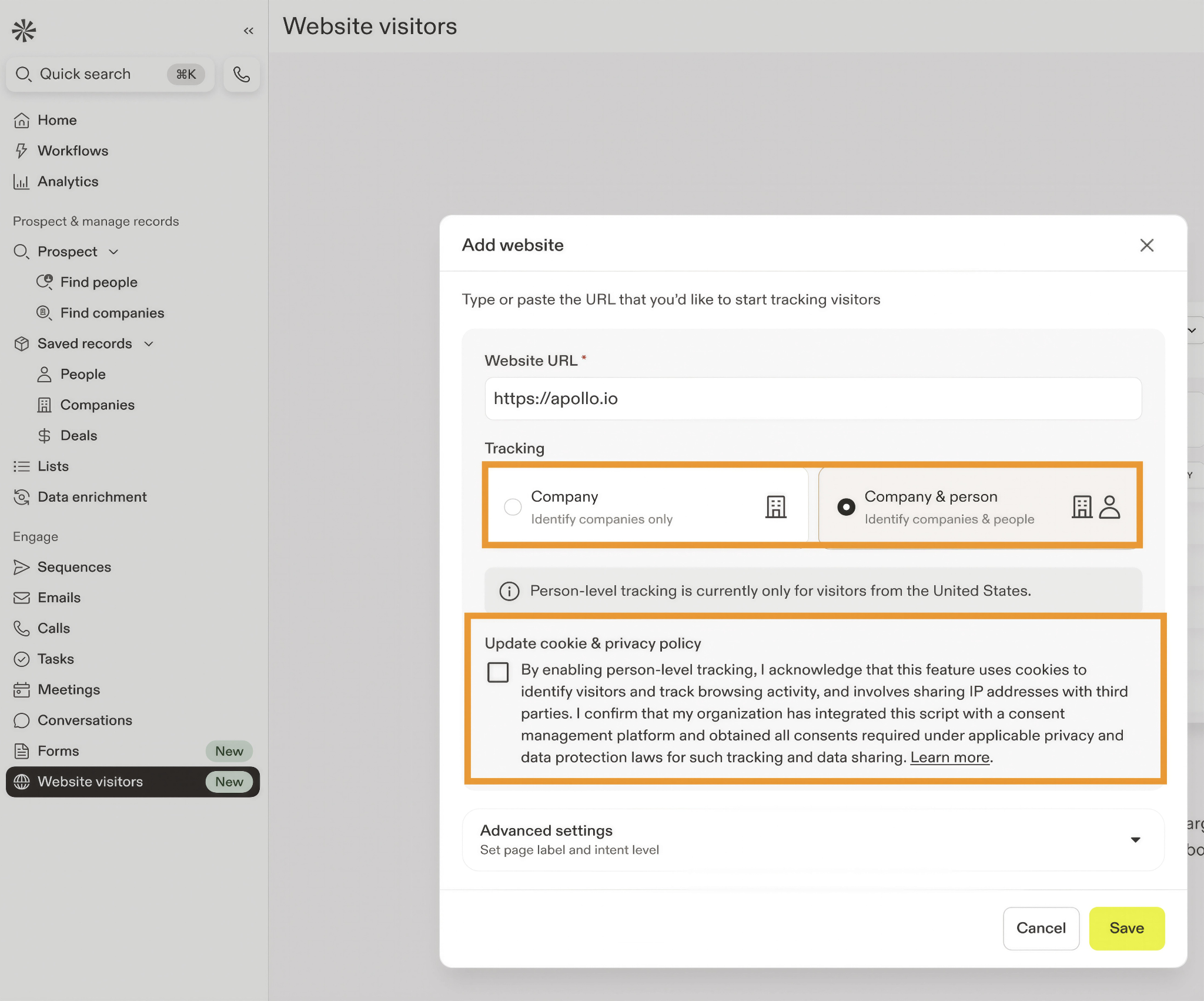
Website visitor identification uses a tracking script to detect which companies visit, which pages they view, and their level of intent. The feature identifies visitors at the company level and surfaces decision-makers at those accounts through AI Research. Paid plans with the inbound add-on support up to 50,000 visitor identifications per month.
Source: Apollo
Form Enrichment is one of Apollo's more distinctive inbound features. When a visitor submits just an email address, Apollo auto-fills fields using its database (company size, industry, title, technographics), shortening forms while capturing richer data. It works across form platforms including Marketo, HubSpot, ActiveCampaign, Webflow, and Wix, and does not consume credits.
Once a lead is captured, Lead Scoring & Signals assigns priority. Apollo supports AI-generated auto-score models trained on CRM success data and custom models using 65+ data attribute filters. Scored leads flow into the Inbound Router, which distributes leads based on CRM ownership, company size, territory, or round-robin rules with bi-directional CRM sync.
Qualified leads book meetings instantly via the Meetings Scheduler, which supports Google Calendar, Outlook, Exchange, and Office365 and auto-generates Zoom and Google Meet links. Leads that are not ready auto-enroll in nurture sequences.
Apollo's Conversation Intelligence and Deal Execution
Deal Execution bundles the post-booking workflow: conversation intelligence, deal management, coaching, and analytics. It is included in platform pricing rather than charged as a separate add-on, which differentiates Apollo from standalone tools in this category.
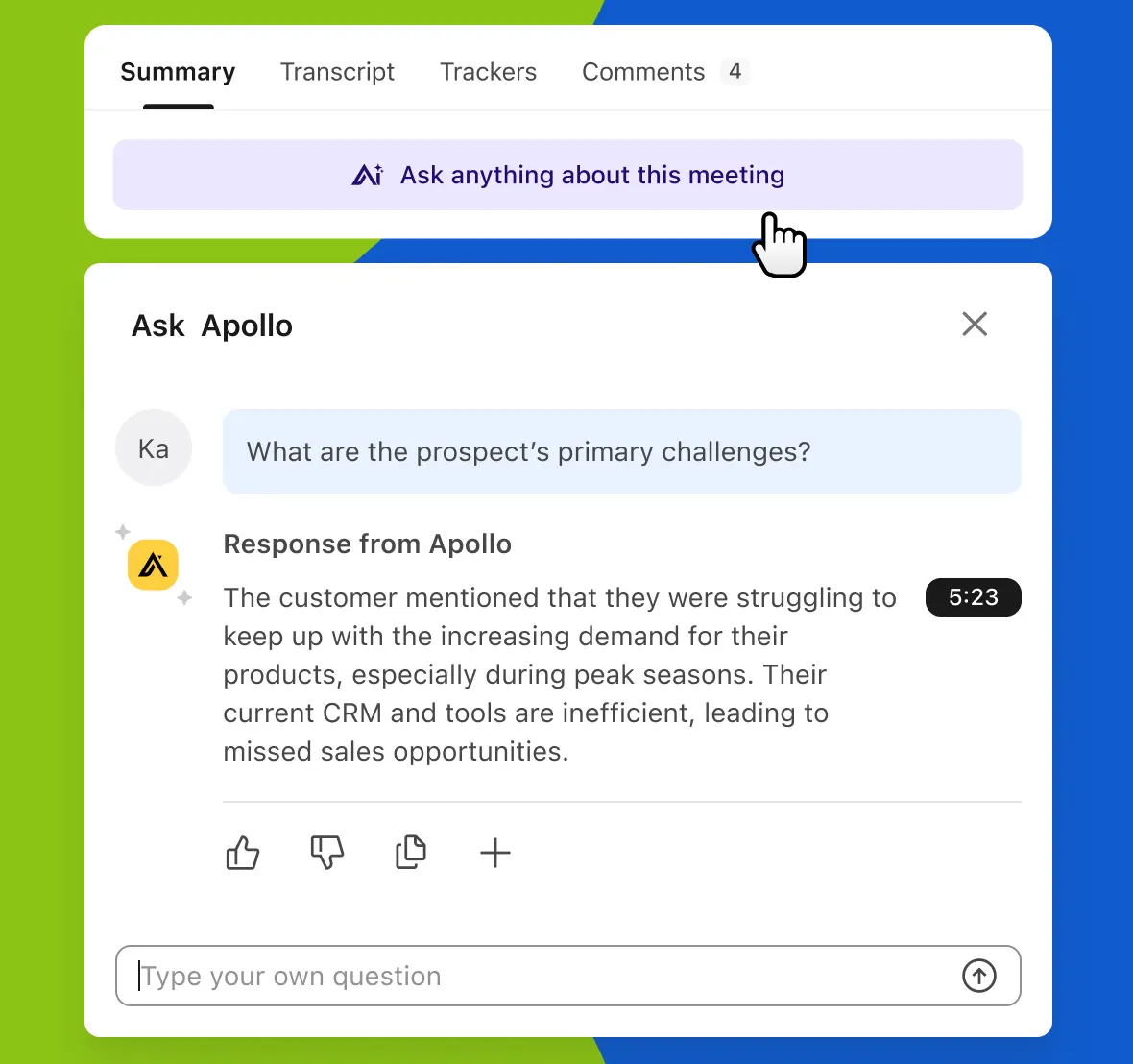
Apollo Conversations records and transcribes sales calls in real time. After the call, AI summaries break down outcomes, next steps, and objections. An AI chatbot lets reps and managers query any transcript in natural language. Call playlists collect strong calls for new hire training, and customizable scorecards standardize call evaluation.
Source: Apollo
Before a meeting, AI-generated intelligence surfaces account data, buyer signals, and deal context so reps walk in prepared. After the call, AI-personalized follow-up emails reference what was discussed, and automatic CRM updates eliminate manual data entry.
Deal Management provides Kanban-style deal boards with stall alerts, bi-directional CRM sync, multiple pipelines, and contact-level engagement history per deal. When a lead shows high intent, it converts automatically to an opportunity without manual pipeline entry.
Sales Coaching tracks talk-to-listen ratios, keyword and phrase frequency, and provides direct transcript commenting for feedback. Goal tracking with alerts notifies managers when reps fall behind targets. Team kudos and scorecards round out the coaching toolkit.
Sales Analytics provides Home Analytics (daily performance and goal pacing), Sequence Reports (per-step performance, reply rates, booking rates), and custom dashboards. These analytics sit in the same platform as the outreach and deal data, so a sales leader can trace performance from initial sequence engagement through closed deal without cross-referencing separate tools.
The structural advantage here is that Deal Execution shares the same database and contact records as outbound. A rep who found a lead in Apollo's database, sequenced them, booked a meeting, and recorded the call sees the entire history on one screen, with AI summarizing and coaching across all of it.
Apollo's Integrations, API, and Technical Infrastructure
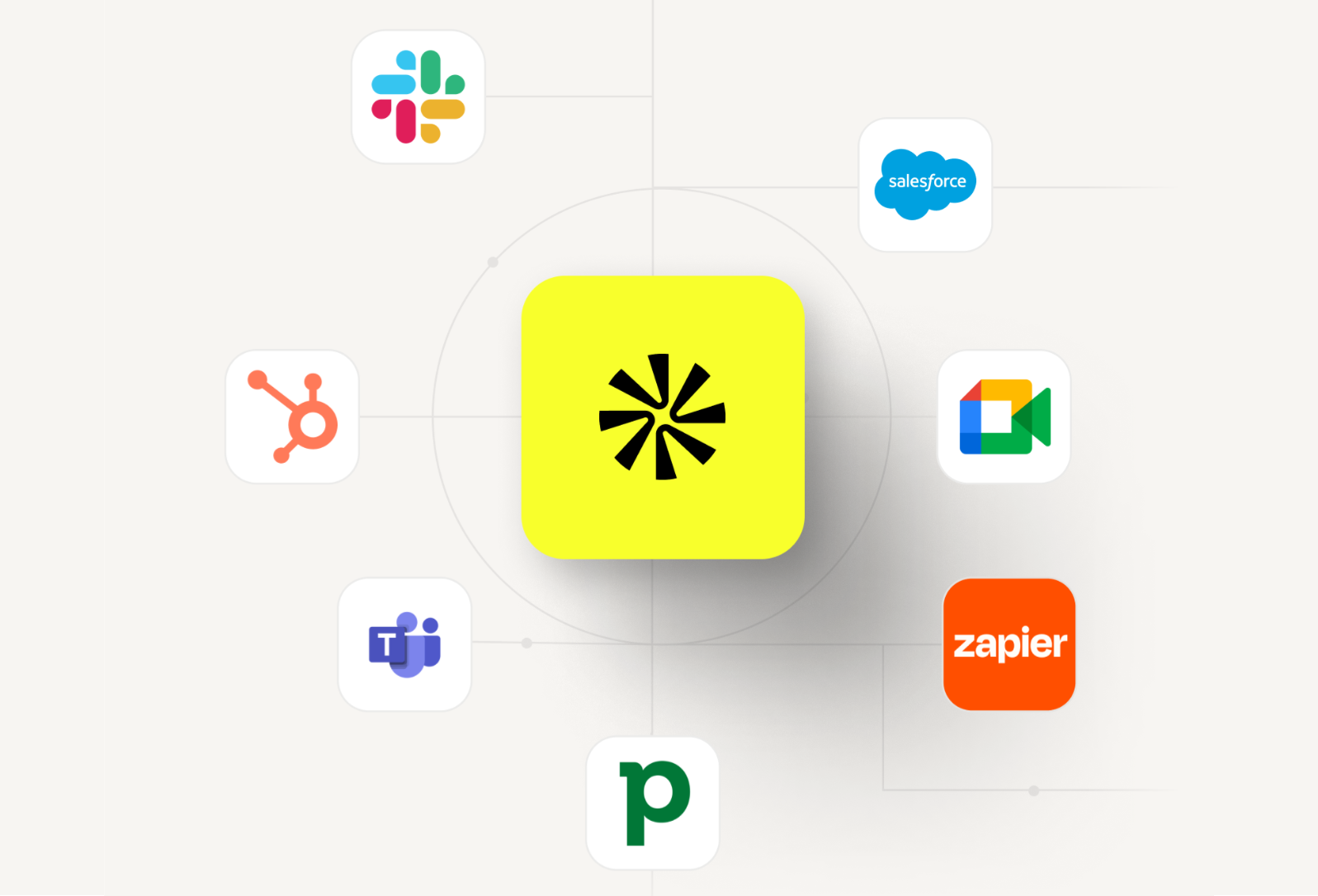
Apollo connects to the broader sales stack through native CRM integrations, a marketplace, an API, and MCP connections for AI tools.
Native CRM integrations cover Salesforce (bidirectional), HubSpot (bidirectional), and Pipedrive. Sales engagement platforms (Outreach, SalesLoft), marketing automation (Marketo, Sendgrid), and LinkedIn are also supported.
Source: Apollo
The Integrations Marketplace spans CRM, Email, Data & Analytics, Video & Web Conferencing, Dialer, Recruiting, Sales Engagement & Intelligence, and Marketing Automation categories, with entries including Adobe Marketo, Clay, Chili Piper, and numerous waterfall enrichment data providers.
The REST API exposes enrichment, search, accounts, contacts, deals, sequences, tasks, calls, conversations, and analytics. All plans include at least basic API access, though advanced functionality depends on the plan.
An OpenAPI specification is available for download, and an Apollo CLI provides command-line workflows. Authentication supports both API keys and OAuth 2.0. Apollo does not publish official SDKs; developers work with the REST API directly or generate clients from the OpenAPI spec.
For AI tool integrations, Apollo ships an MCP server at https://mcp.apollo.io/mcp, connecting to Claude by Anthropic, ChatGPT, Perplexity, and other MCP-compatible tools. The MCP server uses OAuth 2.0 over Streamable HTTP with no API key required.

Source: Apollo
Data import and export supports CSV. Export credits are consumed when exporting outside Apollo.
Apollo's Pricing and Credit System
Apollo's pricing deserves its own section because the credit model directly affects how features work in practice.
Plan | Annual (per seat/mo) | Monthly (per seat/mo) | Credits (annual) | Credits (monthly) |
|---|---|---|---|---|
$0 | $0 | 900/year | 75/month | |
$49 | $65 | 30,000/year upfront | 2,500/month | |
$79 | $99 | 48,000/year upfront | 4,000/month | |
$119 | $149 | 72,000/year upfront | N/A (min. 3 seats) |
Credits do not roll over and are non-refundable. The free plan is limited to 1 seat after 100 days and restricts database selection to 25 records at a time. Basic and Professional offer 14-day free trials with 50 credits and 5 mobile credits. The Unlimited plan follows a Fair Use Policy: 10,000 credits/account/month for non-paying accounts, or the lesser of ($Paid / $0.025) or 1 million credits per year for paying accounts.
Key tier gates beyond credits:
Free: Gmail only for email campaigns, 2 active sequences, no enrichment features
Basic: Microsoft Office and other email providers, higher record limits, add-on credits available
Professional: CRM/CSV/job change enrichment, unlimited active sequences, no record selection limit
Organization: SSO, custom reporting, advanced API access, advanced security and governance, dedicated customer success
Additional costs include the Advanced Dialer add-on ($149/month or $119/month annually), per-minute dialer charges by region, credits for additional mailbox warmup, and credits for AI research, domain/mailbox generation, and waterfall enrichment.
Seats cannot be decreased during a term, all payments are nonrefundable, and subscriptions auto-renew unless you give 30 days written notice.
Where Apollo Stops: The Gaps
Apollo collapses the sales stack into one platform. That consolidation shapes its strengths, but the platform trades specialist depth for breadth in several areas a growing revenue team will eventually need.
Intent data relies on a third-party layer with limited signal depth. Apollo's intent data comes from LeadSift (a Foundry company) and covers 1,600+ topics. Intent platforms built on proprietary signal collection track far more signal volume across web-wide behavior.
Apollo's intent works as a prioritization filter, but it does not reveal how deeply accounts are researching specific topics, how intensely, or over what timeframe. That depth is what shapes account prioritization at enterprise scale.
No intelligence layer connecting CRM data, conversations, and signals. Apollo captures data across its features (sequences, calls, deals, intent), but it does not fuse that data with CRM records, conversation transcripts, and behavioral signals into a layer that explains why deals moved or stalled. Each feature reports its own metrics in isolation.
A sales leader can see that a deal advanced and that the call had a certain talk-to-listen ratio, but the platform does not connect the CFO joining the last call to a pattern of executive sponsorship that predicts deal acceleration across the customer's own historical data.
Website visitor identification operates at the company level. Apollo's tracking script identifies which companies visit and surfaces decision-makers at those accounts through AI Research, but it does not identify the specific person who visited. Teams that need individual-level visitor resolution to trigger personalized outreach need a separate solution.
No marketing orchestration, display advertising, or ABM capabilities. Apollo covers sales execution. It does not include campaign orchestration, audience management for display advertising, account-based marketing plays, or multi-channel campaign management across email, ads, direct mail, and connected TV. Marketing teams running demand generation alongside sales execution need a separate platform.
Credit system complexity creates friction at scale. Apollo's credit system charges different amounts for different actions (1 for an email reveal, 8 for a phone number, variable rates for AI research and waterfall enrichment).
Credits do not roll over, the "Unlimited" plan has Fair Use caps that are not obvious, and some customers remain on a legacy credit system with different rules. At high volume, tracking credit consumption requires active management.
Conversation intelligence and deal management are less mature than dedicated tools. Apollo positions Deal Execution as a replacement for standalone conversation intelligence and CRM tools, but its pipeline management and forecasting do not match the depth of platforms built specifically for those functions.
Apollo itself recommends that enterprise customers speak to sales about Custom plans for integrations, security, and governance needs.
How ZoomInfo Covers the Gaps
The gaps above share a common thread: Apollo optimizes for breadth across the sales workflow but depends on external partnerships or lighter implementations for the intelligence, signal depth, and marketing capabilities that enterprise revenue teams need.
ZoomInfo is an AI GTM platform that supplies those layers, built on a data foundation and intelligence graph that a single-platform consolidation play does not replicate.
ZoomInfo's B2B Data Platform: Deeper Coverage and Verification at Scale
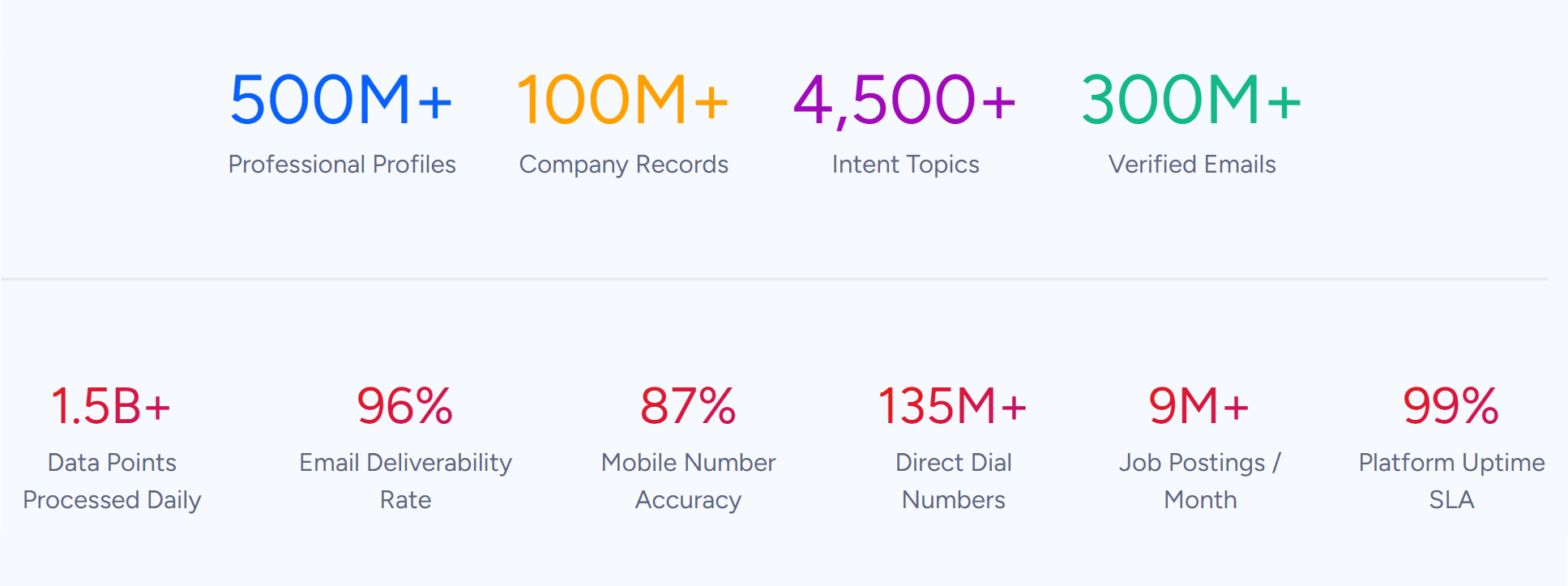
ZoomInfo operates the largest B2B data platform available: 500M contacts, 100M companies, 135M+ verified phone numbers, 120M direct-dial phone numbers, and 200M+ verified business email addresses.
Source: ZoomInfo
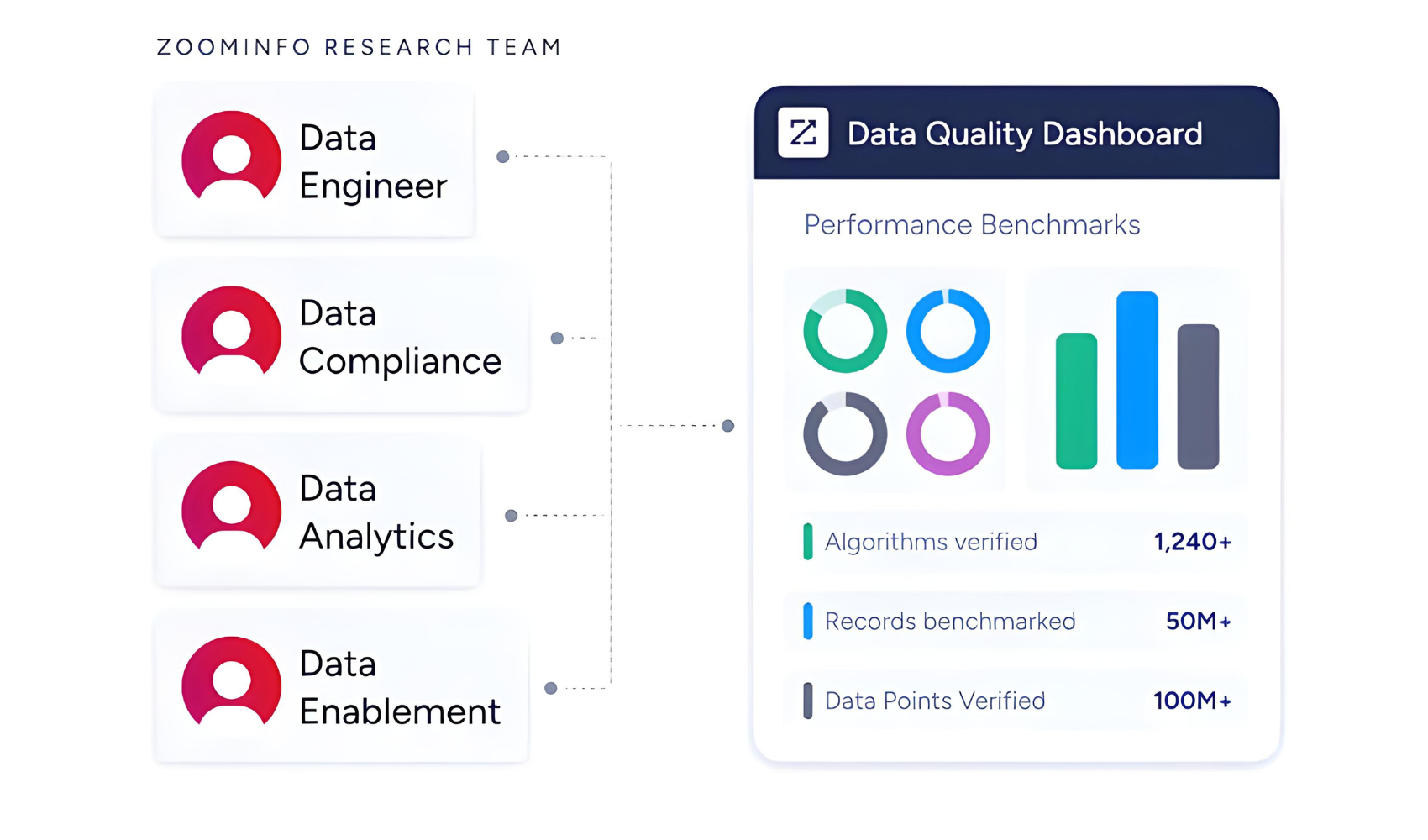
Where Apollo's database covers 240M+ contacts and 30M companies with a 91% claimed email accuracy rate, ZoomInfo's data flows through a proprietary verification pipeline backed by 300+ human researchers and automated ML scanning of 28 million site domains daily, reaching up to 95% accuracy on first-party data.
Source: ZoomInfo
The depth extends beyond contact records. ZoomInfo provides 300+ company attributes for segmentation, department org charts with decision-makers' direct dials, contact tracking with job-change alerts, and technographic profiles covering 30,000+ technologies across 200+ categories for 30+ million companies.
Global coverage extends to 34M+ company profiles outside North America, 200M+ professional profiles outside NA, and 45M+ mobile numbers outside NA.
In a Fortune 500 competitive RFP analyzing 25 million contacts across vendors, an independent consultant concluded that "no other competitor came even close."
ZoomInfo Intent and WebSights: Proprietary Signal Collection at Enterprise Scale
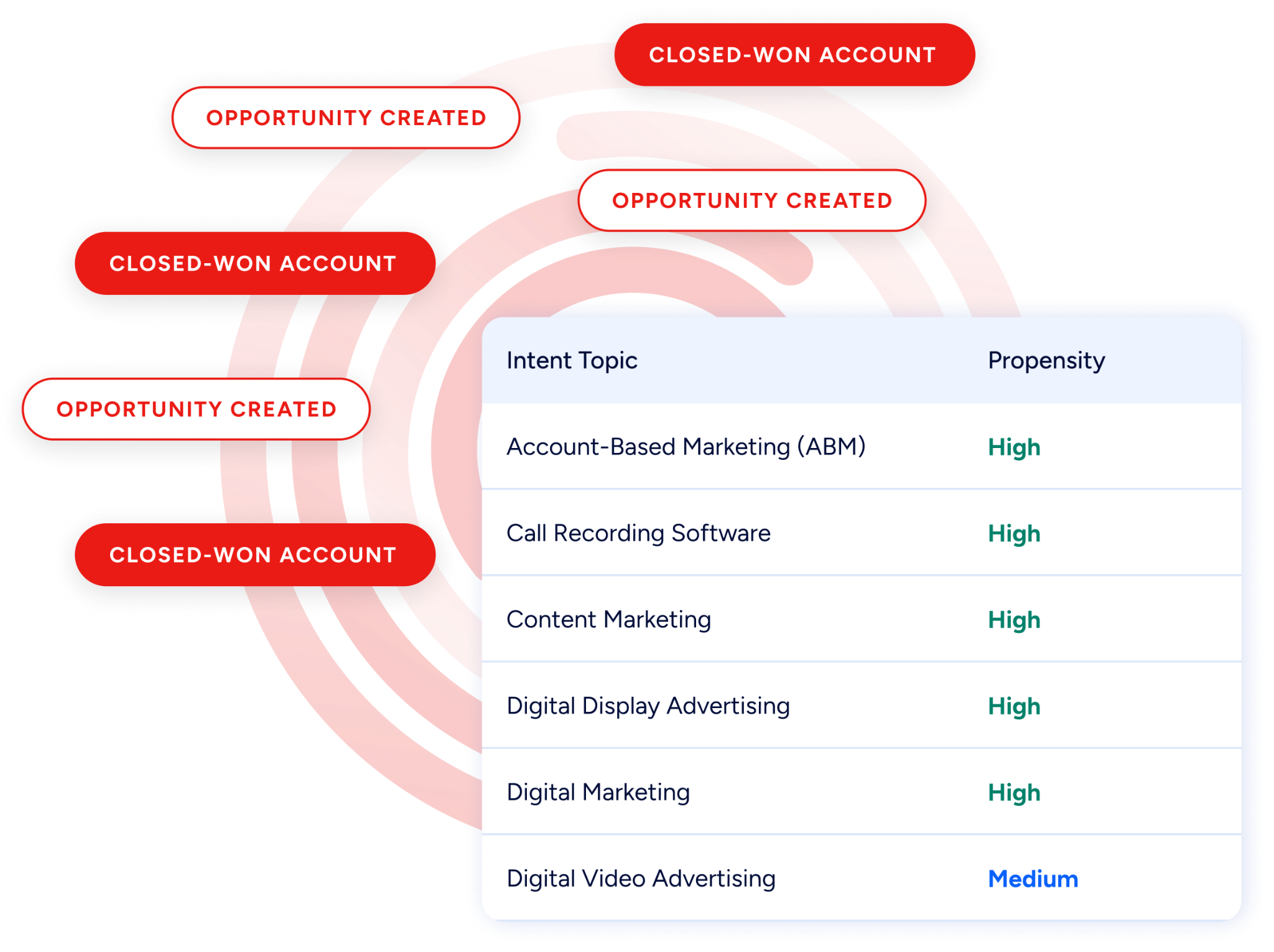
ZoomInfo Intent tracks signals from 210 million IP-to-Organization pairings and 6 trillion+ new keyword-to-device pairings sourced monthly. Where Apollo's intent layer covers 1,600+ topics via a third-party partnership, ZoomInfo builds its signals on proprietary collection that reveals which companies are researching topics related to your product across the web, before you have contacted them.
Source: ZoomInfo
Guided Intent, exclusive to ZoomInfo, identifies the topics historically correlated with deal success rather than requiring manual topic selection.
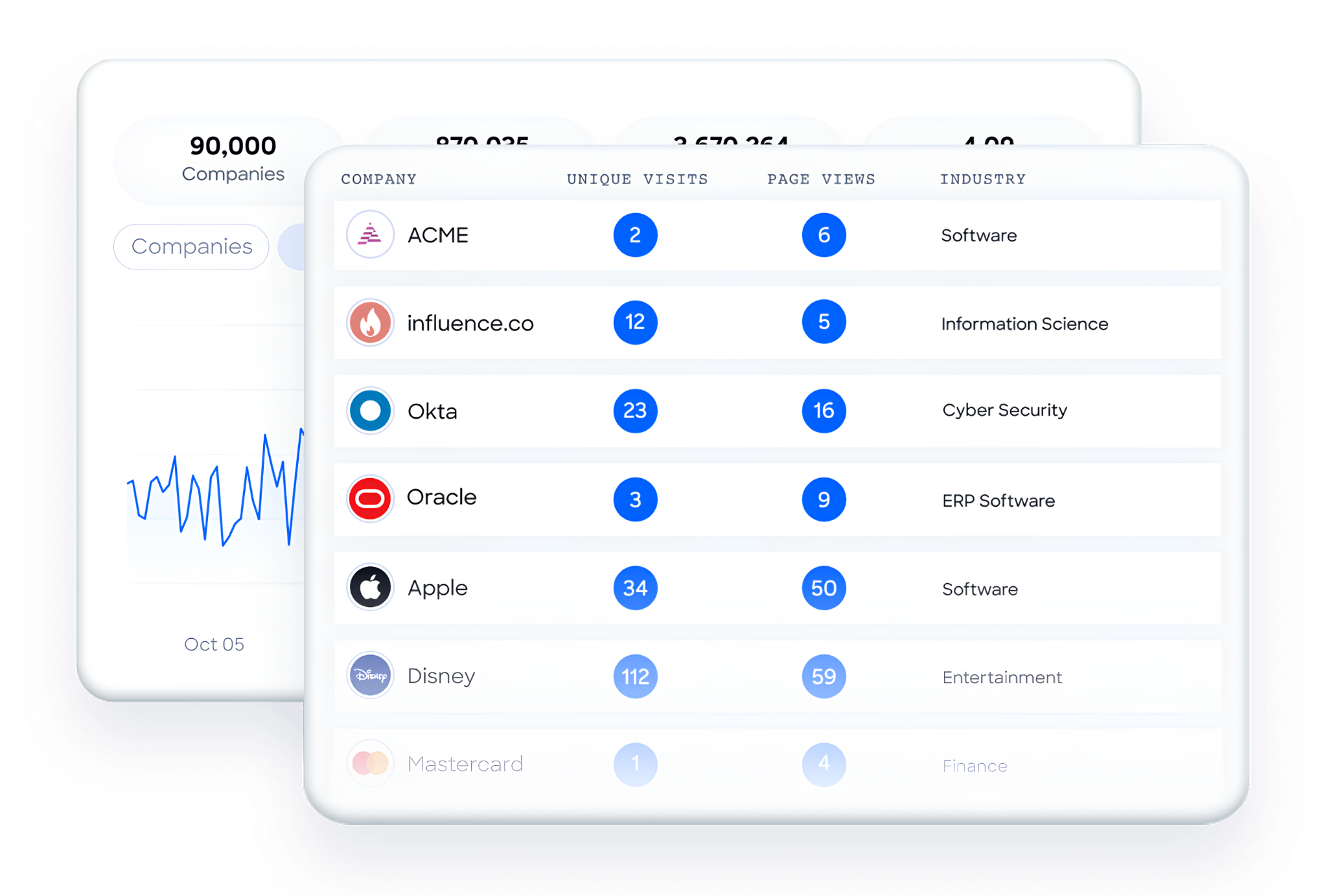
On the website side, WebSights resolves anonymous website traffic to companies with Automatic Traffic Filtering that distinguishes real visitors from bots. ZoomInfo Marketing goes further with contact-level site visitor identification, identifying who visited (not just which company) and triggering personalized outreach. Where Apollo stops at company-level identification, ZoomInfo resolves to the individual.
Source: ZoomInfo
ZoomInfo's GTM Context Graph: Intelligence That Reasons Across Deals, Not Just Records
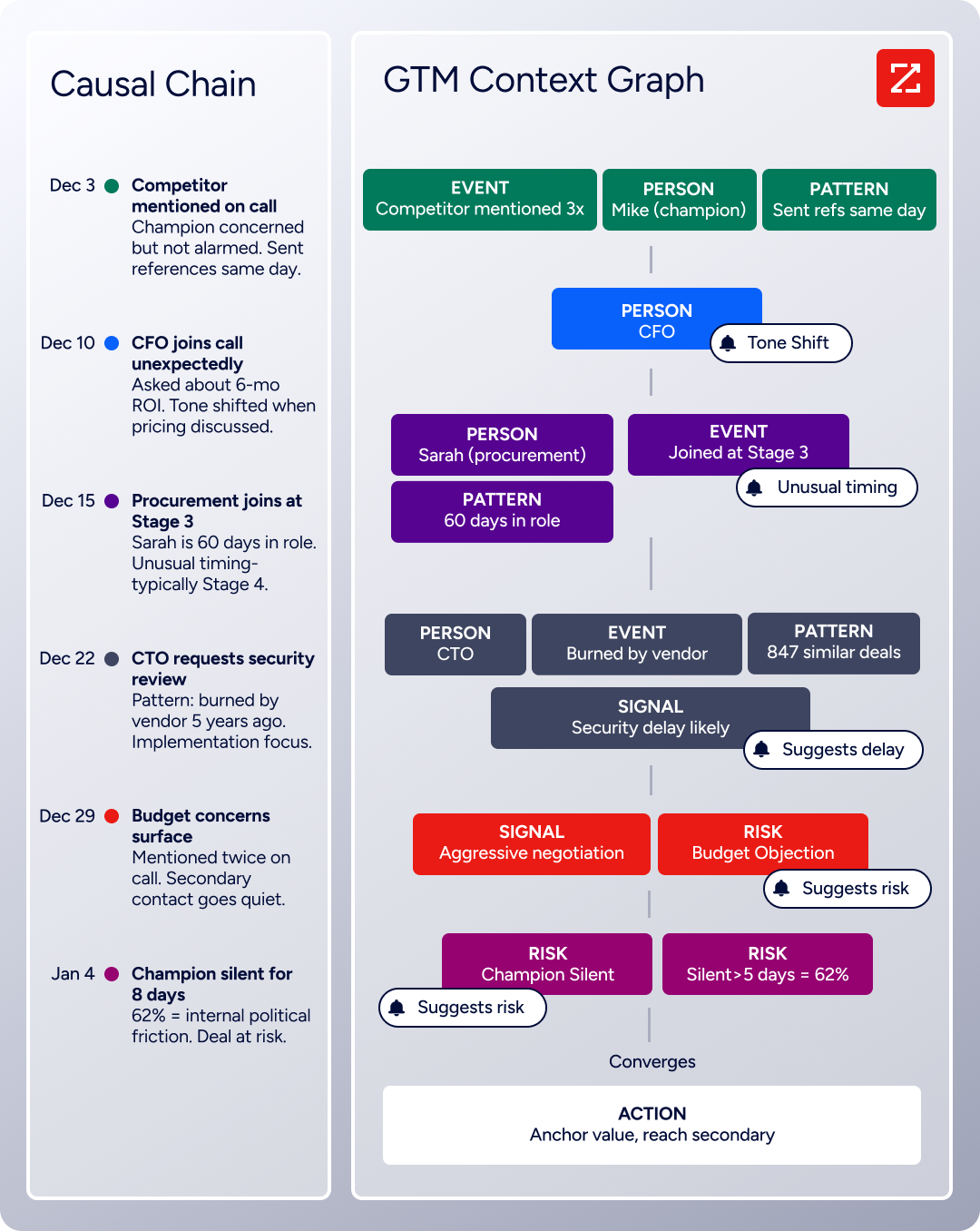
Apollo captures activity across its features but treats each data stream separately. ZoomInfo's GTM Context Graph does something different. It processes 1.5B + data points daily, fusing ZoomInfo's B2B data with a customer's CRM records, conversation intelligence from Chorus (backed by 14 technology patents), email interactions, and behavioral signals into one intelligence layer.
Source: ZoomInfo
A CRM records that a deal moved from Stage 3 to Stage 4. The GTM Context Graph reasons about why: connecting the executive who joined the last call with ROI-focused questions to the pattern behind closed-won deals in the same segment, then linking that to third-party signals showing the company is hiring and researching a competitor.
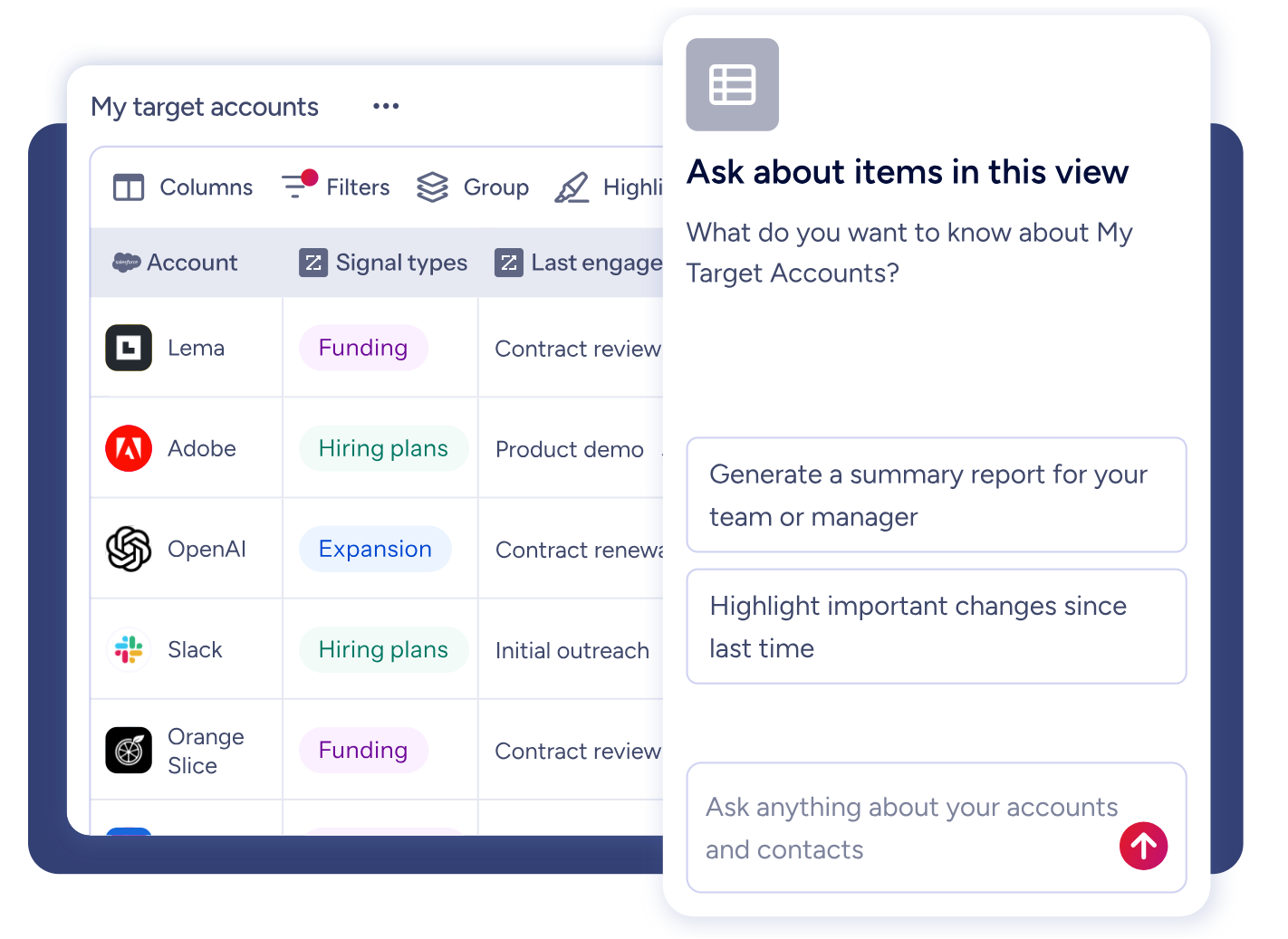
That reasoning flows into outreach, forecasting, and deal execution through GTM Workspace, where sellers see a complete Book of Business view across CRM, ZoomInfo data, conversation history, and market intelligence, with AI agents automating account research, outreach, CRM updates, and signal monitoring.
Source: ZoomInfo
Seismic's sales team attributed 39% of active pipeline to opportunities identified or influenced by ZoomInfo signals, boosted productivity by 54%, and saved 11.5 hours per week per seller. (Seismic Case Study)
ZoomInfo GTM Studio: Marketing Orchestration and ABM That Apollo Does Not Offer
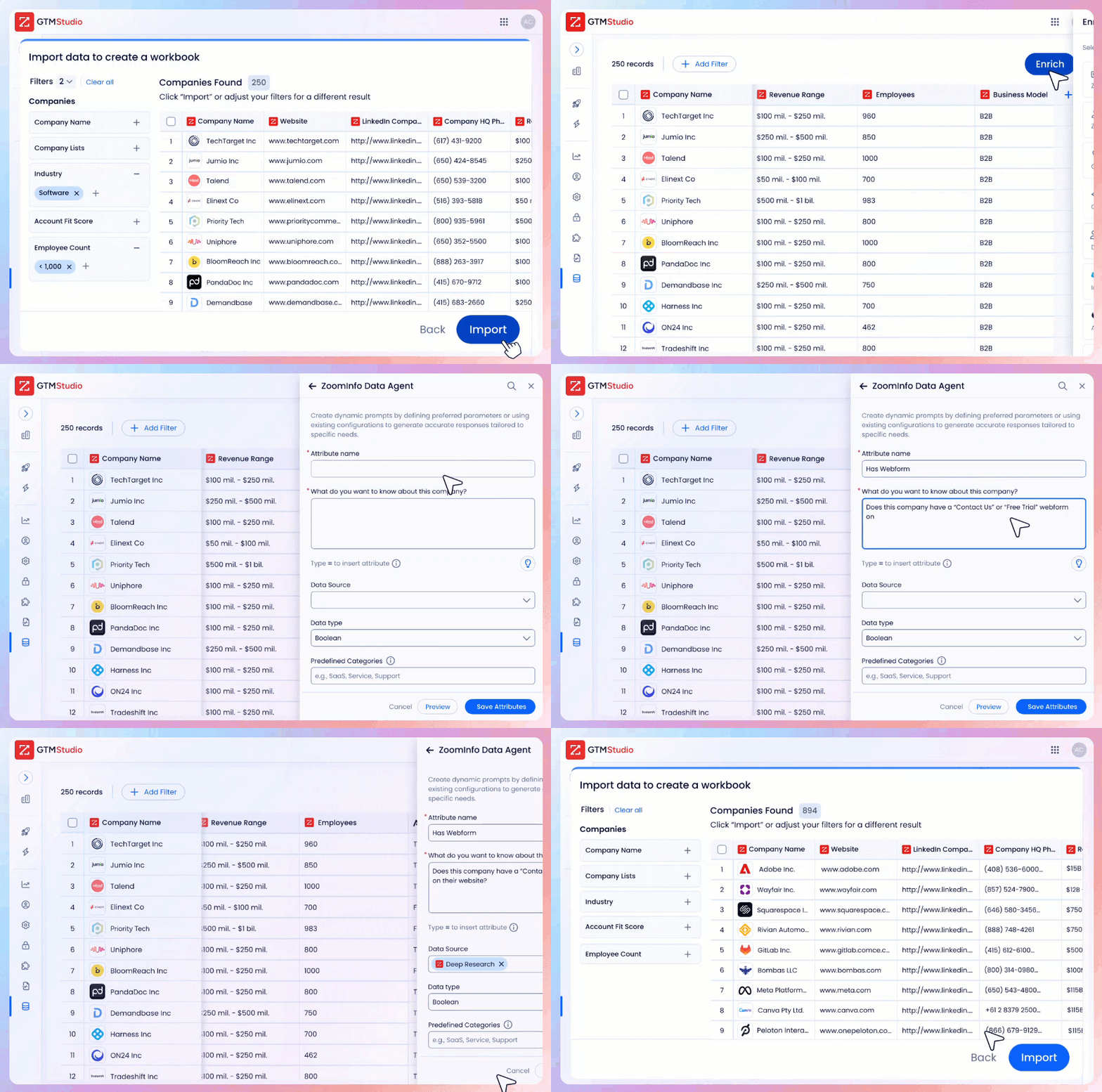
ZoomInfo’s GTM Studio directly addresses the marketing orchestration gap. Marketers, RevOps teams, and GTM engineers can build audiences using natural language, enrich with first- and third-party data, define triggers, and activate plays across channels (email, calls, display ads, direct mail, LinkedIn, Meta, Connected TV) without engineering support.
Source: ZoomInfo
Pre-built GTM plays cover inbound acceleration, champion tracking, competitive displacement, and ICP targeting. Expansion plays that used to take 3 weeks now launch in 30 minutes.
ZoomInfo Marketing includes a native Demand-Side Platform deploying display ads based on 300+ company attributes, FormComplete (reducing forms to a single field while auto-appending data), and Account Fit Scoring (predictive AI scoring 0-100 based on company attribute patterns).
Smartsheet reported a 40%+ increase in form fills, 84% increase in MQLs, 26% increase in opportunity rate, and 59% increase in win rate from these capabilities.
ZoomInfo APIs and MCP: Production-Grade Programmatic Access
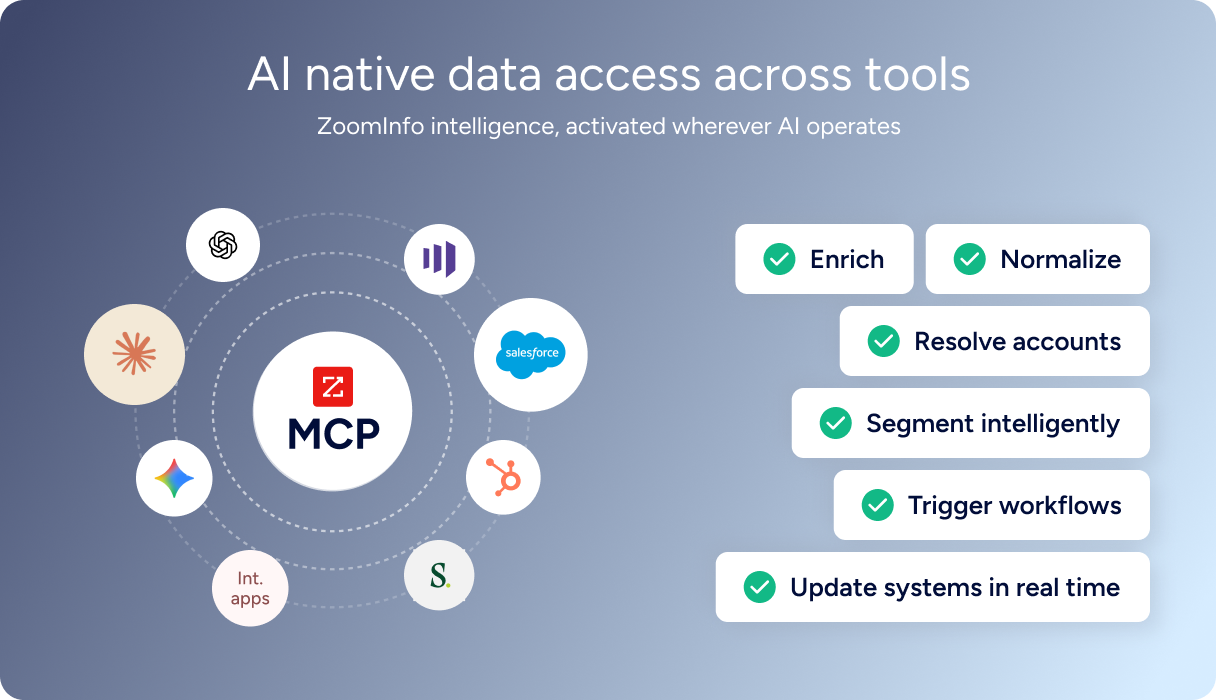
ZoomInfo delivers its intelligence through APIs and MCP, so the same data and GTM Context Graph powering ZoomInfo's own products is accessible inside any third-party tool or custom AI agent. The MCP server connects AI models directly to ZoomInfo's B2B data as a native tool, currently supporting Claude and ChatGPT.
Source: ZoomInfo
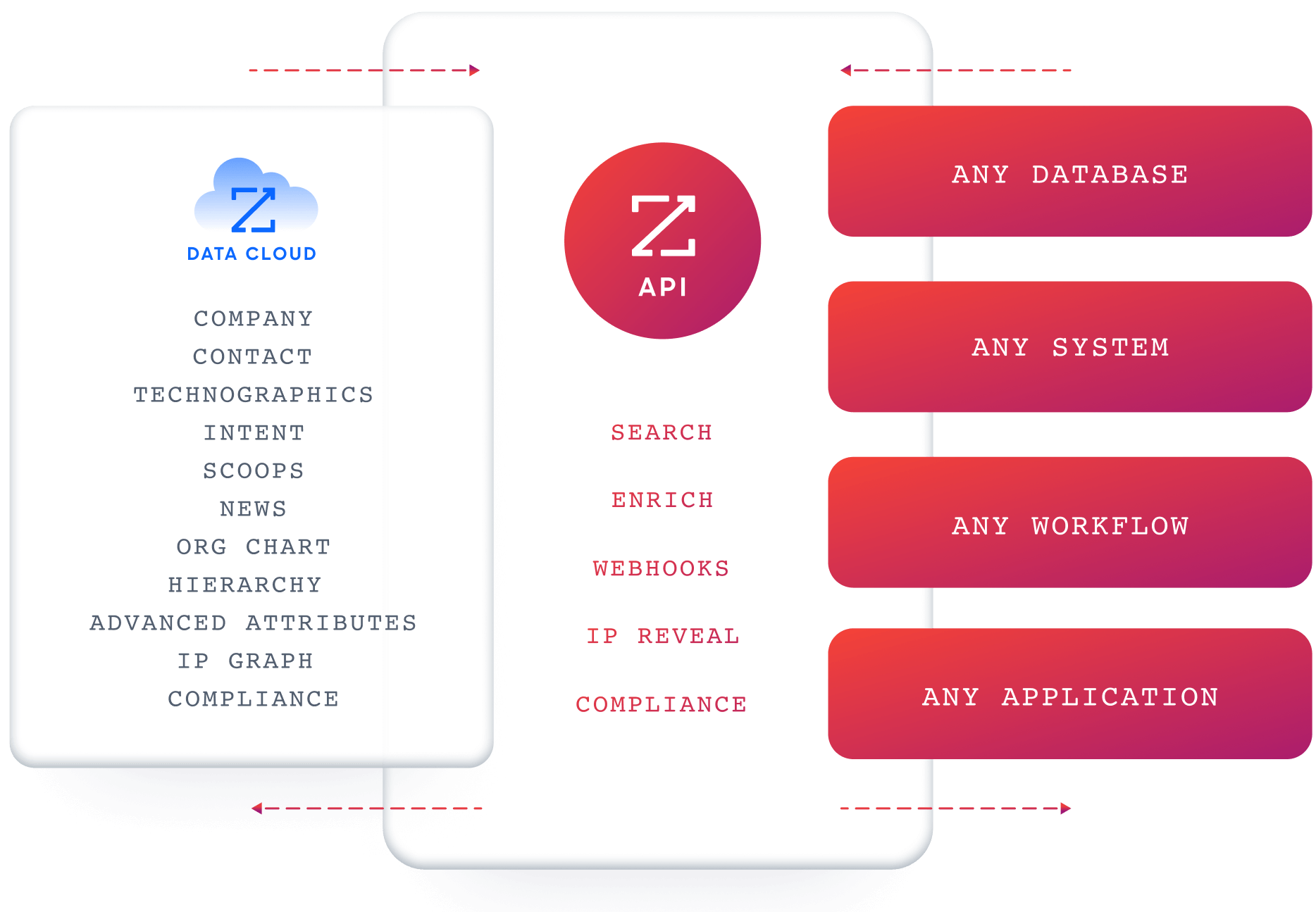
The Enterprise API is organized into four areas: Search & Enrich (contacts, companies, intent, news, scoops), Copilot, GTM Workspace's AI engine (account summaries, company insights, lookalikes, and contact recommendations), Marketing (audience management), and Engagements (bidirectional behavioral data).
Source: ZoomInfo
Published rate-limit tiers scale from 5 req/s (Builder) through 35 req/s (Scaling), with per-hour and per-day windows documented transparently. API access is included in all relevant plans.
ZoomInfo's Free Entry Points: Real Access Before Any Commitment
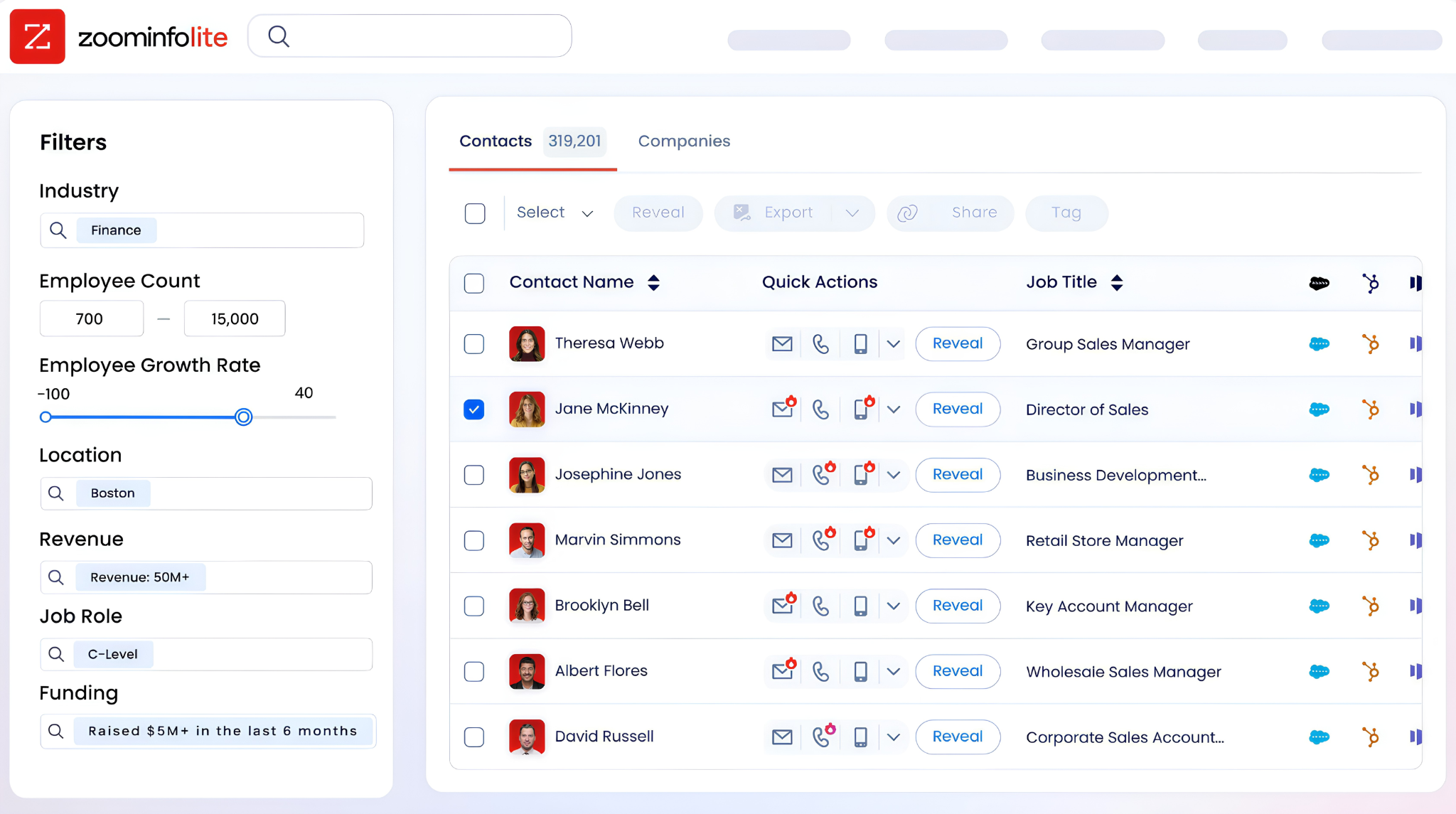
ZoomInfo Lite is a permanent free tier with access to ZoomInfo's B2B database, 10 monthly export credits, individual and company searches, a Chrome extension, and WebSights Lite with up to 10 website visitor reveals per day. A separate 7-day free trial provides broader access with no credit card required.
Source: ZoomInfo
Final Summary
Apollo.io is a thorough toolkit for teams that want B2B data, multichannel outbound, conversation intelligence, and deal management in one subscription: 240M+ contacts with a 91% claimed email accuracy rate, AI-powered email and call workflows, intent data included on every plan (including free), and a credit model that starts at $0 for individual contributors.
It fits SDR-heavy teams, early-stage companies building their first GTM stack, and mid-market organizations consolidating point solutions.
It is lighter on the layers around the sales workflow: intent signals sourced from a third-party partnership rather than proprietary web-wide collection, company-level (not person-level) website visitor identification, no intelligence layer reasoning across CRM data, conversations, and signals, and no marketing orchestration or ABM capabilities.
If your bottleneck sits upstream of the outreach (knowing which accounts are in-market before you sequence them, with the signal depth to explain why) or alongside it (marketing campaigns, display advertising, and multi-channel plays that run on the same data), that is the ground ZoomInfo covers.
Its 500M-contact, 100M-company database provides verified emails and direct dials at scale. ZoomInfo Intent surfaces accounts researching your category from 6 trillion+ keyword-to-device pairings monthly.
The GTM Context Graph fuses all of it with CRM records and conversation intelligence into a single layer that captures why deals move. And GTM Studio gives marketing teams the orchestration and ABM capabilities Apollo does not include.
See what that intelligence layer adds to your pipeline: start with ZoomInfo Lite for free, or request a demo to watch intent signals and verified contacts flow into your workflows.
FAQ
Does Apollo include buyer intent data on all plans?
Yes. Apollo's intent data is available on all plans including free, covering 1,600+ topics via a partnership with LeadSift (a Foundry company). It refreshes weekly and does not consume credits to view. The intent layer helps prioritize accounts researching relevant topics, though it draws from a third-party source rather than proprietary web-wide signal collection.
Which Apollo plan includes CRM enrichment?
CRM enrichment, CSV enrichment, and job change enrichment all require the Professional plan ($79/seat/month annual) or above. The Basic plan includes data access and sequences but does not unlock enrichment workflows. The free plan provides basic database access with 75 credits/month but no enrichment features.
Can Apollo record and analyze sales calls?
Yes. Apollo Conversations records, transcribes, and analyzes sales calls. It includes AI call summaries, an AI chatbot for querying transcripts, call playlists, customizable scorecards, and coaching metrics like talk-to-listen ratios. Conversation intelligence is included in platform pricing, not charged as a separate add-on.
How does Apollo's credit system work?
Apollo uses a hybrid per-seat plus credit-consumption model. Each plan includes a credit allowance (75/month on free, up to 72,000/year on Organization).
Revealing an email costs 1 credit; a phone number costs 8 credits. AI research, waterfall enrichment, additional mailbox warmup, and domain generation also consume credits at varying rates. Credits do not roll over, are non-refundable, and the "Unlimited" plan has Fair Use caps.
Does Apollo offer a free plan?
Yes. The Starter plan is free forever with 75 credits/month, 2 active sequences, the Chrome Extension, and access to buying intent data. Limitations include Gmail-only email campaigns, a 25-record selection limit from the database, no enrichment features, and a restriction to 1 seat after 100 days. Basic and Professional plans offer 14-day free trials.
What CRMs does Apollo integrate with?
Apollo maintains native bidirectional integrations with Salesforce and HubSpot, plus a Pipedrive integration. The platform also connects to Outreach, SalesLoft, Marketo, and Sendgrid. A REST API and MCP server support custom integrations with any tool.
Does Apollo identify individual website visitors?
Apollo's website visitor tracking identifies which companies visit and which pages they view, then surfaces decision-makers at those accounts through AI Research. The identification operates at the company level, not the individual person level. Teams needing contact-level visitor identification can use ZoomInfo Marketing, which identifies who visited and triggers personalized outreach directly.
Does Apollo include marketing orchestration or ABM tools?
No. Apollo covers sales execution but does not include campaign orchestration, display advertising, audience management, or account-based marketing capabilities. Marketing teams running demand generation alongside sales execution need a separate platform.
ZoomInfo's GTM Studio provides multi-channel orchestration across email, calls, ads, direct mail, LinkedIn, Meta, and Connected TV, with pre-built GTM plays that launch in minutes.
