
Choosing between Apptivo and Zoho CRM for your sales team comes down to five questions:
Do you need a CRM, or an entire business operations suite under one roof?
Is AI-powered sales intelligence a priority, or do you want straightforward pipeline management?
How important is a large third-party integration ecosystem to your daily workflow?
Are you willing to invest time learning a feature-heavy platform, or do you need something your team can adopt in days?
Does the quality of your prospect data matter as much as the tool you manage it in?
Here's what we recommend:
Apptivo is built for small businesses that want CRM, invoicing, help desk, field service, and project management in one subscription. With 65+ integrated apps starting at $15/user/month, it covers what enterprise operations suites cover, at a fraction of the cost. Its no-code customization and included 24/7 support make it practical for teams without IT staff. The trade-off: Apptivo's integration ecosystem is narrow, it has no AI features, and the volume of bundled apps can overwhelm teams that just need a CRM.
Zoho CRM is the stronger choice for sales teams that need depth in pipeline management, automation, and AI. Zia, Zoho's built-in AI, handles predictive lead scoring, deal win probability, email sentiment analysis, and autonomous sales agents that nurture leads and schedule follow-ups on their own. With Blueprint process enforcement, omnichannel engagement across email, phone, WhatsApp, and social, and a free plan for up to 3 users, Zoho CRM scales from startup to enterprise. The trade-off is complexity: advanced configuration takes time, and support quality drops outside premium tiers.
Both platforms manage your pipeline and customer relationships. Neither solves the problem upstream of every CRM: finding the right prospects with accurate data. Your CRM is only as effective as the information inside it, and that's where the third piece comes in.
ZoomInfo is a B2B data and GTM platform that supplies the prospect intelligence both Apptivo and Zoho CRM lack. Its database covers 500M contacts, 100M companies, 135M+ verified phone numbers, and 200M+ verified business email addresses, so every sequence and follow-up inside your CRM reaches real decision-makers. The GTM Context Graph (processing 1.5B+ data points daily) goes further, fusing this data with your CRM records and behavioral signals to reveal not just who to contact, but why they're likely to buy. That intelligence reaches your CRM through direct integrations, APIs, and MCP, or through ZoomInfo's GTM Workspace for sellers and GTM Studio for marketers.
If building a sales pipeline on verified data sounds like the missing piece, see how ZoomInfo works.
Apptivo vs. Zoho CRM vs. ZoomInfo at a glance
Apptivo | Zoho CRM | ZoomInfo | |
|---|---|---|---|
Primary function | All-in-one business management suite | AI-powered sales CRM | B2B data intelligence and GTM platform |
AI capabilities | None | Zia AI (scoring, predictions, agents, generative AI) | GTM Context Graph, AI prospecting, intent signals |
Bundled apps | 65+ apps (CRM, invoicing, help desk, field service, HR) | CRM-focused; 60+ apps in broader Zoho ecosystem | Sales, Marketing, Operations, Chorus, Chat |
Integrations | Limited (QuickBooks, Xero, Slack, G Suite) | 120+ integrations plus API/MCP access | |
Customization | Drag-and-drop App Builder, up to 500 custom fields | Canvas Design Studio, 500 custom modules, Kiosk Studio | Custom data configurations and workflow automation |
Starting price | Free for 3 users; paid from $14/user/month | Custom pricing; free Lite tier available | |
Free trial | 15-day trial + permanent free plan | 7-day trial + permanent Lite tier | |
Best for | SMBs wanting one platform for all business operations | Sales teams needing AI, automation, and omnichannel CRM | Teams that need accurate B2B data to fuel any CRM |
The all-in-one suite vs. the CRM ecosystem
Apptivo and Zoho CRM take different approaches to the same problem: businesses need more than a contact database.
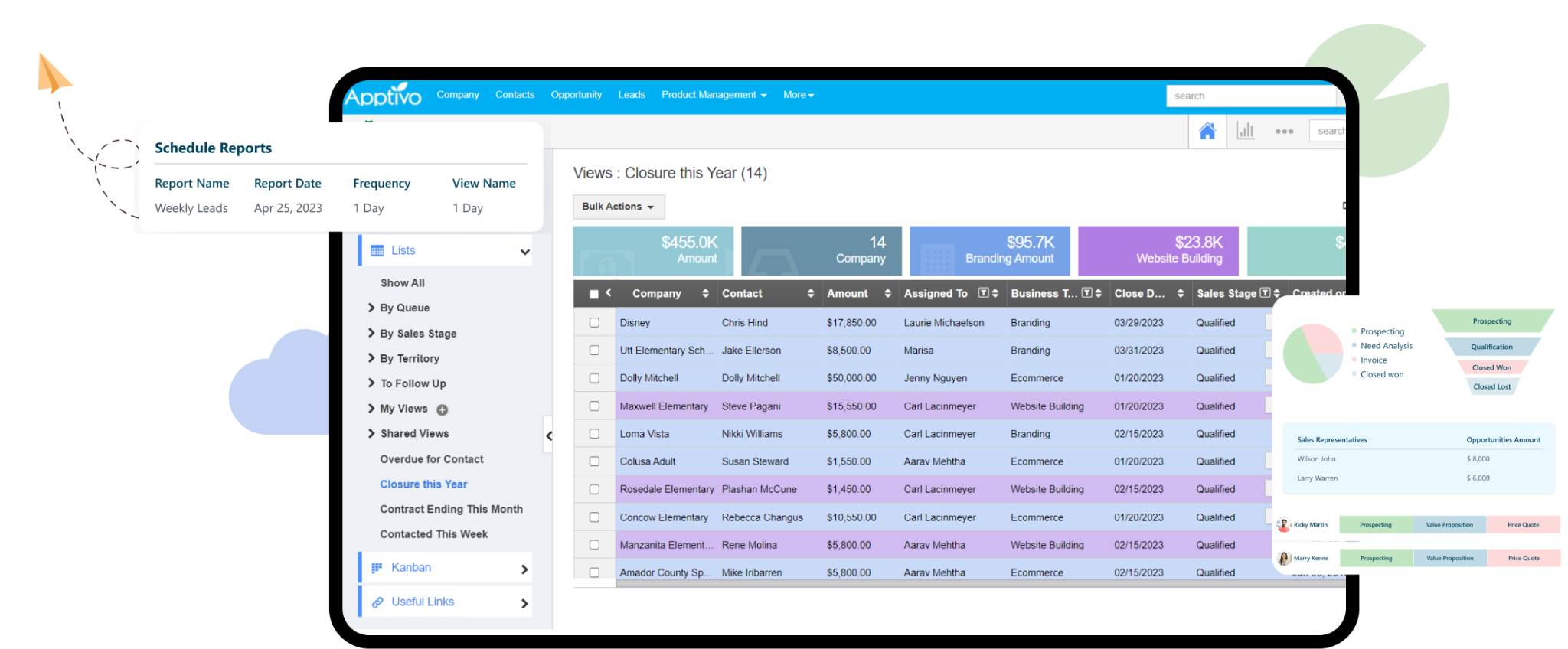
Apptivo bundles everything into one subscription. CRM, invoicing, project management, help desk, field service, email campaigns, HR, supply chain management, and an App Builder for creating custom apps without code. All share a single data layer, so a support ticket can reference the customer's open deals, a completed work order can convert to an invoice in one click, and a campaign can target leads based on pipeline stage. One customer described it as "more ERP than CRM" because of this breadth.
Source: Apptivo
For a 20-person company managing sales, invoicing, and customer support, this consolidation is practical. Instead of connecting separate tools and fixing sync problems, everything lives in one place. The Descon case study documents how a multinational engineering firm uses Apptivo to manage multi-division bid processes, track success rates per sales stage, and log competitor win/loss data.
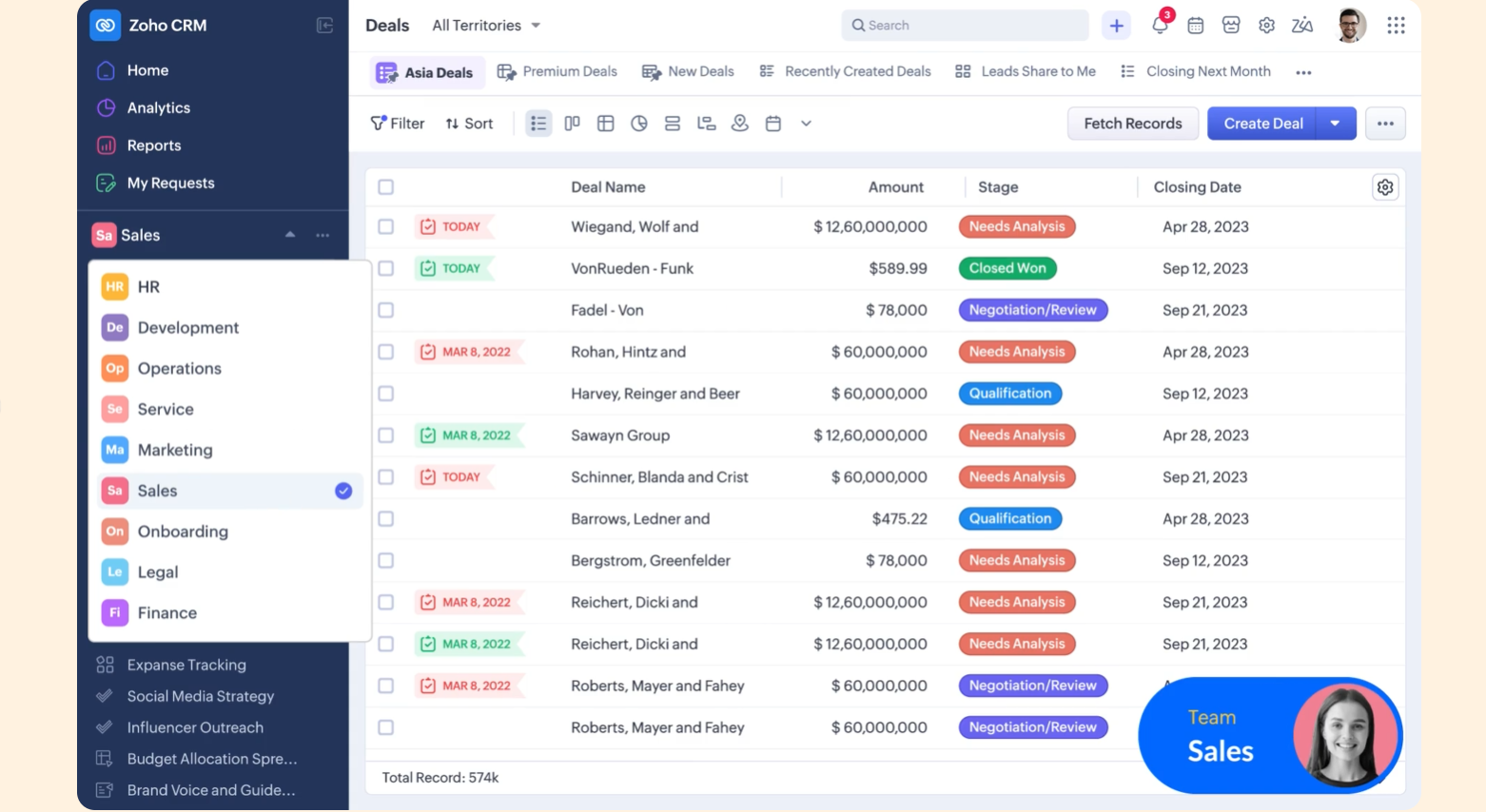
Zoho CRM takes the ecosystem approach. The CRM itself focuses on sales force automation, pipeline management, and customer engagement. When you need more, the broader Zoho suite (Zoho Books for accounting, Zoho Desk for support, Zoho Projects for project management, Zoho Campaigns for email marketing) connects natively. Over 60 applications are available, each designed for its domain.
Source: Zoho CRM
The advantage: each Zoho product goes deeper in its area than Apptivo's equivalent module. Zoho Desk is a more capable help desk than Apptivo's Cases App. Zoho Books is a more complete accounting tool than Apptivo's invoicing module. But you're managing separate products with separate interfaces, even if they share data.
The choice depends on how you want to grow. Apptivo gives you everything at once, with the risk of feature overload. Zoho lets you add capability as you need it, at the cost of managing multiple products.
AI is the widening gap
This is the comparison's clearest divide. Zoho CRM has invested heavily in AI. Apptivo has not.
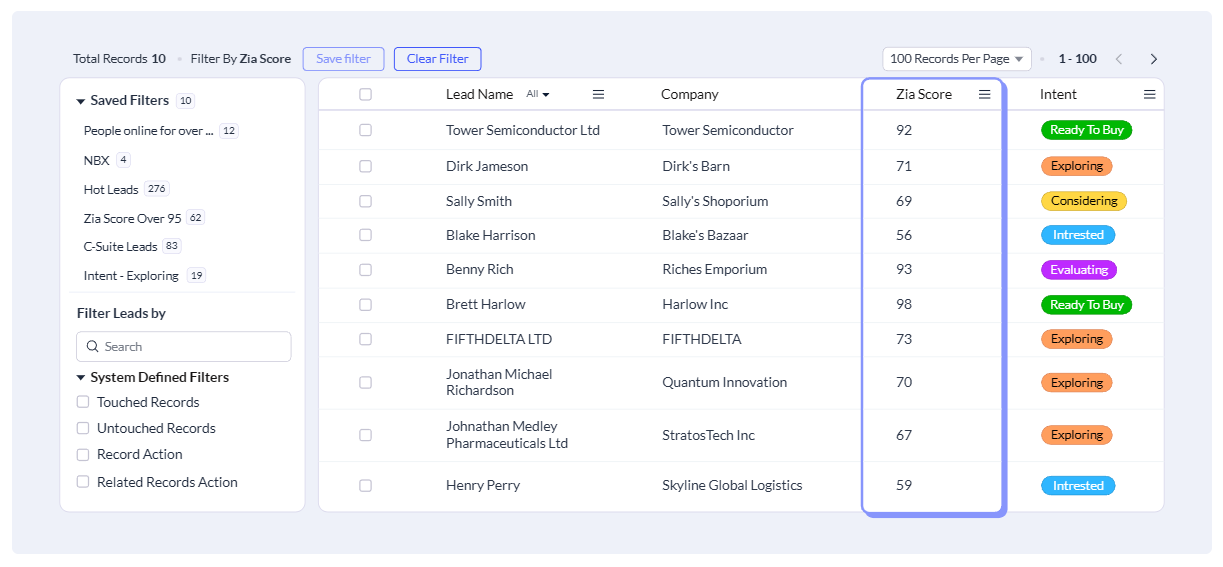
Zia is Zoho CRM's AI engine, and it runs across the platform. For sales teams, Zia provides predictive lead scoring that ranks prospects by conversion probability, deal win predictions that forecast which opportunities will close, best-time-to-contact recommendations per prospect, and churn prediction that flags at-risk customers before they leave.
Source: Zoho CRM
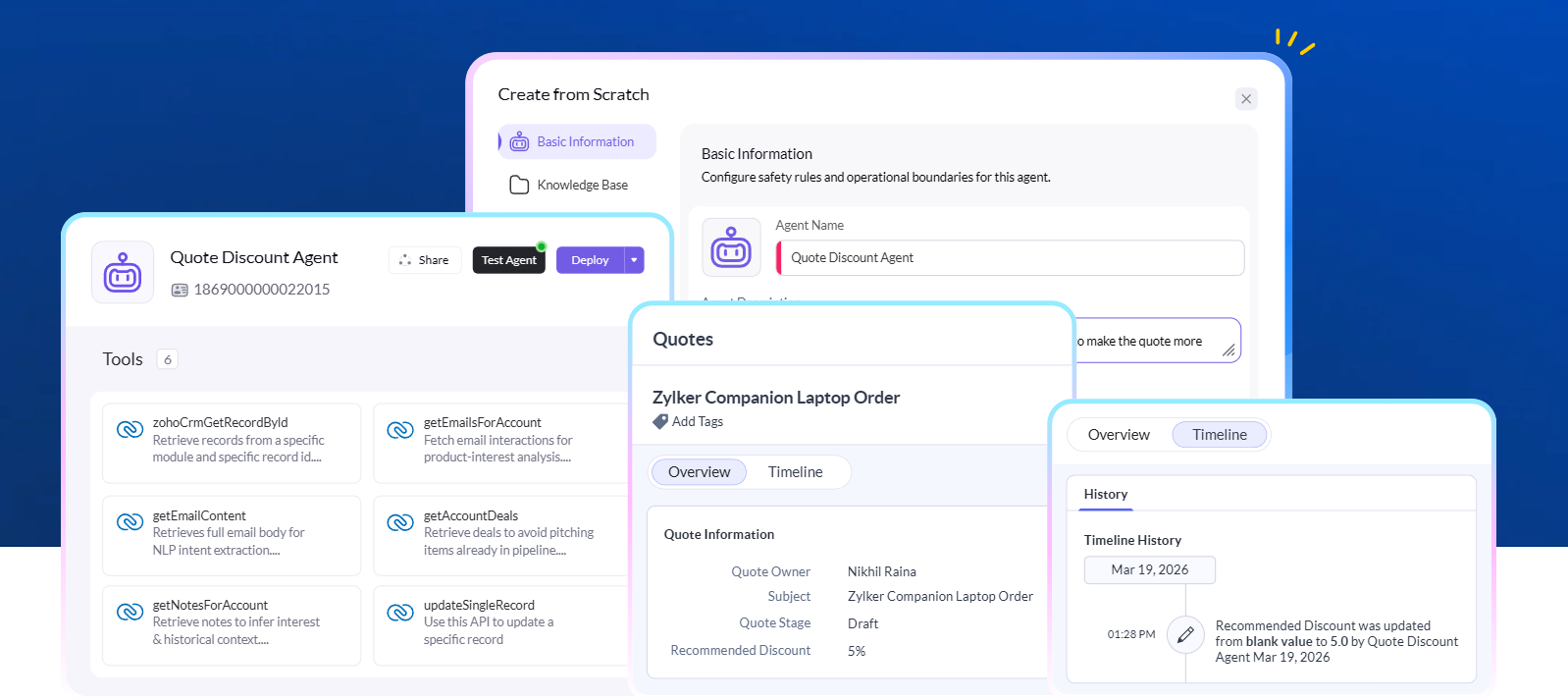
The agentic AI layer goes further. The Zia Agents Store offers seven pre-built sales agents: an SDR agent that nurtures and qualifies leads via targeted emails, a sales coach that trains reps with feedback on real deals, a deal analyzer that shows win probability and next actions, a follow-up scheduler that contacts prospects on its own, and more. These agents can operate as Digital Employees with their own CRM identities, executing tasks without human direction.
Source: Zoho CRM
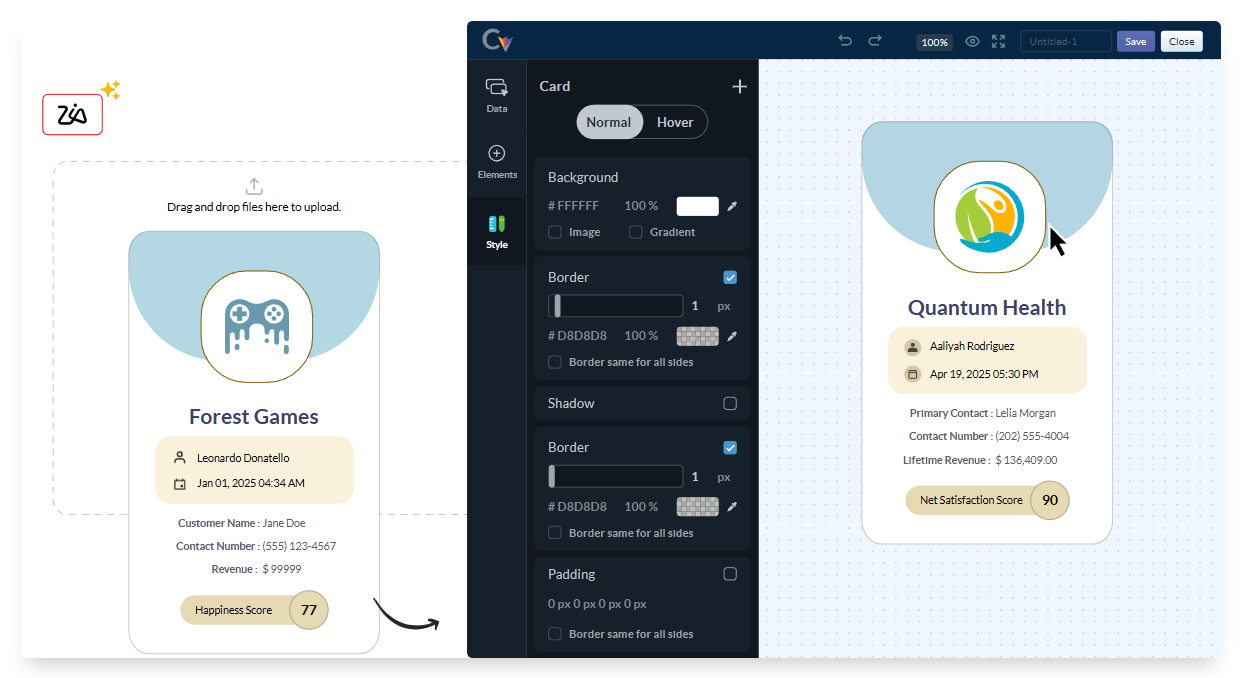
On the generative side, Zia creates data modules from natural language descriptions, builds workflow automation rules from plain-language instructions, and generates reports from conversational queries. The Image to Canvas feature constructs CRM layouts from uploaded screenshots.
Source: Zoho CRM
Apptivo has no equivalent. No predictive scoring, no AI-drafted emails, no autonomous agents, no natural language configuration. For teams that want AI now or soon, this gap matters. For teams that value operational breadth over AI, the absence may not matter today. But the gap grows with every Zoho release.
Your CRM is only as good as the data inside it
Both Apptivo and Zoho CRM are capable pipeline management tools. Neither generates the prospect data your sales team needs to fill that pipeline.
Apptivo captures leads through email, web forms, and manual entry. Zoho CRM adds social and live chat channels plus a business card scanner. Both track what happens after a prospect enters the system. Neither tells you which companies are researching solutions like yours, who the decision-makers are, or whether their direct-dial phone numbers work.
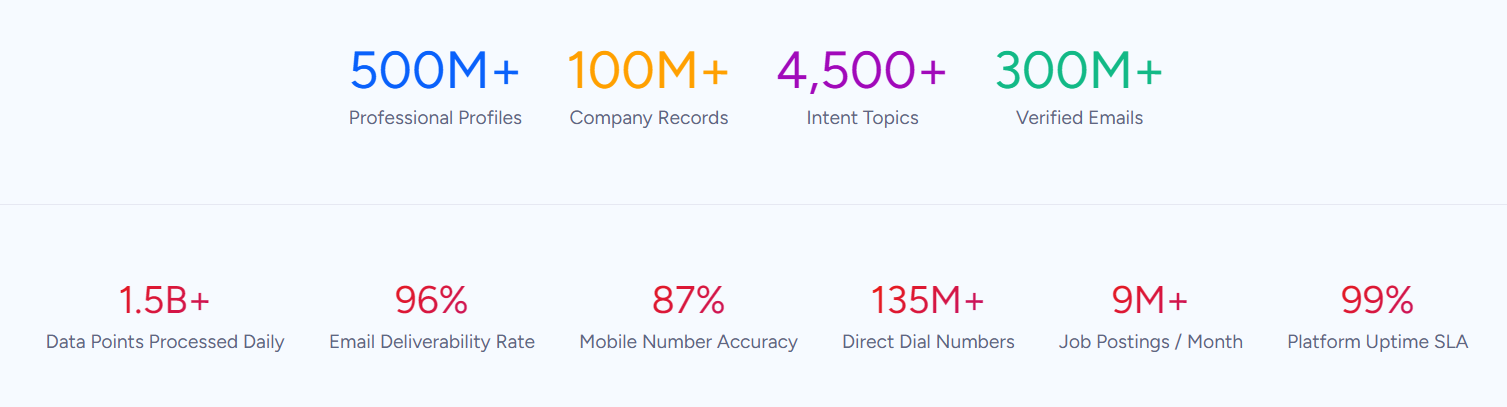
This is the problem ZoomInfo solves. Its B2B database of 500M contacts, 100M companies, 135M+ verified phone numbers, and 200M+ verified business email addresses gives your sales team the data that turns a CRM from a record-keeping system into a pipeline engine. 300+ human researchers back the data, which reaches up to 95% accuracy on first-party records. In a Fortune 500 competitive RFP analyzing 25 million contacts across vendors, the independent consultant concluded that "no other competitor came even close."
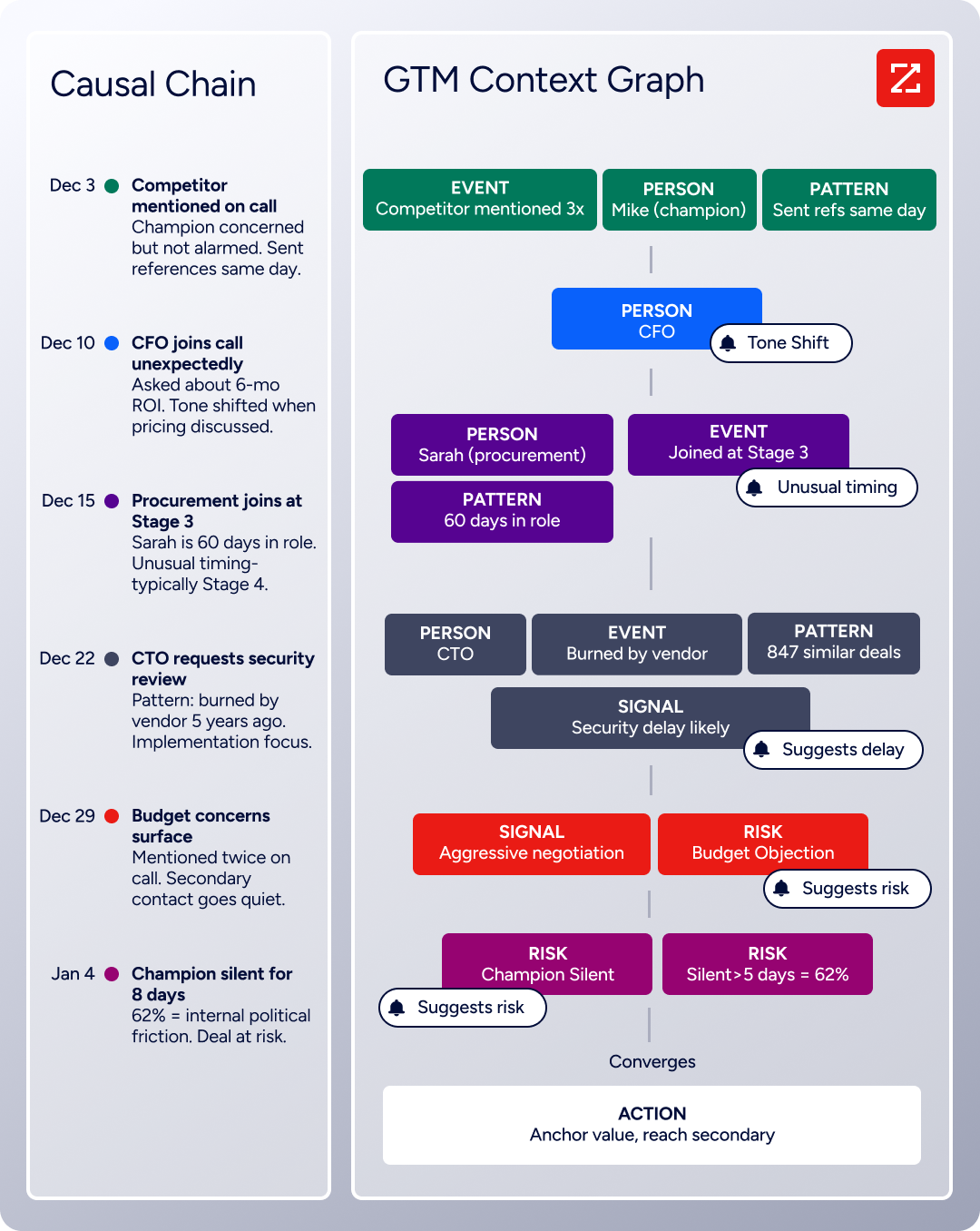
Data alone isn't enough. ZoomInfo's GTM Context Graph (processing 1.5B+ data points daily) fuses its B2B data with your CRM records, conversation transcripts, and behavioral signals. The result: intelligence that shows not just what happened in a deal, but why. Your CRM records that a deal moved to Stage 3. The GTM Context Graph understands that it moved because the CFO joined the call, asked about six-month ROI, and that this pattern matches your highest-converting deals.
ZoomInfo delivers this intelligence three ways. GTM Workspace gives sellers one place to manage prioritized accounts, AI-drafted outreach, and deal execution. GTM Studio gives marketers and RevOps a workspace for building audiences, running campaigns, and measuring pipeline. And APIs and MCP expose the same intelligence to any CRM, custom agent, or third-party tool.
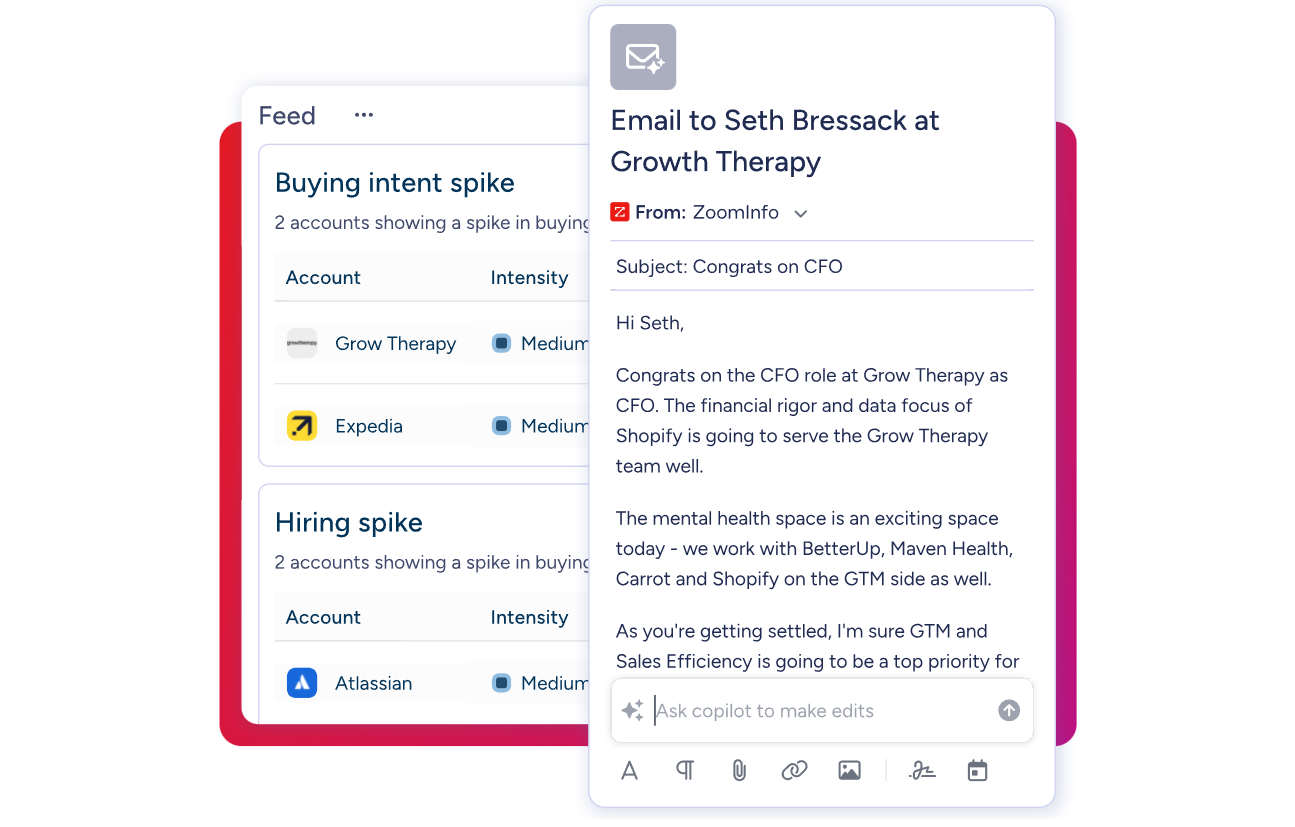
Seismic's sales team boosted productivity by 54%, saved 11.5 hours per week, and attributed 39% of active pipeline to opportunities identified or influenced by ZoomInfo signals. (Seismic Case Study)
Customization and process enforcement
Both platforms let you reshape the CRM to match your business. The depth and approach differ.
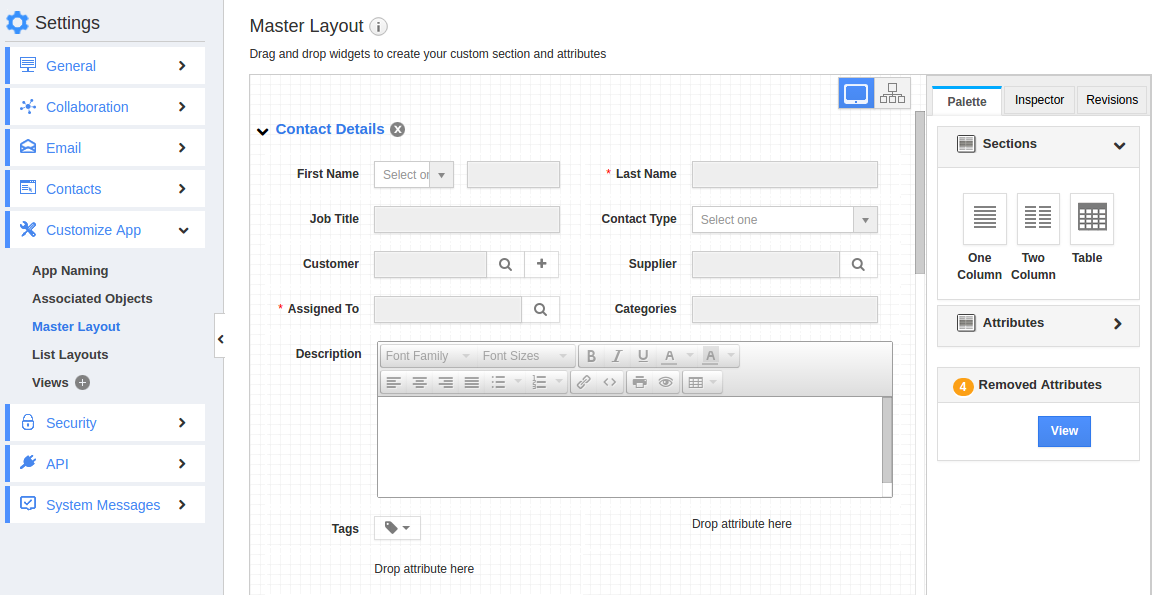
Apptivo offers a Master Layout system for customizing fields, views, and layouts without code. The App Builder lets you create new apps that integrate with the rest of the suite. Field-level security lets you hide sensitive data from specific employees. On the Enterprise tier, you get up to 500 custom fields per app and 300 workflows.
Source: Apptivo
Customers confirm this flexibility. The Chief Revenue Officer at Precision Machine & Manufacturing described it as "the simplest and smoothest process" with the greatest customization across four CRM implementations. The system adapts to how you work, rather than forcing you to adapt to it.
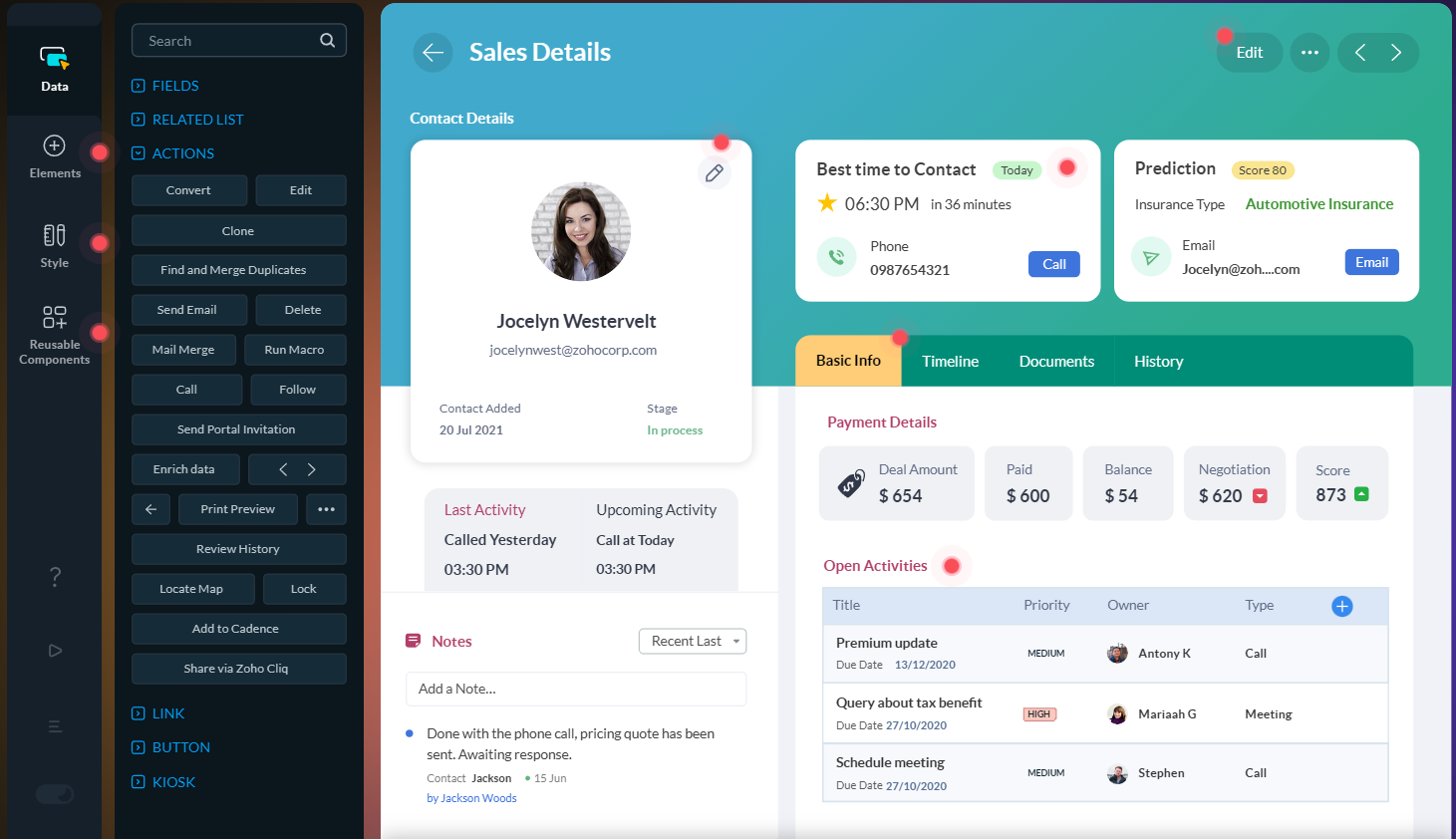
Zoho CRM takes customization further with Canvas Design Studio, a visual design environment with pixel-level control over record views (colors, typography, section groupings, image placement). But the key difference is process enforcement. Blueprint maps each stage of your sales process as a visual flowchart and prevents reps from moving deals forward unless they complete required steps, enter required fields, or obtain required approvals.
Source: Zoho CRM
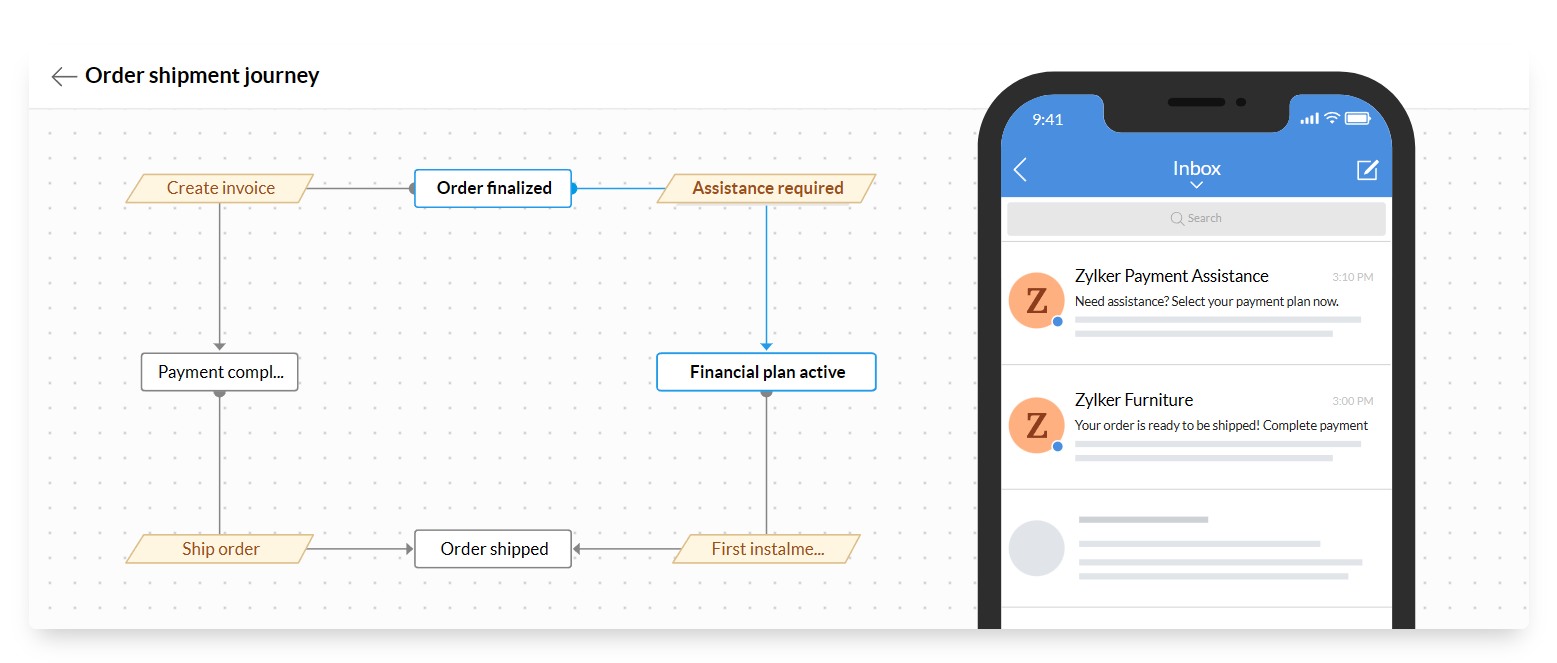
Beyond Blueprint, Zoho offers Cadences for automated multichannel follow-up sequences, Kiosk Studio for building custom guided workflows without code, and CommandCenter for mapping and automating customer journeys. The Ultimate plan supports up to 500 custom modules.
Source: Zoho CRM
The distinction: Apptivo's customization adapts the interface and data model. Zoho's extends into enforcing how your team works within that interface.
Pricing puts them in the same bracket, but the value differs
Both platforms target budget-conscious buyers. The pricing structures reveal different strategies.
Apptivo keeps it simple. Four tiers, all per-user per-month (pricing page):
Lite ($20/month, $15 annual): 18 apps, 25 workflows, 1,000 mass emails/user/month
Premium ($30/month, $25 annual): 46 apps, 75 workflows, 3,000 mass emails/user/month
Ultimate ($50/month, $40 annual): 57 apps, 150 workflows, 5,000 mass emails/user/month
Enterprise (custom pricing): 65 apps, 300 workflows, dedicated instance, white labeling
All plans include 24/7 support via calls, email, and live chat at no extra charge. The 14-day free trial gives access to the Ultimate plan with no credit card required. No permanent free plan exists.
Zoho CRM uses a tiered model with wider spacing between features (pricing page):
Free: Up to 3 users, basic lead, contact, and deal management
Standard ($14/user/month annual): Workflows, AI agents, Cadences, custom reports, sales forecasting
Professional ($23/user/month annual): Blueprint, CPQ, email intelligence, inventory management
Enterprise ($40/user/month annual): Zia AI assistant, journey orchestration, territory management, customer portals
Ultimate ($52/user/month annual): QuickML custom AI models, data preparation, enhanced limits
Support is tiered separately. Classic support (8x5 email) is included free. Premium support (24/5 live chat and phone) costs extra. Enterprise support (24/7) requires at least 50 user licenses.
The math depends on what you need. At the low end, Zoho's free plan stands alone for very small teams. At comparable paid tiers, Apptivo's $15/user includes 24/7 support and 18 integrated apps; Zoho's ~$14/user includes more CRM depth but limited support. The gap shifts at the top: Apptivo's $40/user Ultimate includes 57 apps with full support, while Zoho's ~$40/user Enterprise tier unlocks AI, journey orchestration, and territory management.
Both sell themselves as affordable alternatives to enterprise CRM. One comparison puts the savings in perspective: a CIMCO Refrigeration evaluation found Salesforce quotes at $1,000,000 versus Zoho's $30,000 for the same organization.
ZoomInfo uses a consumption-based pricing model with no publicly listed prices. Costs depend on usage, seats, credit volume, and features selected. A permanent ZoomInfo Lite tier provides free access to the B2B database with 10 monthly export credits, company and contact search, a Chrome extension, and WebSights Lite. A 7-day free trial offers broader access. ZoomInfo costs more, but the ROI is documented: Snowflake achieved 200% higher conversion rates on accounts scored using ZoomInfo data.
Integration ecosystems shape your long-term flexibility
The platforms differ sharply here.
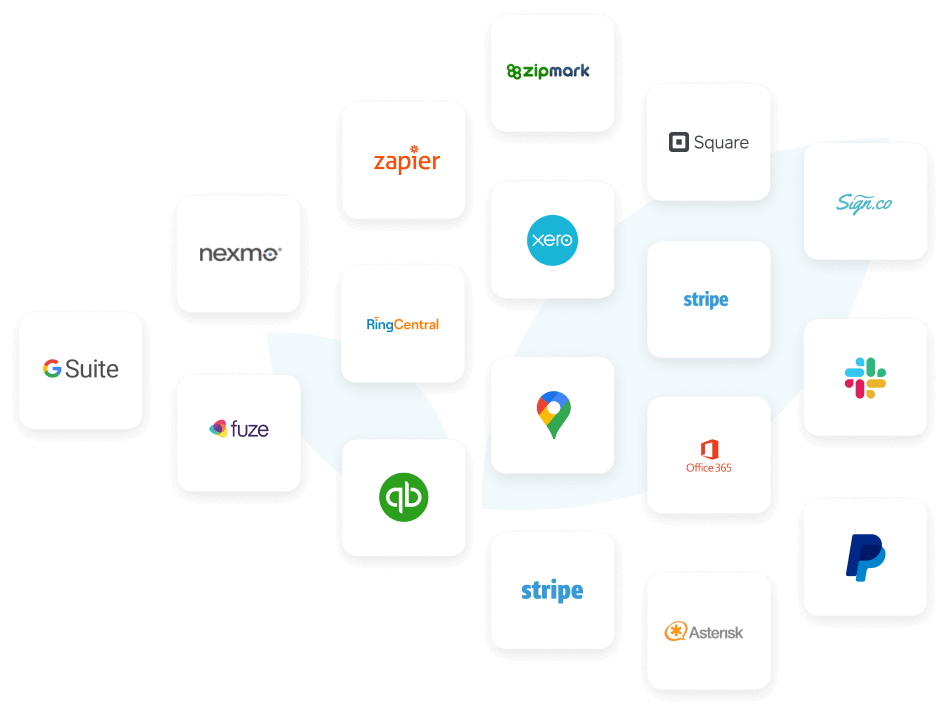
Apptivo's integration footprint is narrow. The integrations page covers QuickBooks, Xero, Authorize.net, Slack, Office 365, WordPress, Dropbox, and a REST API. Google Workspace integration is the most developed, with two-way contact sync, two-way calendar sync, and task sync. For telephony, Apptivo connects to RingCentral, Asterisk, and Nexmo. There is no native Zapier or Make connector, which limits teams using tools outside the supported set.
Source: Apptivo
For businesses that operate inside Apptivo's own suite, this matters less. Everything works together natively. But for teams that rely on Shopify, Marketo, Mailchimp, or other popular SaaS tools, the lack of connectors creates friction.
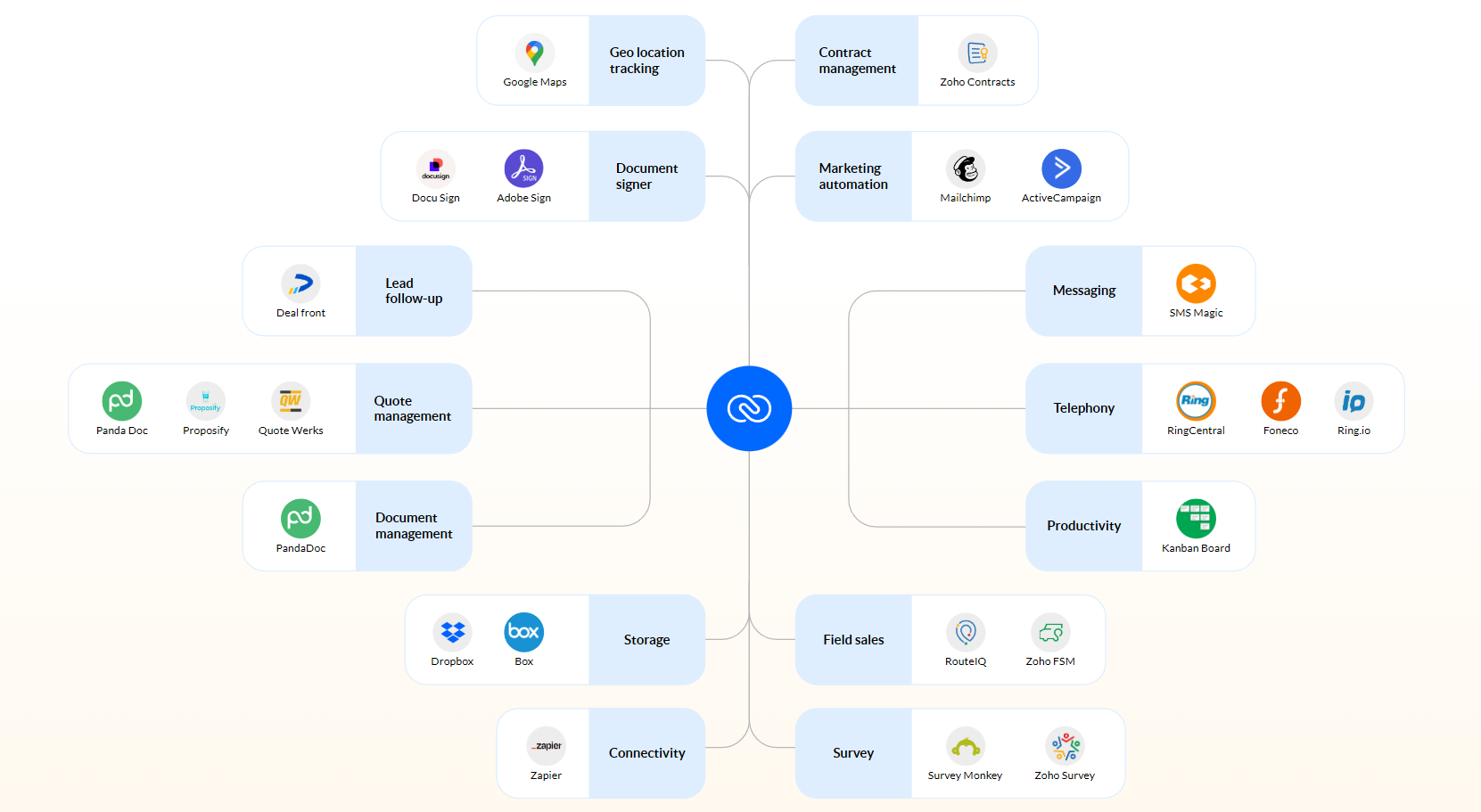
Zoho CRM offers 1,100+ integrations through the Zoho Marketplace, plus native connections to the full Zoho suite. Microsoft integration includes Teams Phone and Online Meeting support. G2 reviewers note some friction when connecting to non-Zoho systems in complex enterprise environments, but the marketplace gives most teams what they need.
Source: Zoho CRM
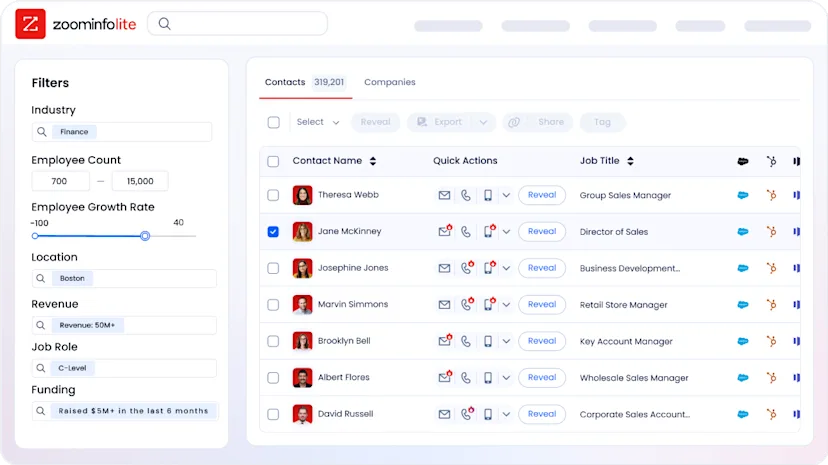
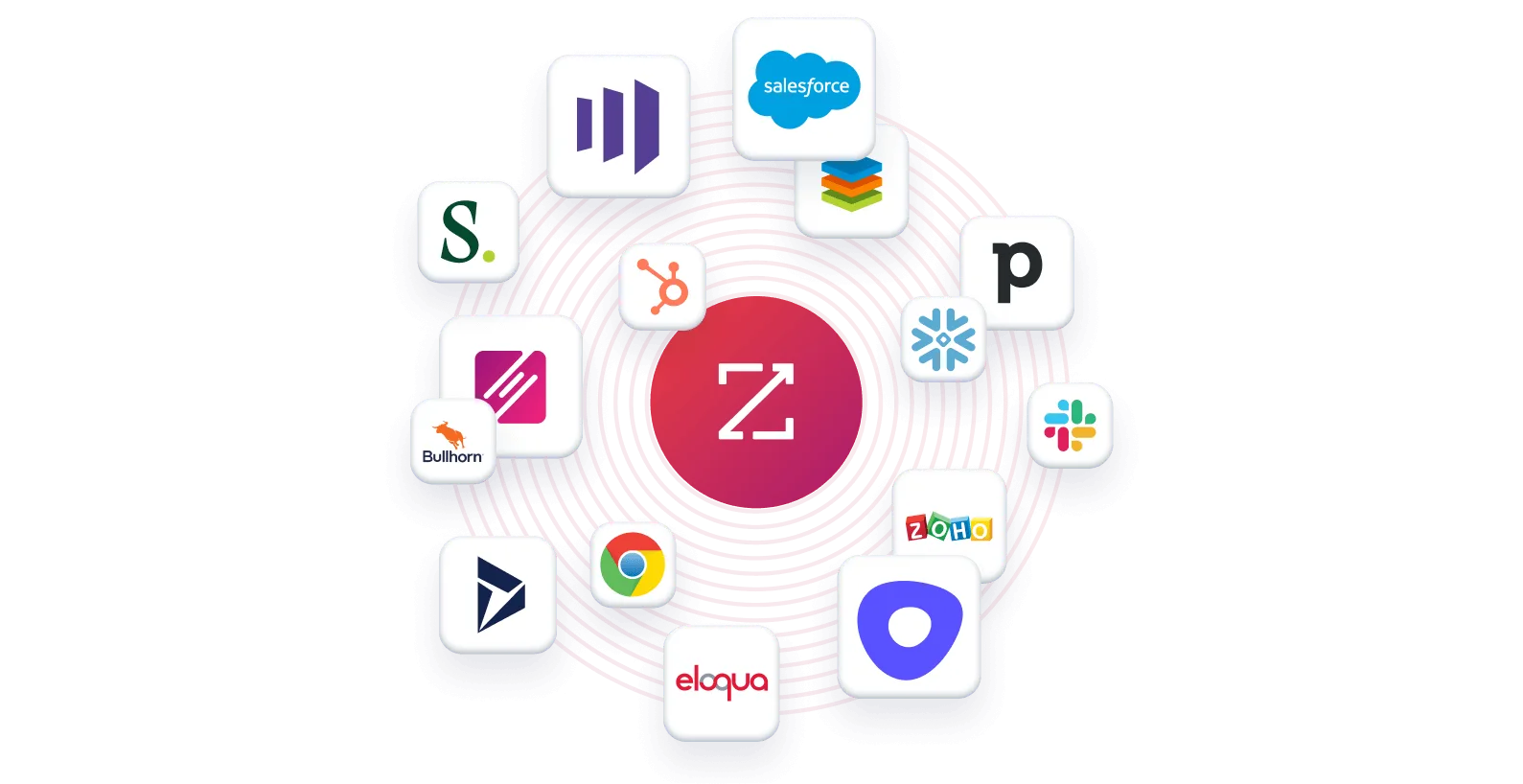
ZoomInfo treats integration as infrastructure. API access comes with all relevant plans, and the MCP server connects AI models to ZoomInfo's data with no custom coding. The App Marketplace lists 120 partner integrations, including native connectors for Salesforce, HubSpot, and Microsoft Dynamics 365. Zoho is listed among ZoomInfo's CRM and MAP integrations in its Marketing plans. For Apptivo users, ZoomInfo's REST API and Enterprise API provide a path to connect the two systems.
"The plug-and-play aspect of the API means I can integrate it into any process and get information at a moment's notice." Jerry Wilson, Senior Marketing Intelligence Analyst at BDO Canada, reduced time spent on data dashboard updates by 87% using ZoomInfo's API. (BDO Canada Case Study)
Analytics and reporting
Sales leaders need more than data entry. They need visibility into what's working, what's stalling, and where to focus.
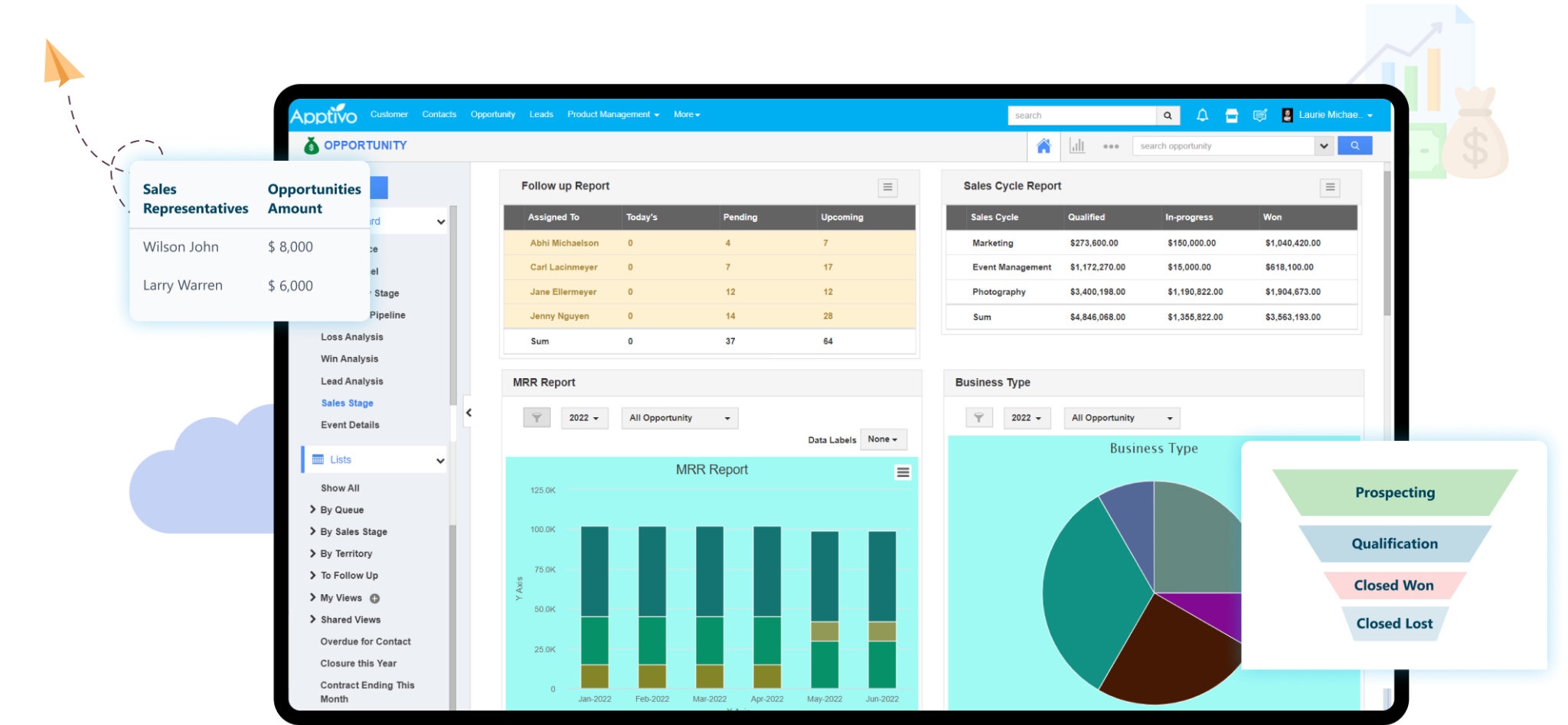
Apptivo provides an Intelligent Sales Dashboard with pipeline visualization, a Snapshot tool for historical pipeline tracking, and a Matrix Table with quartiles for financial pipeline analysis. All tiers include custom reports and dashboards, scaling from 5 custom reports on Lite to 100 on Enterprise. The analytics handle basic pipeline management but lack the depth for complex forecasting or cross-cutting analysis.
Source: Apptivo
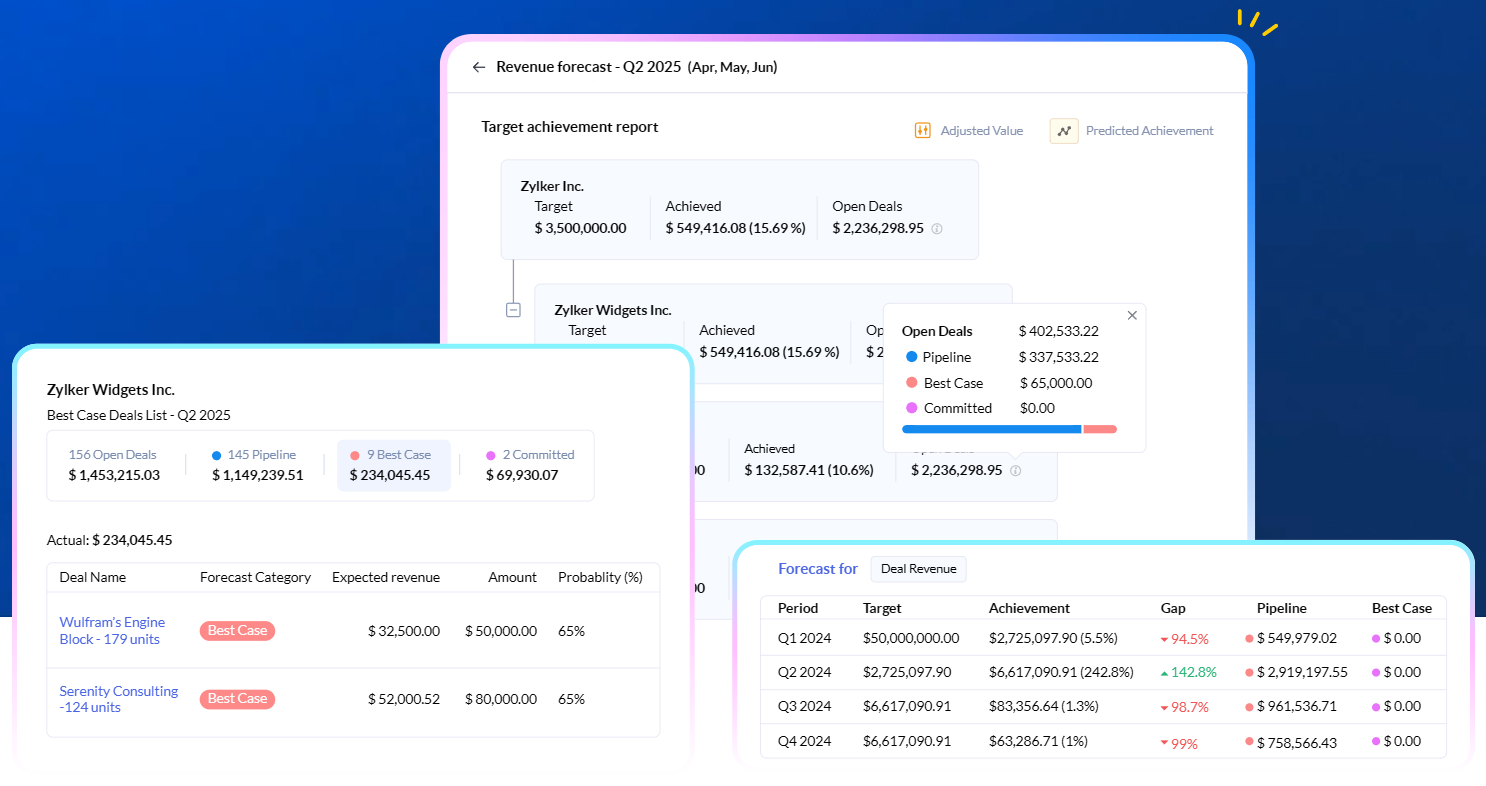
Zoho CRM operates at a different level. It ships with 40+ standard reports organized into folders, supports nine interactive chart types with drill-down capability, and includes Cohort Analysis, Quadrant Analysis, and Waterfall views. Sales forecasting supports top-down and bottom-up views simultaneously, with deals classified into Committed, Best Case, and Open categories.
Source: Zoho CRM
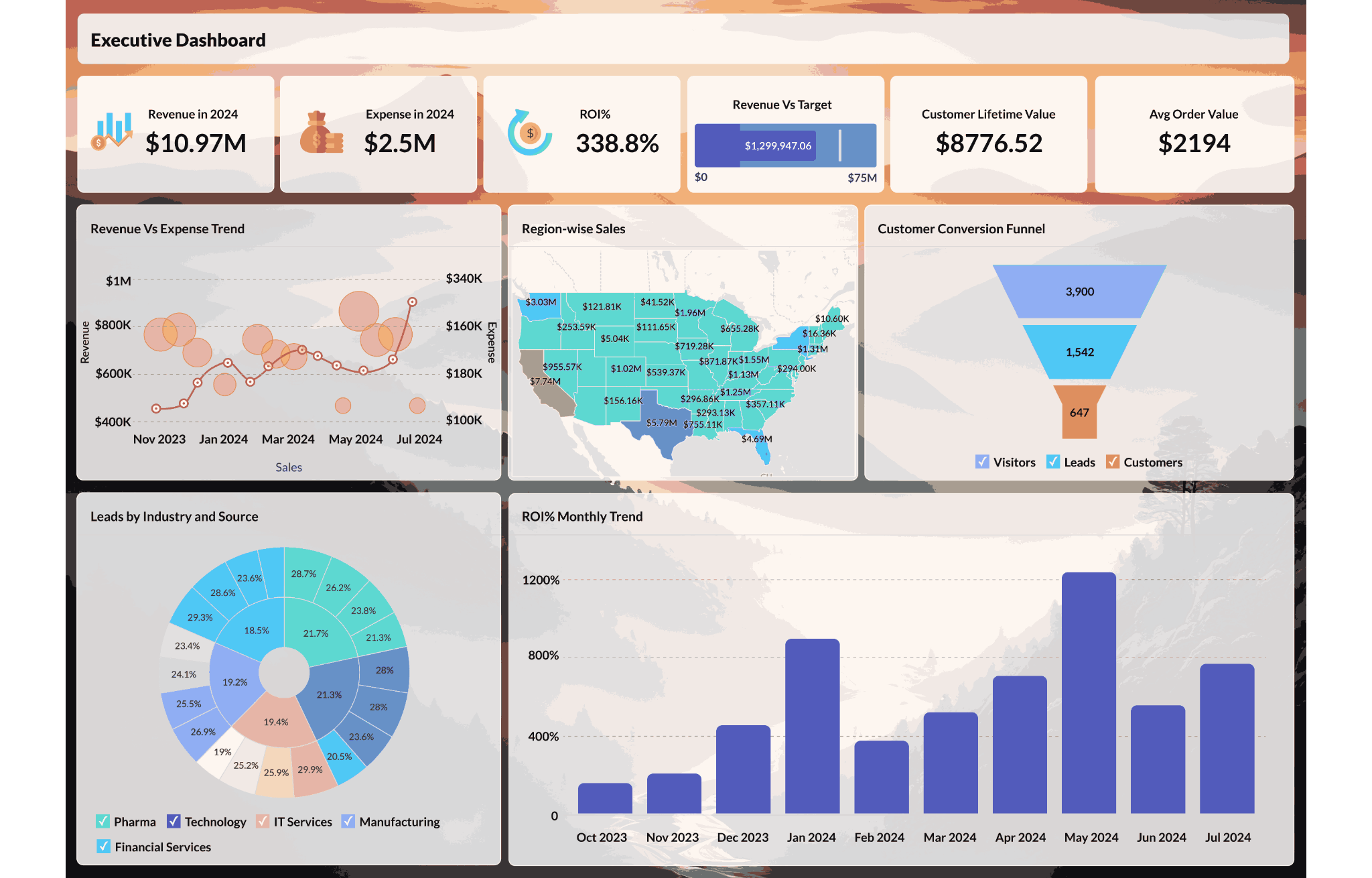
Where Zoho separates itself is AI analytics. Zia's anomaly detection monitors sales metrics and alerts users when numbers deviate from trends, with suggested corrective actions attached. Zia Presentation compiles metrics into presentations from existing reports. And the Zoho Analytics integration, recognized in the 2025 Gartner Magic Quadrant for Analytics and Business Intelligence Platforms, connects 250+ data sources for BI that extends beyond CRM data.
Source: Zoho CRM
For teams making decisions from basic dashboards, Apptivo's reporting is sufficient. For teams that want AI-driven forecasting and analytics across departments, Zoho CRM is in a different class.
Omnichannel engagement for modern sales teams
Reaching prospects on the right channel at the right time is as important as having their contact information.
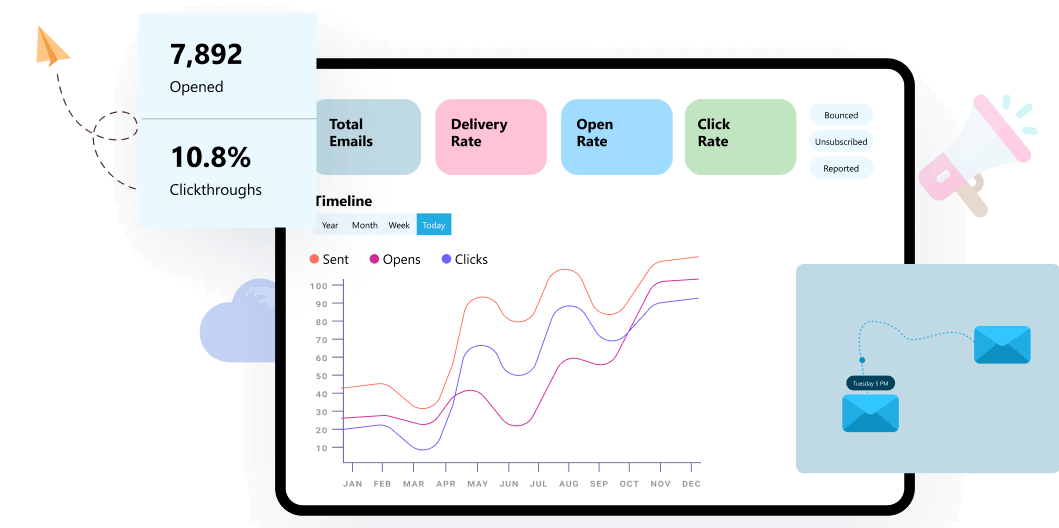
Apptivo supports email with IMAP and two-way Gmail/Outlook sync, email sequencing for automated outreach, and telephony through RingCentral, Asterisk, and Nexmo integrations. The Campaigns module provides drag-and-drop email marketing with SpamAssassin scoring and SPF/DKIM guidance. It covers the essentials, but social media, messaging apps, and live chat aren't part of the CRM's native channel mix.
Source: Apptivo
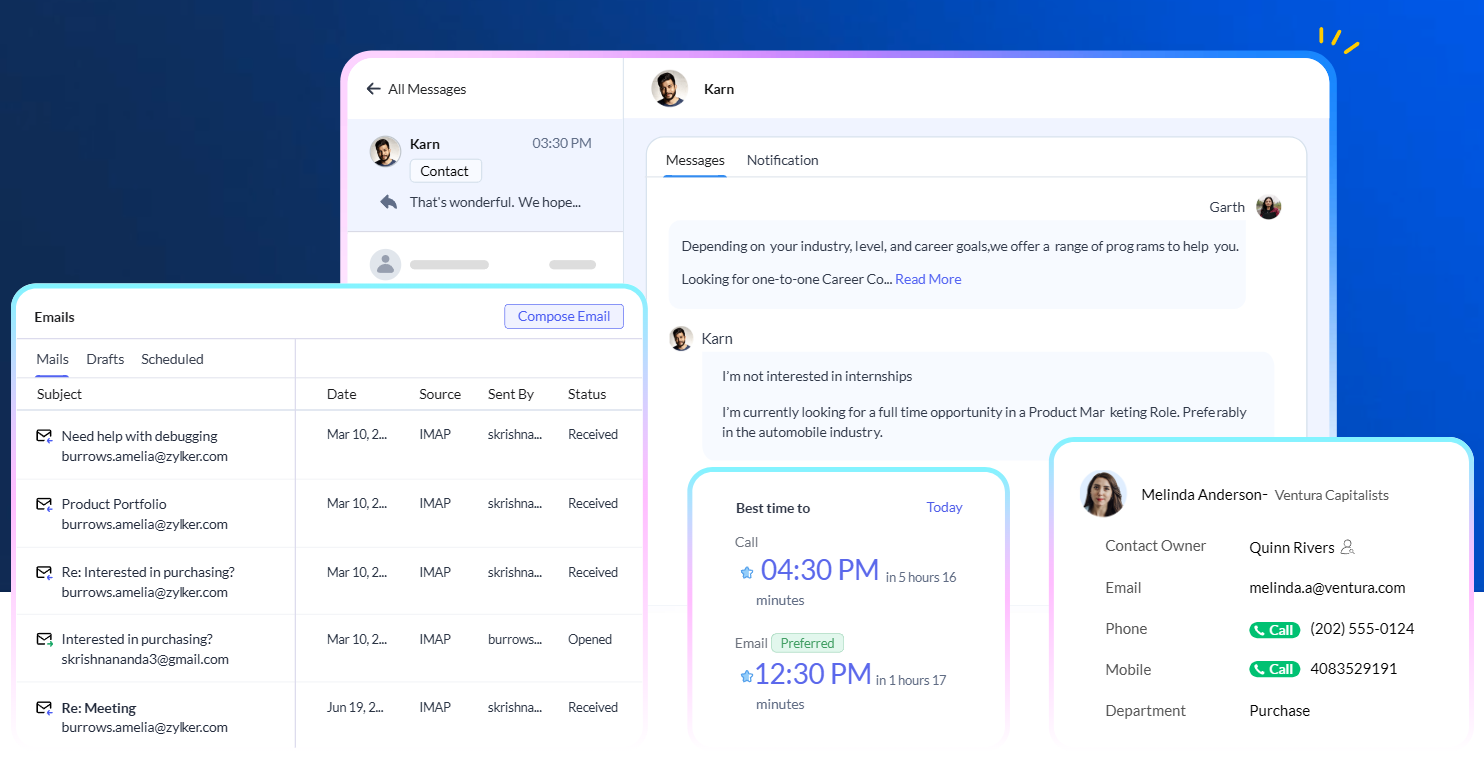
Zoho CRM covers more ground. Email, phone, Facebook, X, WhatsApp Business, LINE for Business, SMS, and online meetings are all managed from within the CRM. Zoho logs every interaction against the relevant record. SalesSignals sends real-time notifications when a prospect opens an email, clicks a link, mentions your brand on social media, or sends a message through any integrated channel.
Source: Zoho CRM
Zia adds email sentiment analysis, intent classification, and competitor mention alerts, plus call transcription with sentiment and emotion analysis on Enterprise and Ultimate plans. For each prospect, Zia recommends the best channel and time to reach out based on that person's engagement history.
For teams selling through email and phone, Apptivo's channels are adequate. For teams engaging prospects across social, messaging, and multiple touchpoints, Zoho CRM's omnichannel coverage is broader.
Security and compliance
Both platforms take security seriously, but their certification portfolios differ in scope.
Apptivo holds SSAE18 SOC2 Type II certification, is GDPR compliant, and participates in the EU-U.S. Privacy Shield framework. Infrastructure runs on Google Kubernetes Engine with 1-hour rolling backups encrypted in AWS S3, and all connections use 256-bit SSL encryption. (Data security details)
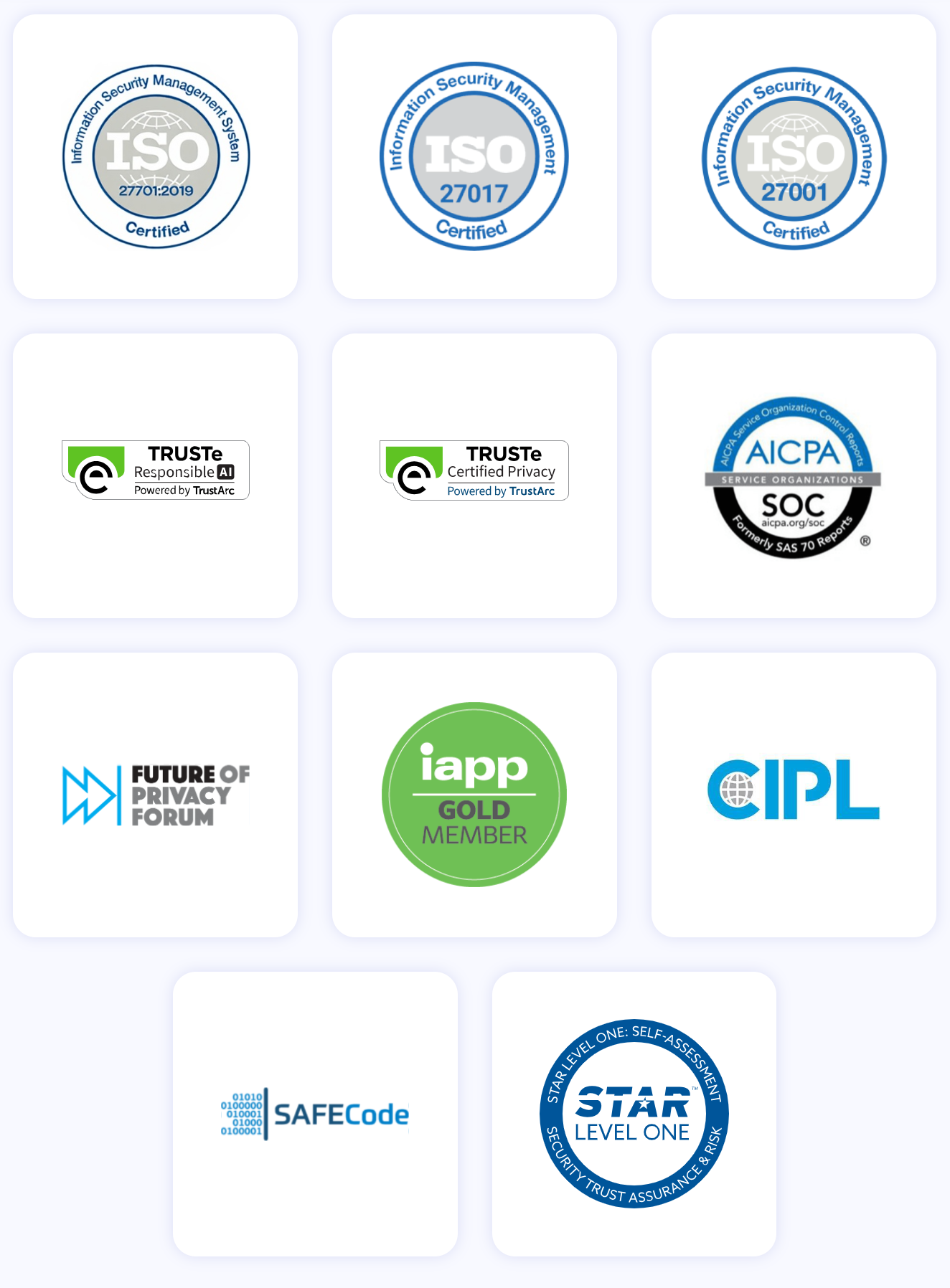
Zoho CRM carries a broader portfolio: ISO 27001, ISO 27701, ISO 27017, ISO 27018, SOC 2 Type II, SOC 1 Type II, and SOC 2 + HIPAA Type 2. Data centers span the US, EU, India, Japan, China, Australia, Canada, Saudi Arabia, and South Africa, giving organizations control over data residency. Zoho says it has never sold user data and runs its own data centers rather than relying on public cloud.
ZoomInfo holds ISO 27001, ISO 27701, SOC 2 Type II, TRUSTe GDPR, and TRUSTe CCPA certifications, all renewed annually. The company is a registered data broker in California and Vermont and maintains a Trust Center.
For most SMB use cases, both Apptivo and Zoho CRM meet standard security requirements. For organizations in regulated industries, Zoho's HIPAA coverage and data residency options provide additional compliance protection.
Apptivo vs. Zoho CRM vs. ZoomInfo: Which should you choose?
The right answer depends on where your biggest bottleneck sits.
Choose Apptivo if:
You need CRM, invoicing, help desk, field service, and project management in one subscription
Your team has fewer than 50 users and wants a flat per-seat price with no surprises
You value 24/7 support included at every tier without a premium surcharge
AI capabilities are not a current priority
Your integration needs are limited to Google Workspace, QuickBooks, and Slack
Choose Zoho CRM if:
Sales pipeline management and automation are your primary needs
AI-powered lead scoring, deal predictions, and autonomous sales agents matter to your workflow
You need omnichannel engagement across email, phone, social, and messaging
You want a permanent free plan for getting started or testing
You're already using or considering other Zoho products
Add ZoomInfo to either if:
You need accurate B2B prospect data to fuel your pipeline
You want to know which companies are researching solutions like yours
Your sales team spends too much time on manual prospect research instead of selling
You need intelligence that tells you who to contact, when to engage, and why they're likely to buy
You want a data foundation that makes any CRM more effective
Explore ZoomInfo's free Lite tier or request a demo to see the full platform.
"ZoomInfo gives us the information we need to execute. We don't have to go through and spend our time digging. It's already there, so we can be three steps ahead." William Kenimer, Vice President of Revenue Operations at Vensure. (Vensure Case Study)
Apptivo and Zoho CRM are both strong platforms for managing your sales process. Apptivo gives you operational breadth at low cost. Zoho CRM gives you sales depth with AI. But the best CRM produces mediocre results when it's filled with incomplete, outdated prospect data. ZoomInfo provides the data layer that keeps whichever CRM you choose fed with accurate, current prospect information.
The best sales stack isn't one tool. It's the right CRM matched to how your business operates, powered by data you can trust.
Apptivo vs. Zoho CRM vs. ZoomInfo FAQ
What is the core difference between Apptivo, Zoho CRM, and ZoomInfo?
Apptivo is an all-in-one business management suite with 65+ integrated apps covering CRM, invoicing, help desk, field service, and project management under one subscription. Zoho CRM is a dedicated sales CRM with AI-powered lead scoring, process automation, omnichannel engagement, and a broader ecosystem of 60+ connected Zoho products. ZoomInfo is a B2B data intelligence platform that provides verified contact and company data, buyer intent signals, and AI-powered prospecting to fuel any CRM's pipeline. Apptivo and Zoho CRM manage relationships; ZoomInfo provides the data to start them.
Which platform is more affordable for a small team?
Zoho CRM has the edge for very small teams with a permanent free plan for up to 3 users. Apptivo starts at $15/user/month (billed annually) with no free plan, only a 14-day trial. However, Apptivo includes 24/7 support and 18 integrated apps at its lowest tier, while Zoho CRM's comparable paid tiers offer deeper CRM features but charge extra for premium support. ZoomInfo offers a permanent free Lite tier with 10 monthly export credits and access to its B2B database.
Does Apptivo have AI features like Zoho CRM's Zia?
No. Apptivo does not offer AI features such as predictive lead scoring, deal win predictions, generative AI content creation, or autonomous sales agents. Zoho CRM's Zia covers all of these and includes seven pre-built AI sales agents that can nurture leads, analyze deals, generate quotes, and schedule follow-ups on their own. For teams that consider AI a priority, this is one of the biggest differences between the two platforms.
Can ZoomInfo integrate with both Apptivo and Zoho CRM?
ZoomInfo lists Zoho among its CRM and marketing automation platform integrations and offers native connectors through its Marketing plans. For Apptivo, ZoomInfo's REST API and Enterprise API provide a path to push B2B data into the system. ZoomInfo's MCP server also lets AI models and custom agents access its data and route it to any connected tool, regardless of which CRM a team uses.
Which platform is better for a business that needs more than just CRM?
Apptivo covers more ground within one subscription, bundling CRM with invoicing, help desk, field service, project management, supply chain, and HR apps. Zoho CRM requires adding separate Zoho products to match this breadth, though each Zoho product goes deeper in its area than Apptivo's equivalent module. ZoomInfo is not a CRM; it provides the data that makes either CRM more effective at finding, engaging, and converting prospects.
How do Apptivo and Zoho CRM compare on customization?
Both offer no-code customization. Apptivo provides a drag-and-drop Master Layout system and an App Builder for creating custom applications, with up to 500 custom fields per app on Enterprise. Zoho CRM offers Canvas Design Studio with pixel-level control over record views, Blueprint for enforcing sales processes stage by stage, Kiosk Studio for building custom guided workflows, and up to 500 custom modules on Ultimate. The key difference: Zoho extends customization into process enforcement, preventing reps from skipping required steps.
Which platform has the stronger integration ecosystem?
Zoho CRM has a broader integration ecosystem with 1,100+ marketplace integrations, compared to Apptivo's limited set covering QuickBooks, Xero, Slack, and Google Workspace. Apptivo has no native Zapier or Make connector. ZoomInfo offers 120+ partner integrations plus API and MCP access that connects to any tool, and its data can be pushed into both Apptivo and Zoho CRM.
Is ZoomInfo a competitor to Apptivo and Zoho CRM?
No. ZoomInfo is a complementary platform. Apptivo and Zoho CRM manage your customer relationships and sales processes. ZoomInfo provides verified B2B data, buyer intent signals, and the intelligence that feeds those systems. It tells your team which companies to target, who the decision-makers are, and when those companies are researching solutions. Your CRM manages the relationship from that point forward. The two types of tools work together, not in place of each other.
