
Here's what most comparisons miss: Bigin and Zoho CRM aren't competitors. They're siblings, both built by Zoho Corporation for different stages of business growth. The real question isn't which one is "better." It's which one fits where you are now.
That decision comes down to five questions:
Are you managing a simple sales pipeline, or do you need multi-department workflows with automation?
Is your team 1–20 people who need something working in 30 minutes, or 20–1,000 people who need customization?
Do you need basic dashboards, or do you need forecasting, territory management, and AI-driven anomaly detection?
Are you comfortable with a CRM you'll outgrow, or do you want one that scales with you for years?
How critical is the quality of your B2B contact data to your sales process?
Here's what we recommend:
Bigin is the CRM for small businesses still running on spreadsheets. With paid plans from $7/user/month, a 30-minute setup, and Team Pipelines that let you manage sales, onboarding, and support in one account, Bigin delivers CRM functionality without the learning curve. The trade-off: you'll hit limits on automation, reporting, and customization as your team grows past 20 people.
Zoho CRM is the full platform for businesses that need depth. It includes Blueprint process automation to enforce sales methodology, Zia AI with predictive lead scoring and automated agents, territory management, CPQ, journey orchestration, and Canvas Design Studio for no-code interface customization. The trade-off: it takes longer to configure, and advanced features require Enterprise-tier pricing.
Both Bigin and Zoho CRM handle pipeline management well. But a CRM is only as effective as the data inside it. If your team sells B2B, the contacts you reach, the companies you target, and the signals that tell you when to act determine whether your CRM generates revenue or sits idle.
ZoomInfo is a B2B data and go-to-market platform built on a large data foundation: 500M contacts, 100M companies, 135M+ verified phone numbers, and 200M+ verified business emails. Its GTM Context Graph processes 1.5B+ data points daily, connecting this data with your CRM records, conversation transcripts, and behavioral signals to give you full visibility into your accounts. That context lets AI show not just what happened, but why, and what to do next. Your team can run sales workflows from the GTM Workspace, build campaigns in GTM Studio, or feed their own tools through the API and MCP. ZoomInfo integrates with both Bigin (via Zoho's ecosystem) and Zoho CRM, enriching your records and feeding prospecting from inside your CRM.
If accurate B2B data and buyer intelligence sound like the missing piece in your CRM strategy, see how ZoomInfo works.
Bigin vs. Zoho CRM vs. ZoomInfo at a glance
Bigin | Zoho CRM | ZoomInfo | |
|---|---|---|---|
Primary function | Simple CRM for small businesses | Full-featured CRM platform | B2B data intelligence and go-to-market platform |
Starting price | Free (1 user); $7/user/month (Express) | Free (3 users); ~$14/user/month (Standard) | Free (ZoomInfo Lite); custom-quoted paid plans |
Setup time | 30 minutes | Days to weeks | Deploys in weeks |
AI capabilities | Zia Agents (email reply, cross-sell, churn analysis) | Zia AI (predictive scoring, anomaly detection, 7 pre-built AI agents) | GTM Context Graph, AI-drafted outreach, buyer intent, account intelligence |
Automation limits | 3 (Free) to 100 (Bigin 360) rules | Up to 2,500 workflow rules | Signal-triggered workflows across channels |
Pipelines | 1–15 Team Pipelines | Multiple pipelines with Blueprint enforcement | N/A (feeds data into your CRM pipelines) |
Reporting | Basic dashboards, charts, KPIs | 40+ standard reports, cohort analysis, forecasting, anomaly detection | AI-powered account summaries and pipeline analytics |
Mobile app | Mobile-first with Samsung, Apple, Google integrations | Native mobile with offline access | Mobile app and Chrome extension |
Key integration | 15+ Zoho apps, Zapier, Google, Microsoft | 1,100+ integrations via Marketplace | Salesforce, HubSpot, Zoho CRM, 120+ partners, API and MCP access |
Best for | 1–20 person teams replacing spreadsheets | 10–1,000 person teams needing depth | B2B sales teams needing verified contact data and buyer signals |
The same company built both CRMs for different buyers
This comparison is unusual because Bigin and Zoho CRM come from the same parent: Zoho Corporation, a bootstrapped company founded in 1996 with 19,000 employees, one million paying customers, and no outside investors.
Bigin launched in May 2020 because Zoho's own data showed that despite 600+ CRM vendors in the market, most small businesses were still stuck on spreadsheets. The existing products (including Zoho's own) were too complex and too expensive for a five-person company that just needed to track deals and follow-ups.
So Zoho built a separate product from scratch. Not a stripped-down Zoho CRM, but a CRM designed for buyers who have never used CRM software.
This matters because it explains why the two products feel different despite sharing a parent company. Bigin answers the question: "What's the smallest useful CRM?" Zoho CRM answers: "How do we compete with Salesforce?" Those are different design goals, and they produce different products.
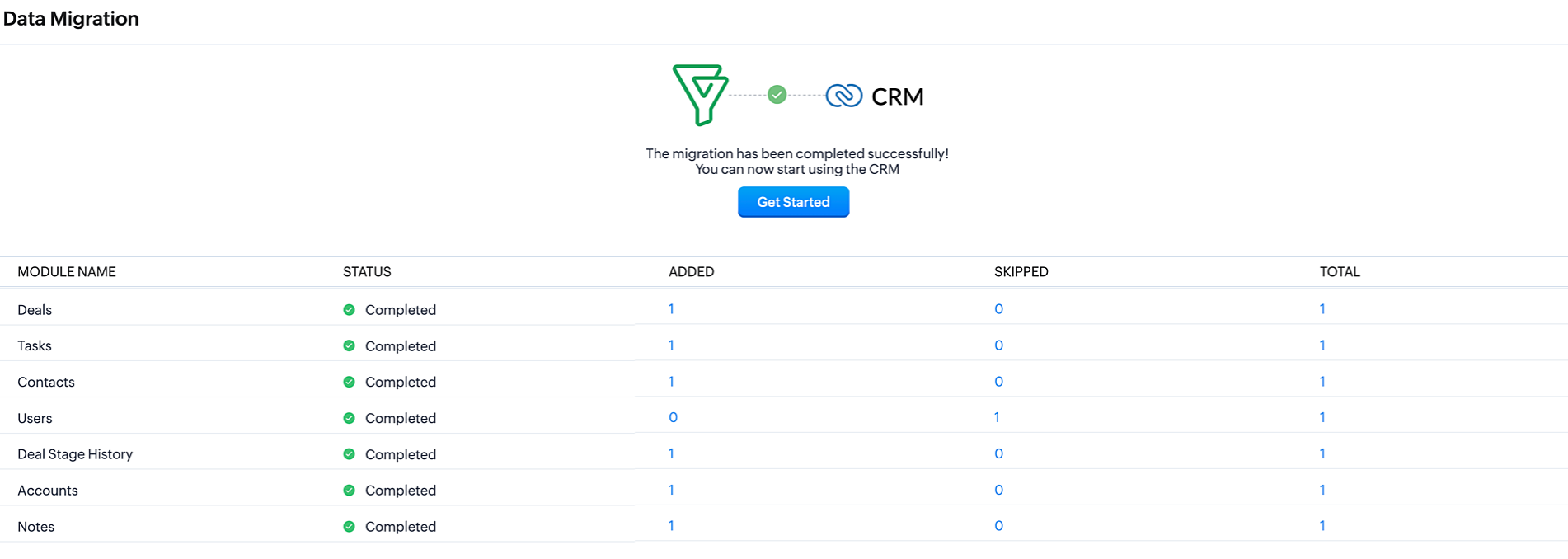
The good news: Zoho designed a single-click migration path from Bigin to Zoho CRM for when you outgrow it. The transition is built into the product strategy. You're not making a permanent choice; you're choosing a starting point.
Source: Zoho
Bigin wins on simplicity and speed to value
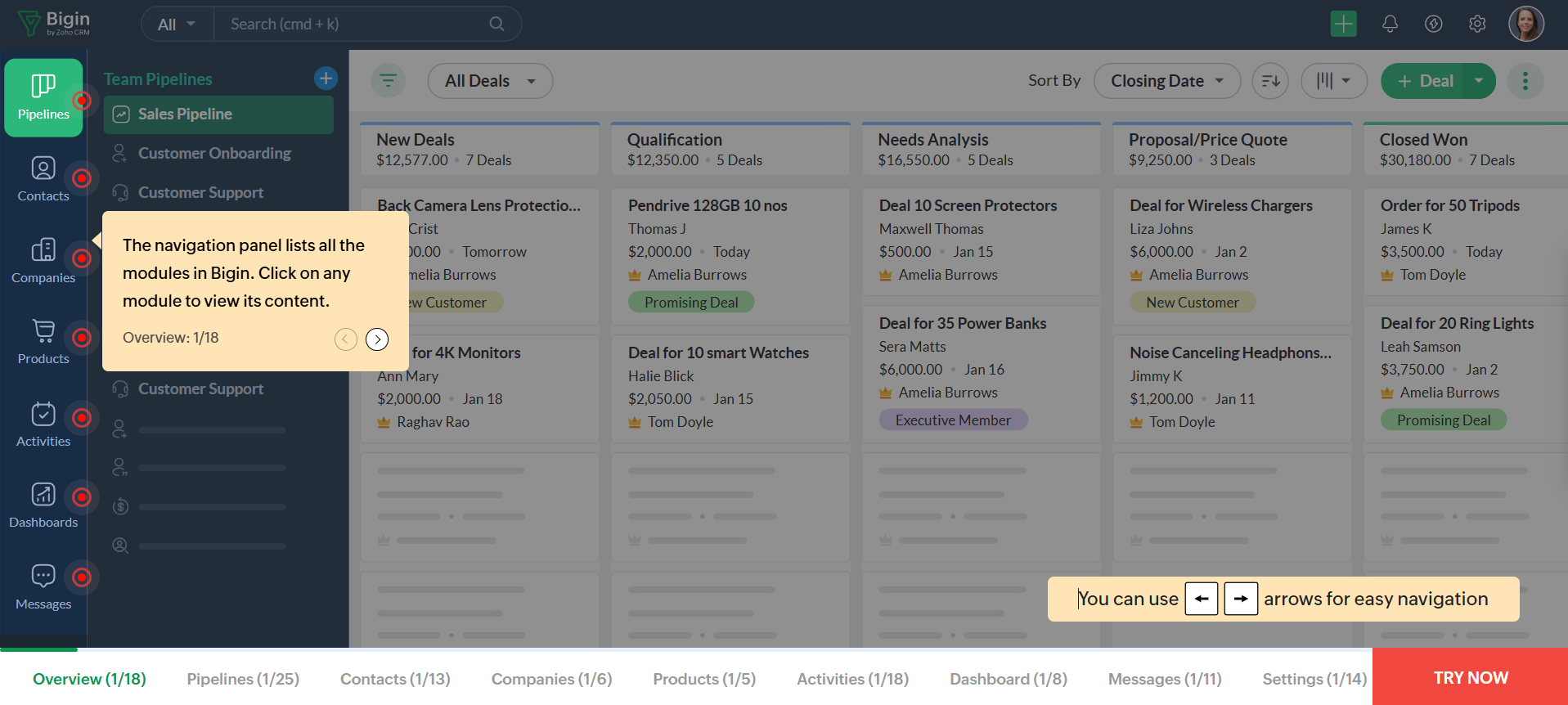
Bigin's product philosophy is that a CRM should be usable by someone who has never touched one. The QuickStart Guide walks you through setup with images, not documentation. The interface puts every module one click from the left-side navigation. And the claim, repeated across the product, is that you're up and running in 30 minutes.
Source: Bigin
Team Pipelines is Bigin's structural differentiator. Rather than limiting you to a sales pipeline, Bigin lets you run sales, onboarding, support, order fulfillment, and other workflows as separate pipelines within one account. ACF Events managed sales and admin pipelines with automated cross-pipeline handoffs. Sea Lanes Brighton ran four pipelines for room hires, events, pop-ups, and networking.
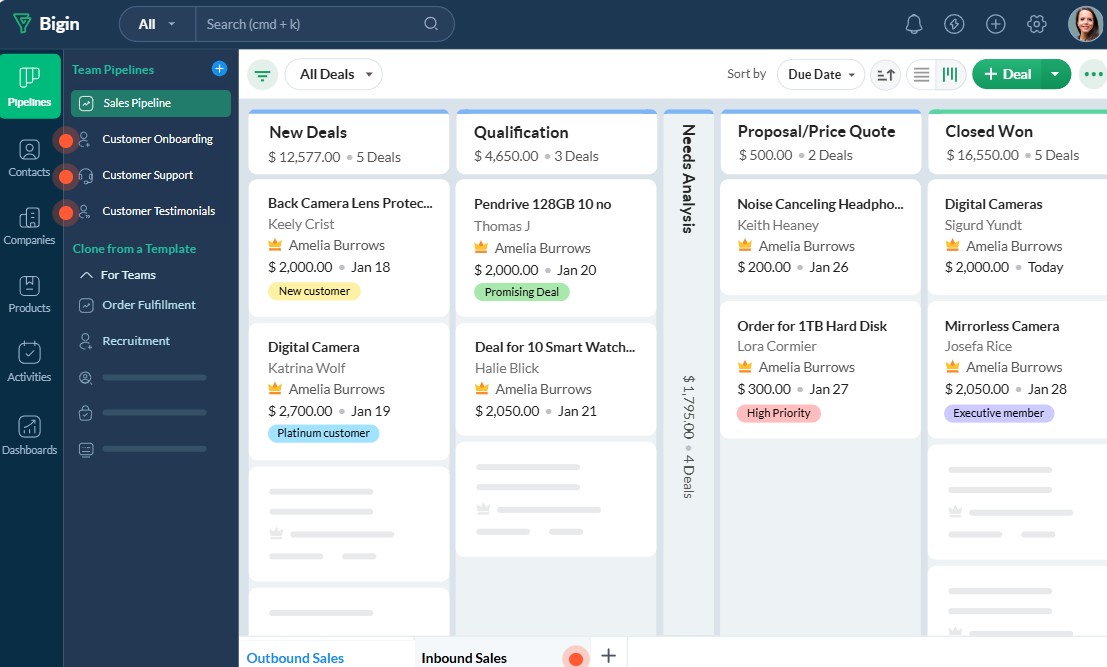
Source: Bigin
The pricing reinforces the accessibility. The Express plan at $7/user/month includes built-in telephony, workflow automations, WhatsApp integration, email tracking, and multiple pipelines. Competitors often gate these features behind plans costing $90/month or more.
But simplicity has boundaries. Bigin caps at 30 automation rules on Express and 50 on Premier. Custom fields max out at 10 per module on Express. There's no native forecasting, territory management, or advanced pipeline analytics.
These aren't flaws. They're design decisions. Bigin exists to get you off spreadsheets fast, not to run a 200-person sales floor.
Zoho CRM wins on depth and scalability
Where Bigin stops, Zoho CRM keeps going.
Blueprint is the clearest example. Blueprint maps your sales process as a visual flowchart, then enforces it. Reps cannot move a deal to the next stage without completing required fields, finishing tasks, or getting approvals. Stagnation alerts fire when records sit too long in a stage.
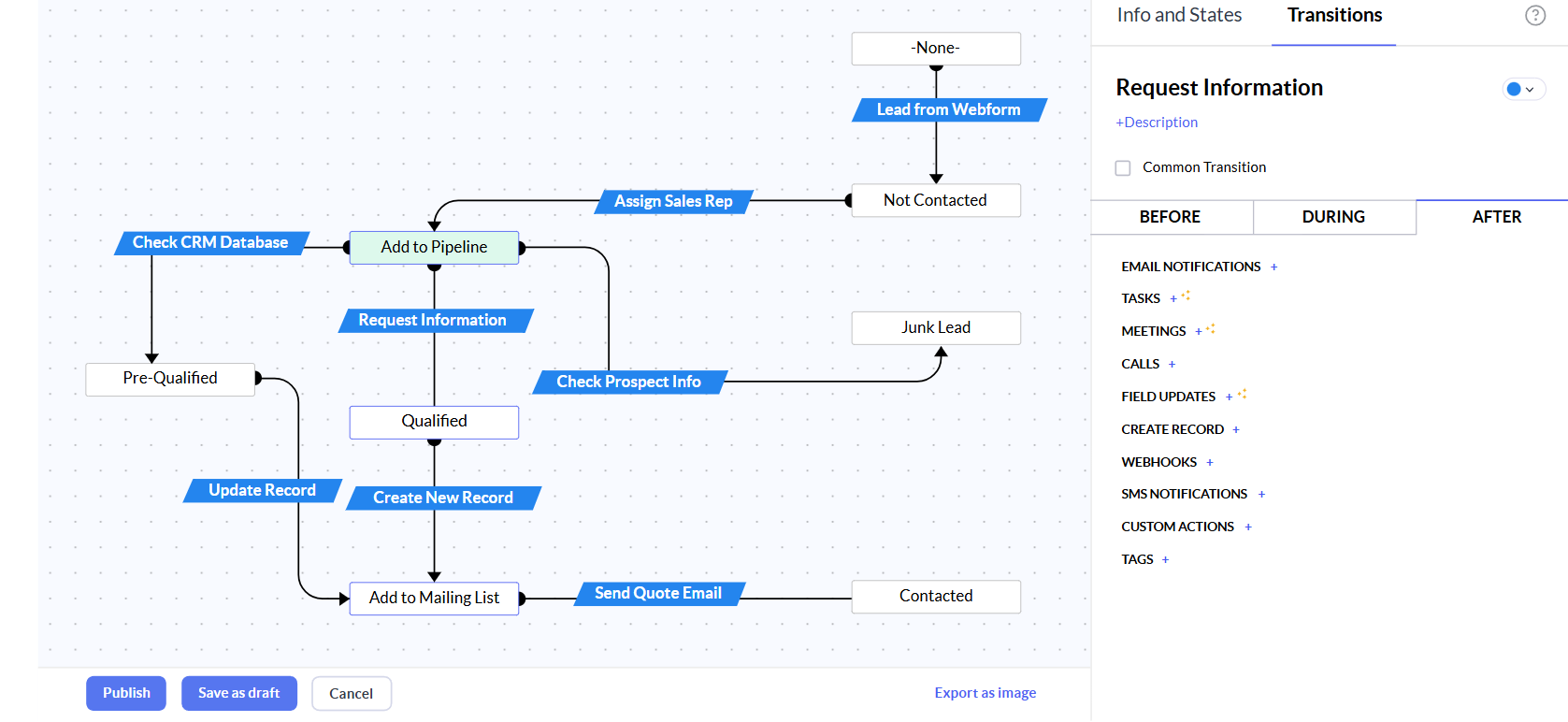
Source: Zoho
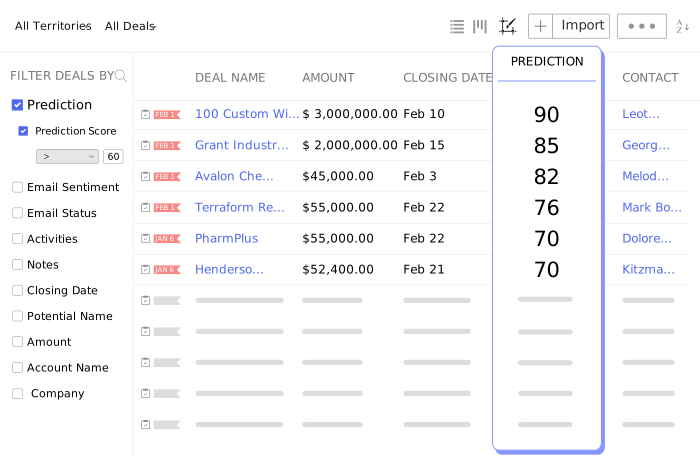
Zia AI goes deeper than Bigin's version. Zoho CRM's Zia includes predictive lead scoring, churn prediction, best time to contact, email sentiment analysis, anomaly detection, deal win probability, and seven pre-built AI agents: an SDR agent, sales coach, deal analyzer, quote generator, follow-up scheduler, revenue growth specialist, and deal closure reminder. Agent Studio lets you create custom agents from natural language descriptions, with no code.
The customization runs deep. Canvas Design Studio lets administrators redesign CRM interfaces at the pixel level, with no code. Up to 500 custom modules are available on the Ultimate plan. Territory management supports up to 250 territories. CPQ handles product configuration, dynamic pricing, and guided selling natively within deal records.
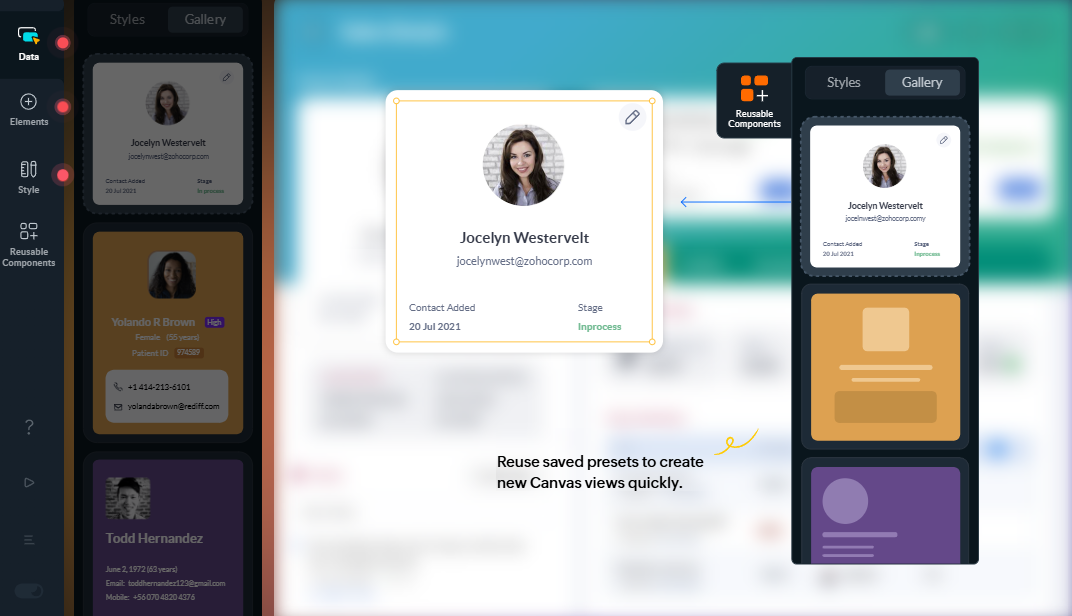
Source: Zoho
The analytics match the depth. Zoho CRM includes 40+ standard reports, cohort analysis, waterfall charts, and AI-driven anomaly detection that prescribes corrective actions.
The trade-off is complexity. G2 reviewers note that while basic use is accessible, the full platform demands time to configure. Capterra reviewers say that deep customization requires real investment. This is the natural consequence of a platform that supports everything from a 3-person startup to a multi-territory enterprise. The power is there; accessing it takes work.
Your CRM is only as good as the data feeding it
Here's the problem neither Bigin nor Zoho CRM solves alone: where do your contacts come from?
A CRM manages relationships. It tracks deals, logs calls, and automates follow-ups. But it doesn't tell you who to call in the first place. It doesn't verify that the email address you imported last quarter still works. It doesn't flag that a target account just started researching your product category.
For B2B sales teams, this data gap is the difference between reps spending their day selling and reps spending their day searching LinkedIn, guessing at email formats, and calling numbers that ring to voicemail.
ZoomInfo fills this gap. As a B2B data and go-to-market platform, it provides the intelligence that makes your CRM actionable. The platform covers 500M contacts and 100M companies, verified through a multi-source process backed by 300+ human researchers and achieving up to 95% accuracy on first-party data.
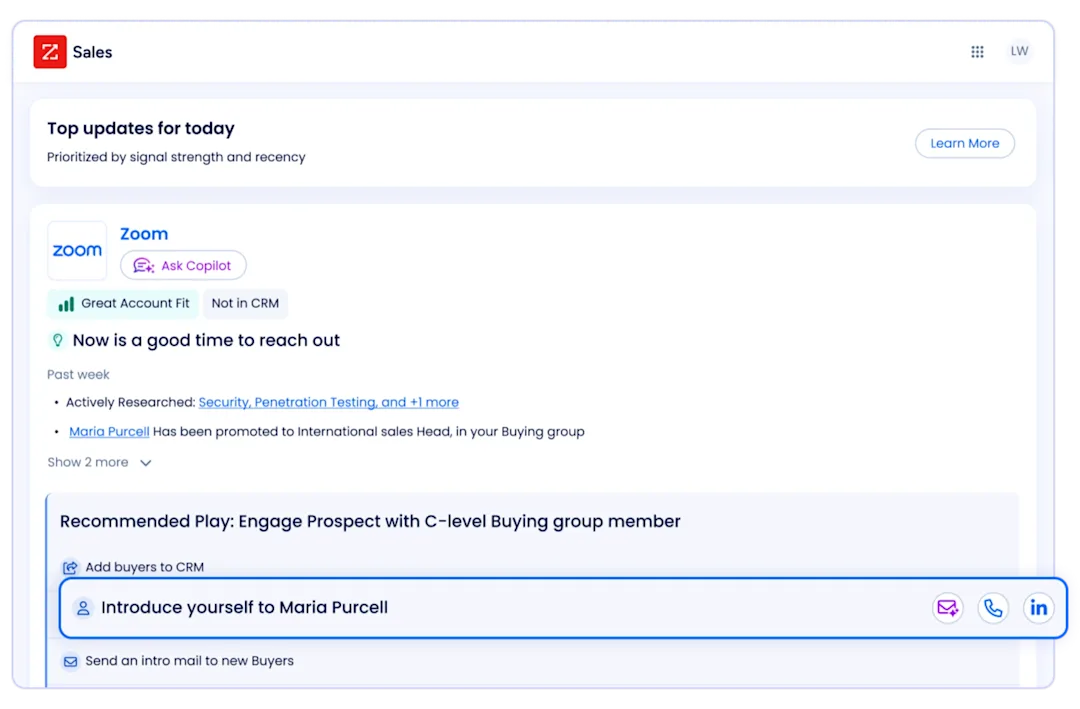
What this means in practice: instead of your reps researching prospects by hand, ZoomInfo provides 120M direct-dial phone numbers and 200M+ verified business email addresses. Instead of guessing which accounts to prioritize, ZoomInfo Intent tracks signals from 210 million IP-to-Organization pairings to identify companies actively researching relevant topics. Instead of treating every lead equally, Guided Intent identifies the topics historically correlated with your deal success.
This intelligence feeds into whichever CRM you choose. ZoomInfo integrates with Zoho CRM through its marketplace and connects to 120+ partner platforms. For teams building custom workflows, APIs and MCP expose the same data to any application or AI agent.
"ZoomInfo gives us the information we need to execute. We don't have to spend our time digging. It's already there, so we can be three steps ahead." (Vensure)
Automation tells you where each CRM draws the line
Automation is where the gap between Bigin and Zoho CRM becomes concrete.
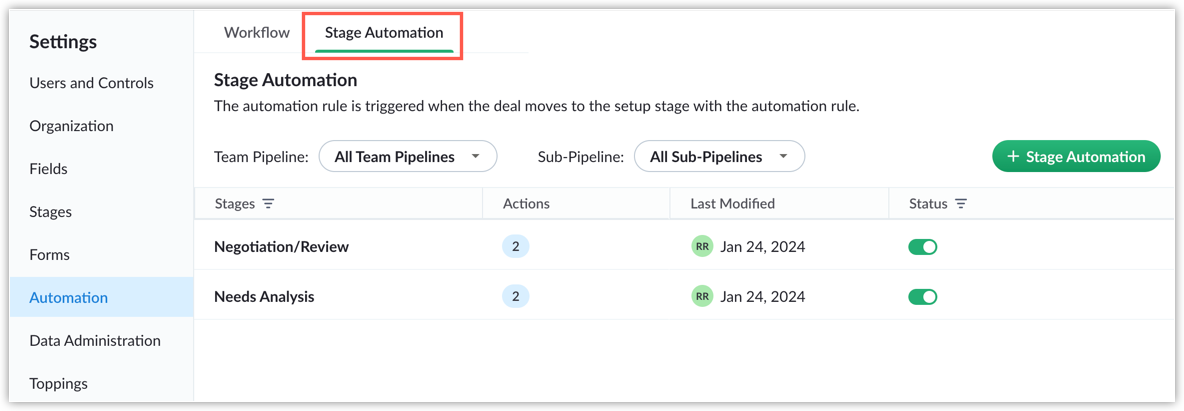
Bigin's automation is built for simplicity. You create workflow rules with a trigger, conditions, and actions (send an email, update a field, create a task). Stage Automation lets you build automations directly from the pipeline view. The caps are clear: 3 rules on Free, 30 on Express, 50 on Premier, and 100 on Bigin 360.
Source: Zoho
For a 10-person team running two or three pipelines, this is plenty. Automate welcome emails when a deal enters onboarding. Create a task when a deal stalls in a stage. Send a follow-up reminder three days before a payment is due.
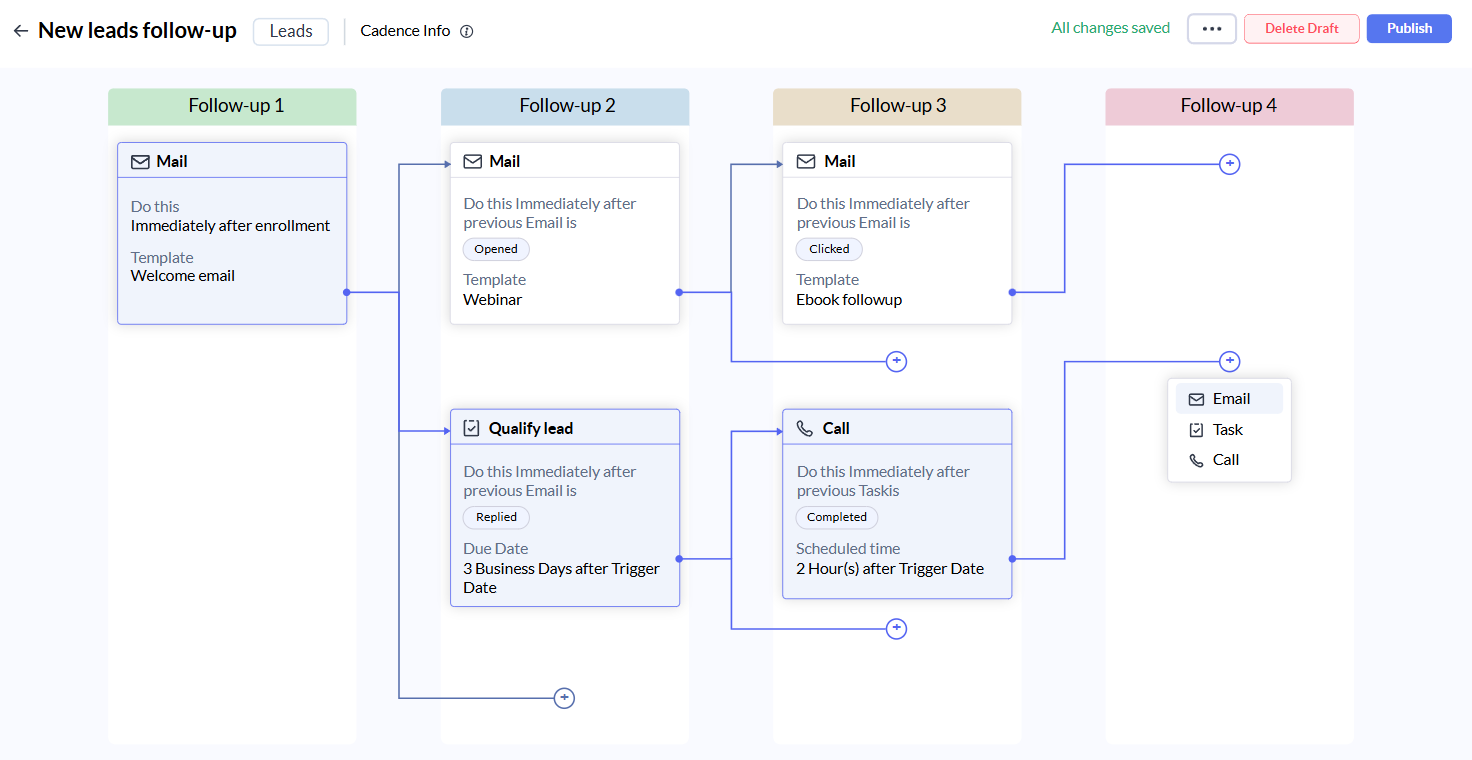
Zoho CRM's automation operates at a different scale. The platform supports up to 2,500 workflow rules per organization. Beyond basic workflows, it adds Blueprint (stage-by-stage process enforcement with mandatory checkpoints), Cadences (multichannel follow-up sequences that branch based on customer responses), Kiosk Studio (no-code interactive process flows), and CommandCenter (cross-channel journey orchestration with PathFinder to visualize actual customer paths).
Source: Zoho
Each tool solves a different problem. Blueprint prevents reps from skipping steps. Cadences coordinate emails, calls, and WhatsApp messages into a single follow-up sequence. CommandCenter shows you how customers actually move through your funnel, so you can design journeys based on observed behavior rather than assumptions.
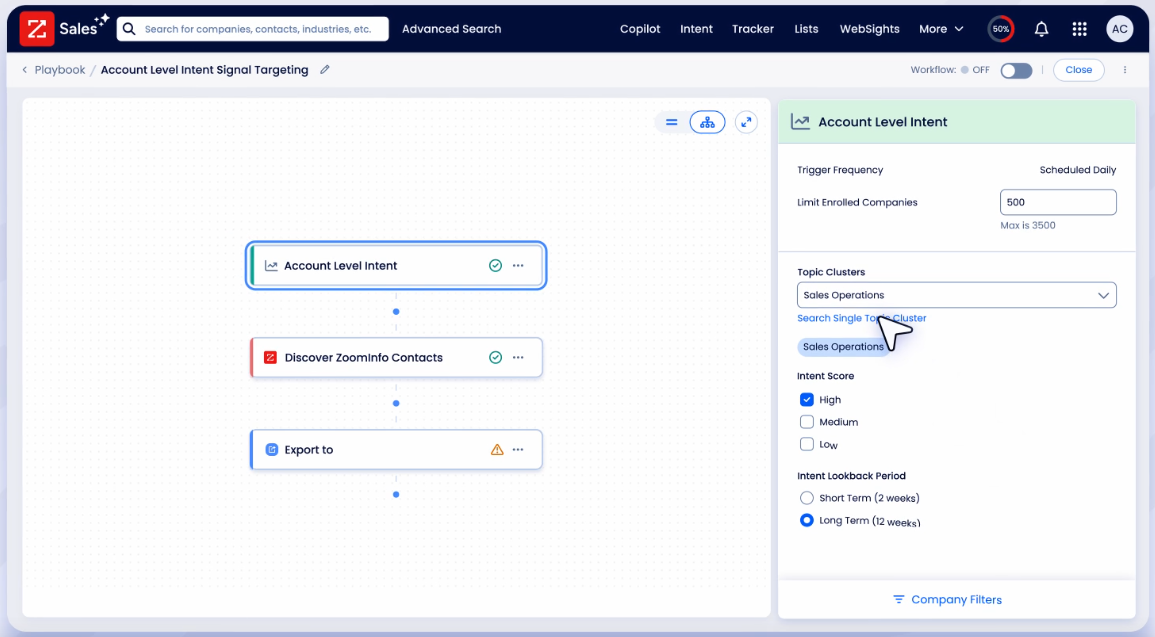
ZoomInfo adds signal-triggered automation on top of either CRM. Rather than automating based on CRM events alone (deal stage changed, field updated), ZoomInfo triggers actions based on external buying signals: a target account starts researching your product category, a key contact changes jobs, a company receives funding. These signals flow into your CRM through automated workflows so your team can act on them immediately.
"It's not just the data itself. It's the right data at the right time to help us reach out with the right message across the full buyer journey." (Redwood Logistics)
AI capabilities differ in scope and ambition
All three platforms have invested in AI, but each applies it differently.
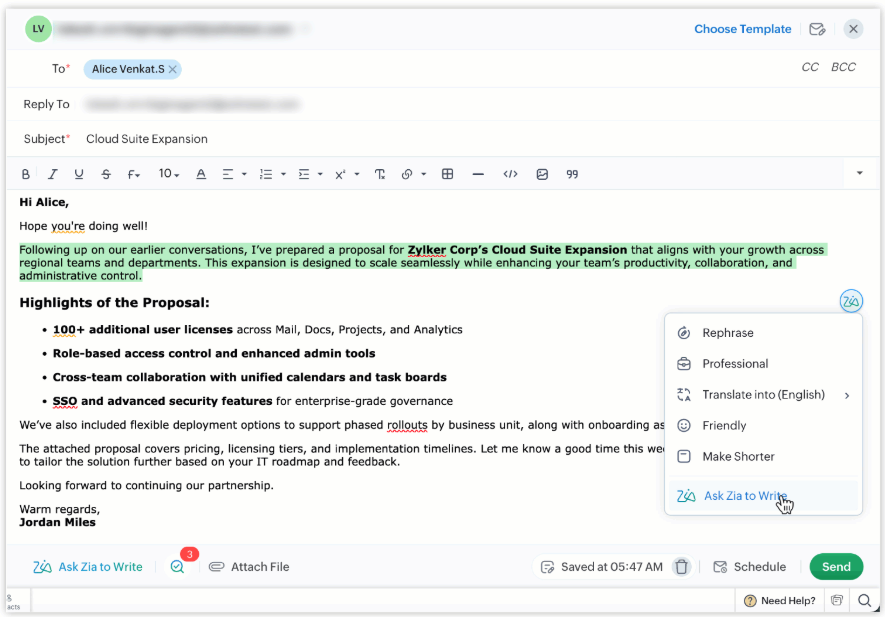
Bigin's AI is sized for small business needs. Zia Agents include a Reply Assistant (monitors inboxes and auto-responds to inquiries), CrossSell Genie (spots cross-sell opportunities on closed deals), and Churn Analyzer (identifies loss reasons on lost deals). The assistive layer adds email composition, proofreading, record summaries, and WhatsApp message summaries. Premier includes 1,000 AI credits monthly; Bigin 360 includes 3,000. Bigin also supports MCP integration, connecting external LLMs like Claude to Bigin data.
Source: Zoho
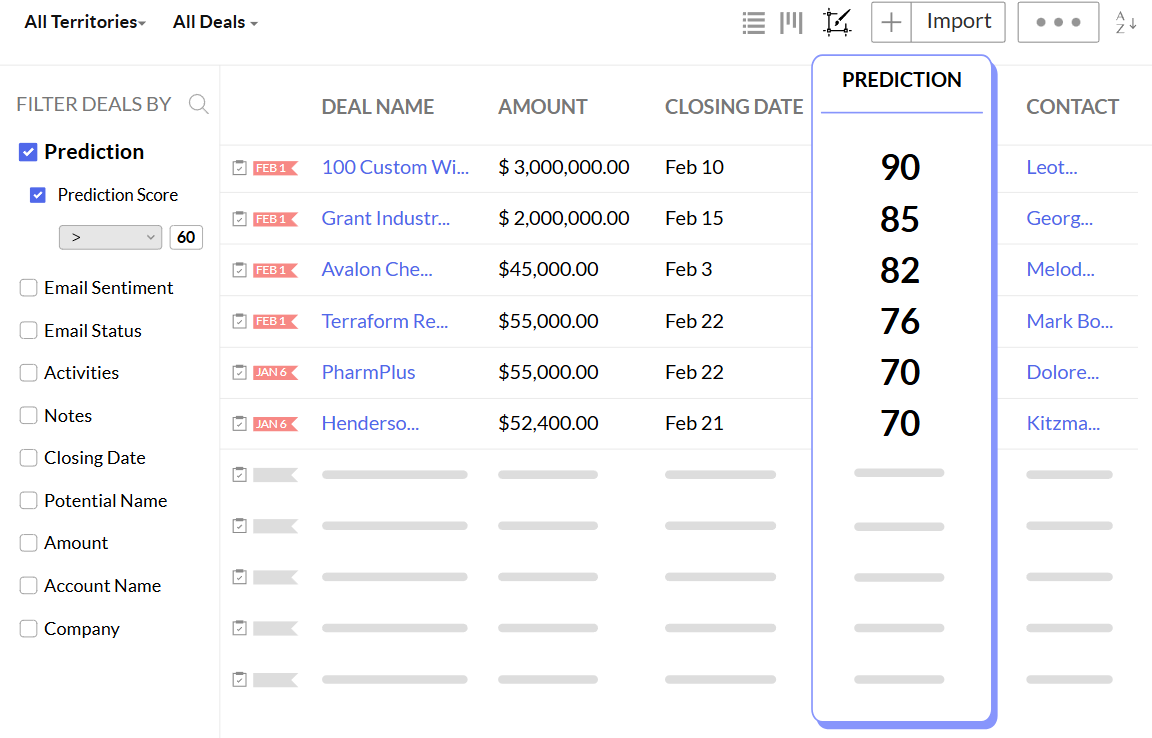
Zoho CRM's AI goes deeper. Zia provides predictive lead scoring, churn prediction, field-level predictions, best time and mode to contact, email sentiment and intent analysis, call transcription with emotion detection, and anomaly detection with corrective prescriptions. The Zia Agents Store offers seven pre-built agents, and Agent Studio lets you create custom agents from natural language descriptions. Generative AI extends to CRM configuration: describe a module and Zia builds it; describe a workflow and Zia creates the automation rules.
Source: Zoho
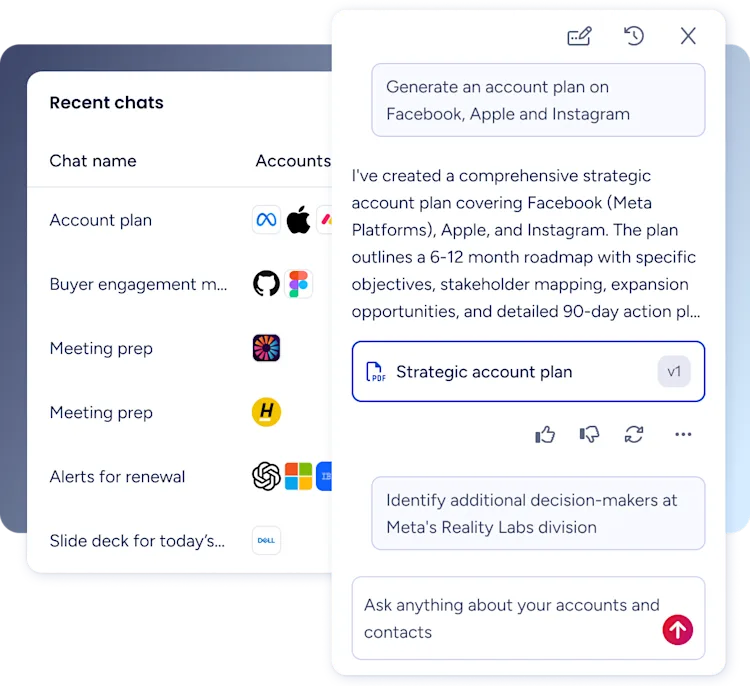
ZoomInfo's AI operates on a different data foundation. The GTM Context Graph processes 1.5B+ data points daily, fusing ZoomInfo's third-party B2B data with a customer's CRM records, conversation transcripts, and behavioral signals. Where CRM AI reasons about what happened inside your system, ZoomInfo's AI reasons about why it happened and what to do next, drawing on patterns across thousands of deals. In GTM Workspace, AI agents handle account research, outreach drafting, CRM updates, and signal monitoring. In GTM Studio, marketers describe audiences in natural language and launch targeted plays without engineering support.
"That combination of our internal CRM data, external signals, and AI that's given all that context has helped us craft very specific account- and persona-based messages. And people have responded to them right away." (Seismic)
Communication channels shape how you engage customers
Both CRMs provide multichannel communication, but with different breadth.
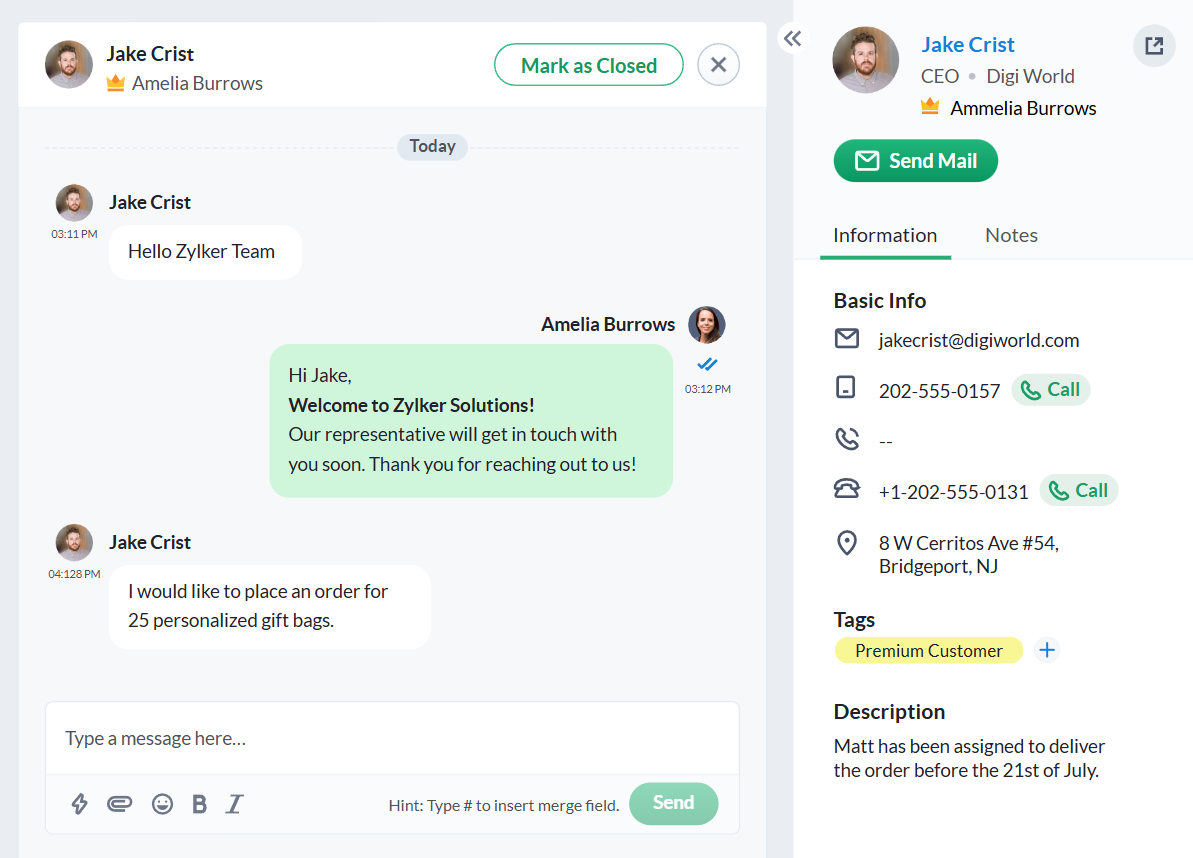
Bigin covers the essentials well. Built-in cloud telephony comes with the Free plan, which is uncommon at any CRM price point. WhatsApp Business integration includes a shared inbox with automated workflows triggered by pipeline events. Email connects via Gmail, Outlook, Zoho Mail, and IMAP/POP3.
Source: Bigin
Signals surface real-time notifications for email opens, missed calls, and social mentions. For teams in markets where WhatsApp is the primary business channel (India, Latin America, Southeast Asia), the native WhatsApp integration on Express and above is a strong differentiator.
Zoho CRM adds more channels and more intelligence per channel. Beyond email and phone, it supports omnichannel messaging including Facebook, X (Twitter), WhatsApp Business, LINE for Business, SMS, and online meetings, all logged against CRM records. The AI layer stands out here: Zia applies sentiment and intent analysis, emotion analysis, and competitor mention alerts to emails, and provides call transcription with sentiment and intent scoring on Enterprise and Ultimate plans.
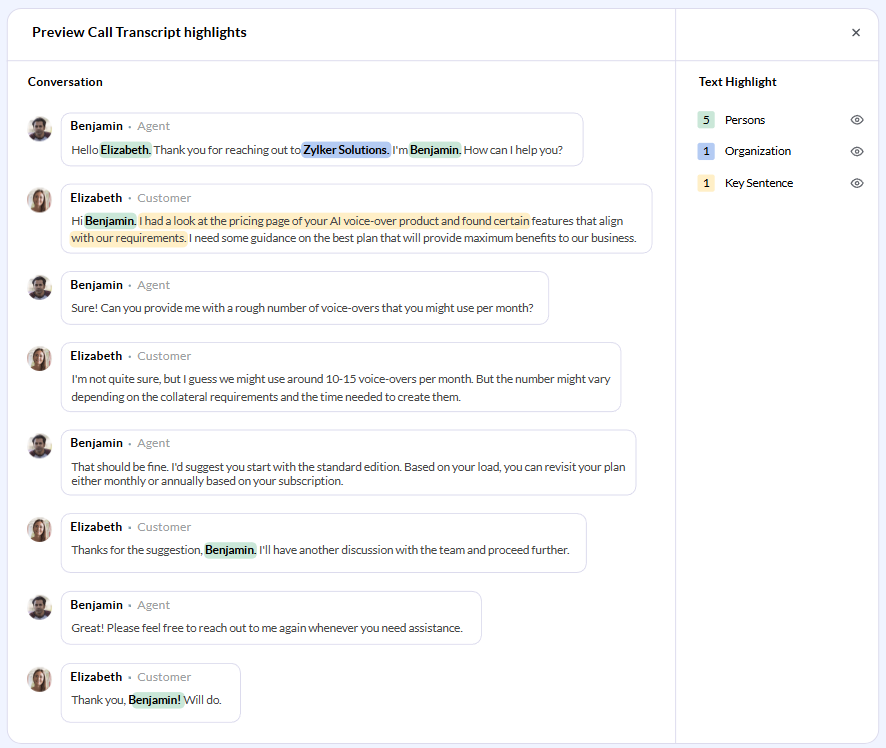
Source: Zoho
SalesSignals aggregates cross-channel interactions into a real-time notification feed. For each prospect, Zia can recommend the best channel and time to reach out.
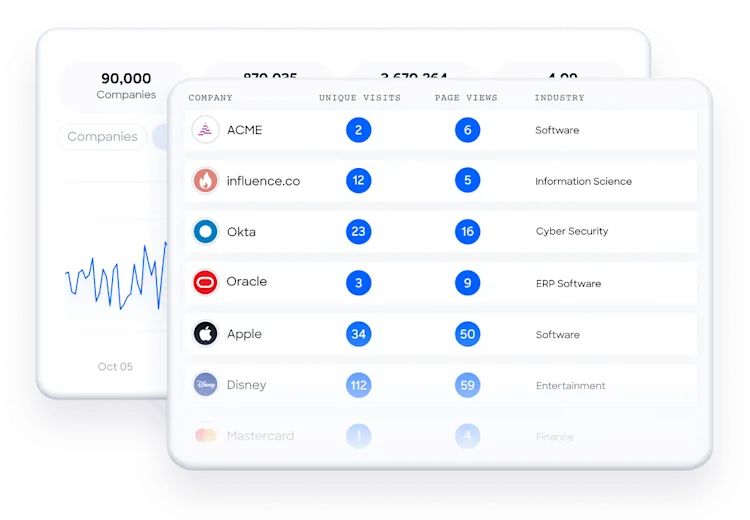
ZoomInfo adds a layer neither CRM provides: the data that makes outreach effective. 120M direct-dial phone numbers mean your reps dial the person, not the switchboard. 200M+ verified business email addresses reduce bounce rates that damage sender reputation. WebSights identifies which companies visit your website before they fill out a form, so you can reach out proactively.
The Zoho ecosystem gives both CRMs an advantage
One factor that applies to both Bigin and Zoho CRM is the broader Zoho ecosystem. Zoho Corporation builds more than 60 products, from accounting (Zoho Books) to helpdesk (Zoho Desk) to marketing automation (Zoho Campaigns) to analytics (Zoho Analytics).
Bigin connects natively to 15+ Zoho apps including Books, Invoice, Desk, Campaigns, Meeting, Forms, and Analytics. Zoho CRM integrates more broadly, with over 1,100 pre-built integrations through the Marketplace plus native connections to the full Zoho suite.
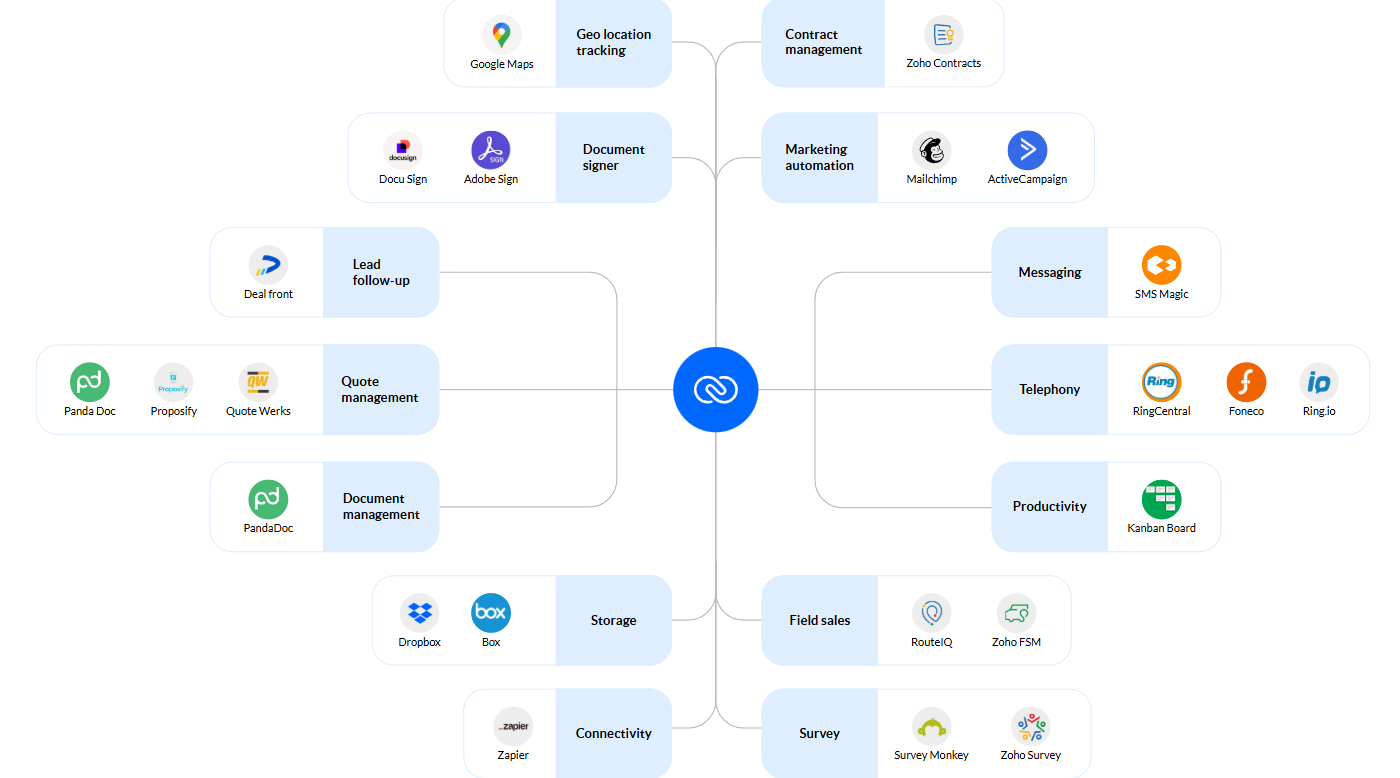
Source: Zoho
For businesses already using any Zoho product, choosing Bigin or Zoho CRM is the path of least resistance. Data flows natively, the interfaces share design patterns, and the upgrade path between products is designed to be smooth.
This ecosystem strength has a flip side. G2 users flag integration friction when connecting Zoho CRM to non-Zoho systems, particularly in enterprise environments. If your tech stack is built on Salesforce, Microsoft, or HubSpot tools, connecting Zoho CRM may require custom API work.
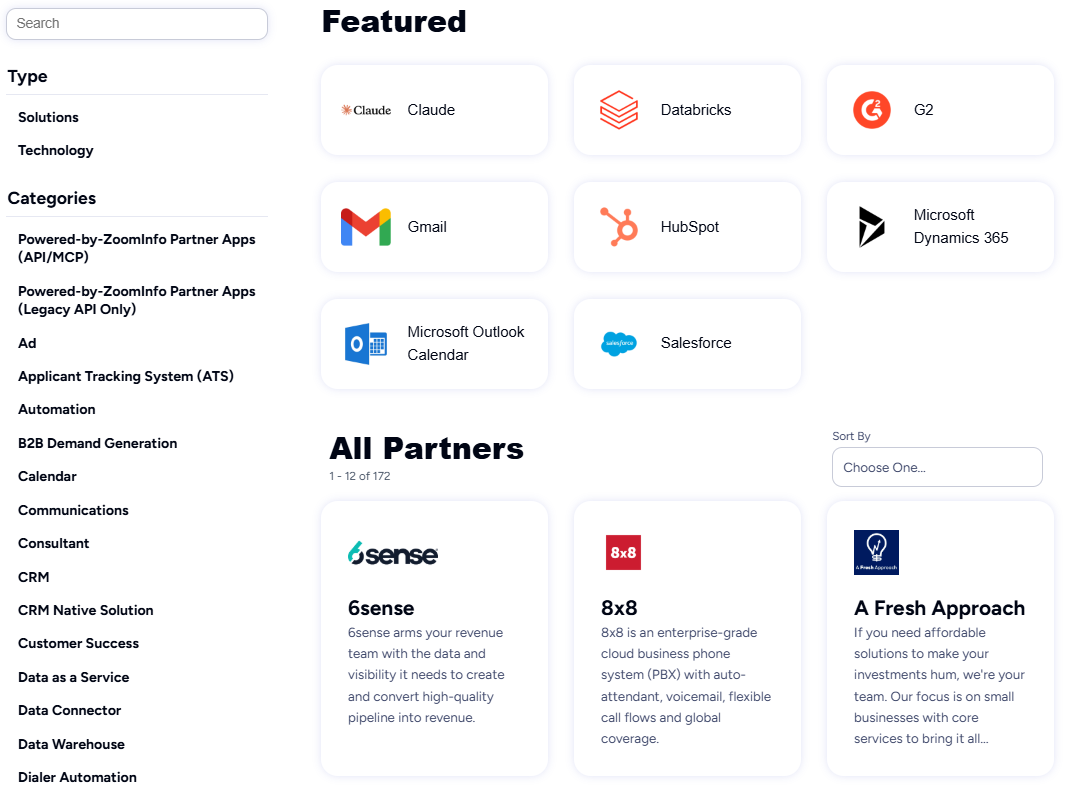
ZoomInfo takes a different approach: it's designed to work with any system. The ZoomInfo App Marketplace lists 120+ partner integrations. APIs and MCP deliver ZoomInfo's intelligence into any application. Whether you're on Bigin, Zoho CRM, Salesforce, HubSpot, or a custom-built system, ZoomInfo's data reaches your workflow.
Pricing reflects different markets
The pricing structures tell you who each product is built for.
Bigin is the cheapest CRM in this comparison. The Free plan supports 1 user with 500 records, 1 pipeline, and 3 automations. Express at $7/user/month (annual) adds 50,000 records, email and WhatsApp integration, and 30 automations. Premier at $12/user/month adds lookup fields, formula fields, multi-currency, and stage transition rules. Bigin 360 at $18/user/month is the most complete tier, with 1 million records, 15 pipelines, and 100 automations. No forced contracts; cancel anytime with a 30-day money-back guarantee.
Zoho CRM costs more but delivers proportionally more. The Free plan supports up to 3 users. Standard, Professional, Enterprise, and Ultimate tiers scale up, with Enterprise (the most popular plan) adding Zia AI, territory management, journey orchestration, and custom functions.
ZoomInfo uses custom-quoted, consumption-based pricing with no published dollar amounts for paid tiers. ZoomInfo Lite is permanently free and includes access to ZoomInfo's B2B database, 10 monthly export credits, individual and company searches, the ReachOut Chrome Extension, and WebSights Lite for website visitor identification. A 7-day free trial provides access to core paid features. Paid tiers (Professional, Advanced, Enterprise) scale based on seats, credits, features, and company size.
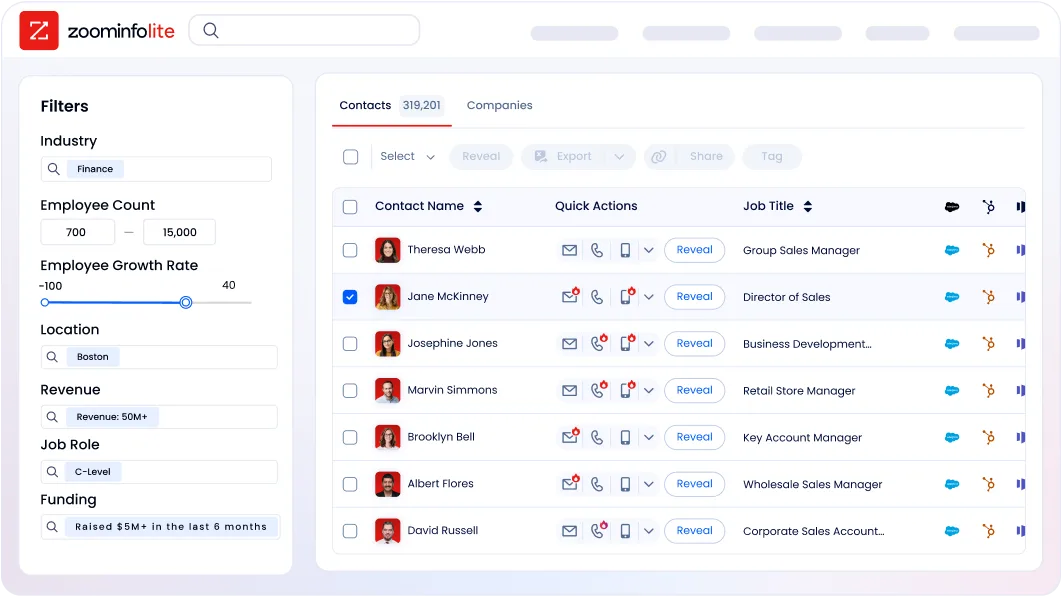
ZoomInfo is a different category of investment from a CRM, but the ROI case is documented: Seismic attributed 39% of active pipeline to opportunities identified by ZoomInfo signals and reported 54% productivity gains.
The practical calculation: Bigin and Zoho CRM are your CRM cost. ZoomInfo is your data intelligence cost. Many B2B teams need both, and the total is still a fraction of what enterprise alternatives charge.
Bigin vs. Zoho CRM vs. ZoomInfo: Which should you choose?
The choice depends on where your business is today and what problem you're solving.
Choose Bigin if:
Your team is 1–20 people and you're still managing customer data in spreadsheets
You need a working CRM in 30 minutes, not 30 days
Your sales process is straightforward and doesn't require complex automation
You want built-in telephony and WhatsApp integration starting at $7/user/month
You're comfortable outgrowing the platform and migrating to Zoho CRM later
Choose Zoho CRM if:
Your team has grown past the point where simple pipelines are enough
You need Blueprint to enforce sales processes, territory management to organize reps, and forecasting to predict revenue
Customization matters: you want Canvas views, custom modules, and no-code workflow builders
You're looking for an enterprise-capable CRM at a fraction of Salesforce's cost
You want AI that scores leads, predicts churn, and coaches reps
Add ZoomInfo if:
Your team sells B2B and needs verified contact data, direct dials, and business emails
You want to know which accounts are researching your product category before they fill out a form
Your reps spend too much time searching for contacts and not enough time selling
You need a data intelligence layer that works with whichever CRM you choose
You want AI that understands not just your CRM data, but the broader context of why deals move
Try ZoomInfo Lite for free or request a demo to see the full platform.
The strongest B2B sales setup isn't one tool. It's a CRM that fits your team's complexity (Bigin for simplicity, Zoho CRM for depth) paired with a data intelligence platform (ZoomInfo) that keeps every contact, account, and signal in that CRM accurate, verified, and current. The CRM manages the relationship. ZoomInfo powers the intelligence behind it.
"Without ZoomInfo, it would be difficult (if not impossible) to achieve our business objectives. Without it, we wouldn't be able to understand the market, have the right contact data, and make meaningful connections." (Smartsheet)
Bigin vs. Zoho CRM vs. ZoomInfo FAQ
Is Bigin just a stripped-down version of Zoho CRM?
No. Zoho built Bigin from scratch as a separate product, not a reduced version of Zoho CRM. They share a parent company (Zoho Corporation) and some design patterns, but Bigin's architecture centers on Team Pipelines and a 30-minute setup for small businesses that have never used a CRM. Zoho CRM is a full-featured platform with Blueprint, territory management, CPQ, and up to 500 custom modules. Bigin includes a single-click migration path to Zoho CRM when a business outgrows it.
Which is cheaper overall: Bigin or Zoho CRM?
Bigin is cheaper. Paid plans start at $7/user/month (Express) versus Zoho CRM's Standard plan at roughly $14/user/month. Bigin's most complete tier (Bigin 360) costs $18/user/month, still less than Zoho CRM's Standard plan at monthly billing. However, Zoho CRM's included capabilities at each tier (Blueprint, AI scoring, territory management) may eliminate the need for separate tools that a Bigin user would have to add.
Can I use ZoomInfo with Bigin, or does it only work with Zoho CRM?
ZoomInfo integrates directly with Zoho CRM through its marketplace and also connects via Zapier and API to other platforms in the Zoho ecosystem. For Bigin users, ZoomInfo data can flow through Zoho's integration layer or Zapier. ZoomInfo's API and MCP access means it can connect to virtually any system, including custom applications.
What does ZoomInfo do that a CRM doesn't?
A CRM manages your existing customer relationships: tracking deals, logging calls, and automating follow-ups. ZoomInfo provides the B2B intelligence that feeds those relationships: 500M contacts with verified emails and direct dials, company attributes and technographics, buyer intent signals showing when accounts are in-market, and website visitor identification. ZoomInfo tells your team who to contact and when. Your CRM manages what happens next.
How do the free plans compare?
Bigin's free plan supports 1 user with 500 records, 1 pipeline, 3 automations, and built-in telephony. Zoho CRM's free plan supports up to 3 users with core lead, contact, and deal management but a 5,000-record cap and no custom reports. ZoomInfo Lite is permanently free with access to the B2B database, 10 monthly export credits, the Chrome extension, and website visitor identification for up to 10 reveals per day. All three offer these free plans permanently, with no credit card required.
Which platform has better AI capabilities?
Zoho CRM has the deepest CRM-native AI, with predictive lead scoring, churn prediction, seven pre-built AI agents, anomaly detection, email sentiment analysis, and natural language CRM configuration. Bigin's AI covers email reply, cross-sell identification, and churn analysis, sized for smaller teams. ZoomInfo's AI operates on a different layer: the GTM Context Graph processes 1.5B+ data points daily, fusing B2B data with CRM records and conversation intelligence to surface buyer intent, draft contextual outreach, and reveal why deals move or stall.
Should I start with Bigin and upgrade to Zoho CRM later, or start with Zoho CRM directly?
If your team is under 20 people with a straightforward sales process, start with Bigin. You'll be productive within an hour, and the migration to Zoho CRM is designed to be smooth when you need it. If you already have complex workflows, multiple territories, or a sales methodology you want to enforce with Blueprint, start with Zoho CRM. The learning curve is steeper, but you avoid a migration later. Either way, adding ZoomInfo's data layer from the start means your CRM is filled with verified, actionable contacts from day one.
How does support compare across the three platforms?
Bigin includes phone, email, and live chat support on all paid plans, plus a free onboarding session and bi-weekly webinars. A paid Jumpstart onboarding service costs $500. Zoho CRM includes Classic 8x5 email support on all paid plans, with Premium (24/5 live chat and phone) and Enterprise (24/7, minimum 50 users) support available as add-ons. ZoomInfo provides support through its Help Center, Knowledge Base, ZoomInfo University, and direct phone support, with dedicated customer service managers on Enterprise plans.