
BuiltWith occupies its own lane in sales intelligence. Instead of competing on contact databases or marketing automation, it solves one problem: telling you what technologies any website runs. Since 2007, it has built the largest technographic database available, tracking over 113,000 web technologies across nearly half a billion domains, with historical data reaching back to 1985.
To write this BuiltWith review, we analyzed the platform in depth. We believe it's the right choice if:
You need technographic intelligence for sales prospecting or competitive research
Your go-to-market motion targets companies based on their technology stack
You want historical technology adoption data going back decades
You sell to eCommerce businesses and need product-level retail intelligence
You need a specialized tool for technology trend analysis and market research
However, BuiltWith might not be the best choice if:
You need verified contact data (direct dials, business emails) alongside technology insights
Your sales team requires intent signals, conversation intelligence, and AI-driven outreach
You want one platform for prospecting, engagement, and deal execution
You need company context, org charts, and buying committee intelligence
Your go-to-market strategy requires multi-channel orchestration, not just lead lists
In this case, consider ZoomInfo: a GTM platform that includes technographic intelligence as part of a broader data foundation (500M contacts, 100M companies, 135M+ verified phone numbers, and 200M+ verified business email addresses), along with intent signals, conversation intelligence, and AI-powered execution tools.
We've included a detailed look at ZoomInfo later in this review for teams that need technology intelligence within a complete go-to-market system. You can start with a free trial here.
What is BuiltWith?
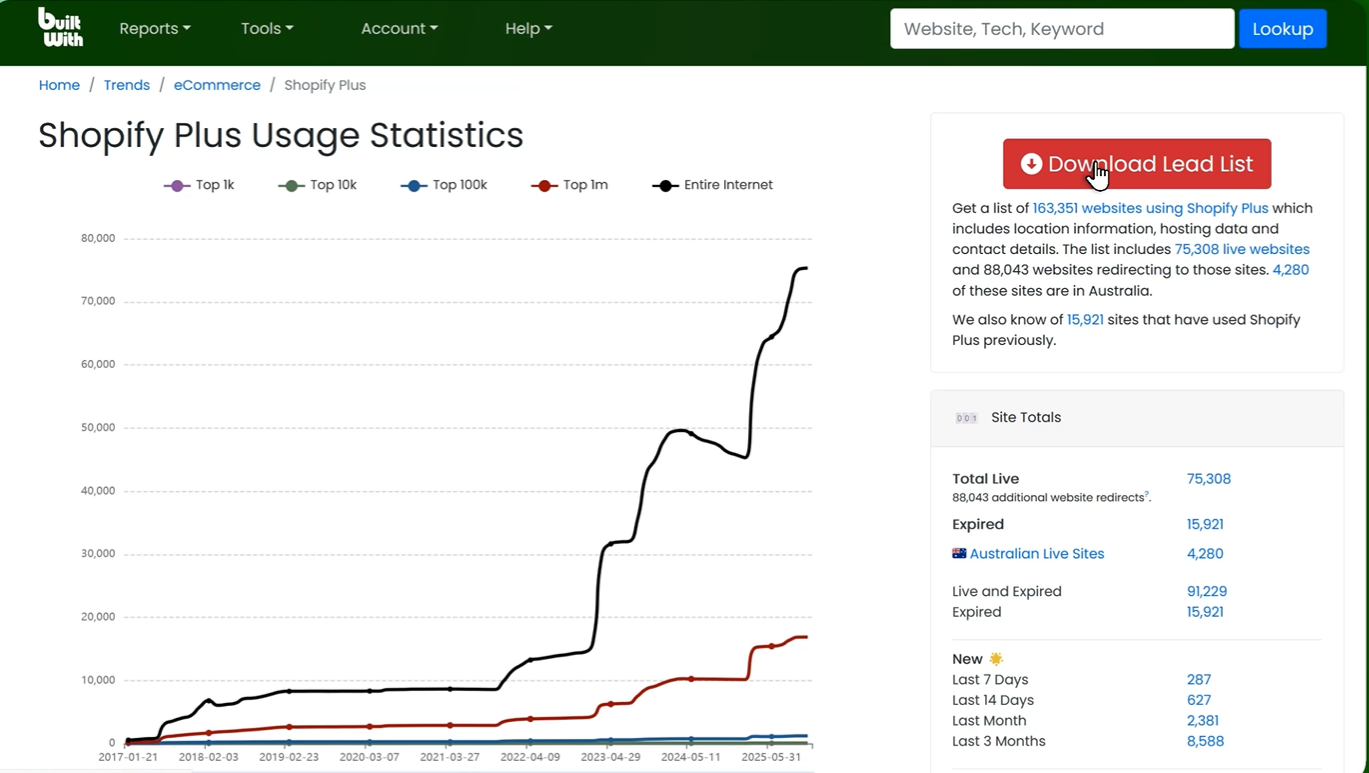
BuiltWith is a website profiling, lead generation, competitive analysis, and business intelligence platform founded on July 22, 2007, by Gary Brewer in Sydney, Australia. Brewer, a software engineer with 10 years of experience in financial media, was browsing startup sites and reading their source code to see what technologies they used.
Source: BuiltWith
Nobody had built a tool to automate this, so he registered the domain that afternoon and started building one.
The platform launched publicly in August 2007 after ReadWriteWeb featured it and it reached #1 on Digg. Brewer ran BuiltWith as a side project for four years, even while the site generated $40,000 a month. In 2011, Andrew Rogers joined as co-founder, and the company moved to a subscription model in 2012.
Today, BuiltWith has never taken outside funding, generates $22.6M in annual revenue with roughly 11 employees, and serves over 1 million Pro users. Its customers include Google, Facebook, Amazon, eBay, Adobe, and financial institutions like Winton Capital. The platform tracks 113,002+ web technologies across 478+ million root domains.
BuiltWith Pros & Cons
Pros | Cons |
|---|---|
Tracks 113,002+ technologies across 478M+ domains | No verified contact data (direct dials, business emails) |
Historical technology data going back to 1985 | Data accuracy inconsistencies reported by some users |
eCommerce intelligence (2B+ products, 26M+ stores) | Plans start at $295/month with no free trial of paid tiers |
Fully exportable data (CSV, Excel) with no locked fields | Working with data at scale requires manual cleanup |
CRM integrations with Salesforce, HubSpot, and others | No intent signals beyond technology stack changes |
Free individual site lookups forever | No outreach, engagement, or campaign execution tools |
Actionable Insights feature for technology change signals | No conversation intelligence or AI-powered outreach |
BuiltWith Review: How it Works & Key Features
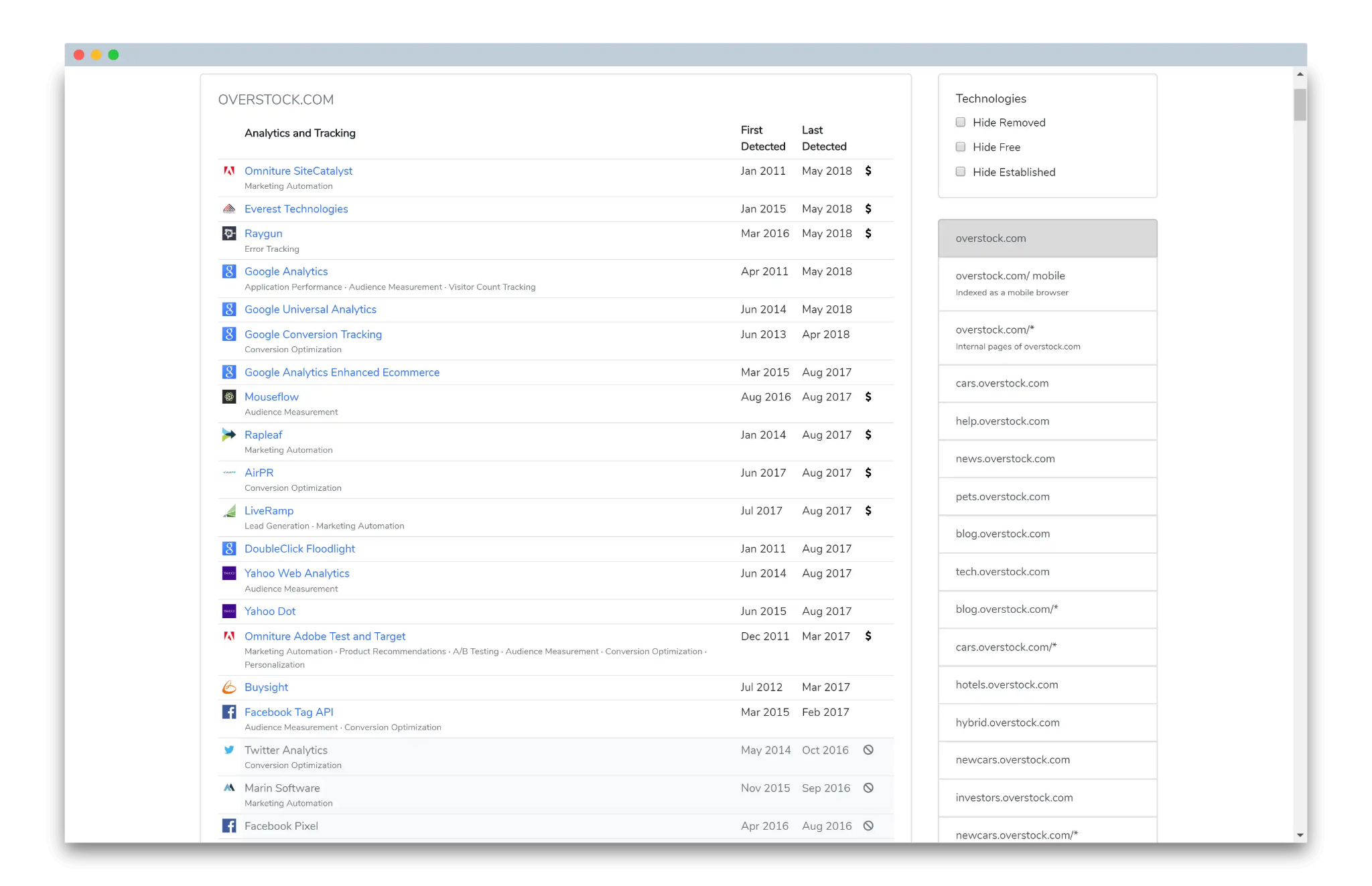
Technology Lookup: BuiltWith identifies the complete technology stack behind any website on the internet.
BuiltWith's core feature is its website profiling tool that catalogs the technologies, frameworks, and software behind any domain. Its crawling infrastructure makes at least 8.1 billion GET requests per month, indexing 23.8 billion data points.
Source: BuiltWith
When you query a domain, the system analyzes DNS records, HTML/JavaScript code, HTTP headers, embedded third-party scripts, and server responses to identify every detectable technology.
Results cover 113,002+ technologies organized into categories including analytics, eCommerce, content management systems, advertising, web frameworks, hosting, CDNs, and AI. Each lookup shows current usage and historical data back to January 1985, so you can see when technologies were adopted, when they were removed, and how long they were active.
The platform offers free basic profiles for individual lookups. Paid plans unlock detailed profiles with site-wide usage details, premium technology identification, and historical timelines. BuiltWith tested its detection through a year-long experiment where a secret controlled domain went undetected by every competitor.
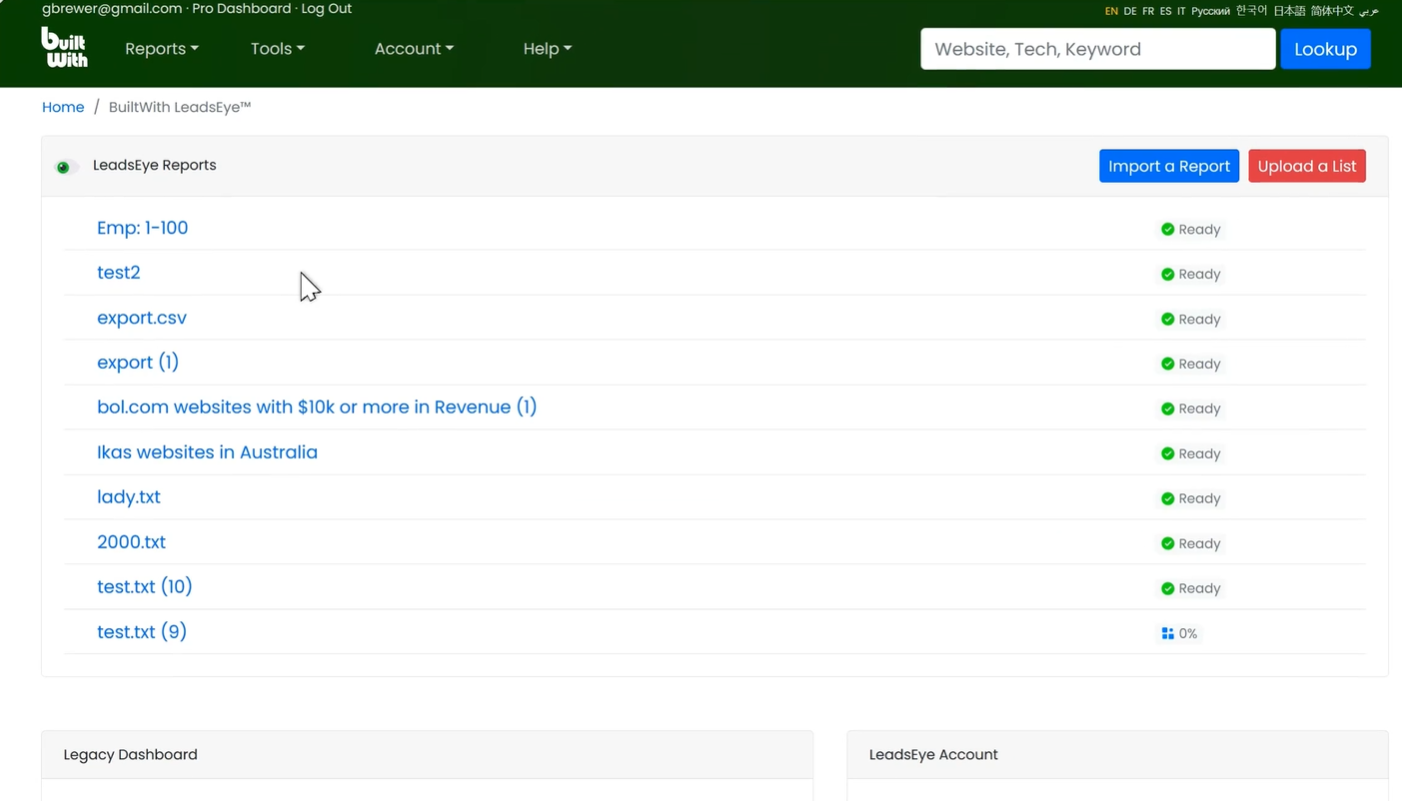
Lead Generation: BuiltWith turns technology data into prospecting lists filtered by spend, traffic, location, and vertical.
The lead generation engine lets users build lists from the full database of 113,002+ technologies tracked across over 673 million websites. You can create technology-based reports (find all Shopify stores in California), keyword-based lists (find dentists in California not using marketing automation), or eCommerce reports filtered by product categories and SKU counts.
Source: BuiltWith
Filters include technology spend levels, traffic ranking, location down to city level, verticals, keywords, revenue estimates, and employee counts. The platform provides contact names, emails, and titles for businesses outside the EU and California. All data exports to CSV and Excel with no field restrictions.
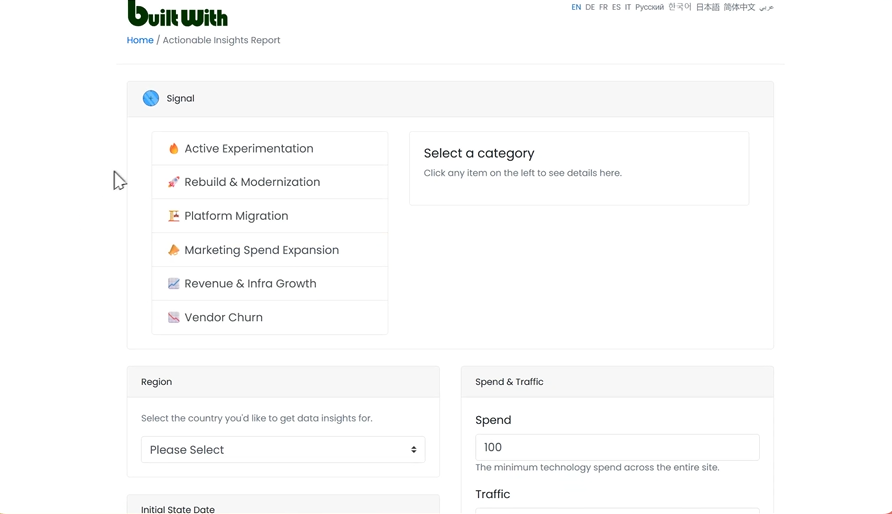
The Actionable Insights feature, launched in January 2026, analyzes technology stack changes to identify companies showing buying signals through active experimentation, platform migrations, and vendor churn. Reports can be regenerated 24 hours after creation to capture new leads matching your criteria.
Source: BuiltWith
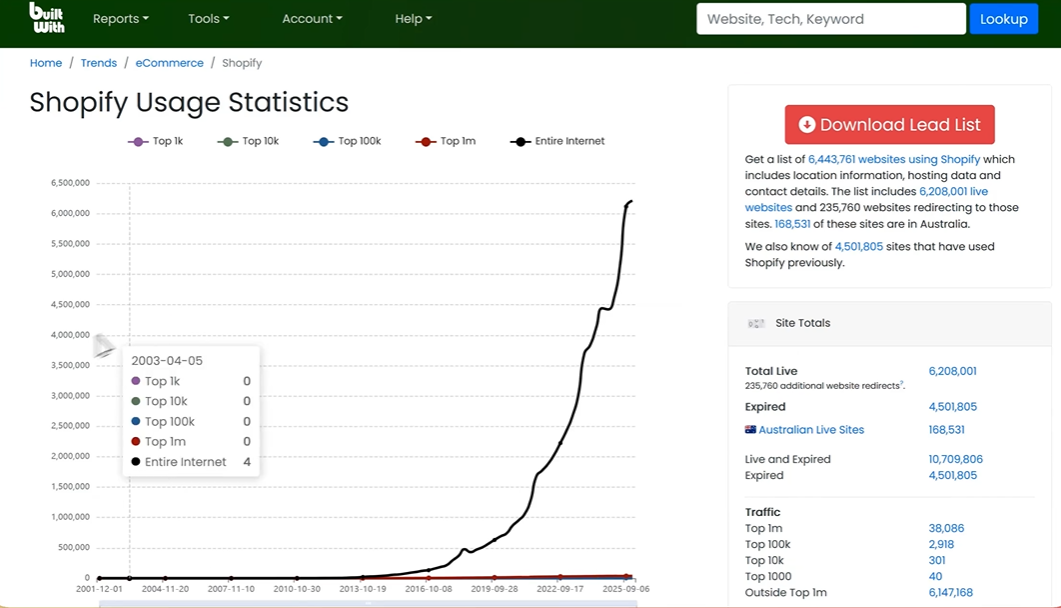
Market Analysis and Technology Trends: BuiltWith tracks technology adoption patterns across the entire internet over four decades.
The Market Analysis feature provides technology market share data across segments including the entire internet, top 10K websites, top 100K, and top 1 million. Users can track adoption trends across all 113,002+ technologies, view usage history back to January 1985, and analyze weekly changes.
Source: BuiltWith
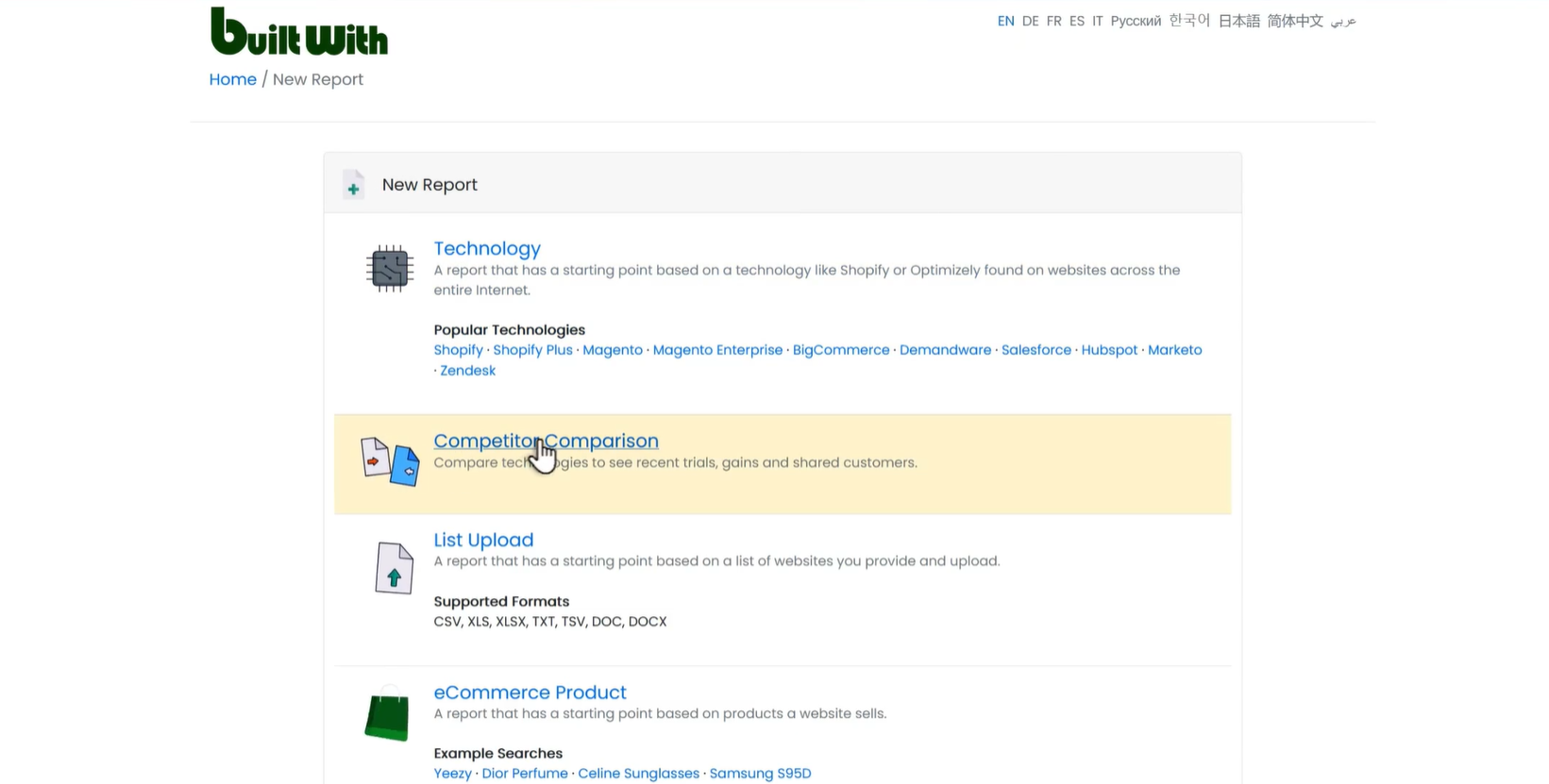
Competitor comparison reports show which websites switched from one technology to another, revealing wins, losses, and churn rates. Geographic analysis provides country-level breakdowns that drill down to city-level reporting.
Source: BuiltWith
eCommerce Intelligence: BuiltWith tracks 2 billion products across 26 million online stores.
The eCommerce feature goes beyond technology detection into product-level data. The platform tracks over 2,500 eCommerce technologies and 2 billion eCommerce products across over 26 million eCommerce websites, with exportable attributes including spend, revenue, employee count, social media count, industry, location, and rank.
Users can search for websites selling specific products by name or identifier, filter by product count, and combine product queries with technology filters. This allows queries like finding all Shopify stores selling outdoor equipment above a certain revenue threshold.
Pricing Structure: BuiltWith offers tiered plans starting at $295/month, with free individual lookups forever.
BuiltWith uses a subscription-based pricing model with monthly and annual options:
Free Plan:
Individual website technology lookups forever
Basic technology profiles
No bulk reports or advanced features
Basic Plan ($295/month or $2,950/year):
Limited to 2 technologies for list-based reports
2,000 upload analysis credits per month
CRM integrations, unlimited report downloads, CSV/Excel export
Pro Plan ($495/month or $4,950/year):
Unlimited technologies, keywords, and retail reports
Team Plan ($995/month or $9,950/year):
100,000 API credits per month
Everything in Pro, built for enterprise teams
All paid plans include data from 414 million domains, 7-day-a-week support, CRM integrations, and full data export. BuiltWith does not offer free trials of paid plans because all data is exportable. The company recommends signing up for the Basic plan, pulling the reports you need, and canceling if you want to evaluate before committing.
Where BuiltWith Falls Short
BuiltWith excels at technology detection, but several limitations surface for teams that need more than technographic data to run go-to-market operations.
No Verified Contact Data: BuiltWith tells you what technologies a company uses, but it doesn't give you the verified phone numbers and business emails sales teams need to reach decision-makers.
The platform exports contact names, emails, and titles for some businesses, but it's not a contact database. Teams still need a separate tool to find the people behind the technology decisions, adding friction and cost.
Technology Data Only, No Broader Intelligence: BuiltWith focuses on what's detectable through website crawling. It doesn't provide company context, org charts, department structures, buying committee data, or behavioral signals that indicate purchase intent beyond technology changes.
A company might be evaluating new solutions through conversations, content consumption, and internal meetings, but none of that would surface in BuiltWith.
Data Management at Scale: Some users report that working with BuiltWith data at scale requires extensive manual cleanup. CSV exports are large and often need processing. CRM integrations exist but are not as smooth as they could be, requiring manual effort to maintain accuracy across systems.
Data Accuracy Inconsistencies: Some users note that BuiltWith's accuracy is inconsistent, with incorrect or missing information that can cause teams to overlook qualified accounts or waste time on false leads. Weekly update cycles mean changes between scans can go undetected.
No Execution Layer: BuiltWith generates lists, not pipeline. There are no outreach tools, no email sequencing, no conversation intelligence, no AI-assisted messaging, and no deal management. Every lead list must be exported to another platform for action.
Cost for Specialized Use: At $295/month for the Basic plan (limited to 2 technology searches), the pricing is hard to justify for teams that need technographic data as one piece of a larger prospecting workflow rather than their primary intelligence source.
These limitations aren't failures. They reflect BuiltWith's focus on being the deepest technographic tool available. But for go-to-market teams whose needs extend beyond technology stack data, they leave a gap that broader platforms fill.
Top BuiltWith Alternative for Complete Go-to-Market Intelligence: ZoomInfo
ZoomInfo addresses BuiltWith's limitations by placing technographic intelligence within a complete go-to-market system. The platform sits on a B2B data foundation (500M contacts, 100M companies, 135M+ verified phone numbers, and 200M+ verified business email addresses) and tracks 30,000+ technologies across 200+ categories from 20+ source types.
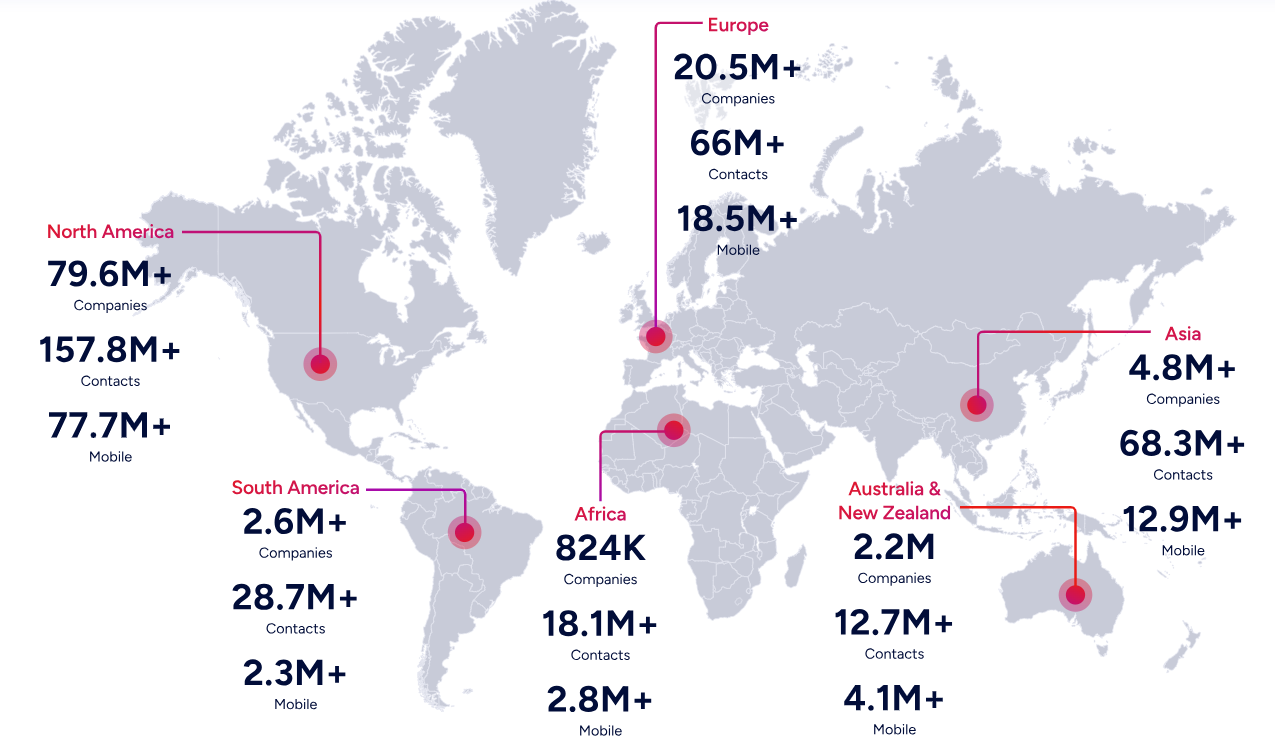
Its GTM Context Graph processes 1.5B+ data points daily, combining this data with CRM records, conversation transcripts, and behavioral signals to show why deals move or stall. That intelligence reaches teams through GTM Workspace for sellers, GTM Studio for marketers and RevOps, or APIs and MCP for any other tool.
Comprehensive B2B Data: ZoomInfo provides verified contacts, company intelligence, and technographic data in one platform.
Where BuiltWith focuses on website technology detection, ZoomInfo works across three data dimensions: identity data (who buyers are and how to reach them), company context (industry, org charts, technographics), and signals (buying activity and behavioral indicators).
ZoomInfo verifies its data through a multi-source pipeline: automated ML scanning of 28 million site domains daily, third-party partner data covering 95 million businesses, a community of 200,000+ ZoomInfo Lite users who share data back, and an in-house Data Training Lab of 300+ human researchers. First-party data reaches up to 95% accuracy.
The difference matters in practice. After finding that a company uses a specific technology stack in BuiltWith, a sales rep still needs to identify the right people, find their contact information, and switch to another tool.
In ZoomInfo, the same rep can identify the technology, pull decision-makers' direct dials and verified emails, review the org chart, check buyer intent signals, and launch outreach, all without leaving the platform.
In a Fortune 500 competitive RFP analyzing 25 million contacts across vendors, an independent consultant concluded that "no other competitor came even close."
"ZoomInfo gives us the information we need to execute. It's already there, so we can be three steps ahead." (Vensure)
GTM Context Graph: ZoomInfo's intelligence layer captures not just what happened in your deals, but why.
BuiltWith provides snapshots of technology usage. ZoomInfo's GTM Context Graph processes 1.5B+ data points daily and combines ZoomInfo's B2B data with your CRM records, conversation intelligence, email interactions, and behavioral signals into one intelligence layer.
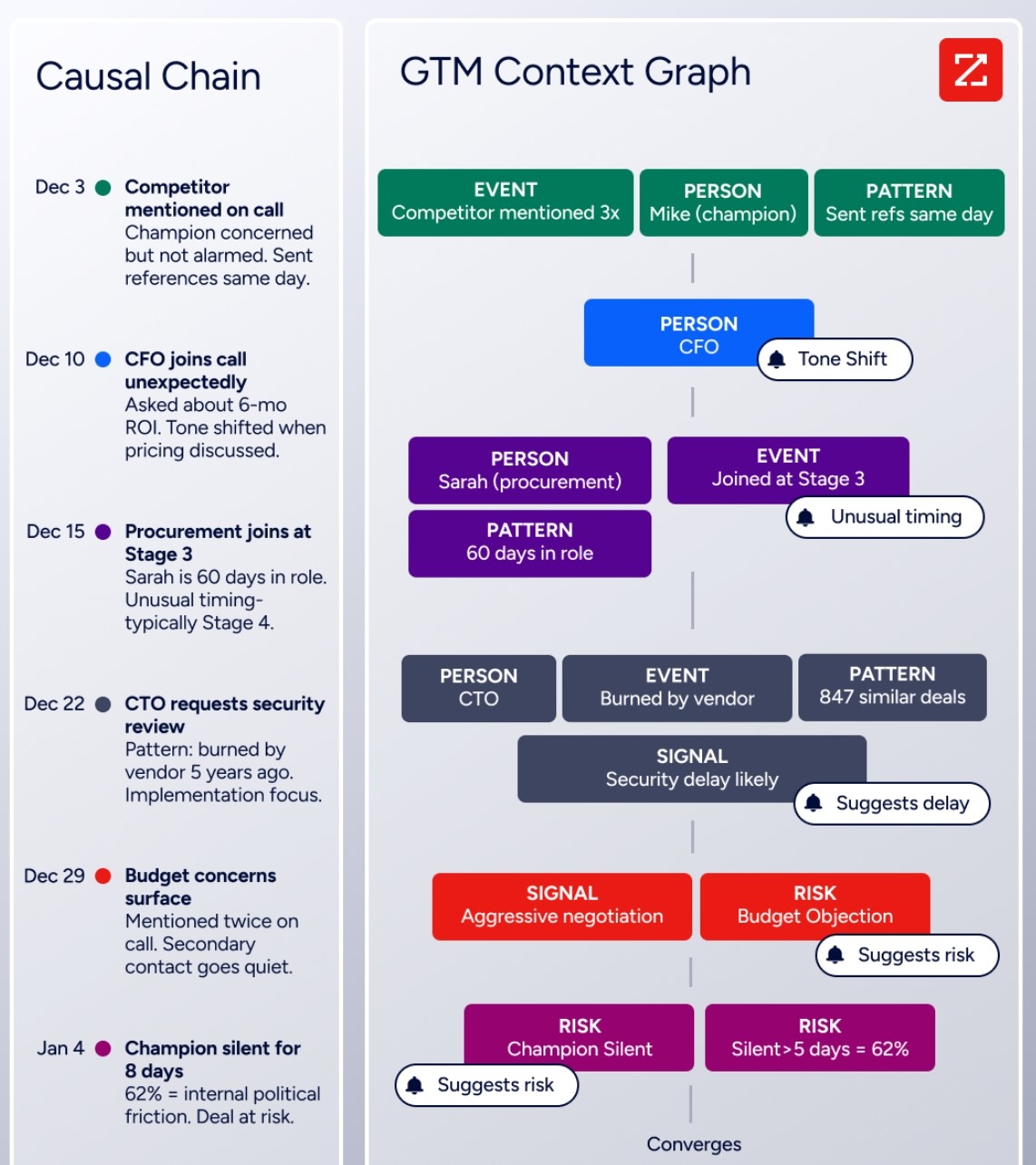
In practice, ZoomInfo doesn't just tell you a company uses a particular technology. It tells you the CFO joined the last sales call and asked about ROI timelines, the VP went quiet for eight days during a budget discussion, and accounts with this pattern close 40% faster when you engage procurement early. BuiltWith's technology snapshots can't provide this kind of context.
ZoomInfo acquired Chorus for its conversation intelligence capabilities and built 20 years of data unification infrastructure to connect first-party and third-party signals. CPO Dominik Facher puts it this way: "If you rebuilt the GTM stack for AI, you'd end up with ZoomInfo for first-party data."
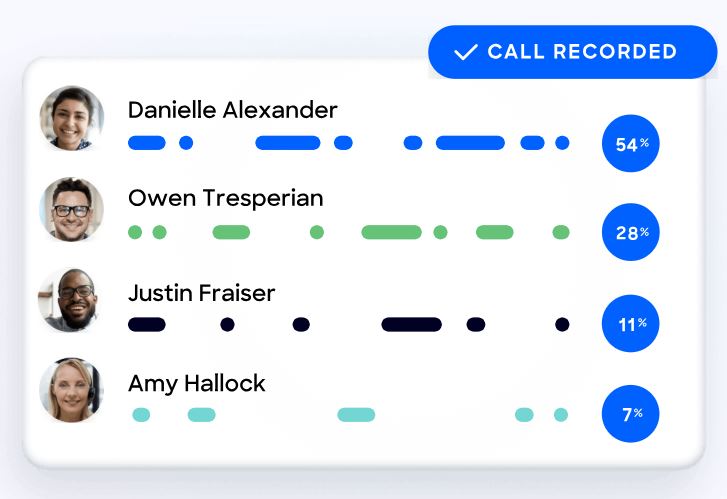
Seismic attributed 39% of active pipeline to ZoomInfo signals: "That combination of our internal CRM data, external signals, and AI has helped us craft very specific account- and persona-based messages." (Seismic)
Universal Access: ZoomInfo delivers intelligence through native apps for sellers and marketers, plus APIs and MCP for any tool.
BuiltWith delivers data through web-based reports and CSV exports, with CRM integrations for Salesforce, HubSpot, and others. ZoomInfo takes a broader approach with three delivery methods.
GTM Workspace gives sellers a single screen where prioritized accounts, AI-drafted outreach, deal intelligence, and CRM updates come together. Built on Anthropic's Claude, its AI agents answer three questions for every rep: who to contact, when to engage, and what to say.
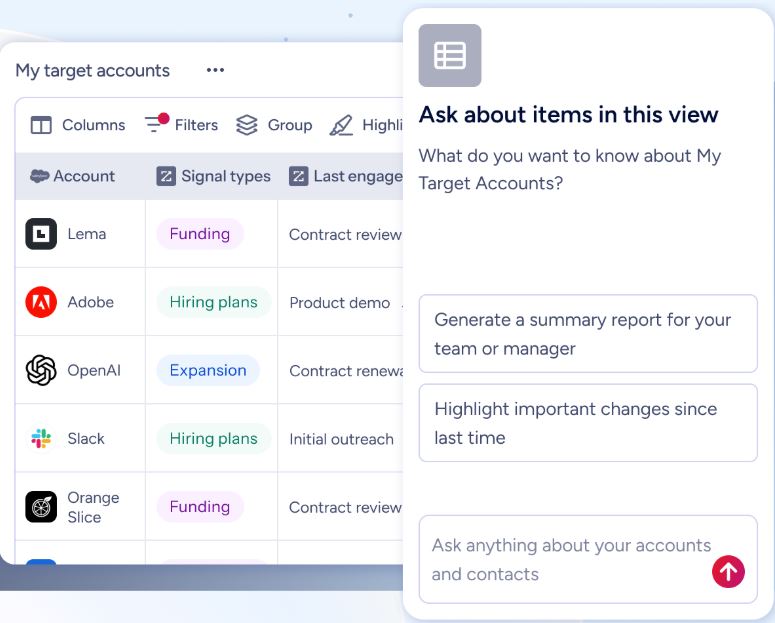
GTM Studio gives marketers and RevOps teams a canvas where audience definition, campaign orchestration, and pipeline measurement happen in natural language. Expansion plays that used to take 3 weeks now launch in 30 minutes.
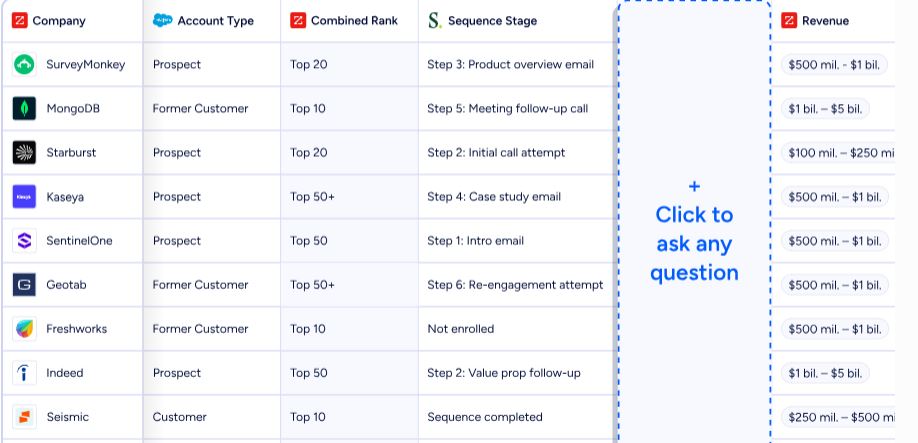
For teams building beyond ZoomInfo's own products, APIs and MCP expose the same data to any custom agent, internal tool, or partner platform. API access is included in all relevant plans.
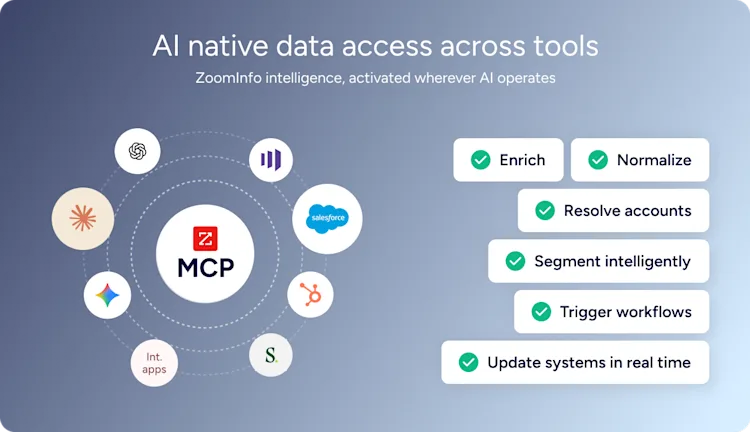
"The plug-and-play aspect of the API means I can integrate it into any process and get information at a moment's notice." BDO Canada saw an 87% reduction in time spent on internal data dashboard updates. (BDO Canada)
Pricing: ZoomInfo offers a permanent free tier and custom-quoted plans for paid access.
ZoomInfo's pricing differs structurally from BuiltWith's published tiers:
ZoomInfo Lite (Free, permanent):
Access to ZoomInfo's B2B database with 100M+ verified profiles
Individual and company searches with advanced filters
Contact information and email addresses
ReachOut Chrome Extension and mobile app
WebSights Lite (up to 10 website visitor reveals per day)
HubSpot integration
Paid Plans (custom-quoted):
ZoomInfo uses a seat-and-credit-based subscription model with no published prices. Costs depend on users/seats, monthly credit volume, features, company size, and contract length.
Three Sales tiers (Professional, Advanced, Enterprise) and three Marketing tiers (Marketing Demand, ABM Lite, ABM Enterprise) unlock progressively advanced capabilities including intent signals, AI features, and dedicated support.
A 7-day free trial is also available, separate from the permanent Lite plan.
Note: ZoomInfo is transitioning toward a consumption-based pricing model.
BuiltWith or ZoomInfo: Comparison Summary
Feature | BuiltWith | ZoomInfo |
|---|---|---|
Primary focus | Technographic intelligence and technology trends | AI-powered GTM platform |
Technologies tracked | 113,002+ across 478M+ domains | 30,000+ across 200+ categories from 20+ source types |
Historical tech data | 41+ years (back to 1985) | Technology tracking with regular updates |
Contact data | Limited (names, emails for non-EU/CA businesses) | 500M contacts, 135M+ verified phone numbers, 200M+ verified emails |
Company data | Basic firmographics via exports | 100M companies with org charts, hierarchies, and 300+ attributes |
Intent signals | Technology change signals only | Buyer Intent from 210M IP-to-Org pairings and 6T+ keyword pairings monthly |
eCommerce data | 2B+ products across 26M+ stores | Not a focus |
AI capabilities | MCP server, AI Agent CLI | GTM Context Graph, AI agents for outreach, scoring, and orchestration |
Execution tools | None (export-only) | GTM Workspace (sellers), GTM Studio (marketers/RevOps), conversation intelligence |
Free tier | Individual site lookups forever | ZoomInfo Lite (permanent, with data access and 10 exports/month) |
Paid pricing | $295-$995/month (published) | Custom-quoted (seat + credit model) |
CRM integrations | Salesforce, HubSpot, Pardot, Zoho, Dynamics 365, Close.io | 120+ integrations including Salesforce, HubSpot, Dynamics 365, Snowflake, and more |
Best for | Technology stack research and technographic prospecting | Complete go-to-market execution from data to deal |
Final Verdict
The choice between BuiltWith and ZoomInfo depends on what role technographic data plays in your go-to-market strategy.
Choose BuiltWith if your primary need is technology intelligence. It's the right tool for teams that prospect almost exclusively on technology stack, need historical adoption data spanning decades, or conduct market research on technology trends. No other platform offers comparable eCommerce product data for retail-focused work.
If you sell web technologies, eCommerce solutions, or agency services and your outreach depends on knowing what platforms your prospects run, BuiltWith offers the deepest technographic dataset available.
Choose ZoomInfo if you need technology intelligence as part of a broader go-to-market system. ZoomInfo pairs technographic data with verified contact information, company intelligence, buyer intent signals, conversation intelligence, and AI-powered execution tools.
For teams that want to move from identifying a prospect's technology stack to reaching the right decision-maker with the right message at the right time (without stitching together multiple tools), ZoomInfo provides the complete platform. Its three delivery methods (GTM Workspace for sellers, GTM Studio for marketers and RevOps, and APIs/MCP for any tool) get the intelligence to every team and workflow.
Get started with ZoomInfo here.
BuiltWith is the specialist: the deepest technographic data available, from the team that invented the category.
ZoomInfo is the broader platform: technographic intelligence placed within B2B data and the execution tools to act on it. Your choice depends on whether technology data is the destination or a stop along the way.
BuiltWith FAQ
What does BuiltWith do?
BuiltWith is a website profiling and technology intelligence platform that identifies the technologies behind any website. It tracks over 113,000 web technologies across 478 million domains, letting sales teams prospect by technology usage, researchers analyze market trends, and agencies spot competitive opportunities. The platform provides historical data going back to 1985.
How much does BuiltWith cost?
BuiltWith's paid plans start at $295 per month for the Basic plan, limited to 2 technology searches for list-based reports. The Pro plan costs $495 per month with unlimited technology and keyword searches. The Team plan costs $995 per month with unlimited logins and API access. Annual billing is available at a discount. Individual site lookups are free forever, but there is no free trial of paid plans.
ZoomInfo offers a permanent free tier (ZoomInfo Lite) with access to its B2B database and 10 monthly export credits, plus a 7-day free trial of paid features.
Is BuiltWith data accurate?
BuiltWith uses patent-pending algorithms developed over 19 years and makes at least 8.1 billion GET requests per month to maintain its database. It tested its detection through a year-long experiment where no competitor detected a secret controlled domain.
However, some users report accuracy inconsistencies, particularly with technology detection on certain domains. The database updates weekly, so changes between scans may not appear immediately.
Does BuiltWith provide contact information?
BuiltWith provides contact names, emails, and titles for businesses with publicly listed individuals outside the EU and California. It is not primarily a contact database. Teams that need verified contact data (direct-dial phone numbers, verified business emails, org charts) alongside technology intelligence typically need a separate platform.
ZoomInfo provides 500 million contacts with 135 million verified phone numbers and 200 million verified business email addresses, verified through a multi-source pipeline backed by 300 human researchers.
What CRM integrations does BuiltWith support?
BuiltWith offers native integrations with Salesforce, HubSpot, Pardot, Zoho CRM, Close.io, and Microsoft Dynamics 365, along with API access for custom integrations. Browser extensions, Slack integration, and data feeds via Snowflake, Databricks, Redshift, and BigQuery are also available. All data exports to CSV and Excel.
ZoomInfo offers 120+ integrations through its App Marketplace, plus Enterprise APIs and MCP access for programmatic use in any tool or AI agent.
Can BuiltWith track eCommerce websites?
Yes. BuiltWith tracks over 2,500 eCommerce technologies and 2 billion eCommerce products across more than 26 million eCommerce websites. Users can search for sites selling specific products, filter by SKU count and revenue estimates, and combine product queries with technology filters. This makes it valuable for teams selling eCommerce solutions or services to online retailers.
Does BuiltWith offer intent data?
BuiltWith's Actionable Insights feature analyzes technology stack changes to surface buying signals (companies experimenting with new tools, migrating platforms, or increasing technology spending). This is limited to signals detectable through technology changes on websites. It does not track broader intent signals like content consumption, search behavior, or ad engagement.
ZoomInfo's intent data tracks signals from 210 million IP-to-Organization pairings and 6 trillion keyword-to-device pairings monthly, providing a wider view of which companies are actively researching solutions.
Who are BuiltWith's typical customers?
BuiltWith serves sales teams selling B2B SaaS or web technologies, eCommerce service providers, web agencies, market research teams, cybersecurity professionals doing risk audits, and financial services firms using technographic data as alternative investment signals.
Customers include Google, Facebook, Amazon, and hedge funds like Winton Capital. The platform fits organizations where technology stack intelligence is a primary driver of prospecting or research.
Keep comparing your options:
