

BuiltWith is one of the most established technology intelligence platforms on the market. It tracks over 113,002 web technologies across 478 million domains, with historical data stretching back to 1985. Sales and marketing teams use it to see what technologies companies run, how their stacks have changed, and where adoption trends are heading.
But as your go-to-market strategy matures, you may find that knowing a prospect's tech stack is only the first step. BuiltWith focuses on detecting web-facing technologies and generating leads from that data, which means it has natural limits in areas like verified contact data, buyer intent beyond tech signals, backend infrastructure visibility, and end-to-end sales execution.
That's where this guide comes in. Whether you're looking to:
Go beyond technology detection to get B2B contact data, intent signals, and AI-powered sales execution in one platform
Layer IT spend intelligence on top of technographic data for enterprise-scale account prioritization
Combine technology detection with website traffic analytics to qualify prospects by business health
Access technology detection with minimal cost and friction for small teams
Detect backend technologies invisible to web crawlers through job posting intelligence
Search website source code for arbitrary code patterns and niche implementations
Get instant, free technology detection for occasional ad-hoc research
We'll cover BuiltWith alternatives that excel in each of these areas.
Some teams will use these tools alongside BuiltWith to fill gaps. Others will replace it with a platform better suited to their needs. This isn't about finding a "better" tool. It's about finding the right fit for your go-to-market motion.
Let's dive in.
The Best BuiltWith Alternatives | |
|---|---|
Best Alternative for B2B Intelligence and GTM Execution We chose ZoomInfo because it goes beyond technology detection to deliver 500M contacts, verified phone numbers and emails, buyer intent signals, and AI-powered GTM execution, unified through the GTM Context Graph. | |
Best Alternative for Enterprise Technology Intelligence with IT Spend Data We chose HG Insights because it adds IT spend intelligence across 140+ categories to technographic data, enabling enterprise teams to prioritize accounts by technology investment rather than technology presence alone. | |
Best Alternative for Traffic-Informed Technology Prospecting We chose SimilarTech because it combines technology detection with Similarweb's traffic analytics, letting sales teams qualify prospects by both tech stack and business health in one platform. | |
Best Alternative for Accessible Technology Detection with Minimal Friction We chose Wappalyzer because its permanent free tier, browser extension with 6M+ installs, and native CRM integrations make it the most approachable entry point for teams new to technographic prospecting. | |
Best Alternative for Backend Technology Detection via Hiring Intent We chose TheirStack because it detects backend technologies and hiring momentum from job postings, revealing infrastructure decisions that web crawlers cannot see. | |
Best Alternative for Free, Instant Technology Detection We chose WhatRuns because it provides technology detection at no cost, no signup, and no learning curve for practitioners who need quick answers without enterprise pricing. | |
Best Alternative for Code-Level Technology Search We chose NerdyData because it lets users search the raw source code of 350M+ websites for arbitrary code patterns, custom SDKs, and niche implementations beyond any predefined technology catalog. |
What is BuiltWith?
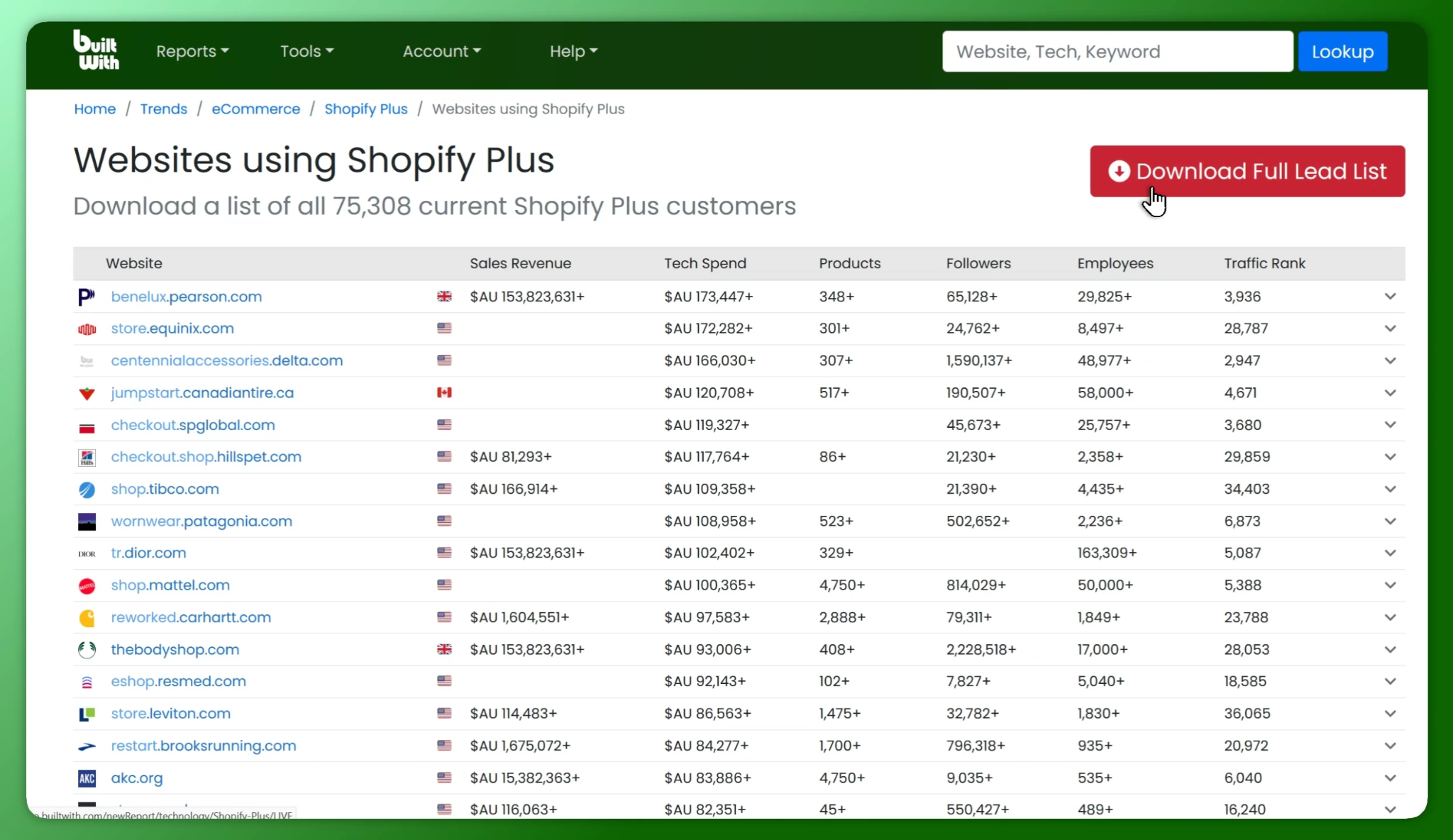
Source: BuiltWith
BuiltWith is a technology intelligence platform that profiles websites to reveal their technology stacks, enabling lead generation, competitive analysis, and market research based on technology adoption data. Founded in 2007 by Gary Brewer, it has grown into one of the most established technographic data providers, serving over 1 million BuiltWith Pro users including Google, Amazon, Adobe, and eBay.
Its key features include:
Technology detection across 113,002+ web technologies spanning analytics, CMS, eCommerce, advertising, hosting, and more
Lead generation with lists filtered by technology usage, location, traffic ranking, technology spend, and industry verticals
Historical data dating back 41+ years to January 1985, tracking how technology adoption changes over time
eCommerce intelligence covering 2 billion unique products across 26 million eCommerce websites
Market analysis with technology trends, market share data, and competitor comparison reports
CRM integrations with Salesforce, HubSpot, Pardot, Zoho, Dynamics 365, and Close.io
Actionable Insights that flag technology stack changes (platform migrations, trials, vendor churn) as buying signals
BuiltWith's core strength is the depth and breadth of its technology tracking. Its crawlers process at least 8.1 billion GET requests per month, indexing 478 million root domains with weekly updates. In a year-long controlled test, no competitor detected a secret domain. All data is fully exportable to CSV and Excel with no fields locked behind the interface.
For sales teams selling technology solutions, web agencies prospecting for clients, and market researchers tracking adoption trends, BuiltWith provides a strong dataset. But teams that need verified B2B contact data, buyer intent signals beyond technology adoption, backend infrastructure visibility, or end-to-end sales execution may find that technology detection alone doesn't close the gap between identifying a prospect and winning the deal.
That's why this article focuses on tools that complement or extend BuiltWith, whether through broader intelligence, deeper specialization, or different detection methods.
How We Curated Our List of BuiltWith Alternatives
After testing BuiltWith and researching the technology intelligence market, we found that teams looking for alternatives typically need more than technology detection. While BuiltWith excels at identifying what technologies websites use, many businesses need capabilities beyond its scope:
Getting verified B2B contact data, buyer intent signals, and AI-powered sales execution alongside technographic intelligence
Understanding how much companies spend on technology, not just which technologies they use
Qualifying prospects by website traffic and business momentum alongside their tech stack
Getting started with technographic prospecting at low cost and low friction
Detecting backend technologies, databases, and infrastructure tools invisible to web crawlers
Searching raw source code for custom implementations and niche technology fingerprints
Running quick, free technology lookups without enterprise pricing
Each tool on this list leads in one of these areas. You might use them alongside BuiltWith or switch entirely; it depends on what your team needs.
DISCLAIMER: We aren't covering every technology intelligence tool on the market. We focus on the best alternatives that address BuiltWith's limitations for specific use cases. |
|---|
1. ZoomInfo — Best Alternative for Comprehensive B2B Intelligence and GTM Execution
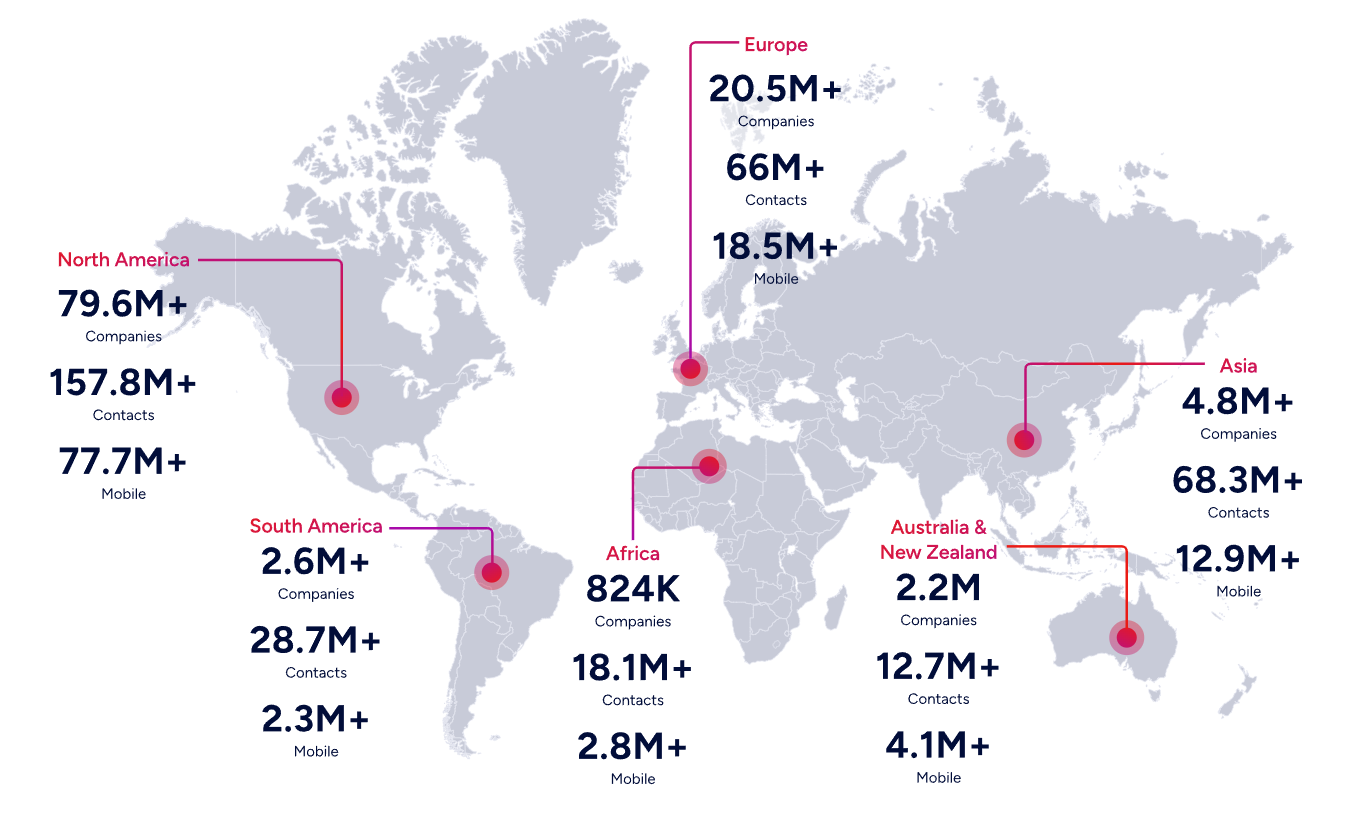
ZoomInfo is a B2B intelligence and GTM platform built on a large data foundation: 500M contacts, 100M companies, 135M+ verified phone numbers, and 200M+ verified business email addresses. Its GTM Context Graph processes 1.5B+ data points daily, merging this data with your CRM records, conversation transcripts, and behavioral signals to show the full context behind your accounts (not just what happened, but why, and what to do next).
While BuiltWith specializes in technology detection, ZoomInfo covers the intelligence stack go-to-market teams need to move from identifying prospects to winning deals. It's accessible through GTM Workspace for sellers, GTM Studio for marketers and RevOps, or APIs and MCP for any tool or AI agent. Its key features include:
B2B data spanning identity data, company context, and buying signals, verified through a multi-source pipeline backed by 300+ human researchers
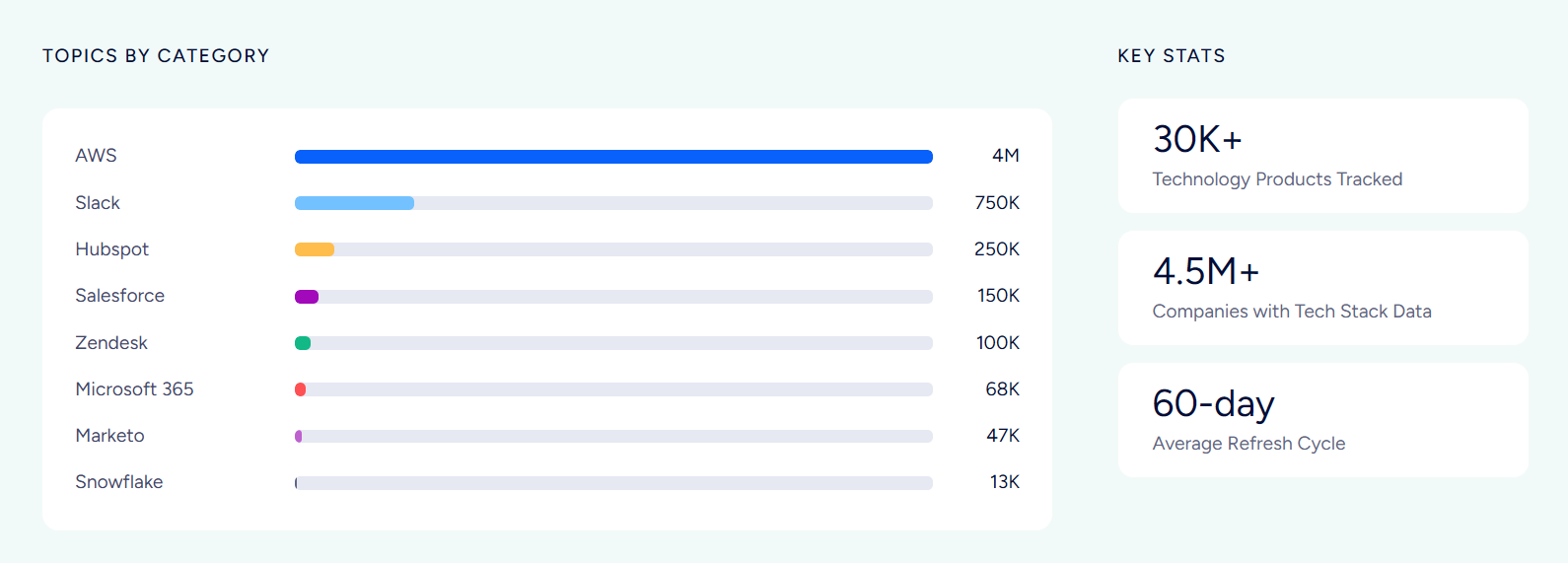
Technographics profiling the tech stacks of 30+ million companies, tracking 30,000+ technologies across 200+ categories
Buyer Intent data tracking signals from 210 million IP-to-Organization pairings and 6 trillion+ new keyword-to-device pairings sourced monthly
GTM Context Graph, which fuses ZoomInfo's data with first-party data to capture not just what happened in a deal, but why
Access through GTM Workspace for sellers, GTM Studio for marketers and RevOps, and APIs and MCP for any tool or AI agent
For B2B sales and marketing teams that use technology intelligence as one signal in a broader GTM motion, ZoomInfo provides what BuiltWith's technology-focused approach cannot: who to contact, when to engage, and what to say.
Why Choose ZoomInfo Over BuiltWith for Comprehensive B2B Intelligence
BuiltWith answers "what technologies does this company use?" ZoomInfo answers the broader question: "who should we target, why are they ready to buy, and how do we reach them?" Here's where ZoomInfo steps up.
Verified B2B Contact Data: Reach Decision-Makers Directly
BuiltWith provides contact names and emails for businesses outside the EU and CA, but contact data is not its primary focus. It's supplementary information attached to technology reports, not a verified contact database built for sales outreach.
ZoomInfo was built from the ground up as a B2B data platform. It maintains 120M direct-dial phone numbers and 200M+ verified business email addresses with up to 95% accuracy on first-party data. That accuracy comes from a multi-source verification pipeline: automated ML scanning of 28 million domains daily, third-party partner data covering 95 million businesses, a community of 200,000+ ZoomInfo Lite users who share data back, and an in-house lab of 300+ human researchers.
The data advantage is externally validated: in a Fortune 500 competitive RFP analyzing 25 million contacts across vendors, the independent consultant concluded that "no other competitor came even close."
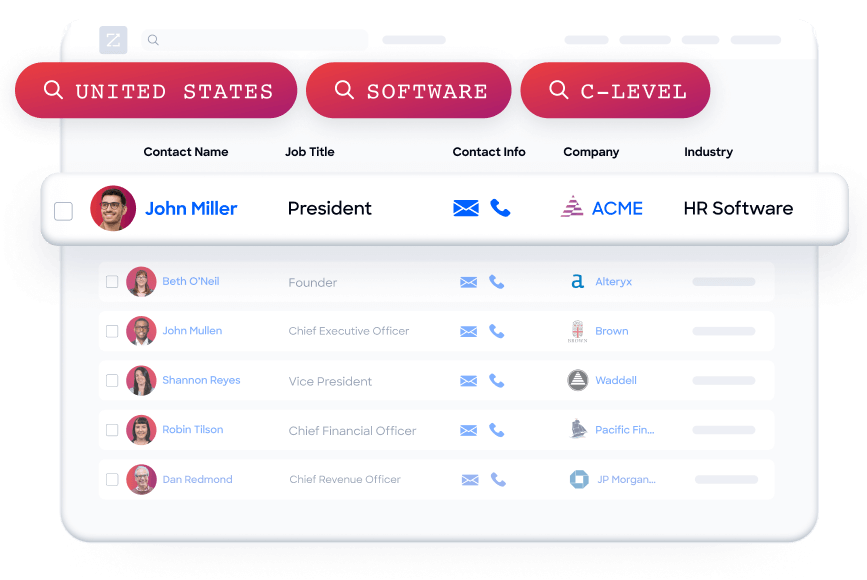
ZoomInfo in Action: Your team identifies a list of companies using a specific eCommerce platform through technology detection. With BuiltWith, you have the domain and potentially some contact names. With ZoomInfo, you get the VP of Engineering's direct dial, the CMO's verified email, the org chart, and the full company profile in one search. You can filter by 300+ company attributes, export directly to your CRM, and launch outreach without manual research.
Buyer Intent and Signal Intelligence: Know When Prospects Are Ready to Buy
BuiltWith recently launched Actionable Insights to identify companies showing buying signals through technology stack changes, including trials, platform migrations, and vendor churn. This is valuable for detecting technology-specific intent, but it represents one dimension of buying behavior.
ZoomInfo's Buyer Intent data tracks signals across a broader range: 210 million IP-to-Organization pairings and 6 trillion+ new keyword-to-device pairings sourced monthly. Its Guided Intent feature identifies research topics correlated with deal success, rather than requiring manual topic selection.
These signals feed into the GTM Context Graph, which fuses ZoomInfo's third-party data with your CRM records, conversation intelligence, and behavioral signals into a single intelligence layer. The result: AI that knows not just what a prospect is researching, but why a deal is moving and which actions will advance it.
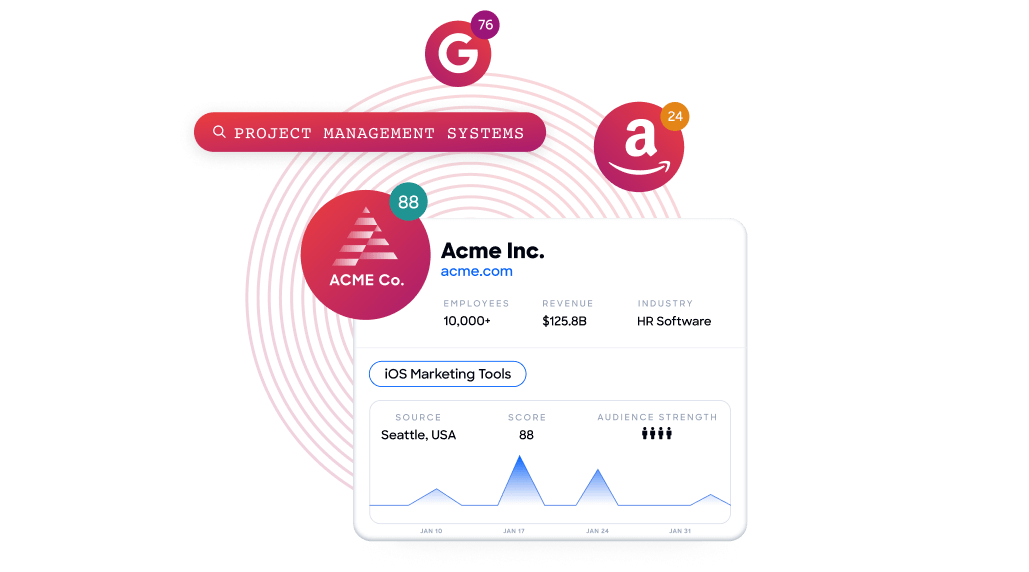
ZoomInfo in Action: A prospect's technology stack hasn't changed (no BuiltWith signal), but their research team has been consuming content about your product category for the past two weeks, three executives just joined from a company that uses your platform, and the VP of Operations mentioned competitive evaluation on a recorded call. ZoomInfo surfaces these signals together, drafts outreach addressing the concerns raised in the call, and prioritizes the account in your seller's workflow, all automatically through GTM Workspace.
Seismic's sales team attributed 39% of active pipeline to opportunities identified or influenced by ZoomInfo signals, boosted productivity by 54%, and saved 11.5 hours per week per seller. (Seismic Case Study)
Technographics Within a Unified Intelligence Platform
ZoomInfo tracks 30,000+ technologies across 200+ categories from 20+ source types across 30+ million companies, with nearly 90% of active pairings updated within three months. While BuiltWith's technology catalog is broader (113,002+ technologies), ZoomInfo's technographic data sits within a platform that connects technology usage to company context, buyer intent, org charts, and verified contact data.
This means you can build a segment like "companies using Salesforce with 500+ employees in healthcare showing CRM migration intent" and access verified contacts at those accounts without leaving the platform.
GTM Execution: From Intelligence to Action in One Platform
BuiltWith delivers intelligence through reports, exports, and CRM integrations, but execution (outreach, campaigns, deal management) happens in separate tools. ZoomInfo provides native execution tools:
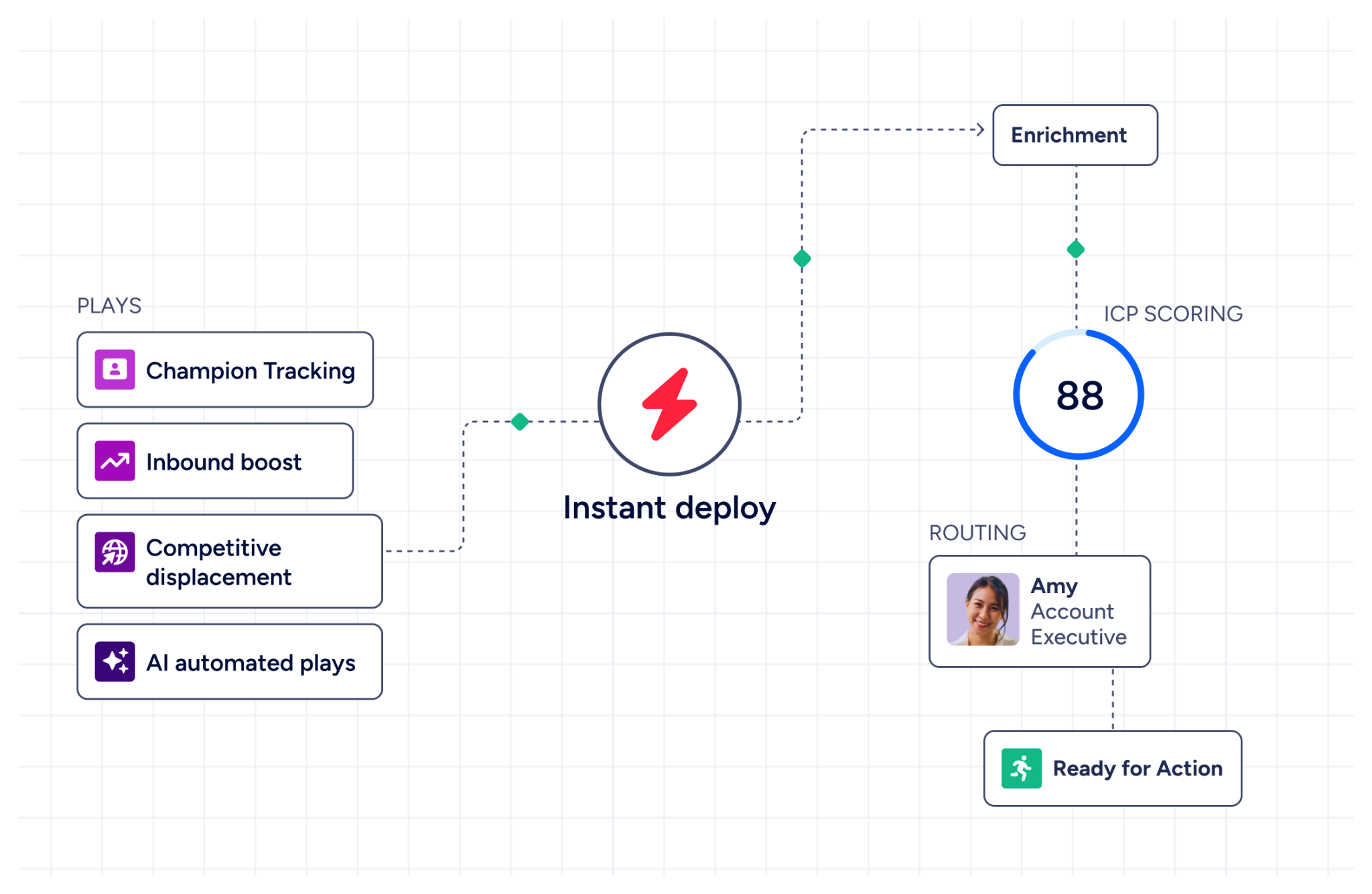
GTM Workspace gives sellers a workspace where prioritized accounts, AI-drafted outreach, and deal execution converge
GTM Studio lets marketers and RevOps design, enrich, and activate GTM plays in natural language, with expansion plays that used to take 3 weeks now launching in 30 minutes
"ZoomInfo is our one source of truth for account data, and even more so for contact data. There's no other provider in the market that provides you with that level of detail." (Smartsheet Case Study)
NOTE: We looked at other B2B intelligence platforms and found Apollo.io and Cognism frequently mentioned. Apollo.io offers a strong free tier and affordable pricing for smaller teams focused on email outreach, while Cognism excels in European and APAC mobile number coverage with strong GDPR compliance. However, neither matches ZoomInfo's data scale, GTM Context Graph, or native execution tools.
ZoomInfo Pricing
ZoomInfo uses a consumption-based pricing model where costs scale with usage, seats, credit volume, features, and contract length. Pricing is custom-quoted, with no publicly listed prices for paid tiers.
ZoomInfo Lite is a permanent free tier (not a trial) that includes access to ZoomInfo's B2B database with 10 monthly export credits, individual and company searches, the ReachOut Chrome Extension, WebSights Lite for website visitor identification, and HubSpot integration.
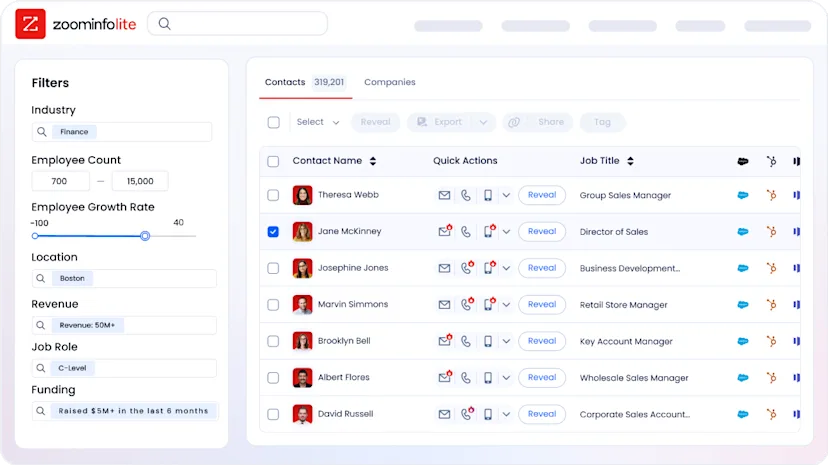
Paid Sales plans are organized into three tiers: Professional (contact and company data, CRM integrations, Chrome extension), Advanced (adds intent signals, website visitors, account prioritization, and GTM plays), and Enterprise (adds real-time intent, AI-generated account summaries, advanced workflows, and a dedicated customer service manager).
Marketing plans include Marketing Demand, ABM Lite, and ABM Enterprise tiers, scaling from audience targeting to cross-channel ABM orchestration.
ZoomInfo also offers a 7-day free trial separate from Lite, with no credit card required.
Who Should Use ZoomInfo?
Choose ZoomInfo if:
Your GTM motion requires B2B contact data, buyer intent signals, and technology intelligence in one platform rather than assembling separate tools for each. ZoomInfo eliminates the need to stitch together BuiltWith for technographics, a contact database for emails and phone numbers, and an intent provider for buying signals.
You need to move from prospect identification to outreach without switching tools. GTM Workspace and GTM Studio handle execution natively, while BuiltWith's workflow ends at data export.
Your team sells into enterprise accounts where understanding the full buying committee, deal dynamics, and organizational context matters more than knowing which CMS a company uses. ZoomInfo's GTM Context Graph captures the "why" behind deal movements, not just the "what."
Want to go beyond technology detection? Start with ZoomInfo Lite for free or request a demo to see how the data, insights, and execution tools work together.
2. HG Insights — Best Alternative for Enterprise Technology Intelligence with IT Spend Data
Source: HG Insights
HG Insights is a Revenue Growth Intelligence platform that combines technographic data, buyer intent signals, IT spending intelligence, and contact data in a single environment designed for enterprise GTM operations. Drawing from over 28 billion source files, 2 billion intent records, and 200M+ technology install detections across 20M+ companies, HG Insights provides technology intelligence at a depth built for large-scale GTM decisions. Its key capabilities include:
IT Spend Intelligence estimating technology spending across 140+ categories at the account level with 12-month spend forecasting
RGI Fabric combining technographic, firmographic, IT spend, buyer intent, and contact intelligence in a single data layer
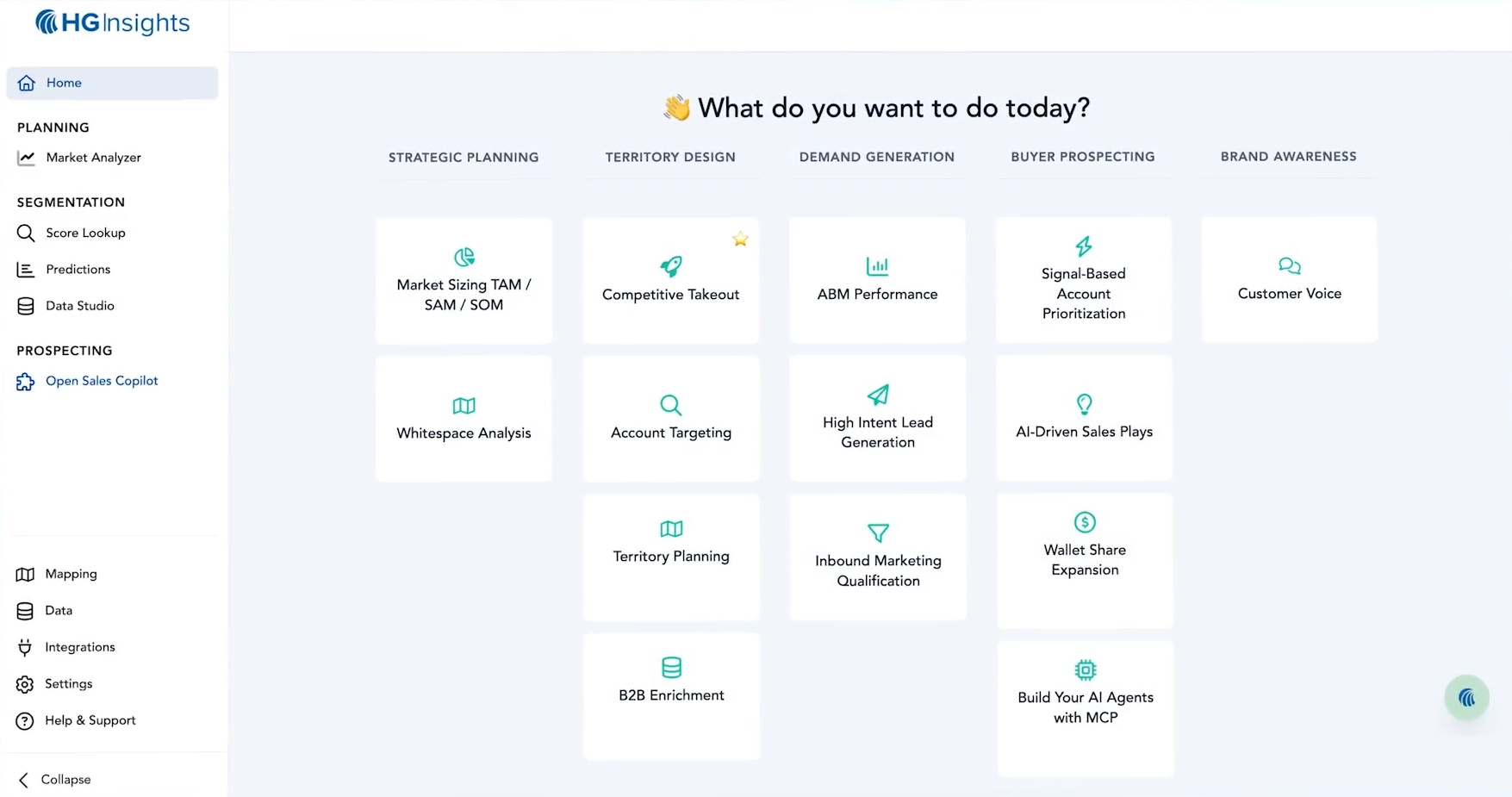
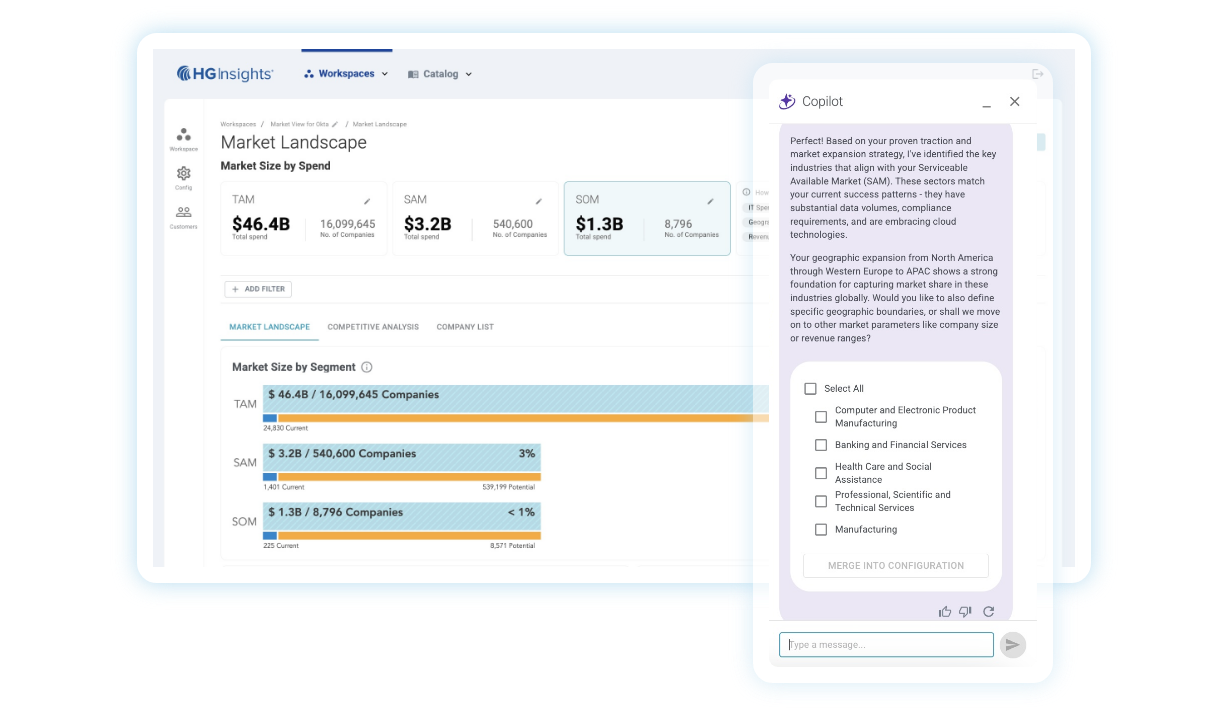
Market Analyzer with AI Copilot providing TAM/SAM/SOM modeling and ICP analysis through conversational queries
No-Code Data Studio for building predictive account scoring models without engineering support
Why Choose HG Insights Over BuiltWith for Enterprise Technology Intelligence
HG Insights stands out in the following areas:
IT Spend Intelligence for Budget-Aware Prioritization BuiltWith tells you which technologies a company uses. HG Insights tells you how much they spend on those technologies across 140+ categories, including hardware, software, services, and communications, with 12-month spend forecasting. Knowing a company spends $4M annually on cloud infrastructure versus $400K changes your entire sales approach. BuiltWith can reveal both companies use AWS, but without the spend layer, sales teams cannot prioritize by budget capacity.
Multi-Signal Intelligence Layer BuiltWith operates primarily as a technology tracking database where users query technologies, apply filters, and export lists. The analytical work of connecting technology usage to intent signals and contact data happens outside the platform. HG Insights delivers all signal types through the RGI Fabric, pre-integrated by a consistent company identifier, reducing the engineering overhead of assembling data from multiple vendors.
No-Code Predictive Modeling and AI Copilots BuiltWith provides filtering and full data export, but the analytical workflow remains manual. HG Insights embeds AI-assisted analytics directly into the platform. Data Studio allows RevOps teams to build predictive models combining CRM data with HG's intelligence. Market Analyzer provides conversational AI for TAM sizing and ICP refinement. Scores push directly into Salesforce, HubSpot, Salesloft, and Gong.
Source: HG Insights
NOTE: We also evaluated SimilarTech and Wappalyzer for this enterprise-focused category. Neither offers the IT spend intelligence, predictive scoring infrastructure, or analytical depth that large organizations require. HG Insights addresses the core limitation of technology detection alone: knowing what a company uses tells you little about whether they have budget and readiness to buy. The platform is trusted by 90% of Fortune 500 tech companies.
HG Insights Pricing
HG Insights uses a consumption-based, modular pricing model combining licensed seats with intelligence credits. Pricing is not publicly listed, with standard contracts defaulting to two-year terms and no free trial available.
Starter Plan: Lower credit allocation, fewer seats, no premium intent signals
Growth Plan: More credits, seats, and lead volumes; includes premium intent signals and 50-seat bundles
Enterprise Plan: Custom volumes, tailored purchasing flexibility, designed for multi-division deployments
Quarterly billing carries an additional premium over annual payment. Up to 20% of monthly credits can roll over; credits beyond that threshold are forfeited.
Who Should Use HG Insights?
Choose HG Insights if:
You are a B2B technology company with dedicated GTM functions that need enterprise-scale territory sizing, account scoring, or market segmentation decisions.
You need IT spend intelligence as a primary qualification signal, not just technology detection, to prioritize accounts by demonstrated technology investment.
Your GTM strategy requires combined technographics, intent, spend, and contact data rather than assembling these from separate vendors.
3. SimilarTech — Best Alternative for Traffic-Informed Technology Prospecting
Source: SimilarTech
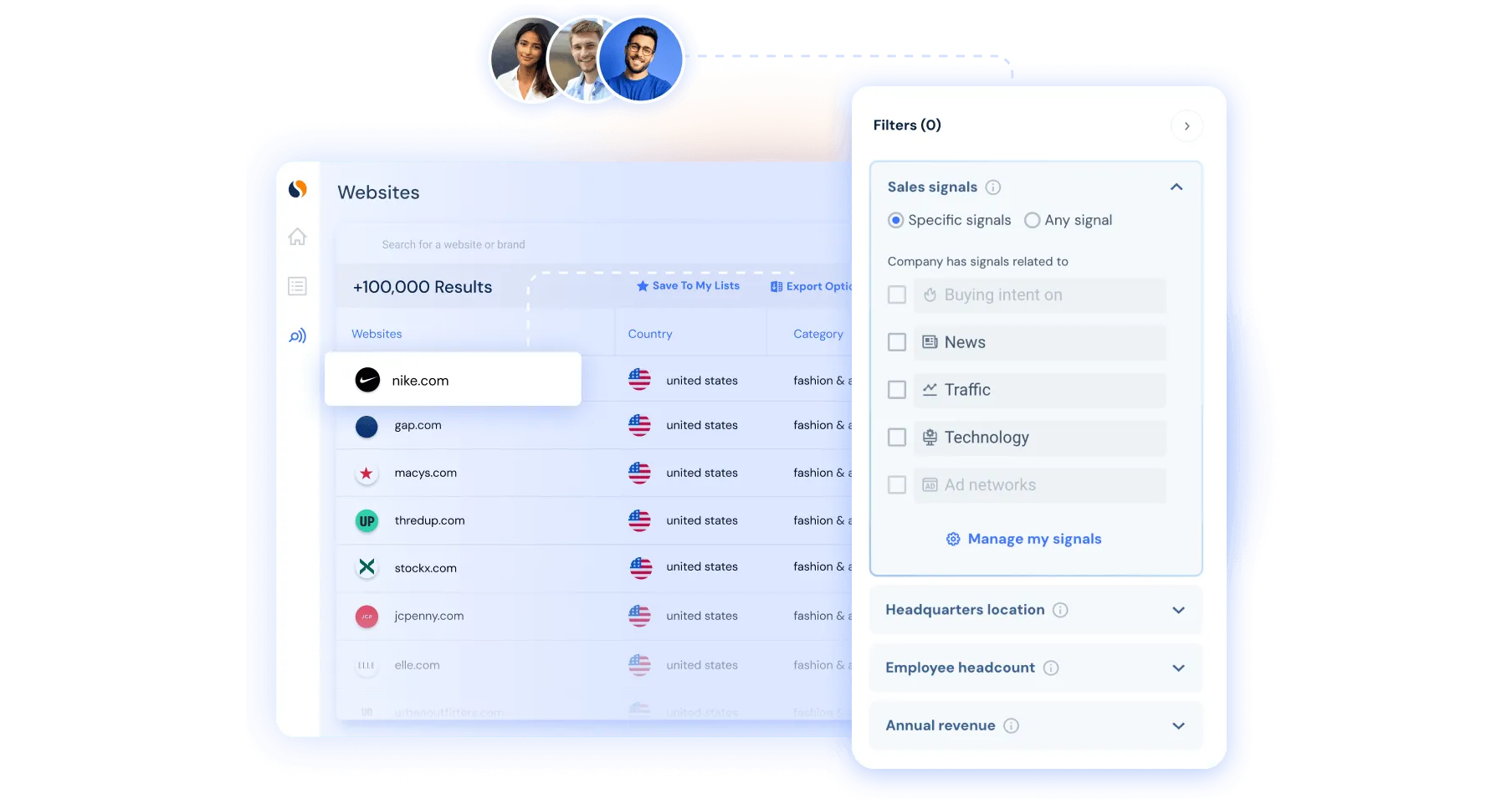
SimilarTech is a web technographics platform that operates as part of the Similarweb family, combining technology detection with traffic analytics. Tracking 100M+ websites, 4M+ apps, and 8,000+ technologies through 30+ billion web pages per month, it layers technographic data with traffic intelligence and engagement metrics. Its key capabilities include:
Similarweb ecosystem integration layering technographics with traffic data, growth rates, and audience demographics
Daily technology change alerts for timely competitive displacement outreach
Country and category filtered lead lists with contact information and technology spend signals
Technology market share and trend reporting tracking adoption patterns across segments
Why Choose SimilarTech Over BuiltWith for Traffic-Informed Technology Intelligence
SimilarTech stands out in the following areas:
Technographics Combined with Traffic Intelligence
BuiltWith provides technology detection but no native traffic analytics. SimilarTech, as part of Similarweb, layers every technographic lookup with web traffic data, growth rates, paid traffic share, and engagement benchmarks. Teams can filter prospects by traffic volume thresholds and year-over-year growth percentages, surfacing businesses that are scaling and likely investing in new tools. BuiltWith can filter by traffic rank, but rank is a relative position, not an absolute growth metric.
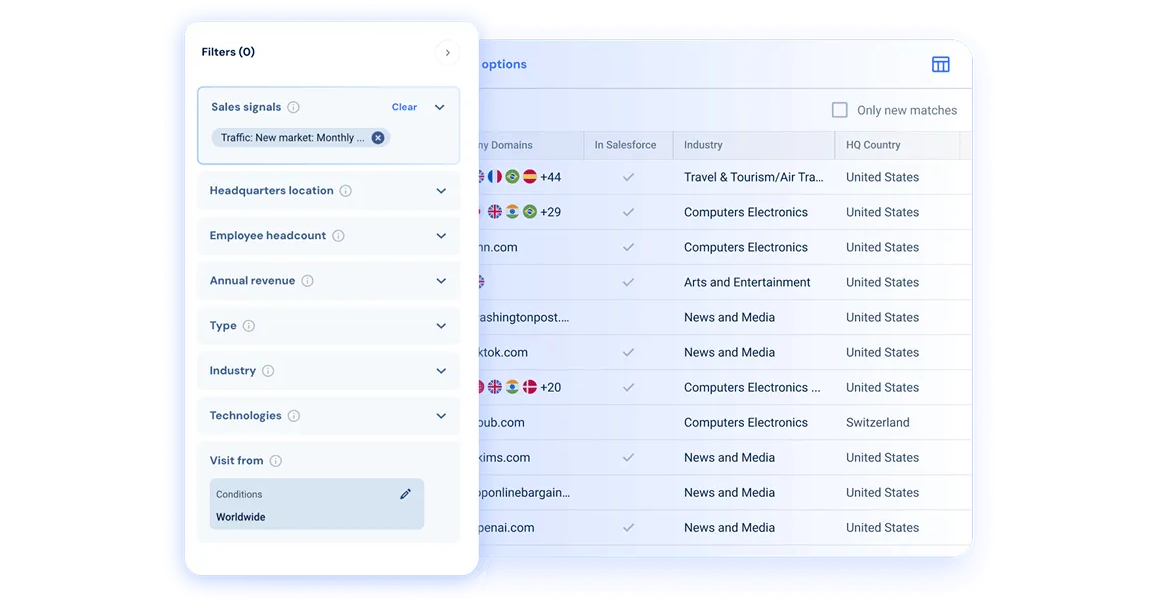
Daily Technology Change Alerts BuiltWith updates its 414 million domain database weekly. SimilarTech delivers daily notifications when websites adopt or remove technologies. For competitive displacement campaigns, this timing difference matters: reaching a company within 48 hours of a platform migration positions outreach as helpful rather than late.
Lead Generation with Traffic-Based Prioritization SimilarTech extends beyond technology and location filters to include native traffic volume thresholds, growth rates, and traffic source breakdowns. Users can isolate companies with specific monthly visit counts or channel mixes (organic vs. paid vs. referral), qualifying prospects by business stage alongside technology fit.
Source: SimilarTech
NOTE: We also evaluated Wappalyzer and NerdyData for this category. Wappalyzer excels at browser-extension-based detection with a freemium model, and NerdyData provides HTML-level code search for developers. SimilarTech offers the best combination of scale and market intelligence for growing teams. Its backing by Similarweb (NYSE: SMWB) adds credibility, with a Forrester TEI study finding 640%+ ROI over three years.
SimilarTech Pricing
SimilarTech operates through Similarweb's Sales Intelligence product with per-seat, subscription-based pricing:
Individual: $99/month billed annually (or $129/month billed monthly). 1 user, 3 months historical traffic data, 1,000 data credits, AI prospecting tools and Chrome extension
Business: Custom pricing. 5 seats, 25 months historical data, CRM integrations, 1,000 contact details/month, API access
Enterprise: Custom pricing. 10+ seats, custom data retention, full platform customization
Who Should Use SimilarTech?
Choose SimilarTech if:
Your sales team needs to qualify prospects by both technology stack and business health in one platform.
You run competitive displacement campaigns and need daily technology change alerts for time-sensitive outreach.
Your organization already uses or is evaluating Similarweb and wants to consolidate vendors by adding technographic prospecting.
4. Wappalyzer — Best Alternative for Accessible Technology Detection with Minimal Friction
Source: Wappalyzer
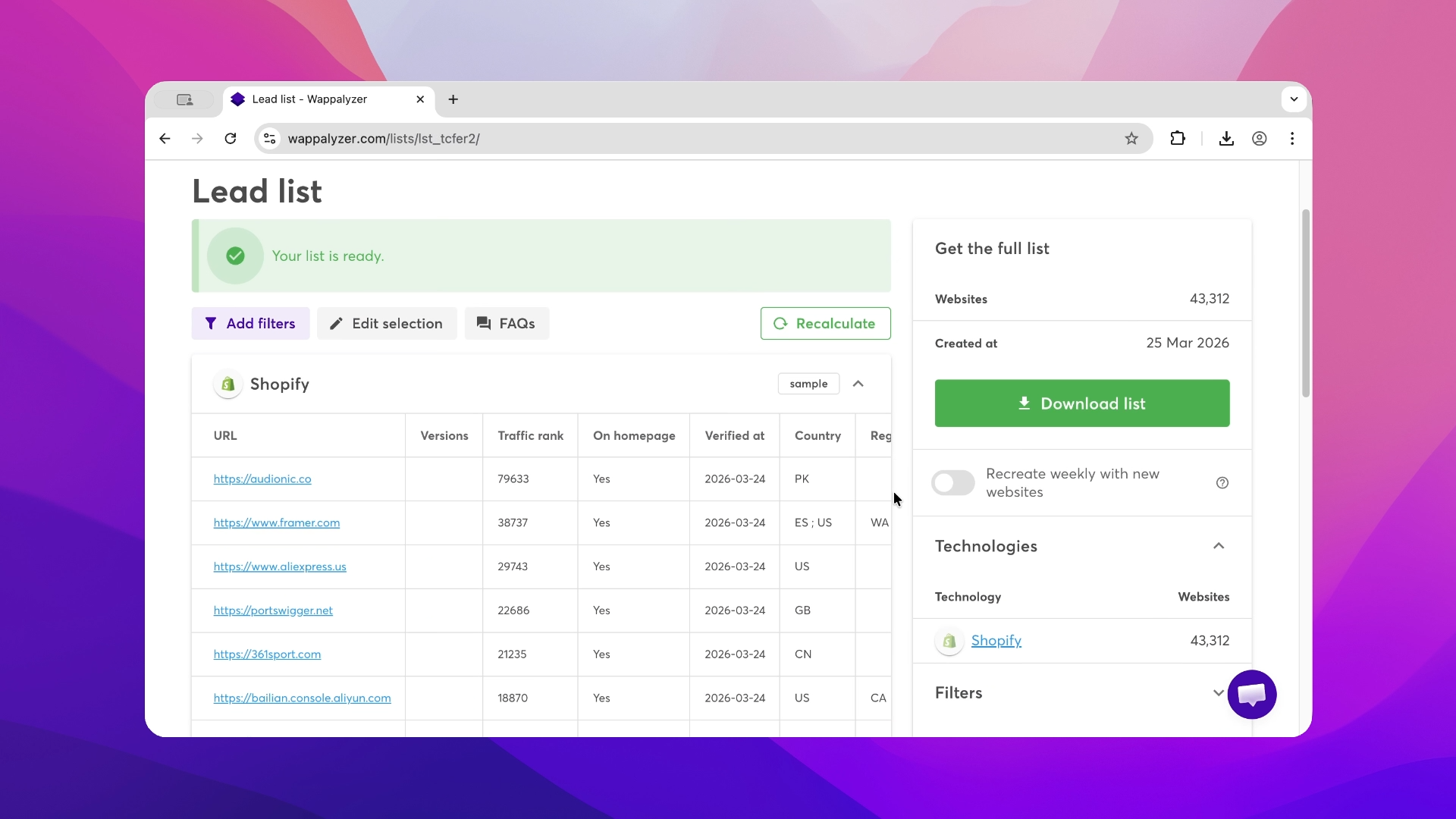
Wappalyzer is a technographic intelligence platform that provides website technology profiling, lead list generation, and technology change monitoring, focused on accessibility and low friction. Tracking 8,028 web technologies across 106 categories, its key capabilities include:
Permanent free tier with 50 monthly lookups and sample lead lists requiring no credit card
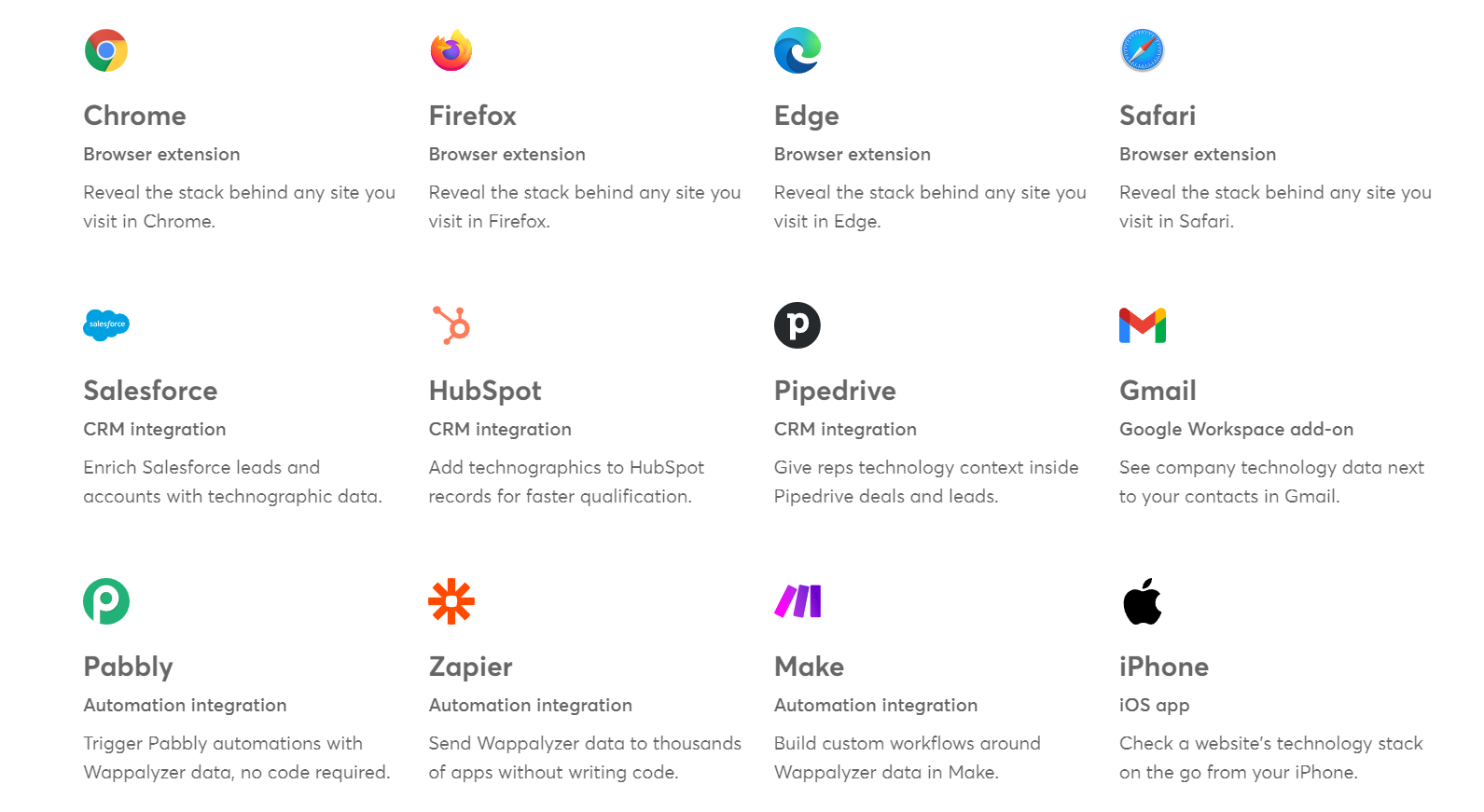
Browser extensions for Chrome, Firefox, Edge, and Safari with over 6 million installs
Lead list generation with technology, company size, location, and traffic filters
Native CRM integrations with Salesforce, HubSpot, and Pipedrive plus Zapier and Make connectors
MCP integration via a hosted server for AI-native workflows
Why Choose Wappalyzer Over BuiltWith for Accessible Technology Detection
Wappalyzer stands out in the following areas:
No Financial Barrier to Entry Wappalyzer offers a permanent free account with 50 lookups per month and sample lead lists that never expires and requires no credit card. BuiltWith offers free individual site lookups but requires commitment to a $295/month Basic plan for list-based lead generation. BuiltWith does not offer a traditional free trial since all data is fully exportable. For small teams that need to prove value before securing budget, this difference in risk allocation is often the deciding factor.
Browser Extension for Instant In-Context Detection BuiltWith's core experience centers on its web dashboard for reports and list building. Wappalyzer's browser extension delivers instant technology visibility without leaving the prospect's website. With a Plus subscription at $10/month, the extension also surfaces company and contact information in the browser, so reps don't switch between tools.
Smoother CRM Enrichment with Less Manual Cleanup Wappalyzer's Salesforce and HubSpot integrations push technology and company data directly into CRM records with minimal configuration. BuiltWith offers CRM integrations as well, but users report that CRM sync often requires manual data cleanup and exports need significant processing. For lean RevOps teams, Wappalyzer integrates more cleanly out of the box.
Source: Wappalyzer
NOTE: We also evaluated TheirStack and WhatRuns for accessible use cases. TheirStack is more affordable and offers a useful free tier, but as a newer entrant it has less market validation and narrower coverage. WhatRuns offers a popular free browser extension but lacks lead list generation entirely. Wappalyzer strikes the best balance between accessibility and capability at this tier.
Wappalyzer Pricing
Free (permanent): 50 lookups/month, 5 website alerts, sample lead lists
Plus: $10/month. 200 lookups, company/contact info in browser extension
Pro: $250/month. 5,000 lookups, 2 lead list technology targets
Business: $450/month. 20,000 lookups, unlimited technology targets, CRM enrichment, API access
Enterprise: From $850/month. 25+ seats, 200,000+ lookups, dedicated support
Annual billing saves 17% versus monthly.
Who Should Use Wappalyzer?
Choose Wappalyzer if:
You are a small team or consultant that needs to prove technographic intelligence value before securing budget.
Your reps qualify prospects on-the-fly rather than working from pre-built lists, benefiting from the browser extension's instant context.
You prioritize CRM integration quality over historical data depth and coverage.
5. TheirStack — Best Alternative for Backend Technology Detection via Hiring Intent
Source: TheirStack
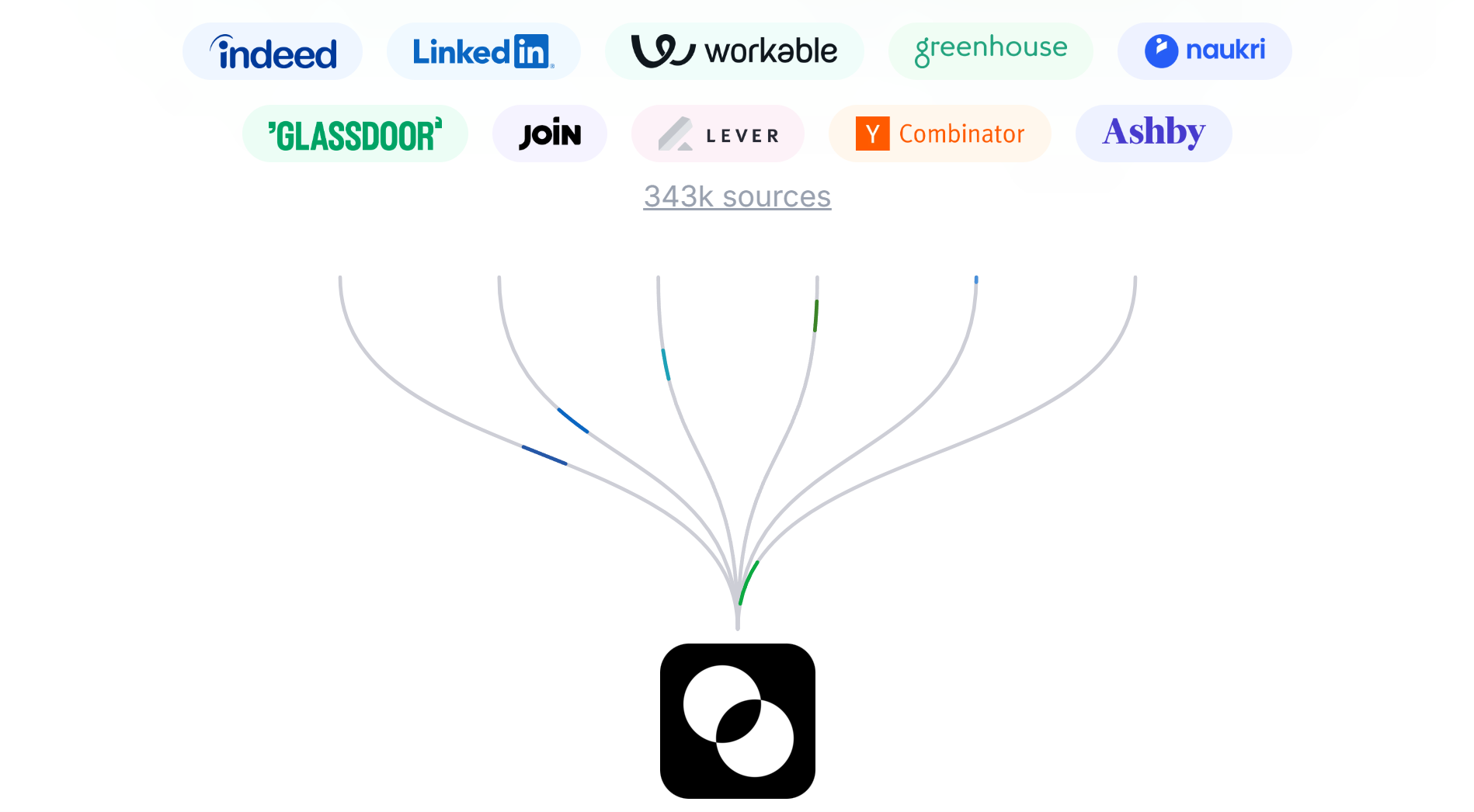
TheirStack is a job-posting-based technographic and sales intelligence platform that detects technologies companies are actively using, hiring for, and investing in by analyzing job postings rather than website source code. Processing 296,000 job postings per day from 335,000 sources across 195 countries, it captures backend infrastructure, databases, and internal platforms that web crawlers cannot see. Its key capabilities include:
Job-posting technology detection identifying 32,000+ technologies from 201M+ job postings, with every signal linked to the original posting
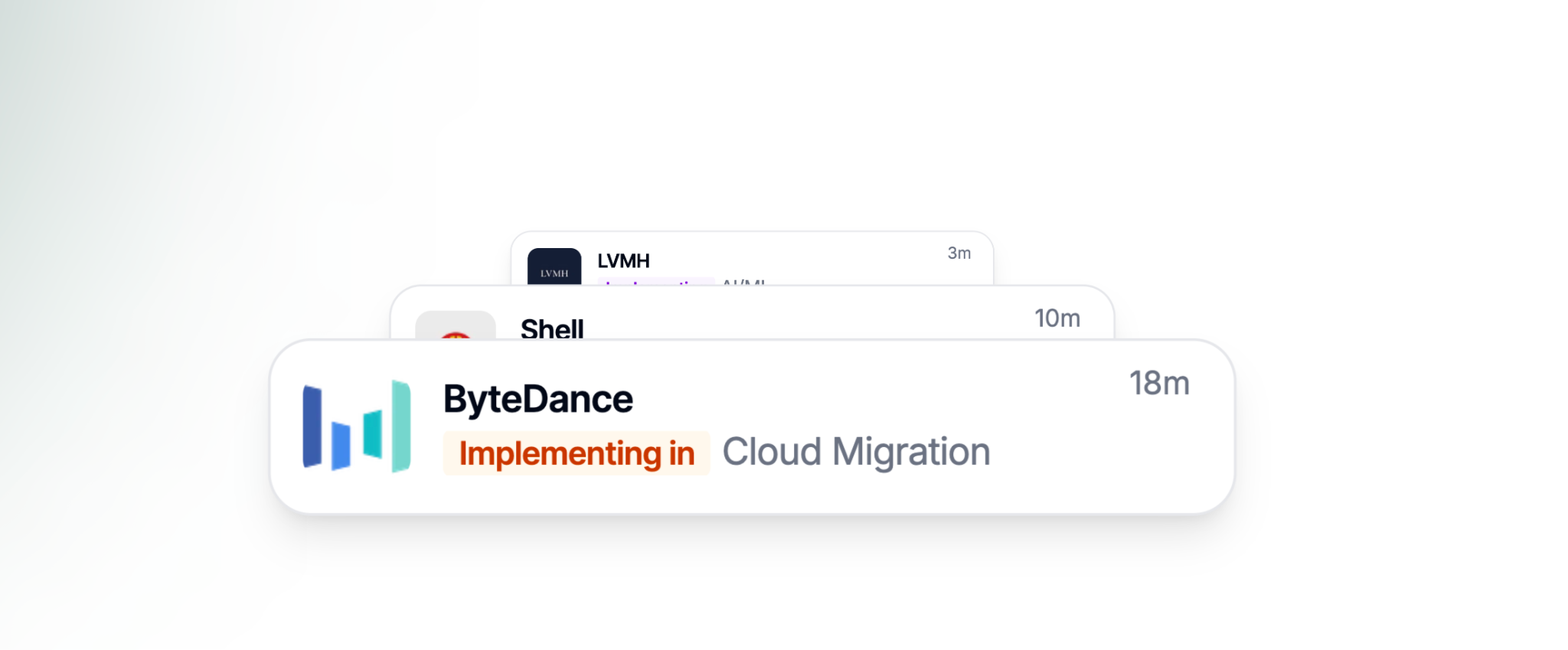
Hiring intent as buying signals, flagging companies actively implementing or migrating technologies with real-time alert delivery within minutes
9,400+ buying intent topics across 14 keyword types including regulations (GDPR, SOC 2), strategic initiatives, and physical equipment
Affordable credit-based pricing starting at $59/month for API access with 12-month credit rollover
Why Choose TheirStack Over BuiltWith for Backend Technology Detection
TheirStack stands out in the following areas:
Backend Technologies That Web Crawlers Cannot Detect BuiltWith crawls public-facing websites to detect visible HTML, JavaScript, and embedded technologies, but backend infrastructure never appears in website source code. TheirStack's job-posting approach reveals databases (PostgreSQL, MongoDB), cloud infrastructure (AWS, GCP, Azure), container orchestration (Kubernetes), and internal CRMs (Salesforce, SAP) by extracting technology requirements from job descriptions. Each signal links back to the original posting for verification.
Hiring Signals Indicate Active Investment and Budget BuiltWith provides snapshots of current technology usage and historical adoption timelines. TheirStack's signals are behavioral: when a company posts jobs mentioning a technology, the need is immediate, the company has committed headcount, and the budget is allocated. A company posting multiple DevOps roles mentioning Kubernetes is actively scaling infrastructure right now.
Intent Beyond Technology for Non-Software Vendors BuiltWith focuses exclusively on web technology intelligence. TheirStack's buying intent topics cover regulations, strategic initiatives, physical equipment, and more. A consulting firm can find companies posting "Compliance Manager, SOC 2 experience required"; an industrial vendor can find "Operations Manager, solar panel installation."
Source: TheirStack
NOTE: We also evaluated Datanyze and HG Insights for backend technology detection. While Datanyze offers real-time tracking with browser-extension detection and HG Insights provides spend intelligence, TheirStack offers the most backend visibility for teams targeting companies actively hiring around specific tools.
TheirStack Pricing
TheirStack uses a credit-based model with pay-as-you-go and subscription options:
Free (permanent): 50 company credits, 200 API credits per month
App Credits: From $109 for 1,000 credits (one-time purchase valid for 12 months) or monthly subscription with 10% discount
API: From $59/month for 1,500 credits to $1,500/month for 1M credits
Datasets: Bulk access (192M+ job records, 49M technographic records) via S3, pricing by request
Who Should Use TheirStack?
Choose TheirStack if:
Your ICP includes engineering-led companies where backend technology intelligence matters more than visible frontend stack.
You need hiring momentum and active technology investment signals rather than static technology snapshots.
You sell non-software products or services tied to compliance, strategic initiatives, or physical equipment.
6. WhatRuns — Best Alternative for Free, Instant Technology Detection
Source: WhatRuns
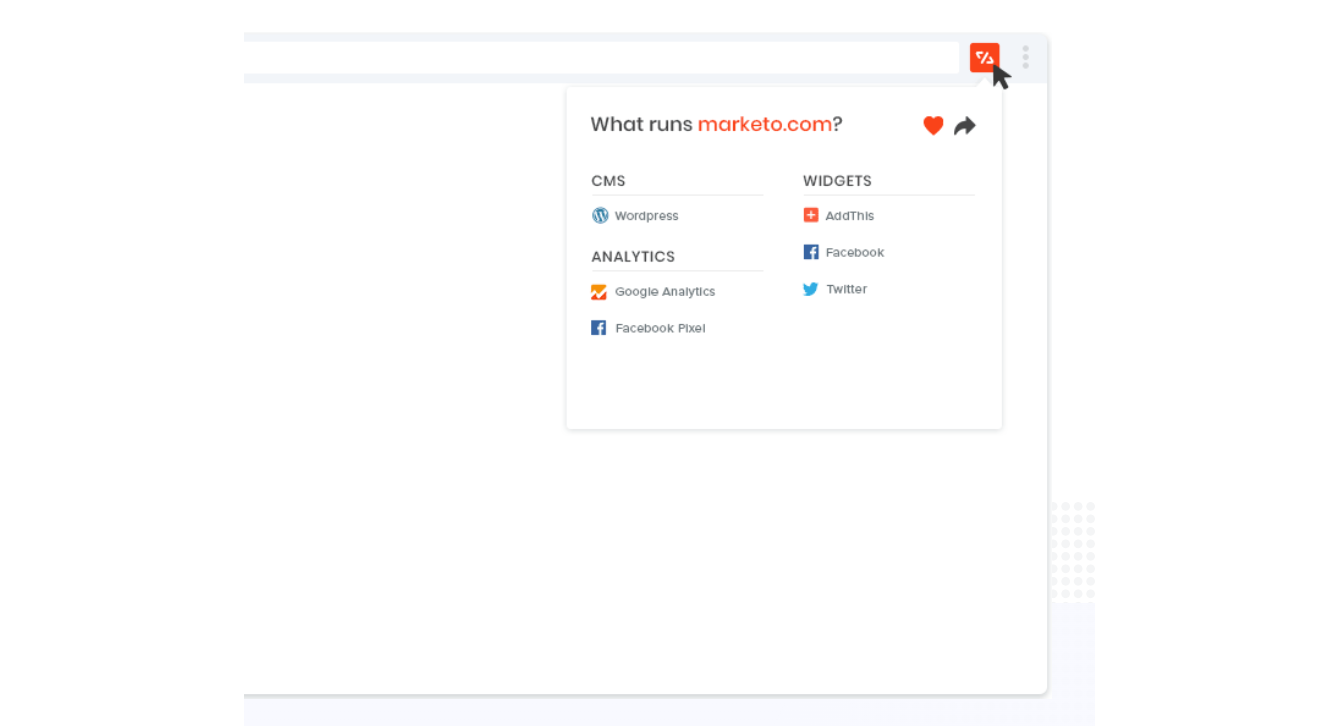
WhatRuns is a free browser extension for Chrome and Firefox that reveals the technology stack of any website with a single click, requiring no account, no subscription, and no payment. With over 450,000 active users, it provides instant technology detection for developers, marketers, and sales professionals who need quick answers without BuiltWith's $295/month minimum. Its key capabilities include:
Completely free with no signup, credit card, or usage limits
One-click detection of frameworks, CMS platforms, analytics tools, WordPress plugins, fonts, and more
Technology change monitoring through website follow notifications
Free API access for programmatic lookups
Daily database updates adding 50-100 new technologies
Why Choose WhatRuns Over BuiltWith for Free Technology Detection
WhatRuns stands out in the following areas:
Zero Financial Barrier BuiltWith's Basic plan starts at $295/month, and the platform does not offer free trials of paid plans. WhatRuns is completely free, with no paid tier. For freelancers, consultants, students, and employees at companies without sales intelligence budgets, this is the difference between "impossible to justify" and "installed and working in 30 seconds."
Instant Results in Live Browsing Context BuiltWith is built for bulk intelligence through reports, filters, and exports. WhatRuns operates within the browser: click the icon on any active tab and receive categorized results immediately. For real-time research (a developer inspecting a competitor's frontend, a marketer checking a prospect's analytics setup during a call), WhatRuns removes the need to navigate to a separate platform.
Zero Learning Curve BuiltWith's depth (113,002 technologies, historical data, keyword reports, CRM integrations, API endpoints, credit management) introduces interface complexity appropriate for enterprise users. WhatRuns has no learning curve: install, visit a site, click the icon, read the results.
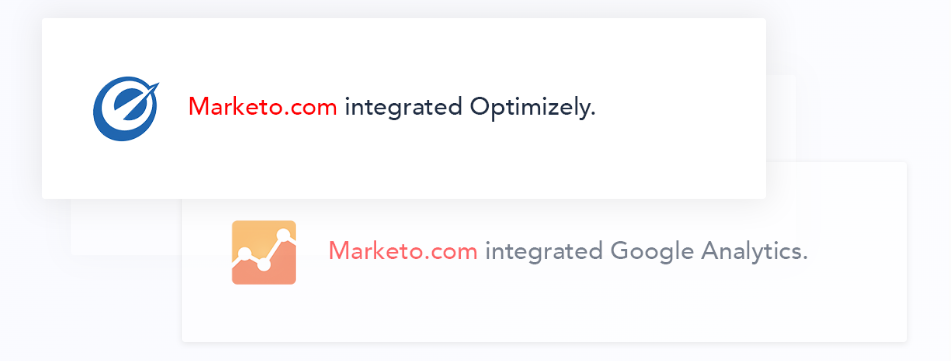
Source: WhatRuns
NOTE: We also evaluated Wappalyzer's free tier and open-source detection tools. Wappalyzer caps free lookups at 50 per month and restricts lead generation behind paid plans. WhatRuns offers free technology detection with no usage limits, making it the clearest zero-cost alternative for individual practitioners.
WhatRuns Pricing
WhatRuns operates on a single-tier model: completely free, with no paid upgrade path.
Free (Only Option): $0, unlimited technology detection, website follow notifications, free API access, no caps or time limits
Who Should Use WhatRuns?
Choose WhatRuns if:
You need occasional, ad-hoc technology detection without justifying a monthly subscription.
Your use case centers on real-time, in-browser research rather than bulk list generation.
You want lightweight competitive monitoring for a handful of specific competitors without enterprise platform costs.
7. NerdyData — Best Alternative for Code-Level Technology Search
Source: NerdyData
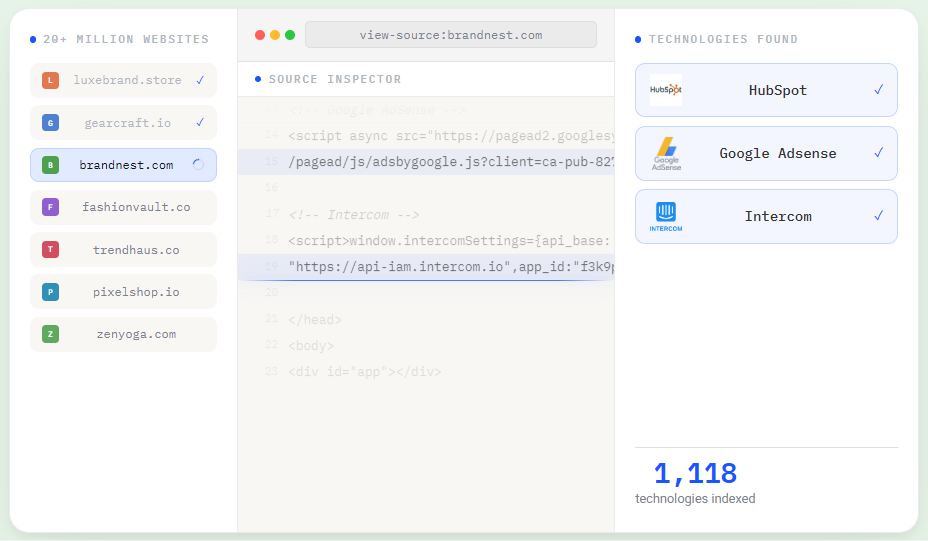
NerdyData is a technographic intelligence platform that searches the actual source code of over 350 million websites for specific HTML tags, JavaScript snippets, CSS patterns, and code fingerprints. Unlike BuiltWith, which categorizes websites by known technology signatures, NerdyData lets users search for any code pattern they define. Its key capabilities include:
Source code search across 350M+ websites for any HTML, JavaScript, CSS, HTTP header, or cookie pattern
Full JavaScript rendering that captures technologies injected at runtime invisible to simpler crawlers
Historical source code search for tracking when code patterns appeared or disappeared on websites
Pay-as-you-go API without mandatory subscription commitment
Why Choose NerdyData Over BuiltWith for Code-Level Detection
NerdyData stands out in the following areas:
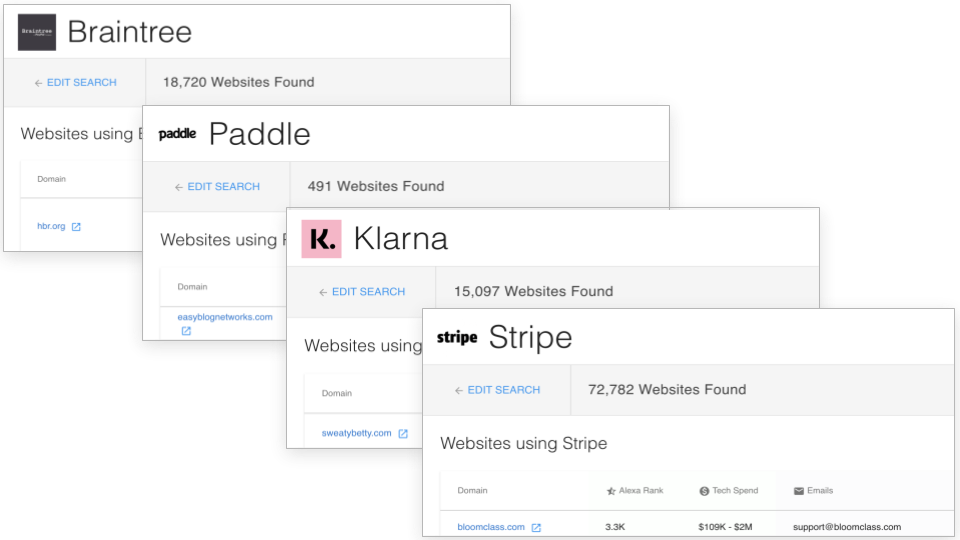
Arbitrary Code Pattern Search BuiltWith's detection relies on predefined signatures for its 113,002+ known technologies. If your product leaves a code fingerprint outside BuiltWith's catalog, or you're tracking a proprietary SDK or niche vendor, BuiltWith may not detect it. NerdyData lets users search for any code pattern directly in HTML, JavaScript, CSS, or HTTP headers. A developer tool company can search for their unique initialization code; an ad-tech vendor can track their specific pixel implementation across the web.
JavaScript Rendering for Runtime-Loaded Technologies NerdyData renders webpages with JavaScript execution before indexing, capturing technologies loaded through tag managers, client-side SDK calls, or conditional scripts. This addresses detection gaps for chatbot widgets, consent management platforms, and analytics SDKs invisible to static HTML crawlers.
Historical Source Code Snapshots While BuiltWith's 41+ years of historical data is unmatched for tracking named technologies, NerdyData maintains historical snapshots of raw website source code. Users can search for code that was present in the past but has since been removed, uncovering competitive displacement patterns by searching for the absence of a competitor's code combined with the presence of your own.
Source: NerdyData
NOTE: We also evaluated Wappalyzer and WhatRuns for this category. Both offer solid technology detection, but neither supports arbitrary code pattern searches or JavaScript-rendered crawling. NerdyData is the specialist tool for teams whose prospecting depends on detecting custom SDKs, niche implementations, or runtime-injected technologies outside standard catalogs.
NerdyData Pricing
NerdyData uses a flat-fee subscription model with three tiers:
Basic: $200/month. 5,000 rows per download, 1,000 domain enrichments/month, unlimited list downloads
Pro (Most Popular): $300/month. 200,000 rows per download, 5,000 domain enrichments/month
Enterprise: $1,000/month. 1,000,000 rows per download, 10,000 domain enrichments/month
A single one-time report is available for $75. API access is billed separately on a pay-as-you-go basis. Annual billing saves over 70%.
Who Should Use NerdyData?
Choose NerdyData if:
Your target customers are defined by proprietary or niche code fingerprints not tracked by standard technology catalogs.
You need to detect technologies loaded asynchronously at runtime through tag managers or third-party scripts.
Your research needs are project-based rather than continuous, making NerdyData's flexible API and single-report purchase attractive.
The Final Verdict
BuiltWith excels as a technology intelligence platform with unmatched historical depth, but different go-to-market strategies demand different tools. Based on our research, here are the best alternatives:
ZoomInfo for B2B intelligence that goes beyond technology detection to provide verified contacts, buyer intent signals, and GTM execution
HG Insights for enterprise teams that need IT spend intelligence and predictive account scoring alongside technographic data
SimilarTech for sales teams that want technology detection layered with traffic analytics and daily change alerts
Wappalyzer for accessible, low-friction technology detection with a permanent free tier and clean CRM integrations
TheirStack for backend technology visibility and hiring intent signals derived from job postings
WhatRuns for free, instant technology detection with no cost and no learning curve
NerdyData for code-level searches targeting custom implementations, niche SDKs, and runtime-loaded technologies
You don't have to choose between BuiltWith and these alternatives exclusively. Many teams use BuiltWith alongside a contact data platform or intent provider. Pick the combination that fits your needs and growth plans.
Ready to go beyond technology detection? Start with ZoomInfo Lite for free and access 500M contacts, verified phone numbers, buyer intent signals, and GTM tools alongside technographic intelligence.
BuiltWith Alternatives FAQ
Why do businesses look for BuiltWith alternatives?
BuiltWith excels at technology detection across 113,002+ technologies with 41 years of historical data, but businesses often need more than technology intelligence alone. Common reasons include needing verified B2B contact data alongside technographic insights, wanting buyer intent signals beyond technology adoption, requiring backend infrastructure visibility that web crawlers cannot provide, or finding the $295/month minimum too high for occasional research needs.
What is the best overall BuiltWith alternative?
There is no single best alternative because different teams need different capabilities. ZoomInfo is the top choice for teams needing B2B intelligence with contacts, intent, and GTM execution. HG Insights leads for enterprise teams needing IT spend data. Wappalyzer is strongest for small teams wanting accessible, low-friction technology detection. The right choice depends on whether you need broader intelligence, deeper specialization, or lower cost.
Is there a free alternative to BuiltWith?
Yes, several alternatives offer free options. WhatRuns is completely free with no usage limits for browser-based technology detection. Wappalyzer provides a permanent free tier with 50 monthly lookups and sample lead lists. TheirStack offers 50 free company credits and 200 API credits per month. ZoomInfo Lite is a permanent free tier with 10 monthly export credits and access to the B2B database. None match BuiltWith's full reporting depth for free, but they cover common use cases.
Which BuiltWith alternative is best for B2B sales teams?
ZoomInfo is designed for B2B sales, providing 500M contacts with verified phone numbers and emails, buyer intent data, outreach tools, and native CRM integrations. While BuiltWith tells you what technologies a company uses, ZoomInfo tells you who to contact, when they're ready to buy, and helps you execute outreach from one platform.
Can any alternative match BuiltWith's historical data depth?
BuiltWith's 41 years of technology history dating back to 1985 is unmatched in the market. No alternative offers comparable historical depth for tracking technology adoption over decades. HG Insights and SimilarTech provide some historical data but measured in months or years, not decades. Teams that need long-term technology trend analysis for market research or investment intelligence will find BuiltWith's historical depth irreplaceable.
Which alternative is best for detecting backend technologies?
TheirStack is designed for backend technology detection through job-posting analysis. By processing 296,000 job postings daily, it reveals databases, cloud infrastructure, DevOps tools, and internal platforms that web crawlers cannot see. NerdyData also captures runtime-loaded technologies through JavaScript rendering, but TheirStack combines technology detection with hiring intent signals.
How do BuiltWith and ZoomInfo compare for technographic data?
BuiltWith tracks 113,002+ technologies across 478 million domains, offering broader technology coverage and deeper historical data. ZoomInfo tracks 30,000+ technologies across 30 million companies. The key difference is context: BuiltWith provides technology data in isolation, while ZoomInfo integrates technographics with verified contacts, buyer intent, company intelligence, and GTM execution tools. Teams that need technology data as one input in a broader sales motion benefit from ZoomInfo's combined approach.
Which BuiltWith alternative is most affordable for small businesses?
WhatRuns is free with no usage limits for browser-based detection. TheirStack starts at $59/month for API access with a permanent free tier and 12-month credit rollover. Wappalyzer's Plus plan at $10/month adds company information to its browser extension. For comparison, BuiltWith's Basic plan starts at $295/month. Small teams should evaluate whether they need list generation (Wappalyzer or TheirStack) or just quick lookups (WhatRuns).
Looking beyond BuiltWith? Compare the strongest alternatives side by side:
