
From buying committees to buying networks
For years, go-to-market teams have been told that success depends on identifying and influencing an account's buying committee or buying group.
That usually meant identifying the senior executives, directors, VPs, or C-level leaders, who held budget authority. They became the central targets of campaigns, demos, and sales motions.
But here's the trap: when you only look at those people, you miss the broader influence map that determines whether your solution even makes it to the decision table. In reality, purchases are determined across a broader, more flexible buying network within a single company.
And if you want your GTM strategy to succeed, you must move beyond thinking of a deal as a one-on-one transaction with a director or VP who signs the paperwork.
For more than two decades, I've worked with organizations to transform how they manage data: CRM, MDM, CDP, Marketing Automation, ERP, customer data, vendor data, and company hierarchies.
If there's one lesson that keeps resurfacing, it's that your success in B2B depends not on how well you find "the decision maker," but how deeply you understand and engage the entire buyer network.
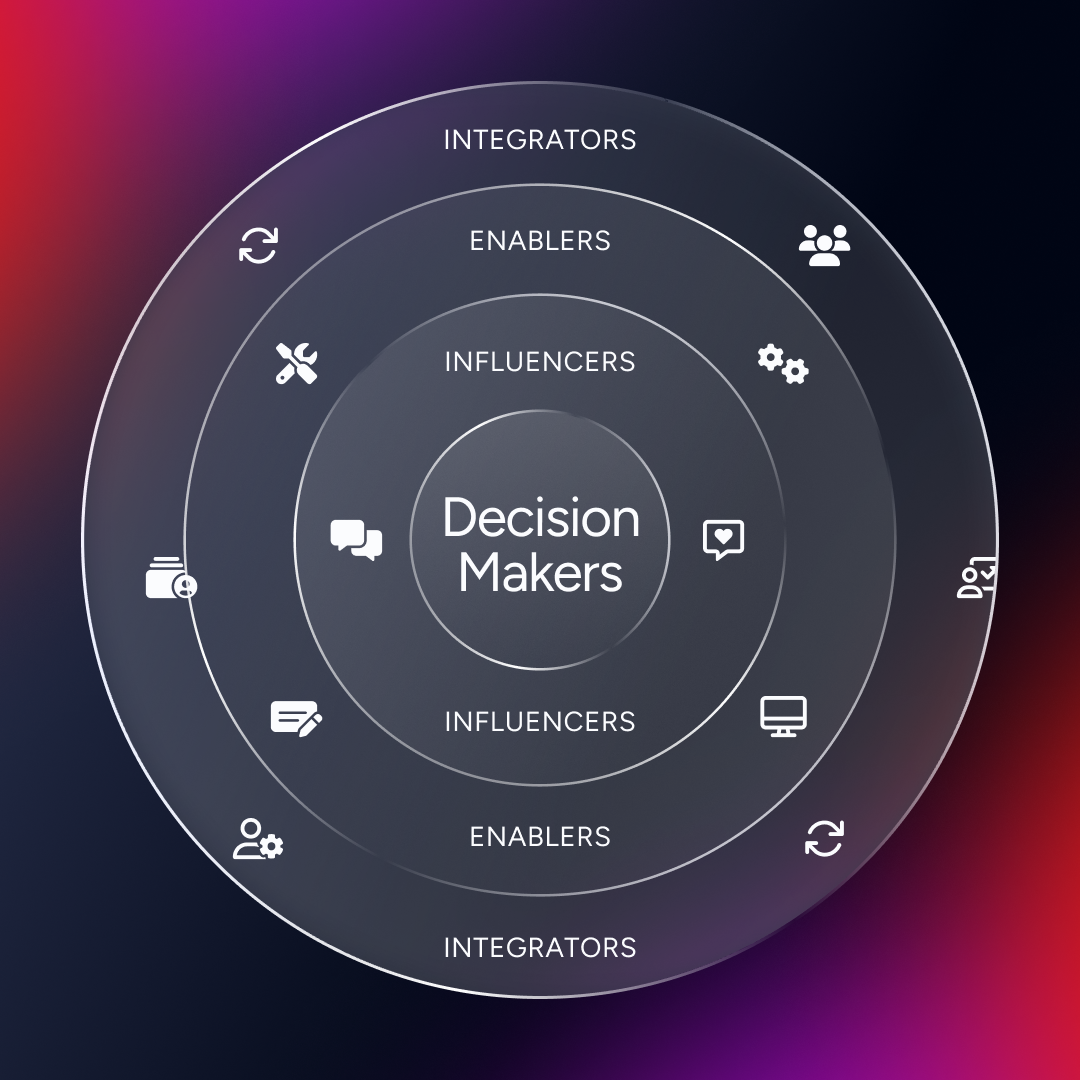
Yes, the apex decision makers matter. Think of them as the inner ring of influence, the ones who ultimately sign contracts and allocate resources. But there are multiple outer rings around them, and together they create the real power structure: the buying network.
Mapping the rings of the buyer network
Here's how to visualize the layers of a buying network:
Inner Ring: Decision Makers. Directors, VPs, and executives who approve budgets and make the final call. Critical, but not the whole story.
First Outer Ring: Influencers. The practitioners closest to the action. More specifically, sales and marketing operations managers, individual contributors, field marketing specialists, and GTM data analysts. They're the ones working with your solution day-to-day and shaping how effective it really is. Ignore them, and your solution may never even reach the inner ring.
Second Outer Ring: Enablers. The tech and operations experts, procurement specialists, and IT product owners. They might not "own" the buying decision, but they enable it. They ensure solutions can scale, integrate, and comply with internal requirements. If they're not aligned, roadblocks appear quickly.
Third Outer Ring: Integrators. External consultants, system implementers, and trusted advisors. Executives often lean on these voices to validate decisions and ensure initiatives succeed. If they haven't heard of you, or worse, if they're skeptical, your solution will struggle to gain traction.
When you engage all these rings, you're no longer chasing a title. You're cultivating network-wide awareness and advocacy. That's the difference between a stalled deal and a scalable, repeatable GTM strategy. Mapping the full buying committee across all four rings is what separates teams that close from teams that stall.
Why buying networks outperform buying committees
Focusing only on the committee is myopic. It assumes a closed circle of authority, when in reality, B2B buying is messy, dynamic, and social. Influence flows sideways, not just upward.
Influence isn't linear. It's distributed. A mid-level operations manager can veto a tool that creates inefficiencies, even if a VP approves it. This is why it's vital to engage individuals in broader rings of influence in the decision-making process; the view from the ground looks a lot different than it does from a corner office. Tracking buying signals across all these roles, not just the executive layer, gives GTM teams a far more complete picture of where a deal actually stands.
Executives may mandate usage of a solution, but true adoption is bottom-up. If practitioners don't like your solution, they won't use it. This can undermine ROI and result in lasting damage to your brand if handled poorly.
Change requires enablers. Without IT or procurement on board, your solution may stall in bureaucracy. The role of enablers becomes even more critical as solutions scale. Genuinely transformative initiatives risk significant disruption to everyday operations, making the support and buy-in of IT and procurement vital to larger deals and deployments.
Similarly, trust is largely external. Consultants and integrators often act as kingmakers, giving decision makers confidence to proceed, but executives also want to see proven track records, strong reputations, and measurable results. This kind of trust is hard-earned, making integrators a crucial part of the broader buying network.
Influence in B2B buying operates like a network effect: each additional stakeholder who understands and advocates for your solution increases the probability of a yes. Contracts are signed at the center, but won or lost at the edges.
Data as the foundation of buyer network strategy
Recognizing the buyer network is one thing. Engaging it effectively is another. This is where many GTM teams fall short: their data isn't broad, deep, or fresh enough to cover the full network. Even if they're confident in their data, many frontline teams attempt to secure the vital first-mover advantage by targeting senior executives right away, overlooking the often-significant network of individuals surrounding them.
Consider this:
Do you have accurate contacts for operations managers, ICs, and analysts? Or do you just have the VPs?
Do you know the procurement lead who will block your deal if they're not educated early?
Are you refreshing data regularly to ensure turnover doesn't erase your network map?
Too often, teams think they've mapped their Total Addressable Market when in reality, they've only mapped the tip of the iceberg. The network is bigger. To reach it, you need a trusted, enriched, and constantly refreshed data set.
That is the kind of foundation ZoomInfo, an all-in-one AI GTM Platform, provides through its GTM Context Graph: a continuously refreshed intelligence layer processing 1.5B+ data points daily across 100M+ companies and 500M+ contacts, accessible to your own AI tools and agents through APIs and MCP.
Smartsheet saw an 84% increase in MQLs and a 26% improvement in opportunity rates after building campaigns against a continuously refreshed contact universe. When your data covers the full buyer network, not just the executives, the campaign outcomes reflect it.
Why a GTM data and intelligence partner is essential
This is why a reliable GTM data and intelligence partner is critical. Even the most disciplined internal CRM team can't keep up with the pace of role changes, market shifts, and organizational complexity in modern B2B.
A strong partner provides:
Coverage across all rings of the buyer network, not just the inner circle
Accuracy to avoid wasting cycles on stale or incorrect contacts
Enrichment that connects people to hierarchies, functions, and relationships
Refreshed data so your campaigns always reach the right person, at the right time
Snowflake achieved 90% higher opportunity rates on ZoomInfo-scored accounts, a direct result of the data foundation driving smarter targeting and prioritization.
When you combine this with account-based strategies, you're not just targeting accounts, you're orchestrating network-wide experiences that build awareness before the decision maker ever sees your proposal.
How AI scales buyer network strategy
Buyer networks are complex, and mapping them manually is impossible at scale.
ZoomInfo's GTM Context Graph reasons across buying signals, org chart movements, and conversation intelligence to identify which outer-ring members are most likely to influence a decision, not by keyword matching, but by pattern-matching against signals from thousands of deal outcomes. GTM Studio lets marketers describe target audiences in plain language and launch multi-channel plays targeting the full buyer network without filing engineering tickets. GTM Workspace surfaces AI-driven outreach for sellers that addresses the specific concern each stakeholder raised, because the system understands the context behind each signal.
Together, these capabilities turn buyer network strategy from a manual research exercise into a scalable GTM motion.
What this means for GTM practitioners
If you're leading GTM strategy today, here's the reality:
Stop chasing only the apex. Directors and VPs matter, but they're not the whole picture.
Engage the rings. Influencers, enablers, and integrators can make or break your success.
Invest in data. Without an enriched, refreshed, and trusted data universe, your buyer network strategy is guesswork.
Use ZoomInfo's GTM Context Graph and GTM Studio to scale, personalize, and predict where influence flows across the full buyer network.
Ultimately, success in modern B2B isn't about securing a single signature. It's about creating a network-wide movement of awareness, trust, and advocacy that culminates in a confident "yes."
Sell to the network, not to individuals
Buying committees were the old map. Buying networks are the new reality. If you want your GTM strategy to thrive, you have to see beyond the decision maker and engage the rings of influence surrounding them.
The organizations that master buyer networks, through reliable data and scalable AI, will not only close more deals, they'll build stronger, longer-lasting customer relationships.
Because in B2B, you don't just sell to a person. You sell to a network.
Ready to map and engage your full buyer network? Request a demo to see how ZoomInfo's GTM Context Graph and GTM Studio work together.
Frequently asked questions about buying networks
What is a buying network in B2B sales?
A buying network is the full ecosystem of stakeholders who influence a B2B purchase decision, extending well beyond the formal buying committee. It includes decision makers (inner ring), practitioners and operations managers (first outer ring), IT and procurement enablers (second outer ring), and external consultants or system integrators (third outer ring). Tracking buying signals across all rings is what separates teams that see the full picture from those chasing only the executives who sign contracts.
How is a buying network different from a buying committee?
A buying committee is the formal group of decision makers with budget authority, typically directors, VPs, and C-suite executives. A buying network is broader: it includes the committee plus the practitioners, enablers, and external advisors who shape whether a solution reaches the decision table at all. Buying committee mapping focuses on identifying who approves; buying network mapping focuses on understanding who influences. Deals are often won or lost by stakeholders who never appear on the formal committee, which is why GTM strategy execution must account for the full network.
How do you map a B2B buying network?
Mapping a B2B buying network starts with identifying all four rings of influence: decision makers, practitioners, enablers, and external advisors. The practical challenge is data coverage: most CRMs capture only the inner ring. Effective mapping requires a contact database with depth across job functions, not just seniority levels, combined with intent signals that show which stakeholders are actively engaging with your category. The GTM Context Graph continuously refreshes this map so role changes and organizational shifts don't silently erase your buying network coverage.
What data do you need to engage a full buyer network?
Engaging a full buyer network requires contact coverage across all four rings, not just senior executives. That means accurate contacts for operations managers, individual contributors, procurement leads, and IT product owners, in addition to the VPs and directors most teams already track. You also need enrichment that connects people to org hierarchies and functions, and continuous data refresh so role changes don't silently erase your network map. Smartsheet increased MQLs by 84% after building campaigns against a continuously refreshed contact universe, proof that data coverage across the full buying network drives measurable outcomes.
How does AI help with buyer network strategy at scale?
AI helps by automating the analysis that would otherwise require manual research across hundreds of stakeholders. ZoomInfo's GTM Context Graph reasons across buying signals, org chart movements, and conversation intelligence to identify which outer-ring members are most likely to influence a decision. GTM Studio lets marketing teams describe target audiences in plain language and launch multi-channel plays across the full buyer network without engineering dependencies. For teams ready to operationalize this, the AI-driven sales process page walks through how these capabilities fit into a modern GTM motion.