
Choosing between Freshsales vs. Pulse CRM for your sales team often comes down to five questions:
Do you need a CRM with AI-powered lead scoring, or an all-in-one system with done-for-you setup?
Is your team technical enough to configure a CRM itself, or do you want someone to build it for you?
Are you a growing sales team that needs multiple pipelines and automated sequences, or a small business that needs CRM, email marketing, and quoting in one place?
How important is the quality of your prospect data, and where does it come from?
Do you want a tool that manages your current pipeline, or one that helps you find the right prospects to put in it?
In short, here's what we recommend:
Freshsales is the pick for growing sales teams that want CRM capability without Salesforce complexity. Built by Freshworks (NASDAQ: FRSH), it includes AI contact scoring, multi-channel sales sequences, and built-in phone and email in a platform that starts at $9/user/month. Freddy AI, the built-in assistant, scores leads, drafts prospecting emails, and flags deals at risk of stalling. For teams of 10 to 500 that need structured pipeline management with room to grow, Freshsales delivers at an accessible price.
The trade-off: features like sales sequences, multiple pipelines, and AI insights sit behind the Pro tier ($39/user/month), and the CRM is a secondary product within Freshworks' broader suite.
Pulse CRM is built for small business owners and franchise operators who want everything in one place without touching a configuration screen. For $49/month you get CRM, email marketing with unlimited sends, text message marketing, sales pipelines, quoting, project boards, and workflow automation, all included at every tier. The differentiator is Pulse's done-for-you implementation: their team builds your automations, pipelines, and workflows so you don't have to. For solo operators or small teams (1-10 people) who need a working system fast, Pulse removes the setup burden that kills CRM adoption.
The trade-offs: no AI features, reliance on Zapier and Make rather than native integrations, and a small team that delivers personal service but may struggle to scale.
Both platforms solve the same problem: organizing your sales process so leads don't slip away. But neither addresses the question that comes before pipeline management: who should be in your pipeline in the first place? Your CRM is only as good as the data feeding it. That's where a different kind of platform matters.
ZoomInfo is an AI GTM platform that lets sales reps walk into every call knowing why a deal is moving, who's championing it, and what's likely to happen next. Marketers can describe audiences in plain language and launch plays against accounts matching proven win patterns, no engineering ticket required. Leaders can see deal risk before it shows up in CRM stage fields.
That depth comes from the GTM Context Graph, an intelligence layer built on the largest B2B dataset in the industry (500M contacts, 100M companies, 135M+ verified phone numbers, and 200M+ verified business emails), unified with your CRM records, conversation transcripts, and behavioral signals.
Sales teams access this through GTM Workspace, where AI agents research accounts, draft outreach, and surface next actions. Marketers and RevOps use GTM Studio to build and launch GTM plays without engineering support, or teams can power their own tools through ZoomInfo's API and MCP. For teams that have outgrown basic CRM and need intelligence-driven prospecting, ZoomInfo fills a gap no CRM can.
If finding the right prospects matters as much as managing them, see how ZoomInfo works for your team.
Freshsales vs. Pulse CRM vs. ZoomInfo at a glance
Freshsales | Pulse CRM | ZoomInfo | |
|---|---|---|---|
Primary function | AI-powered sales CRM | All-in-one CRM + marketing | AI GTM platform |
Ideal team size | 10-500 users | 1-50 users | Mid-market to enterprise |
Starting price | $9/user/month | $49/month (1 user, 500 contacts) | Custom pricing |
AI capabilities | Freddy AI: lead scoring, email drafting, deal insights | None | GTM Context Graph, AI agents, intent signals |
Contact data source | Manual entry + basic auto-enrichment | Manual entry + form capture | 500M contacts, 200M+ verified emails |
Sales sequences | Multi-channel sequences (Pro tier, $39/user) | Email/SMS nurture campaigns | AI-drafted outreach via GTM Workspace |
Pipeline management | Multi-pipeline Kanban with stale deal detection | Lead, Sales, and Client pipelines | Book-of-business with AI prioritization |
Free option | Free plan (3 users) + 21-day trial | Free trial (credit card required) | ZoomInfo Lite (permanent, free) + 7-day trial |
Integrations | 1,200+ marketplace apps | Zapier, Make, API | 120+ native integrations + API/MCP |
Pipeline management: three approaches to the same problem
All three platforms let you track deals through stages. How they do it reveals what each prioritizes.
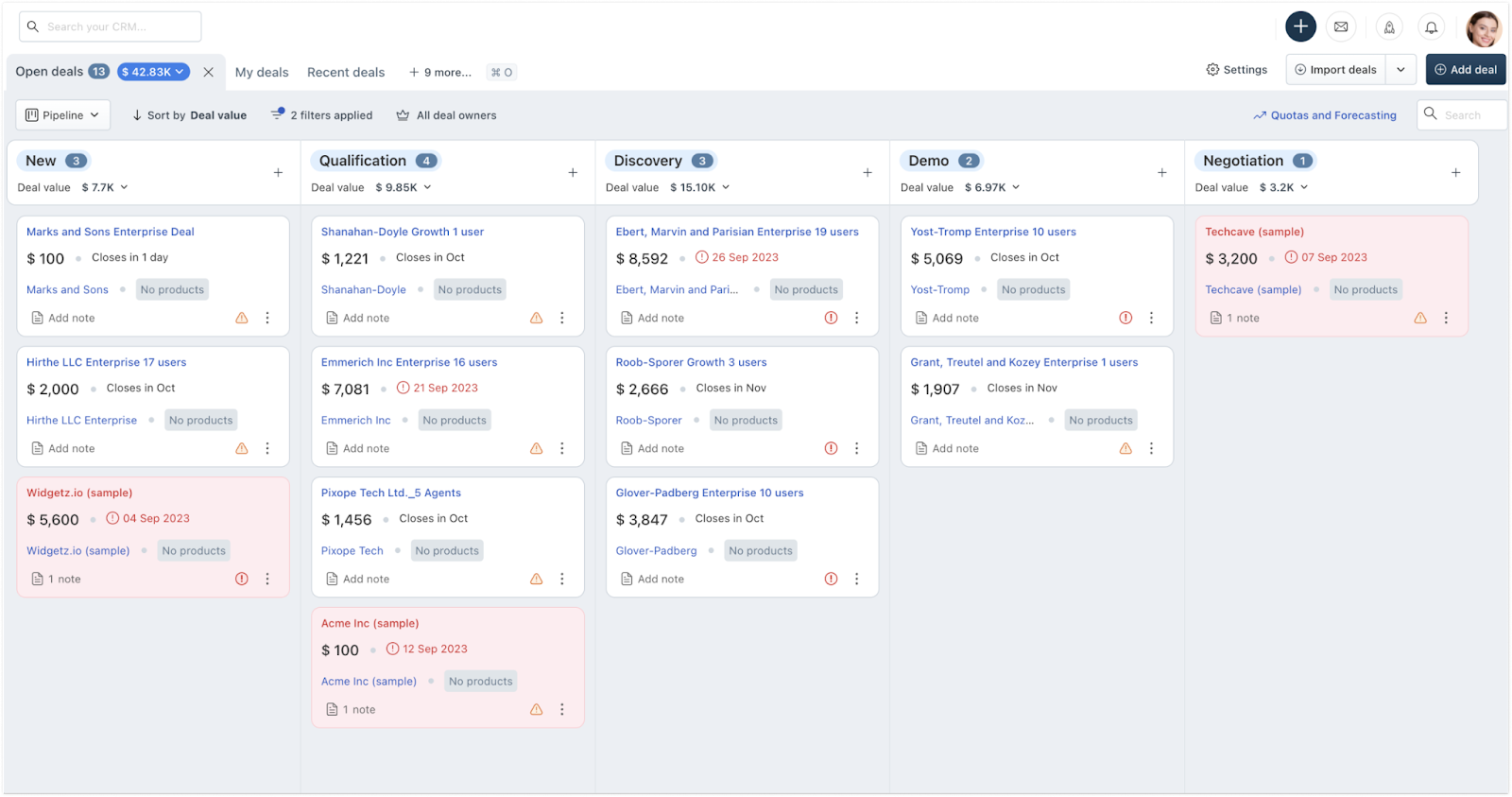
Freshsales offers the most traditional CRM pipeline experience. Deals move through customizable stages with close-probability percentages, displayed in Kanban or table view. The table view fits up to 100 deals on screen without scrolling. A stale deal detection feature flags deals that have sat too long, turning their cards red so reps know what needs attention. On Pro and Enterprise plans, Freddy AI tags each deal as Likely to Close, Trending, At Risk, or Gone Cold, then suggests the next action. Multiple pipelines are available from the Pro tier ($39/user/month), which is where most growing teams will land.
Source: Freshworks
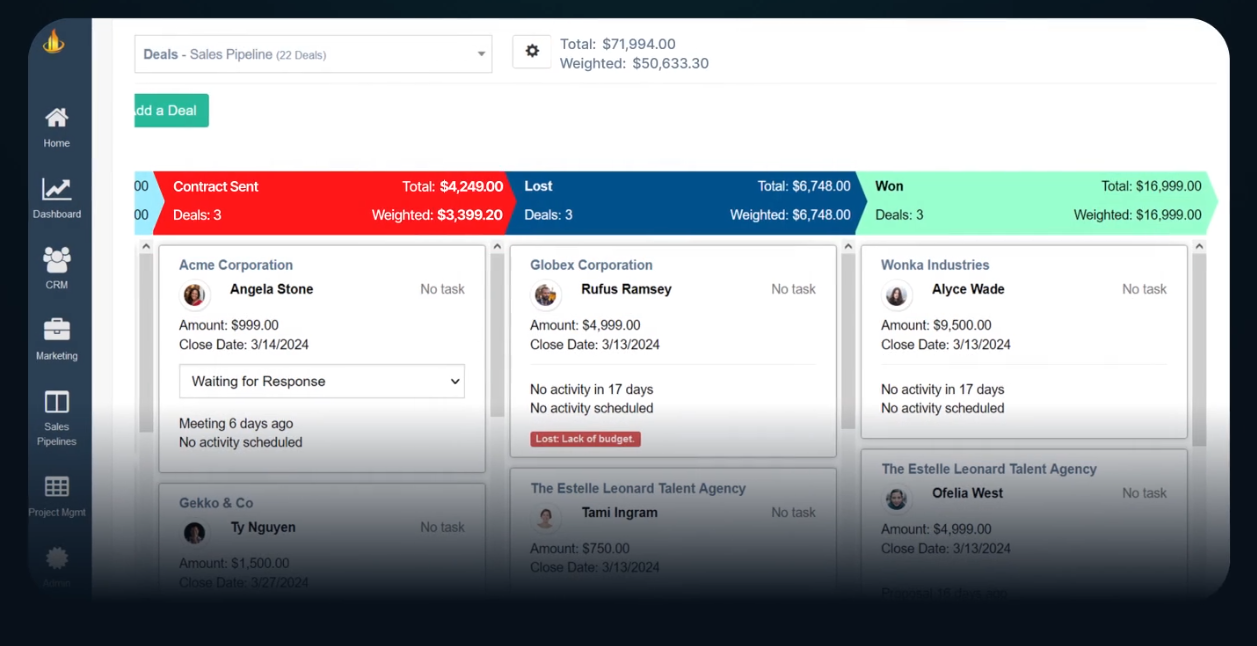
Pulse CRM takes a lifecycle approach with three pipeline types: Lead Pipelines for pre-qualification, Sales Pipelines for active deal management, and Client Pipelines for post-sale project tracking. Most SMB CRMs offer a single linear pipeline. Pulse gives small businesses a framework covering the full customer journey in one view. Each Deal Record acts as a hub for sales activities, letting reps send emails and texts directly from the record. Stage-weighted sales forecasting is built into the pipeline view, and Won and Lost Reason tracking surfaces patterns over time. Permission controls restrict who can view or edit specific pipeline data, useful for franchise and multi-team setups.
Source: Pulse CRM
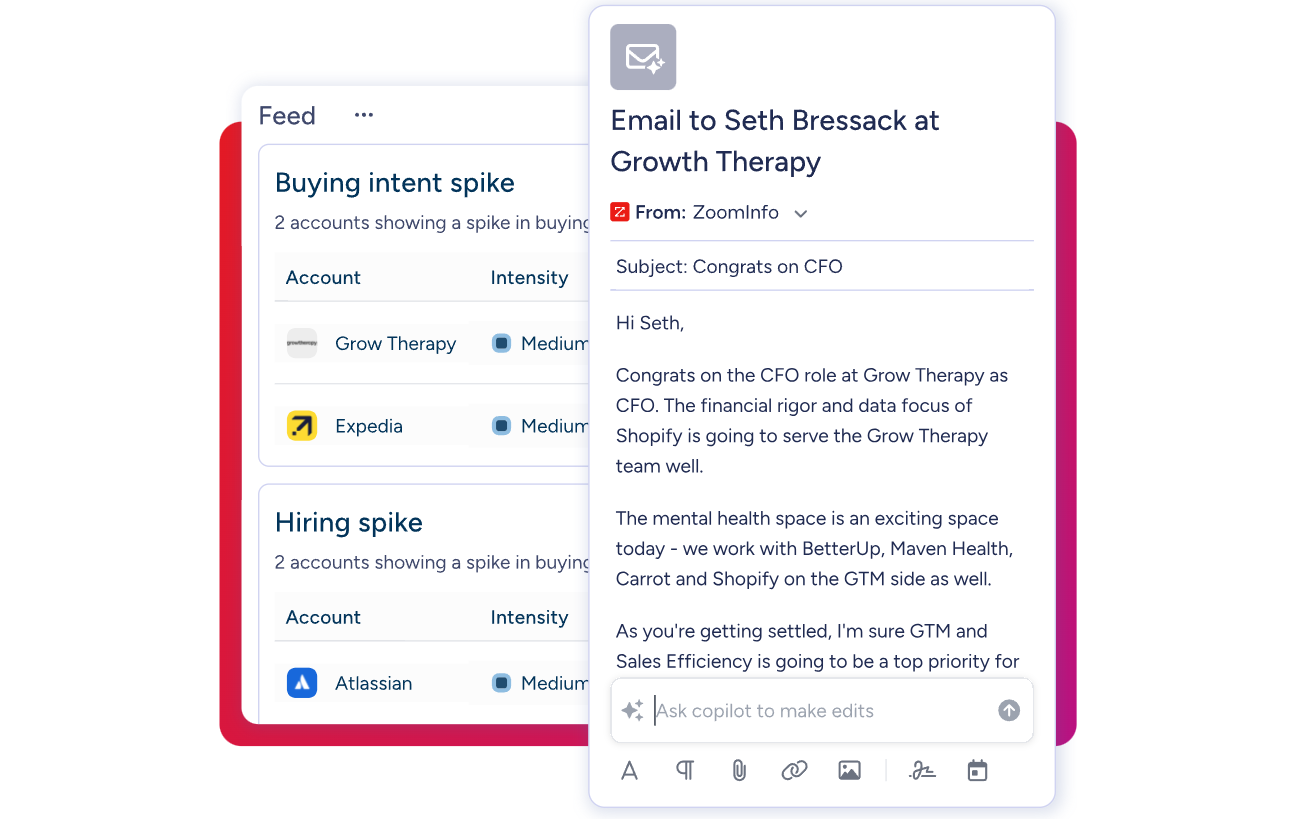
ZoomInfo works differently because it starts upstream. GTM Workspace gives sellers a book-of-business view combining CRM data, ZoomInfo's B2B intelligence, conversation history, and market signals in one place. Rather than waiting for deals to appear in a pipeline, the Action Feed streams in-market buyers matched to your target criteria, with pre-drafted actions on every signal. AI agents handle account research, CRM updates, and signal monitoring. The difference: Freshsales and Pulse show you deals you already have. ZoomInfo helps you find deals you're missing.
Automation and sales engagement
The gap between these platforms widens when you look at how each handles outreach and follow-up.
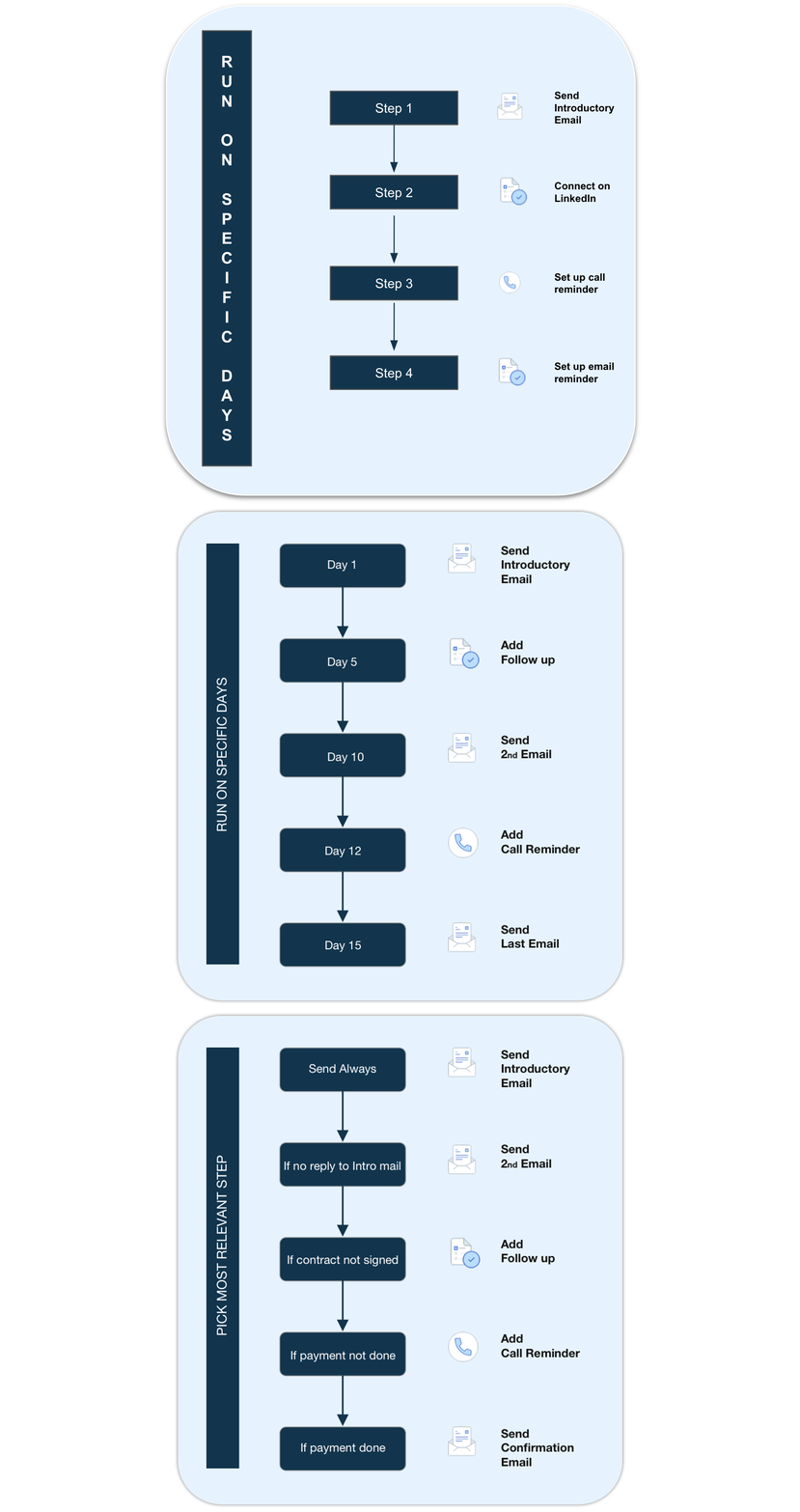
Freshsales embeds email, phone, and chat inside the CRM on every plan, including Free. The deeper engagement layer is Sales Sequences (Pro and Enterprise): automated multi-step cadences mixing email, call reminders, SMS, and tasks. Three sequence types cover different use cases. Classic sequences run on fixed day-offsets for prospecting campaigns. Smart sequences re-evaluate conditions each cycle for onboarding flows. Outbound sequences execute steps based on prior step outcomes.
LinkedIn tasks can be embedded as sequence steps, and Freddy AI drafts prospecting emails on Pro and above. A Bring Your Own Carrier option lets teams keep existing phone contracts while using Freshworks' call recording and monitoring. Sequence limits apply: Pro allows 10 sequences per user and 1,000 sequence emails per month; Enterprise allows 25 sequences and 2,000 emails.
Source: Freshworks
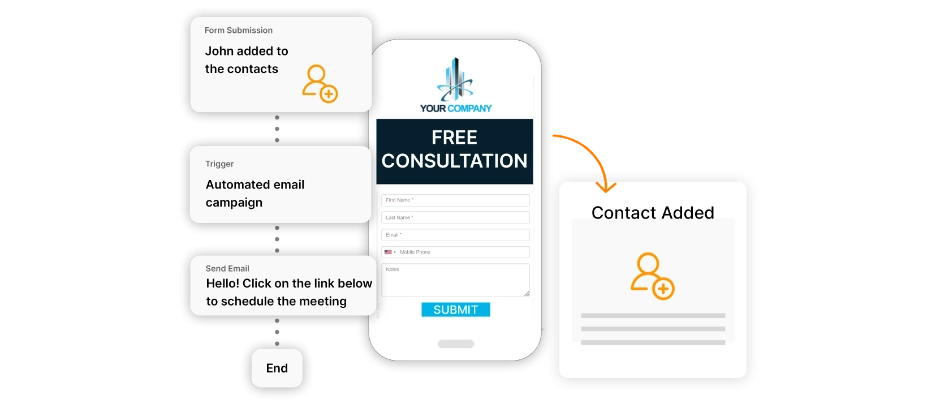
Pulse CRM handles automation through trigger-based workflows that fire when pipeline stages change, quotes are approved, or customers take specific actions. The system spans email and SMS, with all history stored in the contact record. Where Pulse stands out is post-sale automation: customer onboarding workflows trigger welcome emails, create project board tasks, and send milestone updates without manual work.
All plans include unlimited email sends, removing the send-volume cost pressure that makes some tools expensive at scale. The trade-off is sophistication. Pulse lacks the multi-step sequence logic, conditional branching, and LinkedIn integration that Freshsales provides. It's designed for businesses that need reliable automation without complexity.
Source: Pulse CRM
ZoomInfo approaches engagement from the intelligence layer up. GTM Workspace AI agents research accounts, draft outreach, monitor signals, and suggest next actions, all informed by the GTM Context Graph. The outreach isn't just personalized by name and company. It's shaped by what the buyer's organization is doing: hiring patterns, technology changes, funding events, and competitive research activity.
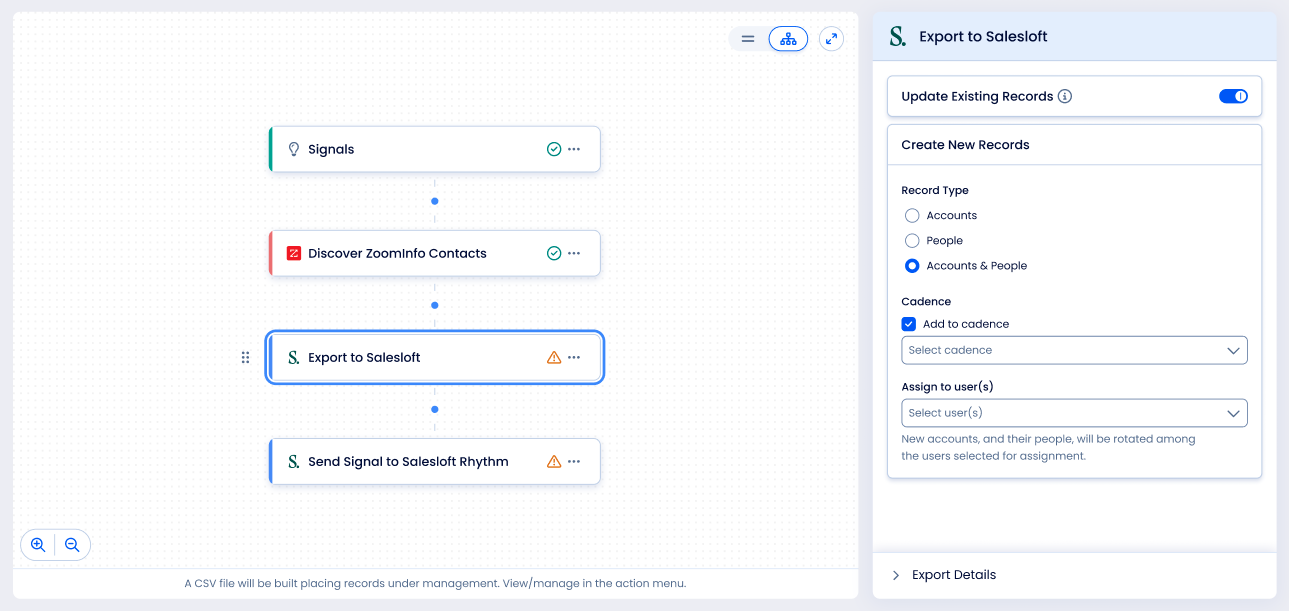
ZoomInfo's partnership with Salesloft provides the sequencing and multi-channel execution layer, with buying signals syncing to Salesloft Rhythm for AI-prioritized engagement. ZoomInfo doesn't replace your CRM's outreach tools. It makes them smarter by ensuring reps contact the right person with the right message at the right time.
Redwood Logistics cut cost-per-click by 99% and increased clickthrough rate by 310% using ZoomInfo's data to reach the right prospects across the full buyer journey, saving 20-25 hours per week. (Redwood Logistics)
Where your prospect data comes from matters more than how you organize it
This is the question neither Freshsales nor Pulse CRM fully answers: where do your contacts come from?
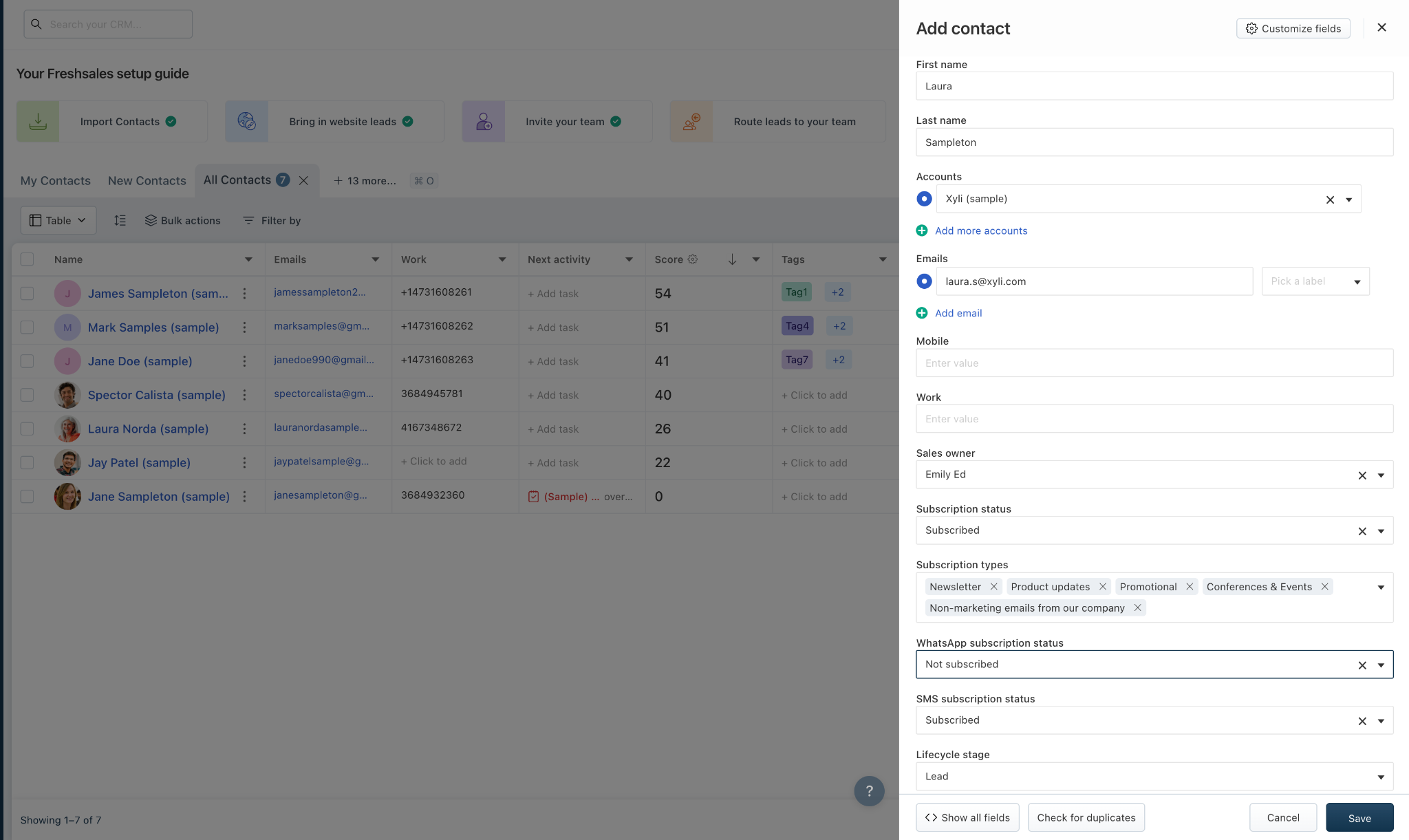
Freshsales offers basic auto-enrichment: enter an email address and the system pulls social profiles and display pictures. Provide a company URL and it fetches the logo, address, and employee count. That fills in blanks on contacts you already have, but it doesn't help you find contacts you don't have. Leads enter Freshsales through manual entry, CSV imports, website tracking code, or incoming conversations. The system manages whatever data you bring to it.
Source: Freshworks
Pulse CRM follows a similar model. Contacts enter through manual creation, form submissions, or email parsing. The Lead Creation via Email feature extracts lead data from inbound email notifications, helpful for businesses receiving leads from third-party directories. But Pulse offers no contact database, no enrichment from external sources, and no way to discover new prospects beyond what comes to you organically.
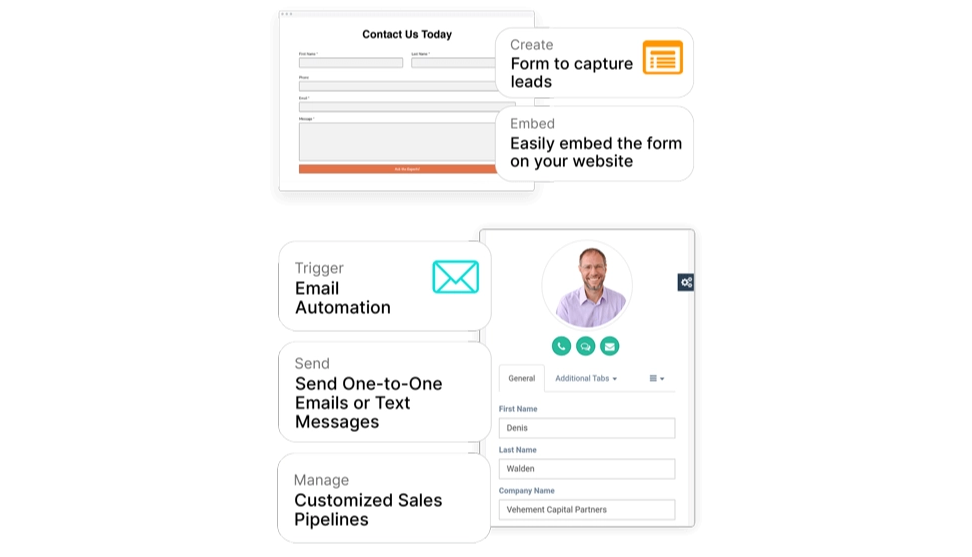
Source: Pulse CRM
Both platforms are containers. They organize, track, and automate around contacts you already have. If your lead sources are strong, that's enough. If they're not, no CRM will fix a weak pipeline.
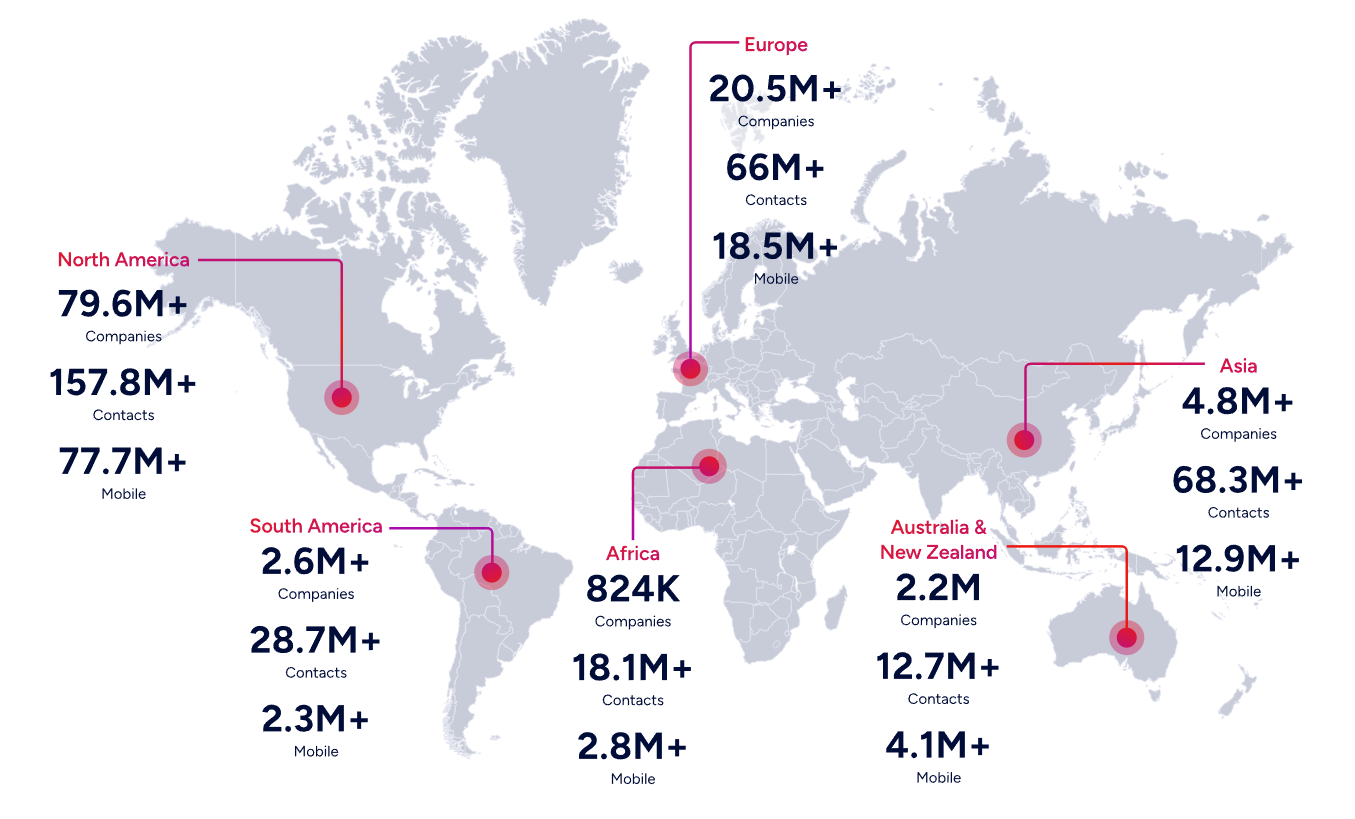
ZoomInfo exists to solve this problem. The platform maintains 500M contacts across 100M companies, with 120M direct-dial phone numbers and 200M+ verified business email addresses. That data is verified through multiple sources: automated ML scanning of 28 million site domains daily, a community of 200,000+ ZoomInfo Lite users who share data back, and an in-house Data Training Lab of 300+ human researchers. First-party data reaches up to 95% accuracy. In a Fortune 500 competitive RFP analyzing 25 million contacts across vendors, the independent consultant concluded that "no other competitor came even close."
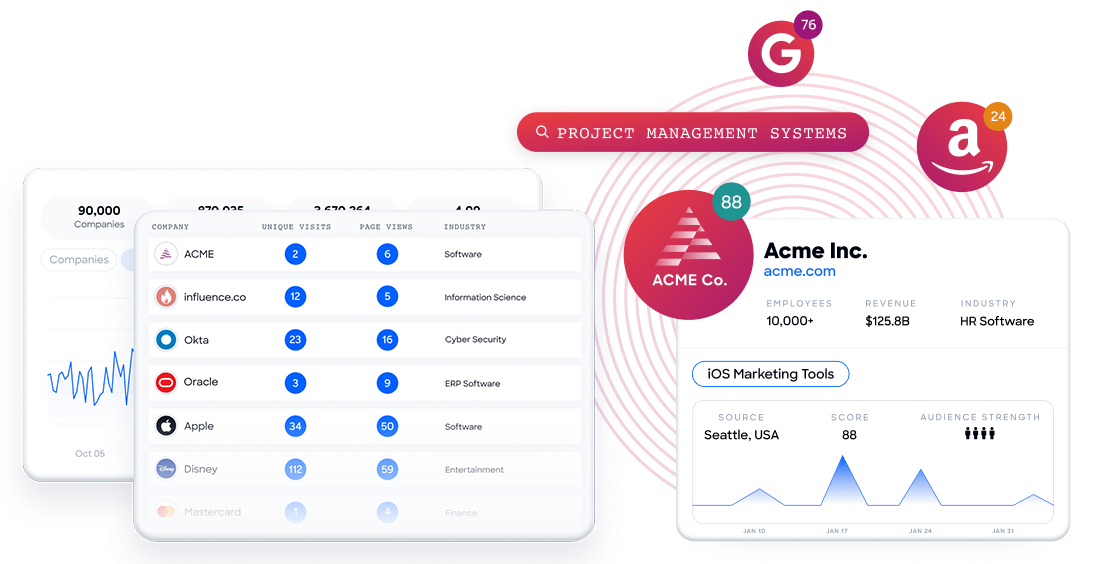
Beyond contacts, ZoomInfo adds dimensions CRMs can't provide. Buyer Intent data tracks signals from 210 million IP-to-Organization pairings and 6 trillion+ new keyword-to-device pairings sourced monthly. Technographics profile the tech stacks of 30+ million companies across 30,000+ technologies. Website visitor identification resolves anonymous traffic to companies. These signals tell you not just who to contact, but when they're researching solutions like yours.
Vensure scaled prospecting by replacing manual research across spreadsheets with ZoomInfo's data, freeing their revenue operations team to execute instead of digging for information. (Vensure)
AI capabilities separate the tiers
AI is where the three platforms diverge most.
Freshsales has Freddy AI, a solid AI offering for a CRM at this price point. Freddy assigns every contact a score from 0-99 based on admin-defined signals and its own ML algorithms, auto-tagging top-scored contacts as Product Qualified Leads. Deal Insights tag opportunities as Likely to Close, At Risk, or Gone Cold, surfacing the top signal behind each prediction alongside a next-action suggestion. Freddy also drafts sales emails, rephrases copy, and resolves duplicate contacts. Reps can mark Freddy's predictions as accurate or inaccurate, and Freddy uses that input to improve over time. AI scoring and email features require the Pro plan ($39/user/month); Forecasting Insights are Enterprise-only ($59/user/month).

Source: Freshworks
Pulse CRM has no AI features. No predictive scoring, no AI-generated content, no deal risk detection. Automation is entirely rule-based, relying on triggers like pipeline stage changes and form submissions. For small businesses with straightforward sales processes, this may not matter. For teams that want data-driven prioritization, it's a gap that will grow as competitors invest in AI.
ZoomInfo operates AI at a different scale. The GTM Context Graph processes 1.5B+ data points daily, combining ZoomInfo's third-party data with a customer's CRM records, conversation transcripts from Chorus, email threads, and behavioral signals.
Where Freddy AI scores contacts based on CRM activity, ZoomInfo's intelligence layer captures why deals move: it connects executive sponsorship entering a call, competitor mentions in conversations, and intent signals from third-party research into a layer that surfaces what happens next. GTM Workspace AI agents act on this intelligence, generating 1-click account briefs, drafting contextual outreach, and surfacing buying group members a CRM would never identify. Guided Intent, exclusive to ZoomInfo, identifies topics historically correlated with deal success rather than requiring manual topic selection.
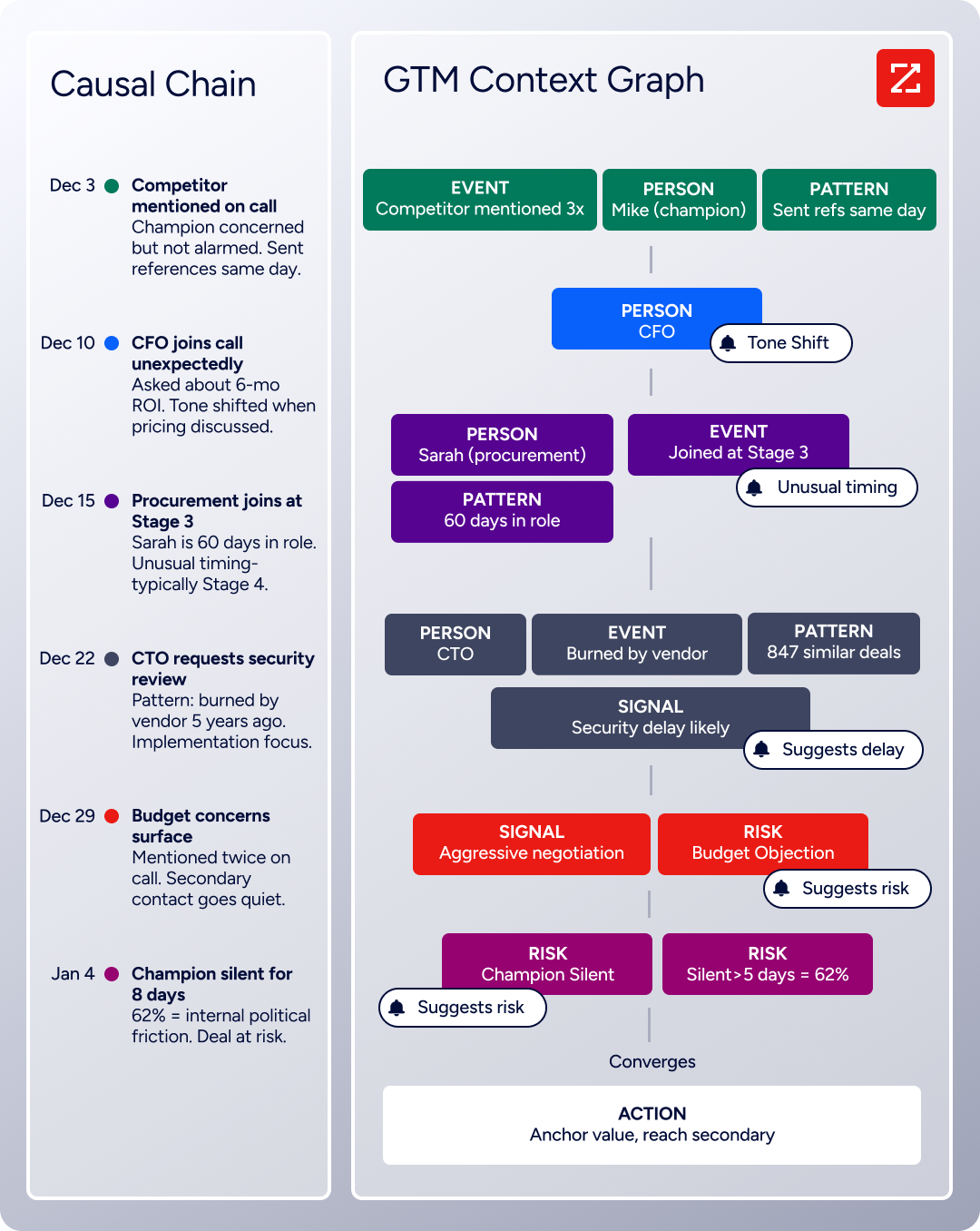
Freshsales' AI works within the CRM's existing data. ZoomInfo's AI draws from the largest B2B dataset in the industry and reasons across first-party and third-party signals simultaneously. They solve different problems at different depths.
Seismic attributed 39% of active pipeline to opportunities identified or influenced by ZoomInfo signals, with their sales team becoming 54% more productive after combining internal CRM data with ZoomInfo's external intelligence. (Seismic)
Pricing reflects different markets
Each platform's pricing tells you who they're building for.
Freshsales uses per-seat pricing across four tiers:
Free: $0 for up to 3 users. Includes Kanban views, built-in phone and chat, email templates. No workflows, no AI, no sequences.
Growth: $9/user/month (billed annually). Adds lifecycle stages, workflows, product catalog, curated reports, 1 CPQ license, and Slack integration.
Pro: $39/user/month. Adds Freddy AI scoring and deal insights, AI email writing, sales sequences, multiple pipelines, territory management, auto-assignment rules, and custom reports.
Enterprise: $59/user/month. Adds custom modules, field-level permissions, AI forecasting, sandbox environment, and audit logs.
The jump from Growth to Pro is where most teams will feel pressure. Sequences, multiple pipelines, AI features, and custom reports are all Pro-gated. A 20-person team on Pro pays $780/month, reasonable for what you get but a real step from the $180/month Growth pricing. Important contract detail: Freshworks' Terms of Service state that customers on paid plans cannot reduce user count or downgrade during the active subscription term. Subscriptions auto-renew, and fees are non-refundable.
Pulse CRM uses flat monthly pricing based on users and contacts:
Starter: $49/month (1 user, 500 contacts)
Growth: $119/month (3 users, 1,000 contacts)
Pro: $199/month (5 users, 10,000 contacts)
Annual billing saves 25%. Every plan includes every feature: CRM, email marketing (unlimited sends), text marketing, sales pipelines, quoting, project boards, automation, and reporting. Additional users cost $15/month each; additional contacts are $50/month per 5,000. No contracts, cancel anytime with 7 days' notice. Franchise pricing requires a separate conversation.
For a 5-person team, Pulse Pro costs $199/month. The same team on Freshsales Pro costs $195/month. At similar prices, the choice comes down to whether you value Freshsales' AI and deeper CRM features or Pulse's broader toolset (quoting, project boards, email marketing) with simpler implementation.
ZoomInfo uses consumption-based pricing with no published prices. Costs scale with user seats, credit volume, features, and contract length. This reflects ZoomInfo's enterprise positioning: the platform is an investment in pipeline quality, not a monthly software expense. ZoomInfo Lite provides a permanent free tier with 10 monthly export credits and access to the B2B database. A 7-day free trial gives access to the full platform.
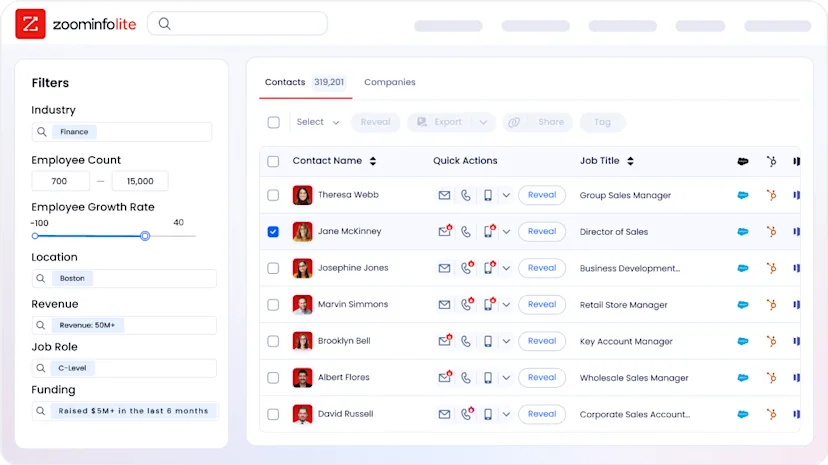
ZoomInfo costs more than either CRM. The question is whether the intelligence it provides generates enough pipeline to justify the investment. Thomson Reuters increased closed-won deals by 40% using GTM Workspace. Snowflake saw 200% higher conversion rates on accounts monitored with ZoomInfo-powered scores. At that scale, the return is clear.
Support and onboarding shape adoption
The best sales platform is the one your team actually uses. Support and onboarding determine whether that happens.
Freshsales provides 24x5 support via phone, email, and chat on all paid plans, including the $9/month Growth tier. A 21-day free trial with no credit card lets teams evaluate before committing. Self-service resources include Freshworks Academy (training and certification), a Community forum, and interactive product tours. The learning curve is moderate: teams migrating from spreadsheets will get productive quickly, but configuring custom modules, advanced workflows, and territory management takes time.
Pulse CRM leads with its done-for-you implementation. The team builds automations, pipelines, and workflows for each customer. Phone support is available during business hours (9AM-5PM ET, Monday-Friday). A dedicated learning portal, downloadable resources like the 30-Minute CRM Tune-Up Toolkit, and live demos round out the onboarding experience. For non-technical business owners, this hands-on approach cuts time to value. The limitation is scale: reviewers on G2 note occasional delays during high-demand periods, a natural constraint for a lean team.
ZoomInfo invests heavily in onboarding. The company redesigned its program from 30 to 90 days, structured across planning, technical implementation, education, and adoption phases, producing a 25% improvement in customer satisfaction scores. ZoomInfo University provides role-specific learning paths, certifications, and on-demand courses. Enterprise tiers include dedicated customer service managers and hands-on onboarding. The platform has more to learn, but the resources behind it reflect a company with $1.25 billion in annual revenue and infrastructure to support its customer base.
Smartsheet relies on ZoomInfo as their single source of truth for account and contact data, calling it essential to understanding their market and connecting with prospects. (Smartsheet)
Freshsales vs. Pulse CRM vs. ZoomInfo: Which should you choose?
The right choice depends on what's actually limiting your sales team today.
Choose Freshsales if:
You need a sales CRM with AI-powered lead scoring and deal insights
Your team is 10-500 people and needs structured pipeline management
Multi-channel sales sequences (email, phone, SMS, LinkedIn) are central to your process
You want a CRM backed by a publicly traded company with 1,200+ marketplace integrations
You can work within per-seat pricing and are comfortable with Pro-tier features at $39/user/month
Choose Pulse CRM if:
You're a small business owner or franchise operator who needs CRM, email marketing, quoting, and project management in one subscription
You want someone to build your automations and pipelines for you
Your team is 1-10 people and doesn't need AI features
All-inclusive pricing with no per-module charges fits your budget
You value simplicity and fast setup over advanced customization
Add ZoomInfo if:
Your biggest challenge isn't managing your pipeline, it's filling it with the right prospects
You need verified contact data, direct dials, and business emails at scale
Buyer intent signals and account intelligence would change how your team prioritizes outreach
You want AI that reasons across your CRM data, conversations, and third-party signals to surface what to do next
You're ready to invest in a platform that makes your CRM and sales tools more effective
Explore ZoomInfo Lite for free, or request a demo to see the full platform.
Freshsales and Pulse CRM are both capable tools for their target audiences. But the question worth asking isn't which CRM has more features. It's whether your bottleneck is pipeline management or pipeline generation. If you already have strong lead sources and need a better system to manage them, either CRM can deliver. If you need to find better prospects, understand their buying signals, and reach them before your competitors do, that's a problem only a platform like ZoomInfo is built to solve.
Freshsales vs. Pulse CRM vs. ZoomInfo FAQ
What is the core difference between Freshsales, Pulse CRM, and ZoomInfo?
Freshsales is a sales CRM with AI lead scoring, multi-channel sequences, and pipeline management for growing teams of 10 to 500. Pulse CRM bundles CRM, email marketing, quoting, and project boards with done-for-you implementation for small businesses and franchises with 1 to 50 users. ZoomInfo is an AI GTM platform with 500M contacts, buyer intent signals, and AI-driven account intelligence. It operates upstream of your CRM, solving the prospect-finding problem rather than the pipeline-management problem.
Which platform is cheapest for a small sales team?
Freshsales offers the lowest entry point at $9/user/month on the Growth plan, though features like AI scoring and sales sequences require Pro at $39/user/month. Pulse CRM starts at $49/month for 1 user with all features included, and $199/month covers 5 users with 10,000 contacts. For a 5-person team needing full features, Freshsales Pro costs $195/month and Pulse Pro costs $199/month. ZoomInfo uses consumption-based pricing with no published rates, though its permanent free tier (ZoomInfo Lite) gives individuals access to the B2B database with 10 monthly exports at no cost.
Does Pulse CRM have AI features like Freshsales?
No. Pulse CRM has no AI capabilities. Its automation is rule-based, relying on triggers like pipeline stage changes and form submissions. Freshsales includes Freddy AI on the Pro plan and above, offering contact scoring on a 0-99 scale, deal insights with next-action suggestions, email drafting, and forecasting. ZoomInfo's AI operates at a broader scale, reasoning across CRM data, conversation intelligence, and third-party signals through its GTM Context Graph.
Can ZoomInfo replace my CRM?
ZoomInfo is not designed to replace a CRM. It integrates with CRMs like Salesforce, HubSpot, and Microsoft Dynamics to enrich contact records, surface buying signals, and power AI-driven outreach. GTM Workspace gives sellers a workspace that reduces context-switching between tools, but the CRM remains the system of record for deals and pipeline. ZoomInfo is most valuable as the intelligence layer that makes your CRM data more complete and actionable.
Which platform is best for franchise businesses?
Pulse CRM has the most specific franchise capabilities, including corporate-to-franchisee lead distribution by geography (zip code, census tract), pre-built automation templates pushed from corporate accounts, and consolidated reporting across all locations. Freshsales does not offer franchise-specific features. ZoomInfo is not franchise management software, but its data and territory management filters can help franchise sales teams identify prospects by location, industry, and company size.
How do the platforms handle integrations?
Freshsales connects to 1,200+ apps through the Freshworks Marketplace, including QuickBooks, DocuSign, Shopify, and native Freshdesk integration. Pulse CRM integrates via Zapier, Make, and its own API, accessing thousands of apps through middleware rather than native connections. ZoomInfo offers 120+ native integrations, an Enterprise API, and a Model Context Protocol (MCP) server that connects AI models directly to ZoomInfo's data. ZoomInfo integrates natively with Salesforce, HubSpot, Microsoft Dynamics, Salesloft, Outreach, and other GTM tools.
Which platform has the strongest data security and compliance?
ZoomInfo holds ISO 27001, ISO 27701, SOC 2 Type II, TRUSTe GDPR and CCPA validations, all renewed annually. Freshsales (via Freshworks) holds ISO 27001, ISO 27701, SOC 2 Type 2, SOC 1 Type 2, PCI DSS v4.0, and CSA STAR Level 1 certifications, with data hosted on AWS using AES-256 encryption. Pulse CRM's privacy policy states it uses "commercially acceptable means" to protect data, but no formal compliance certifications are documented publicly. For regulated industries, Freshsales and ZoomInfo both meet enterprise security standards.
Do I need ZoomInfo if I'm already using Freshsales or Pulse CRM?
If your team struggles to find the right prospects, reach decision-makers with verified contact information, or know when accounts are in-market, ZoomInfo fills gaps neither CRM addresses. Freshsales offers basic contact auto-enrichment but no prospecting database. Pulse CRM relies entirely on contacts you bring to it. ZoomInfo provides the upstream intelligence (who to target, when to engage, what they care about) that makes whichever CRM you use more effective.
More Freshsales comparisons:
