
Comparing Freshsales vs. Zoho CRM for your sales team comes down to five questions most reviews skip:
Do you need a CRM you can set up in a day, or one you can customize for years?
Is your team small enough to benefit from simplicity, or large enough to need enforced sales processes?
Do you want an affordable starting point, or a platform that scales into a full business operating system?
How important is AI that goes beyond scoring leads to predicting outcomes and automating follow-up?
Are you comparing CRMs when what your team really needs is better data?
In short, here's what we recommend:
Freshsales is the right CRM for small sales teams that want to start selling quickly without a heavy setup. Built by Freshworks, it bundles phone, email, and chat into every plan (including the free tier), adds Freddy AI for lead scoring and email drafting on higher plans, and starts at $9/user/month.
For teams migrating from spreadsheets or outgrowing a basic CRM, Freshsales delivers quick returns and enough automation to keep a small team productive.
The tradeoff is depth: features like sales sequences, multiple pipelines, and AI deal insights sit behind the Pro tier at $39/user/month, and customization runs thin compared to more established platforms.
Zoho CRM serves companies that want Salesforce-level capabilities without Salesforce pricing. With 55+ applications spanning CRM, finance, HR, and marketing, Zoho offers a single-vendor ecosystem that can run an entire business.
The CRM is configurable: Blueprint enforces sales processes step by step, Zia AI covers everything from lead scoring to autonomous sales agents, and Canvas Design Studio lets admins rebuild the interface without writing code.
At $14–$52/user/month, Zoho delivers more features per dollar than most competitors. But that depth requires setup and configuration before it pays off.
Both platforms are capable CRMs. But they share a limitation: they can only work with the data your team puts into them. A CRM with empty fields, outdated contacts, and no visibility into buyer intent is an expensive address book. That's the problem ZoomInfo solves.
ZoomInfo is a go-to-market intelligence platform built on 500M contacts, 100M companies, 135M+ verified phone numbers, and 200M+ verified business emails. Instead of waiting for reps to enter contacts and log activities manually, ZoomInfo starts with verified data.
Its GTM Context Graph combines this data with your CRM records, conversation transcripts, and behavioral signals to reveal not just what's happening in your pipeline, but why deals move or stall.
Sellers access this intelligence through GTM Workspace, marketers and RevOps through GTM Studio, and custom tools through APIs and MCP.
If your team needs a sales pipeline built on verified data and real-time buyer signals, see how ZoomInfo works.
Freshsales vs. Zoho CRM vs. ZoomInfo at a glance
Freshsales | Zoho CRM | ZoomInfo | |
|---|---|---|---|
Primary function | Sales CRM | CRM + business platform | GTM intelligence platform |
Starting price | Custom-quoted | ||
Free plan | Up to 3 users | Up to 3 users | (permanent, no time limit) |
AI engine | Freddy AI (scoring, email writing, deal insights) | Zia AI (predictive, generative, agentic) | GTM Context Graph (connects signals across deals) |
B2B contact database | Auto-enrichment from email/URL | Enrichment via Zia | |
Buyer intent signals | None | None | |
Sales engagement | Sales Sequences (Pro+) | Cadences (Standard+) | GTM Workspace + Salesloft integration |
Ecosystem | Freshworks suite (~6 products) | 120+ integrations + API/MCP access | |
Best for | SMBs wanting fast CRM setup | Mid-market wanting customization | Teams that need verified data and buyer intelligence |
Your CRM is only as good as the data inside it
This is the gap most Freshsales vs. Zoho comparisons miss.
Both platforms offer contact auto-enrichment. Freshsales pulls social profiles and display pictures from an email address, and populates company logos, addresses, and headcounts from a website URL. Zoho CRM enriches records through Zia and third-party connectors. These features fill in details on contacts you already know about.
But neither platform tells you who you should be selling to in the first place.
ZoomInfo approaches the problem from the opposite direction. Instead of enriching records after a rep creates them, ZoomInfo provides the records.
The platform covers 500M contacts and 100M companies, verified through a multi-source process backed by 300+ human researchers and achieving up to 95% accuracy on first-party data.
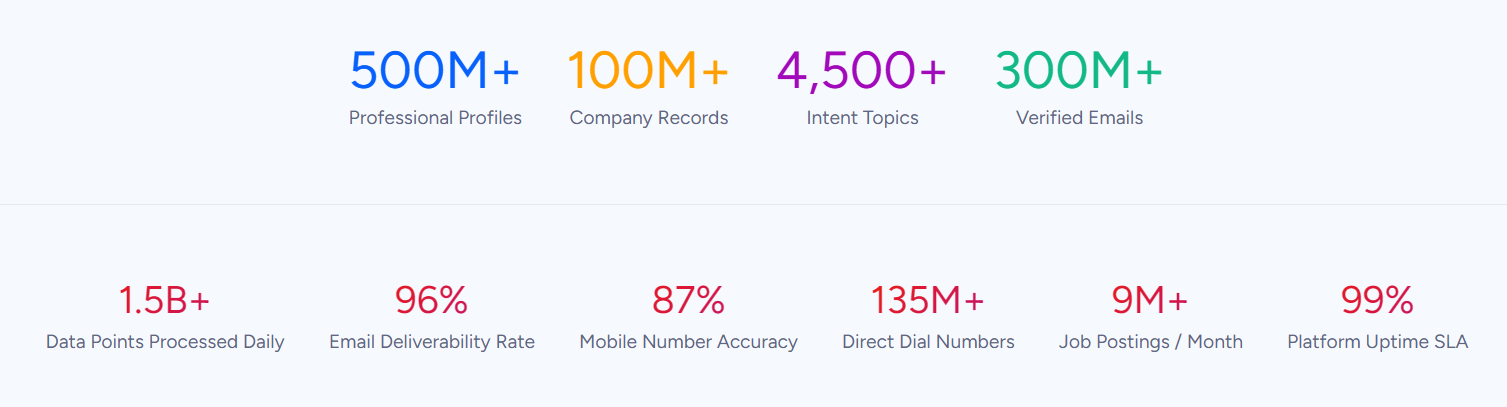
That verification matters when reps act on the data: 120M direct-dial phone numbers mean reps reach decision-makers instead of gatekeepers, and 200M+ verified business emails mean outbound sequences land in inboxes instead of bouncing.
The difference compounds over time. A sales team using Freshsales or Zoho builds its pipeline contact by contact, relying on inbound leads, trade shows, and manual research.
A team using ZoomInfo starts each quarter with a verified map of its entire addressable market, including technographic data on 30,000+ technologies across 30M+ companies, org charts showing who reports to whom, and buyer intent signals showing which accounts are researching solutions right now.
In a Fortune 500 competitive RFP analyzing 25 million contacts across vendors, an independent consultant concluded that "no other competitor came even close" to ZoomInfo's data quality and coverage.
"ZoomInfo gives us the information we need to execute. We don't have to go through and spend our time digging. It's already there, so we can be three steps ahead." (Vensure)
AI capabilities take three distinct approaches
All three platforms invest in AI, but they solve different problems with it.
Freshsales' Freddy AI focuses on making individual rep workflows faster. Freddy scores contacts on a 0 to 99 scale using configurable signals across contact properties, account firmographics, and engagement activity.
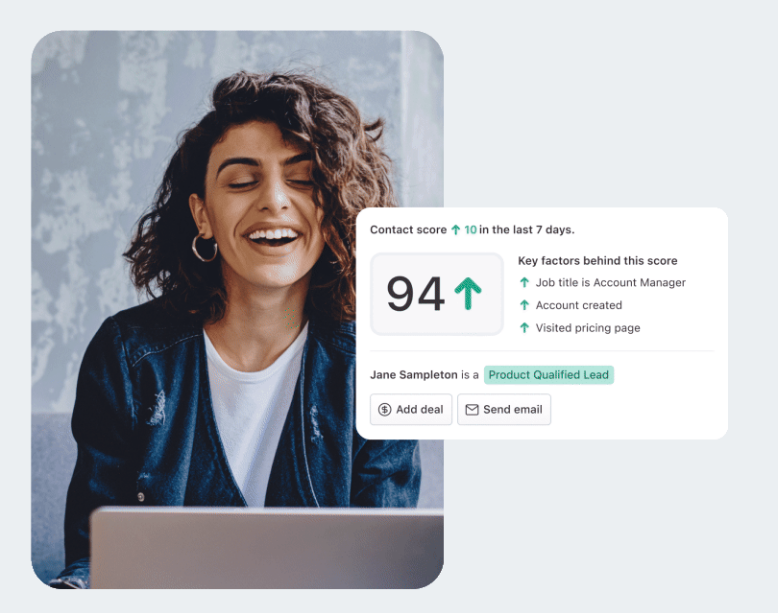
It tags deals as Likely to Close, Trending, At Risk, or Gone Cold based on historical patterns, then suggests next actions like sending an email or scheduling a call. On the Pro plan ($39/user/month), Freddy can draft sales emails, rephrase text, and expand copy.
These are practical features for daily selling, but they operate within the boundaries of whatever data exists in the CRM.
Zoho's Zia AI is broader. Beyond lead scoring and deal prediction, Zia offers email sentiment analysis across eight emotion categories, automatic call transcription with intent extraction, competitor mention alerts with sentiment context, and anomaly detection that flags deviations in sales metrics.
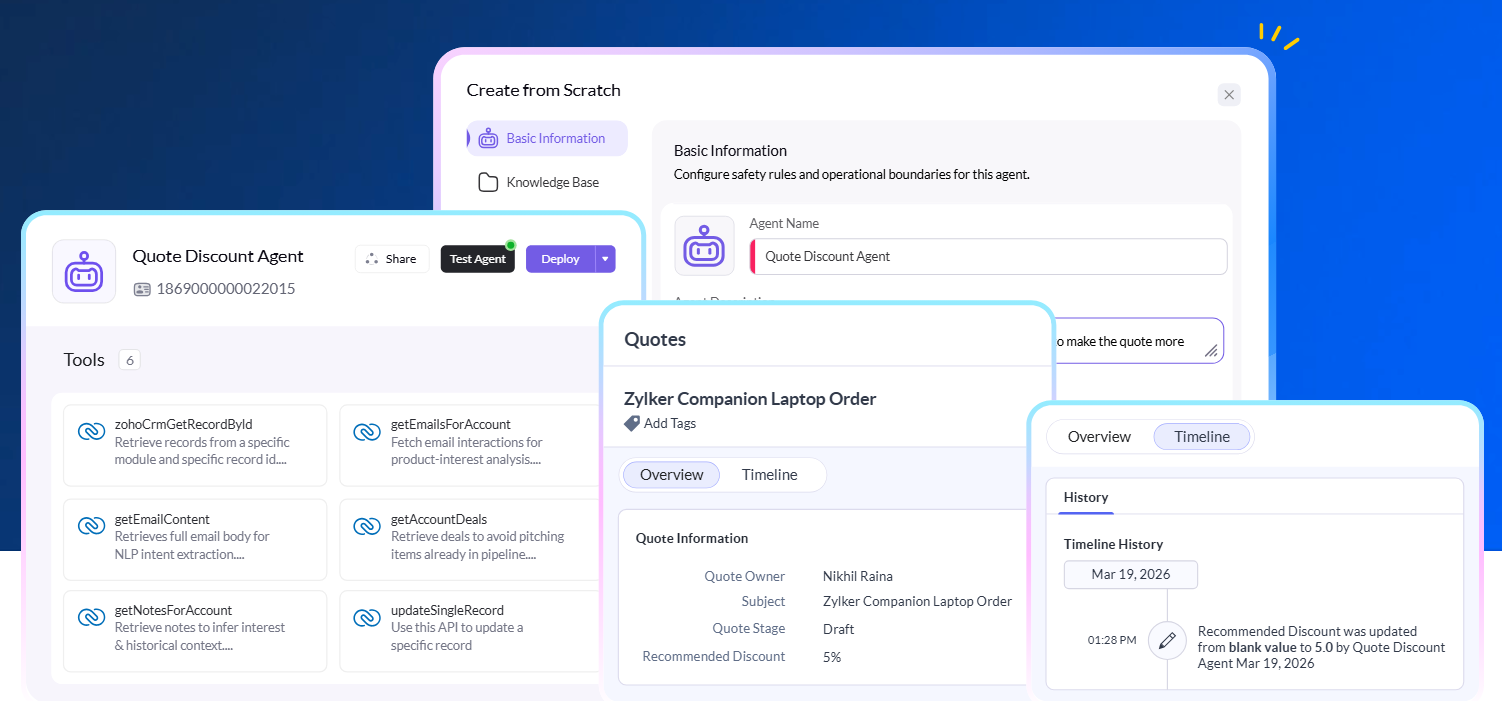
Zia can also create CRM modules, workflows, and reports from natural language commands. Zoho's agentic AI platform goes further, deploying autonomous agents for follow-up scheduling, lead nurturing, and deal analysis through the Zia Agents Store with 100+ pre-built agents.
Zoho runs its own LLM rather than relying entirely on third-party providers. Among mid-market CRMs, Zia's breadth is hard to match.
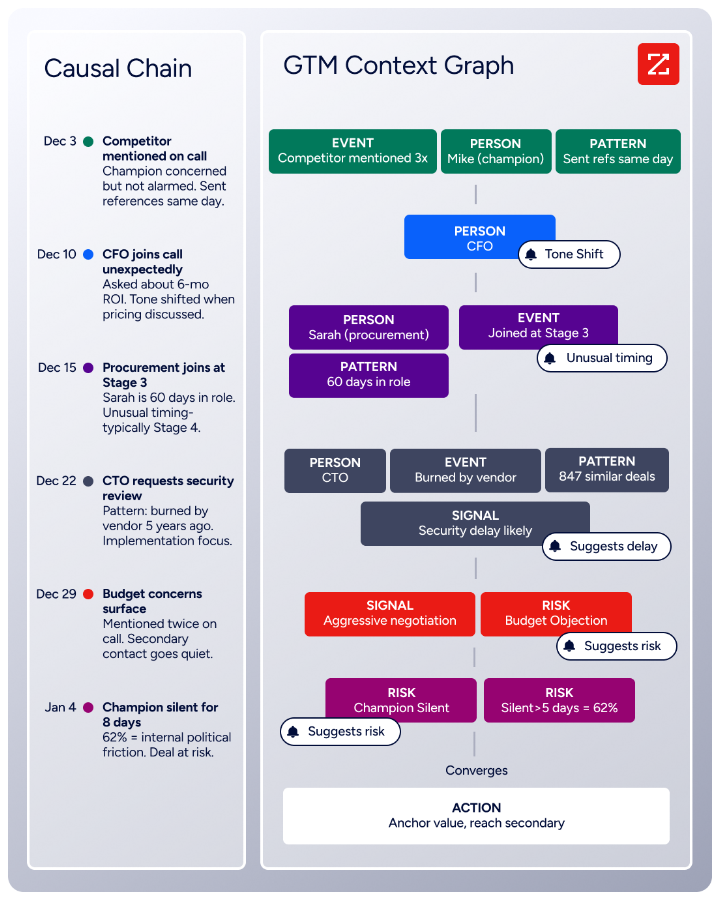
ZoomInfo's GTM Context Graph works at a different level. Where Freddy and Zia analyze data inside the CRM, the GTM Context Graph combines ZoomInfo's B2B data with your CRM records, conversation transcripts, and behavioral signals, then reasons across all of it. A CRM records that a deal moved from Stage 3 to Stage 4.
Source: ZoomInfo
Conversation intelligence captures what the VP of Finance said on the last call. Intent data logs a spike in research activity. The GTM Context Graph connects these signals to explain why the deal moved and what to do next. As ZoomInfo's CPO Dominik Facher writes, "the CRM recorded the state change. It has no record of why it happened."
The practical difference: Freddy tells you a deal is "At Risk." Zia tells you the last email had negative sentiment. ZoomInfo tells you the champion went quiet because of an internal budget battle, three other accounts with this same signal pattern closed after the CFO re-engaged in week six, and the follow-up email it drafted addresses the specific concern the CFO raised.
"That combination of our internal CRM data, external signals, and AI that's given all that context has helped us craft very specific account- and persona-based messages. And people have responded to them right away." (Seismic)
Freshsales wins on simplicity, Zoho wins on depth
For teams that just need a CRM working quickly, Freshsales is hard to beat.
Freshsales bundles phone, email, and chat into every plan, including Free. A rep can make calls, send tracked emails, and manage a Kanban pipeline within an hour of signing up. The 21-day free trial requires no credit card.

Source: Freshsales
The interface is clean and list-based without overwhelming new users. That simplicity becomes a ceiling for growing teams.
Sales sequences, multiple pipelines, territory management, and Freddy AI deal insights all sit behind the Pro tier at $39/user/month. Custom modules, field-level permissions, and sandbox testing require Enterprise at $59/user/month. A team that starts at $9/user often finds the features it needs live two pricing tiers away.
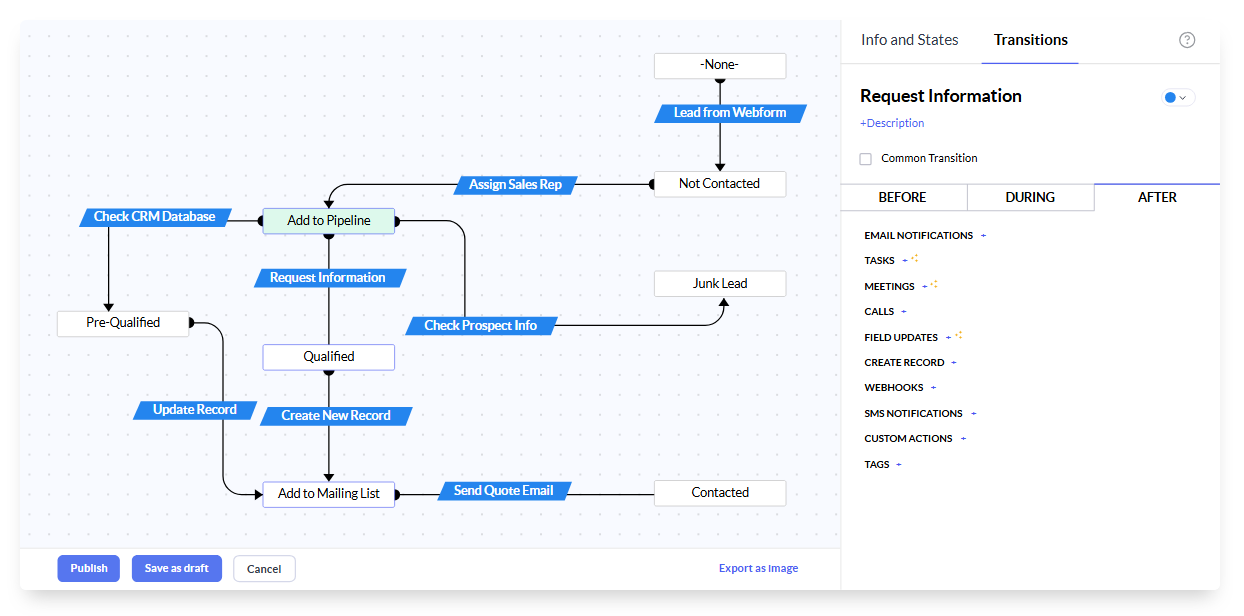
Zoho CRM invests the upfront time Freshsales skips. Blueprint models sales processes as visual state machines, requiring reps to complete specific actions (filling fields, logging a call, completing a task) before advancing a deal.
Source: Zoho CRM
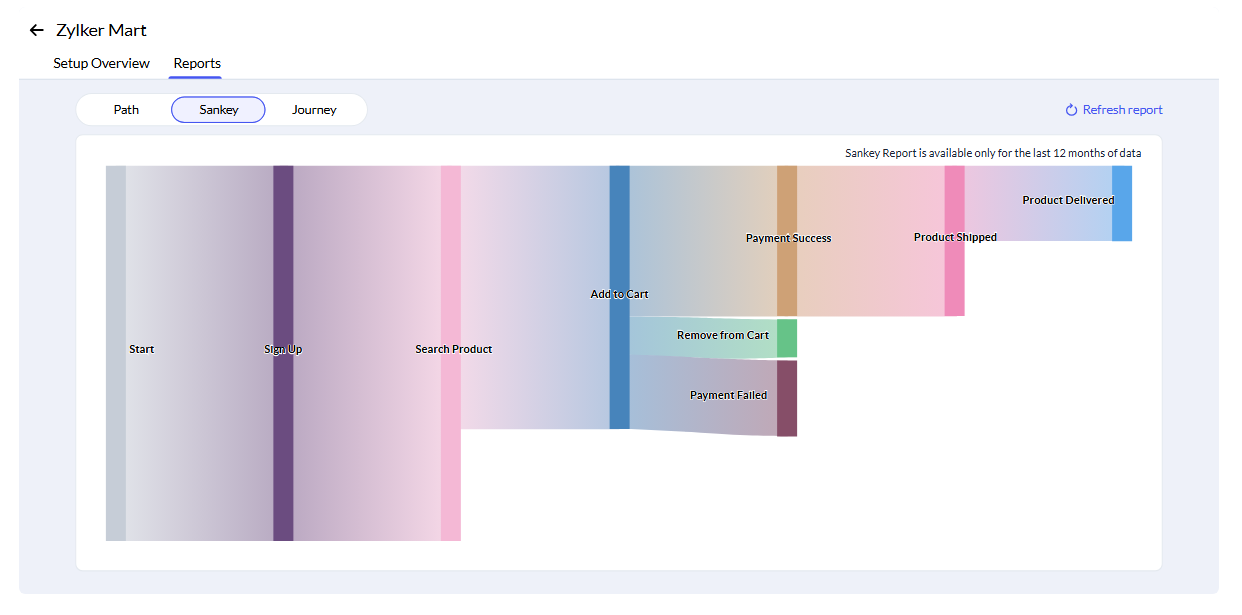
Kiosk Studio lets admins build guided, multi-step process flows without code. CommandCenter orchestrates customer journeys across departments, with PathFinder revealing how customers actually move through touchpoints rather than how the journey was designed.
Source: Zoho CRM
These are tools you'd expect from platforms three times the price.
The cost of that depth is setup time. As SoftwareReviews puts it: "Success requires investing time in setup and configuration rather than expecting immediate out-of-box functionality." Teams that need immediate results may find the configuration work frustrating before the platform pays off.
Sales engagement: sequences, cadences, and signal-driven outreach
How each platform handles multi-step outreach reveals their priorities.
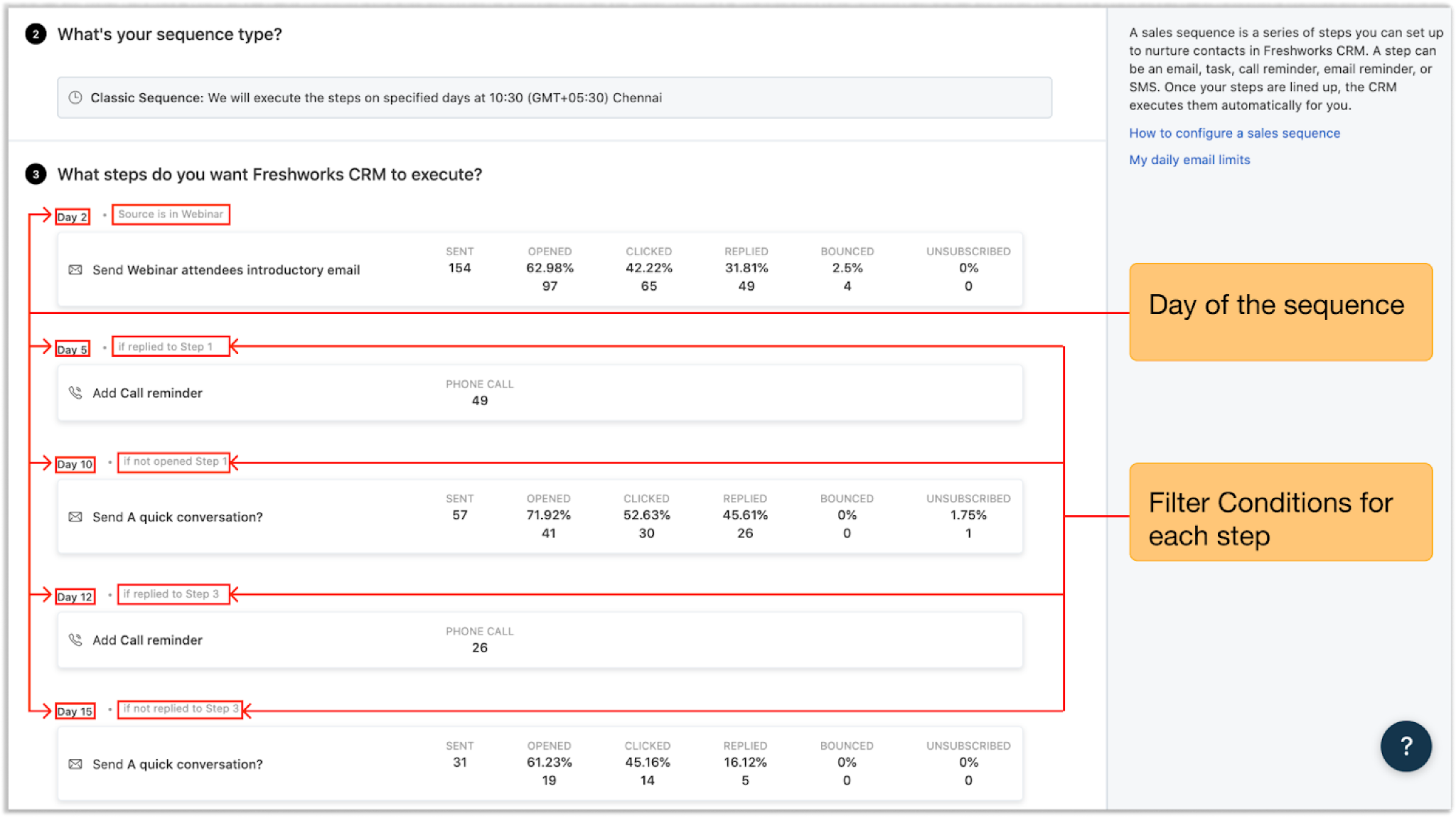
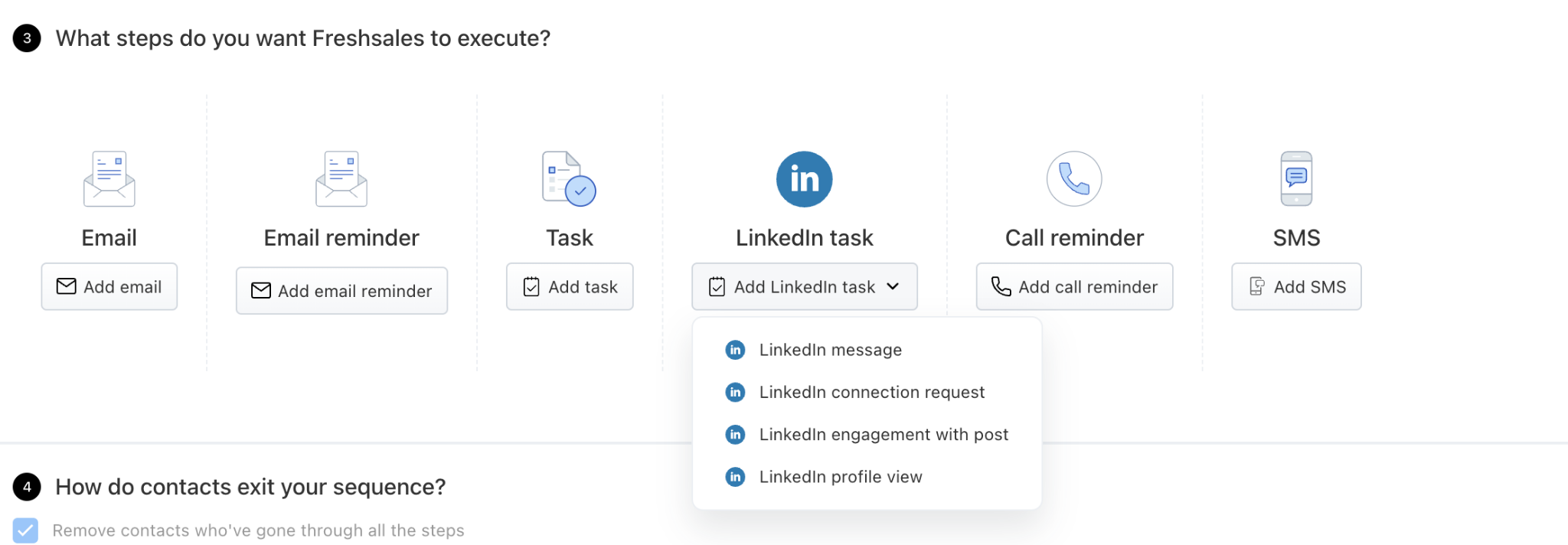
Freshsales offers three sequence types on Pro and Enterprise plans. Classic sequences run on fixed day offsets, Smart sequences re-evaluate conditions on every cycle, and Outbound sequences adjust based on step outcomes.
Source: Freshsales
Steps can include automated emails, call reminders, SMS, follow-up tasks, and LinkedIn tasks. The Smart sequence design is thoughtful: a contact that eventually meets a step condition receives that step at the next interval, even if it was skipped earlier.
Source: Freshsales
The limitation is volume: Pro plans cap sequences at 10 per user with 1,000 emails/user/month; Enterprise allows 25 sequences with 2,000 emails. Free and Growth plans have no sequence access.
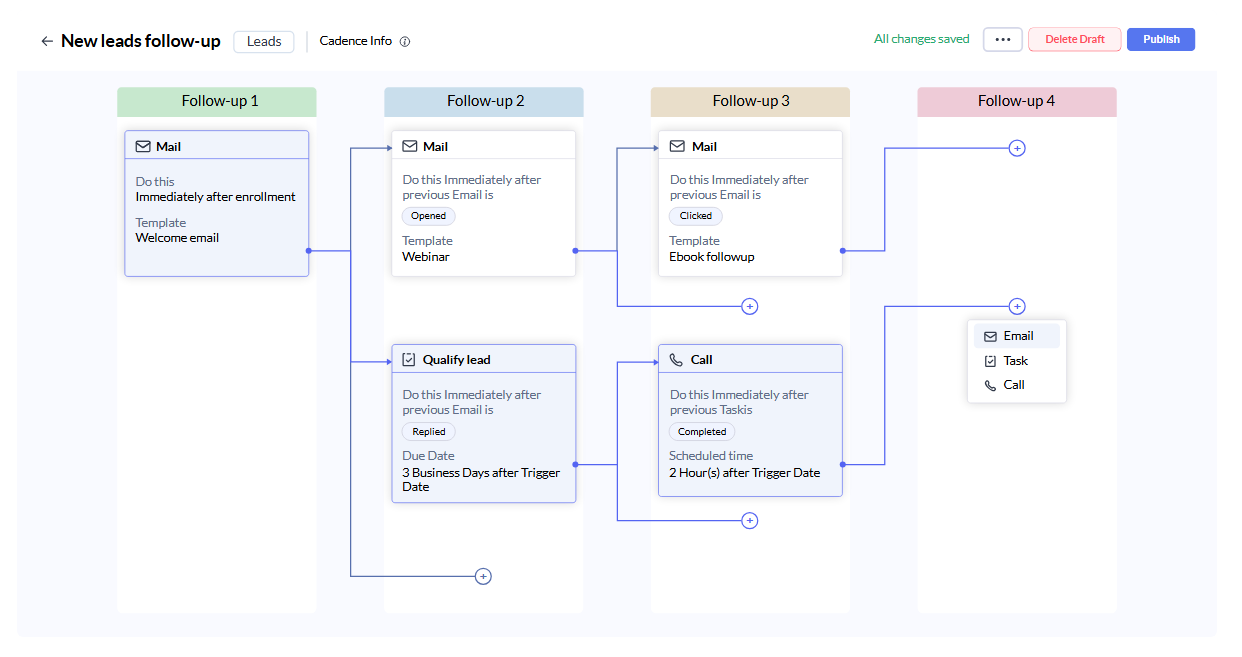
Zoho CRM's Cadences react to prospect behavior. Instead of running on fixed timers, Cadences branch based on how a prospect responds: if they ignore an email, the next step shifts to a phone call; if they click a link, the system schedules a meeting.
Source: Zoho CRM
Cadences support dynamic enrollment, adding and removing leads as criteria change. Available from the Standard tier ($14/user/month), they're accessible earlier in Zoho's pricing than Freshsales' sequences.
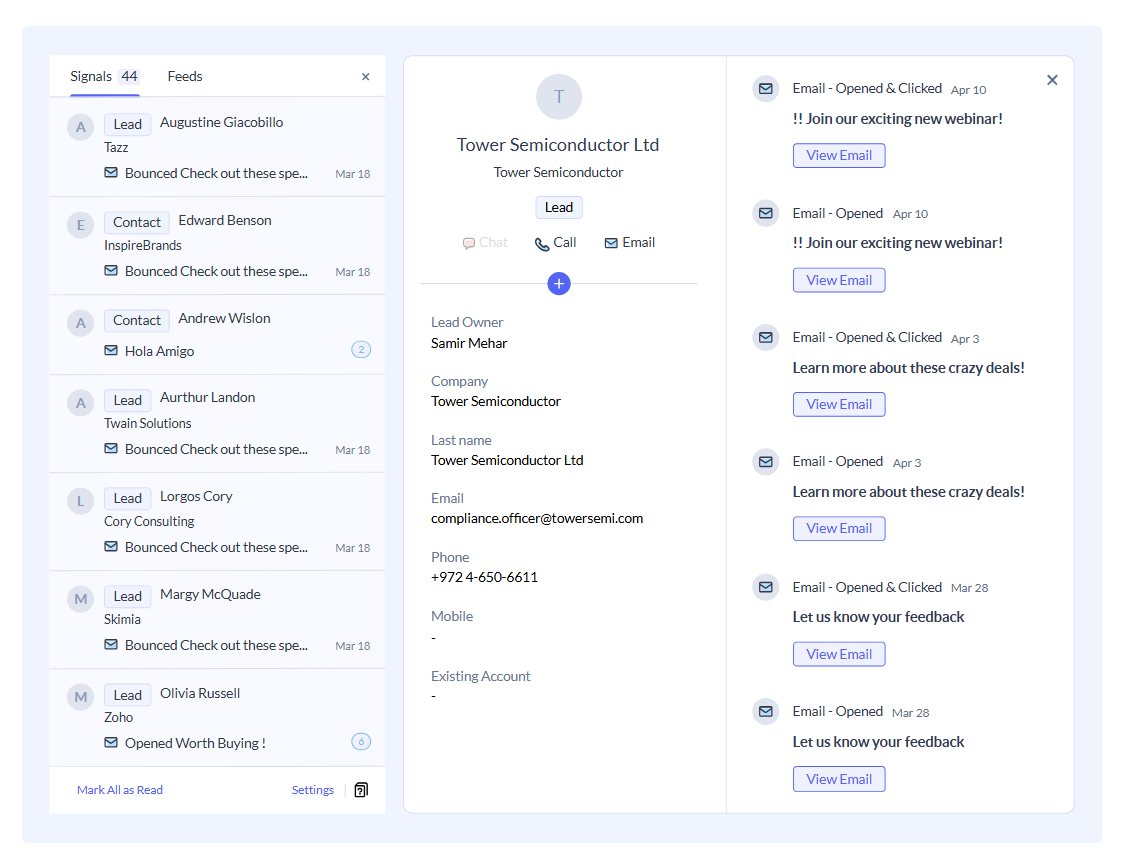
At the Enterprise tier, Zoho adds SalesSignals (real-time notifications when prospects open emails, start a chat, or engage on social media) and Zia's best time and channel to contact recommendations.
Source: Zoho CRM
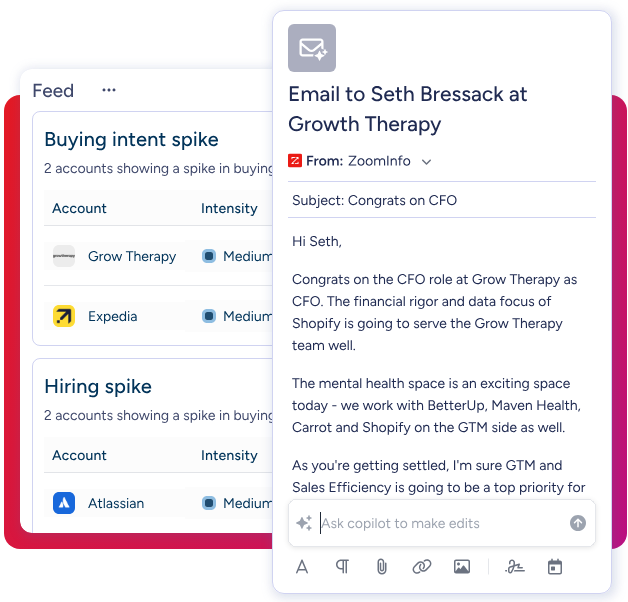
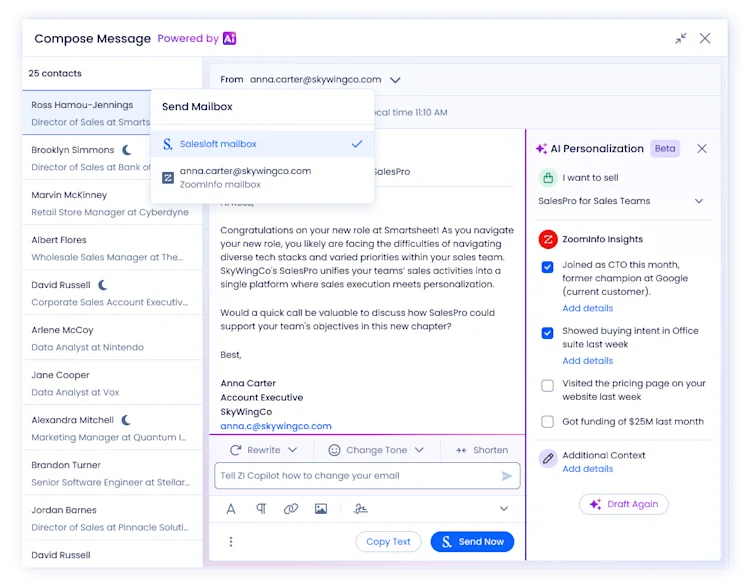
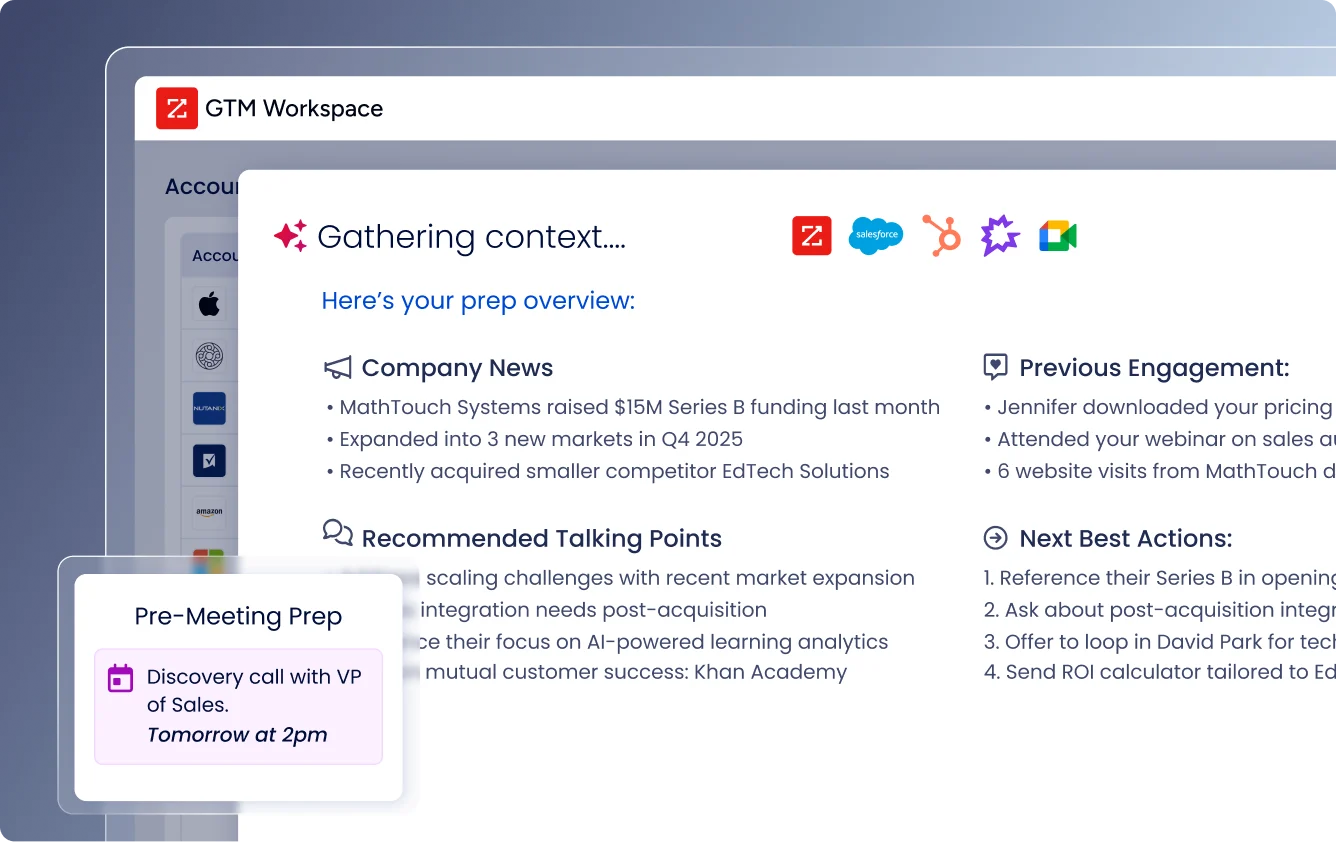
ZoomInfo takes a different approach. Rather than building outreach sequences inside the CRM, GTM Workspace gives sellers an Action Feed of in-market buyers matched to target criteria, with pre-drafted actions on every signal.
Source: ZoomInfo
When a target account visits your pricing page, triggers an intent signal, or hires a new VP, the system surfaces the event with personalized outreach that references the context behind the signal.
For teams using Salesloft, ZoomInfo Buying Signals sync into Salesloft Rhythm for AI-prioritized engagement.
Source: ZoomInfo
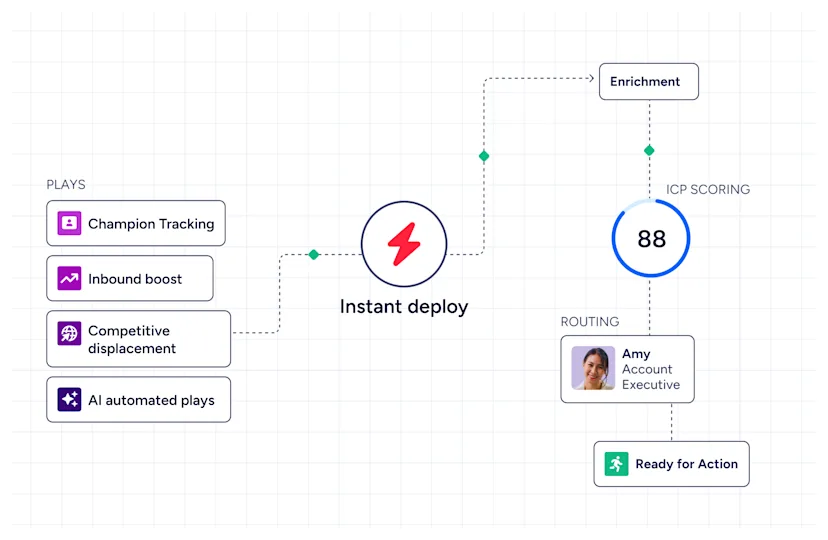
GTM Studio lets marketers and RevOps design multi-channel plays (email, calls, ads, direct mail) triggered by buyer behavior, where expansion plays that used to take three weeks now launch in 30 minutes.
Source: ZoomInfo
The core difference: Freshsales and Zoho automate the process of reaching out. ZoomInfo automates the decision of who to reach, when, and why.
Pricing reflects different value propositions
The three platforms sit at different points on the price-value spectrum.
Freshsales is the cheapest entry point. The Growth plan at $9/user/month (annual billing) includes contact lifecycle stages, basic workflows, a product catalog, one CPQ license, and Slack integration. For a 10-person team, that's $90/month.
But sales automation features require Pro at $39/user/month ($390/month for that team), and full customization needs Enterprise at $59/user/month ($590/month).
One contractual detail worth noting: customers on paid plans cannot reduce user count or downgrade mid-cycle; changes take effect at renewal, and fees paid are non-refundable.
Zoho CRM delivers more features per dollar at every tier. The Standard plan at $14/user/month includes Cadences, custom reports and dashboards, sales forecasting, and AI agents.
Professional at $23/user/month adds Blueprint, CPQ with dynamic pricing rules, and email intelligence. Enterprise at $40/user/month unlocks Zia AI with predictions and anomaly detection, journey orchestration, territory management, and custom functions.
Zoho's total cost of ownership comparison positions its Enterprise tier at $40/user/month against Salesforce at $165 and Dynamics 365 at $95. No annual lock-in: month-to-month billing is available, and you can make changes anytime.
ZoomInfo uses custom-quoted, consumption-based pricing with no published prices. Costs scale with seats, monthly credit volume, features, and contract length. Direct cost comparison is impossible without a quote, but ZoomInfo isn't competing on per-seat CRM pricing.
The ROI calculation differs: Seismic attributed 39% of active pipeline to ZoomInfo signals and reported 54% productivity gains.

Source: ZoomInfo
Snowflake reported 200% higher customer conversion rates on accounts monitored with ZoomInfo-powered scores. The question isn't whether ZoomInfo costs more than a CRM; it's whether the pipeline it generates justifies the investment.
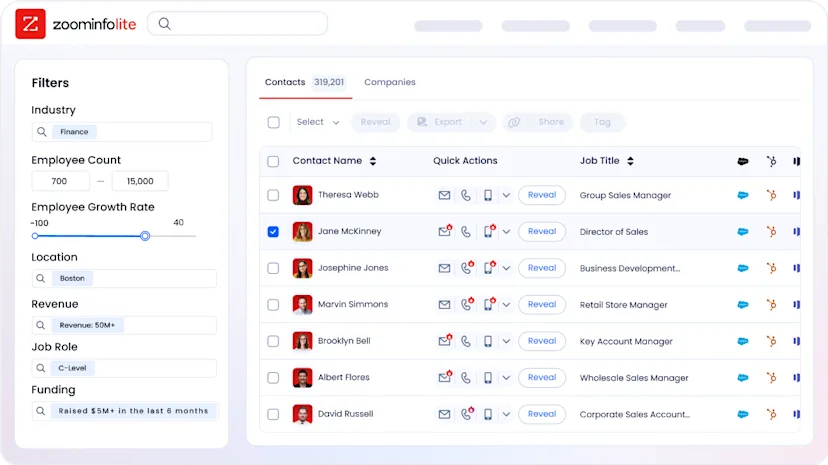
For teams testing the waters, ZoomInfo Lite provides permanent free access to the B2B database with 10 monthly export credits, individual and company searches, a Chrome extension, and HubSpot integration. No credit card, no time limit.
Source: ZoomInfo
Ecosystem breadth vs. intelligence depth
Freshsales and Zoho compete on how many business functions they cover under one roof. ZoomInfo competes on how well it understands your market.
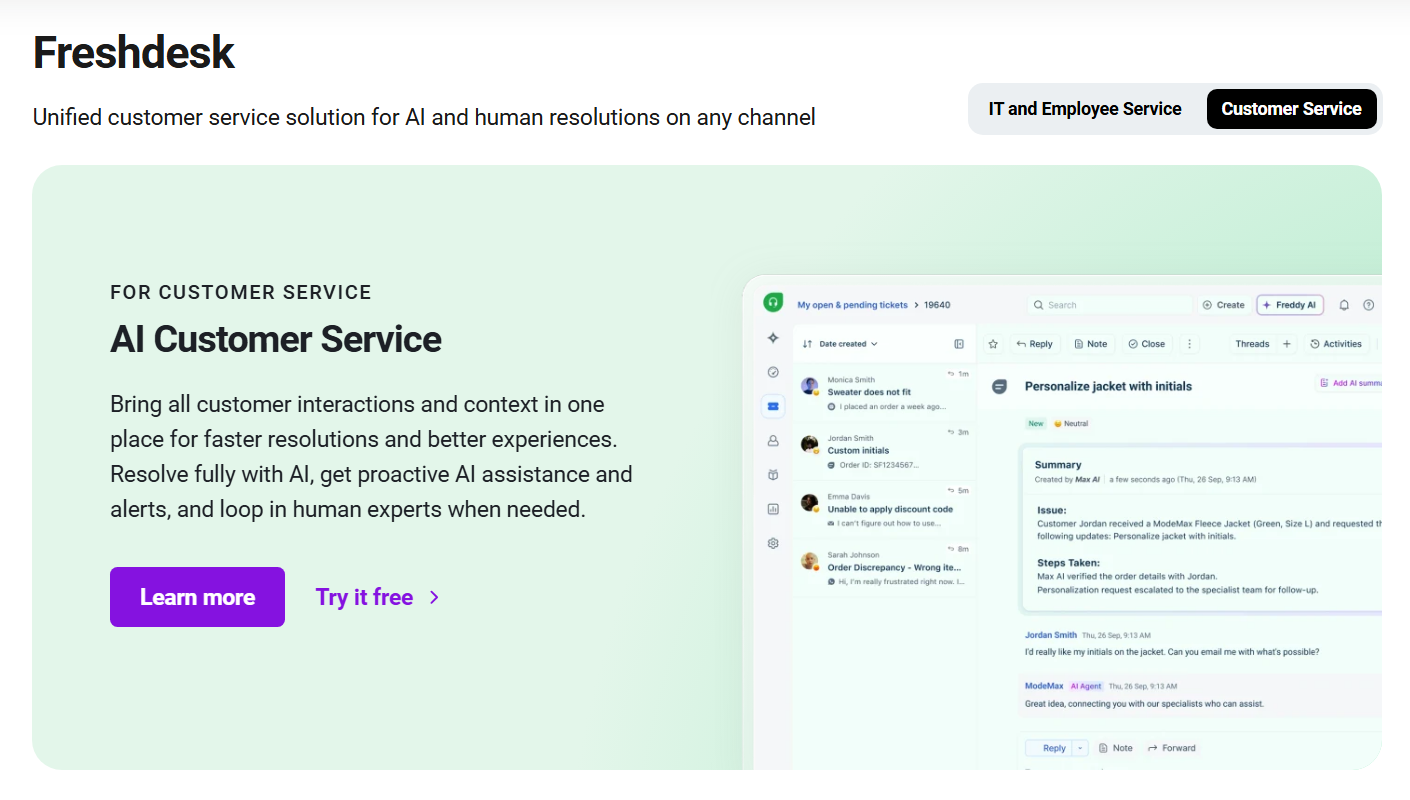
Freshsales benefits from the broader Freshworks platform: Freshdesk for customer support, Freshservice for IT service management, Freshmarketer for marketing automation, and Freshchat for messaging.
Source: Freshsales
The Freshworks Marketplace hosts apps across all products, with Freshdesk as the most-installed Freshsales integration at 5,900+ installs.
For teams already using Freshdesk, adding Freshsales creates a shared view: support tickets tag to lead profiles, giving sales reps visibility into customer issues without switching tools.
The Freshsales Suite bundles sales and marketing into a single CRM for teams that want both. The ecosystem is practical but narrower than Zoho's.

Source: Freshsales
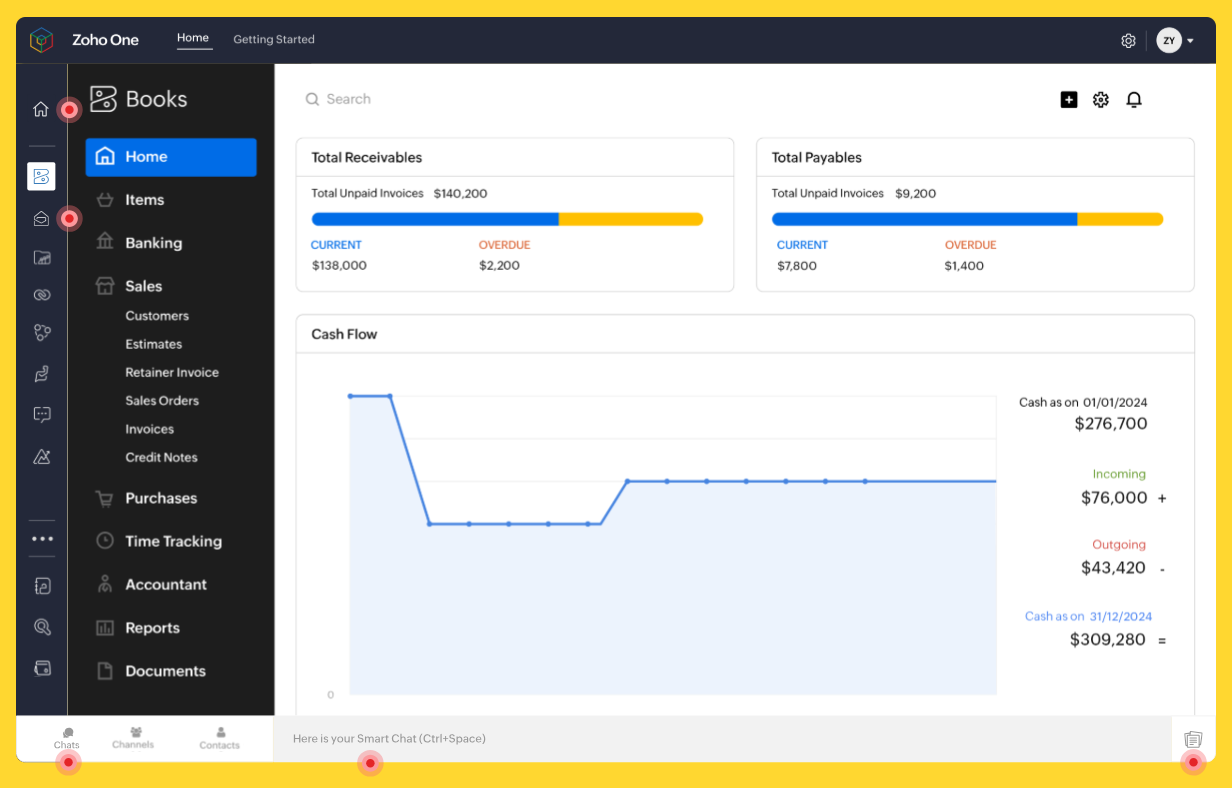
Zoho treats the ecosystem as a competitive moat. Zoho One bundles 50+ applications (CRM, email, accounting, project management, HR, and more) at a flat per-employee rate.
The CRM integrates natively with Zoho Books, Campaigns, Desk, Sign, Analytics, SalesIQ, and Projects. 1,100+ marketplace extensions supplement the first-party apps.
Source: Zoho CRM
For companies willing to commit to one vendor, Zoho eliminates the integration work that comes with stitching together separate tools. The data stays unified because there's nothing to integrate.
The tradeoff: Zoho's marketplace is smaller than Salesforce's 7,000+ AppExchange apps, and third-party connectors for niche enterprise systems can be thinner.
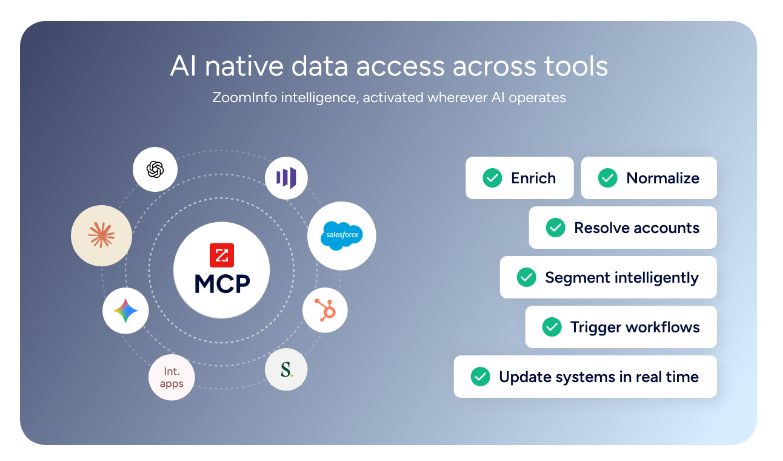
ZoomInfo doesn't try to replace your business tools. It makes them smarter. API access comes with all relevant plans, and the MCP server connects AI models (including Claude and ChatGPT) to ZoomInfo's data without custom coding.
Source: ZoomInfo
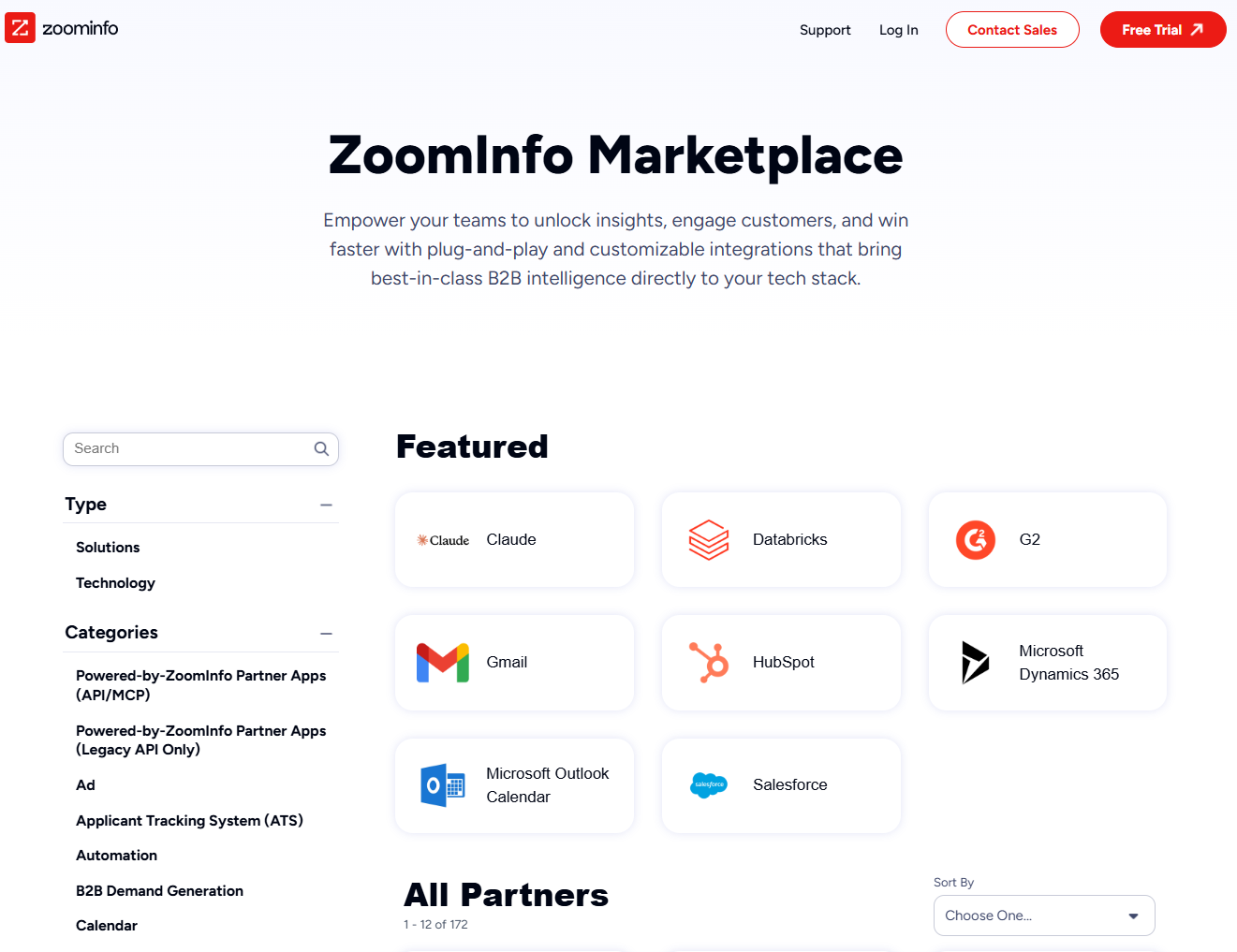
The App Marketplace includes 120+ partner integrations covering Salesforce, HubSpot, Microsoft Dynamics 365, Snowflake, and more.
Source: ZoomInfo
Whether your team uses Freshsales, Zoho, or another CRM, ZoomInfo's intelligence flows into it. The platform works as infrastructure for your GTM stack, not a replacement for it.
"You'll get 10x the value if you think of ZoomInfo as a full platform and not just a tool for one team." (SpringDB)
Reporting and analytics comparison
Sales leaders need more than dashboards. They need answers to three questions: what happened, why, and what to do about it. Each platform addresses these differently.
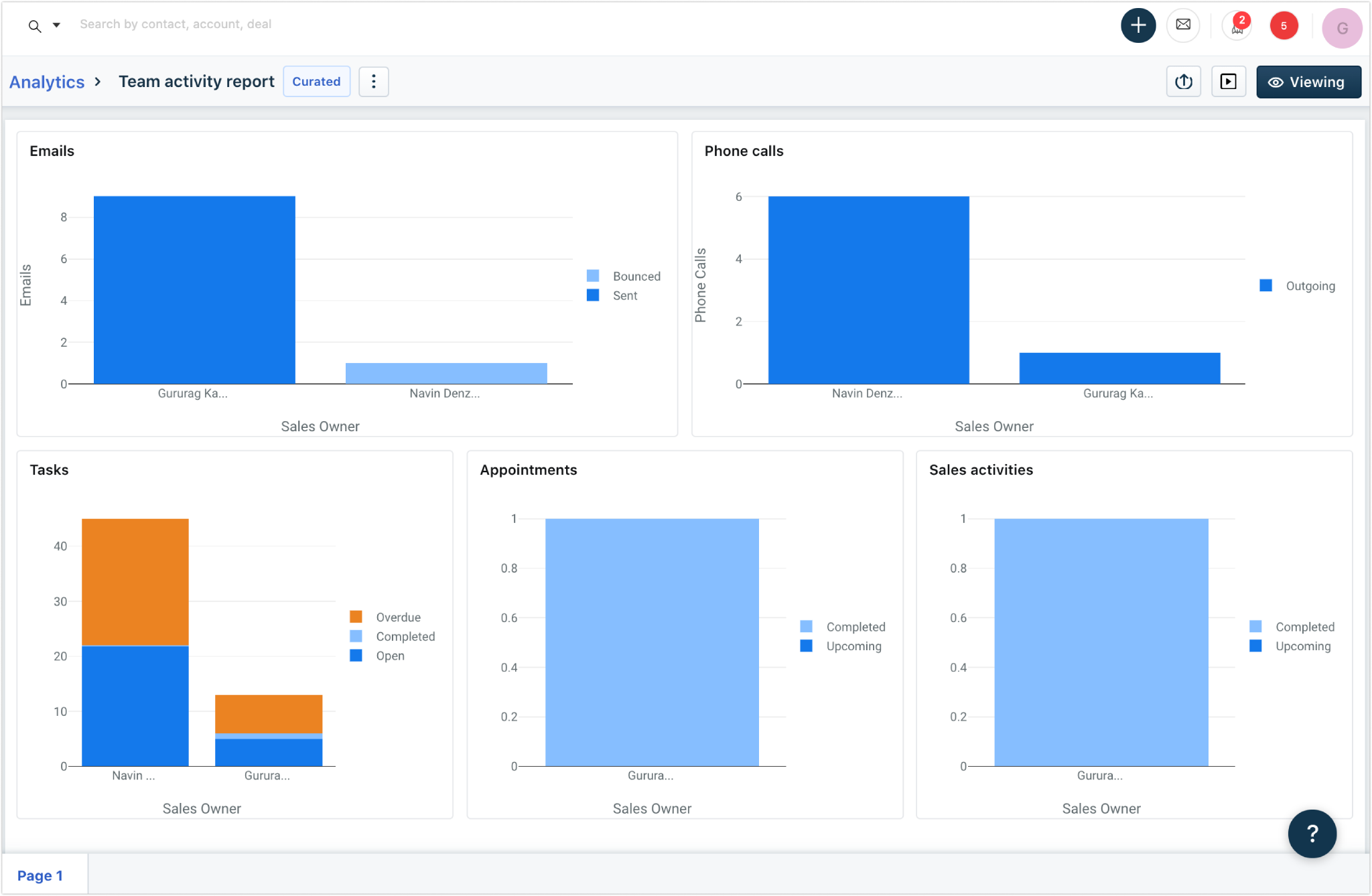
Freshsales provides curated reports on all paid tiers, covering sales trends, contact generation, team activity, and marketing performance.
Source: Freshsales
The Sales Essentials Dashboard preloads demo data so new users can evaluate it before their own pipeline data arrives. Custom reports require the Pro tier ($39/user/month), and advanced analytics and forecasting are Enterprise-only. Reports use a no-code widget system with up to 10 widgets per report.
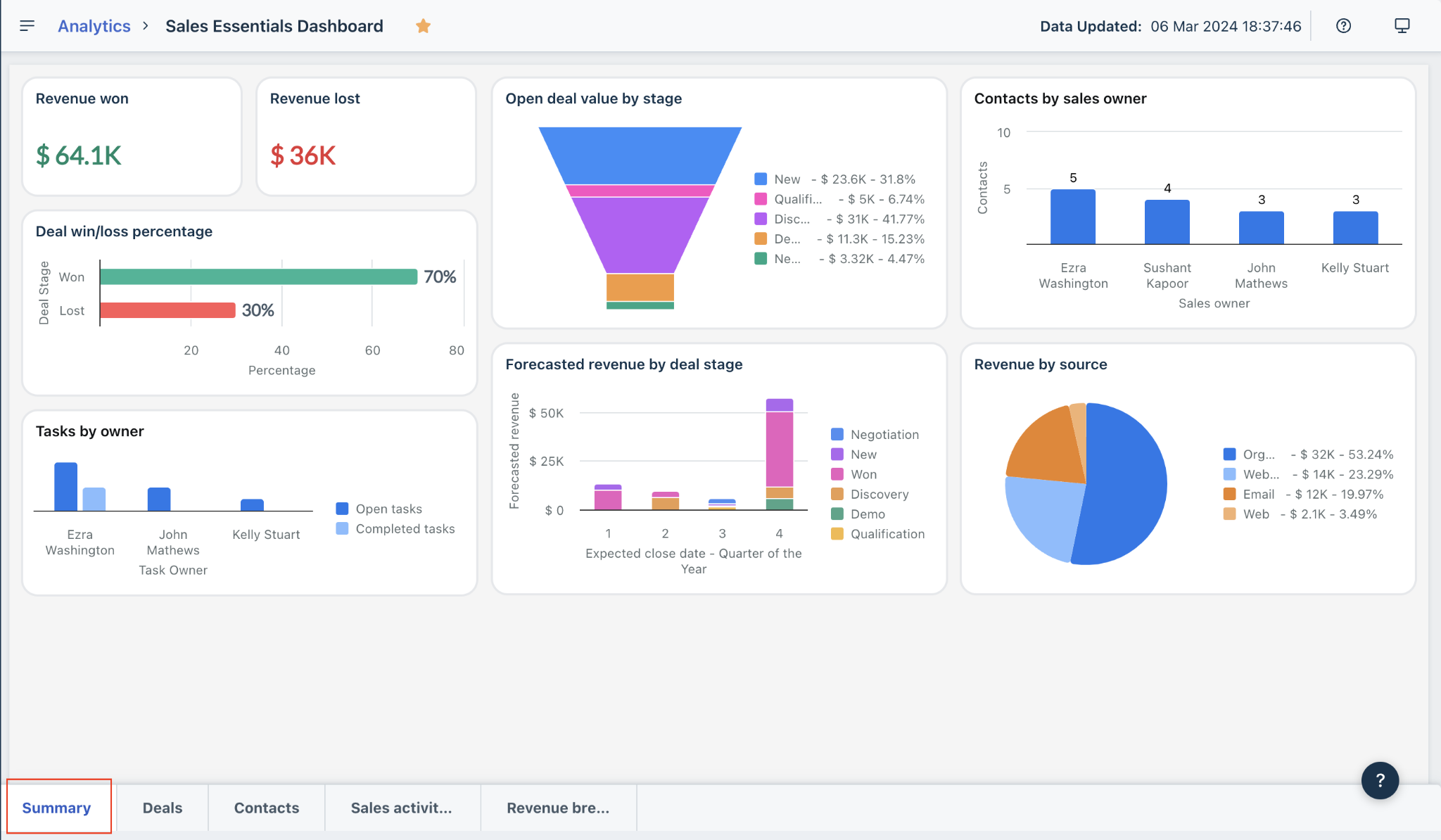
Source: Freshsales
For small teams, the curated dashboards deliver enough visibility out of the box. Larger teams may find the 10-widget cap and Pro-tier gate on custom reports limiting.
Zoho CRM offers deeper analytics starting earlier in its pricing. Custom reports and dashboards are available from the Standard tier, with nine chart types and five KPI formats.
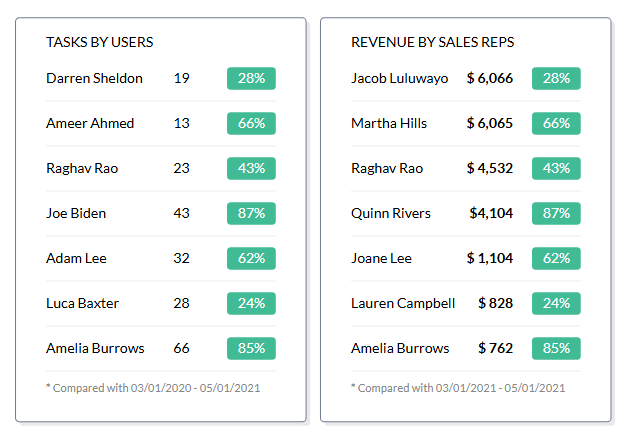
Source: Zoho CRM
Zia's anomaly detection monitors trends and alerts users when sales metrics deviate from expected patterns. Zia can also compile reports into presentation-ready narratives for stakeholder meetings.
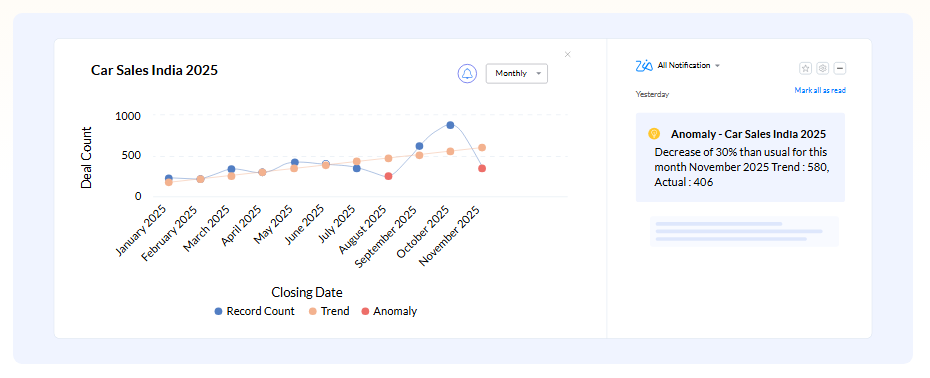
Source: Zoho CRM
For analysis beyond CRM data, Zoho CRM connects natively to Zoho Analytics, a BI platform that blends data from 250+ sources.
ZoomInfo doesn't compete on CRM reporting. Its analytics focus on market intelligence and pipeline attribution. GTM Studio provides dashboards tracking engagement, funnel progression, and top-performing segments.
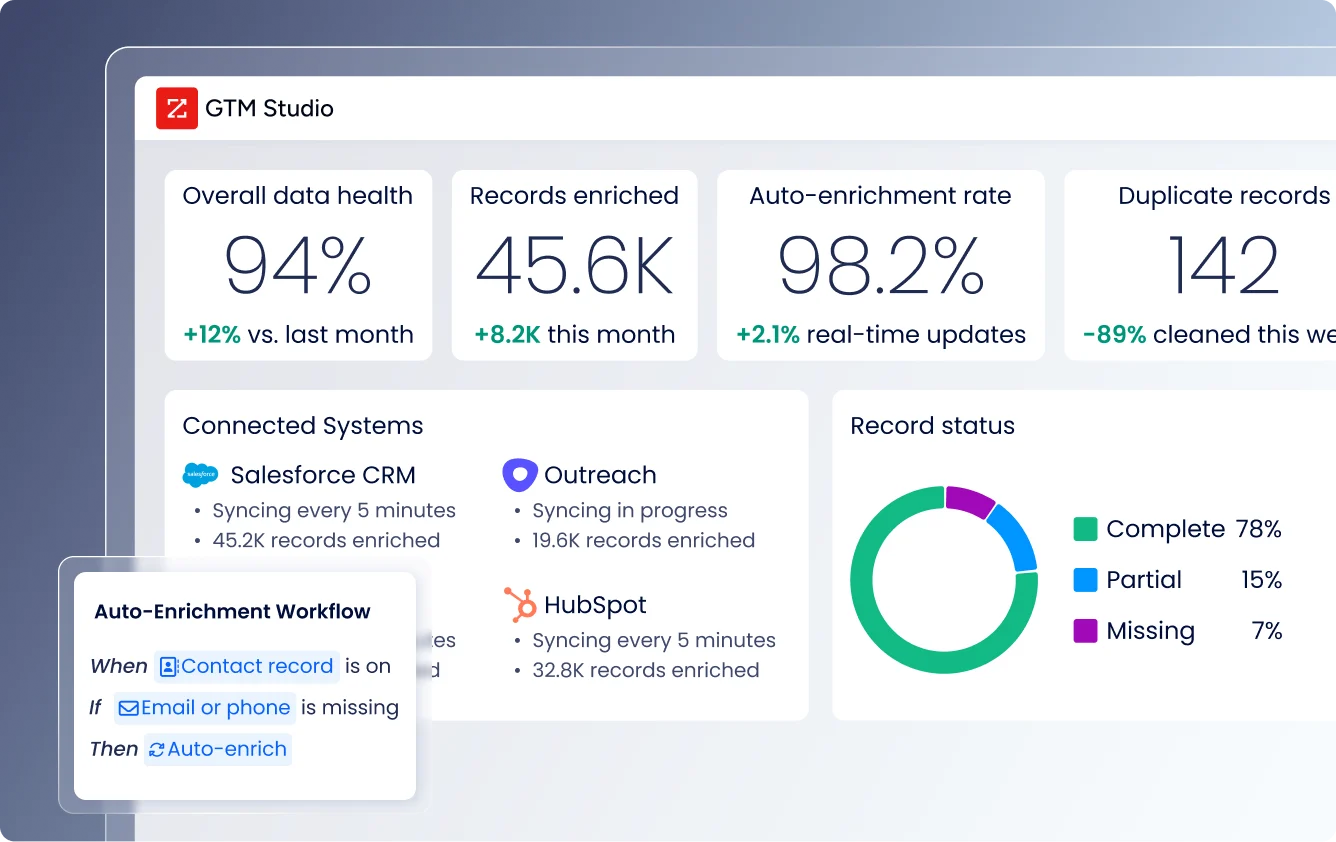
Source: ZoomInfo
GTM Workspace surfaces views that combine CRM data with real-time buying signals, letting managers filter for intent spikes, technology changes, funding events, or personnel movements.
Source: ZoomInfo
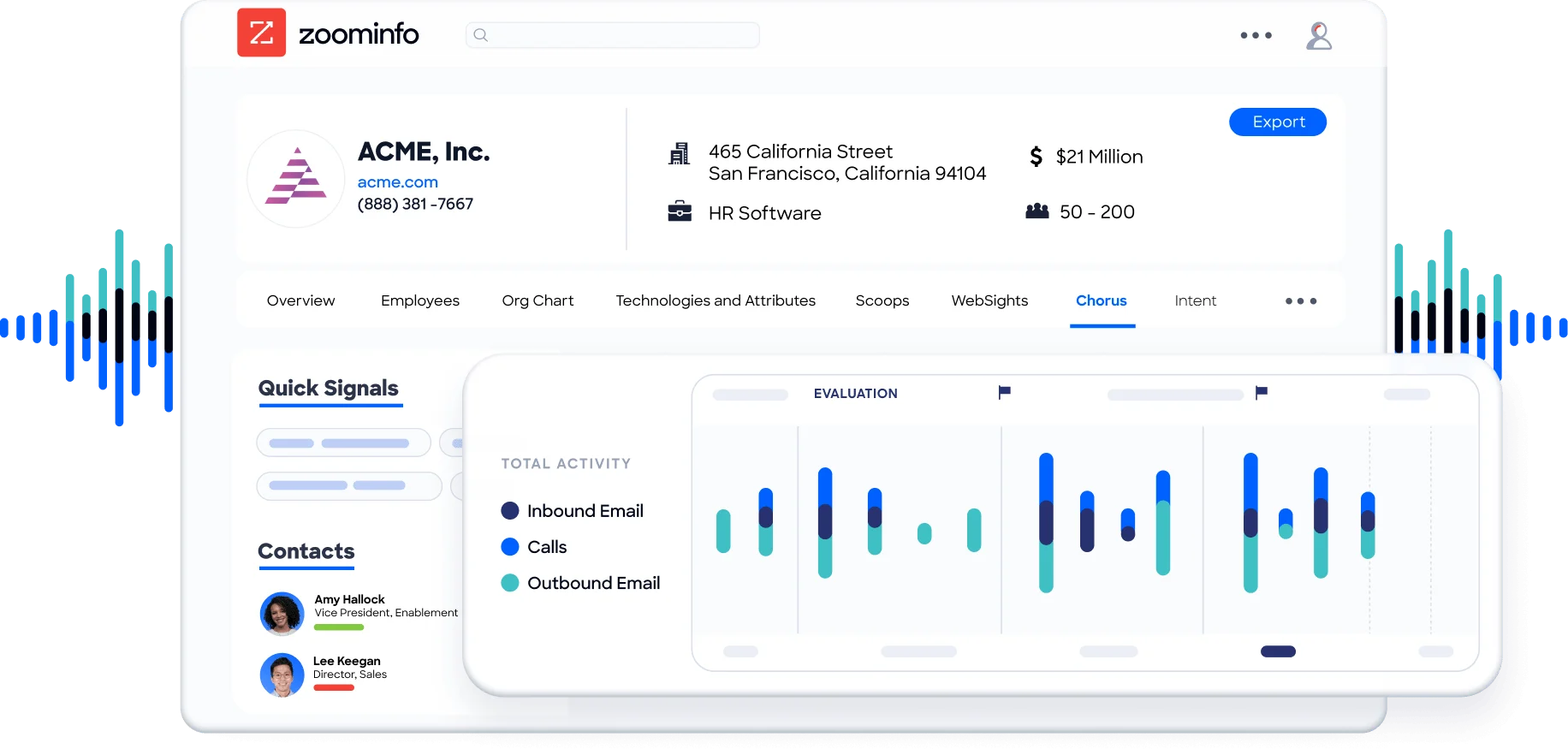
The insight layer extends into forecasting through Chorus, which captures deal intelligence from every customer conversation and syncs deal momentum data to CRM.
Source: ZoomInfo
Freshsales vs. Zoho CRM vs. ZoomInfo: Which should you choose?
The right platform depends on what's actually holding your sales team back.
Choose Freshsales if:
You need a CRM working within days, not weeks
Your team is under 50 people and values simplicity over customization
Built-in phone, email, and chat matter more than process automation
Budget is the primary constraint and $9/user/month is the right starting point
You're already using Freshdesk or other Freshworks products
Choose Zoho CRM if:
You want Salesforce-level customization at a fraction of the cost
Your sales process needs enforcement, not just tracking
You prefer a single-vendor ecosystem covering CRM, finance, HR, and marketing
You have the admin resources to invest in setup and configuration
Data privacy and contract flexibility matter to your organization
Choose ZoomInfo if:
Your pipeline is limited by data quality, not CRM features
You need verified contact data, direct dials, and buyer intent signals before your reps even open the CRM
Your team spends too much time researching accounts and not enough time selling
You want AI that understands deal context, not just CRM field values
You need intelligence that works across your GTM stack, not just inside one tool
Freshsales and Zoho are both capable CRMs for their audiences. Freshsales gets small teams moving fast. Zoho gives growing teams the depth to build scalable sales operations. But neither solves the upstream problem of knowing who to sell to and when they're ready to buy. ZoomInfo provides that intelligence, and it works regardless of which CRM sits downstream.
For teams serious about outbound growth, the most effective setup isn't choosing between these platforms. It's pairing a CRM with the data foundation that makes every feature inside it more productive.
Freshsales vs. Zoho CRM vs. ZoomInfo FAQ
What is the main difference between Freshsales, Zoho CRM, and ZoomInfo?
Freshsales is a sales CRM built for simplicity and speed, with built-in phone, email, and chat on every plan.
Zoho CRM is a customizable CRM backed by a 55+ app ecosystem, offering process enforcement through Blueprint and journey orchestration via CommandCenter.
ZoomInfo is a GTM intelligence platform that provides verified B2B data on 500M contacts and 100M companies, buyer intent signals, and contextual intelligence through its GTM Context Graph.
Freshsales and Zoho manage your pipeline; ZoomInfo tells you who should be in it.
Which platform is cheapest to get started with?
Freshsales starts at $9/user/month on the Growth plan (annual billing). Zoho CRM starts at $14/user/month on the Standard plan (annual billing). Both offer permanent free plans for up to 3 users.
ZoomInfo uses custom-quoted pricing with no published rates, but offers ZoomInfo Lite, a permanent free tier with 10 monthly export credits, individual and company searches, a Chrome extension, and HubSpot integration. No credit card or time limit required for any of the three free options.
Can ZoomInfo integrate with Freshsales or Zoho CRM?
ZoomInfo integrates natively with major CRMs including Salesforce, HubSpot, and Microsoft Dynamics 365 through its App Marketplace. API access comes with all relevant ZoomInfo plans, and the MCP server connects AI models to ZoomInfo's data without custom coding.
While the deepest pre-built integrations are with Salesforce and HubSpot, ZoomInfo's API and data export capabilities let its intelligence flow into any CRM, including Freshsales and Zoho.
Which platform has the best AI capabilities?
Each platform's AI serves a different purpose. Freshsales' Freddy AI scores contacts on a 0 to 99 scale, tags deal health, and drafts emails within the CRM.
Zoho's Zia AI is the broadest among the CRMs, covering predictive scoring, email sentiment analysis across eight emotion categories, call transcription, anomaly detection, natural language CRM configuration, and autonomous sales agents.
ZoomInfo's GTM Context Graph works at a different level, combining B2B data with CRM records, conversation intelligence, and behavioral signals to reason about why deals move or stall, not just score them.
Which CRM is better for a growing mid-market team: Freshsales or Zoho?
Zoho CRM generally offers more for mid-market teams. Its Enterprise plan at $40/user/month includes territory management, journey orchestration, custom functions, Zia AI predictions, and a sandbox environment.
Freshsales requires its Enterprise plan at $59/user/month to access custom modules, field-level permissions, and sandbox testing.
Zoho also provides vertical solutions for industries like financial services, real estate, insurance, and automotive. Freshsales may fit better for teams that prioritize speed of deployment over configuration depth.
How do the platforms handle sales process enforcement?
Zoho CRM is strongest here. Blueprint models sales processes as visual state machines and requires reps to complete specific actions before advancing a deal.
Freshsales offers workflow automation with trigger-condition-action rules but lacks enforcement at the same level.
ZoomInfo does not enforce CRM processes directly; instead, it provides the intelligence that informs them, surfacing which deals need attention and what action to take based on real-time buyer signals and the GTM Context Graph.
Do any of these platforms provide buyer intent data?
Only ZoomInfo provides native buyer intent data. Its intent engine tracks signals from 210 million IP-to-organization pairings and 6 trillion+ new keyword-to-device pairings sourced monthly.
Guided Intent (exclusive to ZoomInfo) identifies topics historically correlated with deal success rather than requiring manual topic selection.
Neither Freshsales nor Zoho CRM includes buyer intent signals; both would require third-party tools to monitor account-level buying behavior.
Which platform is easiest to set up and use?
Freshsales has the gentlest learning curve, with most teams productive within a day thanks to built-in phone, email, and chat on every plan.
ZoomInfo Lite is also quick to start for individual users, though enterprise deployments follow a structured 30-to-90-day onboarding program.
Zoho CRM requires the most setup of the three: its features and customization options demand admin effort before the platform pays off, though Canvas Design Studio and Kiosk Studio reduce the technical barrier for non-developers.
Want more Freshsales and Zoho comparisons? These related breakdowns go deeper:
