
GetAccept is a capable all-in-one digital sales room platform that combines proposals, e-signatures, contract management, mutual action plans, and buyer engagement analytics in a single branded workspace. For B2B revenue teams managing complex deals with multiple stakeholders, it replaces scattered email threads and disconnected tools with one persistent buyer-seller environment.
But as your revenue operations mature, GetAccept's all-in-one approach can create friction. Its Professional plan requires five users at $49/user/month before unlocking AI features, digital sales rooms, and CRM integrations, locking out smaller teams. Its CPQ amounts to a basic product library without guided selling logic or pricing governance. And its contract management, while solid for renewal tracking, doesn't extend into subscription billing, revenue recognition, or post-signature revenue operations.
That's where this guide comes in. Whether you're looking to:
Strengthen your go-to-market intelligence with B2B data, AI-powered account insights, and buyer intent signals
Govern complex pricing configurations with CPQ and post-signature revenue management
Start sending professional proposals without a five-user minimum commitment
Enforce proposal consistency and compliance across a growing sales team
Get enterprise-scale e-signature infrastructure with global compliance and AI-powered agreement intelligence
Access an AI-native digital sales room without upfront platform spend
We'll explore alternatives that excel in these areas.
Some teams use these tools alongside GetAccept to fill gaps. Others replace it entirely with a specialized stack. This isn't about finding a "better" platform; it's about finding the right fit for your needs.
Let's look at the GetAccept alternatives and see which ones serve your revenue team best.
The Best GetAccept Alternatives |
|---|
Best Alternative for AI-Powered Go-to-Market Intelligence & Buyer Signals We chose ZoomInfo because it solves the upstream intelligence gap that deal rooms alone can't address: knowing who to sell to, when they're ready to buy, and why deals move or stall. |
Best Alternative for Enterprise Revenue Teams with Complex Pricing & Approval Workflows We chose DealHub because its CPQ, automated approval routing, and post-signature subscription billing fill the revenue operations gap that GetAccept's basic product library leaves open. |
Best Alternative for Small Teams That Can't Clear the 5-User Minimum We chose PandaDoc because it removes the seat-minimum barrier with a permanent free tier, per-user pricing from $19/month, and native payment collection, making professional proposals accessible to teams of any size. |
Best Alternative for Proposal Governance and Process Consistency at Scale We chose Proposify because its content locking, conditional approval workflows, and pipeline analytics give growing sales teams proposal governance that GetAccept's template system doesn't provide below the Enterprise tier. |
Best Alternative for Enterprise-Scale E-Signature and Agreement Intelligence We chose DocuSign because its global compliance across 180+ countries, AI-powered Intelligent Agreement Management, and recognized signing experience serve enterprise legal and procurement needs that a sales-room e-sign layer cannot match. |
Best Alternative for AI-Native Buyer Collaboration Without Upfront Platform Spend We chose Aligned because its permanent free tier with real digital sales room functionality and AI deal orchestration gives teams of any size an entry point that GetAccept's 5-user minimum blocks. |
What is GetAccept?
GetAccept is an AI-powered Digital Sales Room and proposal platform built for B2B revenue teams.
It replaces email threads, scattered attachments, and disconnected tools with a single, branded, AI-guided workspace where proposals are created, sent, tracked, negotiated, and signed through one persistent link.
Its key features include:
Digital Sales Rooms that serve as shared buyer-seller deal workspaces with real-time engagement tracking
Proposals and quotes with drag-and-drop editing, merge tags, and embedded video
Electronic signatures compliant with US ESIGN/UETA, UK law, and EU eIDAS, including Advanced and Qualified signature tiers
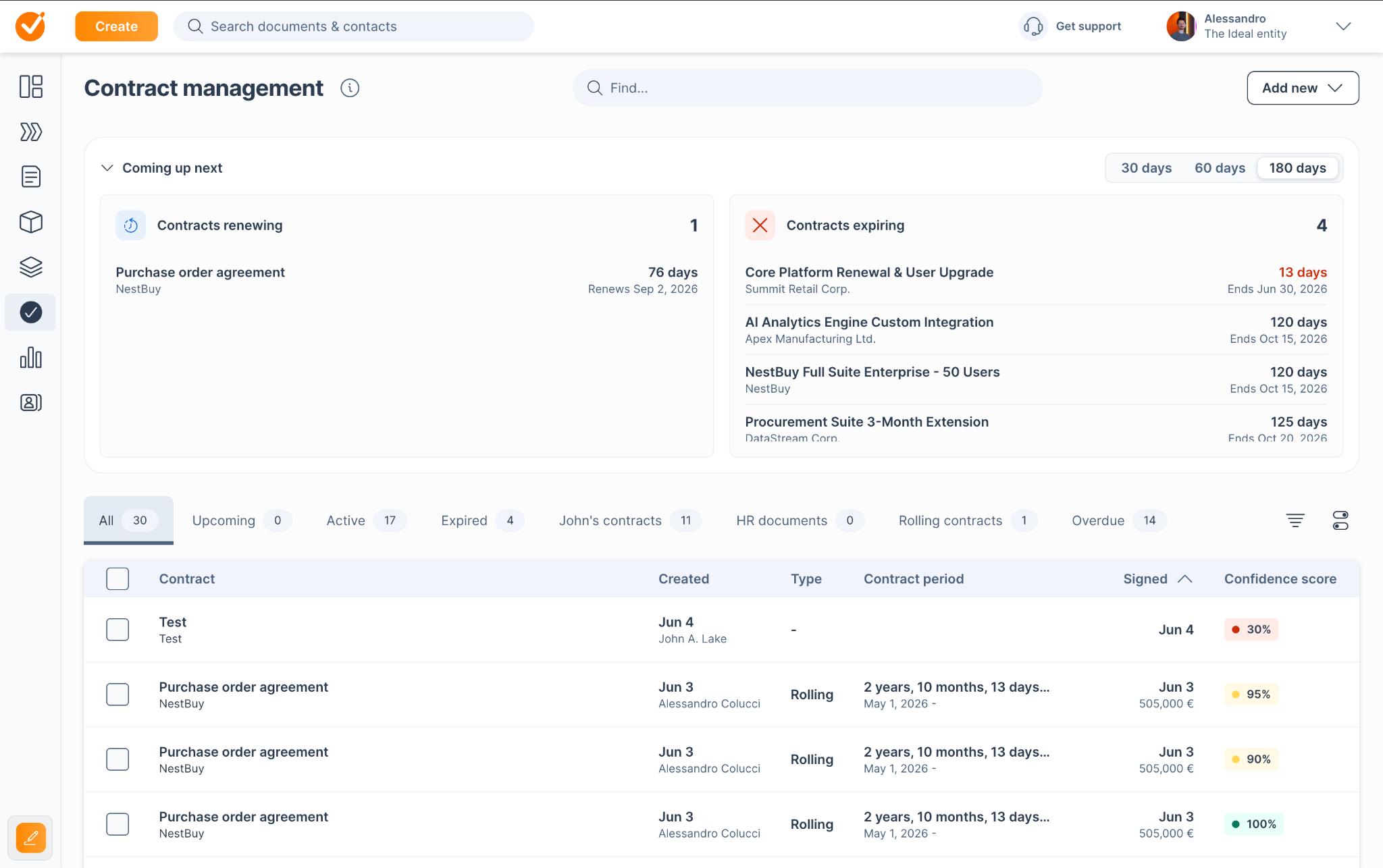
Contract management with AI-powered data extraction from signed agreements
Source: GetAccept
Mutual Action Plans for co-owned buyer-seller deal timelines
Sales content management with cascade updates across templates
Tracking and analytics including a Participant Engagement Score per stakeholder
Native AI layer running a tuned version of Claude Sonnet on GetAccept's own EU servers
When a rep creates a Deal Room, everything connects in one branded microsite: proposals, contracts, mutual action plans, meeting summaries, and chat all live under a single URL.
Buyers access content without logging in, and every interaction is tracked, giving sellers real-time visibility into who opened what, which pages held attention, and when to follow up.
But as your needs grow more specialized, you may need deeper go-to-market intelligence upstream of the deal room, more sophisticated pricing governance, lower entry barriers for smaller teams, or enterprise-grade compliance infrastructure. That's why we've focused on tools that specialize in their domains.
How We Curated Our List of GetAccept Alternatives
After evaluating GetAccept and researching the B2B deal execution market, we found that revenue teams looking beyond GetAccept typically need more capability in specific areas.
While GetAccept handles many deal execution tasks well in one place, growing businesses often need specialized tools for:
Identifying the right accounts, understanding buyer intent, and getting AI-powered deal intelligence before the deal room opens
Configuring complex quotes with pricing governance, approval workflows, and post-signature revenue operations
Getting started with professional proposals and e-signatures without hitting a five-user minimum or annual commitment
Enforcing proposal consistency and brand compliance across a distributed sales team
Meeting enterprise legal, regulatory, and compliance requirements for e-signatures across 180+ countries
Accessing a digital sales room with AI deal orchestration at any team size, including free
Each tool on this list excels in one of these areas. You might use them alongside GetAccept or as standalone replacements; it depends on what your revenue team needs most.
DISCLAIMER: We aren't covering every single tool in the market! Our focus is on highlighting the best alternatives that address some of GetAccept's limitations for specific use cases. The goal is to provide insights into tools that cater to specific revenue team needs. |
|---|
1. ZoomInfo — Best Alternative for AI-Powered Go-to-Market Intelligence & Buyer Signals
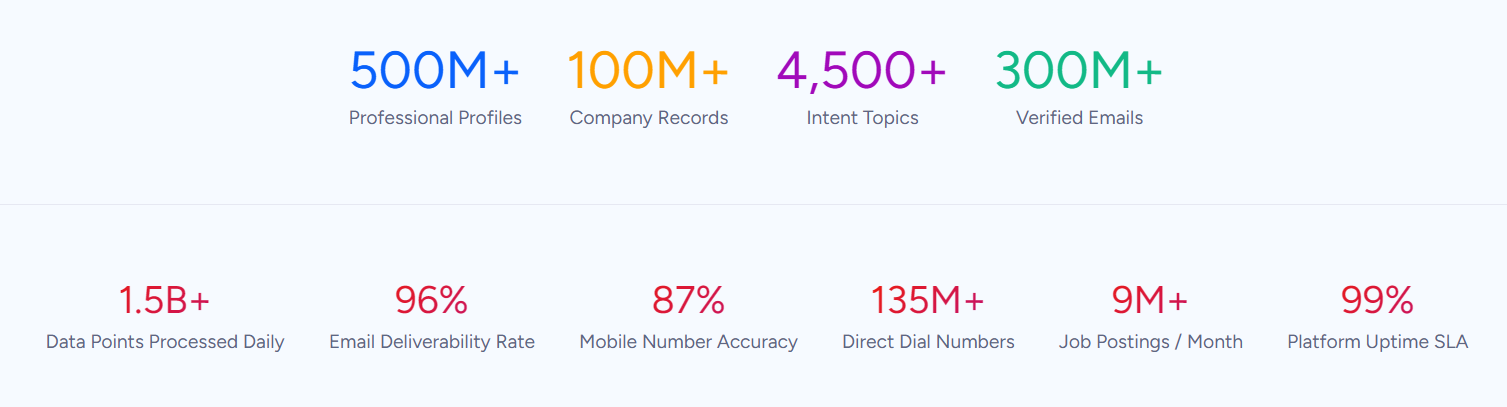
ZoomInfo is an all-in-one AI GTM platform built on a B2B data foundation of 500M contacts, 100M companies, 135M+ verified phone numbers, and 200M+ verified business emails.
For revenue teams evaluating GetAccept alternatives, ZoomInfo solves a different problem: while GetAccept helps you execute deals once you're in front of a buyer, ZoomInfo makes sure you're targeting the right accounts, engaging at the right time, and understanding why deals move or stall, before and throughout the sales cycle.
Its key features include:
B2B data platform spanning identity data, company context, and buying signals, verified through a multi-source pipeline backed by 300+ human researchers and up to 95% accuracy on first-party data
GTM Context Graph that fuses ZoomInfo's third-party data with your CRM records, conversation intelligence, and behavioral signals into an intelligence layer that captures not just what happened in a deal, but why it happened
Buyer Intent signals tracking 210 million IP-to-Organization pairings and 6 trillion+ keyword-to-device pairings monthly, including Guided Intent (exclusive to ZoomInfo) that identifies topics correlated with your deal success
Multiple access points through GTM Workspace for sellers, GTM Studio for marketers and RevOps, and APIs & MCP for any third-party tool or AI agent
GetAccept excels at deal execution: once you know who to sell to, it helps you create proposals, track buyer engagement, and close contracts. ZoomInfo operates upstream, ensuring the accounts entering your deal rooms are the right ones at the right time, and providing contextual intelligence that makes every conversation inside those rooms more effective.
Why Choose ZoomInfo Over GetAccept for Go-to-Market Intelligence
While GetAccept provides real-time engagement analytics inside active deals, ZoomInfo delivers intelligence across the entire go-to-market lifecycle.
Here's where ZoomInfo steps in.
Comprehensive B2B Data: Know Every Buyer Before the Deal Room Opens
GetAccept's strength begins when a rep creates a Deal Room and invites stakeholders. But the platform doesn't help you identify which accounts to target, who the decision-makers are, or how to reach them with verified contact information. Reps depend on their CRM data (which Forbes estimates is 91% incomplete) to populate deal rooms with the right stakeholders.
ZoomInfo solves this at the data layer.
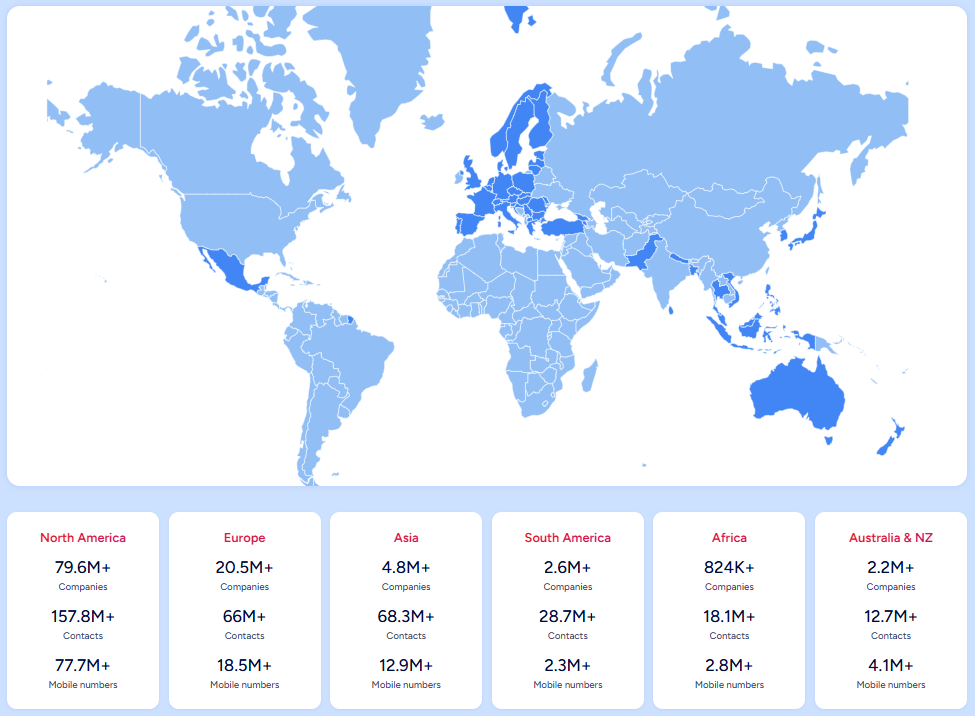
With 500M contacts, 120M direct-dial phone numbers, and 200M+ verified business email addresses, ZoomInfo gives revenue teams verified buyer information before a single outreach is sent.
Source: ZoomInfo
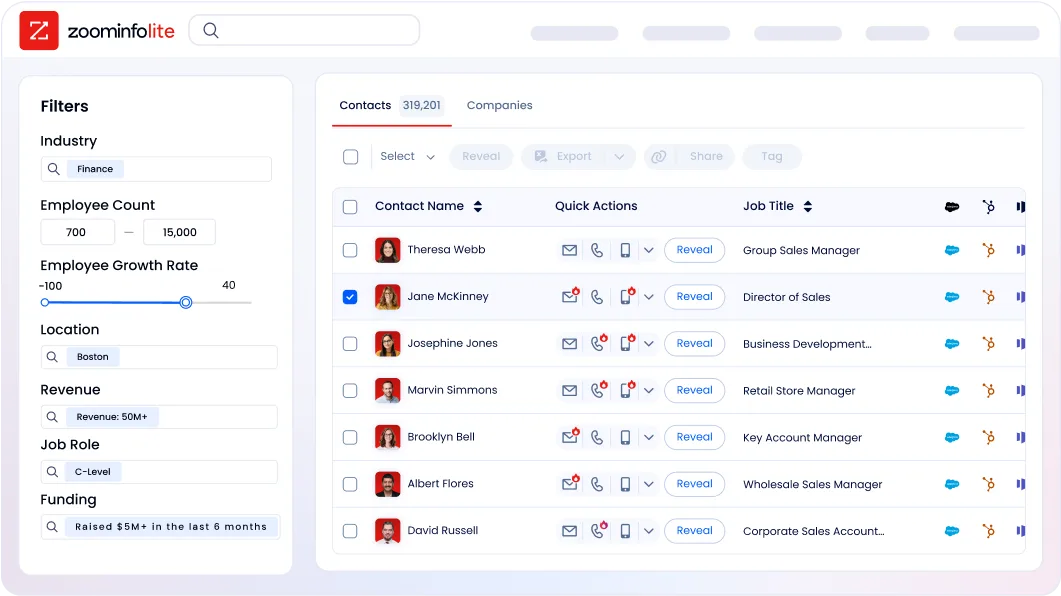
The platform's Contact & Company Search provides access to 300+ company attributes for market segmentation, including department org charts with decision-makers' direct dials, technographic data tracking 30,000+ technologies across 30M+ companies, and job-change alerts that flag when champions move to new companies.
In a Fortune 500 competitive RFP analyzing 25 million contacts across vendors, the independent consultant concluded that "no other competitor came even close."
ZoomInfo in Action: Before creating a GetAccept Deal Room for a target account, your rep opens ZoomInfo to map the full buying committee: VP of Sales (the champion), CFO (the budget holder), and Head of IT Security (the compliance gatekeeper).
ZoomInfo provides verified direct dials and business emails for each, plus org chart context showing reporting relationships. The rep invites all three to the deal room from day one, instead of discovering the CFO's involvement three weeks into the cycle when the deal stalls for budget approval.
GTM Context Graph: Understand Why Deals Move, Not Just That They Moved
GetAccept's Participant Engagement Score tracks buyer behavior inside deal rooms: visit frequency, time spent, content interactions, and stakeholder invitations.
This is valuable for prioritizing follow-ups. But it captures behavior within a single deal environment and cannot tell you why a deal is accelerating or stalling in the context of broader market signals, competitive dynamics, and historical patterns across your pipeline.
ZoomInfo's GTM Context Graph processes 1.5B+ data points daily, fusing your CRM records, conversation transcripts from Chorus, email interactions, product usage signals, and ZoomInfo's third-party intelligence into a single intelligence layer.
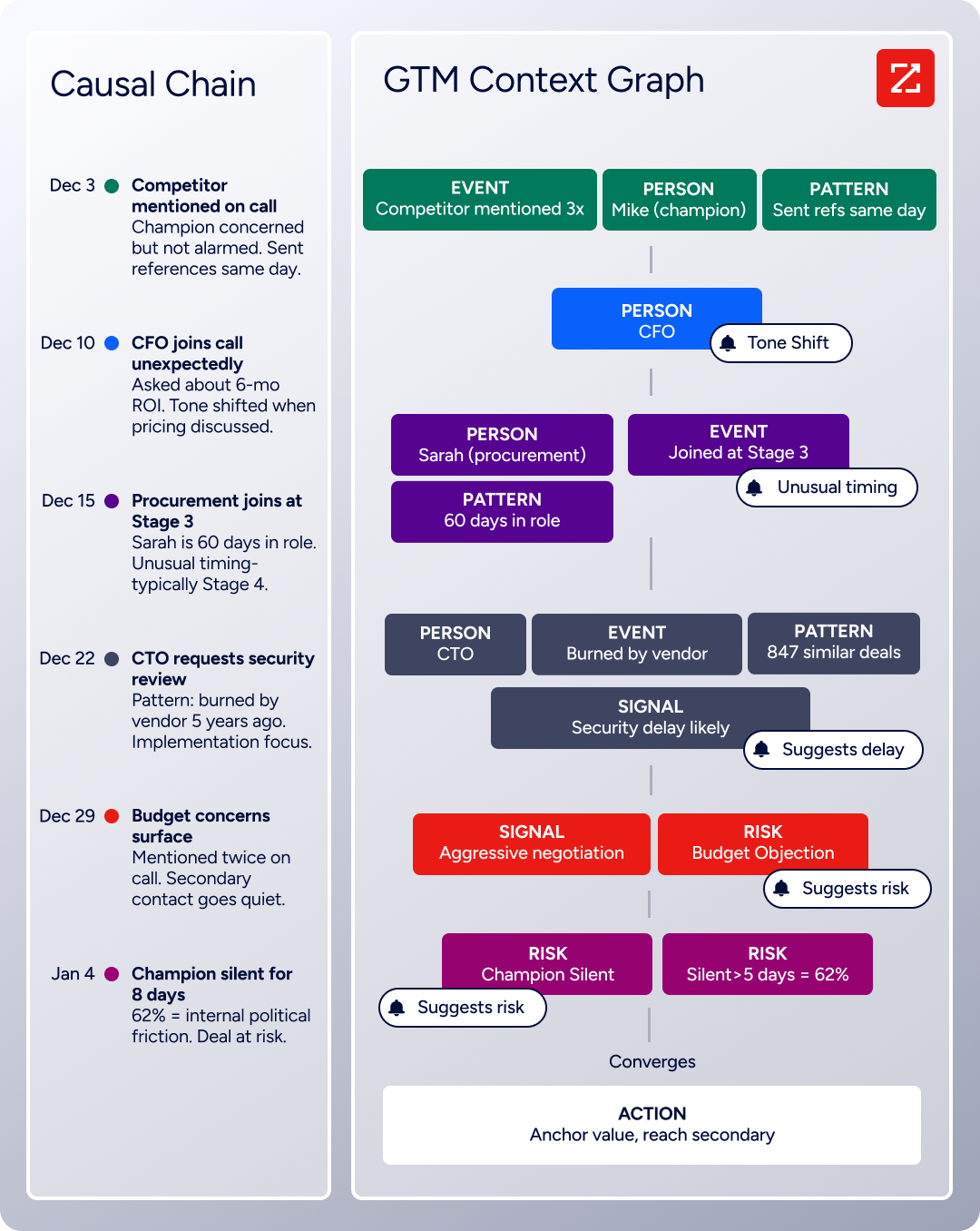
The difference: GetAccept can tell you that the CFO spent 12 minutes on your pricing page.
The GTM Context Graph tells you that the CFO's engagement, combined with the company's recent funding round, three VP-level hires in your target department, and active research into your competitor's product category, matches the pattern behind 78% of your closed-won deals this quarter. Only the GTM Context Graph can connect those signals.
As ZoomInfo CPO Dominik Facher writes: "The CRM recorded the state change. It has no record of why it happened." The GTM Context Graph captures that decision context and makes it machine-readable, powering AI that recommends actions based on actual win patterns rather than surface-level engagement metrics.
ZoomInfo in Action: Your deal with a mid-market SaaS company has been sitting at Stage 3 for two weeks. GetAccept shows the deal room was last viewed five days ago.
ZoomInfo's GTM Context Graph tells you the VP of Sales who championed your deal just changed roles internally, a new VP was hired from a company that uses your competitor, and the account's intent signals for your product category dropped 40% in the last week.
Armed with this context, your rep pivots: reaching out to the new VP with a personalized message addressing the competitor experience, rather than sending a generic "just checking in" follow-up.
Buyer Intent & Website Visitor Identification: Engage Accounts Before They Enter Your Pipeline
GetAccept's analytics are entirely post-engagement: they begin tracking once a buyer enters a Deal Room. The platform has no mechanism for identifying companies that are actively researching solutions in your category but haven't yet engaged with your sales team.
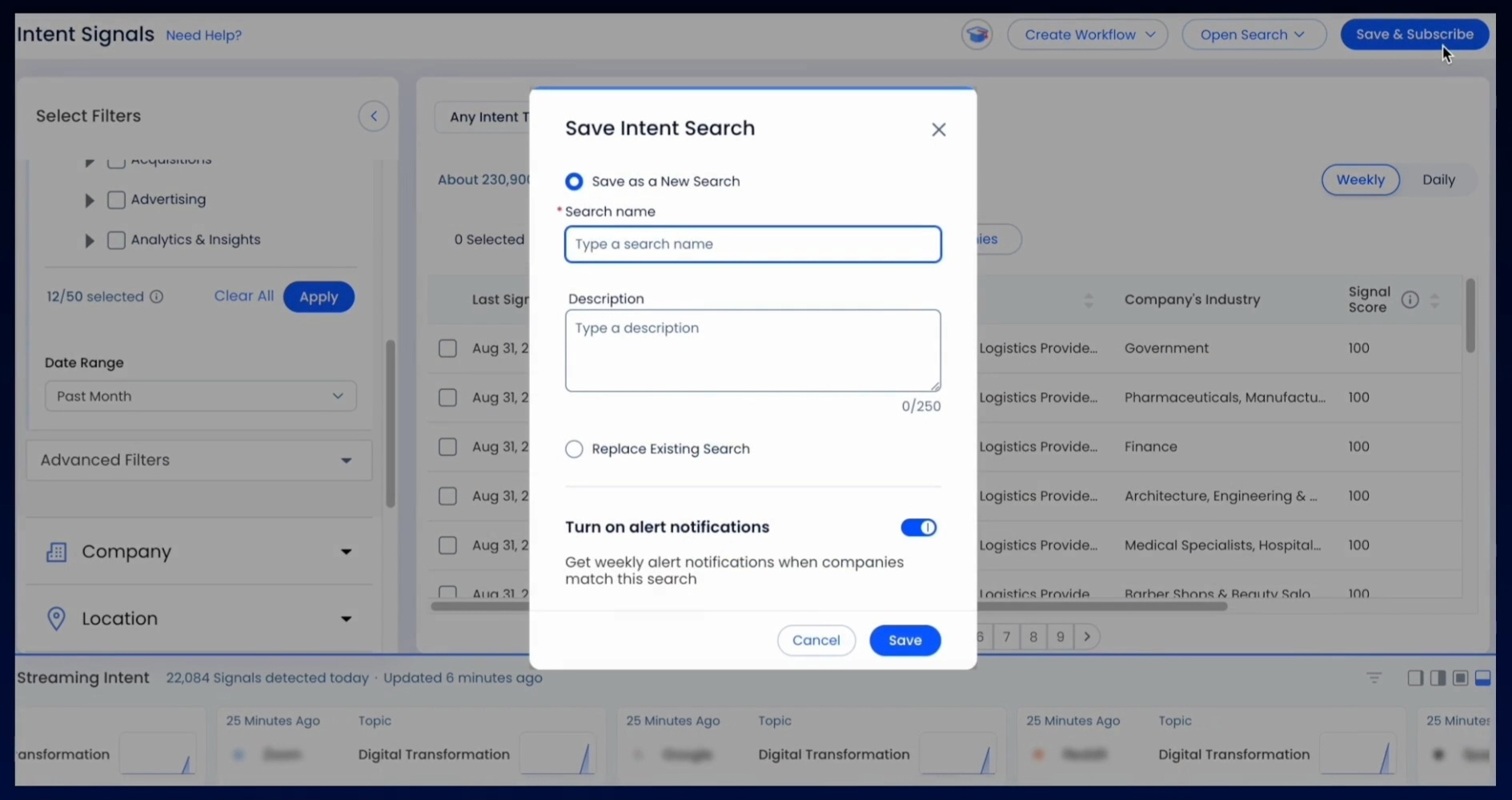
ZoomInfo's Buyer Intent monitors in-market research behavior across the web, tracking signals from 210 million IP-to-Organization pairings.
Source: ZoomInfo
Guided Intent, exclusive to ZoomInfo, automatically identifies the research topics correlated with your successful deals rather than requiring manual keyword selection. Meanwhile, WebSights resolves anonymous website traffic to specific companies, including buying team identification and direct contact information, with Automatic Traffic Filtering that distinguishes real visitors from bots.
These pre-pipeline signals give your team a timing advantage no deal-room tool can provide: you reach out to accounts while they're actively evaluating, not after they find you.
ZoomInfo in Action: ZoomInfo's intent signals show that a target account has been researching "digital sales room alternatives" and "proposal automation software" over the past two weeks.
WebSights confirms that three people from that company visited your pricing page yesterday. Your SDR reaches out with a personalized message referencing their evaluation, books a demo, and creates a GetAccept Deal Room, all before the prospect has contacted any competitor. You're first in the room because ZoomInfo told you they were looking.
"ZoomInfo's not just a contact data company anymore. They've built a full system of execution. GTM Intelligence actually works the list, writes the outreach, triggers the play, and helps drive predictable growth." (Ian Brodie, CEO & Co-Founder, Levanta)
NOTE: We looked into other go-to-market intelligence platforms and found that while tools like 6sense and Bombora provide valuable intent data, ZoomInfo combines the largest B2B contact database with intent signals, conversation intelligence (Chorus), and AI-powered deal reasoning in a single platform.
ZoomInfo holds 133 No. 1 rankings on G2 across Sales Intelligence, Buyer Intent, and Data Quality categories, and was named a Leader in the Forrester Wave for Intent Data Providers B2B (Q1 2025).
ZoomInfo Pricing
ZoomInfo uses a custom-quoted, consumption-based pricing model where costs scale around enterprise license agreements, data access, API consumption, and AI activity. There are no publicly listed prices; all plans require contacting ZoomInfo for a quote.
ZoomInfo offers three Sales plan tiers:
Professional includes contact and company data, advanced search, CRM integrations (HubSpot, Salesforce), Chrome extension, mobile app, and AI-powered email generation.
Advanced adds AI-driven account prioritization, Buyer Intent signals, website visitor identification, Champion Tracking, automated outreach workflows, and GTM plays.
Enterprise adds real-time buyer intent, advanced workflows, custom integrations, AI-generated account summaries, and a dedicated customer service manager.
Marketing and Chorus (conversation intelligence) plans are available separately. API access is included in all relevant plans.
ZoomInfo also offers ZoomInfo Lite, a permanent free tier with access to the B2B database, 10 monthly export credits, individual and company searches, and a Chrome extension. No credit card or time limit required. A 7-day free trial of paid features is also available.
Who Should Use ZoomInfo?
Choose ZoomInfo if:
Your biggest pipeline challenge isn't deal execution inside a room but identifying the right accounts to target, reaching verified decision-makers, and understanding when they're ready to buy. ZoomInfo's data and intent signals solve the "who, when, and why" before the "how" of deal rooms.
You need AI that reasons across your entire go-to-market motion (CRM data, conversation intelligence, intent signals, and buyer behavior) rather than AI that operates within a single deal workspace. ZoomInfo's GTM Context Graph connects signals across thousands of deals to power recommendations based on actual win patterns.
Your revenue operations team spends too much time stitching together contact data, intent signals, and CRM enrichment from multiple vendors. ZoomInfo consolidates the intelligence layer so your team can focus on execution, whether inside GetAccept, another deal room, or ZoomInfo's own GTM Workspace.
Ready to see how ZoomInfo's intelligence layer can improve your go-to-market results? Start your free trial or request a demo to explore the platform.
2. DealHub — Best Alternative for Enterprise Revenue Teams with Complex Pricing & Approval Workflows
DealHub is an AI-powered CPQ and quote-to-revenue platform built for enterprise sales teams whose pricing complexity, subscription structures, and multi-stakeholder approval requirements exceed what a digital sales room alone can handle.
Its key capabilities include:
AI-powered guided CPQ with playbook-driven quoting that walks reps through complex configurations using conditional logic
Integrated DealRoom connected directly to the CPQ workflow for buyer-facing collaboration
Revenue lifecycle management extending beyond the signature into billing, subscription management, and renewal automation
Enterprise CRM integrations with real-time bidirectional sync to Salesforce, Microsoft Dynamics, HubSpot, and Freshworks
Automated approval workflows routing deals based on size, discount level, or product type
API-first headless quoting enabling embedded commerce and self-service portals
Why Choose DealHub Over GetAccept for Complex Revenue Operations
DealHub stands out in the following areas:
Full CPQ vs. a Basic Product Library
GetAccept includes a pricing table and product library that lets reps insert predefined products into proposals.
For straightforward pricing, this works. But GetAccept's CPQ is limited: the product library is capped at 3 products on Professional, unlimited only on Enterprise, with no guided selling logic, no multi-dimensional pricebook, and no approval routing based on discount thresholds.
If a rep applies a 40% discount when company policy caps it at 25%, GetAccept has no mechanism to hold that quote for review.
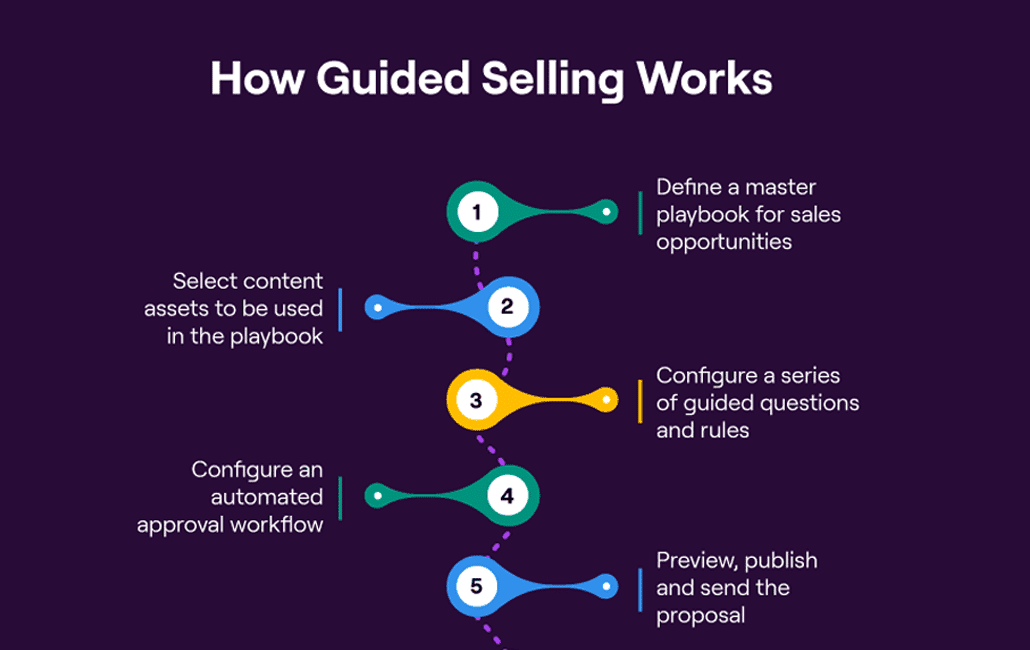
DealHub's playbook-based guided selling walks reps through configuration questionnaires where conditional logic narrows product options and calculates pricing automatically based on tiered, usage-based, and subscription ramp structures.
Source: DealHub
Revenue Lifecycle Management Where GetAccept Ends
GetAccept's value is front-loaded into the sales cycle: create the proposal, engage the buyer, get the signature. Once the contract is signed, GetAccept stores the document and tracks renewal dates. But it does not invoice customers, manage subscription plan changes, prorate upgrades, handle consumption metering, or recognize revenue under ASC 606/IFRS 15.
DealHub's Subscriptions & Billing module manages the full subscription lifecycle: activation, amendments, consumption tracking, automated invoice generation, and proration calculations, all flowing from the same data model as the original CPQ quote. The November 2025 acquisition of Subskribe deepened DealHub's capabilities for SLG, PLG, and consumption-based GTM motions.
Pricing Governance That GetAccept Doesn't Offer
GetAccept's Deal Room is a good collaborative workspace with engagement visibility and mutual action plans. What it doesn't do is prevent a rep from offering a policy-violating discount before the proposal reaches the buyer.
DealHub enforces pricing governance at the system level: multi-step approval workflows route deals automatically based on configurable criteria, so reps cannot send non-compliant quotes without sign-off.
NOTE: We also evaluated Salesforce Revenue Cloud and Conga for this slot. While Salesforce Revenue Cloud offers deep CPQ with tight ecosystem integration, it requires full Salesforce platform commitment and carries higher implementation complexity. Conga covers CLM and document automation well but is less cohesive as a unified quote-to-revenue platform.
DealHub offers the most integrated combination of CPQ, CLM, DealRoom, and subscription billing for enterprise teams needing pricing governance without ecosystem lock-in.
For a detailed head-to-head of how DealHub stacks up against Salesforce CPQ specifically, see our DealHub vs Salesforce CPQ comparison.
DealHub Pricing
DealHub operates on a custom quote-only pricing model with no publicly listed rates.
All plans require contacting DealHub sales. Annual rate increases are capped at the greater of 5% or prior 12-month CPI.
CPQ+ includes guided quoting, multi-dimensional pricebook, approval workflows, deal desk dashboard, partner channel quoting, and integrated DealRoom.
CPQ + CLM adds dynamic contract templates, centralized clause library, contract repository, redline management, and version comparison.
Quote-to-Revenue adds subscription billing, recurring/usage-based pricing, consumption tracking, invoicing, and renewal management.
Who Should Use DealHub?
Choose DealHub if:
Your sales motion involves complex product configurations, multi-tier subscription models, or usage-based pricing that GetAccept's basic product library cannot govern.
You need deal desk enforcement with multi-step approval routing triggered by discount levels, deal size, or product type to protect pricing margins.
Your revenue operations extend beyond the signature into subscription billing, usage metering, mid-cycle amendments, and revenue recognition.
You're scaling a mid-to-large enterprise (150+ sellers) where standardized quoting and enforced pricing policies matter at the organizational level.
3. PandaDoc — Best Alternative for Small Teams That Can't Clear the 5-User Minimum
PandaDoc is a document automation and e-signature platform that removes the entry barrier making GetAccept inaccessible to lean sales teams: you can start with a single user, pay $19/user/month, and get legally binding e-signatures, real-time document tracking, and audit trails without committing to five seats.
Its key capabilities include:
No minimum seat requirements at any paid tier, scaling from one user upward
A permanent free plan with unlimited e-signatures for up to 60 documents per year
1,000+ industry-specific templates with a drag-and-drop block editor
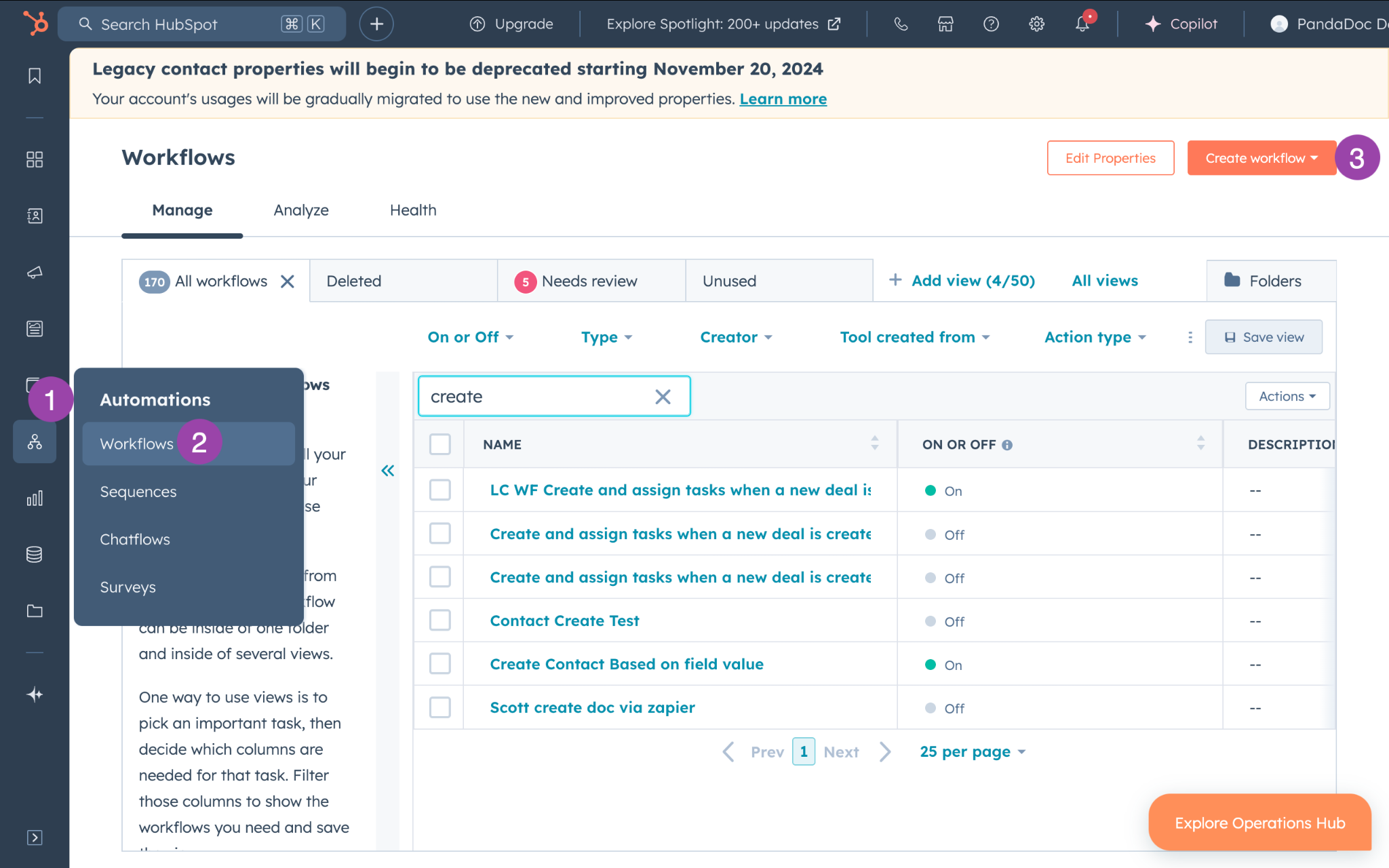
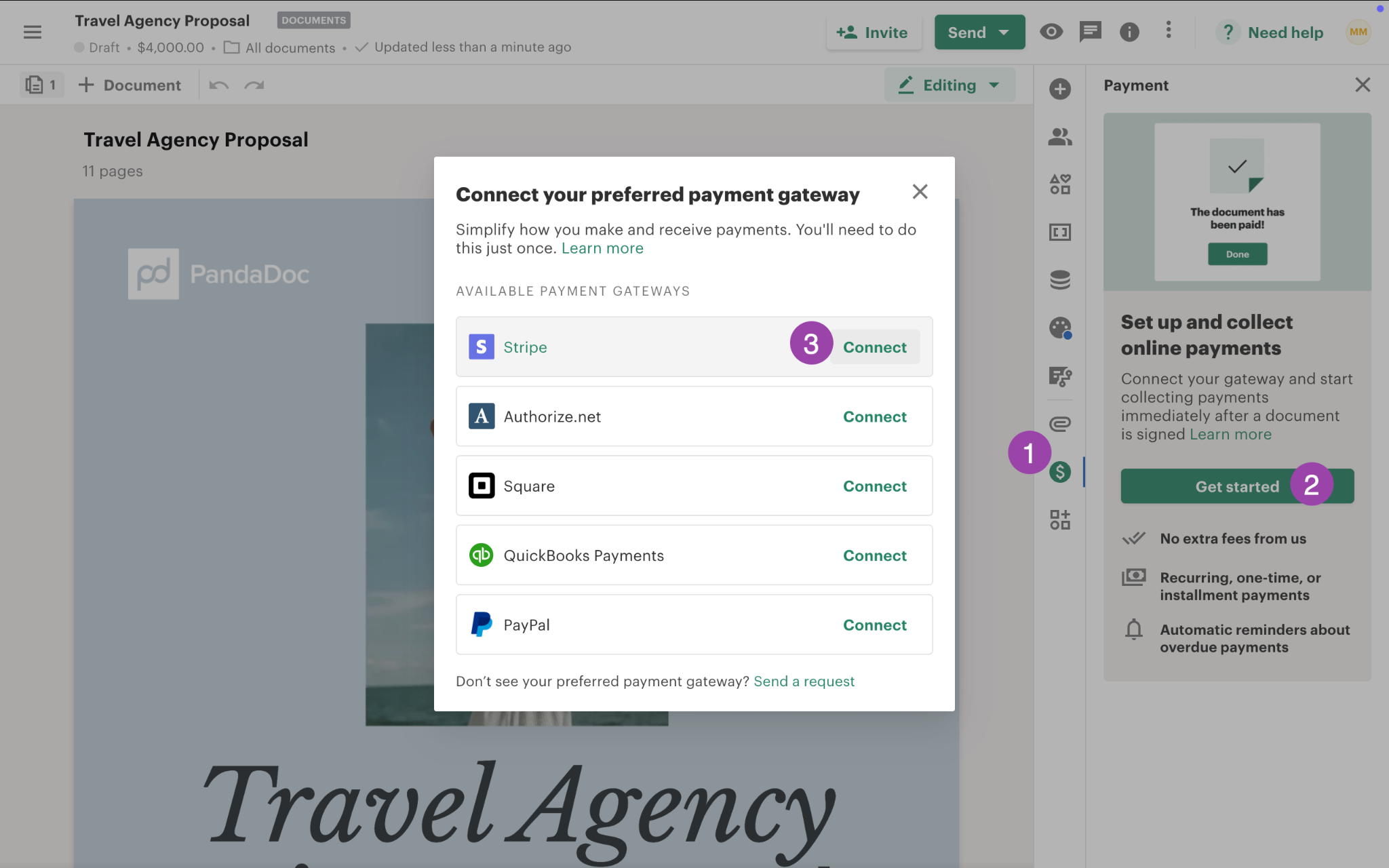
Native payment collection via Stripe, Square, PayPal, Authorize.net, and QuickBooks Payments embedded inside signed documents, available on Free and Starter plans as of March 2026
Page-by-page engagement analytics showing when proposals were opened and which sections held buyer attention
CRM integrations with Salesforce, HubSpot, and Pipedrive, including native CPQ variants on Enterprise
Source: PandaDoc
Why Choose PandaDoc Over GetAccept for Small Teams
PandaDoc stands out in the following areas:
No Seat Minimums at Any Tier
GetAccept's Professional plan (which unlocks AI features, Digital Sales Rooms, Mutual Action Plans, and CRM integrations) requires a minimum of 5 users at $49/user/month: $245/month minimum.
Solo founders and two-person sales teams are locked out of everything that makes GetAccept worth paying for. The eSign plan at $25/user/month has no minimum, but it excludes AI, deal rooms, MAPs, and all CRM integrations.
PandaDoc has no seat minimums at any tier. A single-person operation pays $19/month on Starter and gets an audit trail, unlimited document sends, and 24/7 support.
The Business tier at $49/seat/month adds CRM integrations and approval workflows with the same per-seat pricing and no minimum threshold. PandaDoc scales with headcount rather than demanding a headcount commitment upfront.
A Permanent Free Tier
GetAccept has no permanent free plan, only a trial with an undisclosed duration. PandaDoc's free plan is indefinite, requires no credit card, and delivers unlimited e-signatures for up to 60 documents per year.
As of March 2026, PandaDoc expanded payment collection to Free and Starter plans, so even free-tier users can embed Stripe, Square, or PayPal checkout inside signed documents.
Native Payment Collection, Not an Add-On
GetAccept supports payment integrations via Stripe, Chargebee, and Authorize.net, but these are listed as add-on features on the Professional plan.
PandaDoc's payment collection is native: Stripe (including recurring billing), Square, PayPal, Authorize.net, QuickBooks Payments, and FreshBooks embed directly inside pricing tables. Recipients sign and pay in a single session, which matters for SaaS companies and service firms where a signed contract and first payment are logically the same moment.
Source: PandaDoc
NOTE: We also evaluated Qwilr and Better Proposals for this slot. While Qwilr excels at building polished, interactive web-based proposals, and Better Proposals offers a focused, lightweight tool with solid templates for freelancers, PandaDoc offers the best combination of no-minimum pricing, a permanent free tier, and native payment collection for teams blocked by GetAccept's 5-user threshold.
PandaDoc Pricing
PandaDoc uses a per-seat subscription model across four tiers. Annual billing saves up to 46% versus month-to-month.
Free — $0/month; unlimited e-signatures for up to 60 documents/year; 2 recipients per document; 5 saved templates; payment collection via Stripe, Square, PayPal.
Starter — $19/user/month (annual); unlimited document sends; audit trail; 24/7 email and chat support.
Business — $49/seat/month (annual); CRM integrations (HubSpot, Salesforce, Pipedrive, 15+ others); custom quotes; approval workflows; bulk send; Deal Rooms.
Enterprise — Custom pricing; CPQ for Salesforce, HubSpot, and Pipedrive; Smart Content with conditional logic; SSO; data residency; Qualified Electronic Signatures (QES).
Who Should Use PandaDoc?
Choose PandaDoc if:
Your team has fewer than 5 people and you can't access GetAccept's Digital Sales Room or CRM integrations without hitting the minimum seat threshold.
You need to collect payment at the moment of contract signature, with native Stripe, PayPal, and Square integrations that work across Free, Starter, and Business plans without additional fees.
You want to start with a permanent free plan, validate the workflow with real clients, and upgrade only when volume demands it.
4. Proposify — Best Alternative for Proposal Governance and Process Consistency at Scale
Proposify is a proposal management platform built around the closing moment in the sales cycle, not as a generic document tool, but as a governance-first system that keeps every proposal consistent, compliant, and on-brand across a distributed rep population.
Its key capabilities include:
Content locking at the element or block level, so reps can personalize only the parts they should
Conditional approval workflows triggered by deal size thresholds or discount depth
Pipeline visibility dashboard showing every open proposal's status and section-level engagement data
Interactive pricing tables where buyers select options and adjust quantities inside the proposal
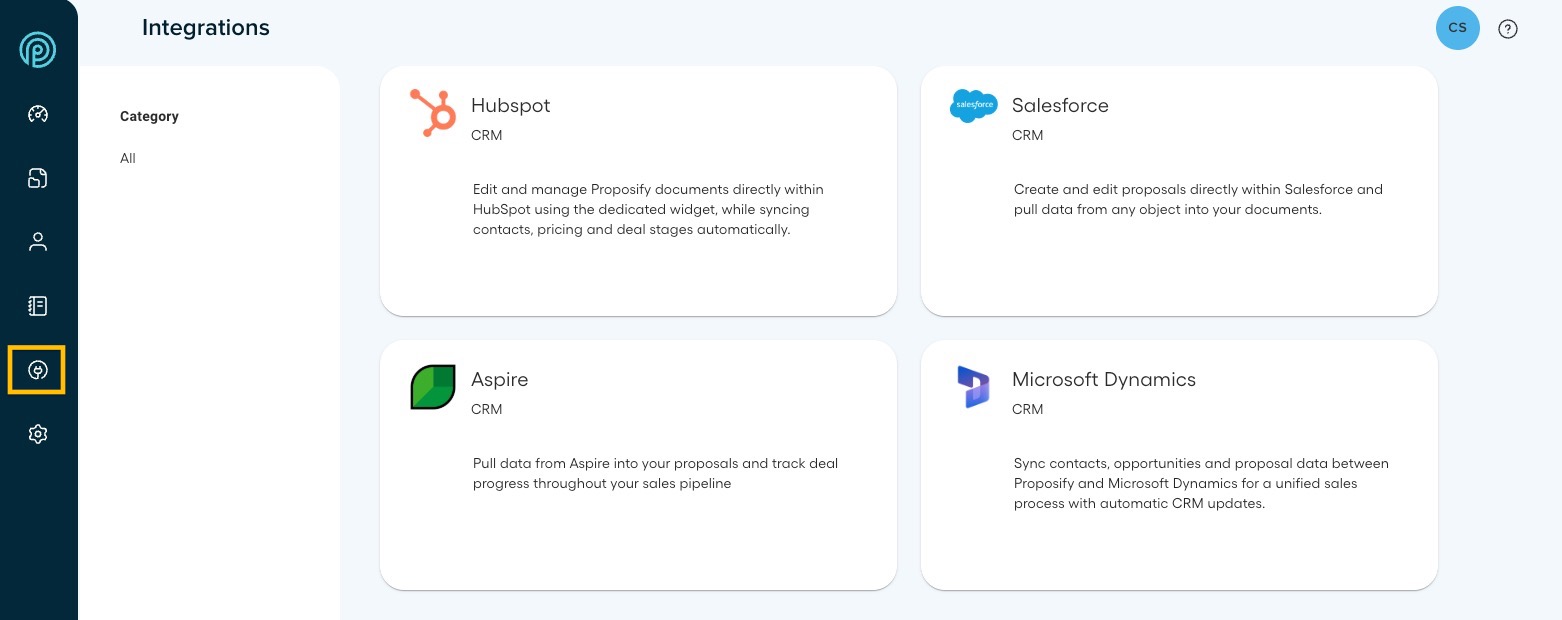
Two-way CRM sync with Salesforce and HubSpot
Source: Proposify
Why Choose Proposify Over GetAccept for Proposal Governance
Proposify stands out in the following areas:
Content Locking That Enforces Compliance Without Manager Bottlenecks
GetAccept's most cited weakness among non-Enterprise users is template inflexibility: G2 reviewers flag that "lack of flexibility in conditional templates forces users to duplicate contracts for minor variations."
Conditional content (the feature that controls what sections reps can modify) is gated to the Enterprise plan. Professional-plan teams have no mechanism to prevent a rep from modifying pricing figures or adding off-script legal language.
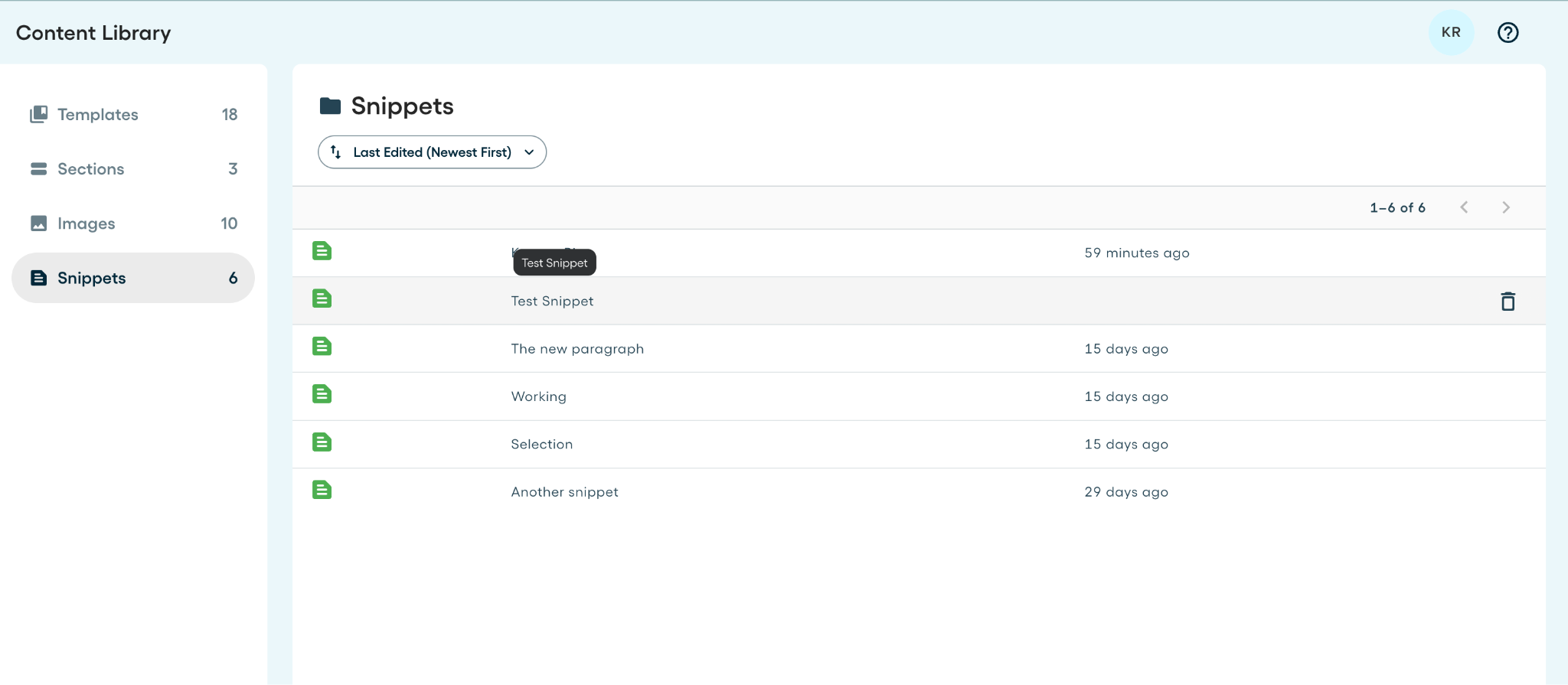
Proposify's element and block locking system lets admins lock specific elements (individual pricing cells, entire legal sections, branded headers) from within the document editor. Reps personalize the parts they're supposed to and cannot touch the parts they shouldn't.
Source: Proposify
Approval Workflows Triggered by Deal Parameters
Proposify's conditional approval workflows route documents to reviewers based on actual deal parameters: deal value thresholds, discount percentages, document type, or optional fee selections.
Routine proposals go directly to the buyer; outlier deals route to the right approver automatically. This differs from GetAccept's approval model, which is primarily a pre-send internal approver flow without deal-parameter conditioning.
Section-Level Proposal Analytics Without Deal Room Setup
GetAccept's engagement analytics are strong but architecturally tied to its full deal room workflow. For a growing team that simply wants to know whether a sent proposal was opened and which sections held buyer attention (without building a digital sales room for every deal),
Proposify's proposal tracking captures section-by-section engagement automatically on every sent document. The State of Proposals 2026 report, built on 742,137 real proposals across 30 industries representing $3.06B in sales, represents Proposify's proprietary benchmark dataset.
NOTE: We also evaluated Qwilr and Oneflow for this slot. While Qwilr excels at visually immersive proposals for creative teams, and Oneflow is strong for contract-native teams needing e-sign with negotiation workflows, Proposify offers the most complete governance architecture for growing sales teams: content locking, conditional approval routing, and pipeline analytics combined at mid-market pricing.
Proposify Pricing
Basic — $19/user/month (annual) or $29/user/month (monthly); up to 10 document sends/month; legally binding e-signatures; document tracking.
Team — $41/user/month (annual) or $49/user/month (quarterly); unlimited sends; per-section analytics; CRM integrations and automations; custom fields.
Business — starts at $3,900/year (contact sales for custom pricing); user roles and permissions; conditional approval workflows; SSO; API access; dedicated CSM.
Who Should Use Proposify?
Choose Proposify if:
Your sales team has grown past the point where individual rep discretion produces consistent proposals, and you need locking architecture to enforce pricing and legal compliance across a distributed rep base.
You're on HubSpot or an early-stage Salesforce deployment and want two-way proposal-to-CRM sync without enterprise-tier pricing.
You want proposal governance (approval workflows and content locking) without forcing every rep to build a full digital sales room for every deal.
5. DocuSign — Best Alternative for Enterprise-Scale E-Signature and Agreement Intelligence
DocuSign is an electronic signature and agreement management platform that serves organizations whose primary requirement is legally airtight, globally compliant signing at scale.
Its key capabilities include:
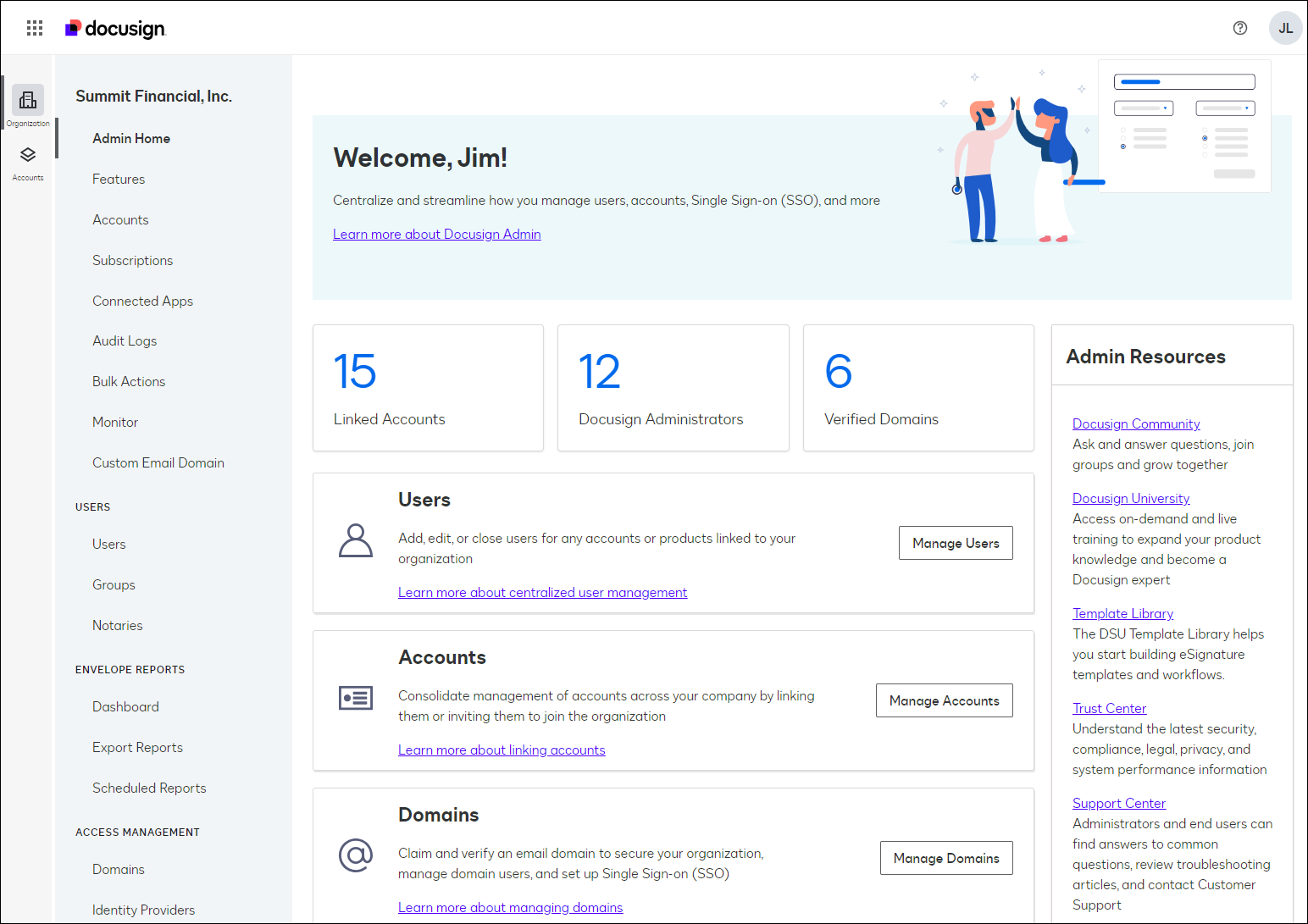
Global legal compliance across 180+ countries, covering ESIGN, UETA, eIDAS (including QES), FedRAMP Moderate, HIPAA, ISO 27001, SOC 2, and more
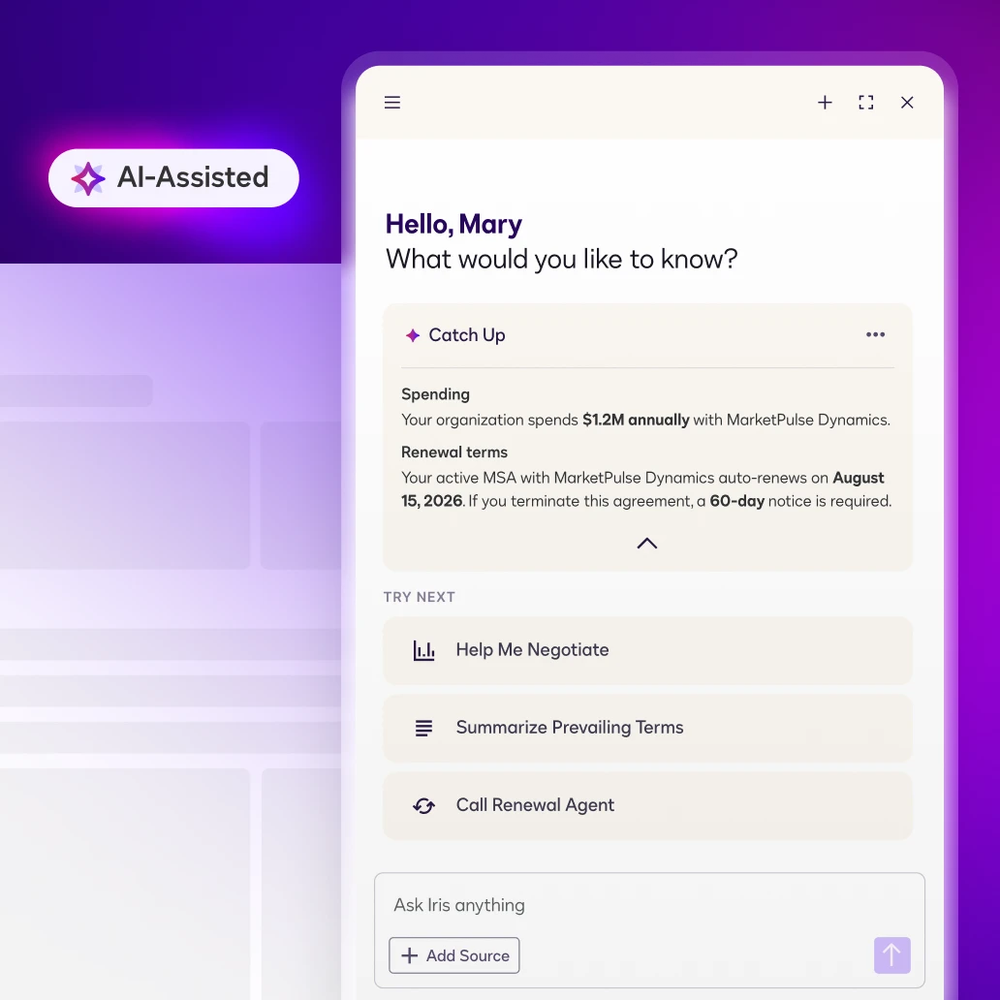
Intelligent Agreement Management (IAM) powered by the Iris AI engine, trained on 200 million+ consented agreements
No-code Workflow Builder for multi-step signing sequences and conditional routing
1,000+ pre-built integrations with Salesforce, Microsoft 365, Google Workspace, SAP, and ServiceNow
Tamper-evident audit trail sealed via PKI at the moment of final signature
Source: DocuSign
Why Choose DocuSign Over GetAccept for Enterprise Compliance and Agreement Management
DocuSign stands out in the following areas:
Global Compliance Depth That No Sales Platform Can Match
GetAccept covers US ESIGN/UETA, UK Electronic Communications Act, and EU eIDAS, a solid baseline for most B2B SaaS teams. What GetAccept does not provide is the granular, jurisdiction-by-jurisdiction legal framework management that regulated-industry enterprise buyers require.
DocuSign's Legality Guide documents country-by-country enforceability across 180+ countries. Its FedRAMP Moderate + DoD IL4 authorization covers US federal and defense procurement. Its 21 CFR Part 11 configuration satisfies FDA electronic records compliance.
For multinational sales teams closing contracts across financial services, healthcare, and government, DocuSign's ability to serve as the single signing vendor for all regulatory contexts is a structural advantage.
AI-Powered Agreement Intelligence at Scale
GetAccept's AI Contract Management is useful for sales-oriented post-signature tracking.
DocuSign's IAM platform operates at a different scale: the Iris AI engine achieves 15% higher precision on legal and business agreement tasks compared to general-purpose models. It flags non-standard liability clauses, generates automated redlines against legal playbooks, and surfaces obligation deadlines organization-wide.
Source: DocuSign
Brand Recognition as a Trust Signal
When 84% of signers say they are more likely to continue doing business with a company that uses DocuSign, that is a network effect built since 2005.
For enterprise buyers sending contracts to legal counsel, institutional investors, or government procurement offices, the counterparty's comfort with the signing interface matters. DocuSign maintains over 99.9% uptime for eSignature with no maintenance downtime.
NOTE: We also evaluated HelloSign (Dropbox Sign) and Adobe Acrobat Sign for this slot. While HelloSign excels at lightweight, low-cost e-signature for smaller teams, and Adobe Acrobat Sign is strong within the Adobe ecosystem, DocuSign offers the broadest compliance coverage, the largest enterprise integration ecosystem, and the most mature AI-powered agreement management.
DocuSign Pricing
DocuSign's pricing separates into eSignature plans and IAM plans:
eSignature Plans (annual billing):
Personal — $10/month; 1 user; 5 envelopes/month.
Standard — $25/user/month; up to 50 users; 100 envelopes/user/year; team templates, collaborative commenting, branding.
Business Pro — $40/user/month; up to 50 users; web forms, payment collection, bulk send, PowerForms.
Enhanced — Contact sales; 50+ users; SSO, Salesforce/Dynamics integrations, HIPAA BAA, FedRAMP, 24/7 support.
IAM Plans (annual billing):
IAM Starter — $45/user/month; Iris AI search and analysis; Agreement Manager.
IAM Standard — $50/user/month (minimum 3 users); unlimited envelopes (web app); 3 Workflows.
IAM Professional — $80/user/month (minimum 3 users); 10 Workflows; full Business Pro features.
IAM Enterprise — Contact sales; AI-Assisted Review and redlining; 24/7 support.
Who Should Use DocuSign?
Choose DocuSign if:
Your organization operates in regulated industries where FedRAMP, HIPAA, 21 CFR Part 11, or eIDAS QES are procurement requirements rather than nice-to-haves.
Your agreement volumes span multiple departments beyond sales: legal, HR, procurement, and customer success all need one platform.
You need an AI-powered contract repository that goes beyond renewal tracking (extracting structured intelligence, flagging high-risk clauses, and automating redlines).
6. Aligned — Best Alternative for AI-Native Buyer Collaboration Without Upfront Platform Spend
Aligned is an AI Deal Workspace built for B2B sales and customer success teams running complex, multi-stakeholder deals. It positions itself as the execution layer between your CRM and your buyer.
Source: Aligned
Its key capabilities include:
Permanent free Starter plan with unlimited seats and three deal rooms per seat, no credit card required
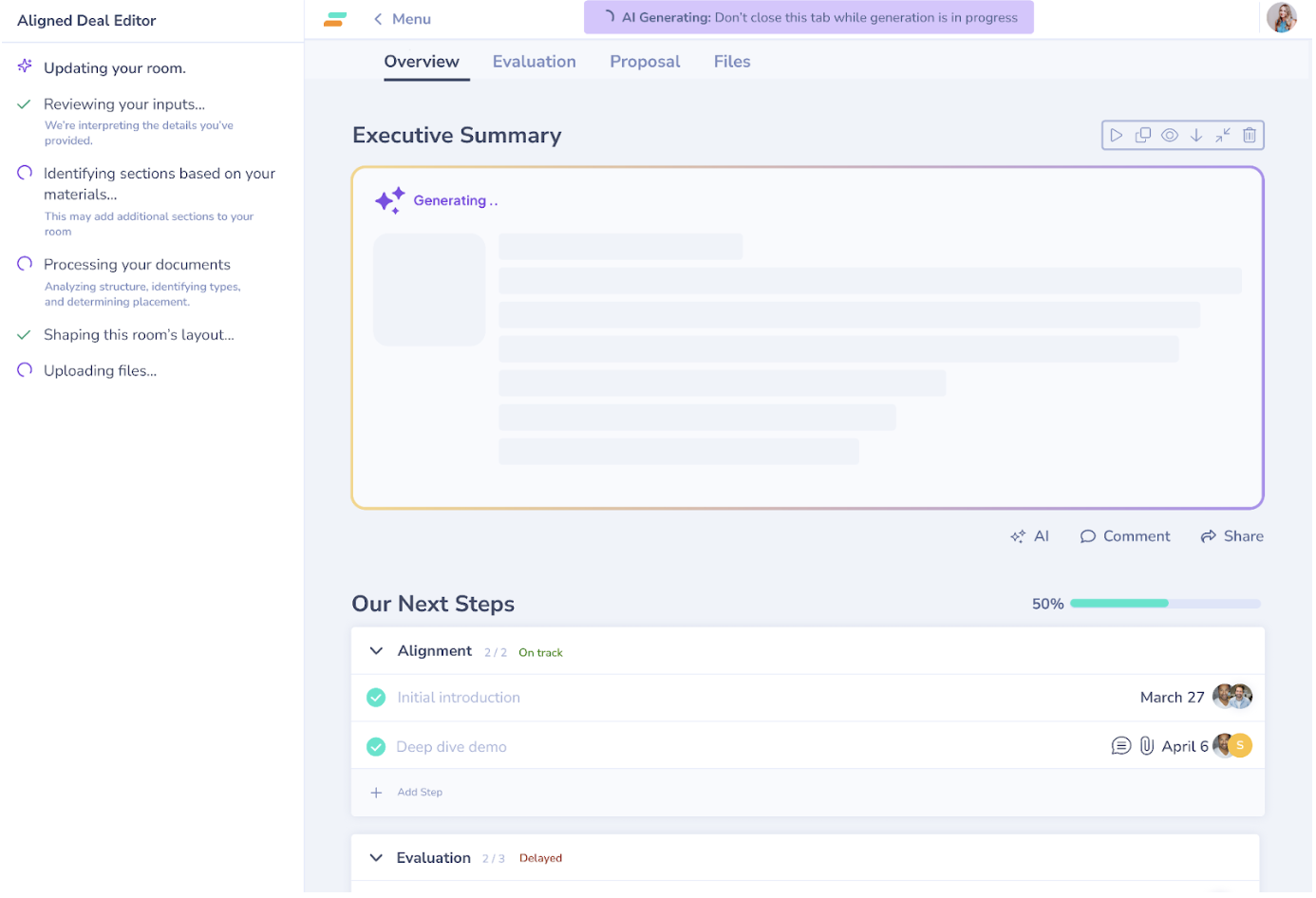
AI Deal Builder that generates a structured deal room from a brief deal description
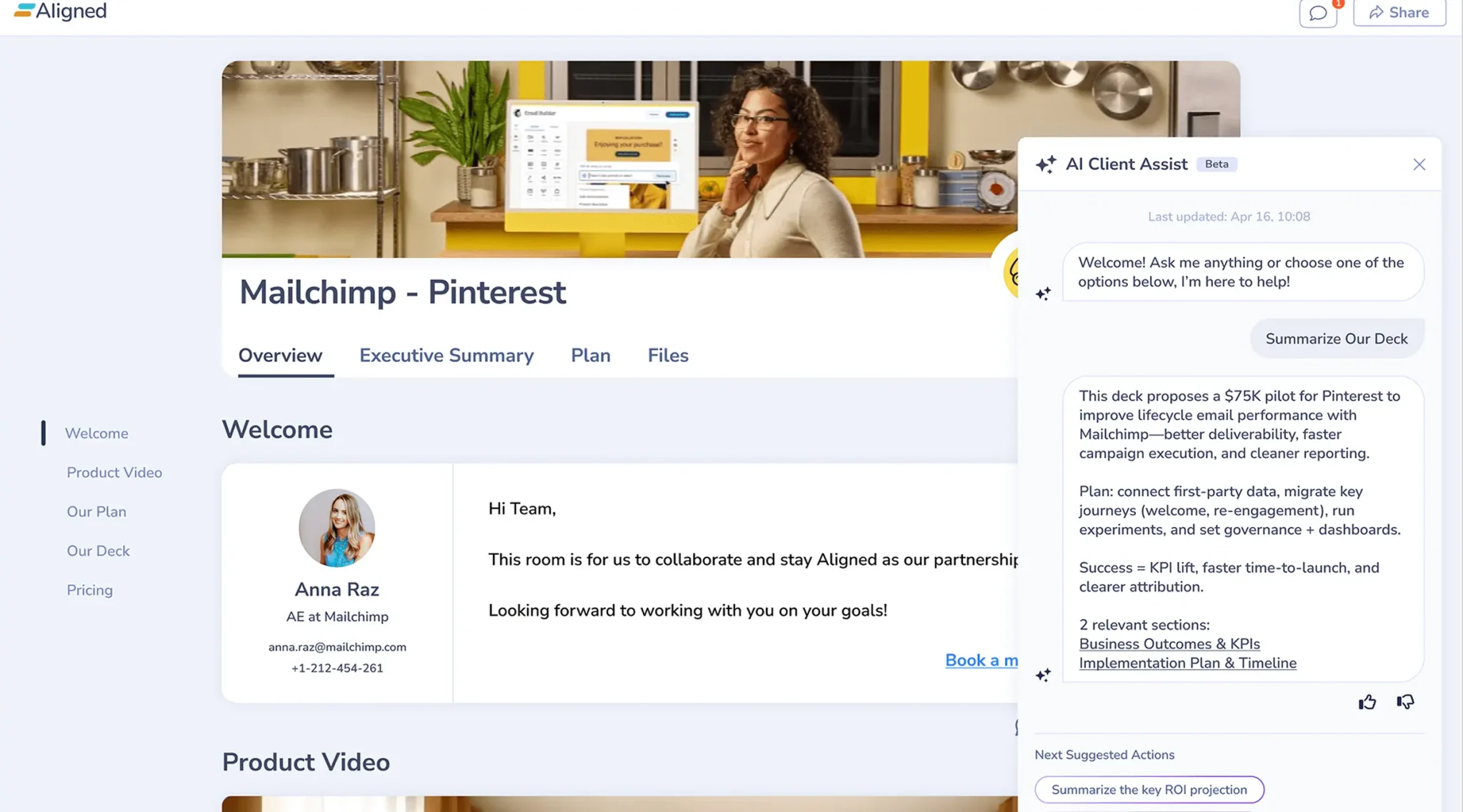
AI Client Assist that surfaces recommended next actions based on real-time buyer engagement patterns
Mutual action plans with bi-directional task ownership feeding deal health scoring
Stakeholder mapping that automatically identifies new contacts who access the room via forwarded links
Buyer-facing AI that lets prospects answer security, compliance, and product questions asynchronously
Why Choose Aligned Over GetAccept for AI-Native Buyer Collaboration
Aligned stands out in the following areas:
A Functional Free Tier vs. GetAccept's 5-User Minimum
GetAccept's Professional plan requires five users at $49/user/month ($245/month floor) before unlocking AI, deal rooms, MAPs, and CRM integrations.
Aligned's Starter plan is permanently free with unlimited seats and three deal rooms per seat, delivering real digital sales room functionality including engagement analytics and secured room sharing.
When teams upgrade, Aligned's Basic plan unlocks unlimited rooms at $29/seat/month with no seat minimum. A two-person AE team can access Aligned's full AI feature set for $98/month on the Pro plan. The equivalent configuration on GetAccept is not purchasable at that team size.
AI That Orchestrates Deal Rooms, Not Just Writes Inside Them
GetAccept's AI is primarily a content generation surface: it drafts business cases, summaries, and meeting recaps inside the deal room.
Aligned's AI Deal Builder works differently. Reps describe the deal in a few sentences and the AI generates the room's entire structure (content layout, section organization, and mutual action plan milestones) from scratch.
AI Client Assist then runs continuously, reading buyer engagement signals and surfacing recommended next actions, closing the gap between signal and action rather than presenting raw analytics for the rep to interpret.
Source: Aligned
Buyer-Side AI for Asynchronous Decision-Making
Aligned gives buyers AI assistance inside the workspace: prospects can ask questions, get answers to security or compliance queries, and summarize content without scheduling another call. GetAccept does not offer a buyer-facing AI surface; its AI layer is entirely seller-directed.
For complex multi-stakeholder deals, this matters: Gartner estimates that 95% of the buying cycle happens when sellers are not in the room. Aligned reports rooms with 4+ hours of buyer engagement achieve an 86% win rate.
NOTE: We also evaluated PandaDoc Free and trumpet's free tier for this slot. PandaDoc Free is limited to e-sign and basic document creation without digital sales room functionality. trumpet's free tier offers a lightweight workspace but lacks AI deal orchestration. Aligned offers the most complete free-tier digital sales room on the market with genuine AI features on paid plans.
Aligned Pricing
Starter — Free (unlimited seats); 3 rooms per seat; engagement analytics; personal subdomain; secured room sharing.
Basic — $29/seat/month (annual) or $35/seat/month (monthly); unlimited rooms and templates; Mutual Action Plans; 1 TB content storage.
Pro — $49/seat/month (annual) or $60/seat/month (monthly); AI Deal Builder, AI Client Assist, AI Content Generator; Gong and PandaDoc integrations.
Enterprise — Custom pricing; bi-directional CRM integration (Salesforce, HubSpot); AI Insights & Actions; SSO; dedicated CSM.
Who Should Use Aligned?
Choose Aligned if:
Your team is evaluating a digital sales room workflow but cannot meet GetAccept's five-user minimum, and you need a free tier to pilot the concept before committing budget.
You are running complex, multi-stakeholder B2B deals where coordinating Finance, Legal, IT, and end-users across asynchronous touchpoints is a core execution challenge.
You want AI that builds the deal room from a brief description and surfaces concrete next-step recommendations, rather than AI that primarily assists with content generation inside a workspace the rep has already built.
The Final Verdict
GetAccept excels as an all-in-one digital sales room and proposal platform, but growing revenue teams often need specialized tools with deeper capabilities.
Based on our research, here are the best alternatives:
ZoomInfo for AI-powered go-to-market intelligence, B2B data, buyer intent signals, and contextual deal reasoning that powers the upstream pipeline
DealHub for CPQ, automated pricing governance, and post-signature revenue lifecycle management
PandaDoc for small teams that need professional proposals, e-signatures, and payment collection without seat minimums or upfront commitment
Proposify for growing sales teams that need proposal governance, content locking, and conditional approval workflows
DocuSign for enterprise-scale e-signature compliance across 180+ countries with AI-powered agreement intelligence
Aligned for teams that want an AI-native digital sales room with a permanent free tier and no seat minimums
You don't have to choose between GetAccept and these alternatives exclusively. Many revenue teams use GetAccept alongside specialized tools to cover their full go-to-market needs. Consider your requirements, team size, and growth trajectory when deciding which solution fits best.
Ready to strengthen your go-to-market results with B2B intelligence? Start your free ZoomInfo trial and see how data-driven insights can improve every deal in your pipeline.
GetAccept Alternatives FAQ
Why do revenue teams look for GetAccept alternatives?
GetAccept works well as an all-in-one digital sales room platform, but teams commonly outgrow it in specific areas.
The most frequent pain points are the 5-user minimum on the Professional plan (which locks smaller teams out of AI, deal rooms, and CRM integrations), limited CPQ capabilities for complex pricing scenarios, template inflexibility without Enterprise-tier conditional content, and the need for deeper go-to-market intelligence upstream of the deal room.
What is the best overall GetAccept alternative?
There is no single best alternative because GetAccept covers multiple functions. ZoomInfo is the top choice for go-to-market intelligence and buyer signals, DealHub leads for complex CPQ and revenue operations, PandaDoc is strongest for small teams needing accessible proposals and e-signatures, and DocuSign is the standard for enterprise-scale compliance and agreement management.
Is there a free alternative to GetAccept?
Yes. PandaDoc offers a permanent free plan with unlimited e-signatures for up to 60 documents per year, including payment collection.
Aligned offers a permanent free Starter plan with unlimited seats, three deal rooms per seat, and engagement analytics.
ZoomInfo offers ZoomInfo Lite, a permanent free tier with access to its B2B database and 10 monthly export credits.
GetAccept itself has only a trial with an undisclosed duration and no permanent free plan.
Which GetAccept alternative is best for small sales teams?
PandaDoc is built for this scenario. It has no seat minimums at any tier, starts at $19/user/month on the Starter plan, and offers a permanent free plan. Aligned is the best option if your priority is digital sales room functionality, with its free Starter plan delivering real deal room capabilities.
Both platforms let teams of 1 to 4 people access core features that GetAccept gates behind a 5-user minimum.
How does ZoomInfo complement or replace GetAccept?
ZoomInfo operates upstream of deal execution: it identifies the right accounts to target, provides verified contact data for decision-makers, surfaces buyer intent signals showing when accounts are actively researching, and delivers AI-powered contextual intelligence about why deals move or stall.
Teams can use ZoomInfo alongside GetAccept (ZoomInfo for targeting and intelligence, GetAccept for deal rooms and proposals) or pair ZoomInfo with its own GTM Workspace for an integrated prospecting-to-close workflow.
Which alternative is best for enterprise compliance requirements?
DocuSign is the clear leader, with legal compliance across 180+ countries and certifications including FedRAMP Moderate, HIPAA BAA, 21 CFR Part 11, ISO 27001, SOC 2, and eIDAS QES.
GetAccept covers GDPR, SOC 2, and eIDAS but does not hold the specialized certifications required for US federal, healthcare, or life sciences procurement.
Can I use multiple GetAccept alternatives together?
Yes, and many teams do. A common configuration is ZoomInfo for upstream intelligence and buyer signals, paired with PandaDoc or Proposify for proposal creation and e-signatures, and DocuSign for enterprise-grade contract management. The right combination depends on which gaps in your current workflow you need to fill.
Which GetAccept alternative handles complex pricing and CPQ best?
DealHub is the standout choice for pricing complexity. Its guided selling playbooks, multi-dimensional pricebooks, and automated approval routing address scenarios that GetAccept's basic product library (capped at 3 products on Professional) cannot handle. DealHub also extends into post-signature subscription billing and revenue recognition, covering the full quote-to-revenue lifecycle.
Looking beyond GetAccept? Compare the strongest alternatives side by side:
