

Accord is a revenue execution platform that gives B2B sales teams a structured way to enforce methodology, run mutual action plans, and manage deals through buyer-facing workspaces. Its playbook-driven approach to MEDDPICC, SPICED, and custom framstakeheworks shows revenue leaders whether reps follow the process that top performers use naturally.
But as your team scales, deal execution methodology becomes only one piece of the puzzle. Some teams need intelligence about who to target and when to engage before they enter a deal room. Others need content infrastructure with governance that scales across hundreds of reps, or a simpler deal room that doesn't require dedicated RevOps to configure.
That's where this guide comes in. Whether you're looking to:
Build a data intelligence foundation that powers every deal from prospecting through close
Scale sales enablement with governed content management and structured rep coaching across large teams
Consolidate deal rooms, proposals, and electronic signatures into a single platform
Deploy personalized buyer experiences without RevOps overhead or enterprise pricing
Run collaborative close plans without full methodology enforcement infrastructure
Cover the full customer lifecycle from deal room through renewal with a free starting point
Use buyer engagement intelligence as your primary deal health signal
We'll explore alternatives that excel in these areas.
This isn't about finding a "better" platform than Accord. It's about finding the right fit for your needs. Some teams might use these tools alongside Accord to fill gaps in their stack, while others might replace it entirely with a solution better suited to their revenue motion.
Let's look at the Accord alternatives and find which ones fit your GTM stack.
The Best Accord Alternatives |
|---|
Best Alternative for AI-Powered B2B Data Intelligence & GTM Execution We chose ZoomInfo because it fills the intelligence gap upstream of deal execution, giving revenue teams B2B data, buyer insights, and a seller workspace to act on those insights across every deal. |
Best Alternative for Enterprise Sales Enablement at Scale We chose Seismic because it delivers governed content management, structured rep coaching, and digital sales rooms under one platform, with 150+ integrations and deployment across 2,000+ organizations. |
Best Alternative for Deal Rooms with Built-In E-Signatures & Proposals We chose GetAccept because it consolidates digital sales rooms, proposal building, and legally compliant electronic signatures into one platform at a transparent per-user price, eliminating the need for three separate tools. |
Best Alternative for Personalized Buyer Pods Without Enterprise Complexity We chose trumpet because any rep can build a branded, interactive buyer workspace in seconds with no RevOps configuration, and its permanent free plan removes all adoption risk. |
Best Alternative for Collaborative Close Plans Without Full Methodology Enforcement We chose Recapped because it specializes in mutual action plans and collaborative deal execution with AI-automated MEDDICC scoring, delivering fast implementation and high rep adoption without heavy RevOps configuration. |
Best Alternative for Full Customer Lifecycle Coverage with a Free Starting Point We chose Dock because its free plan includes unlimited workspaces with AI Documents, and its Connected Workspaces carry deals from sales room through onboarding and renewal in one persistent link. |
Best Alternative for AI-Native Deal Execution with Buyer Engagement Intelligence We chose Aligned because its Buyer Copilot guides buyers through evaluations when sellers aren't present, and its engagement intelligence correlates buyer behavior with an 86% win rate at 4+ hours of engagement. |
What is Accord?
Accord is the Revenue Excellence Platform, an AI-powered platform that turns value-selling best practices and proven sales methodologies into what it calls "unavoidable playbooks."
The central premise: most sales teams can articulate what their top sellers do naturally (multi-thread stakeholders, build CFO-proof business cases, follow mutual action plans) but cannot operationalize those habits at scale. Accord makes excellence the structural default rather than an individual trait.
Its key features include:
Playbooks with MEDDPICC, SPICED, and custom framework enforcement built into the deal workspace, with stage gates that prevent CRM advancement until reps complete critical steps
Mutual Action Plans that create a shared timeline where sellers and buyers track milestones, next steps, and stakeholder responsibilities
Stakeholder Mapping with AI recommendations to identify and engage the full buying committee
Content Management (CMS) that surfaces the right sales asset at the right deal stage (Enterprise tier only)
Intelligence (AI) that generates account plans, business cases, and executive summaries from internal playbook context and external research
Performance Management with dual scoring (automated Execution Score and manual Coaching Score) for objective deal inspection
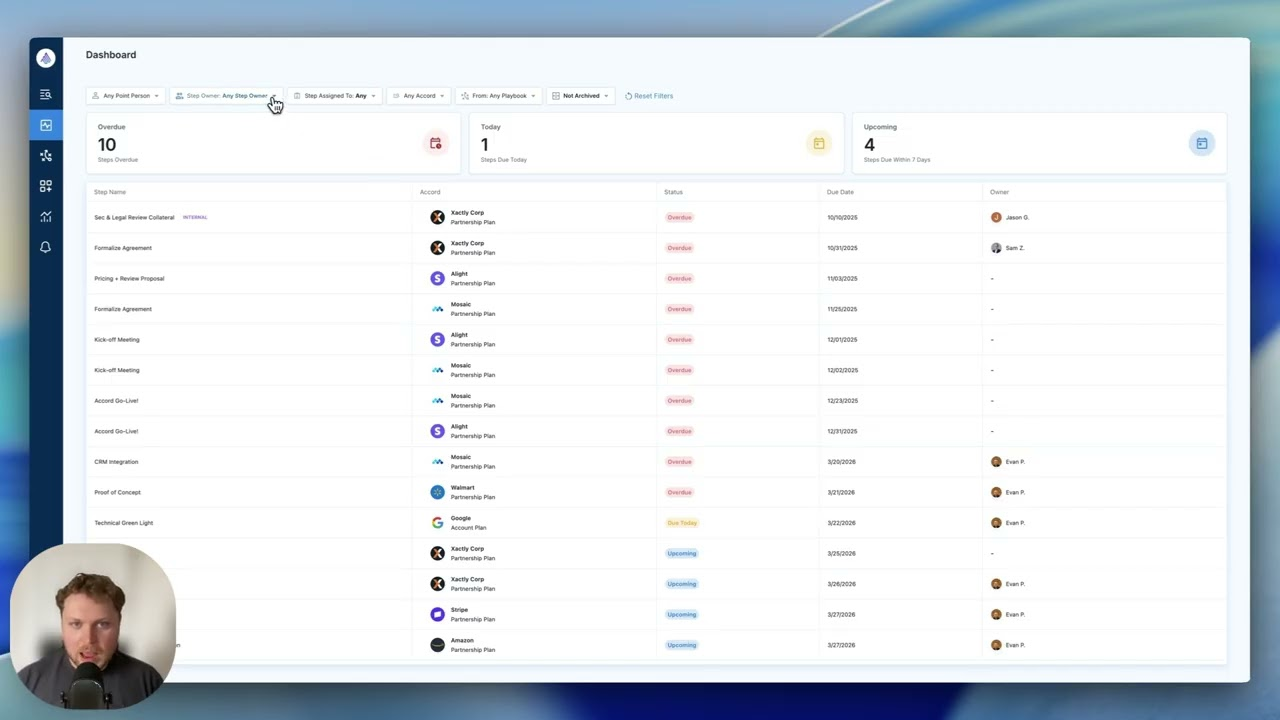
Source: Accord
When a rep creates a deal workspace from an approved Playbook, every stage, step, resource, and stakeholder role pre-populates automatically. As they work through the deal, all activity syncs to the CRM without manual data entry. Sales leadership sees whether a process is being followed and how each deal is progressing.
Accord's collaborative workspace model (buyers and sellers operate in the same environment) has driven adoption among mid-market to enterprise B2B SaaS companies including Stripe, Figma, Freshworks, Samsara, Hootsuite, and Xactly.
However, Accord's strength in methodology enforcement comes with tradeoffs. Its pricing starts at $99/user/month plus an undisclosed platform fee, with core enterprise capabilities (CMS, API access, SSO, AI stakeholder recommendations) locked behind custom-priced tiers.
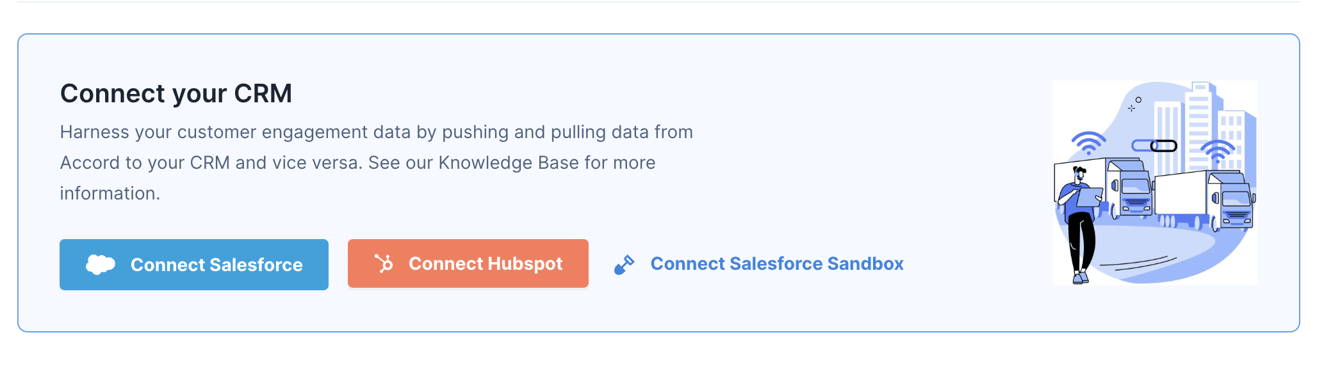
Its native integrations are limited to Salesforce, HubSpot, Slack, Gmail, Gong, and Zapier. And its design assumes a RevOps-driven organization that can build and maintain playbooks before reps can use the tool.
Source: Accord
That's why this article focuses on alternatives that excel where Accord's deal execution specialization may not cover your needs.
Looking for the intelligence foundation that powers every deal? ZoomInfo gives your revenue team B2B data, buyer insights, and a seller workspace to find, win, and grow customers. Learn more about ZoomInfo.
How We Curated Our List of Accord Alternatives
After testing Accord and researching the revenue execution market, we focused on tools that serve needs beyond Accord's methodology enforcement model.
While Accord excels at structuring the sales process, revenue teams often need:
A data intelligence foundation to identify the right buyers and read buying signals before deals begin
Governed content management, structured coaching, and learning programs that scale across large teams
Deal rooms, proposals, and e-signatures consolidated into a single platform
Personalized buyer-facing workspaces that deploy quickly without dedicated RevOps or enterprise budgets
Collaborative close plans and mutual action plans without full methodology enforcement infrastructure
Full customer lifecycle coverage from first demo through onboarding and renewal in one persistent workspace
Buyer engagement intelligence (rather than seller process completion) as the primary deal health indicator
Each tool on this list leads in one of these areas. You might use them alongside Accord or switch entirely; it depends on what your revenue organization needs most.
DISCLAIMER: We aren't covering every single tool in the market! Our focus is on highlighting the best alternatives that address some of Accord's limitations for various use cases. The goal is to provide insights into tools that cater to specific business needs. |
|---|
1. ZoomInfo - Best Alternative for AI-Powered B2B Data Intelligence & GTM Execution
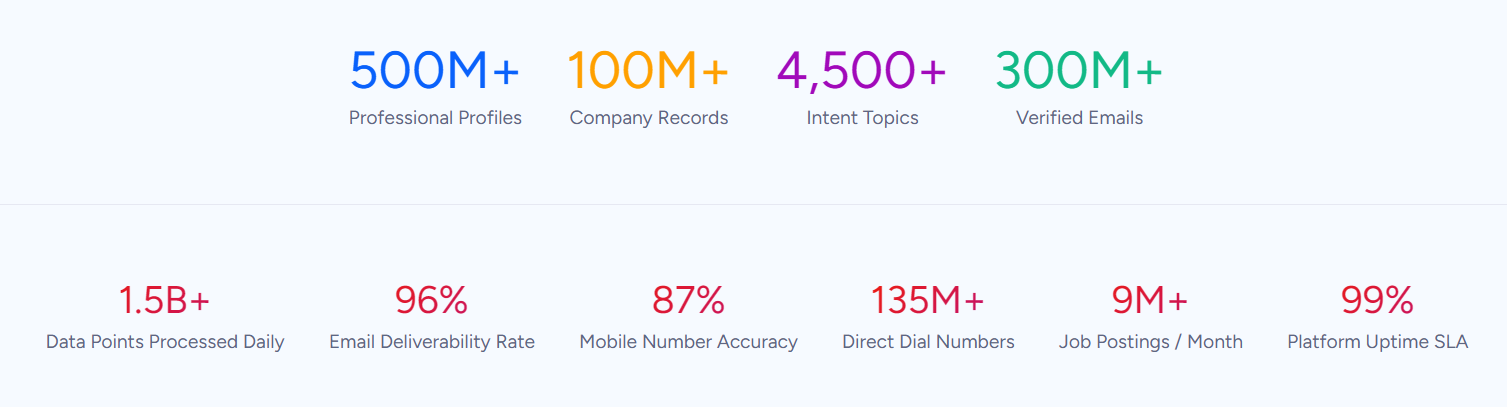
ZoomInfo is an all-in-one AI GTM platform built on the largest B2B data foundation in the industry: 500M contacts, 100M companies, 135M+ verified phone numbers, and 200M+ verified business email addresses.
Its key features include:
B2B data covering identity data, company context, and buying signals, verified by 300+ human researchers and achieving up to 95% accuracy on first-party data
GTM Context Graph that fuses ZoomInfo's third-party intelligence with your CRM records, conversation transcripts, and behavioral signals into a single intelligence layer processing 1.5B+ data points daily
GTM Workspace for sellers: an AI execution workspace with prioritized account feeds, AI-drafted outreach, buying group intelligence, and deal health monitoring
GTM Studio for marketers and RevOps: a builder environment where audience definition, campaign orchestration, and pipeline measurement happen in natural language
Universal access through APIs and MCP that deliver the same intelligence into any third-party tool, custom agent, or partner platform
For revenue teams evaluating Accord alternatives, ZoomInfo takes a different approach to improving deal outcomes. Where Accord enforces methodology after you're in a deal, ZoomInfo provides the intelligence that ensures you're targeting the right accounts, contacting the right people, at the right time, with context on why a deal is moving or stalling.
Why Choose ZoomInfo Over Accord for GTM Intelligence
Accord structures how your team executes deals. ZoomInfo gives your team the intelligence that makes every deal interaction more effective.
Here's where ZoomInfo steps up.
B2B Data Intelligence: Know Exactly Who to Target and When to Engage
Accord starts working once you're inside a deal: it enforces which steps reps follow, tracks stakeholder mapping, and scores playbook completion. But it has no data layer to help your team identify the right accounts, find direct contact information for decision-makers, or detect when a prospect is actively researching solutions like yours.
ZoomInfo addresses this entire upstream motion.
With 500M contacts and 100M companies, your team can search across 300+ company attributes to build targeted prospect lists. 120M direct-dial phone numbers and 200M+ verified business email addresses mean reps reach the right person on the first attempt, rather than bouncing through generic inboxes.
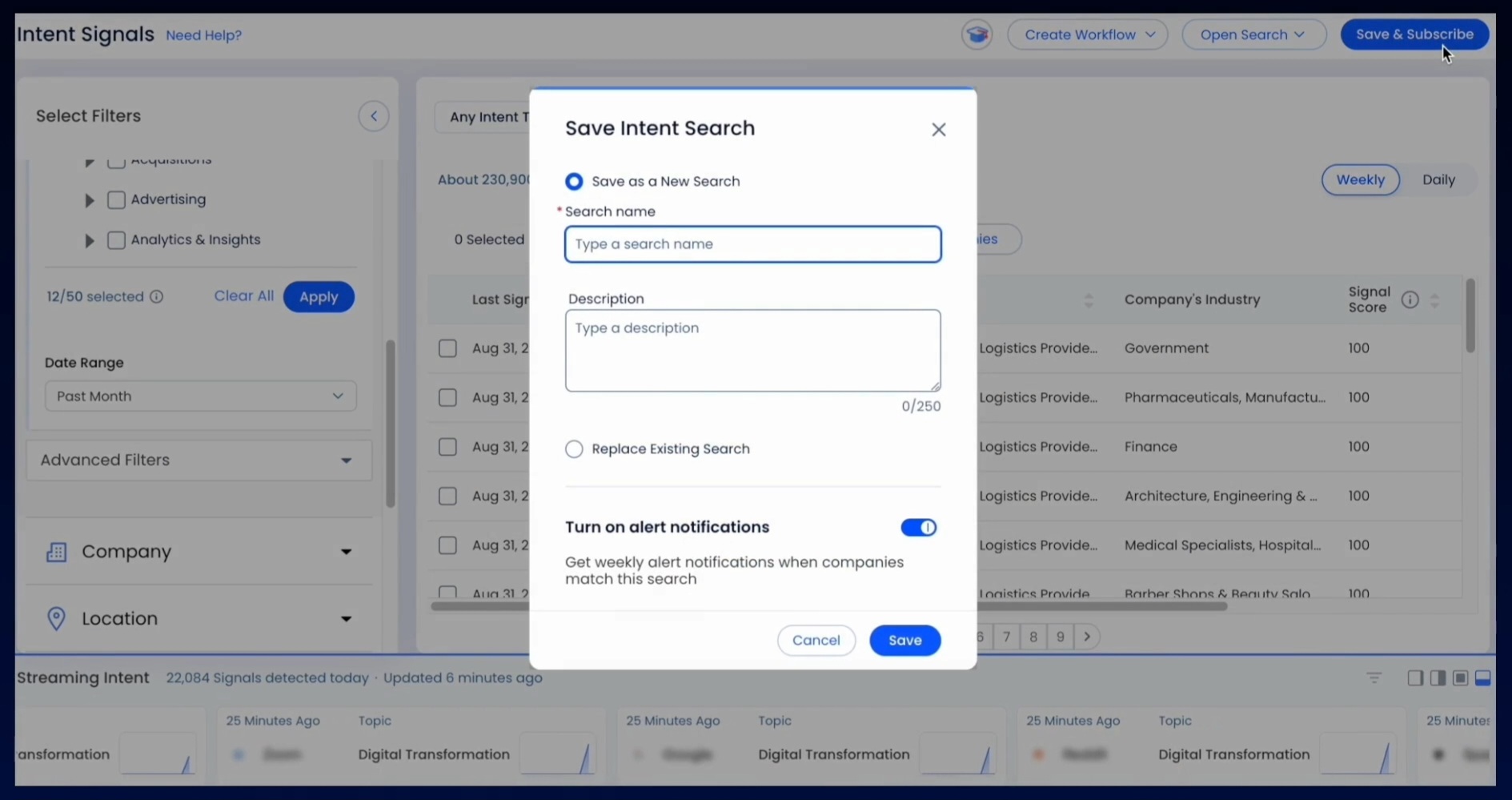
ZoomInfo Intent, which tracks signals from 210 million IP-to-Organization pairings and 6 trillion+ keyword-to-device pairings monthly, reveals when companies are actively researching your category, so your team engages at the moment of highest receptivity.
Source: ZoomInfo
The data advantage is not self-reported. In a Fortune 500 competitive RFP analyzing 25 million contacts across vendors, the independent consultant concluded that "no other competitor came even close." ZoomInfo was named a Forrester Wave Leader for Intent Data Providers B2B (Q1 2025), receiving the highest possible scores across eight criteria.
ZoomInfo in Action: Your team is prospecting into enterprise manufacturing. Instead of manually researching companies on LinkedIn and hoping to find the right contacts, a rep opens ZoomInfo and filters by industry, employee count, technology stack, and region to build a list of 200 target accounts. Intent signals flag that 15 of those accounts are researching deal execution software this week.
For each high-intent account, ZoomInfo surfaces verified direct dials and emails for the VP of Sales, the CRO, and the Head of RevOps, along with an org chart showing reporting structure. The rep starts outreach within minutes, not days.
GTM Context Graph: Understand Why Deals Move or Stall
Accord tracks whether reps completed playbook steps and assigns execution scores based on that completion. This tells you what happened in a deal process. It cannot tell you why a deal accelerated, why a champion went quiet, or which signal patterns across your pipeline predict closed-won outcomes.
ZoomInfo's GTM Context Graph fills that gap.
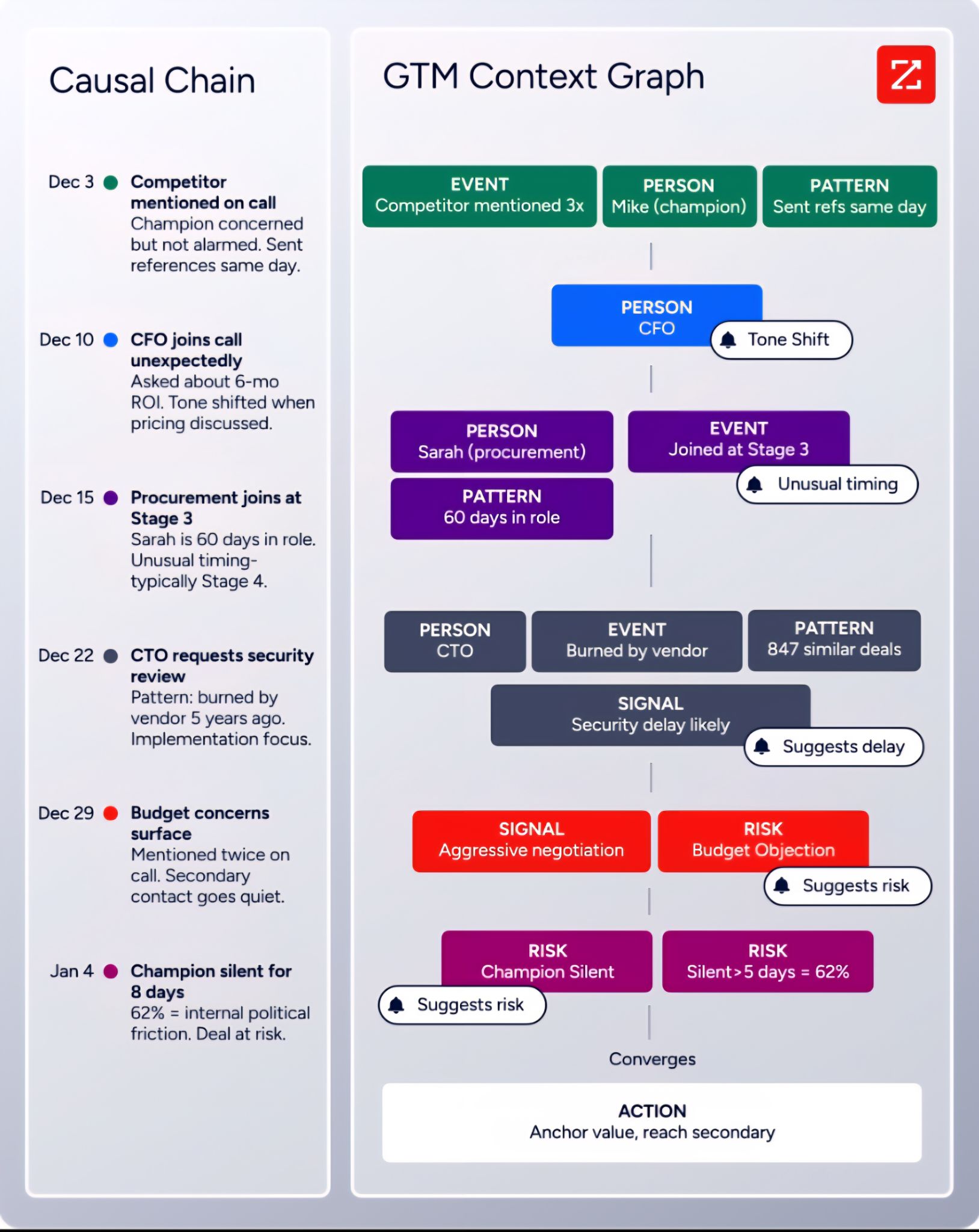
It unifies your CRM records, conversation transcripts from Chorus (ZoomInfo's conversation intelligence engine), email interactions, intent signals, and behavioral data into a single graph that captures the connections between signals and outcomes. As ZoomInfo's Chief Product Officer Dominik Facher writes: "The CRM recorded the state change. It has no record of why it happened."
The GTM Context Graph captures people and their relationships (who influences whom, who's blocking, who's championing), actions and their outcomes (what each action responded to, whether it worked), patterns and predictions (what thousands of similar deals suggest happens next), and exceptions and explanations (why things slipped, what that reveals about real blockers).
ZoomInfo in Action: A deal has been sitting at Stage 3 for two weeks. In Accord, the playbook completion score might look healthy because the rep checked the required boxes.
In ZoomInfo, the GTM Context Graph surfaces that the CFO joined the last call (captured by Chorus) and asked detailed ROI questions, that the company just posted three VP-level job openings (a hiring signal indicating growth investment), and that intent data shows the account is simultaneously researching a competitor.
The system reasons that executive sponsorship is emerging but competitive pressure requires faster follow-up. The next action isn't "complete step 4 of the playbook." It's a specific, context-informed response that addresses the CFO's concern with a relevant case study.
Seismic's sales team boosted productivity by 54%, saved 11.5 hours per week, and attributed 39% of pipeline to ZoomInfo signals. (Seismic Case Study)
GTM Workspace: AI-Powered Execution That Meets Sellers Where They Work
Accord's workspace is built around the playbook: reps open a deal, see the stages and steps configured by RevOps, complete the required actions, and earn execution scores. It enforces process consistency.
ZoomInfo's GTM Workspace takes a different approach.
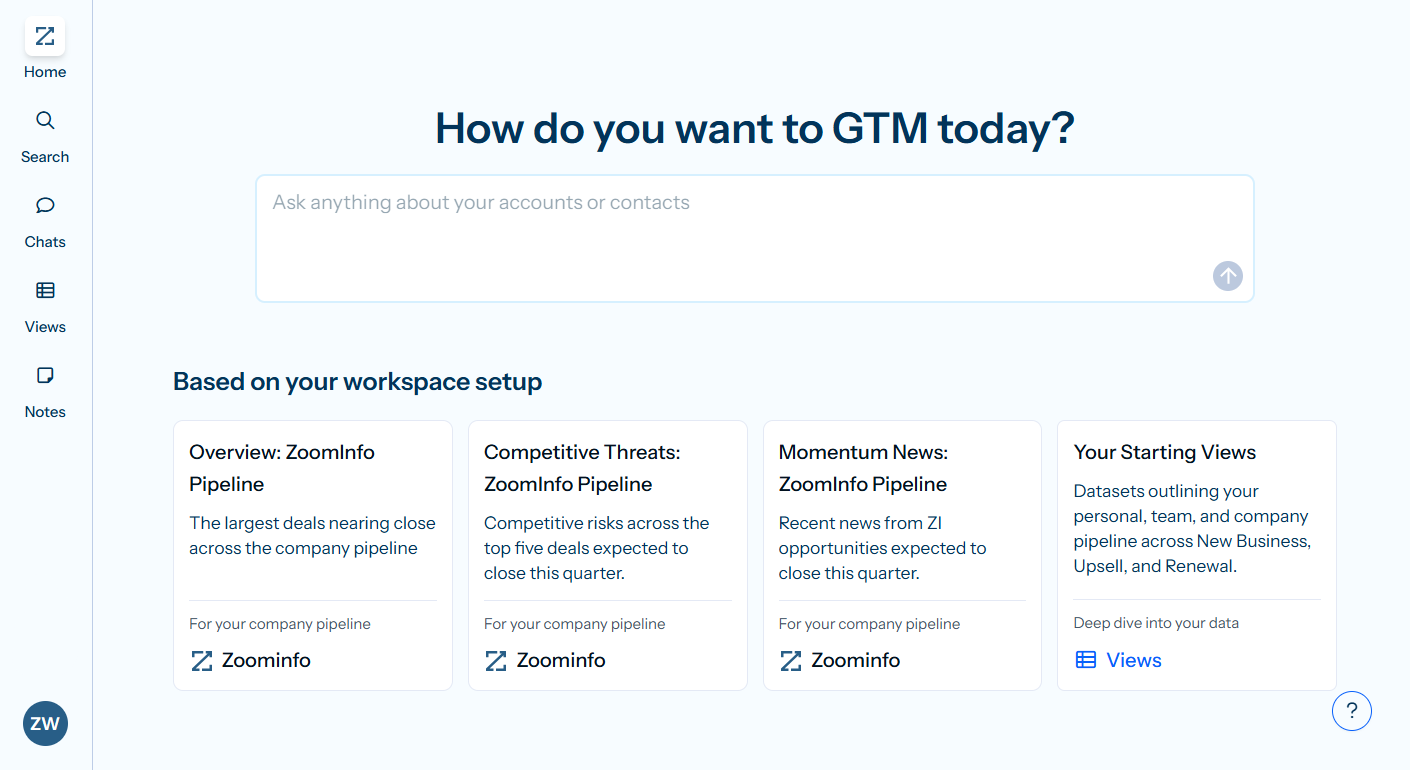
Instead of enforcing a predefined process, it gives sellers a workspace where prioritized accounts, AI-drafted outreach, and deal execution converge. AI agents within Workspace research accounts, generate follow-ups, monitor signals, draft outreach, update CRM fields, and surface next best actions by drawing on ZoomInfo's data and GTM Context Graph.
Source: ZoomInfo
Key capabilities include a Complete Book of Business view across CRM, ZoomInfo data, and market intelligence; an Action Feed with live signals and pre-drafted actions; AI-generated outreach personalized from full account context; and buying group intelligence that surfaces hidden stakeholders and whitespace. All of this integrates natively with Salesforce, HubSpot, and Microsoft Dynamics.
ZoomInfo in Action: A seller opens GTM Workspace in the morning to find their Action Feed highlighting three accounts that triggered intent signals overnight, two champion job changes across their pipeline, and a competitive mention in a recent Chorus-recorded call.
For each signal, Workspace presents a pre-drafted action: a personalized email for the intent-triggered accounts, a congratulations-plus-reconnect message for the champion movers, and a competitive positioning talk track for the next call. The rep reviews, adjusts, and sends without leaving the workspace or toggling between tools.
SpringDB achieved 2-3x increases in campaign conversions, a 300% increase in database usability, and 30-50% uplift in average deal size using ZoomInfo's platform. "You'll get 10x the value if you think of ZoomInfo as a full platform and not just a tool for one team," said John Kotsuros, Founder and CEO. (SpringDB Case Study)
Universal Access: Your Intelligence in Any Tool, Any Workflow
Accord's API is in Beta and requires an Enterprise-tier license. Its native integrations cover Salesforce, HubSpot, Slack, Gmail, Gong, and Zapier. Teams using Microsoft Dynamics, Outreach, Salesloft, or LinkedIn Sales Navigator need custom builds.
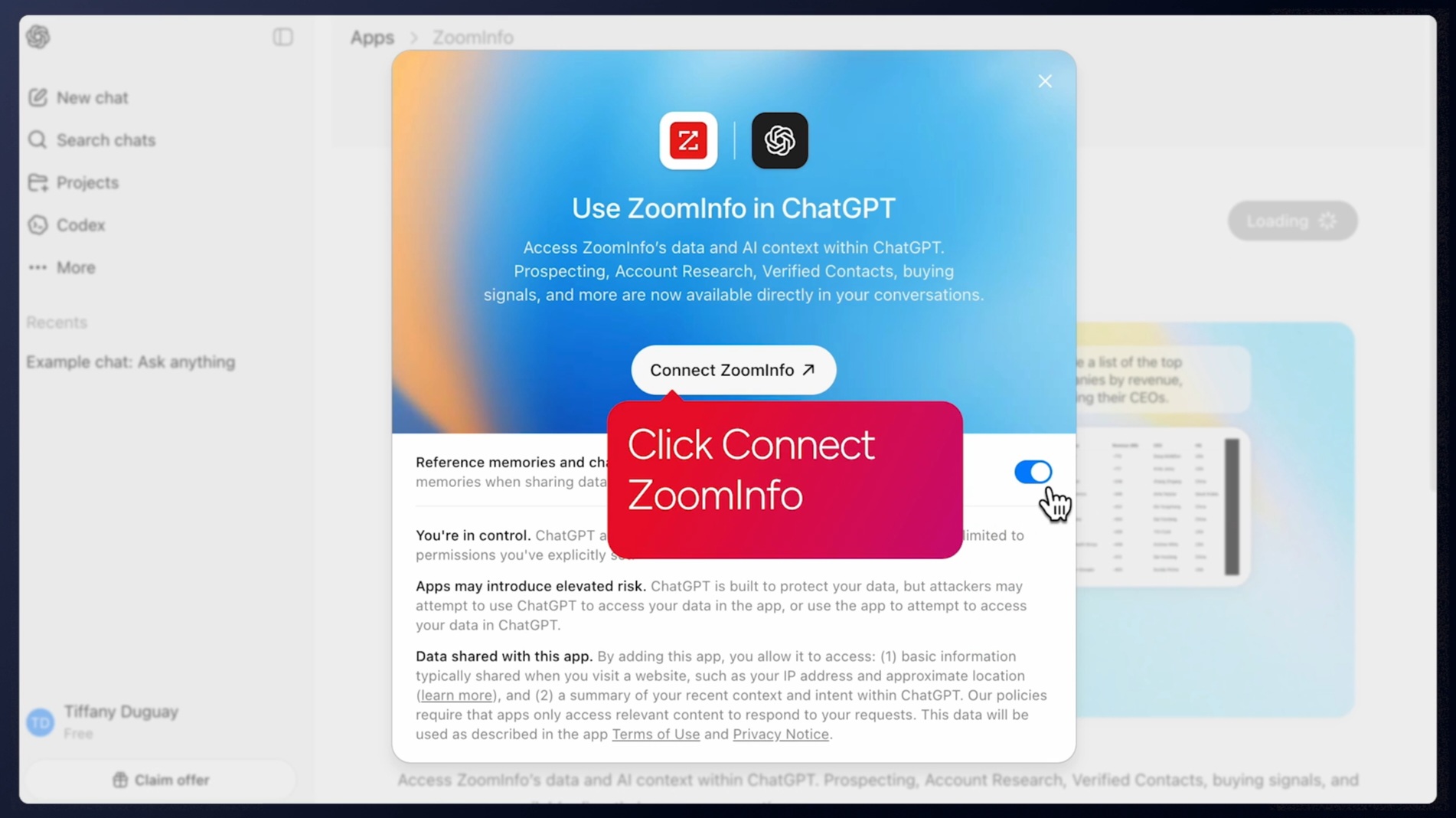
ZoomInfo has added API access to all relevant plans and launched an MCP server that connects AI models directly to ZoomInfo's B2B data, currently supporting Claude and ChatGPT.
Source: ZoomInfo
The ZoomInfo App Marketplace lists 120+ partner integrations across CRM, marketing automation, sales engagement, data warehouse, and communications categories. Cloud Partners enables direct data ingestion into AWS, Google Cloud, Snowflake, and Databricks.
ZoomInfo in Action: Your RevOps team has built a custom internal app for territory planning. Using ZoomInfo's Enterprise API, the app pulls company attributes, intent signals, and company hierarchies directly into the planning interface.
Meanwhile, your marketing team uses GTM Studio to describe audiences in natural language and launch multi-channel plays. And an AE uses ZoomInfo's MCP server through Claude to ask "Which accounts in my territory have shown buying signals for deal execution software in the last 30 days?" and gets an immediate, structured response. The same intelligence, accessible in every surface where decisions get made.
NOTE: We looked at other leading B2B intelligence platforms and found Apollo.io frequently mentioned. Apollo.io offers a strong combination of contact data and sales engagement at an accessible price.
However, ZoomInfo's larger data foundation (500M contacts vs. Apollo's smaller database), the GTM Context Graph, and enterprise-grade compliance certifications (ISO 27001, ISO 27701, SOC 2 Type II) make ZoomInfo the stronger choice for mid-market and enterprise revenue teams that need verified data accuracy at scale.
ZoomInfo Pricing
ZoomInfo uses a custom-quoted, consumption-based pricing model.
Pricing scales around enterprise license agreements, data access, API consumption, and AI activity. Costs depend on usage patterns, number of users, monthly credit volume, features required, and contract length.
The platform is organized into three product lines:
Sales Plans include Professional (contact and company data, CRM integrations, Chrome extension), Advanced (AI-driven account prioritization, Buyer Intent signals, website visitors, automated workflows), and Enterprise (real-time buyer intent, advanced automation, AI-generated account summaries, dedicated service manager).
Marketing Plans include Marketing Demand (B2B data and audience targeting), ABM Lite (dynamic audiences, intent data, display advertising), and ABM Enterprise (full ABM with AI-powered insights).
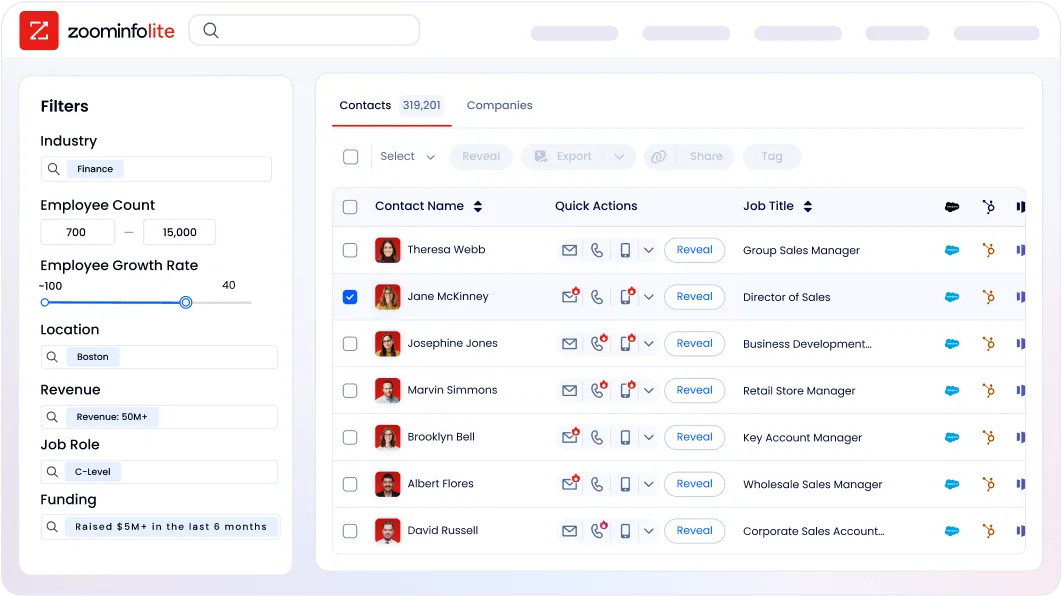
ZoomInfo Lite is a permanent free tier (not a trial) with access to ZoomInfo's B2B database, 10 monthly export credits, individual and company searches, the Chrome extension, and HubSpot integration. A 7-day free trial is also available for the full platform, no credit card required.
Who Should Use ZoomInfo?
Choose ZoomInfo if:
You need the intelligence foundation that powers your entire GTM motion (identifying accounts, reading buying signals, engaging at the right moment) rather than a tool focused on deal execution methodology after you're already in a conversation.
Your revenue team spans sales, marketing, and RevOps and needs a single intelligence layer connecting prospecting, pipeline generation, deal execution, and customer expansion, accessible through a native workspace or via APIs and MCP in any existing tool.
You're an enterprise or upper mid-market B2B organization that treats verified data as a competitive advantage, with compliance requirements (ISO 27001, ISO 27701, SOC 2 Type II) that demand a mature vendor.
Want to see how ZoomInfo's intelligence foundation can power your GTM motion? Start your free trial or explore ZoomInfo Lite to experience the platform firsthand.
2. Seismic - Best Alternative for Enterprise Sales Enablement at Scale
Seismic is a revenue enablement platform and the #1 Global Sales Enablement Platform, combining content management, sales learning, coaching, meeting intelligence, and digital sales rooms in a single cloud.
As an alternative to Accord, Seismic addresses the challenge of operationalizing sales excellence across organizations with 100+ reps, where Accord's deal-level execution model reaches its administrative ceiling.
Its key capabilities include:
AI-powered content management with LiveDocs automation that cuts content creation time and eliminates manual search overhead
Digital sales rooms with full stakeholder engagement analytics
Integrated learning and coaching with AI role-play, video coaching, and manager recommendations
Program strategy command center tying content usage and training activity to revenue outcomes
150+ native integrations covering Salesforce, Microsoft Dynamics 365, HubSpot, Gong, Outreach, Salesloft, and LinkedIn Sales Navigator via Seismic Exchange
Why Choose Seismic Over Accord for Enterprise Sales Enablement
Seismic stands out in the following areas:
Enterprise Content Management Infrastructure
Accord's Content Management module is a deal-embedded CMS that surfaces pre-uploaded assets at specific playbook steps, but it sits behind the Enterprise tier and relies on manual admin tagging.
Seismic's content management system is a full enterprise platform with version control, content expiration, role-based permissions, audit trails, and LiveDocs, a document automation engine that transforms PowerPoint and Word files into governed templates with live CRM data connections.
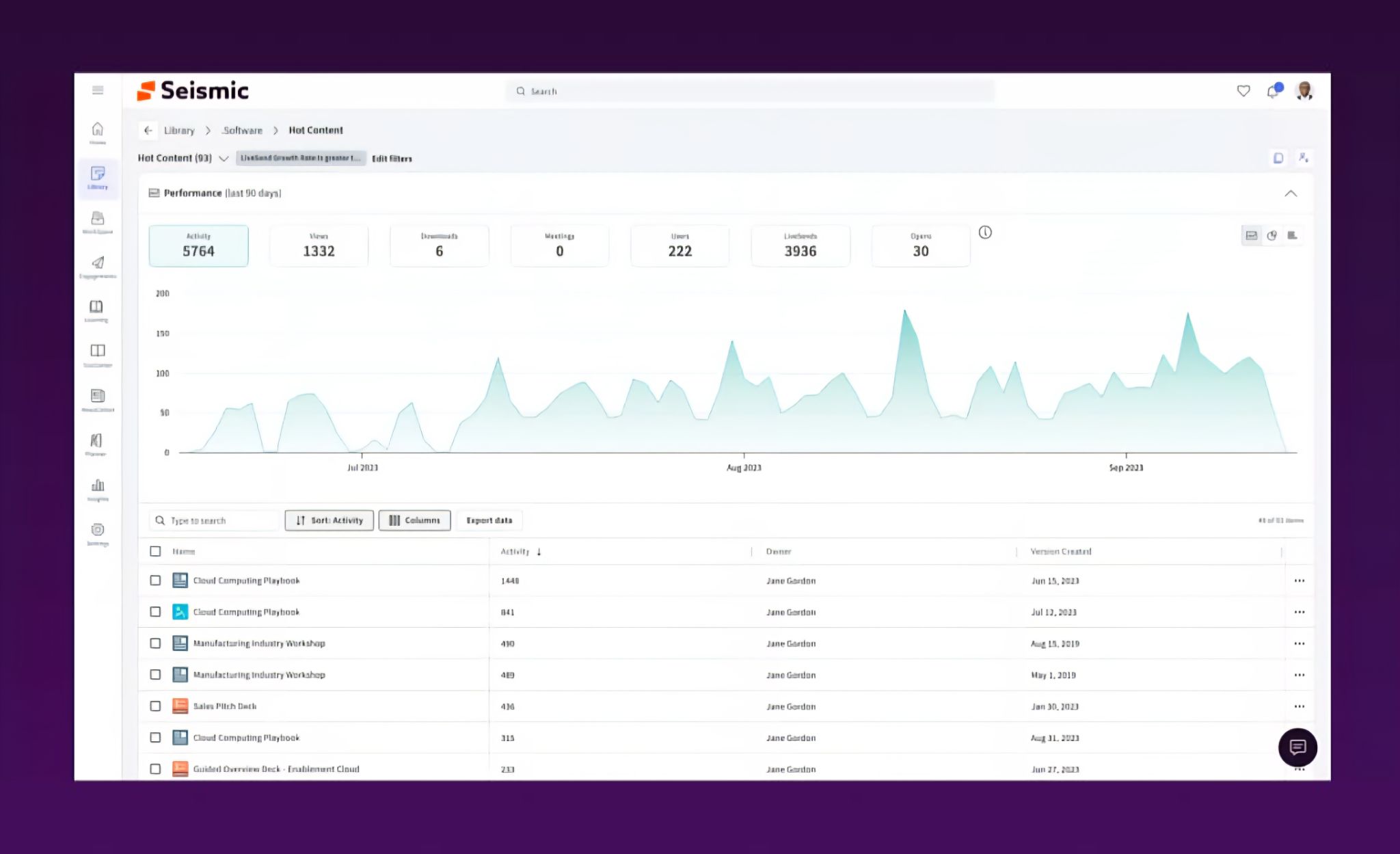
Source: Seismic
Reps complete a guided Q&A wizard; LiveDocs assembles the document by pulling account-specific data automatically.
Aura AI auto-generates metadata tags, content descriptions, and duplicate detections at upload time. For organizations in regulated industries where only approved, current-version materials can reach prospects, this level of governance has no equivalent in Accord's CMS.
Sales Learning and Coaching Built for Scale
Accord's coaching model is a Deal Review tab where managers assign 1-3 scores to playbook steps. Seismic provides a complete readiness platform: interactive course builders, role-specific learning paths, AI role-play simulations, video coaching with asynchronous manager review, and AI-driven skills assessments.
Seismic Learning & Coaching creates a closed loop between training and field performance that Accord's deal-review-based coaching cannot replicate. For organizations where onboarding velocity and consistent performance across large teams are primary business levers, Seismic's learning infrastructure is a different capability entirely.
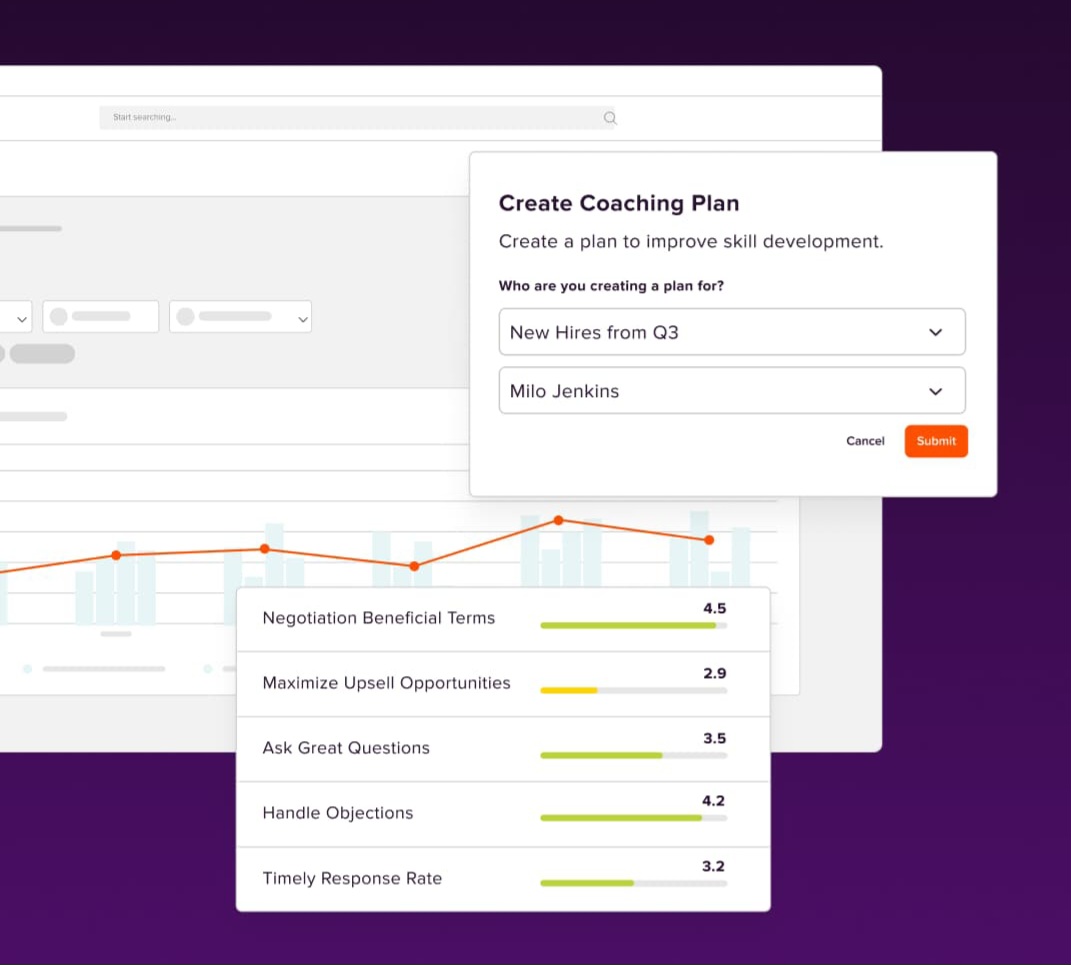
Source: Seismic
Market-Leading Platform Maturity
Accord is a Series A company with $17M raised, founded in 2020. Seismic has invested in enterprise readiness since 2010, reached profitability in FY2025 with 90% gross customer retention, and was named a Leader in the inaugural Gartner Magic Quadrant for Revenue Enablement Platforms in 2025.
Seismic holds SOC 2 Type II, ISO 27001, ISO 27701, and ISO 42001 certifications. The February 2026 merger with Highspot further consolidates its enterprise position.
NOTE: We also evaluated Mindtickle and Showpad for this archetype. Mindtickle excels at revenue readiness with conversation intelligence and competency-based coaching. Showpad offers channel partner enablement suited to manufacturing and distribution.
Seismic offers the broadest enterprise enablement platform for organizations needing governed content management, structured coaching, and digital sales rooms under one vendor.
Seismic Pricing
Seismic does not publish pricing; all contracts are negotiated through a sales-assisted process.
The platform sells on a named-user licensing model across two product lines: Seismic Content (Professional and Enterprise Premier editions) and Seismic Learning (purchased separately). All contracts are billed annually in advance. No self-serve free trial or permanent free tier is available.
Who Should Use Seismic?
Choose Seismic if:
Your revenue organization has 100+ reps and needs governed content infrastructure that scales without a proportionally growing admin headcount, particularly in financial services, healthcare, or manufacturing where content compliance is a regulatory requirement.
You need a single platform spanning content management, rep onboarding, ongoing learning, coaching, and digital sales rooms rather than deploying separate tools for each.
Your team runs on Microsoft (Dynamics 365, Teams, Outlook) or operates across multiple CRMs and needs 150+ integrations for broader coverage than Accord's current integration footprint.
3. GetAccept - Best Alternative for Deal Rooms with Built-In E-Signatures & Proposals
GetAccept is an AI-powered Digital Sales Room and proposal platform that consolidates three tools growing revenue teams typically buy separately: a buyer-facing deal workspace, a proposal builder, and an electronic signature solution. Its key capabilities include:
Digital Sales Rooms with branded, multi-page buyer microsites centralizing all deal content and communication
AI-powered proposal and document generation that drafts personalized proposals from meeting transcripts and buyer data
Built-in electronic signatures covering US ESIGN/UETA, UK Electronic Communications Act, and EU eIDAS simultaneously
Mutual Action Plans with embedded buyer collaboration and task tracking
Real-time buyer engagement tracking with a composite Participant Engagement Score per stakeholder
Contract management with AI data extraction that reads signed contracts and pulls out renewal dates and key terms
Why Choose GetAccept Over Accord for Deal Room and Document Workflow
GetAccept stands out in the following areas:
All-in-One Deal Execution
Accord enforces sales process (MEDDPICC stage gates, playbook scoring, rep coaching) but does not generate, send, e-sign, or manage the actual documents that close deals. A team using Accord still needs separate e-signature, proposal, and contract tools.
GetAccept replaces all three. Its deal room is the buyer-facing workspace; its native proposal builder generates branded documents from CRM data; its e-signature layer is legally compliant across the US, UK, and EU; and its AI Contract Management extracts renewal dates and deadlines without manual tagging. Accord adds a tool to your stack; GetAccept collapses one.
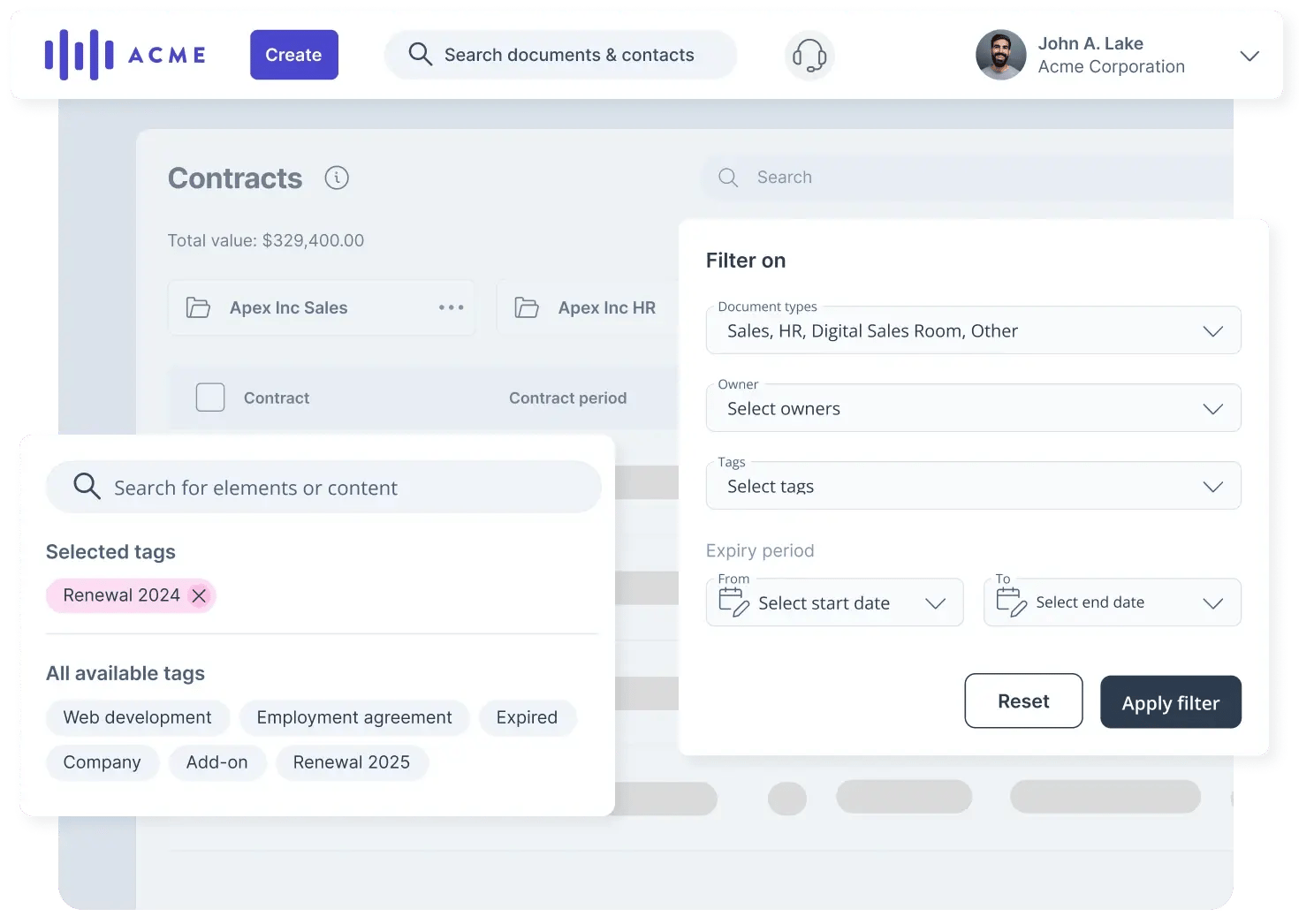
Source: GetAccept
Transparent Per-User Pricing
Accord's pricing starts at $99/user/month with an additional undisclosed platform fee on every tier.
GetAccept's Professional plan is $49/user/month (minimum 5 users) with Digital Sales Rooms, Mutual Action Plans, the full AI suite, CRM integrations, and e-signatures included. Additional charges are limited to published per-use SMS and eID fees. For a 20-person sales team, the difference is enough to fund additional headcount.
Established Mid-Market Scale
GetAccept has operated since 2015 and serves 40,000+ users across 4,000+ enterprises in 60+ countries. It holds a 4.6/5 G2 rating across 1,233+ reviews and has been a G2 Leader in Digital Sales Room since the category was created in October 2021.
For RevOps leaders evaluating platform stability over a three-to-five year commitment, that track record reduces vendor risk compared to earlier-stage alternatives.
NOTE: We also evaluated Flowla and DealHub. Flowla excels at lightweight deal room creation for smaller teams. DealHub is built for CPQ-heavy enterprise deals with complex pricing. GetAccept offers the most practical consolidation for growing revenue teams: deal rooms, proposals, and e-signatures in one plan with mid-market pricing transparency.
GetAccept Pricing
GetAccept uses a per-user, per-month model with three published tiers:
eSign: $25/user/month with unlimited e-signatures, basic contract management, and content library. No Digital Sales Rooms, AI features, or CRM integrations.
Professional: $49/user/month (minimum 5 users) with the full AI Digital Sales Room suite, Mutual Action Plans, CRM integrations (Salesforce, HubSpot, MS Dynamics, Pipedrive), and e-signatures.
Enterprise: Contact sales. Adds CPQ, SSO, API access, conditional content, and premium CRM integrations.
Who Should Use GetAccept?
Choose GetAccept if:
Your team is paying for three separate tools (proposal platform, e-signature vendor, deal workspace) and wants to consolidate them into one $49/user/month plan.
You need legally compliant e-signatures covering the US, UK, and EU simultaneously, with the e-sign capability inside the same environment where proposals are built and reviewed.
Your immediate pain is the fragmented proposal-to-signature workflow, not rep process compliance, and you want a platform that solves the document layer completely.
4. trumpet - Best Alternative for Personalized Buyer Pods Without Enterprise Complexity
trumpet is a digital sales room and customer onboarding platform that centralizes the B2B buying journey inside interactive microsites called Pods.
Unlike Accord, which requires RevOps to configure Playbooks before reps can use the tool, trumpet is built rep-first: any AE can assemble a branded Pod in under 30 seconds.
Its key capabilities include:
Drag-and-drop Pod builder with 70+ pre-built widgets and 50+ templates for common deal scenarios
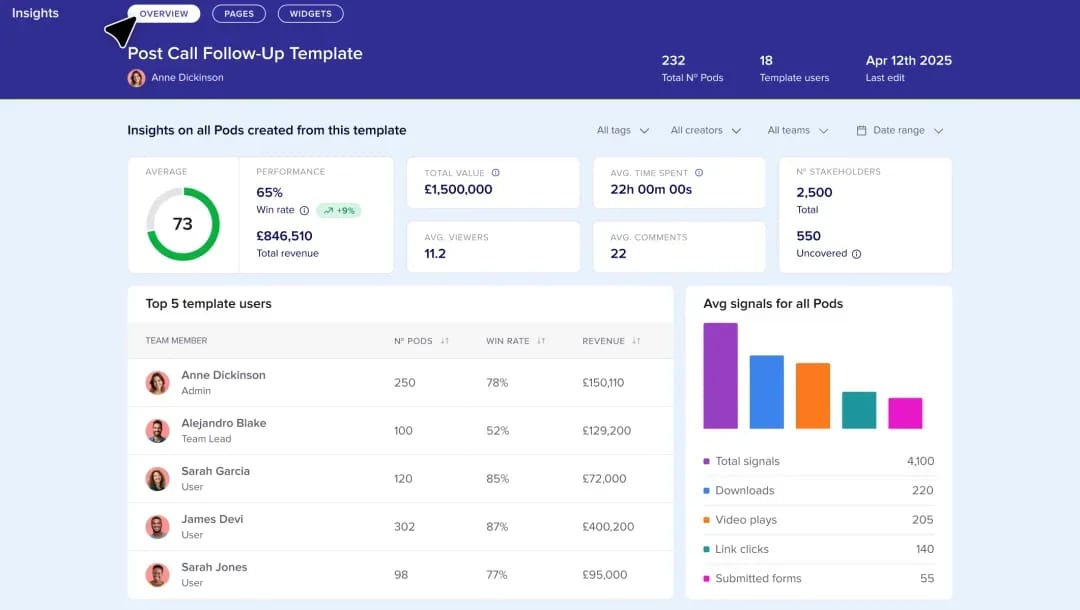
Source: trumpet
AutoBrand AI that detects a prospect's branding from a URL and applies it automatically
Real-time buyer engagement analytics capturing content views, time on page, and MAP step completions
Mutual Action Plans embedded natively with shared task tracking and automated reminders
Post-sale onboarding rooms built on the same Pod infrastructure, extending coverage through renewal
A permanent free plan with up to 10 Pods per account and unlimited users
Why Choose trumpet Over Accord for Personalized Buyer Pods
trumpet stands out in the following areas:
Rep-First Deployment with No RevOps Dependency
Accord's architecture requires an admin to build, configure, and approve a Playbook before any rep can create a workspace.
For startups and lean teams without enablement support, this creates a barrier before the tool delivers value. trumpet inverts this: CRM-powered auto-fill pulls buyer data directly into the Pod on creation, and any rep can assemble a professional workspace without admin permission or a pre-built template library.
A Genuine Free Entry Point
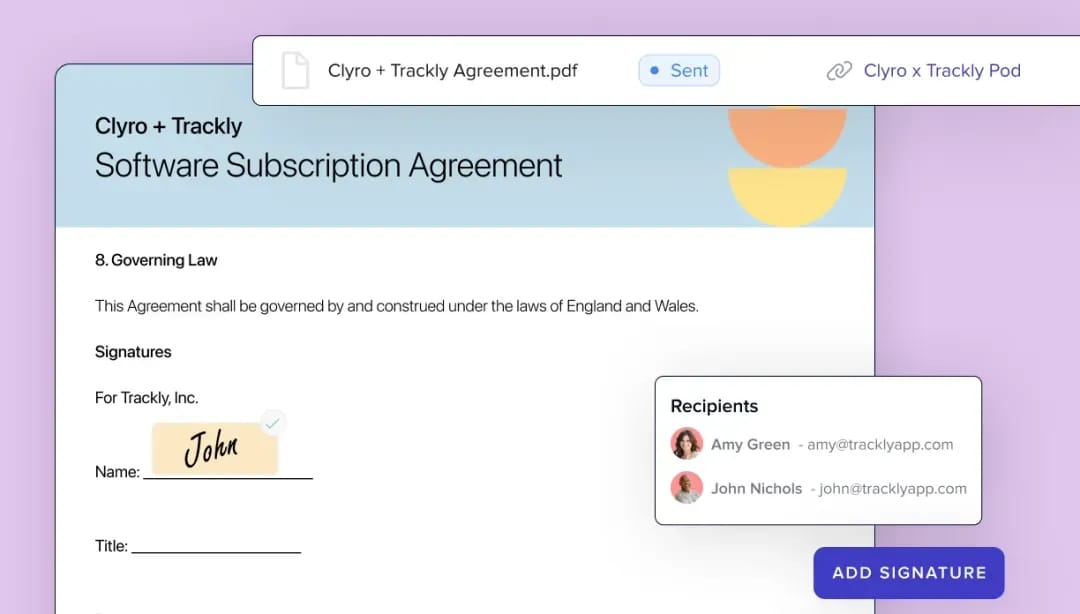
Accord requires a sales conversation for every tier, starting at $99/user/month plus an undisclosed platform fee. trumpet's permanent free plan offers 10 Pods per account with unlimited users, Mutual Action Plans, AI Org Charts, 40+ integrations, and basic analytics, with no credit card required.
The Pro plan at $45/user/month removes the Pod limit and adds CRM integrations. The Scale plan at $100/user/month adds native eSignature, the full AI suite, video recording, and proposals.
Full Revenue Lifecycle in One Pod
The same builder that powers a Digital Sales Room extends into customer onboarding portals, renewal rooms, and account success hubs without a separate tool or subscription. Customer success teams continue from the Pods that AEs built during the deal, with all context already present.
Source: trumpet
NOTE: We also evaluated Aligned and Recapped for this archetype. Aligned offers buyer-side AI and engagement intelligence. Recapped covers MAPs and onboarding at a similar SMB price point. trumpet offers the most accessible free entry point and the most polished pod builder for lean teams where individual reps own the deal room creation process.
trumpet Pricing
Free: $0/user/month, unlimited users, 10 Pods per account, Mutual Action Plans, AI Org Charts, 40+ integrations
Pro: $45/user/month (max 5 users), unlimited Pods, CRM integrations, AI engagement scoring
Scale: $100/user/month, TrumpetSign eSignature, full AI suite, video recording, proposals and quotes, content analytics
Elite: $160/user/month, SSO and SCIM, white-labeling, AI Co-Pilot, global analytics
Who Should Use trumpet?
Choose trumpet if:
You're a startup, individual AE, or SMB team that needs to deploy polished buyer experiences in minutes without weeks of RevOps Playbook configuration.
You want to evaluate a deal room platform at zero cost, with trumpet's free plan covering the full core experience.
Your CS team needs post-sale onboarding coverage without purchasing a separate tool.
5. Recapped - Best Alternative for Collaborative Close Plans Without Full Methodology Enforcement
Recapped is a Digital Sales Room and AI-powered deal execution platform built from the ground up for mutual action plans and collaborative close plans.
Where Accord is a methodology enforcement platform with MAP features, Recapped is a MAP specialist that delivers deal execution without RevOps infrastructure overhead.
Its key capabilities include:
MAP-first interface with drag-and-drop workspace configuration
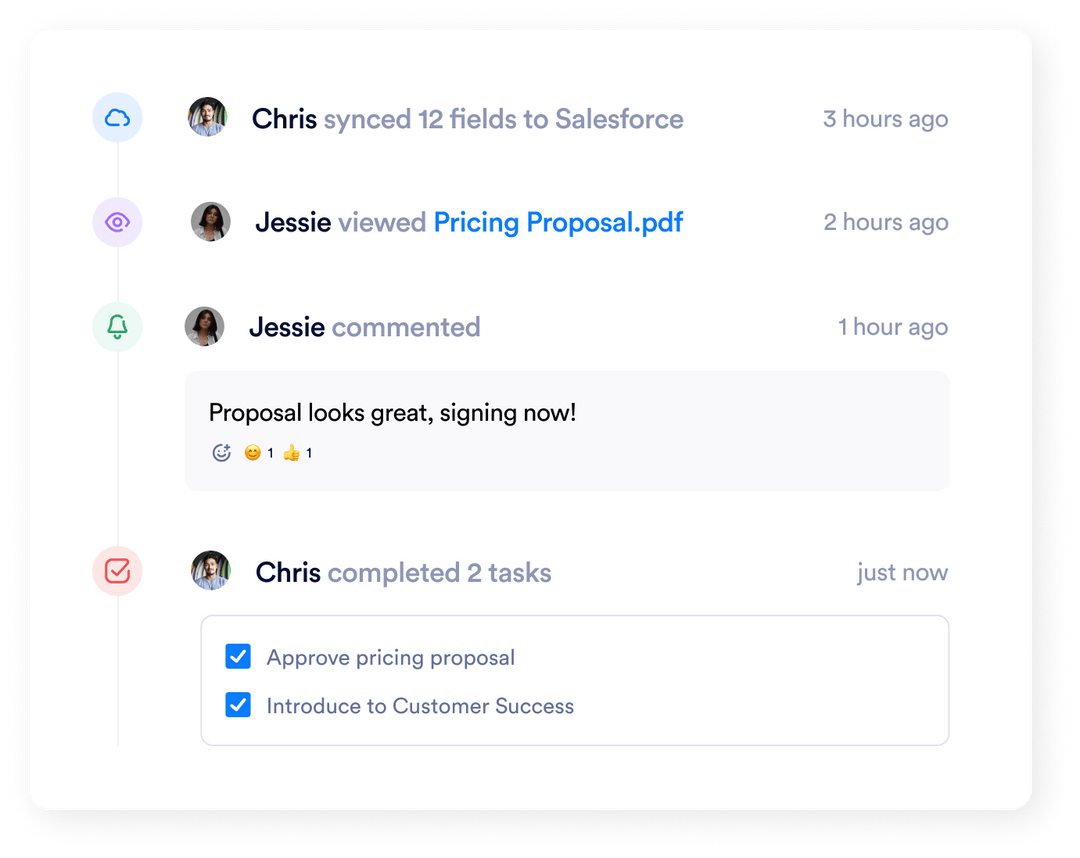
AI-powered MEDDICC qualification scoring that updates CRM fields without manual scorecards
CRM field embedding with bi-directional sync for Salesforce and HubSpot
Native post-sale handoff into customer onboarding plans, preserving deal context across the revenue cycle
Source: Recapped
Why Choose Recapped Over Accord for Collaborative Close Plans
Recapped stands out in the following areas:
MAP-First Workspace
Accord was designed as a methodology enforcement platform; mutual action plans are a delivery mechanism within that infrastructure. Recapped makes the collaborative workspace and shared task list the entire product.
Teams that need a structured space to run close plans with buyers will get there faster in Recapped because it skips the playbook configuration, execution criteria setup, and RevOps maintenance overhead. Recapped holds G2 badges for Easiest Setup, Fastest Implementation, and Highest User Adoption simultaneously.
AI-Automated MEDDICC Scoring
Accord's approach is structural: admins build Execution Criteria that track step completion. Recapped's AI MEDDICC grading analyzes deal activity and scores deals automatically, updating CRM fields without requiring reps to fill out separate scorecards.
For teams where the bottleneck is MEDDICC adoption because reps resist the overhead, Recapped removes the friction at the source.
Native Post-Sale Continuity
A closed deal's mutual action plan transitions directly into a customer onboarding plan. The workspace doesn't reset, deal context doesn't get lost in a handoff email, and the customer doesn't start over with a new team.
Accord handles post-sale through separate Implementation playbooks, so the pre-sale workspace and post-sale plan are distinct instances.
NOTE: We also evaluated Mutually and Flowla. Mutually offers solid MAP functionality. Flowla brings a polished buyer experience with embedded content delivery. Recapped offers the deepest MAP-specific functionality in the simplest package: AI-automated MEDDICC scoring and native post-sale onboarding continuity.
Recapped Pricing
Recapped offers both per-seat and flat-rate team pricing:
Free: $0 for one user, unlimited Digital Sales Rooms, Mutual Action Plans, task manager
Starter/Team: $45/user/month or $600/month flat-rate (unlimited users), Salesforce and HubSpot integration, reusable templates
Growth/Business: $95/user/month or $1,250/month flat-rate (unlimited users), bi-directional CRM sync, Slack, Zapier, AI-Generated Business Cases
Enterprise: Contact for pricing (10+ users), AI CRM updates, AI MEDDICC grading, SSO
The flat-rate option ($600/month or $1,250/month for unlimited users) makes cost planning straightforward as teams grow. Accord starts at $99/user/month plus an undisclosed platform fee, so total cost requires a sales conversation to calculate.
Who Should Use Recapped?
Choose Recapped if:
Your team's primary bottleneck is deal execution chaos (scattered collateral, champions who go dark, invisible forecasts) rather than methodology non-compliance.
You want fast implementation and high rep adoption without heavy playbook configuration.
You need predictable, scalable pricing without a per-seat-plus-platform-fee structure.
6. Dock - Best Alternative for Full Customer Lifecycle Coverage with a Free Starting Point
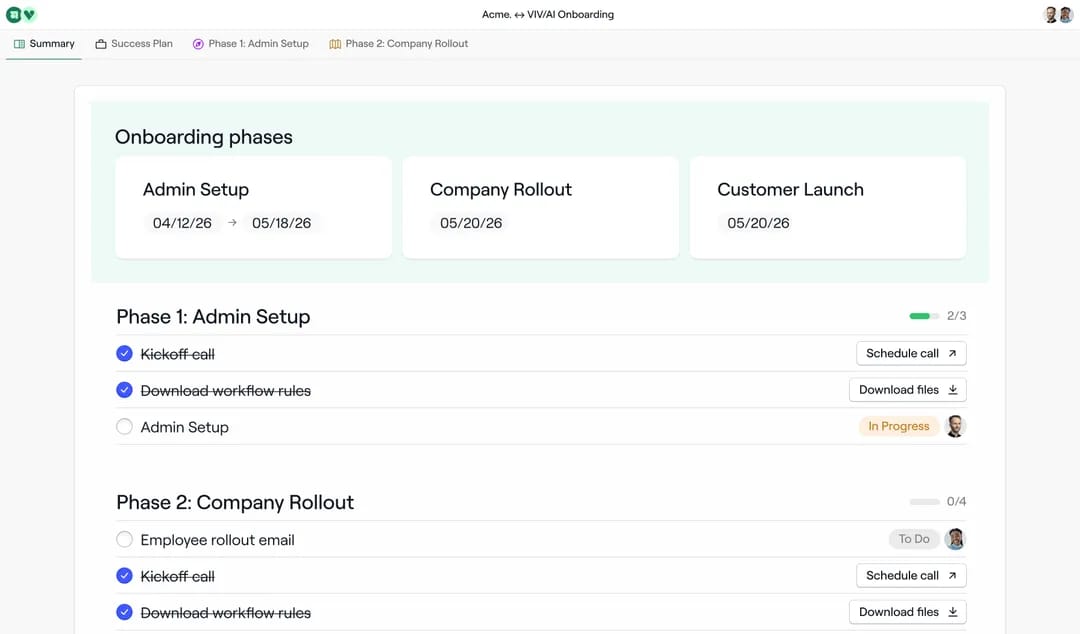
Dock is an AI revenue enablement platform built around a shared workspace model that covers the entire customer relationship (first demo through onboarding and renewal) within a single persistent link.
Source: Dock
Where Accord enforces internal methodology through playbooks, Dock orients toward the buyer-facing experience and full lifecycle continuity.
Its key capabilities include:
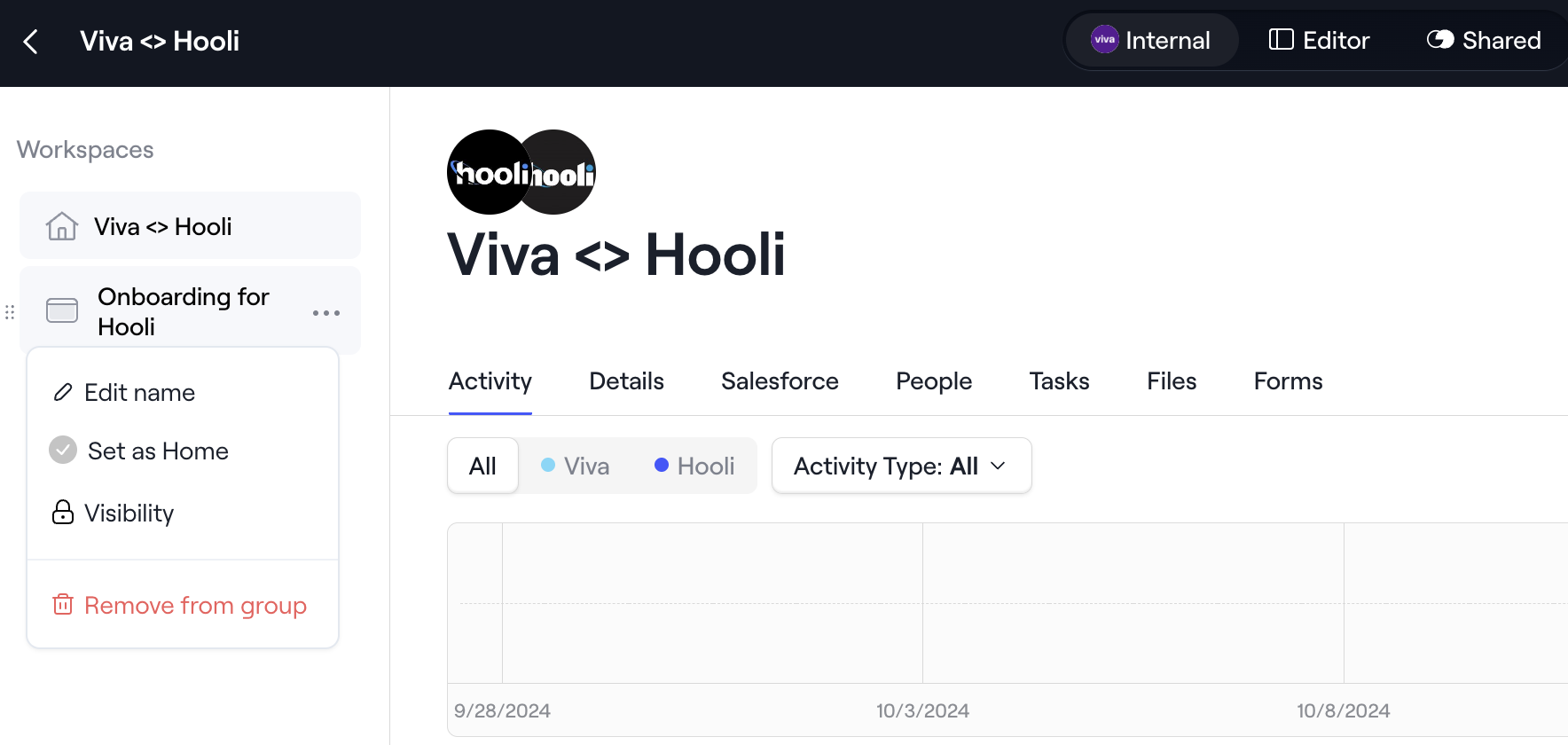
Connected Workspaces that chain sales deal rooms, customer onboarding portals, and client portals under one URL
Content management with AI-powered tagging, search, and content-to-deal attribution (paid plans)
Dock AI for generating business cases, meeting recaps, and executive summaries from CRM data and call transcripts
Embedded Order Forms and CPQ with native e-signature and approval routing
A free-forever plan with unlimited workspaces and AI Documents
Why Choose Dock Over Accord for Full-Lifecycle Coverage
Dock stands out in the following areas:
A Free Plan That Works
Accord has no free plan and no self-serve entry point. Dock's free tier includes unlimited workspaces, AI Documents on all plans, and deal room infrastructure, with no credit card required. Teams can build real deal rooms, share them with prospects, and test the buyer experience before spending anything.
Transparent, Flat-Rate Pricing
Dock's Standard plan is $350/month flat for up to five internal users, not per seat. The Premium plan at $1,000/month covers ten users and adds content management, learning playbooks, order forms, and connected workspaces. Every sub-Enterprise tier is self-serve with published rates.
One Workspace Through the Full Customer Lifecycle
Accord's Implementation and Expansion playbooks address post-sale, but the pre-sale workspace and post-sale plan are distinct instances. Dock's Connected Workspaces chain a sales deal room, onboarding portal, client portal, and renewal workspace under one shared URL, with each stage's content and context carried forward automatically.
Source: Dock
NOTE: We also evaluated trumpet and Aligned. trumpet offers a free tier and a solid buyer-facing experience. Aligned provides similar lifecycle coverage. Dock offers the most generous free plan (unlimited workspaces with AI Documents) combined with the most complete lifecycle coverage at this price point.
Dock Pricing
Free: $0/month, unlimited workspaces, AI Documents, basic integrations (Slack, Loom, PandaDoc)
Standard: $350/month flat for 5 users, CRM integration (Salesforce, HubSpot), Gong and Chorus integrations
Premium: $1,000/month for 10 users, content management, order forms, connected workspaces, Dock branding removal
Enterprise: Custom pricing, Courses/LMS, API access, SSO, Workspace Automation
Who Should Use Dock?
Choose Dock if:
Your team is evaluating deal room software but isn't ready to commit budget; Dock's free plan lets you run real deal rooms before spending anything.
You want one platform to cover the customer from first demo through renewal, rather than handing off to a separate tool at signature.
Your budget is fixed and predictable, and you need published, flat-rate pricing without undisclosed platform fees.
7. Aligned - Best Alternative for AI-Native Deal Execution with Buyer Engagement Intelligence
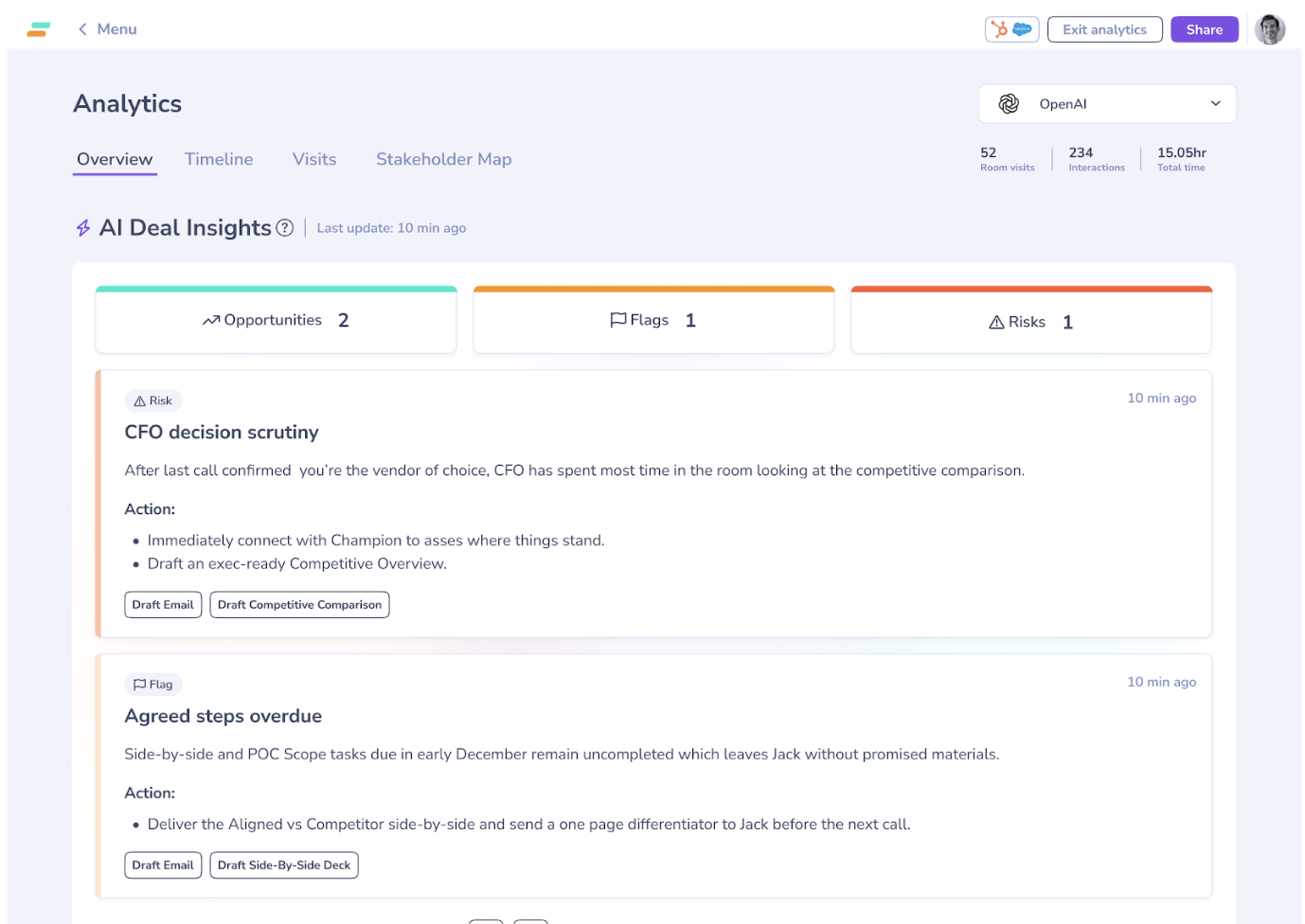
Aligned is an AI Deal Workspace that positions itself as the "missing execution layer between your CRM and your buyer."
Source: Aligned
Where Accord enforces seller-side process, Aligned deploys AI on both sides: building rooms and surfacing signals for sellers while guiding buyers through their evaluation when no rep is present.
Its key capabilities include:
Buyer Copilot embedded within the buyer's view to guide self-directed evaluations and answer questions asynchronously
Engagement-based deal intelligence where rooms with 4+ hours of buyer engagement achieve an 86% win rate
Hidden stakeholder discovery that surfaces individuals who access the workspace without formal invitation
AI-powered Mutual Action Plans auto-built after every call with activity-based alerts
Full revenue lifecycle coverage from digital sales room through customer onboarding and success
Free Starter plan with unlimited users and 3 rooms per seat
Why Choose Aligned Over Accord for Buyer Engagement Intelligence
Aligned stands out in the following areas:
Buyer-Side AI
Accord's AI layer (Accord Intelligence) faces sellers: it generates business cases and account plans for reps. Aligned's Buyer Copilot is deployed within the buyer's view. Buyers can ask questions, summarize pitch decks, and get answers to security queries without scheduling another call.
This drives deeper buyer engagement and arms internal champions with the resources they need to build the business case when no seller is present.
Engagement Intelligence as the Primary Deal Health Signal
Accord scores deals on whether reps completed playbook steps. Aligned's Revenue Intelligence captures buyer-generated signals: content views, time-on-page, AI chatbot queries, and stakeholder access patterns.
Hidden Stakeholder Discovery
Accord's stakeholder mapping requires admins to pre-define roles and either have reps fill slots manually or use Enterprise-only AI recommendations. Aligned works from the bottom up: when anyone from the buyer's organization accesses the workspace (even without a formal invitation), Aligned immediately alerts the seller.
A caveat: native CRM integration is Enterprise-only in Aligned, while Accord provides Salesforce and HubSpot integration starting at Starter tier.
NOTE: We also evaluated Flowla and Distribute. Flowla delivers a clean mutual action plan flow with solid buyer analytics. Distribute focuses on interactive microsites for buyer enablement content. Aligned offers the most differentiated approach for teams prioritizing buyer engagement intelligence, specifically the Buyer Copilot and the engagement-driven win rate data.
Aligned Pricing
Starter: Free, unlimited seats, 3 rooms per seat, room analytics, no time limit
Basic: $29/seat/month (annual), unlimited rooms, Mutual Action Plans, 1 TB content storage, CMS
Pro: $49/seat/month (annual), AI Client Assist (Buyer Copilot), AI Content Generator, Gong integration
Enterprise: Custom pricing, bi-directional CRM sync (Salesforce, HubSpot), AI Insights, SSO, dedicated CRM
Who Should Use Aligned?
Choose Aligned if:
Your deals involve 3+ stakeholders and you consistently lose visibility into buyer committee activity between calls; Aligned's hidden stakeholder discovery and engagement analytics surface signals that CRM fields cannot.
You want AI that works for the buyer, not just the seller, giving buyers a guided, self-service evaluation experience that increases engagement depth.
You need a free entry point to validate the buyer workspace category before committing to enterprise pricing.
The Final Verdict
Accord excels as a methodology enforcement platform for sales teams that need structured playbooks, stage gates, and execution scoring. But growing revenue organizations often need specialized tools that address different parts of the GTM challenge.
Based on our research, here are the best alternatives:
ZoomInfo for the intelligence foundation that powers every deal, from B2B data and intent signals to AI-powered seller execution through GTM Workspace
Seismic for enterprise-scale sales enablement with governed content management, structured coaching, and 150+ integrations
GetAccept for consolidating deal rooms, proposals, and e-signatures into one transparent-pricing platform
trumpet for polished buyer pods that any rep can deploy in seconds, with a permanent free plan
Recapped for MAP-first mutual action plans with AI MEDDICC scoring and flat-rate team pricing
Dock for full customer lifecycle coverage from deal room through renewal, with a generous free starting point
Aligned for AI-native deal execution where buyer engagement intelligence drives deal health predictions
You don't have to choose between Accord and these alternatives exclusively. Many revenue teams use Accord for methodology enforcement alongside other specialized tools. Consider your needs, team size, and growth trajectory when deciding which solution fits your organization.
Ready to power your GTM motion with B2B data and AI-driven intelligence? Start your free ZoomInfo trial or explore ZoomInfo Lite and see the buyers, signals, and insights your team needs to find, win, and grow customers.
Accord Alternatives FAQ
Why do businesses look for Accord alternatives?
Accord excels at methodology enforcement and deal execution for teams with dedicated RevOps support, but businesses look for alternatives when they need data intelligence and prospecting capabilities upstream of the deal, broader content management and rep coaching at enterprise scale, simpler deal rooms that don't require RevOps to configure playbooks before reps can use them, or more transparent pricing without undisclosed platform fees.
The limited native integrations (Salesforce, HubSpot, Slack, Gmail, Gong, and Zapier) also drive evaluation when teams use Microsoft Dynamics, Outreach, or Salesloft.
What is the best overall Accord alternative?
There is no single best alternative because Accord covers a specific niche (sales methodology enforcement) that differs from what each alternative specializes in.
ZoomInfo is the top choice for teams that need the intelligence foundation powering their entire GTM motion.
Seismic leads for enterprise-scale enablement with governed content and coaching.
For teams focused on deal rooms specifically, GetAccept offers the most practical consolidation of proposals, e-signatures, and buyer collaboration at a transparent price point.
Is there a free alternative to Accord?
Yes, several alternatives offer free plans. trumpet provides 10 Pods per account with unlimited users, Mutual Action Plans, and AI Org Charts.
Aligned offers unlimited seats with 3 rooms per seat and buyer engagement analytics.
Dock includes unlimited workspaces with AI Documents.
Recapped offers a free plan for one user with unlimited Digital Sales Rooms.
ZoomInfo Lite is a permanent free tier with access to ZoomInfo's B2B database and 10 monthly export credits.
Accord has no free plan or self-serve trial.
Which Accord alternative is best for enterprise sales teams?
For enterprise organizations with 100+ reps, Seismic offers the broadest platform with governed content management (LiveDocs), structured learning and coaching, and digital sales rooms under one vendor, backed by a Gartner Magic Quadrant Leader designation and SOC 2 Type II, ISO 27001, and ISO 27701 certifications.
ZoomInfo serves the enterprise intelligence layer with 35,000+ customers including Adobe, Microsoft, and Snowflake.
How does ZoomInfo compare to Accord?
ZoomInfo and Accord address different parts of the revenue challenge. Accord enforces sales methodology after you're inside a deal, structuring how reps execute through playbooks, stage gates, and execution scoring.
ZoomInfo provides the intelligence foundation upstream: identifying the right accounts, surfacing buyer intent signals, verifying contact information, and giving sellers AI-powered context on why deals move or stall through the GTM Context Graph. Many enterprise teams use both: ZoomInfo to find and prioritize the right opportunities, and a deal execution tool to manage the selling process once engaged.
Which alternative is best for small teams without RevOps support?
trumpet is the strongest fit for lean teams where individual reps own the deal room creation process. Any AE can build a branded buyer workspace in seconds with no admin configuration, and the permanent free plan removes adoption risk entirely.
Recapped is also well suited, holding G2 badges for Easiest Setup, Fastest Implementation, and Highest User Adoption, with flat-rate team pricing that makes cost predictable as the team grows.
Can I use Accord alongside these alternatives?
Yes. Several alternatives serve complementary functions rather than direct replacements. ZoomInfo provides the data and intelligence layer that feeds into any deal execution tool.
Seismic handles content management and rep coaching at enterprise scale.
Many teams run Accord for methodology enforcement while using a separate tool for prospecting intelligence, content governance, or document workflow (proposals and e-signatures) where Accord has no native capability.
Which Accord alternative offers the best buyer-facing experience?
Aligned offers the most differentiated buyer experience through its Buyer Copilot, which guides buyers through their evaluation asynchronously when no seller is present. trumpet offers the most visually polished buyer workspace with AutoBrand AI that automatically applies the prospect's branding.
GetAccept combines the buyer experience with built-in proposals and e-signatures, creating a complete document-to-close workflow within the deal room.
Looking beyond Accord? Compare the strongest alternatives side by side:
