
Why the calculus of growth is changing
Although it may sound counterintuitive, multiple periods of economic uncertainty have revealed a striking pattern: the biggest winners in business are those who keep investing in growth.
And regardless of how the current economic headwinds play out, Bain & Company partner Jordan Lee says this era's winners will be the companies that focus their go-to-market strategies around highly efficient, data-driven go-to-market plays.
"Companies that do go-to-market plays, and do them well, are three times more likely to be outpacing their competitors," Lee says, according to Bain & Company research. "Right now is the right time, because we have the downturn. We know winners break out. And commercial productivity is going to be the big differentiator 10 years from now."
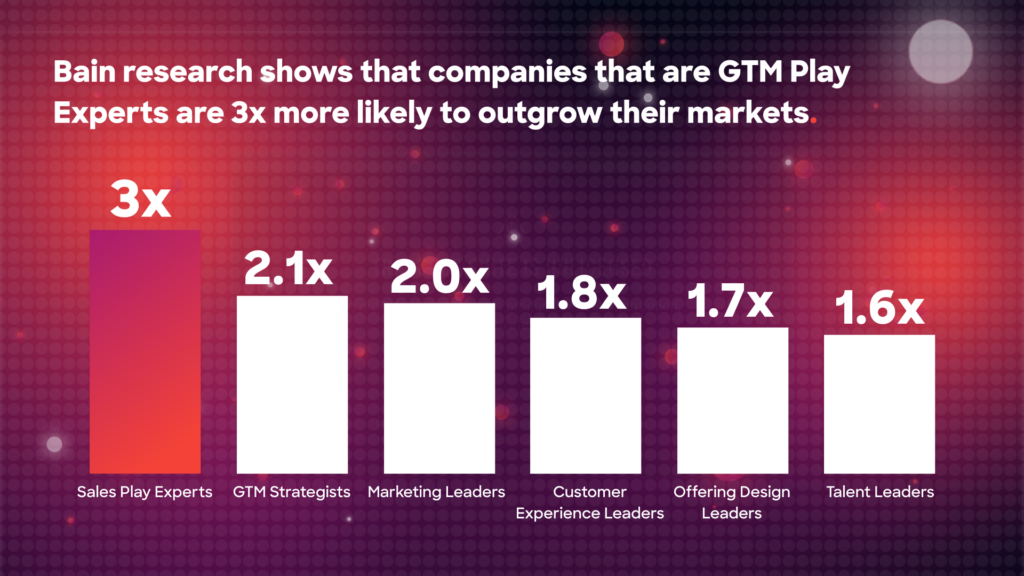
In a recent panel discussion for enterprise CMOs and revenue executives in Seattle, Lee stressed that productivity has become a central force for growth in this economic era, replacing the previous cycle's focus on growth through added sales capacity.
The long-simmering trend toward buyers performing more sophisticated research is also sharpening the focus on productivity.
"Buyers are coming to the buyer table way more educated than they've ever been, 95% of them are coming to the table already knowing something about the product that they're interested in buying. And not just knowing something, but they often feel like they're fully educated," Lee says, according to Bain & Company research Lee cited.
The majority of these educated buyers will come with a short list of vendors, which will likely include the vendor they end up choosing. That doesn't mean sales reps can't still have an impact on winning or losing a deal, but it does mean they may never get a chance if a company can't figure out how to get to buyers much earlier in the process.
"This increases the burden of the commercial engine. It's not just about getting more sales reps out on the field. Now, there's more marketing that you need to get integrated into it," Lee says.
The level of strategic and operational sophistication required for GTM has risen significantly, driven by a fundamental shift in B2B buying behaviors. Legacy playbooks built around adding headcount and increasing outreach volume are no longer sufficient. Gartner research finds that B2B buyers spend only 17% of their total purchase consideration time meeting with potential suppliers, and when comparing multiple vendors, the time any single rep gets may be as low as 5-6%.
Sales efficiency and the case for go-to-market plays
On its face, sales efficiency may not sound terribly exciting. But when you dig into the economics of the world's most valuable companies, high go-to-market efficiency is a common denominator.
"The more efficient you get, the more dollars you actually have to invest back into research and development, the more dollars you have to invest back into the business, and the more margin you're able to show to your investors and your shareholder base," ZoomInfo founder and CEO Henry Schuck said at the Seattle panel discussion. "It turns out that running a good business means that you actually make money, and that's now in vogue."
Bain Capital Ventures research makes the underlying principle explicit: the most important determinant of GTM success is not product quality or the size of a funding round. It is the ability to execute GTM strategy and create repeatability with the right customers. Companies that industrialize their go-to-market plays, turning the instincts of top performers into standardized, repeatable processes, build a structural advantage that compounds over time.
What Bain research identifies as the core GTM plays
Bain Capital Ventures and Bain & Company have synthesized research across hundreds of B2B companies to identify the plays that consistently separate breakout performers from the rest. The following taxonomy draws on that body of work.
The six foundational go-to-market plays
ICP Beachhead Play. Narrow your go-to-market focus to 2-3 high-value use cases in specific verticals before attempting to scale broadly. This play, grounded in Bain Capital Ventures research on early-stage GTM strategy, prevents the diffusion of resources across too many segments simultaneously. When to use it: pre-product-market fit or when entering a new market. Core actions: define the 2-3 use cases where your product solves the problem most completely, identify the verticals where those use cases cluster, and concentrate all GTM resources there. Key metric: consistent problem statement across 3 or more design partners.
Design Partner Acquisition Play. The zero-to-five-customers playbook for early-stage repeatability. Before a company can scale a GTM motion, it needs a small cohort of customers who share ICP characteristics and can validate the core value proposition. When to use it: pre-revenue or first-customer phase. Core actions: recruit design partners from your target ICP, co-develop the product with their input, and use their shared characteristics to define the repeatable profile. Key metric: 5 customers sharing ICP characteristics.
Land-and-Expand Play. Win a beachhead customer or use case, then systematically expand revenue within that account by adding seats, modules, or geographies. Bain Capital Ventures identifies this as one of the foundational GTM plays for scaling B2B SaaS companies. When to use it: once an NPS threshold is met and usage depth is confirmed. Expansion is also triggered when a champion is promoted within the account. Core actions: define the expansion trigger criteria, build an internal champion network, and sequence the expansion motion by product line or geography. Key metric: net revenue retention.
Operating Plan Alignment Play. Sync headcount, budget, and milestones before GTM launch. One of the most common failure modes in GTM execution is launching a play before the organizational capacity to support it is in place. When to use it: pre-launch or during annual planning cycles. Core actions: map GTM capacity (sales headcount, marketing budget, SDR coverage) against pipeline targets, identify gaps before launch, and align milestones across functions. Key metric: GTM capacity vs. pipeline target ratio.
Commercial Productivity Play. Industrialize the plays of top-performing sellers so that B and C players can execute them at scale. This is the play Jordan Lee describes as the central leverage point for GTM efficiency. When to use it: at a growth plateau or when sales efficiency is declining. Core actions: identify the market signals and trigger criteria that A players rely on, codify those into a standardized play, and deploy the play across the full sales team. Key metric: B/C player quota attainment vs. A player baseline.
Buyer-Journey-Aware Play. Sequence outreach to match the narrow window of time buyers actually spend evaluating suppliers. Given that Gartner research shows B2B buyers spend only 17% of their total purchase consideration time with potential suppliers, plays that arrive outside the active evaluation window are largely wasted. When to use it: when a high-intent signal is detected. Core actions: connect intent signals to a defined play with a specific time window, route the account to the right seller, and launch a coordinated multi-channel sequence. Key metric: meeting conversion rate from intent-triggered outreach.
GTM plays reference table
Play Name | Stage | Primary Motion | Key Metric |
|---|---|---|---|
ICP Beachhead Play | Early | Outbound / ICP focus | Consistent problem statement across 3+ design partners |
Design Partner Acquisition Play | Early | Relationship / co-development | 5 customers sharing ICP characteristics |
Land-and-Expand Play | Growth / Scale | Account expansion | Net revenue retention |
Operating Plan Alignment Play | Early / Growth | Cross-functional planning | GTM capacity vs. pipeline target ratio |
Commercial Productivity Play | Growth / Scale | Sales enablement | B/C player quota attainment vs. A player baseline |
Buyer-Journey-Aware Play | Growth / Scale | Intent-triggered outreach | Meeting conversion rate from intent-triggered outreach |
Automating your best plays at scale
The six plays above give you the taxonomy, the question is how to turn that framework into live, automated motions running across your full team.
But according to Lee, the most successful companies look at sales plays as more than just levers to pull, instead seeing them as strategic assets that can be "industrialized" to make lower-ranking sellers as productive as a company's top performers.
ZoomInfo's all-in-one AI GTM Platform can make automated, data-driven plays a reality for more companies than ever before. And developing a high-quality playbook can start with a simple conversation, Schuck says: sit down with the top three sellers at a company and find out which market signals they rely on to begin their outreach, from hiring and funding news to spikes in intent data.
"Those key moments should trigger a play that gets that account executive or that account manager in front of the right company at the right time," Schuck says. "They're responsible for the right message. But they figured out how to be in front of the best companies at the best time."
ZoomInfo's all-in-one AI GTM Platform is critical to turning those best practices into standard processes, which can drive efficiency by giving sellers more opportunities to talk to prospects, something that field sellers only spend about 45% of their time doing, according to Bain & Company research Lee cited.
"The reality is, a lot of us spend our time focusing on A players. They work on the biggest deals, they work on the biggest opportunities. We probably enjoy working with them a lot because they're really good at what they do," Lee says. "That's not the leverage point. The leverage point when you're driving productivity is your B players and your C players."
That B/C player productivity gap is exactly what the platform's three core capabilities are built to close. The data foundation covers 500M contacts and 100M companies, continuously verified so plays trigger against accurate signals, not stale snapshots. The GTM Context Graph processes 1.5B+ data points daily, fusing CRM data, conversation intelligence, and behavioral signals into a reasoning layer that reveals not just what signals are firing but why they matter. And through GTM Studio, built for marketers, RevOps, and GTM engineers, teams can build, launch, and iterate plays without queuing up engineering tickets or waiting on a data analyst.
Seismic boosted seller productivity by 54% and attributed 39% of active pipeline to ZoomInfo signals after deploying the platform, demonstrating that play automation delivers measurable outcomes for marketing and revenue teams.
How to build your first GTM play
Bain & Company research shows that companies with a structured play-building process are three times more likely to outpace competitors. Here is how to build your first play.
Building a library of go-to-market plays in your business can start with a single play you can stand up and iterate against quickly. ZoomInfo CMO Bryan Law recommends following these steps:
Define your objective. Whether you're trying to win back a churned customer or acting on an intent data signal, be specific about the outcome you want to affect.
Use data. This might be a no-brainer, but the more real-time or dynamic data you can pull, the more robust a play you'll be able to orchestrate, in terms of both targeting and personalization. Smartsheet increased MQLs by 84% and opportunity rates by 26% after applying data-driven play targeting to their marketing programs.
Know the triggers. Designate the real-time action that will kick off your play. This could be when one of your target accounts gets a new round of funding or opens a new location.
Compose your "recipe." Establish the set of activities that will constitute your play and the length of time over which they'll take place. Your play is likely to be a multi-step activity across several channels. Because you're now able to operate at scale, you can test and see what combinations of channels and outreach work best.
Don't forget the content. You can have the most optimally structured play, but if you're not delivering value, you won't pique the kind of interest that will allow you to develop the conversation with your customer.
"Our fundamental belief here is go-to-market plays, when elevated to the right level, are really what's going to get breakout performance," Lee says.
Demand creation is the foundation that makes every other play in the taxonomy more effective. Plays that arrive before a buyer is aware of your category face a fundamentally different conversion challenge than plays that arrive during an active evaluation, which is why top-of-funnel investment compounds the return on every downstream motion you build.
Turning plays into a repeatable GTM engine with ZoomInfo
The framework above shows what a structured play looks like in isolation. The harder problem is making that structure repeatable across every segment, every seller, and every signal firing simultaneously, which is where the platform layer matters.
ZoomInfo's GTM Studio gives marketing and RevOps teams a codeless play builder, so the plays described in this article can go from insight to live campaign in hours, not weeks, no specialist dependencies required. The GTM Plays library offers customizable play templates your team can run at every go-to-market stage.
Request a demo to see how ZoomInfo's GTM Studio turns your best plays into automated workflows.
Frequently asked questions
What are go-to-market plays?
Go-to-market plays are repeatable, trigger-based sequences of sales and marketing actions tied to a specific desired outcome, such as winning back a churned customer, acting on a funding signal, or expanding into a new buying team within an existing account. Each play has a defined trigger condition, a set of coordinated actions across channels, and a success metric. The goal is to turn the instincts of top-performing sellers into a standardized process that any team member can execute. The GTM Plays library offers ready-made templates for every go-to-market stage.
How do you build a go-to-market play from scratch?
Start by defining a specific objective, such as winning back a churned customer or acting on a funding signal. Identify the real-time trigger that will kick off the play, select the data signals you will use for targeting and personalization, and compose the sequence of actions across channels with a defined time window. Test with a small segment, measure against your key metric, and iterate. ZoomInfo CMO Bryan Law's five-step framework, define objective, use data, know the triggers, compose the recipe, deliver value, is a practical starting point.
What does Bain research say about go-to-market strategy?
Bain & Company research, including insights from partner Jordan Lee and Bain Capital Ventures, identifies several consistent findings: companies that execute GTM plays well are three times more likely to outpace competitors; the most important determinant of GTM success is the ability to create repeatability with the right customers, not product quality alone; and the level of strategic sophistication required for GTM has risen significantly as B2B buyers complete more of their journey digitally before engaging a sales rep. Bain Capital Ventures specifically names ICP focus, design partner acquisition, land-and-expand, and operating plan alignment as the foundational plays for scaling B2B companies.
How does intent data trigger a go-to-market play?
Intent data signals, such as a spike in research activity around a topic relevant to your product, indicate that an account is actively evaluating solutions. When these signals are detected, they can automatically trigger a GTM play: routing the account to the right seller, launching a targeted ad sequence, or initiating a personalized outreach cadence. The key is connecting the intent data signals to a specific play with defined actions and a time window, so the outreach reaches the buyer while the intent window is still open.
What is the land-and-expand go-to-market strategy?
Land-and-expand is a GTM motion where a company wins an initial beachhead customer or use case, then systematically grows revenue within that account by expanding to additional teams, geographies, or product lines. The goal is to reduce customer acquisition cost while increasing lifetime value. Expansion is typically triggered by a combination of usage depth, NPS threshold, and champion promotion within the account. Bain Capital Ventures identifies land-and-expand as one of the foundational GTM plays for scaling B2B SaaS companies.
How do you measure the success of a GTM play?
Each GTM play should have a single primary metric tied to its objective. For a new-logo acquisition play, the metric might be meeting conversion rate or pipeline generated. For a land-and-expand play, it is net revenue retention. For a commercial productivity play, it is B/C player quota attainment relative to the A player baseline. The most important discipline is defining the metric before the play launches, not after, so you can iterate against a clear signal rather than rationalizing results after the fact. Smartsheet increased MQLs by 84% and opportunity rates by 26% by applying exactly this kind of data-driven measurement discipline to their marketing plays.