
HubSpot is one of the most popular customer platforms on the market. Its suite of marketing, sales, service, and content tools serves 288,706 customers across 135+ countries. Its Smart CRM connects everything in one place, and the Breeze AI layer adds automation across every hub.
But as your business scales, HubSpot's generalist approach leaves gaps. Its built-in prospecting data does not match dedicated B2B intelligence platforms. Its CRM customization has limits compared to enterprise alternatives. Its contact-based pricing escalates as your database grows. And its marketing automation may not reach the depth of specialist tools.
That's where this guide comes in. Whether you're looking to:
Power your prospecting with verified B2B data, buyer intent signals, and go-to-market intelligence
Scale into enterprise CRM operations with customization and production-ready AI agents
Control costs with predictable per-user CRM pricing that doesn't penalize list growth
Simplify pipeline management for sales teams that need clear deal visibility
Deepen your email, SMS, and WhatsApp marketing automation beyond what an all-in-one platform offers
Deploy a complete CRM, marketing, and support stack on a small team budget
Build a custom, AI-native CRM around the way your business actually operates
We'll explore dedicated tools that excel in these areas.
Some businesses pair these tools with HubSpot to fill gaps. Others replace HubSpot entirely with a custom stack. This is not about finding a "better" platform; it is about finding the right fit as your go-to-market requirements evolve.
The Best HubSpot Alternatives |
|---|
Best Alternative for B2B Data Intelligence & Go-to-Market Execution We chose ZoomInfo because it provides the largest B2B data foundation in the industry (500M contacts, 135M+ verified phone numbers, 200M+ verified business emails), buyer intent signals, and an AI-powered GTM Context Graph that captures why deals move. It integrates natively with HubSpot and all major CRMs. |
Best Alternative for Enterprise CRM Depth & AI Agents in Production We chose Salesforce because its 25+ years of enterprise customization, production-ready Agentforce AI agents, and 9,000+ app AppExchange ecosystem make it the natural next step for organizations that have outgrown a lighter CRM. |
Best Alternative for Predictable Costs Without Contact-Based Pricing We chose Zoho CRM because its flat per-user pricing stays the same whether your database holds 5,000 or 100,000 contacts, with no mandatory onboarding fees and AI included at the Enterprise tier without credit-based consumption. |
Best Alternative for Clean Pipeline Management & Sales Adoption We chose Pipedrive because it was built by salespeople for salespeople, with unlimited contacts on every plan, a pipeline-first design, and no mandatory onboarding fees or contact-based pricing penalties. |
Best Alternative for Advanced Email, SMS & WhatsApp Automation We chose ActiveCampaign because it offers 800+ pre-built automation recipes, native SMS and WhatsApp channels in a single visual workflow canvas, and per-recipient predictive send-time optimization that goes beyond batch-level scheduling. |
Best Alternative for Small Teams on Tight Budgets We chose EngageBay because its free plan supports 15 team members with CRM, marketing, and helpdesk included, making it the most generous entry point for teams that need the full go-to-market stack before spending a dollar on platform fees. |
Best Alternative for Custom Data Models & AI-Native CRM We chose Attio because it lets teams design their own CRM data architecture with custom objects, AI-powered field enrichment, and full developer access (API, MCP, webhooks) on every plan, including free. |
What is HubSpot?
Source: HubSpot
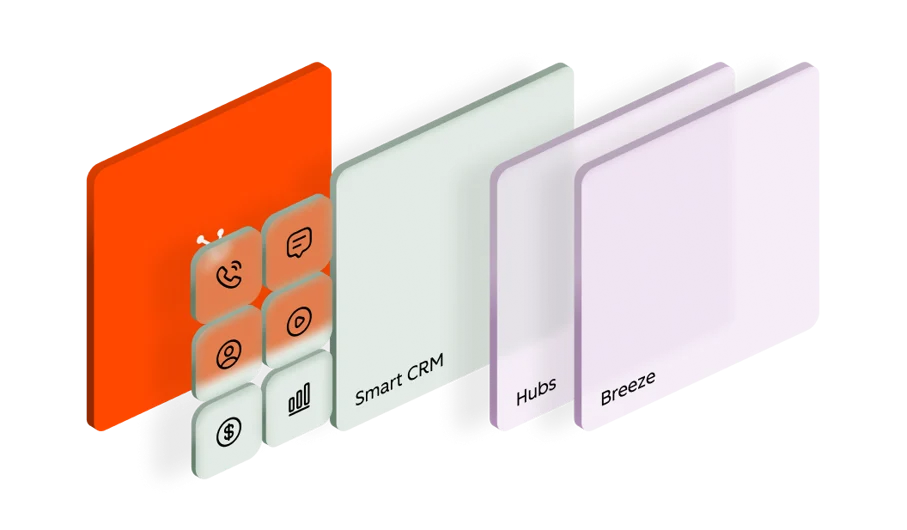
HubSpot is an "agentic customer platform" for scaling companies, built around a Smart CRM that connects marketing, sales, service, content, data, and commerce tools in one system. Its key features include:
Marketing Hub for email marketing, automation workflows, landing pages, social media management, and multi-touch attribution
Sales Hub for pipeline management, AI prospecting, sequences, CPQ, and conversation intelligence
Service Hub for omnichannel ticketing, knowledge base, and AI-powered customer support
Content Hub for AI-assisted content creation, website management, and SEO
Data Hub for data quality, syncing, and programmable automation
Commerce Hub for quotes, invoicing, and payment processing
Breeze AI layer running across all hubs, including Customer Agent, Prospecting Agent, and Data Agent
Over 2,000 app integrations with 2.5 million active installs
When a lead interacts with your business, HubSpot captures the interaction and connects it to the contact's full history across marketing, sales, and service. The Breeze AI layer surfaces insights, drafts outreach, and automates tasks from that data.
Connecting all your go-to-market tools to a single CRM creates real efficiency, especially for teams consolidating a fragmented stack. But as your business scales, parts of the platform may need more power than a generalist tool provides. That is why we are exploring specialized alternatives.
Looking for verified B2B data, buyer intent signals, and AI-powered go-to-market intelligence to power your pipeline? Learn how ZoomInfo can enhance your CRM with the largest B2B dataset in the industry.
How We Curated Our List of HubSpot Alternatives
After testing HubSpot and researching the market, we found that users look for specialized tools in areas where HubSpot's all-in-one approach has limits. While HubSpot handles many go-to-market tasks well in one place, growing businesses often need more power for:
Accessing verified B2B prospecting data and buyer intent signals at scale
Running enterprise CRM operations with complex customization and AI agents in production
Controlling costs with predictable pricing that does not escalate as the contact database grows
Managing sales pipelines with a tool built for deal-closing workflows
Executing multichannel marketing automation across email, SMS, and WhatsApp
Deploying a complete CRM, marketing, and support stack for a small team without breaking the budget
Building a custom CRM data architecture that mirrors the way the business actually operates
Each tool on this list leads in one of these areas. You might pair them with HubSpot to fill gaps or use them as part of a new stack; it depends on what your growing business needs most.
DISCLAIMER: We are not covering every single tool in the market! Our focus is on highlighting the best alternatives that address some of HubSpot's limitations for various use cases. |
|---|
1. ZoomInfo - Best Alternative for B2B Data Intelligence & Go-to-Market Execution
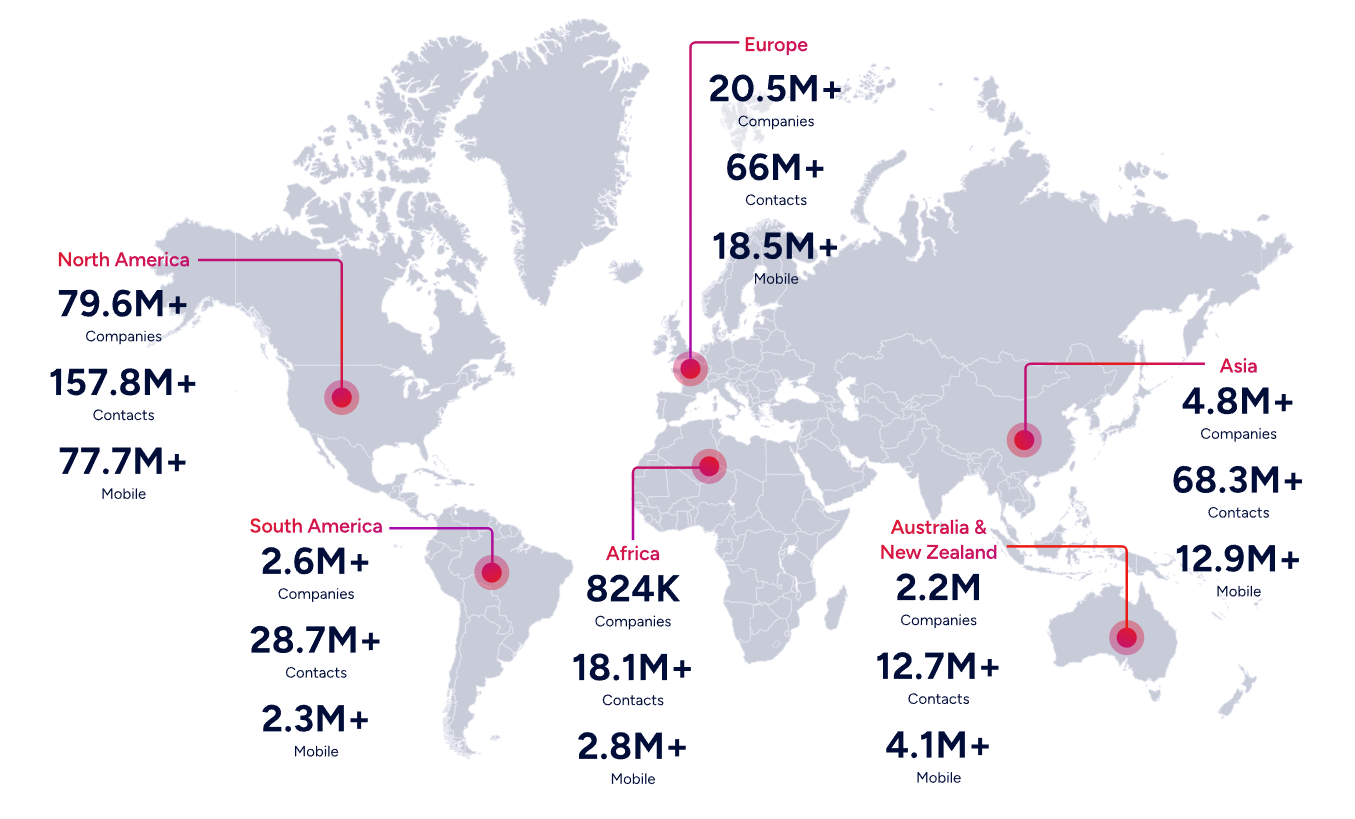
ZoomInfo is an all-in-one AI GTM platform built on the largest B2B data foundation in the industry. Its key capabilities include:
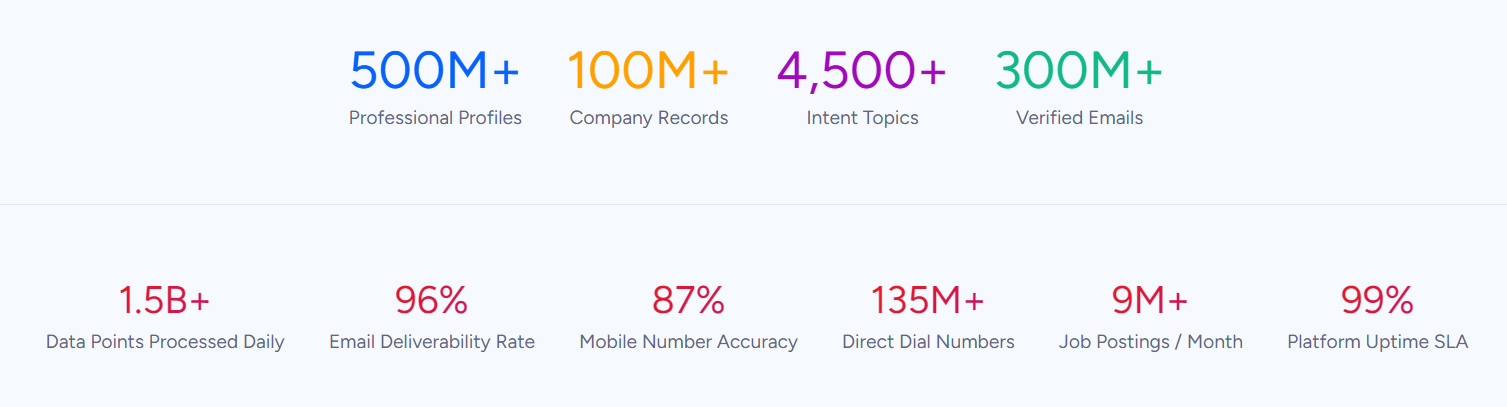
B2B data: 500M contacts, 100M companies, 135M+ verified phone numbers, 120M direct-dial phone numbers, and 200M+ verified business email addresses, maintained by 300+ human researchers with up to 95% accuracy on first-party data
Buyer Intent Data: Tracks signals from 210 million IP-to-Organization pairings and 6 trillion+ keyword-to-device pairings monthly, with exclusive Guided Intent that identifies topics correlated with your actual deal success
GTM Context Graph: An intelligence layer processing 1.5B+ data points daily that fuses B2B data with CRM records, conversation transcripts, and behavioral signals to capture why deals move or stall
Universal access: GTM Workspace for sellers, GTM Studio for marketers and RevOps, APIs and MCP for any custom tool or AI agent
ZoomInfo is not a CRM replacement. It is the B2B data intelligence layer that makes your CRM more effective. It integrates natively with HubSpot, Salesforce, and Microsoft Dynamics 365, so the intelligence flows directly into whichever CRM you use.
Why Add ZoomInfo to Your Go-to-Market Stack
HubSpot's Smart CRM enriches records using email threads, call recordings, and web data. That covers the internal side of your business. But for the external side (knowing who is in your addressable market, how to reach them with verified contact data, and which accounts are researching solutions right now), you need a dedicated B2B intelligence platform.
B2B Data at a Scale No CRM Can Match Internally
HubSpot's built-in enrichment pulls data from conversations and public web sources. This works for records already in your system but cannot identify the contacts, companies, and buying committees outside your database that represent your next customers.
ZoomInfo maintains the largest B2B dataset in the industry. The data flows through a proprietary verification system: automated ML scanning of 28 million site domains daily, third-party partner data covering 95 million businesses, a community of 200,000+ ZoomInfo Lite users who share data back, and an in-house Data Training Lab of 300+ human researchers. In a Fortune 500 competitive RFP analyzing 25 million contacts across vendors, the independent consultant concluded that "no other competitor came even close."
For sales reps, the practical difference is that the direct dial actually rings and the email actually lands, instead of bouncing. For RevOps teams, enrichment workflows do not require stitching together multiple vendors and a manual research layer to get a complete account picture.
ZoomInfo in Action: Your team imports a target account list into HubSpot. ZoomInfo automatically enriches each record with verified direct dials, business emails, org chart data, technographics, and company attributes. Instead of reps spending hours researching each account, they open a fully populated contact record with decision-makers' verified phone numbers and email addresses already in place.
SpringDB used ZoomInfo's enriched data to enable precise targeting for their clients, achieving 2x-3x increases in campaign conversions and a 300% increase in database usability. (SpringDB Case Study)
Buyer Intent Signals: Know Which Accounts Are In-Market Before They Contact You
HubSpot tracks what happens on your website and inside your platform: form submissions, email opens, page visits. But it cannot tell you what prospects are researching across the broader web before they ever visit your site.
ZoomInfo Intent identifies companies actively researching topics related to your solution. Guided Intent, exclusive to ZoomInfo, goes further by identifying specific topics historically correlated with your closed-won deals rather than requiring manual topic selection. WebSights resolves anonymous website traffic to companies, including buying team identification and direct contact info, with Automatic Traffic Filtering that separates real company traffic from bots.
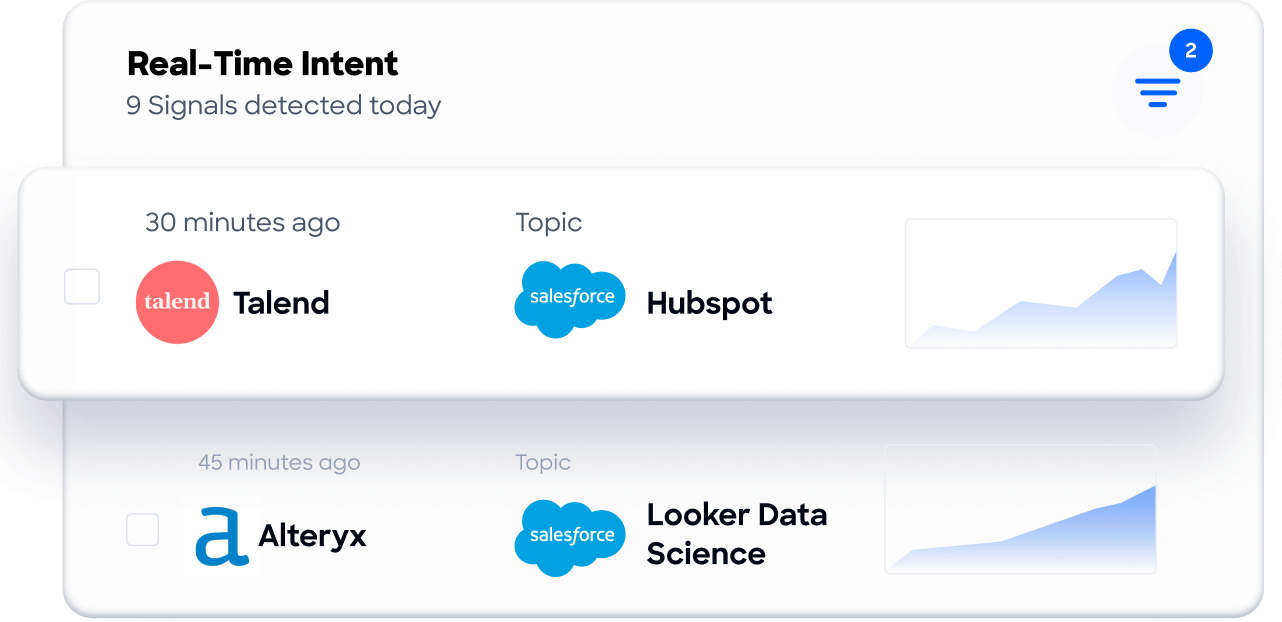
ZoomInfo in Action: A company in your target market starts researching your product category across industry publications and review sites. ZoomInfo surfaces this account with an intent signal spike before they visit your website. Your sales team reaches out with a relevant message while the prospect is still evaluating options, instead of waiting for an inbound form fill that may never come.
Redwood Logistics improved targeting and ROI with ZoomInfo's data-driven audience insights, achieving a 99% reduction in CPC, a 310% increase in CTR, and saving 20-25 hours per week. (Redwood Logistics Case Study)
The GTM Context Graph: Intelligence That Understands Why Deals Move
HubSpot's CRM records deal stage changes, logs activities, and tracks contact properties. But as ZoomInfo's Chief Product Officer Dominik Facher writes: "The CRM recorded the state change. It has no record of why it happened." Maybe the CFO joined the last call and asked about ROI. Maybe the VP went quiet because of an internal budget battle. CRMs were not designed to capture these signals.
The GTM Context Graph, processing 1.5B+ data points daily, fuses ZoomInfo's B2B data with your CRM records, conversation transcripts from Chorus (ZoomInfo's conversation intelligence engine), email threads, and behavioral signals. It captures connections between people and their relationships, actions and their outcomes, patterns from thousands of similar deals, and exceptions that reveal real blockers. This lets AI draft follow-up emails that address the specific concern raised on the last call, target accounts matching your actual win patterns, and weight forecasts by buying evidence rather than rep optimism.
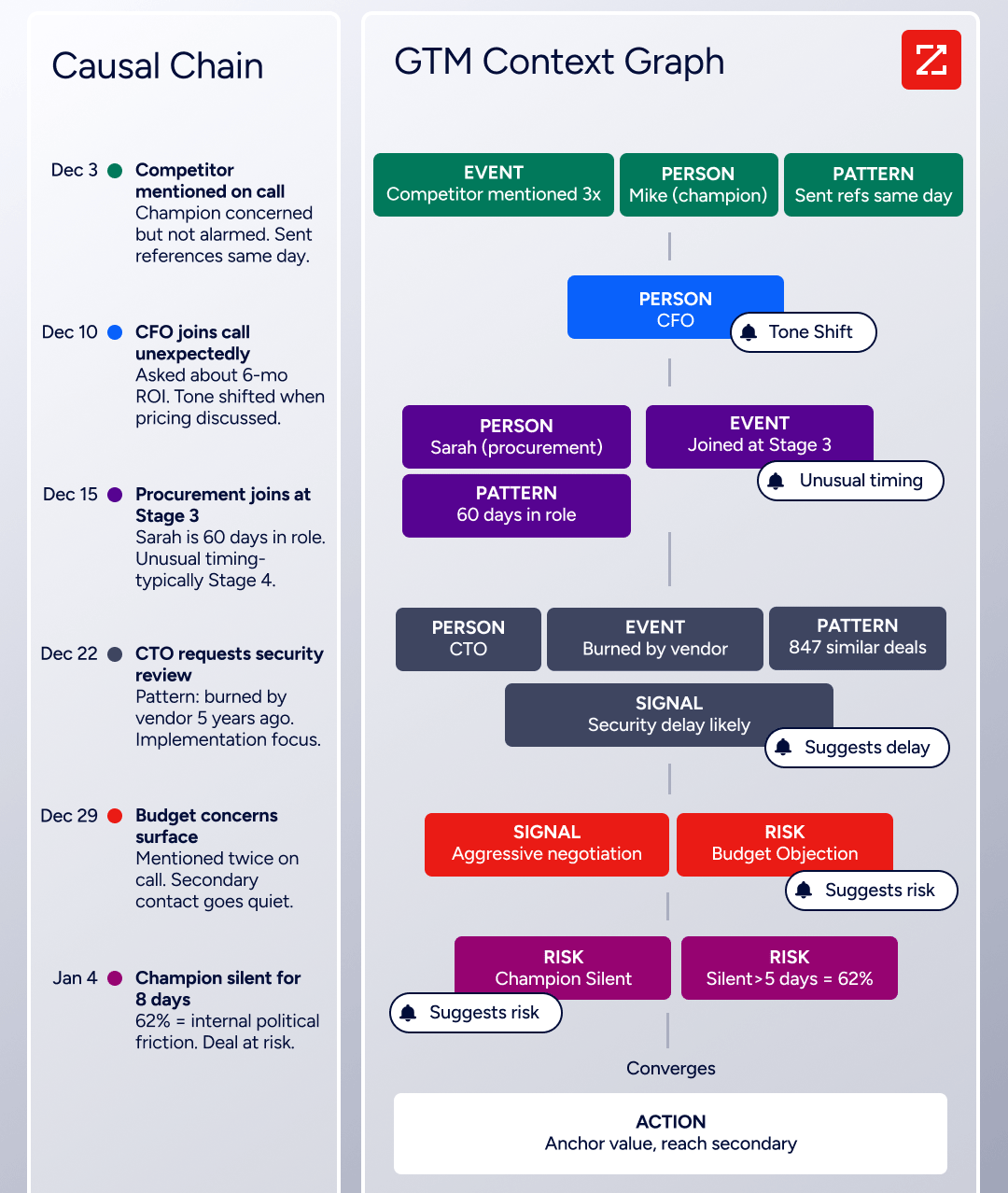
ZoomInfo in Action: A deal stalls in Stage 3, and HubSpot shows no activity for a week. ZoomInfo's GTM Context Graph identifies that the champion mentioned a competing vendor on the last call, three new VPs joined the buying committee last month, and intent signals show the account is researching a competitor's pricing. Your rep gets an alert with context on why the deal is at risk and a recommended action plan.
Seismic's sales team attributed 39% of active pipeline to opportunities identified or influenced by ZoomInfo signals and reported 54% higher productivity. (Seismic Case Study)
Universal Access: Works Inside HubSpot and Every Other CRM
ZoomInfo's intelligence is not locked inside a single application. It reaches your team through three channels:
GTM Workspace gives sellers a single workspace where prioritized accounts, AI-drafted outreach, and deal execution converge
GTM Studio gives marketers and RevOps a builder environment for audience definition, campaign orchestration, and pipeline measurement in natural language
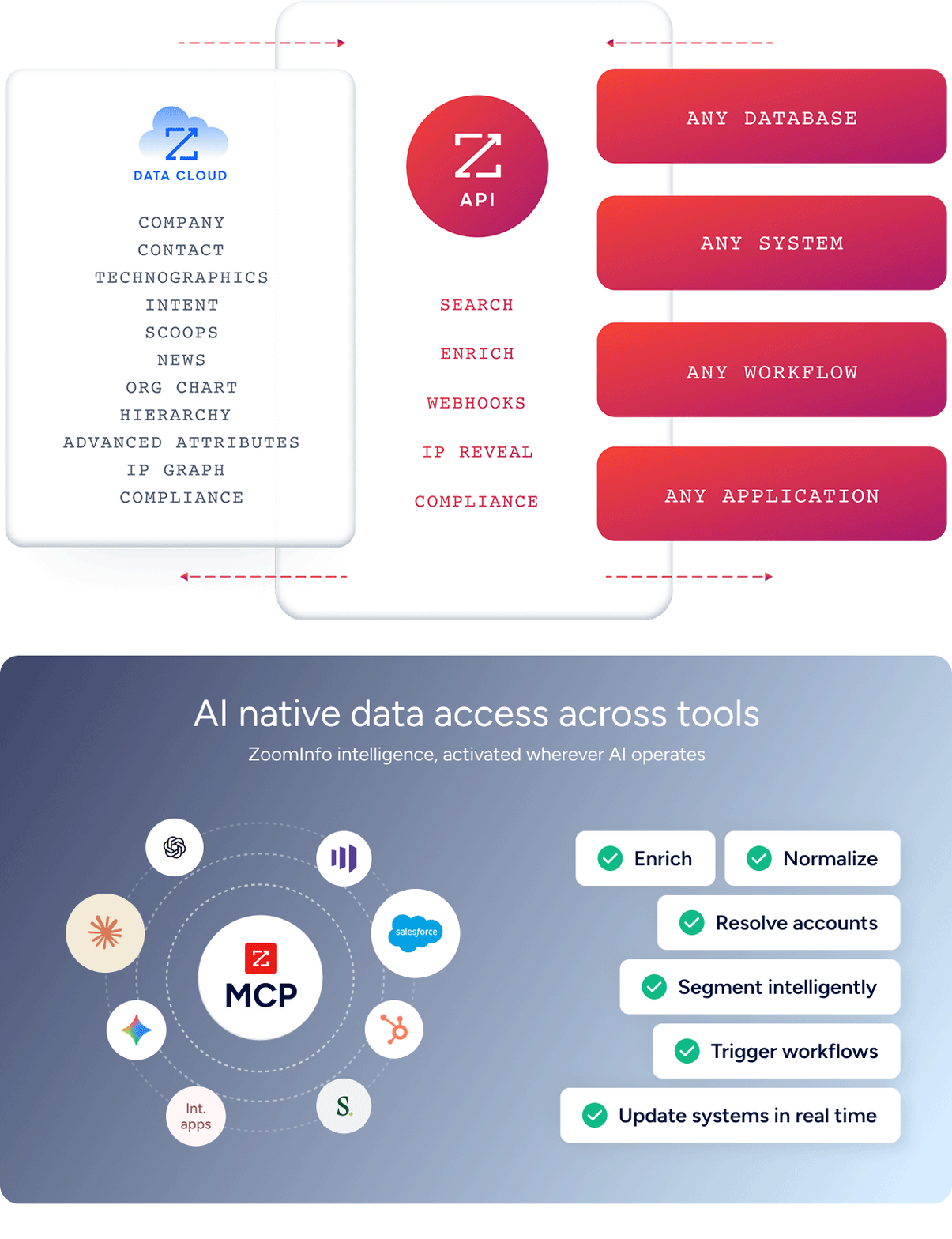
The native HubSpot integration pushes enriched contact and company data directly into your HubSpot CRM, keeping records current without manual updates. If you switch CRMs, ZoomInfo also integrates natively with Salesforce, Microsoft Dynamics 365, and 120+ other tools in the ZoomInfo App Marketplace.
BDO Canada activated ZoomInfo's data directly within their internal systems via the API, cutting time spent on data dashboard updates by 87%. (BDO Canada Case Study)
NOTE: ZoomInfo integrates natively with HubSpot and with several other CRMs on this list, including Salesforce and Microsoft Dynamics 365. Regardless of which CRM you choose, ZoomInfo's B2B data intelligence layer powers your prospecting, enrichment, and go-to-market execution.
ZoomInfo Pricing
ZoomInfo uses a custom-quoted, consumption-based pricing model organized into three product lines (Sales, Marketing, and additional products), each with tiered feature access (Professional, Advanced, and Enterprise). Pricing scales based on usage patterns, number of users, monthly credit volume, features, and contract length.
ZoomInfo Lite is a permanent free tier (not a trial) that includes access to ZoomInfo's B2B database with 100M+ verified profiles, 10 monthly export credits (25 with Community Edition upgrade), individual and company searches, the ReachOut Chrome Extension, WebSights Lite (up to 10 website visitor reveals per day), and a HubSpot integration. No credit card required, no time limit.
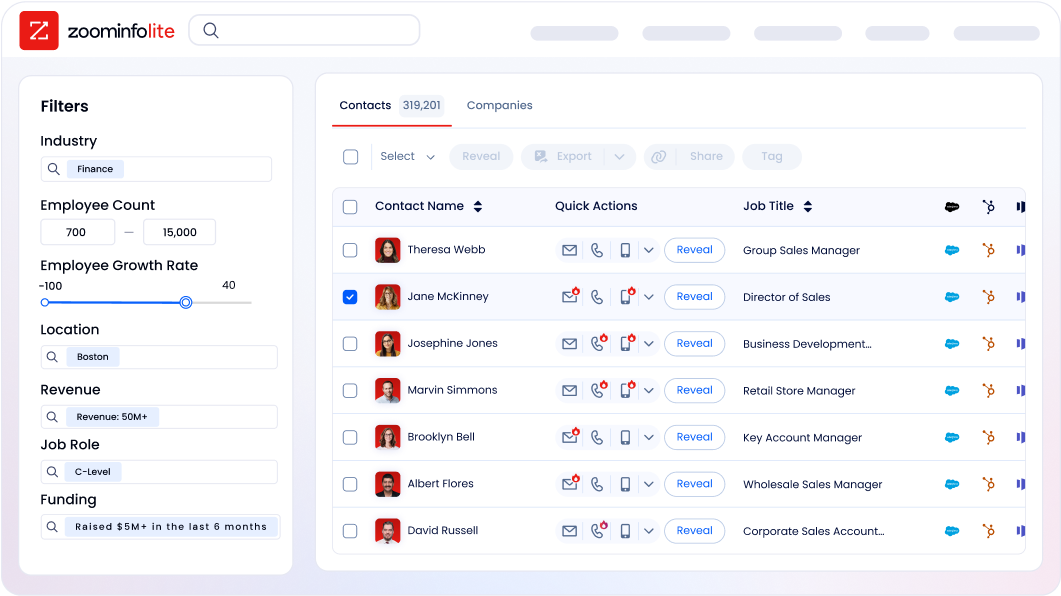
A separate 7-day free trial is available for teams wanting to explore the full platform, including contact and company search, sales intelligence tools, intent signals, and email outreach.
Who Should Use ZoomInfo?
Choose ZoomInfo if:
Your sales team spends hours manually researching accounts and still works with incomplete or outdated contact data. You need verified direct dials and business emails at scale to fill your pipeline faster.
You want to identify which target accounts are in-market for your solution before they raise their hand, using buyer intent signals and website visitor identification to prioritize outreach.
Your CRM data is incomplete, stale, or siloed across multiple tools, and you need continuous enrichment that keeps contact and company records current without manual work.
You run account-based marketing campaigns and need precise audience targeting powered by company attributes, technographics, and intent data to improve campaign ROI.
Your go-to-market teams need intelligence that goes beyond CRM automation, capturing why deals move and recommending the next action based on the context behind every account interaction.
Ready to see which accounts are in-market for your solution right now? Start your ZoomInfo free trial to see what verified B2B data and intent-driven intelligence do for your pipeline.
2. Salesforce - Best Alternative for Enterprise CRM Depth & AI Agents in Production
Source: Salesforce
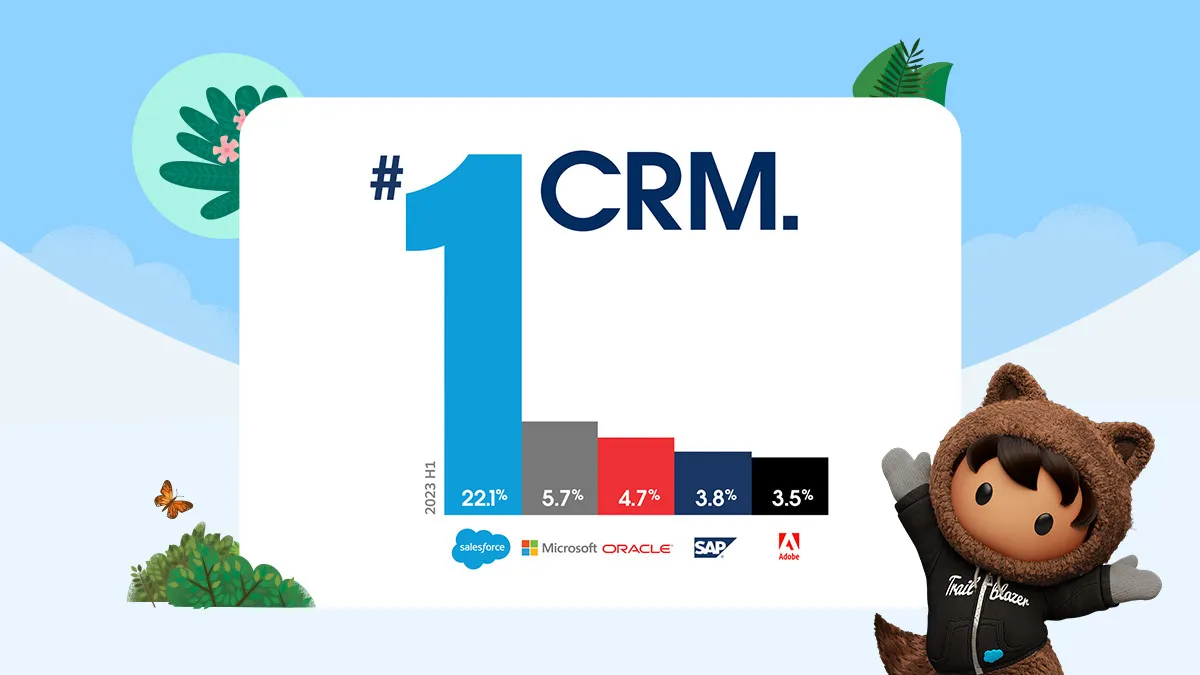
Salesforce is the world's #1 CRM by IDC revenue market share, an enterprise AI platform built for large organizations managing complex sales motions, multi-cloud customer engagement, and autonomous AI agents in production. Its key capabilities include:
AppExchange marketplace with 9,000+ partner apps, 14M+ installs, and 91% customer adoption
Agentforce autonomous AI agent platform, now at $800M ARR growing 169% YoY with 29,000 deals closed and 2.4 billion Agentic Work Units delivered
Data Cloud real-time customer data platform, Gartner MQ Leader for Customer Data Platforms for the second consecutive year
CRM customization: multi-territory, multi-currency, intricate approval chains, reflecting 25+ years of enterprise feature development
Gartner MQ Leader for Sales Force Automation for 19 consecutive years
Salesforce is the natural next step for organizations that have outgrown HubSpot's CRM depth and need enterprise customization, production-ready AI agents, and the largest integration ecosystem in the CRM market.
Why Choose Salesforce Over HubSpot for Enterprise CRM Operations
Salesforce stands out in the following areas:
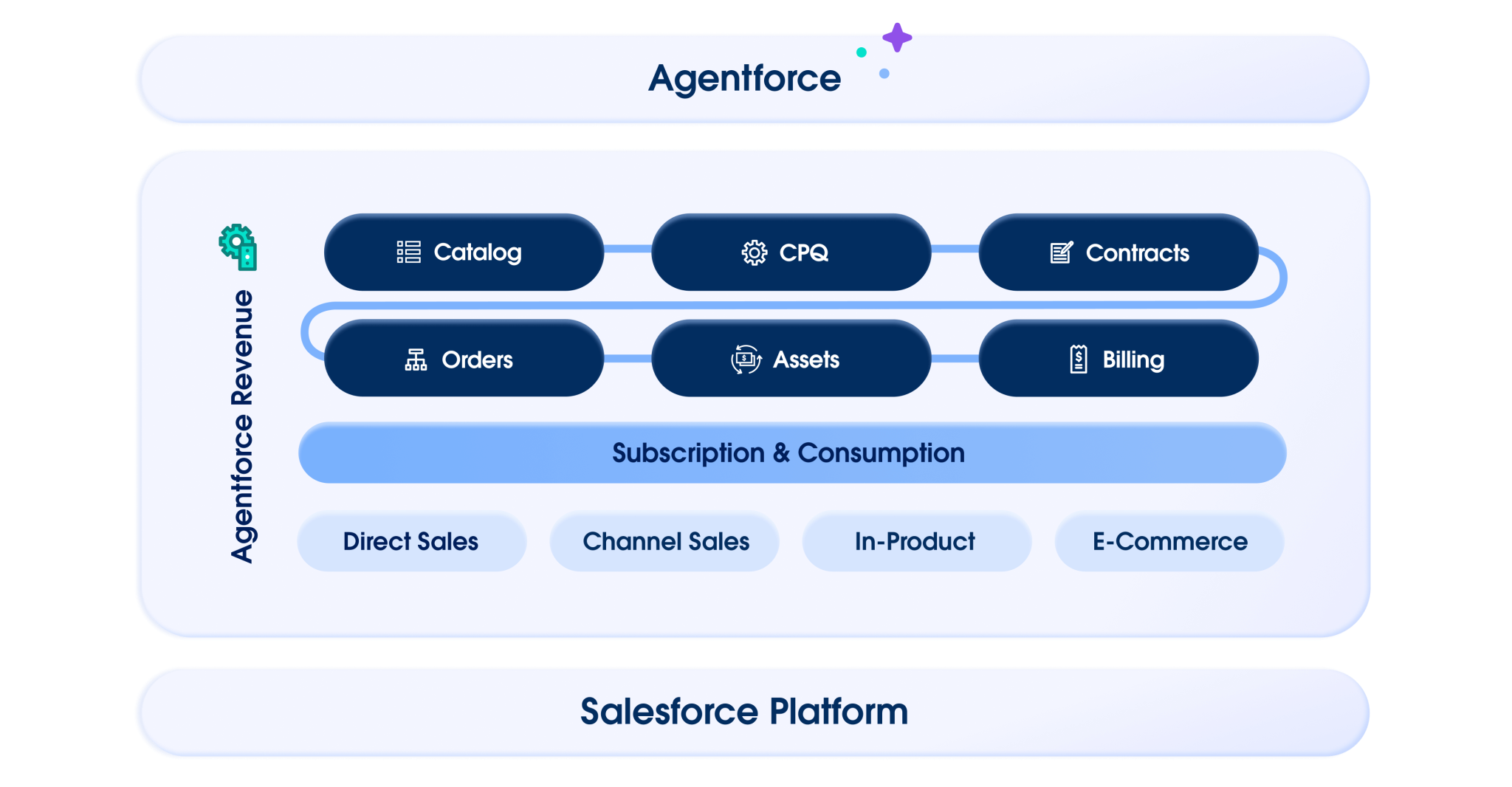
Enterprise Customization Built Over 25 Years HubSpot's enterprise pitch centers on 90 days to meaningful outcomes, which works for scaling companies consolidating a fragmented stack. But Salesforce's customization engine reflects 25+ years of engineering against hard enterprise problems: multi-territory hierarchies, Revenue Lifecycle Management (CPQ, contract lifecycle, subscription billing), advanced sharing rules, forecast rollups, and multi-currency operations across dozens of country entities. Organizations in manufacturing, financial services, or any sector with genuinely complex sales operations will find depth that cannot be replicated by shortcutting the history.
AI Agents in Production at Scale, Not Beta HubSpot's Breeze AI is investing in agentic capabilities, but several key features (AI-Powered Segmentation, Marketing Studio, Knowledge Base Agent, Breeze Studio) are listed as Beta in the Fall 2025 Spotlight. Salesforce's Agentforce is in production at scale: $800M ARR, 29,000 deals closed, 2.4 billion work units delivered. The Atlas Reasoning Engine uses a reason, act, observe, adapt loop for multi-step scenarios, and the Einstein Trust Layer enforces zero data retention with LLM partners, PII masking, and full audit trails.
An Integration Ecosystem Five Times Larger HubSpot's App Marketplace surpassed 2,000 integrations with 2.5 million active installs. AppExchange operates at a different scale: 9,000+ partner apps, 14+ million installs, spanning ERP connectors, industry-specific vertical tools, and niche workflow automation. For enterprises with complex existing tech stacks, the size of the integration ecosystem directly determines total implementation cost.
Source: Salesforce
NOTE: We also evaluated Microsoft Dynamics 365 and Oracle CX. Dynamics 365 excels for organizations already running Azure and Microsoft 365 infrastructure. Oracle CX is built for enterprises on Oracle ERP. Salesforce offers the broadest enterprise AI CRM for organizations without a pre-existing commitment to Microsoft or Oracle. ZoomInfo integrates natively with Salesforce, delivering the same B2B data intelligence and buyer intent capabilities into the Salesforce CRM.
For a detailed look at how HubSpot and Salesforce compare across enterprise CRM use cases, see our HubSpot vs Salesforce comparison.
Salesforce Pricing
Salesforce operates on annual contracts with a multi-cloud, multi-tier structure. A June 2025 restructuring introduced Agentforce editions:
Free Suite: $0/user/mo (max 2 users); basic lead, account, and opportunity management
Starter Suite: $25/user/mo; unlimited users, AI email sync, lead routing
Pro Suite: $100/user/mo (annual); customization, quoting, forecasting, AppExchange access
Enterprise: $175/user/mo (annual); AI for sales/service, pipeline insights, workflow automation
Unlimited: $350/user/mo (annual); full AI suite, conversation intelligence, Premier Success included
Agentforce 1: $550/user/mo (annual); unmetered Agentforce, Tableau Next, Slack Enterprise+
Agentforce consumption at Enterprise and Unlimited tiers is billed separately via Flex Credits ($500 per 100,000 credits), per conversation ($2 per 24-hour session), or as a user add-on ($125/user/month for unmetered employee-facing use).
Who Should Use Salesforce?
Choose Salesforce if:
Your organization has complex sales operations (multi-territory, multi-currency, intricate approval chains, or industry-specific compliance requirements) that demand a CRM built to model that complexity faithfully.
You need AI agents in production today with enterprise governance: zero-data-retention with LLM partners, PII masking, full audit trails, and proven deployment at scale.
Your tech stack spans multiple enterprise systems and you need an integration ecosystem large enough to have certified connectors already built for most of them.
3. Zoho CRM - Best Alternative for Predictable Costs Without Contact-Based Pricing
Source: Zoho CRM
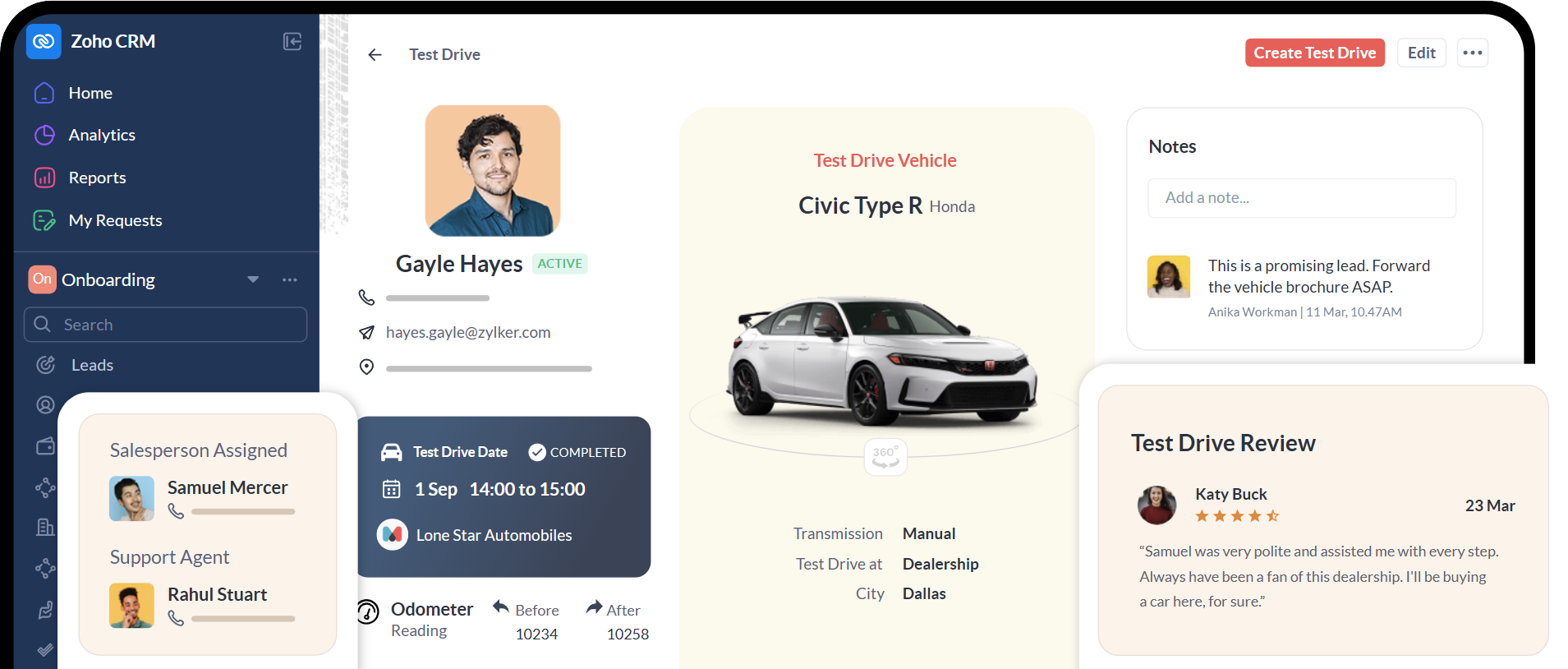
Zoho CRM is a cloud-based CRM suite that delivers sales force automation, AI-powered pipeline management, and a native ecosystem of 55+ integrated business applications at a per-user price that does not escalate as your marketing database grows. Its key capabilities include:
Full sales force automation with multi-pipeline management, CPQ, territory management, and AI-powered forecasting
Zia AI assistant with predictive lead scoring, deal close probability, anomaly detection, and natural language workflow creation
Canvas Design Studio for no-code UI customization and Blueprint process automation for stage-by-stage compliance
Omnichannel communication (email, phone, WhatsApp, SMS, live chat) managed from a single contact record
Per-user pricing with no contact-based tiers: costs stay flat whether your database holds 10,000 or 100,000 contacts
Why Choose Zoho CRM Over HubSpot for Cost-Predictable CRM
Zoho CRM stands out in the following areas:
No Contact-Based Pricing, Flat Per-User Cost HubSpot's Marketing Hub charges based on the number of marketing contacts. At Professional tier, each additional 5,000 contacts costs $250/month. A team growing its marketing list from 10,000 to 100,000 contacts sees a cost increase because the database grew, not because the team did. Zoho CRM charges per user per month, full stop. Standard starts at $14/user/month (annual billing); Enterprise runs $40/user/month. The bill reflects headcount, not database growth.
No Mandatory Onboarding Fees HubSpot charges mandatory onboarding fees at Professional and Enterprise tiers: $3,000 for Marketing Hub Professional, $7,000 for Enterprise, $1,500 for Sales Hub Professional, and $3,500 for Enterprise. A team activating Marketing, Sales, and Service Hubs at Professional tier faces $6,000 in mandatory upfront costs. Zoho CRM has no mandatory onboarding fee at any tier. The optional Jumpstart program starts at $200/hour, but it is entirely elective.
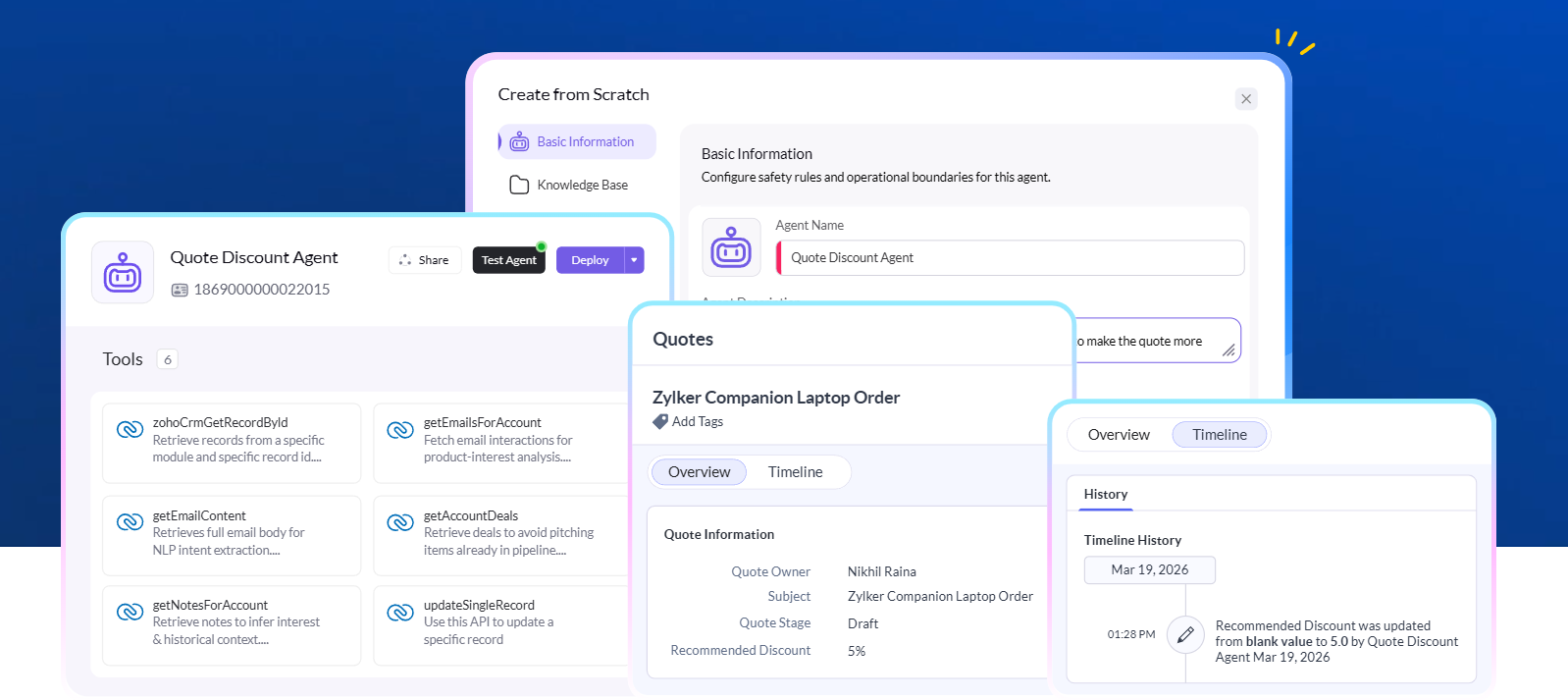
Zia AI Included at Enterprise Without Credit-Based Consumption HubSpot's AI runs on HubSpot Credits (3,000/month at Professional, 5,000 at Enterprise), resetting monthly with no rollover. Zoho CRM's Zia AI is included in the Enterprise plan at $40/user/month and covers predictive scoring, churn prediction, anomaly detection, call transcription, email sentiment analysis, and natural language workflow creation, all without a separate credit allotment.
Source: Zoho CRM
NOTE: We also evaluated Accelo, Freshsales and Insightly. Accelo brings project management and time tracking into the CRM for agency and services teams. Freshsales offers a strong free tier for small teams. Insightly provides solid project management integration. Zoho CRM offers the best cost-to-feature ratio in the SMB-to-mid-market space. The Zoho One bundle's 55+ application breadth and Zia AI's depth at the Enterprise price point make it the clearest HubSpot alternative on value per dollar.
For a full breakdown of how HubSpot and Zoho CRM compare on pricing, features, and AI capabilities, see our HubSpot vs Zoho CRM comparison.
Zoho CRM Pricing
Zoho CRM pricing (annual billing in USD):
Standard: $14/user/month; workflows, Cadences, custom reports, sales forecasting (100,000 records)
Professional: $23/user/month; adds CPQ, Blueprint process automation, email intelligence, inventory management
Enterprise: $40/user/month (most popular); adds full Zia AI, journey orchestration, territory management, sandbox
Ultimate: $52/user/month; adds custom AI/ML via QuickML, consulting sessions, migration assistance
A permanent free plan supports up to 3 users with 5,000 records. A 15-day free trial provides full Enterprise-tier access, no credit card required.
Who Should Use Zoho CRM?
Choose Zoho CRM if:
Your team has grown past 5-10 people and is hitting HubSpot's contact-based pricing that escalates as your marketing database grows.
You need the full marketing, sales, and service stack under one vendor without per-hub fees, and the Zoho One bundle delivers whole-company deployment at a flat per-employee rate.
You want AI (predictive scoring, anomaly detection, churn prediction) built into the CRM at a flat per-user rate rather than metered through monthly credit consumption.
4. Pipedrive - Best Alternative for Clean Pipeline Management & Sales Adoption
Source: Pipedrive
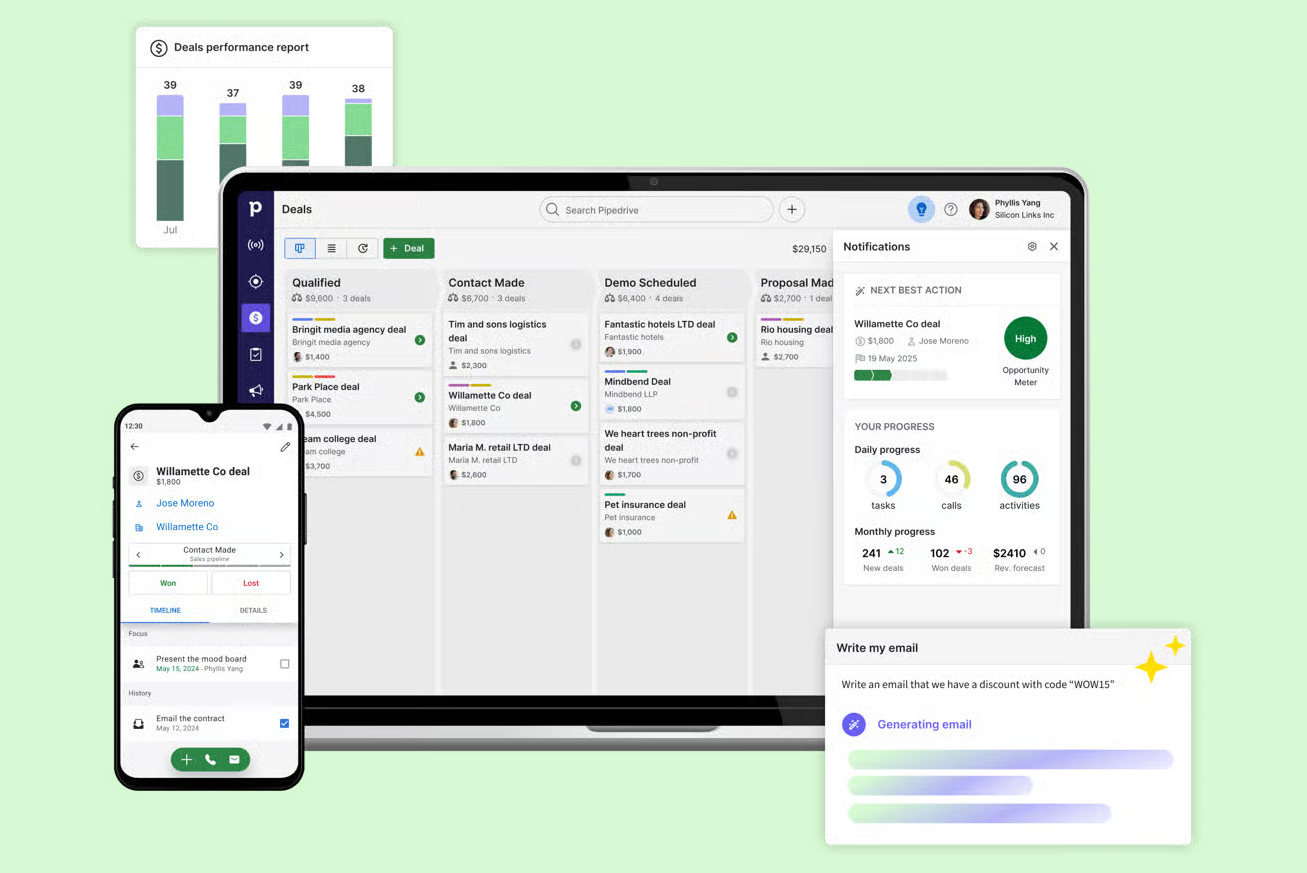
Pipedrive is a sales-focused CRM co-founded in 2010 by five salespeople who found existing tools were designed for managers to monitor reps rather than for reps to close deals. Its key capabilities include:
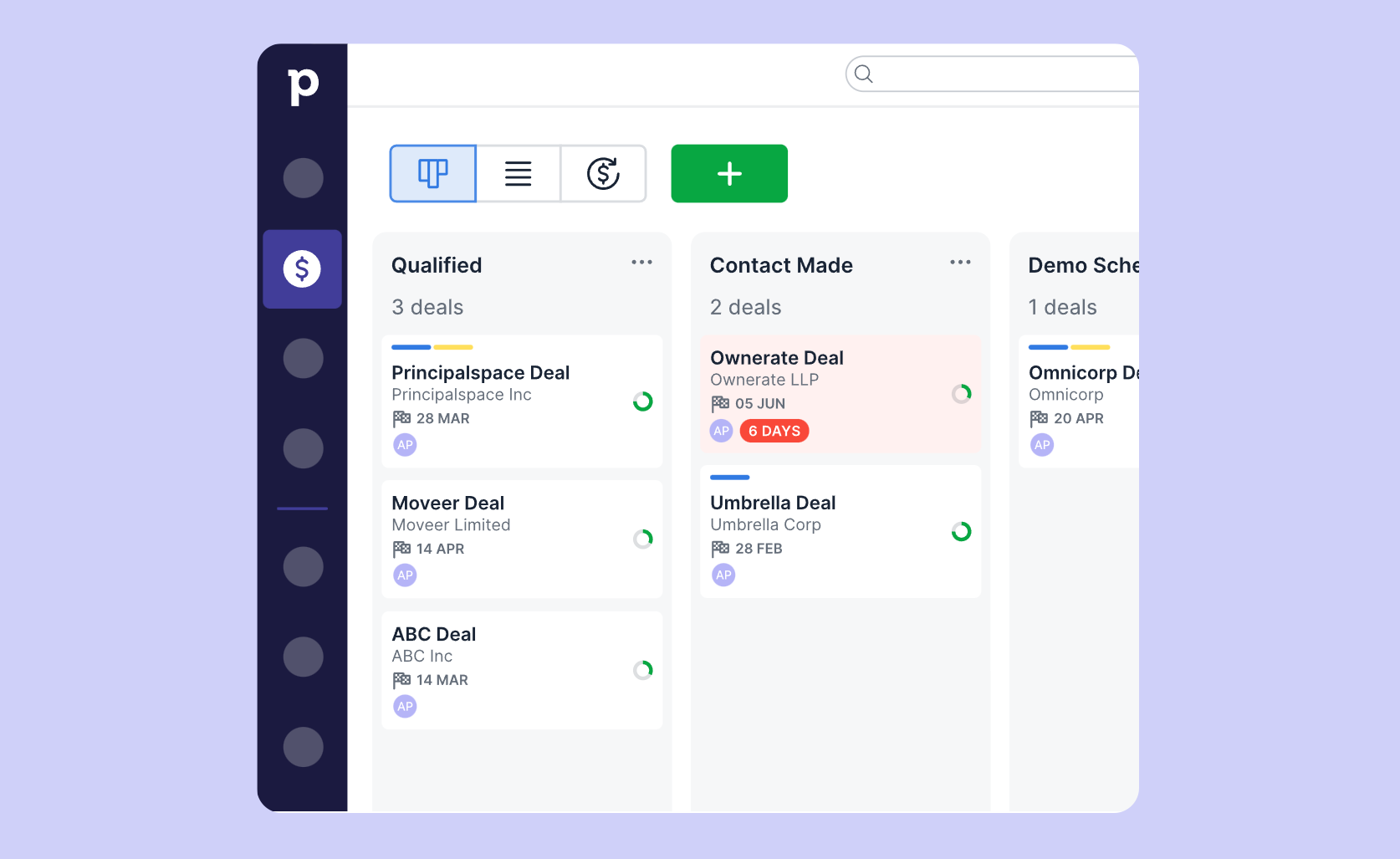
Visual drag-and-drop pipeline management with unlimited custom stages across unlimited pipelines on every paid plan
No contact limits on any pricing tier; the entire database is accessible regardless of plan
AI Sales Assistant with deal-level coaching, at-risk deal identification, and next-best-action recommendations
Workflow automation with conditional if/else branching, delay logic, and native Slack, Teams, Trello, and Asana connections
Transparent per-user pricing starting at $14/user/month with no mandatory onboarding fees
Why Choose Pipedrive Over HubSpot for Pipeline Management
Pipedrive stands out in the following areas:
Unlimited Contacts on Every Plan HubSpot's contact-based pricing means a team that crosses a contact threshold sees its bill jump. Pipedrive removes this entirely. No contact limits exist on any plan; a team on the entry-tier Lite plan stores the same unlimited contacts as a team on Ultimate. Pricing is a flat per-seat fee that does not change when a new round of leads is imported.
Pipeline-First Design Built for Sales Adoption HubSpot's platform is broad by design, which can add navigational complexity for a pure sales team. Pipedrive built the kanban pipeline view as the primary workspace. Colored rotting indicators flag deals without recent activity. Activities attach directly to deal records and surface inside the pipeline view.
Feature Access Without Mandatory Onboarding Gates Pipedrive charges no mandatory onboarding fees at any tier. Onboarding support is included as a product feature. Unlimited sales pipelines, product catalogs, customizable reports, and a free open API are available on the entry Lite plan.
Source: Pipedrive
NOTE: We also evaluated Freshsales and Close. Freshsales offers a built-in dialer and tighter native marketing automation. Close is built for high-velocity inside sales with power dialing at its core. Pipedrive offers the most scalable pipeline management for teams growing from 5 to 50 reps who want clear deal visibility and predictable per-seat costs. ZoomInfo's B2B data and prospecting intelligence integrates via Pipedrive's open API and 500+ marketplace integrations, filling the prospecting data gap that neither CRM addresses natively.
For a side-by-side look at how HubSpot and Pipedrive compare on pipeline management and pricing, see our HubSpot vs Pipedrive comparison.
Pipedrive Pricing
Pipedrive uses per-seat pricing with up to 42% discount on annual billing. All plans include unlimited contacts, unlimited pipelines, API access, and the Pipedrive Marketplace:
Lite: Starts at $14/user/month (annual); customizable pipelines, deal rotting alerts, product catalog, custom fields, Insights dashboards
Growth: Adds full email sync, workflow automations with branching, sequences, meeting scheduler, forecast view
Premium: Adds Smart Docs with eSignature, LeadBooster (chatbot, live chat, Prospector), AI email tools
Ultimate: Highest usage limits; security alerts, contact data enrichment, 500 custom fields
No mandatory onboarding fees at any tier.
Who Should Use Pipedrive?
Choose Pipedrive if:
Your team is a pure sales organization (5 to 50 reps) managing discrete deal pipelines, and you do not need marketing automation or service ticketing bundled in.
You are paying HubSpot's contact-tier fees and your database is growing faster than your revenue; Pipedrive's unlimited-contact model removes the cost penalty.
You want a CRM your sales reps will use from day one, without a formal onboarding program or a mandatory onboarding fee.
5. ActiveCampaign - Best Alternative for Advanced Email, SMS & WhatsApp Automation
Source: ActiveCampaign
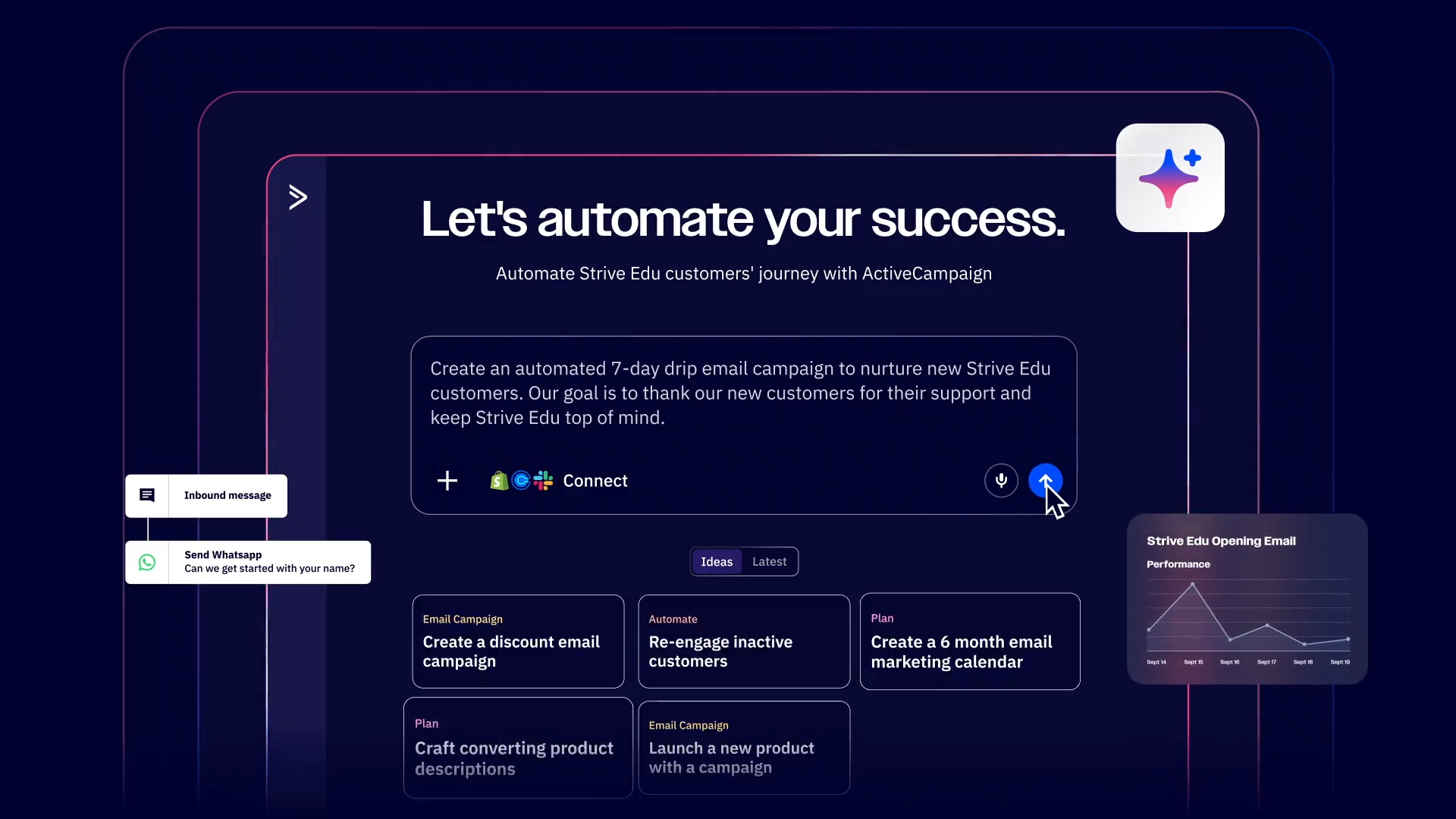
ActiveCampaign is a marketing automation platform that replaces HubSpot for teams whose primary need is behavior-driven multichannel marketing automation. Its key capabilities include:
800+ pre-built automation recipes covering email nurture, abandoned cart recovery, SaaS onboarding, lead scoring triggers, and re-engagement campaigns
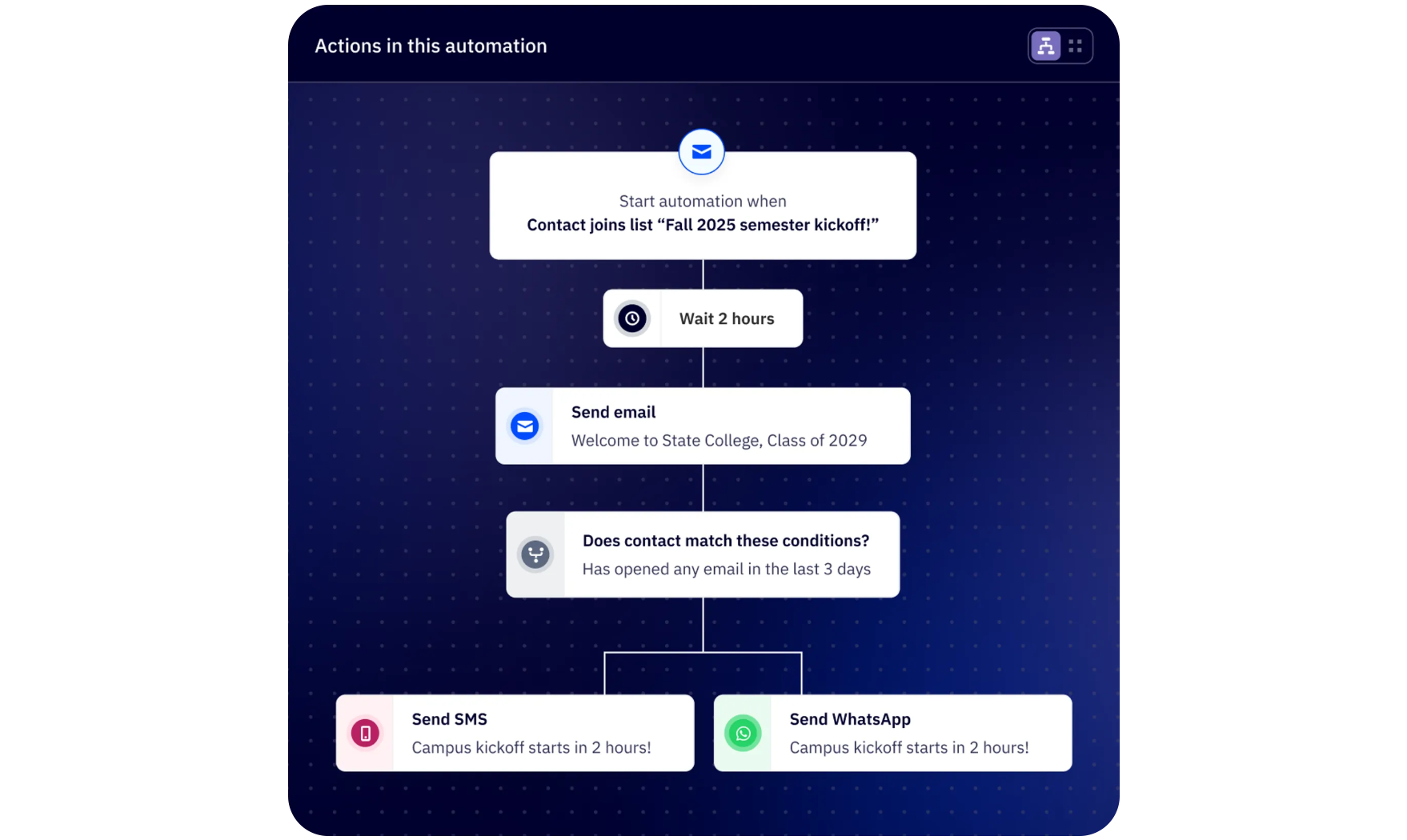
Native SMS and WhatsApp channels orchestrated from a single visual workflow canvas without third-party connectors
Predictive Sending that determines the best send time for each contact based on their personal engagement history
Active Intelligence AI layer that generates campaigns, segments, and automations from plain-language goals
Contact-based pricing that scales by list size rather than seat count
Why Choose ActiveCampaign Over HubSpot for Marketing Automation
ActiveCampaign stands out in the following areas:
Contact-Based Pricing That Doesn't Penalize Team Growth HubSpot's per-seat model means costs escalate with headcount, and the mixed-tier rule (where all Core Seats are billed at the highest tier) can inflate the total. ActiveCampaign charges by contact count, not seat count. A business managing 5,000 contacts pays a predictable rate regardless of whether five or fifteen people need access. Starter is $149/month for 10,000 contacts.
Native SMS and WhatsApp Without a Third-Party Add-On HubSpot does not offer native SMS marketing as a built-in channel in Marketing Hub. ActiveCampaign handles SMS and WhatsApp natively within the same automation canvas used for email. A single workflow can fire an email, wait for a behavioral signal, send an SMS follow-up, and branch into a WhatsApp conversation. WhatsApp integration operates through official Meta Business Partner access. SMS carries a 98% open rate with 90% of messages read within 3 minutes.
Automation Depth with 800+ Pre-Built Recipes and Per-Recipient Send Intelligence ActiveCampaign was built automation-first. The 800+ pre-built automation recipes cover every common marketing scenario, and Predictive Sending analyzes each contact's engagement pattern to deliver emails at the moment that person is most likely to open.
Source: ActiveCampaign
NOTE: We also evaluated Klaviyo and Brevo. Klaviyo excels at ecommerce behavioral automation with Shopify integration but lacks B2B CRM and sales pipeline features. Brevo offers competitive contact-based pricing and native SMS but thinner automation depth. ActiveCampaign offers the most complete multichannel automation (email + SMS + WhatsApp) with a built-in B2B sales layer for teams needing marketing and sales coordination in one platform.
For a head-to-head breakdown of marketing automation features and pricing, see our ActiveCampaign vs HubSpot comparison.
ActiveCampaign Pricing
ActiveCampaign uses contact-based pricing where monthly cost scales with list size. Prices are confirmed at activecampaign.com/pricing:
Starter: Starts at $149/month for 10,000 contacts; 1 user seat, email marketing automation, basic ecommerce integrations, 5 actions per automation
Plus: Dynamic pricing by contact count; unlimited automation actions, multichannel marketing, landing pages, AI content generation
Professional: Dynamic pricing; 3 user seats, advanced segmentation, predictive sending, revenue attribution
Enterprise: Custom pricing; 5 user seats, SSO, HIPAA support, premium CRM integrations, dedicated account team
No mandatory onboarding fees. A 14-day free trial and 30-day money-back guarantee are available.
Who Should Use ActiveCampaign?
Choose ActiveCampaign if:
Your primary need is behavioral marketing automation (multi-step nurture sequences, abandoned cart flows, lifecycle triggers) and you want an automation canvas built as the core product.
You need native SMS and WhatsApp automation within the same workflow builder as your email campaigns, without connecting a third-party service.
Your team is large relative to your contact list, and contact-based pricing is cheaper than per-seat pricing at your headcount.
6. EngageBay - Best Alternative for Small Teams on Tight Budgets
Source: EngageBay
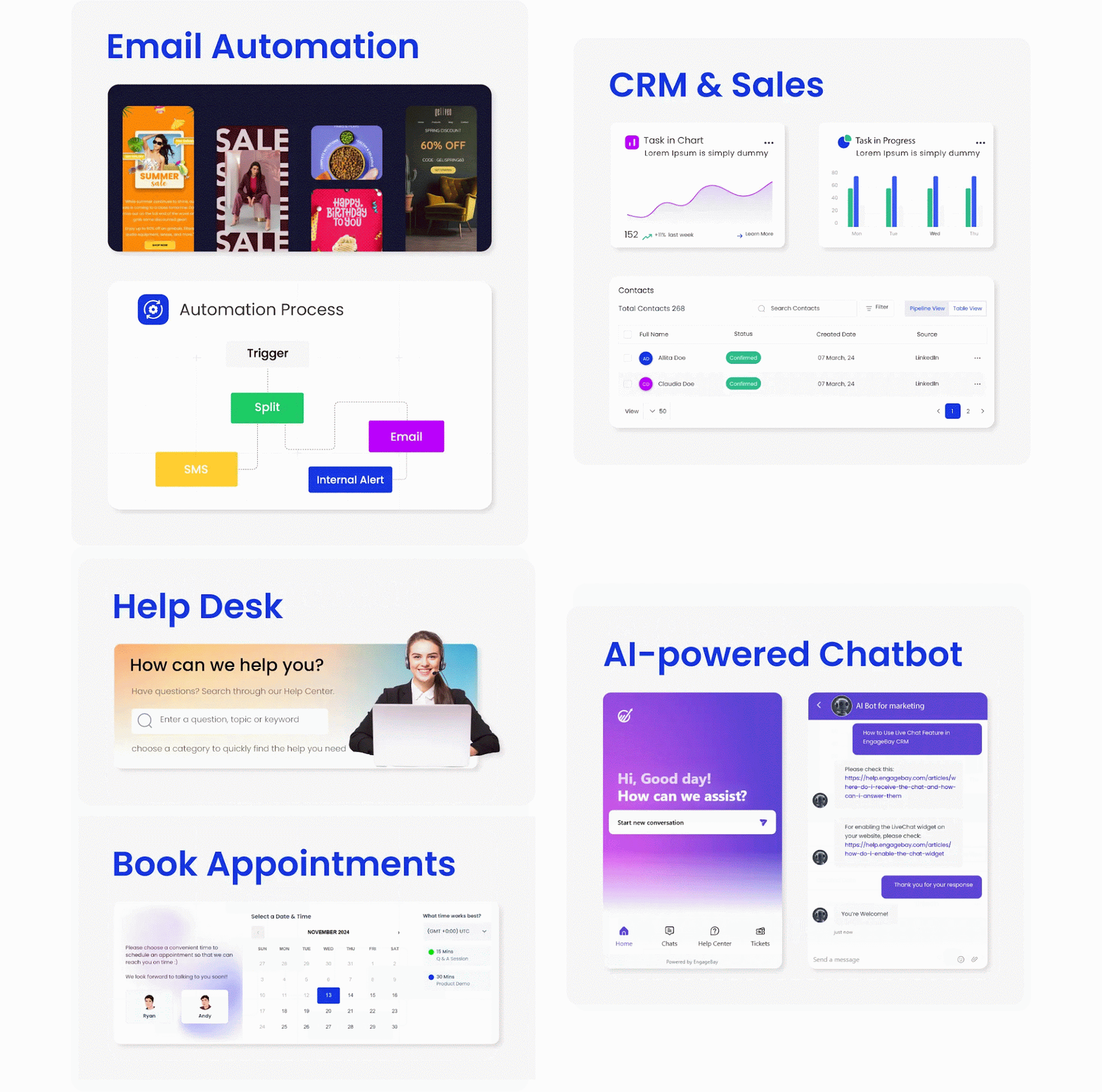
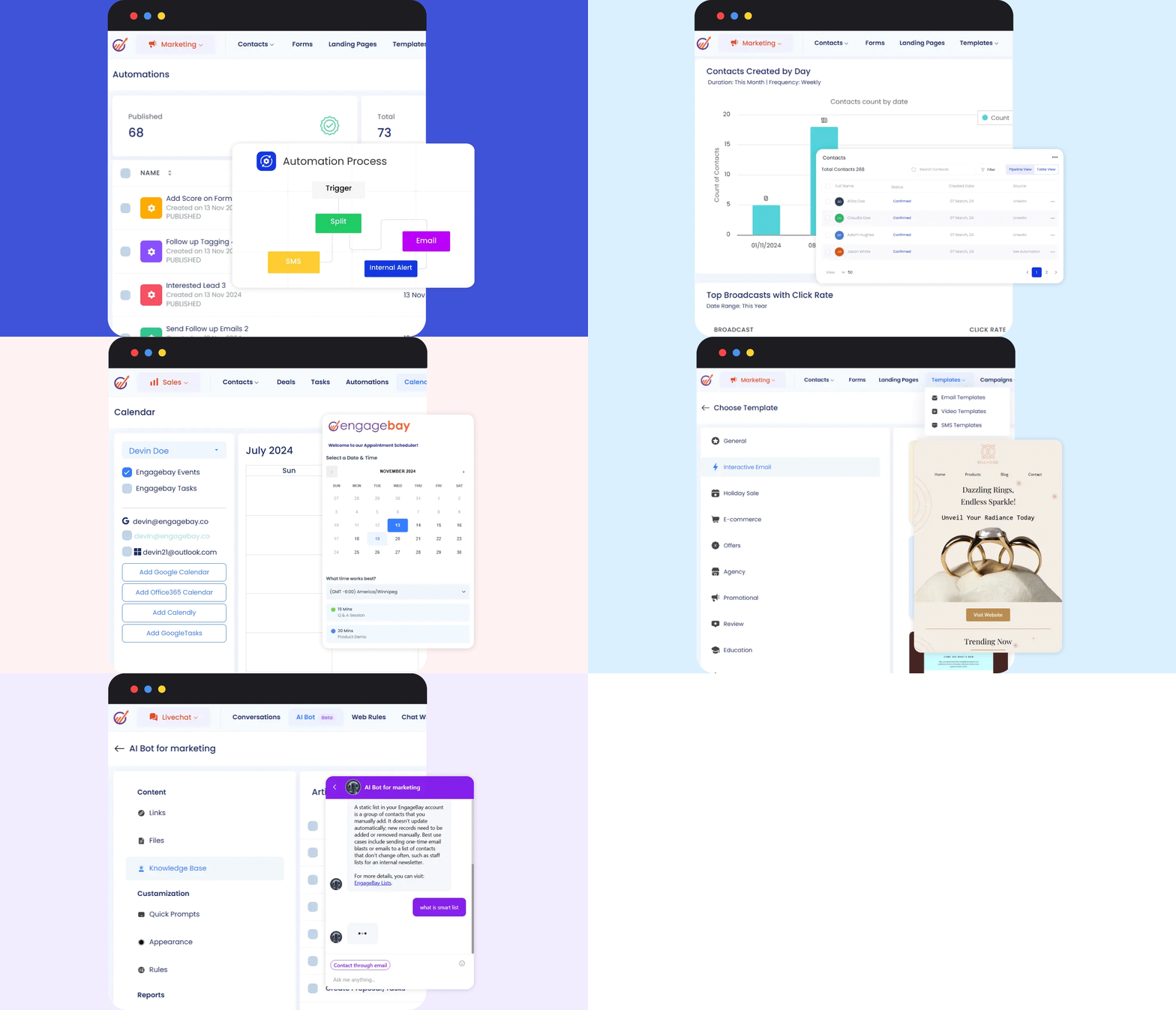
EngageBay is an all-in-one CRM, marketing automation, and customer support platform built for startups and small businesses that need a complete go-to-market stack without per-hub pricing. Its key capabilities include:
Full CRM with deal pipelines, lead scoring, and 360-degree contact records accessible across all tiers
Email marketing broadcasts, drip sequences, and trigger-based automation with 16 event triggers
Helpdesk ticketing, shared inbox, live chat widget, and AI chatbot included on the free plan
Built-in cloud telephony and appointment scheduling with Google Calendar/Office 365 sync
Free plan supporting up to 15 users with CRM, marketing, and support included
Why Choose EngageBay Over HubSpot for Small Teams
EngageBay stands out in the following areas:
Free Plan Supports 15 Users Where HubSpot Caps at Two HubSpot's free CRM caps at two user seats. A team of ten (split across sales, marketing, and support) cannot operate inside HubSpot's free tier at the same time. EngageBay's free plan covers up to fifteen users with the full CRM, email marketing, live chat, and helpdesk included. No credit card required.
No Mandatory Onboarding Fees and No Annual Contracts HubSpot's mandatory onboarding fees total $4,500 or more for a team activating Marketing, Sales, and Service Hubs at Professional tier. EngageBay charges no onboarding fee on any plan. Paid plans carry no long-term contract requirement, and cancellation takes effect at the end of the current billing period with no early termination penalty.
CRM, Marketing, and Helpdesk Priced as One Platform A team of ten using HubSpot's Marketing, Sales, and Service Hubs at Professional tier pays approximately $2,600/month before mandatory onboarding. EngageBay's All-in-One suite bundles all three functions under a single per-user rate. On the Growth plan ($64.99/user/month), that same ten-person team pays $649.90/month for CRM, marketing automation, and the full helpdesk.
Source: EngageBay
NOTE: We also evaluated Zoho CRM Free and Bitrix24. Zoho CRM Free offers a capable free tier but caps at three users and requires separate subscriptions for marketing and helpdesk. Bitrix24's free plan is generous on storage but its interface complexity creates friction. EngageBay offers the most generous free plan in combined team size (15 users), built-in support tools, and unified CRM-marketing-support architecture.
EngageBay Pricing
EngageBay All-in-One Suite pricing (no annual contract required):
Free: $0/user/month (up to 15 users); 250 contacts, 1,000 branded emails/month, full CRM, helpdesk, live chat, one landing page
Basic: $12.74-$14.99/user/month; 500 contacts, 3,000 emails/month, lead scoring, SMS marketing, social suite
Growth: $55.24-$64.99/user/month; 5,000 contacts, 25,000 emails/month, marketing automation (up to 10 workflows), appointment scheduling, service automation
Pro: $101.99-$119.99/user/month; 50,000 contacts, 50,000 emails/month, unlimited automation workflows, SSO, custom reporting, dedicated account manager
Free migration included on all plans.
Who Should Use EngageBay?
Choose EngageBay if:
Your team has more than two people who need CRM, marketing, or support access and you are not ready for a multi-hundred-dollar monthly subscription.
You are paying separately for a CRM, email tool, and helpdesk, and the combined cost exceeds what the actual usage justifies.
You want month-to-month flexibility with no annual lock-in and no mandatory onboarding fees while you test whether an all-in-one platform suits your team.
7. Attio - Best Alternative for Custom Data Models & AI-Native CRM
Source: Attio
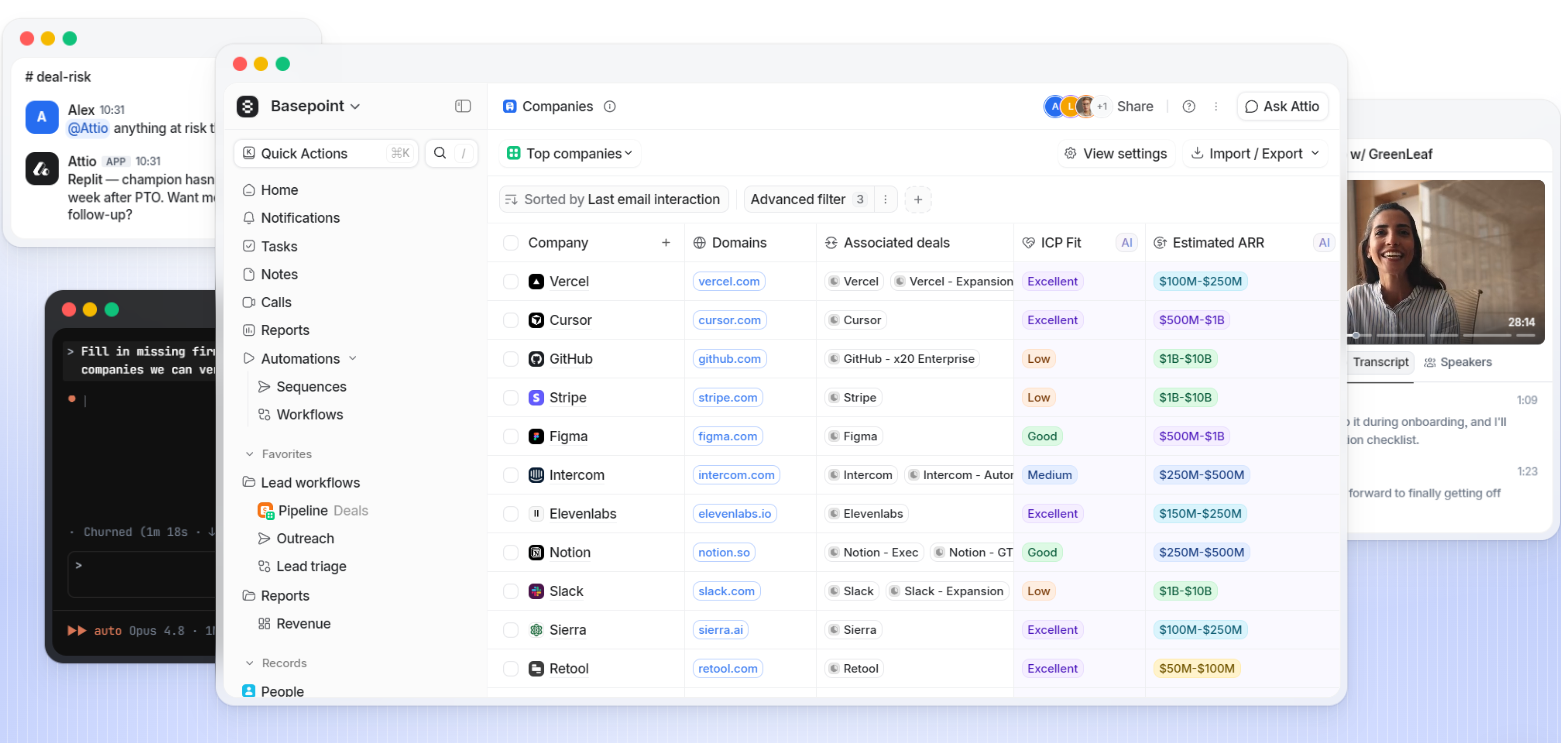
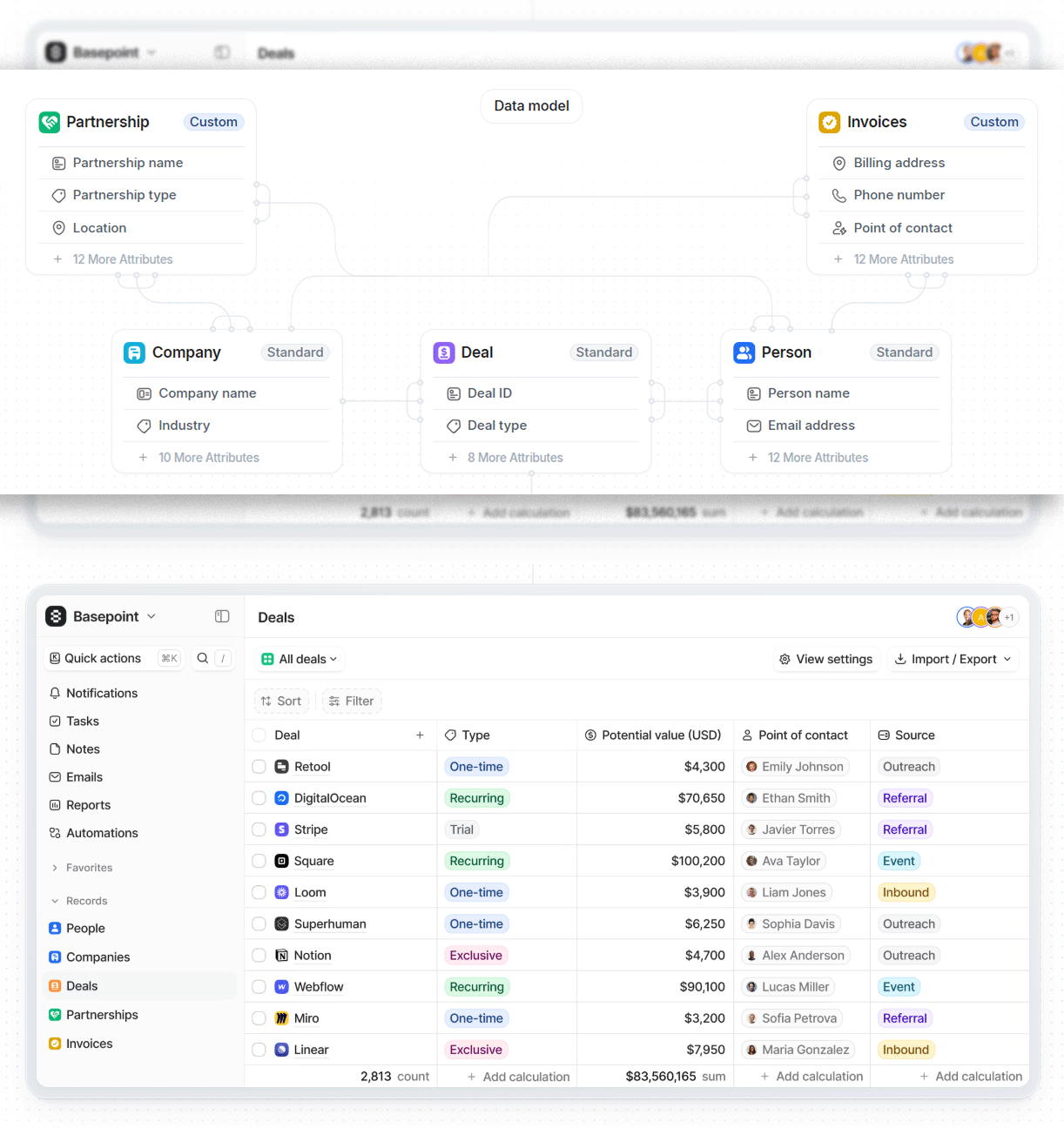
Attio is an AI-native CRM that lets teams design their own data architecture from the ground up, defining custom objects, attributes, and relationships to mirror how their business operates. Its key capabilities include:
Flexible custom data model with 17 attribute types and unlimited custom objects on Enterprise
AI Attributes that auto-populate any field on any object by summarizing linked records, classifying contacts into ICP tiers, or researching a company's tech stack via web crawl
Ask Attio conversational AI for querying pipeline, surfacing account summaries, and drafting follow-ups in natural language
Call Intelligence that records, transcribes, and auto-links conversations to CRM records across Google Meet, Zoom, and Teams
Developer-first architecture with REST API, hosted MCP server, webhooks, and App SDK available on all plans including free
Attio is built for seed-to-Series-B startups and technical GTM teams that have outgrown simple contact managers but want to avoid both Salesforce's implementation burden and HubSpot's schema rigidity. 5,000 paying customers as of August 2025, backed by $116 million raised including a Series B led by GV (Google Ventures).
Why Choose Attio Over HubSpot for Custom CRM Architecture
Attio stands out in the following areas:
Schema Flexibility Without the Enterprise Price Tag HubSpot's custom objects are locked behind the Enterprise tier, starting at $150/seat/month for Sales Hub with a mandatory $3,500 onboarding fee. Attio's data model is the product. Every paid plan gets custom objects: 5 on Plus ($29/seat/month), 12 on Pro ($69/seat/month), unlimited on Enterprise. Teams define their own object types and build relationships between any two objects, enabling CRM architectures that the standard contacts-companies-deals hierarchy cannot represent. According to G2's CRM Grid Report, Attio leads in "ease of customization" with a 9.4/10 rating.
AI Embedded at the Data Layer, Not Bolted On Attio's AI Attributes let any field on any object (including custom ones) auto-fill using AI. A company attribute can summarize the account from all linked notes, calls, and emails. A contact attribute can classify each person into an ICP tier. Ask Attio, powered by Claude Sonnet and Gemini Pro, operates on Universal Context, a semantic index that treats all CRM data, emails, call transcripts, and notes as one interconnected whole.
Full Developer Access Without an Enterprise Contract HubSpot's API Limit Increase add-on runs $500/month per capacity pack. Attio's REST API, webhooks, hosted MCP server, and App SDK are available on every plan including free. The MCP server exposes roughly 30 structured tools covering the full Attio data model, so any MCP-compatible AI agent can read and write CRM data without a custom integration.
Source: Attio
NOTE: We also evaluated Salesflare and Folk CRM. Salesflare excels at relationship-tracking automation for small teams. Folk CRM offers a clean contact-first workspace with tight LinkedIn integration. Attio offers the most flexible foundation for technical GTM teams building custom revenue workflows. For B2B prospecting data and account intelligence, ZoomInfo's MCP server and Attio's MCP server can work together, giving AI agents access to both B2B intelligence and custom CRM data in a single workflow.
For a deeper look at how Attio and HubSpot compare on CRM customization and developer access, see our Attio vs HubSpot comparison.
Attio Pricing
Attio pricing uses per-seat pricing with a 20% discount on annual billing. All plans include API access, webhooks, and MCP server access:
Free: $0 (up to 3 seats); 50,000 records, 3 custom objects, 100 seat credits/user/month
Plus: $29/seat/month (annual); unlimited seats, 250,000 records, 5 custom objects, Ask Attio, AI agents, Call Intelligence
Pro: $69/seat/month (annual); 1,000,000 records, 12 custom objects, Sequences, advanced permissions, priority support
Enterprise: Custom pricing; unlimited objects and teams, SSO, migration service
A 14-day free trial of Pro is available. Qualifying startups can access an 80% discount on the annual Pro plan for year one.
Who Should Use Attio?
Choose Attio if:
You are a B2B SaaS startup that has hit HubSpot's schema ceiling and is not ready to pay Enterprise-tier pricing just to unlock custom objects.
Your GTM team includes engineers or RevOps practitioners who want to build custom automation, integrate via API, or connect AI agents to CRM data without capabilities gated behind the most expensive plan.
You manage complex relationship types that do not fit a contacts-companies-deals hierarchy (VC deal flow, marketplace buyer/seller records, multi-sided sales processes) and need a graph-style object model.
The Final Verdict
HubSpot excels as a unified customer platform for scaling companies, but growing businesses often need specialized tools with more depth in specific areas. Here are the best alternatives:
ZoomInfo for B2B data intelligence, buyer intent signals, and AI-powered go-to-market execution that integrates with any CRM
Salesforce for enterprise CRM depth with 25+ years of customization, production-ready AI agents, and the largest integration ecosystem
Zoho CRM for cost-predictable CRM with no contact-based pricing, no mandatory onboarding fees, and AI included at a flat per-user rate
Pipedrive for pipeline-first sales management with unlimited contacts and no onboarding fees
ActiveCampaign for multichannel marketing automation spanning email, SMS, and WhatsApp with 800+ pre-built recipes
EngageBay for small teams needing CRM, marketing, and support in one platform with a 15-user free plan
Attio for technical teams building custom CRM data architectures with AI embedded at the data layer
You do not have to choose between HubSpot and these alternatives. Many businesses pair HubSpot with specialized tools (like ZoomInfo for prospecting intelligence) or build a custom stack from multiple platforms. Consider your needs, team size, and growth plans when deciding which solution fits.
Want to see which accounts are researching solutions in your market right now? Start your ZoomInfo free trial and power your pipeline with verified B2B data, buyer intent signals, and AI-driven go-to-market intelligence.
HubSpot Alternatives FAQ
Why do businesses look for HubSpot alternatives?
HubSpot works well as a unified customer platform, but businesses commonly outgrow it in specific areas. The most cited reasons: contact-based pricing that escalates as marketing databases grow, mandatory onboarding fees at Professional and Enterprise tiers, built-in prospecting data that lacks the depth of dedicated B2B intelligence platforms, and CRM customization limits that surface at enterprise scale.
What is the best overall HubSpot alternative?
There is no single best alternative because HubSpot covers many functions. ZoomInfo is the top choice for B2B data intelligence and prospecting, Salesforce leads for enterprise CRM depth, Zoho CRM and Pipedrive offer the strongest cost-predictable CRM options, ActiveCampaign excels at multichannel marketing automation, EngageBay serves budget-conscious small teams, and Attio provides the most flexible CRM architecture for technical teams.
Can I use ZoomInfo with HubSpot instead of replacing it?
Yes. ZoomInfo integrates natively with HubSpot, so you can layer ZoomInfo's B2B data intelligence, buyer intent signals, and go-to-market execution on top of your existing HubSpot CRM. Many businesses use both: HubSpot manages the CRM, marketing automation, and customer service, while ZoomInfo provides the prospecting data, intent signals, and account intelligence that HubSpot's built-in tools do not cover at the same depth.
To see a full breakdown of what each platform covers and where they complement each other, read our HubSpot vs ZoomInfo comparison.
Is there a free alternative to HubSpot?
Several alternatives on this list offer free plans. ZoomInfo Lite provides permanent free access to its B2B database with 10 monthly export credits. EngageBay's free plan supports up to 15 users with CRM, marketing, and helpdesk included. Attio's free plan covers 3 seats with 50,000 records and API access. Zoho CRM Free supports 3 users with 5,000 records. Pipedrive and ActiveCampaign do not offer permanent free plans but provide free trials.
Which HubSpot alternative is cheapest for growing teams?
For pure CRM needs, Zoho CRM Standard starts at $14/user/month and Pipedrive Lite starts at $14/user/month, both without contact-based pricing or mandatory onboarding fees. For teams needing CRM plus marketing and support, EngageBay's Growth plan at $64.99/user/month bundles all three functions. For marketing automation, ActiveCampaign Starter starts at $149/month for 10,000 contacts regardless of team size.
How does HubSpot's pricing compare to these alternatives?
HubSpot's pricing complexity is one of the main reasons businesses evaluate alternatives. Marketing Hub Professional starts at $800/month (annual) with a mandatory $3,000 onboarding fee. Sales Hub Professional runs $90/seat/month with a $1,500 onboarding fee. When subscribing to multiple Hubs at different tiers, all Core Seats are billed at the highest tier's rate, which can increase total cost substantially. Most alternatives on this list use simpler pricing without mandatory onboarding fees or mixed-tier seat cost escalation.
Which alternative is best for B2B sales prospecting?
ZoomInfo is built for B2B sales prospecting, offering 500M contacts, 135M+ verified phone numbers, 200M+ verified business email addresses, buyer intent signals, and AI-powered go-to-market execution. It integrates natively with HubSpot, Salesforce, and Microsoft Dynamics 365. HubSpot's built-in prospecting tools (Breeze Prospecting Agent, contact enrichment) work within the platform's own data but do not match the scale or verification depth of a dedicated B2B intelligence platform.
Is it difficult to migrate from HubSpot to one of these alternatives?
Migration complexity depends on how deeply you use HubSpot. Replacing a single function (like adding ZoomInfo for prospecting or switching email marketing to ActiveCampaign) is straightforward since most tools offer native integrations or import workflows. Replacing the full CRM (moving to Salesforce, Zoho, Pipedrive, or Attio) requires more planning around data migration, workflow recreation, and team retraining. Many businesses find a hybrid approach works best: keeping HubSpot for certain functions while adding specialized tools for others.
