
HubSpot is a customer platform that connects marketing, sales, service, content, data management, and commerce under one CRM, with an AI layer called Breeze running across all of it. It serves 288,706 customers in 135+ countries, including eBay, DoorDash, Reddit, TripAdvisor, and Eventbrite.
This breakdown covers every feature, how it works, who it serves, and which plan unlocks it.
HubSpot's feature set has you covered if:
You run marketing campaigns across email, social, ads, and landing pages and need automation workflows that trigger on contact behavior
You manage a sales pipeline with sequences, call tracking, quoting, and AI-powered prospecting inside the same CRM as your marketing
You handle customer support across email, chat, WhatsApp, and phone and want an AI agent resolving inquiries without human escalation
You create and publish content (blog, website, video, podcast) and want AI writing, SEO tools, and CRM-connected personalization
You need one platform where marketing, sales, service, and operations teams share a single contact record and data layer
You want to move from quote to signature to payment to subscription without leaving the CRM
You'll reach the edges of its capabilities if:
You need a B2B prospecting database with hundreds of millions of verified contacts, direct dials, and business emails to fuel outbound at scale
You want buyer intent data showing which companies are researching your category across the web before you ever reach out
You need an intelligence layer that reasons about why deals move or stall, connecting conversation transcripts, CRM changes, and market signals into one picture
You want contact-level website visitor identification that tells you who visited your site, not just which company
You need multi-vendor data enrichment that queries 60+ providers in a waterfall to find the highest-confidence result
For those needs, the reference point is ZoomInfo: an AI GTM platform built on the largest B2B dataset in the industry, a GTM Context Graph that captures why deals move, and access through native products, APIs, and MCP. ZoomInfo integrates natively with HubSpot, supplying the intelligence and prospecting data that HubSpot's execution tools depend on.
After the feature breakdown, this article covers where HubSpot stops and how ZoomInfo fills those edges.
HubSpot Platform Overview
HubSpot calls itself "the agentic customer platform" for scaling companies. The central pitch: "Disconnected tools and data slow you down. HubSpot connects everything (and everyone) in one place." The platform targets SMBs through mid-market but has been moving upmarket.
Everything connects through HubSpot's Smart CRM, a shared data layer that every Hub reads from and writes to. The platform is organized around eight capabilities:
Module | What It Does | Plan Range |
|---|---|---|
Unified contact, company, and deal database with AI enrichment and custom objects | Free (2 users) through Enterprise | |
Marketing automation, email, social media, landing pages, and full-funnel analytics | Starter $20/seat/mo through Enterprise $3,600/mo | |
Prospecting, sequences, pipeline management, CPQ, and conversation intelligence | Starter $20/seat/mo through Enterprise $150/seat/mo | |
Help desk, AI customer agent, knowledge base, surveys, and customer success | Starter $20/seat/mo through Enterprise $150/seat/mo | |
Website builder, AI content creation, content remix, podcasting, and video | Starter $9/seat/mo through Enterprise $1,500/mo | |
Data quality, data sync (100+ apps), Data Studio, and programmable automation | Starter $9/seat/mo through Enterprise $2,000/mo | |
CPQ, invoicing, payments, subscriptions, and revenue reporting | Free invoicing; Pro $57/mo (Early Adopter) | |
AI agents (Customer, Prospecting, Data, Closing) and Breeze Assistant across all Hubs | Free (Assistant); Pro/Enterprise (Agents); runs on HubSpot Credits |
HubSpot uses a hybrid pricing model: per-seat fees, contact-based tiers (for Marketing Hub), flat-fee plans, and a consumption-based credit system for AI features. Every Hub offers a free tier, Starter, Professional, and Enterprise editions. One cost rule to note: when subscribing to multiple Hubs at different tiers, all Core Seats are billed at the highest tier. With that structure in place, here is the full tour.
HubSpot's Smart CRM and Data Foundation
The Smart CRM is not a standalone product but the data layer underlying everything else. HubSpot positions it as more than a record store: "Other CRMs simply store data. HubSpot's Smart CRM understands it."
Source: HubSpot
Every contact, company, deal, ticket, and interaction lives in one database that marketing, sales, and service share. 83% of HubSpot users say the platform unifies all their data, and 93% use it daily.
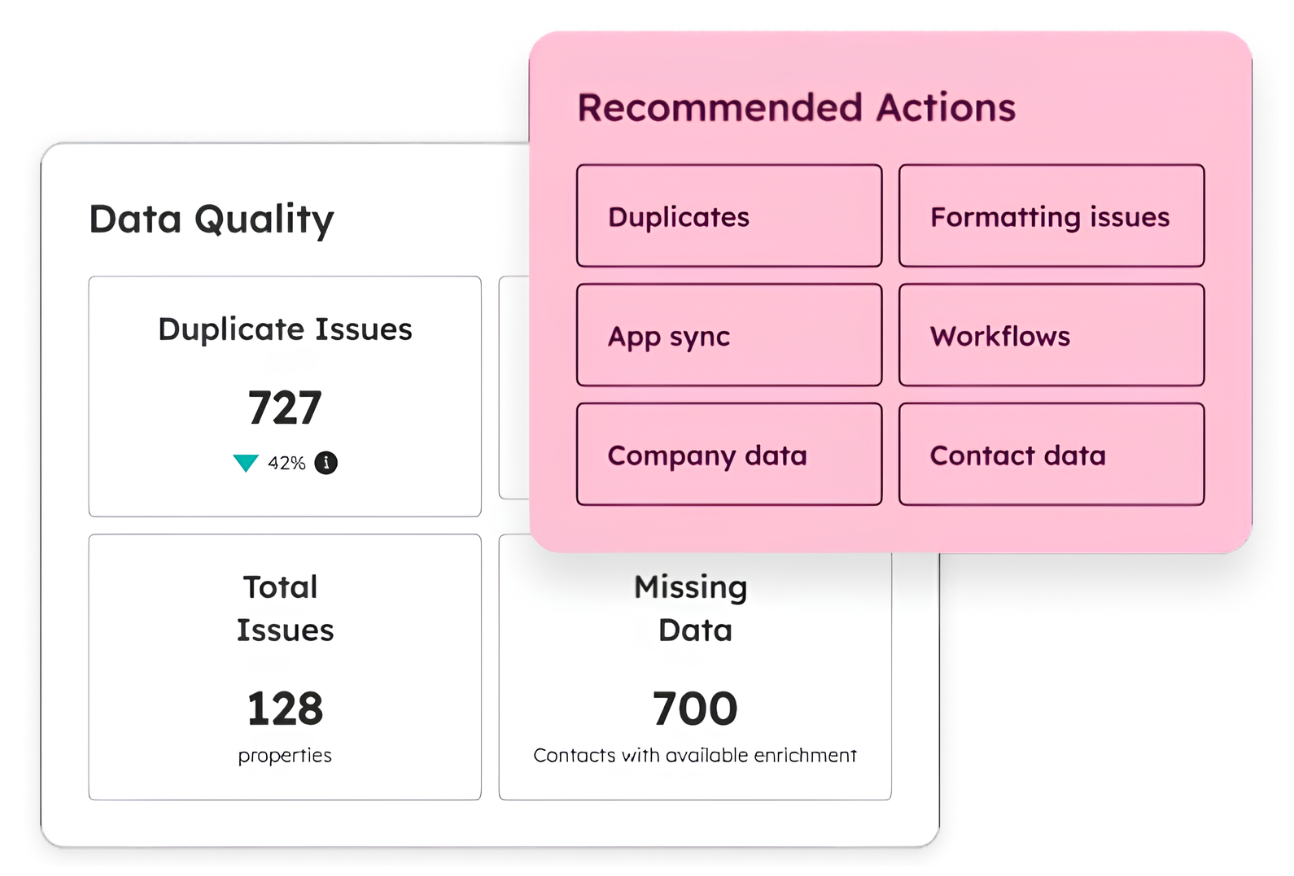
Data Enrichment pulls information from email threads, recorded calls, company websites, and HubSpot's own dataset to fill in contact and company records. Company records re-enrich when properties like employee count or annual revenue change. Automatic Duplicate Detection identifies and merges duplicate records using AI, keeping the database clean without manual audits.
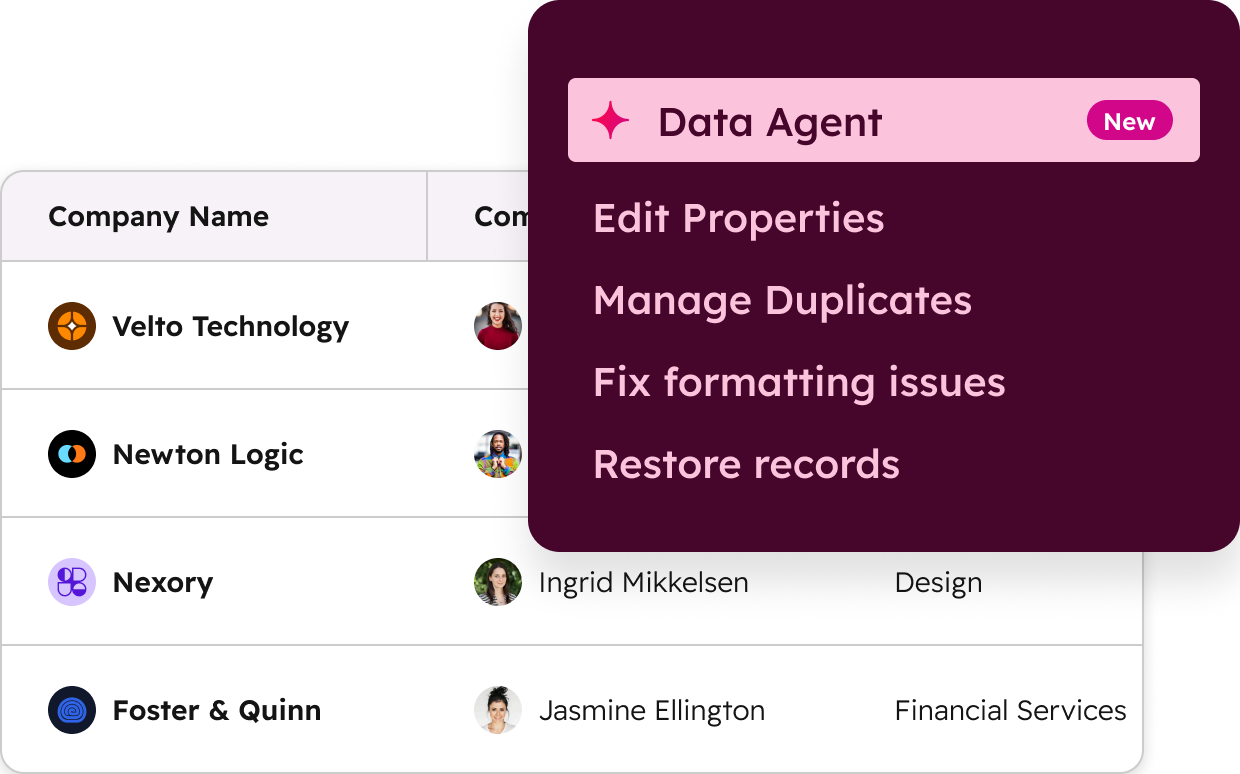
The Data Agent lets users ask natural-language questions about their customers. It searches across CRM records, call recordings, emails, documents, and the web to return answers, going beyond field lookups to handle qualitative business questions.
Source: HubSpot
AI Overviews (Beta) surface important information on records automatically, flagging issues or missing data without a user having to look.
The CRM supports a Custom Data Model with custom objects, custom events, contact and deal scoring formulas, and calculated properties, so teams can store any type of business data alongside standard CRM records.
Flexible CRM Views (Beta) offer six visualization options: table, kanban board, calendar, map, Gantt chart, and report. Governance features include field-level permissions, 2FA, SSO, and a Centralized Audit Log tracking every action by humans, automations, integrations, and AI agents. A Sandbox Test Account (Enterprise) lets teams test changes before going live.
On the data operations side, Data Hub extends the CRM with tools for combining, cleaning, and activating data across the tech stack. Data Studio provides a spreadsheet-style interface for blending first-party CRM data with external sources and data warehouses using AI assistance.
Data Sync connects to 100+ business apps with bidirectional, real-time sync through a point-and-click interface. No code required. Basic sync is free. Data Quality Software uses AI to identify duplicates with higher accuracy than rule-based tools and can merge records based on configured preferences.
Programmable Automation is where HubSpot opens up to technical users: custom JavaScript or Python code actions run inside HubSpot's workflow engine, handling ERP integrations, commission calculations, and data enrichment without external middleware like Zapier or custom ETL pipelines. The platform supports up to 15 million contacts (expandable to 50 million) at Enterprise tier.
HubSpot Marketing Hub: Lead Generation and Campaign Automation
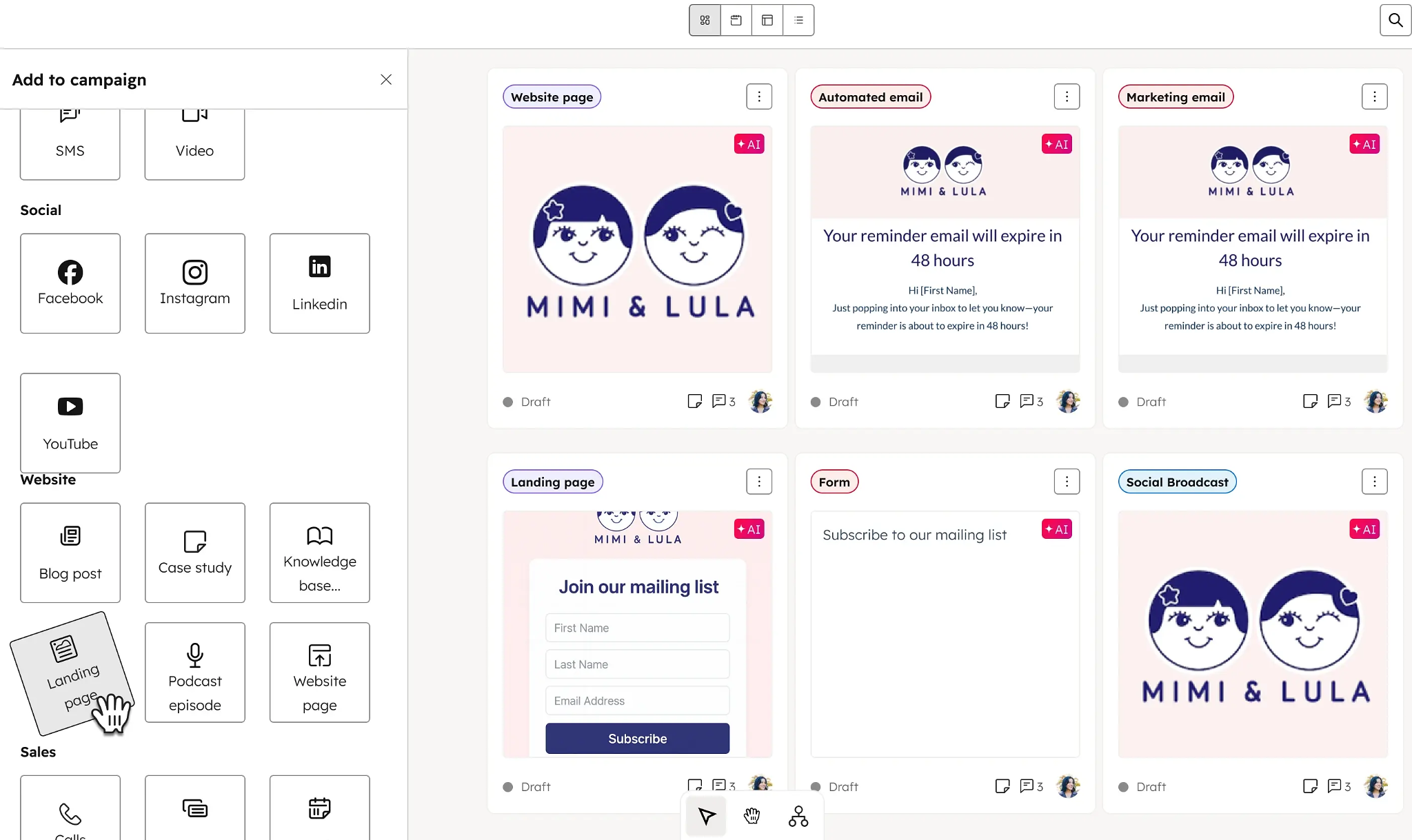
Marketing Hub consolidates lead generation, campaign automation, content personalization, social media management, and multi-touch analytics in one platform. Because it sits on the Smart CRM, every form submission, email open, website visit, and ad click lands in the same record used by sales and service.
Source: HubSpot
Email Marketing uses a drag-and-drop editor with AI email writing, send-time optimization, A/B testing, and deliverability tools. Send volume scales with the contact tier: 5x on Starter, 10x on Professional, and 20x on Enterprise.
Marketing Automation provides a visual workflow builder for multi-step, branching nurture sequences triggered by contact behavior, lifecycle stage changes, and form fills. Workflows require Professional tier or above; Starter is limited to simple automations.
Forms, landing pages, and chatbots handle capture. All are drag-and-drop, connected to the CRM, and available on the free tier (with HubSpot branding). Landing pages on the free tier are capped at 30. Audience Segments update in real time based on CRM properties, behavioral signals, and intent data. Lookalike Lists use AI to find contacts resembling your best-fit customers.
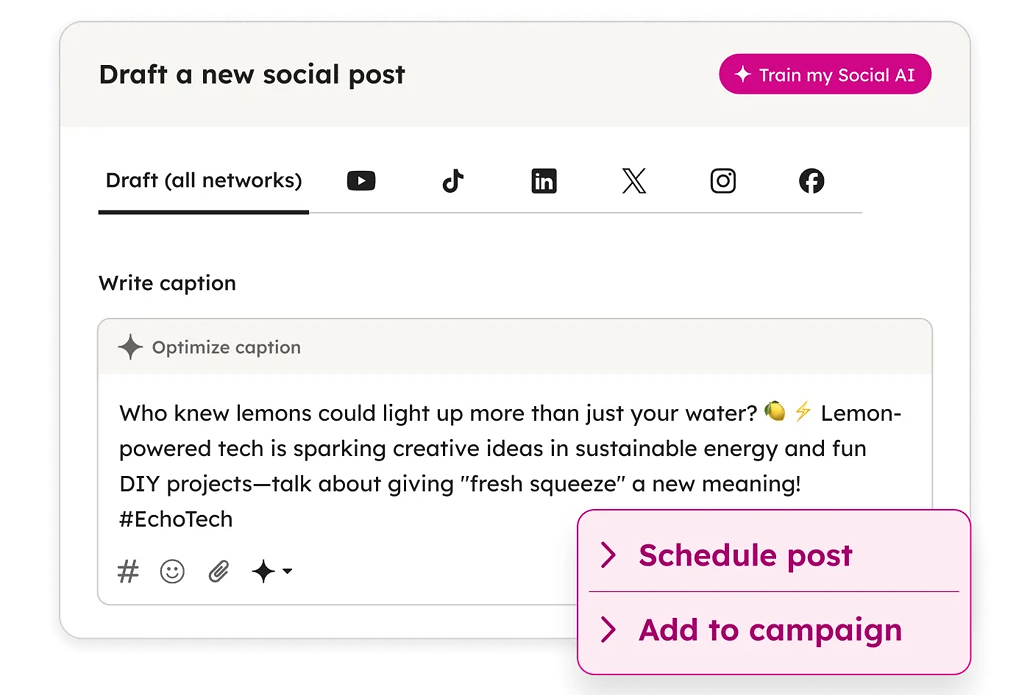
Social Media Management publishes, schedules, and monitors posts across multiple accounts from one inbox. The Breeze Social Agent automates posting. Advanced Marketing Reporting ties campaign activity to revenue using multi-touch attribution and customer journey analytics (called Pathfinder). The Salesforce integration syncs lead intelligence bidirectionally in real time.
Source: HubSpot
Personalization (Beta) uses AI to adjust landing pages, emails, ads, and CTAs based on industry, role, funnel stage, and time of day, without developer involvement. HubSpot is also positioning Marketing Hub around Answer Engine Optimization (AEO), recognizing that chat-based search engines intercept up to 25% of traditional search traffic. The AEO Grader and AEO Strategy tool (Beta) recommend ways to rank in LLM-generated answers.
Marketing Hub pricing starts at $20/seat/month (Starter) with 1,000 marketing contacts. Professional ($890/month) includes 3 Core Seats and 2,000 marketing contacts with a $3,000 mandatory onboarding fee. Enterprise ($3,600/month) includes 5 Core Seats and 10,000 marketing contacts with a $7,000 onboarding fee. Additional contacts at Professional cost $250 per 5,000/month.
HubSpot Sales Hub: Prospecting, Pipeline, and Deal Closing
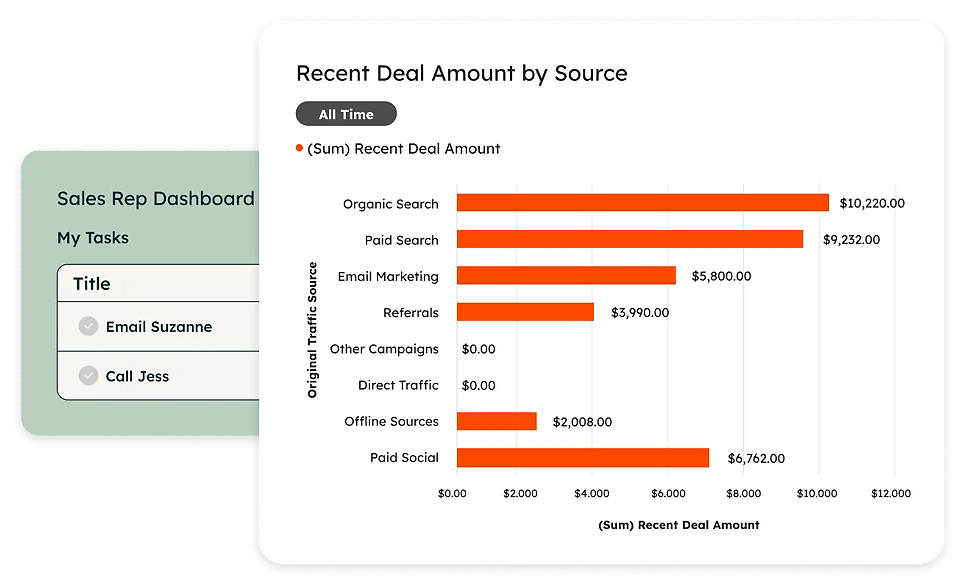
Sales Hub bundles prospecting, engagement, pipeline management, quoting, forecasting, coaching, and reporting in one platform. HubSpot frames it as covering the entire sales cycle, "from finding potential leads and tracking their progress, to managing and automating the deal flow, and even generating quotes," rather than requiring separate tools for each task.
Source: HubSpot
The Lead Management workspace organizes prospecting, leads, and tasks in one view. The Breeze Prospecting Agent researches prospects, scores them against ideal customer profiles, monitors buying signals (leadership changes, funding rounds, engagement spikes), and drafts personalized outreach emails using the full HubSpot customer history (won deals, support tickets, marketing engagement).
The agent runs in either review mode (rep approves each email) or fully autonomous mode. Multilingual support is in Beta. Customizable selling profiles for different products or buyer personas are configured in Breeze Studio.
Sequences support automated emails, manual email tasks, call tasks, general tasks, and LinkedIn Sales Navigator tasks, with configurable delays between steps and up to 10 email templates per sequence. Contacts auto-unenroll when they reply or book a meeting.
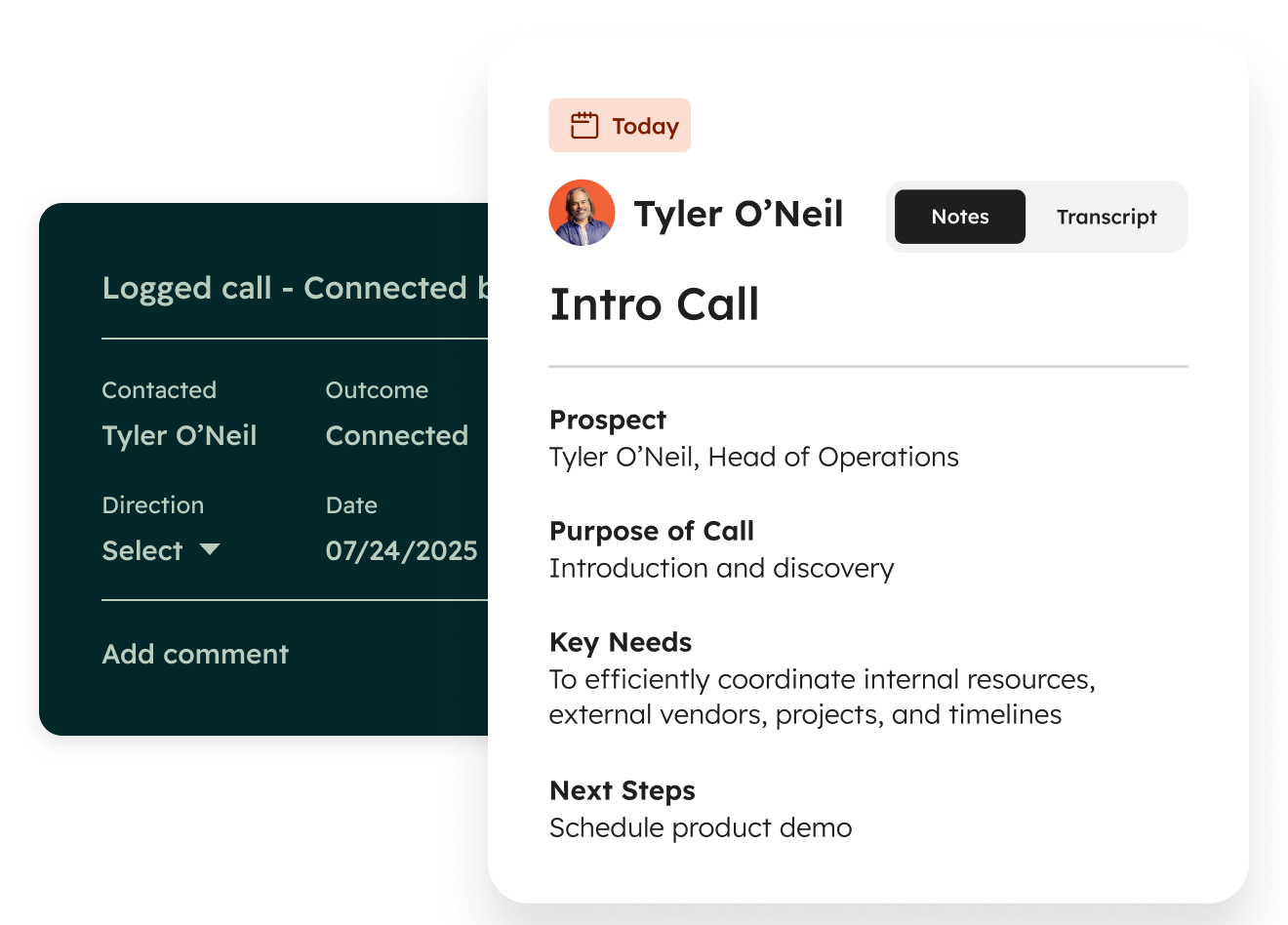
Call Tracking includes a power dialer with voicemail drops and automatic CRM logging. AI Guided Selling surfaces prioritized queues, daily action summaries, and target account recommendations in one workspace.
Source: HubSpot
Deal Pipelines use customizable stages, deal scoring, and task assignment. The CPQ software generates branded quotes from deal-record context in minutes, with configurable approval workflows and integrated e-signature. Buyers can track quote engagement in real time.
Conversation Intelligence records and transcribes sales calls, surfacing insights for manager coaching. Forecasting provides AI-powered revenue projections with drill-down capability, and Predictive Lead Scoring uses AI to rank prospects by fit.
Sales Hub also includes Document Tracking (a content library with per-document engagement analytics), Playbooks (in-CRM reference cards for positioning, scripts, and competitor comparisons), and a mobile app for iOS and Android.
Pricing: Starter at $20/seat/month (monthly) or $9/seat/month (annual). Professional at $100/seat/month with a $1,500 mandatory onboarding fee. Enterprise at $150/seat/month (annual only) with a $3,500 onboarding fee. The free tier supports 2 users with basic email tracking (200 notifications/month), 3 email templates, a basic chatbot, and a meeting scheduler.
HubSpot Service Hub: Customer Support and Success
Service Hub consolidates ticketing, live chat, AI support, knowledge base, surveys, and customer health management in one workspace connected to every contact, company, and deal record.
Source: HubSpot
The Help Desk Workspace (Professional and Enterprise) connects incoming channels: email, live chat, forms, calling, WhatsApp, Facebook Messenger, and custom channels. Each incoming message creates a ticket in a unified queue. Routing rules direct tickets to agents or teams automatically; skill-based routing is available at Enterprise. The workspace integrates with Slack, Microsoft Teams, and Google Chat.
SLA management lets teams set goals for time to first reply and time to close. Conditional SLAs (Enterprise) apply different response windows based on ticket properties like priority or customer tier.
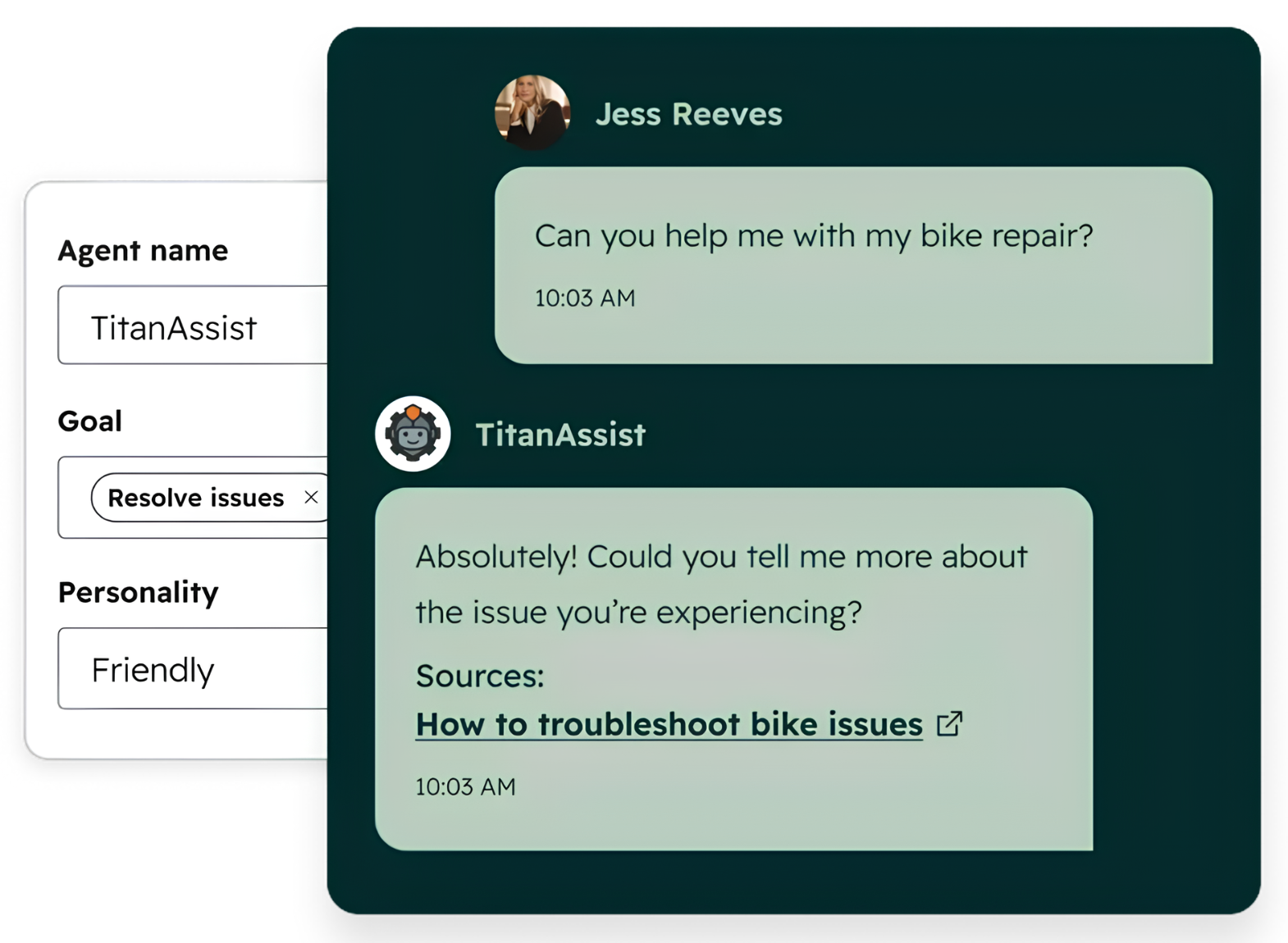
The Breeze Customer Agent handles customer conversations across chat, email, WhatsApp, and Facebook Messenger around the clock. It trains on the company's knowledge base, website content, PDFs, and blog posts, and cites approved sources in its answers.
HubSpot claims it resolves over 50% of customer conversations without human intervention. Setup takes minutes without coding. In May 2025, HubSpot expanded the agent to cover the full buyer journey: marketing (lead conversion), sales (pricing and trial inquiries), and post-purchase service across all Pro and Enterprise Hubs. It runs on HubSpot Credits (included in Professional and Enterprise subscriptions).
The Knowledge Base publishes searchable self-service articles with performance tracking: most-viewed articles, searches with no results, and article feedback ratings. The Breeze Knowledge Base Agent (Beta) drafts new help articles from resolved ticket interactions.
A Customer Portal gives customers a branded interface for tracking open tickets without contacting support. Feedback surveys (NPS, CSAT, CES) are built in and stored in CRM records.
The Customer Success Workspace is where CSMs track health scores, product usage, renewal pipelines, and expansion opportunities. Professional supports 1 health score; Enterprise supports up to 10, each configurable with property values, behavioral events, and engagement windows.
HubSpot positions this workspace as competing with dedicated CSP platforms like Gainsight and ChurnZero. Service Hub also includes interactive voice response (IVR) at Enterprise tier.
HubSpot Content Hub: Content Marketing and Website Management
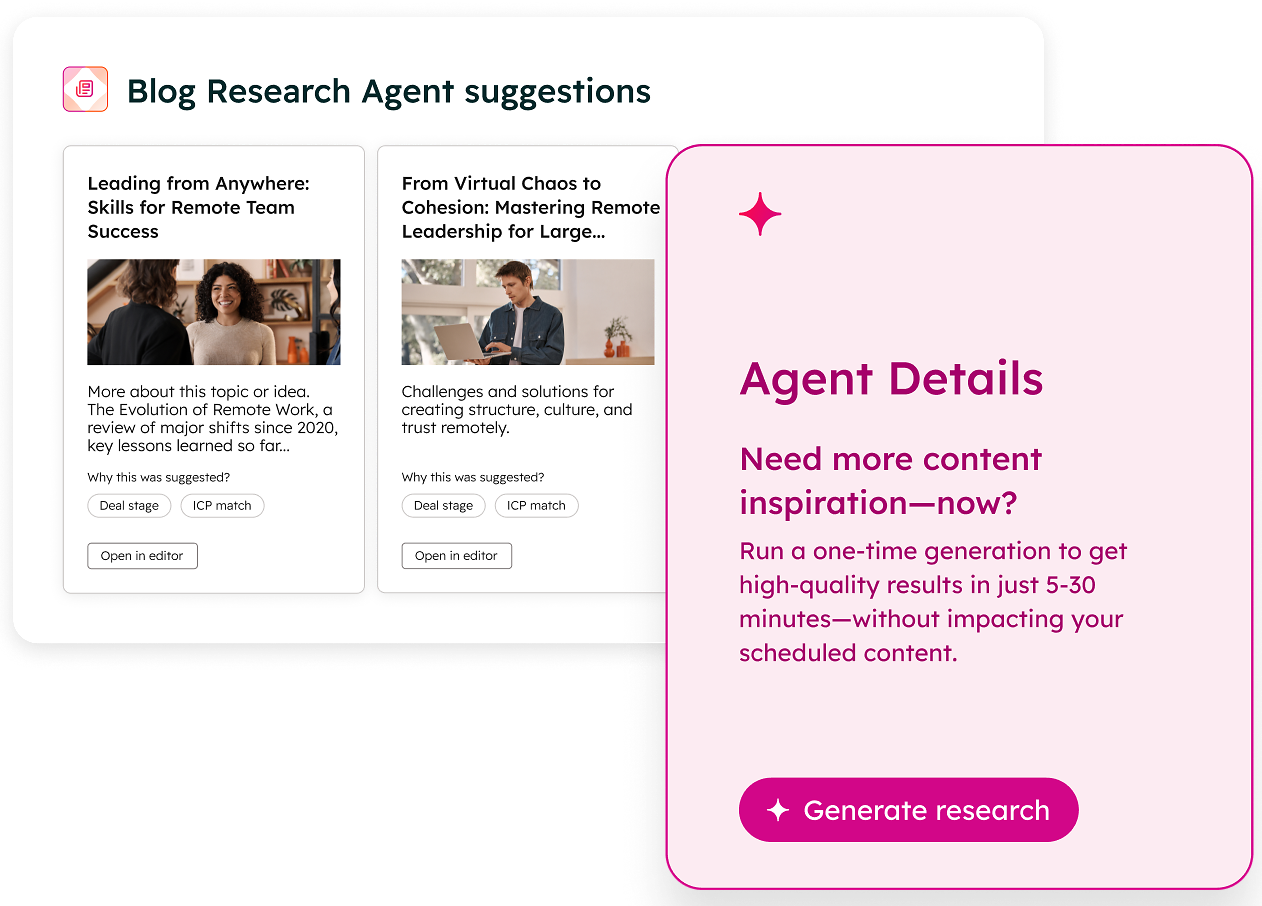
Content Hub puts content creation, audience data (via the Smart CRM), and performance analytics under one roof. Marketing teams take ownership of their website and content without depending on developers, while developers keep flexible tools when they need them.
Source: HubSpot
The drag-and-drop website builder handles website pages, landing pages, and blog posts with pre-built themes and templates. No developer is required for day-to-day editing; developers use HubSpot CMS developer tools for custom themes, modules, and serverless functions. The platform includes cloud hosting and automatic SSL.
Multi-site management (Enterprise) supports multiple websites or brand domains from a single account, and content approvals (Enterprise) add workflow-based sign-off before publication.
The AI Content Writer is embedded across the platform, generating blogs, website copy, social posts, email subject lines, meta descriptions, and more from prompts. A dedicated AI Blog Writer handles long-form content, and the AI Website Generator creates page designs from text prompts. Brand voice stores a company's style guide so AI-generated content matches the brand's identity.
Content Remix (Professional and above) transforms a piece of content into new formats for different channels, turning a blog post into social posts, email copy, a LinkedIn carousel, or a short-form video script.
Personalization tokens pull live CRM data (name, company, job title, location, lifecycle stage, past purchase behavior) into emails, landing pages, and web pages without any integration step. Smart content blocks update dynamically based on CRM objects or HubDB table data.
Content Hub also includes Podcast Software (Beta) for AI-assisted scripting, episode hosting, and RSS-based distribution to Apple Podcasts, Spotify, and iHeart Radio (though no import tool exists for existing podcasts yet), Video Marketing for embedding and tracking video performance, and in-editor SEO recommendations.
HubSpot Commerce Hub: Quotes, Payments, and Billing
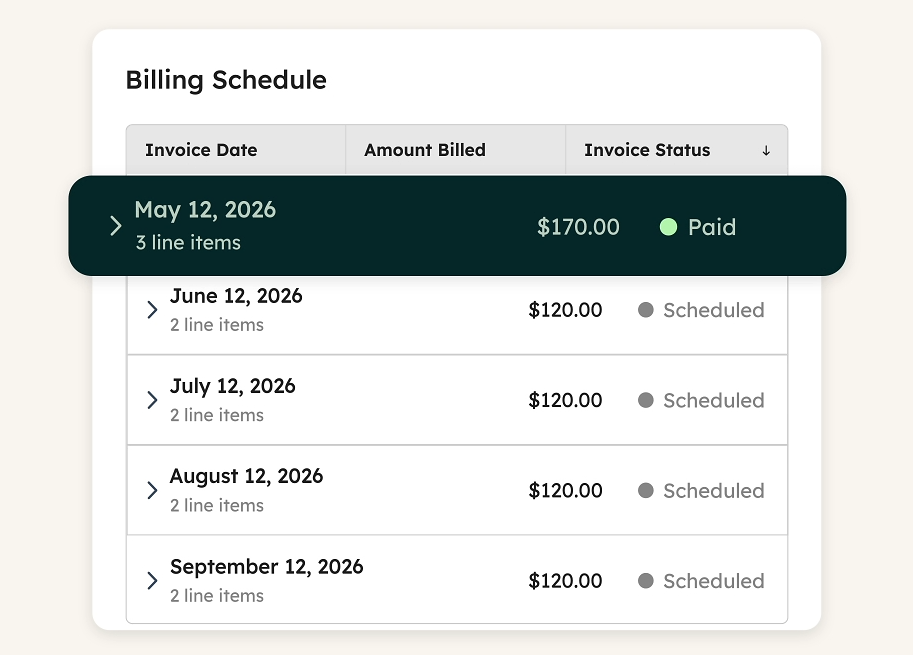
Commerce Hub handles the quote-to-revenue cycle inside the CRM. Sales reps start a quote from a deal record, and AI-powered quote generation pulls deal data, line items, and pricing from the CRM to draft a branded proposal. Configurable approval workflows trigger on criteria like deal size or discount thresholds.
Source: HubSpot
Integrated e-signature lets buyers sign without leaving HubSpot. The Closing Agent (Beta) answers buyer pricing questions around the clock, reducing the need for a human rep during closing.
Payment processing accepts credit/debit cards, ACH, PADs, SEPA Direct Debit, Apple Pay, and Google Pay through either HubSpot Payments (available in the US, UK, and Canada) or a connected Stripe account (available globally, keeping the customer's negotiated Stripe rates).
Payments are accepted in 130+ currencies for credit cards. HubSpot adds a 0.75% platform fee on top of the processing fee for all Commerce Hub transactions. HubSpot reports a 29% increase in deals closed within 12 months for customers who activate payments.
Invoices are available at no cost to both free and paid HubSpot users, created from quotes or deals, hosted on the company's domain, and include embedded payment links. One-time and recurring invoices are supported, with automated dunning for overdue payments.
Subscription management handles recurring billing natively, with subscription data surfacing in CRM records alongside all other customer data. QuickBooks Online syncs bidirectionally with HubSpot invoices.
Commerce Hub Pro is currently offered at Early Adopter pricing: $57/month (from $95) for Professional, $84/month (from $140) for Enterprise.
HubSpot Breeze AI: Agents and Intelligence Across the Platform
Breeze is not a single product but the AI layer that runs across the entire HubSpot platform.
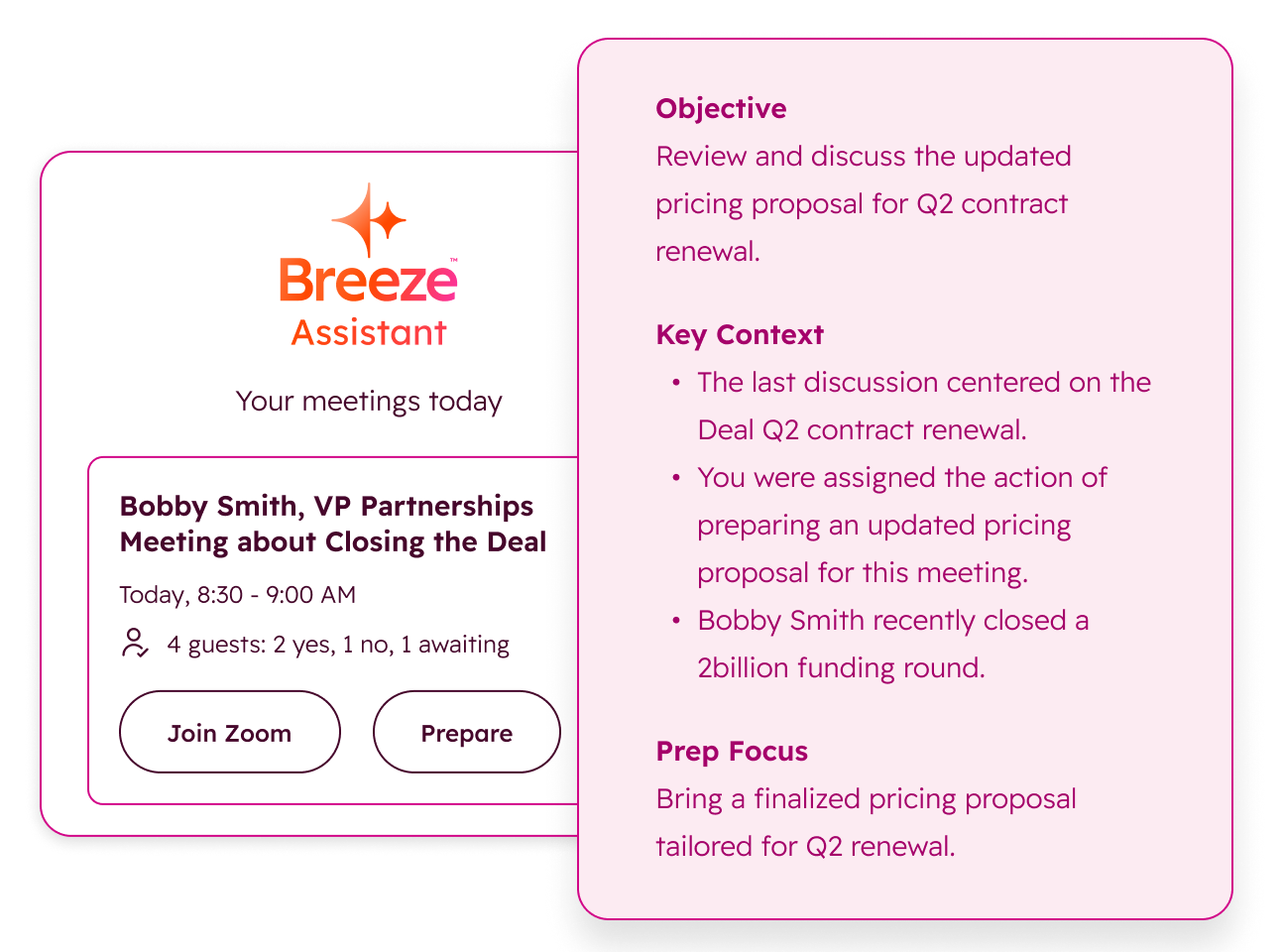
It has three components: Breeze Assistant (a personal AI tool with full CRM context, available on desktop and mobile, for meeting prep, content drafting, and analysis), Breeze Agents (AI agents that run full workflows on their own across marketing, sales, and service), and embedded Breeze features throughout the platform (AI blog writer, AI email writer, Content Remix, conversation intelligence).
Source: HubSpot
The key Breeze Agents each handle a specific workflow:
Customer Agent: Resolves customer inquiries across chat, WhatsApp, Facebook, email, and voice around the clock, citing approved knowledge-base sources.
Prospecting Agent: Monitors buying signals, drafts personalized outreach, and executes campaigns using the full HubSpot customer history, in either review or fully autonomous mode.
Data Agent: Answers business questions across CRM, calls, emails, documents, and the web, delivering answers into Smart CRM records, workflows, and Data Studio.
Company Research Agent (Beta): Pulls insights from a target company's website, recent news, and CRM records for pre-call prep.
Closing Agent (Beta): Handles buyer pricing questions in the quoting flow.
Knowledge Base Agent (Beta): Drafts help articles from resolved ticket conversations.
Agents operate with configurable guardrails: teams define brand voice, approval workflows, engagement rules, and escalation triggers. Breeze Studio (Beta) provides a control center to discover, install, customize, and manage agents without code. Agents are also available through the Breeze Marketplace. HubSpot publishes model cards detailing how each AI system interacts with customer data.
Breeze runs on HubSpot Credits, a consumption-based currency. Subscriptions include monthly credit allotments that vary by tier:
Starter: 500 credits/month
Professional: 3,000 credits/month (5,000 with Data Hub or Customer Platform)
Enterprise: 5,000 credits/month (10,000 with Data Hub or Customer Platform)
Credits reset monthly with no rollover. Additional credits are available at $10 per 1,000 credits/month (Capacity Pack) or $0.01 per credit pay-as-you-go.
HubSpot Integrations, Developer Platform, and Security
The HubSpot App Marketplace has surpassed 2,000 apps with over 2.5 million active installs. Notable native integrations include Salesforce, Microsoft Teams, Slack, Zoom, Google Chat, Gmail, Outlook, LinkedIn, Google Ads, Jira, Amplitude, WordPress, Aircall, Canva, and Adobe Express. Zapier, the largest connector by installs (177,000+), bridges HubSpot to 8,000+ external apps.
HubSpot's REST API covers the full CRM data model with date-based versioning (introduced March 2026). Endpoints follow the pattern /api-name/YYYY-MM/resource, with new versions shipping twice a year and each version supported for at least 18 months. Official SDKs cover six languages: PHP, Java, Ruby, Go, TypeScript, and Python. API access is bundled into all subscription plans with daily call limits:
Free and Starter: 250,000 calls/day
Professional: 650,000 calls/day
Enterprise: 1,000,000 calls/day
An API Limit Increase add-on ($500/month per capacity pack) adds 1,000,000 calls/day, up to two packs. A remote HubSpot MCP server (GA as of April 2026) provides read and write access to HubSpot CRM data via MCP-compatible AI agents, and a HubSpot Agent CLI (public beta, June 2026) lets AI agents interact with CRM data programmatically.
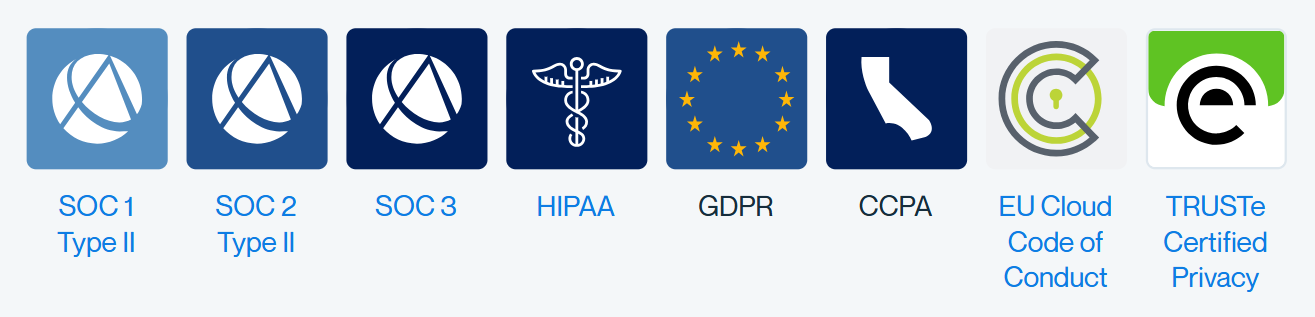
On security, HubSpot maintains SOC 2 Type II and SOC 3 certifications. An independent HIPAA attestation supports healthcare use cases. Compliance covers GDPR and CCPA, with EU Cloud Code of Conduct Level 2 compliance and TRUSTe certification. Data is encrypted with AES-256 at rest and TLS 1.2/1.3 in transit.
Source: HubSpot
The platform hosts primarily on AWS in the United States, with an EU Data Center for customers requiring EU data localization. Authentication includes SSO, 2FA, passkeys, and IP allowlisting. HubSpot runs a bug bounty program on Bugcrowd and publishes regular penetration test attestations.
HubSpot Academy offers free online courses and certifications, with over 200,000 certified professionals. The Knowledge Base is available in 17+ languages. Support tiers range from community-only (Free) to phone support (Professional and Enterprise at 1-888-HUBSPOT x3).
Where HubSpot Stops: The Gaps
HubSpot is built as a customer platform: it connects marketing, sales, service, content, and commerce on a shared CRM with AI agents across all of it. That scope is broad, but it creates specific boundaries in the layers underneath.
No native B2B prospecting database. HubSpot's Smart CRM stores and enriches data you already have. It does not include a searchable database of hundreds of millions of B2B contacts, direct-dial phone numbers, and verified business emails for finding new prospects.
The Breeze Prospecting Agent personalizes outreach to contacts already in the CRM; it does not source new contacts from an external database. Teams building outbound pipelines need a separate prospecting data source to feed the CRM.
No proprietary third-party buyer intent data. HubSpot tracks engagement with your own content: email opens, website visits, form fills, and ad clicks. It does not include intent data showing which companies are researching specific topics across the wider web before they visit your site or open your email.
Engagement signals tell you who is responding to your outreach; intent signals tell you who is in-market before you reach out.
Enrichment from internal signals, not a verified B2B data pipeline. Smart CRM's enrichment pulls from email threads, recorded calls, company websites, and HubSpot's own dataset. It does not draw from a multi-vendor waterfall querying 60+ data providers, nor does it include a team of 300+ human researchers verifying contact accuracy.
For teams where data quality drives pipeline conversion, the enrichment depth matters.
Contact-level website visitor identification is limited. HubSpot identifies companies visiting your website and tracks page-level engagement for known contacts. It does not resolve anonymous website traffic to specific individuals the way a dedicated visitor intelligence platform can, which limits personalized outreach to unknown visitors.
No intelligence layer reasoning about deal context. HubSpot's conversation intelligence records and transcribes calls, and the Smart CRM logs pipeline changes. Neither connects those signals to explain why a deal accelerated or stalled.
The CRM records that a deal moved stages; it does not reason that the CFO joining the last call with ROI-focused questions matches the pattern behind closed-won deals in your segment. That level of contextual reasoning requires a dedicated intelligence layer that fuses CRM data, conversation context, and third-party signals.
How ZoomInfo Covers the Gaps
The gaps above share a common thread: HubSpot is an execution platform that depends on external data and intelligence to fuel its workflows at the top end. ZoomInfo is an AI GTM platform that supplies that data and intelligence layer, and it integrates natively with HubSpot so the two platforms work as one motion.
ZoomInfo's B2B Data Platform: The prospecting database HubSpot does not include
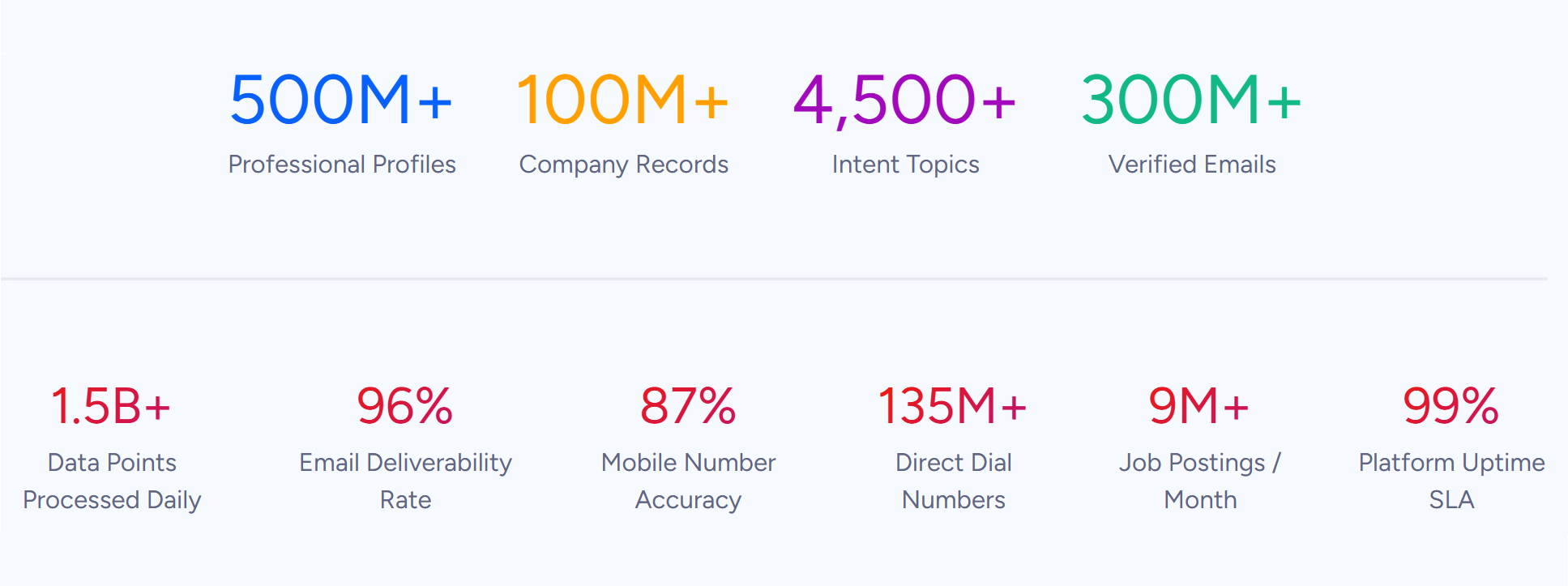
ZoomInfo operates the largest B2B data platform in the industry: 500M contacts, 100M companies, 135M+ verified phone numbers, 120M direct-dial phone numbers, and 200M+ verified business email addresses. The data flows through a verification pipeline backed by 300+ human researchers and automated ML scanning of 28 million site domains daily, reaching up to 95% accuracy on first-party data.
Source: ZoomInfo
For a team using HubSpot, this fills the prospecting gap. HubSpot's Smart CRM stores and enriches your existing contacts but does not provide a searchable database for finding new accounts and buyers.
ZoomInfo provides department org charts with decision-makers' direct dials and emails, 300+ company attributes for segmentation, contact tracking with job-change alerts, and technographic profiles covering 30,000+ technologies across 200+ categories for 30+ million companies.
Global coverage extends to 34M+ company profiles outside North America, 200M+ professional profiles outside NA, and 45M+ mobile numbers outside NA. Contacts found in ZoomInfo flow into HubSpot through the native integration, ready for Breeze Prospecting Agent to personalize outreach.
In a Fortune 500 competitive RFP analyzing 25 million contacts across vendors, an independent consultant concluded that "no other competitor came even close."
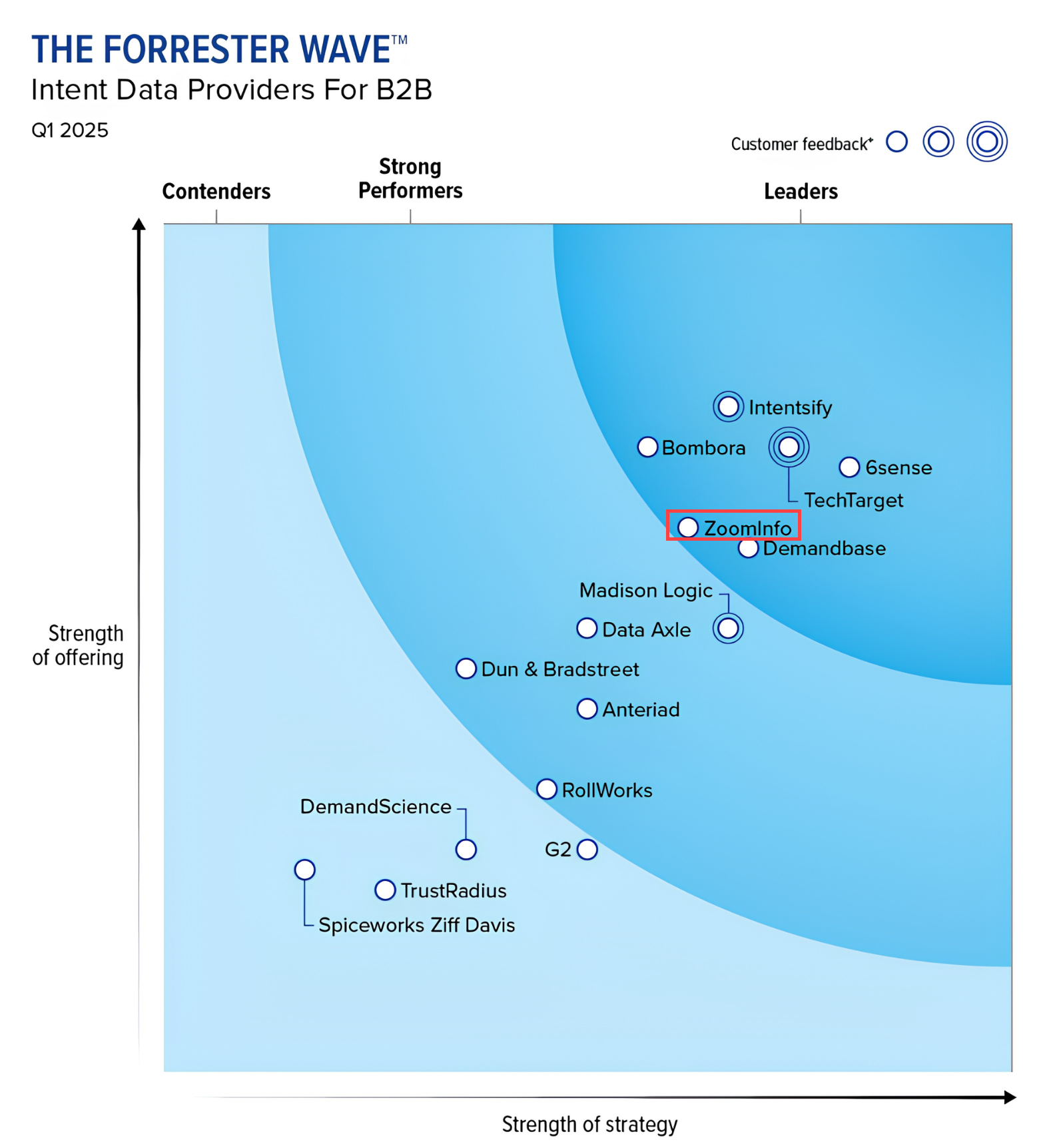
The data quality is externally validated: Leader in the Forrester Wave for Intent Data Providers, Q1 2025, Leader in the Gartner Magic Quadrant for ABM Platforms for the second consecutive year, and the only vendor in the Customers' Choice quadrant in Gartner Voice of the Customer with a 4.7/5.0 rating.
Source: ZoomInfo
ZoomInfo Intent and WebSights: Signals that show who is in-market before outreach begins
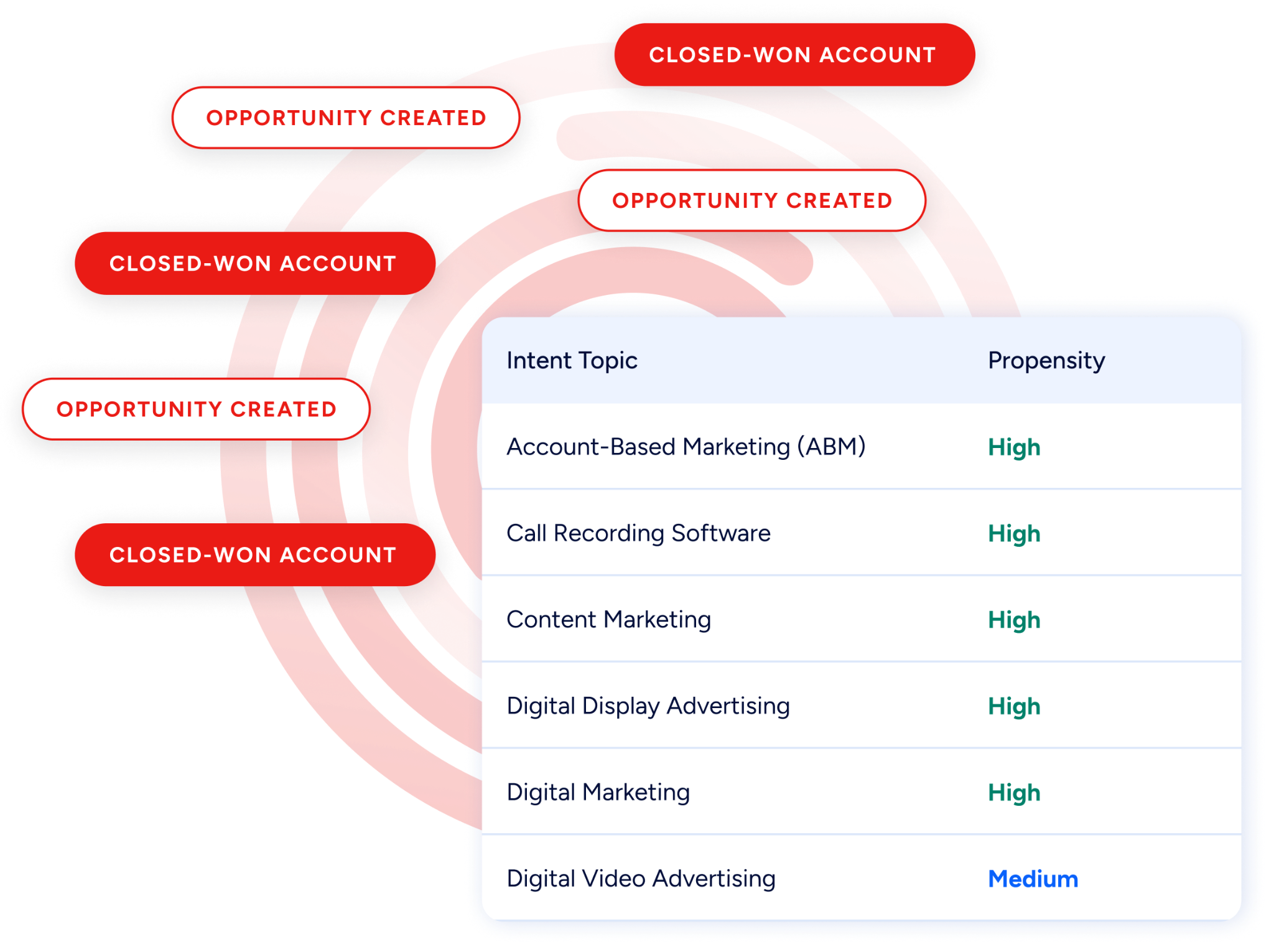
ZoomInfo Intent tracks signals from 210 million IP-to-Organization pairings and 6 trillion+ new keyword-to-device pairings sourced monthly. Where HubSpot tracks engagement with your own content, ZoomInfo's intent data reveals which companies are researching topics related to your product across the web, before they have visited your site or opened your email.
Source: ZoomInfo
Guided Intent, exclusive to ZoomInfo, identifies topics historically correlated with deal success rather than requiring manual topic selection.
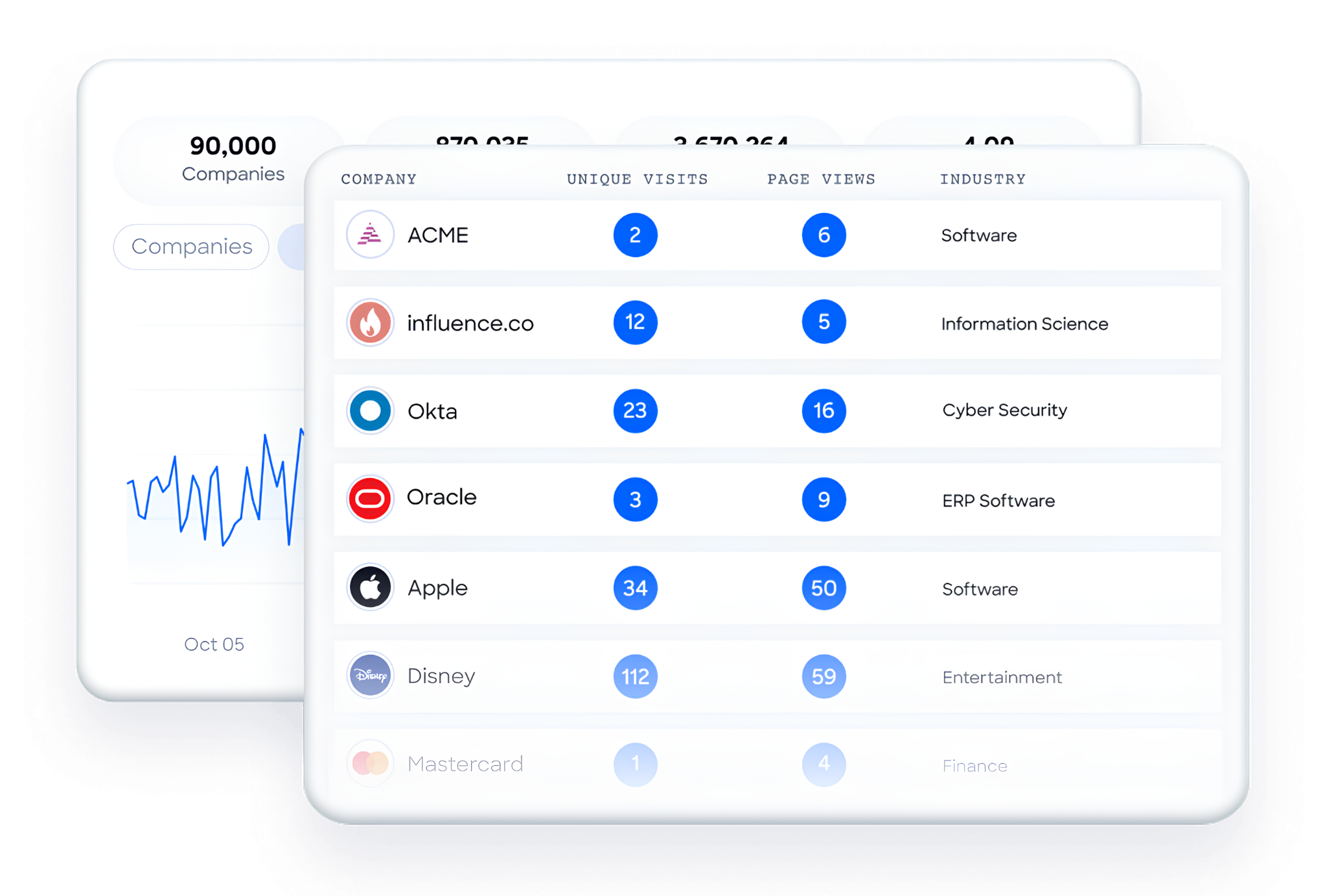
On the website side, WebSights resolves anonymous website traffic to companies with Automatic Traffic Filtering that distinguishes real visitors from bots. ZoomInfo Marketing goes further with contact-level site visitor identification, identifying who visited (not just which company) and triggering personalized outreach.
Source: ZoomInfo
Where HubSpot's tracking identifies companies and monitors engagement for known contacts, ZoomInfo identifies the specific individuals behind anonymous visits.
ZoomInfo's GTM Context Graph: Intelligence that captures why deals move, not just what happened
HubSpot's Smart CRM records activity (emails, calls, meetings) and tracks pipeline changes, but it has no layer that reasons across all of that data to explain why outcomes happened.
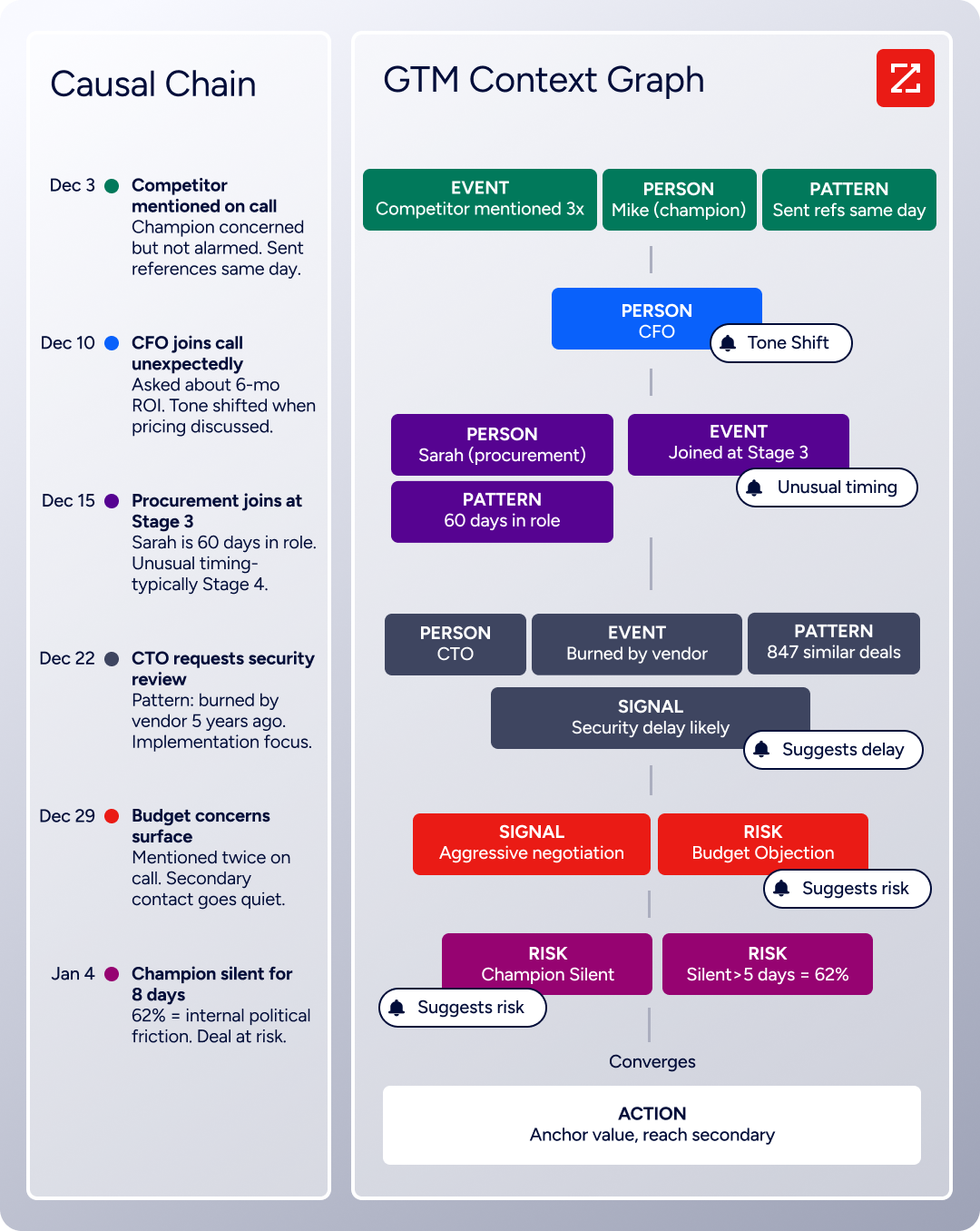
ZoomInfo's GTM Context Graph fills this role. It processes 1.5B + data points daily, fusing ZoomInfo's B2B data with a customer's CRM records, conversation intelligence (via Chorus), email interactions, and behavioral signals into one intelligence layer.
Source: ZoomInfo
A CRM records that a deal moved from Stage 3 to Stage 4. The GTM Context Graph reasons about why: connecting the CFO joining the last call with ROI-focused questions to the pattern behind closed-won deals in the same segment, then linking that to third-party signals showing the company is hiring and researching a competitor. That reasoning flows into outreach, forecasting, and deal execution.
Chorus, ZoomInfo's conversation intelligence engine backed by 14 technology patents, records and transcribes sales calls, surfaces AI-generated insights (talk ratios, sentiment, objection detection), auto-syncs deal intelligence to the CRM, and provides coaching scorecards and clip sharing.,

Source: ZoomInfo
It captures the context that CRM activity logs miss: why a champion went quiet, what a competitive mention means for deal risk, which objection patterns predict closed-lost outcomes.
Seismic's sales team attributed 39% of active pipeline to opportunities identified or influenced by ZoomInfo signals, boosted productivity by 54%, and saved 11.5 hours per week per seller. (Seismic Case Study)
ZoomInfo Operations: Multi-vendor data enrichment that keeps CRM records accurate
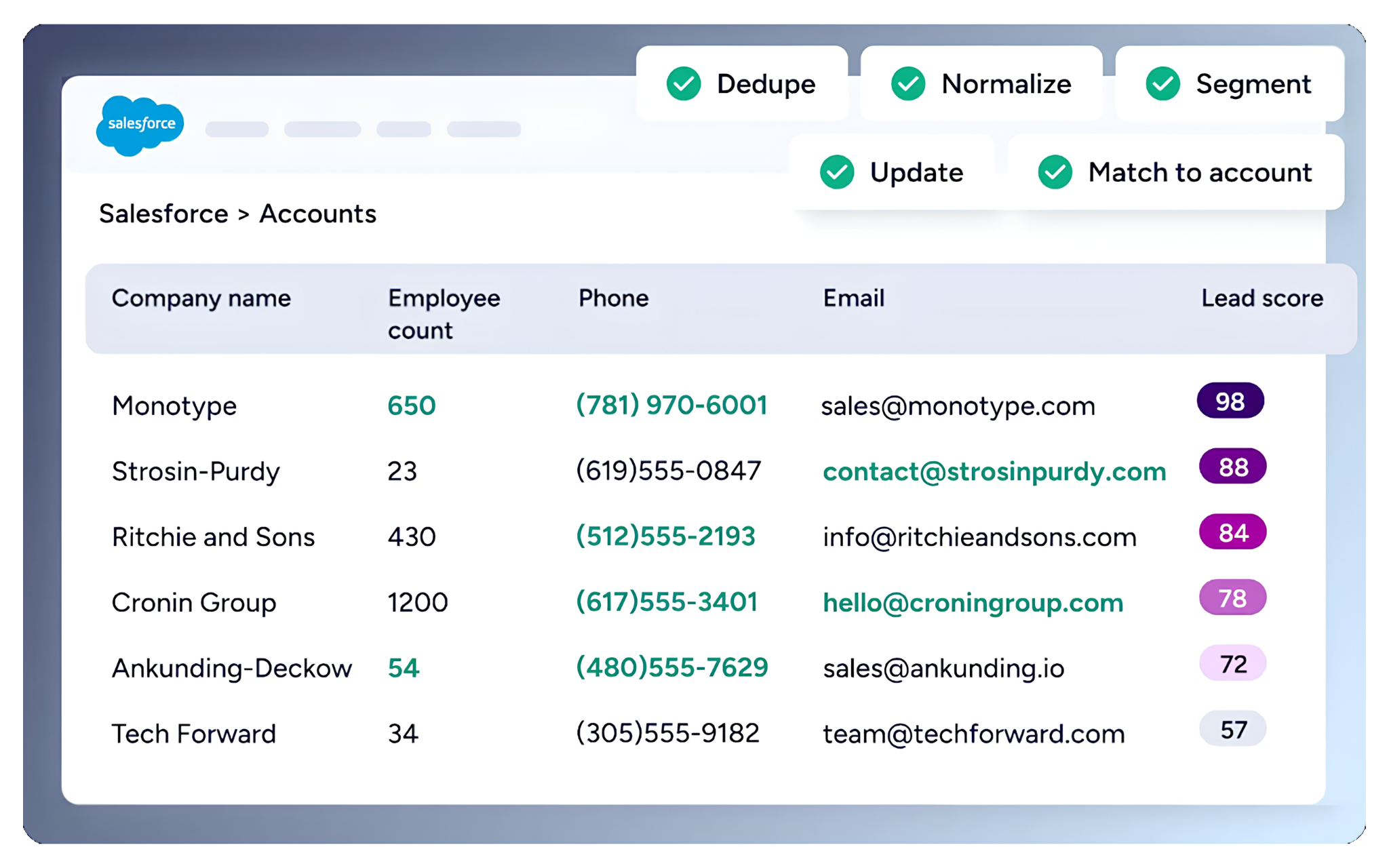
HubSpot's Smart CRM enriches from its own AI and internal signals. ZoomInfo Operations runs multi-vendor enrichment from roughly 60 vendors via a codeless interface, querying multiple sources in a waterfall until the highest-confidence result is found.
Source: ZoomInfo
Perimeter protection blocks bad data at entry, and lead-to-account matching uses company hierarchies and domain intelligence to route leads accurately. Safety Services increased MQLs by 200% in one month using ZoomInfo's workflow tools.
For teams using HubSpot's Data Hub alongside ZoomInfo, the enrichment layers complement each other: Data Hub syncs and cleans data across 100+ apps inside the HubSpot ecosystem, while ZoomInfo Operations enriches records from the broader B2B intelligence layer and feeds them into HubSpot through the native integration.
ZoomInfo GTM Workspace and GTM Studio: Execution and orchestration surfaces
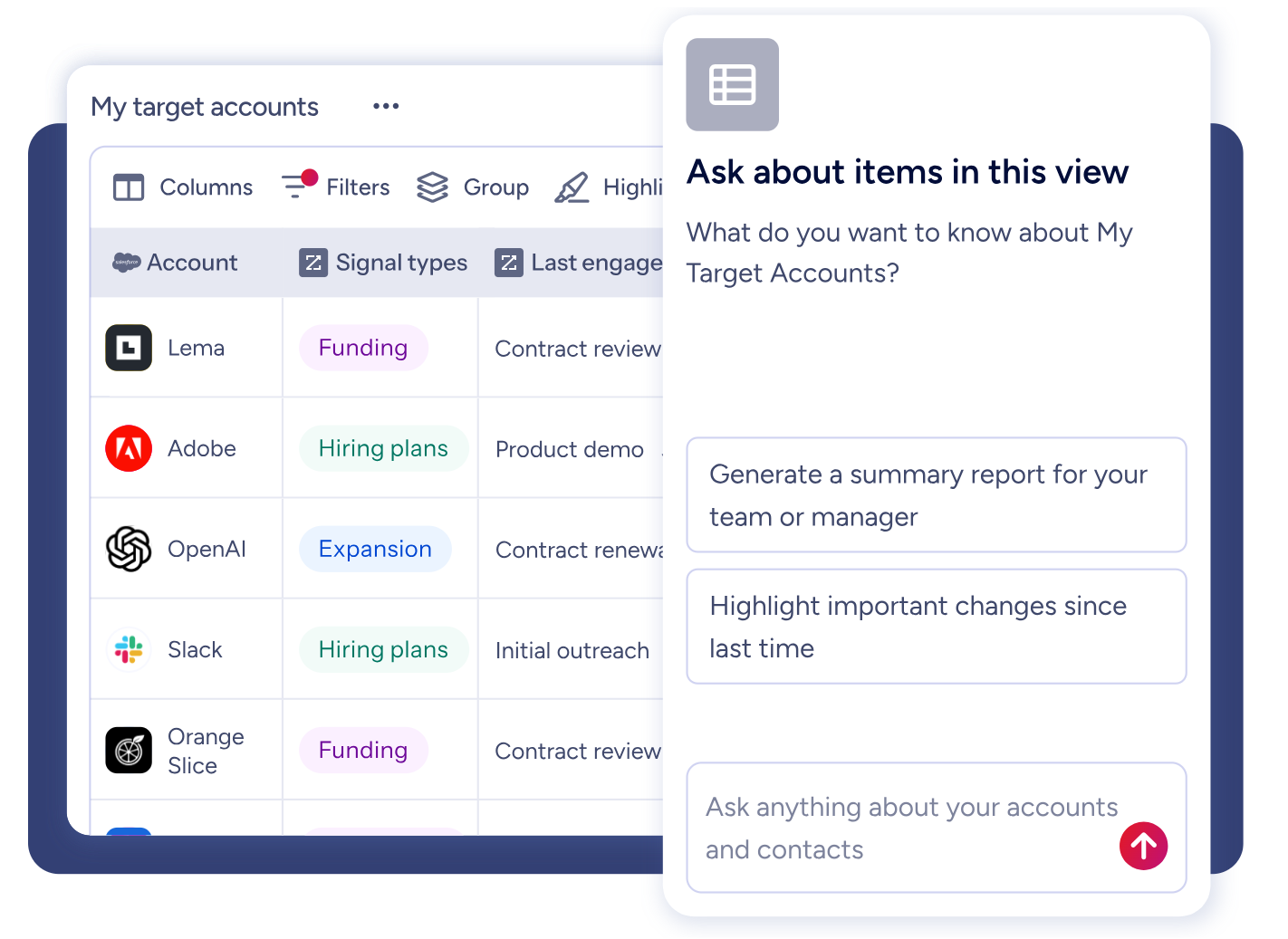
GTM Workspace is ZoomInfo's seller front-end, built on the GTM Context Graph. It provides a full Book of Business view across CRM, ZoomInfo data, and market intelligence, with AI agents automating account research, outreach, CRM updates, and signal monitoring.
Source: ZoomInfo
An Action Feed streams in-market buyers matched to target criteria with pre-drafted actions on every signal. GTM Workspace integrates natively with HubSpot, so sellers using HubSpot as their CRM see ZoomInfo's intelligence inside their existing workflow.
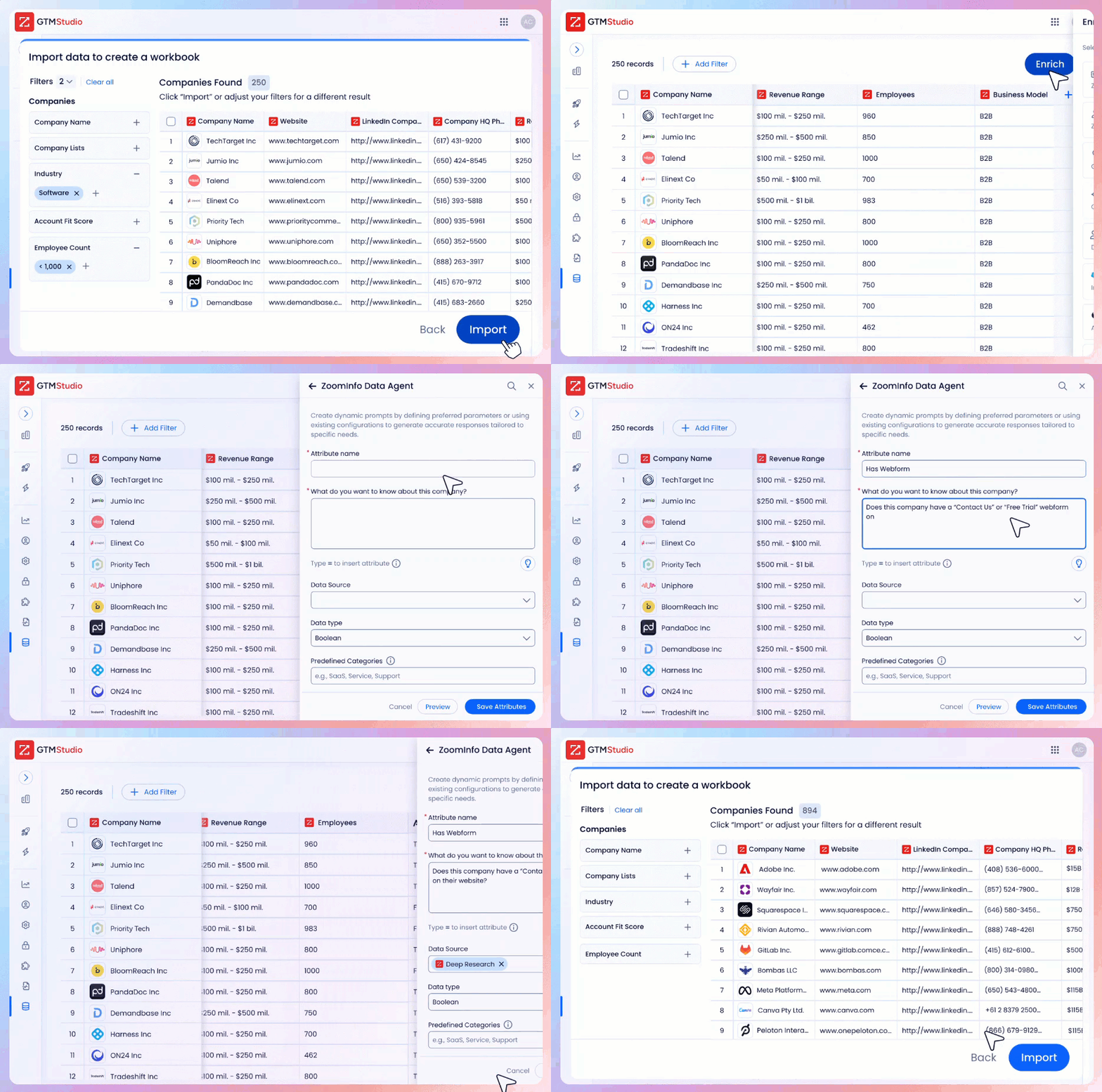
GTM Studio gives marketers, RevOps teams, and GTM engineers the ability to build audiences using natural language, enrich with first- and third-party data, define triggers, and activate plays across channels (email, calls, display ads, direct mail, LinkedIn, Meta, Connected TV) without engineering support.
Source: ZoomInfo
Pre-built GTM plays cover inbound acceleration, champion tracking, competitive displacement, and ICP targeting. Expansion plays that used to take 3 weeks now launch in 30 minutes.
ZoomInfo APIs and MCP: Data access for any tool or AI agent
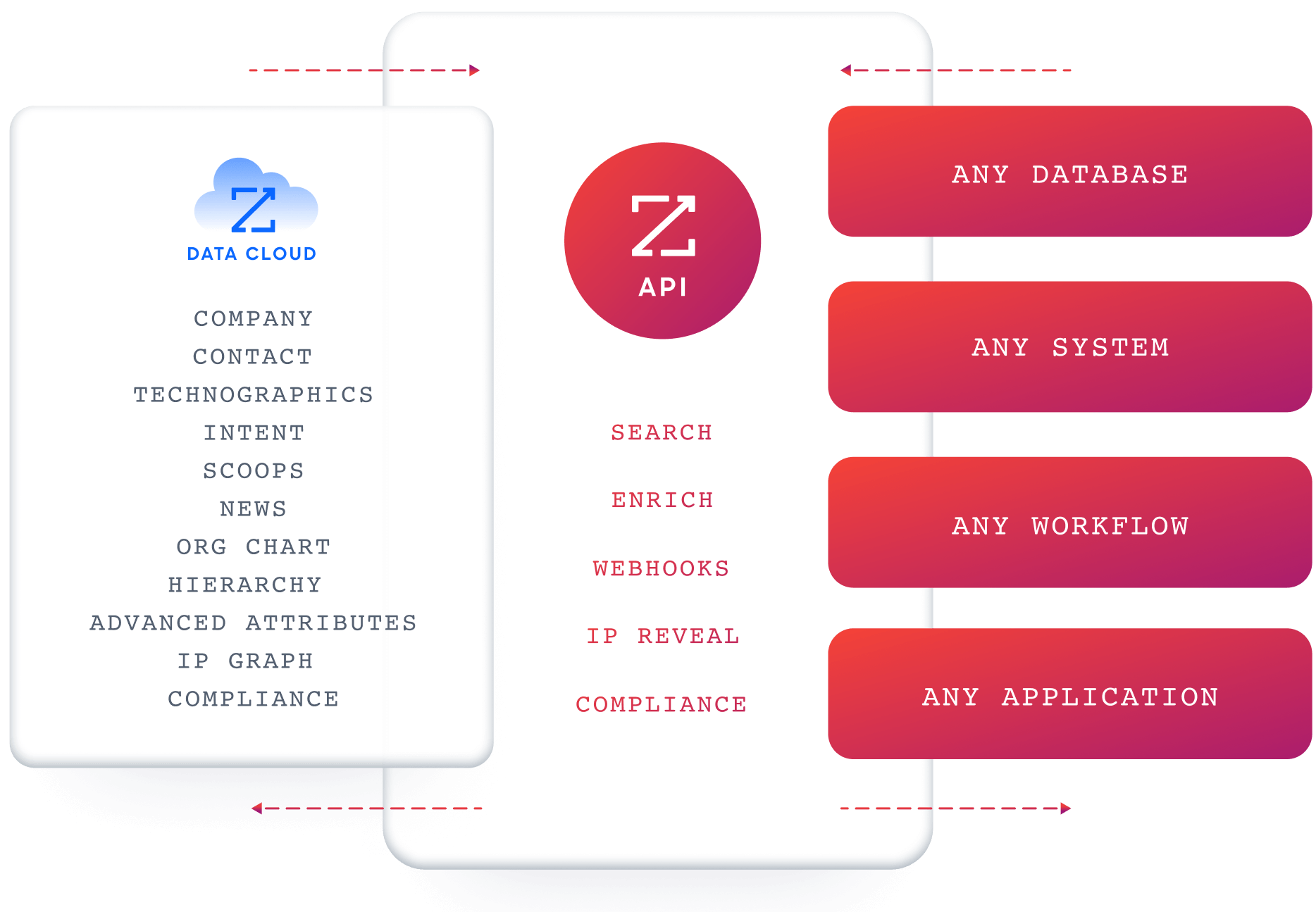
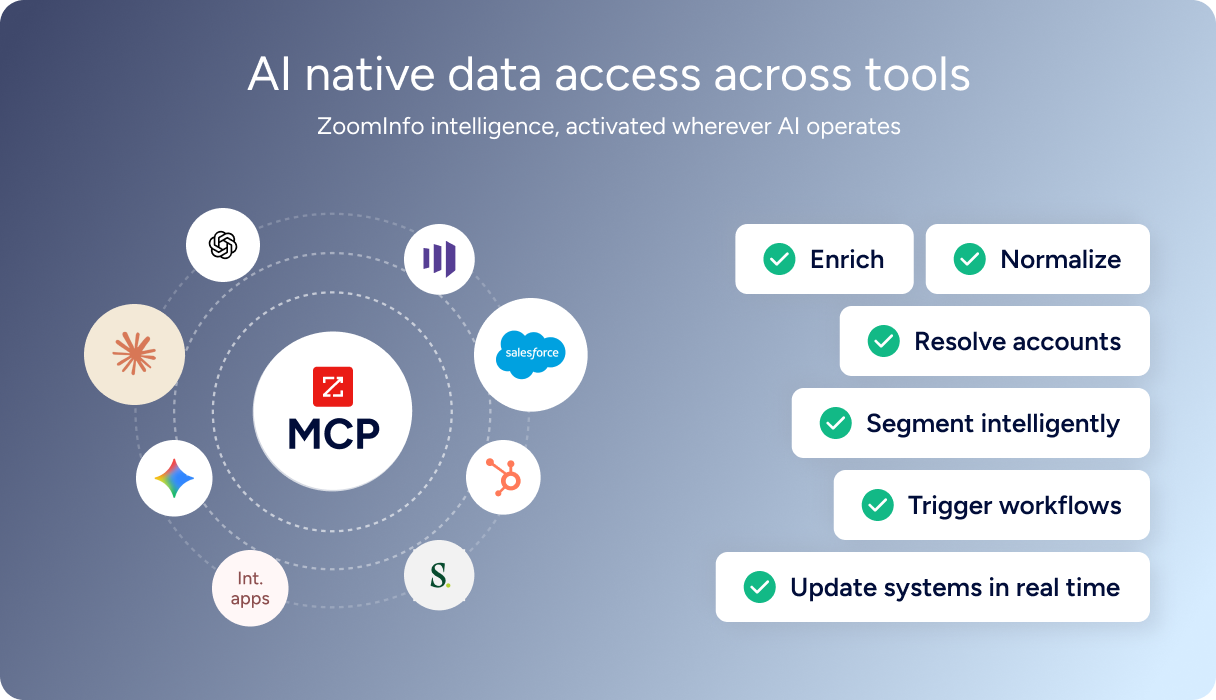
ZoomInfo delivers its intelligence through APIs and MCP (Model Context Protocol), so the same data and GTM Context Graph powering ZoomInfo's own products is accessible inside any third-party tool or custom AI agent.
Source: ZoomInfo
The MCP server connects AI models to ZoomInfo's B2B data as a native tool, currently supporting Claude and ChatGPT. API access is included in all relevant plans, and the Enterprise API covers Search, Enrich, Copilot (AI intelligence), Marketing (audience management), and Engagements endpoints.
Source: ZoomInfo
ZoomInfo's Free Entry Points: A way to evaluate the platform without commitment
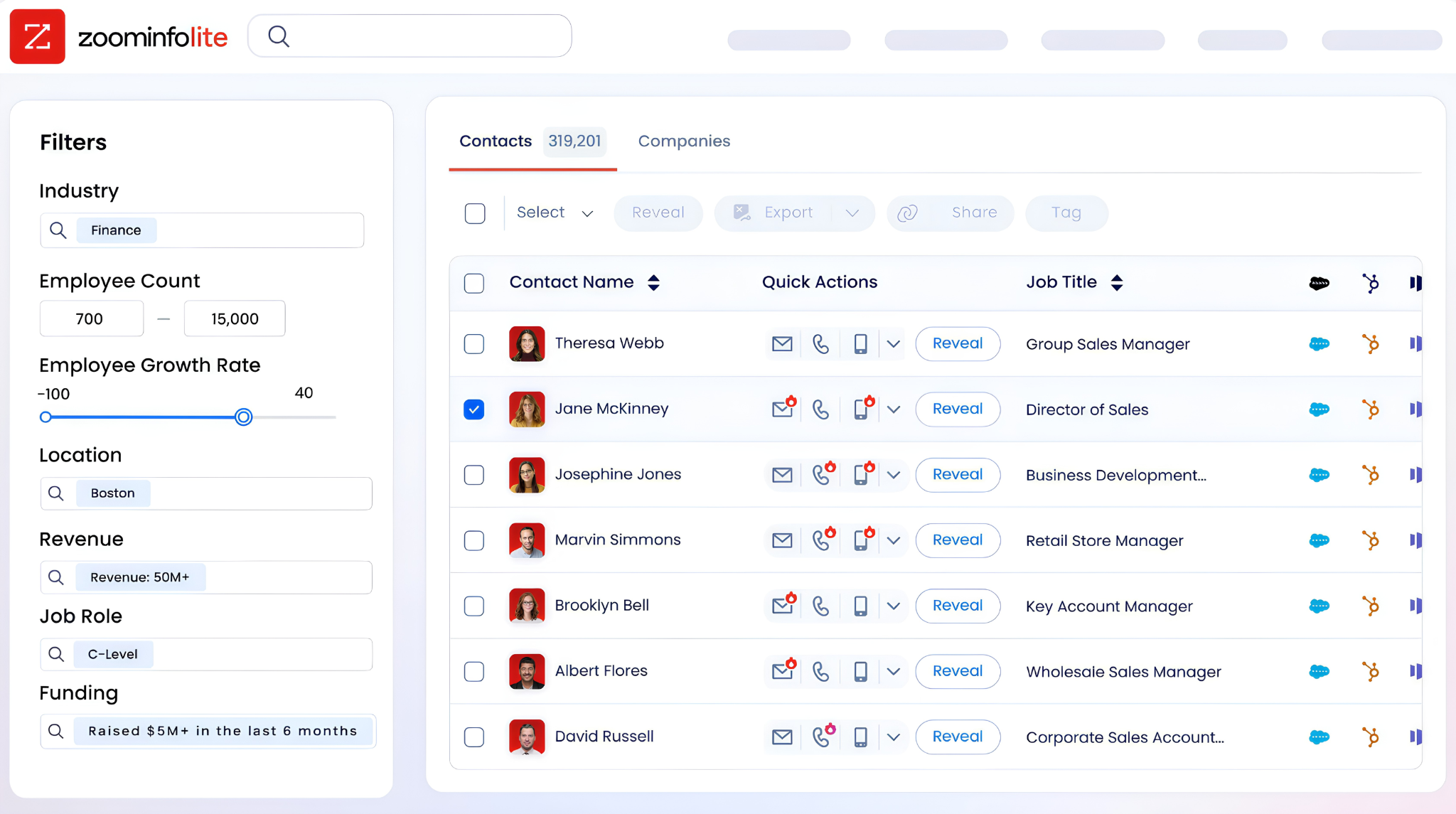
ZoomInfo offers two paths into the platform without a sales conversation. ZoomInfo Lite is a permanent free tier with access to ZoomInfo's B2B database, 10 monthly export credits, individual and company searches, a Chrome extension, and WebSights Lite with up to 10 website visitor reveals per day.
Source: ZoomInfo
ZoomInfo Lite includes HubSpot integration, so contacts flow into the CRM. A separate 7-day free trial provides broader access with no credit card required.
Final Summary
HubSpot is a broad, well-integrated customer platform: Marketing Hub automates campaigns and attribution, Sales Hub manages the pipeline from prospecting through quoting, Service Hub handles support and customer success, Content Hub powers website and content creation, Commerce Hub closes the quote-to-cash loop, Data Hub maintains data quality across 100+ apps, and Breeze AI agents automate workflows across all of it.
It fits teams that want marketing, sales, service, and operations running on a single CRM with ease of use and a free tier that works as a real onboarding ramp.
It is lighter on the intelligence and data layers upstream of execution: no B2B prospecting database at scale, no proprietary third-party intent signals, enrichment from internal AI rather than a verified multi-vendor pipeline, and no intelligence layer reasoning about why deals move.
If your bottleneck is upstream of execution (knowing which accounts are in-market, who the decision-makers are, and why the deal is moving), that is the ground ZoomInfo covers.
Its 500M-contact, 100M-company database supplies the verified emails and direct dials that HubSpot's Breeze Prospecting Agent and Sequences can act on. ZoomInfo Intent surfaces the accounts researching your category from 6 trillion+ keyword-to-device pairings monthly.
Chorus captures and reasons about every sales conversation with 14 technology patents. And the GTM Context Graph fuses all of it into one intelligence layer that captures why deals move, not just that they moved. The native HubSpot integration means the two platforms work as one motion: ZoomInfo finds and qualifies the buyer, HubSpot executes the engagement.
See what that intelligence layer adds to your stack: start with ZoomInfo Lite for free (it includes HubSpot integration), or request a demo to see verified contacts and live intent signals flow into your CRM.
FAQ
Does HubSpot offer a free plan?
Yes. HubSpot offers a permanent free tier across all Hubs, not a time-limited trial. The free CRM includes unlimited contacts (up to 1M records), 1 deal pipeline, basic email integration, contact and company management, and activity logging, capped at 2 user seats.
Free marketing tools include 2,000 email sends/month (with HubSpot branding), 10 active CRM segments, basic forms, and 30 landing pages. Free sales tools include a meeting scheduler, email tracking (200 notifications/month), and 3 email templates. Access never expires.
How do HubSpot's mandatory onboarding fees work?
Marketing Hub Professional requires a $3,000 one-time onboarding fee; Enterprise requires $7,000. Sales Hub and Service Hub Professional each require $1,500; their Enterprise tiers require $3,500 each. Content Hub and Data Hub have no mandatory onboarding fee at any tier. These fees are in addition to subscription costs and are non-negotiable through the standard purchase process.
What happens when you mix HubSpot Hub tiers across departments?
When subscribing to multiple Hubs at different tiers (for example, Marketing Hub Professional plus Sales Hub Enterprise), all Core Seats across the account are billed at the rate of the highest subscription tier. Adding an Enterprise-tier Hub to a Professional-tier stack raises the per-seat cost for every user, not just those using the Enterprise product.
Which plan includes the Breeze Prospecting Agent?
The Breeze Prospecting Agent is available at Professional and Enterprise tiers of Sales Hub. It runs on HubSpot Credits (Professional includes 3,000 credits/month; Enterprise includes 5,000 credits/month). Starter plans include Breeze Assistant but not the Breeze Agents. Customization of the Prospecting Agent's selling profiles requires Breeze Studio, currently in Beta.
Can HubSpot's Breeze Customer Agent handle support fully autonomously?
The Breeze Customer Agent operates across chat, email, WhatsApp, and Facebook Messenger around the clock without human intervention. It resolves inquiries by citing approved knowledge-base sources and can pull real-time customer data. HubSpot claims it resolves over 50% of conversations on its own.
Teams define guardrails, escalation triggers, and approval checkpoints. The agent runs on HubSpot Credits, included in Professional and Enterprise subscriptions.
Does HubSpot integrate with Salesforce?
Yes. Marketing Hub includes native bidirectional Salesforce sync at Professional and above, syncing lead intelligence in real time. Sales Hub and Service Hub also support Salesforce integration at Professional and Enterprise tiers. Beyond Salesforce, HubSpot maintains over 2,000 app integrations in its marketplace with 2.5 million active installs.
What are HubSpot Credits and how do they work?
HubSpot Credits are a consumption-based currency for AI features, primarily Breeze Agents and advanced automation. Each subscription tier includes a monthly allotment (500 at Starter, 3,000 at Professional, 5,000 at Enterprise).
Credits are not additive across Hubs; you receive the highest allotment based on your highest subscription tier. They reset monthly with no rollover. Additional credits cost $10 per 1,000/month (Capacity Pack) or $0.01 per credit on a pay-as-you-go basis.
Does HubSpot include a B2B prospecting database for finding new contacts?
No. HubSpot's Smart CRM stores, enriches, and manages contacts you already have. It does not include a searchable database of B2B contacts, direct-dial phone numbers, or verified business emails for discovering new prospects. The Breeze Prospecting Agent personalizes outreach to contacts already in the CRM but does not source new contacts.
Teams building outbound pipelines pair HubSpot with a data platform like ZoomInfo, whose database of 500M contacts, 100M companies, and 120M direct-dial phone numbers supplies the verified contacts that HubSpot's engagement tools run on. ZoomInfo Lite (a permanent free tier) includes HubSpot integration, so contacts flow into the CRM.
