
ZoomInfo named a Leader in the Forrester Wave for intent data providers
Not so long ago, a detailed profile of your ideal customer and a general idea of their purchase intent was enough to fuel growth for many go-to-market teams. Those days are gone. But the best teams still find ways to win consistently.
To stay ahead in an unpredictable market, businesses need to truly understand buyer behavior, the kind of nuanced portrait that draws from a comprehensive, real-time view of the signals that indicate readiness and likelihood to purchase.
This is where ZoomInfo and our customers truly excel. It's why we're thrilled to be named a Leader in both The Forrester Wave™: Intent Data Providers For B2B, Q1 2025 and The Forrester Wave™: Marketing And Sales Data Providers For B2B, Q1 2024. For buyers evaluating b2b intent data providers, this recognition reflects years of investment in the breadth and accuracy of ZoomInfo's signal coverage.
We believe these acknowledgments reinforce ZoomInfo's position as an all-in-one AI GTM Platform, empowering customers with the most expansive, actionable, and accurate data available.
What sets ZoomInfo apart is the ability to enrich traditional intent signals by layering them with additional buying and contextual signals, significantly enhancing their accuracy and relevance. By leveraging GTM Context Graph reasoning, multi-source insights, and guided intelligence, ZoomInfo empowers customers to adopt a truly data-driven approach to their sales and marketing strategies. Teams that want to wire this same intelligence directly into their own AI tools and agents can do so through GTM AI, which connects ZoomInfo's B2B data, intent signals, and contextual graph to any agent via MCP or one API.
ZoomInfo's three pillars work together to deliver this capability: comprehensive B2B data covering 500M contacts and 100M companies, the GTM Context Graph that processes 1.5B+ data points daily to reason across signals and surface why accounts are moving, and universal access through GTM Workspace, GTM Studio, and APIs and MCP so teams can act on those signals in any workflow or tool.
This comprehensive approach helps businesses pinpoint the highest-value opportunities and maximize outreach efforts. Seismic attributed 39% of pipeline to ZoomInfo signals and saved 11.5 hours per week per seller, a result that reflects what's possible when intent data is connected to a unified intelligence layer rather than operating as a standalone feed.
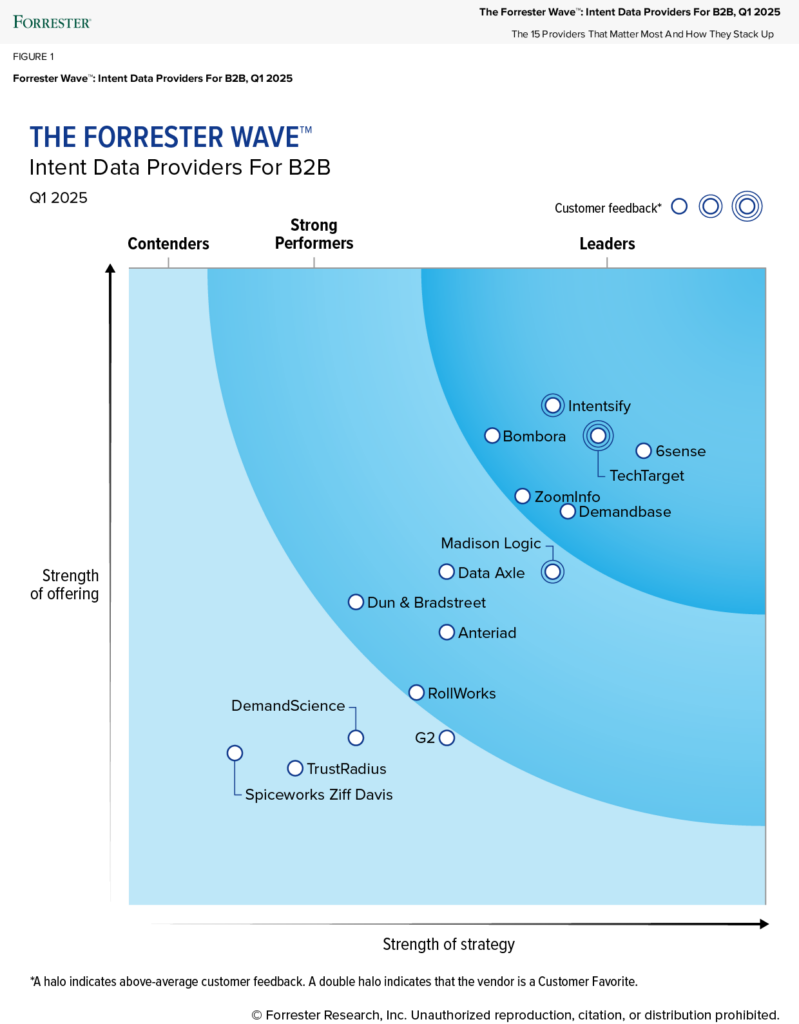
What the Forrester Wave measures for intent data buyers
The Forrester Wave is an independent, scored evaluation of vendors in a defined technology category. For buyers navigating the crowded intent data market, it provides a structured framework that reduces the vendor-selection risk of relying solely on self-reported claims. The Forrester Wave Q1 2025 evaluation of intent data providers assessed vendors across three core dimensions:
Wave Dimension | What It Measures | Buyer Question to Ask |
|---|---|---|
Signal scale within core-fit accounts | Whether the vendor's coverage is deep enough in the specific account universe that matters to your business, not just broad coverage across all companies | "What is your coverage rate within my ICP account list specifically?" |
Relative accuracy of signals | How reliably a vendor's signals predict actual purchase behavior, measured against a baseline | "How do you validate signal accuracy, and can you share methodology documentation?" |
Incremental business impact | The lift a vendor's signals provide beyond what your existing first-party data sources already capture | "What incremental pipeline did customers attribute to your signals in the first 90 days?" |
For b2b teams evaluating intent data providers, the Wave's value is less about the final quadrant placement and more about the evaluation criteria it surfaces. When Forrester scores vendors on these three dimensions, it gives procurement teams a common vocabulary for comparing providers and a set of questions to pressure-test during vendor conversations. Analyst validation functions as risk reduction: it signals that a vendor has been assessed by an independent third party against a consistent methodology, not just measured against its own marketing claims. The Forrester Wave Q1 2025 is the most current evaluation of this category and reflects the state of the market as of early 2025.
Q1 2025 Forrester Wave intent data landscape: what vendors have disclosed
The complete Wave rankings and full scoring data are available in the gated Forrester report. The placements below reflect only what each vendor has publicly disclosed on their own landing pages.
Vendor | Self-Disclosed Placement | Key Differentiator Claimed | Criteria Scores Disclosed |
|---|---|---|---|
ZoomInfo | Leader | Highest scores across 8 criteria; largest R&D investment of any provider in the evaluation | Highest scores across 8 criteria (Q1 2025) |
6sense | Self-positions as category leader | Signalverse data network for cross-channel intent aggregation | Not publicly disclosed at criteria level |
Anteriad | Strong Performer | Programmatic and data-as-a-service capabilities for B2B marketers | 5 out of 5 in four key criteria |
For buyers using the intent data Forrester Wave Q1 results as a procurement input, this table is a starting point, not a complete picture. The gated report contains the full scoring breakdown across all evaluated intent data providers, including criteria weighting and vendor-specific commentary. Requesting the full scorecard from each vendor during evaluation conversations is the most reliable way to map Wave scores to your specific use case.
How ZoomInfo goes beyond traditional intent data sources
ZoomInfo's differentiation starts with signal breadth, and understanding why that breadth matters requires a quick look at where traditional intent data falls short.
Intent data has long been a powerful tool for identifying accounts showing interest in your offerings. But today's B2B sellers and marketers need to go beyond traditional intent data sources to truly understand their prospects.
ZoomInfo takes this approach to the next level.
By tapping into a broader spectrum of data points, such as technographic shifts, job changes, and web activity patterns, ZoomInfo provides customers with a richer, more accurate picture of buyer behavior. ZoomInfo's Intent includes Person-Level Intent, which surfaces a named contact tied to account-level research activity, giving teams a direct starting point for prioritization and outreach. This wealth of insights enables businesses to not only react to interest but proactively identify where the most promising opportunities lie.
Understanding the signal taxonomy matters here. ZoomInfo combines three distinct signal types: first-party signals from ZoomInfo's own web activity and platform data, second-party signals from partner network activity, and third-party signals from publisher bidstream sources. No single source type is sufficient on its own. Bidstream data captures broad research behavior but misses the job change that signals a new buying cycle. Technographic shifts reveal when a competitor's contract is ending. Web activity patterns show which accounts are returning to pricing and product pages. ZoomInfo integrates all three to produce a more complete picture of buyer readiness than any single source can provide.
Intent signals also have a short shelf life. Forrester has named the rapid decay of insight value as one of the core challenges in evaluating intent data providers, and it is a real operational constraint: a signal that was accurate on Monday may be noise by Friday if the account's research behavior has shifted. ZoomInfo's daily processing cadence addresses this directly.
We process over 1.5 billion data points every single day, capturing 58 million intent signals weekly from a diverse range of sources, far beyond traditional bidstream data. We're expanding the data universe to include things like web activity, job transitions, competitive shifts, and technographic changes. By integrating these diverse signals, we empower go-to-market teams to identify the accounts most likely to convert, pinpoint the exact right moments to engage, and provide them with the precise messaging, all from one unified platform. For intent data sales teams, this means acting on signals while they're still warm, not after the window has closed.
How to evaluate intent data providers: a Forrester-aligned framework
Most B2B organizations have well-established processes for evaluating traditional data providers: they assess coverage, accuracy, and integration depth. What they often lack is equivalent rigor for second- and third-party intent sources, where the evaluation criteria are fundamentally different and the failure modes are less obvious. Forrester's research on this category consistently finds that buyers underinvest in scoping their intent data trials and overestimate how quickly they'll see signal-to-pipeline correlation.
The rubric below maps Forrester's three evaluation dimensions to six specific criteria you can assess during vendor conversations:
Evaluation Criterion | What to Assess | Questions to Ask the Vendor |
|---|---|---|
Signal volume in ICP accounts | Coverage depth within your specific target account universe, not overall database size | "What is your coverage rate if I upload my ICP account list?" |
Keyword mapping flexibility | Whether you can define custom intent topics or are constrained to pre-built topic clusters | "Can I create custom intent topics, and how granular can the keyword mapping get?" |
Geographic and industry coverage | Whether signal volume holds up in your specific markets, not just in aggregate | "What are your coverage rates in [specific geographies or verticals]?" |
Signal decay rate and refresh cadence | How frequently signals are updated and how quickly stale signals are removed | "What is your data refresh cadence for intent signals specifically?" |
Integration with existing MAP and CRM stack | Whether signals flow automatically into your existing workflows or require manual list exports | "How does your platform integrate with [your MAP] and what does the data model look like?" |
Accuracy validation method | How the vendor measures and reports signal accuracy, and whether that methodology is independently verifiable | "How do you validate that a signal predicts purchase behavior, and can you share the methodology?" |
Trial scoping guidance
Forrester recommends that b2b intent data trials use a narrow keyword set, a tight geographic and industry scope, and a timeframe of weeks rather than months. The logic is straightforward: a broad trial produces too many variables to isolate signal quality, and a multi-quarter commitment locks you into a vendor before you have meaningful accuracy data.
The most reliable accuracy check is to validate signals in territory where you already have sales and marketing activity data. If an intent data provider surfaces accounts as high-intent in a segment where your team has closed deals in the last 12 months, you can compare the signal timing against your own CRM records to assess whether the signals preceded or lagged actual buying behavior. This is a more rigorous test than measuring pipeline generated from net-new accounts, where the baseline is unknown.
ZoomInfo's Guided Intent feature addresses one of the most common evaluation challenges Forrester identifies: keyword mapping complexity. Rather than requiring you to build a keyword taxonomy from scratch, Guided Intent identifies intent topics that are historically correlated with deal success for your specific business, narrowing the aperture to accounts most likely to engage based on your own closed-won data.
How ZoomInfo aligns sales and marketing around shared intent signals
With the evaluation framework in place, the next question is operational: how does intent data actually flow between sales and marketing once you've selected a provider? Guided Intent's account prioritization is only as valuable as the alignment it enables across both teams.
ZoomInfo introduced Guided Intent to help customers prioritize the accounts with the highest potential for conversion. This feature identifies intent topics that are highly correlated with previous success, which narrows the aperture to accounts that are most likely to engage.
By understanding behaviors, trends, and signals indicating readiness to purchase, businesses can optimize their outreach strategies and increase their chances of converting high-intent leads. For intent data sales applications, the value is in the timing: sales teams receive real-time alerts on accounts that are actively researching, not accounts that showed interest last quarter.
Traditional intent data tools often operate in silos, leaving teams with fragmented insights. ZoomInfo bridges this gap through its GTM Context Graph, ensuring that both teams work in sync with a unified view of intent signals, firmographic intelligence, and engagement data. When sales and marketing operate from the same signal layer, campaigns don't just launch, they land on the accounts that are actually in-market.
With real-time alerts, automated workflows, and AI agents in GTM Workspace surface next-best-action recommendations, ZoomInfo ensures that sales teams are always aware of the highest-priority leads, while marketing can fine-tune targeting strategies for maximum conversion. This seamless collaboration results in accelerated pipeline growth and improved revenue outcomes for businesses leveraging ZoomInfo's platform.
The outcomes from this alignment are measurable. Thomson Reuters increased closed-won by 40% and achieved 115% average monthly quota attainment after aligning sales and marketing on ZoomInfo's unified signal layer. On the marketing side, Smartsheet saw an 84% MQL increase and a 26% opportunity rate increase using ZoomInfo's marketing capabilities, a result that reflects what happens when audience targeting is built on real-time behavioral signals rather than static list pulls.
Why ZoomInfo's intent data delivers more complete, actionable, and accurate intelligence
ZoomInfo's intent data, unique signals, and contextual intelligence provide a competitive edge for businesses seeking to stay ahead. With the ability to capture and analyze data from multiple sources, ZoomInfo offers customers a more complete, actionable, and accurate picture of buyer behavior, enabling smarter decisions, more effective outreach, and stronger sales outcomes.
The accuracy advantage is clearest at the account-scoring level. Snowflake saw 90% higher opportunity rates and 2x customer conversion on ZoomInfo-scored accounts, a result that reflects the difference between raw signal volume and scored, prioritized intelligence. ZoomInfo's account scoring combines intent signals, firmographic data, and engagement history to produce a ranked account list that reflects actual purchase likelihood, not just research activity.
Intent data use cases: matching provider capabilities to your GTM motion
The right intent data provider depends on which GTM motions you're trying to accelerate. The same signal types that power ABM account prioritization work differently in an outbound sequence context or a pipeline acceleration play. Here are three use cases where the provider's capability profile matters most.
ABM account prioritization
Third-party intent signals surface net-new in-market accounts before they raise their hand through a form fill or inbound inquiry. The challenge is that broad intent topics return large account lists that include out-of-ICP companies consuming budget without conversion potential. ZoomInfo's Guided Intent narrows the aperture by identifying accounts that match the intent topic profile of your historical closed-won deals, not just accounts researching the category generally. Combined with firmographic filtering (industry, company size, geography, technology stack), this prevents the common failure mode where government agencies, consumer brands, or other non-ICP accounts generate high engagement metrics while delivering zero pipeline. This directly addresses the operational reality that non-ICP accounts can consume a disproportionate share of advertising budget with no catch mechanism in place.
Outbound sequence triggering
Topic surge detection, a spike in research activity on specific keywords above a baseline threshold, creates a timing signal for SDR outreach that is more reliable than static account lists. As described in the signal taxonomy section above, ZoomInfo captures signals across web activity, job transitions, and technographic shifts that are particularly useful for outbound triggers. For intent data sales teams, these signals create a trigger-based outreach model that replaces the spray-and-pray cadence with prioritized, timed engagement.
Pipeline acceleration
First-party behavioral signals, repeat visits to pricing or product pages, form engagement, and content consumption patterns, combined with ZoomInfo's b2b intent data, create a high-confidence signal for sales prioritization within existing pipeline. Snowflake's results (90% higher opportunity open rates and 2x customer conversion on ZoomInfo-scored accounts) reflect this use case: the value is not in net-new account discovery but in ranking existing pipeline by purchase likelihood so sales effort concentrates on deals that are actually moving.
Measuring incremental impact
Incremental impact is the signal volume and quality your intent data provider delivers beyond what your existing first-party sources already capture. Measuring it requires a baseline: before layering in a new provider's signals, document the accounts your first-party data (web analytics, CRM activity, MAP engagement) already surfaces as high-intent. After implementation, compare the provider's account list against your baseline. A 90-day post-implementation measurement window is the minimum timeframe for meaningful signal-to-pipeline correlation, since most B2B sales cycles extend well beyond the initial intent signal.
See how ZoomInfo's intent data can accelerate your pipeline.
Frequently asked questions
What is intent data and how does ZoomInfo use it?
Intent data is behavioral signals that indicate a company or individual is actively researching a purchase decision, ranging from topic-level research activity to specific product page visits and technographic changes. ZoomInfo captures intent signals from multiple sources beyond traditional bidstream data, including web activity patterns, job transitions, and technographic shifts. ZoomInfo processes 1.5B+ data points daily and captures 58 million intent signals weekly, combining these diverse sources into a unified signal layer. For more on how b2b intent data works mechanically, see what is intent data.
Which intent data providers were named Leaders in the Forrester Wave Q1 2025?
The full Wave rankings are in the gated Forrester report and are not publicly reproduced here. From publicly disclosed information: ZoomInfo was named a Leader with the highest scores across 8 criteria, as confirmed on ZoomInfo's Forrester Wave recognition page. 6sense self-positions as a category leader referencing its Signalverse data network. Anteriad disclosed Strong Performer status with 5 out of 5 scores in four criteria. See the vendor landscape table above for the full summary. The complete report is available directly from Forrester or via participating intent data providers.
How does ZoomInfo's Guided Intent differ from traditional intent data?
Traditional intent data identifies companies researching a topic but does not differentiate signal quality or relevance to your specific business. Guided Intent uses AI to identify intent topics historically correlated with deal success for your specific customer base, narrowing the aperture to accounts most likely to engage rather than returning broad lists of category researchers. This directly addresses the common pain point where b2b intent data topics are too broad to be actionable, returning thousands of accounts when the actual in-market universe is a fraction of that size.
How does ZoomInfo help align sales and marketing teams around shared signals?
ZoomInfo's GTM Context Graph provides a unified view of intent signals, firmographic intelligence, and engagement data that both sales and marketing teams access from a single platform. Sales receives real-time alerts on high-priority accounts; marketing can fine-tune targeting based on the same signals, so outreach and campaigns hit the same accounts with a coherent message rather than operating from separate data sources. Thomson Reuters increased closed-won by 40% and achieved 115% average monthly quota attainment after aligning on ZoomInfo's unified signal layer, demonstrating the pipeline impact of intent data sales and marketing alignment.
What signals does ZoomInfo capture beyond bidstream data?
ZoomInfo captures a range of signal types beyond traditional bidstream: web activity patterns, job transitions, technographic shifts (technology installs and removals), competitive displacement signals, and firmographic changes. Combining these diverse signals with the GTM Context Graph produces a more accurate picture of buyer readiness than bidstream alone because it captures the timing signals, a new executive hire, a competitor contract ending, that precede a formal purchase process. See ZoomInfo's data coverage for the full scope of signal sources.
How do I evaluate intent data providers using the Forrester Wave results?
The Forrester Wave scores intent data providers on three dimensions: signal scale within core-fit accounts, relative accuracy, and incremental business impact. When using Wave results for vendor selection, map each dimension to your specific GTM use case (ABM, outbound, pipeline acceleration) and request full scorecard breakdowns from vendors during evaluation conversations. Most B2B organizations lack rigorous evaluation processes for intent data specifically, and a structured trial with a narrow keyword scope, tight geographic and industry boundaries, and a timeframe of weeks rather than months produces the most reliable accuracy validation. ZoomInfo's intent data evaluation resources provide additional context on how Guided Intent addresses the keyword mapping complexity Forrester identifies as a core evaluation challenge.
Forrester does not endorse any company, product, brand, or service included in its research publications and does not advise any person to select the products or services of any company or brand based on the ratings included in such publications. Information is based on the best available resources. Opinions reflect judgment at the time and are subject to change.