

Lusha is a B2B sales intelligence platform built on 280M+ verified contacts and 30M+ company profiles. It helps revenue teams find buyers, track purchase-intent signals, and act on both without leaving the platform.
The platform covers four areas: prospecting (search, browser extension, AI-driven lists, CRM enrichment), buying signals (intent data, job changes, technology shifts, alerts), outreach (email sequencing and conversation recording), and connected systems (CRM integrations, API, and MCP for AI tools). This breakdown covers every feature, how it works, who it serves, and which plan unlocks it.
Lusha's feature set has you covered if:
You need verified direct dials and business emails for cold outbound, with 98% email deliverability and 85% phone accuracy as published benchmarks
You prospect on LinkedIn and want a browser extension that reveals contact data without leaving the page
You want AI-curated prospect lists that refresh daily based on your activity patterns and intent signals
You need automated CRM enrichment that fills missing fields on record creation, update, or on a schedule
You want buying signals (job changes, funding rounds, technology adoption, Bombora intent data) attached to verified contacts, not raw signal feeds you have to match yourself
You run GDPR-sensitive operations and need a vendor with ISO 27701, ISO 27001, SOC 2 Type II, and GDPR certification
You'll hit its limits if:
You need conversation intelligence that records, transcribes, and coaches from sales calls at scale (Lusha Conversations is still in beta)
You want multi-channel outreach sequencing across email, phone, LinkedIn, and SMS from one platform (Lusha Engage is email-only)
You need bidirectional CRM sync where changes in your CRM flow back into the intelligence platform
You want account-based marketing orchestration, display advertising, or multi-channel campaign management
You need a single intelligence layer that connects your CRM data, conversation transcripts, and third-party signals to explain why deals move or stall
For those needs, the reference point is ZoomInfo: a GTM platform built on 500M contacts, 100M companies, 135M+ verified phone numbers, and 200M+ verified business email addresses. Its GTM Context Graph processes 1.5B+ data points daily by combining B2B data with CRM records, conversation intelligence, and behavioral signals. Access runs through APIs, MCP, GTM Workspace, and GTM Studio.
After the feature breakdown, this article covers where Lusha stops and how ZoomInfo fills those gaps.
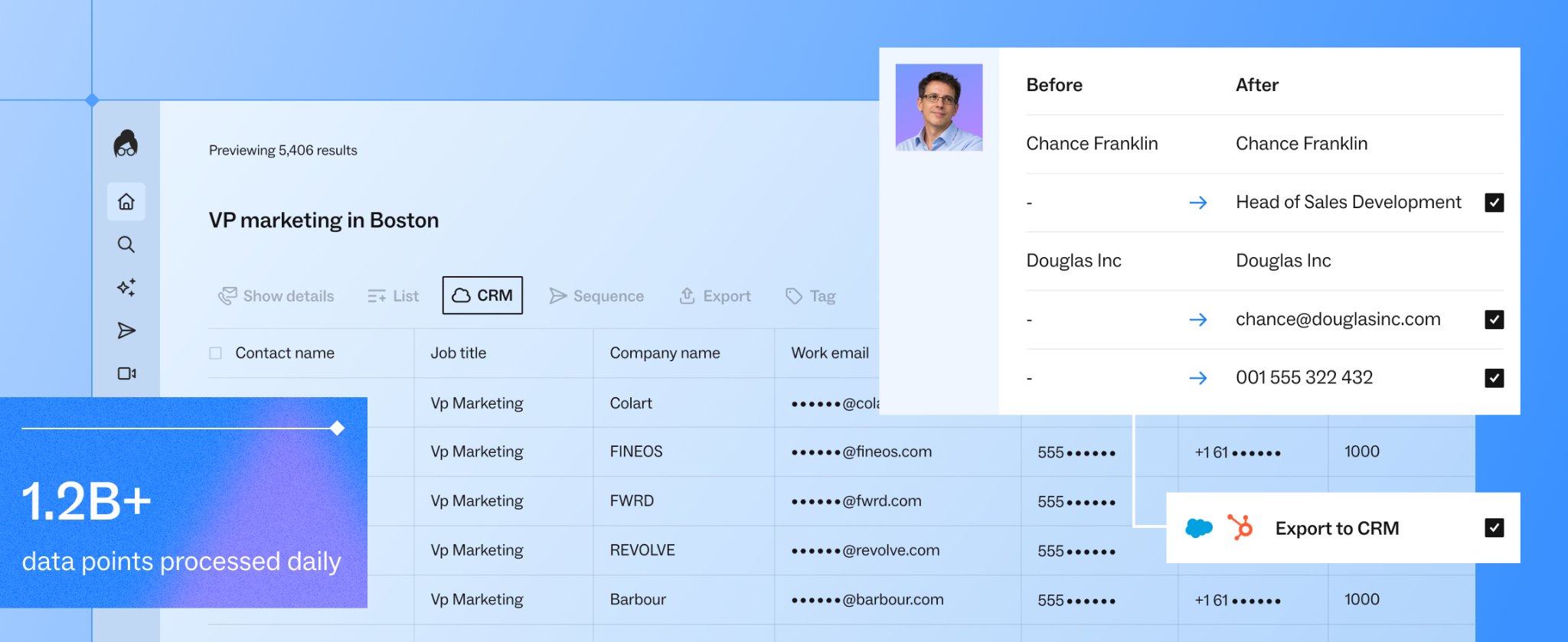
Lusha Platform Overview
Source: Lusha
Lusha targets four team types: Sales, RevOps, Marketers, and Recruiters, serving both SMB and Enterprise buyers. Named customers include Oracle NetSuite, WalkMe, Snowflake, Google, Zendesk, Autodesk, Amplitude, and Anaplan. The platform organizes around four pillars, each containing named products:
Module | What It Does | Plan Access |
|---|---|---|
Central prospecting hub: search, filter, organize, and activate contacts and companies | All plans | |
Chrome extension revealing contacts on LinkedIn, Sales Navigator, CRMs, and B2B websites | All plans (including Free) | |
Auto-updating prospect lists that learn from user activity | All plans | |
Automated CRM record enrichment on creation, update, or schedule | Paid plans | |
Buying intent, job changes, funding, hiring, and technology adoption signals | Paid plans | |
Weekly notifications when tracked signals fire on target accounts | All plans | |
AI-surfaced new prospects based on activity patterns and intent data | All plans | |
Native email sequencing with AI-generated content and scheduling | All plans (included at no extra charge) | |
Meeting recording, transcription, and analysis | Beta (select Premium and Scale customers) | |
RESTful endpoints for enrichment, prospecting, signals, and lookalikes | Pro and above | |
Model Context Protocol integration for Claude, ChatGPT, and Cursor | Plans with API access |
Lusha Prospecting: Search, Extension, and List Building
Prospecting is the feature area most buyers encounter first. It spans four products: Workspace (the search hub), Extension (the browser plugin), Lists (AI-driven prospect playlists), and Enrichment (automated CRM data filling).
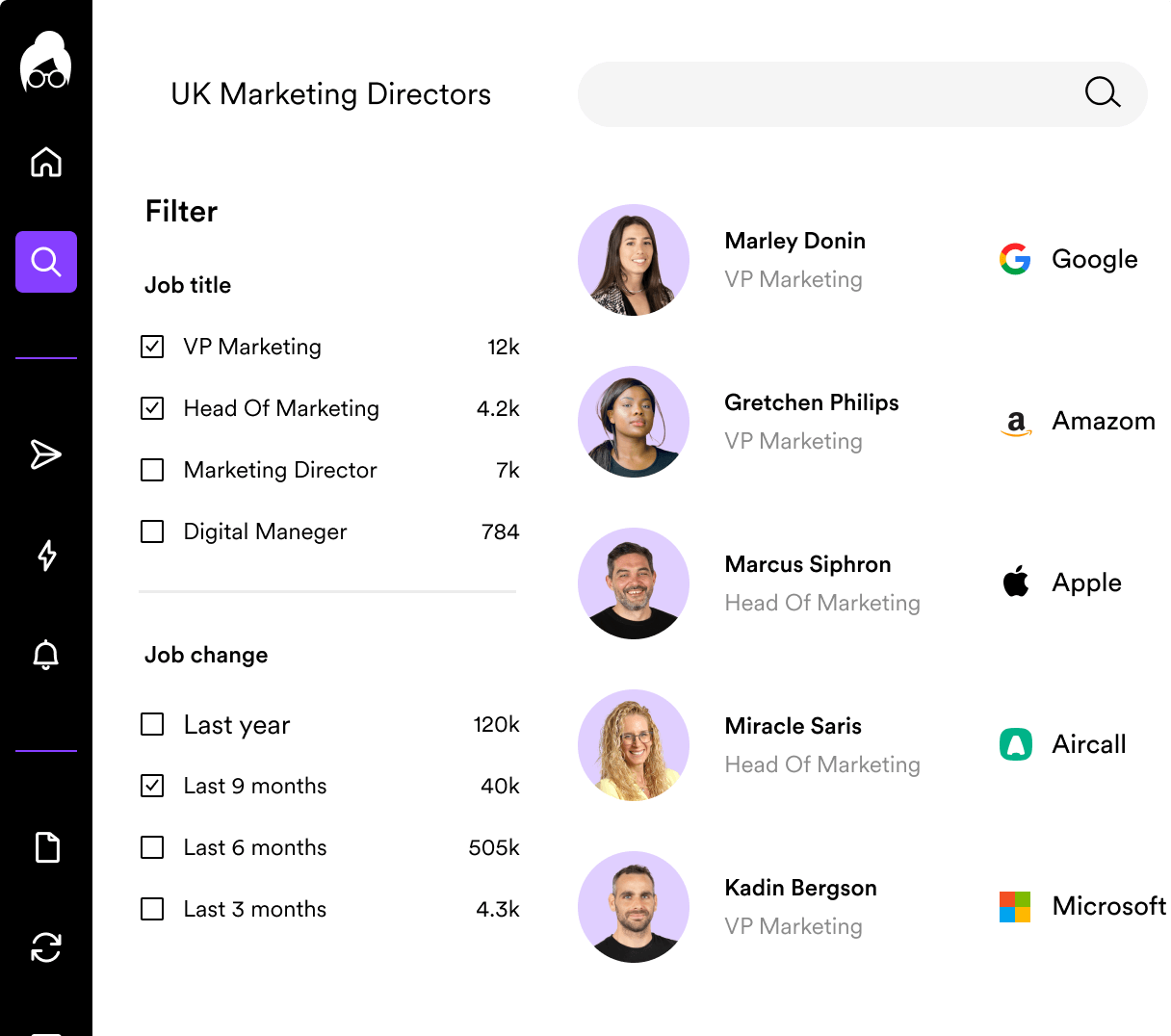
Workspace is the central interface for finding and activating contacts. The workflow runs in sequence: search 285M+ enriched contacts with filters (role, seniority, company size, job changes, technologies), identify target accounts by firmographic and technographic criteria, organize results into shared lists with ownership and routing, then sync to CRM or export to CSV.
Source: Lusha
The search layer supports both structured filters and natural language queries via AI, so a user can describe their ICP instead of building a filter stack manually.
Lists support prioritization, routing, and cross-team collaboration, and contacts can move directly into outreach sequences or CRM workflows without a manual handoff.
The Extension is the tool cited in nearly every Lusha customer story. It installs from the Chrome Web Store with no setup and reveals verified phone numbers, emails, and job updates on LinkedIn, Sales Navigator, CRM interfaces, and B2B websites.
From the extension, users can save contacts to lists, push them into sequences via Engage, or export to CRM (including in bulk). The extension is available on the free plan, making it the entry point to the broader platform.
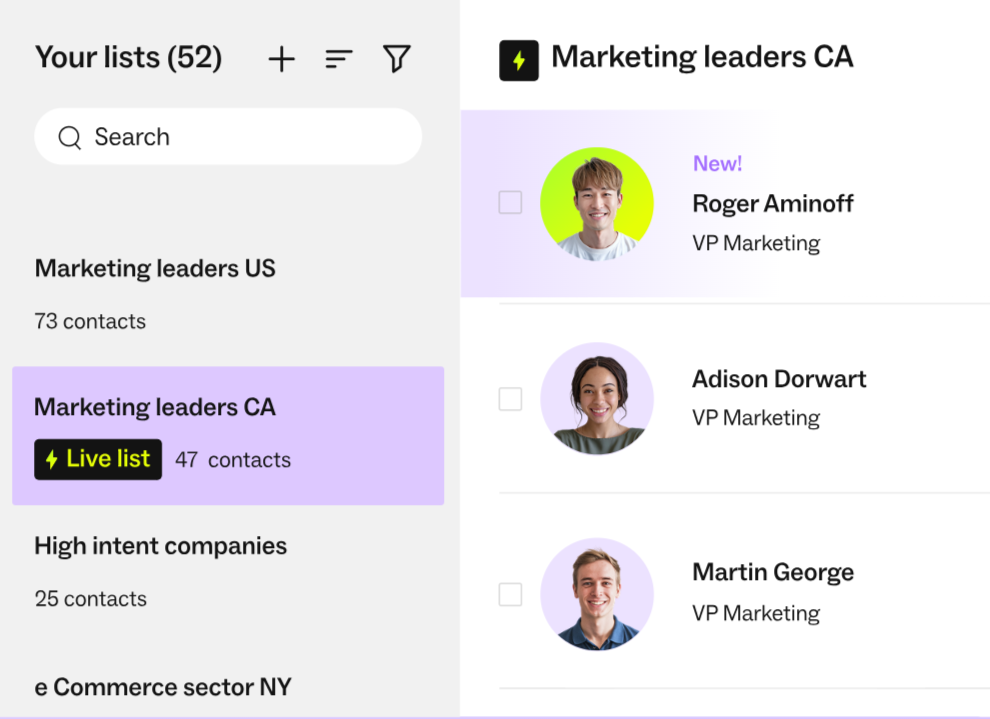
Lists (AI Playlists) tackle the problem that sales reps typically spend 70% of their time on non-selling prospecting activities. Instead of static exports, Playlists are dynamic: the user sets a frequency (daily or weekly) and volume (10, 25, or 50 prospects), toggles on "Auto-add similar contacts," and the AI analyzes what connects winning prospects (company size, industry, job title, growth indicators) to surface matches.
Source: Lusha
The lists refresh with new leads, and every interaction teaches the algorithm. Lists integrate with Salesforce, HubSpot, and Pipedrive with custom field mapping, and connect to buyer intent alerts and outreach sequences.
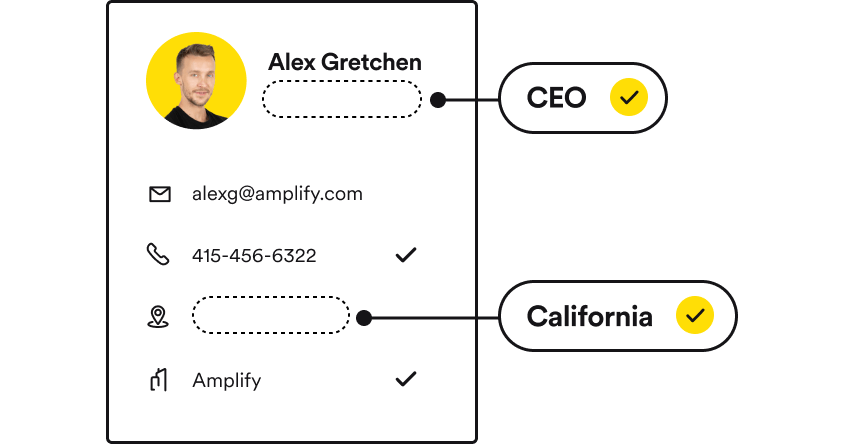
Enrichment automates ongoing CRM data maintenance rather than treating enrichment as a one-time import. It triggers in three ways: on record creation, on record updates, or on scheduled workflows. Two actions drive the module.
Source: Lusha
Update auto-fills CRM records with verified contact and company data.
Expand populates accounts with ICP-matched contacts for outbound and ABM, so a RevOps team can automatically build out the buying committee at every new account entering the CRM. Enrichment covers three record types: contacts/leads, accounts, and new records entering CRM.
Lusha Buying Signals: Intent, Job Changes, and AI Recommendations
The buying signals layer is where Lusha moves beyond static contact data into timing. Three products work together: Signals detects changes, Alerts notifies users, and AI Recommendations surfaces new opportunities.
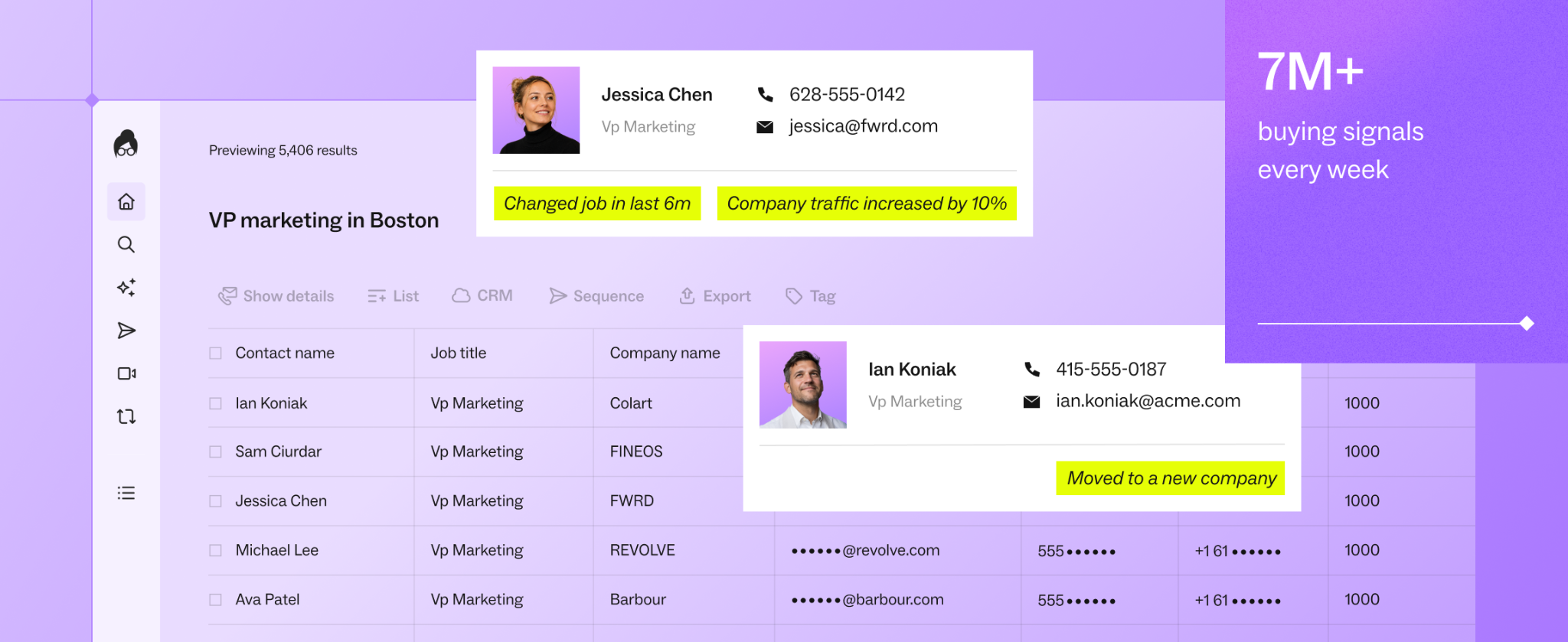
Signals tracks four categories of change across target accounts.
Source: Lusha
Buying and Research Signals run on Bombora's Company Surge data, which ingests content consumption across a data cooperative of 5,000+ B2B sites and measures weekly acceleration against a 12-week rolling baseline. The network spans 4M unique domains and 16.3B monthly interactions, and signals refresh weekly.
Career Movement Signals track job changes and promotions at the contact level, with filtering by timeframe (60 days, 90 days, 9 months, 1 year). A champion who changes companies becomes an immediate warm lead at the new account.
Company Change Signals cover funding, growth, hiring trends, headcount increases, financial events, and corporate strategy news.
Technology Signals detect new technology adoption and stack changes, collected through Lusha's proprietary in-house model. Every signal surfaces with verified contact and company data attached, giving the user both the timing and the person to call. The Signals API supports automation via Make, Zapier, and n8n.
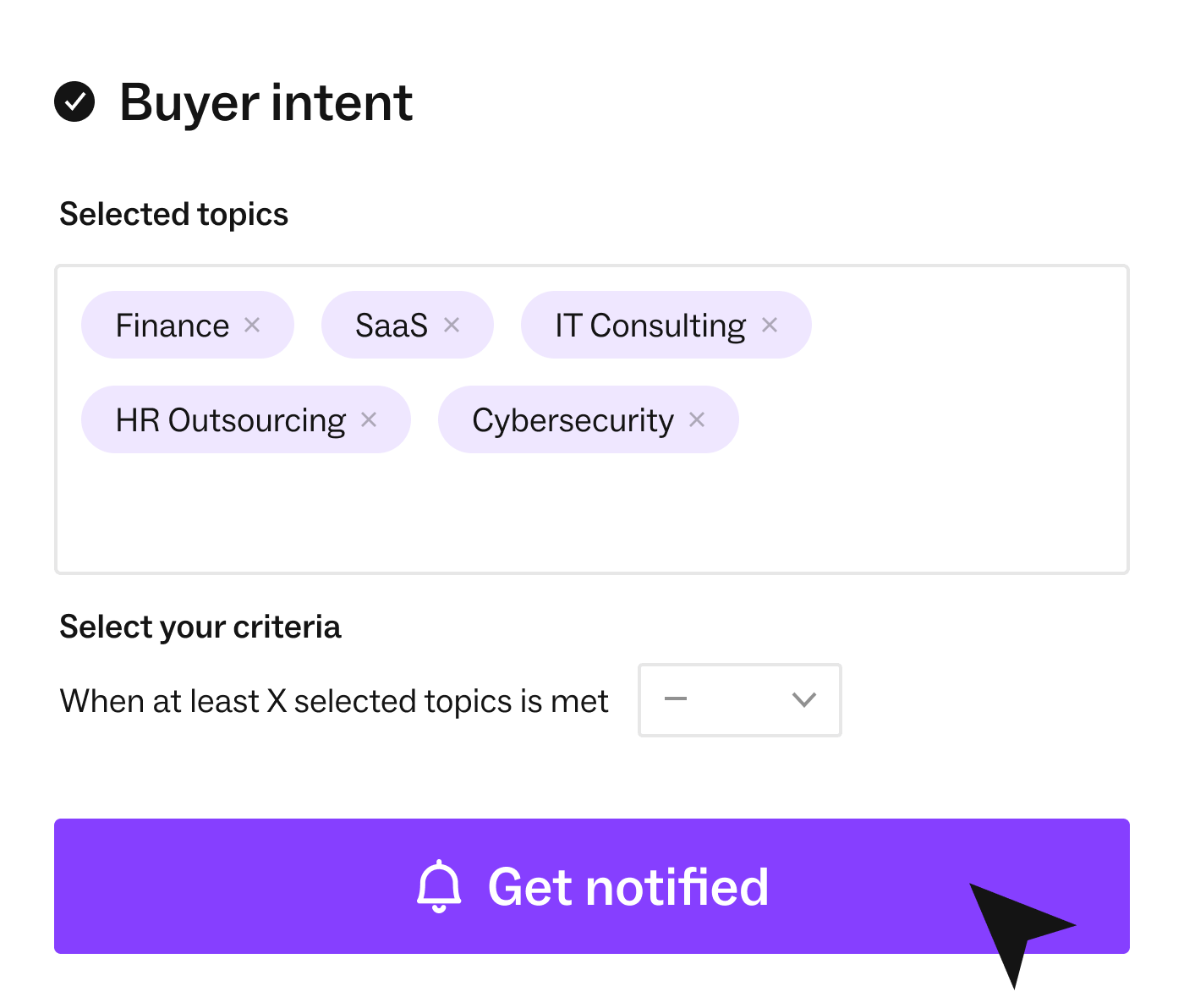
Alerts is the notification layer. Instead of requiring users to watch dashboards, Alerts delivers scheduled weekly updates based on configured rules. Users set alert criteria (buying interest, technology changes), receive weekly summaries, and act with full context, including verified contact data.
Source: Lusha
Alerts are available to all Lusha users regardless of plan.
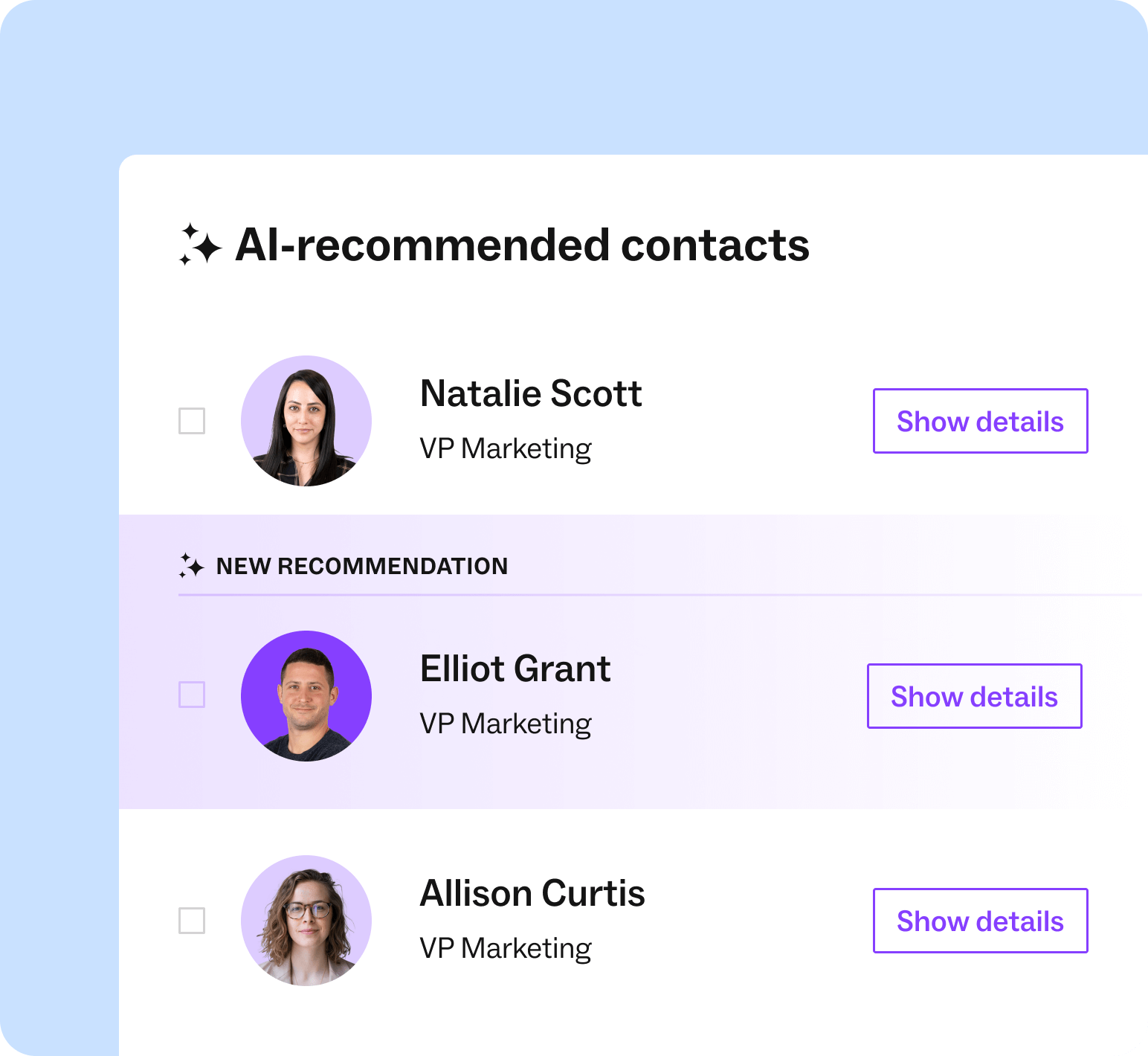
AI Recommendations discovers prospects the user has not yet revealed or saved. Two recommendation types run in parallel.
Source: Lusha
Activity-Based recommendations scan up to 90 days or the last 1,500 revealed contacts and companies, identify winning attributes, and generate fresh daily lookalike lists. The algorithm combines user activity with crowdsourced data, and every interaction teaches it preferences.
Intent-Based recommendations combine Lusha's ICP matching with Bombora intent data to surface companies most likely to be in-market. If no intent topics are set manually, Lusha assigns calculated topics automatically; topic selections can be reset every 30 days.
Recommendations refresh daily, only surface unrevealed contacts, and users can generate up to 25 additional recommendations, twice per day. The feature is available for all Lusha plans at no additional cost.
Lusha Outreach: Engage and Conversations
Lusha's outreach layer is newer than its prospecting and signal capabilities. It covers two products: Engage for email sequencing and Conversations for meeting intelligence.
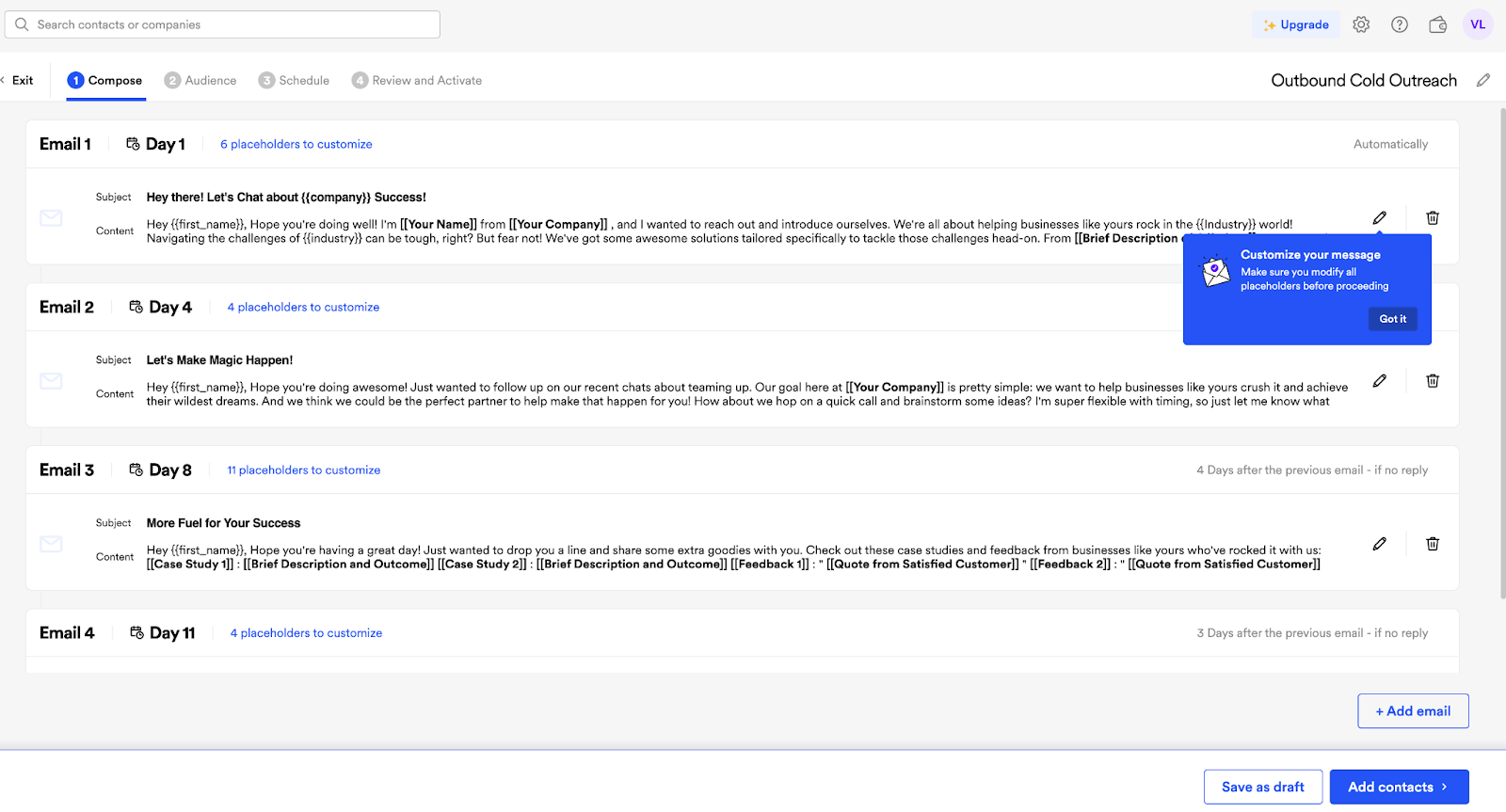
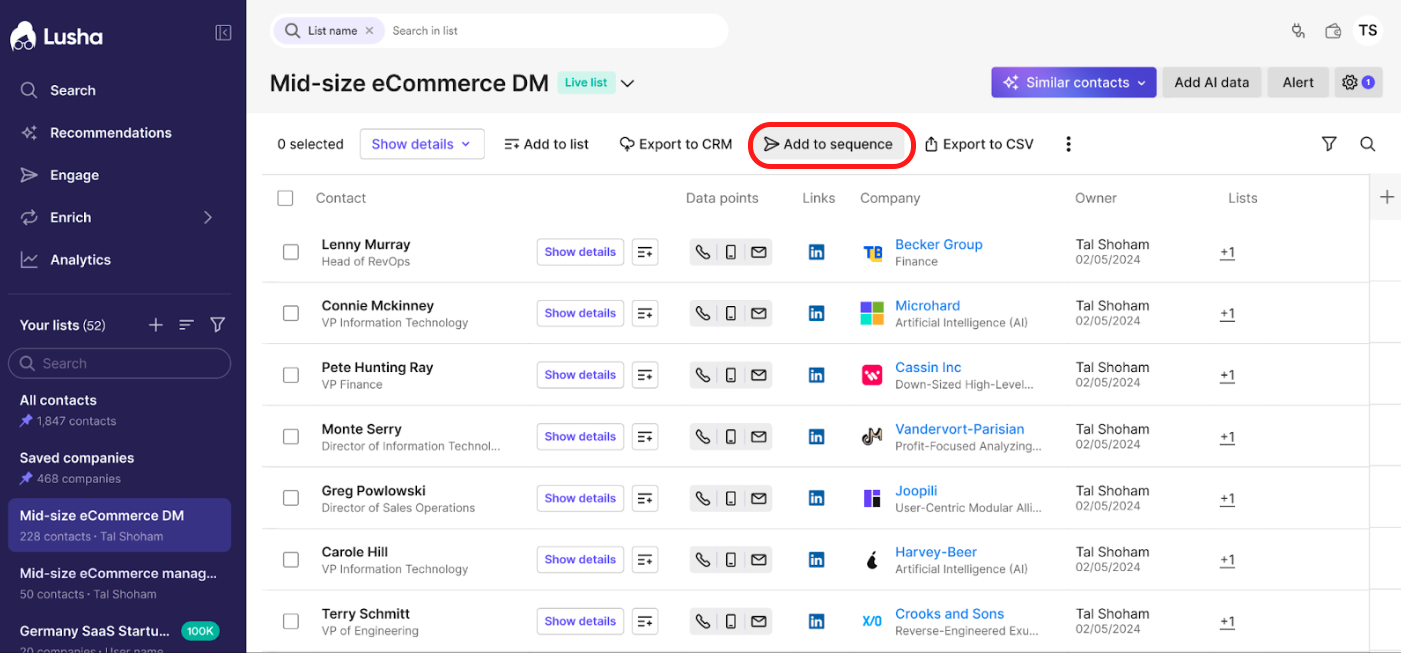
Engage is a native email sequencing tool. Because it sits inside the same platform as the contact database and buying signals, sequences draw on verified data without a manual import step.
Three creation methods are available: the AI Email Assistant (generates multi-step sequences using OpenAI models plus Lusha's database), pre-built expert templates, or building from scratch (up to 45,000 characters per email).
Source: Lusha
Sequences support dynamic personalization tags that automatically block sends for contacts with missing data, preventing blank-field emails.
Auto Sequence automatically enrolls contacts when they join a list, creating a direct path from prospecting to outreach. Automatic bounce and reply handling removes contacts from sequences on reply or bounce. Salesforce sync for sequences logs activity back to the CRM.
Source: Lusha
Engage requires Gmail or Outlook to send and is limited to 1,000 emails per user per day with a maximum of 5 active sequences. The tool is included at no extra charge for all Lusha users.
The scope is clear: Engage is email-only with no LinkedIn, SMS, phone, or multi-channel sequencing.
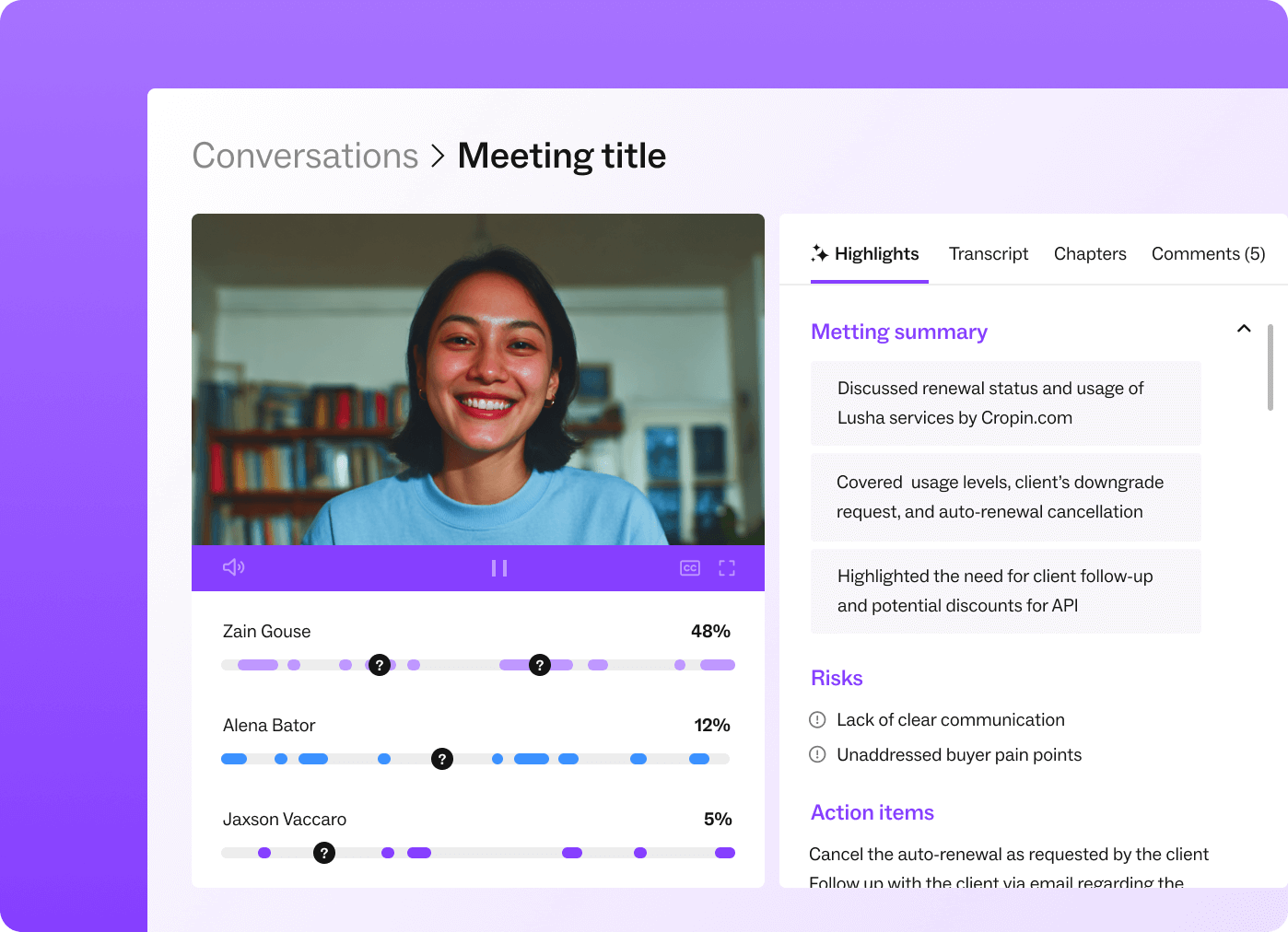
Conversations is Lusha's entry into conversation intelligence. A named Lusha bot joins scheduled meetings automatically when auto-recording is enabled, and all participants are notified when recording begins.
Source: Lusha
After the meeting, an analysis email arrives within 2 to 5 minutes containing an AI-generated summary, risk indicators, action items, discussion chapters, a transcript with filtered Q&A, and engagement metrics.
Coaching features include Smart Snippets, timestamped @mention comments, and talk ratios. Recordings sync to Salesforce as Event activities, with HubSpot and Pipedrive connectors in development.
Meeting insights feed back into Lusha's Recommendations engine, closing the loop between conversations and prospecting.
Lusha commits to no AI training on customer data and holds SOC 2 Type II and ISO 27001 certification.
Conversations is currently in beta, available at no charge to some Premium and Scale plan customers. It is a first step into meeting intelligence, but it is early-stage compared to dedicated conversation intelligence platforms.
Lusha Connected Systems: Integrations, API, and MCP
The connected systems layer determines how Lusha's data flows into and out of a team's existing stack. Three products serve this: native integrations, the REST API, and the MCP server for AI tools.
Native CRM integrations cover the major platforms with per-platform export caps:
Salesforce: up to 150 contacts per batch
HubSpot: up to 100 per batch
Zoho CRM: up to 50 per batch
Bullhorn, Pipedrive, Outreach, Salesloft, MS Dynamics: up to 25 per batch
Additional integrations include monday CRM, Chili Piper, Gmail, Outlook, SourceWhale, and Scalestack. One detail worth noting: data flow is unidirectional. Lusha pushes data out to the CRM, but CRM changes do not flow back into Lusha.
Field mapping covers contact, lead, and company/account fields including intent topics, technologies, and a Predefined Value field for stamping lead source.
For automation, a Connectors hub supports six platforms: Make, n8n, Zapier, Workato, Pipedream, and Albato, plus a native Google Sheets add-on for spreadsheet-based bulk enrichment.
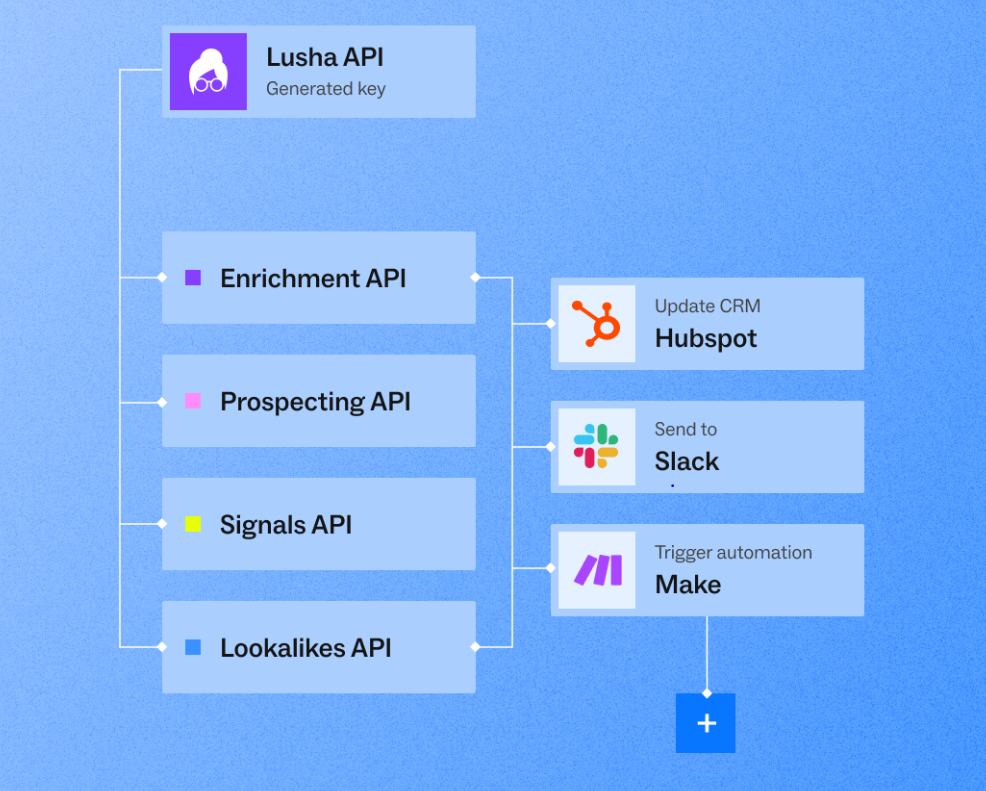
The Lusha API provides programmatic access through four endpoint groups: Enrichment (person and company lookups, up to 100 records per bulk request), Prospecting (filter contacts and companies by ICP criteria), Signals (job changes, promotions, hiring surges, funding events, news), and Lookalikes (similar contacts and companies from seed accounts).
Source: Lusha
Webhooks deliver real-time push notifications on contact job changes and company business events, with signals webhooks listed as coming soon.
API access requires the Pro plan or above, and rate limits scale by tier (from 50 requests per minute on Pro to 300 per minute on Premium and Scale). Credit costs via API differ from on-platform costs: phone reveals consume 5 credits via API versus 10 on-platform.
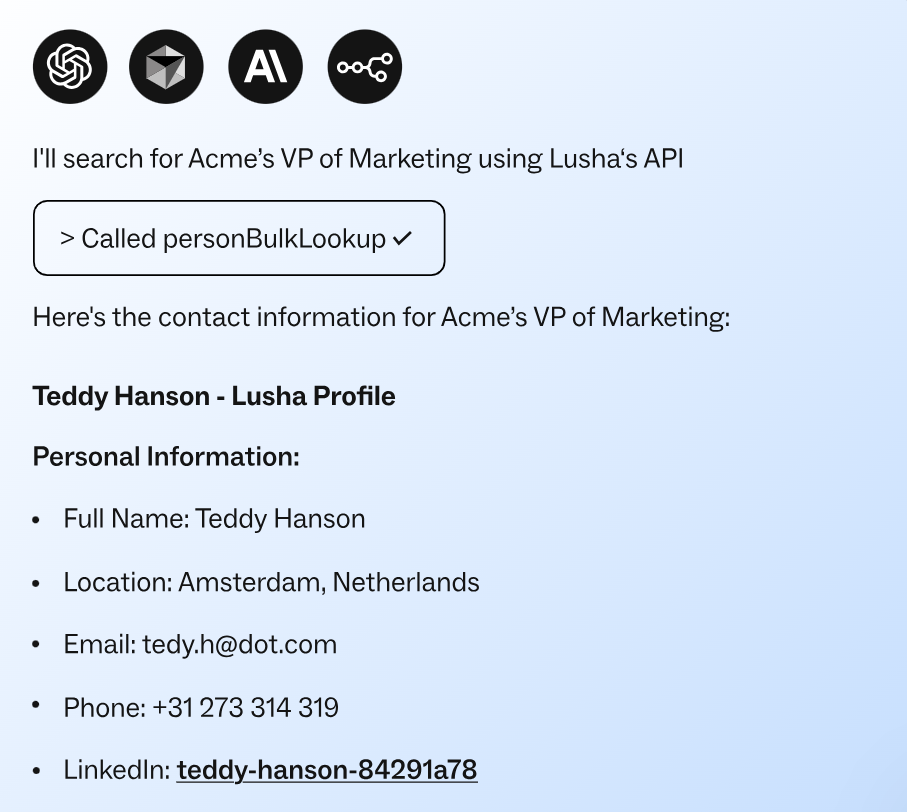
The MCP Server implements Model Context Protocol to stream verified B2B data into AI tools. Two deployment modes are available: local (user-hosted) and remote (managed at mcp.lusha.com, no setup required).
Source: Lusha
Nine tools are exposed, covering contact search, company search, prospecting, and enrichment. Supported clients currently include Claude (Remote MCP), ChatGPT (Remote MCP, requires Dev Mode), and Cursor (local), with N8N and Make integration in progress. MCP requires a plan with API access, and credits follow the same rules as the API.
Lusha Data Quality and Compliance
Lusha's data sourcing and compliance posture deserve their own section because they are central to the platform's positioning, particularly for European buyers.
The database covers 280M+ verified contacts, 152M+ emails, 280M+ direct dials, and 30M+ company profiles.
Lusha publishes benchmarks of 98% email deliverability and 85 to 86% phone accuracy. Data comes from "business-only contacts from professional communities, trusted partners, and vetted contributors", and Lusha states it never scrapes LinkedIn or social networks.
The compliance certifications include:
ISO 27001 (Information Security Management)
ISO 27701 (Privacy Information Management)
ISO 27017 (Cloud Environment Security)
ISO 31700 (Privacy by Design)
Lusha became the first B2B sales intelligence platform to receive ISO 27701 certification in January 2022, and added Australian Privacy Act compliance in March 2025. A downloadable Trust Kit contains all third-party audit copies. The Privacy Center provides self-service controls for data access requests, profile editing, removal requests, and CCPA opt-out.
Where Lusha Stops: The Gaps
Lusha centers on verified contact data and buying signals, with a lightweight outreach layer. That focus shapes its strengths but also defines clear boundaries.
Email-only outreach sequencing. Engage supports email sequences with AI-generated content, but it does not include LinkedIn steps, SMS, phone dialing, or any multi-channel sequencing. Teams running structured outbound across email, phone, and social need a separate sales engagement platform. The constraint is tightened by a 5-active-sequence limit and a 1,000-email daily cap per user.
Conversation intelligence still in beta. Conversations records and transcribes meetings with AI-generated summaries and coaching signals, but it is available only to select Premium and Scale customers and currently syncs only to Salesforce (HubSpot and Pipedrive in development).
Teams relying on conversation intelligence for deal management, coaching at scale, or CRM-wide call analysis need a dedicated tool.
Unidirectional CRM integration. Lusha's CRM integrations push data out but do not sync changes back. A contact updated in Salesforce does not update in Lusha. For RevOps teams that need a single source of truth across systems, this creates a maintenance gap.
No account-based marketing or campaign orchestration. Lusha does not include display advertising, audience management, multi-channel campaign orchestration, or marketing automation. Marketing teams running demand generation alongside sales outbound need a separate platform.
No intelligence layer connecting conversations, CRM, and signals. Lusha's signals and CRM enrichment operate in parallel, but the platform does not connect first-party CRM data, conversation transcripts, and third-party signals into a layer that explains why deals move.
The buying signals tell you who is in-market; they do not connect that to what happened on the last call or why a champion went quiet.
Intent data reliant on a single third-party source. Lusha's buying intent signals run on Bombora's Company Surge data. Lusha does not operate its own intent collection infrastructure. Signal quality and coverage depend on Bombora's cooperative network.
How ZoomInfo Covers the Gaps
The gaps above share a thread: Lusha is a verified data platform with a lightweight execution layer that depends on external tools for the intelligence, orchestration, and multi-channel capabilities that sit around the data. ZoomInfo is an AI-powered GTM platform that supplies those layers.
Multi-Channel Sales Execution: Structured outreach beyond email
ZoomInfo addresses the outreach gap through its partnership with Salesloft, where ZoomInfo data and buying signals sync to Salesloft Rhythm for AI-prioritized multi-channel engagement across email, phone, and LinkedIn.
Inside ZoomInfo's own platform, GTM Workspace provides AI-generated outreach that drafts personalized emails and messaging from full account context, with AI agents automating account research, outreach, CRM updates, and signal monitoring.
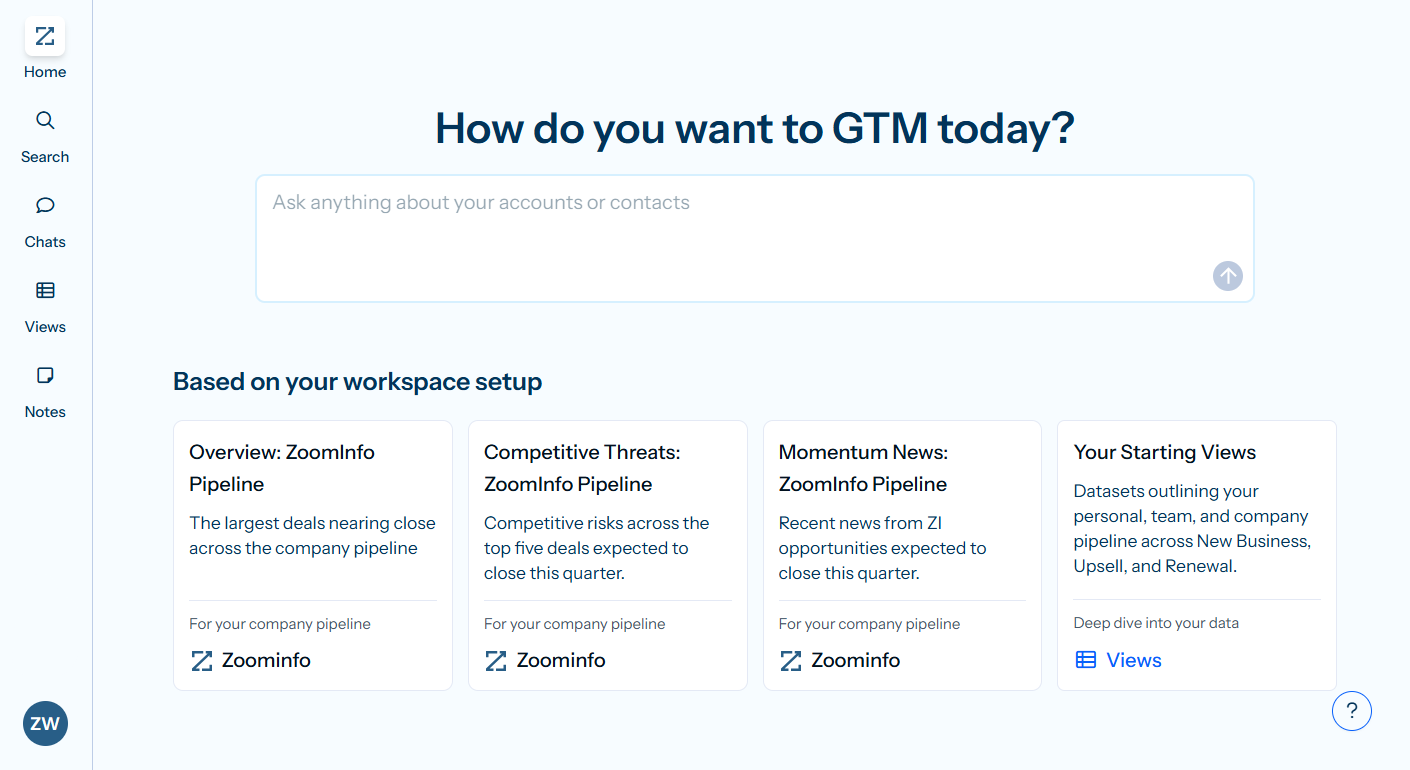
Where Lusha Engage stops at email with a 5-sequence limit, ZoomInfo connects signals directly to multi-channel sequencing the moment a prospect starts researching.
Chorus Conversation Intelligence: What happened on the call, and why it matters
Chorus, ZoomInfo's conversation intelligence engine backed by 14 technology patents, fills the gap Lusha Conversations cannot cover at its current beta stage.
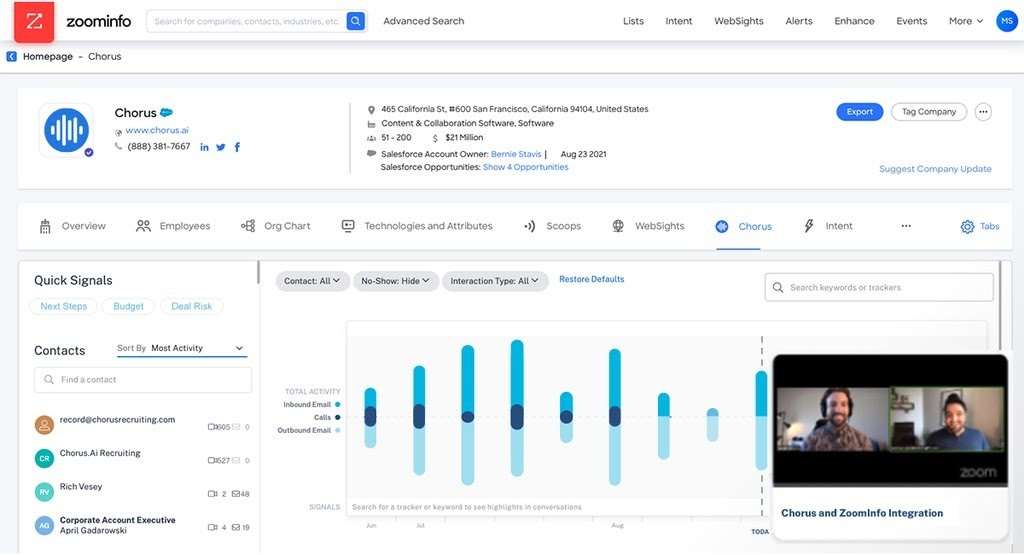
Chorus records and transcribes sales calls, surfaces AI-generated insights (talk ratios, sentiment, objection detection), auto-syncs deal intelligence to the CRM, and provides coaching scorecards and clip sharing.
Where Lusha Conversations syncs only to Salesforce, Chorus integrates natively with the broader ZoomInfo platform, feeding conversation context into the GTM Context Graph. The difference is scope: Chorus does not just record what was said.
It identifies why a champion went quiet, what a competitive mention predicts about deal risk, and which objection patterns correlate with closed-lost outcomes.
The GTM Context Graph: Intelligence that connects signals, conversations, and outcomes
Lusha provides buying signals and CRM enrichment as separate data streams. ZoomInfo's GTM Context Graph combines those streams into an intelligence layer that processes 1.5B+ data points daily, joining B2B data with CRM records, conversation intelligence from Chorus, email interactions, and behavioral signals.
A CRM records that a deal moved from Stage 3 to Stage 4. The GTM Context Graph identifies why: the CFO joined the last call with ROI-focused questions, matching the pattern behind closed-won deals in the same segment, and third-party signals show the company is hiring and researching a competitor.
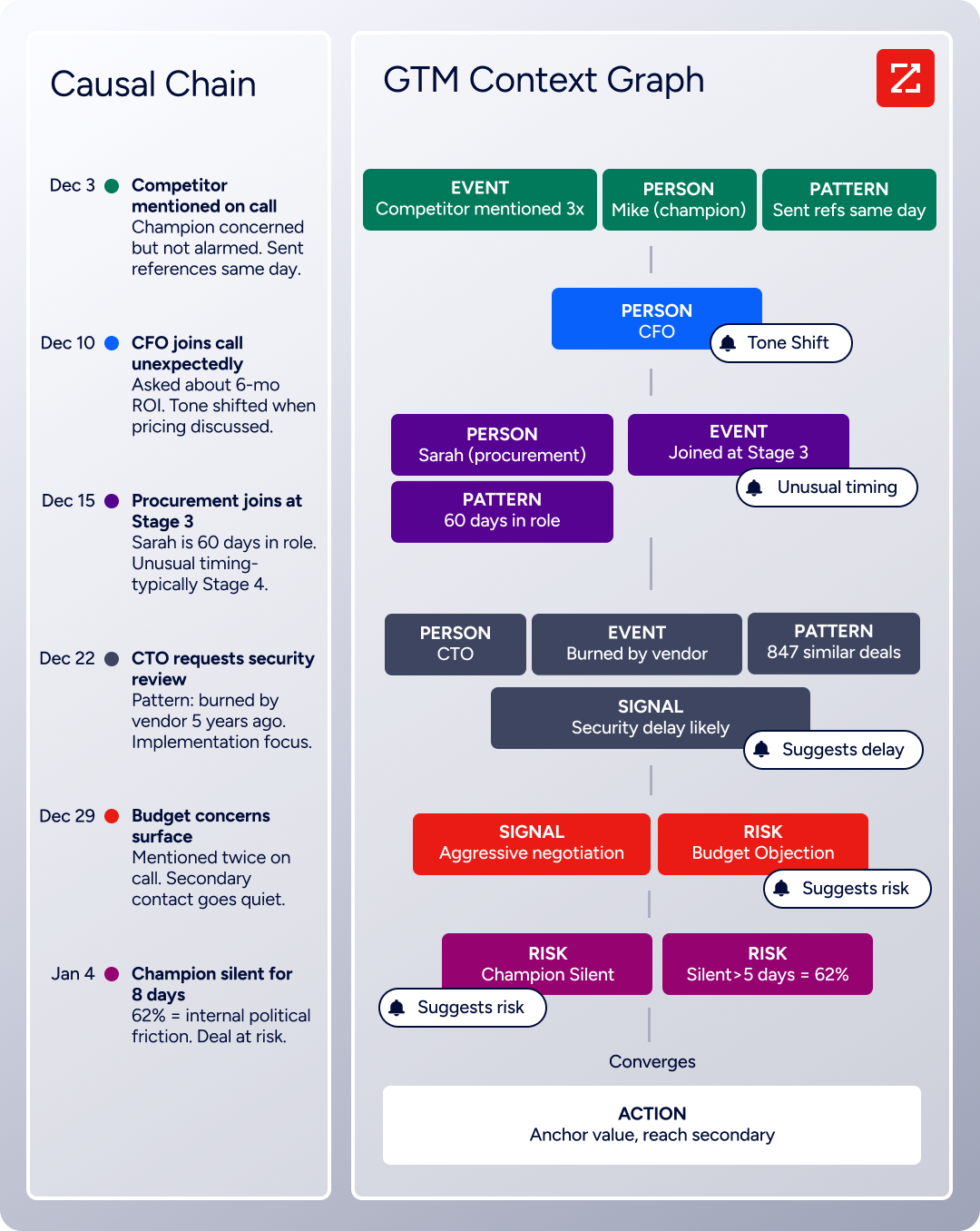
That reasoning flows into outreach, forecasting, and deal execution through GTM Workspace and GTM Studio.
Seismic's sales team attributed 39% of active pipeline to opportunities identified or influenced by ZoomInfo signals, boosted productivity by 54%, and saved 11.5 hours per week per seller. (Seismic Case Study)
ZoomInfo's Proprietary Intent and WebSights: Signals from a larger collection infrastructure
Lusha's intent data runs on Bombora's cooperative network.
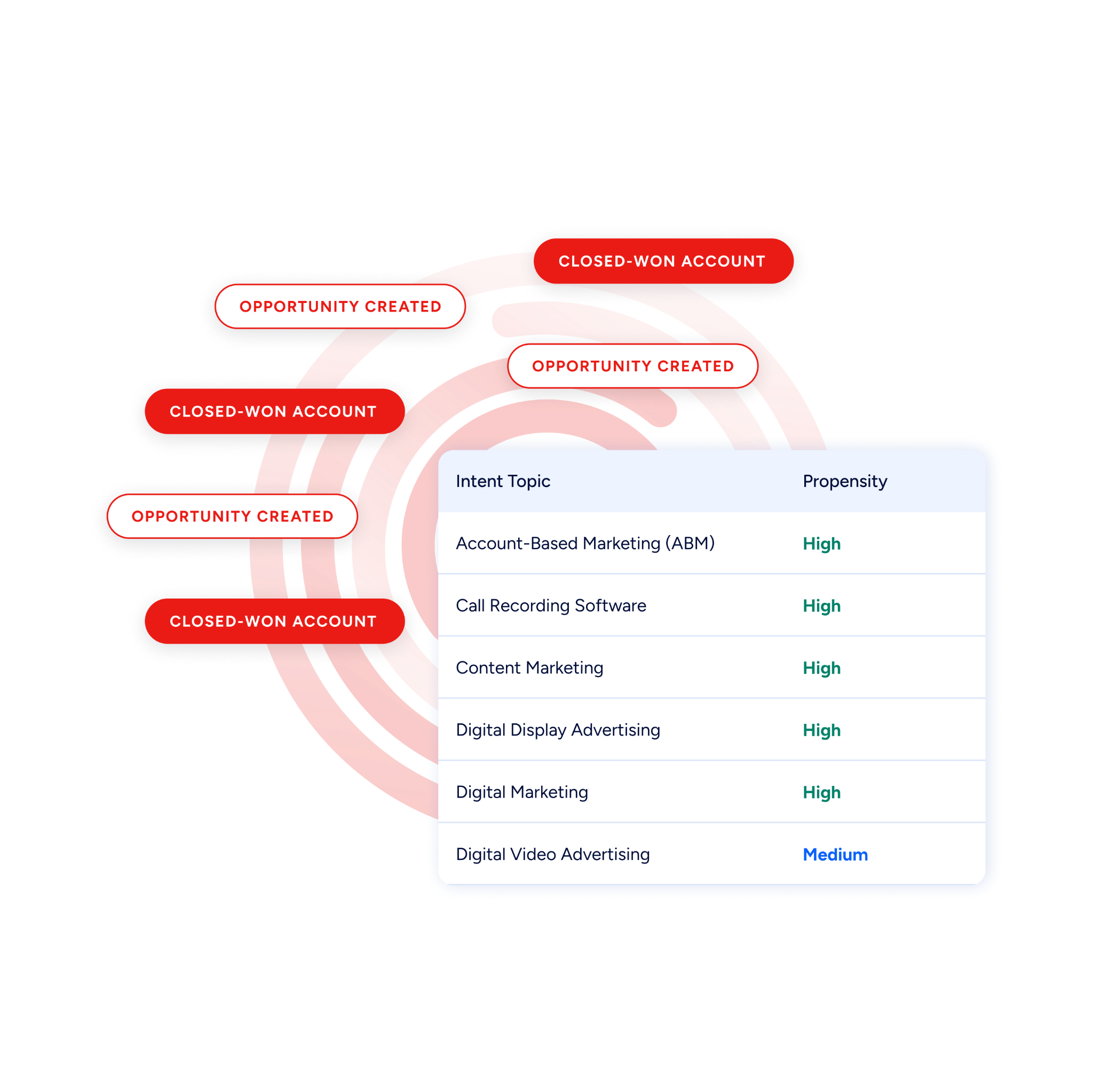
ZoomInfo Intent tracks signals from 210 million IP-to-Organization pairings and 6 trillion+ new keyword-to-device pairings sourced monthly.
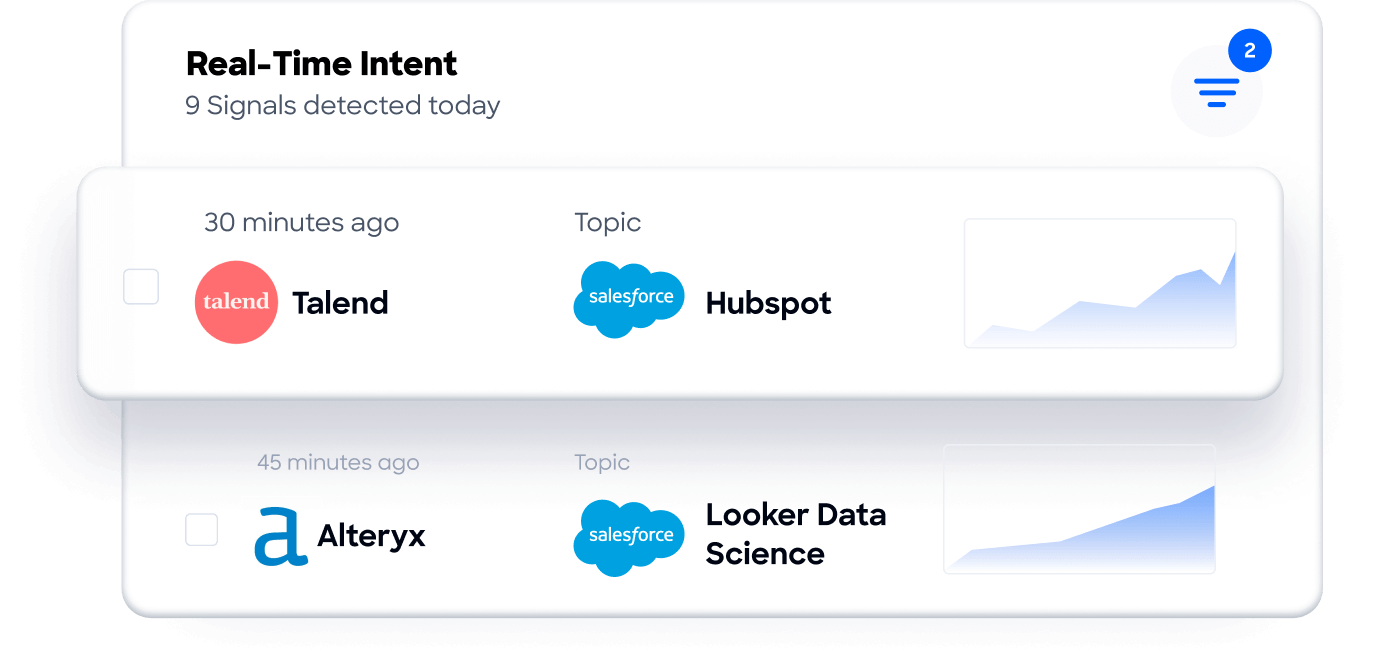
Guided Intent, exclusive to ZoomInfo, identifies the topics historically correlated with deal success rather than requiring manual topic selection.
On the website side, WebSights resolves anonymous website traffic to companies with Automatic Traffic Filtering that distinguishes real visitors from bots.
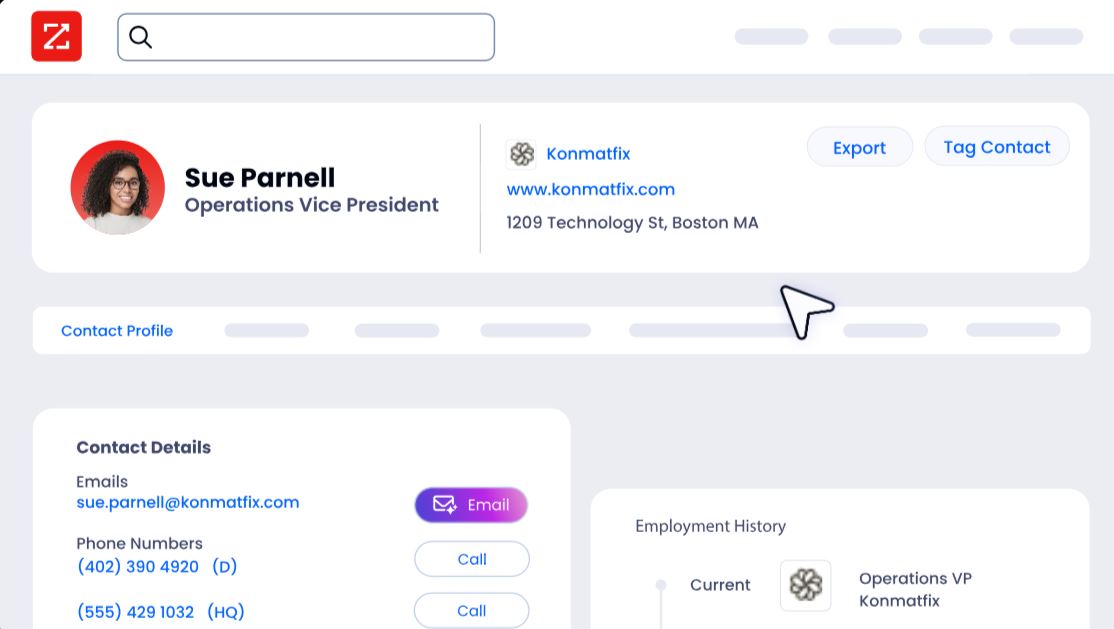
ZoomInfo Marketing goes further with contact-level site visitor identification, identifying the specific person visiting (not just the company) and triggering personalized outreach.
GTM Studio: Marketing orchestration and ABM that a data platform cannot provide
ZoomInfo’s GTM Studio addresses the marketing orchestration gap directly. Marketers, RevOps teams, and GTM engineers can build audiences using natural language, enrich with first- and third-party data, define triggers, and activate plays across channels (email, calls, display ads, direct mail, LinkedIn, Meta, Connected TV) without engineering support.
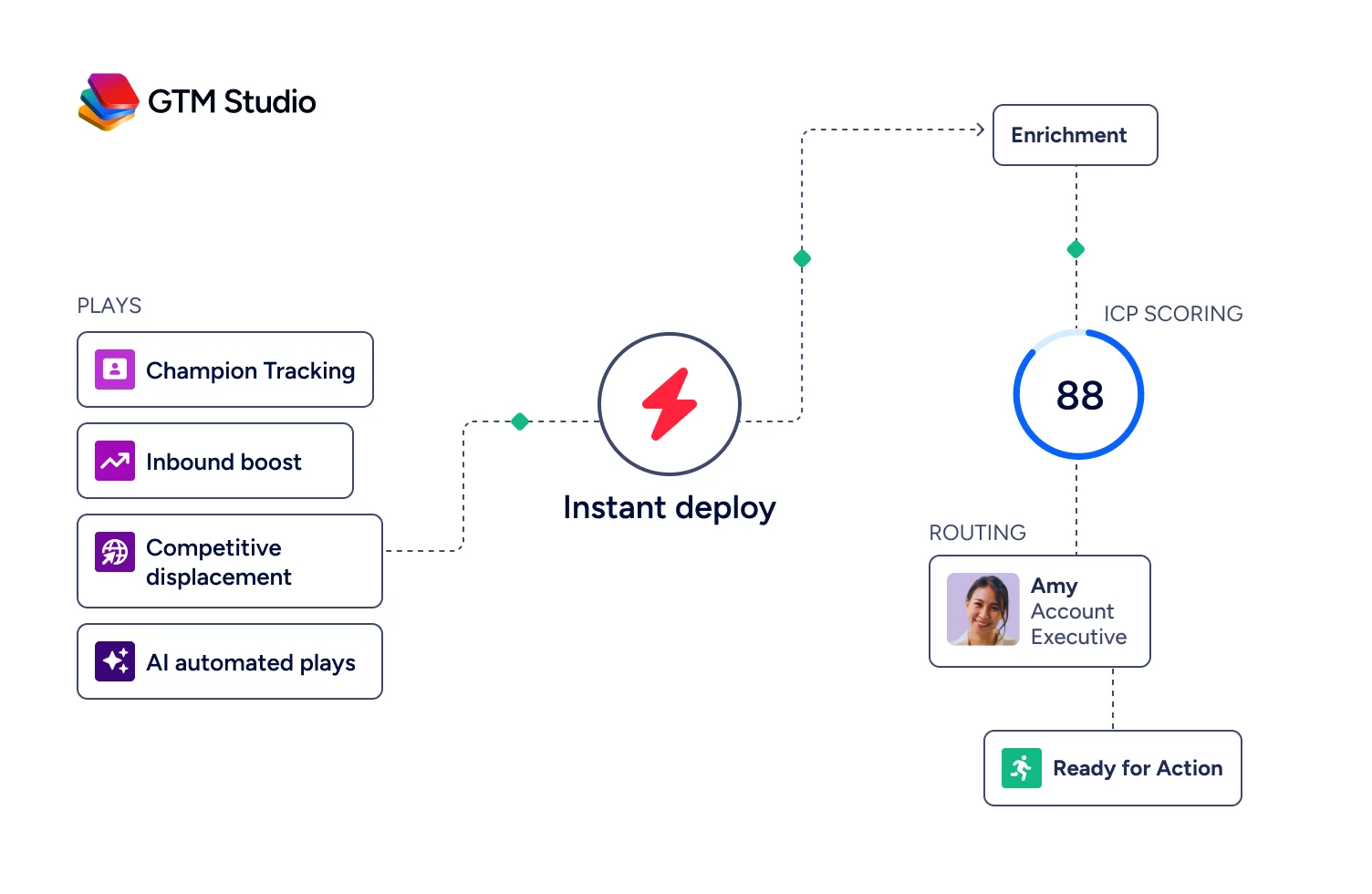
ZoomInfo Marketing includes a native Demand-Side Platform deploying display ads based on 300+ company attributes, FormComplete (reducing forms to a single field while auto-appending data), and Account Fit Scoring (predictive AI scoring 0 to 100 based on company attribute patterns). Pre-built GTM plays cover inbound acceleration, champion tracking, competitive displacement, and ICP targeting. Expansion plays that used to take 3 weeks now launch in 30 minutes.
ZoomInfo's Data Scale: A larger, deeper B2B database
ZoomInfo operates a B2B data platform spanning 500M contacts, 100M companies, 135M+ verified phone numbers, 120M direct-dial phone numbers, and 200M+ verified business email addresses. Compared to Lusha's 280M+ contacts and 30M+ company profiles, ZoomInfo covers nearly twice the contacts and more than three times the companies.
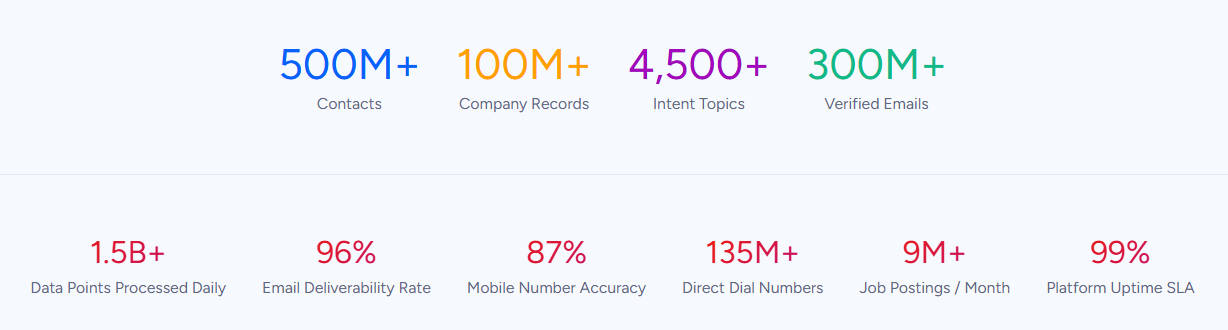
The data flows through a proprietary verification pipeline backed by 300+ human researchers and automated ML scanning of 28 million site domains daily, reaching up to 95% accuracy on first-party data.
Beyond contact records, the platform provides 300+ company attributes for segmentation, department org charts with decision-makers' direct dials, contact tracking with job-change alerts, and technographic profiles covering 30,000+ technologies across 200+ categories for 30+ million companies.
Global coverage extends to 34M+ company profiles outside North America, 200M+ professional profiles outside NA, and 45M+ mobile numbers outside NA.
In a Fortune 500 competitive RFP analyzing 25 million contacts across vendors, an independent consultant concluded that "no other competitor came even close."
Final Summary
Lusha is a focused, compliance-certified B2B data platform: verified contacts and direct dials with published accuracy benchmarks, AI-driven prospecting lists that learn from user activity, buying signals powered by Bombora intent data and proprietary technology tracking, and a certification stack (ISO 27701, ISO 27001, SOC 2 Type II, GDPR, CCPA) that clears procurement for EMEA-sensitive operations.
It covers outbound prospecting, CRM enrichment, and signal-driven timing well, with a lightweight email sequencing layer included at no extra cost.
It is lighter on the layers around that data: email-only outreach with no multi-channel sequencing, beta-stage conversation intelligence, unidirectional CRM sync, no marketing orchestration, and no intelligence layer connecting signals, conversations, and deal outcomes.
If your bottleneck sits beyond the contact record (understanding why deals move based on what happened across calls, emails, and intent signals, or orchestrating multi-channel marketing campaigns alongside sales execution), that is the ground ZoomInfo covers.
Its 500M-contact, 100M-company database provides verified contacts at nearly twice Lusha's scale. The
GTM Context Graph combines that data with CRM records, conversation intelligence from Chorus, and behavioral signals into an intelligence layer that captures why deals move. GTM Studio gives marketing teams multi-channel orchestration and ABM capabilities that a data platform does not include. And APIs and MCP deliver the same intelligence into any tool or AI agent.
See what that intelligence layer adds to your GTM motion: start with ZoomInfo Lite for free, or request a demo to see intent signals, verified contacts, and conversation intelligence flow into your pipeline.
FAQ
Does Lusha include multi-channel outreach sequencing?
No. Lusha Engage supports email sequences with AI-generated content, dynamic personalization, and auto-enrollment from lists, but it is email-only. There are no LinkedIn steps, SMS, phone dialing, or multi-channel workflows. Teams running structured outbound across multiple channels need to pair Lusha with a dedicated sales engagement platform like Outreach or Salesloft.
Which Lusha plan includes API access?
API access begins at the Pro plan ($52.45/month billed annually, starting at 7,200 credits per year). The Free and Starter plans do not include API access. Premium and Scale plans provide higher rate limits (up to 300 requests per minute and 18,000 to 50,000 requests per day) and additional capabilities under the API Advanced tier. Phone reveals cost 5 credits via API versus 10 credits on-platform.
How does Lusha's intent data work?
Lusha's buying intent signals run on Bombora's Company Surge data, which monitors content consumption across a cooperative of 5,000+ B2B websites spanning 4M unique domains and 16.3B monthly interactions.
The system measures weekly acceleration in topic research against a 12-week rolling baseline. When a company's research activity on a topic surges beyond normal levels, Lusha surfaces the signal with verified contact data attached.
ZoomInfo operates its own intent collection from 210 million IP-to-Organization pairings and 6 trillion+ keyword-to-device pairings monthly, with Guided Intent identifying topics correlated with historical deal success.
Can Lusha record and analyze sales calls?
Lusha Conversations records, transcribes, and analyzes sales meetings with AI-generated summaries, risk indicators, action items, and engagement metrics. However, it is currently in beta and available only to select Premium and Scale customers. CRM sync is limited to Salesforce (HubSpot and Pipedrive are in development).
For teams that need production-grade conversation intelligence with coaching at scale, ZoomInfo's Chorus offers a mature alternative backed by 14 technology patents.
Does Lusha offer bidirectional CRM sync?
No. Lusha's CRM integrations are unidirectional: Lusha pushes contact and company data out to CRMs (Salesforce, HubSpot, Pipedrive, Zoho, Bullhorn, MS Dynamics, and others), but changes made in the CRM do not sync back into Lusha. Teams that need a single source of truth with bidirectional data flow require a platform with deeper CRM integration architecture.
What does Lusha's free plan include?
Lusha offers a permanent free plan (not a time-limited trial) with 40 credits per month, one seat, the browser extension, basic and advanced search filters, verified emails and phone numbers, and CRM integrations.
No credit card is required. One credit reveals one email; phone number reveals cost 10 credits. At 40 credits per month, the free plan supports light prospecting but is restrictive for teams doing volume outbound.
Does Lusha support marketing orchestration or ABM?
No. Lusha is built for sales prospecting, CRM enrichment, and signal-driven outreach. It does not include display advertising, audience management, account-based marketing, or multi-channel campaign orchestration. Marketing teams need a separate platform for demand generation.
ZoomInfo's GTM Studio provides this: AI-powered audience building, pre-built GTM plays, and multi-channel activation across email, calls, ads, direct mail, LinkedIn, Meta, and Connected TV.
Does Lusha have an MCP server for AI tools?
Yes. Lusha operates an MCP server at mcp.lusha.com that streams verified B2B data into AI tools. It currently supports Claude (Remote MCP), ChatGPT (Remote MCP with Dev Mode), and Cursor (local). Nine tools are exposed, covering contact search, company search, prospecting filters, and enrichment. MCP requires a plan with API access (Pro or above), and credits follow the same rules as the public API. ZoomInfo also offers an MCP server at mcp.zoominfo.com, currently supporting Claude and ChatGPT, with additional MCP-compatible tools noted as coming soon.
