
Mutiny has built a strong AI platform for creating customer-facing content. Its agent-first approach lets sales reps and marketers generate personalized landing pages, deal rooms, business cases, and pitch decks in minutes, removing the dependency on design teams and engineering queues.
But as your go-to-market motion matures, you'll find that content generation is only one piece of the puzzle. Mutiny creates the assets, but it doesn't tell you which accounts to target, doesn't predict where buyers sit in their journey, and doesn't provide the B2B data foundation that makes personalization intelligent rather than cosmetic.
That's where this guide comes in. We'll explore Mutiny alternatives that excel where you need them most, whether you're looking to:
Power your entire GTM motion with B2B data, AI-driven intelligence, and account insights that inform every sales and marketing decision
Orchestrate enterprise ABM programs with native advertising, website personalization, and account intelligence in one platform
Predict which accounts are actively in-market and classify them by buying stage before they ever raise their hand
Start with a free, all-in-one marketing hub that includes landing pages, A/B testing, smart content, and CRM without a five-figure annual commitment
Build persistent, evolving content destinations that adapt to account signals across the full buying cycle
Generate on-brand ABM microsites and ad landing pages at a fraction of the cost
Deploy personalized omnichannel demand generation campaigns across email, ads, landing pages, and sales outreach from a single brief
This isn't about finding a "better" platform than Mutiny. It's about finding the right fit for your specific needs. Some teams will use these tools alongside Mutiny to fill capability gaps; others may find a single platform that covers more of their GTM workflow. Let's look at the alternatives.
The Best Mutiny Alternatives |
|---|
Best Alternative for B2B Data and AI-Powered GTM Intelligence We chose ZoomInfo because it solves the upstream intelligence gap that Mutiny doesn't address: knowing which accounts to target, who the decision-makers are, and what signals indicate buying readiness, all powered by a large-scale B2B data platform. |
Best Alternative for Enterprise ABM Programs with Native Advertising and Account Intelligence We chose Demandbase because it combines intent-driven account discovery, a B2B DSP, and full-funnel pipeline attribution in one platform, addressing the account identification and measurement gaps that content creation tools alone cannot solve. |
Best Alternative for Predictive ABM That Identifies In-Market Accounts by Buying Stage We chose 6sense because its predictive buying-stage classification and Signalverse intent engine tell growing teams which accounts are worth investing personalization resources in, and when. |
Best Alternative for Free Marketing Hub with Landing Pages, A/B Testing, and Built-in CRM We chose HubSpot because it offers a free-to-start platform for teams needing CRM, email marketing, landing page building, A/B testing, and smart content personalization without an enterprise-level commitment. |
Best Alternative for Persistent ABM Content Destinations and Digital Sales Rooms We chose Folloze because it replaces one-time asset creation with persistent buyer experiences that adapt to account signals in real time, with native 6sense and Demandbase integration closing the intelligence-to-experience gap. |
Best Alternative for On-Brand ABM Microsites and Ad Landing Pages at Lower Cost We chose Flint AI because it matches Mutiny's landing page use case with stronger brand extraction, programmatic CSV-driven page generation, and pricing that starts free, making ABM microsites accessible without enterprise budgets. |
Best Alternative for Omnichannel AI-Driven Demand Generation We chose Tofu because it generates personalized campaign content across email, landing pages, ads, and call scripts simultaneously from a single brief, solving the full demand generation bottleneck rather than the deal-cycle asset bottleneck alone. |
What is Mutiny?
Source: Mutiny
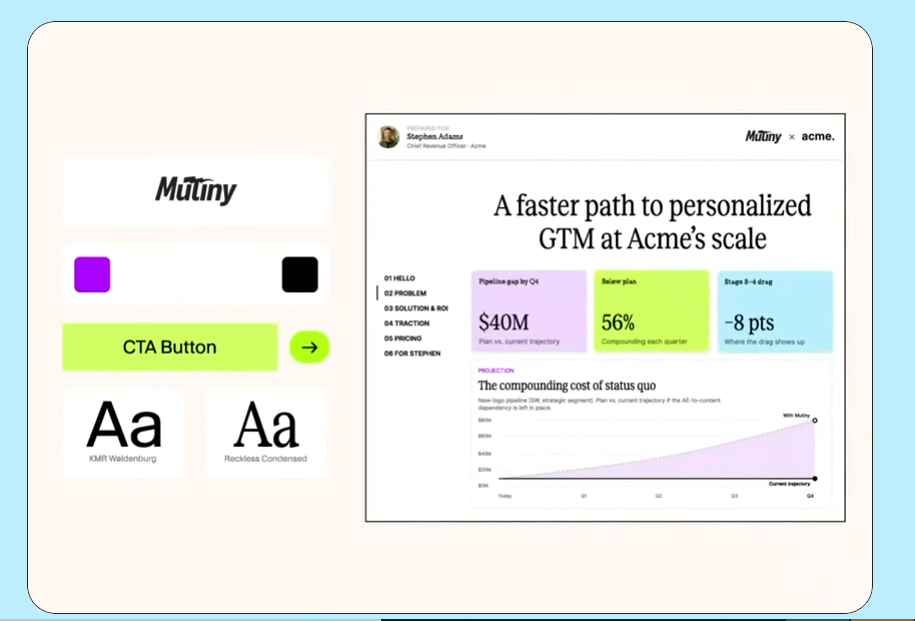
Mutiny is an AI-powered platform for creating customer-facing GTM content. Originally built as a website personalization tool, Mutiny was rebuilt as an agent-first platform in 2024-2025. The founding team deliberately killed the original SaaS product to redesign it around AI-driven content generation.
Its key features include:
AI Creative Agent that generates landing pages, deal rooms, pitch decks, business cases, and outreach assets from natural language prompts, with automatic brand extraction from a company's website URL
17+ Blueprint frameworks spanning the full deal cycle: prospecting (1:1 ABM, cold outreach), evaluation (demo pre-read, competitive comparison), negotiation (pricing proposal, executive business case), and expansion (impact report, expansion ABM)
Account Studio for centralized account data management with AI-driven enrichment, allowing teams to filter, segment, and personalize at scale using CRM data, CSV uploads, and natural language research prompts
Buyer engagement analytics showing which accounts visit shared assets, what pages they view, and how long they stay, with session replays and proactive notifications
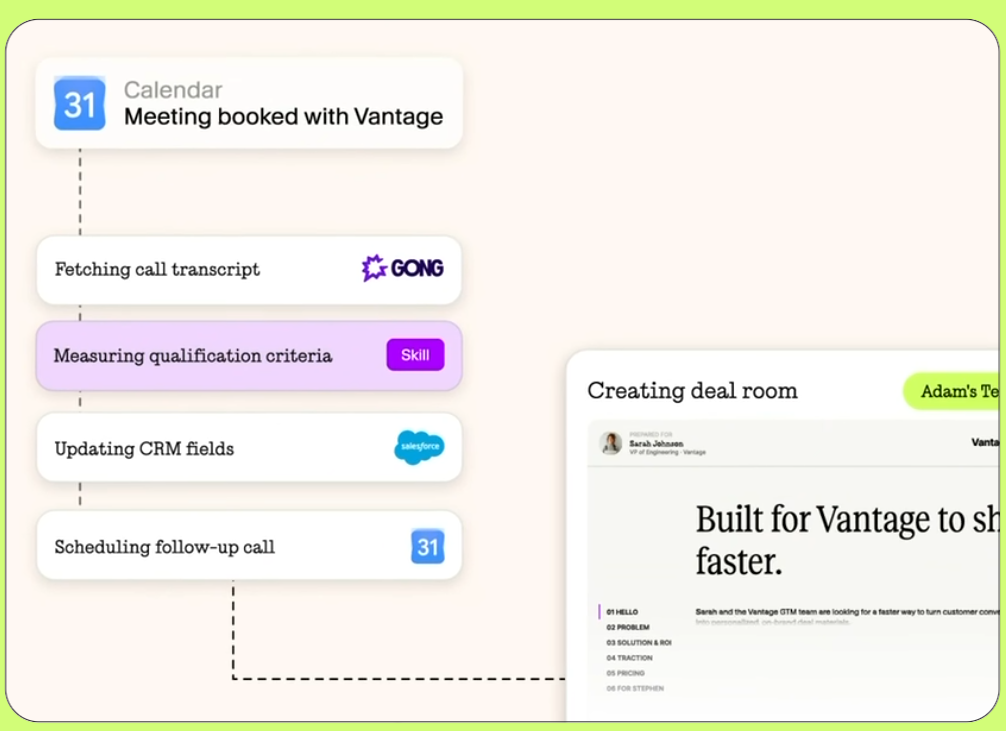
CRM and call transcript ingestion that automatically personalizes logos, case studies, industry messaging, and metrics per account based on Salesforce, HubSpot, and conversation intelligence data
MCP server enabling native workflow inside Claude and ChatGPT, so sellers can generate on-brand assets directly within AI assistant conversations
Mutiny excels at removing the dependency between sales teams and marketing/design resources. When an AE needs a personalized business case or an ABM marketer needs a 1:1 landing page for a named account, Mutiny produces brand-compliant, deal-specific assets in minutes rather than weeks.
Source: Mutiny
However, Mutiny focuses on the content creation layer of the GTM stack. It does not provide the upstream intelligence that determines which accounts to target, does not offer B2B contact or company data, and analytics are cited as a weakness in user reviews.
Teams that need the full picture (from account identification through content delivery to pipeline attribution) will find Mutiny covers one step in a larger workflow.
Looking for the B2B intelligence layer that powers smarter GTM decisions? ZoomInfo combines broad data with AI-driven account insights to tell you who to target, when to engage, and what to say. Learn more about ZoomInfo.
How We Curated Our List of Mutiny Alternatives
After testing Mutiny and researching the market, we found that teams evaluating alternatives typically face capability gaps in distinct categories. While Mutiny handles content generation well, GTM teams often need tools for:
Identifying which accounts are actively in-market before investing in personalized content for them
Accessing verified B2B contact and company data to power multi-threaded outreach
Running coordinated ABM programs with advertising, personalization, and account intelligence in one platform
Building and testing landing pages with native A/B testing and CRM-connected attribution
Creating persistent content destinations that evolve as accounts move through the buying cycle
Generating on-brand campaign pages at scale without enterprise-level pricing
Deploying full omnichannel campaigns across email, ads, and sales outreach from a single workflow
Each tool on this list addresses one or more of these needs. Some teams will pair these tools with Mutiny to strengthen their stack; others may find a platform that replaces Mutiny entirely.
DISCLAIMER: We aren't covering every tool in the market! Our focus is on highlighting alternatives that address specific limitations in Mutiny's capabilities for various use cases. The goal is to provide insights into tools that cater to specific GTM needs. |
|---|
1. ZoomInfo: Best Alternative for B2B Data and AI-Powered GTM Intelligence
ZoomInfo is an AI GTM platform built on a large B2B data foundation: 500M contacts, 100M companies, 135M+ verified phone numbers, and 200M+ verified business emails.
By fusing this data with your CRM records, conversation transcripts, and behavioral signals, ZoomInfo's GTM Context Graph (which processes 1.5B+ data points daily) reveals the full context of your accounts. That context gives AI the fuel to show not just what happened, but why it happened, and which actions to take next.
Its key features include:
B2B data spanning identity data, company context, and dynamic signals, verified by 300+ human researchers with up to 95% accuracy on first-party data
GTM Context Graph that unifies your CRM records, conversation intelligence, intent signals, and behavioral data into a single intelligence layer that captures why deals move or stall
Buyer Intent Data tracking signals from 210 million IP-to-Organization pairings with Guided Intent that identifies topics historically correlated with deal success
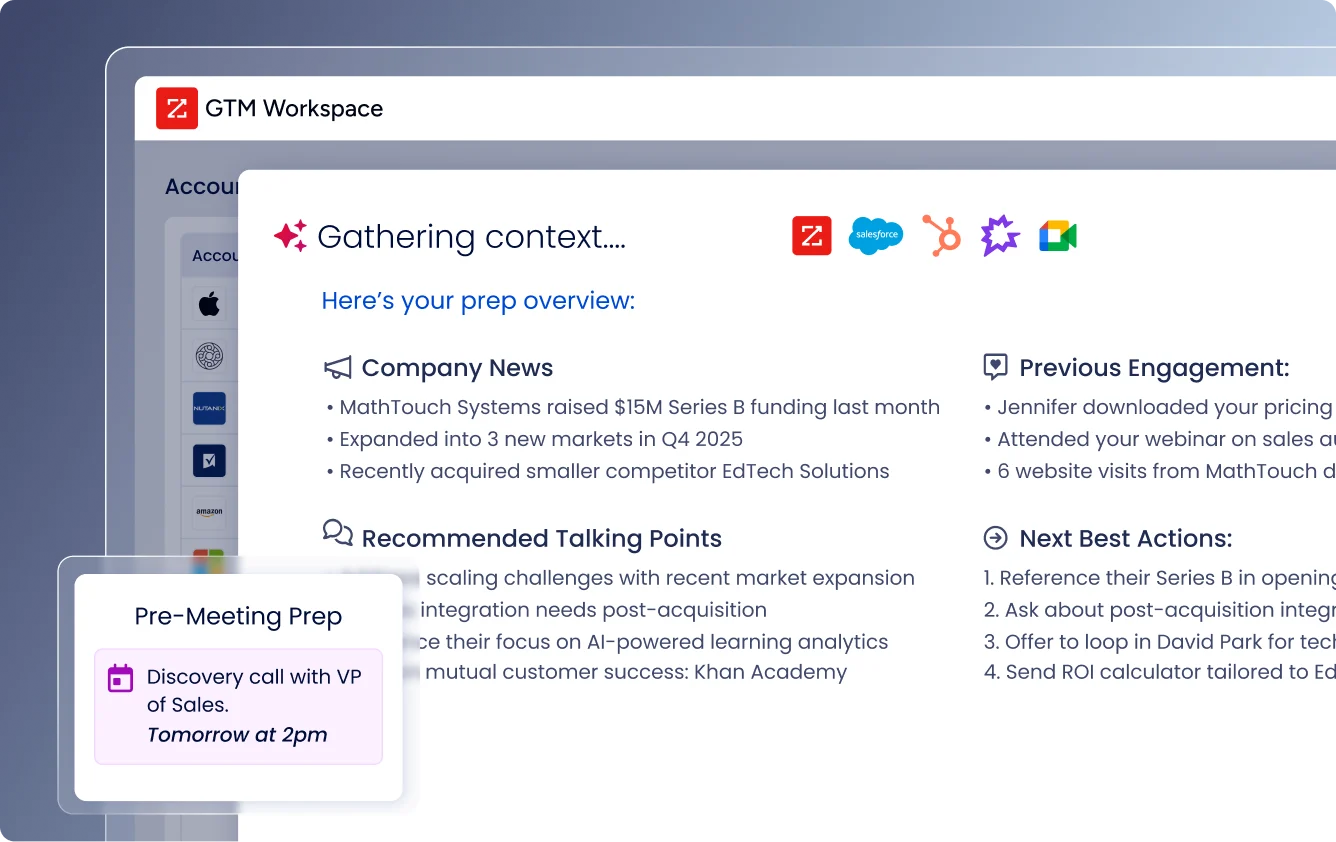
GTM Workspace for sellers, providing AI-powered execution with prioritized accounts, AI-drafted outreach, and deal intelligence in one place
GTM Studio for marketers, RevOps, and GTM engineers, offering an AI-powered orchestration canvas where audience definition, campaign orchestration, and pipeline measurement happen in natural language
APIs and MCP delivering the same intelligence to any custom agent, internal tool, or partner platform
Mutiny creates personalized content for accounts you've already identified. ZoomInfo solves the broader challenge: identifying which accounts to target, understanding who the decision-makers are, detecting when they're actively in-market, and powering the intelligence layer that makes every GTM motion more effective.
For teams whose content creation is strong but whose account targeting, data quality, or pipeline intelligence is the bottleneck, ZoomInfo addresses the foundation that content tools build on.
Why Choose ZoomInfo Over Mutiny for GTM Intelligence
Mutiny excels at producing customer-facing assets. ZoomInfo provides the intelligence infrastructure that determines what those assets should say, who they should reach, and when.
B2B Data: Know Who to Target and How to Reach Them
Mutiny's Account Studio can enrich account data with AI-generated web research, answering questions like "Have they raised funding recently?" using publicly available sources. This adds useful context to a named account list. But it does not provide verified contact data: direct-dial phone numbers, validated business email addresses, org charts, or technographic profiles.
ZoomInfo's data platform covers these dimensions at scale: 120M direct-dial phone numbers, 200M+ verified business email addresses, 300+ company attributes, department org charts with decision-makers' contact information, and technographics tracking 30,000+ technologies across 200+ categories at 30+ million companies.
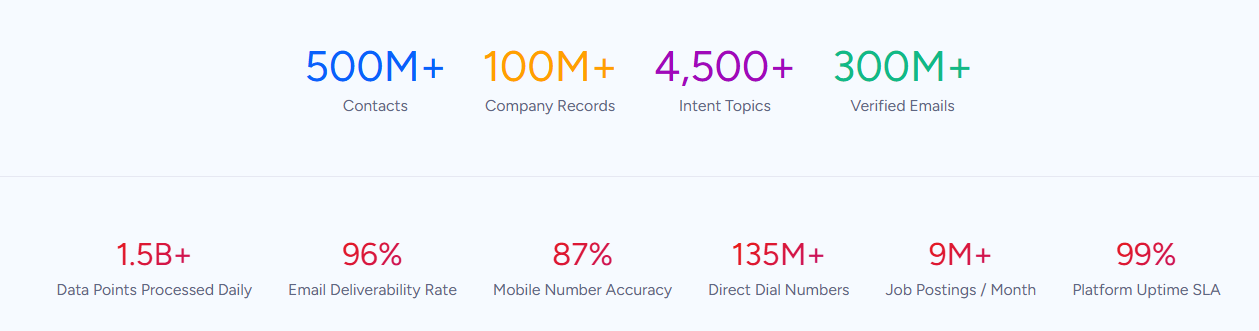
The data quality is externally validated: in a Fortune 500 competitive RFP analyzing 25 million contacts across vendors, the independent consultant concluded that "no other competitor came even close."
For teams using Mutiny to personalize deal rooms and business cases, the difference is foundational. You can't personalize an executive business case for a VP of Finance you can't find. You can't multi-thread a deal without the org chart. ZoomInfo provides the verified contact intelligence that makes downstream personalization effective.
ZoomInfo in Action: Your ABM team is building a campaign targeting enterprise accounts evaluating a competitor's solution. Instead of manually researching each account, ZoomInfo surfaces the complete buying committee: the VP of Marketing who's the likely champion, the CFO who controls budget, and the IT Director who evaluates integrations.
Each contact comes with a verified direct dial and business email. Your team then uses that intelligence to create personalized Mutiny assets, or uses ZoomInfo's own GTM Workspace to draft outreach that addresses each stakeholder's specific concerns.
GTM Context Graph: Understand Why Deals Move, Not Just That They Moved
Mutiny tracks engagement at the asset level: which accounts visited a deal room, how long they stayed, and from which channel. This is valuable signal for individual deals. But it cannot tell you why a deal accelerated, why a champion went quiet, or what patterns predict closed-won outcomes across your pipeline.
ZoomInfo's GTM Context Graph addresses this at a structural level. It fuses ZoomInfo's third-party data with your CRM records, conversation transcripts (via Chorus), email threads, and product usage signals into one intelligence layer.
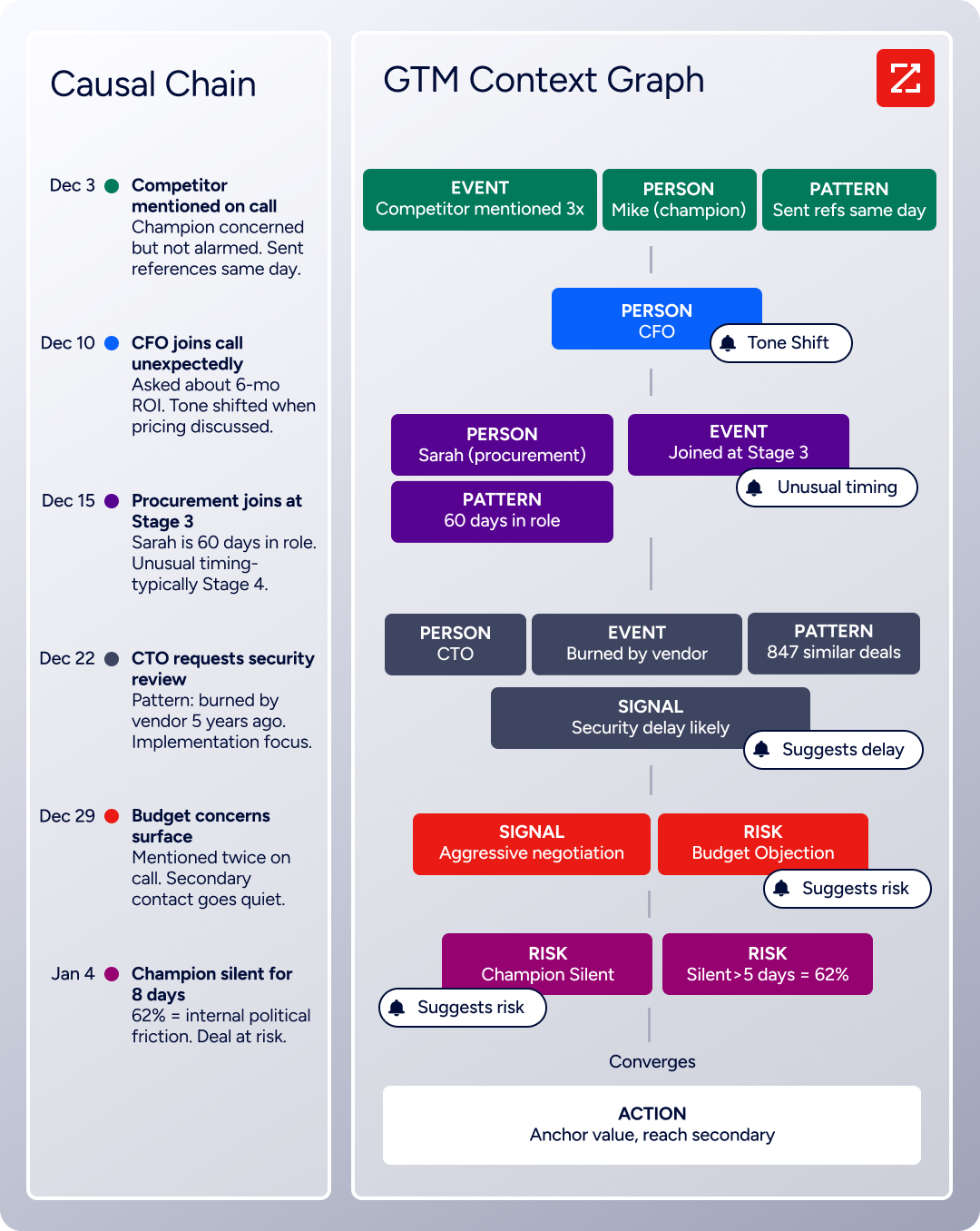
The result: AI that doesn't just record that a deal moved from Stage 3 to Stage 4, but identifies that executive sponsorship entering at this stage, combined with ROI-focused questions from the CFO, matches the pattern behind closed-won deals in your segment.
As ZoomInfo's CPO Dominik Facher explains: "The CRM recorded the state change. It has no record of why it happened."
The GTM Context Graph captures that decision context and makes it machine-readable, so AI-drafted follow-ups address the specific concern the CFO raised, plays target accounts whose signal combinations match your actual win patterns, and forecasts weight deals by buying evidence rather than stage labels.
ZoomInfo in Action: Your sales team closes a $200K deal after the CFO joined the final evaluation call. ZoomInfo's GTM Context Graph captures that executive sponsorship at this stage, combined with the CFO's questions about six-month ROI, correlates with 73% of closed-won deals in your segment.
When twelve other accounts show the same pattern, GTM Workspace surfaces them automatically with AI-drafted outreach addressing the specific ROI concerns executives in this segment typically raise.
ZoomInfo helped Seismic's sales team boost productivity by 54% and attribute 39% of active pipeline to opportunities identified or influenced by ZoomInfo signals. As Chief Business Officer Toby Carrington put it: "That combination of our internal CRM data, external signals, and AI that's given all that context has helped us craft very specific account- and persona-based messages. And people have responded to them right away."
Buyer Intent Data: Know Which Accounts to Target Before They Raise Their Hand
Mutiny's value starts after you've identified which accounts to pursue. The platform requires your team to bring the account list; it does not surface which accounts are actively researching solutions in your category.
ZoomInfo Intent fills this gap directly, tracking signals from 210 million IP-to-Organization pairings and 6 trillion+ keyword-to-device pairings sourced monthly.
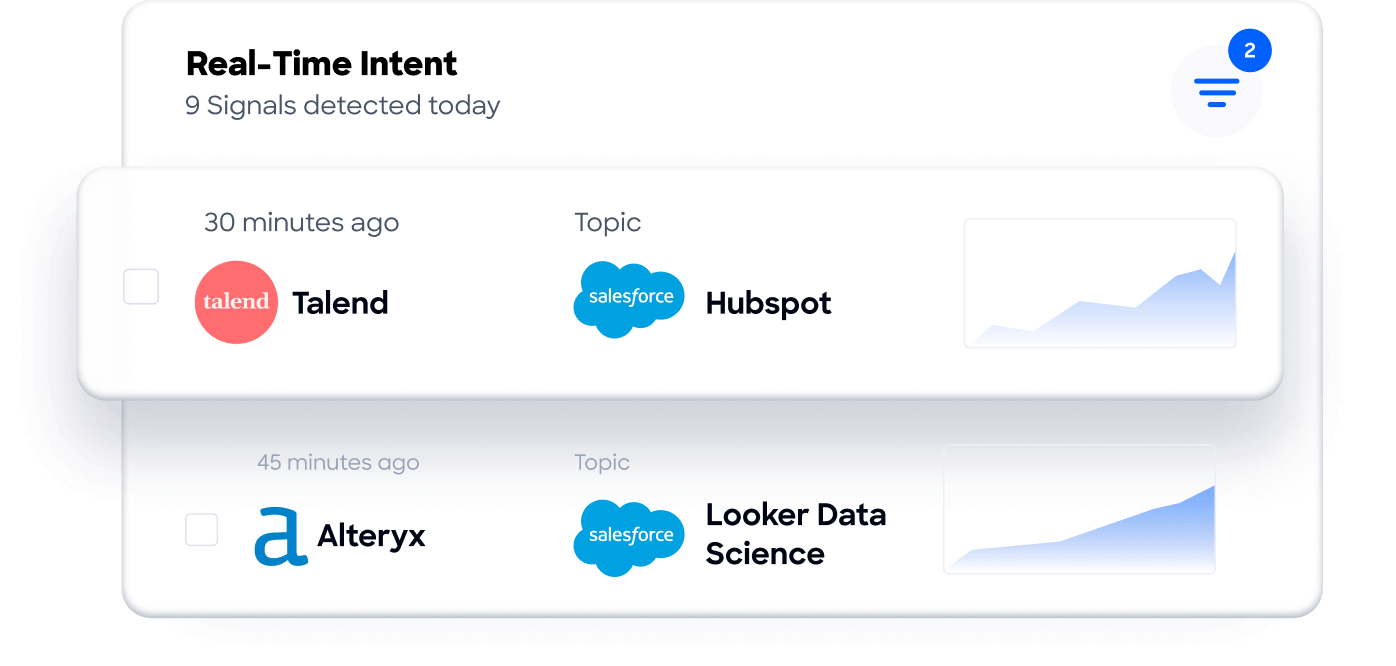
Guided Intent, exclusive to ZoomInfo, identifies topics historically correlated with deal success rather than requiring manual topic selection.
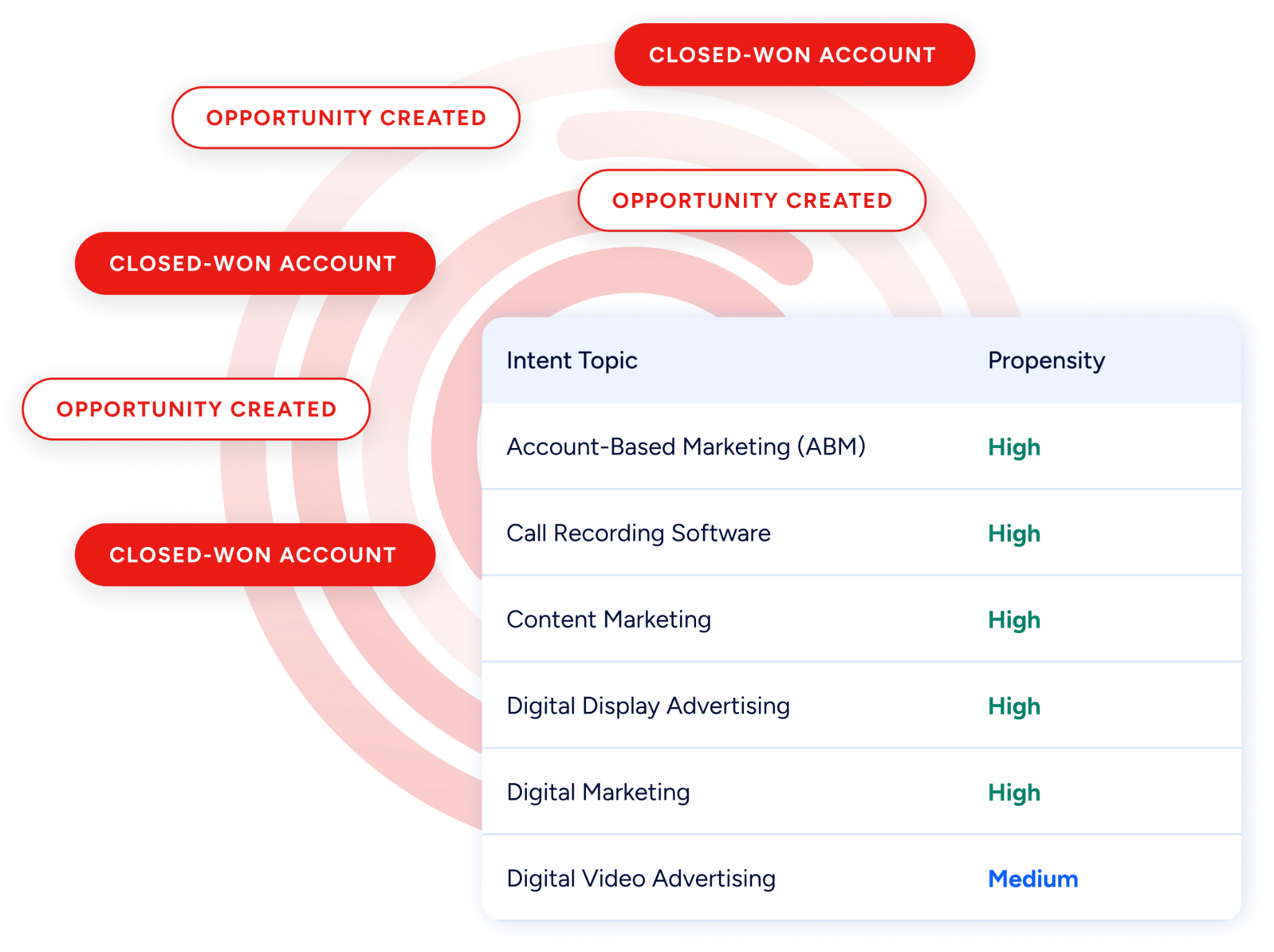
Combined with WebSights (which resolves anonymous website traffic to companies, including buying team identification), ZoomInfo identifies accounts consuming competitor content, reviewing vendor comparisons, and reading industry publications about the problems your product solves, before those accounts ever fill out a form.
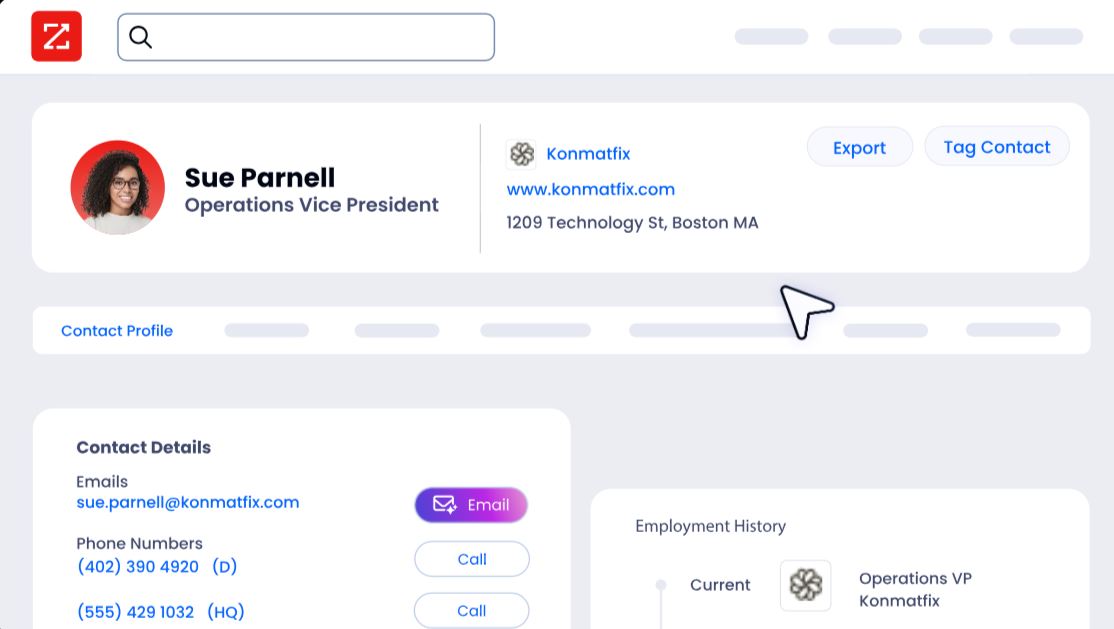
For teams that build ABM target lists based on firmographic criteria and then use Mutiny to personalize content for those lists, ZoomInfo adds the intent layer that tells you which accounts are actually worth investing in right now.
ZoomInfo in Action: Instead of creating personalized landing pages for all 200 accounts on your target list, ZoomInfo's Guided Intent identifies the 35 accounts actively researching your product category this month. Your team concentrates Mutiny credits (or ZoomInfo's own GTM Workspace outreach) on accounts showing real buying signals, rather than spreading resources across accounts that aren't in-market yet.
Levanta's CEO Ian Brodie described ZoomInfo's evolution: "ZoomInfo's not just a contact data company anymore. They've built a full system of execution. GTM Intelligence actually works the list, writes the outreach, triggers the play, and helps drive predictable growth."
Universal Access: Use ZoomInfo Intelligence in Any Tool or Workflow
Mutiny's integrations run through Pipedream and cover CRM connections (Salesforce and HubSpot on Enterprise), sales engagement tools (Outreach and Salesloft), and conversation intelligence (Gong). Its MCP server enables asset creation from within Claude or ChatGPT.
ZoomInfo's access architecture is broader. APIs and MCP deliver ZoomInfo's data and GTM Context Graph into any custom agent, internal tool, or partner platform.
ZoomInfo's App Marketplace lists 172+ integration partners across CRM, marketing automation, sales engagement, revenue intelligence, data warehouse, and communications categories.
Cloud Partners enable direct data ingestion into AWS, Google Cloud, Snowflake, and Databricks.
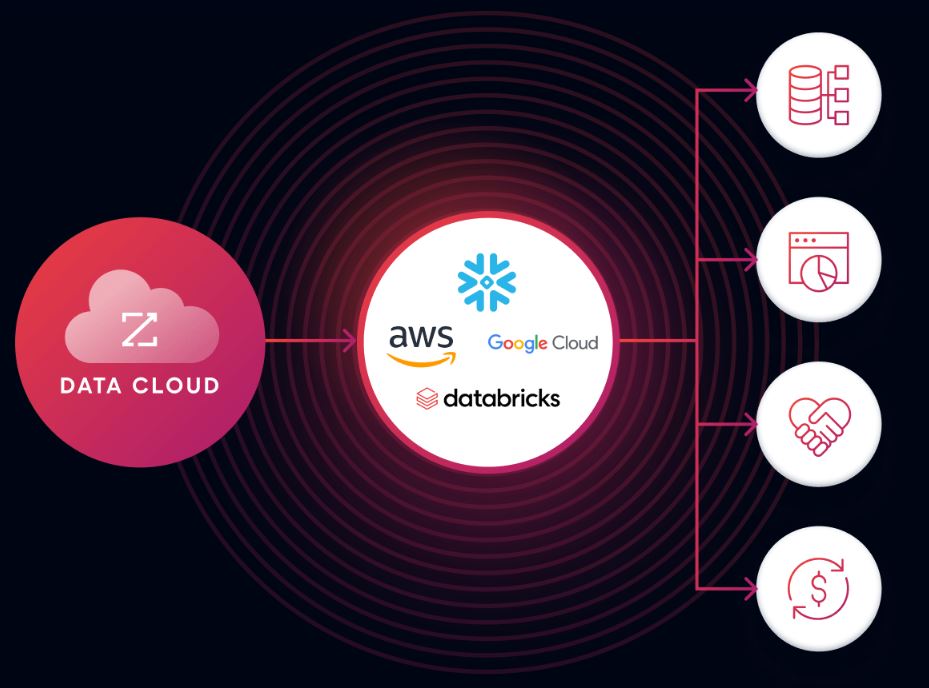
The critical point: all access methods (APIs/MCP, GTM Workspace for sellers, GTM Studio for marketers and RevOps) draw from one GTM Context Graph. The same data foundation, the same reasoning, the same continuously learning model. Nothing is degraded or siloed by which surface you use.
BDO Canada's Senior Marketing Intelligence Analyst Jerry Wilson highlighted this flexibility: "The plug-and-play aspect of the API means I can integrate it very easily into any process and get information at a moment's notice." The firm achieved an 87% reduction in time spent on internal data dashboard updates using ZoomInfo's API.
NOTE: We looked at other B2B intelligence platforms and considered tools like Apollo.io and Lusha for data enrichment. Apollo offers a strong sales engagement and prospecting workflow with competitive contact data pricing, while Lusha excels at phone number verification for SDR teams. However, neither matches ZoomInfo's scale across all three data dimensions (identity, company context, and dynamic signals), nor does either offer the GTM Context Graph's ability to unify first-party and third-party data to capture why deals move.
ZoomInfo Pricing
ZoomInfo uses a consumption-based pricing model where pricing scales around enterprise license agreements, data access, API consumption, and AI activity. All paid plans are custom-quoted through direct sales.
ZoomInfo Lite is a permanent free tier (not a trial) that includes access to ZoomInfo's B2B database with 100M+ verified profiles, 10 monthly export credits, individual and company searches, the ReachOut Chrome Extension, and WebSights Lite. No credit card or annual commitment required.
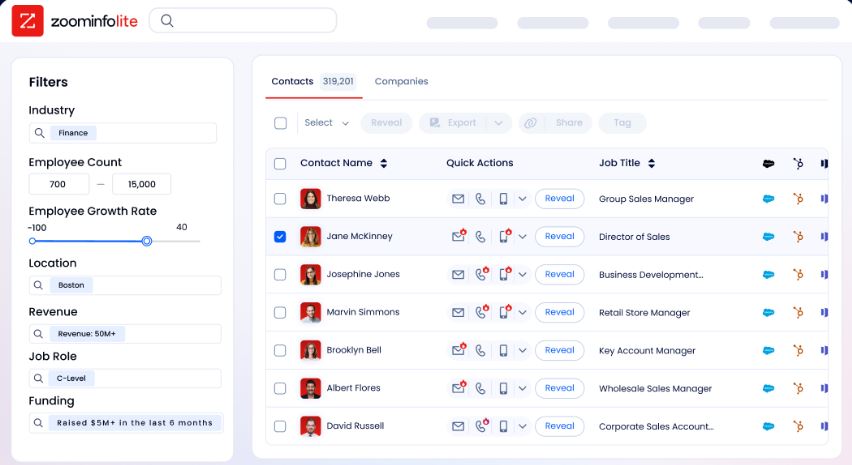
Paid plans are organized into Sales (Professional, Advanced, Enterprise), Marketing (Marketing Demand, ABM Lite, ABM Enterprise), and standalone products (Chorus, Chat). Each tier adds progressively deeper capabilities: Professional provides contact and company data with CRM integrations; Advanced adds AI-driven account prioritization, intent signals, and GTM plays; Enterprise includes real-time buyer intent, advanced workflows, and AI-generated account summaries.
ZoomInfo also offers a 7-day free trial separate from Lite, with access to core platform features including contact and company search, sales intelligence tools, intent signals, and email outreach.
Who Should Use ZoomInfo?
Choose ZoomInfo if:
Your team's bottleneck isn't content creation but knowing which accounts to target, who the decision-makers are, and when those accounts are actually in-market. ZoomInfo's data foundation and intent signals solve the upstream intelligence problem that content tools assume is already solved.
You need verified B2B contact data (direct dials, business emails, org charts, technographics) to power multi-threaded outreach across buying committees, not just AI-generated web research about whether an account raised funding recently.
You want an AI intelligence layer that synthesizes your CRM data, conversation transcripts, intent signals, and third-party B2B data to surface why deals move or stall, so every outreach draws on pattern-matched deal intelligence rather than template personalization.
Your go-to-market motion spans sales, marketing, and RevOps, and you need a single intelligence platform accessible through native front-ends (GTM Workspace, GTM Studio) or through APIs and MCP in any tool your team already uses.
Ready to power your GTM motion with an intelligence layer that makes every decision smarter? Start with ZoomInfo Lite for free or request a demo to see the full platform in action.
2. Demandbase: Best Alternative for Enterprise ABM Programs with Native Advertising and Account Intelligence
Source: Demandbase
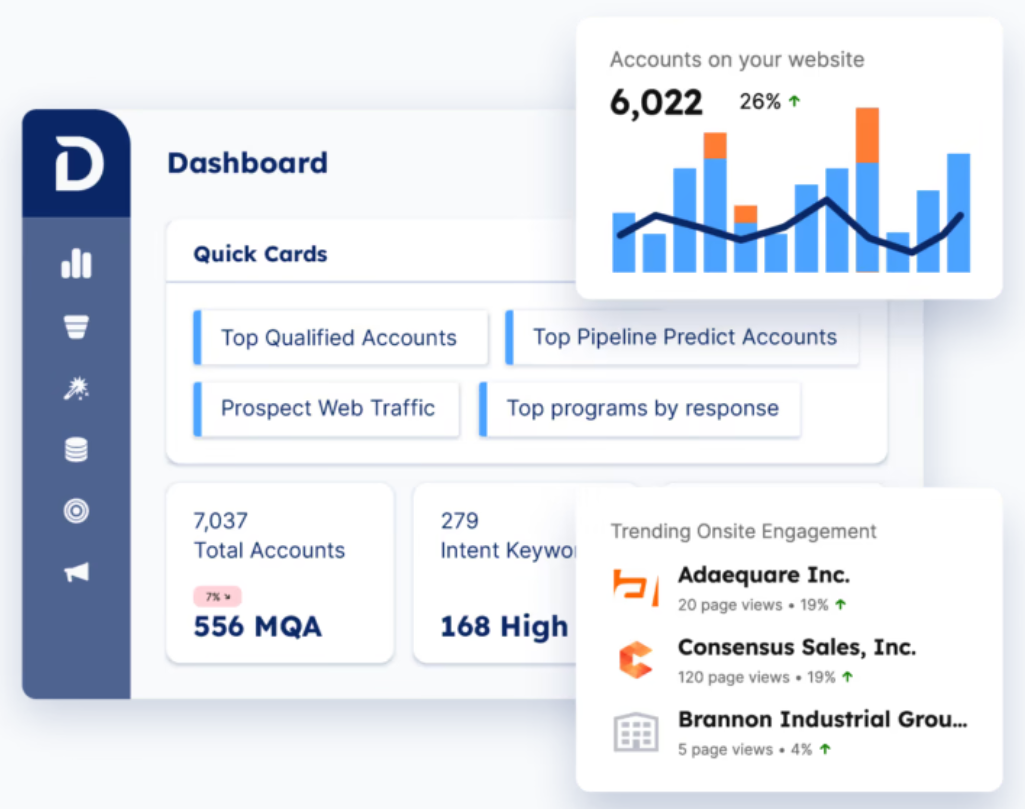
Demandbase is a B2B pipeline AI platform built for enterprise marketing and sales teams that need to orchestrate the full account-based go-to-market motion, from identifying in-market accounts to running targeted advertising, personalizing web experiences, and tracking the full buying committee through to closed revenue. Its key capabilities include:
Intent tracking processing 2 trillion signals per month from 70B+ page views daily, covering 810,000+ keywords in 133 languages
Native B2B DSP (Piper) running display, video, native, and connected TV ads directly to named accounts from within the same account intelligence system
Website personalization that dynamically serves account-specific content based on real-time intent signals and firmographic profile
Buying Groups as a first-class platform object, with AI identifying champions, influencers, and decision-makers from a 150M+ contact database
Agentbase AI agents handling account research, buying-group identification, and next-action recommendations autonomously
Mutiny generates the content; Demandbase powers the full ABM infrastructure around it. For enterprise teams running complex, multi-stakeholder sales cycles where content creation is one component of a broader orchestration need, Demandbase provides the account intelligence, advertising execution, and pipeline attribution that content tools alone cannot deliver.
Why Choose Demandbase Over Mutiny for Enterprise ABM Programs
Demandbase stands out in the following areas:
Intent-Driven Account Discovery Before Asset Distribution.
Mutiny's value starts once you already have an account to target. Demandbase addresses the upstream problem: its intent layer processes over 2 trillion signals per month gathered directly from the bidstream via its own DSP, augmented with third-party signals from Bombora Surge, G2, and TrustRadius. This means Demandbase identifies accounts consuming competitor content and researching relevant topics before they ever fill out a form. For enterprise ABM programs, this discovery window is the difference between entering a conversation first and catching up to a deal a competitor already owns.
Native B2B Advertising Inside the Account Intelligence Layer.
Mutiny connects to LinkedIn Ads for distribution, but the ad targeting and optimization live in LinkedIn's system, separated from your account intelligence. Demandbase eliminates this fragmentation with Piper, the only B2B-specific DSP. It supports display, retargeting, native, video, and connected TV with social channel audience sync for LinkedIn, Facebook, Instagram, Google, YouTube, Bing, Adobe, and X.
Multi-Touch Attribution and Full-Funnel Pipeline Reporting.
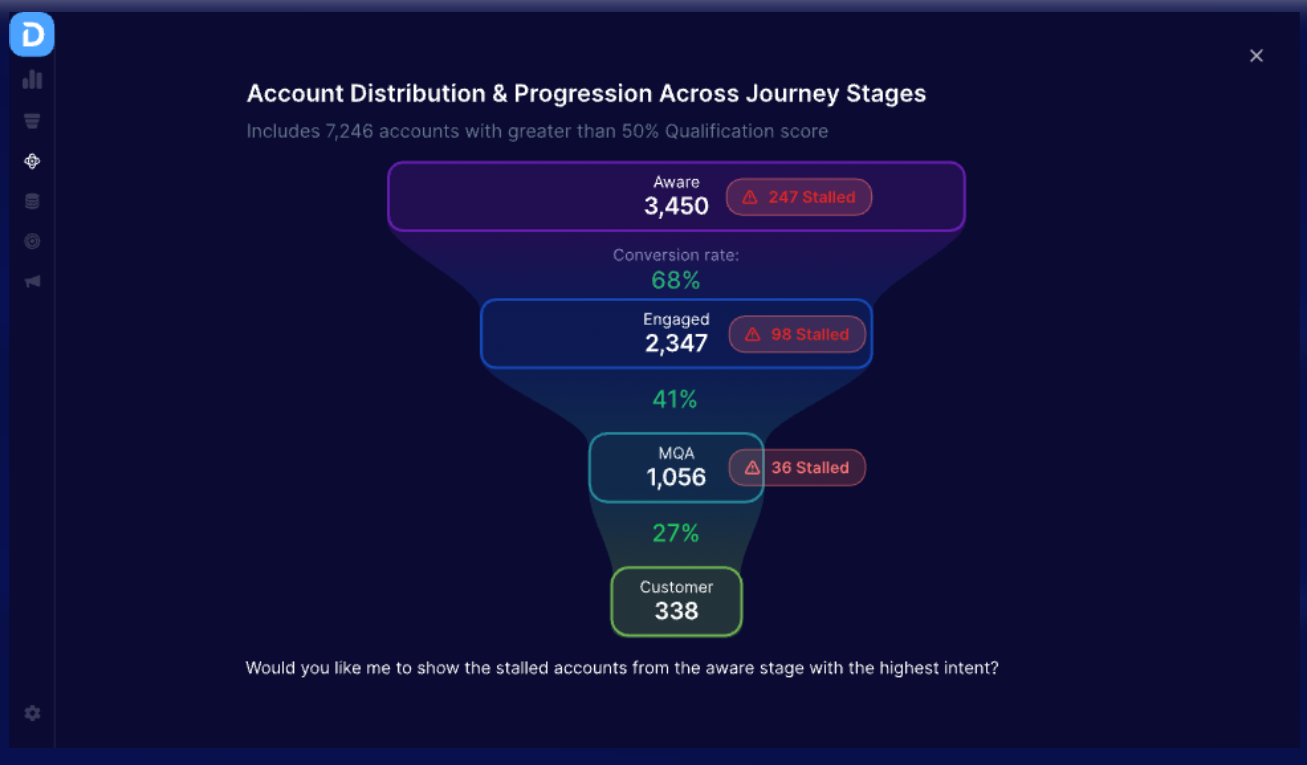
Mutiny tracks individual asset engagement but lacks multi-touch attribution and pipeline influence reporting. Demandbase's Deal Story reconstructs every interaction that preceded a deal close in a single timeline. Program Impact shows how each campaign influences pipeline and revenue. Journey Stage analytics track volume, velocity, and conversion at every stage from Aware through Closed-Won.
Source: Demandbase
NOTE: We also evaluated 6sense and Terminus (now DemandScience). While 6sense is a strong ABM competitor with comparable intent data and predictive scoring, Demandbase was selected here because its native B2B DSP and website personalization are more directly comparable to Mutiny's asset distribution use cases at the enterprise tier. Terminus is positioned more narrowly around advertising and account targeting.
For a comprehensive look at how Demandbase performs as an enterprise ABM platform, see our Demandbase review.
Demandbase Pricing
Demandbase does not publish specific dollar amounts. The pricing page confirms all pricing is negotiated through direct sales with a hybrid structure: a flat platform fee covering all software and services, plus a per-user fee that scales with team size.
Demandbase One (Flagship): Includes the full suite: Marketing, Sales Intelligence, Advertising via Piper DSP, Buying Groups, and Agentbase AI Agents. Cannot be split into Marketing-only or Sales-only purchases.
Advertising Standalone: Available as an entry point for buyers not yet ready for the full suite.
Data Standalone: Account Intelligence (firmographics, technographics, contact data, intent) delivered via REST API or data feeds.
Free tools include a B2B Intent Data preview showing top 10 in-market accounts for a selected segment, an ROI calculator, and an advertising planning calculator.
For a detailed breakdown of Demandbase's pricing tiers and what each includes, see our Demandbase pricing guide.
Who Should Use Demandbase?
Choose Demandbase if:
Your enterprise ABM program needs advertising, website personalization, and account intent intelligence managed from one platform, and you're currently managing these motions across separate vendors that don't share data.
You're running complex, multi-stakeholder B2B sales cycles with buying committees of 5-10+ people, and need buying group identification and committee-level attribution as a native workflow.
Your team needs to justify ABM investment with full-funnel pipeline attribution, journey stage conversion metrics, and deal influence analytics that Mutiny's engagement tracking cannot deliver.
3. 6sense: Best Alternative for Predictive ABM That Identifies In-Market Accounts by Buying Stage

Source: 6sense
6sense is an agent-powered revenue intelligence platform that gives B2B teams the ability to identify which accounts are researching solutions and where those accounts sit in the buying journey, before any prospect books a demo or fills out a form. Its key capabilities include:
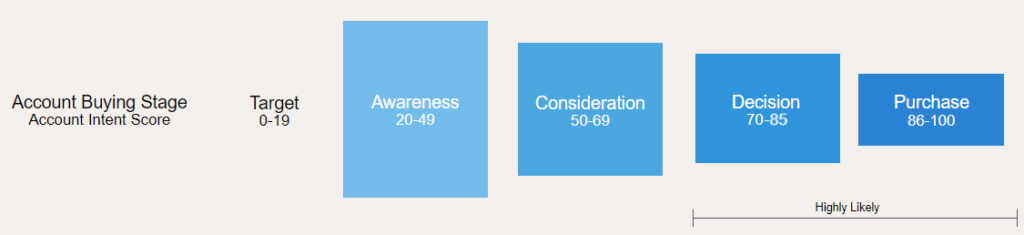
Predictive buying-stage classification (Awareness, Consideration, Decision, Purchase) powered by per-customer AI models trained on historical won/lost opportunity data
Signalverse intent engine processing over one trillion signals daily from 415M+ company profiles and third-party intent partners including Bombora, G2, TrustRadius, TechTarget, and PeerSpot
Intelligent Workflows for coordinated orchestration across advertising, email, CRM, and sales engagement from a single drag-and-drop canvas
AI Email Agents that autonomously write, send, follow up, read replies, and route qualified conversations to sales
Built-in B2B DSP with native advertising across display, LinkedIn, Meta, Google Ads, and CTV
Mutiny creates the content for accounts you've already chosen. 6sense tells you which accounts to choose and when they're ready to hear from you, powering the targeting decisions that make personalized content investment worthwhile.
Why Choose 6sense Over Mutiny for Predictive ABM
6sense stands out in the following areas:
Pre-Identification of In-Market Accounts.
6sense calls the gap the Dark Funnel: only 3% of website visitors self-identify through form fills, meaning 97% of buyer research is invisible to tools relying on owned channel engagement. At least 70% of the B2B buyer journey is complete before a prospect speaks to a seller. The Signalverse surfaces accounts researching solutions before they've ever interacted with your content. Rather than creating assets for static lists that may or may not be in-market, 6sense tells you which accounts are worth personalizing for right now.
Buying Stage Prediction for Prioritized Resource Allocation.
Mutiny personalizes assets but applies the same type of content regardless of where an account is in its journey. 6sense classifies each account into five buying stages using models trained on each customer's historical data. An account in Decision stage receives different content, outreach cadence, and ad exposure than one in Awareness.
Source: 6sense
Multi-Channel Campaign Orchestration.
Mutiny publishes assets and tracks engagement but doesn't coordinate simultaneous advertising, email, and sales outreach from within the same workflow. 6sense's Intelligent Workflows trigger coordinated multi-channel plays automatically when accounts enter a target buying stage. Users configure account entry criteria and channel-specific actions in a single drag-and-drop canvas, replacing manual coordination between separate tools.
For a full look at 6sense's platform, capabilities, and real-world performance, read our 6sense review.
NOTE: We also evaluated Demandbase and Abmatic AI for this slot. While Demandbase delivers mature enterprise ABM with a strong native DSP, and Abmatic AI offers lightweight intent-based personalization for smaller teams, 6sense offers the most complete predictive intelligence for growing teams. Its per-customer AI model training and Intelligent Workflows give scaling ABM programs the infrastructure to build a systematic program rather than running account-by-account plays.
6sense Pricing
6sense operates on a fully custom-quote model; no list prices are published for paid tiers.
Free Plan: $0/month with 50 credits per month for contact data unlocks, including company and people search, sales alerts, list builder, and Chrome Extension. Does not include intent data, predictive scoring, or CRM integration.
Paid Plans: Custom-quoted through direct sales. Three variants of the Sales Intelligence license are available, plus the full ABM Intelligence suite including predictive models, Intelligent Workflows, advertising, and AI Email Agents.
Advertising: Billed separately with 15-18% variable fees deducted from campaign spend; no contractual minimum required.
For a complete breakdown of 6sense's free and paid plans, see our 6sense pricing guide.
Who Should Use 6sense?
Choose 6sense if:
Your ABM program needs to know which accounts are actually in-market before allocating content creation and SDR resources to them, rather than treating all target accounts equally.
You have at least one dedicated RevOps or Marketing Ops resource to manage predictive model configuration and workflow setup, as 6sense rewards teams with operational capacity.
You're running or want to run coordinated multi-channel ABM (advertising, SDR outreach, email nurture, CRM activity) from a single orchestration layer, rather than manually coordinating separate tools.
You need to connect program activity to deal progression and pipeline contribution, not just track asset-level engagement.
4. HubSpot: Best Alternative for Free Marketing Hub with Landing Pages, A/B Testing, and Built-in CRM
Source: HubSpot
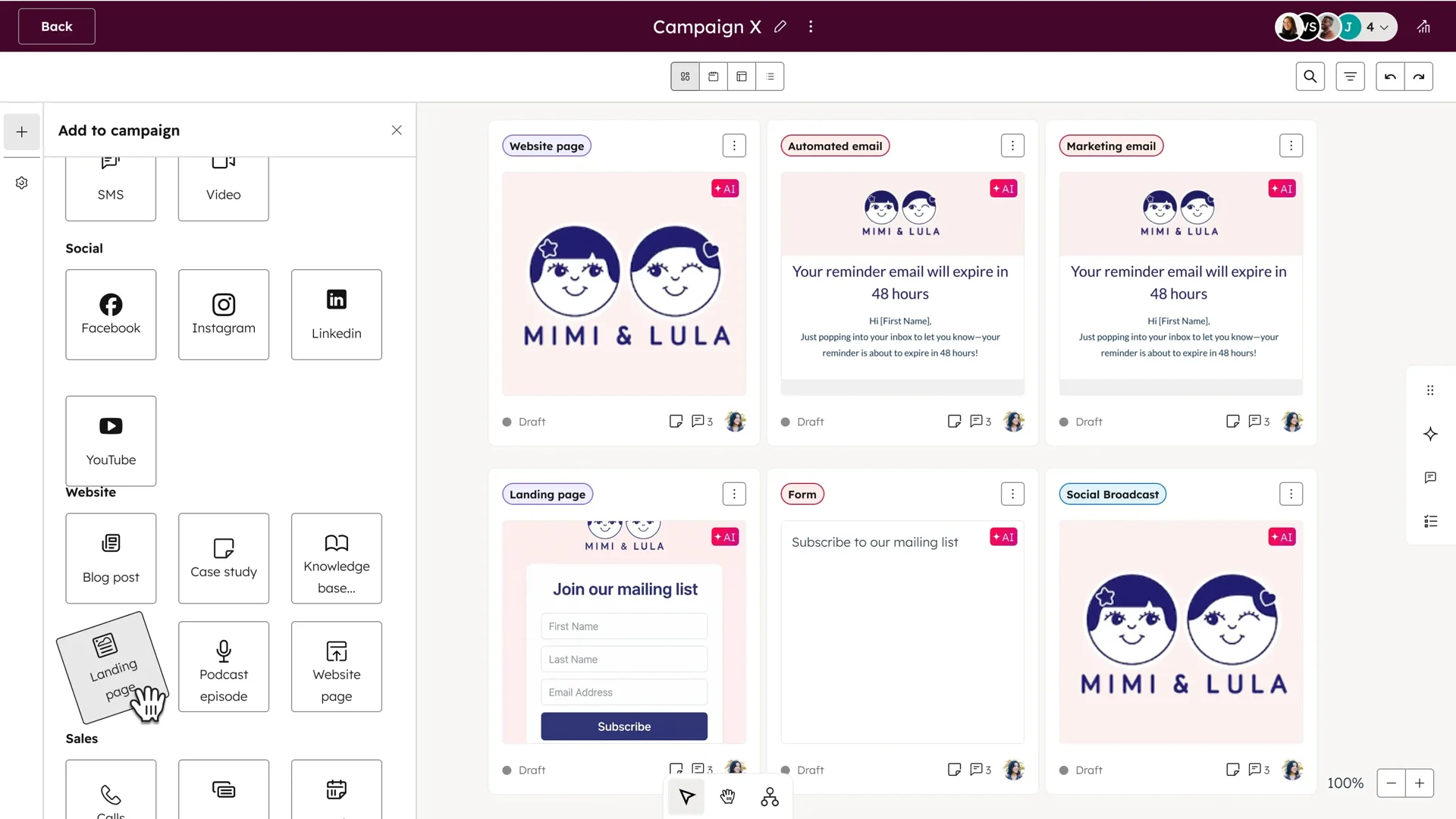
HubSpot is an all-in-one customer platform that connects marketing, sales, and service on a shared CRM data layer.
For small and growing B2B teams evaluating Mutiny, HubSpot offers a broad free-to-start alternative: landing page building, A/B testing, smart content personalization, email marketing, and full CRM, with no credit limits, no per-seat caps, and no $30,000/year Enterprise commitment. Its key capabilities include:
Drag-and-drop landing page builder with native A/B testing across headlines, CTAs, and layouts, available from the Starter tier
Smart content personalization that dynamically swaps copy, CTAs, images, and page sections based on visitor list membership, lifecycle stage, device type, or country
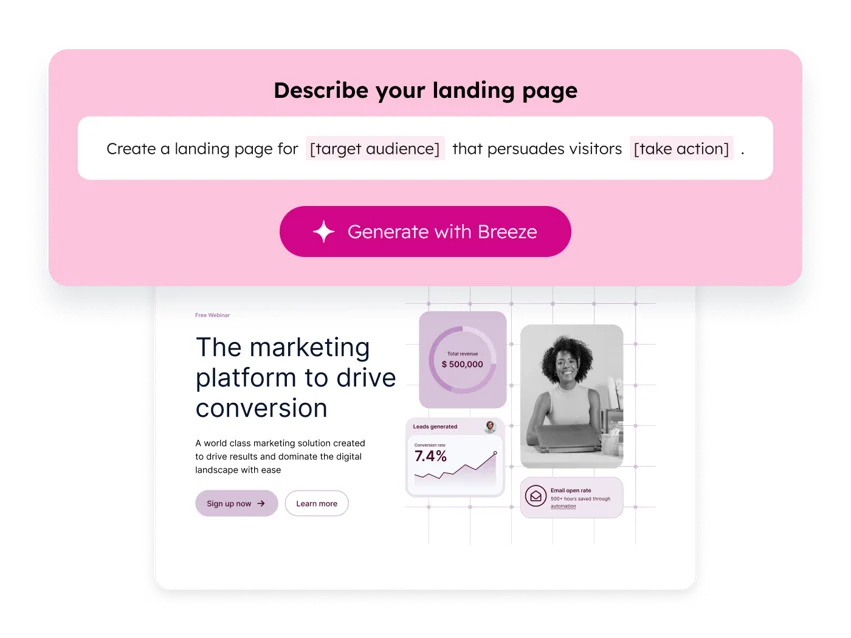
Content Hub with AI writing tools that generate landing pages, blog posts, and emails from brand guidelines and CRM contact properties
Permanently free CRM tier with contact management, email marketing, landing page builder, and form tools
Full-funnel attribution reporting tying every asset, form submission, and page view back to a CRM contact record
Over 2,000 app integrations including native Salesforce bidirectional sync
HubSpot addresses a different buyer than Mutiny. Where Mutiny is designed for teams with established ABM programs and enterprise budgets ($30,000+/year for full features), HubSpot provides the marketing, sales, and CRM foundation that smaller teams need to get started, and scales with them as they grow.
Why Choose HubSpot Over Mutiny for a Free Marketing Hub
HubSpot stands out in the following areas:
Native A/B Testing on Landing Pages and Emails.
Mutiny was identified by user reviews as lacking A/B testing capability. It generates personalized content but doesn't help you test which version performs better. HubSpot's landing page builder includes native split testing on headlines, CTAs, and page layouts, with results feeding directly into reporting dashboards alongside the rest of the contact lifecycle. Available starting at the Starter tier ($15/seat per month, annual).
Source: HubSpot
Full-Funnel Attribution Connected to CRM.
Mutiny's analytics track visit timestamps, click counts, and time on page, but multi-touch pipeline attribution requires external tooling. HubSpot closes this loop at the platform level: because every asset is natively connected to the Smart CRM, every interaction ties to a contact record and flows into Advanced Marketing Reporting.
Free-to-Start Pricing with No Annual Commitment.
Mutiny's Business tier starts at $50/seat/month with only 50 credits per month. Enterprise, which unlocks CRM integrations and Account Studio, starts at $30,000/year. HubSpot's permanently free CRM includes contact management for up to 1 million records, email marketing, a landing page builder (30 pages), forms, live chat, and basic segmentation, with no time limit and no credit card required. The Starter Customer Platform bundles all Hubs at $9/seat/month (annual).
NOTE: We also evaluated Flint AI and Unbounce for this slot. While Flint AI excels at AI-driven ABM content generation for mid-market teams, and Unbounce is strong for landing page testing and conversion rate optimization, HubSpot offers the broadest free-to-start platform for teams needing CRM, email, landing pages, A/B testing, and smart content personalization in a single connected system.
HubSpot Pricing
HubSpot uses a hybrid model combining per-seat and flat monthly pricing depending on the Hub and tier:
Free (All Hubs): $0, permanent. Up to 2 user seats, unlimited contacts (up to 1M records), 30 landing pages, 2,000 email sends/month, live chat, basic ticketing. HubSpot branding appears on free-tier tools.
Starter Customer Platform: $9/seat/month (annual) or $15/seat/month (monthly). Bundles Starter editions of all Hubs. Includes custom domain, HubSpot branding removal, email automation, A/B testing.
Marketing Hub Professional: $800/month (annual, includes 3 Core Seats). Adds smart content personalization, advanced Workflows, multi-touch attribution, 2,000 marketing contacts. One-time mandatory onboarding fee: $3,000.
Marketing Hub Enterprise: $3,600/month (includes 5 Core Seats). Adds custom event triggers, predictive lead scoring, custom objects, up to 10,000 marketing contacts. One-time mandatory onboarding fee: $7,000.
Who Should Use HubSpot?
Choose HubSpot if:
Your team is starting out or has limited budget and needs a free landing page builder, CRM, and email marketing tool without a five-figure annual contract.
You need native A/B testing on landing pages and emails built into the same tool where you're running campaigns.
Your marketing team needs to prove pipeline influence and attribute revenue to specific content assets through multi-touch attribution.
You're building an inbound content motion and want all channels under a single platform with one shared CRM data layer.
5. Folloze: Best Alternative for Persistent ABM Content Destinations and Digital Sales Rooms
Source: Folloze
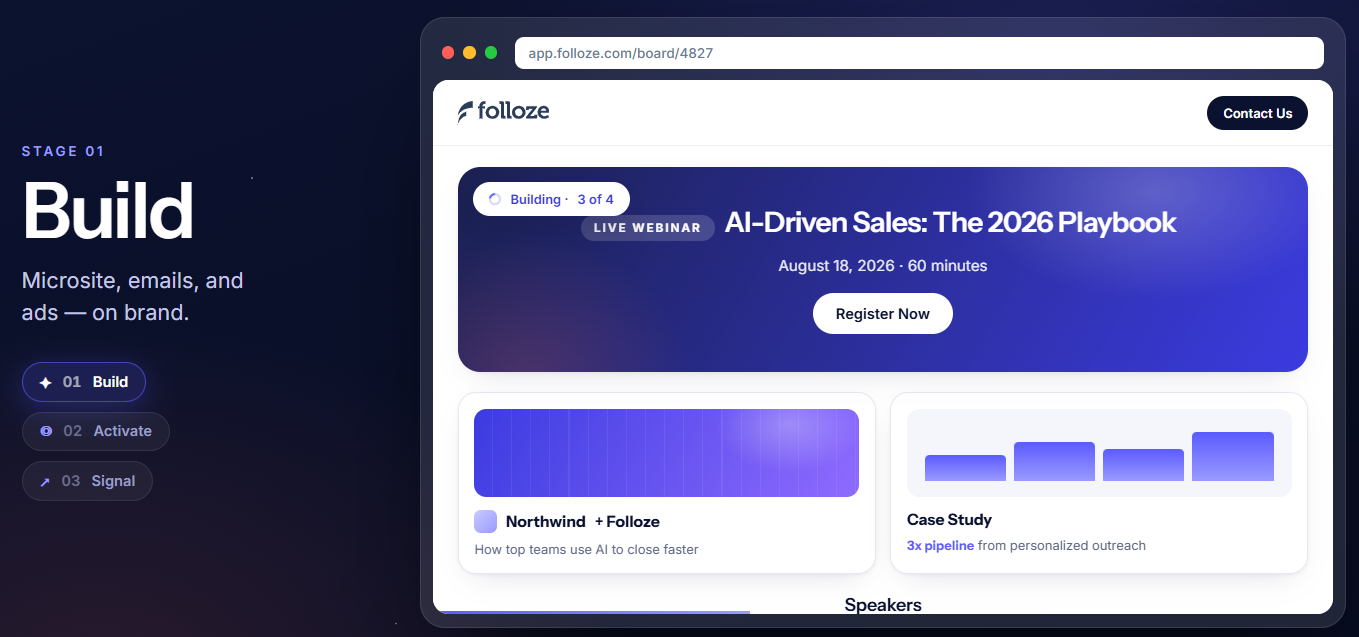
Folloze is an AI-powered B2B buyer experience platform that replaces one-time asset generation with persistent, evolving content destinations. Where Mutiny produces individual assets (a landing page, a deal room, a business case), each as a distinct URL for a specific moment in the deal cycle, Folloze Boards are live buyer experiences that adapt as accounts move through the buying cycle. Its key capabilities include:
No-code content board builder producing on-brand microsites, campaign hubs, and digital sales rooms without engineering queues and without per-generation credit consumption
AI personalization agents (Generator, Personalize, and Translate) that create personalized microsites from campaign briefs and localize content into 20+ languages
Native 6sense and Demandbase integration allowing board personalization rules to draw directly from ABM buying-stage intelligence
Real-time Impact Dashboard providing individual-level and account-level engagement, five-stage scoring, and pipeline influence estimates
Digital sales rooms for multi-stakeholder co-navigation with contact-level engagement tracking
Enterprise customers include Cisco, Autodesk, ServiceNow, ADP, HP, Docusign, and Seismic, with 300,000+ campaigns powered and $11B in influenced pipeline.
Why Choose Folloze Over Mutiny for ABM Content Destinations
Folloze stands out in the following areas:
Persistent Content Destinations vs. One-Time Asset Generation.
A Mutiny asset is a snapshot: a landing page or deal room built for a specific moment. A Folloze Board is a live buyer experience that a named account returns to repeatedly. Marketers configure Content Plays that schedule new assets to publish into the board over time, so the same URL shows different content as the account moves from awareness to active evaluation, without sending a new link. This architecture lets ABM teams scale to thousands of accounts without creating a separate page for each one.
Native ABM Platform Integration.
One of the most common frustrations for ABM teams using Mutiny alongside 6sense or Demandbase is the manual handoff: intent intelligence has to be interpreted before feeding into personalization decisions. Folloze's native connectors let board personalization rules draw directly from buying-stage signals. The 6sense-powered enrichment identifies anonymous visitors by industry, revenue range, and region before any form fill.
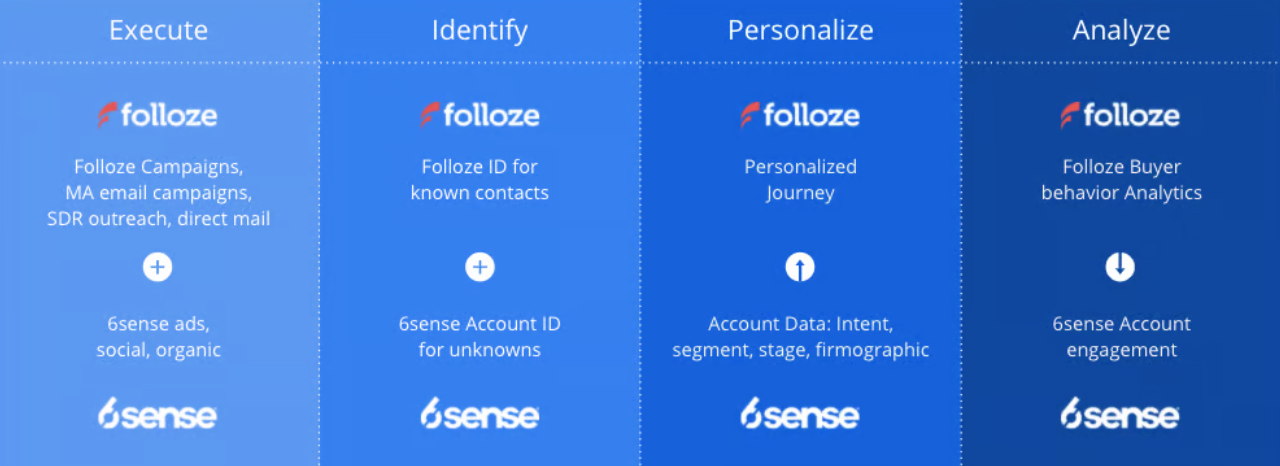
Source: Folloze
Account-Level Engagement Analytics Built for ABM.
Folloze's Impact Dashboard runs a five-stage scoring model (New, Initial, Growing, Active, Surging) that synthesizes content views, time on board, CTA intent signals, and count of engaged buying committee members per account. That score syncs directly to Salesforce and HubSpot. A built-in Potential Revenue widget estimates pipeline impact inside the dashboard.
NOTE: We also evaluated Uberflip and PathFactory. Uberflip excels at content stream management for demand gen teams with large libraries, and PathFactory is strong for self-serve content journey analytics. Folloze offers the best combination of no-code ABM campaign boards, native 6sense/Demandbase integration, and digital sales room functionality for teams needing persistent content destinations.
Folloze Pricing
Folloze does not publish pricing publicly. All pricing is negotiated through direct sales via the request-a-demo page. Based on available information, the platform operates as a sales-led, enterprise SaaS model with annual contracts.
The platform includes AI agent suite (Generator, Personalize, Translate agents), no-code board builder, Impact Dashboard, and native ABM integrations. Customer success packages and professional services are tiered separately. Folloze Academy training is included for existing customers.
Who Should Use Folloze?
Choose Folloze if:
Your team runs an account-based motion with a named account list of hundreds to thousands, and you need content experiences that auto-personalize without building a separate page per account.
You already invest in 6sense or Demandbase and want the content experience layer to activate that intent data automatically rather than manually translating signals into personalization decisions.
Your sales cycle involves multiple buying committee stakeholders who need a shared digital sales room with contact-level engagement visibility.
You have an existing content library (case studies, videos, solution briefs) and need a platform to organize, personalize, and distribute those assets into branded destinations.
6. Flint AI: Best Alternative for On-Brand ABM Microsites and Ad Landing Pages at Lower Cost
Source: Flint AI
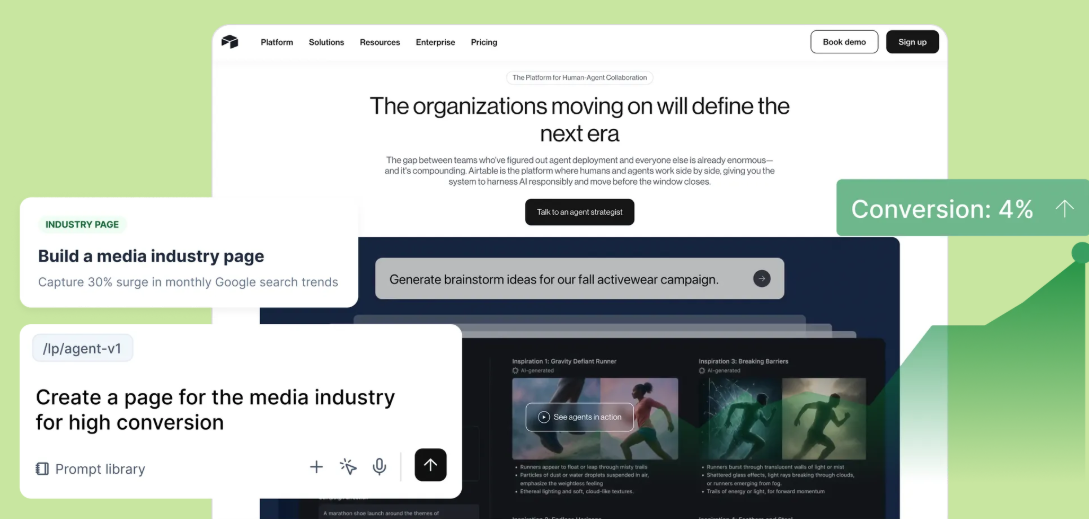
Flint AI is an AI landing page platform that generates on-brand campaign pages and ABM microsites without design dependencies. Where Mutiny covers a broad range of GTM content (deal rooms, pitch decks, business cases), Flint focuses on the web page layer and, within that lane, delivers faster generation, lower pricing, and stronger brand fidelity. Its key capabilities include:
AI page generation from a single URL with autonomous brand system extraction: colors, typography, components, animations, and interactive elements
Bulk ABM microsite creation from CSV or CRM data, generating hundreds of account-specific pages in minutes
Ad landing page optimization with programmatic creation per ad group, keyword, or campaign variable
GEO pages built for AI answer engines (ChatGPT, Perplexity, Google AI Overview) with SSR, llms.txt, and sitemap.xml automatically included
API and MCP integration for page generation via Claude, Clay, Relay.app, or any HTTP-capable tool
Permanent free tier at 160 credits per month with no credit card required
Flint is the right choice for growth and demand gen teams at B2B SaaS companies who need ABM microsites and campaign landing pages without design bottlenecks or enterprise price tags.
Why Choose Flint AI Over Mutiny for On-Brand ABM Microsites
Flint AI stands out in the following areas:
Accessible Pricing and a Genuine Free Tier.
Mutiny's Account Studio (which enables ABM personalization at scale) is locked to Enterprise plans starting at $30,000/year. Business plan users at $50/seat/month get only 50 credits monthly. Flint's Free plan provides 160 credits per month at zero cost. The Starter plan at $96/month covers 12,000 credits per year; the Pro plan at $400/month covers 60,000 credits annually and adds root-domain hosting for SEO.
Brand Fidelity in Head-to-Head Comparison.
Both platforms extract brand elements from a URL. Flint goes further, capturing animations and interactive components that a flat color-palette extraction misses. This deeper extraction means generated pages more closely mirror the look and feel of your existing website, reducing manual design adjustments after generation.
Programmatic Scale Without Enterprise Price Gates.
Flint's CSV-driven bulk generation is available starting at the Starter plan. Upload a CSV with account name, page description, and relevant context columns, and Flint generates one personalized microsite per row. The Clay + Flint API integration automates the full pipeline: Clay enriches prospect data, calls the Flint API, and Flint fires a webhook back with the generated page URL and auto-populated outbound email copy.
NOTE: We also evaluated Webflow and Unbounce. Webflow is a visual CMS but requires engineering involvement for campaign pages at volume. Unbounce offers strong A/B testing and template-based page building but lacks Flint's autonomous brand extraction and requires manual brand setup. Flint offers the most direct replacement for Mutiny's landing page workflow at a fraction of the cost.
Flint AI Pricing
Free: $0/month. 160 credits per month, one-time Design System import, API and MCP access. No custom domain; Flint badge on published pages.
Starter: $96/month (annual). 12,000 credits per year, 10 GB hosting bandwidth, custom domain, email support, badge removal.
Pro: $400/month (annual). 60,000 credits per year, 50 GB bandwidth, root domain hosting (better for SEO), dedicated Slack Connect channel.
Enterprise: Custom pricing. Custom credits and bandwidth, multiple websites, multi-time Design System syncing, password protection, SSO/SAML, dedicated CSM. SOC 2 Type II certification in preparation as of July 2026.
Who Should Use Flint AI?
Choose Flint AI if:
Your primary use case is creating personalized landing pages and ABM microsites (not deal rooms, pitch decks, or business cases) and Mutiny's $30K+/year Enterprise tier is out of reach for that use case alone.
You're a demand gen or growth team of 1-5 people running paid campaigns and need on-brand landing pages per ad group without routing every page through design.
You want to run programmatic ABM at scale (50-300+ account-specific microsites from a CSV) without paying for ABM platform infrastructure designed for large enterprise sales orgs.
You need pages hosted on your root domain for SEO authority, not a vendor subdomain.
7. Tofu: Best Alternative for Omnichannel AI-Driven Demand Generation
Source: Tofu
Tofu is an agentic GTM platform built for B2B marketing teams that need personalized, on-brand campaign content deployed across every channel at once.
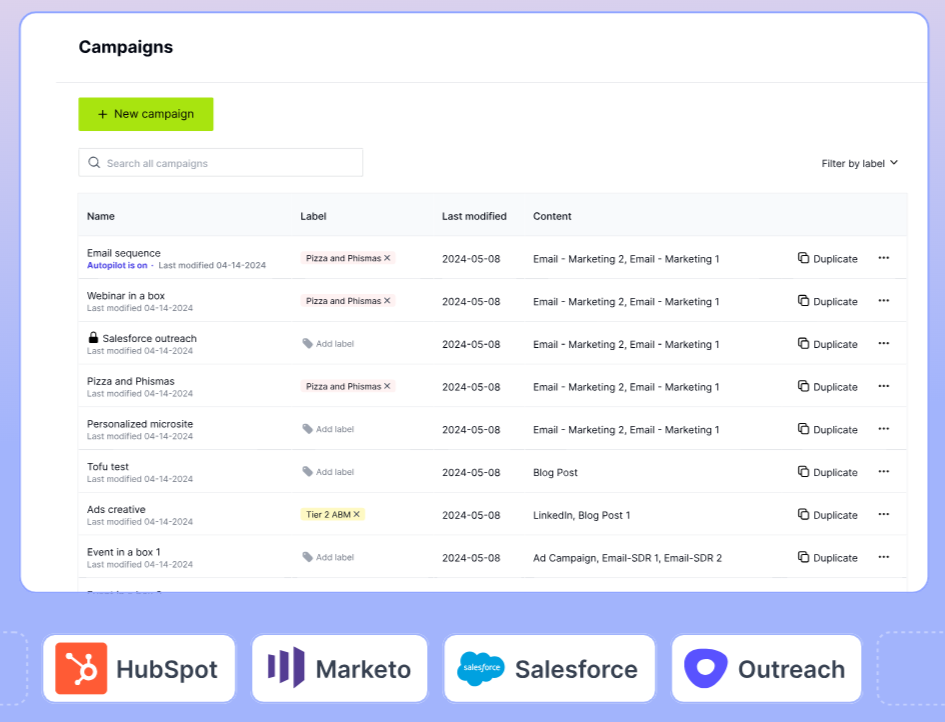
Its architecture runs three AI agents in sequence: a Research Agent that synthesizes CRM data with signals from 75+ third-party sources, a Create Agent that produces multi-channel assets, and a Launch Agent that pushes content directly into HubSpot, Salesforce, Marketo, and Outreach. Its key capabilities include:
AI Playbook knowledge graph that ingests brand voice, ICP definitions, persona frameworks, and messaging into a persistent knowledge layer informing every generated asset
Omnichannel output covering email sequences, landing pages, LinkedIn ads, display ads, call scripts, case studies, and blog posts from a single brief
CRM signal-triggered campaign execution via native connections to HubSpot, Salesforce, Marketo, Outreach, Salesloft, and Gong Engage
Content repurposing engine transforming anchor content into derivative assets adapted by industry, persona, or account
Direct CRM field-writing so campaigns run inside existing MAP workflows without separate sending infrastructure
Mutiny's Blueprint library covers the deal cycle: prospecting pages, deal rooms, business cases. Tofu covers the full demand generation stack: email, ads, landing pages, call scripts, and content repurposing, all generated from one campaign brief and deployed through native CRM integrations.
Why Choose Tofu Over Mutiny for Omnichannel Demand Generation
Tofu stands out in the following areas:
Persistent Playbook Architecture vs. Per-Asset Context.
Mutiny assembles brand context per-session, drawing on Company Context profiles and attached files for each asset creation. This works well for deal-level content. For demand gen teams running dozens of simultaneous campaigns, re-establishing context per generation becomes an operational constraint. Tofu's Playbook encodes messaging frameworks, ICP definitions, and tone guides during onboarding, then applies them automatically across all campaigns. This persistent knowledge layer means brand consistency scales with campaign volume rather than degrading as volume increases.
Full Demand Generation Stack vs. Deal-Cycle Content.
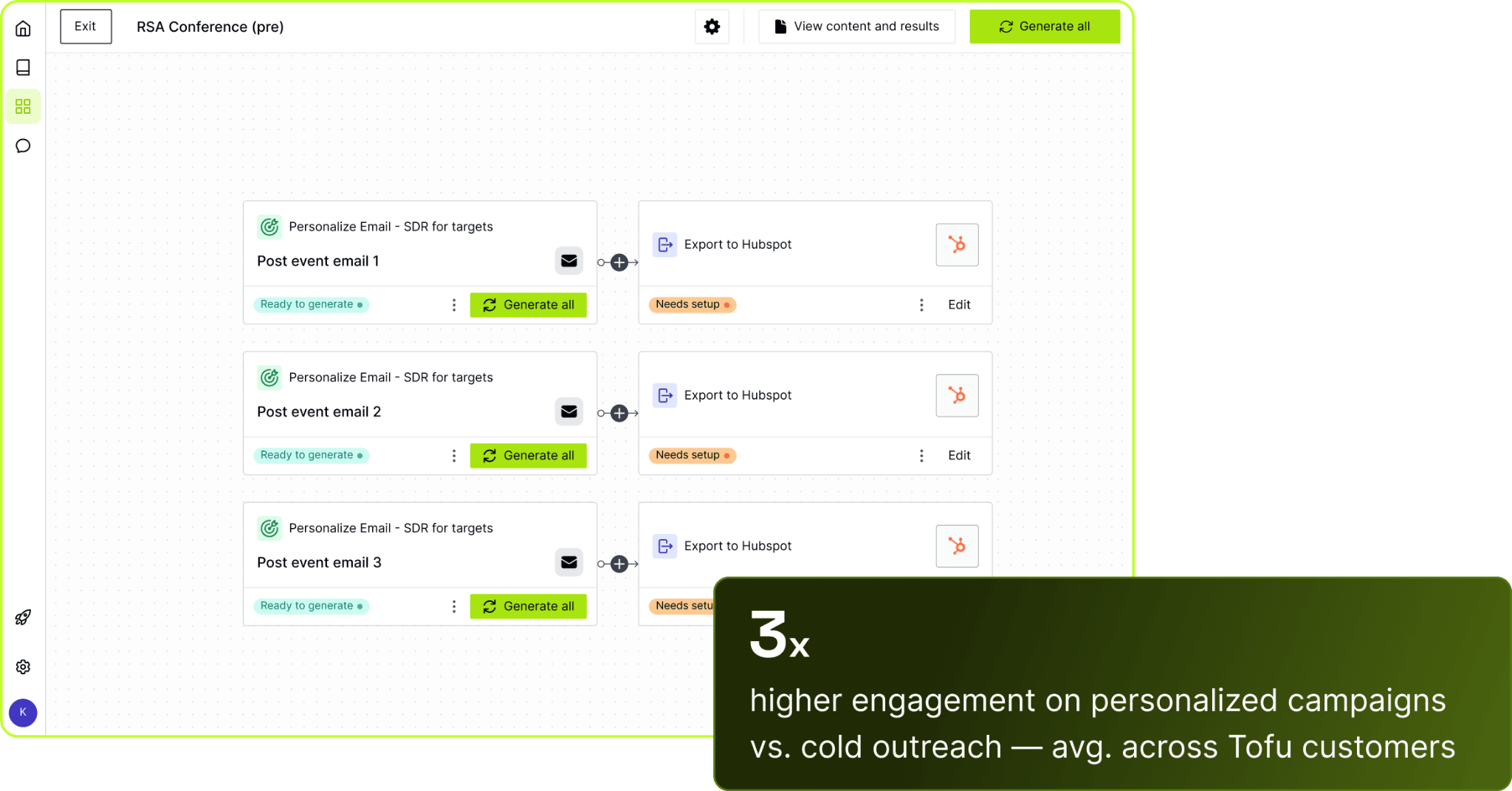
Mutiny doesn't cover the full demand gen content stack: no email sequence builder, no ad creative generation, no event follow-up automation. Tofu's Create Agent produces all of these from a single brief. A campaign manager defines the audience, messaging angle, and channels once, and the platform generates coordinated assets across email, landing pages, ads, and call scripts simultaneously.
Source: Tofu
Always-On CRM-Triggered Automation vs. Human-Initiated Production.
Mutiny's workflow is human-initiated: someone decides to create an asset and provides context. Tofu's Launch Agent operates on triggers: deal stage changes, form fills, or lead status updates cause the Research, Create, and Launch pipeline to run automatically. Teams set up persona segments and channel configurations once, and Tofu continuously generates and deploys personalized messaging as new accounts enter each segment.
NOTE: We also evaluated Userled and Abmatic AI. Userled excels at 1:1 ABM landing page personalization with CRM integration, and Abmatic AI is built for targeted account microsites. Tofu offers the broadest omnichannel content generation for teams needing full demand gen campaigns, not just landing pages, at scale.
Tofu Pricing
Tofu does not publish a pricing page and operates on a sales-led model. Tofu's own buyer's guide states that "full-stack AI marketing platforms" like Tofu typically run $2,000-$10,000+ per month depending on volume and features.
Custom Annual SaaS License: Scales by features and content generation volume, not by seats. Mid-tier plans accommodate 500+ accounts per campaign; enterprise plans support up to 2,000 accounts.
All packages include a dedicated Customer Success Manager, SOC 2 compliance, and regular working sessions.
Guided Free Trial: Available via scheduled onboarding session. Full access to personalization and AI content generation. No disclosed time limit or credit card requirement.
Who Should Use Tofu?
Choose Tofu if:
Your marketing team needs personalized campaign content across email, paid ads, landing pages, and sales outreach simultaneously, not just deal-level ABM assets.
You have a defined ICP, established messaging, and a CRM populated with real account data; Tofu amplifies existing strategy and won't substitute for one that hasn't been built yet.
Your target account list exceeds 50 accounts for ABM programs, or you're running multi-segment demand gen where personalized content at volume would lift conversion.
Headcount constraints are a real ceiling: Tofu's ROI case is strongest when the gap between desired campaign volume and available marketing capacity is wide.
The Final Verdict
Mutiny excels at AI-powered content generation for deal-level assets. But growing B2B teams often need tools that address the full go-to-market workflow. Here are the best alternatives:
ZoomInfo for B2B data, AI-driven GTM intelligence, buyer intent signals, and the intelligence foundation that informs every sales and marketing decision
Demandbase for enterprise ABM programs that need advertising, website personalization, and account intelligence unified in one platform with full-funnel pipeline attribution
6sense for predictive ABM that classifies accounts by buying stage, identifies in-market buyers before they raise their hand, and orchestrates multi-channel campaigns from a single workflow
HubSpot for small and growing B2B teams needing a free-to-start marketing hub with landing pages, A/B testing, smart content, CRM, and full-funnel attribution
Folloze for persistent ABM content destinations that adapt to account signals and digital sales rooms with native 6sense/Demandbase integration
Flint AI for on-brand ABM microsites and ad landing pages at a fraction of the cost, with a genuine free tier and programmatic CSV-driven page generation
Tofu for omnichannel demand generation campaigns that produce personalized content across email, ads, landing pages, and sales outreach from a single brief
You don't have to choose between Mutiny and these alternatives. Many teams use Mutiny for deal-level content creation alongside ZoomInfo for intelligence and data, or 6sense for intent-driven targeting, to build a GTM stack that covers the full workflow. Consider your specific needs and growth plans when deciding which solution works best.
Ready to power your go-to-market motion with the B2B intelligence layer behind 35,000+ companies worldwide? Start with ZoomInfo Lite for free and see how data, AI-driven insights, and buyer intent signals transform how your team finds, wins, and grows customers.
Mutiny Alternatives FAQ
Why do businesses look for Mutiny alternatives?
Mutiny excels at AI-powered content generation for customer-facing assets like landing pages, deal rooms, and business cases.
Teams look for alternatives because the platform focuses on the content creation layer without providing upstream intelligence (which accounts to target, who the decision-makers are, when they're in-market), lacks native A/B testing and multivariate experimentation, and its analytics are limited to session-based engagement tracking rather than multi-touch pipeline attribution.
Teams also find that Account Studio enrichment and CRM integrations require the Enterprise plan starting at $30,000/year.
What is the best overall Mutiny alternative?
There is no single best alternative because Mutiny addresses a specific need (content generation) within a broader GTM workflow.
ZoomInfo is the top choice for teams needing B2B data and AI-driven intelligence to power targeting decisions. Demandbase leads for enterprise ABM programs requiring advertising, personalization, and attribution in one platform. HubSpot is the strongest option for small teams needing an accessible, free-to-start marketing and CRM foundation.
Is there a free alternative to Mutiny?
Yes. HubSpot offers a permanently free CRM tier with landing page building, email marketing, contact management, and basic segmentation, with no credit card or time limit.
ZoomInfo Lite provides free access to its B2B database with 10 monthly export credits and WebSights Lite. Flint AI includes a free plan with 160 credits per month for AI-generated landing pages. 6sense offers a free plan with 50 credits per month for contact data unlocks. Mutiny itself has a free tier, but it is limited to 30 credits per month.
Which Mutiny alternative is best for enterprise ABM programs?
Demandbase is built for enterprise ABM, combining a native B2B DSP, intent data processing 2 trillion signals monthly, buying group identification, and full-funnel pipeline attribution in one platform. For teams that also need predictive buying-stage classification and multi-channel workflow orchestration, 6sense is a strong alternative with per-customer AI models trained on historical deal data.
For a detailed comparison of these two platforms, see our 6sense vs Demandbase breakdown.
How does Mutiny's pricing compare to the alternatives?
Mutiny's Free plan offers 30 credits per month per seat. Business is $50/seat/month with 50 credits. Enterprise starts at $30,000/year and is required for CRM integrations and Account Studio enrichment. By comparison, HubSpot's free tier includes a landing page builder with no credit limits, and its Starter plan begins at $9/seat/month. Flint AI offers 160 free credits monthly and starts at $96/month for Starter.
ZoomInfo Lite is permanently free with 10 monthly export credits. Demandbase, 6sense (paid tiers), Folloze, and Tofu all require custom quotes through direct sales.
Can I use Mutiny alongside these alternatives?
Yes. Many teams use Mutiny for deal-level content creation while pairing it with ZoomInfo for account intelligence and contact data, 6sense or Demandbase for intent signals and ABM orchestration, and HubSpot for CRM and marketing automation.
The combination works because Mutiny handles a specific step (asset generation) while these platforms handle complementary steps (targeting, data, orchestration, attribution) in the GTM workflow.
Which alternative is best for small B2B teams with limited budget?
HubSpot is the clear choice for small teams, offering a broad free-to-start platform with CRM, landing pages, email marketing, and A/B testing. Flint AI is ideal if the primary need is affordable landing pages and ABM microsites. ZoomInfo Lite provides free access to B2B data for prospecting.
These three platforms provide genuine production value at no cost, whereas Demandbase, Folloze, and Tofu are designed for teams with established ABM programs and corresponding budgets.
What should I look for when evaluating a Mutiny replacement?
Start by identifying your actual bottleneck. If it is content creation speed, Mutiny, Flint AI, or Tofu may be the right fit. If it is knowing which accounts to target, ZoomInfo or 6sense provide the intelligence layer. If it is full-funnel ABM orchestration, Demandbase or 6sense cover targeting through attribution. If it is budget constraints, HubSpot or Flint AI provide accessible starting points.
The most common mistake is replacing a content tool with another content tool when the real gap is upstream intelligence or downstream measurement.
