
Oracle Cloud CX is one of the largest customer experience platforms on the market, backed by a company with $57.4 billion in annual revenue and 162,000 employees. Its defining promise: native integration between your customer-facing tools (marketing, sales, service) and your back-office systems (ERP, supply chain, HR, finance), all on a single cloud platform.
That integration matters because it eliminates the data gaps that plague most CRM deployments. When a sales rep generates a quote, Oracle CX pulls real-time pricing from ERP. When a service agent handles a case, they see the customer's contract terms, billing history, and open orders without switching systems. For large enterprises already running Oracle's back-office applications, this shared data model removes entire categories of integration work.
To create this Oracle Cloud CX review, we've analyzed it extensively. We believe it's the ideal choice if:
You're a large enterprise already running Oracle ERP, HCM, or SCM
You need marketing, sales, and service tools that share data natively with your financial and operational systems
You manage complex B2B sales with configurable products and multi-tier pricing
You require industry-specific CX capabilities for verticals like communications, financial services, or healthcare
You prioritize enterprise security and compliance across a single vendor
However, Oracle Cloud CX is not a good choice if:
You're a small or mid-sized business looking for quick time-to-value
You need a CRM your team can adopt without extensive training or consulting
You rely heavily on non-Oracle tools in your go-to-market stack
You want transparent pricing without multi-year contract commitments
You need third-party B2B prospecting data (verified contacts, direct dials, buyer intent signals) built into your workflow
In this case, consider pairing your CX platform with ZoomInfo: a B2B data and go-to-market platform covering 500M contacts, 100M companies, 135M+ verified phone numbers, and 200M+ verified business email addresses. Its GTM Context Graph processes 1.5B+ data points daily, combining this data with your CRM records, conversation transcripts, and behavioral signals to show what happened, why, and what to do next. Your team can run sales from GTM Workspace, build go-to-market plays from GTM Studio, or connect their own tools through the Enterprise API and MCP.
We've included a detailed look at ZoomInfo later in this review as a data intelligence complement for enterprise CX deployments. If you're ready to try ZoomInfo, start with a free trial here.
What is Oracle Cloud CX?
Oracle Cloud CX is an enterprise customer experience suite built on Oracle's Fusion cloud platform. Oracle Corporation was founded in 1977 by Larry Ellison, Bob Miner, and Ed Oates. It has grown into one of the largest technology companies in the world, with more than $110 billion in total acquisitions across 150+ deals.
The CX suite was assembled primarily through acquisition. Oracle acquired Siebel Systems (the dominant on-premise CRM vendor) in 2005, RightNow Technologies for customer service in 2011, Eloqua for B2B marketing automation in 2012, and Responsys for B2C campaign management in 2013. In 2011, Oracle launched its Fusion Cloud Applications platform, which unified these acquired products onto a single cloud architecture.
Today, Oracle Cloud CX encompasses Oracle Marketing (Eloqua, Responsys, Unity CDP, CrowdTwist, Infinity), Oracle Sales (SFA, CPQ, Commerce, Subscription Management), Oracle Service (Service Center, Field Service, Knowledge Management), Oracle Fusion CX Analytics, and Oracle AI for CX. The suite serves large enterprises across seven industry verticals: Communications, Financial Services, Government, Hospitality, Life Sciences, Retail, and Utilities.
Oracle's current strategy, outlined in its "From CRM Systems to Systems of Outcomes" blog post from May 2026, positions Oracle CX as an active platform that drives outcomes, not a passive CRM. The latest push centers on agentic AI: multi-agent teams that coordinate decisions across marketing, sales, and service using data from Oracle's full Fusion stack, including finance, supply chain, and HR.
Named customers include Broadcom, Bosch, Cisco, Docusign, JetBlue, Mazda, and Pella.
Oracle Cloud CX Pros & Cons
Pros | Cons |
|---|---|
- Native integration with Oracle ERP, SCM, and HCM on a shared data model | - Steep learning curve with a non-intuitive interface |
- Gartner Leader in five CX categories simultaneously | - Complex, expensive implementations requiring consulting or certified SIs |
- Full suite covering marketing, sales, service, and field service | - High total cost of ownership, prohibitive for SMBs |
- AI capabilities embedded at no additional per-feature cost | - Third-party integration ecosystem thinner than competitors |
- CPQ connects to 20+ ERP systems including non-Oracle platforms | - Three-year standard contract terms with no month-to-month option |
- Industry-specific pre-built data models for seven verticals | - No self-serve free trial available |
- Enterprise security and compliance certifications | - No built-in B2B prospecting data or buyer intent signals at scale |
Oracle Cloud CX Review: How It Works & Key Features
Oracle Marketing: Enterprise campaign orchestration across B2B and B2C channels.
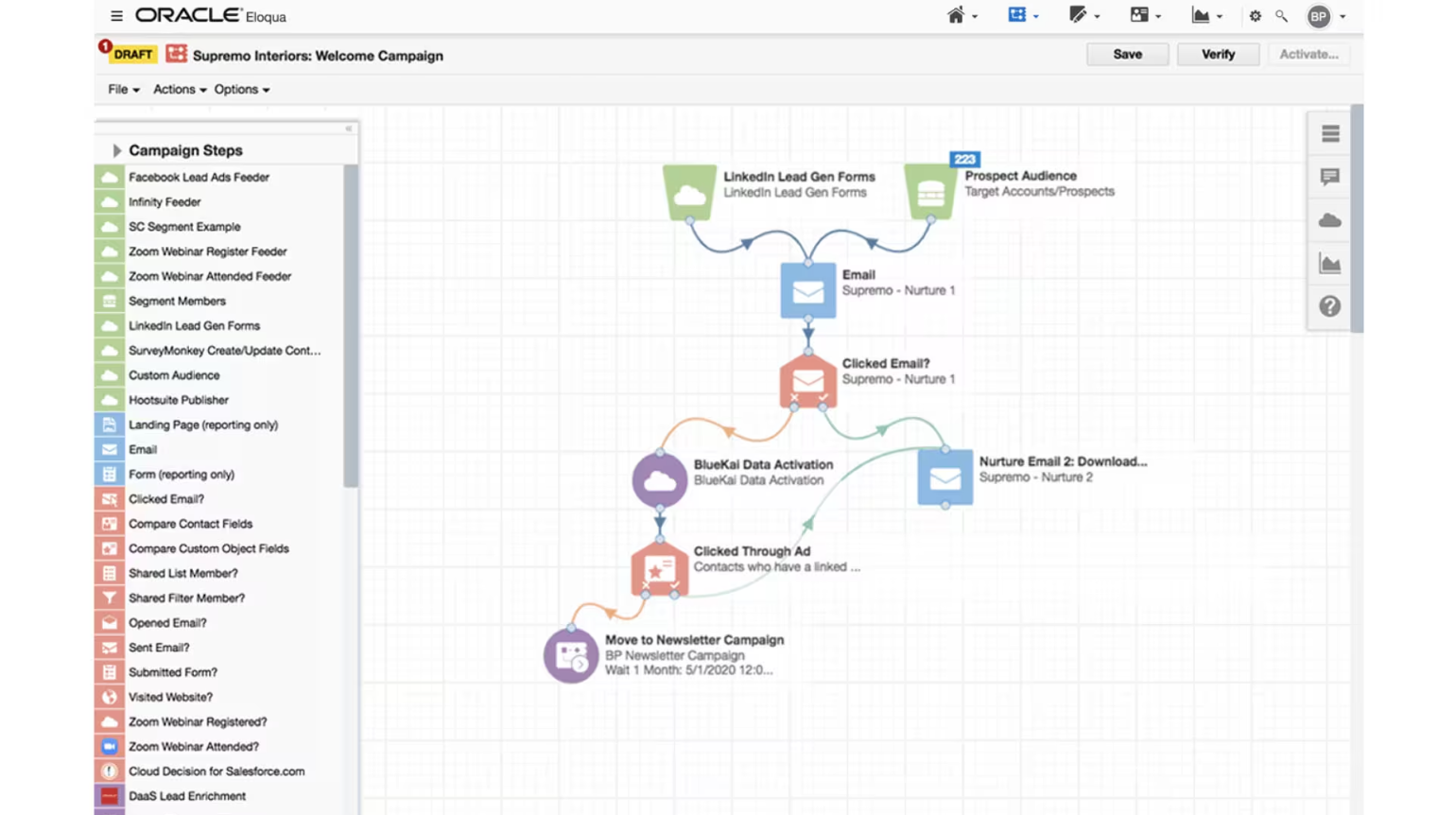
Oracle Marketing combines five products. Oracle Eloqua handles B2B campaign orchestration with a drag-and-drop canvas for building multi-step programs across email, SMS, display, search, web, video, social, and events. Guided Campaigns let non-technical marketers and sellers launch ABM campaigns with prebuilt workflows and step-by-step guidance. Oracle Responsys manages B2C lifecycle marketing with AI-assisted channel and content optimization, supporting A/B and multivariate testing with up to eight creative variations. Its Intelligent Switch selects the best campaign, channel, and time for each customer.
Source: Oracle
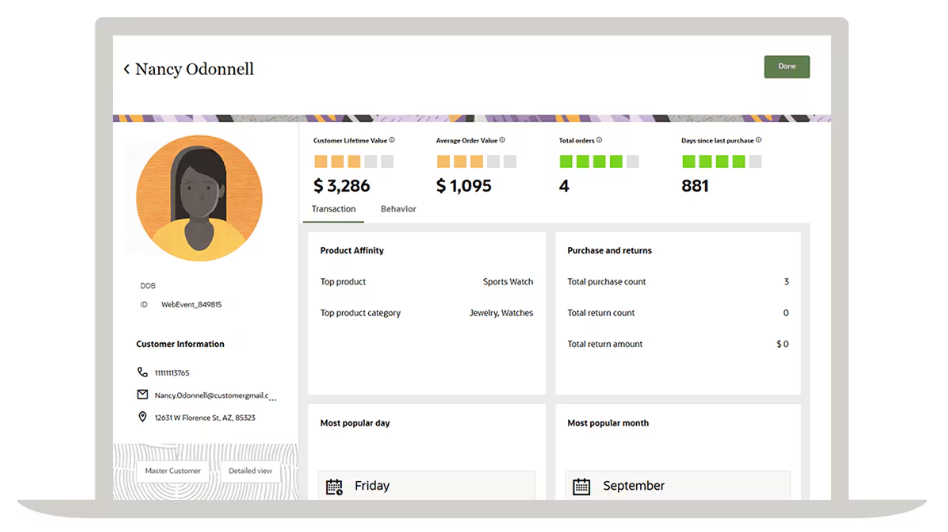
The Oracle Fusion Unity CDP connects these tools by ingesting data from across the enterprise (CRM, ERP, commerce, service) and resolving identities across devices and channels. Unity includes 27+ AI models for predictive scoring, propensity modeling, and lookalike generation, plus 80+ behavioral scores and 100+ behavioral attributes for churn likelihood, purchase propensity, and high-value customer identification. Dynamic consent and preference management integrates with CMPs like OneTrust, with HIPAA attestation, ISO 27001, and SOC 2 compliance built into data models.
Source: Oracle
Oracle Infinity Behavioral Intelligence collects real-time behavioral data and uses ML to generate in-session predictions while the customer is still on the digital property, triggering actions in Responsys, Eloqua, and Unity CDP. CrowdTwist adds loyalty and engagement programs that reward both purchase and non-purchase activities.
Because Unity CDP runs on the same Fusion platform as Oracle ERP, marketing attribution connects to actual financial transactions without custom connectors or ETL processes. AI models run inside Oracle's database, so customer data never leaves Oracle infrastructure for processing. For a direct comparison of Oracle's data platform against Adobe's, see our Adobe Experience Platform vs. Oracle breakdown.
Oracle Sales: Quote-to-cash automation with CPQ as the standout asset.
Oracle Sales covers the full revenue cycle: Sales Force Automation, Configure Price Quote (CPQ), Commerce, Subscription Management, Sales Performance Management (SPM), and Partner Relationship Management (PRM). Oracle holds Gartner Leader status for both SFA and CPQ for nine consecutive years.
Source: Oracle
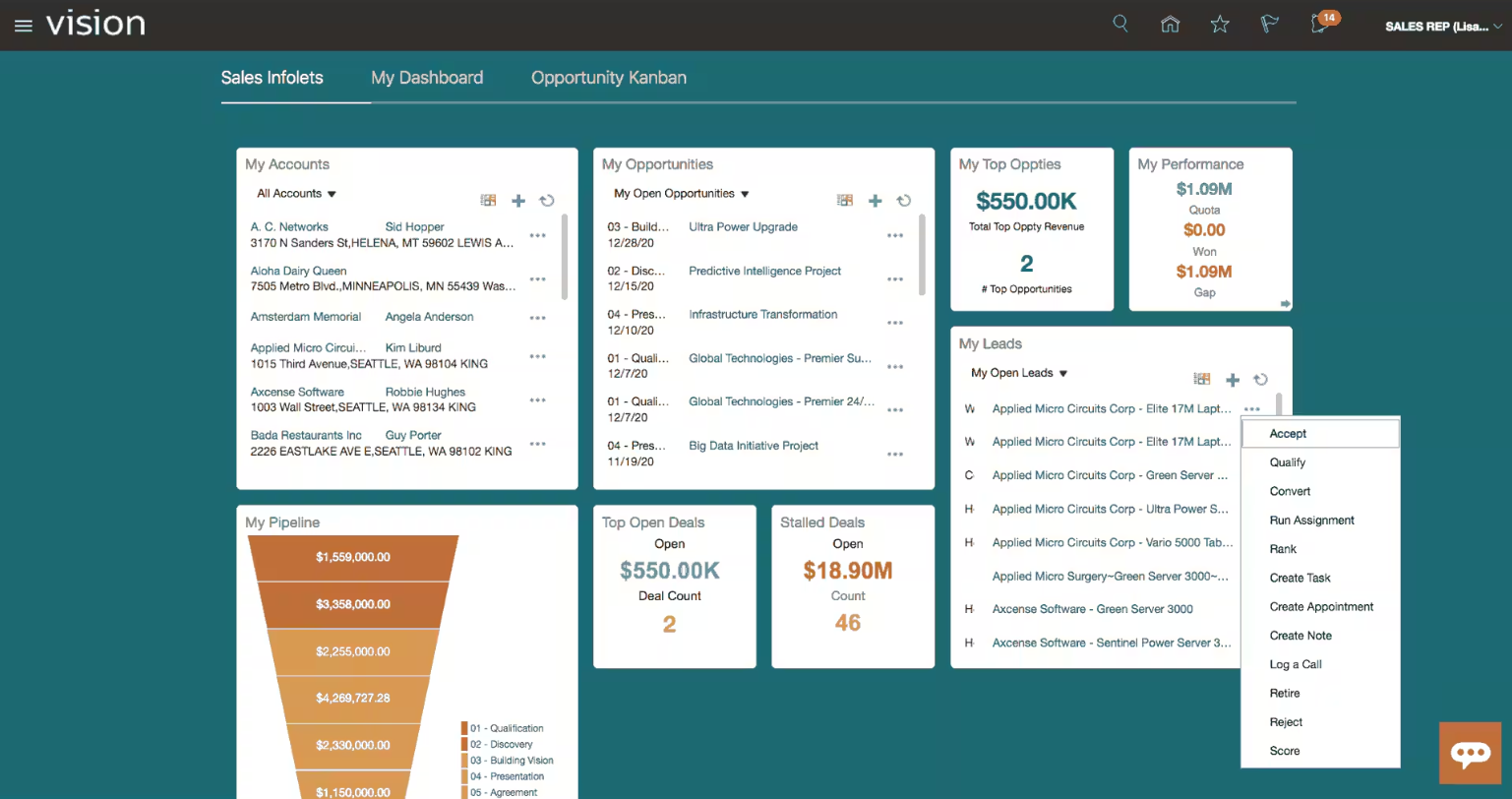
The SFA component delivers a home page with prioritized tasks, closing opportunities, and hot leads. An action bar lets sellers search, update, and communicate from any screen. The system auto-captures customer interactions from email and calendar without manual CRM updates. ML models score leads and recommend next actions, and simplified ML fine-tuning lets business users build custom models without data science skills.
Source: Oracle
CPQ is Oracle's strongest CX product. It embeds directly into CRM screens so sellers access full customer order history and generate quotes without switching tools. Rules-based configuration handles complex product catalogs with guided selling and AI suggestions. The CPQ Quote Generation Agent reads unstructured inputs like emails and engineering drawings to pre-populate pricing templates. The platform connects to 20+ ERP systems including SAP, Microsoft Dynamics, Oracle E-Business Suite, and JD Edwards, making it usable even for organizations that don't run Oracle ERP everywhere.
Subscription Management connects CPQ, Commerce, and ERP into a single subscription lifecycle workflow. ML churn predictions enable proactive retention, and the Renewal Agent monitors contract health, generates renewal briefs with usage trends, and flags at-risk accounts.
SPM integrates directly with Oracle Fusion Payroll so commissions appear on payslips alongside base salary, providing a total compensation view that most standalone tools cannot match.
Oracle Service: Unified contact center and field service management.
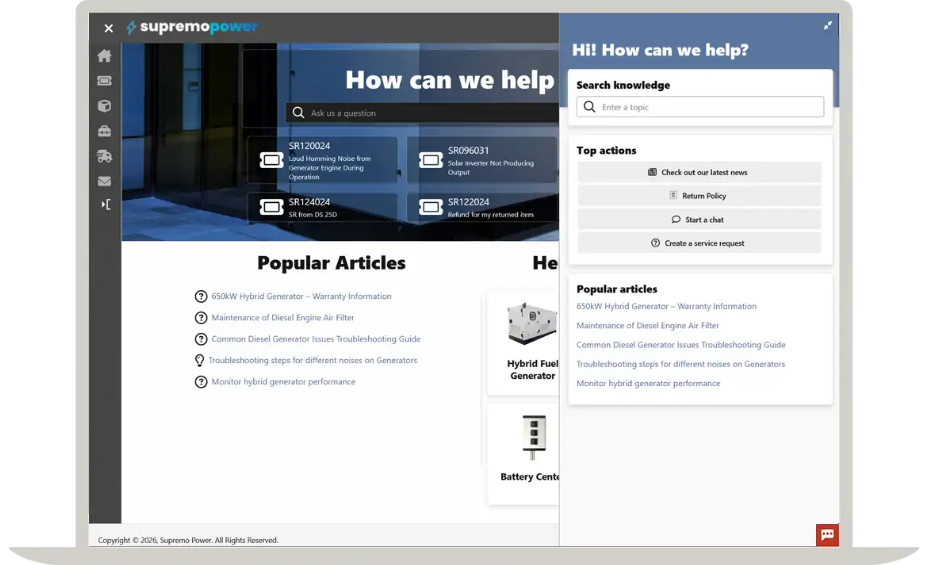
Oracle Service spans contact center case management, field service, knowledge management, and digital self-service. Oracle was named a Gartner Leader for CRM Customer Engagement Center for 13 consecutive years.
Source: Oracle
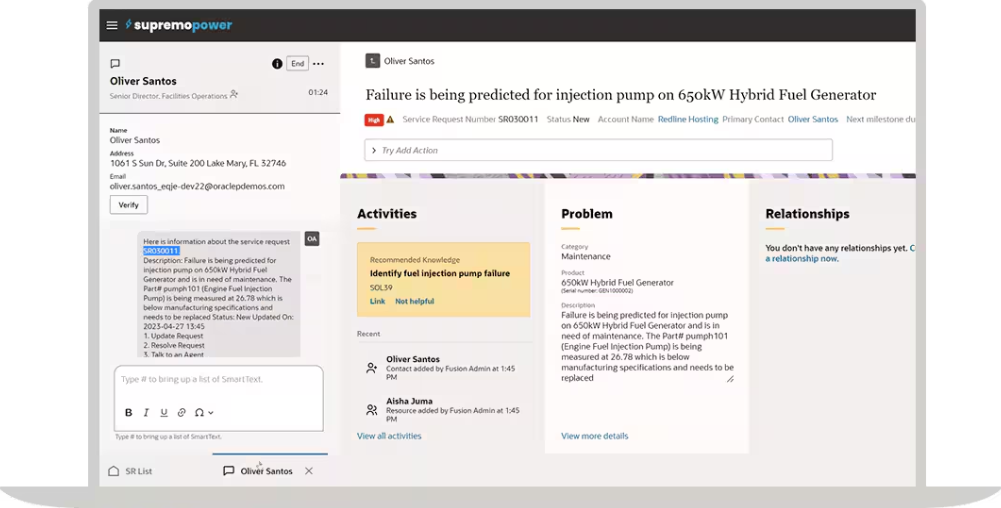
The Service Center provides a configurable agent workspace that surfaces CRM, ERP, supply chain, billing, and contract data on one screen. A smart action bar provides one-click access to hundreds of resolution actions. Omnichannel routing handles email, chat, phone, video, SMS, and messaging. AI generates interaction summaries, suggests knowledge articles, and recommends next actions in real time. The platform includes 1,000+ prebuilt reports and supports cross-department swarming through Slack and Microsoft Teams integration.
Source: Oracle
Field Service Management uses AI planning, scheduling, and dispatch across employees, contractors, and seasonal workers. The scheduling engine reoptimizes based on skills, location, traffic, and past performance. Technicians use an offline-capable mobile app with Apple CarPlay and Android Auto support. Parts inventory management tracks stock levels across depots, trucks, and repair centers, with auto-triggered shipments. Customer self-service scheduling lets customers book, reschedule, and track technician arrival on a live map.
Knowledge Management provides a centralized knowledge base with ML article recommendations, approval workflows, 33+ language support, and version control with full audit history. The same knowledge base feeds agent workspaces, self-service portals, chatbots, field service devices, and internal help desks.
The Digital Assistant does more than retrieve information. Using multilingual NLP and conversational AI, it executes transactions in ERP, supply chain, and CRM systems (processing returns, updating billing, not just answering questions). Asynchronous chat preserves conversation context across sessions.
Oracle Fusion CX Analytics: Prebuilt cross-enterprise reporting with 700+ KPIs.
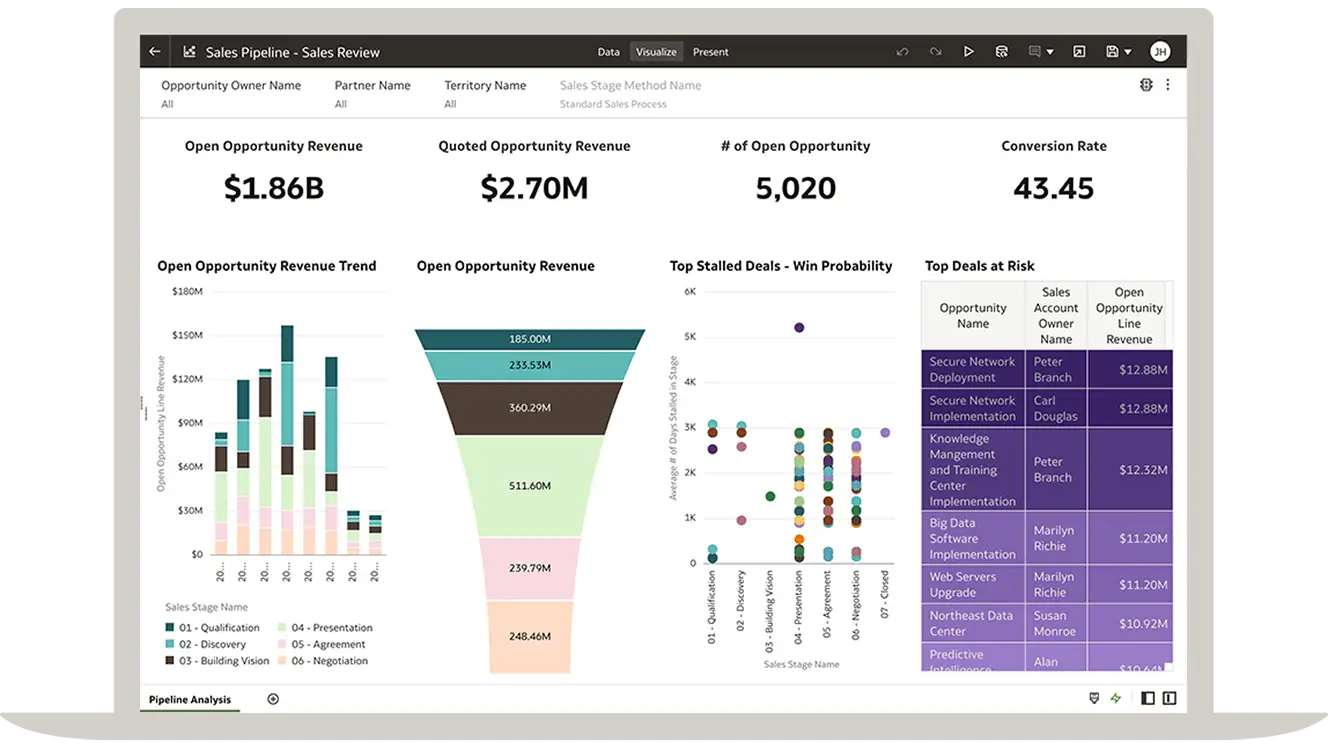
Oracle Fusion CX Analytics provides a managed analytics layer that ingests data from all Oracle Cloud CX applications. Because it shares a data model with ERP, HCM, and SCM analytics, it enables front-to-back-office analysis (tracking lead-to-order or quote-to-cash flows) without custom integration.
Source: Oracle
The platform includes 700+ CX KPIs and 100+ dashboards covering nine subject areas: sales pipeline, win-loss analysis, lead prioritization, sales activity, quote efficiency, subscription pipeline, campaign efficiency, account-based analysis, and service effectiveness. Role-based security is inherited directly from Oracle Cloud CX, requiring no separate configuration. 50+ connectors link to non-Oracle data sources.
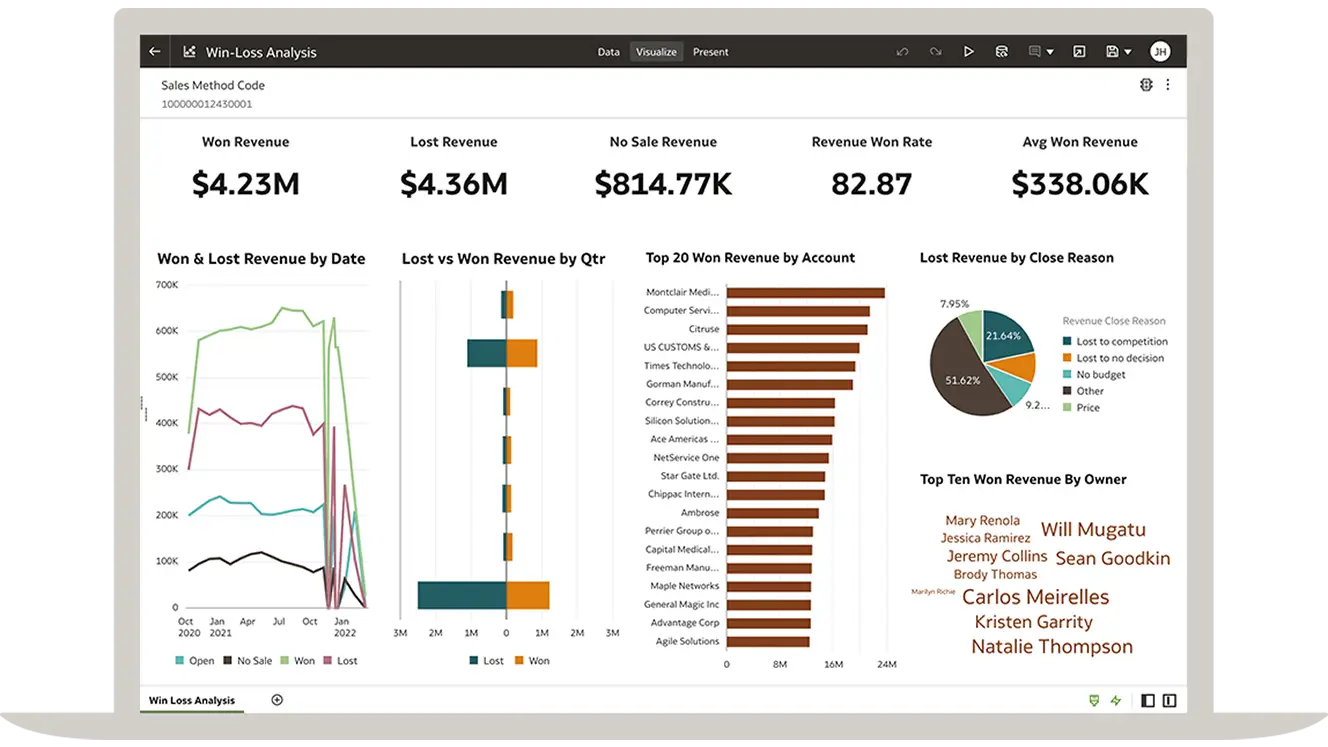
Source: Oracle
Natural language querying lets users generate reports by asking questions like "Show me closed opportunities by stage for Q2." Prebuilt ML models provide outcome prediction and risk detection without separate licensing or model training.
Oracle AI for CX: Embedded AI with agentic applications.
Oracle AI for CX spans three tiers: predictive ML (scoring, forecasting), generative AI (content creation, summarization), and agentic AI (multi-agent teams that coordinate and act across the enterprise). Oracle lists 60+ named AI capabilities across sales, service, and marketing.
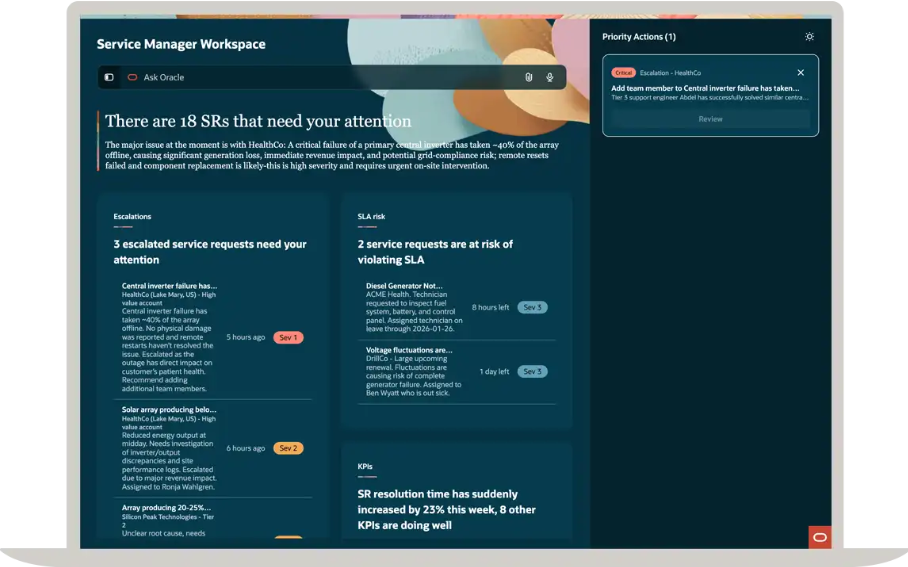
Source: Oracle
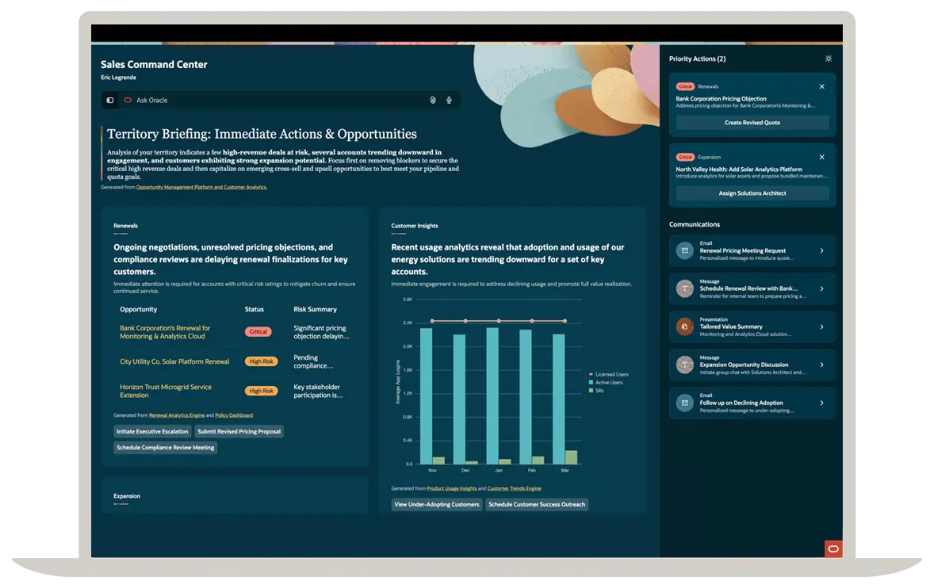
In April 2026, Oracle launched Fusion Agentic Applications: workflow-level applications designed to orchestrate AI agent teams for specific business processes. These include the Sales Command Center (territory monitoring and pipeline risk detection), Cross-Sell Program Workspace (installed base expansion), Contract Compliance Workspace (semantic contract analysis for policy deviation), and Marketing Command Center (revenue opportunity identification and growth program launch).
The AI architecture uses specialized agents that coordinate with each other, drawing from Fusion's full data scope including finance, supply chain, and HR data. Several agents use retrieval-augmented generation (RAG) to ground recommendations in live business data and attached documents like earnings reports and financial disclosures.
Oracle also launched an Agentic Applications Builder in AI Agent Studio (March 2026), allowing customers to build, connect, and run custom AI automation using Oracle, partner, and external agents without traditional application development.
All AI runs on Oracle Cloud Infrastructure, and Oracle states that sensitive business data is never shared with other infrastructure or LLM providers. AI comes with the base subscription rather than requiring separate licensing. The Gartner CRM CEC report cited this as a differentiator against competitors with tiered AI pricing.
Oracle Cloud CX Pricing
Oracle CX uses a per-user, per-month subscription model for most products, with contacts-based pricing for marketing and session-based pricing for CPQ and digital service. All prices below are maximum list prices from the Oracle Fusion Cloud Service Global Price List (May 2026); actual prices are negotiated based on volume, bundling, and account relationship.
Sales:
Product | Monthly List Price | Minimum |
|---|---|---|
Oracle Fusion Sales Enterprise | $150.00 per user | 10 users |
Oracle Fusion Incentive Compensation | $75.00 per participant | 500 participants |
Oracle Fusion CPQ | $240.00 per user | 10 users |
Service:
Product | Monthly List Price | Minimum |
|---|---|---|
Oracle Fusion Service Enterprise | $200.00 per user | 360 pooled users |
Oracle Fusion Field Service | $225.00 per user | 360 pooled users |
Oracle Fusion Digital Customer Service | $70.00 per 1,000 sessions | 10,000 sessions |
Marketing:
Product | Annual Price | Minimum |
|---|---|---|
Oracle Fusion CDP | $40.00 per 1,000 profiles | 5,000 profiles |
Oracle Fusion Marketing Orchestration | $50.00 per 10,000 contacts | 1,200 contacts |
AI and Analytics:
Product | Price | Minimum |
|---|---|---|
Oracle Fusion CX Analytics | $200.00/month per user | 10 users |
Oracle Fusion Agentic Applications | $500,000.00/year per environment | 1 environment |
Oracle Fusion AI Agents | $150.00/month per user | 50 users |
The standard contract term is three years for all Fusion Cloud subscriptions. No month-to-month option is available. Oracle does not offer a self-serve free trial for CX; product pages provide only "Request a Demo" and "Chat with CX Sales" options.
Additional costs listed in the price list include test environments ($75,000/year), integration access ($500,000/year), HIPAA compliance ($100,000/year), and implementation assessments ($10,000 one-time). Enterprise deployments typically require Oracle Consulting or a certified systems integrator (Deloitte, Accenture, IBM), adding substantial project costs beyond licensing.
Where Oracle Cloud CX Falls Short
Oracle Cloud CX has limitations that vary by your organization's size, stack, and go-to-market approach. These reflect a platform built for large Oracle-centric environments, not broad accessibility.
Steep Learning Curve and Interface Friction. Reviewers on G2 and Gartner Peer Insights note the interface "is vast and lacks intuition" and is "not intuitive, slow, and lacks integrations with third parties that help sales teams work more efficiently." Oracle's Redwood design system is rolling out progressively, but legacy screens remain. Oracle addresses this with Oracle Guided Learning (in-app tours, process guides, tooltips), but needing a dedicated adoption platform underscores the complexity.
Implementation Burden. Setup "can be complex and require specialized knowledge," and "without proper training or consulting, it's easy to run into roadblocks," per Gartner Peer Insights reviewers. Effective deployments typically require Oracle Consulting or a certified SI, adding cost and time. This is the trade-off of a platform touching ERP, supply chain, and HR data, but it puts Oracle CX out of reach for organizations that need faster time-to-value.
Third-Party Integration Gap. Despite strong Oracle-to-Oracle integration, connecting to non-Oracle tools remains a challenge users report consistently. Oracle's app marketplace is thinner than Salesforce's AppExchange. For go-to-market teams that rely on specialized tools for prospecting, conversation intelligence, or sales engagement, this forces workarounds that undercut the platform's efficiency.
Prohibitive for SMBs. With list prices starting at $150/month per user for sales (minimum 10 users), $200/month per user for service (minimum 360 pooled users), three-year contract terms, and implementation costs that typically run into six or seven figures, Oracle CX requires large IT budgets. G2 and Capterra reviewers consistently flag cost as a barrier for smaller organizations.
No Built-In B2B Prospecting Intelligence. Oracle CX manages the customer experience once you have relationships in the system, but it does not provide B2B contact data, verified phone numbers, buyer intent signals, or account intelligence that go-to-market teams need to identify and reach new buyers. Sales and marketing teams using Oracle CX still need a separate source of verified buyer data to fill their pipeline.
These limitations aren't failures. They reflect Oracle's focus on enterprise operations, not broad accessibility or prospecting. But they create a need for a complementary layer that provides verified buyer data, intent signals, and account insights alongside Oracle CX's operational tools.
The Essential Complement to Oracle Cloud CX: ZoomInfo
ZoomInfo addresses Oracle CX's B2B intelligence gap by providing the data foundation that CX platforms depend on but don't build themselves. While Oracle CX manages the operational workflow (campaigns, quotes, cases, field service), ZoomInfo provides the upstream intelligence: who to target, when they're in-market, and how to reach them.
B2B Data: ZoomInfo provides the verified contacts, direct dials, and company intelligence that CRM systems need but don't generate.
ZoomInfo operates the largest B2B data platform: 500M contacts, 100M companies, 135M+ verified phone numbers, 120M direct-dial phone numbers, and 200M+ verified business email addresses. Built through a multi-source pipeline and 300+ human researchers, the data reaches 95% accuracy on first-party data.
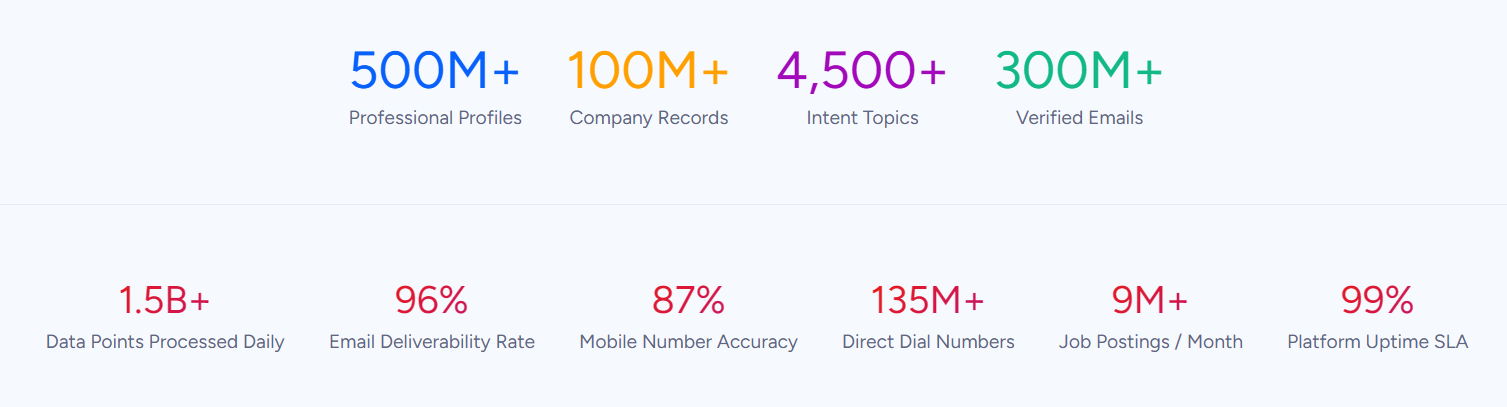
CRM platforms like Oracle CX store and manage customer data, but they don't source it. A sales team using Oracle Sales still needs verified contact information, org charts, and direct dials for the people they want to reach. ZoomInfo fills that gap with 300+ company attributes for market segmentation, department org charts with decision-makers' contact details, and job-change alerts that keep records current.
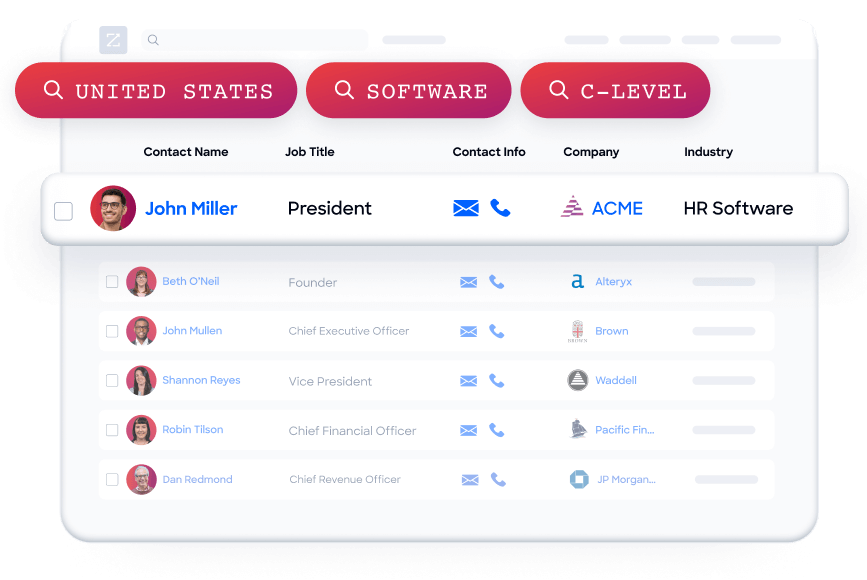
The data quality claim is externally validated. In a Fortune 500 competitive RFP analyzing 25 million contacts across vendors, the independent consultant concluded that "no other competitor came even close." ZoomInfo has also been named a Leader in the Forrester Wave for Intent Data Providers B2B (Q1 2025), a Gartner Magic Quadrant Leader for ABM Platforms for two consecutive years, and the only vendor positioned in Gartner's Customers' Choice quadrant with a 4.7/5.0 average rating.
"ZoomInfo gives us the information we need to execute. We don't have to go through and spend our time digging. It's already there, so we can be three steps ahead." (Vensure)
Buyer Intent and Account Intelligence: ZoomInfo identifies in-market accounts before they engage your sales team.
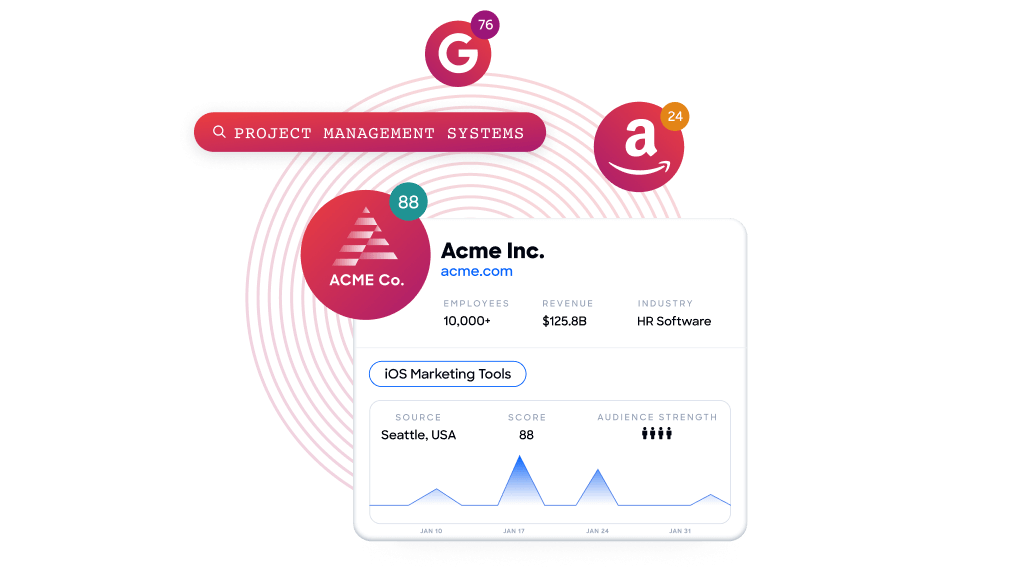
Where Oracle CX tracks behavior within your own digital properties (through Oracle Infinity), ZoomInfo tracks buying signals across the broader internet. ZoomInfo Intent monitors signals from 210 million IP-to-Organization pairings and 6 trillion+ new keyword-to-device pairings sourced monthly. Guided Intent, exclusive to ZoomInfo, identifies topics historically correlated with deal success rather than requiring manual topic selection.
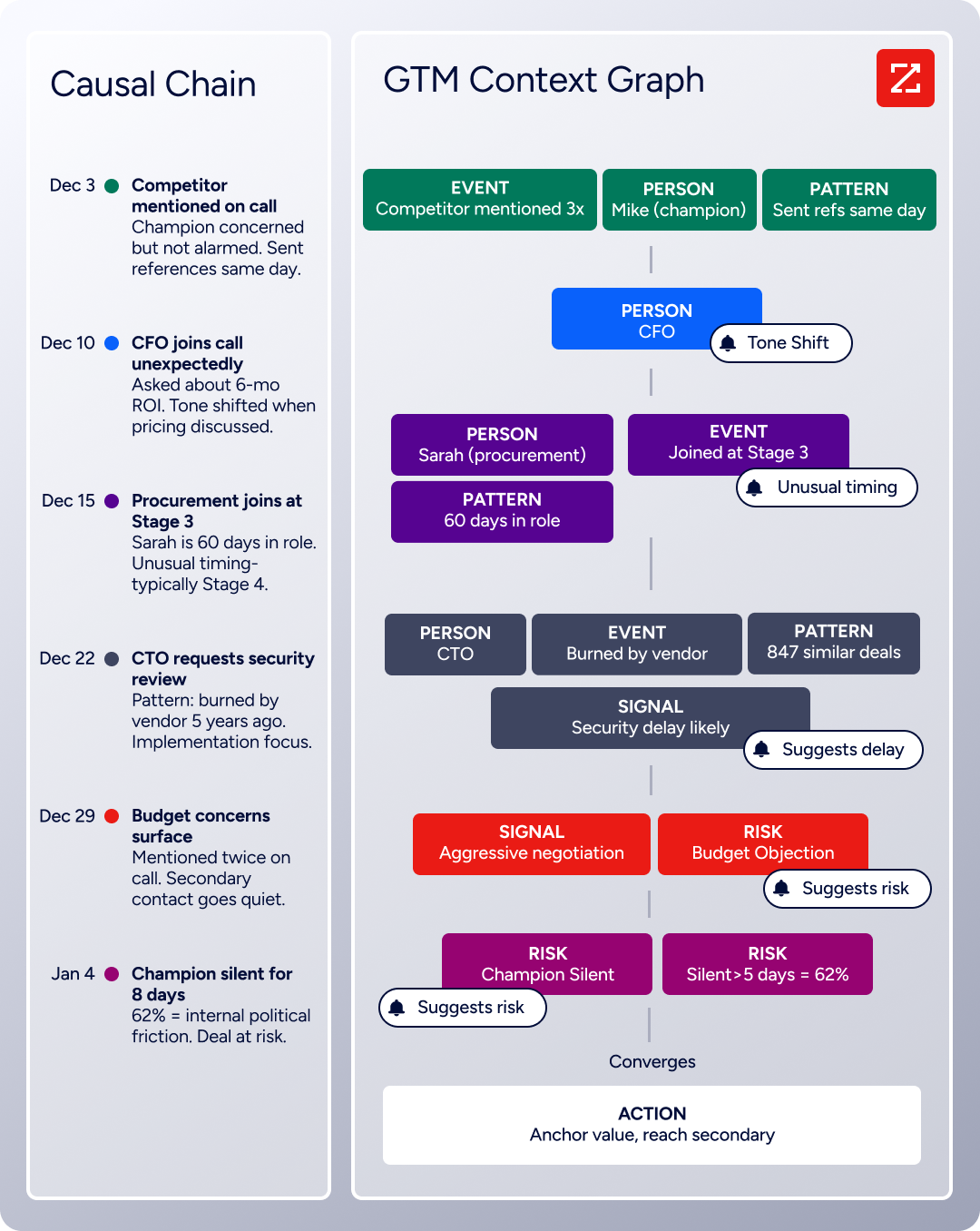
The GTM Context Graph goes further by fusing ZoomInfo's third-party data with a customer's CRM records, conversation transcripts, and behavioral signals into a single intelligence layer processing 1.5B+ data points daily. CRMs record that a deal's stage changed. Conversation intelligence transcribes what the VP of Finance said on the last call. Intent platforms log a spike in research activity. The GTM Context Graph fuses all three to capture why the deal moved, not just that it did. That intelligence flows into every downstream action: follow-up emails, account prioritization, and forecast accuracy.
WebSights resolves anonymous website traffic to companies, identifies the buying team, and provides direct contact information, with Automatic Traffic Filtering that distinguishes real visitors from bots.
"The combination of our internal CRM data, external signals, and AI has helped us craft very specific account- and persona-based messages. And people have responded right away." Seismic attributed 39% of active pipeline to ZoomInfo-influenced opportunities. (Seismic)
Universal Access: ZoomInfo's intelligence flows into any tool through APIs, MCP, and dedicated workspaces.
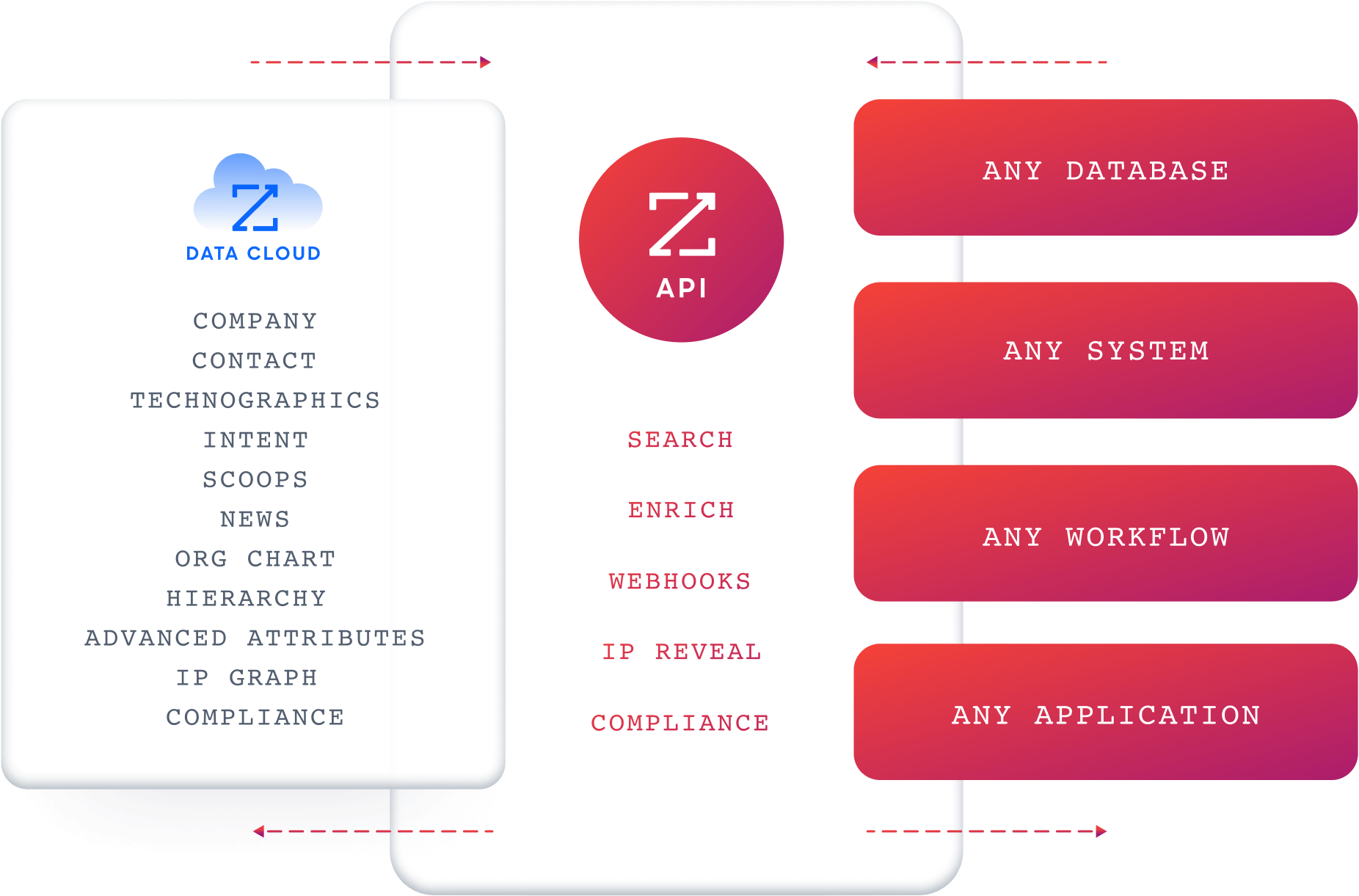
Oracle CX's third-party integration limitations are well documented by users. ZoomInfo addresses this through three channels: APIs, an MCP server, and dedicated workspaces.
The Enterprise API, documented at docs.zoominfo.com, provides programmatic access across four areas: Data API for search and enrichment, Copilot API for AI intelligence (account summaries, company insights, contact recommendations), Marketing API for audience management, and Platform API for engagement data. API access is included in all relevant plans.
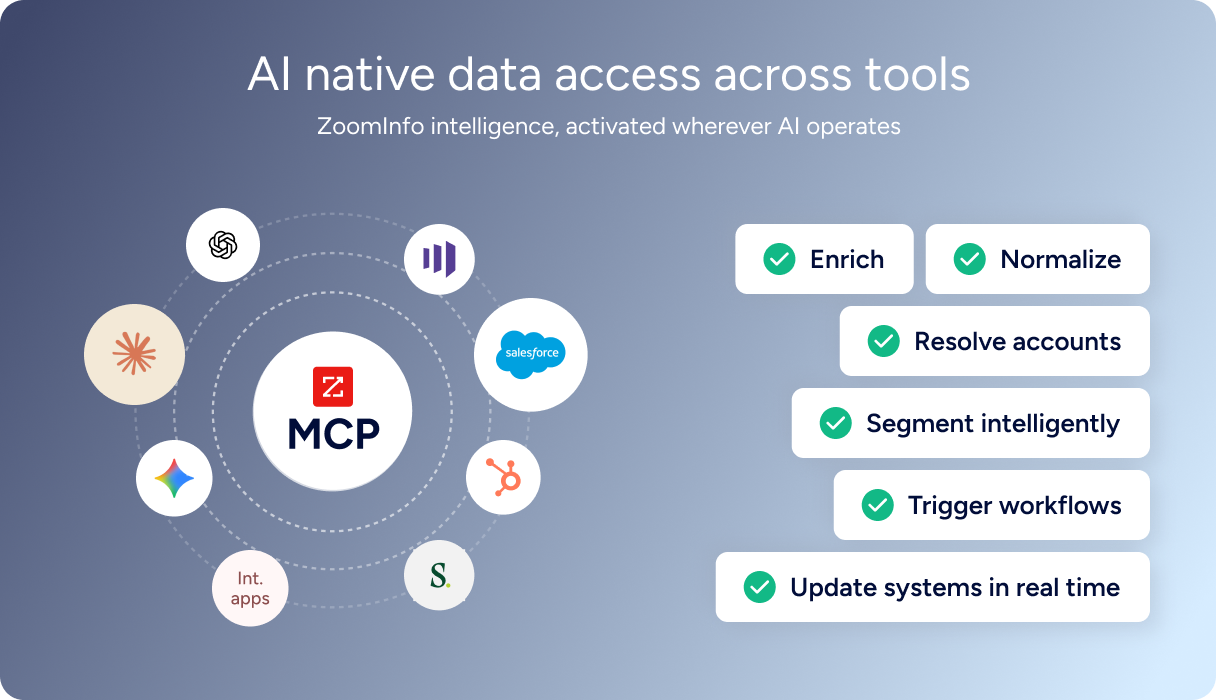
The ZoomInfo MCP server connects AI models to ZoomInfo's B2B data through the Model Context Protocol, so AI agents can search companies, enrich contacts, and research accounts in natural language without custom code. It currently supports Claude and ChatGPT, with additional MCP-compatible tools noted as coming soon.
For teams working inside dedicated interfaces, GTM Workspace gives sellers one screen for prioritized accounts, AI-drafted outreach, and deal execution. AI agents handle researching accounts, generating follow-ups, monitoring signals, and updating CRM fields. GTM Studio gives marketers and RevOps teams a canvas for designing audiences in natural language, launching multi-channel plays, and measuring pipeline impact, without engineering support.
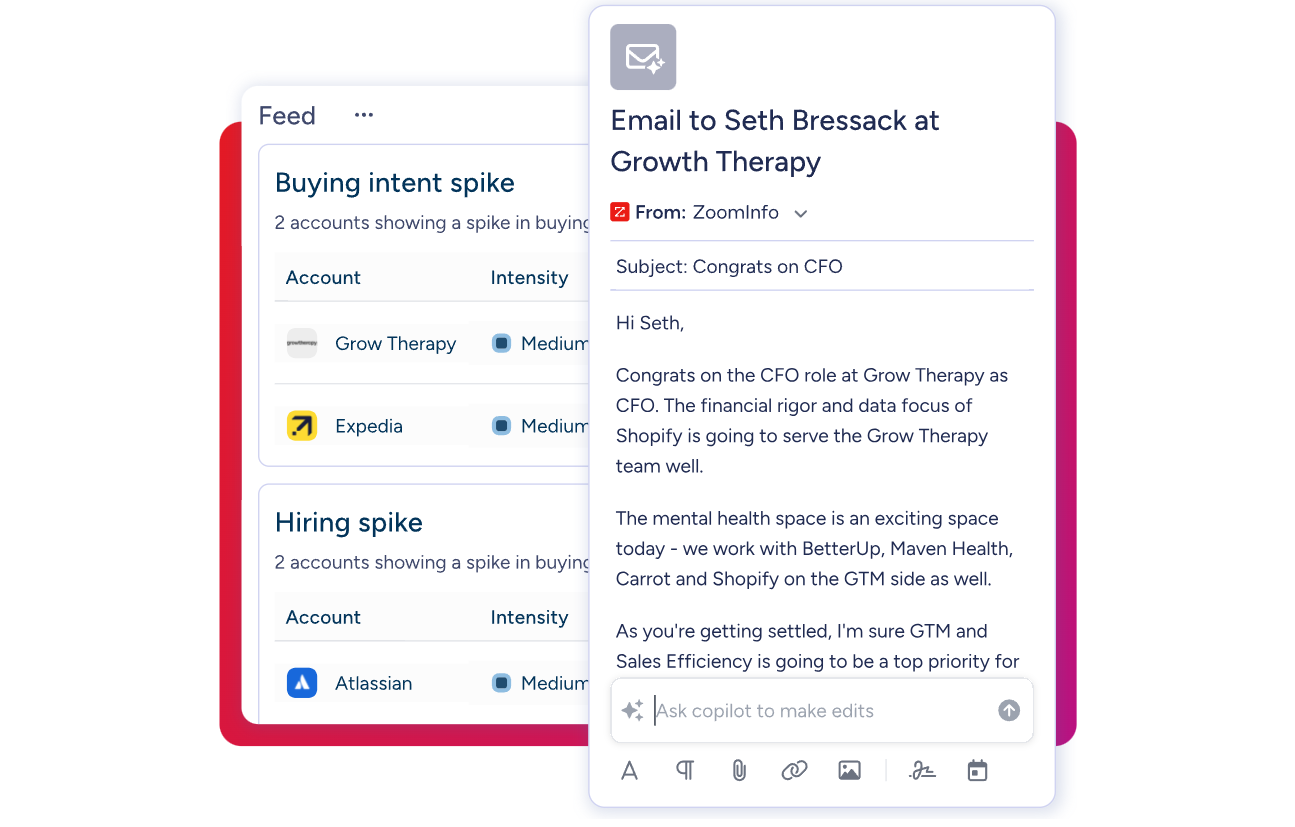
"The plug-and-play aspect of the API means I can integrate it very easily into any process and get information at a moment's notice." BDO Canada achieved an 87% reduction in time spent on data dashboard updates. (BDO Canada)
Pricing with Free Entry Points: ZoomInfo offers free tiers for evaluation.
Oracle CX requires three-year contracts, enterprise-level budgets, and formal procurement. ZoomInfo provides two free entry points. ZoomInfo Lite is a permanent free tier (not a trial) with access to ZoomInfo's B2B database, 10 monthly export credits, individual and company searches, CRM enrichment, a Chrome extension, and WebSights Lite with up to 10 website visitor reveals per day. A separate 7-day free trial of the full platform is also available with no credit card required.
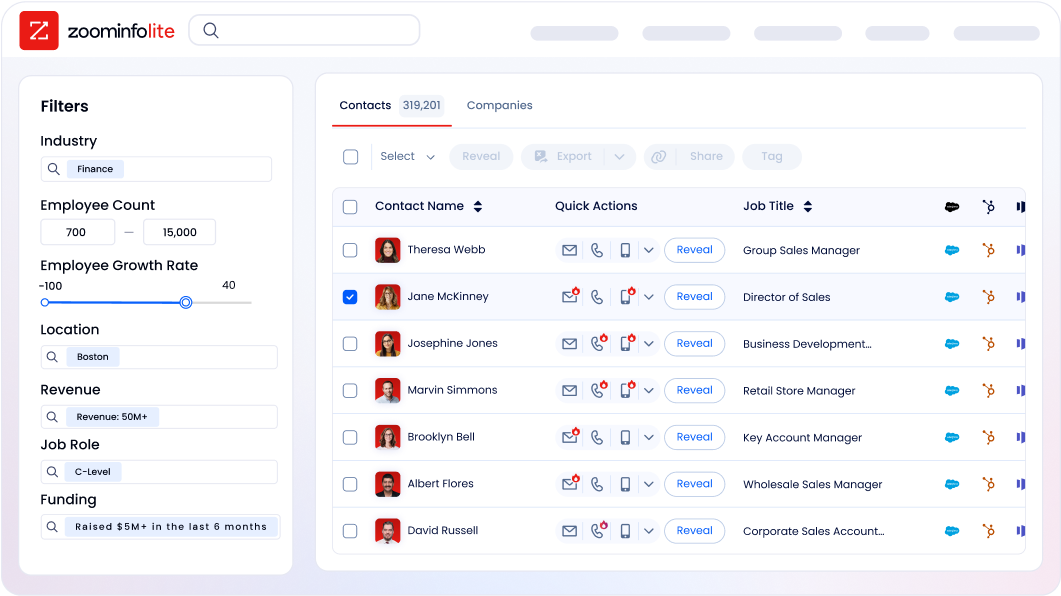
Paid plans follow a consumption-based pricing model scaled to usage. Three product lines (Sales, Marketing, and Conversation Intelligence) each offer tiered plans from Professional through Enterprise, with pricing custom-quoted based on seats, credit volume, and features. Credits are consumed only when exporting data; searching and viewing within ZoomInfo does not use credits.
Oracle Cloud CX and ZoomInfo: How They Work Together
Aspect | Oracle Cloud CX | ZoomInfo |
|---|---|---|
Primary purpose | Manage customer experience operations across marketing, sales, and service | Provide B2B data intelligence, buyer signals, and go-to-market execution |
When used | Campaign execution, pipeline management, quoting, service resolution, field dispatch | Buyer identification, prospecting, account intelligence, intent monitoring |
Data source | Internal CRM, ERP, and operational data | 500M contacts, 100M companies, intent signals, and first-party data fusion |
AI focus | Agentic AI acting across back-office and front-office workflows | GTM Context Graph intelligence across buyer behavior and deal outcomes |
Integration approach | Native with Oracle Fusion stack; limited third-party ecosystem | API and MCP access into any CRM, tool, or AI agent |
Pricing model | Per-user/month, three-year contracts, enterprise pricing | Consumption-based, custom-quoted, with free Lite tier |
Implementation | Months-long deployment with SI involvement | Deploys in weeks; Lite available immediately |
Free option | No self-serve free trial | Permanent free tier + 7-day trial, no credit card |
Target buyer | Large enterprises (1,000+ employees), especially Oracle ERP customers | Enterprise and upper mid-market B2B organizations |
Best for | Operational CX management and back-office integration | B2B buyer intelligence and go-to-market execution |
Final Verdict
Oracle Cloud CX and ZoomInfo serve different but connected roles in the enterprise go-to-market stack.
Oracle Cloud CX is the right choice for large enterprises that need their customer-facing tools to share data natively with ERP, supply chain, and finance. Its defining advantage is structural: the same Fusion platform runs everything, so a quote generated in CPQ flows into ERP for order management, a service case surfaces contract and billing data without integration work, and marketing attribution connects to actual financial transactions. For organizations already running Oracle's back-office applications, adding CX to the stack removes categories of middleware and data reconciliation that cost real time and money. Its Gartner Leader status across five CX categories, industry-specific data models, and embedded AI make it a fit for complex enterprise operations.
ZoomInfo is the data intelligence layer for CX deployments. CX deployments depend on verified B2B contact data, direct dials, buyer intent signals, and account intelligence to fill their pipeline, and that data lives outside any CRM or CX platform. ZoomInfo provides this through its B2B data platform, the GTM Context Graph (which captures why deals move, not just that they moved), and access that delivers intelligence into any tool through APIs, MCP, GTM Workspace, or GTM Studio. Whether your CX system is Oracle, Salesforce, or anything else, ZoomInfo provides the upstream intelligence that makes your downstream operations effective.
Get started with ZoomInfo here.
The strongest go-to-market teams don't choose between operational CX and data intelligence. They use both: a CX platform to manage the customer experience, and ZoomInfo to ensure they're reaching the right buyers with the right context at the right time.
Oracle Cloud CX FAQ
What is Oracle Cloud CX used for?
Oracle Cloud CX is an enterprise suite that manages marketing, sales, and service operations. It includes B2B marketing automation (Eloqua), B2C campaign management (Responsys), a customer data platform (Unity CDP), sales force automation, configure-price-quote tools, customer service case management, field service management, and analytics. Its primary use case is operational CX management for large organizations, particularly those that want customer-facing tools connected to Oracle ERP, supply chain, and HR systems on a shared data model.
How much does Oracle Cloud CX cost?
Oracle CX pricing varies by module and uses per-user monthly rates. Sales starts at $150/month per user (minimum 10), Service at $200/month per user (minimum 360 pooled users), CPQ at $240/month per user, and CX Analytics at $200/month per user. The Fusion Agentic Applications tier costs $500,000/year per environment. All subscriptions require three-year minimum terms. Actual prices are negotiated, and implementation costs (typically requiring Oracle Consulting or a certified systems integrator) add substantially to the total.
Does Oracle Cloud CX offer a free trial?
Oracle does not offer a self-serve free trial for its CX suite. Product pages provide "Request a Demo" and "Chat with CX Sales" options. Oracle's Free Cloud Tier applies to infrastructure services only, not Fusion SaaS applications. CX Analytics offers a structured "innovation trial" that loads prebuilt content against your data, but this is a facilitated evaluation, not a self-serve trial. ZoomInfo, by contrast, offers both a permanent free tier (ZoomInfo Lite) and a 7-day free trial with no credit card required.
Who is Oracle Cloud CX designed for?
Oracle Cloud CX is designed for large enterprises, typically 5,000 to 100,000+ employees. It delivers the most value to organizations already running Oracle Fusion ERP, where native back-office integration eliminates significant middleware costs. Key industries with dedicated product packages include communications, financial services, government, hospitality, life sciences, retail, and utilities. The platform does not fit SMBs, startups, or organizations that need quick implementation without consulting.
What Gartner recognitions does Oracle Cloud CX hold?
Oracle holds simultaneous Gartner Magic Quadrant Leader status in five CX categories: CRM Customer Engagement Center (13 consecutive years), B2B Marketing Automation Platforms (13 consecutive years), Configure Price Quote Applications (9 consecutive years), Sales Force Automation Platforms (9 consecutive years), and Customer Data Platforms. No other single vendor holds Leader status across all five categories simultaneously.
Does Oracle Cloud CX integrate with non-Oracle tools?
Oracle CX integrates natively with Oracle's own Fusion applications (ERP, SCM, HCM) without middleware. For non-Oracle tools, integration options exist through REST APIs, the Oracle Cloud Marketplace, and ISV partnerships with companies like DocuSign, Five9, LinkedIn, and Dun & Bradstreet. However, user reviews consistently note that connecting non-Oracle tools is harder than with competing CRMs, and Oracle's partner marketplace is thinner than Salesforce's AppExchange. ZoomInfo's API and MCP access offer a way to bring B2B data intelligence into Oracle CX environments without relying on Oracle's integration ecosystem.
What is Oracle CX's AI strategy?
Oracle embeds three tiers of AI across its CX suite: predictive ML (lead scoring, forecasting), generative AI (content creation, summarization), and agentic AI (multi-agent teams that decide and act). In April 2026, Oracle launched Fusion Agentic Applications, workflows designed to orchestrate AI agent teams for specific outcomes like cross-sell identification, contract compliance, and territory monitoring. Oracle's claim is that its agents access finance, supply chain, and HR data alongside CRM data, enabling broader recommendations than CRM-only AI. All AI runs on Oracle Cloud Infrastructure, and Oracle states that customer data is never shared with third-party LLM providers.
How can ZoomInfo complement Oracle Cloud CX?
Oracle CX manages customer experience operations but does not generate the B2B contact data, buyer intent signals, or account intelligence that sales and marketing teams need to identify new buyers. ZoomInfo fills this gap with 500M contacts, 135M+ verified phone numbers, intent data from 210 million IP-to-Organization pairings, and the GTM Context Graph. ZoomInfo's Enterprise API and MCP server deliver this data into any CRM or tool, while GTM Workspace gives sellers a place for prospecting and deal execution. Together, ZoomInfo identifies and qualifies buyers upstream, and Oracle CX manages the customer relationship downstream.
