
RudderStack is customer data infrastructure for engineering teams that need warehouse-native event collection, identity resolution, and data activation. It delivered 3.3 trillion events for over 4,000 organizations in 2025, with production deployments handling 1 billion daily events. For data engineers who want full control over their pipelines, it works.
But as your data needs evolve, RudderStack's engineering-first approach creates friction outside its core strengths. Its 200+ integrations cover the most common destinations but fall short for teams with broader tool stacks. Its warehouse-native architecture requires dedicated data engineering resources to configure and maintain. And its focus on first-party behavioral data leaves a gap for teams that also need third-party B2B intelligence for prospecting, enrichment, and go-to-market execution.
That's where this guide comes in. Whether you're looking to:
Enrich first-party behavioral data with B2B intelligence for prospecting and GTM execution
Access a broader integration catalog with no-code audience building for growing teams
Manage customer data orchestration in regulated enterprise environments
Get product analytics running without building pipeline infrastructure first
Activate warehouse data with streaming sync and AI-powered decisioning
Collect schema-validated behavioral data at infrastructure-only cost
Consolidate product intelligence tools for AI-native development
We'll explore RudderStack alternatives that excel in each of these areas.
Some teams will use these tools alongside RudderStack to fill specific gaps; others will replace it with a platform better suited to their needs. This isn't about finding a "better" tool. It's about finding the right fit for your data stack as your requirements become more specialized.
The Best RudderStack Alternatives
Best Complement for B2B Intelligence & GTM Execution We chose ZoomInfo because it provides the third-party B2B intelligence (500M contacts, 100M companies, intent signals) that first-party behavioral data tools like RudderStack cannot deliver, accessible via API and MCP in any data stack. |
|---|
Best Alternative for Growing Businesses Needing Broad Integration Coverage We chose Segment because its 750+ pre-built integrations and no-code Generative Audiences let growing teams activate customer data without the engineering overhead RudderStack requires. |
Best Alternative for Enterprise Regulated-Industry Data Orchestration We chose Tealium because its 1,300+ centrally maintained connectors, real-time consent propagation, and private cloud deployment meet the compliance requirements that RudderStack's self-managed model places on your engineering team. |
Best Alternative for Small Teams Needing Product Analytics Without Pipeline Infrastructure We chose Mixpanel because it delivers behavioral analytics (funnels, retention, cohorts) from a single JavaScript snippet, bypassing the warehouse setup and data engineering that RudderStack requires. |
Best Alternative for Warehouse Data Activation We chose Hightouch because its Streaming Reverse ETL, no-code Customer Studio, and AI Decisioning engine provide a deeper activation layer than RudderStack's schedule-based Reverse ETL. |
Best Free Alternative for Schema-Validated Behavioral Data Infrastructure We chose Snowplow because its schema-first validation at the collection layer and infrastructure-only cost model give engineering teams higher data fidelity with no per-event platform fees. |
Best Alternative for Engineering Teams Building AI-Native Products We chose PostHog because it consolidates product analytics, session replay, feature flags, error tracking, and native LLM observability under one data model, replacing the multi-tool stack RudderStack feeds. |
What is RudderStack?
Source: RudderStack
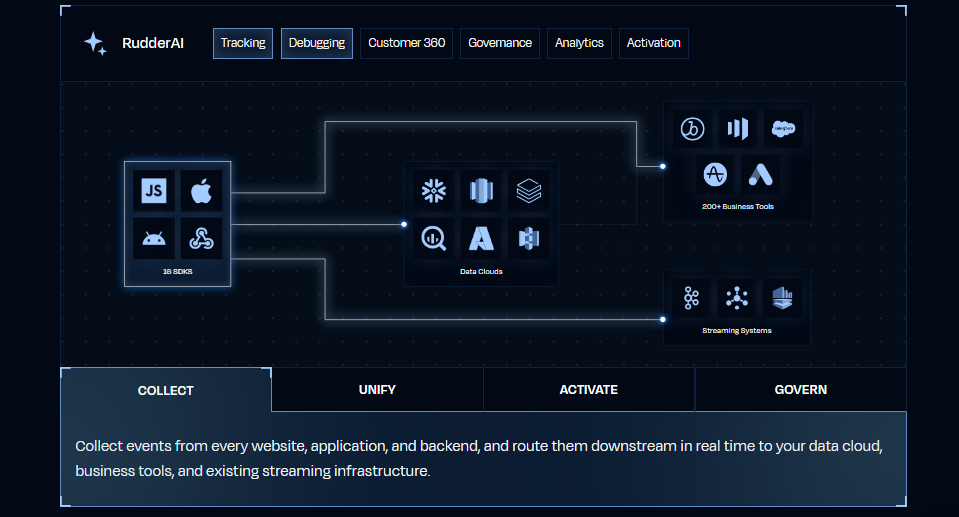
RudderStack is a customer data infrastructure platform built for data engineers who need warehouse-native event collection, identity resolution, and data activation. Unlike traditional CDPs that store customer data in their own systems, RudderStack routes all data directly to the customer's own warehouse (Snowflake, BigQuery, Redshift, Databricks), giving teams full ownership and control.
Its key features include:
Event Stream for real-time data collection via 16+ SDK sources and 200+ cloud destinations
Profiles for warehouse-native identity resolution and Customer 360 profile building
Reverse ETL for activating warehouse data in downstream SaaS tools
Transformations for real-time JavaScript or Python enrichment and filtering in-pipeline
Data Quality Toolkit for schema governance and event validation
Data Compliance Toolkit for consent management and PII controls
Because everything is warehouse-native, your team manages the pipeline configuration, transformation code, and surrounding infrastructure. Data flows through RudderStack and lands in your warehouse, where you model, enrich, and activate it downstream. Engineering teams get control over every step of the data lifecycle.
But as your requirements grow beyond first-party behavioral data collection, you may need specialized tools: broader integration coverage, enterprise compliance, product analytics without infrastructure overhead, deeper activation capabilities, or third-party B2B intelligence that behavioral data alone cannot provide.
Looking for B2B intelligence to complement your customer data stack? ZoomInfo provides contact, company, and intent data accessible via API and MCP in any tool.
How We Curated Our List of RudderStack Alternatives
After testing RudderStack and researching the customer data infrastructure market, we found that its engineering-first, warehouse-native approach doesn't fit every team. RudderStack excels at giving data engineers full control over event pipelines, but some businesses need more specialized tools for:
Enriching first-party data with B2B intelligence for prospecting and GTM execution
Accessing broader integration coverage without maintaining custom connectors
Managing data in regulated enterprise environments with built-in compliance controls
Getting product analytics running without warehouse infrastructure
Activating warehouse data with streaming sync and AI-powered optimization
Collecting schema-validated behavioral data at infrastructure-only cost
Consolidating product intelligence tools under a single data model
Each tool on this list leads in one of these areas. You might use them alongside RudderStack or switch entirely; it depends on what your business needs most.
DISCLAIMER: We aren't covering every single tool in the market! Our focus is on highlighting the best alternatives that address some of RudderStack's limitations for various use cases. The goal is to provide insights into tools that cater to specific business needs. |
|---|
1. ZoomInfo: Best Complement for B2B Intelligence & GTM Execution
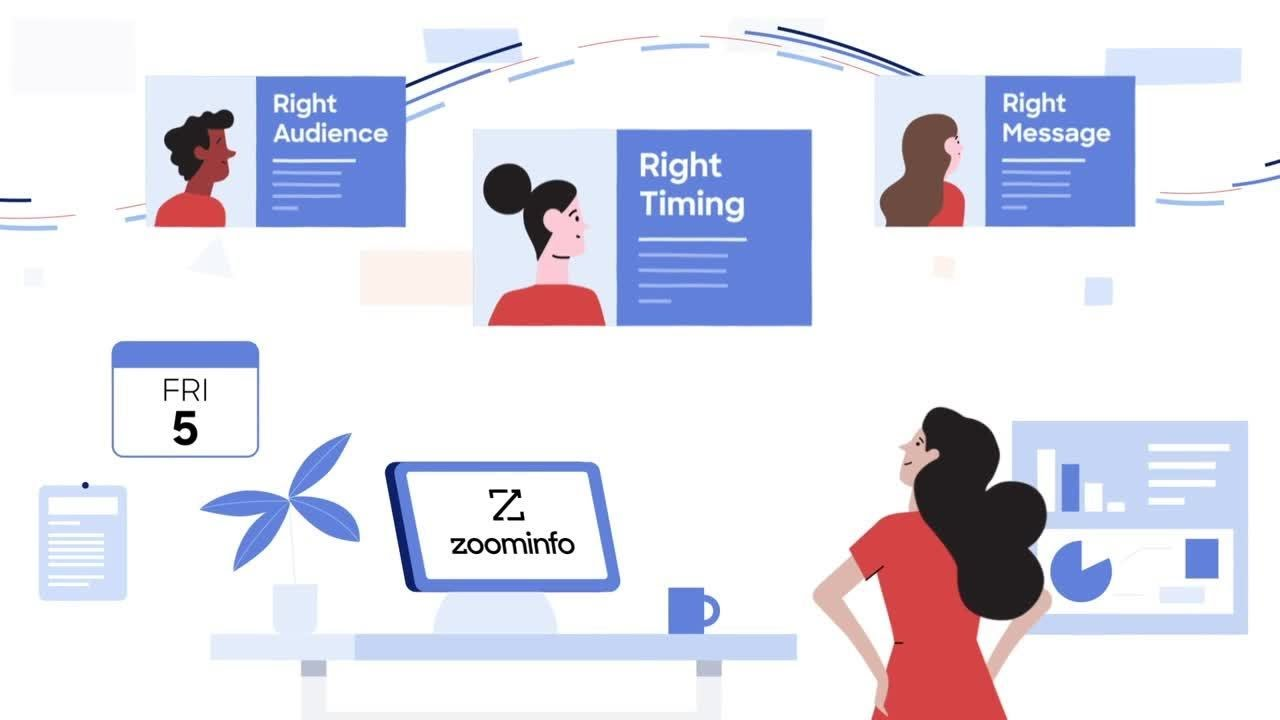
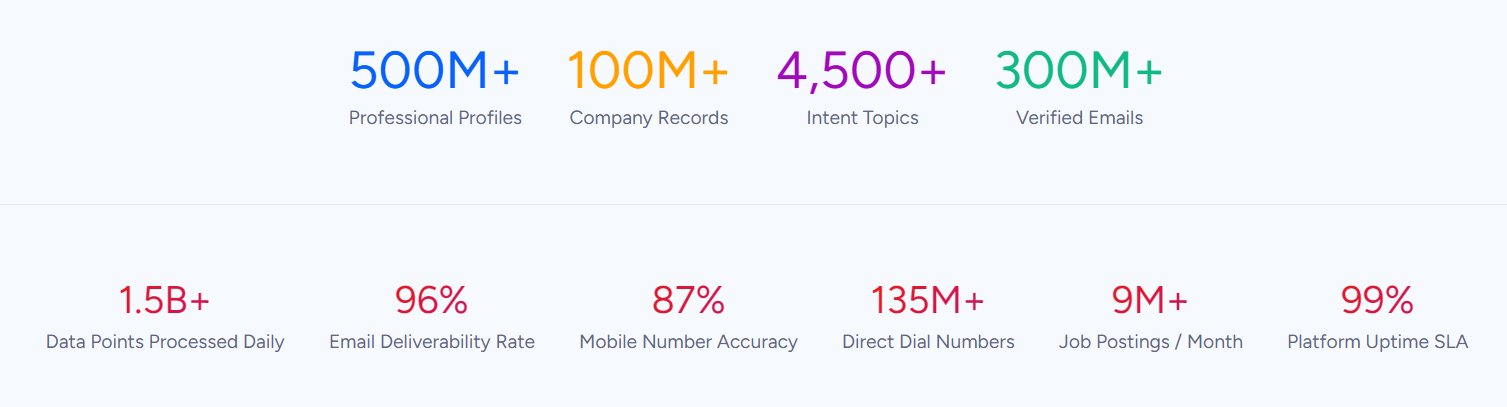
ZoomInfo is an AI GTM platform built on a large B2B data foundation: 500M contacts, 100M companies, 135M+ verified phone numbers, and 200M+ verified business email addresses.
While RudderStack captures and routes what users do inside your product, ZoomInfo provides the intelligence that lives outside it: who your buyers are, who else is on the buying committee, what technologies they run, and whether they're actively in-market for a solution like yours.
That data foundation fuels ZoomInfo's GTM Context Graph, an intelligence layer that processes 1.5B+ data points daily. It fuses ZoomInfo's B2B data with your CRM records, conversation transcripts, and behavioral signals to reveal not just what happened, but why deals move or stall. Your team accesses this intelligence through APIs and MCP in any tool, GTM Workspace for sellers, or GTM Studio for marketers and RevOps.
For teams that use RudderStack (or any CDP) to collect first-party behavioral data, ZoomInfo fills the intelligence gap: the third-party B2B data, intent signals, and GTM context that behavioral event streams cannot capture on their own.
Key differentiators include:
Buyer intent signals: 210M IP-to-Organization pairings and 6T+ keyword-to-device pairings sourced monthly, including Guided Intent (exclusive to ZoomInfo) that identifies topics historically correlated with deal success
Data verification: Up to 95% accuracy on first-party data, verified through a multi-source pipeline backed by 300+ human researchers
Cloud delivery: Data available directly in Snowflake, BigQuery, AWS, Google Cloud, and Databricks via Cloud Partners, so teams running RudderStack can combine first-party behavioral signals with ZoomInfo's B2B intelligence in a single warehouse
How ZoomInfo Enhances Your Customer Data Stack
RudderStack captures what happens inside your product. ZoomInfo provides the intelligence that lives outside it. Here's where they work together.
B2B Data Enrichment: The Identity Layer Behavioral Data Can't Build
RudderStack's Profiles product unifies customer identities within your warehouse, stitching together anonymous IDs, emails, and device IDs from your own product surfaces. It's useful for understanding your existing users.
But it cannot tell you who else at that user's company should be involved in the buying decision, what their direct phone number is, or what technologies they're running.
ZoomInfo's data platform covers three dimensions at once: identity data (who buyers are and how to reach them), company context (100M companies with org charts and technographics covering 30,000+ technologies across 200+ categories), and dynamic signals that reveal when accounts are actively in-market. A multi-source pipeline backed by 300+ human researchers verifies this data.
In a Fortune 500 competitive RFP analyzing 25 million contacts across vendors, the independent consultant concluded that "no other competitor came even close."
Source: ZoomInfo
ZoomInfo in Action: Your RudderStack pipeline captures that three users from the same company signed up for a free trial this week. ZoomInfo enriches that signal: the company is a 2,000-person fintech with $50M in funding, the VP of Engineering (a decision-maker with a verified direct dial) hasn't signed up yet, and the company is actively researching your competitor's category. Your sales team now has the full picture, not just the behavioral breadcrumbs.
SpringDB used ZoomInfo's enriched data to achieve 2x to 3x increases in campaign conversions across channels, a 300% increase in database usability, and 30-50% uplift in average deal size. (SpringDB)
GTM Context Graph: Understanding Why Deals Move, Not Just What Users Click
The GTM Context Graph separates ZoomInfo from a static database. It fuses ZoomInfo's B2B data with a customer's own CRM records, conversation intelligence from calls and meetings, email interactions, and behavioral signals into a single layer that captures not just what happened, but why.
As ZoomInfo's Chief Product Officer Dominik Facher writes: "The CRM recorded the state change. It has no record of why it happened." Perhaps the CFO joined the last call and asked about six-month ROI; that's what actually accelerated the deal. The GTM Context Graph makes this decision context machine-readable, capturing people and their relationships, actions and their outcomes, patterns and predictions, and exceptions and explanations.
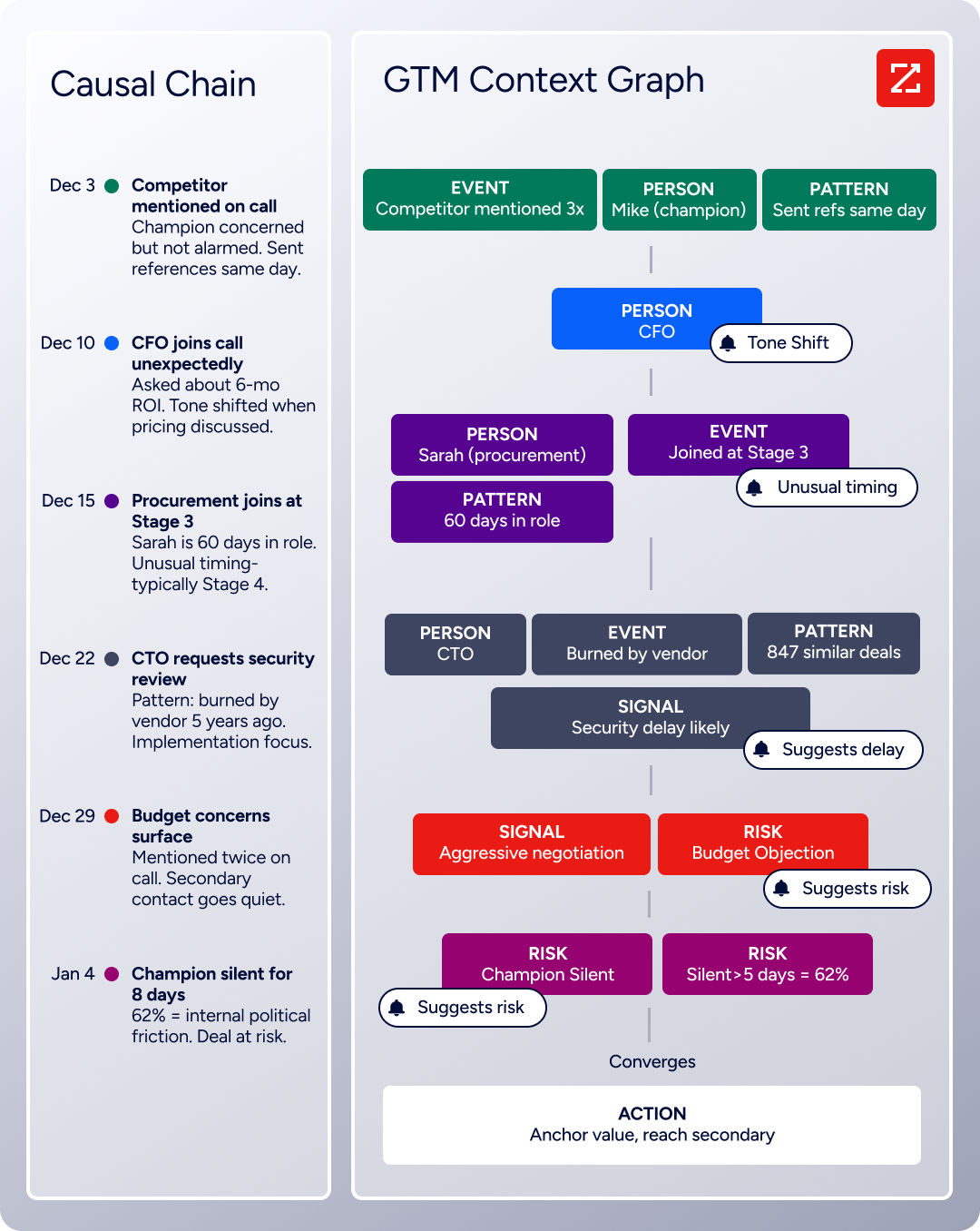
Source: ZoomInfo
ZoomInfo in Action: Your data pipeline tracks that a prospect visited your pricing page three times this week. The GTM Context Graph adds context: their CFO was on the last demo call and asked about ROI, two new VPs were hired last month (a common buying signal in your segment), and the account matches the pattern of deals that close within 30 days. Your rep doesn't just know the prospect is active; they know why the deal is moving and what to say next.
Seismic attributed 39% of active pipeline to opportunities identified or influenced by ZoomInfo signals, with sales teams reporting 54% higher productivity. (Seismic)
Universal Access: ZoomInfo Intelligence in Any Tool via API and MCP
ZoomInfo delivers its intelligence through three channels.
APIs expose the full data layer programmatically, with Search, Enrich, Copilot, and Marketing endpoints documented at docs.zoominfo.com. The MCP server connects AI models directly to ZoomInfo's B2B data as a native tool, supporting Claude and ChatGPT with additional MCP-compatible tools coming soon. GTM Workspace gives sellers a single AI-powered workspace, while GTM Studio gives marketers and RevOps teams a canvas for building and launching GTM plays.
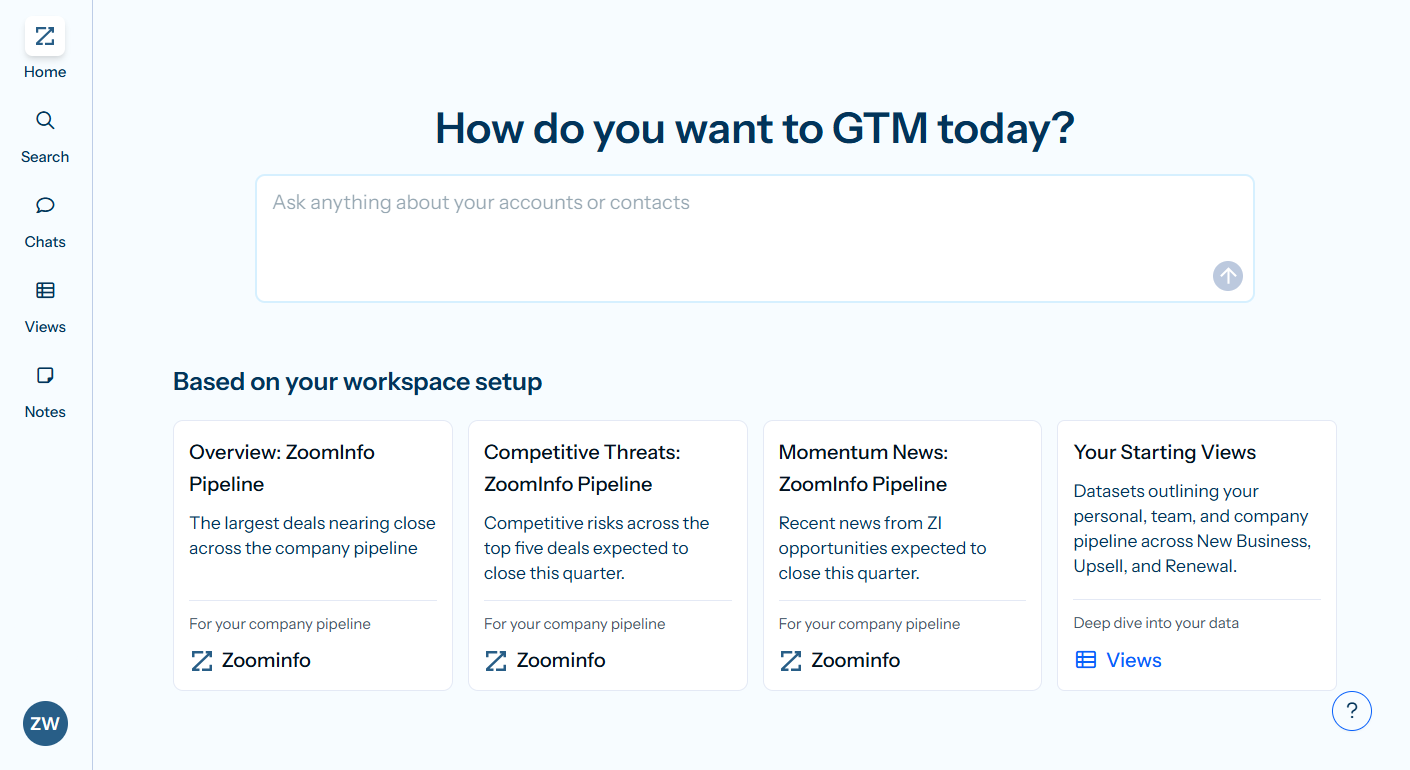
Because ZoomInfo also delivers data directly into Snowflake, BigQuery, AWS, Google Cloud, and Databricks via Cloud Partners, teams running RudderStack (which routes behavioral data into these same warehouses) can combine first-party behavioral signals with ZoomInfo's third-party B2B intelligence in a single warehouse environment.
API access is included in all relevant plans.
BDO Canada achieved an 87% reduction in time spent on updates to their internal data dashboards using the ZoomInfo API. "The plug-and-play aspect of the API means I can integrate it very easily into any process and get information at a moment's notice." (BDO Canada)
ZoomInfo Pricing
ZoomInfo uses a consumption-based pricing model with no publicly listed prices for paid tiers. Pricing scales around enterprise license agreements, data access, API consumption, and AI activity, so costs depend on usage patterns, number of users, monthly credit volume, features, and contract length.
ZoomInfo's pricing page is organized into Sales plans (Professional, Advanced, Enterprise) and Marketing plans (Marketing Demand, ABM Lite, ABM Enterprise), with Chorus and Chat available as standalone products.
Two free entry points make it accessible to evaluate:
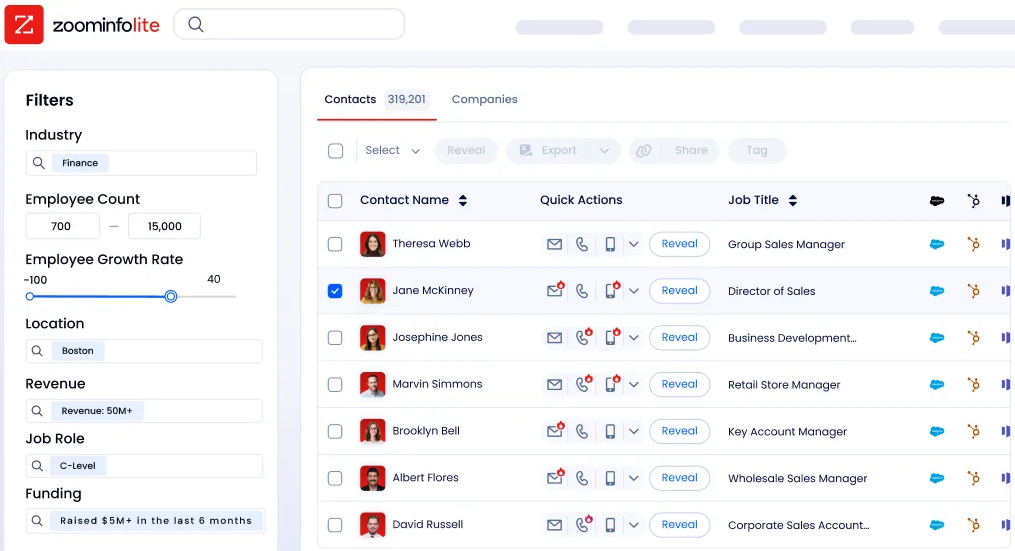
ZoomInfo Lite: a permanent free tier (not a trial) with access to ZoomInfo's B2B database, 10 monthly export credits, individual and company search, the ReachOut Chrome Extension, and WebSights Lite. No credit card required.
A 7-day free trial with access to core platform features including contact and company search, sales intelligence tools, intent signals, and email outreach.
Source: ZoomInfo
Who Should Use ZoomInfo?
Choose ZoomInfo if:
You collect first-party behavioral data through RudderStack (or any CDP) but need third-party B2B intelligence to identify who your users are, map their buying committees, and prioritize accounts showing in-market signals.
Your sales team needs verified direct dials and business emails to reach prospects, not just behavioral event logs showing anonymous product activity.
You want an intelligence layer that connects CRM data, conversation transcripts, intent signals, and behavioral events to surface why deals are moving, not just that activity occurred.
You need your B2B data accessible in any tool: via API, MCP for AI agents, or delivered directly into your data warehouse alongside your first-party pipeline data.
Ready to add B2B intelligence to your data stack? Start with ZoomInfo Lite for free or request a demo to see how ZoomInfo's 500M contacts, intent signals, and GTM Context Graph complement your existing customer data infrastructure.
2. Segment: Best Alternative for Growing Businesses Needing Broad Integration Coverage
Source: Twilio
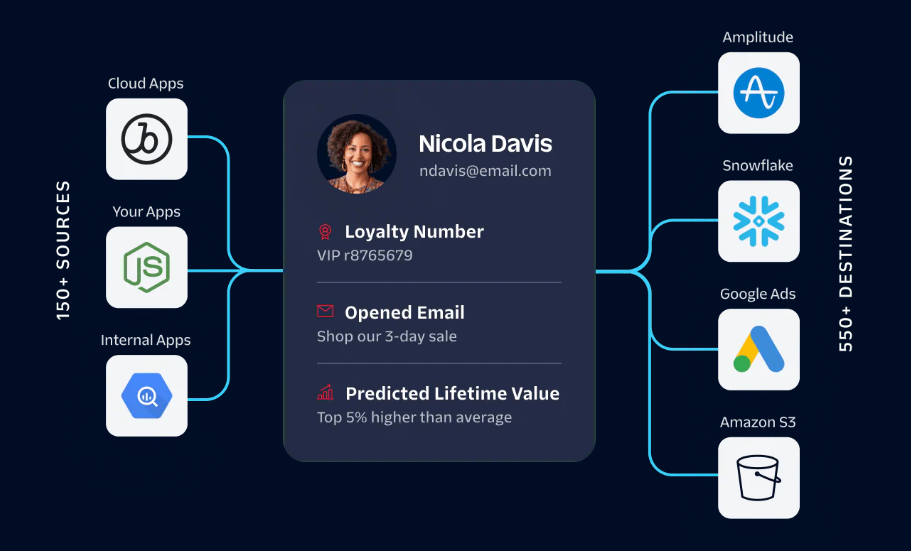
Twilio Segment is a customer data platform that combines the broadest pre-built integration catalog in the CDP category with no-code audience activation tools. It fits growing businesses that need customer data flowing through their stack without dedicated data engineering overhead.
Why Choose Segment Over RudderStack for Growing Businesses
Segment stands out in the following areas:
Integration Coverage That Eliminates the Long-Tail Connector Problem
RudderStack ships approximately 200+ pre-built cloud destinations, and TrustRadius reviewers have flagged that the destination catalog "needs expansion."
Segment's 750+ integrations close this gap. G2 users note it "integrates with almost all the tools out there." For growth-stage companies still adopting new tools, Segment's breadth means those decisions don't create integration backlogs for engineering.
No-Code Audience Building for Teams Without Data Engineering
RudderStack's architecture is designed for engineers and data scientists, not marketers. Segment's Generative Audiences lets marketers describe an audience in plain English, and Segment translates it into a structured segment definition. Predictive Traits adoption grew 57% year-over-year in 2024, signaling real demand for AI-powered segmentation. Linked Audiences extend this further by pulling directly from Snowflake, BigQuery, and Redshift.
Data Governance Built for Collaborative Environments
Segment Protocols closes the governance gap with centralized Tracking Plans, real-time violation detection, active event blocking, and quarantine routing.
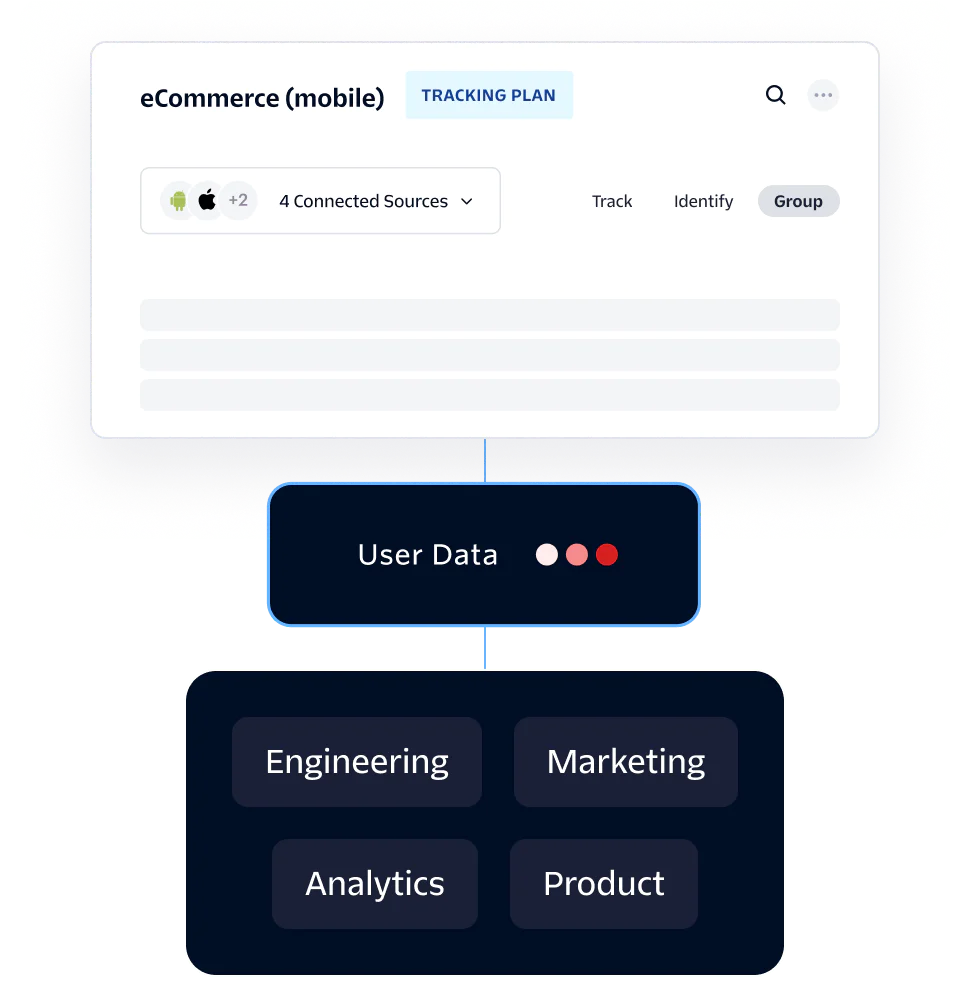
Source: Twilio
NOTE: We also evaluated mParticle (mobile-first consumer app use cases) and ActionIQ (enterprise audience management). Segment offers the most accessible path for growing businesses, combining the broadest integration catalog, natural language audience building, and pricing that doesn't require an enterprise contract. For a detailed side-by-side of mParticle and Segment, see our mParticle vs Segment comparison.
Segment Pricing
Free Plan: $0/month for up to 1,000 monthly tracked users, 2 sources, 1 warehouse destination, full access to 700+ integrations.
Team Plan: Starting at $120/month for 10,000 MTUs. 14-day free trial available, no credit card required.
Business Plan: Custom pricing with Protocols, HIPAA eligibility, regional data residency, and dedicated support.
Who Should Use Segment?
Choose Segment if:
Your team is growing faster than your data engineering capacity and needs no-code audience tools for marketing activation without engineering queues.
You're managing a wide tool stack and want native integrations for any platform you adopt, without custom connector maintenance.
You're already using or evaluating Twilio for communications (SMS, email via SendGrid, WhatsApp) and want behavioral data and messaging on one platform.
3. Tealium: Best Alternative for Enterprise Regulated-Industry Data Orchestration
Source: Tealium
Tealium is a Customer Data Orchestration Platform built for regulated enterprise environments where data governance, compliance, and integration maintenance are procurement requirements.
Why Choose Tealium Over RudderStack for Enterprise Data Orchestration
Tealium stands out in the following areas:
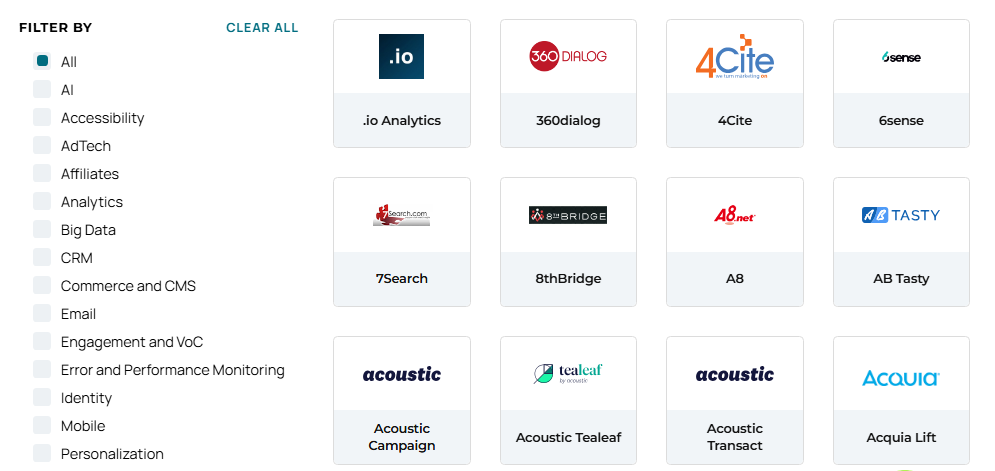
1,300+ Centrally Maintained Connectors
RudderStack's engineering-first model means your team maintains connector reliability and API version changes. Tealium's 1,300+ pre-built connectors are maintained by Tealium's engineering team. For enterprise teams managing 50+ active destinations, the long-run engineering cost of connector maintenance often exceeds the cost of the platform itself.
Source: Tealium
Structural Compliance Infrastructure
RudderStack's compliance value proposition is that it stores no customer data. This matters for GDPR. But consent enforcement and HIPAA controls must be built using RudderStack's Transformations and Compliance Toolkit.
Tealium's compliance model is structural: consent state from OneTrust, Ketch, or Didomi propagates in real time across every connector. HIPAA Business Associate Agreements and private cloud deployment provide full data sovereignty. TrustRadius reviewers describe Tealium's privacy and security posture as "second to none compared to competitors."
Real-Time CDP and AI Layer
AudienceStream CDP operates as a server-side real-time layer with identity resolution, 500+ visitor attributes, and Tealium Predict for churn and propensity modeling. The Tealium Moments API benchmarks at approximately 60ms latency and includes a managed MCP server for AI agent access to consent-aware customer profiles. Tealium holds Gartner Magic Quadrant Leader placements in both 2024 and 2025.
NOTE: We also evaluated Adobe Real-Time CDP and SAP Customer Data Platform. Tealium offers the strongest combination of integration breadth, HIPAA BAA, private cloud deployment, and real-time consent propagation without requiring lock-in to a specific cloud vendor.
Tealium Pricing
Tealium does not publish pricing. The platform is sold through direct sales and negotiated enterprise contracts. Pricing is modular (Data Collection, AudienceStream CDP, EventStream, Data Cloud Activation, Tealium for AI) and scales based on data volumes and connector usage.
Who Should Use Tealium?
Choose Tealium if:
Your organization operates in financial services, healthcare, or telecommunications where HIPAA BAA, ISO 27701, and private cloud deployment are compliance requirements.
Your engineering team spends meaningful time maintaining destination connectors and you want that to be the vendor's responsibility.
You need a real-time CDP with managed ML and MCP server access for AI workflows today, without building those capabilities on top of a warehouse-native identity pipeline.
4. Mixpanel: Best Alternative for Small Teams Needing Product Analytics Without Pipeline Infrastructure
Source: Mixpanel
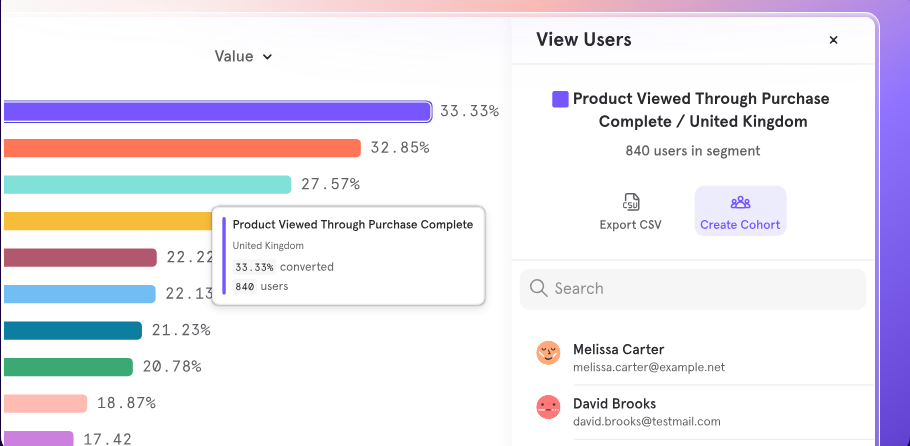
Mixpanel is a digital analytics platform designed for product teams that need behavioral analytics (funnels, retention, cohorts, flows) without assembling a data pipeline first.
Why Choose Mixpanel Over RudderStack for Self-Serve Product Analytics
Mixpanel stands out in the following areas:
No Infrastructure Required
RudderStack requires a data warehouse, data engineering team, and multi-week setup. Mixpanel removes that prerequisite entirely. A developer adds a JavaScript snippet (or enables the {autocapture: true} SDK flag), and Mixpanel immediately begins recording interactions.
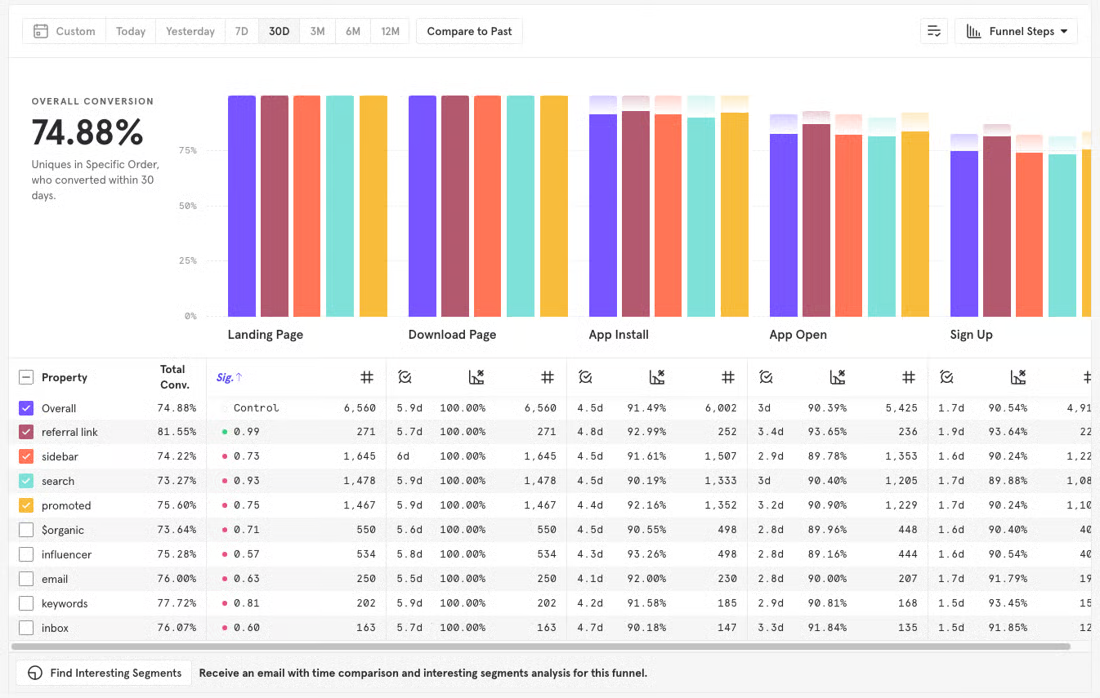
Autocapture records clicks, page views, Dead Clicks (no visible response within 0.5 seconds), and Rage Clicks (four or more clicks within one second), surfacing frustration signals without separate tooling.
Built-In Analytics Replaces a Two-Tool Stack
With RudderStack, data collection and analytics are separate layers. Mixpanel collapses that: the same platform that ingests events lets you build Funnels, Retention cohorts, and Flows. Mixpanel reports a 19% average MAU increase and 18% improvement in retention among customers. The platform also includes Session Replay, Heatmaps, and Experiments under the same data model.
Source: Mixpanel
A Generous Free Tier That's a Real Product
Mixpanel's permanent free plan covers 1 million monthly events with full analytics access. For startups under five years old with less than $8 million raised, the Startup Program extends this to one year free with up to 1 billion events annually.
NOTE: We also evaluated Amplitude (comparable analytics depth, more restricted free tier) and June (simpler B2B SaaS analytics, narrower feature surface). Mixpanel offers the most complete entry point for small teams that need behavioral analytics immediately, without pipeline infrastructure.
Mixpanel Pricing
Free: Permanently free, 1 million monthly events, full access to Insights, Funnels, Flows, and Retention.
Growth: First 1 million events/month included at no cost; additional events starting at approximately $0.28 per 1,000 events.
Enterprise: Custom pricing with unlimited events, advanced governance, and EU/India data residency.
Who Should Use Mixpanel?
Choose Mixpanel if:
Your team doesn't have a dedicated data engineer and needs behavioral analytics running within hours, not weeks.
You want a single platform for event collection and product analytics, replacing the two-tool stack RudderStack's architecture requires.
Your primary questions are about product behavior (feature adoption, drop-off, retention) rather than routing customer data to downstream marketing and sales tools.
5. Hightouch: Best Alternative for Warehouse Data Activation
Source: Hightouch
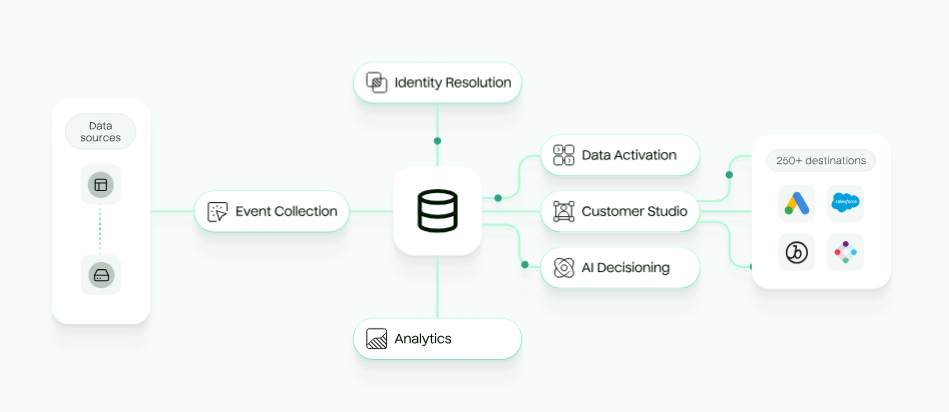
Hightouch is a warehouse-native activation platform that turns any SQL model or table in Snowflake, BigQuery, Redshift, or Databricks into a live feed to 250+ downstream destinations. Named a Leader in the January 2026 Gartner Magic Quadrant for Customer Data Platforms, Hightouch enters after data collection is solved and focuses its engineering depth on the activation problem.
Why Choose Hightouch Over RudderStack for Warehouse Data Activation
Hightouch stands out in the following areas:
Streaming Reverse ETL vs. Schedule-Based Batch Syncing
RudderStack's Reverse ETL runs on configured schedules (30 minutes minimum on Growth, 5 minutes on Enterprise). Hightouch's Streaming Reverse ETL uses warehouse-native change data capture for sub-minute latency, continuously syncing high-volume records to downstream destinations without batch scheduling constraints.
Customer Studio: No-Code Audience Building
Customer Studio includes a visual audience builder with real-time size previews, a Traits engine, native A/B Splits with holdout groups, and multi-step Journey orchestration. RudderStack's Audiences UI handles basic audience syncs but lacks the Traits engine, split testing, and journey orchestration.
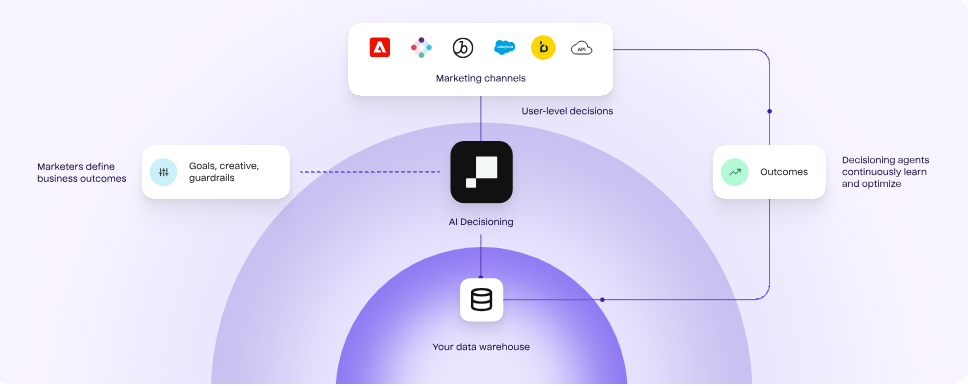
AI Decisioning: Autonomous 1:1 Personalization
AI Decisioning is a reinforcement learning engine that autonomously determines the best message, channel, timing, and offer for each customer. RudderStack does not include a campaign optimization layer.
Source: Hightouch
NOTE: We also evaluated Census (B2B RevOps-focused warehouse syncing) and Polytomic (no-code mid-market option). Hightouch offers the most complete activation platform for teams with a mature data collection stack, combining Streaming Reverse ETL, no-code audience tooling, and an AI Decisioning layer.
Hightouch Pricing
Free: Permanently free, 2 active syncs per month, unlimited destinations and seats, hourly sync frequency.
Self-Serve Paid: Up to 10 active syncs; pricing not publicly disclosed.
Composable CDP: Quote-based. Usage-based on active syncs plus platform fee. No MTU caps or limits on source/destination types. SOC 2 Type 2, ISO 27001, HIPAA, GDPR included.
AI Decisioning: Quote-based; purchasable independently.
Who Should Use Hightouch?
Choose Hightouch if:
Your data collection and warehouse infrastructure is already mature and you need a deeper activation layer than RudderStack's schedule-based Reverse ETL provides.
Your marketing team needs self-serve access to warehouse data through no-code audience building, journey orchestration, and AI-powered personalization.
You need sub-minute activation latency for loyalty offers, re-engagement, or any use case where message value degrades with delay.
6. Snowplow: Best Free Alternative for Schema-Validated Behavioral Data Infrastructure
Source: Snowplow
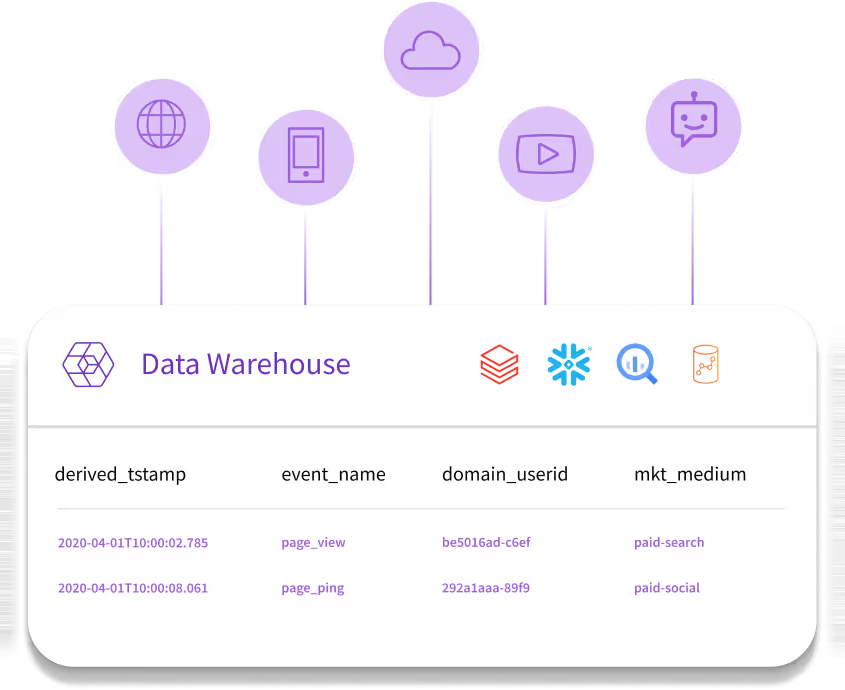
Snowplow is a customer data infrastructure platform that captures, validates, enriches, and delivers behavioral event data to your own warehouse, with zero platform licensing fees on the self-hosted tier. It processes 1 trillion+ events monthly across 2M+ websites and applications.
Why Choose Snowplow Over RudderStack for Schema-Validated Behavioral Data
Snowplow stands out in the following areas:
Schema Validation at the Collection Layer
RudderStack's Data Quality Toolkit evaluates violations after events arrive at the data plane. Snowplow validates every event against a centrally managed JSON Schema before the event exits the pipeline. Non-conforming events route to a separate bad-rows stream for recovery and reprocessing, not silent loss.
Infrastructure-Only Cost Model
RudderStack charges by event volume: 250,000 events/month free, $220/month for 1M on Starter. Snowplow's self-hosted pipeline eliminates the platform fee entirely. The full stack runs on your own AWS, GCP, or Azure infrastructure, making it attractive at scale where per-event pricing compounds.
130+ Auto-Captured Properties With In-Pipeline Enrichment
Where RudderStack requires teams to write JavaScript or Python Transformations for enrichment, Snowplow applies 15+ in-stream enrichments automatically: IAB bot detection, MaxMind IP geolocation, campaign attribution, user agent parsing, PII pseudonymization, and event fingerprinting. Each event auto-captures 130+ properties without custom instrumentation.
NOTE: We also evaluated PostHog (product analytics with a functional free tier, but not behavioral data infrastructure) and Apache Unomi (open-source profile management for GDPR compliance, but not a high-throughput event pipeline). Snowplow offers the most production-hardened free alternative for event collection, validation, enrichment, and warehouse delivery.
Snowplow Pricing
Self-Hosted Pipeline: Runs within your own cloud infrastructure (AWS, GCP, Azure). All infrastructure costs are yours. Includes 35+ trackers, 15+ enrichments, warehouse loaders, and 24/7 support.
Snowplow Platform (Fully Managed): Quote-based. Options include Private Managed Cloud (your cloud account, Snowplow manages operations) or Hosted CDI Cloud (Snowplow manages the data plane). 14-day free trial available, no credit card required.
Who Should Use Snowplow?
Choose Snowplow if:
Your data engineering team is comfortable managing cloud infrastructure and per-event platform pricing has become a meaningful budget item at your event volumes.
Data quality problems trace consistently to schema drift or undetected instrumentation bugs at the source, and you need upstream enforcement rather than downstream remediation.
Your behavioral event streams feed ML pipelines or AI agents where event fidelity and schema consistency matter more than integration breadth.
7. PostHog: Best Alternative for Engineering Teams Building AI-Native Products
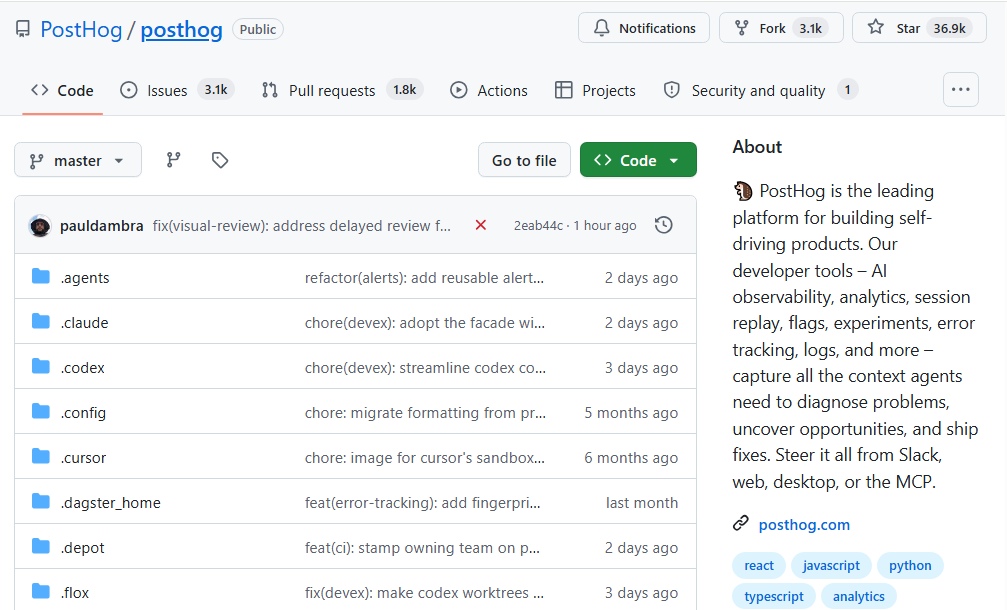
Source: Github
PostHog is an open-source product intelligence platform that consolidates product analytics, session replay, feature flags, A/B experimentation, error tracking, and native LLM observability under one data model. 98% of its 190,000+ teams use the platform entirely for free.
Why Choose PostHog Over RudderStack for AI-Native Product Development
PostHog stands out in the following areas:
Native LLM Observability
RudderStack has announced plans for LLM application data capabilities, but they remain a roadmap item. PostHog's LLM Analytics is in production: wrap your existing OpenAI, Anthropic, AWS Bedrock, LangChain, or Vercel AI SDK client, and every LLM call automatically becomes a captured event with inputs, outputs, token counts, latency, costs, and trace hierarchy for multi-step agent pipelines.
Because LLM events are first-class PostHog events, you can build funnels connecting model behavior to user outcomes.
All-in-One Product Intelligence vs. Multi-Tool Data Infrastructure
RudderStack routes events to separate analytics, feature flag, and session replay tools. PostHog collapses that architecture: the entire product (analytics, session replay, feature flags, experiments, error tracking, LLM analytics, surveys, and a data warehouse) runs on one shared event model, eliminating the multi-tool overhead RudderStack's routing architecture requires.
Engineering-First Pricing
PostHog's permanent free plan covers 1 million events, 5,000 session recordings, 1 million feature flag requests, and 100,000 LLM events per month. No credit card required. Pay-as-you-go rates kick in above thresholds: $0.00005 per event.
PostHog commits to cutting prices rather than raising them. The self-hosted option via Docker Compose (35,000+ GitHub stars) provides data sovereignty for sensitive environments.
NOTE: We also evaluated Segment (enterprise-grade event routing with a deep destination catalog) and Amplitude (standalone product analytics). PostHog offers the most unified product intelligence stack for teams who want analytics, feature flags, session replay, and LLM observability under one data model.
PostHog Pricing
Free: 1M events/month, 5,000 session recordings, 1M feature flag requests, 100K LLM events. No credit card, unlimited team members.
Pay-as-you-go: $0.00005/event from 1-2M, $0.005/recording from 5-15K. Configurable per-product billing caps.
Platform Add-ons: Boost ($250/mo), Scale ($750/mo), Enterprise ($2,000/mo) for HIPAA, SSO, RBAC, and dedicated support.
Who Should Use PostHog?
Choose PostHog if:
You're building an AI-native product and need native observability for LLM calls (token usage, cost, latency, traces) integrated with your behavioral analytics.
You currently run separate tools for product analytics, session replay, feature flags, and error tracking, and want to consolidate under one data model.
You want to evaluate and use the full product stack at meaningful scale before any sales conversation or financial commitment.
The Final Verdict
RudderStack excels as warehouse-native customer data infrastructure for engineering teams, but different business needs call for specialized tools. Based on our research, here are the best alternatives:
ZoomInfo for B2B intelligence, intent signals, and GTM execution to complement your first-party data stack
Segment for growing businesses needing the broadest integration catalog and no-code audience activation
Tealium for regulated enterprise environments requiring centrally maintained connectors and structural compliance
Mixpanel for small teams needing behavioral product analytics without pipeline infrastructure
Hightouch for warehouse data activation with streaming sync and AI-powered decisioning
Snowplow for engineering teams needing schema-validated behavioral data at infrastructure-only cost
PostHog for product engineering teams building AI-native applications under one data model
You don't have to choose between RudderStack and these alternatives exclusively. Many businesses combine RudderStack's first-party data infrastructure with specialized tools to build their ideal data stack. Consider your specific needs, team capabilities, and growth trajectory when deciding which combination works best.
Ready to add B2B intelligence to your customer data stack? Start with ZoomInfo Lite for free or request a demo to see how ZoomInfo's 500M contacts, intent signals, and GTM Context Graph complement your existing data infrastructure.
RudderStack Alternatives FAQ
Why do businesses look for RudderStack alternatives?
RudderStack works well as warehouse-native customer data infrastructure for engineering teams, but businesses often outgrow its capabilities in specific areas.
Its 200+ integrations can fall short for teams with broader tool stacks, its engineering-first architecture requires dedicated data engineering resources for setup and maintenance, and its focus on first-party behavioral data leaves gaps for teams that also need third-party B2B intelligence, product analytics without pipeline overhead, or enterprise compliance controls built into the platform.
What is the best overall RudderStack alternative?
There is no single best alternative because RudderStack covers multiple functions.
Segment is the strongest general-purpose CDP replacement for growing teams. Tealium fits regulated enterprises best. Mixpanel is ideal for small teams that need product analytics without infrastructure. Hightouch leads for warehouse activation. The right choice depends on which capability gap you need to fill.
Is there a free alternative to RudderStack?
Several alternatives offer meaningful free tiers.
Snowplow's self-hosted pipeline runs at infrastructure-only cost with no per-event platform fees. PostHog offers 1 million events per month permanently free across product analytics, session replay, and feature flags. Mixpanel provides 1 million monthly events with full analytics access. Segment's free plan covers 1,000 monthly tracked users. Hightouch includes 2 permanent active syncs on its free tier.
Can ZoomInfo work alongside RudderStack?
Yes. ZoomInfo and RudderStack serve complementary functions.
RudderStack captures and routes first-party behavioral data to your warehouse, while ZoomInfo provides third-party B2B intelligence (contacts, companies, intent signals). Both deliver data to Snowflake, BigQuery, and other major warehouses, so teams can combine first-party behavioral signals with ZoomInfo's B2B data in a single warehouse environment. ZoomInfo's API and MCP make its intelligence accessible in any tool within your data stack.
Which RudderStack alternative is best for teams without a data engineer?
Mixpanel is the top choice for teams without data engineering capacity, delivering behavioral analytics from a single JavaScript snippet with no warehouse or pipeline configuration required.
PostHog is a close second, offering a similar self-contained experience with broader capabilities (session replay, feature flags, LLM analytics). Segment is the best option for teams that want a CDP-style data routing layer with no-code audience building.
How does Hightouch compare to RudderStack's Reverse ETL?
RudderStack's Reverse ETL runs on scheduled intervals (30 minutes minimum on Growth, 5 minutes on Enterprise). Hightouch's Streaming Reverse ETL uses warehouse-native change data capture for sub-minute continuous sync.
Hightouch also adds a no-code Customer Studio with journey orchestration, A/B splits, and an AI Decisioning engine for autonomous 1:1 personalization, capabilities RudderStack's Reverse ETL does not include.
Which alternative is best for regulated industries?
Tealium is designed for regulated enterprise environments, offering HIPAA BAA availability, SOC 2 Type II and ISO 27701 certification, private cloud deployment, and real-time consent propagation across 1,300+ connectors. It holds back-to-back Gartner Magic Quadrant Leader placements for Customer Data Platforms (2024 and 2025). Segment also offers HIPAA eligibility and regional data residency on its Business plan, though with a less complete compliance stack.
Is it difficult to migrate from RudderStack to one of these alternatives?
Migration complexity depends on what you use RudderStack for.
Segment maintains API compatibility with the same event spec, making event collection migration relatively straightforward. PostHog and Mixpanel can run alongside existing infrastructure during transition. Snowplow provides dedicated migration guides from both Segment and RudderStack.
For teams that only need a specific capability (activation, analytics, intelligence), adding a complementary tool like Hightouch or ZoomInfo may be simpler than a full replacement.
Looking beyond RudderStack? Compare the strongest alternatives side by side:
