
Discovery calls can make or break your sales process. When handled well, they give you the pipeline intelligence that separates real opportunities from noise, and that separation is what drives quota attainment, not just activity volume.
They are especially critical when markets are competitive or emerging, which puts more responsibility on reps to make a compelling case early. The first scheduled conversation sets the trajectory for everything that follows.
This guide covers what a discovery call is, how to prepare for one, a step-by-step framework for running it, a question bank organized by category, the most common mistakes that kill deals, a full annotated script, what to do after the call ends, and how AI tools are changing the prep and follow-up process.
What is a discovery call?
A discovery call is the centerpiece of your sales process, the scheduled conversation where you establish your relationship with a potential buyer and lay out the path to a sale. From the seller's perspective, it's where you qualify fit and uncover the specific needs that will shape the rest of the deal. From the buyer's perspective, it's their chance to evaluate whether your solution is worth their time before committing to a demo or formal evaluation.
Discovery typically occurs after initial outreach has piqued the prospect's interest, but before demos or formal proposals. Both sides are deciding whether to keep going.
Discovery call vs. cold call: what's the difference?
Cold call | Discovery call | Sales call | |
|---|---|---|---|
Purpose | Generate interest and secure a meeting | Qualify fit and uncover needs | Advance or close an active opportunity |
Who initiates | Seller, unsolicited | Seller, by mutual agreement | Either party |
Typical duration | 2–5 minutes | 20–60 minutes | 30–90 minutes |
Primary goal | Open the door | Understand the prospect's world | Move the deal forward |
Tone | Interruptive, brief | Consultative, exploratory | Collaborative, outcome-focused |
Success metric | Meeting booked | Qualified opportunity created | Deal advanced or closed |
A cold call can shift into a discovery call mid-conversation when a prospect shows genuine interest. Reps should be ready to switch modes.
Why discovery calls matter for pipeline quality
Discovery calls determine whether your pipeline is full of real opportunities or just noise. They separate leads worth pursuing from those that will waste your time.
Here's what effective discovery accomplishes:
Qualification: Determine if the prospect has a problem you solve, budget to spend, and timeline to act.
Positioning: Understand which capabilities matter most so you lead with relevance instead of generic pitches.
Multithreading: Identify other stakeholders who influence or approve the purchase before you're too far down the path.
Deal velocity: Surface blockers early so you can address them before they stall the deal.
The best reps treat discovery as genuine exploration, not confirmation of a pre-formed pitch. Showing up with a hypothesis is fine; treating it as fact before the prospect speaks is how deals die.
Pipeline quality beats pipeline volume. Discovery is where you establish quality.
How to prepare for a discovery call
Before jumping on a discovery call, research your accounts across these critical areas:
CRM history review: Check all prior interactions, notes, and any previous opportunities with the account. Showing up informed signals respect and saves time.
LinkedIn activity scan: Review recent posts, job changes, and shared content to understand what the prospect is thinking about right now.
Recent company news: Search for press releases, funding announcements, product launches, or executive moves from the last 90 days.
Funding and leadership changes: New capital or new leadership signals shifting priorities and openness to change.
Tech stack research: Understand what tools they already use to position integrations and identify replacement opportunities.
Fiscal year timing: Budget cycles dictate when prospects can actually buy, not just when they want to.
Stakeholder org chart mapping: Identify the economic buyer, technical evaluator, end user, and internal champion before the call starts.
Agenda drafting: Write out your three ACE agenda items so you can open with clarity and purpose.
Reps who show up informed save the first five minutes of every call, and those five minutes are when first impressions form. It can also help to email the prospect a few questions beforehand. Even if they are too busy to reply, they get a clearer idea of what you will cover together.
This upfront work is where good reps separate themselves. As Florin Tatulea, GTM Engineer in Residence at ZoomInfo, put it on the Context Layer podcast:
"I'm a huge believer in building account plans, and this is not only for AEs. When you spend time upfront sharpening that axe and collecting the right data, you have such a higher opportunity to convert at a higher clip."
The payoff is real. On the same episode, Tatulea described an SDR who spent multiple days each quarter building account plans before prospecting and converted roughly 15 percent of net-new accounts, against a typical 3 to 4 percent, a 3 to 5x lift from doing the preparation properly.
Research the prospect's company and industry
The checklist above tells you what to gather. Here's how to use it once you have it.
Company size and organizational structure tell you how decisions get made, whether you're dealing with a single approver or a committee. Recent news and announcements point to where budget and attention are flowing right now. Industry trends let you connect your solution to pressures the prospect is already feeling, rather than asking them to explain their world from scratch. Tech stack context helps you frame integrations and flag replacement opportunities before the call starts. And fiscal year timing tells you whether urgency is real or theoretical.
Check your CRM history to see any prior interactions. Showing up informed saves time and builds credibility.
Map key stakeholders and decision-makers
B2B purchases involve multiple people. Know who they are before the call starts.
Identify these stakeholder types:
Economic buyer: Controls the budget and signs off on the purchase.
Technical evaluator: Assesses whether your solution works for their environment.
End user: Uses your product daily and prioritizes usability.
Champion: Internal advocate who sells your solution when you're not in the room.
Most reps know this list. The harder part is actually mapping it before the call, not reconstructing it afterward from memory. This is where account intelligence earns its keep: ZoomInfo surfaces verified org chart data, buying-committee makeup, and fiscal-year timing, so you walk in knowing who is in the room and who is not. For a deeper method, see our guides to stakeholder mapping and finding the right decision-maker.
Identify buying signals and trigger events
Prospects are more likely to buy when something in their business has changed. Spot these signals:
Recent funding: New capital means budget availability and pressure to grow.
Leadership changes: New executives bring new priorities and willingness to change vendors.
Tech stack shifts: Adopting or dropping tools signals broader platform changes.
Hiring patterns: Rapid headcount growth in specific departments indicates investment areas.
Active research: Prospects visiting your website, downloading content, or engaging with your brand show intent.
Showing up with context means you're not asking prospects to repeat information they've already made public.
A named framework for running discovery calls
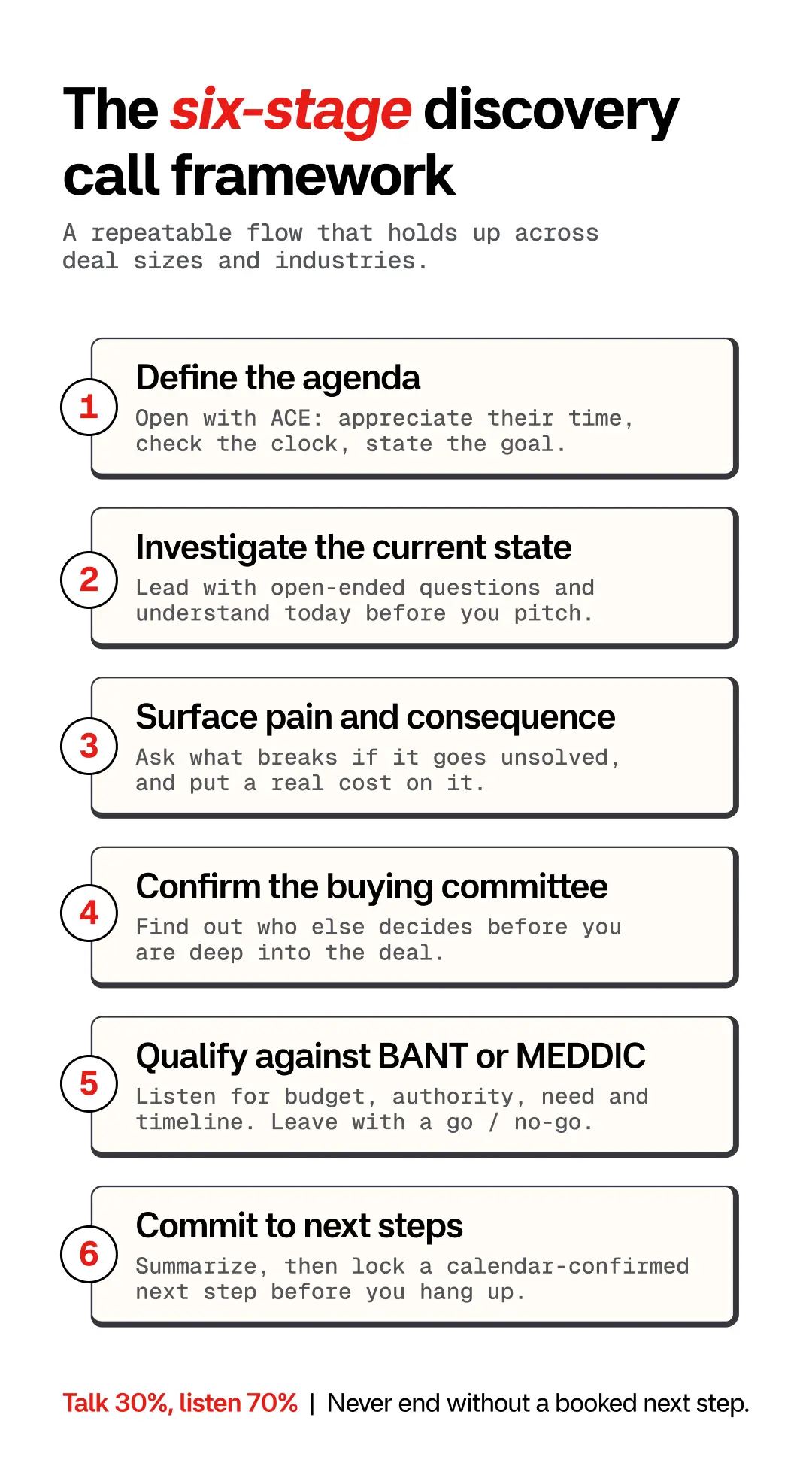
Most discovery calls fail not because reps ask the wrong questions, but because they have no consistent structure to fall back on under pressure. This six-stage sequence gives you a repeatable flow that holds up across deal sizes and industries.
Here's the six-stage framework at a glance, with the full breakdown of each stage right after:
Stage 1: Define the agenda
Open every call using the ACE methodology: Appreciate the prospect's time, Check the time available ("It looks like we have 30 minutes together today"), and state the End goal for the conversation. Ask the prospect if there's anything they'd like to add. This sets shared expectations and signals that you're organized and respectful of their schedule.
Example: "Thanks for making time. We have 30 minutes, I'd like to spend the first half understanding where things stand for you today, and the second half exploring whether and how we might be able to help. Does that work, or is there anything you'd like to make sure we cover?"
Stage 2: Investigate with open-ended questions
Lead with questions that can't be answered with a yes or no. Your goal in this stage is to understand the prospect's current state, not to pitch. Spread your questions across the call rather than front-loading them.
Example: "Tell me about your current process for [X]. What's working well, and where do things tend to break down?"
Stage 3: Surface pain and consequence
Once the prospect describes a challenge, go deeper. Ask what happens if the problem isn't solved. Consequence questions are what separate discovery calls from casual conversations, they reveal urgency and help you understand what's actually at stake for the buyer.
Example: "What happens to your team if this problem isn't resolved by end of quarter? What does that cost you in time, revenue, or headcount?"
Stage 4: Confirm stakeholders and buying committee
Before you're too far into the deal, understand who else is involved. Ask directly and without apology, it protects both sides from late-stage surprises.
Example: "When your team has evaluated solutions like this before, who else typically gets involved in the decision? Is there a finance or IT sign-off required?"
Stage 5: Outline qualification dimensions
Map what you've heard to your qualification framework, BANT (Budget, Authority, Need, Timeline) or MEDDIC (Metrics, Economic Buyer, Decision Criteria, Decision Process, Identify Pain, Champion). You don't need to ask about every dimension explicitly; listen for signals and ask targeted follow-ups to fill gaps. The goal is to exit the call with a clear go/no-go signal.
Example: "It sounds like budget conversations happen in Q3 for you, is that the right window for us to be working toward, or is there flexibility?"
Stage 6: Verify next steps and commit
Never end a sales discovery call without a specific, calendar-confirmed next step. Vague next steps ("I'll follow up") are where qualified deals go cold. Summarize what you heard, confirm priorities, and get a date on the calendar before the call ends.
Example: "Based on what you've shared, it sounds like the biggest priority is [X]. I'd like to set up a demo focused specifically on that use case, does [date/time] work for you?"
For enterprise deals, discovery is not a single call, it continues from lead to close as stakeholders shift and priorities evolve.
Discovery call questions to uncover buyer needs
The questions you ask determine what you learn. Organize your questions by what you need to uncover. For a deeper bank, see our full list of sales qualification questions.
Goals and challenges
These questions establish the prospect's current state and desired outcomes. The goal is to understand what they're trying to accomplish and what's getting in the way.
What prompted you to explore our solution?
Tell me about your current process to do [X].
What are you looking to improve about [Y]?
What would happen if you didn't do anything and kept [X] the same?
What, if anything, piqued your interest on our call today?
How would you define success for this initiative 12 months from now?
Current process and pain
These questions surface the operational friction that creates urgency. Specifics here are more valuable than general dissatisfaction.
Walk me through how your team handles [X] today.
Where does that process tend to break down?
How much time does your team spend on [X] each week?
What workarounds have you built because the current solution doesn't do what you need?
Consequence and urgency
These questions reveal what's actually at stake. A prospect who can articulate consequences is far more likely to move than one who can't.
What happens if this problem isn't solved in the next quarter?
How is this issue affecting your team's ability to hit its goals?
Have you tried to solve this before? What happened?
What's the cost of staying with your current approach?
Decision-making and budget
Understand the buying process and who controls the purse strings:
Who is involved in the decision-making process to buy?
How does your team typically evaluate and purchase solutions like this?
Who typically gets involved in the approval process?
What does your budget process look like for this type of investment?
Have you considered any other solutions to solve [Y]?
Qualification and fit
These give you a clear go or no-go signal and protect your pipeline. Strong disqualifying questions protect focus as much as qualifying ones. For the full method, see our guide to lead qualification.
What does your timeline look like for making a decision?
Are there any internal initiatives or priorities that could compete for this budget?
What would need to be true for you to move forward?
Is there anything that would prevent you from moving forward even if this is a great fit?
Map your questions to BANT or MEDDIC dimensions to ensure you exit every call with a clear go/no-go signal. Strong disqualifying questions protect pipeline focus as much as qualifying ones do.
Green flag | Red flag | |
|---|---|---|
Budget | Budget exists and is allocated or accessible | No budget identified; "we'd need to find the money" |
Timeline | Clear decision date tied to a business event | "No rush" or timeline keeps shifting |
Stakeholders | Champion identified; knows the buying process | Rep is talking to someone who has no influence on the decision |
Common discovery call mistakes that kill deals
Knowing what to do on a discovery call is half the battle. Knowing what not to do is the other half.
Pitching before the prospect articulates their pain
This is the most common mistake in sales discovery calls. The rep has a great product and is eager to show it, so they lead with capabilities before understanding whether those capabilities solve a real problem for this particular buyer. The result: the prospect feels like they're being sold to rather than understood, and engagement drops.
Why it happens: reps conflate preparation with readiness to pitch. They've done their research and they know what they want to say.
How to fix it: commit to asking at least three open-ended questions before you mention a single product feature. If you catch yourself pitching, stop and ask a question.
Asking questions you could have answered with basic research
Asking a prospect what their company does, how many employees they have, or what tools they use when that information is publicly available signals that you didn't prepare. It wastes the prospect's time and damages credibility before the real conversation starts.
Why it happens: reps skip pre-call research because it takes time, or they rely on discovery to fill gaps that should have been filled beforehand.
How to fix it: use the pre-call checklist in the preparation section above. Anything findable in 10 minutes of research should not be a discovery question.
Treating discovery as a one-time event
For enterprise deals, discovery is not a single call. Stakeholders shift, priorities evolve, and new information surfaces from lead to close. Reps who treat the first discovery call as the only discovery call miss the ongoing intelligence that shapes late-stage positioning.
Why it happens: the pipeline stage moves from "discovery" to "demo" and reps stop asking exploratory questions.
How to fix it: build discovery questions into every call, not just the first one. Each new stakeholder you meet is a new discovery opportunity.
Over-preparing a script that kills spontaneity
A script is a safety net, not a transcript. Reps who follow their question list instead of building on what the prospect says produce conversations that feel like interviews rather than dialogues. Prospects notice.
Why it happens: anxiety about silence or forgetting key questions leads reps to over-structure.
How to fix it: prepare your core questions, then put the list away once the call starts. Trust that you know your product and your ICP well enough to follow the conversation.
Ending without a committed next step
The call was productive, both sides are engaged, and then it ends with "I'll send you some information and we can reconnect." Three weeks later the deal is cold. Vague next steps are where qualified pipeline goes to die.
Why it happens: reps don't want to seem pushy, or they're not confident enough in the opportunity to ask for a commitment.
How to fix it: before the call ends, get a specific date and time on the calendar. "Let me send you a calendar invite before we hang up" is not pushy, it's professional.
Asking too many questions without listening
Discovery becomes an interrogation when reps move from question to question without building on what the prospect says. The prospect feels processed, not heard.
Why it happens: reps have a long list of questions and are focused on getting through them.
How to fix it: aim for a 30/70 split, you talk 30% of the time, the prospect talks 70%. After each answer, pause. Ask one follow-up question based on what you just heard before moving to the next topic.
The mistakes above share a common thread: they stem from a lack of structure, not a lack of effort. The script below gives you a framework to avoid each one in real time.
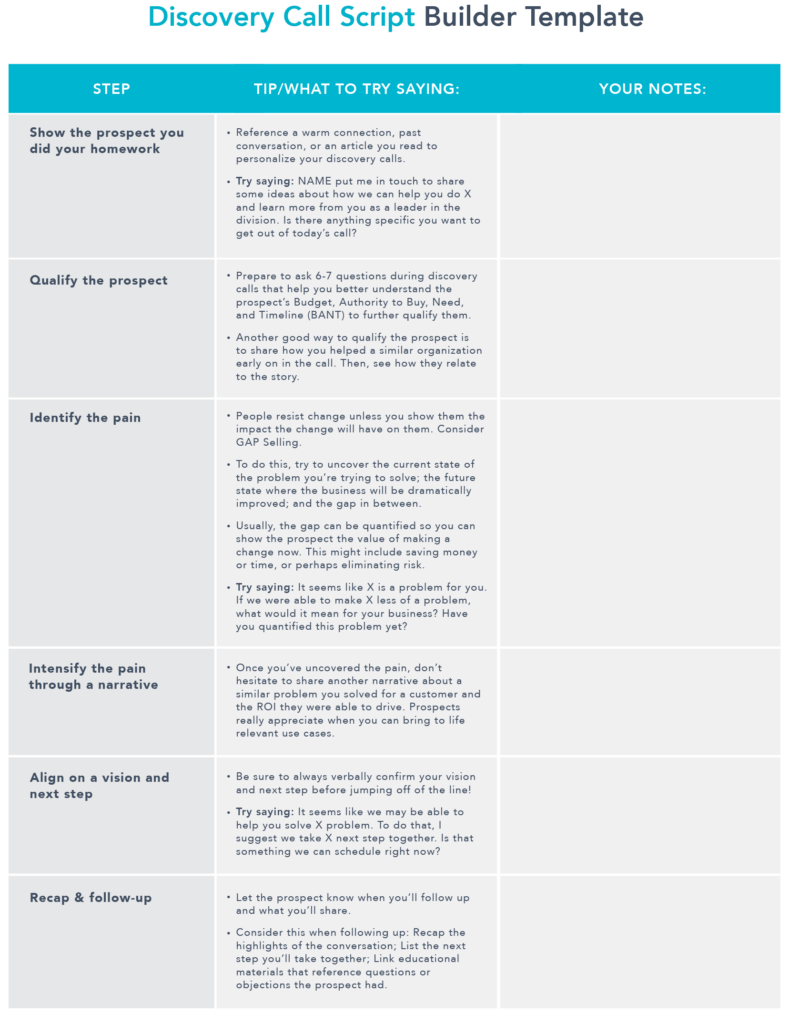
Discovery call script template
Use this framework to structure your discovery calls. Adapt it to your product, prospect, and what you learn during the conversation.
Phase 1: Opening and rapport (ACE methodology)
Rep: "Thanks for making time today, [Name], I really appreciate it. It looks like we have about 30 minutes together. My goal for today is to understand where things stand for your team around [topic], and by the end I'd love for us to have a clear sense of whether it makes sense to keep the conversation going. Does that work, or is there anything you'd like to make sure we cover?"
[Rep pauses and waits for the prospect to respond, this is the first signal about how engaged they are]
Phase 2: Agenda-setting
Rep: "Great. Before I start asking questions, is there anything specific that prompted you to take this meeting today?"
[Rep pauses here, silence invites elaboration. The prospect's answer to this question often contains the most important intelligence of the entire call]
Phase 3: Pain discovery questions
Rep: "Tell me about your current process for [X]. Where does it tend to work well, and where do things break down?"
Prospect: "[Describes current state]"
Rep: "That's helpful. When [specific pain point they mentioned] happens, what does that cost your team, in time, in revenue, in headcount?"
[Rep builds on what the prospect said rather than moving to the next scripted question]
Phase 4: Consequence probing
Rep: "You mentioned [specific challenge]. What happens if that problem isn't resolved by end of [quarter/year]? What's at stake for you personally?"
[Rep pauses here, consequence questions often produce the most candid answers when given space]
Phase 5: Qualification check
Rep: "When your team has evaluated solutions like this before, who else typically gets involved in the decision? And in terms of timing, is there a date or business event that's driving urgency on your end?"
[Rep listens for BANT/MEDDIC signals without running through a checklist out loud]
Phase 6: Next-step close
Rep: "Based on everything you've shared, it sounds like [summarize top 1–2 pain points]. I'd like to put together a focused demo that speaks directly to [specific use case]. Does [date/time] work to continue the conversation?"
[Rep gets a calendar commitment before ending the call, not a "I'll send you something"]
What to do after a discovery call
The call is over. What happens in the next 60 minutes determines whether a qualified opportunity advances or quietly goes cold.
Write the follow-up email
Send this the same day, ideally within two hours of the call ending.
Hi [Name],
Thanks for the time today. A few things I took away from our conversation:
Your biggest challenge right now: [pain point 1]
Secondary priority: [pain point 2]
What success looks like for you: [outcome they described]
Based on what you shared, I think there's a real fit worth exploring. Our agreed next step is [specific action] on [date/time], I've sent a calendar invite.
One thing I wanted to add: [one value-add observation from the call, a relevant case study, a data point, or a connection to something they mentioned].
Looking forward to continuing the conversation.
[Your name]
Keep it under 150 words. The goal is to confirm alignment and reinforce the next step, not to re-pitch. For building this into a repeatable sequence, see our guide to sales email sequences that convert.
Log in CRM immediately
Do this before your next call, while the details are still fresh. Log:
Pain points captured (specific language the prospect used)
Budget range discussed
Decision timeline
Stakeholders identified (names, titles, roles in the buying committee)
Agreed next step and date
Any red flags noted
GTM Workspace can auto-populate key call fields from Chorus conversation intelligence, reducing post-call logging time and ensuring nothing gets lost between the call and the CRM.
Internal debrief
If you're an SDR handing off to an AE, share key insights, pain points, stakeholder map, qualification status, and any red flags, before the deal advances. The AE should not be starting from scratch on their first call.
Follow-up cadence
Follow up the same day with the summary email. If you don't hear back within three business days, send a brief check-in referencing the specific next step you agreed on. Be persistent but not pushy, you earned the right to follow up by running a good call.
How AI tools are changing discovery call preparation
AI tools handle the research and documentation burden so reps can focus on the conversation itself, the part no AI can replace.
It helps to understand where this intelligence comes from. ZoomInfo is an all-in-one AI GTM Platform built as three connected layers. At the foundation sits its B2B data (500M contacts and 100M companies, verified through multi-source research).
On top of that data runs the GTM Context Graph, the intelligence layer that fuses ZoomInfo data with your CRM records, conversation intelligence, and behavioral signals into one reasoning layer that captures not just what happened in an account but why. Teams then consume that intelligence wherever they work: inside GTM Workspace for sellers, in GTM Studio for marketing and RevOps, or through the headless API and MCP for any tool or AI agent. For discovery specifically, GTM Workspace handles prep and follow-up while Chorus handles the live conversation, all running off the same account context instead of a dozen open tabs.
Pre-call research automation
Before AI-assisted prep, a rep spent 20 to 30 minutes pulling together org chart data, recent news, tech stack details, and intent signals before a single discovery call. GTM Workspace compresses that into one account brief that surfaces automatically: recent company news, org chart changes, buying signals, and verified contact data in a single view, before the rep opens a browser tab. Our AI account research agent does the same legwork for whole target lists at once.
The reason it works is that the context already exists, it is just scattered. As Florin Tatulea put it, "Having one context layer or pane of glass where all this exists, being able to fetch that data and then allowing a human to contextualize it, is such a game changer." That is the difference between a rep with 20 tabs open and a rep who walks in already knowing the account.
Seismic put this to work across its entire go-to-market team, layering AI-assisted prep on ZoomInfo data. The results show what that does at scale:

"That combination of our internal CRM data, external signals, and the AI chatbot that's given all that context has helped us craft very specific account- and persona-based messages."
Real-time conversation intelligence
Chorus captures what happens during the call itself. It tracks talk-time ratios and flags when a rep is dominating the conversation, surfaces follow-up questions based on what the prospect says, and records MEDDIC and BANT field signals as they emerge mid-call. Reps who review Chorus data after calls improve their discovery technique faster than those who rely on memory alone.
Post-call CRM auto-fill
After the call, GTM Workspace captures the updates from the Chorus transcript, the qualification fields, pain points, budget signals, decision timeline, and stakeholders, and pushes them to your CRM automatically. Reps who used to spend 15 to 20 minutes on post-call logging can redirect that time to the next prospect, and the record is more accurate because it comes from the transcript, not from memory.
See how GTM Workspace and Chorus work together in a live discovery-prep workflow: book a ZoomInfo demo for sales.
Discovery call FAQs
How long should a discovery call be?
Match length to deal complexity. For SMB deals, 20 to 30 minutes is usually enough to qualify fit and agree on next steps. Mid-market calls run 30 to 45 minutes to cover stakeholder mapping and qualification. Enterprise discovery often needs 45 to 60 minutes, and for complex deals, multiple discovery calls across different stakeholders are normal. Signal your time boundaries at the outset with the ACE method. It sets expectations and keeps the conversation focused.
What is the difference between a discovery call and a demo?
A discovery call focuses on understanding the prospect's challenges, qualifying fit, and uncovering the needs that shape the deal. A demo shows your product against those specific needs. Discovery comes first so the demo addresses relevant use cases instead of generic features. Skipping discovery and going straight to a demo is one of the most common deal-killing mistakes: you end up showing the wrong things to the wrong people.
What should you not do on a discovery call?
Do not pitch before the prospect articulates their pain. Do not ask questions you could have answered with basic research. Do not dominate the conversation; aim for 30 percent rep, 70 percent prospect. Do not end without a committed next step on the calendar. And for enterprise deals, do not treat discovery as a one-time event, because buying committees shift and priorities evolve across a long cycle. The mistakes section above covers each with specific fixes.
How do you qualify a prospect on a discovery call?
Use a framework like BANT or MEDDIC to structure what you listen for. Map your questions to each dimension, but do not run the framework as a checklist out loud. Listen for signals and ask targeted follow-ups to fill gaps. Strong disqualifying questions are as valuable as qualifying ones: confidently exiting a bad-fit deal protects your focus and your time. Tying qualification to real buying signals, like intent, funding, and org changes, keeps reps focused on the accounts most likely to convert.
What happens after a discovery call?
Three immediate actions: send a follow-up email the same day summarizing pain points, the agreed next step, and the timeline. Log key fields in your CRM while the call is fresh, pain points, budget range, decision timeline, stakeholders, and any red flags. Schedule the next touchpoint before the call ends, not after. Vague next steps are where qualified deals go cold. Automating the logging step helps, since GTM Workspace can auto-populate call fields from Chorus so the record is complete without manual entry.