

Veridion occupies a distinct position in the B2B data market by focusing on something most sales-oriented platforms overlook: company-level intelligence. With a database of 134 million companies across 250 countries and weekly data refreshes, it serves procurement teams hunting for suppliers, insurance underwriters validating business profiles, and market intelligence analysts mapping industries. The platform was built for understanding what a business does, not for finding the phone number of the person who runs it.
To write this Veridion review, we analyzed it extensively. We believe it's the right choice if:
You need company-level data for procurement, insurance, or market intelligence
Your primary use case is supplier discovery, not sales prospecting
You require global SMB coverage that legacy providers like Dun & Bradstreet miss
You have a data science team capable of working with APIs
You value weekly data freshness and AI-powered entity resolution
However, Veridion might not be the best choice if:
You need contact-level data: direct dials, verified emails, and org charts
Your primary goal is sales prospecting or outbound engagement
You want intent signals showing which companies are actively in-market
You need a self-service platform with transparent pricing
You require conversation intelligence, sales automation, or marketing orchestration
In this case, you should consider ZoomInfo: an AI GTM platform built on a large B2B dataset (500M contacts, 100M companies, 134M+ verified phone numbers, and 200M+ verified business emails). That data fuels ZoomInfo's GTM Context Graph, an intelligence layer that unifies your CRM records, conversation transcripts, and behavioral signals with the 1.5B + data points ZoomInfo processes daily. It captures why deals move or stall, so your team can act on context rather than guesswork. ZoomInfo covers the company data layer Veridion specializes in and adds the contact data, intent signals, and execution tools needed to turn company intelligence into a pipeline. Your team can use this intelligence through GTM Workspace for sellers, GTM Studio for marketers and RevOps, or APIs and MCP in any front-end.
We've included a detailed look at ZoomInfo at the end of this Veridion review as the broader alternative for teams that need both company intelligence and the ability to act on it. If you'd like to explore ZoomInfo's data firsthand, you can start with ZoomInfo Lite for free here.
What is Veridion?
Source: Veridion
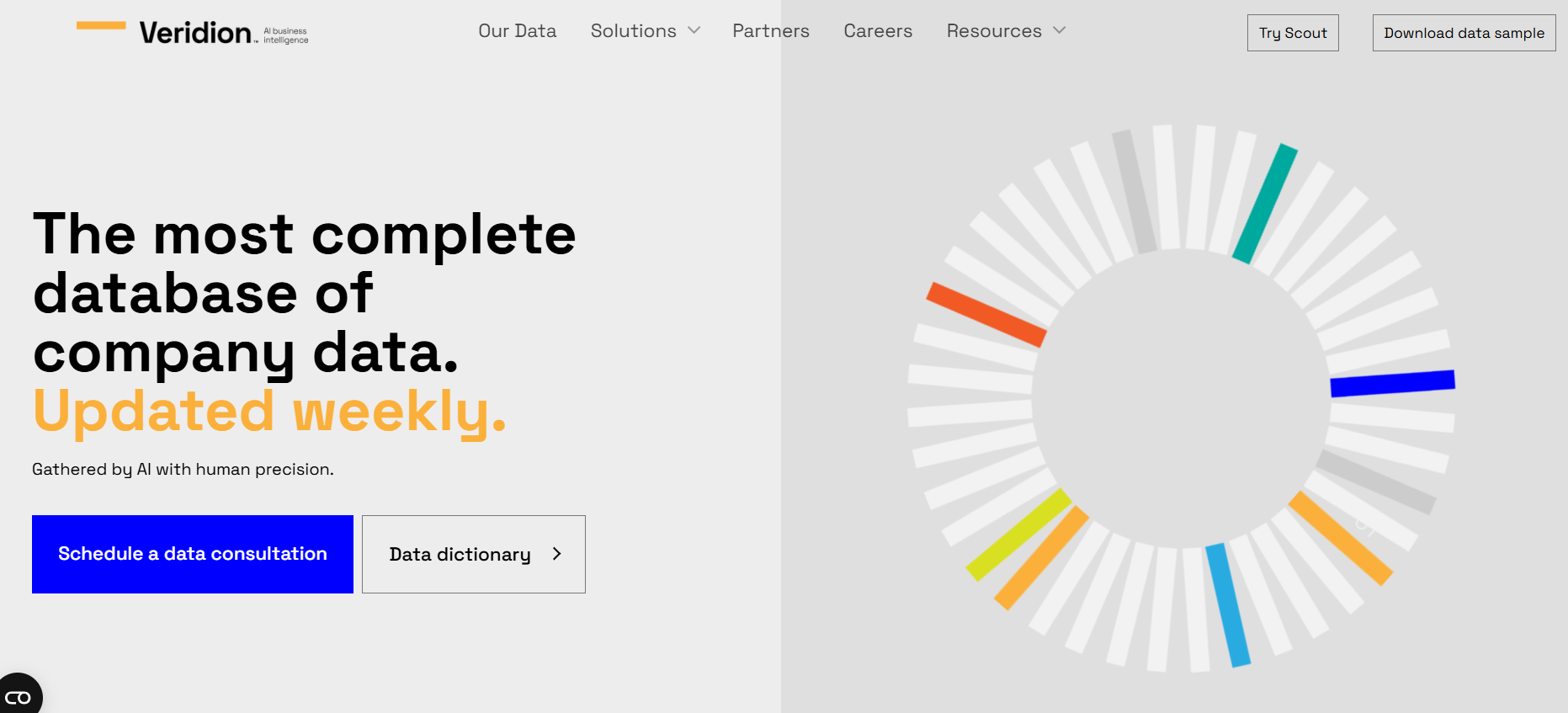
Veridion (formerly Soleadify) is a business intelligence platform founded in 2019 by Florin Tufan, Mihai Vinaga, and Sorina Vlasceanu in Bucharest, Romania. The company started as a machine-learning-powered business database for sales and marketing, then rebranded from Soleadify to Veridion in February 2023 to signal a shift toward firmographic intelligence for enterprise use cases like procurement, insurance, and risk management.
The platform tracks 134 million companies globally with over 320 attributes per profile, covering firmographics, products and services, financial proxies, certifications, ESG data, and geographic markers. Veridion differentiates itself through AI-first data collection: rather than buying data from government registries like traditional providers, it uses proprietary AI to process billions of webpages every week, building company profiles from scratch.
The company has raised $1.5 million in seed funding and serves enterprise customers including Everstream, Exiger, Experian, Bosch, Capgemini, Coupa, PwC, and PepsiCo. Its three core products are the Search API, Match & Enrich API, and Scout (a supplier discovery platform).
Veridion's ideal users are enterprise procurement teams, commercial insurance underwriters, market intelligence analysts, and data science teams that need company data to feed decision-making systems. It deprioritizes contact data in favor of company intelligence, positioning it as a data layer rather than a sales prospecting tool.
Veridion Pros & Cons
Pros | Cons |
|---|---|
134M+ companies across 240+ countries | No individual contact data (no direct dials, no emails) |
Weekly data refreshes across all records | No public pricing (custom quotes only) |
320+ attributes per company profile | Limited presence on B2B review platforms (no G2 or TrustRadius profile) |
Strong SMB coverage that legacy providers miss | API-first approach requires technical resources |
AI-powered entity resolution with confidence scoring | No intent signals or buying behavior data |
Natural language supplier search via Scout | No sales engagement or marketing automation tools |
Enterprise customers include Bosch, PwC, PepsiCo | Small company (~50 employees) with limited support documentation |
Veridion Review: How It Works & Key Features
Search API: Veridion lets you find companies through multi-criteria queries that go well beyond basic industry and location filters.
Source: Veridion
Veridion's Search API accepts structured JSON queries that combine multiple filters with nested Boolean logic. Instead of keyword searches, you construct queries that specify product attributes, geographic constraints, company size, industry codes, and supplier types, all connected with AND/OR operators nested up to two levels deep.
The API supports 13 filter types including company name, location (headquarters and branches), proximity-based searches within defined radii, NAICS codes, employee count, revenue, year founded, and products/services. The product filter is particularly granular: it supports both exact product identifier matching (SKU, CAS numbers, UPC/EAN codes) and expression-based semantic queries for broader discovery.
Results rank by a two-layered sorting system: relevance first, then company prominence. Each result includes a search_details object showing which snippets and contexts triggered the match, so you can verify why a company appeared. The API returns pages of up to 200 companies per request with pagination tokens for working through large result sets.
Three strictness levels control the trade-off between precision and recall: strictness 1 searches only main locations, strictness 2 only secondary locations, and strictness 3 includes both.
Match & Enrich API: Veridion takes partial company information and returns complete, verified profiles within seconds.
Source: Veridion
The Match & Enrich API solves a common enterprise problem: fragmented company data scattered across supplier databases, CRM records, and compliance files. You feed it a company name and country (at minimum), and it returns a complete profile with over 320 attributes in under two seconds.
The matching process sets this apart. Before attempting a match, the system normalizes and standardizes inputs: addresses break into components, websites reduce to domain-level format, and phone numbers convert to prefixed formats. This preprocessing means the algorithm can handle inaccurate input, matching records despite typos or minor name variations.
The API distinguishes between legal and operational entities using a dual-view model. When a company's legal registration and operations are in the same jurisdiction, you get both views. For multi-jurisdiction entities, the algorithm prioritizes the profile most consistent with your input. Each result includes a confidence score from 0 to 1 and detail on which attributes drove the match and whether each was Exact, Fuzzy, Partial, or Approximate.
Enriched profiles cover 11 data categories: company identity, business classification codes (NAICS, SIC, ISIC, NACE), business activity, location intelligence, building data, financials, product portfolios, contact information, corporate hierarchy, ESG metrics, and technographics. Data is updated weekly with over 95% accuracy validation.
Scout: Veridion's natural language supplier discovery platform compresses hours of sourcing into minutes.
Source: Veridion
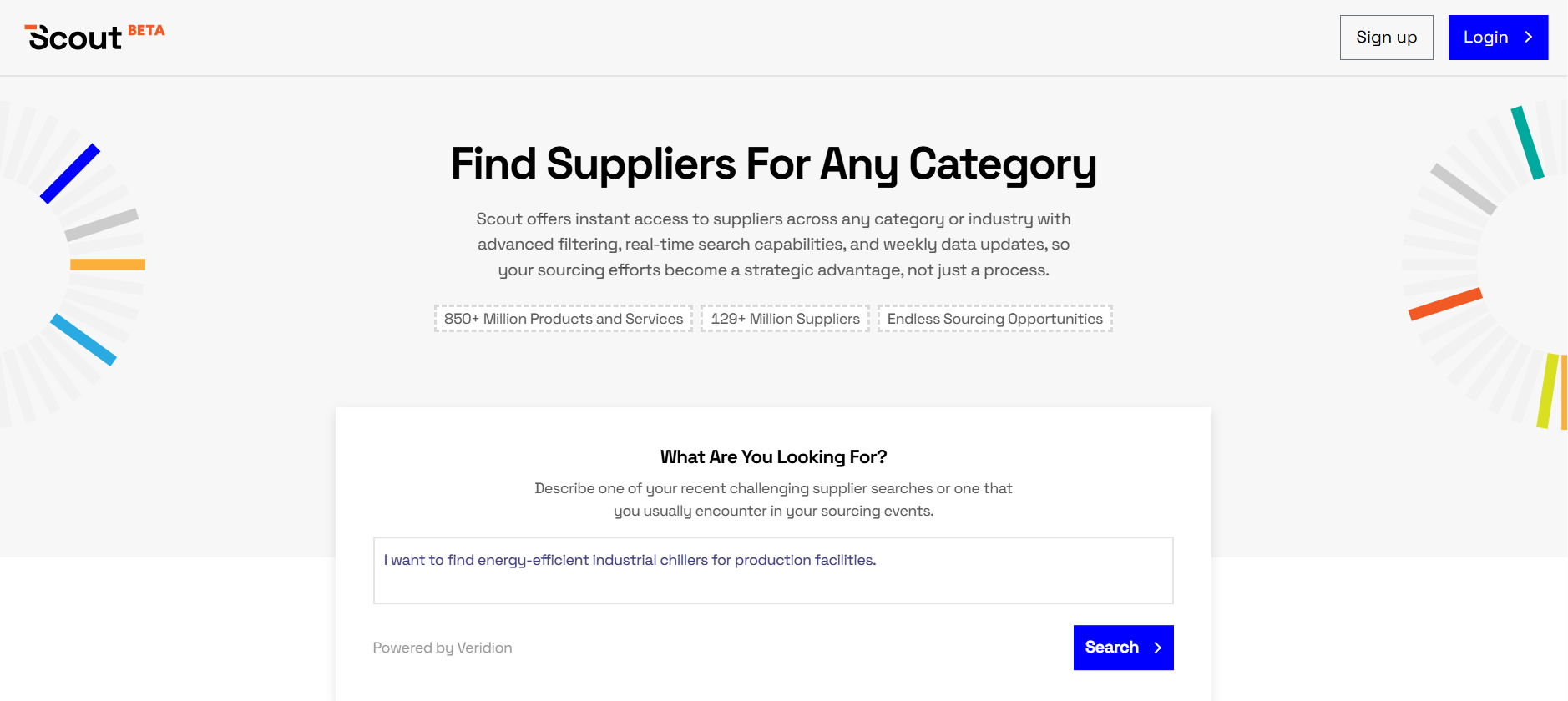
Scout (marketed as ScoutPro in procurement contexts) is a web-based platform that lets procurement teams search for suppliers in plain English. Instead of constructing JSON queries manually, you type a description like "fire-resistant cables for infrastructure" and Scout's AI translates it into search filters.
The platform accesses 134 million+ supplier profiles across 249+ countries and claims to deliver 90% time savings over traditional sourcing methods. Before running a full search, you can toggle preview results to see interactive charts showing geographic distribution, industry breakdowns, and company sizes. This helps catch zero-hit or over-hit scenarios before committing to a full query.
Scout claims wider coverage than its direct competitors: 129 million suppliers compared to 14 million for Matchory, 13 million for Tealbook, and 9 million for Scoutbee. The platform integrates with Coupa's sourcing module through the Coupa App Marketplace, and teams can save filter templates for reuse and export shortlist-ready CSVs.
Data Coverage and Freshness: Veridion's AI-first approach captures companies that traditional providers miss.
The core differentiator behind all of Veridion's products is its data collection method. Rather than purchasing data from government registries or relying on web scraping, Veridion uses proprietary AI to process billions of webpages every week. This lets it discover and profile businesses (particularly SMBs) that don't appear in traditional databases.

Source: Veridion
The database covers 134 million companies across 240+ countries with weekly refreshes. Veridion notes that up to 30% of supplier data changes yearly, making this refresh rate a real advantage over competitors that update monthly or quarterly.
Company profiles include over 320 attributes organized across firmographics, operations, products and services, financial proxies, ESG data, certifications, and technographics. The platform supports all commonly used industry taxonomies: NAICS, NACE, SIC, ISIC, and more. Corporate hierarchy data identifies subsidiaries, brand aliases, and corporate families with transparent explanations for how relationships were determined.
Where Veridion Falls Short
While Veridion excels at company-level intelligence for its target verticals, several limitations define what it can and cannot do. These reflect deliberate design choices, not oversights.
No Contact-Level Data: Veridion deprioritizes contact data in favor of company intelligence. You won't find direct-dial phone numbers, verified personal emails, org charts, or individual buyer profiles. For teams that need to identify and contact people at companies (not just the companies themselves), this is a fundamental gap. Sales teams, SDRs, and account executives would need a separate contact data provider.
No Intent or Behavioral Signals: The platform provides static firmographic data refreshed weekly, but it doesn't track buying signals, content consumption patterns, or in-market behavior. You can identify companies that match your criteria, but you can't tell which ones are researching solutions right now. For go-to-market teams that prioritize timing, this matters.
Opaque Pricing: Veridion does not publish pricing on its website. All packages require contacting sales for custom quotes. While a Startup Programme offers EUR 30,000 in free credits for qualifying early-stage companies, most buyers have no way to estimate costs before engaging with sales. This creates friction, especially for teams accustomed to self-service SaaS purchasing.

Source: Veridion
API-First Requires Technical Resources: Veridion's core products are APIs. While Scout provides a web interface for supplier discovery, the Search API and Match & Enrich API require engineering resources to integrate. Organizations without data science teams or API development capabilities may struggle to extract value from the platform. Some users have also noted the lack of native integrations with CRM systems like Pipedrive.
Limited Public Social Proof: As of 2026, Veridion does not have an active profile on G2 or TrustRadius under its current brand name. Reviews exist only for its legacy Soleadify brand on Capterra (4.8 out of 5 based on 11 reviews). For buyers who rely on peer reviews during evaluation, this scarce presence makes independent validation difficult.
No Engagement or Execution Tools: Veridion is a data platform. It doesn't include email outreach, campaign orchestration, conversation intelligence, or any tools for acting on the data it provides. Every downstream action (contacting suppliers, running campaigns, managing relationships) requires separate tools.
These limitations aren't failures. They reflect Veridion's focus on being the strongest company data foundation for its core verticals. But for teams that need to go beyond company identification to contact buyers and drive pipeline, these gaps point to a need for a broader platform.
Top Veridion Alternative for Go-to-Market Teams: ZoomInfo
Source: ZoomInfo
ZoomInfo addresses Veridion's limitations by providing not just company data, but everything needed to identify, contact, and convert buyers. As an AI GTM platform, ZoomInfo combines a large B2B dataset with an intelligence layer that connects data to action.
Where Veridion stops at telling you which companies exist, ZoomInfo tells you who works there, how to reach them, when they're in-market, and what message will land.
Comprehensive B2B Data: ZoomInfo covers both company intelligence and individual contact data at scale.
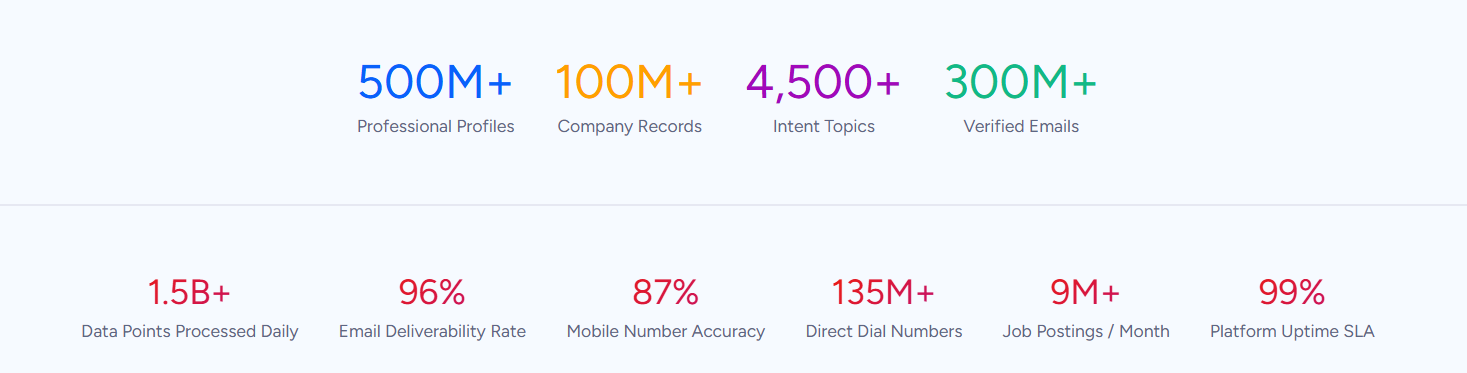
ZoomInfo's data spans three dimensions. Identity data covers 500M contacts, 135M+ verified phone numbers, 120M direct-dial phone numbers, and 300M+ verified business email addresses. Company context includes 100M companies with firmographics, org charts, technographics, and parent-child hierarchies. Dynamic signals capture intent data, website visitor behavior, and buying activity that reveals when accounts are in-market.
Source: ZoomInfo
This breadth matters because company data without contacts is incomplete for go-to-market execution. Knowing that a manufacturing firm in Ohio matches your ideal customer profile has limited value if you can't identify the VP of Procurement, verify their direct dial, and confirm they're researching solutions like yours. ZoomInfo combines all three data layers in one platform.
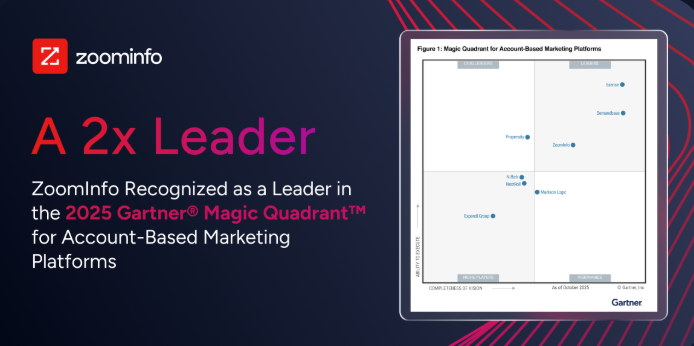
The data is verified through a multi-source pipeline backed by 300+ human researchers, achieving up to 95% accuracy on first-party data. In a Fortune 500 competitive RFP analyzing 25 million contacts across vendors, the independent consultant concluded that "no other competitor came even close." ZoomInfo has been named a Leader in the Gartner Magic Quadrant for ABM Platforms two years running and a Leader in the Forrester Wave for Intent Data Providers.
Source: ZoomInfo
GTM Context Graph: ZoomInfo's intelligence layer captures not just what happened in a deal, but why.
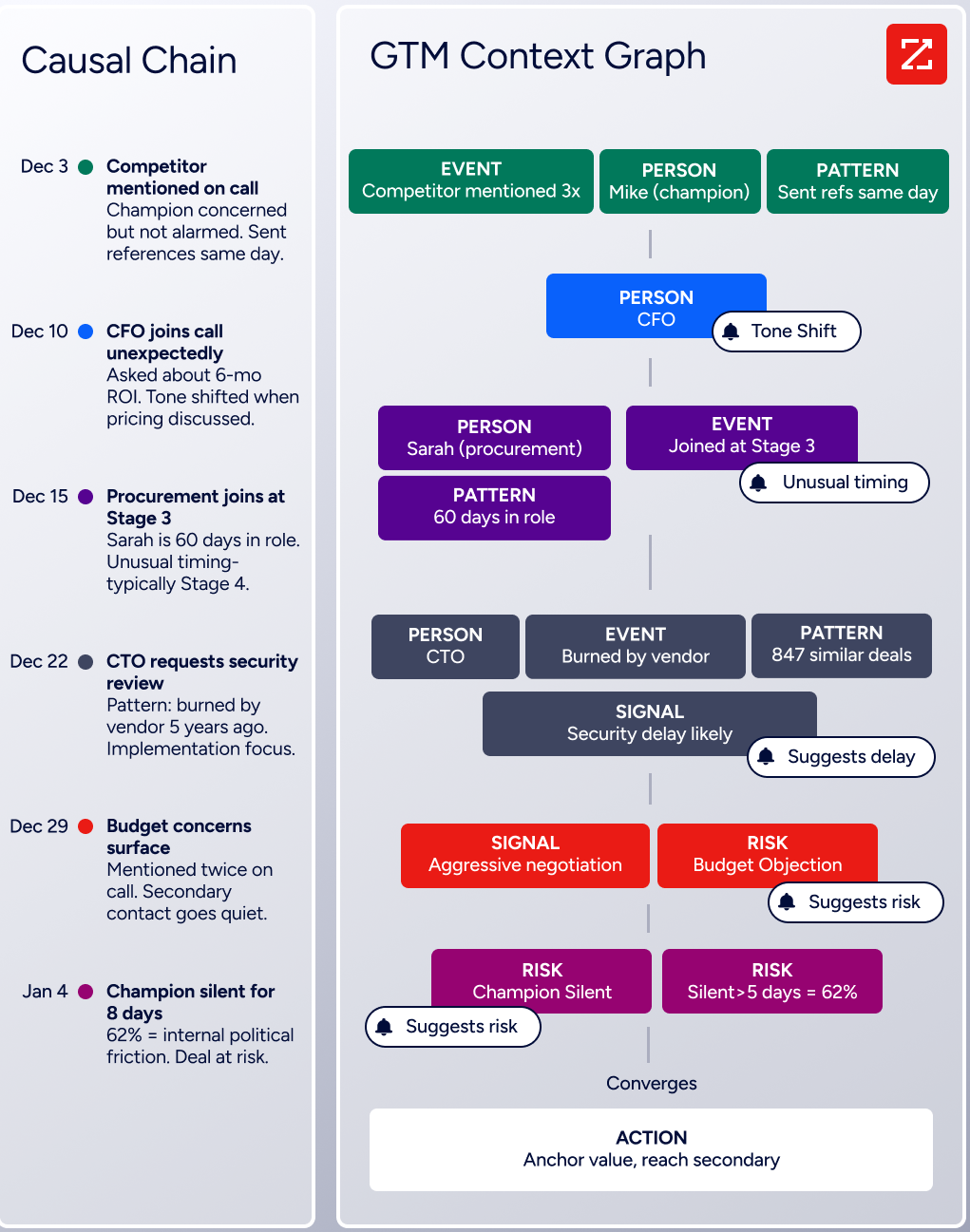
The GTM Context Graph is what separates ZoomInfo from a static data provider. It processes 1.5B+ data points daily, fusing ZoomInfo's third-party intelligence with a customer's CRM records, conversation transcripts from Chorus (ZoomInfo's conversation intelligence product), email threads, and behavioral signals into a single intelligence layer.
For example, a CRM records that a deal moved to Stage 4. A call transcript shows the CFO joined and asked about ROI. An intent signal shows the company is researching your competitor. The GTM Context Graph connects these signals: executive sponsorship entering at this stage, combined with ROI-focused questions and competitive research, matches the pattern behind your closed-won deals. That context flows into every downstream action. The follow-up addresses the CFO's specific concern. The play targets accounts with similar signal combinations. The forecast weights deals by buying evidence rather than stage labels.
This intelligence layer exists because ZoomInfo spent twenty years building data unification infrastructure and acquired the conversation and behavioral intelligence engines (Chorus, Workbounce) needed to capture context at scale.
Source: ZoomInfo
Universal Access: ZoomInfo delivers its intelligence through native products for sellers and marketers, plus APIs and MCP for any other tool.
ZoomInfo's intelligence reaches teams through three channels. GTM Workspace gives sellers a single place where prioritized accounts, AI-drafted outreach, and deal execution converge. Seismic's sales team reported 54% productivity gains and 39% of pipeline attributed to ZoomInfo signals using Workspace.
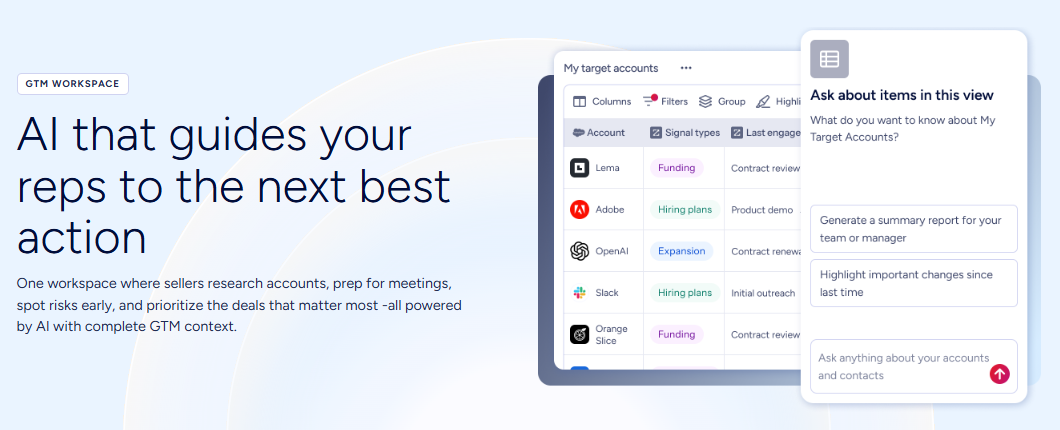
GTM Studio gives marketers, RevOps, and GTM engineers a builder environment where audience definition, campaign orchestration, and pipeline measurement happen in natural language. Expansion plays that used to take three weeks now launch in 30 minutes, without engineering support.
For teams building beyond ZoomInfo's own products, APIs and MCP expose the same intelligence to any custom agent, internal tool, or partner platform. All three channels draw from one GTM Context Graph: the same data, the same intelligence, nothing degraded by how you access it.
Pricing with a Free Entry Point: ZoomInfo offers permanent free access alongside custom enterprise packages.
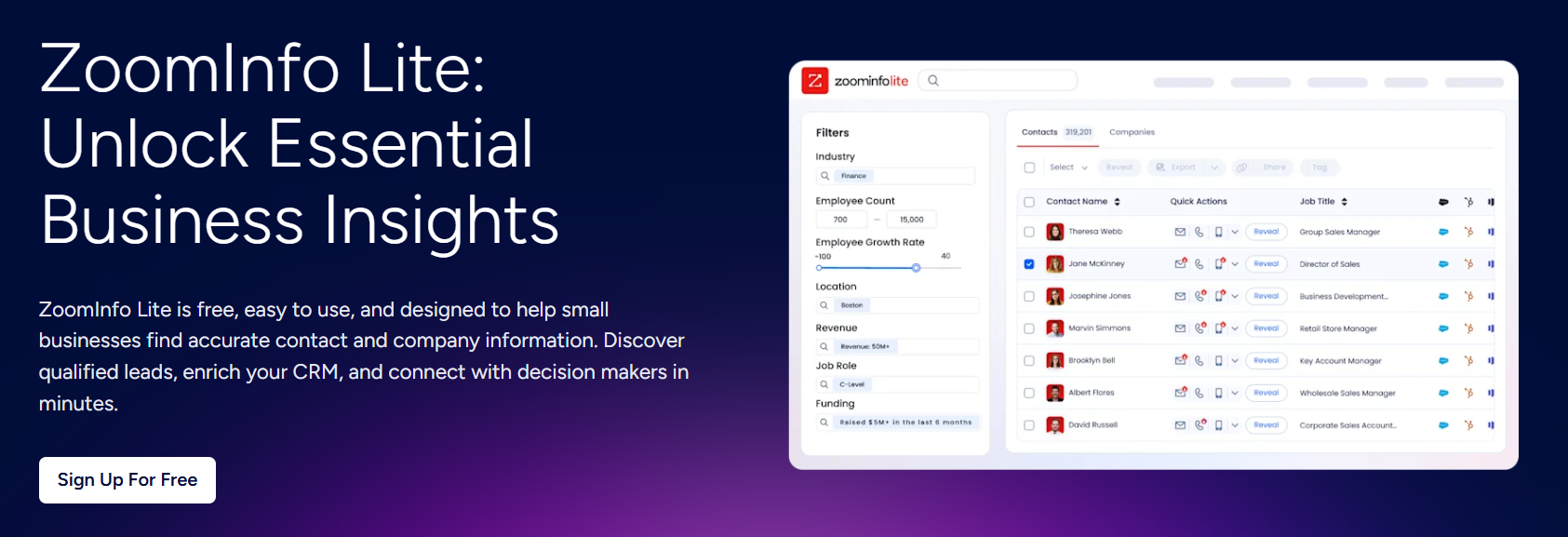
ZoomInfo Lite is a permanent free plan (not a trial) that includes access to ZoomInfo's B2B database, 10 monthly export credits, individual and company searches, contact information, a Chrome extension, and HubSpot integration. No credit card required, no time limit.
Source: ZoomInfo
Paid plans are organized into Sales and Marketing product lines, each with three plans (Professional, Advanced, Enterprise) that add capabilities like intent signals, AI-generated outreach, advanced workflows, and dedicated support. ZoomInfo uses a custom-quoted, seat-and-credit model, so pricing depends on team size, credit volume, and feature requirements. A 7-day free trial provides broader access than Lite for evaluation purposes.
Veridion or ZoomInfo: Comparison Summary
Aspect | Veridion | ZoomInfo |
|---|---|---|
Primary focus | Company-level firmographic intelligence | AI GTM platform (data + intelligence + execution) |
Company database | 134M+ companies, 240+ countries | 100M companies worldwide |
Contact data | Not a focus | 500M contacts, 135M+ verified phones, 120M direct dials, 200M+ verified emails |
Attributes per company | 320+ | 300+ company attributes, plus contact-level data |
Data refresh | Weekly | Continuous monitoring and updates |
Intelligence layer | Not available | GTM Context Graph (1.5B+ data points daily, fuses first- and third-party data) |
Intent signals | Not available | |
Conversation intelligence | Not available | Chorus (call recording, transcription, AI analysis) |
Sales automation | Not available | GTM Workspace, Workflows, Salesloft partnership |
Marketing orchestration | Not available | GTM Studio, ABM, native DSP, FormComplete |
API access | Search API, Match & Enrich API | Enterprise API, MCP, Cloud Data Cubes |
Supplier discovery | Scout (natural language search) | Not a dedicated feature |
Ideal for | Procurement, insurance, market intelligence | Sales, marketing, RevOps, go-to-market execution |
Free tier | Data samples; Startup Programme for qualifying companies | ZoomInfo Lite (permanent free) + 7-day trial |
Pricing model | Custom quotes only | Custom-quoted, seat-and-credit based |
Security certifications | GDPR, CCPA, Privacy Shield | ISO 27001, ISO 27701, SOC 2 Type II, TRUSTe GDPR/CCPA |
Review presence | Capterra only (legacy brand, 11 reviews) | G2 (133 No. 1 rankings), Gartner Customers' Choice, TrustRadius |
Final Verdict
The choice between Veridion and ZoomInfo depends on what you need the data for.
Choose Veridion if your work centers on company-level intelligence for supplier discovery, insurance underwriting, or industry analysis. Veridion's strength is its depth of company attributes, global SMB coverage, and weekly refresh rate, all delivered through APIs that integrate into data science workflows and enterprise decision systems. If you're a procurement team sourcing suppliers, an insurer validating business profiles, or a market analyst mapping competitive landscapes, and you have the technical resources to work with APIs, Veridion provides a focused data foundation built for those use cases.
Learn more about Veridion here.
Choose ZoomInfo if you need to go beyond identifying companies to contacting and converting the people at those companies. ZoomInfo combines company and contact data with intent signals, conversation intelligence, and execution tools for sales, marketing, and RevOps. The GTM Context Graph connects these layers so your team knows not just which companies to target, but who to call, when to engage, and what to say. For go-to-market teams that need data, intelligence, and action in one platform, ZoomInfo is the broader solution.
Get started with ZoomInfo Lite for free here.
Veridion built a strong platform for a specific set of use cases. For teams whose work begins and ends with company data, it delivers. For teams that need the full journey from company identification through buyer engagement, ZoomInfo provides the data, the intelligence, and the tools to execute.
