

Warmly packages website visitor identification, intent signals, AI chat, and outbound orchestration into one platform run by two autonomous AI agents. For growth-stage companies paying separate vendors for intent data, contact enrichment, on-site conversion, and outbound sequencing, the pitch is consolidation: one platform instead of five or six.
To write this Warmly review, we analyzed the platform extensively. We believe it's the right choice if:
You're a growth-stage or mid-market B2B SaaS company with active website traffic
You want to consolidate visitor identification, intent data, chat, and outbound into one tool
You prefer an autonomous agent model over manual workflow building
You need quick implementation with little setup overhead
Unlimited seats matter more to you than data scale
However, Warmly might not be the best choice if:
You need the largest verified B2B contact database available
Your team requires conversation intelligence and deal analytics
You want data infrastructure that powers custom AI agents via APIs and MCP
You need analyst-validated data quality at Fortune 500 scale
Your GTM motion spans sales, marketing, and RevOps with distinct workflow needs
In this case, you should consider ZoomInfo: an AI GTM platform built on the largest B2B data foundation in the industry, with 500M contacts, 100M companies, 135M+ verified phone numbers, and 200M+ verified business emails.
ZoomInfo's GTM Context Graph fuses this data with your CRM records, conversation transcripts, and behavioral signals to capture not just what happened in a deal, but why. That intelligence reaches your team through GTM Workspace for sellers, GTM Studio for marketers and RevOps, or APIs and MCP in any front-end.
We've included a detailed look at ZoomInfo at the end of this Warmly review as the stronger choice for teams that need enterprise-scale data, contextual intelligence, and broad access. If you're ready to explore it, you can start with a free trial here.
What is Warmly?
Warmly is a GTM platform founded in 2019-2020 by three former Google employees: Max Greenwald (CEO), Carina Boo (CPO), and Alan Zhao (CTO).
Based in San Francisco, the company went through Y Combinator's Summer 2020 cohort and has raised approximately $21.5M across four funding rounds, most recently a $6M Series A+ led by RTP Global in February 2025.
Source: Warmly
The company didn't start here. Warmly originally built a Zoom-native context tool that overlaid participant profile information during video calls, reaching the top of the Zoom App Marketplace. When that product proved hard to monetize, the team pivoted in 2023 to website visitor identification and intent-based sales orchestration, which is what Warmly does today.
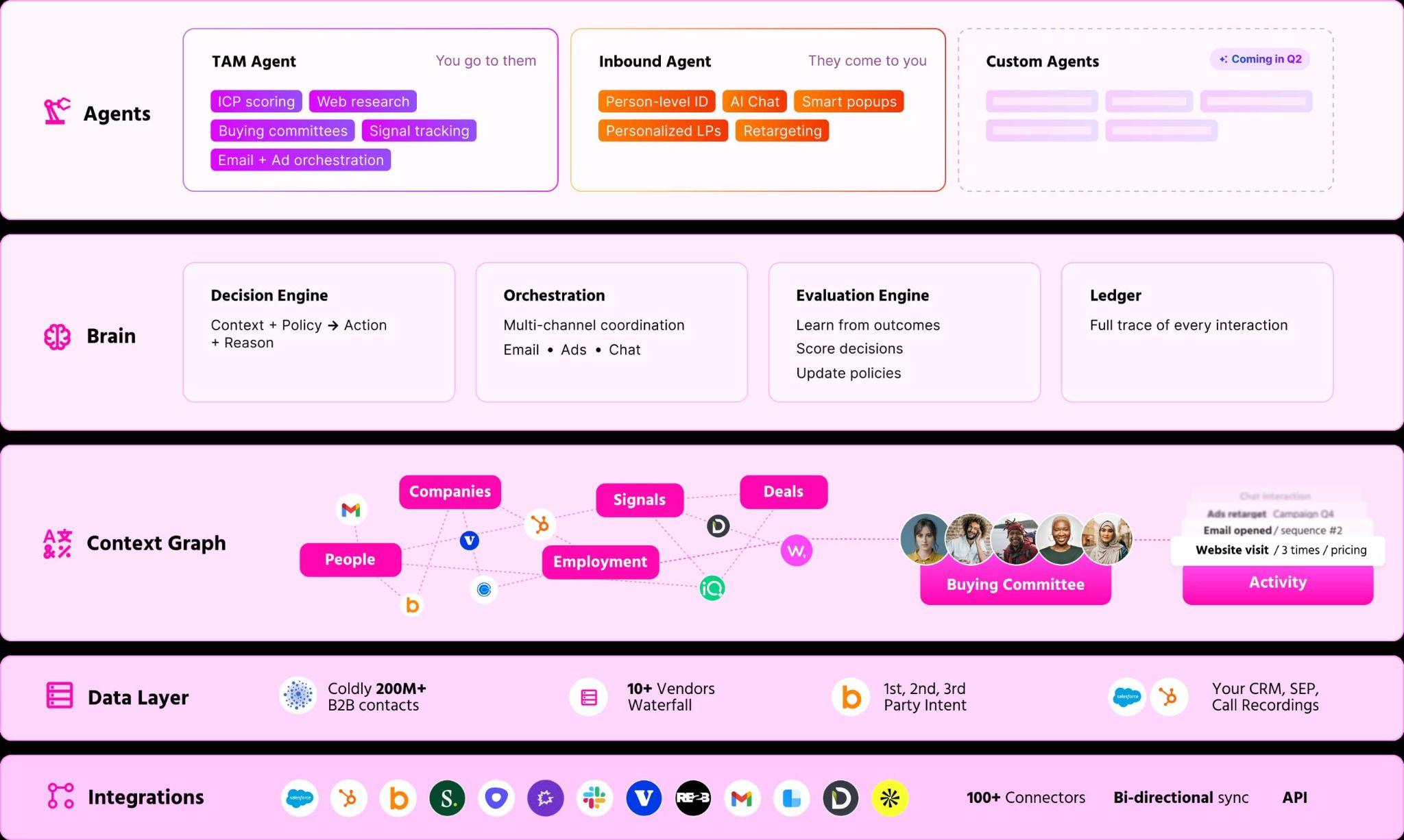
The platform now runs on two autonomous AI agents: a TAM Agent that handles outbound prospecting (audience building, buying committee identification, intent scoring, email and ad orchestration) and an Inbound Agent that converts website visitors through AI chat, smart popups, personalized landing pages, and meeting booking. A shared data layer called the Context Graph connects both agents.
As of early 2025, Warmly reported $3M ARR with over 300 customers and a 4.8/5 star rating from 200+ reviews. The platform targets B2B SaaS companies from startup through enterprise, with particular strength among growth-stage and mid-market teams looking to replace fragmented GTM tool stacks.
Warmly Pros & Cons
Pros | Cons |
|---|---|
Unified inbound and outbound in one platform | Person-level visitor identification resolves only ~15% of sessions |
Real-time, person-level intent signals | Advanced features locked behind higher pricing tiers |
Unlimited seats on all plans | Analytics and reporting lack depth for granular attribution |
Fast implementation (most teams live within a week) | Platform still maturing (some users report bugs during onboarding) |
AI chatbot with full visitor context | Starting price of $15,000/year limits access for smaller teams |
Bundled Bombora intent data | Contact database scale not publicly benchmarked against larger providers |
Strong Slack integration and real-time alerts | Support consistency varies according to user feedback |
Warmly Review: How It Works & Key Features
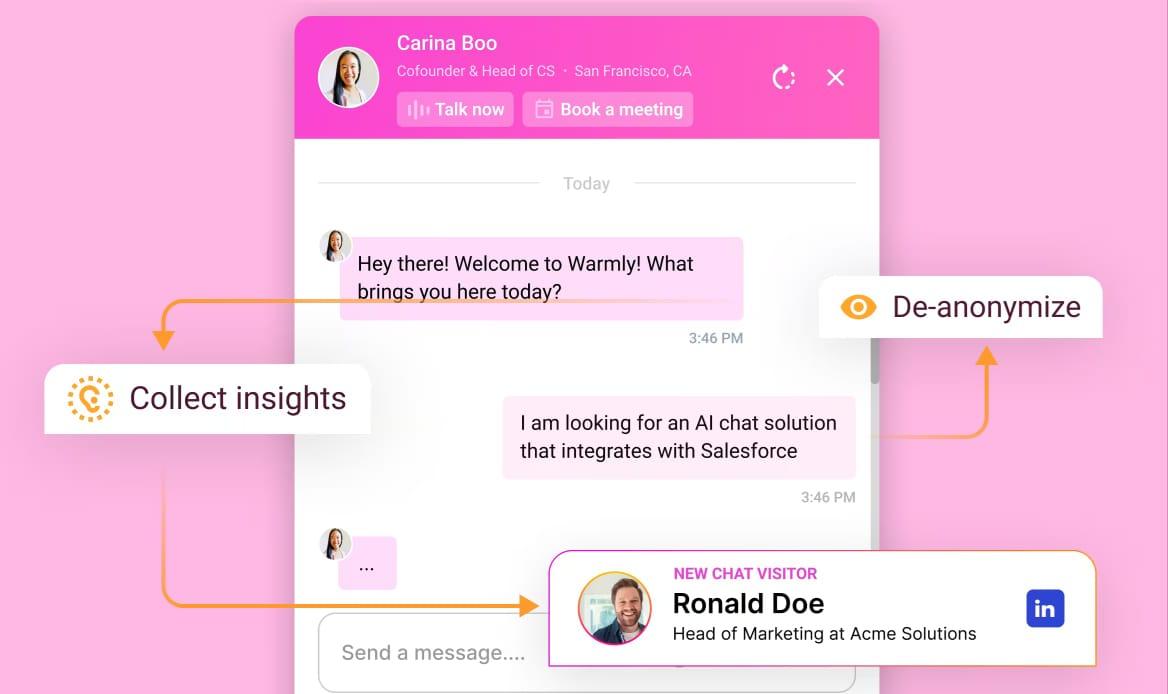
Inbound Agent: Warmly identifies website visitors and engages them with context-aware AI before they leave.
The Inbound Agent is Warmly's on-site conversion system.
It solves a specific problem: most B2B websites convert only 2-3% of visitors through forms, and the remaining 97% leave without identifying themselves. Warmly identifies those visitors automatically and engages them in real time.
Source: Warmly
When a visitor lands on the site, Warmly runs a multi-vendor waterfall that queries multiple identity providers in parallel, achieving roughly 15% person-level identification at 90%+ accuracy on matched profiles. For unmatched visitors, the platform still resolves company-level identity at about 65% coverage.
Once a visitor is identified, the AI Chatbot starts a conversation with full context: the visitor's title, CRM history, pages viewed, and relevant intent signals. Warmly claims this contextual approach converts at 5-10x the rate of traditional script-based bots. When the AI hits questions outside its training, it escalates to a human rep or offers to book a meeting.
Supporting features include Smart Popups that trigger on behavioral signals rather than arbitrary timers (Warmly claims 4x better conversion), Personalized Landing Pages that adjust content to the visitor's profile, and Lead Routing that assigns visitors to the right rep based on CRM ownership, territory, or round-robin logic.
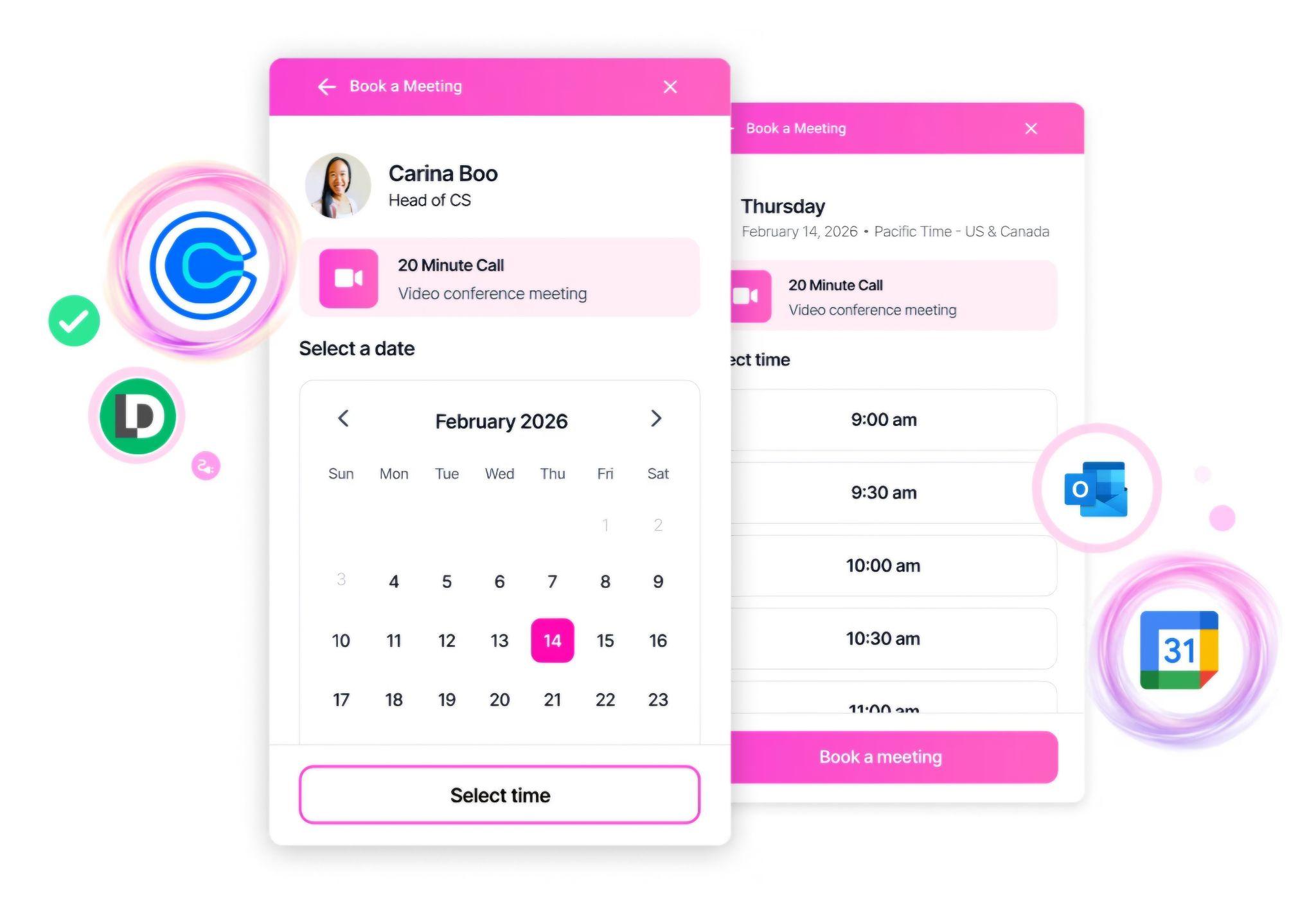
Meeting booking is embedded in the conversation flow, integrated with Calendly, Google Calendar, Outlook, Cal.com, and Microsoft Bookings.
For visitors who don't convert on their first visit, the Inbound Agent coordinates with the TAM Agent to add them to LinkedIn retargeting audiences and email nurture sequences.
TAM Agent: Warmly automates outbound prospecting with intent-driven audience building and orchestration.
The TAM Agent is Warmly's outbound engine.
It replaces the manual process of building account lists, enriching contacts, and triggering outbound sequences with an autonomous agent that runs continuously.
The process starts with Dynamic Audience Building. Users define criteria once (firmographics, technographics, intent thresholds, CRM deal stage), and the TAM Agent continuously refreshes the audience, adding accounts when they qualify and removing them when they don't.
Next comes AI ICP Tiering. The agent analyzes closed-won deals to find patterns, then trains an ML model to score every account as Tier 1, 2, 3, or "Not ICP." The system explains each score. Warmly reports that Tier 1 accounts convert 3x better.
For each target account, the TAM Agent performs Buying Committee Identification, using AI to analyze org charts, job descriptions, and LinkedIn data to identify four buying personas: Champion, Decision-Maker, Influencer, and Approver. It returns verified work emails at 95%+ deliverability for each persona through a multi-vendor enrichment waterfall.
The ML Intent Scoring layer combines first-party signals (website visits, chat engagement) with third-party data (Bombora surges, G2 research, job postings, LinkedIn activity). Scores are weighted by recency and fully transparent, showing users exactly which signals contributed what weight.
Source: Warmly
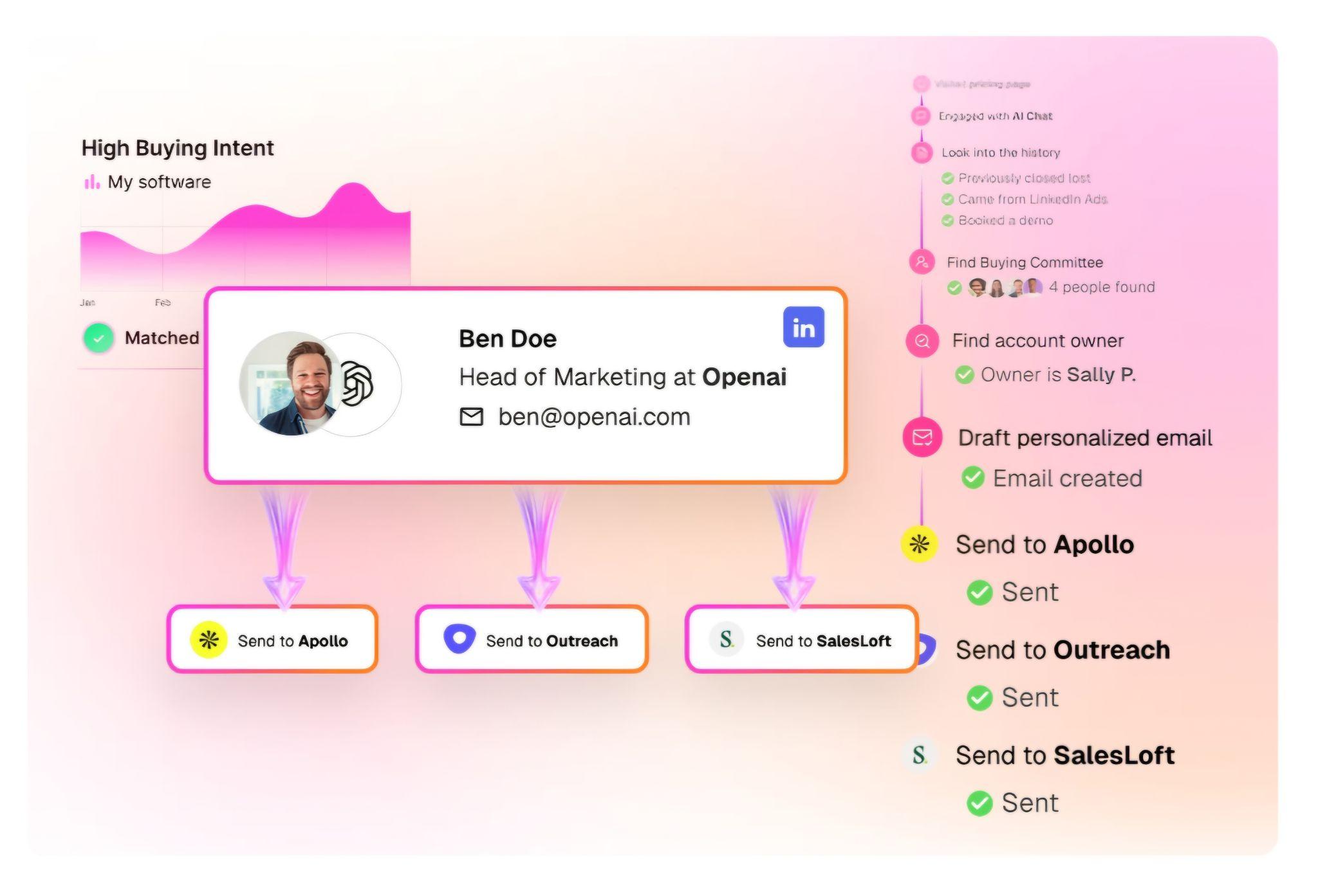
Once accounts cross an intent threshold, TAM Agent triggers outbound execution: syncing buying committee members to LinkedIn Matched Audiences and enrolling contacts in email sequences. Teams can choose between routing to reps, full AI SDR mode, or a hybrid where AI handles initial outreach and reps take over on engagement.
Context Graph: Warmly's data layer connects signals, actions, and outcomes across both agents.
Warmly’s Context Graph is the shared data layer that feeds both the Inbound and TAM Agents.
It builds a timeline for every account by ingesting four types of information: buyer signals (website activity, Bombora surges, G2 research), your team's actions (emails sent, meetings held, chat responses), decision context (why outreach was triggered), and outcomes (meetings booked, deals won or lost).
The practical benefit is consistency. When the AI chatbot engages a visitor, it knows about outbound sequences already sent. When a rep gets a Slack alert, they see the full history of signals and actions. Because both agents query the same graph, they coordinate automatically to prevent double-touching the same contact.
Source: Warmly
Warmly frames this as an OODA+L loop (Observe, Orient, Decide, Act, Learn), where every outcome feeds back into the system. The "+L" (Learn) step is how the Context Graph improves over time, theoretically making both agents smarter as more deals close.
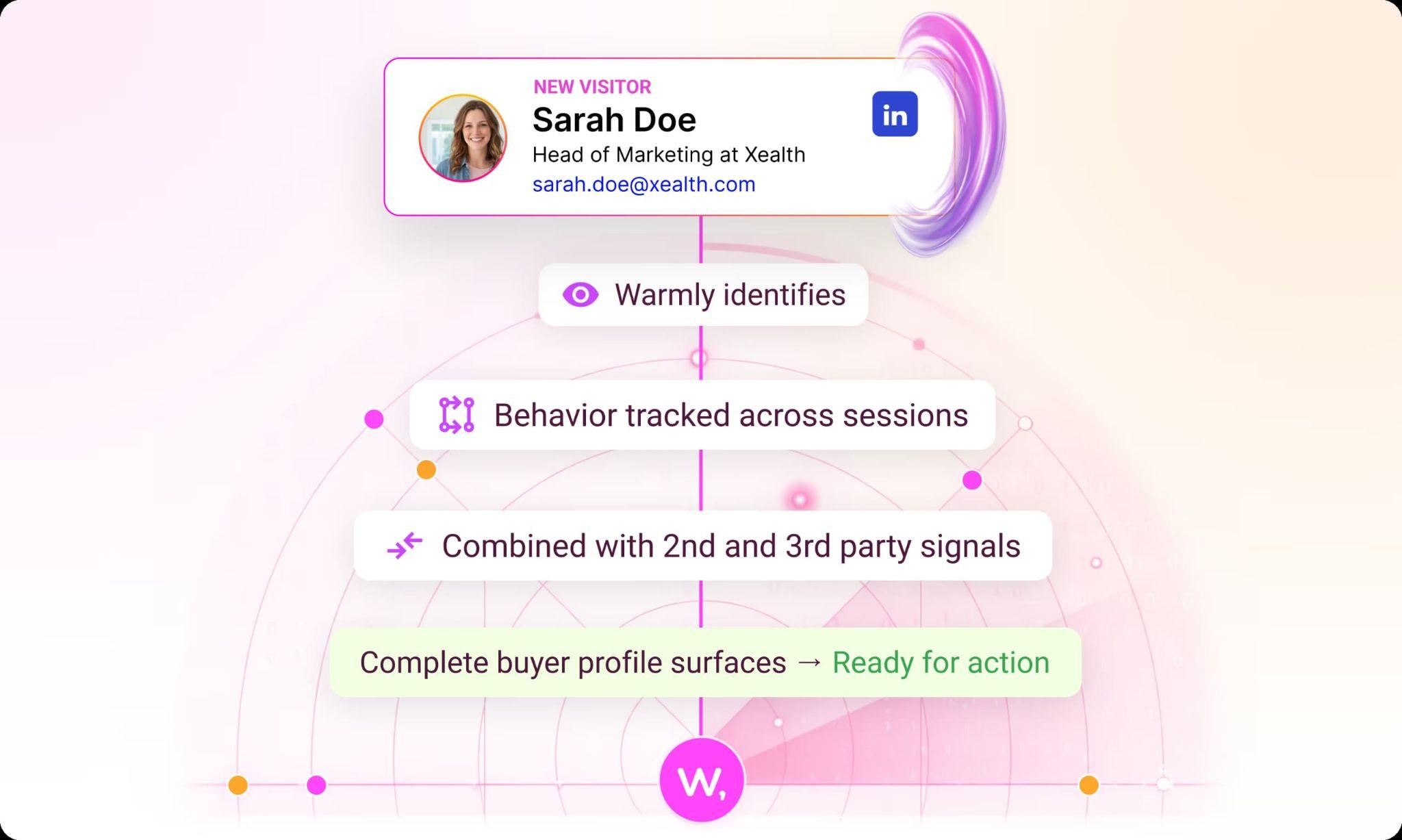
Signals: Warmly combines three tiers of intent data, resolved to the person level in real time.
Warmly Signals ingests buying indicators from three sources.
Source: Warmly
First-party signals come from a JavaScript tracking pixel on your website, capturing page views, session duration, scroll depth, return visits, and chat conversations.
Second-party signals track LinkedIn engagement like profile views, content interactions, and connection activity.
Third-party signals are powered by Bombora, covering off-site research behavior, G2 reviews, job postings, and funding news.
What distinguishes Warmly's approach is that all three signal types resolve to the person level, not just the account level. Instead of learning "Acme is researching CRM," you see "Sarah Chen, VP Sales at Acme, visited your pricing page twice this week." Signals update in real time for first-party data and within hours for third-party data.
Importantly, signals are wired to actions, not just dashboards. A pricing page visit can trigger an AI chat engagement, a Slack alert to the assigned rep, a CRM record update, sequence enrollment, or LinkedIn audience sync, all automatically.
Where Warmly Falls Short
Warmly delivers a consolidated platform, but several limitations show up with regular use.
These reflect a company still early in its growth, with $3M ARR and a product surface broader than what a 50-person team can fully mature.
Visitor Identification Accuracy. Person-level resolution runs at about 15% of sessions, meaning 85% of visitors remain anonymous. This is an industry-wide constraint, not unique to Warmly, but buyers should run a proof-of-concept on their actual traffic before committing. Match rates vary by traffic source and network type.
Analytics and Reporting Gaps. G2 reviewers consistently flag that the dashboard lacks depth for teams wanting granular attribution, custom funnel reporting, or cohort analysis. Teams accustomed to Salesforce Analytics or Tableau will need supplementary reporting tools.
Contact Database Scale. Warmly bundles a contact database called Coldly with its plans, offering a 13+ vendor waterfall with 95%+ email deliverability. But the total database size is not publicly benchmarked, making it hard to compare against providers with documented scales of hundreds of millions of contacts.
Source: Warmly
Platform Maturity. Some G2 reviewers describe the setup process as "difficult and funky," with bugs during initial onboarding. This fits a company iterating fast on a broad product surface. The platform has improved since the 2023 pivot, but teams should expect rough edges.
Pricing Entry Point. The TAM Agent plan starts at $15,000/year and the Inbound Agent at $30,000/year. Warmly positions this as cheaper than a fragmented stack, but it's still a significant commitment for early-stage companies, especially since exact feature limits and credit allocations require a sales conversation.
Learning Curve on Full Feature Set. The platform's breadth (two agents, context graph, three signal types, outbound orchestration, AI chatbot configuration) means new users may need time to optimize all features. The more advanced orchestrations require Warmly's premium Forward Deployed Engineer service.
These limitations aren't failures. They're the natural result of a growth-stage company building a broad platform. But they create clear gaps for teams that need enterprise-scale data, analytics depth, and proven infrastructure.
Top Warmly Alternative: ZoomInfo
ZoomInfo addresses Warmly's limitations at the data and intelligence layers.
Source: ZoomInfo
Where Warmly consolidates several point-solution functions into an agent-driven platform, ZoomInfo is an AI GTM platform built on nearly two decades of infrastructure investment, serving 35,000+ companies including Adobe, Snowflake, Thomson Reuters, and Databricks.
Comprehensive B2B Data: ZoomInfo operates the largest verified B2B data platform in the industry.
The foundational difference between ZoomInfo and Warmly is data scale.
ZoomInfo covers 500M contacts, 100M companies, 135M+ verified phone numbers, 120M direct-dial phone numbers, and 200M+ verified business email addresses. This data is verified through a multi-source pipeline backed by 300+ human researchers, with up to 95% accuracy on first-party data.
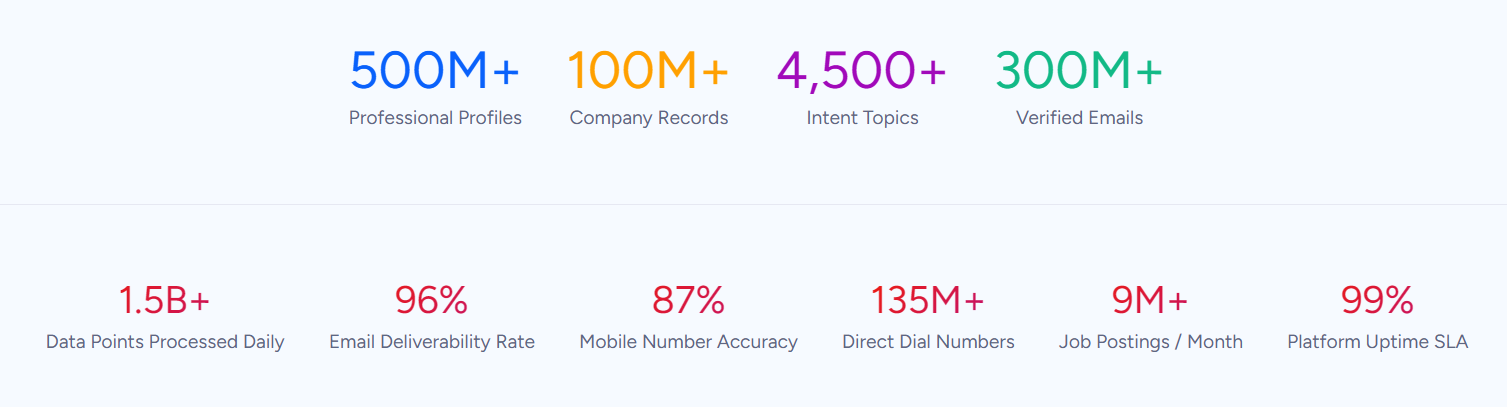
This isn't a self-reported claim. In a Fortune 500 competitive RFP analyzing 25 million contacts across vendors, the independent consultant concluded that "no other competitor came even close." Forrester named ZoomInfo a Leader in Intent Data Providers for B2B (Q1 2025), and Gartner named it a Leader in ABM Platforms for the second consecutive year.
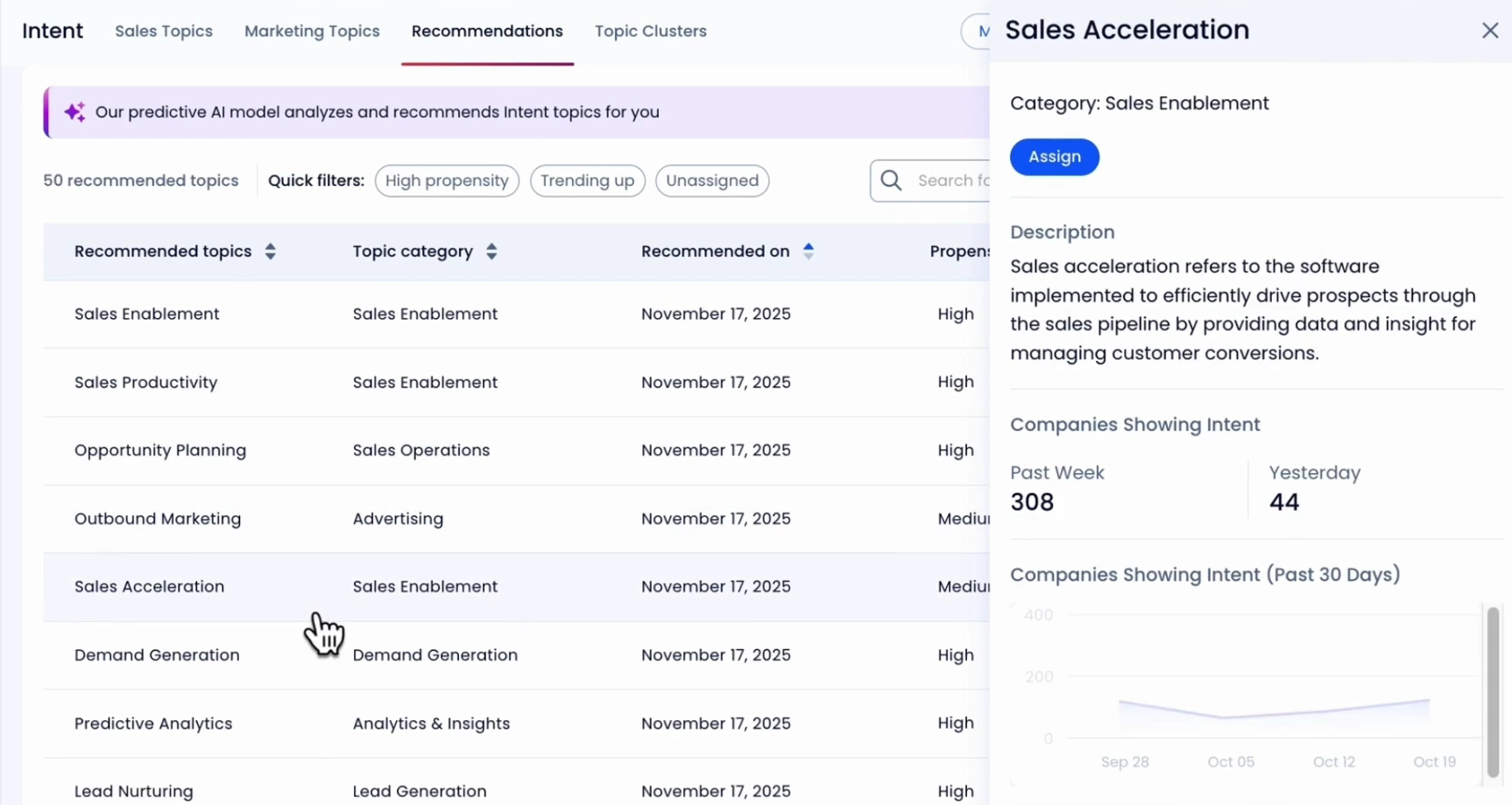
The data spans three dimensions: identity data (who buyers are and how to reach them), company context (firmographics, org charts, technographics tracking 30,000+ technologies across 30M+ companies), and dynamic signals including Buyer Intent data from 210 million IP-to-Organization pairings.
Guided Intent, exclusive to ZoomInfo, identifies topics historically correlated with deal success rather than requiring manual topic selection.
For teams evaluating Warmly's bundled Coldly database, the contrast is plain: ZoomInfo's data has been built and verified over nearly two decades, externally validated by major analyst firms, and used by enterprises that stake their pipeline on data accuracy.
"ZoomInfo gives us the information we need to execute. We don't have to spend our time digging. It's already there, so we can be three steps ahead." (Vensure)
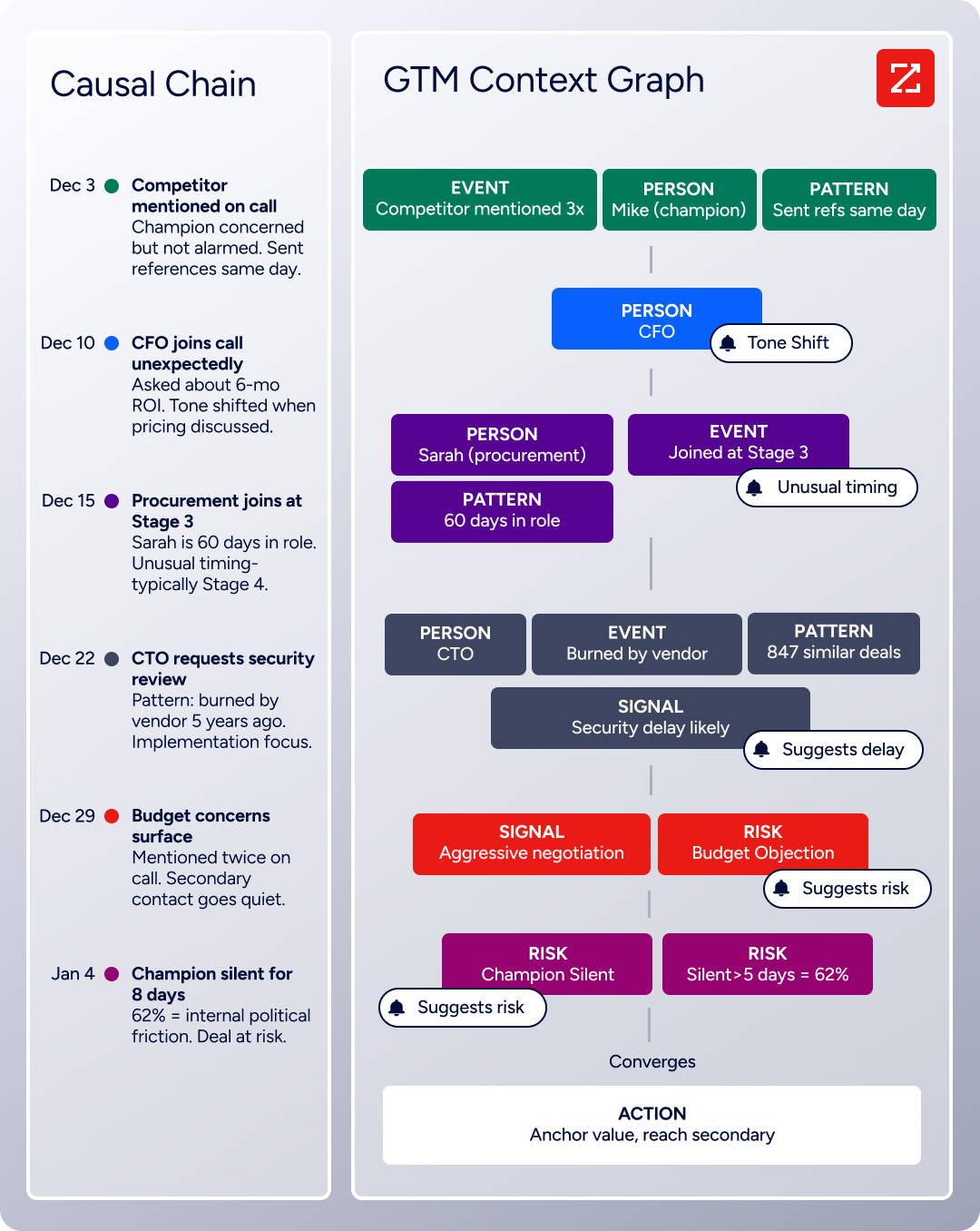
GTM Context Graph: ZoomInfo's intelligence layer captures not just what happened in a deal, but why.
Warmly's Context Graph connects signals and actions across its two agents.
ZoomInfo's GTM Context Graph goes deeper: it fuses ZoomInfo's B2B data with a customer's CRM records, conversation transcripts (captured by Chorus), email interactions, and behavioral signals into a single intelligence layer that processes 1.5B+ data points daily.
Source: ZoomInfo
The difference is depth. A CRM records that a deal moved from Stage 3 to Stage 4. Conversation intelligence transcribes what the VP of Finance said on the last call. Intent data logs a research spike.
The GTM Context Graph connects all three to understand why the deal moved, linking executive sponsorship patterns, competitive mentions, and buying signal combinations to actual outcomes across thousands of deals.
That contextual intelligence powers everything downstream: AI-drafted outreach that addresses specific concerns raised in calls, GTM plays that target accounts matching proven win patterns, and forecasts weighted by buying evidence rather than rep optimism.
Seismic attributed 39% of active pipeline to ZoomInfo-influenced opportunities and reported 54% productivity gains: "That combination of our internal CRM data, external signals, and AI that's given all that context has helped us craft very specific account- and persona-based messages." (Seismic)
Universal Access: ZoomInfo delivers intelligence through seller workspaces, marketing studios, and open APIs.
Warmly delivers its intelligence through its own dashboard and Slack alerts.
ZoomInfo provides three paths, so the same intelligence reaches every team through their preferred interface.
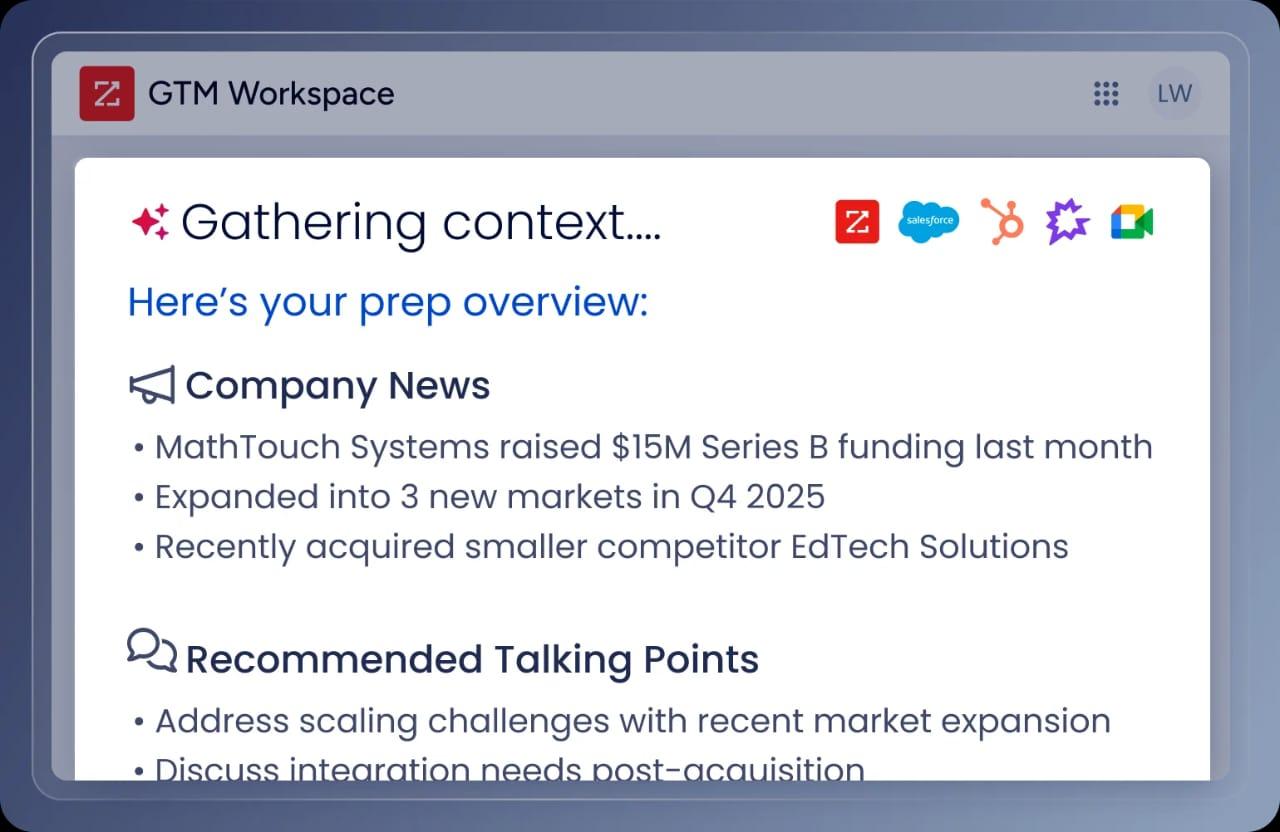
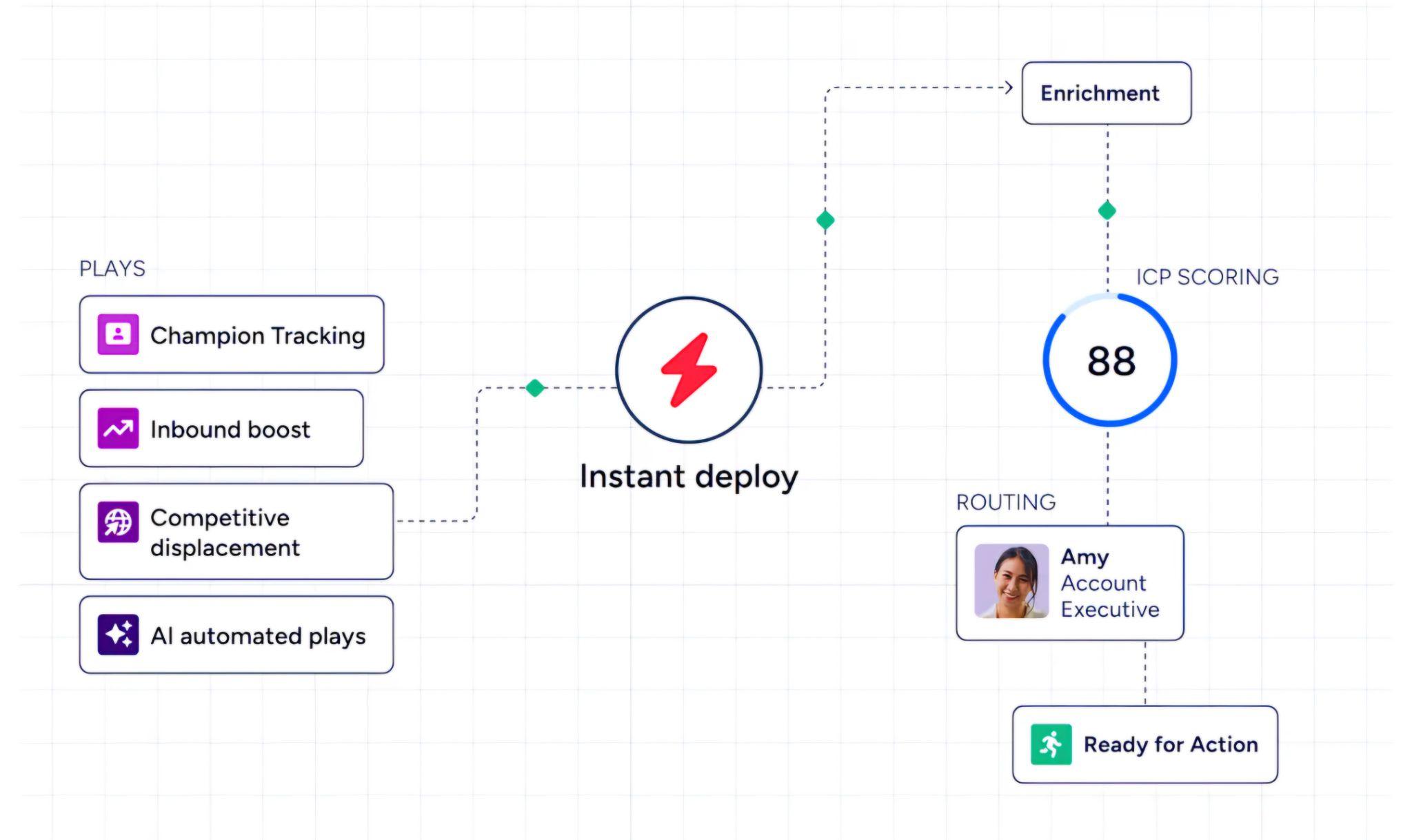
GTM Workspace gives sellers a single workspace where prioritized accounts, AI-drafted outreach, and deal context converge. Built on Anthropic's Claude, the AI agents answer three questions for every rep: who to contact, when to engage, and what to say. Databricks reached prospects 50% faster. Thomson Reuters increased closed-won deals by 40%.
GTM Studio gives marketers, RevOps, and GTM engineers a builder environment where audience definition, campaign orchestration, and pipeline measurement happen in natural language. Expansion plays that used to take 3 weeks now launch in 30 minutes, without engineering support.
Source: ZoomInfo
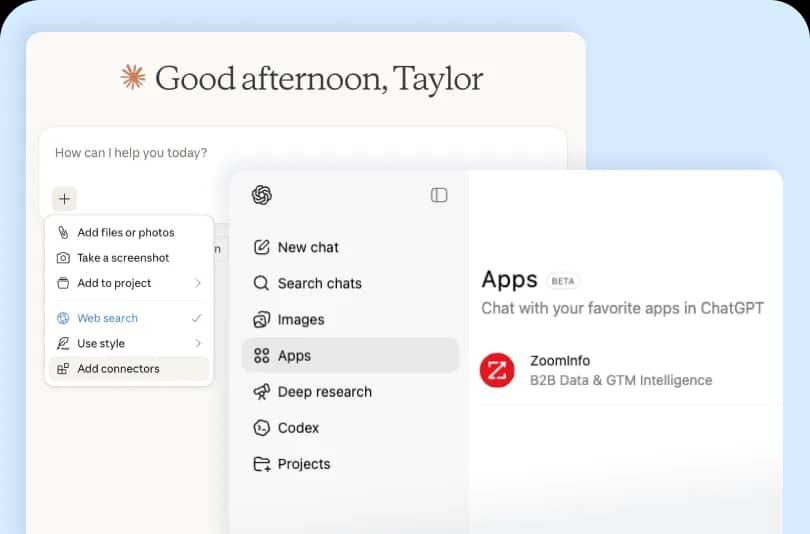
For teams building beyond ZoomInfo's own products, APIs and MCP expose the same intelligence to any custom agent, internal tool, or partner platform. The MCP server connects AI models directly to ZoomInfo's data, supporting Claude and ChatGPT. API access is included in all relevant plans.
Source: ZoomInfo
"The plug-and-play aspect of the API means I can integrate it easily into any process and get information at a moment's notice," achieving an 87% reduction in time spent on internal data dashboard updates. (BDO Canada)
Pricing and Entry Points: ZoomInfo offers free access and scalable plans for teams of any size.
ZoomInfo uses a custom-quoted subscription model organized into Sales, Marketing, and Operations product lines, each with tiered plans (Professional, Advanced, Enterprise for Sales; Marketing Demand, ABM Lite, ABM Enterprise for Marketing).
Pricing depends on seats, credit volume, features, and contract terms.
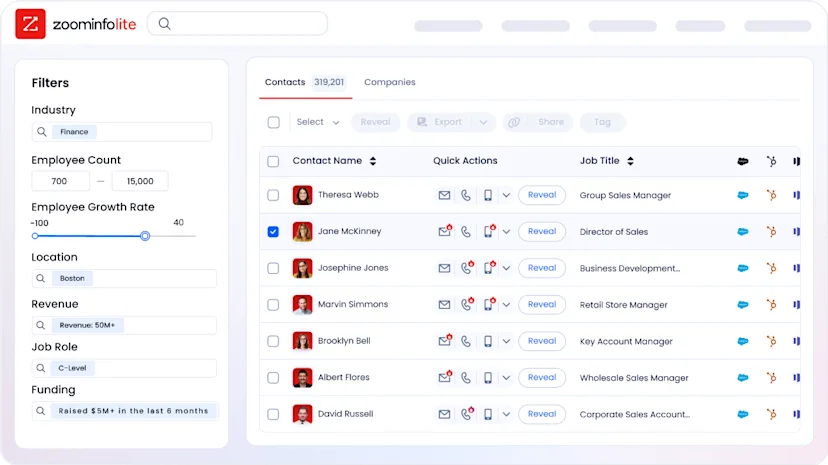
Two free entry points exist. ZoomInfo Lite is a permanent free tier (not a trial) with access to ZoomInfo's B2B database, 10 monthly export credits, individual and company searches, the ReachOut Chrome Extension, WebSights Lite (up to 10 website visitor reveals per day), and HubSpot integration. A separate 7-day free trial provides access to core paid features with no credit card required.
Warmly or ZoomInfo: Comparison Summary
Warmly | ZoomInfo | |
|---|---|---|
Core positioning | GTM platform with autonomous agents | AI GTM platform built on comprehensive data |
Contact database scale | Coldly database (size not publicly disclosed) | 500M contacts, 200M+ verified emails, 135M+ verified phones |
Intent data | Bombora (bundled) + 1st/2nd-party signals | Proprietary + Bombora, 210M IP-to-Org pairings, Guided Intent |
Website visitor identification | ~15% person-level, ~65% company-level | WebSights with automatic bot filtering |
AI chat/on-site conversion | AI Chatbot, Smart Popups, Personalized Landing Pages | ZoomInfo Chat with routing |
Outbound orchestration | TAM Agent (email + LinkedIn ads) | GTM Studio plays + Salesloft partnership |
Conversation intelligence | Not included | Chorus (14 patents, call/meeting/email analysis) |
Intelligence layer | Context Graph (signals + actions + outcomes) | GTM Context Graph (1.5B+ data points daily) |
Seller front-end | Unified dashboard + Slack alerts | GTM Workspace (AI agents for every rep) |
Marketing/RevOps front-end | Audience building in TAM Agent | GTM Studio (natural language orchestration) |
API/MCP access | API and MCP on Full GTM plan | |
Analyst recognition | None disclosed | Gartner MQ ABM Leader, Forrester Wave Intent Data Leader, G2 133 No.1 rankings |
Pricing model | Per-organization, annual ($15K-$30K+ /year) | Custom-quoted, seat-and-credit-based |
Free tier | Free version (limits not publicly disclosed) | ZoomInfo Lite (permanent, 10 credits/month) + 7-day trial |
Seats | Unlimited on all plans | Seat-based (varies by plan) |
Customer base | 300+ customers, $3M ARR | 35,000+ companies, $1.25B annual revenue |
Security | SOC 2, GDPR, CCPA | ISO 27001, ISO 27701, SOC 2 Type II, TRUSTe GDPR/CCPA |
Best for | Growth-stage B2B teams consolidating their GTM stack | Enterprise and mid-market teams needing comprehensive data, contextual intelligence, and broad access |
Final Verdict
The choice between Warmly and ZoomInfo depends on where your team sits and what matters most: autonomous agent convenience or data depth and enterprise infrastructure.
Choose Warmly if you're a growth-stage or mid-market B2B SaaS team that wants to replace a fragmented set of point solutions with a single agent-driven platform. Its strength is consolidation: visitor identification, intent signals, AI chat, and outbound orchestration in one tool with unlimited seats.
If your team is small, your website traffic is your primary lead source, and you want to move fast with minimal setup, Warmly delivers a coherent experience that removes the overhead of managing five separate vendors.
Choose ZoomInfo if your GTM motion requires the largest B2B dataset available, intelligence that connects your CRM, conversations, and market signals to reveal why deals move, and the flexibility to access that intelligence from any tool your team uses.
ZoomInfo's data foundation has been externally validated by Gartner, Forrester, and Fortune 500 competitive evaluations. The GTM Context Graph captures why deals move, not just that they moved. And the three access paths (GTM Workspace, GTM Studio, APIs and MCP) ensure every team, from sellers to RevOps to custom AI builders, works from the same intelligence.
Get started with ZoomInfo here.
Warmly is building a solid platform for teams that want an autonomous, consolidated GTM tool. ZoomInfo provides the data depth, contextual intelligence, and enterprise infrastructure that GTM teams rely on to scale.
Warmly FAQ
What does Warmly cost?
Warmly offers three plans: the TAM Agent starting at $15,000/year for outbound intelligence and orchestration, the Inbound Agent starting at $30,000/year for website visitor conversion, and a Full GTM plan at custom pricing that combines both. All plans include unlimited seats. Exact feature limits and credit allocations are not publicly disclosed and require a sales conversation.
ZoomInfo offers a permanent free tier (ZoomInfo Lite) with 10 monthly export credits and a 7-day free trial, with paid plans custom-quoted based on seats, credits, and features.
How accurate is Warmly's visitor identification?
Warmly achieves roughly 15% person-level identification on website sessions at 90%+ accuracy on matched profiles. For unmatched visitors, it resolves company-level identity at about 65% coverage. These rates vary by traffic quality and network type.
ZoomInfo's WebSights identifies anonymous website visitors at the company level with automatic bot filtering, and connects those identifications to its full contact database of 500M contacts for immediate outreach.
Does Warmly include a contact database?
Yes, Warmly bundles a contact database called Coldly, which uses a 13+ vendor waterfall to deliver verified emails with reported 95%+ deliverability. The total database size is not publicly disclosed.
ZoomInfo's database covers 500M contacts, 200M+ verified business emails, and 135M+ verified phone numbers, verified through 300+ human researchers and multi-source automated validation, and has been externally validated by Forrester, Gartner, and independent competitive evaluations.
What integrations does Warmly support?
Warmly integrates with 40+ tools including CRMs (HubSpot, Salesforce, Pipedrive, Microsoft Dynamics 365), sales engagement platforms (Outreach, Salesloft, Apollo, Instantly), notifications (Slack, Microsoft Teams), intent and ABM platforms (6sense, Demandbase, Bombora, ZoomInfo), advertising networks (LinkedIn, Google Ads, Facebook), and calendar tools (Calendly, Google Calendar, Outlook). Developer access includes webhooks, Zapier, Make, and a Client-Side JS API.
Does Warmly offer conversation intelligence?
No. Warmly does not include conversation intelligence for analyzing sales calls, meetings, or emails. Its Context Graph captures website behavior, outbound actions, and intent signals, but not call recordings or meeting transcripts.
ZoomInfo includes Chorus, a conversation intelligence product with 14 technology patents that captures and analyzes every customer call, meeting, and email, feeding that context into the GTM Context Graph.
Is Warmly suitable for enterprise teams?
Warmly markets to enterprises and includes SOC 2, GDPR, and CCPA compliance, SSO/SAML on the Full GTM plan, and a 99.9% uptime SLA.
However, the company has roughly 300 customers and $3M ARR as of early 2025, and analyst recognition from Gartner or Forrester has not been publicly disclosed. Enterprise buyers in regulated industries should evaluate data residency, implementation support, and whether the platform's maturity meets their requirements.
ZoomInfo serves 35,000+ companies, holds ISO 27001, ISO 27701, and SOC 2 Type II certifications, and is a registered data broker in California and Vermont.
How does Warmly's intent scoring work?
Warmly combines first-party signals (website visits, chat engagement, email clicks), second-party signals (LinkedIn activity), and third-party signals (Bombora topic surges, G2 research, job postings) into a single ML-based intent score.
Scores are weighted by recency, with signals from the past seven days carrying a 1.5x bonus, and the scoring logic is transparent, showing users exactly which signals contributed what weight.
ZoomInfo's intent data tracks signals from 210 million IP-to-Organization pairings and includes Guided Intent, which identifies topics historically correlated with deal success rather than requiring manual topic selection.
Can Warmly replace multiple GTM tools?
That is Warmly's core value proposition. The platform aims to replace separate contracts for intent data, contact enrichment, on-site chat, outbound sequencing, and LinkedIn ad targeting. Whether it fully replaces each tool depends on the depth your team requires in each area.
Teams with demanding requirements around data scale, conversation intelligence, or advanced marketing orchestration may find Warmly's breadth comes with trade-offs in depth compared to specialized platforms or comprehensive platforms like ZoomInfo.
